Cambridge A Level English - Language AS and A Level (from 2014) 9093 — 2024 May/June Paper 1 · Variant 2
9093/12/M/J/24 · 50 marks · 135 min
The question paper and its mark scheme, free to read here and free to download. This is Cambridge’s own paper, exactly as it was sat.
Question paper8 pages


Mark scheme16 pages
Answers below. Sit the paper first if you are practising.
Paper as text
Question paper, page 1
Cambridge International AS & A Level 9093/12 May/June 2024 2 hours 15 minutes ENGLISH LANGUAGE Paper 1 Reading You must answer on the enclosed answer booklet. You will need: Answer booklet (enclosed) INSTRUCTIONS • Answer all questions. • Follow the instructions on the front cover of the answer booklet. If you need additional answer paper, ask the invigilator for a continuation booklet. • Dictionaries are not allowed. INFORMATION • The total mark for this paper is 50. • The number of marks for each question or part question is shown in brackets [ ]. This document has 8 pages. Any blank pages are indicated. [Turn over 06_9093_12_2024_1.13 © UCLES 2024 *0497308824*
Question paper, page 2
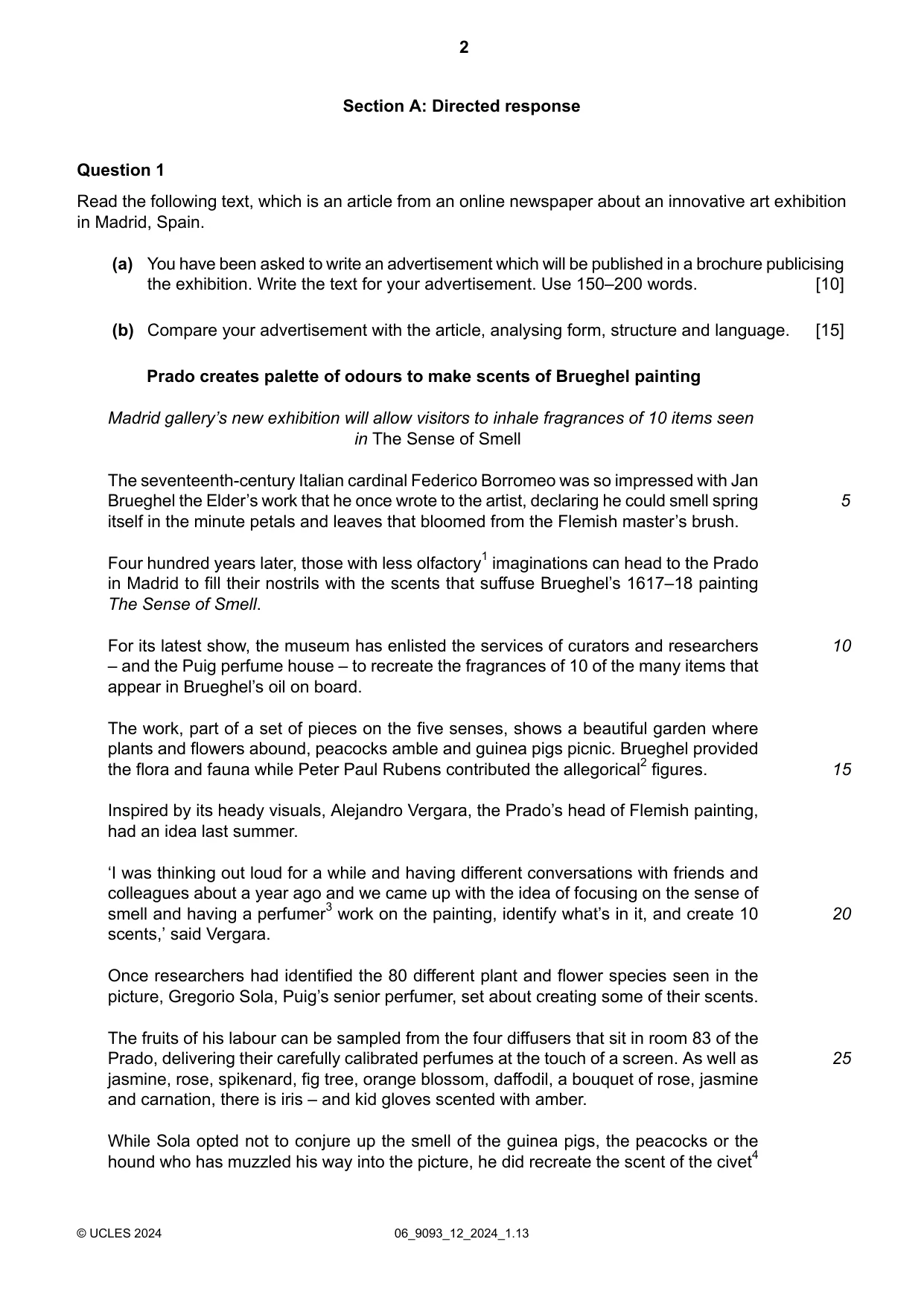
25 20 15 10 5 Section A: Directed response Question 1 Read the following text, which is an article from an online newspaper about an innovative art exhibition in Madrid, Spain. You have been asked to write an advertisement which will be published in a brochure publicising the exhibition. Write the text for your advertisement. Use 150–200 words. [10] (a) Compare your advertisement with the article, analysing form, structure and language. [15] (b) Prado creates palette of odours to make scents of Brueghel painting Madrid gallery’s new exhibition will allow visitors to inhale fragrances of 10 items seen in The Sense of Smell The seventeenth-century Italian cardinal Federico Borromeo was so impressed with Jan Brueghel the Elder’s work that he once wrote to the artist, declaring he could smell spring itself in the minute petals and leaves that bloomed from the Flemish master’s brush. Four hundred years later, those with less olfactory1 imaginations can head to the Prado in Madrid to fill their nostrils with the scents that suffuse Brueghel’s 1617–18 painting The Sense of Smell. For its latest show, the museum has enlisted the services of curators and researchers – and the Puig perfume house – to recreate the fragrances of 10 of the many items that appear in Brueghel’s oil on board. The work, part of a set of pieces on the five senses, shows a beautiful garden where plants and flowers abound, peacocks amble and guinea pigs picnic. Brueghel provided the flora and fauna while Peter Paul Rubens contributed the allegorical2 figures. Inspired by its heady visuals, Alejandro Vergara, the Prado’s head of Flemish painting, had an idea last summer. ‘I was thinking out loud for a while and having different conversations with friends and colleagues about a year ago and we came up with the idea of focusing on the sense of smell and having a perfumer3 work on the painting, identify what’s in it, and create 10 scents,’ said Vergara. Once researchers had identified the 80 different plant and flower species seen in the picture, Gregorio Sola, Puig’s senior perfumer, set about creating some of their scents. The fruits of his labour can be sampled from the four diffusers that sit in room 83 of the Prado, delivering their carefully calibrated perfumes at the touch of a screen. As well as jasmine, rose, spikenard, fig tree, orange blossom, daffodil, a bouquet of rose, jasmine and carnation, there is iris – and kid gloves scented with amber. While Sola opted not to conjure up the smell of the guinea pigs, the peacocks or the hound who has muzzled his way into the picture, he did recreate the scent of the civet4 06_9093_12_2024_1.13 © UCLES 2024 2
Question paper, page 3
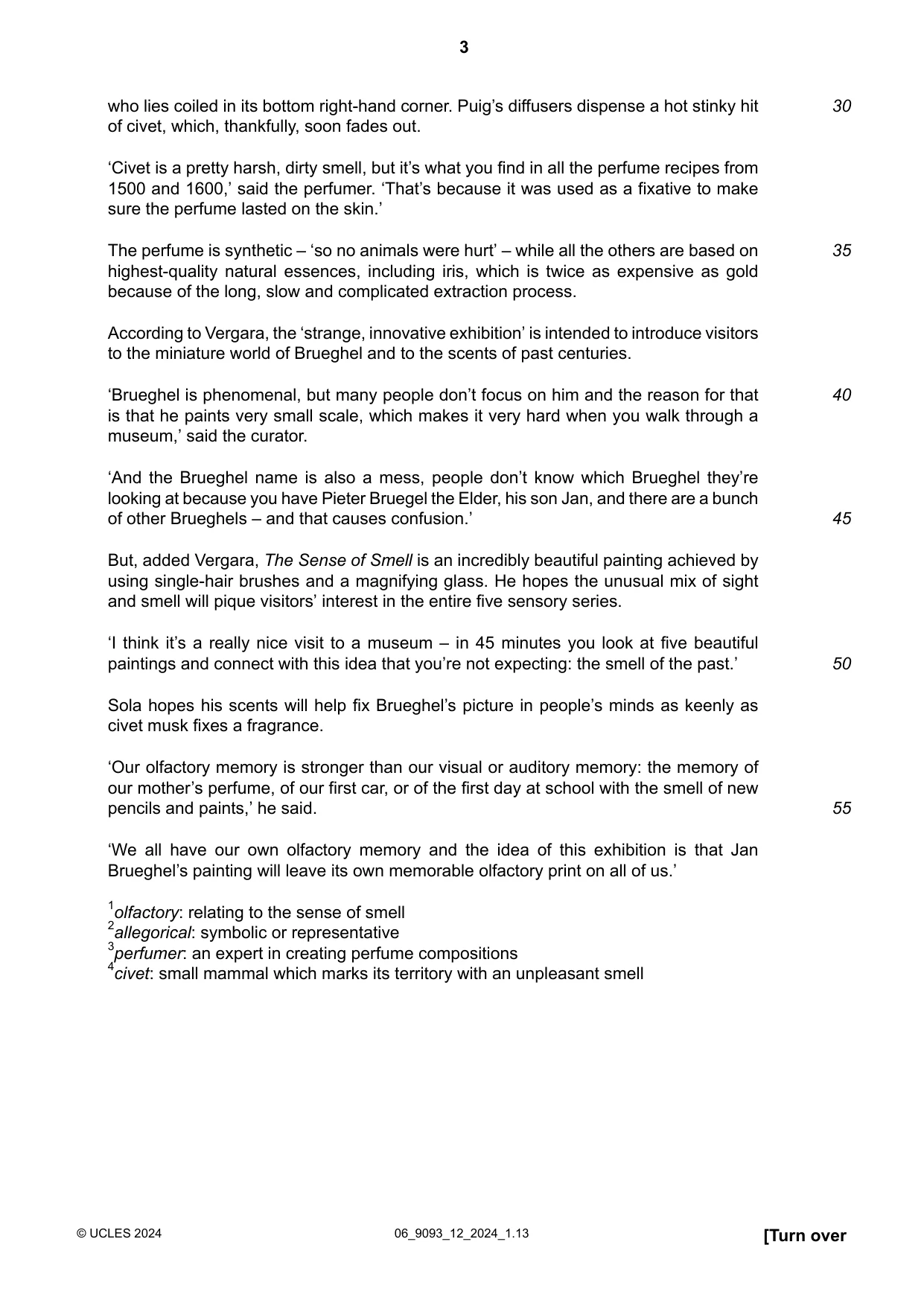
55 50 45 40 35 30 who lies coiled in its bottom right-hand corner. Puig’s diffusers dispense a hot stinky hit of civet, which, thankfully, soon fades out. ‘Civet is a pretty harsh, dirty smell, but it’s what you find in all the perfume recipes from 1500 and 1600,’ said the perfumer. ‘That’s because it was used as a fixative to make sure the perfume lasted on the skin.’ The perfume is synthetic – ‘so no animals were hurt’ – while all the others are based on highest-quality natural essences, including iris, which is twice as expensive as gold because of the long, slow and complicated extraction process. According to Vergara, the ‘strange, innovative exhibition’ is intended to introduce visitors to the miniature world of Brueghel and to the scents of past centuries. ‘Brueghel is phenomenal, but many people don’t focus on him and the reason for that is that he paints very small scale, which makes it very hard when you walk through a museum,’ said the curator. ‘And the Brueghel name is also a mess, people don’t know which Brueghel they’re looking at because you have Pieter Bruegel the Elder, his son Jan, and there are a bunch of other Brueghels – and that causes confusion.’ But, added Vergara, The Sense of Smell is an incredibly beautiful painting achieved by using single-hair brushes and a magnifying glass. He hopes the unusual mix of sight and smell will pique visitors’ interest in the entire five sensory series. ‘I think it’s a really nice visit to a museum – in 45 minutes you look at five beautiful paintings and connect with this idea that you’re not expecting: the smell of the past.’ Sola hopes his scents will help fix Brueghel’s picture in people’s minds as keenly as civet musk fixes a fragrance. ‘Our olfactory memory is stronger than our visual or auditory memory: the memory of our mother’s perfume, of our first car, or of the first day at school with the smell of new pencils and paints,’ he said. ‘We all have our own olfactory memory and the idea of this exhibition is that Jan Brueghel’s painting will leave its own memorable olfactory print on all of us.’ 1olfactory: relating to the sense of smell 2allegorical: symbolic or representative 3perfumer: an expert in creating perfume compositions 4civet: small mammal which marks its territory with an unpleasant smell [Turn over 06_9093_12_2024_1.13 © UCLES 2024 3
Question paper, page 4
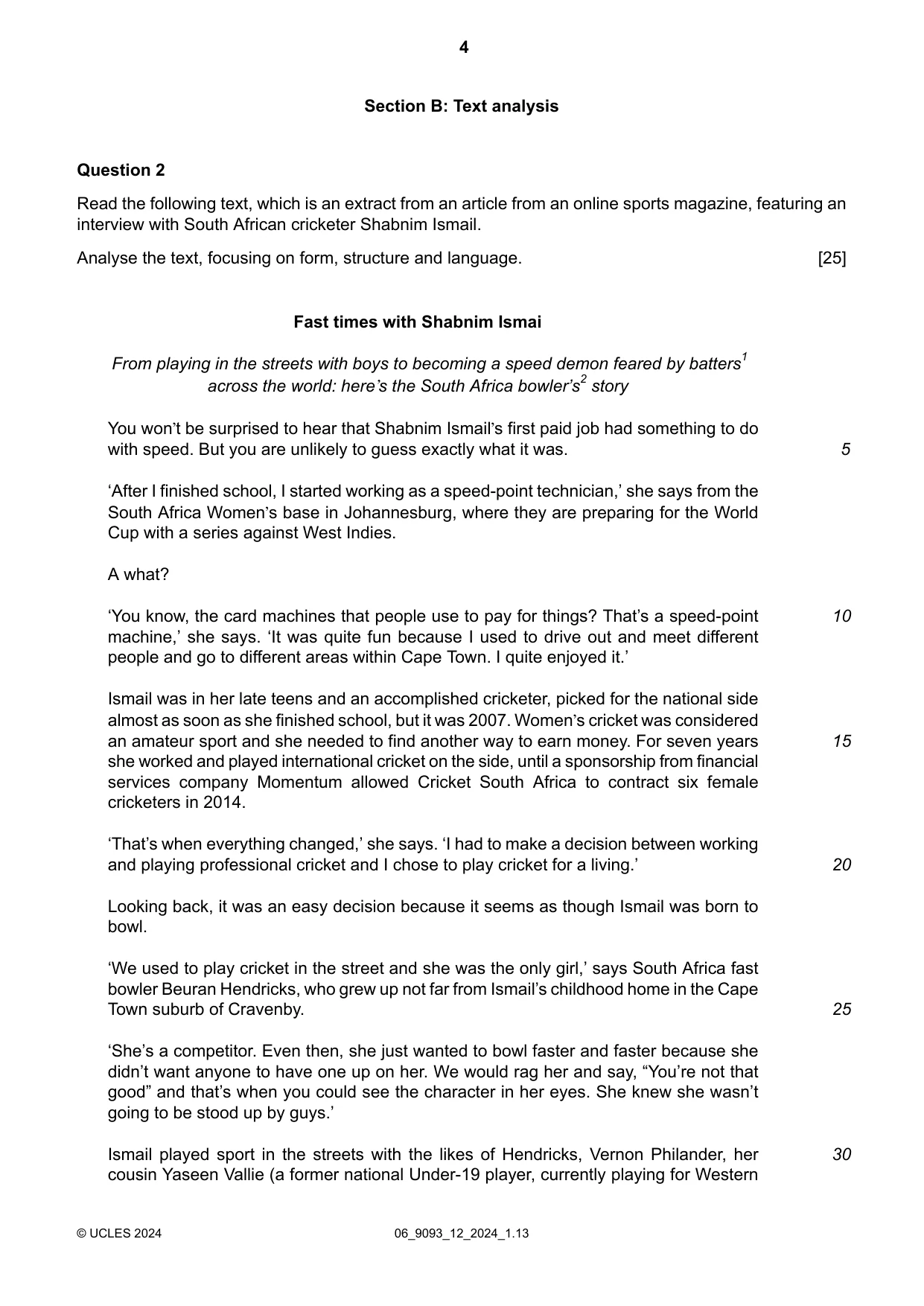
30 25 20 15 10 5 Section B: Text analysis Question 2 Read the following text, which is an extract from an article from an online sports magazine, featuring an interview with South African cricketer Shabnim Ismail. Analyse the text, focusing on form, structure and language. [25] Fast times with Shabnim Ismai From playing in the streets with boys to becoming a speed demon feared by batters1 across the world: here’s the South Africa bowler’s2 story You won’t be surprised to hear that Shabnim Ismail’s first paid job had something to do with speed. But you are unlikely to guess exactly what it was. ‘After I finished school, I started working as a speed-point technician,’ she says from the South Africa Women’s base in Johannesburg, where they are preparing for the World Cup with a series against West Indies. A what? ‘You know, the card machines that people use to pay for things? That’s a speed-point machine,’ she says. ‘It was quite fun because I used to drive out and meet different people and go to different areas within Cape Town. I quite enjoyed it.’ Ismail was in her late teens and an accomplished cricketer, picked for the national side almost as soon as she finished school, but it was 2007. Women’s cricket was considered an amateur sport and she needed to find another way to earn money. For seven years she worked and played international cricket on the side, until a sponsorship from financial services company Momentum allowed Cricket South Africa to contract six female cricketers in 2014. ‘That’s when everything changed,’ she says. ‘I had to make a decision between working and playing professional cricket and I chose to play cricket for a living.’ Looking back, it was an easy decision because it seems as though Ismail was born to bowl. ‘We used to play cricket in the street and she was the only girl,’ says South Africa fast bowler Beuran Hendricks, who grew up not far from Ismail’s childhood home in the Cape Town suburb of Cravenby. ‘She’s a competitor. Even then, she just wanted to bowl faster and faster because she didn’t want anyone to have one up on her. We would rag her and say, “You’re not that good” and that’s when you could see the character in her eyes. She knew she wasn’t going to be stood up by guys.’ Ismail played sport in the streets with the likes of Hendricks, Vernon Philander, her cousin Yaseen Vallie (a former national Under-19 player, currently playing for Western 06_9093_12_2024_1.13 © UCLES 2024 4
Question paper, page 5
55 50 45 40 35 Province) and many other kids who all grew up in a sporting environment that many in this country and beyond would be unfamiliar with. Theirs was not the culture of elite school sport but of a community vibe, fostered by passion and resourcefulness. ‘Cravenby is a very sporting-mad town. We played cricket, soccer and all kinds of sports,’ Hendricks says. ‘We didn’t have much but we made a plan. For cricket, if we had an indoor cricket ball, we’d play with that. Or we’d get a tennis ball and tape it. We never played with a hard ball because with a lot of windows around, it could get dangerous. We would play on the road with whatever we could find. We’d get crates and use that to get a field going.’ Ismail’s first love was football and she wanted to make a career of it, but her mother and late grandfather coaxed her towards cricket, coaching her and cultivating her love for the game. ‘They made me read cricket books and made me make my hands hard to catch balls,’ Ismail says. ‘My mom is my role model and she was basically just like me. She played all the sports. She was always with the boys out there, trying to be better than them and having fun. I’ve got all of her genes inside of me.’ Except that Ismail didn’t just want to play for fun. She was there to be the best and it didn’t sit well with everyone. ‘You’d always get boys who said, “I don’t like her because she is better than me”, but playing with the boys definitely made me stronger.’ ‘I used to get Vernon out a lot and he used to hate that about me but I used to love bowling against him. He used to hit me now and then, and then I’d get him out. When I was batting against him, I was a bit scared because I was just a little girl at that stage.’ ‘But I miss those days of waking up in the morning and just saying, “Mom, I am going to play with the boys.” You don’t even pack a bag, you just grab a bat and ball and off you go.’ 1batters: players on a cricket team who try to hit the ball with a bat 2bowler: the player on a cricket team who propels the ball towards the batter 06_9093_12_2024_1.13 © UCLES 2024 5
Question paper, page 6
BLANK PAGE 06_9093_12_2024_1.13 © UCLES 2024 6
Question paper, page 7
BLANK PAGE 06_9093_12_2024_1.13 © UCLES 2024 7
Question paper, page 8
BLANK PAGE Permission to reproduce items where third-party owned material protected by copyright is included has been sought and cleared where possible. Every reasonable effort has been made by the publisher (UCLES) to trace copyright holders, but if any items requiring clearance have unwittingly been included, the publisher will be pleased to make amends at the earliest possible opportunity. To avoid the issue of disclosure of answer-related information to candidates, all copyright acknowledgements are reproduced online in the Cambridge Assessment International Education Copyright Acknowledgements Booklet. This is produced for each series of examinations and is freely available to download at www.cambridgeinternational.org after the live examination series. Cambridge Assessment International Education is part of Cambridge Assessment. Cambridge Assessment is the brand name of the University of Cambridge Local Examinations Syndicate (UCLES), which is a department of the University of Cambridge. 06_9093_12_2024_1.13 © UCLES 2024 8
Mark scheme, page 1
This document consists of 16 printed pages. © Cambridge University Press & Assessment 2024 [Turn over Cambridge International AS & A Level ENGLISH LANGUAGE 9093/12 Paper 1 Reading May/June 2024 MARK SCHEME Maximum Mark: 50 Published This mark scheme is published as an aid to teachers and candidates, to indicate the requirements of the examination. It shows the basis on which Examiners were instructed to award marks. It does not indicate the details of the discussions that took place at an Examiners’ meeting before marking began, which would have considered the acceptability of alternative answers. Mark schemes should be read in conjunction with the question paper and the Principal Examiner Report for Teachers. Cambridge International will not enter into discussions about these mark schemes. Cambridge International is publishing the mark schemes for the May/June 2024 series for most Cambridge IGCSE, Cambridge International A and AS Level and Cambridge Pre-U components, and some Cambridge O Level components.
Mark scheme, page 2
9093/12 Cambridge International AS & A Level – Mark Scheme PUBLISHED May/June 2024 © Cambridge University Press & Assessment 2024 Page 2 of 16 Generic Marking Principles These general marking principles must be applied by all examiners when marking candidate answers. They should be applied alongside the specific content of the mark scheme or generic level descriptions for a question. Each question paper and mark scheme will also comply with these marking principles. GENERIC MARKING PRINCIPLE 1: Marks must be awarded in line with: the specific content of the mark scheme or the generic level descriptors for the question the specific skills defined in the mark scheme or in the generic level descriptors for the question the standard of response required by a candidate as exemplified by the standardisation scripts. GENERIC MARKING PRINCIPLE 2: Marks awarded are always whole marks (not half marks, or other fractions). GENERIC MARKING PRINCIPLE 3: Marks must be awarded positively: marks are awarded for correct/valid answers, as defined in the mark scheme. However, credit is given for valid answers which go beyond the scope of the syllabus and mark scheme, referring to your Team Leader as appropriate marks are awarded when candidates clearly demonstrate what they know and can do marks are not deducted for errors marks are not deducted for omissions answers should only be judged on the quality of spelling, punctuation and grammar when these features are specifically assessed by the question as indicated by the mark scheme. The meaning, however, should be unambiguous. GENERIC MARKING PRINCIPLE 4: Rules must be applied consistently, e.g. in situations where candidates have not followed instructions or in the application of generic level descriptors.
Mark scheme, page 3
9093/12 Cambridge International AS & A Level – Mark Scheme PUBLISHED May/June 2024 © Cambridge University Press & Assessment 2024 Page 3 of 16 GENERIC MARKING PRINCIPLE 5: Marks should be awarded using the full range of marks defined in the mark scheme for the question (however; the use of the full mark range may be limited according to the quality of the candidate responses seen). GENERIC MARKING PRINCIPLE 6: Marks awarded are based solely on the requirements as defined in the mark scheme. Marks should not be awarded with grade thresholds or grade descriptors in mind.
Mark scheme, page 4
9093/12 Cambridge International AS & A Level – Mark Scheme PUBLISHED May/June 2024 © Cambridge University Press & Assessment 2024 Page 4 of 16 English & Media subject specific general marking principles (To be read in conjunction with the Generic Marking Principles (and requiring further guidance on how to place marks within levels)) Components using level descriptors: We use level descriptors as a guide to broad understanding of the qualities normally expected of, or typical of, work in a level. Level descriptors are a means of general guidance, and should not be interpreted as hurdle statements. Where indicative content notes are supplied for a question, these are not a prescription of required content, and must not be treated as such. Alternative correct points and unexpected answers in candidates’ scripts must be given marks that fairly reflect the knowledge and skills demonstrated. While we may have legitimate expectations as to the ground most answers may occupy, we must at all times be prepared to meet candidates on their chosen ground, provided it is relevant ground (e.g. clearly related to and derived from a relevant passage/text and meeting the mark scheme requirements for the question).
Mark scheme, page 5
9093/12 Cambridge International AS & A Level – Mark Scheme PUBLISHED May/June 2024 © Cambridge University Press & Assessment 2024 Page 5 of 16 English Language specific marking instructions: AO1 Read and demonstrate understanding of a wide variety of texts. (Understanding) Marks should be awarded for the accuracy of the candidate’s understanding of the text and its features, not for any analysis of them which is recognised under AO3. Where comparison is required, marks should be awarded for the candidate’s recognition of similarities and differences between the texts and their features, not for any consequent analysis. When awarding a ‘best-fit’ mark within a Level for each AO, consider each bullet point equally. AO2 Write effectively, creatively, accurately and appropriately, for a range of audiences and purposes. (Writing) Marks should be awarded equally on the basis of the level of the candidate’s written expression (range of features used and accuracy) and the development of their writing (its organisation and relevance to task and audience). When awarding a ‘best-fit’ mark within a Level for each AO, consider each bullet point equally. AO3: Analyse the ways in which writers’ and speakers’ choices of form, structure and language produce meaning and style. (Analysis) Marks should be awarded equally on the basis of the level of the candidate’s analysis of the text’s elements (form, structure and language) and of the writer’s stylistic choices (including how style relates to audience and shapes meaning). When awarding a ‘best-fit’ mark within a Level for each AO, consider each bullet point equally. In response to Question 1(a), candidates are required to write between 150 and 200 words. While there is no direct penalty for failing to adhere to this requirement, examiners should consider this an aspect of the response’s ‘relevance to purpose’. As such, adherence to the word limit is assessed as part of the second bullet point of AO2.
Mark scheme, page 6
9093/12 Cambridge International AS & A Level – Mark Scheme PUBLISHED May/June 2024 © Cambridge University Press & Assessment 2024 Page 6 of 16 Section A: Directed response Question Answer Marks 1(a) Read the following text, which is an article from an online newspaper about an innovative art exhibition in Madrid, Spain. You have been asked to write an advertisement which will be published in a brochure publicising the exhibition. Write the text for your advertisement. Use 150–200 words. Mark according to the levels of response marking criteria in Table A. Additional guidance: The comments below are illustrative and are not intended to be exhaustive. Candidates may make other valid comments that should be credited. Responses might feature the following: form, audience, purpose, style, conventions, language and structure will be appropriately adapted to suit the task content may include key factual information about the exhibition, as well as other relevant ideas tone will be used to have an impact on the reader and to create an effect. 10
Mark scheme, page 7
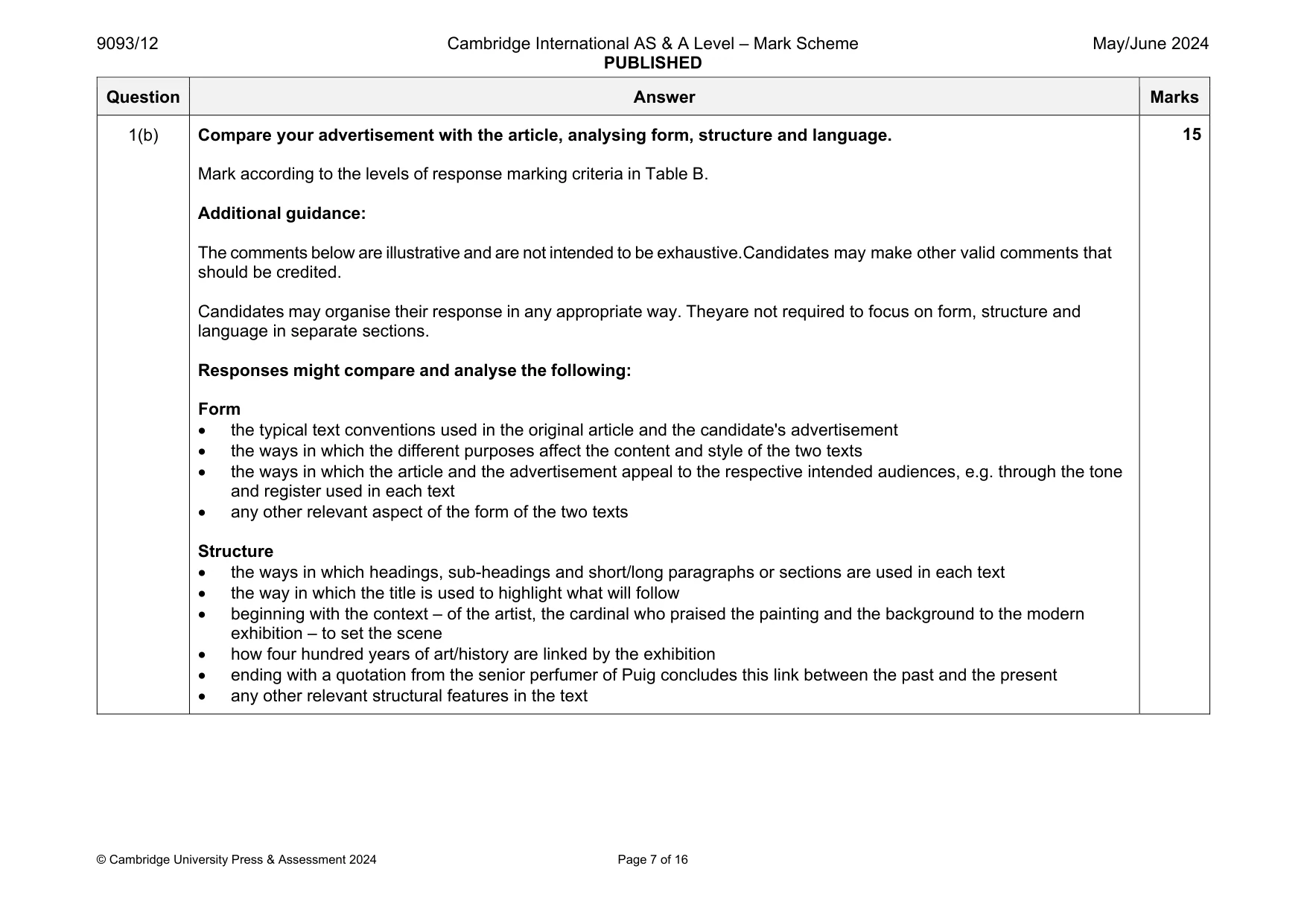
9093/12 Cambridge International AS & A Level – Mark Scheme PUBLISHED May/June 2024 © Cambridge University Press & Assessment 2024 Page 7 of 16 Question Answer Marks 1(b) Compare your advertisement with the article, analysing form, structure and language. Mark according to the levels of response marking criteria in Table B. Additional guidance: The comments below are illustrative and are not intended to be exhaustive. Candidates may make other valid comments that should be credited. Candidates may organise their response in any appropriate way. They are not required to focus on form, structure and language in separate sections. Responses might compare and analyse the following: Form the typical text conventions used in the original article and the candidate's advertisement the ways in which the different purposes affect the content and style of the two texts the ways in which the article and the advertisement appeal to the respective intended audiences, e.g. through the tone and register used in each text any other relevant aspect of the form of the two texts Structure the ways in which headings, sub-headings and short/long paragraphs or sections are used in each text the way in which the title is used to highlight what will follow beginning with the context – of the artist, the cardinal who praised the painting and the background to the modern exhibition – to set the scene how four hundred years of art/history are linked by the exhibition ending with a quotation from the senior perfumer of Puig concludes this link between the past and the present any other relevant structural features in the text 15
Mark scheme, page 8
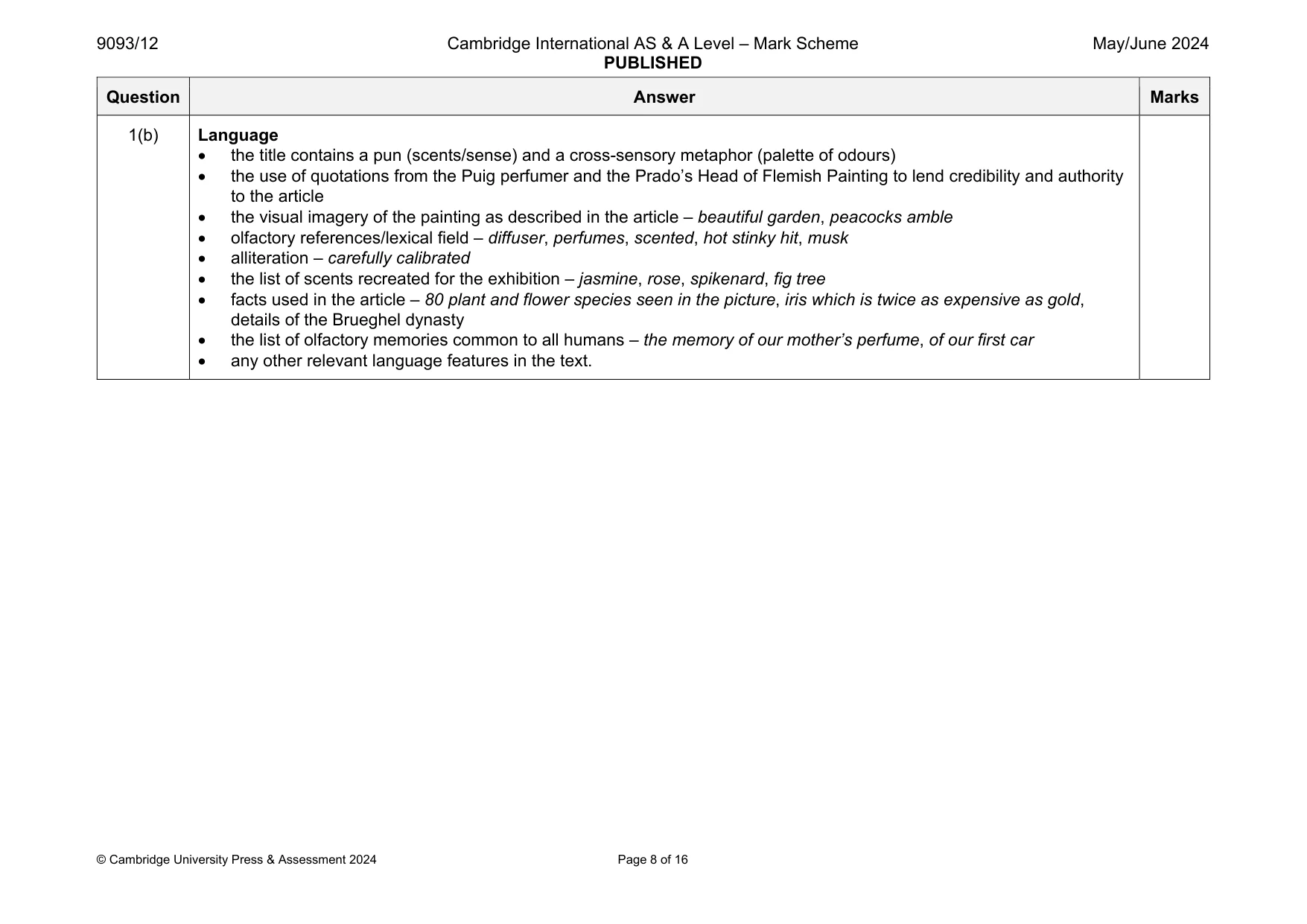
9093/12 Cambridge International AS & A Level – Mark Scheme PUBLISHED May/June 2024 © Cambridge University Press & Assessment 2024 Page 8 of 16 Question Answer Marks 1(b) Language the title contains a pun (scents/sense) and a cross-sensory metaphor (palette of odours) the use of quotations from the Puig perfumer and the Prado’s Head of Flemish Painting to lend credibility and authority to the article the visual imagery of the painting as described in the article – beautiful garden, peacocks amble olfactory references/lexical field – diffuser, perfumes, scented, hot stinky hit, musk alliteration – carefully calibrated the list of scents recreated for the exhibition – jasmine, rose, spikenard, fig tree facts used in the article – 80 plant and flower species seen in the picture, iris which is twice as expensive as gold, details of the Brueghel dynasty the list of olfactory memories common to all humans – the memory of our mother’s perfume, of our first car any other relevant language features in the text.
Mark scheme, page 9
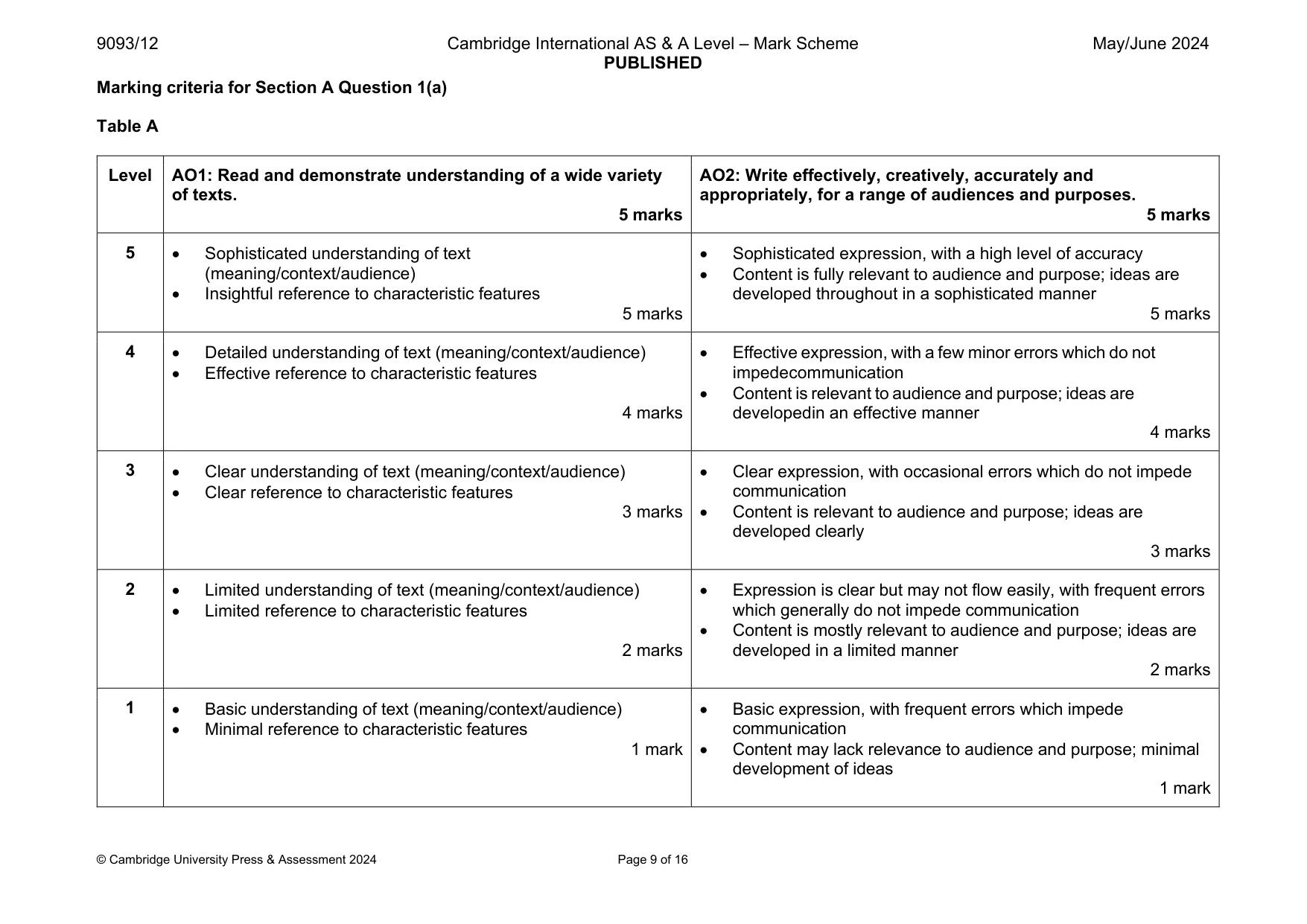
9093/12 Cambridge International AS & A Level – Mark Scheme PUBLISHED May/June 2024 © Cambridge University Press & Assessment 2024 Page 9 of 16 Marking criteria for Section A Question 1(a) Table A Level AO1: Read and demonstrate understanding of a wide variety of texts. 5 marks AO2: Write effectively, creatively, accurately and appropriately, for a range of audiences and purposes. 5 marks 5 Sophisticated understanding of text (meaning/context/audience) Insightful reference to characteristic features 5 marks Sophisticated expression, with a high level of accuracy Content is fully relevant to audience and purpose; ideas are developed throughout in a sophisticated manner 5 marks 4 Detailed understanding of text (meaning/context/audience) Effective reference to characteristic features 4 marks Effective expression, with a few minor errors which do not impede communication Content is relevant to audience and purpose; ideas are developed in an effective manner 4 marks 3 Clear understanding of text (meaning/context/audience) Clear reference to characteristic features 3 marks Clear expression, with occasional errors which do not impede communication Content is relevant to audience and purpose; ideas are developed clearly 3 marks 2 Limited understanding of text (meaning/context/audience) Limited reference to characteristic features 2 marks Expression is clear but may not flow easily, with frequent errors which generally do not impede communication Content is mostly relevant to audience and purpose; ideas are developed in a limited manner 2 marks 1 Basic understanding of text (meaning/context/audience) Minimal reference to characteristic features 1 mark Basic expression, with frequent errors which impede communication Content may lack relevance to audience and purpose; minimal development of ideas 1 mark
Mark scheme, page 10
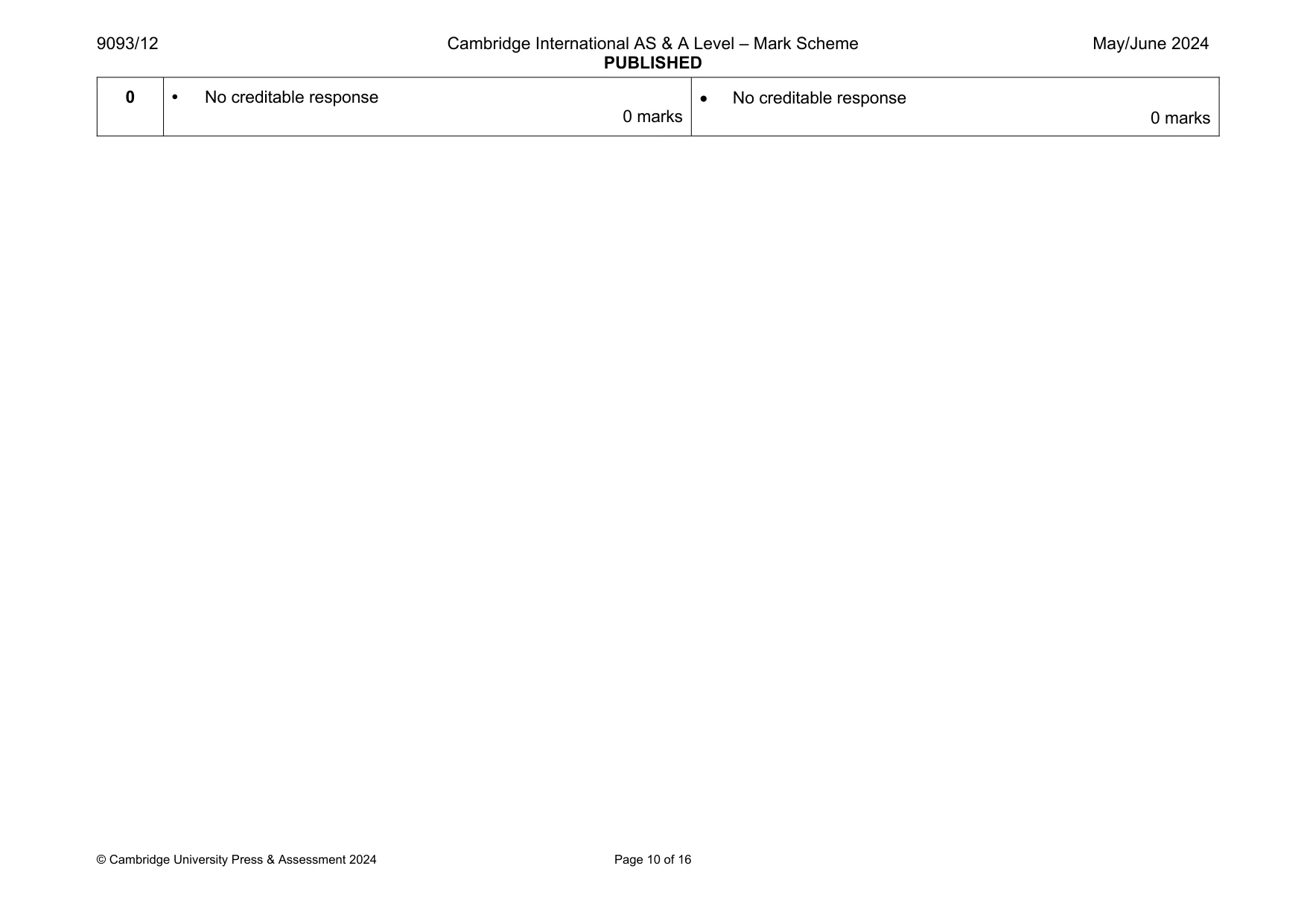
9093/12 Cambridge International AS & A Level – Mark Scheme PUBLISHED May/June 2024 © Cambridge University Press & Assessment 2024 Page 10 of 16 0 • No creditable response 0 marks No creditable response 0 marks
Mark scheme, page 11
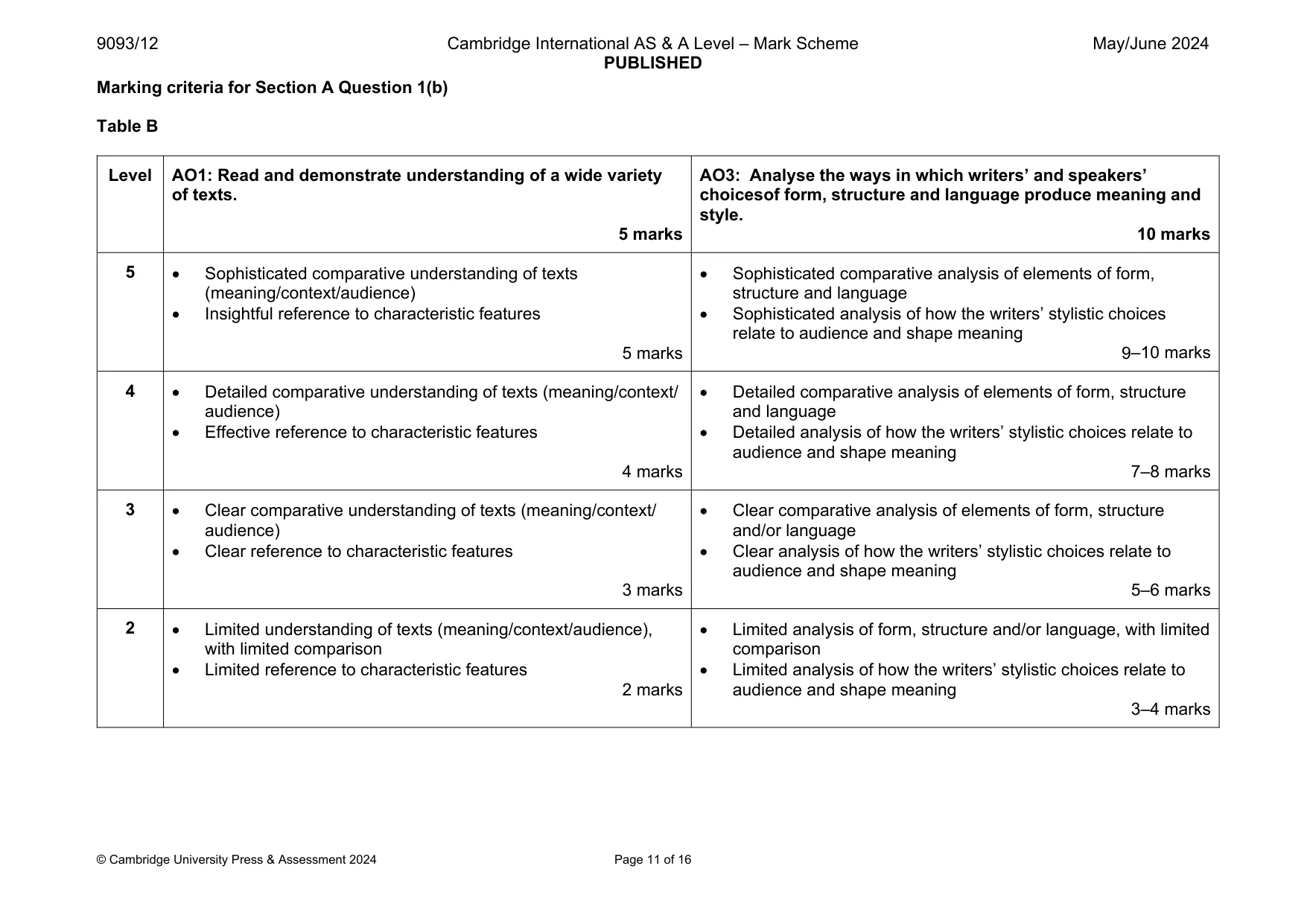
9093/12 Cambridge International AS & A Level – Mark Scheme PUBLISHED May/June 2024 © Cambridge University Press & Assessment 2024 Page 11 of 16 Marking criteria for Section A Question 1(b) Table B Level AO1: Read and demonstrate understanding of a wide variety of texts. 5 marks AO3: Analyse the ways in which writers’ and speakers’ choices of form, structure and language produce meaning and style. 10 marks 5 Sophisticated comparative understanding of texts (meaning/context/audience) Insightful reference to characteristic features 5 marks Sophisticated comparative analysis of elements of form, structure and language Sophisticated analysis of how the writers’ stylistic choices relate to audience and shape meaning 9–10 marks 4 Detailed comparative understanding of texts (meaning/context/ audience) Effective reference to characteristic features 4 marks Detailed comparative analysis of elements of form, structure and language Detailed analysis of how the writers’ stylistic choices relate to audience and shape meaning 7–8 marks 3 Clear comparative understanding of texts (meaning/context/ audience) Clear reference to characteristic features 3 marks Clear comparative analysis of elements of form, structure and/or language Clear analysis of how the writers’ stylistic choices relate to audience and shape meaning 5–6 marks 2 Limited understanding of texts (meaning/context/audience), with limited comparison Limited reference to characteristic features 2 marks Limited analysis of form, structure and/or language, with limited comparison Limited analysis of how the writers’ stylistic choices relate to audience and shape meaning 3–4 marks
Mark scheme, page 12
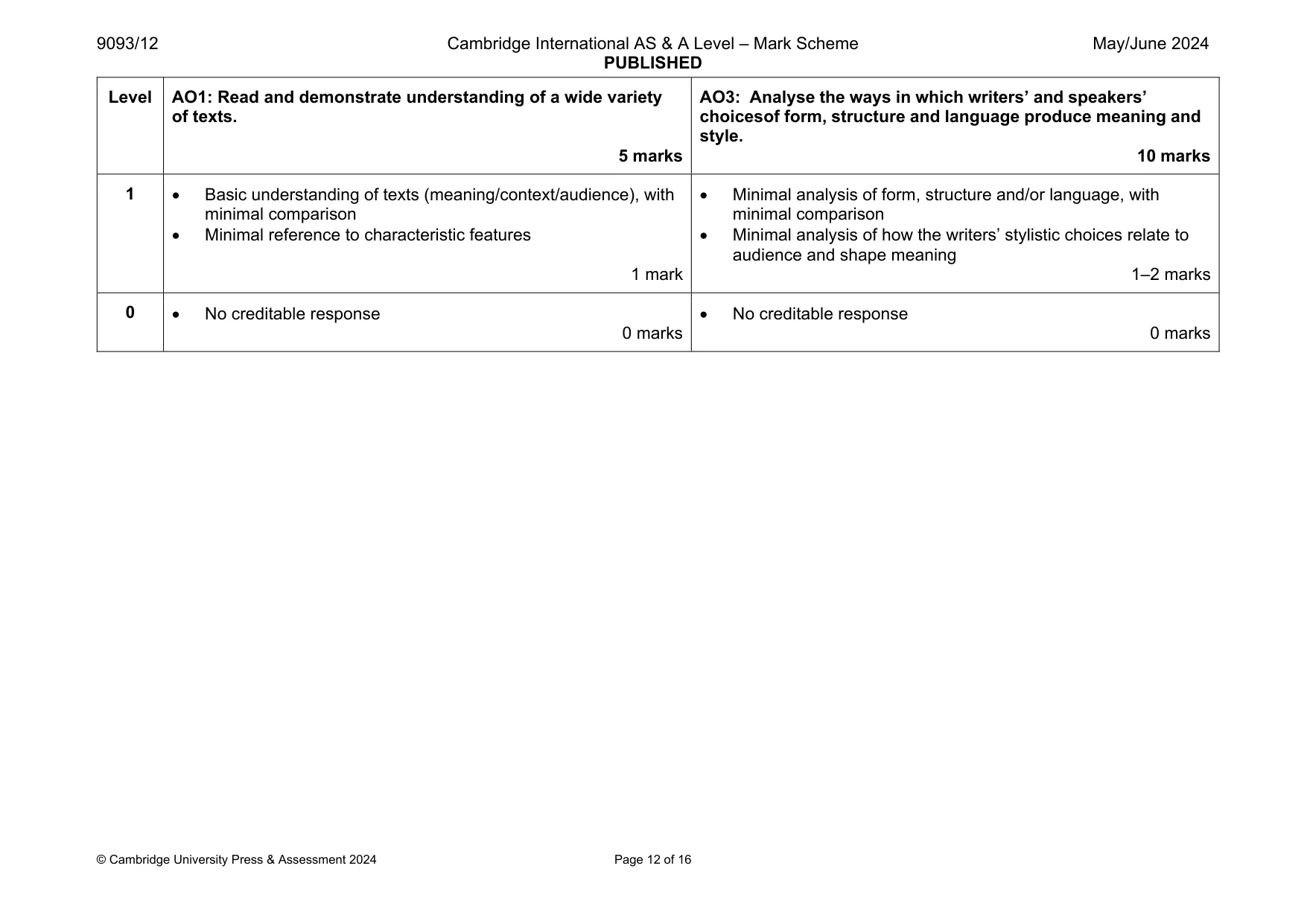
9093/12 Cambridge International AS & A Level – Mark Scheme PUBLISHED May/June 2024 © Cambridge University Press & Assessment 2024 Page 12 of 16 Level AO1: Read and demonstrate understanding of a wide variety of texts. 5 marks AO3: Analyse the ways in which writers’ and speakers’ choices of form, structure and language produce meaning and style. 10 marks 1 Basic understanding of texts (meaning/context/audience), with minimal comparison Minimal reference to characteristic features 1 mark Minimal analysis of form, structure and/or language, with minimal comparison Minimal analysis of how the writers’ stylistic choices relate to audience and shape meaning 1–2 marks 0 No creditable response 0 marks No creditable response 0 marks
Mark scheme, page 13
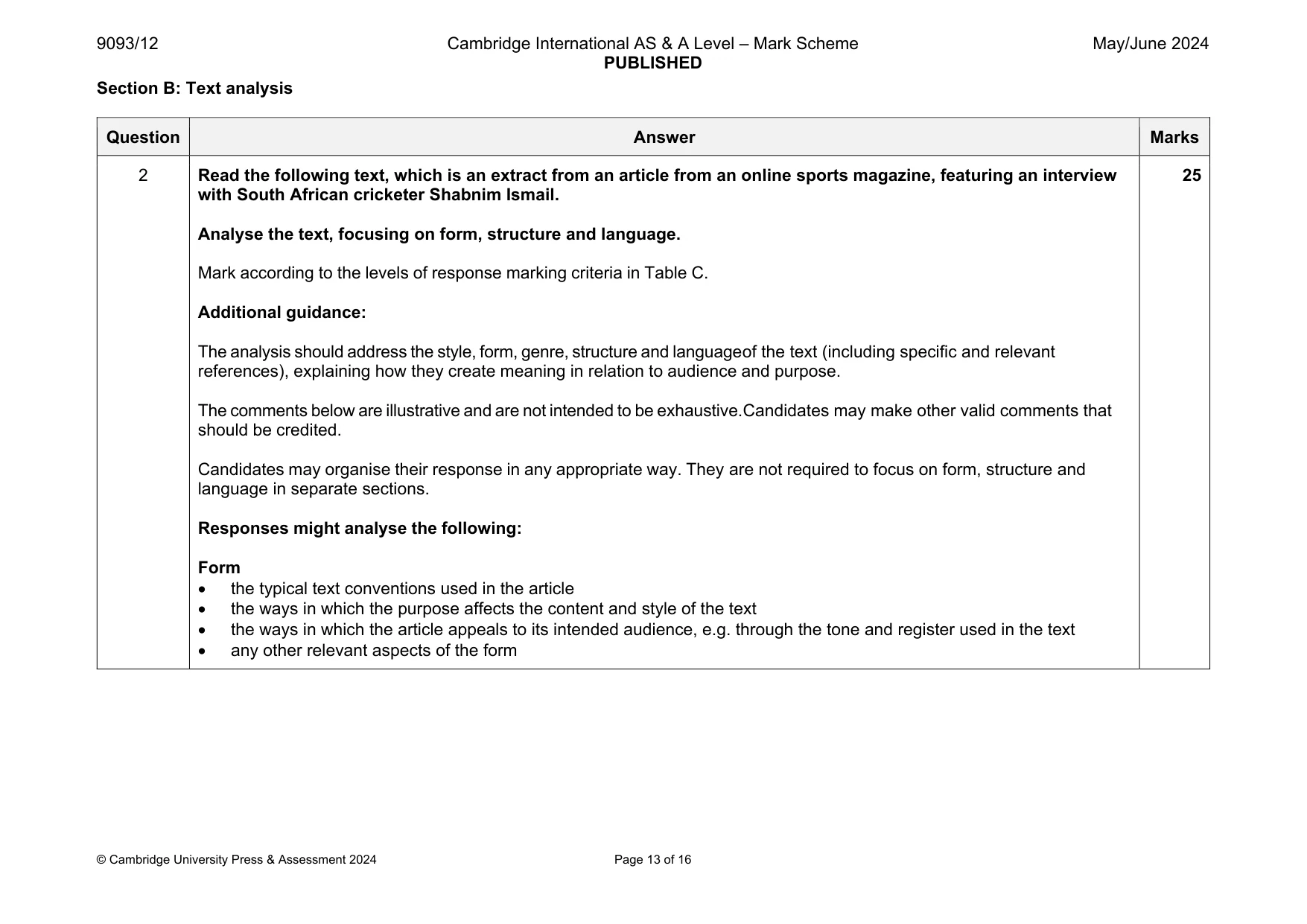
9093/12 Cambridge International AS & A Level – Mark Scheme PUBLISHED May/June 2024 © Cambridge University Press & Assessment 2024 Page 13 of 16 Section B: Text analysis Question Answer Marks 2 Read the following text, which is an extract from an article from an online sports magazine, featuring an interview with South African cricketer Shabnim Ismail. Analyse the text, focusing on form, structure and language. Mark according to the levels of response marking criteria in Table C. Additional guidance: The analysis should address the style, form, genre, structure and language of the text (including specific and relevant references), explaining how they create meaning in relation to audience and purpose. The comments below are illustrative and are not intended to be exhaustive. Candidates may make other valid comments that should be credited. Candidates may organise their response in any appropriate way. They are not required to focus on form, structure and language in separate sections. Responses might analyse the following: Form the typical text conventions used in the article the ways in which the purpose affects the content and style of the text the ways in which the article appeals to its intended audience, e.g. through the tone and register used in the text any other relevant aspects of the form 25
Mark scheme, page 14
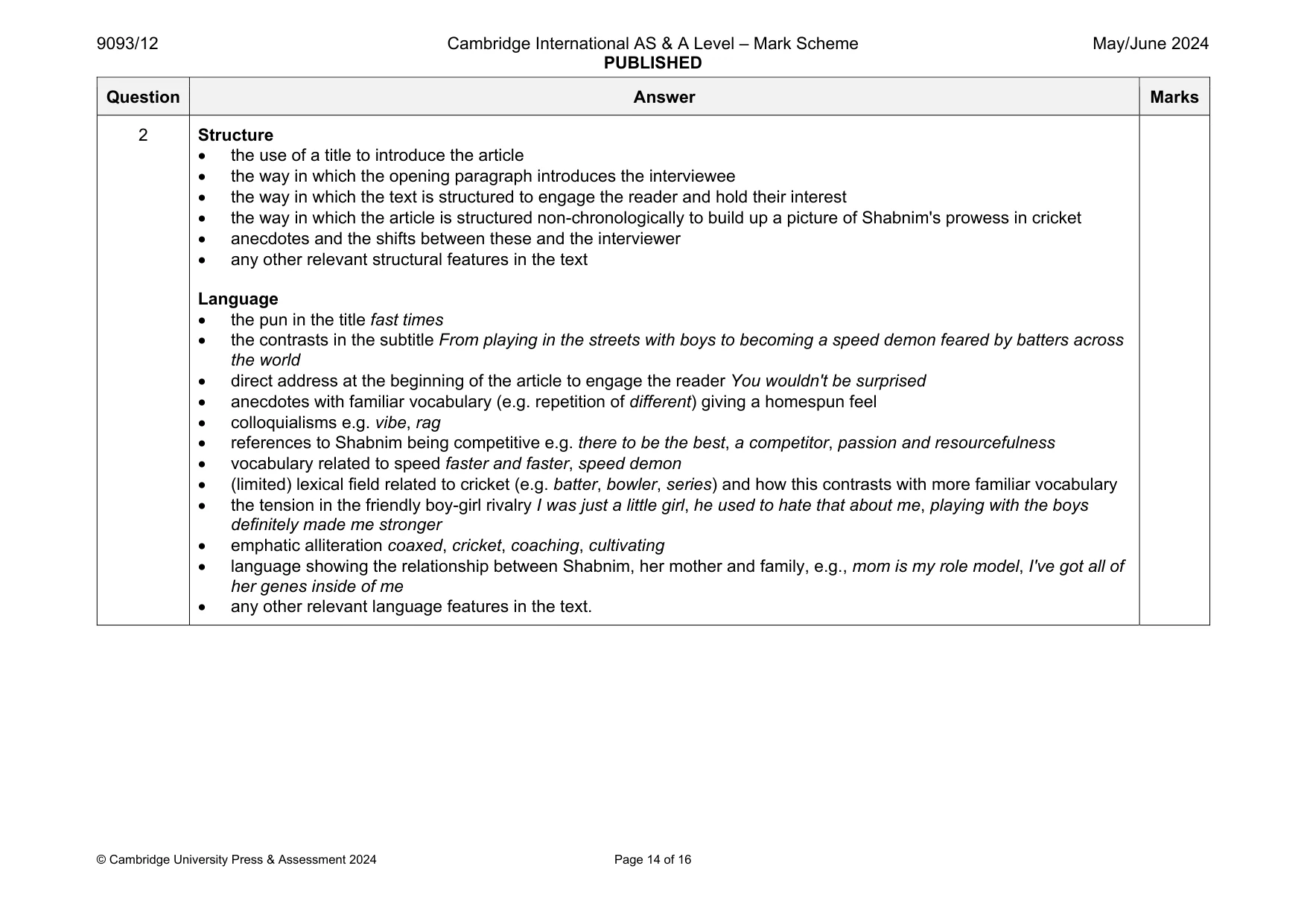
9093/12 Cambridge International AS & A Level – Mark Scheme PUBLISHED May/June 2024 © Cambridge University Press & Assessment 2024 Page 14 of 16 Question Answer Marks 2 Structure the use of a title to introduce the article the way in which the opening paragraph introduces the interviewee the way in which the text is structured to engage the reader and hold their interest the way in which the article is structured non-chronologically to build up a picture of Shabnim's prowess in cricket anecdotes and the shifts between these and the interviewer any other relevant structural features in the text Language the pun in the title fast times the contrasts in the subtitle From playing in the streets with boys to becoming a speed demon feared by batters across the world direct address at the beginning of the article to engage the reader You wouldn't be surprised anecdotes with familiar vocabulary (e.g. repetition of different) giving a homespun feel colloquialisms e.g. vibe, rag references to Shabnim being competitive e.g. there to be the best, a competitor, passion and resourcefulness vocabulary related to speed faster and faster, speed demon (limited) lexical field related to cricket (e.g. batter, bowler, series) and how this contrasts with more familiar vocabulary the tension in the friendly boy-girl rivalry I was just a little girl, he used to hate that about me, playing with the boys definitely made me stronger emphatic alliteration coaxed, cricket, coaching, cultivating language showing the relationship between Shabnim, her mother and family, e.g., mom is my role model, I've got all of her genes inside of me any other relevant language features in the text.
Mark scheme, page 15
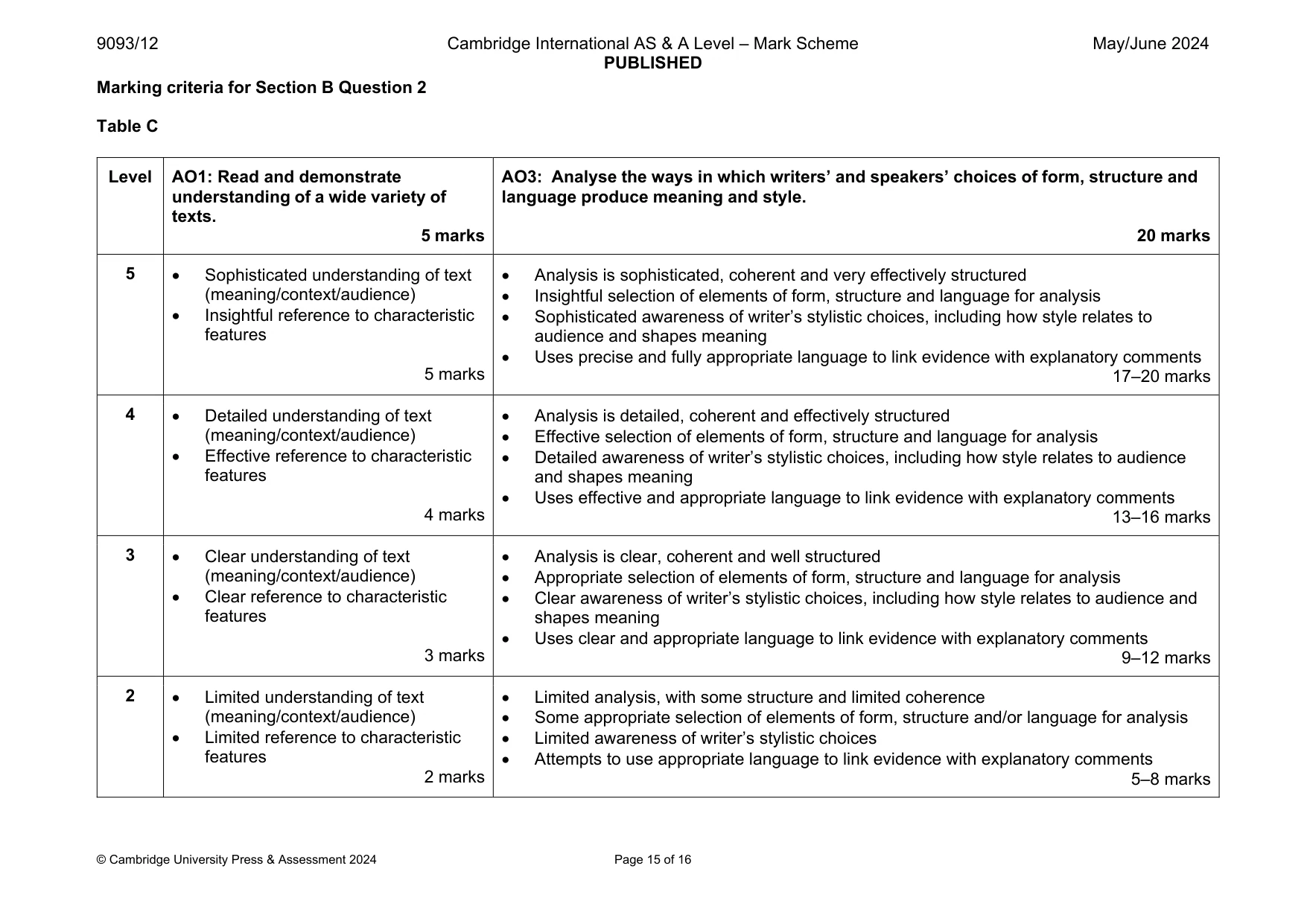
9093/12 Cambridge International AS & A Level – Mark Scheme PUBLISHED May/June 2024 © Cambridge University Press & Assessment 2024 Page 15 of 16 Marking criteria for Section B Question 2 Table C Level AO1: Read and demonstrate understanding of a wide variety of texts. 5 marks AO3: Analyse the ways in which writers’ and speakers’ choices of form, structure and language produce meaning and style. 20 marks 5 Sophisticated understanding of text (meaning/context/audience) Insightful reference to characteristic features 5 marks Analysis is sophisticated, coherent and very effectively structured Insightful selection of elements of form, structure and language for analysis Sophisticated awareness of writer’s stylistic choices, including how style relates to audience and shapes meaning Uses precise and fully appropriate language to link evidence with explanatory comments 17–20 marks 4 Detailed understanding of text (meaning/context/audience) Effective reference to characteristic features 4 marks Analysis is detailed, coherent and effectively structured Effective selection of elements of form, structure and language for analysis Detailed awareness of writer’s stylistic choices, including how style relates to audience and shapes meaning Uses effective and appropriate language to link evidence with explanatory comments 13–16 marks 3 Clear understanding of text (meaning/context/audience) Clear reference to characteristic features 3 marks Analysis is clear, coherent and well structured Appropriate selection of elements of form, structure and language for analysis Clear awareness of writer’s stylistic choices, including how style relates to audience and shapes meaning Uses clear and appropriate language to link evidence with explanatory comments 9–12 marks 2 Limited understanding of text (meaning/context/audience) Limited reference to characteristic features 2 marks Limited analysis, with some structure and limited coherence Some appropriate selection of elements of form, structure and/or language for analysis Limited awareness of writer’s stylistic choices Attempts to use appropriate language to link evidence with explanatory comments 5–8 marks
Mark scheme, page 16
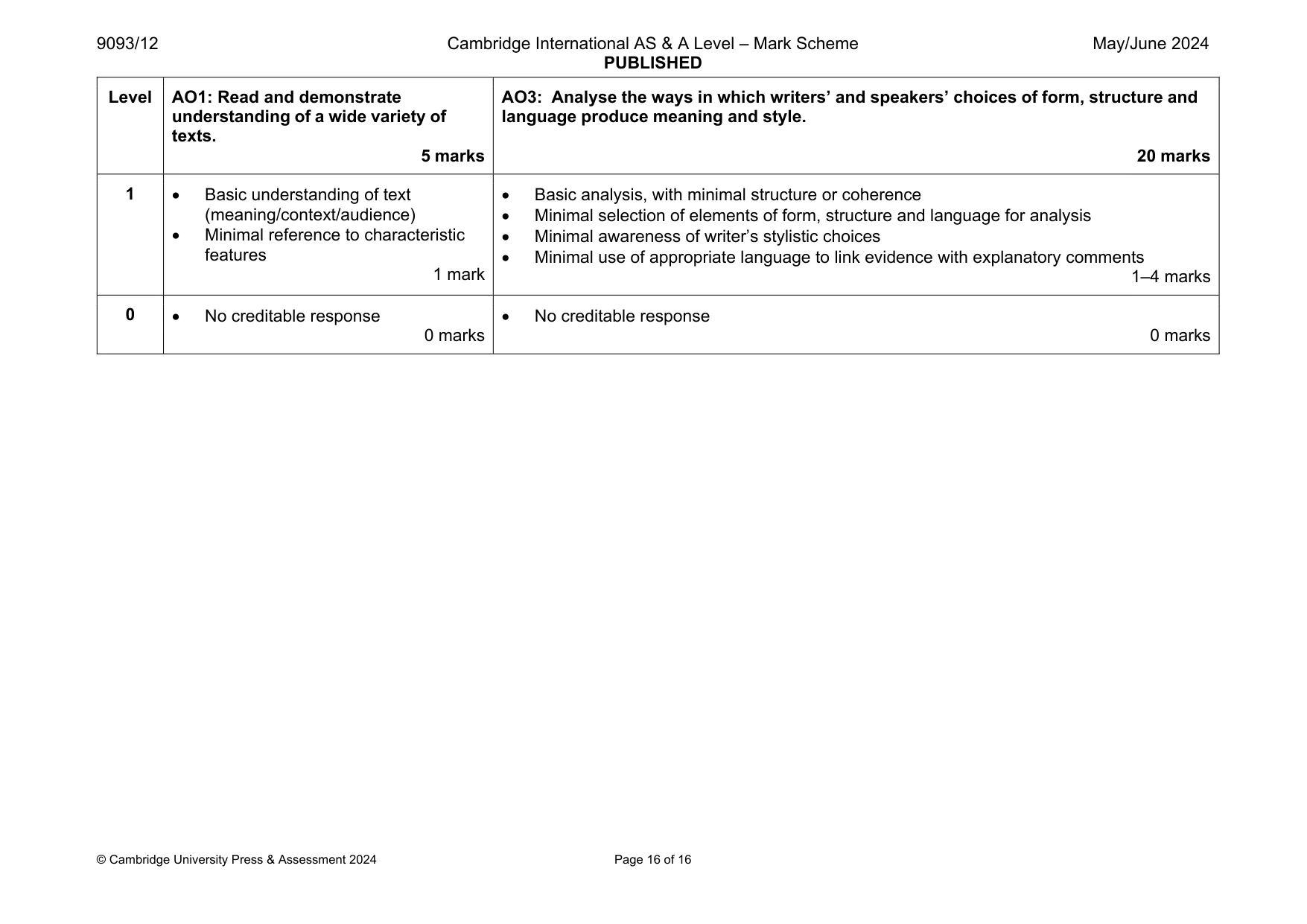
9093/12 Cambridge International AS & A Level – Mark Scheme PUBLISHED May/June 2024 © Cambridge University Press & Assessment 2024 Page 16 of 16 Level AO1: Read and demonstrate understanding of a wide variety of texts. 5 marks AO3: Analyse the ways in which writers’ and speakers’ choices of form, structure and language produce meaning and style. 20 marks 1 Basic understanding of text (meaning/context/audience) Minimal reference to characteristic features 1 mark Basic analysis, with minimal structure or coherence Minimal selection of elements of form, structure and language for analysis Minimal awareness of writer’s stylistic choices Minimal use of appropriate language to link evidence with explanatory comments 1–4 marks 0 No creditable response 0 marks No creditable response 0 marks
What you needed in this session
Cambridge’s own grade thresholds for 2024 May/June, Paper 1 · Variant 2. A higher threshold means an easier paper — the bar moves with how the cohort did.