Cambridge A Level English - Language AS and A Level (from 2014) 9093 — 2023 Feb/March Paper 1 · Variant 2
9093/12/F/M/23 · 50 marks · ≈56 min
The question paper and its mark scheme, free to read here and free to download. This is Cambridge’s own paper, exactly as it was sat.
Question paper8 pages


Mark scheme15 pages
Answers below. Sit the paper first if you are practising.
Paper as text
Question paper, page 1
Cambridge International AS & A Level 9093/12 February/March 2023 2 hours 15 minutes ENGLISH LANGUAGE Paper 1 Reading You must answer on the enclosed answer booklet. You will need: Answer booklet (enclosed) INSTRUCTIONS • Answer all questions. • Follow the instructions on the front cover of the answer booklet. If you need additional answer paper, ask the invigilator for a continuation booklet. • Dictionaries are not allowed. INFORMATION • The total mark for this paper is 50. • The number of marks for each question or part question is shown in brackets [ ]. This document has 8 pages. Any blank pages are indicated. [Turn over 03_9093_12_2023_1.19 © UCLES 2023 *7028945718*
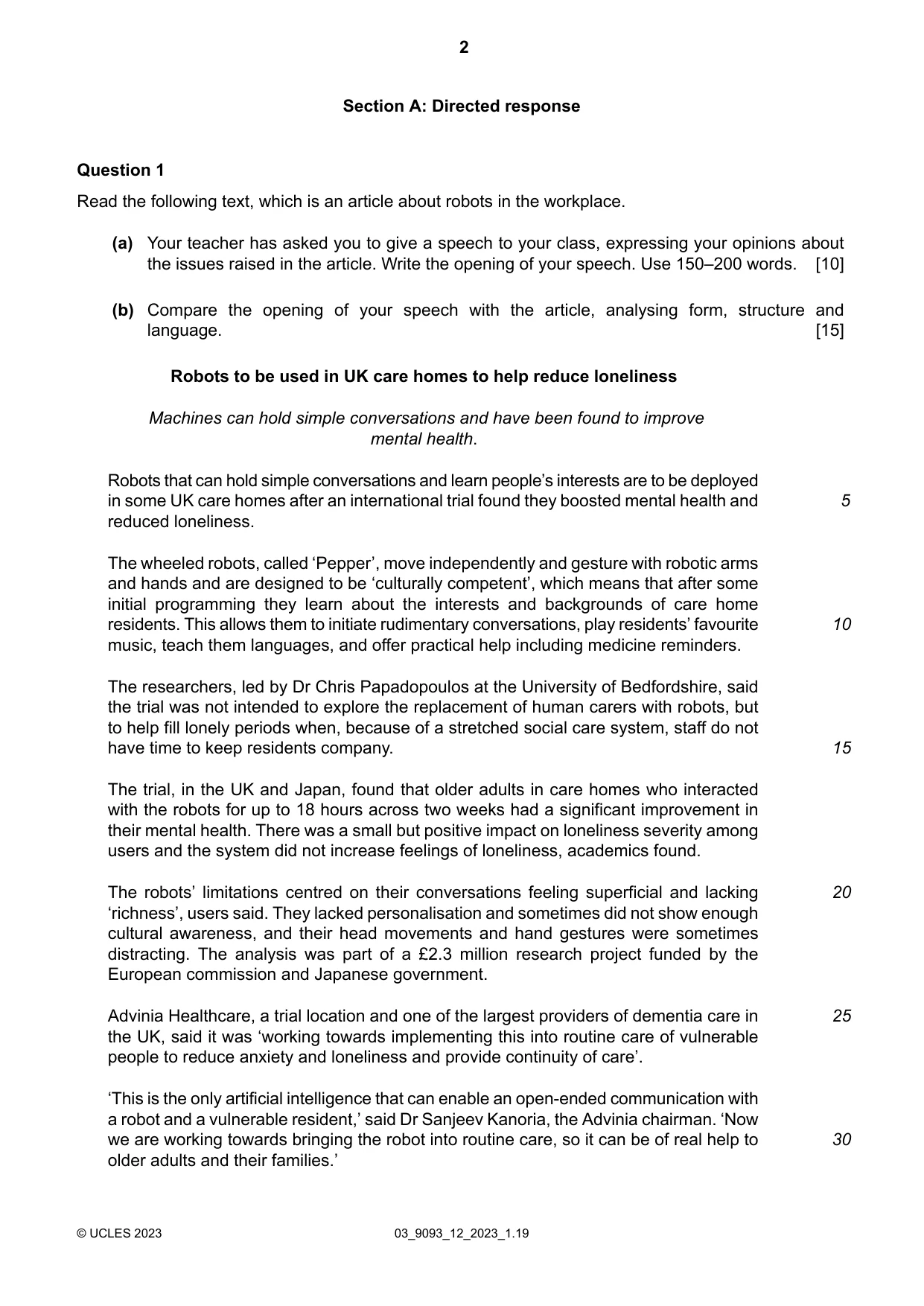
Question paper, page 2
30 25 20 15 10 5 Section A: Directed response Question 1 Read the following text, which is an article about robots in the workplace. Your teacher has asked you to give a speech to your class, expressing your opinions about the issues raised in the article. Write the opening of your speech. Use 150–200 words. [10] (a) Compare the opening of your speech with the article, analysing form, structure and language. [15] (b) Robots to be used in UK care homes to help reduce loneliness Machines can hold simple conversations and have been found to improve mental health. Robots that can hold simple conversations and learn people’s interests are to be deployed in some UK care homes after an international trial found they boosted mental health and reduced loneliness. The wheeled robots, called ‘Pepper’, move independently and gesture with robotic arms and hands and are designed to be ‘culturally competent’, which means that after some initial programming they learn about the interests and backgrounds of care home residents. This allows them to initiate rudimentary conversations, play residents’ favourite music, teach them languages, and offer practical help including medicine reminders. The researchers, led by Dr Chris Papadopoulos at the University of Bedfordshire, said the trial was not intended to explore the replacement of human carers with robots, but to help fill lonely periods when, because of a stretched social care system, staff do not have time to keep residents company. The trial, in the UK and Japan, found that older adults in care homes who interacted with the robots for up to 18 hours across two weeks had a significant improvement in their mental health. There was a small but positive impact on loneliness severity among users and the system did not increase feelings of loneliness, academics found. The robots’ limitations centred on their conversations feeling superficial and lacking ‘richness’, users said. They lacked personalisation and sometimes did not show enough cultural awareness, and their head movements and hand gestures were sometimes distracting. The analysis was part of a £2.3 million research project funded by the European commission and Japanese government. Advinia Healthcare, a trial location and one of the largest providers of dementia care in the UK, said it was ‘working towards implementing this into routine care of vulnerable people to reduce anxiety and loneliness and provide continuity of care’. ‘This is the only artificial intelligence that can enable an open-ended communication with a robot and a vulnerable resident,’ said Dr Sanjeev Kanoria, the Advinia chairman. ‘Now we are working towards bringing the robot into routine care, so it can be of real help to older adults and their families.’ 03_9093_12_2023_1.19 © UCLES 2023 2
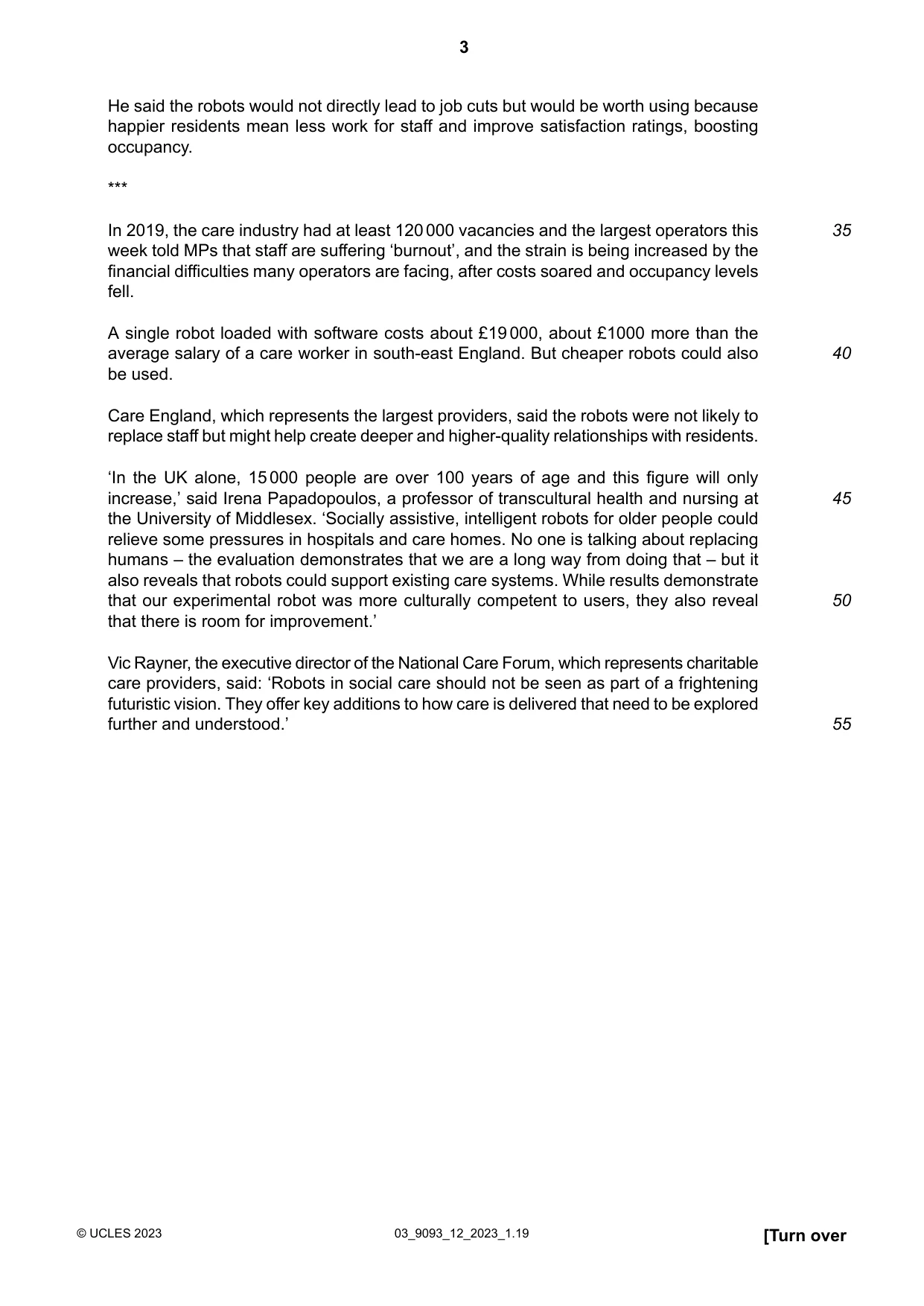
Question paper, page 3
55 50 45 40 35 He said the robots would not directly lead to job cuts but would be worth using because happier residents mean less work for staff and improve satisfaction ratings, boosting occupancy. *** In 2019, the care industry had at least 120000 vacancies and the largest operators this week told MPs that staff are suffering ‘burnout’, and the strain is being increased by the financial difficulties many operators are facing, after costs soared and occupancy levels fell. A single robot loaded with software costs about £19000, about £1000 more than the average salary of a care worker in south-east England. But cheaper robots could also be used. Care England, which represents the largest providers, said the robots were not likely to replace staff but might help create deeper and higher-quality relationships with residents. ‘In the UK alone, 15000 people are over 100 years of age and this figure will only increase,’ said Irena Papadopoulos, a professor of transcultural health and nursing at the University of Middlesex. ‘Socially assistive, intelligent robots for older people could relieve some pressures in hospitals and care homes. No one is talking about replacing humans – the evaluation demonstrates that we are a long way from doing that – but it also reveals that robots could support existing care systems. While results demonstrate that our experimental robot was more culturally competent to users, they also reveal that there is room for improvement.’ Vic Rayner, the executive director of the National Care Forum, which represents charitable care providers, said: ‘Robots in social care should not be seen as part of a frightening futuristic vision. They offer key additions to how care is delivered that need to be explored further and understood.’ [Turn over 03_9093_12_2023_1.19 © UCLES 2023 3
Question paper, page 4
Section B: Text analysis Question 2 Read the following text, which is the opening of a short story published in 1952. The text describes the arrival of a train in an unnamed village in Africa. Analyse the text, focusing on form, structure and language. [25] The train came out of the red horizon and bore down towards them over the single straight track. 03_9093_12_2023_1.19 © UCLES 2023 4 Content removed due to copyright restrictions.
Question paper, page 5
The two children careered over the sand, clutching the bread, and burst through the iron gate and up the path through the garden in which nothing grew. 03_9093_12_2023_1.19 © UCLES 2023 5 Content removed due to copyright restrictions.
Question paper, page 6
BLANK PAGE 03_9093_12_2023_1.19 © UCLES 2023 6
Question paper, page 7
BLANK PAGE 03_9093_12_2023_1.19 © UCLES 2023 7
Question paper, page 8
BLANK PAGE Permission to reproduce items where third-party owned material protected by copyright is included has been sought and cleared where possible. Every reasonable effort has been made by the publisher (UCLES) to trace copyright holders, but if any items requiring clearance have unwittingly been included, the publisher will be pleased to make amends at the earliest possible opportunity. To avoid the issue of disclosure of answer-related information to candidates, all copyright acknowledgements are reproduced online in the Cambridge Assessment International Education Copyright Acknowledgements Booklet. This is produced for each series of examinations and is freely available to download at www.cambridgeinternational.org after the live examination series. Cambridge Assessment International Education is part of Cambridge Assessment. Cambridge Assessment is the brand name of the University of Cambridge Local Examinations Syndicate (UCLES), which is a department of the University of Cambridge. 03_9093_12_2023_1.19 © UCLES 2023 8
Mark scheme, page 1
This document consists of 15 printed pages. © UCLES 2023 [Turn over Cambridge International AS & A Level ENGLISH LANGUAGE 9093/12 Paper 1 Reading February/March 2023 MARK SCHEME Maximum Mark: 50 Published This mark scheme is published as an aid to teachers and candidates, to indicate the requirements of the examination. It shows the basis on which Examiners were instructed to award marks. It does not indicate the details of the discussions that took place at an Examiners’ meeting before marking began, which would have considered the acceptability of alternative answers. Mark schemes should be read in conjunction with the question paper and the Principal Examiner Report for Teachers. Cambridge International will not enter into discussions about these mark schemes. Cambridge International is publishing the mark schemes for the February/March 2023 series for most Cambridge IGCSE™, Cambridge International A and AS Level components and some Cambridge O Level components.
Mark scheme, page 2
9093/12 Cambridge International AS & A Level – Mark Scheme PUBLISHED February/March 2023 © UCLES 2023 Page 2 of 15 Generic Marking Principles These general marking principles must be applied by all examiners when marking candidate answers. They should be applied alongside the specific content of the mark scheme or generic level descriptors for a question. Each question paper and mark scheme will also comply with these marking principles. GENERIC MARKING PRINCIPLE 1: Marks must be awarded in line with: • the specific content of the mark scheme or the generic level descriptors for the question • the specific skills defined in the mark scheme or in the generic level descriptors for the question • the standard of response required by a candidate as exemplified by the standardisation scripts. GENERIC MARKING PRINCIPLE 2: Marks awarded are always whole marks (not half marks, or other fractions). GENERIC MARKING PRINCIPLE 3: Marks must be awarded positively: • marks are awarded for correct/valid answers, as defined in the mark scheme. However, credit is given for valid answers which go beyond the scope of the syllabus and mark scheme, referring to your Team Leader as appropriate • marks are awarded when candidates clearly demonstrate what they know and can do • marks are not deducted for errors • marks are not deducted for omissions • answers should only be judged on the quality of spelling, punctuation and grammar when these features are specifically assessed by the question as indicated by the mark scheme. The meaning, however, should be unambiguous. GENERIC MARKING PRINCIPLE 4: Rules must be applied consistently, e.g. in situations where candidates have not followed instructions or in the application of generic level descriptors.
Mark scheme, page 3
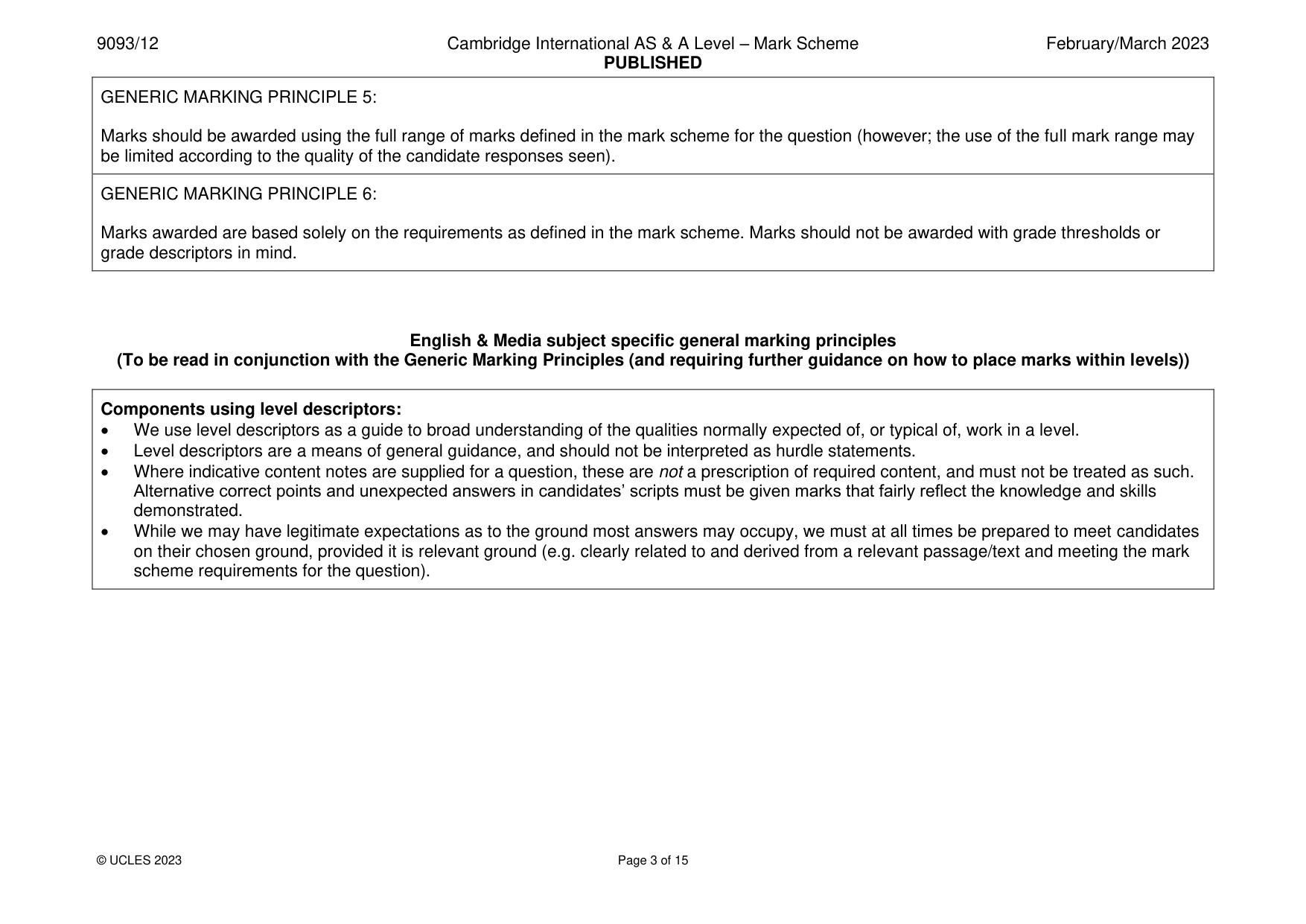
9093/12 Cambridge International AS & A Level – Mark Scheme PUBLISHED February/March 2023 © UCLES 2023 Page 3 of 15 GENERIC MARKING PRINCIPLE 5: Marks should be awarded using the full range of marks defined in the mark scheme for the question (however; the use of the full mark range may be limited according to the quality of the candidate responses seen). GENERIC MARKING PRINCIPLE 6: Marks awarded are based solely on the requirements as defined in the mark scheme. Marks should not be awarded with grade thresholds or grade descriptors in mind. English & Media subject specific general marking principles (To be read in conjunction with the Generic Marking Principles (and requiring further guidance on how to place marks within levels)) Components using level descriptors: • We use level descriptors as a guide to broad understanding of the qualities normally expected of, or typical of, work in a level. • Level descriptors are a means of general guidance, and should not be interpreted as hurdle statements. • Where indicative content notes are supplied for a question, these are not a prescription of required content, and must not be treated as such. Alternative correct points and unexpected answers in candidates’ scripts must be given marks that fairly reflect the knowledge and skills demonstrated. • While we may have legitimate expectations as to the ground most answers may occupy, we must at all times be prepared to meet candidates on their chosen ground, provided it is relevant ground (e.g. clearly related to and derived from a relevant passage/text and meeting the mark scheme requirements for the question).
Mark scheme, page 4
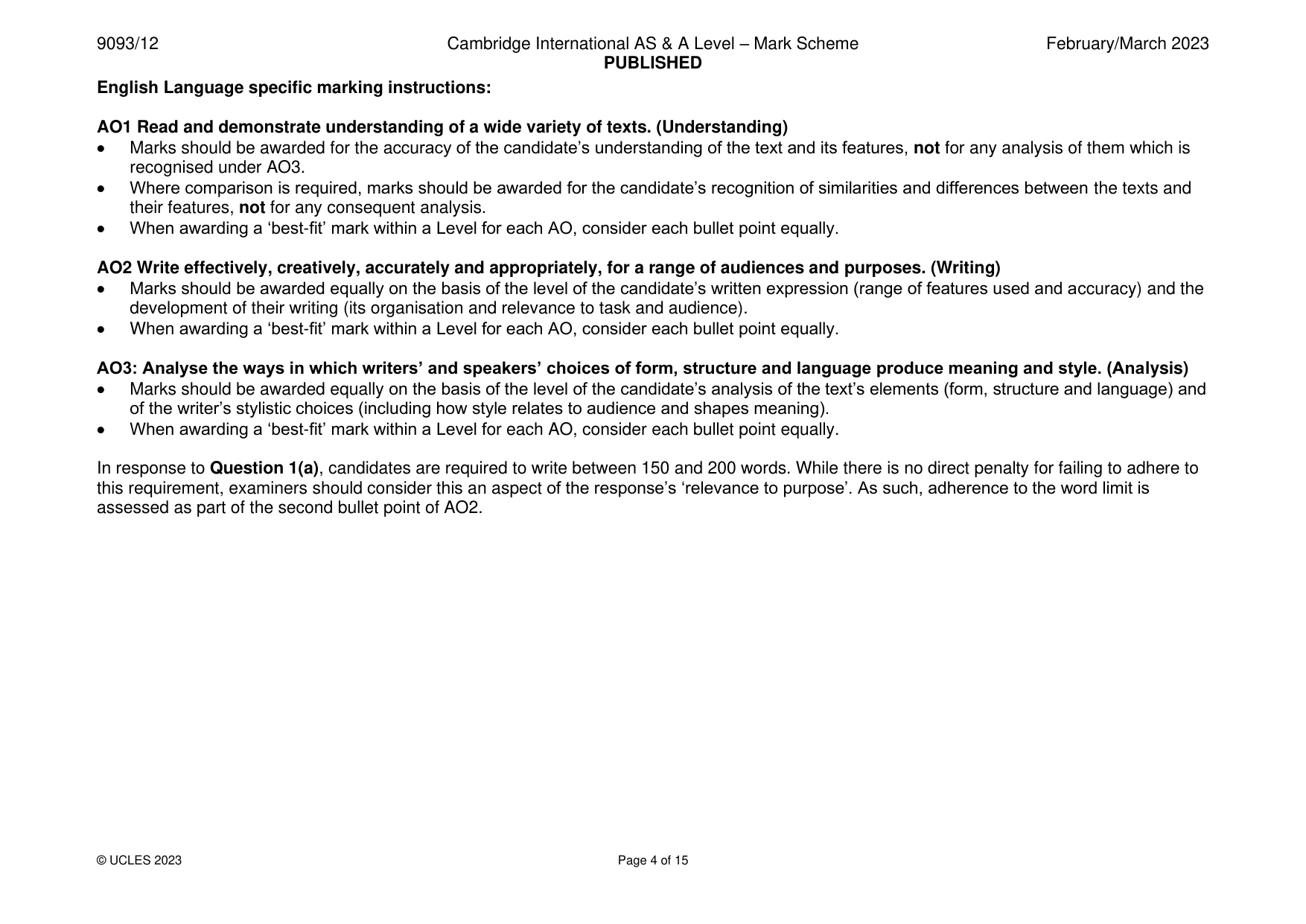
9093/12 Cambridge International AS & A Level – Mark Scheme PUBLISHED February/March 2023 © UCLES 2023 Page 4 of 15 English Language specific marking instructions: AO1 Read and demonstrate understanding of a wide variety of texts. (Understanding) • Marks should be awarded for the accuracy of the candidate’s understanding of the text and its features, not for any analysis of them which is recognised under AO3. • Where comparison is required, marks should be awarded for the candidate’s recognition of similarities and differences between the texts and their features, not for any consequent analysis. • When awarding a ‘best-fit’ mark within a Level for each AO, consider each bullet point equally. AO2 Write effectively, creatively, accurately and appropriately, for a range of audiences and purposes. (Writing) • Marks should be awarded equally on the basis of the level of the candidate’s written expression (range of features used and accuracy) and the development of their writing (its organisation and relevance to task and audience). • When awarding a ‘best-fit’ mark within a Level for each AO, consider each bullet point equally. AO3: Analyse the ways in which writers’ and speakers’ choices of form, structure and language produce meaning and style. (Analysis) • Marks should be awarded equally on the basis of the level of the candidate’s analysis of the text’s elements (form, structure and language) and of the writer’s stylistic choices (including how style relates to audience and shapes meaning). • When awarding a ‘best-fit’ mark within a Level for each AO, consider each bullet point equally. In response to Question 1(a), candidates are required to write between 150 and 200 words. While there is no direct penalty for failing to adhere to this requirement, examiners should consider this an aspect of the response’s ‘relevance to purpose’. As such, adherence to the word limit is assessed as part of the second bullet point of AO2.
Mark scheme, page 5
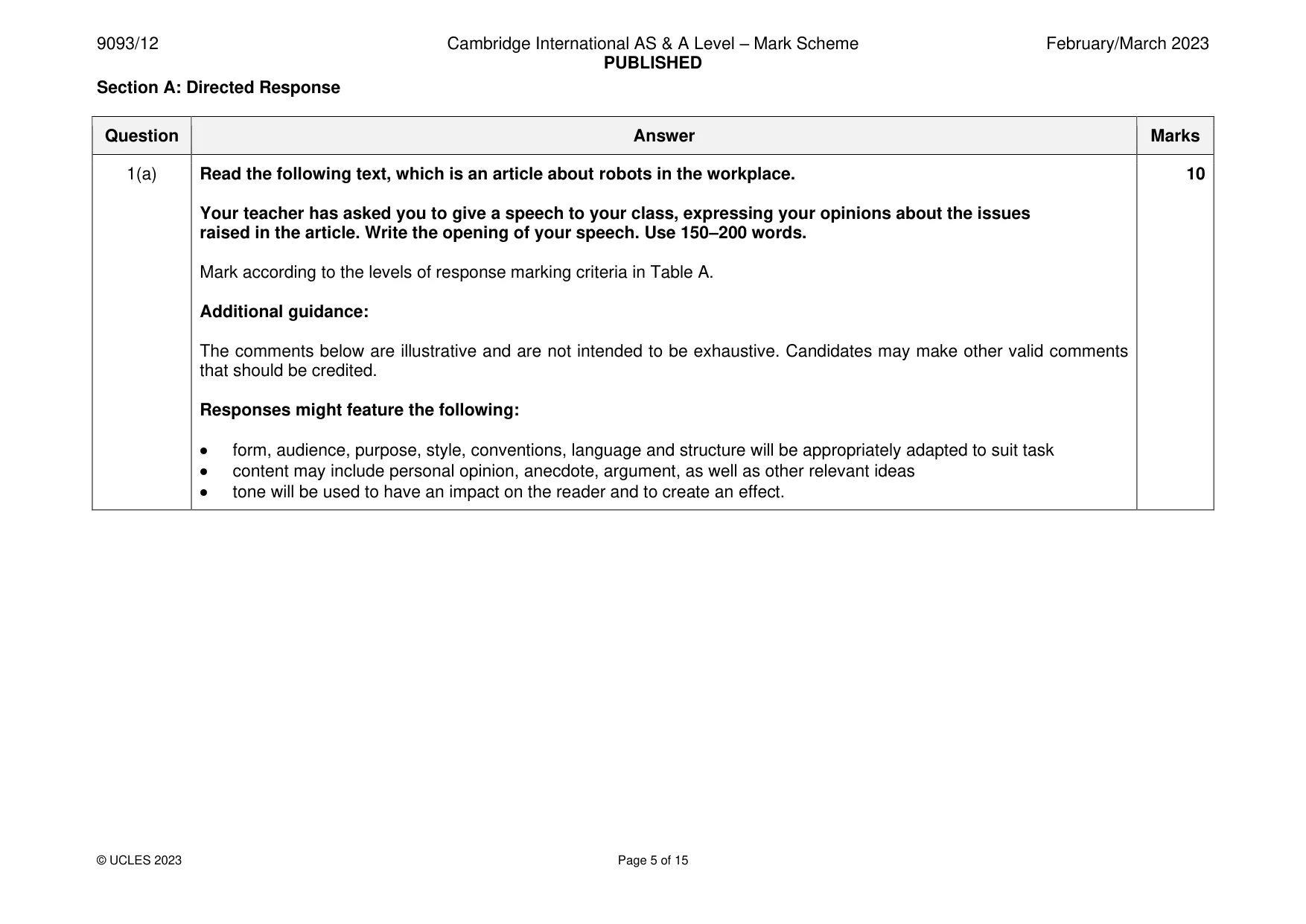
9093/12 Cambridge International AS & A Level – Mark Scheme PUBLISHED February/March 2023 © UCLES 2023 Page 5 of 15 Section A: Directed Response Question Answer Marks 1(a) Read the following text, which is an article about robots in the workplace. Your teacher has asked you to give a speech to your class, expressing your opinions about the issues raised in the article. Write the opening of your speech. Use 150–200 words. Mark according to the levels of response marking criteria in Table A. Additional guidance: The comments below are illustrative and are not intended to be exhaustive. Candidates may make other valid comments that should be credited. Responses might feature the following: • form, audience, purpose, style, conventions, language and structure will be appropriately adapted to suit task • content may include personal opinion, anecdote, argument, as well as other relevant ideas • tone will be used to have an impact on the reader and to create an effect. 10
Mark scheme, page 6
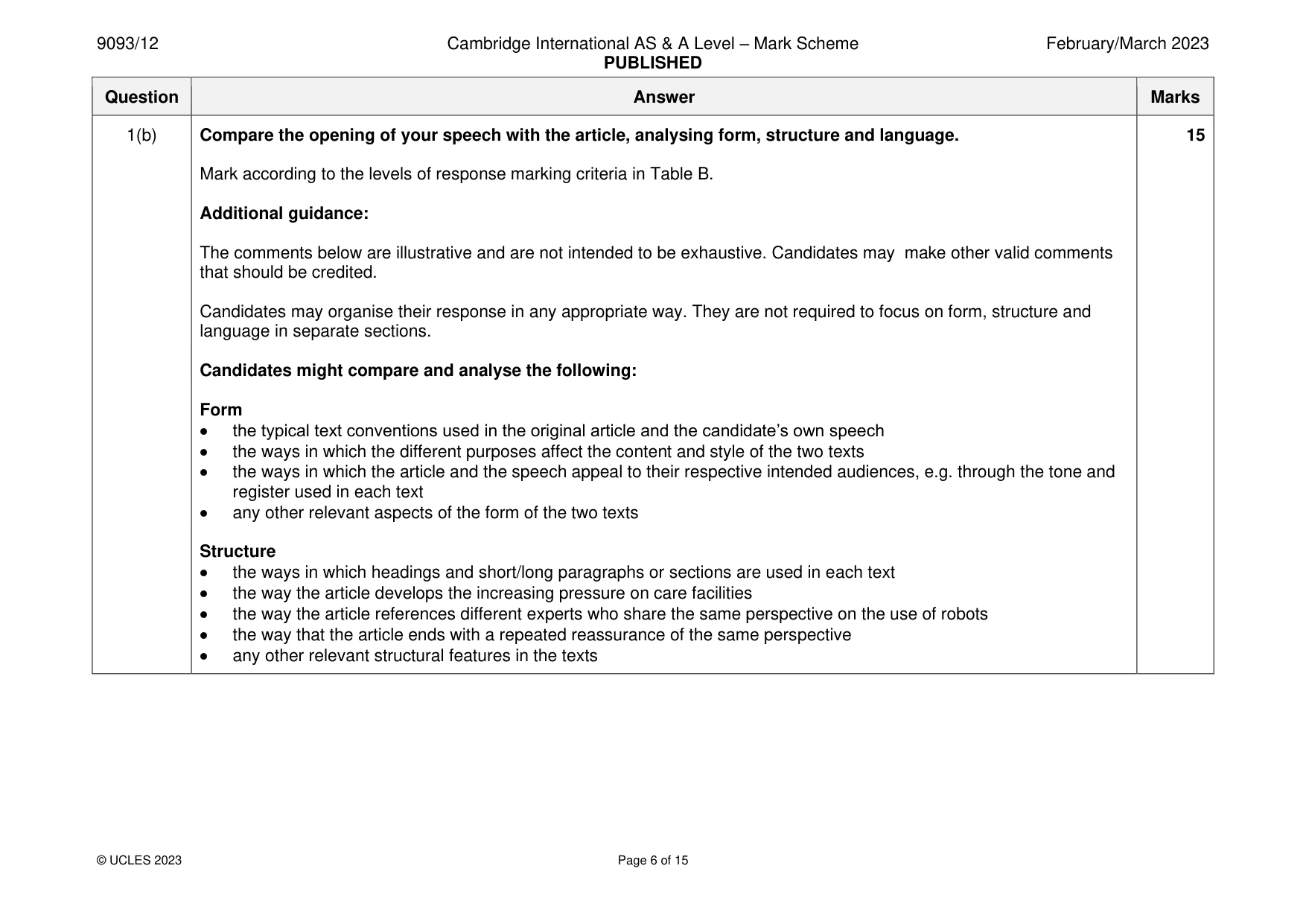
9093/12 Cambridge International AS & A Level – Mark Scheme PUBLISHED February/March 2023 © UCLES 2023 Page 6 of 15 Question Answer Marks 1(b) Compare the opening of your speech with the article, analysing form, structure and language. Mark according to the levels of response marking criteria in Table B. Additional guidance: The comments below are illustrative and are not intended to be exhaustive. Candidates may make other valid comments that should be credited. Candidates may organise their response in any appropriate way. They are not required to focus on form, structure and language in separate sections. Candidates might compare and analyse the following: Form • the typical text conventions used in the original article and the candidate’s own speech • the ways in which the different purposes affect the content and style of the two texts • the ways in which the article and the speech appeal to their respective intended audiences, e.g. through the tone and register used in each text • any other relevant aspects of the form of the two texts Structure • the ways in which headings and short/long paragraphs or sections are used in each text • the way the article develops the increasing pressure on care facilities • the way the article references different experts who share the same perspective on the use of robots • the way that the article ends with a repeated reassurance of the same perspective • any other relevant structural features in the texts 15
Mark scheme, page 7
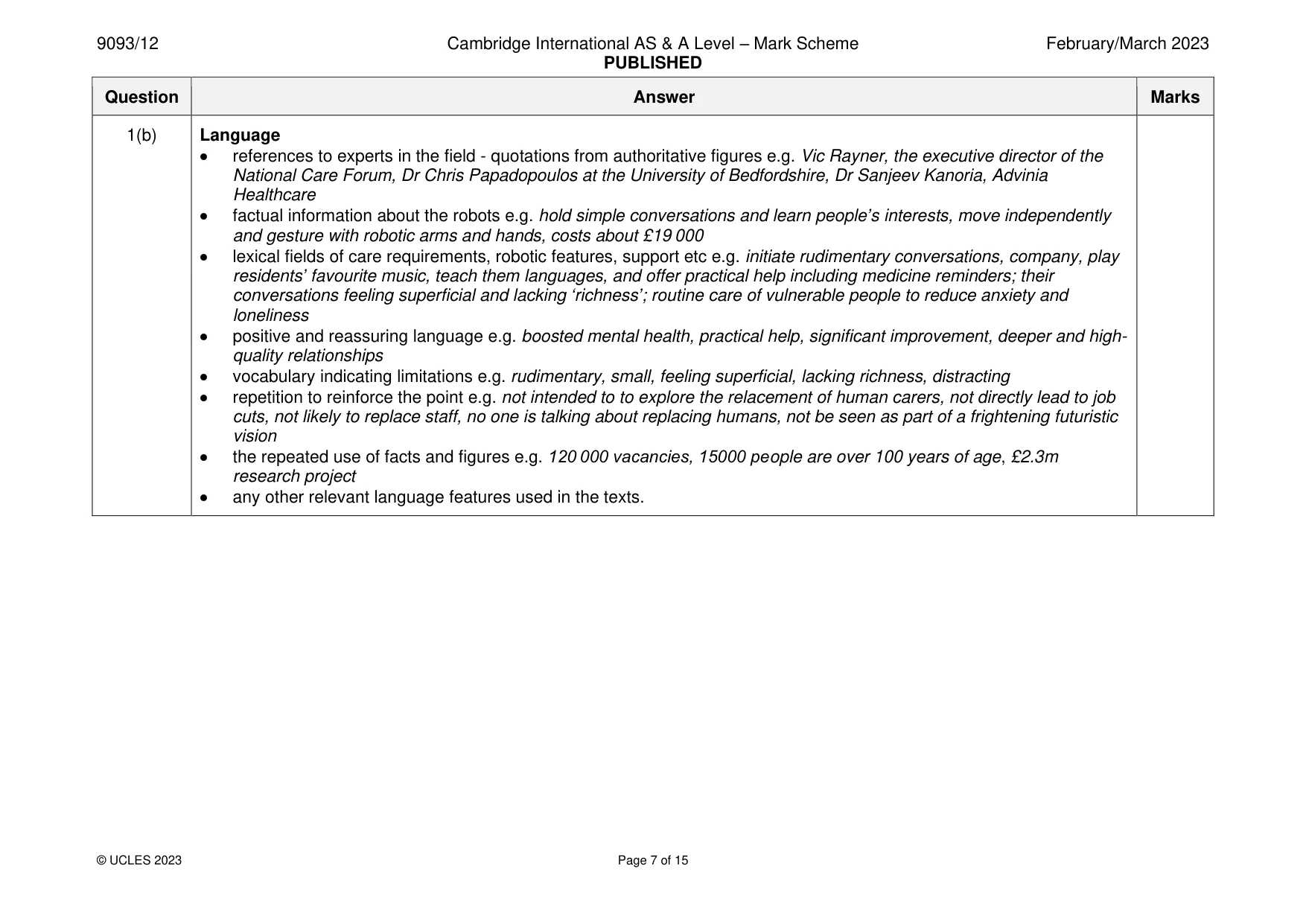
9093/12 Cambridge International AS & A Level – Mark Scheme PUBLISHED February/March 2023 © UCLES 2023 Page 7 of 15 Question Answer Marks 1(b) Language • references to experts in the field - quotations from authoritative figures e.g. Vic Rayner, the executive director of the National Care Forum, Dr Chris Papadopoulos at the University of Bedfordshire, Dr Sanjeev Kanoria, Advinia Healthcare • factual information about the robots e.g. hold simple conversations and learn people’s interests, move independently and gesture with robotic arms and hands, costs about £19 000 • lexical fields of care requirements, robotic features, support etc e.g. initiate rudimentary conversations, company, play residents’ favourite music, teach them languages, and offer practical help including medicine reminders; their conversations feeling superficial and lacking ‘richness’; routine care of vulnerable people to reduce anxiety and loneliness • positive and reassuring language e.g. boosted mental health, practical help, significant improvement, deeper and high- quality relationships • vocabulary indicating limitations e.g. rudimentary, small, feeling superficial, lacking richness, distracting • repetition to reinforce the point e.g. not intended to to explore the relacement of human carers, not directly lead to job cuts, not likely to replace staff, no one is talking about replacing humans, not be seen as part of a frightening futuristic vision • the repeated use of facts and figures e.g. 120 000 vacancies, 15000 people are over 100 years of age, £2.3m research project • any other relevant language features used in the texts.
Mark scheme, page 8
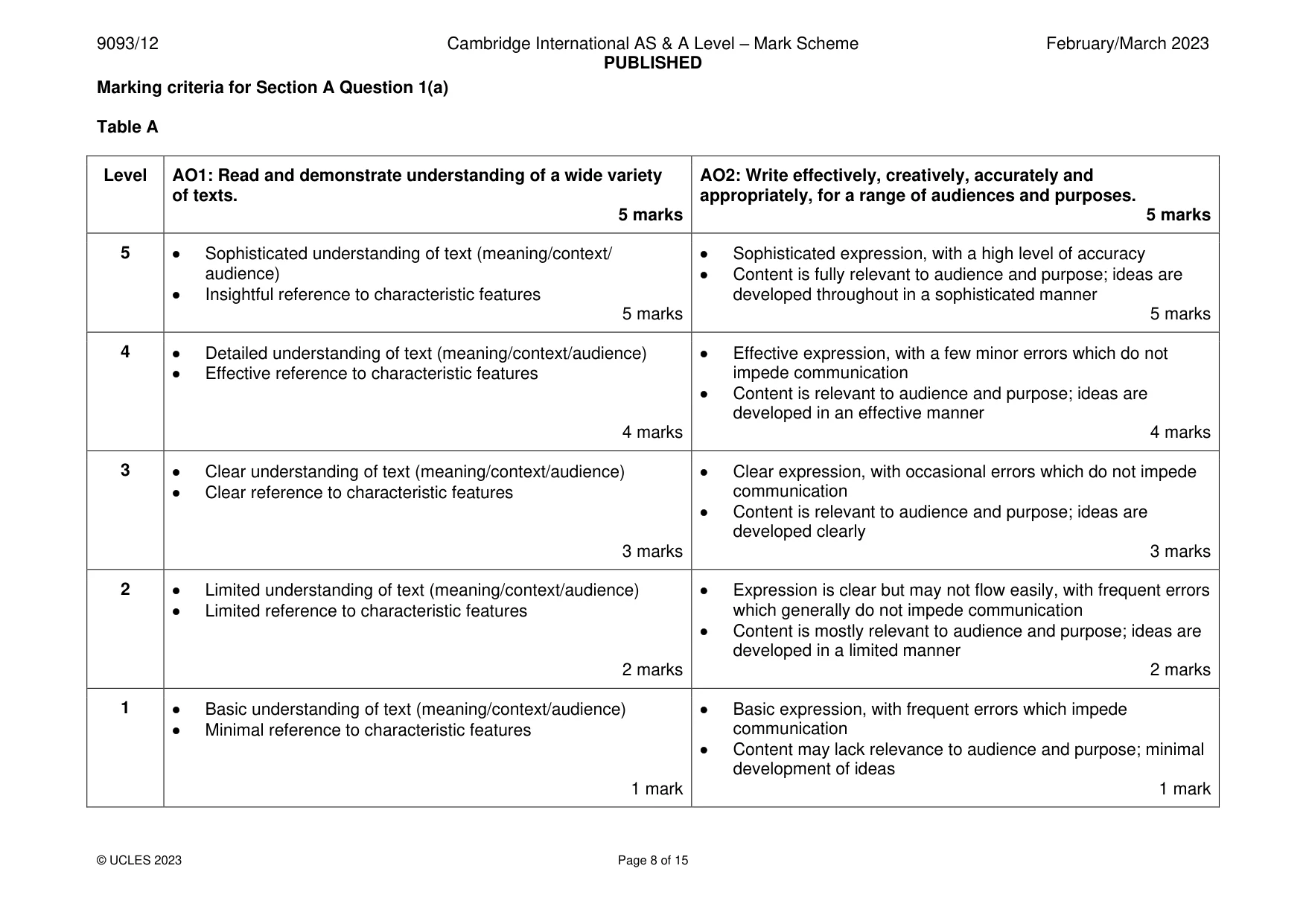
9093/12 Cambridge International AS & A Level – Mark Scheme PUBLISHED February/March 2023 © UCLES 2023 Page 8 of 15 Marking criteria for Section A Question 1(a) Table A Level AO1: Read and demonstrate understanding of a wide variety of texts. 5 marks AO2: Write effectively, creatively, accurately and appropriately, for a range of audiences and purposes. 5 marks 5 • Sophisticated understanding of text (meaning/context/ audience) • Insightful reference to characteristic features 5 marks • Sophisticated expression, with a high level of accuracy • Content is fully relevant to audience and purpose; ideas are developed throughout in a sophisticated manner 5 marks 4 • Detailed understanding of text (meaning/context/audience) • Effective reference to characteristic features 4 marks • Effective expression, with a few minor errors which do not impede communication • Content is relevant to audience and purpose; ideas are developed in an effective manner 4 marks 3 • Clear understanding of text (meaning/context/audience) • Clear reference to characteristic features 3 marks • Clear expression, with occasional errors which do not impede communication • Content is relevant to audience and purpose; ideas are developed clearly 3 marks 2 • Limited understanding of text (meaning/context/audience) • Limited reference to characteristic features 2 marks • Expression is clear but may not flow easily, with frequent errors which generally do not impede communication • Content is mostly relevant to audience and purpose; ideas are developed in a limited manner 2 marks 1 • Basic understanding of text (meaning/context/audience) • Minimal reference to characteristic features 1 mark • Basic expression, with frequent errors which impede communication • Content may lack relevance to audience and purpose; minimal development of ideas 1 mark
Mark scheme, page 9
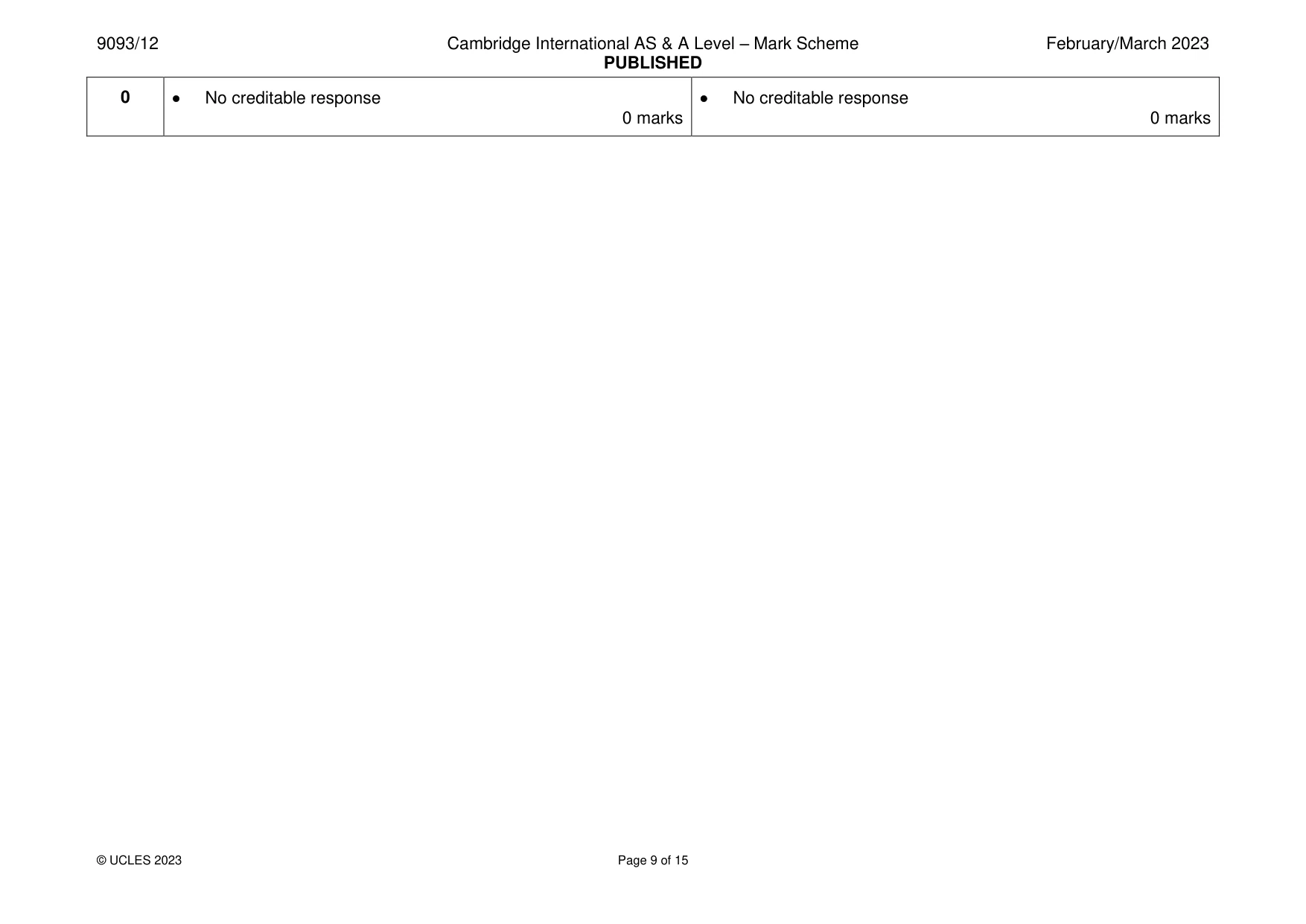
9093/12 Cambridge International AS & A Level – Mark Scheme PUBLISHED February/March 2023 © UCLES 2023 Page 9 of 15 0 • No creditable response 0 marks • No creditable response 0 marks
Mark scheme, page 10
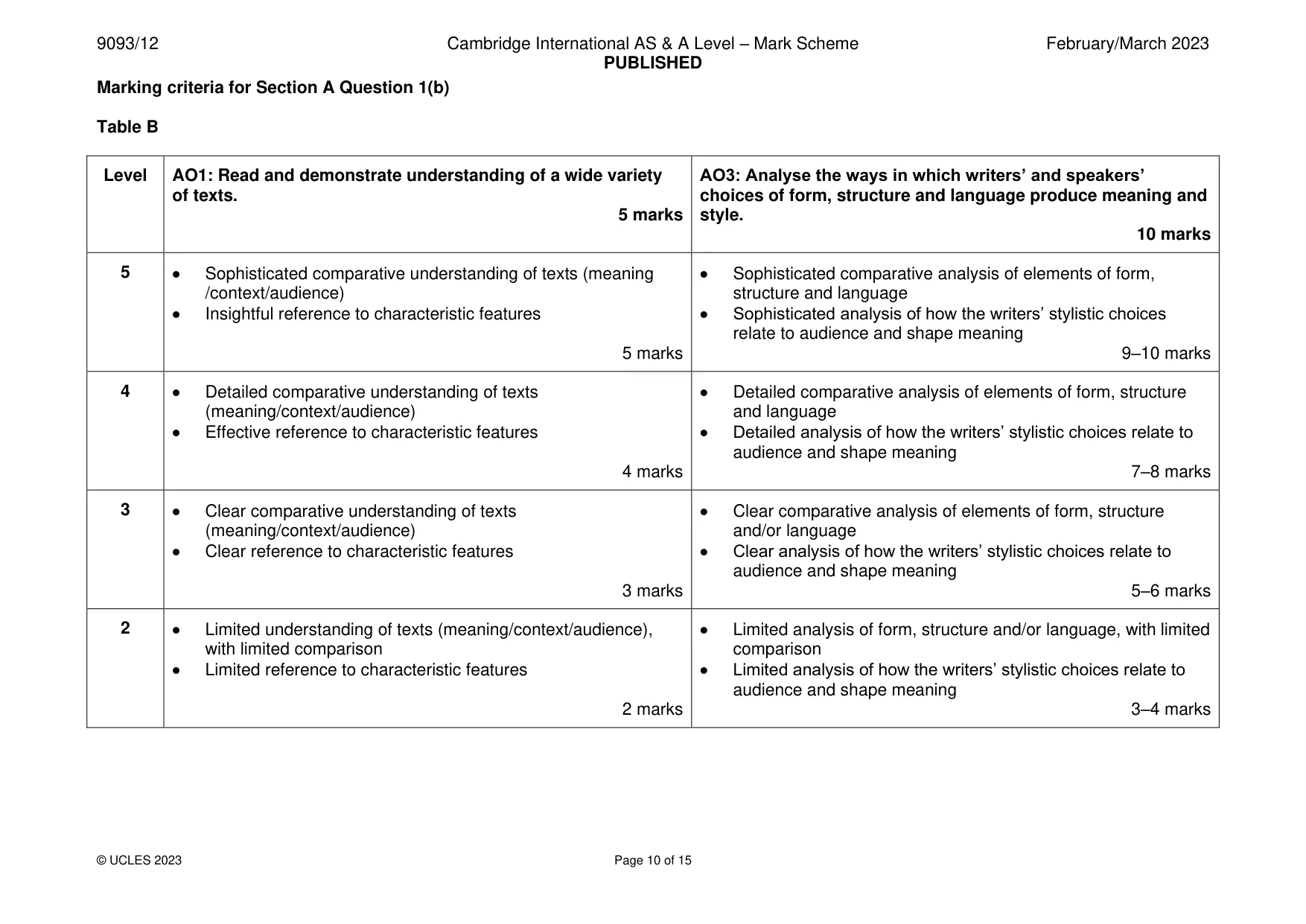
9093/12 Cambridge International AS & A Level – Mark Scheme PUBLISHED February/March 2023 © UCLES 2023 Page 10 of 15 Marking criteria for Section A Question 1(b) Table B Level AO1: Read and demonstrate understanding of a wide variety of texts. 5 marks AO3: Analyse the ways in which writers’ and speakers’ choices of form, structure and language produce meaning and style. 10 marks 5 • Sophisticated comparative understanding of texts (meaning /context/audience) • Insightful reference to characteristic features 5 marks • Sophisticated comparative analysis of elements of form, structure and language • Sophisticated analysis of how the writers’ stylistic choices relate to audience and shape meaning 9–10 marks 4 • Detailed comparative understanding of texts (meaning/context/audience) • Effective reference to characteristic features 4 marks • Detailed comparative analysis of elements of form, structure and language • Detailed analysis of how the writers’ stylistic choices relate to audience and shape meaning 7–8 marks 3 • Clear comparative understanding of texts (meaning/context/audience) • Clear reference to characteristic features 3 marks • Clear comparative analysis of elements of form, structure and/or language • Clear analysis of how the writers’ stylistic choices relate to audience and shape meaning 5–6 marks 2 • Limited understanding of texts (meaning/context/audience), with limited comparison • Limited reference to characteristic features 2 marks • Limited analysis of form, structure and/or language, with limited comparison • Limited analysis of how the writers’ stylistic choices relate to audience and shape meaning 3–4 marks
Mark scheme, page 11
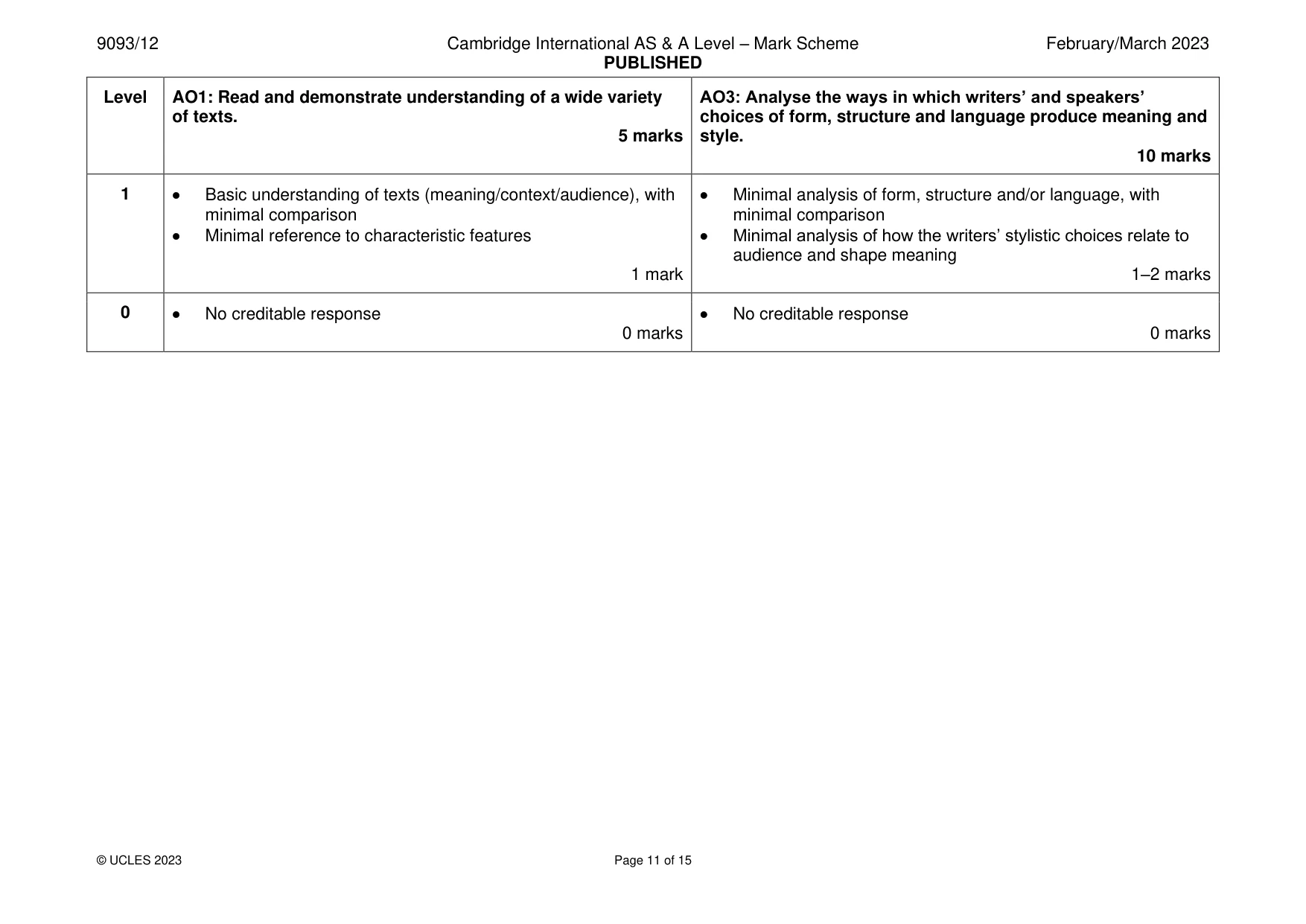
9093/12 Cambridge International AS & A Level – Mark Scheme PUBLISHED February/March 2023 © UCLES 2023 Page 11 of 15 Level AO1: Read and demonstrate understanding of a wide variety of texts. 5 marks AO3: Analyse the ways in which writers’ and speakers’ choices of form, structure and language produce meaning and style. 10 marks 1 • Basic understanding of texts (meaning/context/audience), with minimal comparison • Minimal reference to characteristic features 1 mark • Minimal analysis of form, structure and/or language, with minimal comparison • Minimal analysis of how the writers’ stylistic choices relate to audience and shape meaning 1–2 marks 0 • No creditable response 0 marks • No creditable response 0 marks
Mark scheme, page 12
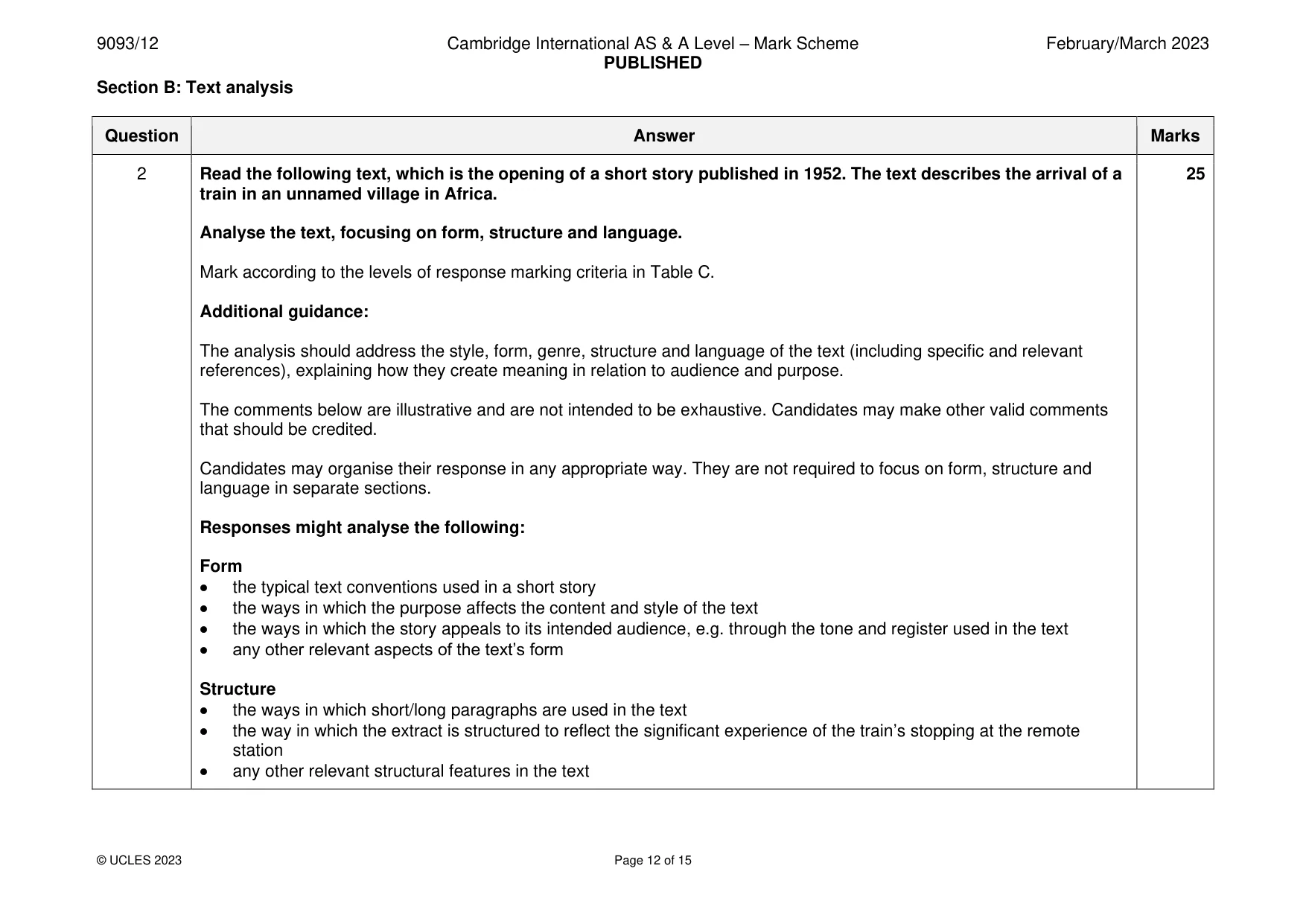
9093/12 Cambridge International AS & A Level – Mark Scheme PUBLISHED February/March 2023 © UCLES 2023 Page 12 of 15 Section B: Text analysis Question Answer Marks 2 Read the following text, which is the opening of a short story published in 1952. The text describes the arrival of a train in an unnamed village in Africa. Analyse the text, focusing on form, structure and language. Mark according to the levels of response marking criteria in Table C. Additional guidance: The analysis should address the style, form, genre, structure and language of the text (including specific and relevant references), explaining how they create meaning in relation to audience and purpose. The comments below are illustrative and are not intended to be exhaustive. Candidates may make other valid comments that should be credited. Candidates may organise their response in any appropriate way. They are not required to focus on form, structure and language in separate sections. Responses might analyse the following: Form • the typical text conventions used in a short story • the ways in which the purpose affects the content and style of the text • the ways in which the story appeals to its intended audience, e.g. through the tone and register used in the text • any other relevant aspects of the text’s form Structure • the ways in which short/long paragraphs are used in the text • the way in which the extract is structured to reflect the significant experience of the train’s stopping at the remote station • any other relevant structural features in the text 25
Mark scheme, page 13
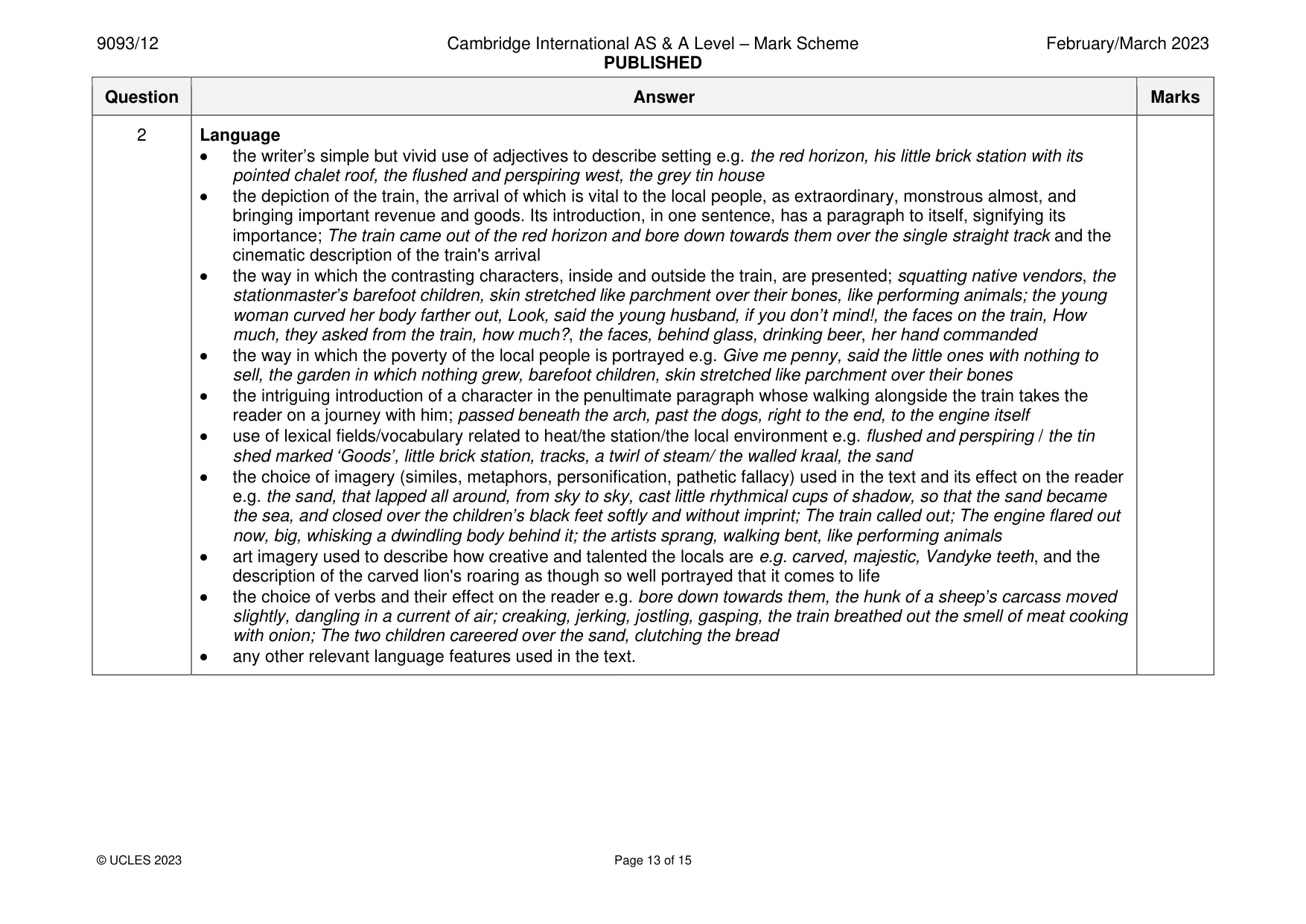
9093/12 Cambridge International AS & A Level – Mark Scheme PUBLISHED February/March 2023 © UCLES 2023 Page 13 of 15 Question Answer Marks 2 Language • the writer’s simple but vivid use of adjectives to describe setting e.g. the red horizon, his little brick station with its pointed chalet roof, the flushed and perspiring west, the grey tin house • the depiction of the train, the arrival of which is vital to the local people, as extraordinary, monstrous almost, and bringing important revenue and goods. Its introduction, in one sentence, has a paragraph to itself, signifying its importance; The train came out of the red horizon and bore down towards them over the single straight track and the cinematic description of the train's arrival • the way in which the contrasting characters, inside and outside the train, are presented; squatting native vendors, the stationmaster’s barefoot children, skin stretched like parchment over their bones, like performing animals; the young woman curved her body farther out, Look, said the young husband, if you don’t mind!, the faces on the train, How much, they asked from the train, how much?, the faces, behind glass, drinking beer, her hand commanded • the way in which the poverty of the local people is portrayed e.g. Give me penny, said the little ones with nothing to sell, the garden in which nothing grew, barefoot children, skin stretched like parchment over their bones • the intriguing introduction of a character in the penultimate paragraph whose walking alongside the train takes the reader on a journey with him; passed beneath the arch, past the dogs, right to the end, to the engine itself • use of lexical fields/vocabulary related to heat/the station/the local environment e.g. flushed and perspiring / the tin shed marked ‘Goods’, little brick station, tracks, a twirl of steam/ the walled kraal, the sand • the choice of imagery (similes, metaphors, personification, pathetic fallacy) used in the text and its effect on the reader e.g. the sand, that lapped all around, from sky to sky, cast little rhythmical cups of shadow, so that the sand became the sea, and closed over the children’s black feet softly and without imprint; The train called out; The engine flared out now, big, whisking a dwindling body behind it; the artists sprang, walking bent, like performing animals • art imagery used to describe how creative and talented the locals are e.g. carved, majestic, Vandyke teeth, and the description of the carved lion's roaring as though so well portrayed that it comes to life • the choice of verbs and their effect on the reader e.g. bore down towards them, the hunk of a sheep’s carcass moved slightly, dangling in a current of air; creaking, jerking, jostling, gasping, the train breathed out the smell of meat cooking with onion; The two children careered over the sand, clutching the bread • any other relevant language features used in the text.
Mark scheme, page 14
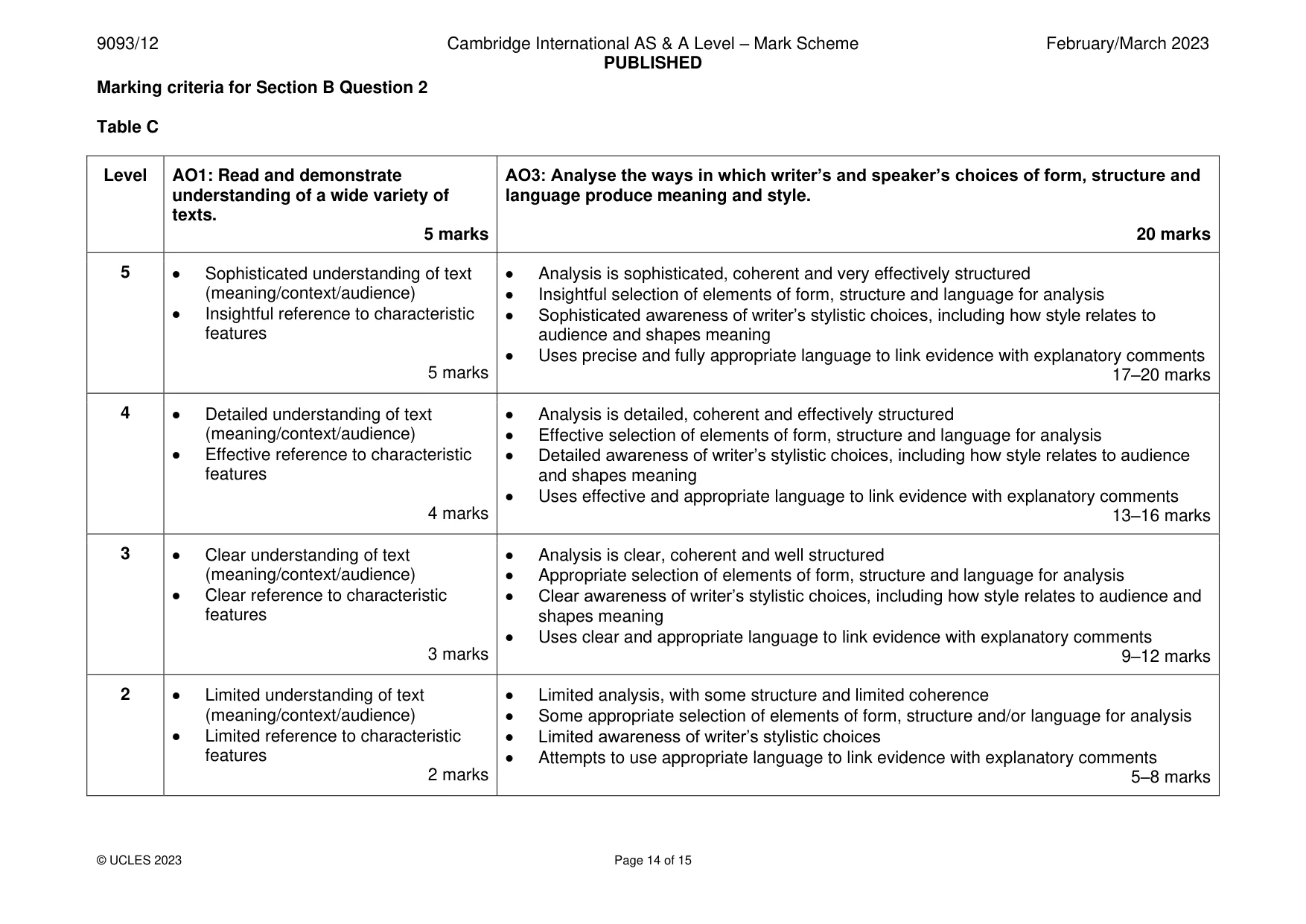
9093/12 Cambridge International AS & A Level – Mark Scheme PUBLISHED February/March 2023 © UCLES 2023 Page 14 of 15 Marking criteria for Section B Question 2 Table C Level AO1: Read and demonstrate understanding of a wide variety of texts. 5 marks AO3: Analyse the ways in which writer’s and speaker’s choices of form, structure and language produce meaning and style. 20 marks 5 • Sophisticated understanding of text (meaning/context/audience) • Insightful reference to characteristic features 5 marks • Analysis is sophisticated, coherent and very effectively structured • Insightful selection of elements of form, structure and language for analysis • Sophisticated awareness of writer’s stylistic choices, including how style relates to audience and shapes meaning • Uses precise and fully appropriate language to link evidence with explanatory comments 17–20 marks 4 • Detailed understanding of text (meaning/context/audience) • Effective reference to characteristic features 4 marks • Analysis is detailed, coherent and effectively structured • Effective selection of elements of form, structure and language for analysis • Detailed awareness of writer’s stylistic choices, including how style relates to audience and shapes meaning • Uses effective and appropriate language to link evidence with explanatory comments 13–16 marks 3 • Clear understanding of text (meaning/context/audience) • Clear reference to characteristic features 3 marks • Analysis is clear, coherent and well structured • Appropriate selection of elements of form, structure and language for analysis • Clear awareness of writer’s stylistic choices, including how style relates to audience and shapes meaning • Uses clear and appropriate language to link evidence with explanatory comments 9–12 marks 2 • Limited understanding of text (meaning/context/audience) • Limited reference to characteristic features 2 marks • Limited analysis, with some structure and limited coherence • Some appropriate selection of elements of form, structure and/or language for analysis • Limited awareness of writer’s stylistic choices • Attempts to use appropriate language to link evidence with explanatory comments 5–8 marks
Mark scheme, page 15
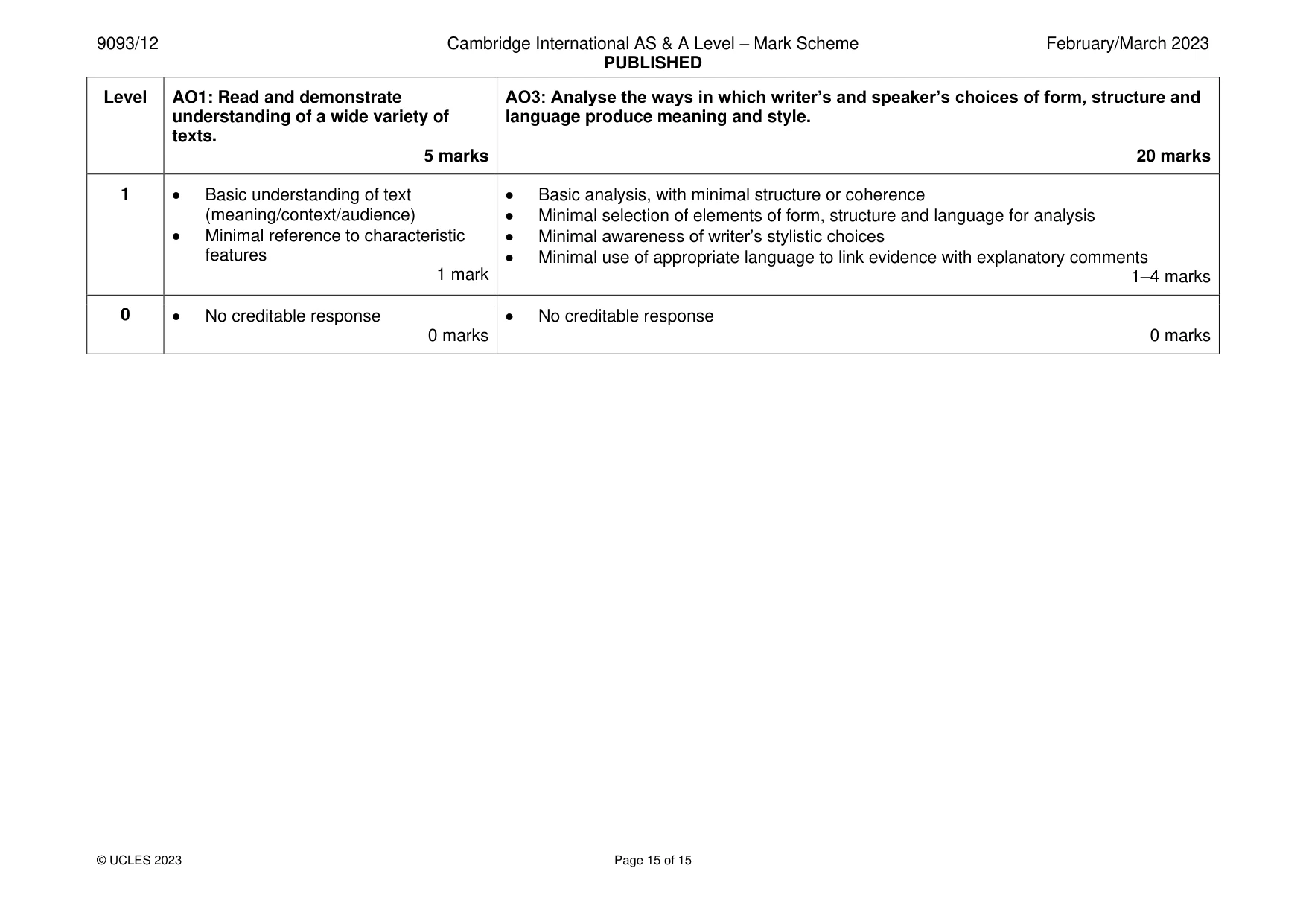
9093/12 Cambridge International AS & A Level – Mark Scheme PUBLISHED February/March 2023 © UCLES 2023 Page 15 of 15 Level AO1: Read and demonstrate understanding of a wide variety of texts. 5 marks AO3: Analyse the ways in which writer’s and speaker’s choices of form, structure and language produce meaning and style. 20 marks 1 • Basic understanding of text (meaning/context/audience) • Minimal reference to characteristic features 1 mark • Basic analysis, with minimal structure or coherence • Minimal selection of elements of form, structure and language for analysis • Minimal awareness of writer’s stylistic choices • Minimal use of appropriate language to link evidence with explanatory comments 1–4 marks 0 • No creditable response 0 marks • No creditable response 0 marks
What you needed in this session
Cambridge’s own grade thresholds for 2023 Feb/March, Paper 1 · Variant 2. A higher threshold means an easier paper — the bar moves with how the cohort did.