Cambridge A Level English - Language AS and A Level (from 2014) 9093 — 2025 May/June Paper 1 · Variant 2
9093/12/M/J/25 · 50 marks · 135 min
The question paper and its mark scheme, free to read here and free to download. This is Cambridge’s own paper, exactly as it was sat.
Question paper8 pages


Mark scheme18 pages
Answers below. Sit the paper first if you are practising.
Paper as text
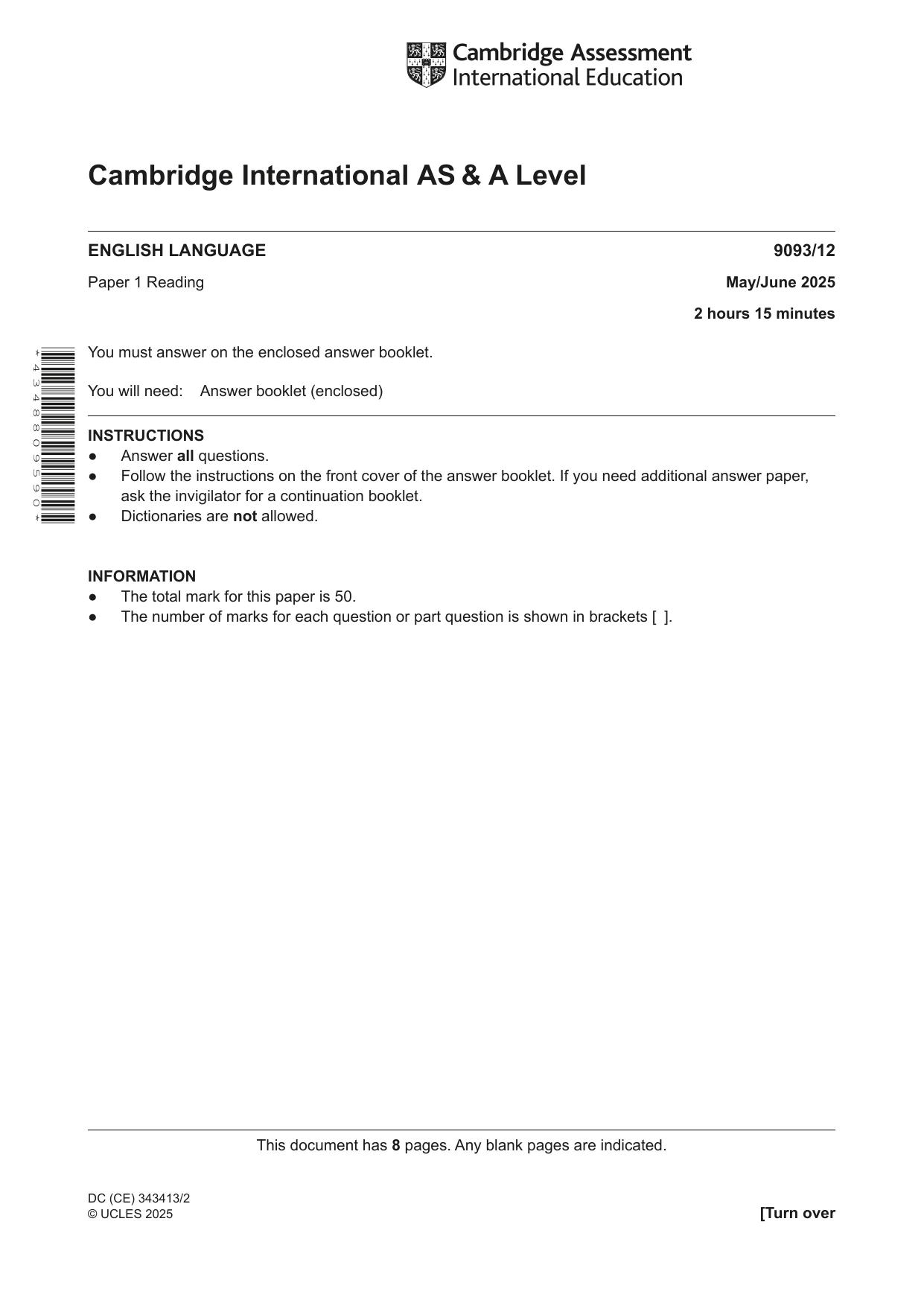
Question paper, page 1
This document has 8 pages. Any blank pages are indicated. [Turn over Cambridge International AS & A Level DC (CE) 343413/2 © UCLES 2025 ENGLISH LANGUAGE 9093/12 Paper 1 Reading May/June 2025 2 hours 15 minutes You must answer on the enclosed answer booklet. You will need: Answer booklet (enclosed) INSTRUCTIONS ● Answer all questions. ● Follow the instructions on the front cover of the answer booklet. If you need additional answer paper, ask the invigilator for a continuation booklet. ● Dictionaries are not allowed. INFORMATION ● The total mark for this paper is 50. ● The number of marks for each question or part question is shown in brackets [ ]. * 4 3 4 8 8 0 9 5 9 0 *
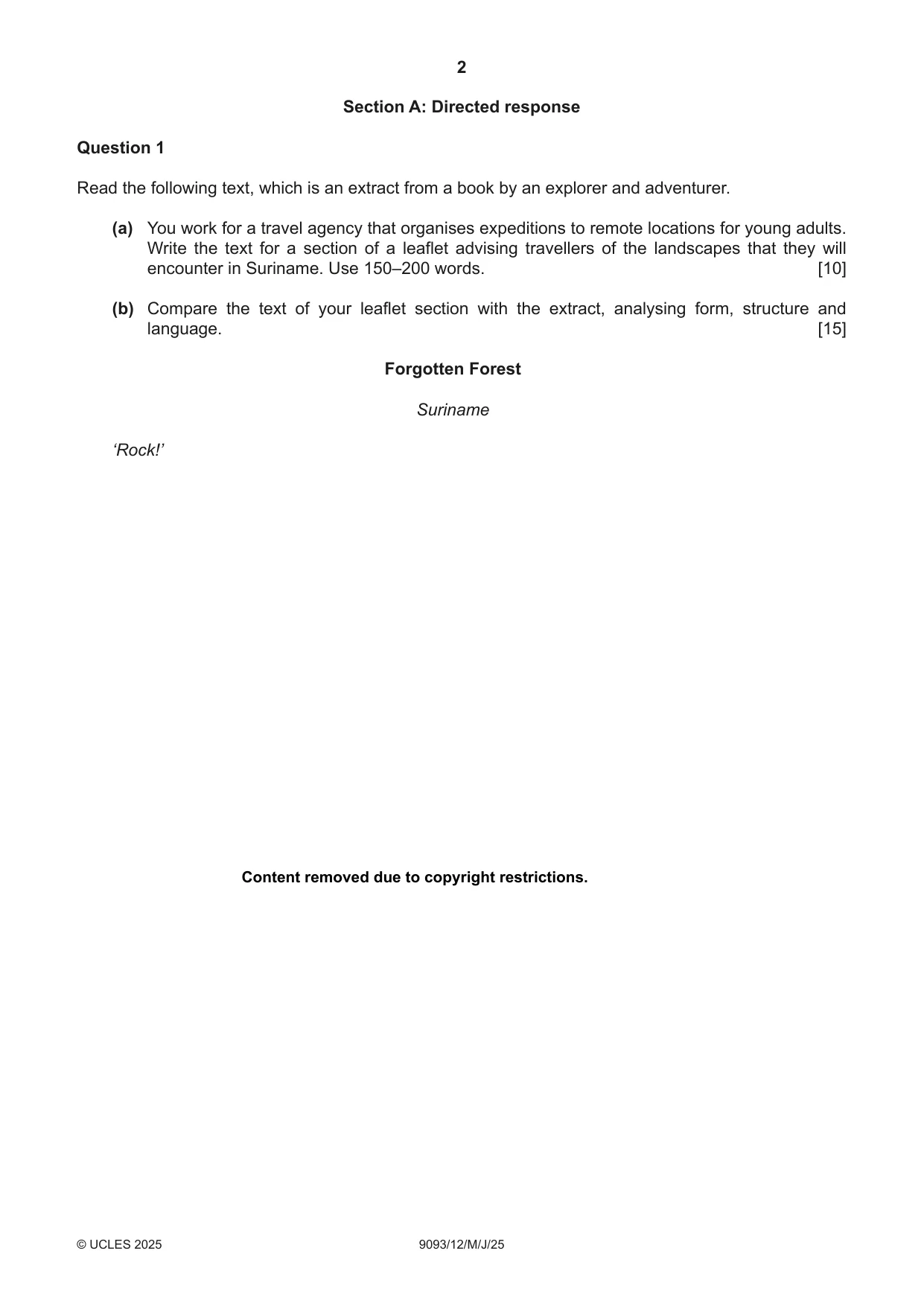
Question paper, page 2
2 9093/12/M/J/25 © UCLES 2025 Section A: Directed response Question 1 Read the following text, which is an extract from a book by an explorer and adventurer. (a) You work for a travel agency that organises expeditions to remote locations for young adults. Write the text for a section of a leaflet advising travellers of the landscapes that they will encounter in Suriname. Use 150–200 words. [10] (b) Compare the text of your leaflet section with the extract, analysing form, structure and language. [15] Forgotten Forest Suriname ‘Rock!’ Content removed due to copyright restrictions.
Question paper, page 3
3 9093/12/M/J/25 © UCLES 2025 [Turn over It would have been an unbeatable(!) expedition, but it would have taken a month we did not have. Content removed due to copyright restrictions.
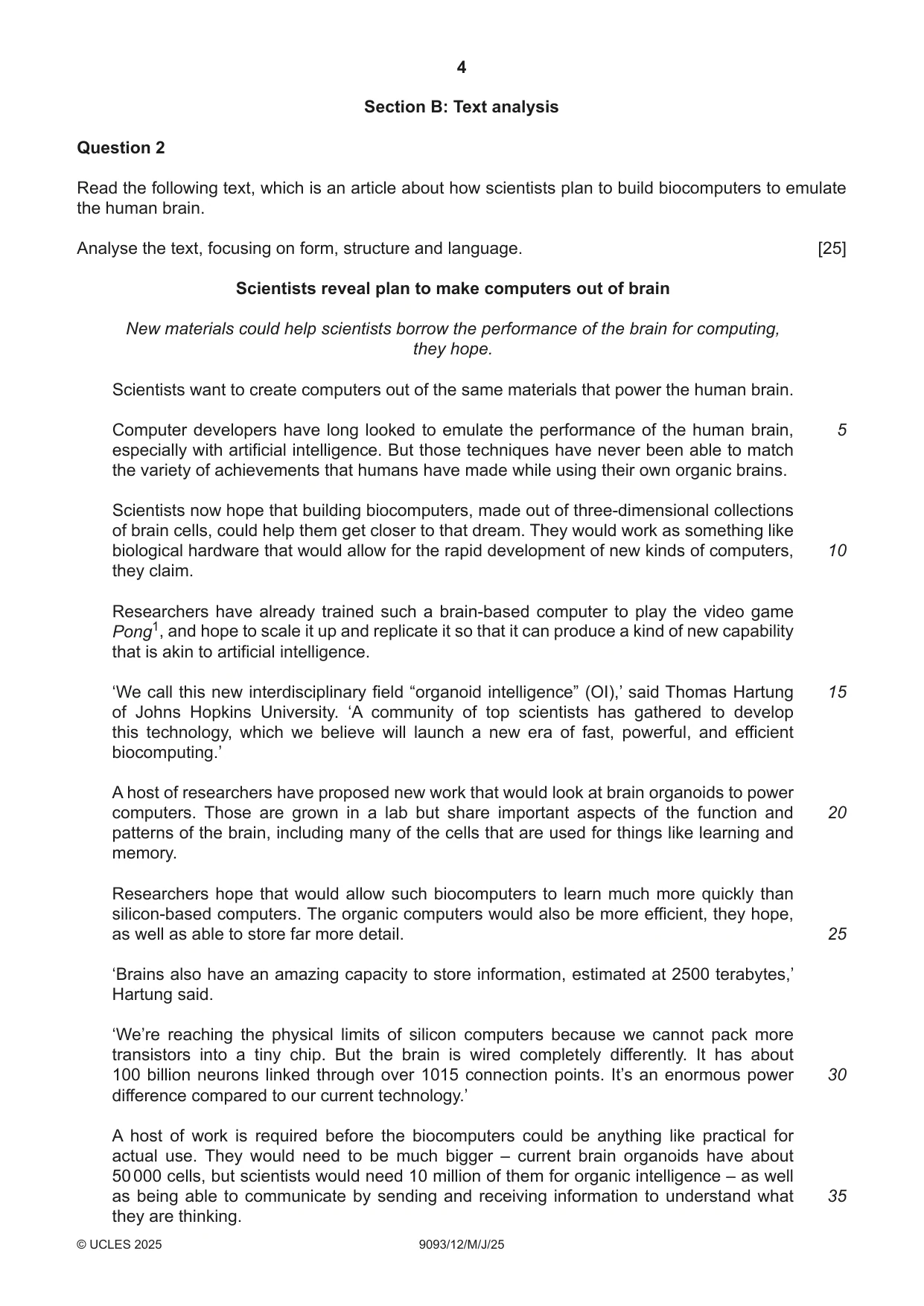
Question paper, page 4
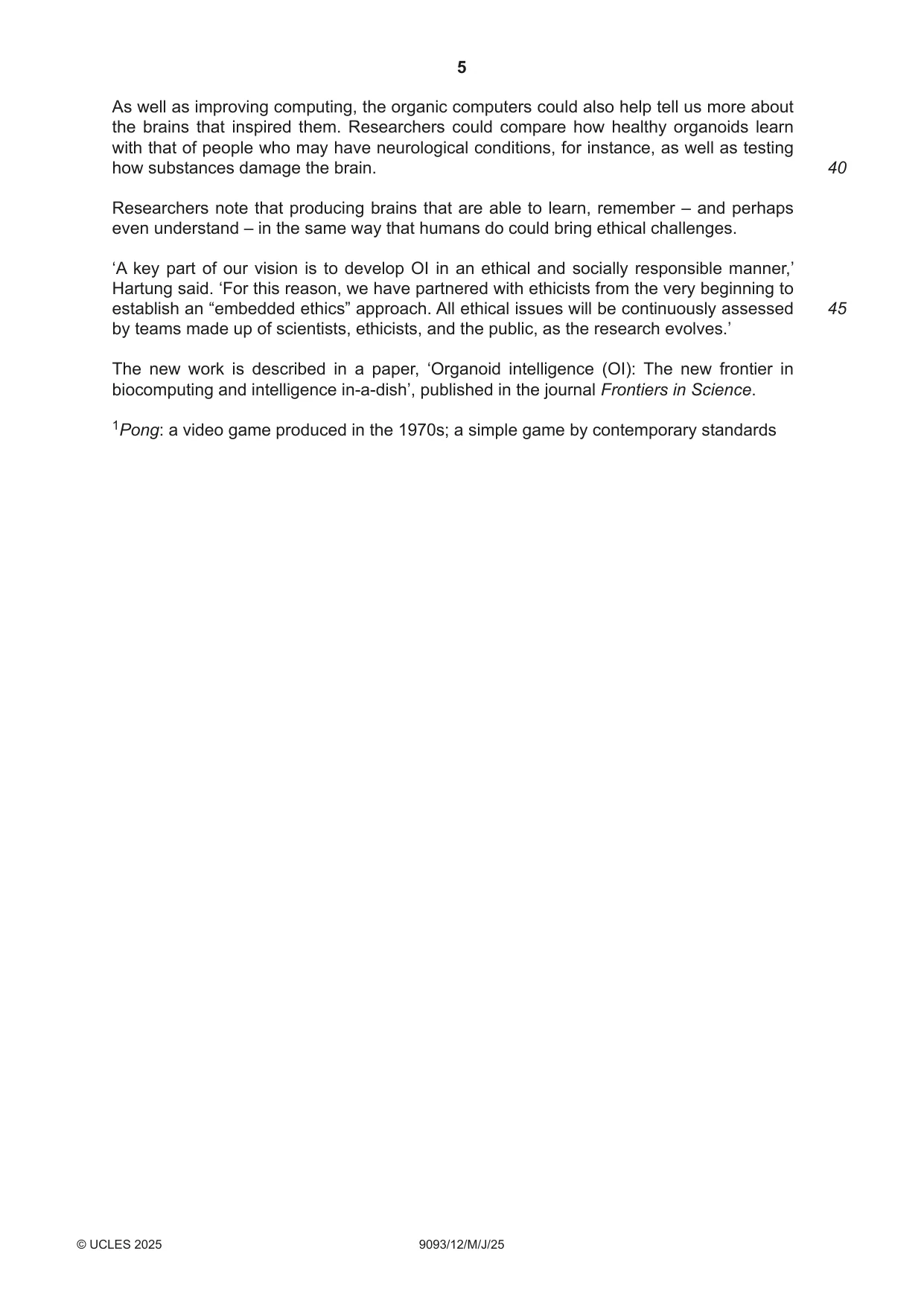
4 9093/12/M/J/25 © UCLES 2025 Section B: Text analysis Question 2 Read the following text, which is an article about how scientists plan to build biocomputers to emulate the human brain. Analyse the text, focusing on form, structure and language. [25] Scientists reveal plan to make computers out of brain New materials could help scientists borrow the performance of the brain for computing, they hope. Scientists want to create computers out of the same materials that power the human brain. Computer developers have long looked to emulate the performance of the human brain, especially with artificial intelligence. But those techniques have never been able to match the variety of achievements that humans have made while using their own organic brains. Scientists now hope that building biocomputers, made out of three-dimensional collections of brain cells, could help them get closer to that dream. They would work as something like biological hardware that would allow for the rapid development of new kinds of computers, they claim. Researchers have already trained such a brain-based computer to play the video game Pong1, and hope to scale it up and replicate it so that it can produce a kind of new capability that is akin to artificial intelligence. ‘We call this new interdisciplinary field “organoid intelligence” (OI),’ said Thomas Hartung of Johns Hopkins University. ‘A community of top scientists has gathered to develop this technology, which we believe will launch a new era of fast, powerful, and efficient biocomputing.’ A host of researchers have proposed new work that would look at brain organoids to power computers. Those are grown in a lab but share important aspects of the function and patterns of the brain, including many of the cells that are used for things like learning and memory. Researchers hope that would allow such biocomputers to learn much more quickly than silicon-based computers. The organic computers would also be more efficient, they hope, as well as able to store far more detail. ‘Brains also have an amazing capacity to store information, estimated at 2500 terabytes,’ Hartung said. ‘We’re reaching the physical limits of silicon computers because we cannot pack more transistors into a tiny chip. But the brain is wired completely differently. It has about 100 billion neurons linked through over 1015 connection points. It’s an enormous power difference compared to our current technology.’ A host of work is required before the biocomputers could be anything like practical for actual use. They would need to be much bigger – current brain organoids have about 50 000 cells, but scientists would need 10 million of them for organic intelligence – as well as being able to communicate by sending and receiving information to understand what they are thinking. 5 10 15 20 25 30 35
Question paper, page 5
5 9093/12/M/J/25 © UCLES 2025 As well as improving computing, the organic computers could also help tell us more about the brains that inspired them. Researchers could compare how healthy organoids learn with that of people who may have neurological conditions, for instance, as well as testing how substances damage the brain. Researchers note that producing brains that are able to learn, remember – and perhaps even understand – in the same way that humans do could bring ethical challenges. ‘A key part of our vision is to develop OI in an ethical and socially responsible manner,’ Hartung said. ‘For this reason, we have partnered with ethicists from the very beginning to establish an “embedded ethics” approach. All ethical issues will be continuously assessed by teams made up of scientists, ethicists, and the public, as the research evolves.’ The new work is described in a paper, ‘Organoid intelligence (OI): The new frontier in biocomputing and intelligence in-a-dish’, published in the journal Frontiers in Science. 1Pong: a video game produced in the 1970s; a simple game by contemporary standards 40 45
Question paper, page 6
6 9093/12/M/J/25 © UCLES 2025 BLANK PAGE
Question paper, page 7
7 9093/12/M/J/25 © UCLES 2025 BLANK PAGE
Question paper, page 8
8 9093/12/M/J/25 © UCLES 2025 Permission to reproduce items where third-party owned material protected by copyright is included has been sought and cleared where possible. Every reasonable effort has been made by the publisher (UCLES) to trace copyright holders, but if any items requiring clearance have unwittingly been included, the publisher will be pleased to make amends at the earliest possible opportunity. To avoid the issue of disclosure of answer-related information to candidates, all copyright acknowledgements are reproduced online in the Cambridge Assessment International Education Copyright Acknowledgements Booklet. This is produced for each series of examinations and is freely available to download at www.cambridgeinternational.org after the live examination series. Cambridge Assessment International Education is part of Cambridge Assessment. Cambridge Assessment is the brand name of the University of Cambridge Local Examinations Syndicate (UCLES), which is a department of the University of Cambridge. BLANK PAGE
Mark scheme, page 1
This document consists of 18 printed pages. © Cambridge University Press & Assessment 2025 [Turn over Cambridge International AS & A Level ENGLISH LANGUAGE 9093/12 Paper 1 Reading May/June 2025 MARK SCHEME Maximum Mark: 50 Published This mark scheme is published as an aid to teachers and candidates, to indicate the requirements of the examination. It shows the basis on which Examiners were instructed to award marks. It does not indicate the details of the discussions that took place at an Examiners’ meeting before marking began, which would have considered the acceptability of alternative answers. Mark schemes should be read in conjunction with the question paper and the Principal Examiner Report for Teachers. Cambridge International will not enter into discussions about these mark schemes. Cambridge International is publishing the mark schemes for the May/June 2025 series for most Cambridge IGCSE, Cambridge International A and AS Level components, and some Cambridge O Level components.
Mark scheme, page 2
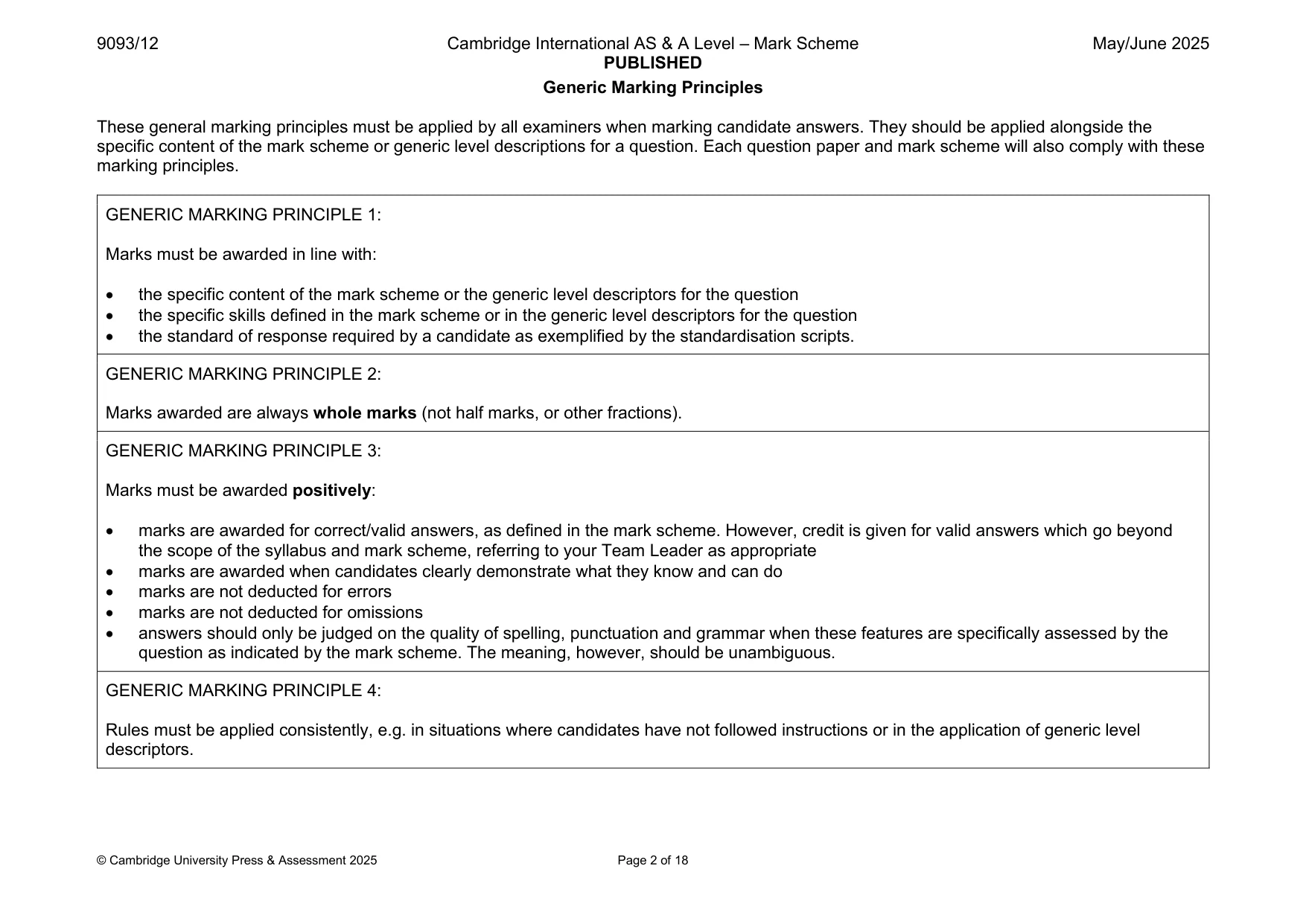
9093/12 Cambridge International AS & A Level – Mark Scheme PUBLISHED May/June 2025 © Cambridge University Press & Assessment 2025 Page 2 of 18 Generic Marking Principles These general marking principles must be applied by all examiners when marking candidate answers. They should be applied alongside the specific content of the mark scheme or generic level descriptions for a question. Each question paper and mark scheme will also comply with these marking principles. GENERIC MARKING PRINCIPLE 1: Marks must be awarded in line with: • the specific content of the mark scheme or the generic level descriptors for the question • the specific skills defined in the mark scheme or in the generic level descriptors for the question • the standard of response required by a candidate as exemplified by the standardisation scripts. GENERIC MARKING PRINCIPLE 2: Marks awarded are always whole marks (not half marks, or other fractions). GENERIC MARKING PRINCIPLE 3: Marks must be awarded positively: • marks are awarded for correct/valid answers, as defined in the mark scheme. However, credit is given for valid answers which go beyond the scope of the syllabus and mark scheme, referring to your Team Leader as appropriate • marks are awarded when candidates clearly demonstrate what they know and can do • marks are not deducted for errors • marks are not deducted for omissions • answers should only be judged on the quality of spelling, punctuation and grammar when these features are specifically assessed by the question as indicated by the mark scheme. The meaning, however, should be unambiguous. GENERIC MARKING PRINCIPLE 4: Rules must be applied consistently, e.g. in situations where candidates have not followed instructions or in the application of generic level descriptors.
Mark scheme, page 3
9093/12 Cambridge International AS & A Level – Mark Scheme PUBLISHED May/June 2025 © Cambridge University Press & Assessment 2025 Page 3 of 18 GENERIC MARKING PRINCIPLE 5: Marks should be awarded using the full range of marks defined in the mark scheme for the question (however; the use of the full mark range may be limited according to the quality of the candidate responses seen). GENERIC MARKING PRINCIPLE 6: Marks awarded are based solely on the requirements as defined in the mark scheme. Marks should not be awarded with grade thresholds or grade descriptors in mind.
Mark scheme, page 4
9093/12 Cambridge International AS & A Level – Mark Scheme PUBLISHED May/June 2025 © Cambridge University Press & Assessment 2025 Page 4 of 18 English & Media subject specific general marking principles (To be read in conjunction with the Generic Marking Principles (and requiring further guidance on how to place marks within levels)) Components using level descriptors: • We use level descriptors as a guide to broad understanding of the qualities normally expected of, or typical of, work in a level. • Level descriptors are a means of general guidance and should not be interpreted as hurdle statements. • Where indicative content notes are supplied for a question, these are not a prescription of required content, and must not be treated as such. Alternative correct points and unexpected answers in candidates’ scripts must be given marks that fairly reflect the knowledge and skills demonstrated. • While we may have legitimate expectations as to the ground most answers may occupy, we must at all times be prepared to meet candidates on their chosen ground, provided it is relevant ground (e.g. clearly related to and derived from a relevant passage/text and meeting the mark scheme requirements for the question).
Mark scheme, page 5
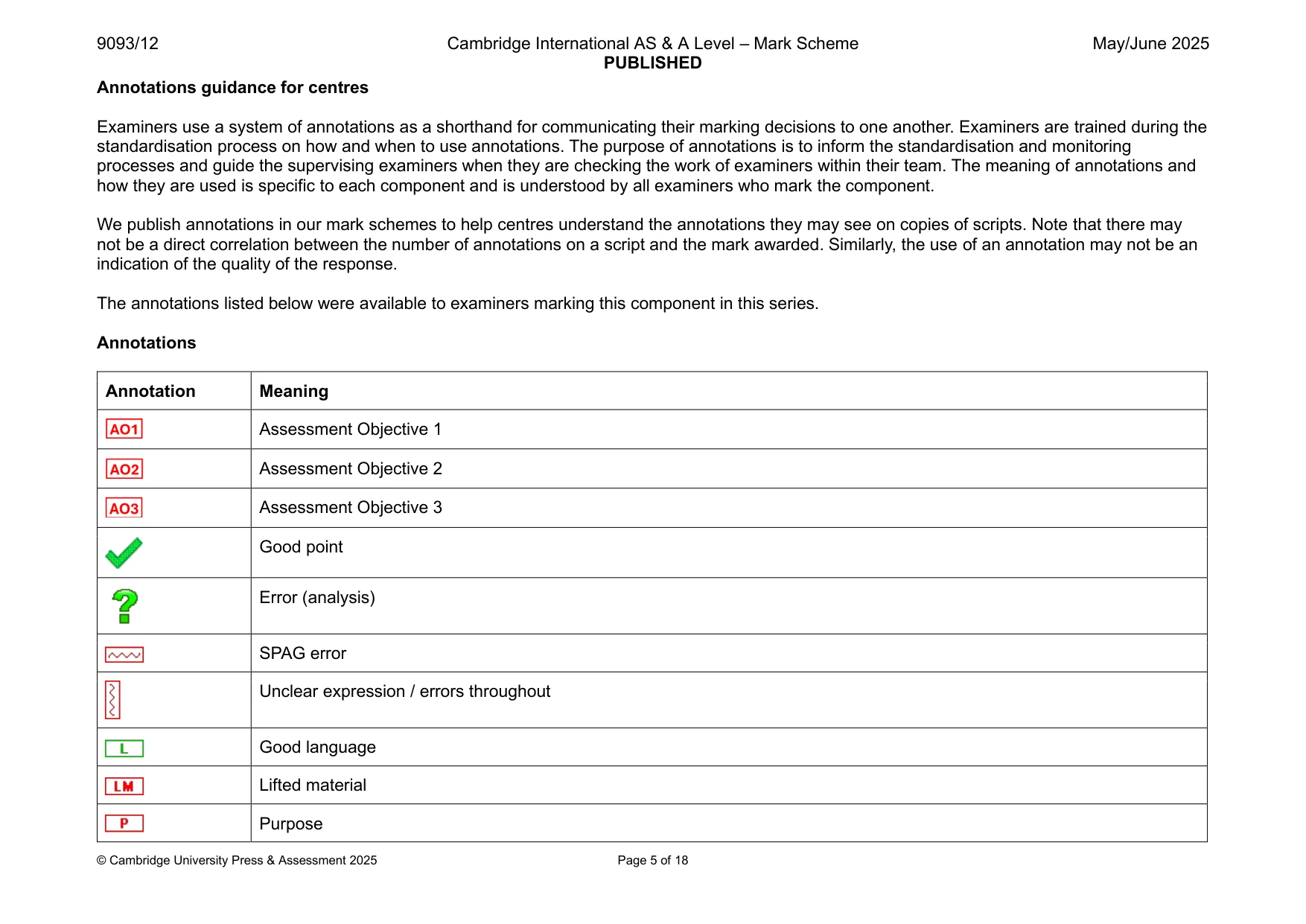
9093/12 Cambridge International AS & A Level – Mark Scheme PUBLISHED May/June 2025 © Cambridge University Press & Assessment 2025 Page 5 of 18 Annotations guidance for centres Examiners use a system of annotations as a shorthand for communicating their marking decisions to one another. Examiners are trained during the standardisation process on how and when to use annotations. The purpose of annotations is to inform the standardisation and monitoring processes and guide the supervising examiners when they are checking the work of examiners within their team. The meaning of annotations and how they are used is specific to each component and is understood by all examiners who mark the component. We publish annotations in our mark schemes to help centres understand the annotations they may see on copies of scripts. Note that there may not be a direct correlation between the number of annotations on a script and the mark awarded. Similarly, the use of an annotation may not be an indication of the quality of the response. The annotations listed below were available to examiners marking this component in this series. Annotations Annotation Meaning Assessment Objective 1 Assessment Objective 2 Assessment Objective 3 Good point Error (analysis) SPAG error Unclear expression / errors throughout Good language Lifted material Purpose
Mark scheme, page 6
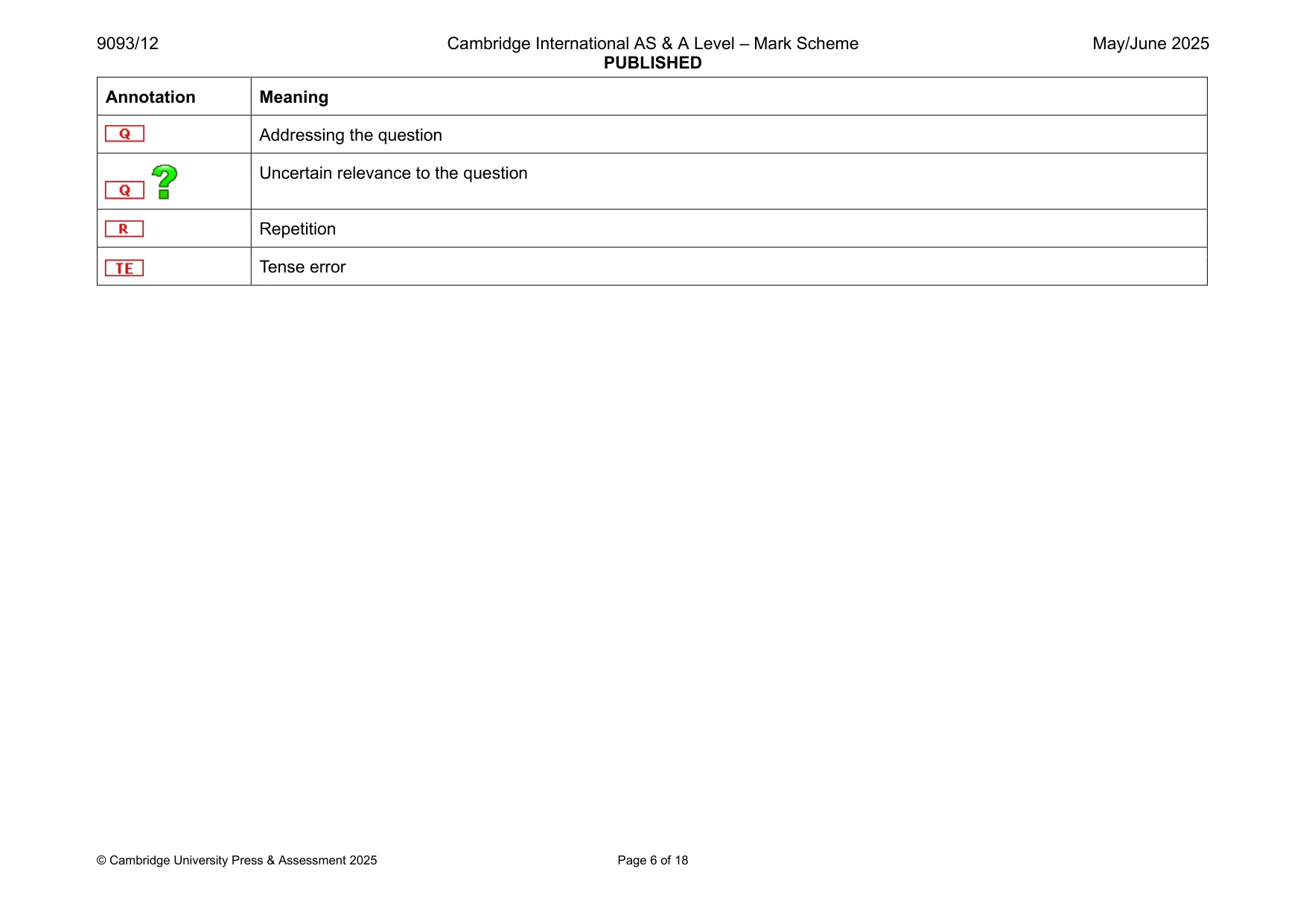
9093/12 Cambridge International AS & A Level – Mark Scheme PUBLISHED May/June 2025 © Cambridge University Press & Assessment 2025 Page 6 of 18 Annotation Meaning Addressing the question Uncertain relevance to the question Repetition Tense error
Mark scheme, page 7
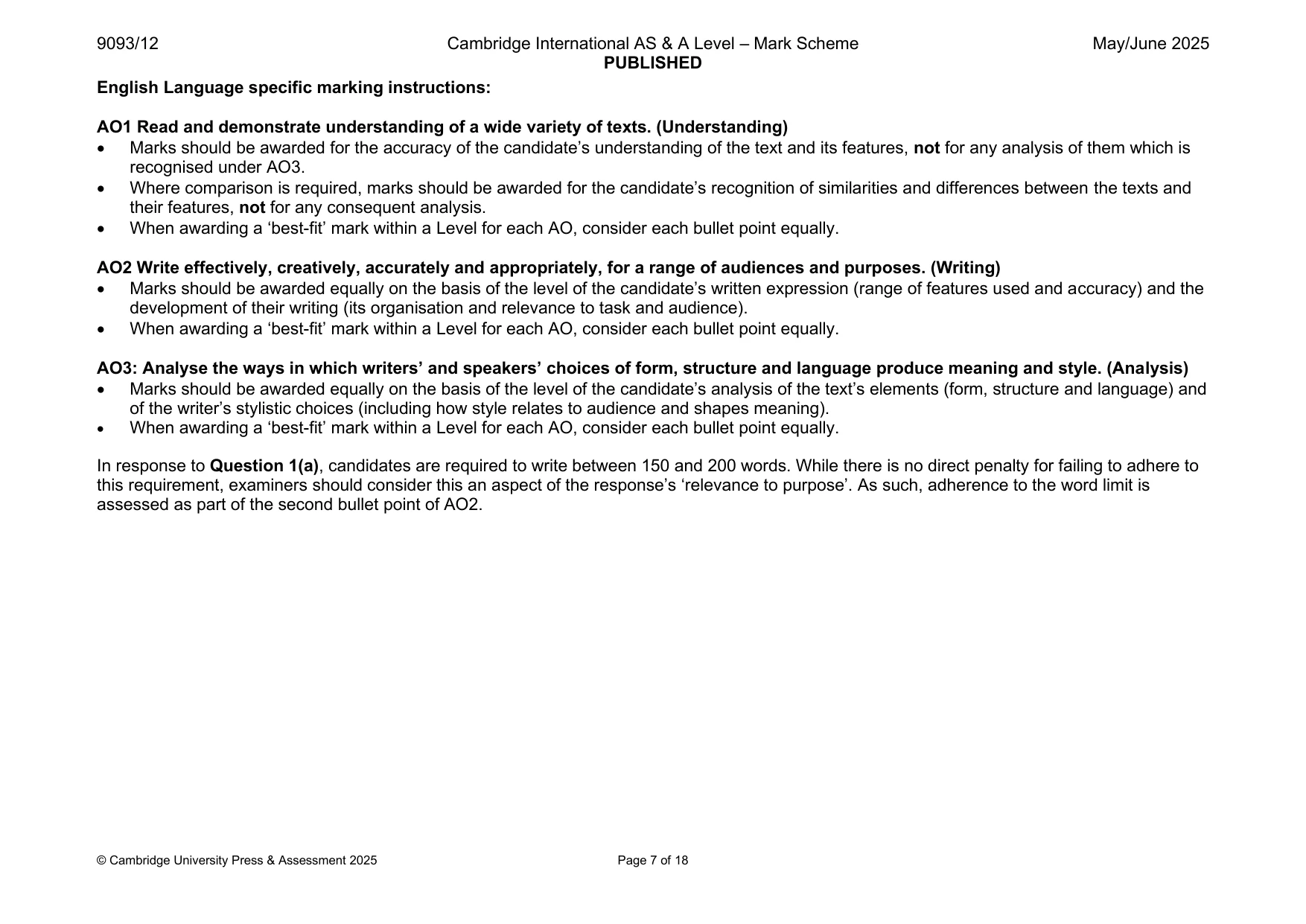
9093/12 Cambridge International AS & A Level – Mark Scheme PUBLISHED May/June 2025 © Cambridge University Press & Assessment 2025 Page 7 of 18 English Language specific marking instructions: AO1 Read and demonstrate understanding of a wide variety of texts. (Understanding) • Marks should be awarded for the accuracy of the candidate’s understanding of the text and its features, not for any analysis of them which is recognised under AO3. • Where comparison is required, marks should be awarded for the candidate’s recognition of similarities and differences between the texts and their features, not for any consequent analysis. • When awarding a ‘best-fit’ mark within a Level for each AO, consider each bullet point equally. AO2 Write effectively, creatively, accurately and appropriately, for a range of audiences and purposes. (Writing) • Marks should be awarded equally on the basis of the level of the candidate’s written expression (range of features used and accuracy) and the development of their writing (its organisation and relevance to task and audience). • When awarding a ‘best-fit’ mark within a Level for each AO, consider each bullet point equally. AO3: Analyse the ways in which writers’ and speakers’ choices of form, structure and language produce meaning and style. (Analysis) • Marks should be awarded equally on the basis of the level of the candidate’s analysis of the text’s elements (form, structure and language) and of the writer’s stylistic choices (including how style relates to audience and shapes meaning). • When awarding a ‘best-fit’ mark within a Level for each AO, consider each bullet point equally. In response to Question 1(a), candidates are required to write between 150 and 200 words. While there is no direct penalty for failing to adhere to this requirement, examiners should consider this an aspect of the response’s ‘relevance to purpose’. As such, adherence to the word limit is assessed as part of the second bullet point of AO2.
Mark scheme, page 8
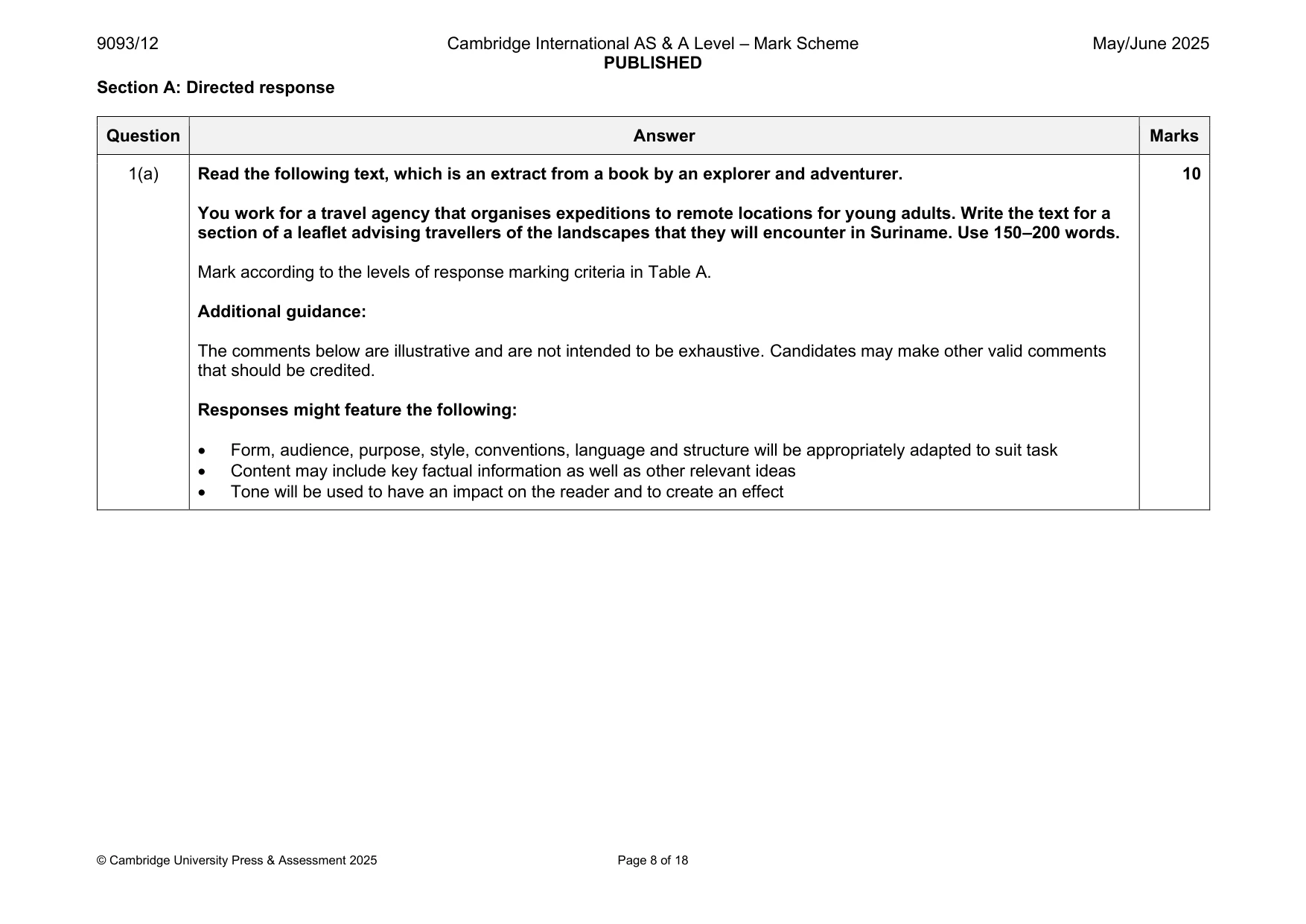
9093/12 Cambridge International AS & A Level – Mark Scheme PUBLISHED May/June 2025 © Cambridge University Press & Assessment 2025 Page 8 of 18 Section A: Directed response Question Answer Marks 1(a) Read the following text, which is an extract from a book by an explorer and adventurer. You work for a travel agency that organises expeditions to remote locations for young adults. Write the text for a section of a leaflet advising travellers of the landscapes that they will encounter in Suriname. Use 150–200 words. Mark according to the levels of response marking criteria in Table A. Additional guidance: The comments below are illustrative and are not intended to be exhaustive. Candidates may make other valid comments that should be credited. Responses might feature the following: • Form, audience, purpose, style, conventions, language and structure will be appropriately adapted to suit task • Content may include key factual information as well as other relevant ideas • Tone will be used to have an impact on the reader and to create an effect 10
Mark scheme, page 9
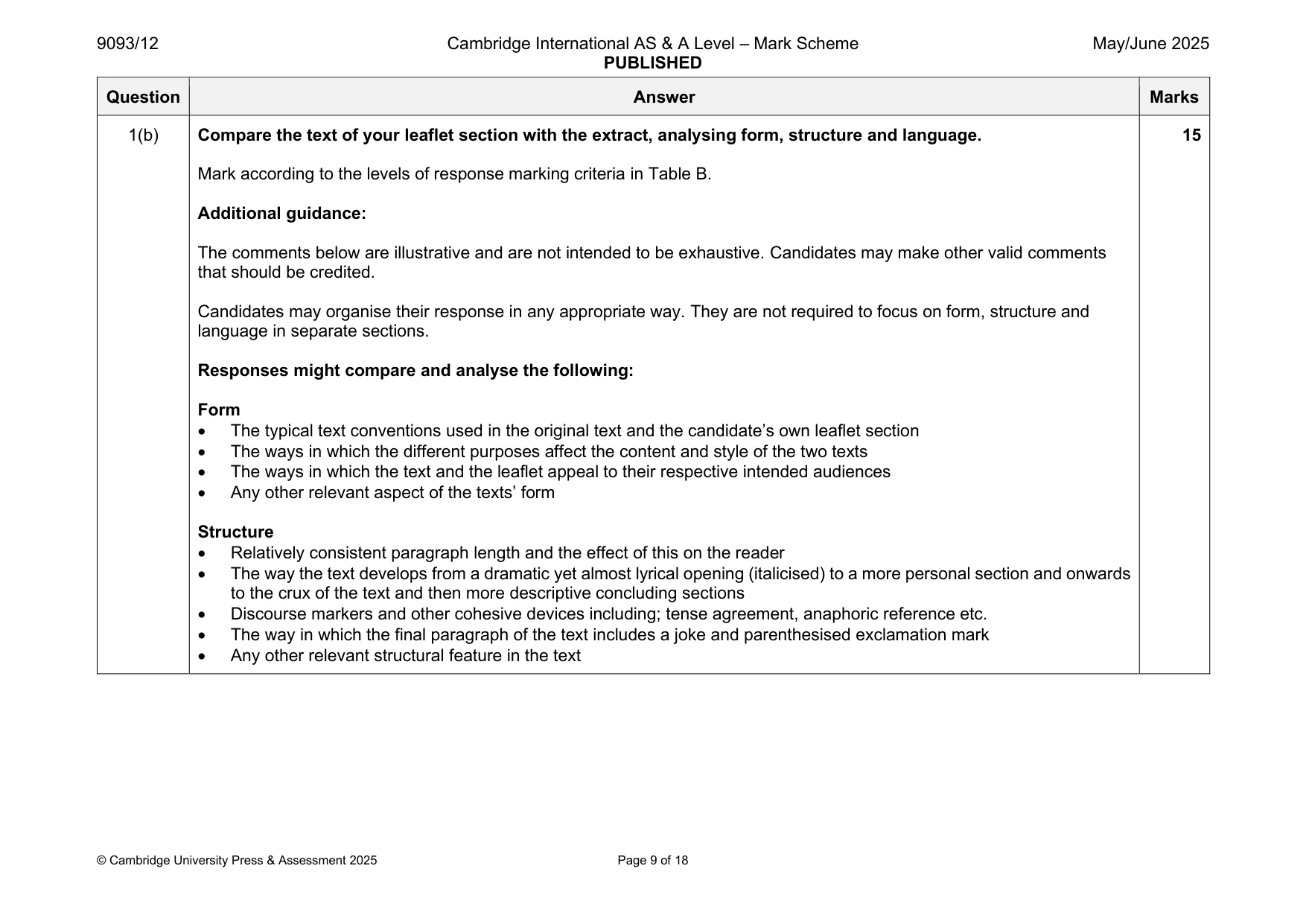
9093/12 Cambridge International AS & A Level – Mark Scheme PUBLISHED May/June 2025 © Cambridge University Press & Assessment 2025 Page 9 of 18 Question Answer Marks 1(b) Compare the text of your leaflet section with the extract, analysing form, structure and language. Mark according to the levels of response marking criteria in Table B. Additional guidance: The comments below are illustrative and are not intended to be exhaustive. Candidates may make other valid comments that should be credited. Candidates may organise their response in any appropriate way. They are not required to focus on form, structure and language in separate sections. Responses might compare and analyse the following: Form • The typical text conventions used in the original text and the candidate’s own leaflet section • The ways in which the different purposes affect the content and style of the two texts • The ways in which the text and the leaflet appeal to their respective intended audiences • Any other relevant aspect of the texts’ form Structure • Relatively consistent paragraph length and the effect of this on the reader • The way the text develops from a dramatic yet almost lyrical opening (italicised) to a more personal section and onwards to the crux of the text and then more descriptive concluding sections • Discourse markers and other cohesive devices including; tense agreement, anaphoric reference etc. • The way in which the final paragraph of the text includes a joke and parenthesised exclamation mark • Any other relevant structural feature in the text 15
Mark scheme, page 10
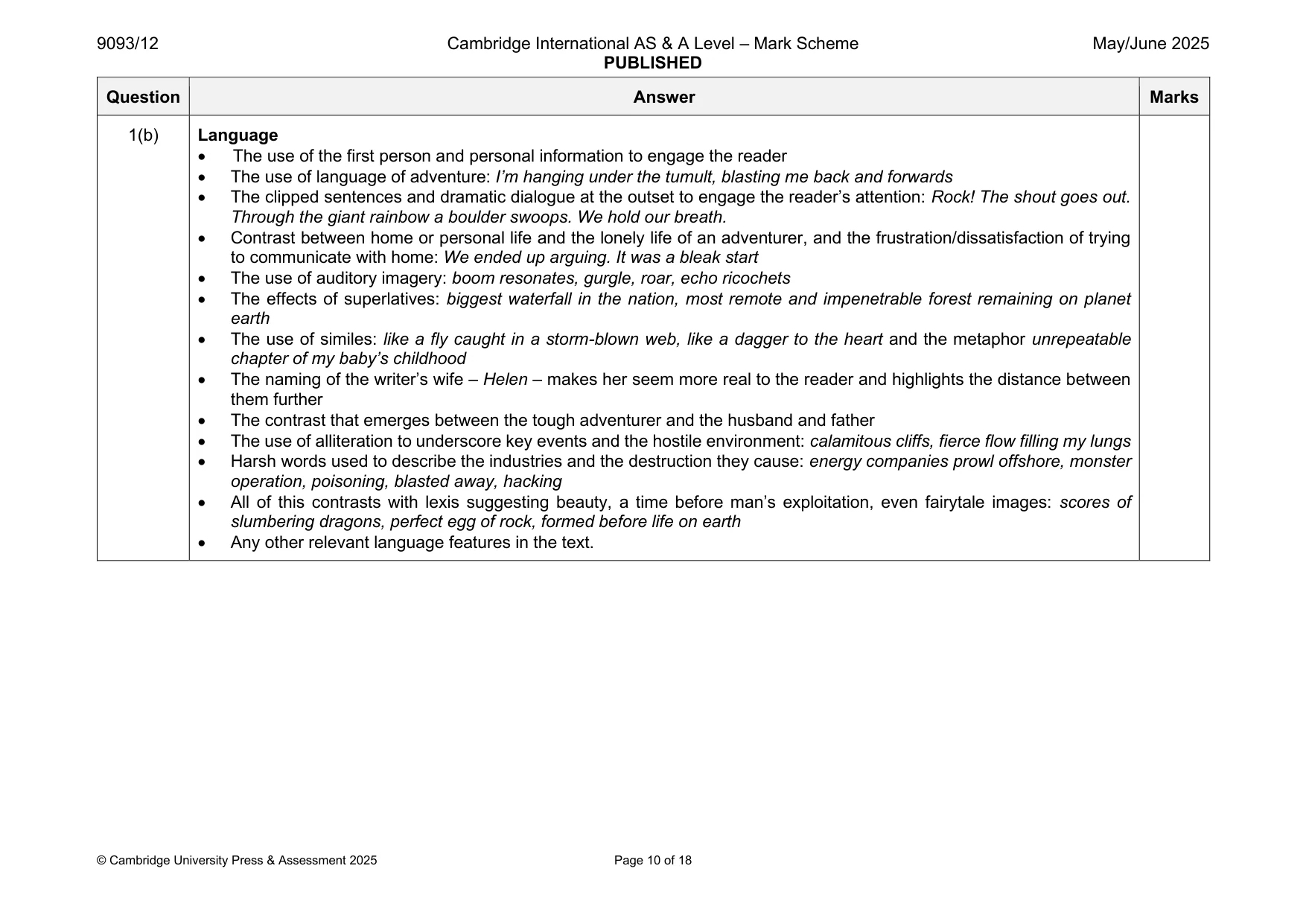
9093/12 Cambridge International AS & A Level – Mark Scheme PUBLISHED May/June 2025 © Cambridge University Press & Assessment 2025 Page 10 of 18 Question Answer Marks 1(b) Language • The use of the first person and personal information to engage the reader • The use of language of adventure: I’m hanging under the tumult, blasting me back and forwards • The clipped sentences and dramatic dialogue at the outset to engage the reader’s attention: Rock! The shout goes out. Through the giant rainbow a boulder swoops. We hold our breath. • Contrast between home or personal life and the lonely life of an adventurer, and the frustration/dissatisfaction of trying to communicate with home: We ended up arguing. It was a bleak start • The use of auditory imagery: boom resonates, gurgle, roar, echo ricochets • The effects of superlatives: biggest waterfall in the nation, most remote and impenetrable forest remaining on planet earth • The use of similes: like a fly caught in a storm-blown web, like a dagger to the heart and the metaphor unrepeatable chapter of my baby’s childhood • The naming of the writer’s wife – Helen – makes her seem more real to the reader and highlights the distance between them further • The contrast that emerges between the tough adventurer and the husband and father • The use of alliteration to underscore key events and the hostile environment: calamitous cliffs, fierce flow filling my lungs • Harsh words used to describe the industries and the destruction they cause: energy companies prowl offshore, monster operation, poisoning, blasted away, hacking • All of this contrasts with lexis suggesting beauty, a time before man’s exploitation, even fairytale images: scores of slumbering dragons, perfect egg of rock, formed before life on earth • Any other relevant language features in the text.
Mark scheme, page 11
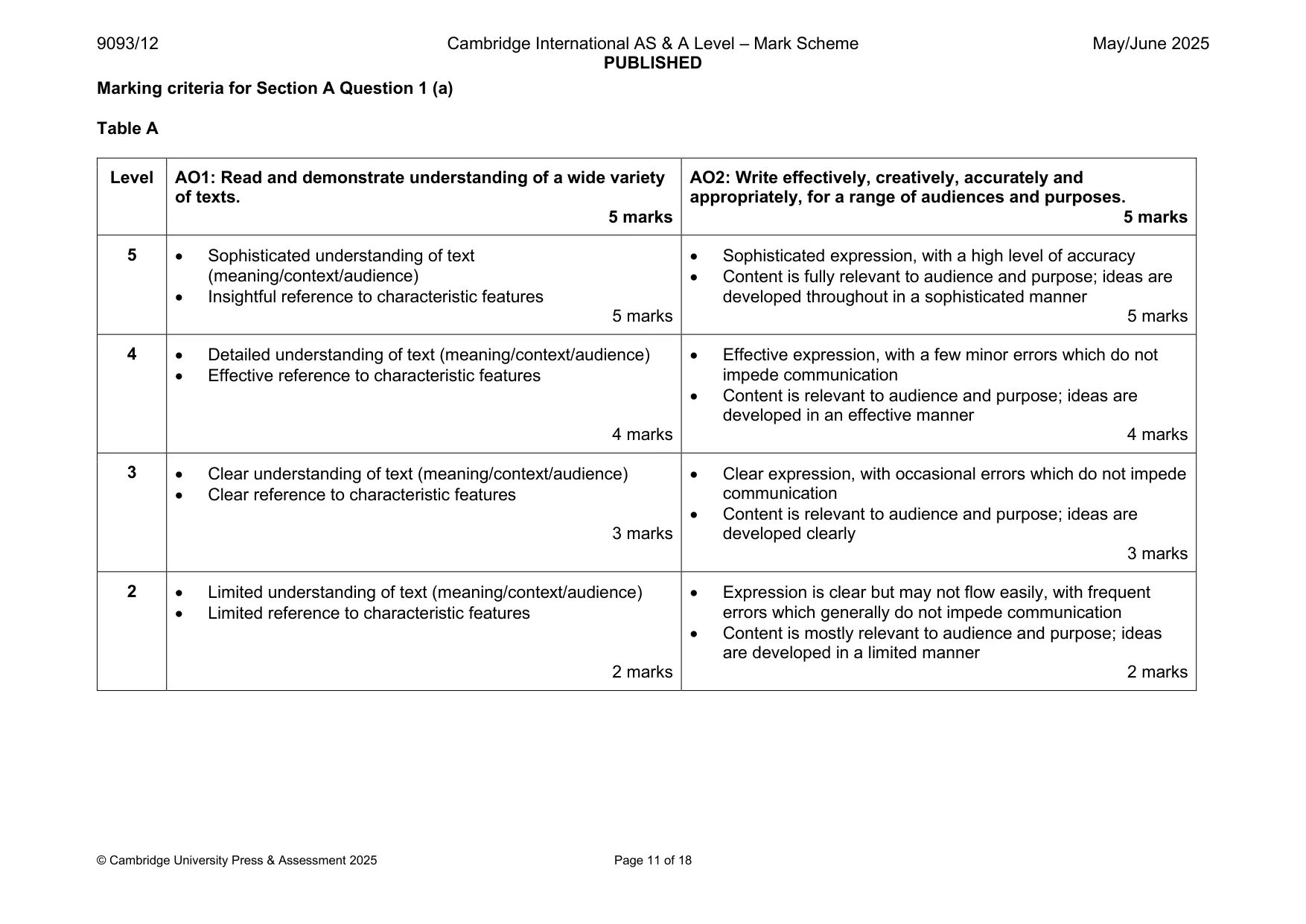
9093/12 Cambridge International AS & A Level – Mark Scheme PUBLISHED May/June 2025 © Cambridge University Press & Assessment 2025 Page 11 of 18 Marking criteria for Section A Question 1 (a) Table A Level AO1: Read and demonstrate understanding of a wide variety of texts. 5 marks AO2: Write effectively, creatively, accurately and appropriately, for a range of audiences and purposes. 5 marks 5 • Sophisticated understanding of text (meaning/context/audience) • Insightful reference to characteristic features 5 marks • Sophisticated expression, with a high level of accuracy • Content is fully relevant to audience and purpose; ideas are developed throughout in a sophisticated manner 5 marks 4 • Detailed understanding of text (meaning/context/audience) • Effective reference to characteristic features 4 marks • Effective expression, with a few minor errors which do not impede communication • Content is relevant to audience and purpose; ideas are developed in an effective manner 4 marks 3 • Clear understanding of text (meaning/context/audience) • Clear reference to characteristic features 3 marks • Clear expression, with occasional errors which do not impede communication • Content is relevant to audience and purpose; ideas are developed clearly 3 marks 2 • Limited understanding of text (meaning/context/audience) • Limited reference to characteristic features 2 marks • Expression is clear but may not flow easily, with frequent errors which generally do not impede communication • Content is mostly relevant to audience and purpose; ideas are developed in a limited manner 2 marks
Mark scheme, page 12
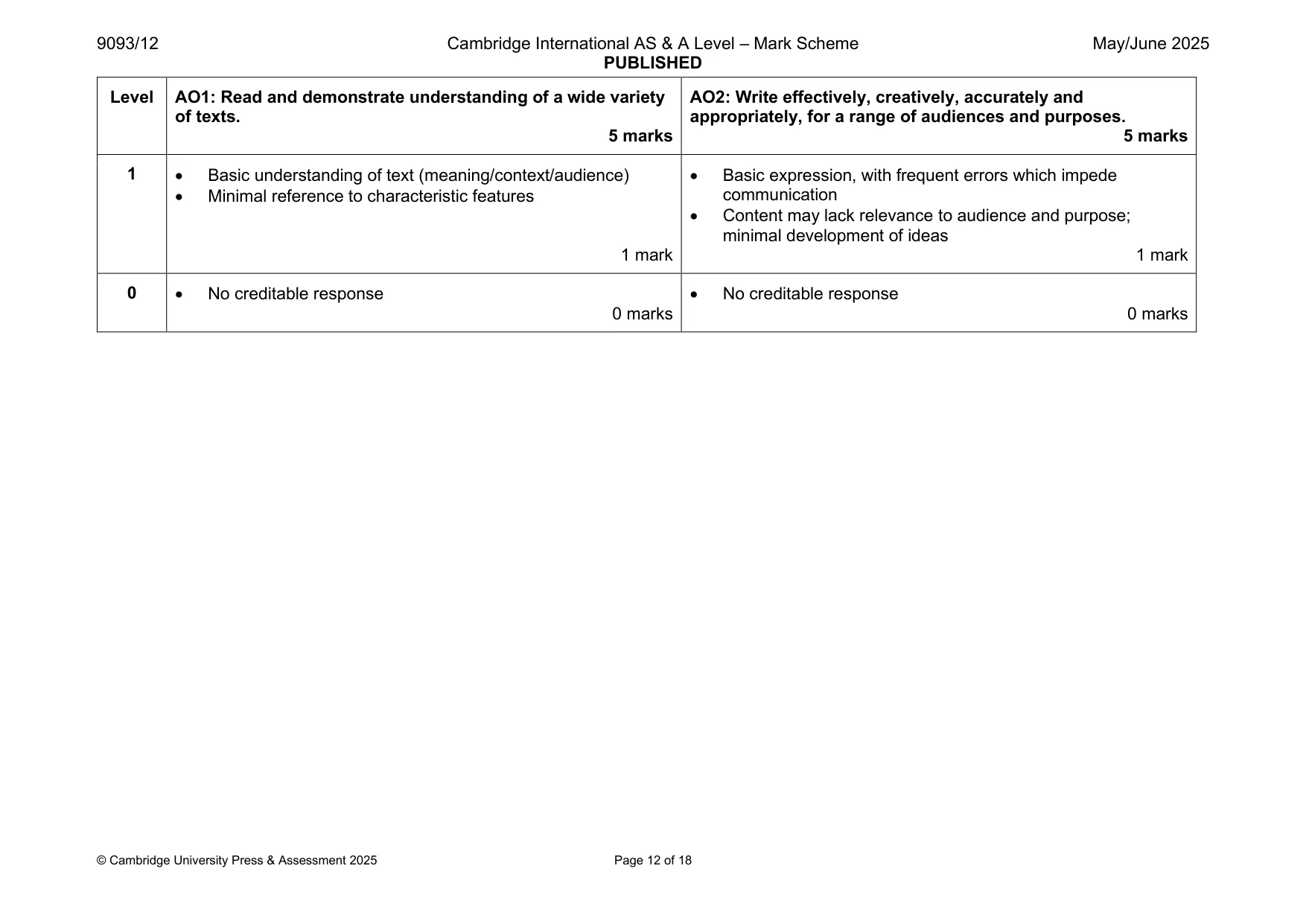
9093/12 Cambridge International AS & A Level – Mark Scheme PUBLISHED May/June 2025 © Cambridge University Press & Assessment 2025 Page 12 of 18 Level AO1: Read and demonstrate understanding of a wide variety of texts. 5 marks AO2: Write effectively, creatively, accurately and appropriately, for a range of audiences and purposes. 5 marks 1 • Basic understanding of text (meaning/context/audience) • Minimal reference to characteristic features 1 mark • Basic expression, with frequent errors which impede communication • Content may lack relevance to audience and purpose; minimal development of ideas 1 mark 0 • No creditable response 0 marks • No creditable response 0 marks
Mark scheme, page 13
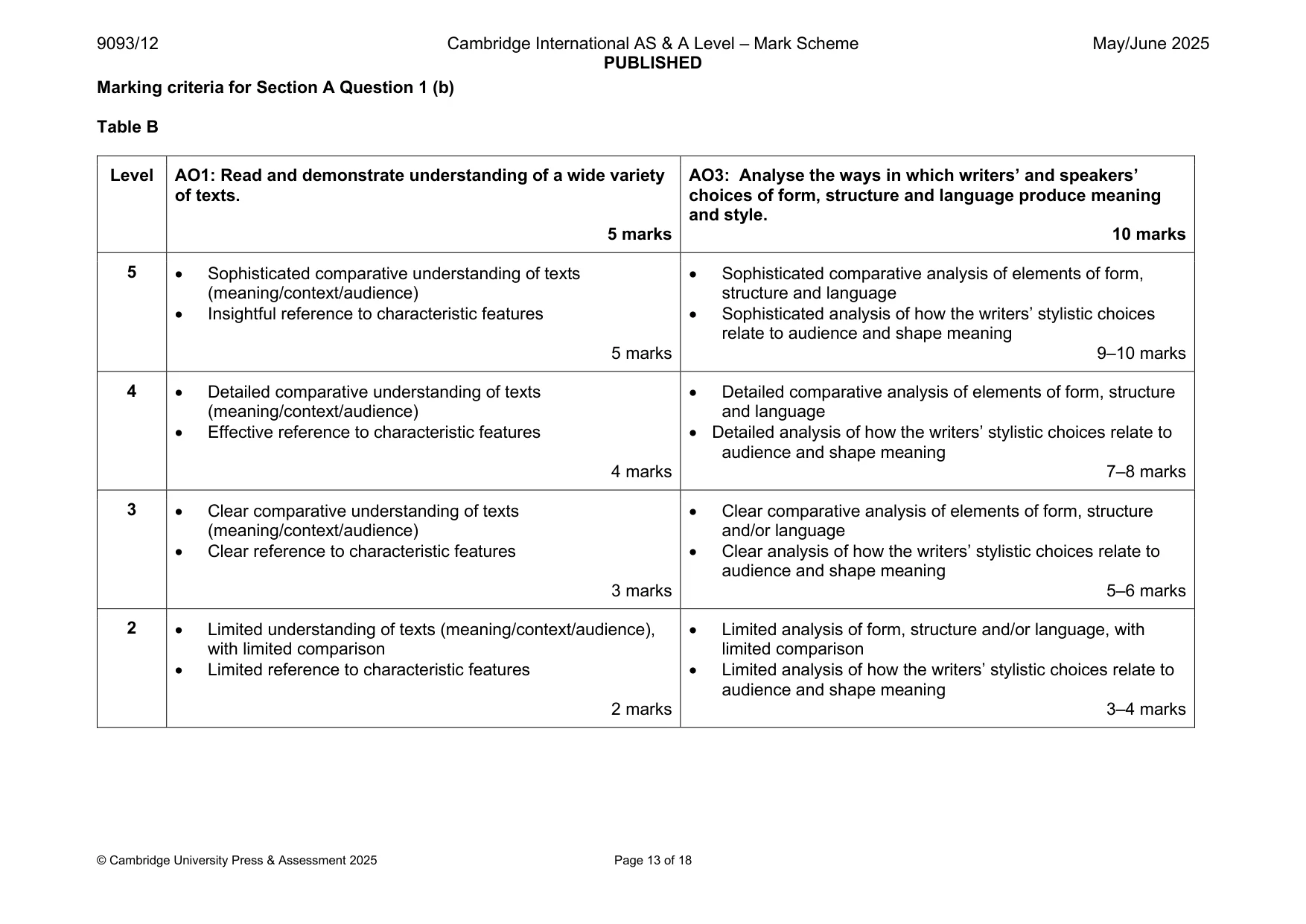
9093/12 Cambridge International AS & A Level – Mark Scheme PUBLISHED May/June 2025 © Cambridge University Press & Assessment 2025 Page 13 of 18 Marking criteria for Section A Question 1 (b) Table B Level AO1: Read and demonstrate understanding of a wide variety of texts. 5 marks AO3: Analyse the ways in which writers’ and speakers’ choices of form, structure and language produce meaning and style. 10 marks 5 • Sophisticated comparative understanding of texts (meaning/context/audience) • Insightful reference to characteristic features 5 marks • Sophisticated comparative analysis of elements of form, structure and language • Sophisticated analysis of how the writers’ stylistic choices relate to audience and shape meaning 9–10 marks 4 • Detailed comparative understanding of texts (meaning/context/audience) • Effective reference to characteristic features 4 marks • Detailed comparative analysis of elements of form, structure and language • Detailed analysis of how the writers’ stylistic choices relate to audience and shape meaning 7–8 marks 3 • Clear comparative understanding of texts (meaning/context/audience) • Clear reference to characteristic features 3 marks • Clear comparative analysis of elements of form, structure and/or language • Clear analysis of how the writers’ stylistic choices relate to audience and shape meaning 5–6 marks 2 • Limited understanding of texts (meaning/context/audience), with limited comparison • Limited reference to characteristic features 2 marks • Limited analysis of form, structure and/or language, with limited comparison • Limited analysis of how the writers’ stylistic choices relate to audience and shape meaning 3–4 marks
Mark scheme, page 14
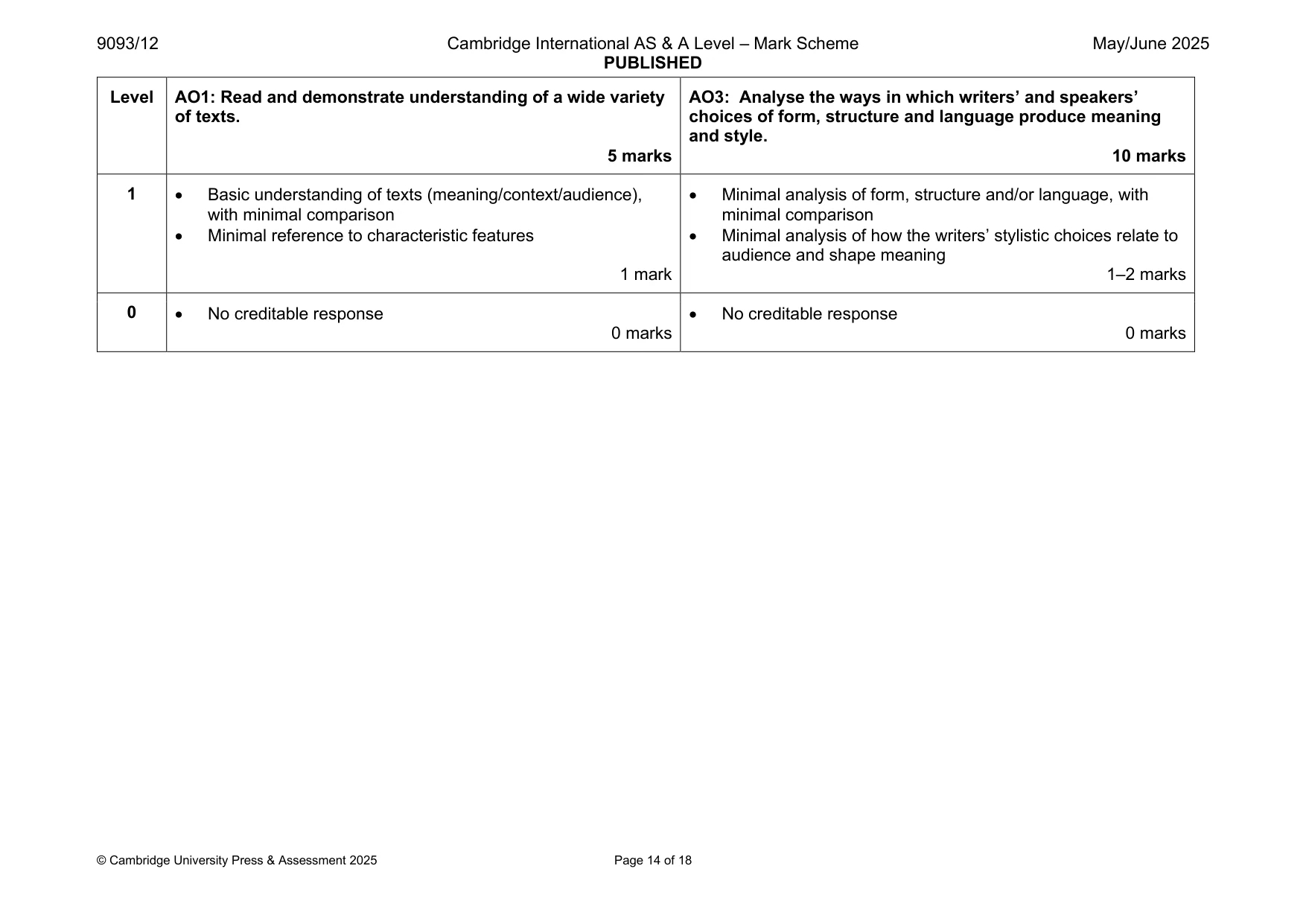
9093/12 Cambridge International AS & A Level – Mark Scheme PUBLISHED May/June 2025 © Cambridge University Press & Assessment 2025 Page 14 of 18 Level AO1: Read and demonstrate understanding of a wide variety of texts. 5 marks AO3: Analyse the ways in which writers’ and speakers’ choices of form, structure and language produce meaning and style. 10 marks 1 • Basic understanding of texts (meaning/context/audience), with minimal comparison • Minimal reference to characteristic features 1 mark • Minimal analysis of form, structure and/or language, with minimal comparison • Minimal analysis of how the writers’ stylistic choices relate to audience and shape meaning 1–2 marks 0 • No creditable response 0 marks • No creditable response 0 marks
Mark scheme, page 15
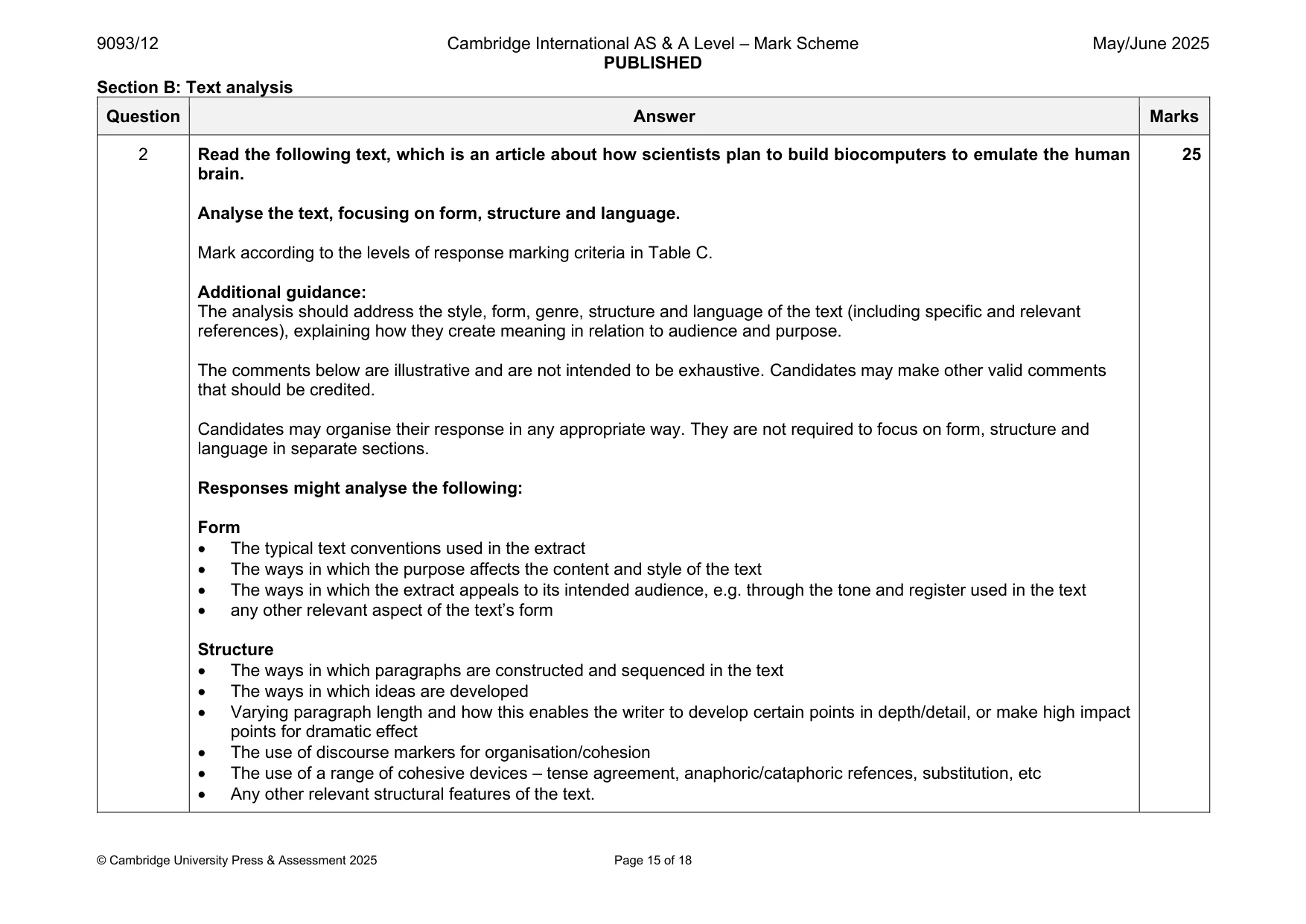
9093/12 Cambridge International AS & A Level – Mark Scheme PUBLISHED May/June 2025 © Cambridge University Press & Assessment 2025 Page 15 of 18 Section B: Text analysis Question Answer Marks 2 Read the following text, which is an article about how scientists plan to build biocomputers to emulate the human brain. Analyse the text, focusing on form, structure and language. Mark according to the levels of response marking criteria in Table C. Additional guidance: The analysis should address the style, form, genre, structure and language of the text (including specific and relevant references), explaining how they create meaning in relation to audience and purpose. The comments below are illustrative and are not intended to be exhaustive. Candidates may make other valid comments that should be credited. Candidates may organise their response in any appropriate way. They are not required to focus on form, structure and language in separate sections. Responses might analyse the following: Form • The typical text conventions used in the extract • The ways in which the purpose affects the content and style of the text • The ways in which the extract appeals to its intended audience, e.g. through the tone and register used in the text • any other relevant aspect of the text’s form Structure • The ways in which paragraphs are constructed and sequenced in the text • The ways in which ideas are developed • Varying paragraph length and how this enables the writer to develop certain points in depth/detail, or make high impact points for dramatic effect • The use of discourse markers for organisation/cohesion • The use of a range of cohesive devices – tense agreement, anaphoric/cataphoric refences, substitution, etc • Any other relevant structural features of the text. 25
Mark scheme, page 16
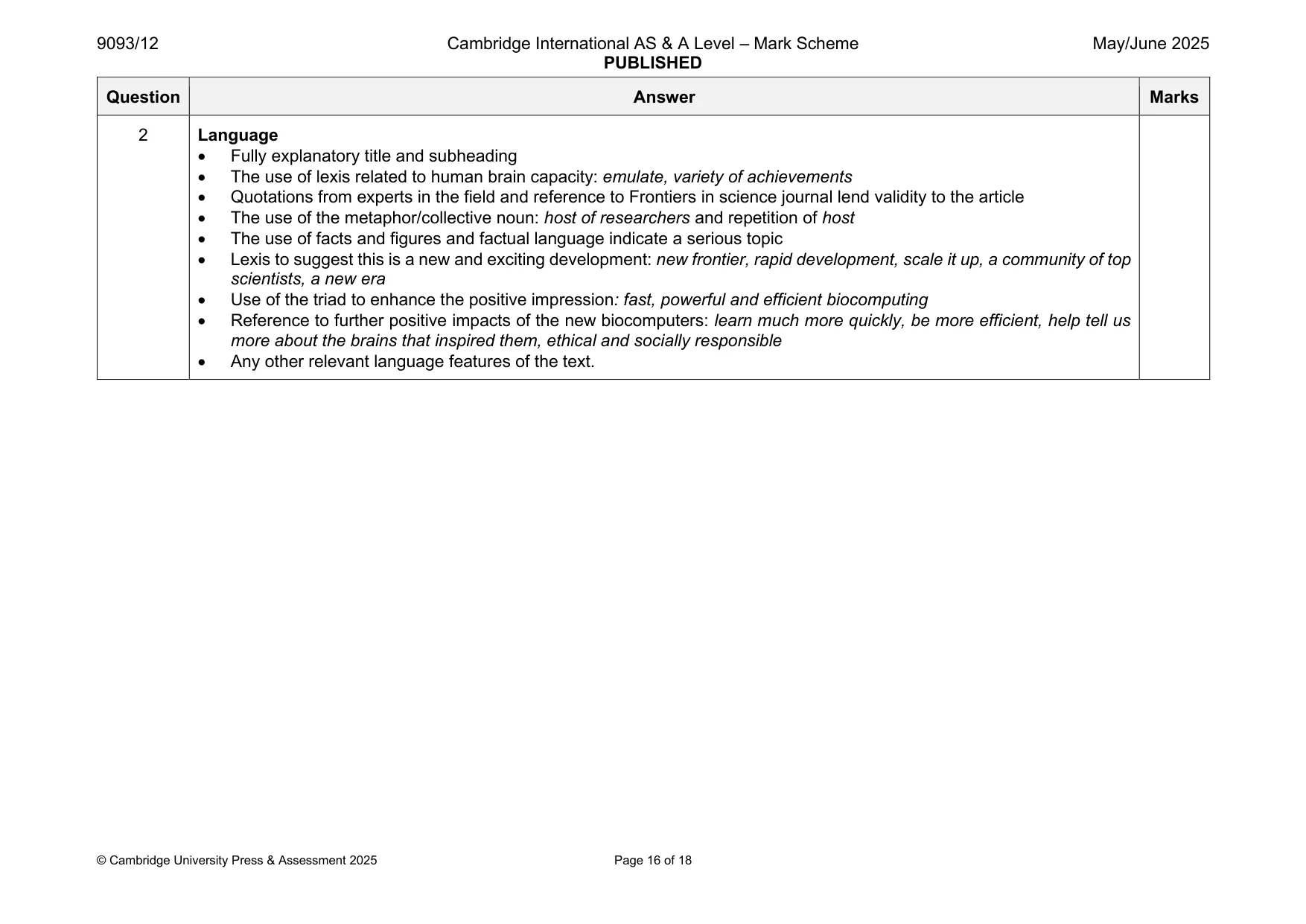
9093/12 Cambridge International AS & A Level – Mark Scheme PUBLISHED May/June 2025 © Cambridge University Press & Assessment 2025 Page 16 of 18 Question Answer Marks 2 Language • Fully explanatory title and subheading • The use of lexis related to human brain capacity: emulate, variety of achievements • Quotations from experts in the field and reference to Frontiers in science journal lend validity to the article • The use of the metaphor/collective noun: host of researchers and repetition of host • The use of facts and figures and factual language indicate a serious topic • Lexis to suggest this is a new and exciting development: new frontier, rapid development, scale it up, a community of top scientists, a new era • Use of the triad to enhance the positive impression: fast, powerful and efficient biocomputing • Reference to further positive impacts of the new biocomputers: learn much more quickly, be more efficient, help tell us more about the brains that inspired them, ethical and socially responsible • Any other relevant language features of the text.
Mark scheme, page 17
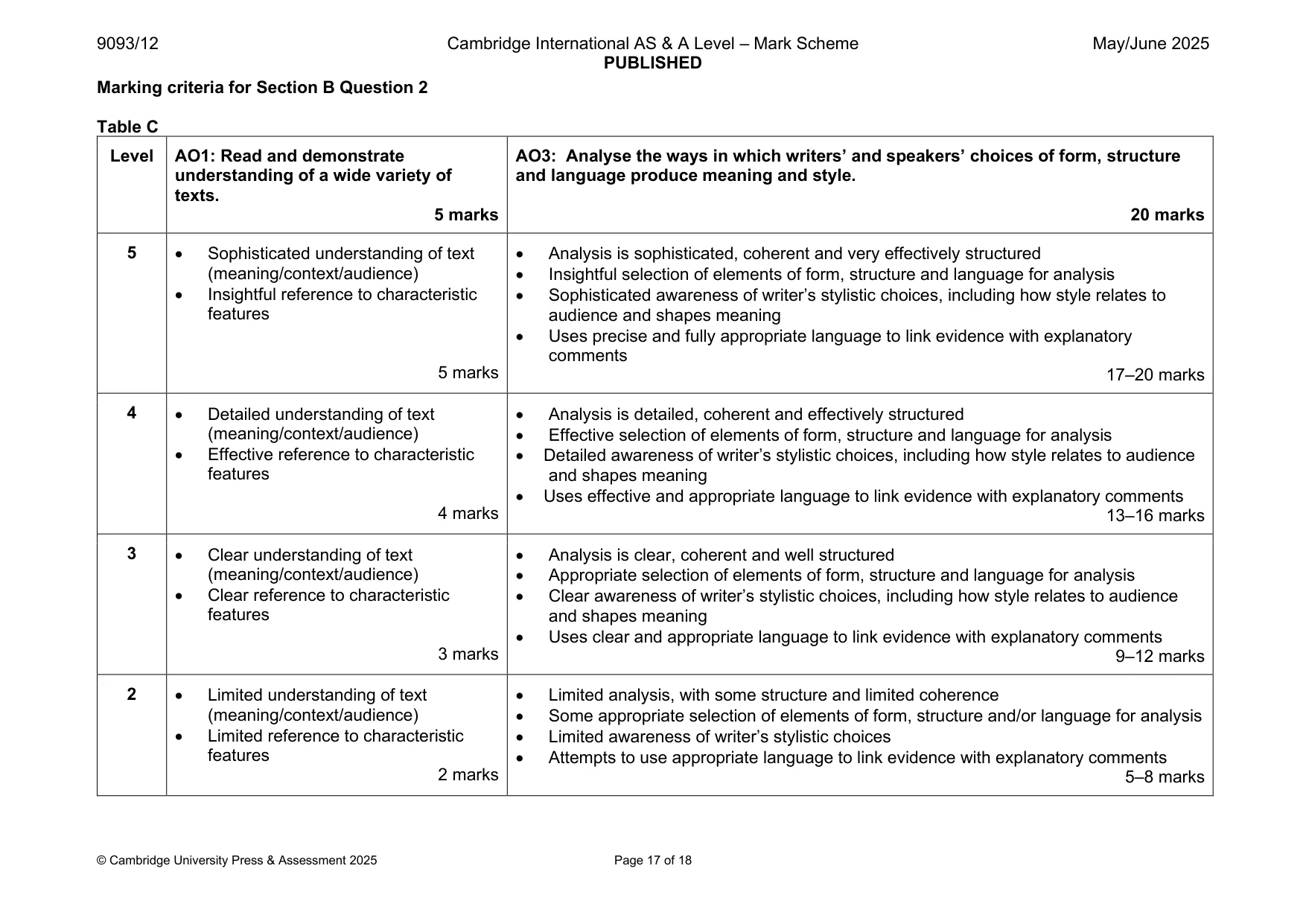
9093/12 Cambridge International AS & A Level – Mark Scheme PUBLISHED May/June 2025 © Cambridge University Press & Assessment 2025 Page 17 of 18 Marking criteria for Section B Question 2 Table C Level AO1: Read and demonstrate understanding of a wide variety of texts. 5 marks AO3: Analyse the ways in which writers’ and speakers’ choices of form, structure and language produce meaning and style. 20 marks 5 • Sophisticated understanding of text (meaning/context/audience) • Insightful reference to characteristic features 5 marks • Analysis is sophisticated, coherent and very effectively structured • Insightful selection of elements of form, structure and language for analysis • Sophisticated awareness of writer’s stylistic choices, including how style relates to audience and shapes meaning • Uses precise and fully appropriate language to link evidence with explanatory comments 17–20 marks 4 • Detailed understanding of text (meaning/context/audience) • Effective reference to characteristic features 4 marks • Analysis is detailed, coherent and effectively structured • Effective selection of elements of form, structure and language for analysis • Detailed awareness of writer’s stylistic choices, including how style relates to audience and shapes meaning • Uses effective and appropriate language to link evidence with explanatory comments 13–16 marks 3 • Clear understanding of text (meaning/context/audience) • Clear reference to characteristic features 3 marks • Analysis is clear, coherent and well structured • Appropriate selection of elements of form, structure and language for analysis • Clear awareness of writer’s stylistic choices, including how style relates to audience and shapes meaning • Uses clear and appropriate language to link evidence with explanatory comments 9–12 marks 2 • Limited understanding of text (meaning/context/audience) • Limited reference to characteristic features 2 marks • Limited analysis, with some structure and limited coherence • Some appropriate selection of elements of form, structure and/or language for analysis • Limited awareness of writer’s stylistic choices • Attempts to use appropriate language to link evidence with explanatory comments 5–8 marks
Mark scheme, page 18
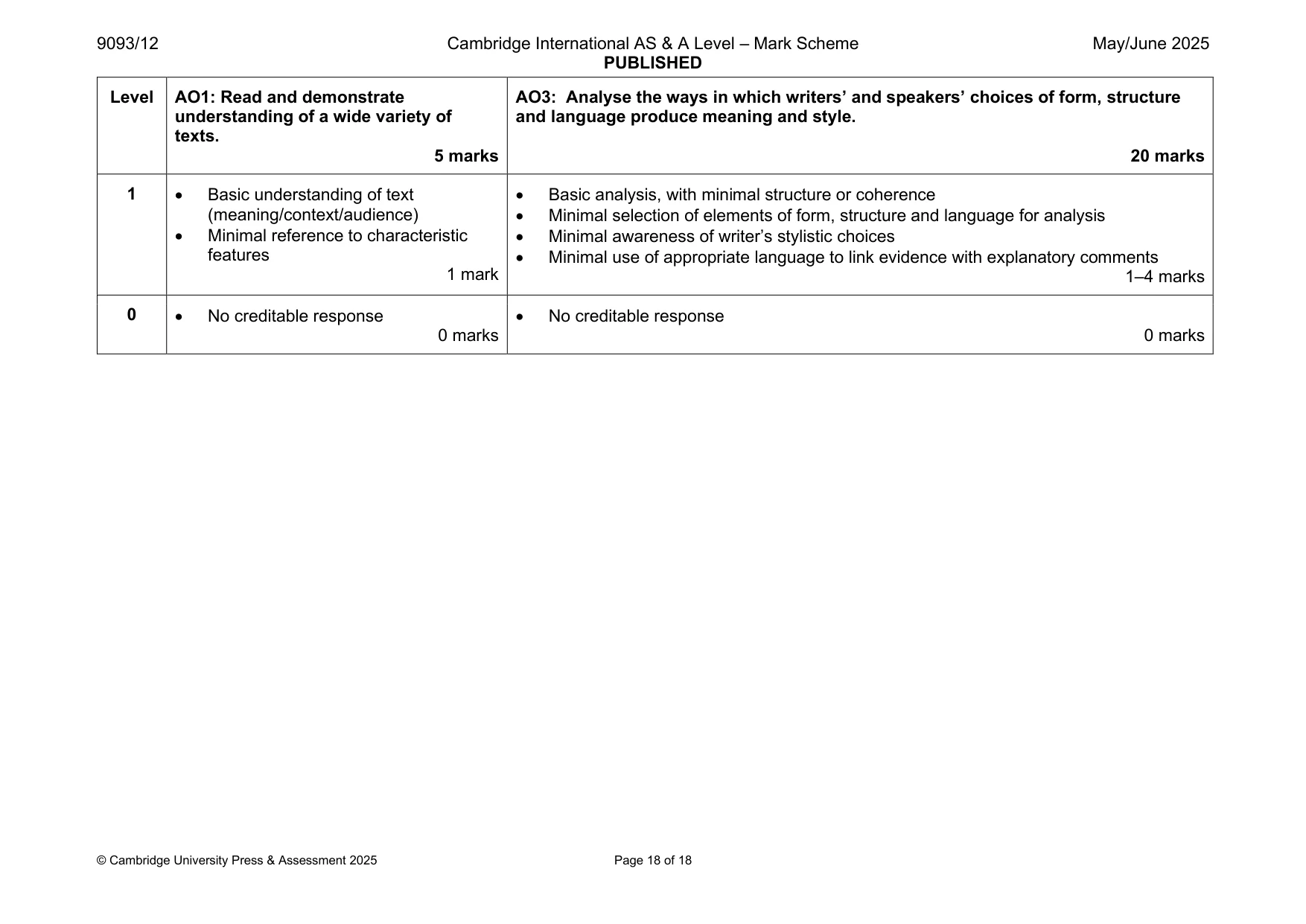
9093/12 Cambridge International AS & A Level – Mark Scheme PUBLISHED May/June 2025 © Cambridge University Press & Assessment 2025 Page 18 of 18 Level AO1: Read and demonstrate understanding of a wide variety of texts. 5 marks AO3: Analyse the ways in which writers’ and speakers’ choices of form, structure and language produce meaning and style. 20 marks 1 • Basic understanding of text (meaning/context/audience) • Minimal reference to characteristic features 1 mark • Basic analysis, with minimal structure or coherence • Minimal selection of elements of form, structure and language for analysis • Minimal awareness of writer’s stylistic choices • Minimal use of appropriate language to link evidence with explanatory comments 1–4 marks 0 • No creditable response 0 marks • No creditable response 0 marks
What you needed in this session
Cambridge’s own grade thresholds for 2025 May/June, Paper 1 · Variant 2. A higher threshold means an easier paper — the bar moves with how the cohort did.