Cambridge A Level English - Language AS and A Level (from 2014) 9093 — 2023 Feb/March Paper 4 · Variant 2
9093/42/F/M/23 · 50 marks · ≈56 min
The question paper and its mark scheme, free to read here and free to download. This is Cambridge’s own paper, exactly as it was sat.
Question paper8 pages


Mark scheme9 pages
Answers below. Sit the paper first if you are practising.
Paper as text
Question paper, page 1
This document has 8 pages. Any blank pages are indicated. [Turn over Cambridge International AS & A Level * 4 6 6 4 3 1 3 1 7 6 * DC (EF) 313232/3 © UCLES 2023 ENGLISH LANGUAGE 9093/42 Paper 4 Language Topics February/March 2023 2 hours 15 minutes You must answer on the enclosed answer booklet. You will need: Answer booklet (enclosed) INSTRUCTIONS ● Answer all questions. ● Follow the instructions on the front cover of the answer booklet. If you need additional answer paper, ask the invigilator for a continuation booklet. ● Dictionaries are not allowed. INFORMATION ● The total mark for this paper is 50. ● The number of marks for each question or part question is shown in brackets [ ].
Question paper, page 2
2 9093/42/F/M/23 © UCLES 2023 Section A: English in the world Question 1 Read the following text, which is an article from The Guardian, a British newspaper. It was published in 2020. Discuss what you feel are the most important issues raised in the text relating to the present and future status of English in an international context. You should refer to specific details from the text as well as to ideas and examples from your wider study of English in the world. [25] ‘Hello work’ or job centre? Language experts spell trouble for Japan’s mangled English Encountering mangled English is a frequent source of mirth for many residents of Japan, but for one group of language professionals, the proliferation of inappropriate words and phrases is becoming a national embarrassment. Their recently formed group, loosely translated as the association for the consideration of Japan’s English, is taking local governments and other bodies to task for their over‑reliance on machine translation on official websites and public signage. Since launching their group several months ago, the seven women, mostly graduates of Columbia Business School, have identified a range of culprits. The official website of Meguro ward in Tokyo, for example, renders kurashi – or ‘living’ – as ‘dark matter’, while the Kobe municipal government turns sumai (home) as ‘I’m sorry’, the machine translation having apparently misread the original word as sumanai, a casual form of apology. Chikako Tsuruta, an experienced conference interpreter and professor at Tokyo Woman’s Christian University, said problems arise when software mistranslates the meaning of specific kanji characters. ‘They produce unintentionally funny translations that could easily be corrected if they were just checked by an English speaker,’ said Tsuruta, adding that Chinese‑ and Korean‑speaking colleagues had noticed similar issues with those languages. Her group, comprising interpreters, researchers and employees of foreign companies, had long been frustrated by the widespread use of wasei‑eigo – Japanese‑made English – in official literature, advertising and marketing. ‘We were talking about it over lunch and decided we no longer wanted to feel embarrassed about poor English usage,’ she said. ‘We want official English to be decent and presentable to the rest of the world. And foreign people living in Japan should at the very least be given accurate, understandable information, especially if they need to evacuate after a natural disaster. It could be a matter of life or death.’ The group’s members appear to be divided, however, over the merits of using irregular, but nonetheless catchy, English titles for government business, including Hello Work (job centres), My Number (a 12‑digit ID system), and, more recently, Go To Travel, a subsidised scheme to encourage domestic tourism. Even major corporations occasionally fall into the wasei‑eigo trap, Tsuruta said, citing Hitachi’s long‑running ‘Inspire the Next’, and Toyota’s Olympic‑inspired ‘Start your Impossible’. 5 10 15 20 25 30 35
Question paper, page 3
3 9093/42/F/M/23 © UCLES 2023 [Turn over The association will have its work cut out should it choose to take on the misuse of English in advertising and design. The longstanding practice of using English words and phrases to give a product, service or campaign a cosmopolitan feel has produced several classics, including Nissin’s ‘Boil Japan’ promotion for its Cup Noodles. Others are guilty only of the same poor punctuation found on shop signage in countries where English is the first language. This month, Takashimaya department store in Kyoto was forced to cover up posters after social media users pointed out how a missing comma had sabotaged its simple, and supposedly inspirational, message. ‘Rising Again,’ it began. ‘Save the World from Kyoto JAPAN.’ 40 45
Question paper, page 4
4 9093/42/F/M/23 © UCLES 2023 Section B: Language and the self Question 2 Read the following two texts. Text A is the beginning of an article published on the Psychology Today website in 2020. Text B is an extract from an article published in 2020 on Insider.com, an online magazine. Discuss what you feel are the most important issues raised in the texts relating to the ways in which language can shape and reflect personal and social identity. You should refer to specific details from the texts as well as to ideas and examples from your wider study of Language and the self. [25] Text A Baffled by the language of teenagers? As the parent of two teenagers, being a linguist did not adequately prepare me for the strange things that sometimes come out of their mouths. And, via linguistic innovations, these linguistic trendsetters unknowingly contribute to the shape of language to come. Content removed due to copyright restrictions.
Question paper, page 5
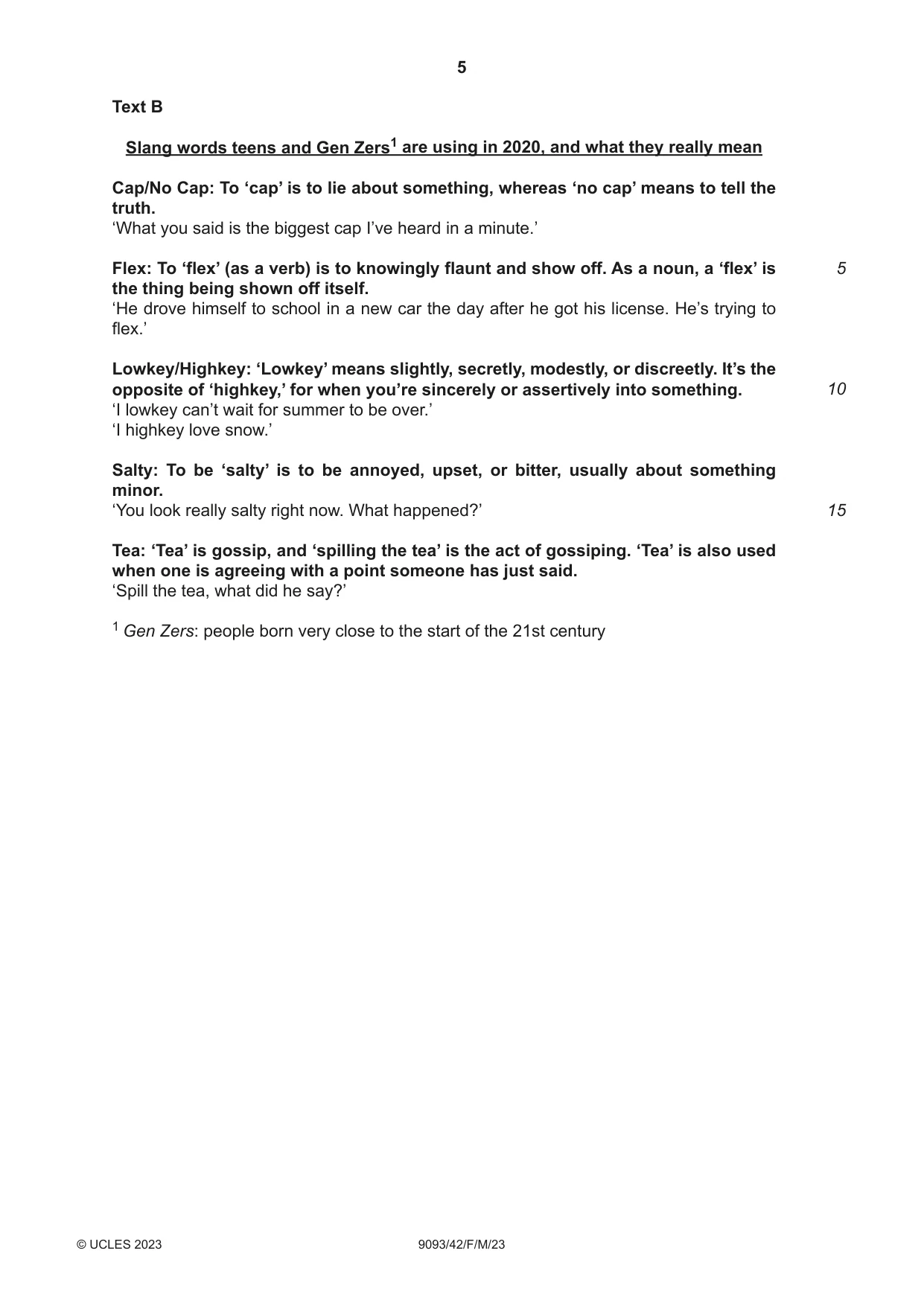
5 9093/42/F/M/23 © UCLES 2023 Text B Slang words teens and Gen Zers1 are using in 2020, and what they really mean Cap/No Cap: To ‘cap’ is to lie about something, whereas ‘no cap’ means to tell the truth. ‘What you said is the biggest cap I’ve heard in a minute.’ Flex: To ‘flex’ (as a verb) is to knowingly flaunt and show off. As a noun, a ‘flex’ is the thing being shown off itself. ‘He drove himself to school in a new car the day after he got his license. He’s trying to flex.’ Lowkey/Highkey: ‘Lowkey’ means slightly, secretly, modestly, or discreetly. It’s the opposite of ‘highkey,’ for when you’re sincerely or assertively into something. ‘I lowkey can’t wait for summer to be over.’ ‘I highkey love snow.’ Salty: To be ‘salty’ is to be annoyed, upset, or bitter, usually about something minor. ‘You look really salty right now. What happened?’ Tea: ‘Tea’ is gossip, and ‘spilling the tea’ is the act of gossiping. ‘Tea’ is also used when one is agreeing with a point someone has just said. ‘Spill the tea, what did he say?’ 1 Gen Zers: people born very close to the start of the 21st century 5 10 15
Question paper, page 6
6 9093/42/F/M/23 © UCLES 2023 BLANK PAGE
Question paper, page 7
7 9093/42/F/M/23 © UCLES 2023 BLANK PAGE
Question paper, page 8
8 9093/42/F/M/23 © UCLES 2023 Permission to reproduce items where third‑party owned material protected by copyright is included has been sought and cleared where possible. Every reasonable effort has been made by the publisher (UCLES) to trace copyright holders, but if any items requiring clearance have unwittingly been included, the publisher will be pleased to make amends at the earliest possible opportunity. To avoid the issue of disclosure of answer‑related information to candidates, all copyright acknowledgements are reproduced online in the Cambridge Assessment International Education Copyright Acknowledgements Booklet. This is produced for each series of examinations and is freely available to download at www.cambridgeinternational.org after the live examination series. Cambridge Assessment International Education is part of Cambridge Assessment. Cambridge Assessment is the brand name of the University of Cambridge Local Examinations Syndicate (UCLES), which is a department of the University of Cambridge. BLANK PAGE
Mark scheme, page 1
This document consists of 9 printed pages. © UCLES 2023 [Turn over Cambridge International A Level ENGLISH LANGUAGE 9093/42 Paper 4 Language Topics February/March 2023 MARK SCHEME Maximum Mark: 50 Published This mark scheme is published as an aid to teachers and candidates, to indicate the requirements of the examination. It shows the basis on which Examiners were instructed to award marks. It does not indicate the details of the discussions that took place at an Examiners’ meeting before marking began, which would have considered the acceptability of alternative answers. Mark schemes should be read in conjunction with the question paper and the Principal Examiner Report for Teachers. Cambridge International will not enter into discussions about these mark schemes. Cambridge International is publishing the mark schemes for the February/March 2023 series for most Cambridge IGCSE™, Cambridge International A and AS Level components and some Cambridge O Level components.
Mark scheme, page 2
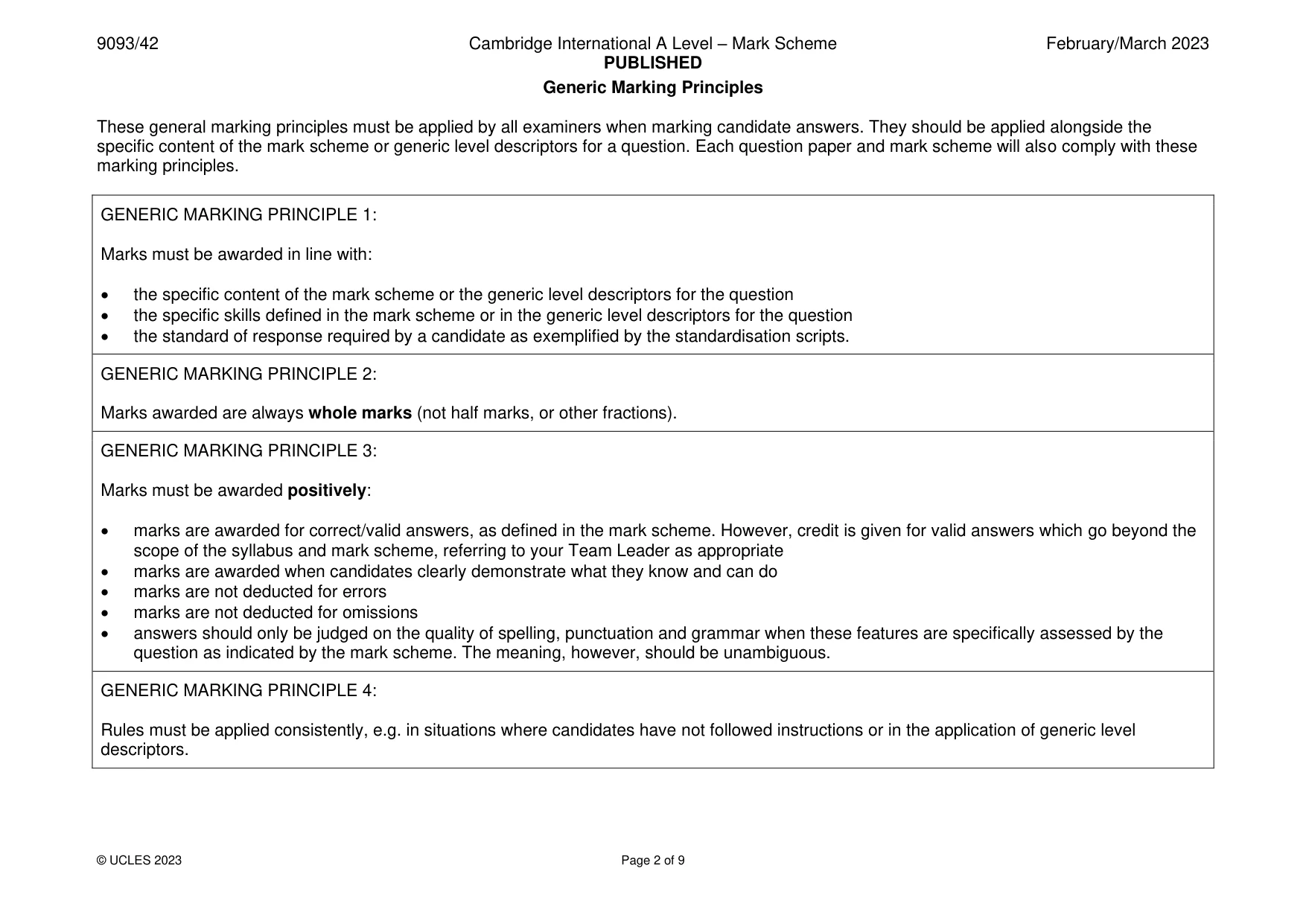
9093/42 Cambridge International A Level – Mark Scheme PUBLISHED February/March 2023 © UCLES 2023 Page 2 of 9 Generic Marking Principles These general marking principles must be applied by all examiners when marking candidate answers. They should be applied alongside the specific content of the mark scheme or generic level descriptors for a question. Each question paper and mark scheme will also comply with these marking principles. GENERIC MARKING PRINCIPLE 1: Marks must be awarded in line with: • the specific content of the mark scheme or the generic level descriptors for the question • the specific skills defined in the mark scheme or in the generic level descriptors for the question • the standard of response required by a candidate as exemplified by the standardisation scripts. GENERIC MARKING PRINCIPLE 2: Marks awarded are always whole marks (not half marks, or other fractions). GENERIC MARKING PRINCIPLE 3: Marks must be awarded positively: • marks are awarded for correct/valid answers, as defined in the mark scheme. However, credit is given for valid answers which go beyond the scope of the syllabus and mark scheme, referring to your Team Leader as appropriate • marks are awarded when candidates clearly demonstrate what they know and can do • marks are not deducted for errors • marks are not deducted for omissions • answers should only be judged on the quality of spelling, punctuation and grammar when these features are specifically assessed by the question as indicated by the mark scheme. The meaning, however, should be unambiguous. GENERIC MARKING PRINCIPLE 4: Rules must be applied consistently, e.g. in situations where candidates have not followed instructions or in the application of generic level descriptors.
Mark scheme, page 3
9093/42 Cambridge International A Level – Mark Scheme PUBLISHED February/March 2023 © UCLES 2023 Page 3 of 9 GENERIC MARKING PRINCIPLE 5: Marks should be awarded using the full range of marks defined in the mark scheme for the question (however; the use of the full mark range may be limited according to the quality of the candidate responses seen). GENERIC MARKING PRINCIPLE 6: Marks awarded are based solely on the requirements as defined in the mark scheme. Marks should not be awarded with grade thresholds or grade descriptors in mind.
Mark scheme, page 4
9093/42 Cambridge International A Level – Mark Scheme PUBLISHED February/March 2023 © UCLES 2023 Page 4 of 9 English & Media subject specific general marking principles (To be read in conjunction with the Generic Marking Principles (and requiring further guidance on how to place marks within levels)) Components using level descriptors: • We use level descriptors as a guide to broad understanding of the qualities normally expected of, or typical of, work in a level. • Level descriptors are a means of general guidance, and should not be interpreted as hurdle statements. • Where indicative content notes are supplied for a question, these are not a prescription of required content, and must not be treated as such. Alternative correct points and unexpected answers in candidates’ scripts must be given marks that fairly reflect the knowledge and skills demonstrated. • While we may have legitimate expectations as to the ground most answers may occupy, we must at all times be prepared to meet candidates on their chosen ground, provided it is relevant ground (e.g. clearly related to and derived from a relevant passage/text and meeting the mark scheme requirements for the question).
Mark scheme, page 5
9093/42 Cambridge International A Level – Mark Scheme PUBLISHED February/March 2023 © UCLES 2023 Page 5 of 9 English Language specific marking instructions: AO1 Read and demonstrate understanding of a wide variety of texts. (Understanding) • Marks should be awarded for the accuracy of the candidate’s understanding of the text and its features, not for any analysis of them which is recognised under AO3. • Where comparison is required, marks should be awarded for the candidate’s recognition of similarities and differences between the texts and their features, not for any consequent analysis. • When awarding a ‘best-fit’ mark within a Level for each AO, consider each bullet point equally. AO2 Write effectively, creatively, accurately and appropriately, for a range of audiences and purposes. (Writing) • Marks should be awarded equally on the basis of the level of the candidate’s written expression (range of features used and accuracy) and the development of their writing (its organisation and relevance to task and audience). • When awarding a ‘best-fit’ mark within a Level for each AO, consider each bullet point equally. AO4: Demonstrate understanding of linguistic issues, concepts, methods and approaches. (Conceptualisation) • Marks should be awarded equally on the basis of the level of the candidate’s understanding of the relevant issues, concepts, methods and approaches represented both in the text(s) and in their wider studies. • When awarding a ‘best-fit’ mark within a Level for each AO, consider each bullet point equally.
Mark scheme, page 6
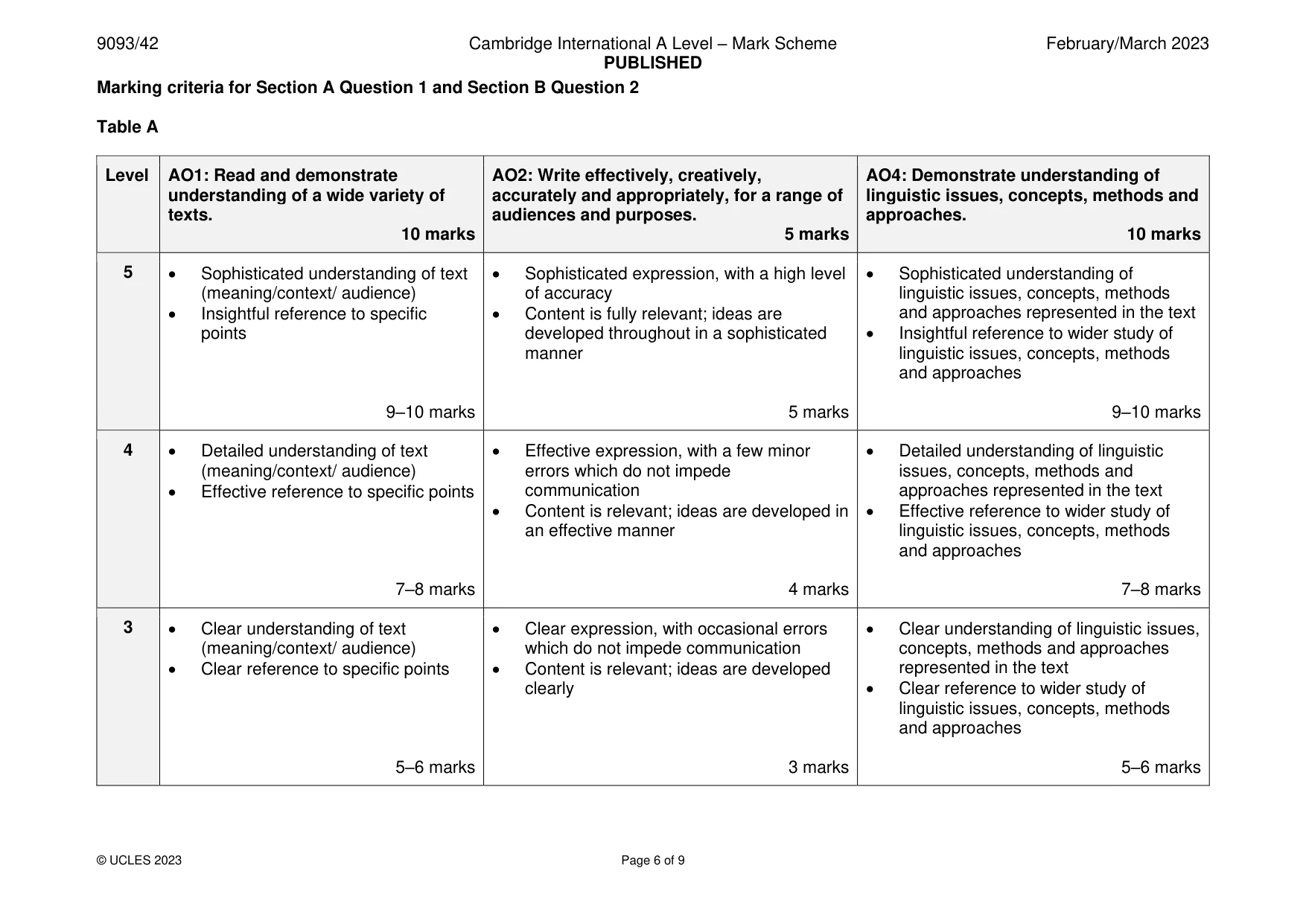
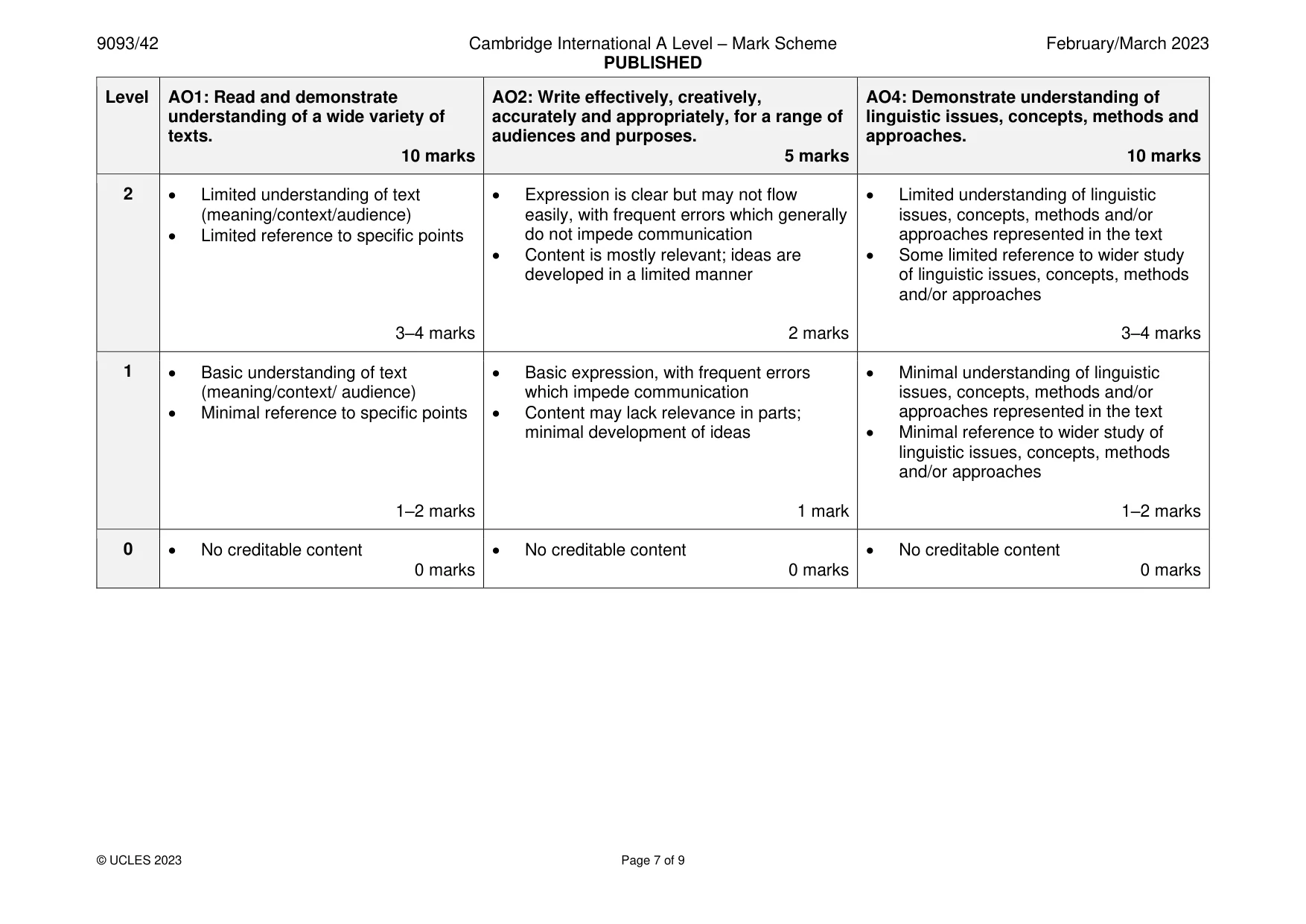
9093/42 Cambridge International A Level – Mark Scheme PUBLISHED February/March 2023 © UCLES 2023 Page 6 of 9 Marking criteria for Section A Question 1 and Section B Question 2 Table A Level AO1: Read and demonstrate understanding of a wide variety of texts. 10 marks AO2: Write effectively, creatively, accurately and appropriately, for a range of audiences and purposes. 5 marks AO4: Demonstrate understanding of linguistic issues, concepts, methods and approaches. 10 marks 5 • Sophisticated understanding of text (meaning/context/ audience) • Insightful reference to specific points 9–10 marks • Sophisticated expression, with a high level of accuracy • Content is fully relevant; ideas are developed throughout in a sophisticated manner 5 marks • Sophisticated understanding of linguistic issues, concepts, methods and approaches represented in the text • Insightful reference to wider study of linguistic issues, concepts, methods and approaches 9–10 marks 4 • Detailed understanding of text (meaning/context/ audience) • Effective reference to specific points 7–8 marks • Effective expression, with a few minor errors which do not impede communication • Content is relevant; ideas are developed in an effective manner 4 marks • Detailed understanding of linguistic issues, concepts, methods and approaches represented in the text • Effective reference to wider study of linguistic issues, concepts, methods and approaches 7–8 marks 3 • Clear understanding of text (meaning/context/ audience) • Clear reference to specific points 5–6 marks • Clear expression, with occasional errors which do not impede communication • Content is relevant; ideas are developed clearly 3 marks • Clear understanding of linguistic issues, concepts, methods and approaches represented in the text • Clear reference to wider study of linguistic issues, concepts, methods and approaches 5–6 marks
Mark scheme, page 7
9093/42 Cambridge International A Level – Mark Scheme PUBLISHED February/March 2023 © UCLES 2023 Page 7 of 9 Level AO1: Read and demonstrate understanding of a wide variety of texts. 10 marks AO2: Write effectively, creatively, accurately and appropriately, for a range of audiences and purposes. 5 marks AO4: Demonstrate understanding of linguistic issues, concepts, methods and approaches. 10 marks 2 • Limited understanding of text (meaning/context/audience) • Limited reference to specific points 3–4 marks • Expression is clear but may not flow easily, with frequent errors which generally do not impede communication • Content is mostly relevant; ideas are developed in a limited manner 2 marks • Limited understanding of linguistic issues, concepts, methods and/or approaches represented in the text • Some limited reference to wider study of linguistic issues, concepts, methods and/or approaches 3–4 marks 1 • Basic understanding of text (meaning/context/ audience) • Minimal reference to specific points 1–2 marks • Basic expression, with frequent errors which impede communication • Content may lack relevance in parts; minimal development of ideas 1 mark • Minimal understanding of linguistic issues, concepts, methods and/or approaches represented in the text • Minimal reference to wider study of linguistic issues, concepts, methods and/or approaches 1–2 marks 0 • No creditable content 0 marks • No creditable content 0 marks • No creditable content 0 marks
Mark scheme, page 8
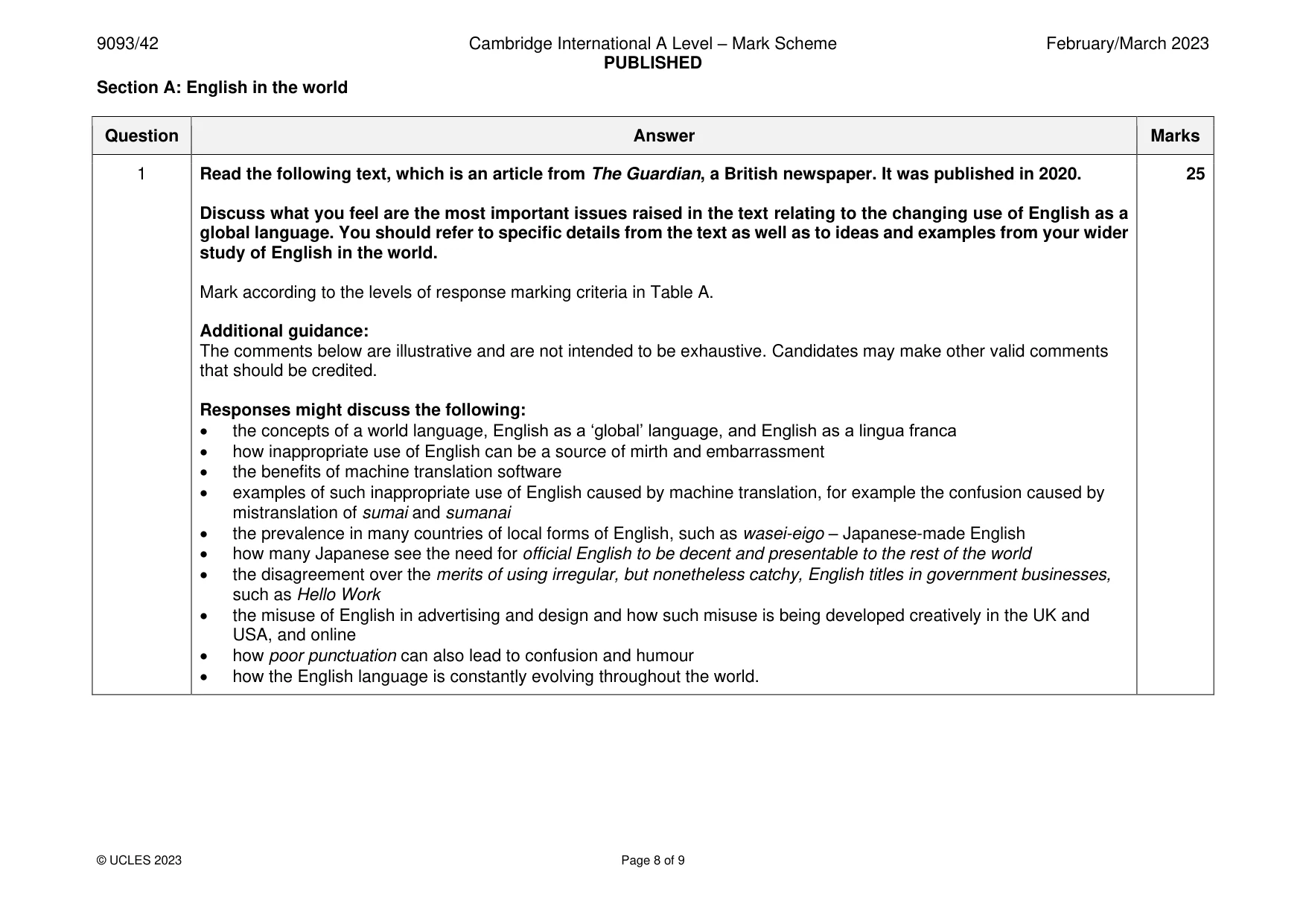
9093/42 Cambridge International A Level – Mark Scheme PUBLISHED February/March 2023 © UCLES 2023 Page 8 of 9 Section A: English in the world Question Answer Marks 1 Read the following text, which is an article from The Guardian, a British newspaper. It was published in 2020. Discuss what you feel are the most important issues raised in the text relating to the changing use of English as a global language. You should refer to specific details from the text as well as to ideas and examples from your wider study of English in the world. Mark according to the levels of response marking criteria in Table A. Additional guidance: The comments below are illustrative and are not intended to be exhaustive. Candidates may make other valid comments that should be credited. Responses might discuss the following: • the concepts of a world language, English as a ‘global’ language, and English as a lingua franca • how inappropriate use of English can be a source of mirth and embarrassment • the benefits of machine translation software • examples of such inappropriate use of English caused by machine translation, for example the confusion caused by mistranslation of sumai and sumanai • the prevalence in many countries of local forms of English, such as wasei-eigo – Japanese-made English • how many Japanese see the need for official English to be decent and presentable to the rest of the world • the disagreement over the merits of using irregular, but nonetheless catchy, English titles in government businesses, such as Hello Work • the misuse of English in advertising and design and how such misuse is being developed creatively in the UK and USA, and online • how poor punctuation can also lead to confusion and humour • how the English language is constantly evolving throughout the world. 25
Mark scheme, page 9
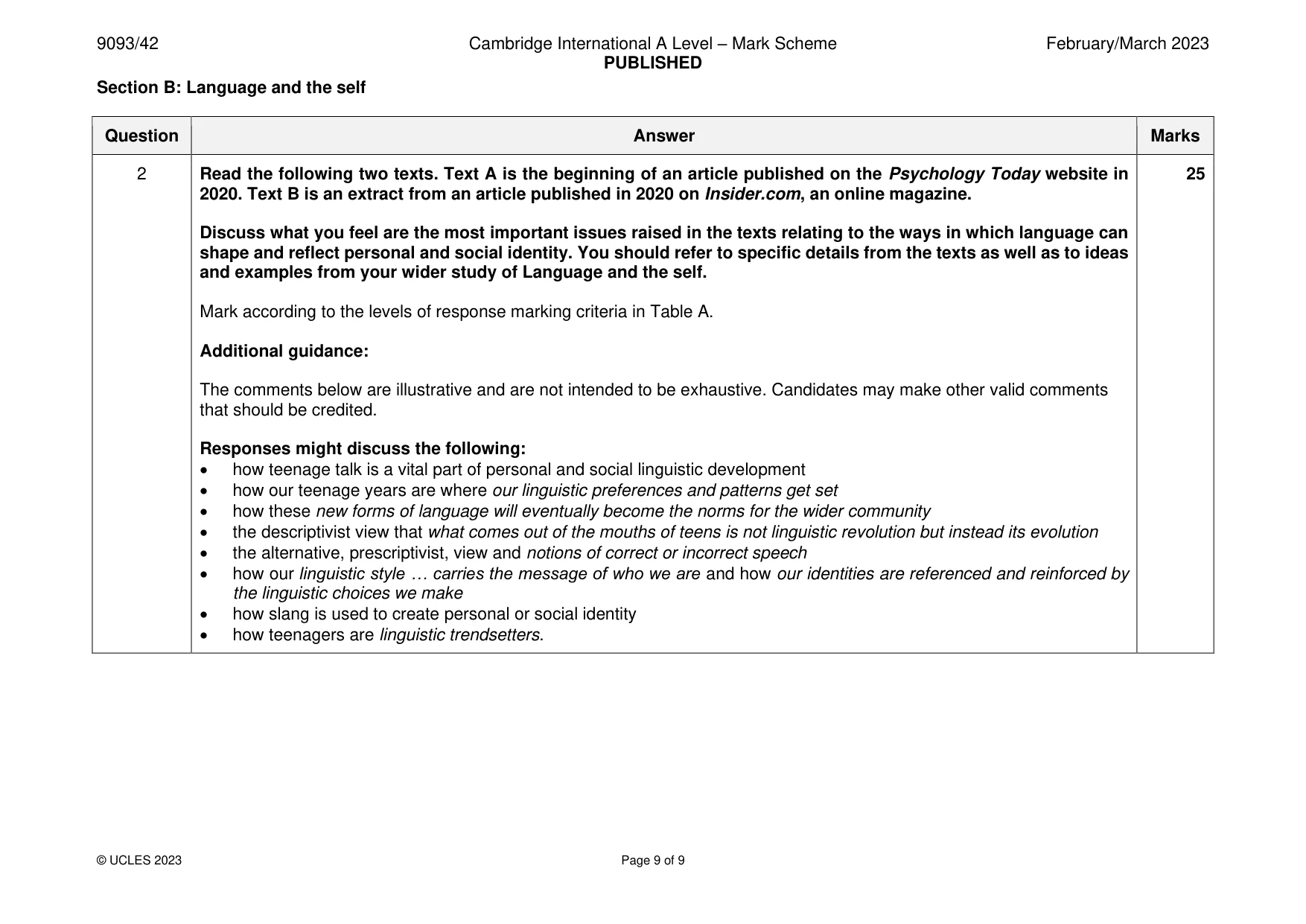
9093/42 Cambridge International A Level – Mark Scheme PUBLISHED February/March 2023 © UCLES 2023 Page 9 of 9 Section B: Language and the self Question Answer Marks 2 Read the following two texts. Text A is the beginning of an article published on the Psychology Today website in 2020. Text B is an extract from an article published in 2020 on Insider.com, an online magazine. Discuss what you feel are the most important issues raised in the texts relating to the ways in which language can shape and reflect personal and social identity. You should refer to specific details from the texts as well as to ideas and examples from your wider study of Language and the self. Mark according to the levels of response marking criteria in Table A. Additional guidance: The comments below are illustrative and are not intended to be exhaustive. Candidates may make other valid comments that should be credited. Responses might discuss the following: • how teenage talk is a vital part of personal and social linguistic development • how our teenage years are where our linguistic preferences and patterns get set • how these new forms of language will eventually become the norms for the wider community • the descriptivist view that what comes out of the mouths of teens is not linguistic revolution but instead its evolution • the alternative, prescriptivist, view and notions of correct or incorrect speech • how our linguistic style … carries the message of who we are and how our identities are referenced and reinforced by the linguistic choices we make • how slang is used to create personal or social identity • how teenagers are linguistic trendsetters. 25
What you needed in this session
Cambridge’s own grade thresholds for 2023 Feb/March, Paper 4 · Variant 2. A higher threshold means an easier paper — the bar moves with how the cohort did.