Cambridge A Level English - Language AS and A Level (from 2014) 9093 — 2024 Oct/Nov Paper 4 · Variant 1
9093/41/O/N/24 · 50 marks · 135 min
The question paper and its mark scheme, free to read here and free to download. This is Cambridge’s own paper, exactly as it was sat.
Question paper8 pages


Mark scheme8 pages
Answers below. Sit the paper first if you are practising.
Paper as text
Question paper, page 1
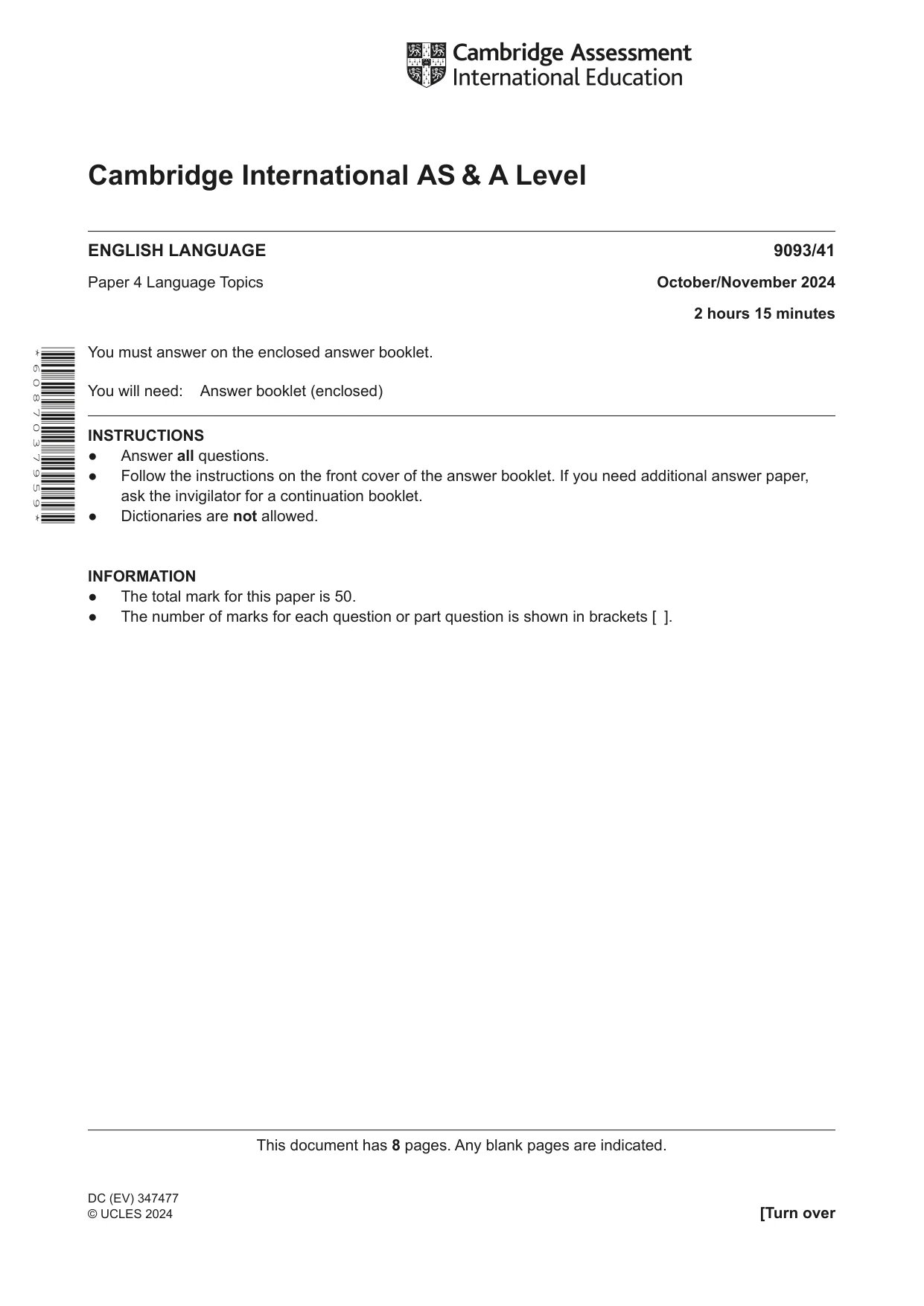
[Turn over This document has 8 pages. Any blank pages are indicated. DC (EV) 347477 © UCLES 2024 * 6 0 8 7 0 3 7 9 5 9 * ENGLISH LANGUAGE 9093/41 Paper 4 Language Topics October/November 2024 2 hours 15 minutes You must answer on the enclosed answer booklet. You will need: Answer booklet (enclosed) INSTRUCTIONS ● Answer all questions. ● Follow the instructions on the front cover of the answer booklet. If you need additional answer paper, ask the invigilator for a continuation booklet. ● Dictionaries are not allowed. INFORMATION ● The total mark for this paper is 50. ● The number of marks for each question or part question is shown in brackets [ ]. Cambridge International AS & A Level
Question paper, page 2
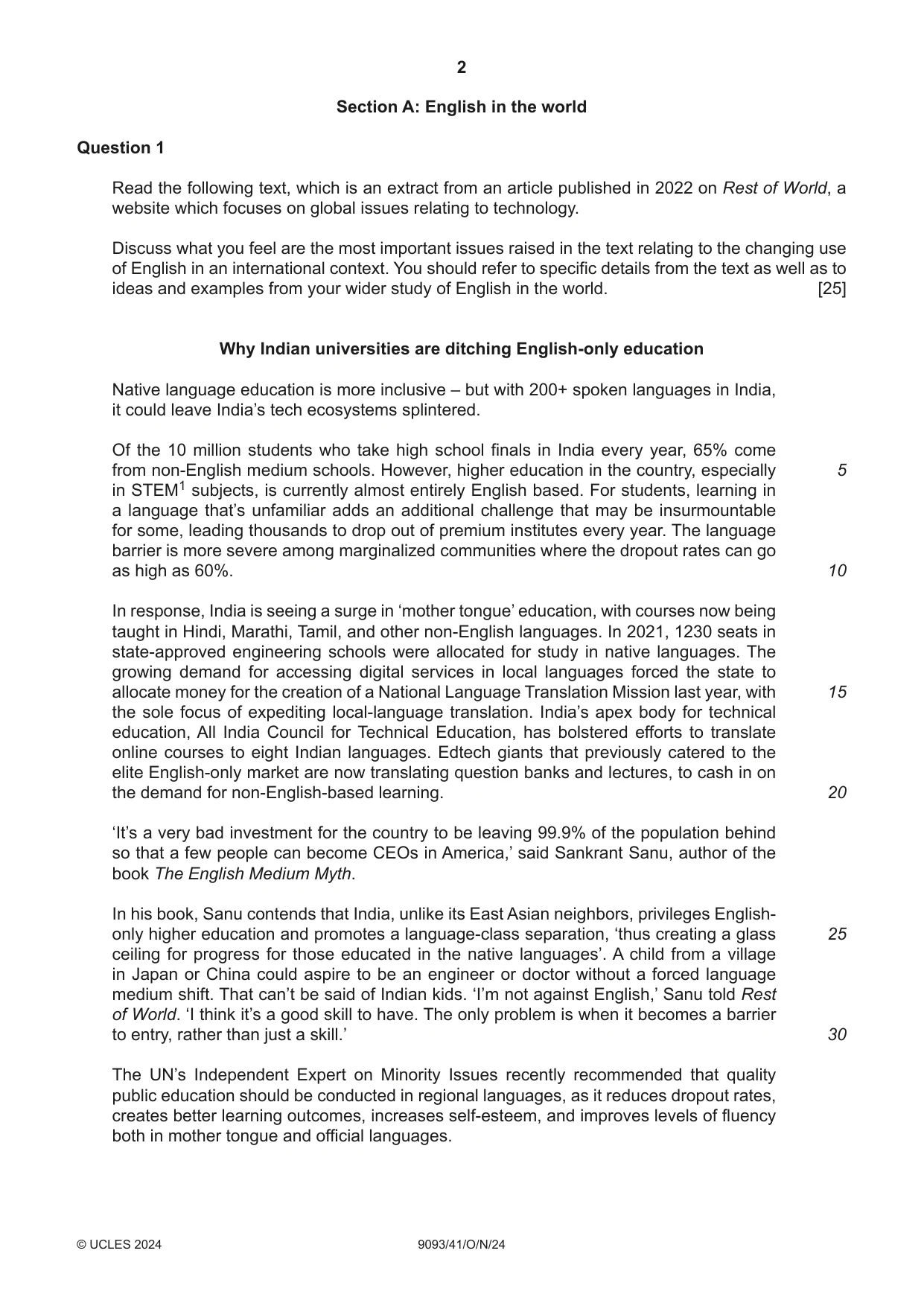
2 9093/41/O/N/24 © UCLES 2024 Section A: English in the world Question 1 Read the following text, which is an extract from an article published in 2022 on Rest of World, a website which focuses on global issues relating to technology. Discuss what you feel are the most important issues raised in the text relating to the changing use of English in an international context. You should refer to specific details from the text as well as to ideas and examples from your wider study of English in the world. [25] Why Indian universities are ditching English-only education Native language education is more inclusive – but with 200+ spoken languages in India, it could leave India’s tech ecosystems splintered. Of the 10 million students who take high school finals in India every year, 65% come from non-English medium schools. However, higher education in the country, especially in STEM1 subjects, is currently almost entirely English based. For students, learning in a language that’s unfamiliar adds an additional challenge that may be insurmountable for some, leading thousands to drop out of premium institutes every year. The language barrier is more severe among marginalized communities where the dropout rates can go as high as 60%. In response, India is seeing a surge in ‘mother tongue’ education, with courses now being taught in Hindi, Marathi, Tamil, and other non-English languages. In 2021, 1230 seats in state-approved engineering schools were allocated for study in native languages. The growing demand for accessing digital services in local languages forced the state to allocate money for the creation of a National Language Translation Mission last year, with the sole focus of expediting local-language translation. India’s apex body for technical education, All India Council for Technical Education, has bolstered efforts to translate online courses to eight Indian languages. Edtech giants that previously catered to the elite English-only market are now translating question banks and lectures, to cash in on the demand for non-English-based learning. ‘It’s a very bad investment for the country to be leaving 99.9% of the population behind so that a few people can become CEOs in America,’ said Sankrant Sanu, author of the book The English Medium Myth. In his book, Sanu contends that India, unlike its East Asian neighbors, privileges English- only higher education and promotes a language-class separation, ‘thus creating a glass ceiling for progress for those educated in the native languages’. A child from a village in Japan or China could aspire to be an engineer or doctor without a forced language medium shift. That can’t be said of Indian kids. ‘I’m not against English,’ Sanu told Rest of World. ‘I think it’s a good skill to have. The only problem is when it becomes a barrier to entry, rather than just a skill.’ The UN’s Independent Expert on Minority Issues recently recommended that quality public education should be conducted in regional languages, as it reduces dropout rates, creates better learning outcomes, increases self-esteem, and improves levels of fluency both in mother tongue and official languages. 5 10 15 20 25 30
Question paper, page 3
3 9093/41/O/N/24 © UCLES 2024 [Turn over Certainly not everyone is on board: at least one academic has called the recent trend ‘the beginning of the end’ of India’s global technical competence. Academics believe that local-language technical education creates dissonance with global demand and that those students graduating from vernacular medium higher education institutes may struggle to find jobs. 1STEM: science, technology, engineering and mathematics 35
Question paper, page 4
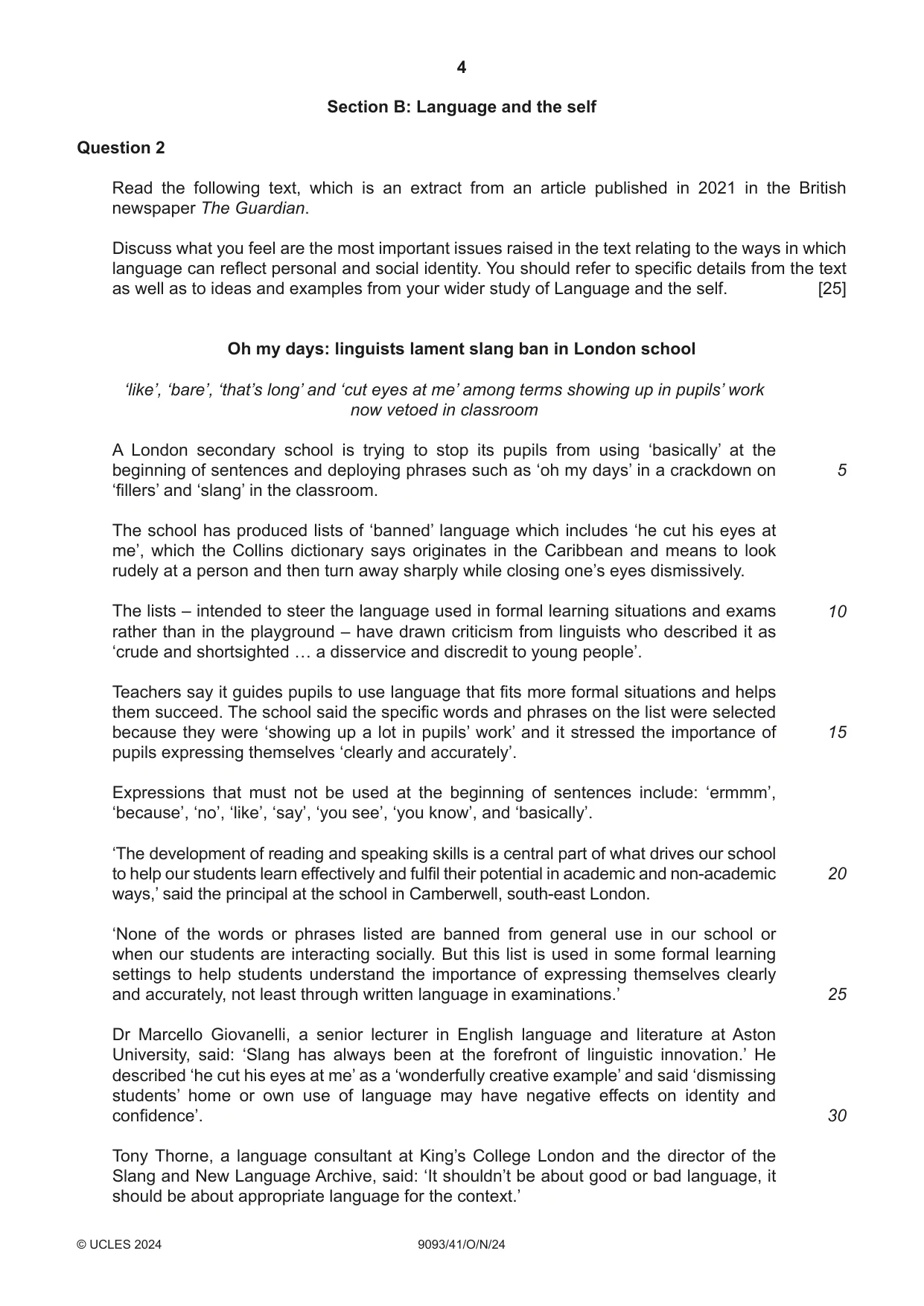
4 9093/41/O/N/24 © UCLES 2024 Section B: Language and the self Question 2 Read the following text, which is an extract from an article published in 2021 in the British newspaper The Guardian. Discuss what you feel are the most important issues raised in the text relating to the ways in which language can reflect personal and social identity. You should refer to specific details from the text as well as to ideas and examples from your wider study of Language and the self. [25] Oh my days: linguists lament slang ban in London school ‘like’, ‘bare’, ‘that’s long’ and ‘cut eyes at me’ among terms showing up in pupils’ work now vetoed in classroom A London secondary school is trying to stop its pupils from using ‘basically’ at the beginning of sentences and deploying phrases such as ‘oh my days’ in a crackdown on ‘fillers’ and ‘slang’ in the classroom. The school has produced lists of ‘banned’ language which includes ‘he cut his eyes at me’, which the Collins dictionary says originates in the Caribbean and means to look rudely at a person and then turn away sharply while closing one’s eyes dismissively. The lists – intended to steer the language used in formal learning situations and exams rather than in the playground – have drawn criticism from linguists who described it as ‘crude and shortsighted … a disservice and discredit to young people’. Teachers say it guides pupils to use language that fits more formal situations and helps them succeed. The school said the specific words and phrases on the list were selected because they were ‘showing up a lot in pupils’ work’ and it stressed the importance of pupils expressing themselves ‘clearly and accurately’. Expressions that must not be used at the beginning of sentences include: ‘ermmm’, ‘because’, ‘no’, ‘like’, ‘say’, ‘you see’, ‘you know’, and ‘basically’. ‘The development of reading and speaking skills is a central part of what drives our school to help our students learn effectively and fulfil their potential in academic and non-academic ways,’ said the principal at the school in Camberwell, south-east London. ‘None of the words or phrases listed are banned from general use in our school or when our students are interacting socially. But this list is used in some formal learning settings to help students understand the importance of expressing themselves clearly and accurately, not least through written language in examinations.’ Dr Marcello Giovanelli, a senior lecturer in English language and literature at Aston University, said: ‘Slang has always been at the forefront of linguistic innovation.’ He described ‘he cut his eyes at me’ as a ‘wonderfully creative example’ and said ‘dismissing students’ home or own use of language may have negative effects on identity and confidence’. Tony Thorne, a language consultant at King’s College London and the director of the Slang and New Language Archive, said: ‘It shouldn’t be about good or bad language, it should be about appropriate language for the context.’ 5 10 15 20 25 30
Question paper, page 5
5 9093/41/O/N/24 © UCLES 2024 ‘You don’t want to make them feel they have to reject the cultural aspects of their own language,’ said Dr Natalie Sharpling, who teaches applied linguistics at Warwick University. ‘We should celebrate the different ways language is being used and concentrate on the content of what is being said.’ Sharpling said she had observed an increasing trend in schools to police language and said, ‘it would be a shame if it becomes a case of if you want to be successful, this is the way you have to speak’. 35 40
Question paper, page 6
6 9093/41/O/N/24 © UCLES 2024 BLANK PAGE
Question paper, page 7
7 9093/41/O/N/24 © UCLES 2024 BLANK PAGE
Question paper, page 8
8 9093/41/O/N/24 © UCLES 2024 Permission to reproduce items where third-party owned material protected by copyright is included has been sought and cleared where possible. Every reasonable effort has been made by the publisher (UCLES) to trace copyright holders, but if any items requiring clearance have unwittingly been included, the publisher will be pleased to make amends at the earliest possible opportunity. To avoid the issue of disclosure of answer-related information to candidates, all copyright acknowledgements are reproduced online in the Cambridge Assessment International Education Copyright Acknowledgements Booklet. This is produced for each series of examinations and is freely available to download at www.cambridgeinternational.org after the live examination series. Cambridge Assessment International Education is part of Cambridge Assessment. Cambridge Assessment is the brand name of the University of Cambridge Local Examinations Syndicate (UCLES), which is a department of the University of Cambridge. BLANK PAGE
Mark scheme, page 1
This document consists of 8 printed pages. © Cambridge University Press & Assessment 2024 [Turn over Cambridge International A Level ENGLISH LANGUAGE 9093/41 Paper 4 Language Topics October/November 2024 MARK SCHEME Maximum Mark: 50 Published This mark scheme is published as an aid to teachers and candidates, to indicate the requirements of the examination. It shows the basis on which Examiners were instructed to award marks. It does not indicate the details of the discussions that took place at an Examiners’ meeting before marking began, which would have considered the acceptability of alternative answers. Mark schemes should be read in conjunction with the question paper and the Principal Examiner Report for Teachers. Cambridge International will not enter into discussions about these mark schemes. Cambridge International is publishing the mark schemes for the October/November 2024 series for most Cambridge IGCSE, Cambridge International A and AS Level components, and some Cambridge O Level components.
Mark scheme, page 2
9093/41 Cambridge International A Level – Mark Scheme PUBLISHED October/November 2024 © Cambridge University Press & Assessment 2024 Page 2 of 8 Generic Marking Principles These general marking principles must be applied by all examiners when marking candidate answers. They should be applied alongside the specific content of the mark scheme or generic level descriptions for a question. Each question paper and mark scheme will also comply with these marking principles. GENERIC MARKING PRINCIPLE 1: Marks must be awarded in line with: • the specific content of the mark scheme or the generic level descriptors for the question • the specific skills defined in the mark scheme or in the generic level descriptors for the question • the standard of response required by a candidate as exemplified by the standardisation scripts. GENERIC MARKING PRINCIPLE 2: Marks awarded are always whole marks (not half marks, or other fractions). GENERIC MARKING PRINCIPLE 3: Marks must be awarded positively: • marks are awarded for correct/valid answers, as defined in the mark scheme. However, credit is given for valid answers which go beyond the scope of the syllabus and mark scheme, referring to your Team Leader as appropriate • marks are awarded when candidates clearly demonstrate what they know and can do • marks are not deducted for errors • marks are not deducted for omissions • answers should only be judged on the quality of spelling, punctuation and grammar when these features are specifically assessed by the question as indicated by the mark scheme. The meaning, however, should be unambiguous. GENERIC MARKING PRINCIPLE 4: Rules must be applied consistently, e.g. in situations where candidates have not followed instructions or in the application of generic level descriptors.
Mark scheme, page 3
9093/41 Cambridge International A Level – Mark Scheme PUBLISHED October/November 2024 © Cambridge University Press & Assessment 2024 Page 3 of 8 GENERIC MARKING PRINCIPLE 5: Marks should be awarded using the full range of marks defined in the mark scheme for the question (however; the use of the full mark range may be limited according to the quality of the candidate responses seen). GENERIC MARKING PRINCIPLE 6: Marks awarded are based solely on the requirements as defined in the mark scheme. Marks should not be awarded with grade thresholds or grade descriptors in mind.
Mark scheme, page 4
9093/41 Cambridge International A Level – Mark Scheme PUBLISHED October/November 2024 © Cambridge University Press & Assessment 2024 Page 4 of 8 English & Media subject specific general marking principles (To be read in conjunction with the Generic Marking Principles (and requiring further guidance on how to place marks within levels)) Components using level descriptors: • We use level descriptors as a guide to broad understanding of the qualities normally expected of, or typical of, work in a level. • Level descriptors are a means of general guidance, and should not be interpreted as hurdle statements. • Where indicative content notes are supplied for a question, these are not a prescription of required content, and must not be treated as such. Alternative correct points and unexpected answers in candidates’ scripts must be given marks that fairly reflect the knowledge and skills demonstrated. • While we may have legitimate expectations as to the ground most answers may occupy, we must at all times be prepared to meet candidates on their chosen ground, provided it is relevant ground (e.g. clearly related to and derived from a relevant passage/text and meeting the mark scheme requirements for the question).
Mark scheme, page 5
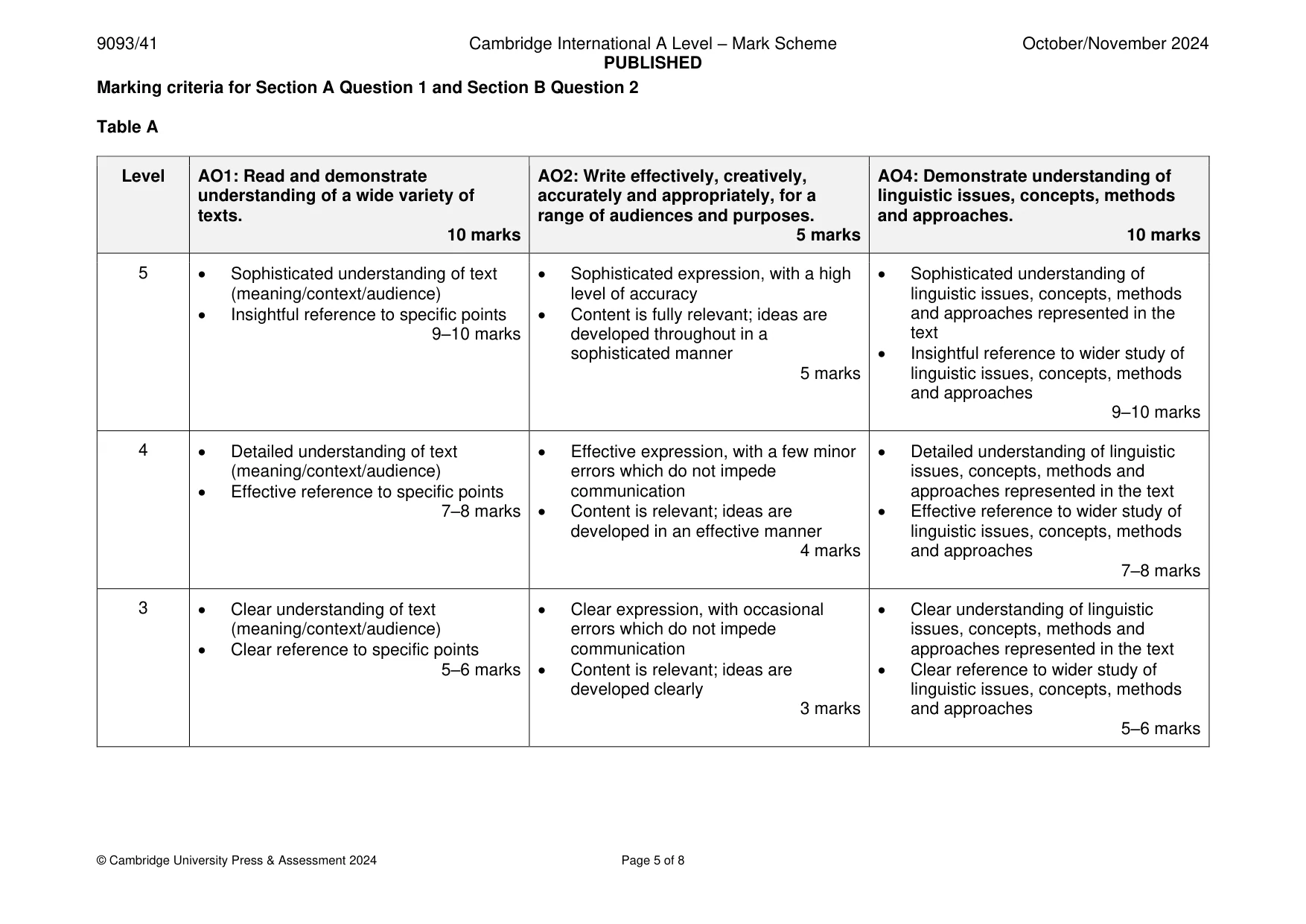
9093/41 Cambridge International A Level – Mark Scheme PUBLISHED October/November 2024 © Cambridge University Press & Assessment 2024 Page 5 of 8 Marking criteria for Section A Question 1 and Section B Question 2 Table A Level AO1: Read and demonstrate understanding of a wide variety of texts. 10 marks AO2: Write effectively, creatively, accurately and appropriately, for a range of audiences and purposes. 5 marks AO4: Demonstrate understanding of linguistic issues, concepts, methods and approaches. 10 marks 5 • Sophisticated understanding of text (meaning/context/audience) • Insightful reference to specific points 9–10 marks • Sophisticated expression, with a high level of accuracy • Content is fully relevant; ideas are developed throughout in a sophisticated manner 5 marks • Sophisticated understanding of linguistic issues, concepts, methods and approaches represented in the text • Insightful reference to wider study of linguistic issues, concepts, methods and approaches 9–10 marks 4 • Detailed understanding of text (meaning/context/audience) • Effective reference to specific points 7–8 marks • Effective expression, with a few minor errors which do not impede communication • Content is relevant; ideas are developed in an effective manner 4 marks • Detailed understanding of linguistic issues, concepts, methods and approaches represented in the text • Effective reference to wider study of linguistic issues, concepts, methods and approaches 7–8 marks 3 • Clear understanding of text (meaning/context/audience) • Clear reference to specific points 5–6 marks • Clear expression, with occasional errors which do not impede communication • Content is relevant; ideas are developed clearly 3 marks • Clear understanding of linguistic issues, concepts, methods and approaches represented in the text • Clear reference to wider study of linguistic issues, concepts, methods and approaches 5–6 marks
Mark scheme, page 6
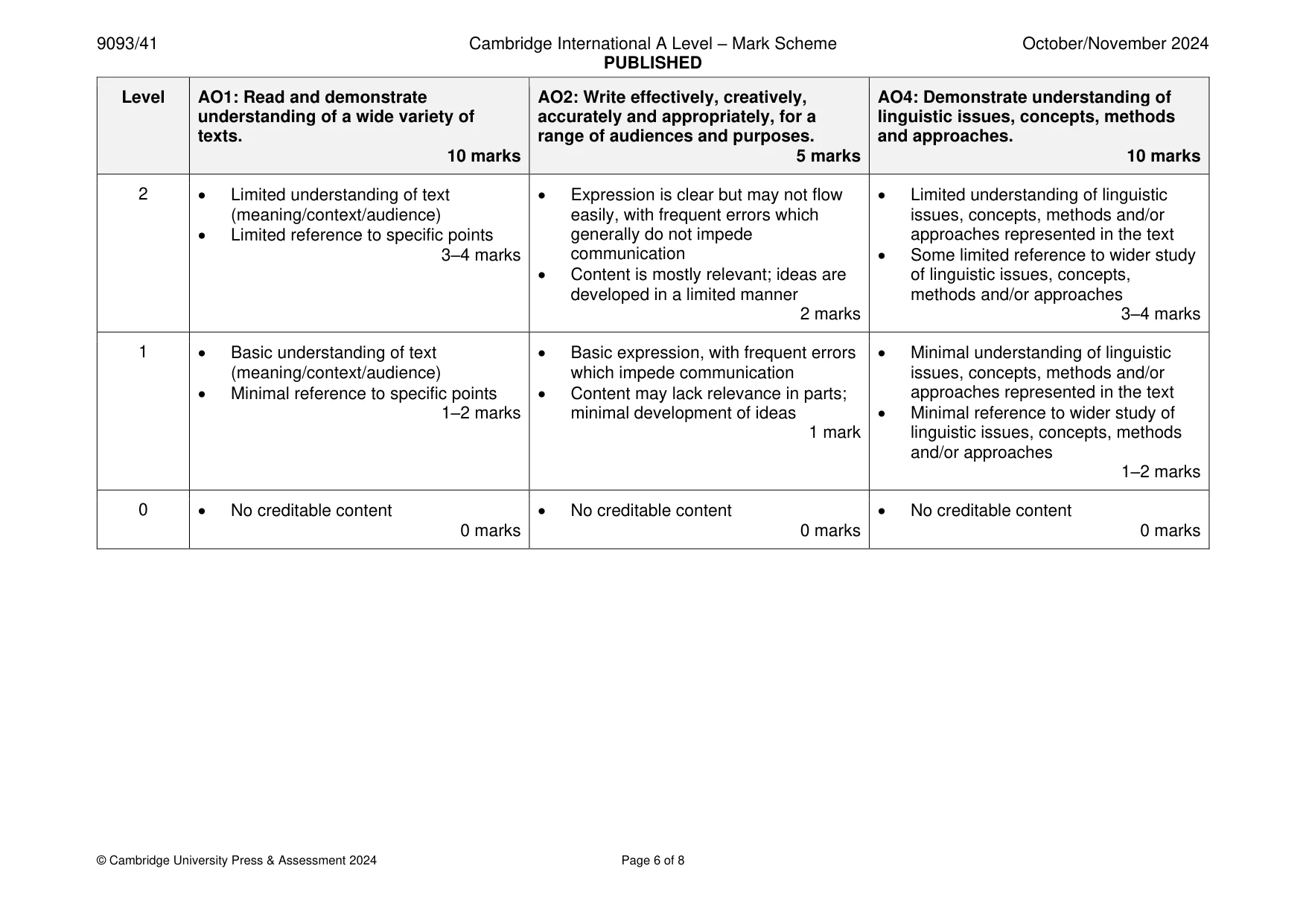
9093/41 Cambridge International A Level – Mark Scheme PUBLISHED October/November 2024 © Cambridge University Press & Assessment 2024 Page 6 of 8 Level AO1: Read and demonstrate understanding of a wide variety of texts. 10 marks AO2: Write effectively, creatively, accurately and appropriately, for a range of audiences and purposes. 5 marks AO4: Demonstrate understanding of linguistic issues, concepts, methods and approaches. 10 marks 2 • Limited understanding of text (meaning/context/audience) • Limited reference to specific points 3–4 marks • Expression is clear but may not flow easily, with frequent errors which generally do not impede communication • Content is mostly relevant; ideas are developed in a limited manner 2 marks • Limited understanding of linguistic issues, concepts, methods and/or approaches represented in the text • Some limited reference to wider study of linguistic issues, concepts, methods and/or approaches 3–4 marks 1 • Basic understanding of text (meaning/context/audience) • Minimal reference to specific points 1–2 marks • Basic expression, with frequent errors which impede communication • Content may lack relevance in parts; minimal development of ideas 1 mark • Minimal understanding of linguistic issues, concepts, methods and/or approaches represented in the text • Minimal reference to wider study of linguistic issues, concepts, methods and/or approaches 1–2 marks 0 • No creditable content 0 marks • No creditable content 0 marks • No creditable content 0 marks
Mark scheme, page 7
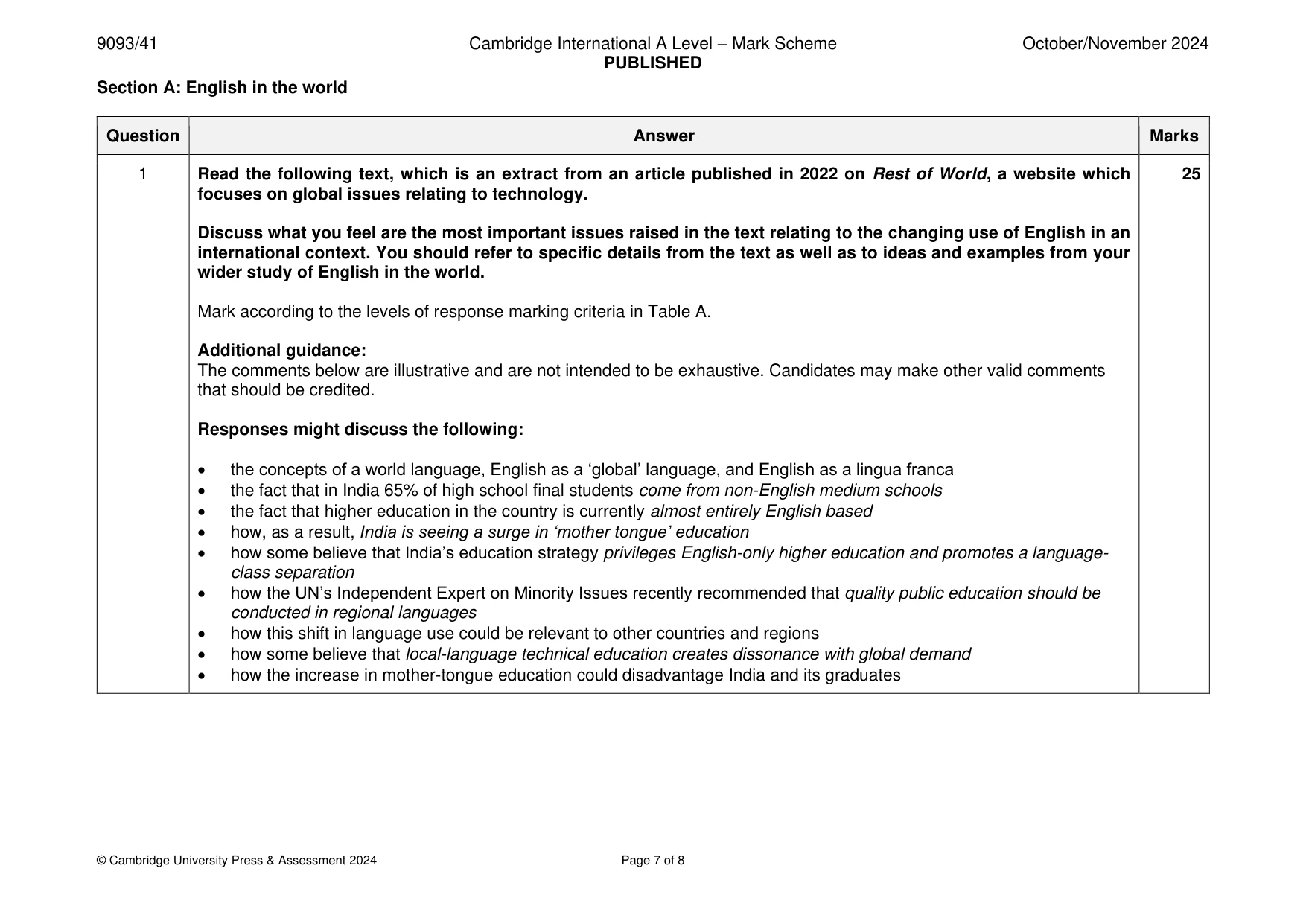
9093/41 Cambridge International A Level – Mark Scheme PUBLISHED October/November 2024 © Cambridge University Press & Assessment 2024 Page 7 of 8 Section A: English in the world Question Answer Marks 1 Read the following text, which is an extract from an article published in 2022 on Rest of World, a website which focuses on global issues relating to technology. Discuss what you feel are the most important issues raised in the text relating to the changing use of English in an international context. You should refer to specific details from the text as well as to ideas and examples from your wider study of English in the world. Mark according to the levels of response marking criteria in Table A. Additional guidance: The comments below are illustrative and are not intended to be exhaustive. Candidates may make other valid comments that should be credited. Responses might discuss the following: • the concepts of a world language, English as a ‘global’ language, and English as a lingua franca • the fact that in India 65% of high school final students come from non-English medium schools • the fact that higher education in the country is currently almost entirely English based • how, as a result, India is seeing a surge in ‘mother tongue’ education • how some believe that India’s education strategy privileges English-only higher education and promotes a language- class separation • how the UN’s Independent Expert on Minority Issues recently recommended that quality public education should be conducted in regional languages • how this shift in language use could be relevant to other countries and regions • how some believe that local-language technical education creates dissonance with global demand • how the increase in mother-tongue education could disadvantage India and its graduates 25
Mark scheme, page 8
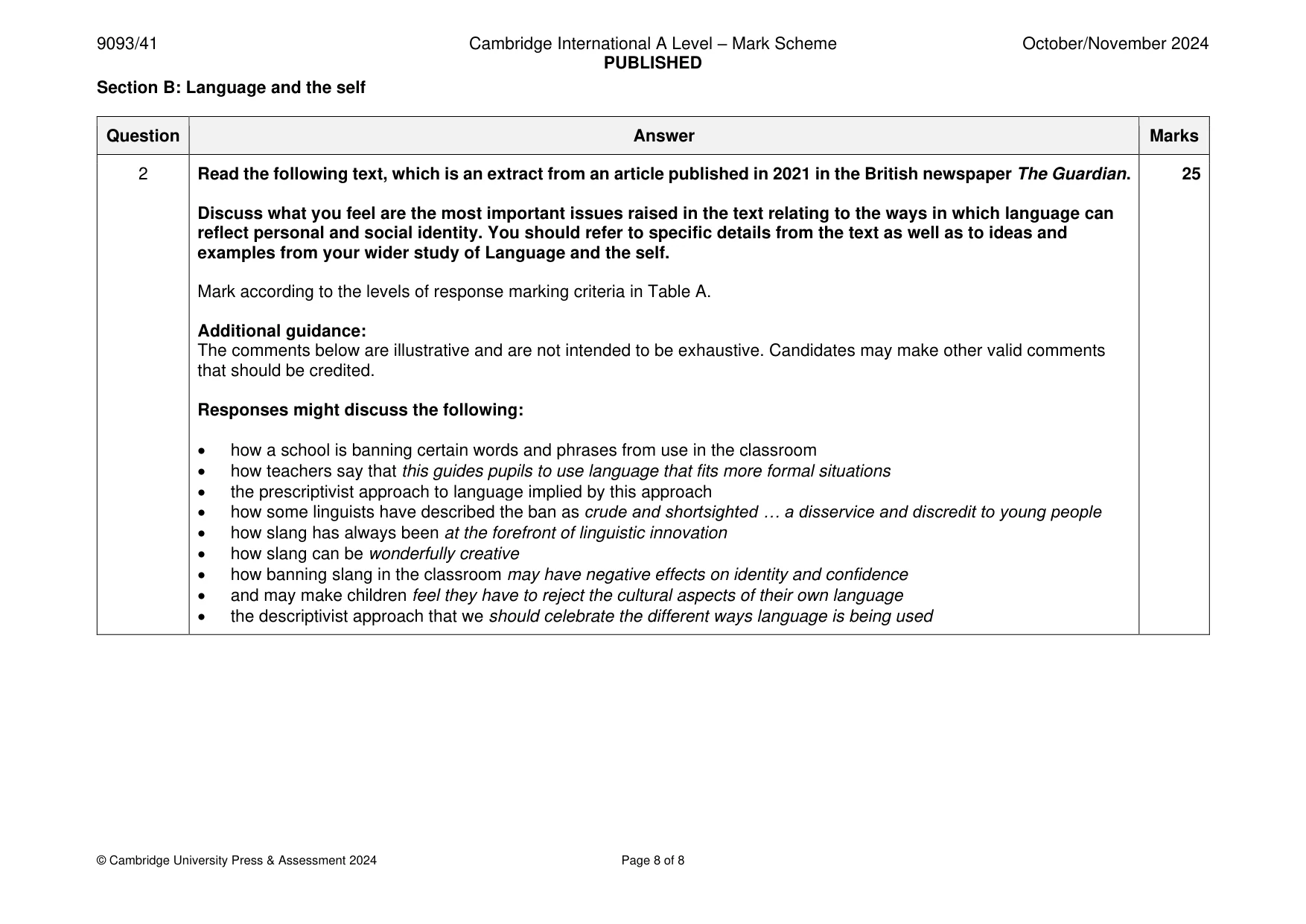
9093/41 Cambridge International A Level – Mark Scheme PUBLISHED October/November 2024 © Cambridge University Press & Assessment 2024 Page 8 of 8 Section B: Language and the self Question Answer Marks 2 Read the following text, which is an extract from an article published in 2021 in the British newspaper The Guardian. Discuss what you feel are the most important issues raised in the text relating to the ways in which language can reflect personal and social identity. You should refer to specific details from the text as well as to ideas and examples from your wider study of Language and the self. Mark according to the levels of response marking criteria in Table A. Additional guidance: The comments below are illustrative and are not intended to be exhaustive. Candidates may make other valid comments that should be credited. Responses might discuss the following: • how a school is banning certain words and phrases from use in the classroom • how teachers say that this guides pupils to use language that fits more formal situations • the prescriptivist approach to language implied by this approach • how some linguists have described the ban as crude and shortsighted … a disservice and discredit to young people • how slang has always been at the forefront of linguistic innovation • how slang can be wonderfully creative • how banning slang in the classroom may have negative effects on identity and confidence • and may make children feel they have to reject the cultural aspects of their own language • the descriptivist approach that we should celebrate the different ways language is being used 25
What you needed in this session
Cambridge’s own grade thresholds for 2024 Oct/Nov, Paper 4 · Variant 1. A higher threshold means an easier paper — the bar moves with how the cohort did.