Cambridge A Level English - Language AS and A Level (from 2014) 9093 — 2024 Oct/Nov Paper 3 · Variant 3
9093/33/O/N/24 · 50 marks · 135 min
The question paper and its mark scheme, free to read here and free to download. This is Cambridge’s own paper, exactly as it was sat.
Question paper8 pages


Mark scheme13 pages
Answers below. Sit the paper first if you are practising.
Paper as text
Question paper, page 1
[Turn over Cambridge International AS & A Level This document has 8 pages. Any blank pages are indicated. DC (WW) 336618/4 © UCLES 2024 ENGLISH LANGUAGE 9093/33 Paper 3 Language Analysis October/November 2024 2 hours 15 minutes You must answer on the enclosed answer booklet. You will need: Answer booklet (enclosed) INSTRUCTIONS ● Answer all questions. ● Follow the instructions on the front cover of the answer booklet. If you need additional answer paper, ask the invigilator for a continuation booklet. ● Dictionaries are not allowed. INFORMATION ● The total mark for this paper is 50. ● The number of marks for each question or part question is shown in brackets [ ]. * 8 2 5 4 8 6 5 7 0 6 *
Question paper, page 2
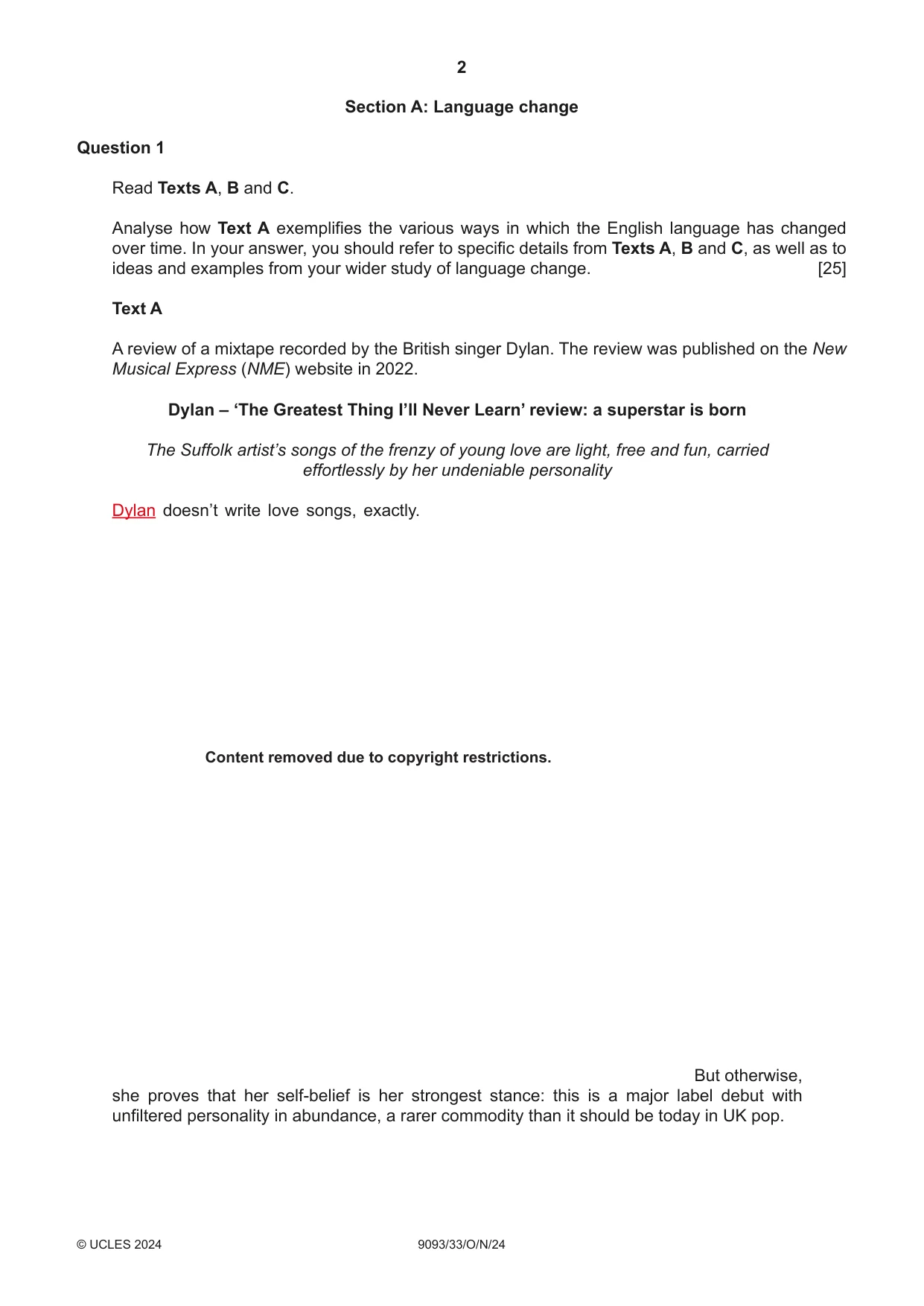
2 9093/33/O/N/24 © UCLES 2024 Section A: Language change Question 1 Read Texts A, B and C. Analyse how Text A exemplifies the various ways in which the English language has changed over time. In your answer, you should refer to specific details from Texts A, B and C, as well as to ideas and examples from your wider study of language change. [25] Text A A review of a mixtape recorded by the British singer Dylan. The review was published on the New Musical Express (NME) website in 2022. Dylan – ‘The Greatest Thing I’ll Never Learn’ review: a superstar is born The Suffolk artist’s songs of the frenzy of young love are light, free and fun, carried effortlessly by her undeniable personality Dylan doesn’t write love songs, exactly. But otherwise, she proves that her self-belief is her strongest stance: this is a major label debut with unfiltered personality in abundance, a rarer commodity than it should be today in UK pop. Content removed due to copyright restrictions.
Question paper, page 3
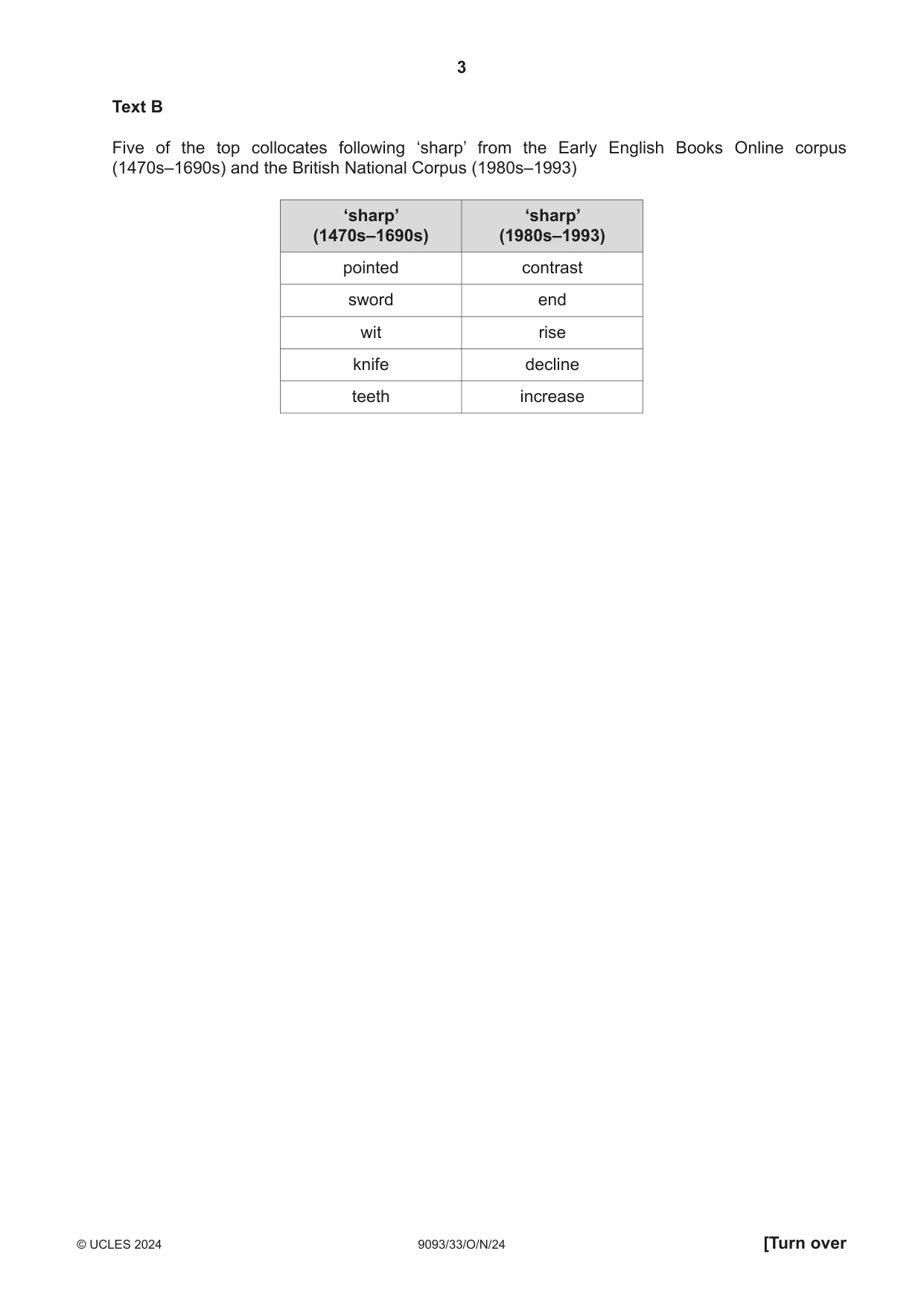
3 9093/33/O/N/24 © UCLES 2024 [Turn over Text B Five of the top collocates following ‘sharp’ from the Early English Books Online corpus (1470s–1690s) and the British National Corpus (1980s–1993) ‘sharp’ (1470s–1690s) ‘sharp’ (1980s–1993) pointed contrast sword end wit rise knife decline teeth increase
Question paper, page 4
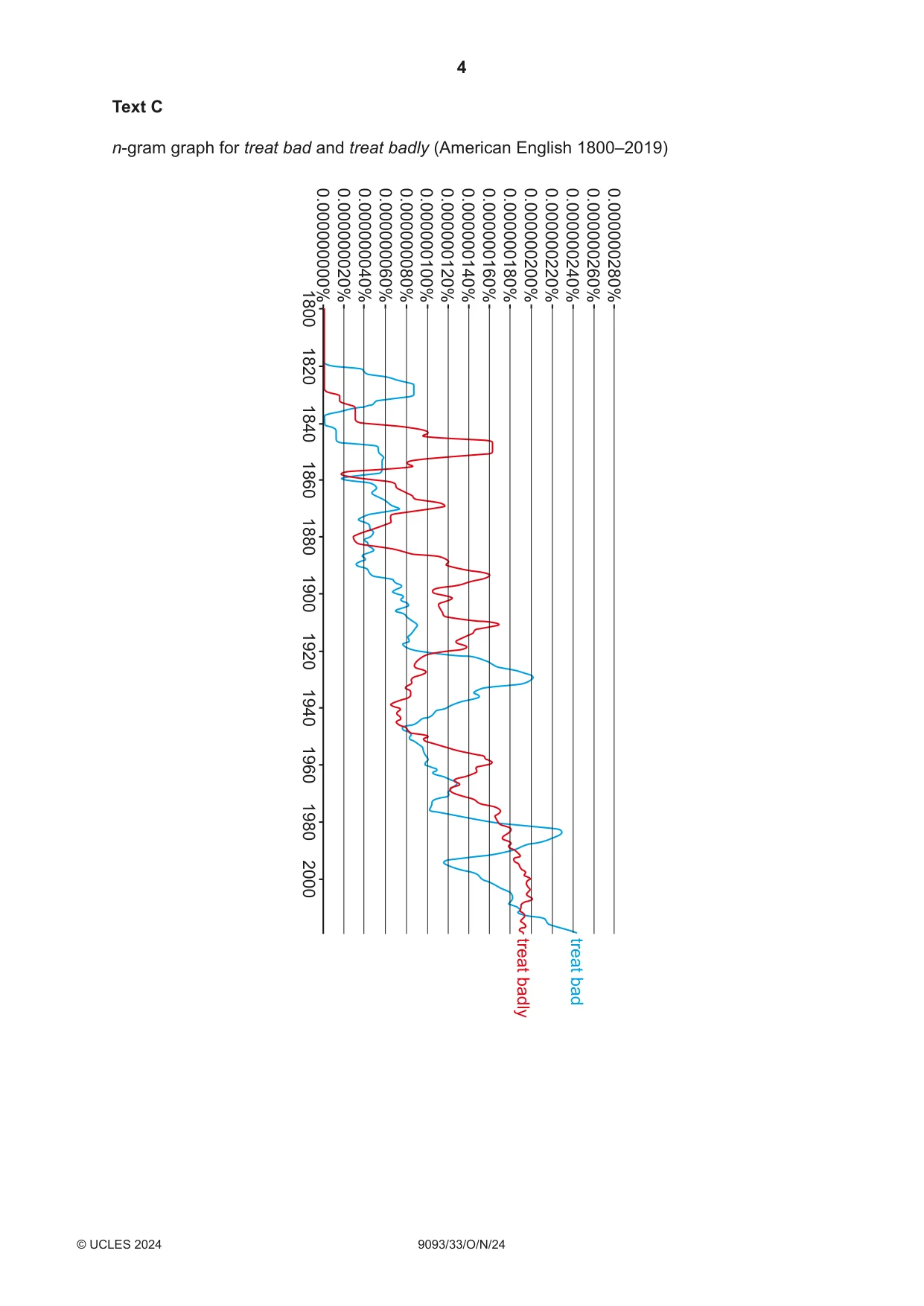
4 9093/33/O/N/24 © UCLES 2024 Text C n-gram graph for treat bad and treat badly (American English 1800–2019) treat bad treat badly 1800 0.000000000% 0.000000020% 0.000000040% 0.000000060% 0.000000080% 0.000000100% 0.000000120% 0.000000140% 0.000000160% 0.000000180% 0.000000200% 0.000000220% 0.000000240% 0.000000260% 0.000000280% 1820 1840 1860 1880 1900 1920 1940 1960 1980 2000
Question paper, page 5
5 9093/33/O/N/24 © UCLES 2024 [Turn over BLANK PAGE
Question paper, page 6
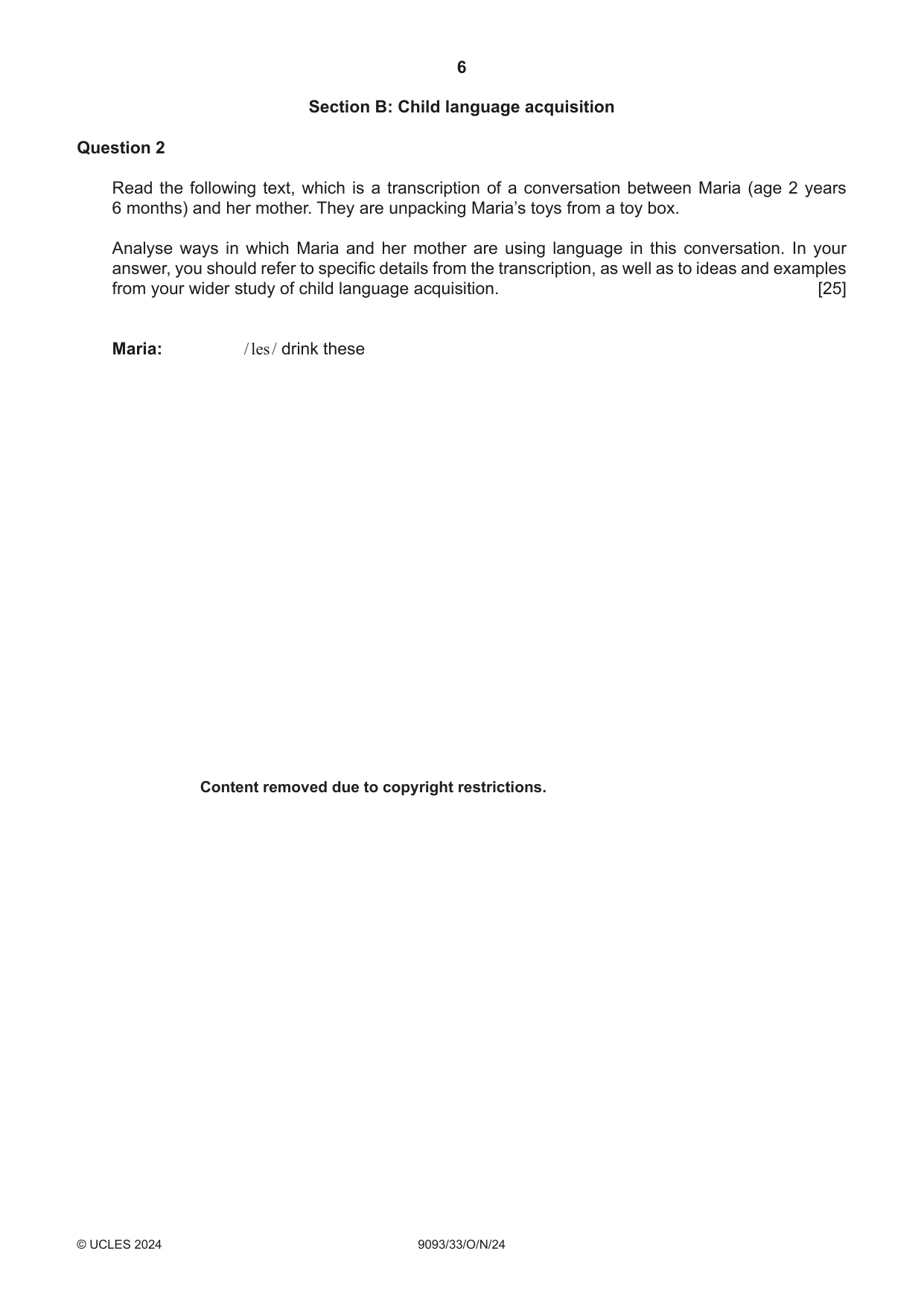
6 9093/33/O/N/24 © UCLES 2024 Section B: Child language acquisition Question 2 Read the following text, which is a transcription of a conversation between Maria (age 2 years 6 months) and her mother. They are unpacking Maria’s toys from a toy box. Analyse ways in which Maria and her mother are using language in this conversation. In your answer, you should refer to specific details from the transcription, as well as to ideas and examples from your wider study of child language acquisition. [25] Maria: / les / drink these Content removed due to copyright restrictions.
Question paper, page 7
7 9093/33/O/N/24 © UCLES 2024 [Turn over Maria: no (1) going to sit there Content removed due to copyright restrictions.
Question paper, page 8
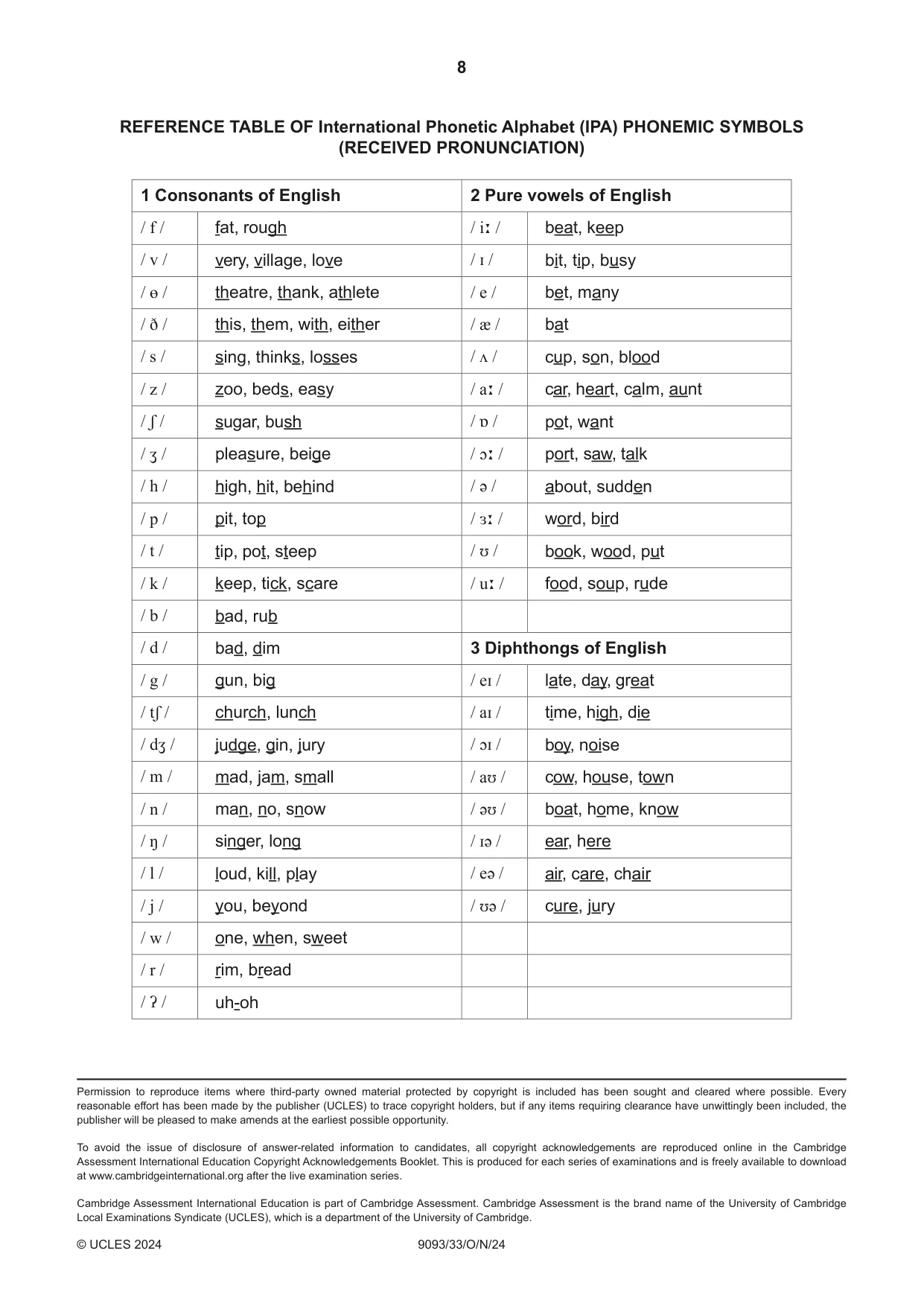
8 9093/33/O/N/24 © UCLES 2024 Permission to reproduce items where third-party owned material protected by copyright is included has been sought and cleared where possible. Every reasonable effort has been made by the publisher (UCLES) to trace copyright holders, but if any items requiring clearance have unwittingly been included, the publisher will be pleased to make amends at the earliest possible opportunity. To avoid the issue of disclosure of answer-related information to candidates, all copyright acknowledgements are reproduced online in the Cambridge Assessment International Education Copyright Acknowledgements Booklet. This is produced for each series of examinations and is freely available to download at www.cambridgeinternational.org after the live examination series. Cambridge Assessment International Education is part of Cambridge Assessment. Cambridge Assessment is the brand name of the University of Cambridge Local Examinations Syndicate (UCLES), which is a department of the University of Cambridge. REFERENCE TABLE OF International Phonetic Alphabet (IPA) PHONEMIC SYMBOLS (RECEIVED PRONUNCIATION) 1 Consonants of English 2 Pure vowels of English / f / fat, rough / iː / beat, keep / v / very, village, love / ɪ / bit, tip, busy / ɵ / theatre, thank, athlete / e / bet, many / ð / this, them, with, either / æ / bat / s / sing, thinks, losses / ʌ / cup, son, blood / z / zoo, beds, easy / aː / car, heart, calm, aunt / ʃ / sugar, bush / ɒ / pot, want / ʒ / pleasure, beige / ɔː / port, saw, talk / h / high, hit, behind / ə / about, sudden / p / pit, top / ɜː / word, bird / t / tip, pot, steep / ʊ / book, wood, put / k / keep, tick, scare / uː / food, soup, rude / b / bad, rub / d / bad, dim 3 Diphthongs of English / g / gun, big / eɪ / late, day, great / tʃ / church, lunch / aɪ / time, high, die / dʒ / judge, gin, jury / ɔɪ / boy, noise / m / mad, jam, small / aʊ / cow, house, town / n / man, no, snow / əʊ / boat, home, know / ŋ / singer, long / ɪə / ear, here / l / loud, kill, play / eə / air, care, chair / j / you, beyond / ʊə / cure, jury / w / one, when, sweet / r / rim, bread / ʔ / uh-oh
Mark scheme, page 1
This document consists of 13 printed pages. © Cambridge University Press & Assessment 2024 [Turn over Cambridge International A Level ENGLISH LANGUAGE 9093/33 Paper 3 Language Analysis October/November 2024 MARK SCHEME Maximum Mark: 50 Published This mark scheme is published as an aid to teachers and candidates, to indicate the requirements of the examination. It shows the basis on which Examiners were instructed to award marks. It does not indicate the details of the discussions that took place at an Examiners’ meeting before marking began, which would have considered the acceptability of alternative answers. Mark schemes should be read in conjunction with the question paper and the Principal Examiner Report for Teachers. Cambridge International will not enter into discussions about these mark schemes. Cambridge International is publishing the mark schemes for the October/November 2024 series for most Cambridge IGCSE, Cambridge International A and AS Level components, and some Cambridge O Level components.
Mark scheme, page 2
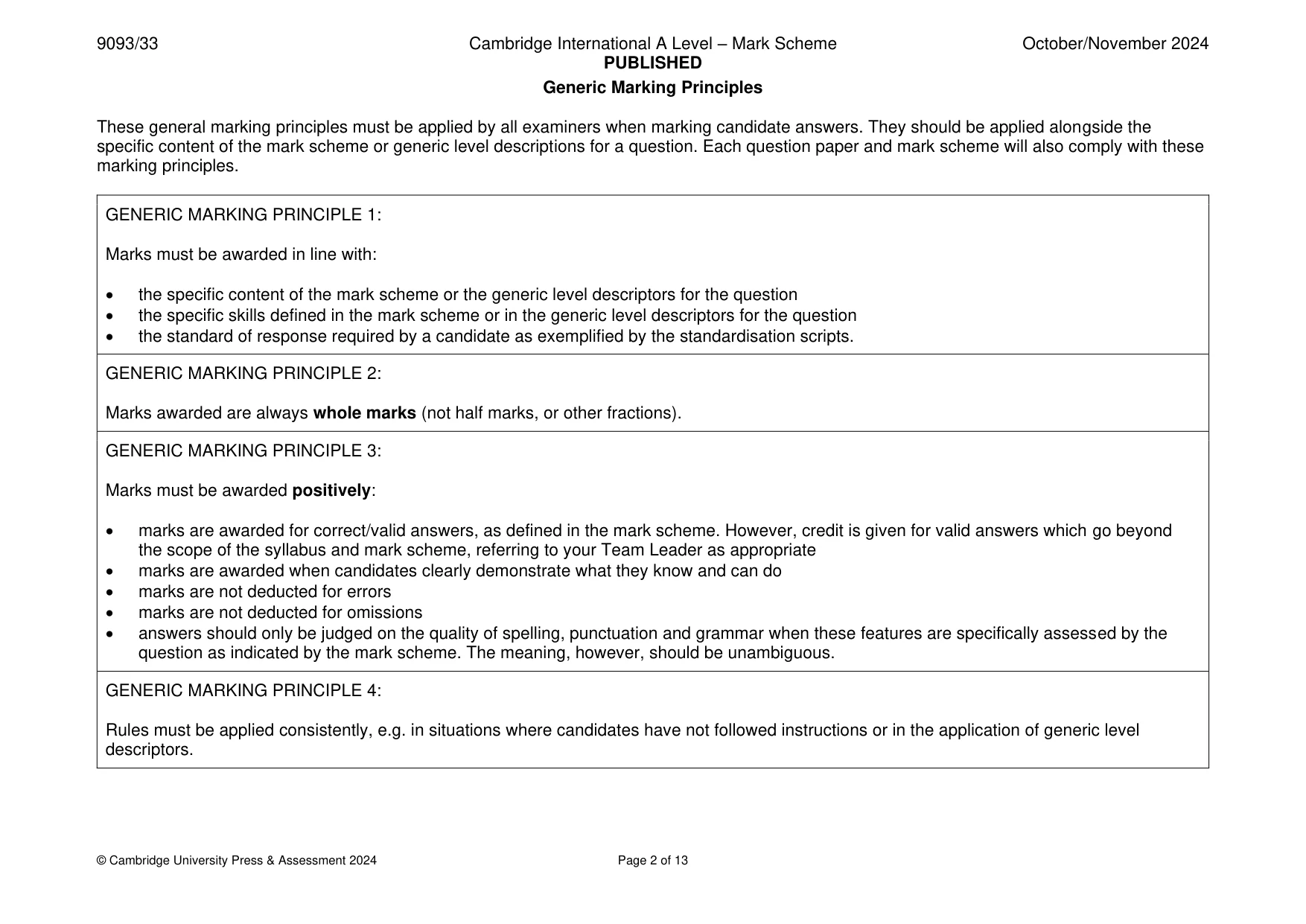
9093/33 Cambridge International A Level – Mark Scheme PUBLISHED October/November 2024 © Cambridge University Press & Assessment 2024 Page 2 of 13 Generic Marking Principles These general marking principles must be applied by all examiners when marking candidate answers. They should be applied alongside the specific content of the mark scheme or generic level descriptions for a question. Each question paper and mark scheme will also comply with these marking principles. GENERIC MARKING PRINCIPLE 1: Marks must be awarded in line with: • the specific content of the mark scheme or the generic level descriptors for the question • the specific skills defined in the mark scheme or in the generic level descriptors for the question • the standard of response required by a candidate as exemplified by the standardisation scripts. GENERIC MARKING PRINCIPLE 2: Marks awarded are always whole marks (not half marks, or other fractions). GENERIC MARKING PRINCIPLE 3: Marks must be awarded positively: • marks are awarded for correct/valid answers, as defined in the mark scheme. However, credit is given for valid answers which go beyond the scope of the syllabus and mark scheme, referring to your Team Leader as appropriate • marks are awarded when candidates clearly demonstrate what they know and can do • marks are not deducted for errors • marks are not deducted for omissions • answers should only be judged on the quality of spelling, punctuation and grammar when these features are specifically assessed by the question as indicated by the mark scheme. The meaning, however, should be unambiguous. GENERIC MARKING PRINCIPLE 4: Rules must be applied consistently, e.g. in situations where candidates have not followed instructions or in the application of generic level descriptors.
Mark scheme, page 3
9093/33 Cambridge International A Level – Mark Scheme PUBLISHED October/November 2024 © Cambridge University Press & Assessment 2024 Page 3 of 13 GENERIC MARKING PRINCIPLE 5: Marks should be awarded using the full range of marks defined in the mark scheme for the question (however; the use of the full mark range may be limited according to the quality of the candidate responses seen). GENERIC MARKING PRINCIPLE 6: Marks awarded are based solely on the requirements as defined in the mark scheme. Marks should not be awarded with grade thresholds or grade descriptors in mind.
Mark scheme, page 4
9093/33 Cambridge International A Level – Mark Scheme PUBLISHED October/November 2024 © Cambridge University Press & Assessment 2024 Page 4 of 13 English & Media subject specific general marking principles (To be read in conjunction with the Generic Marking Principles (and requiring further guidance on how to place marks within levels)) Components using level descriptors: • We use level descriptors as a guide to broad understanding of the qualities normally expected of, or typical of, work in a level. • Level descriptors are a means of general guidance, and should not be interpreted as hurdle statements. • Where indicative content notes are supplied for a question, these are not a prescription of required content, and must not be treated as such. Alternative correct points and unexpected answers in candidates’ scripts must be given marks that fairly reflect the knowledge and skills demonstrated. • While we may have legitimate expectations as to the ground most answers may occupy, we must at all times be prepared to meet candidates on their chosen ground, provided it is relevant ground (e.g. clearly related to and derived from a relevant passage/text and meeting the mark scheme requirements for the question).
Mark scheme, page 5
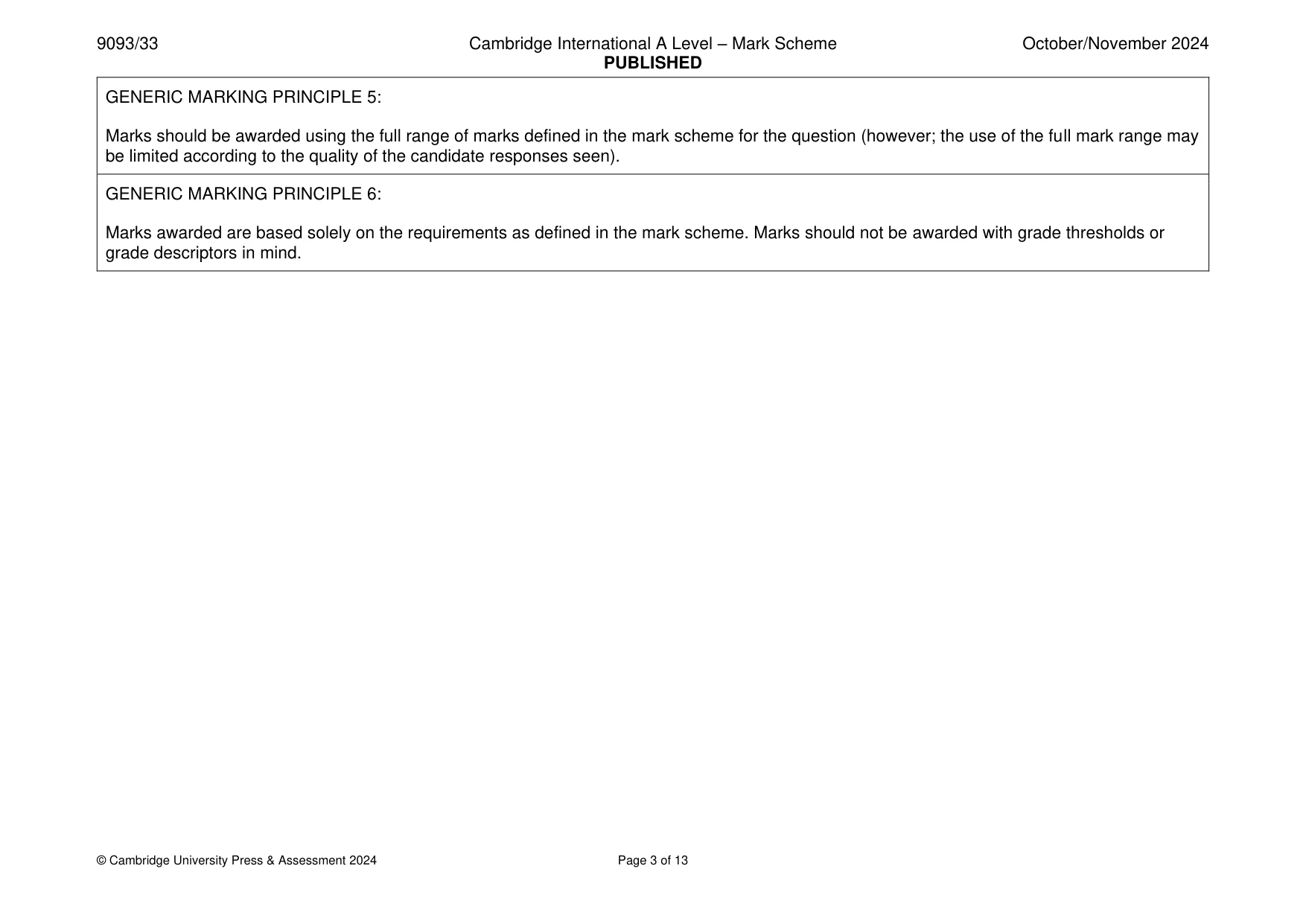
9093/33 Cambridge International A Level – Mark Scheme PUBLISHED October/November 2024 © Cambridge University Press & Assessment 2024 Page 5 of 13 English Language specific marking instructions: AO1 Read and demonstrate understanding of a wide variety of texts. (Understanding) • Marks should be awarded for the accuracy of the candidate’s understanding of the text and its features, not for any analysis of them which is recognised under AO3. • Where comparison is required, marks should be awarded for the candidate’s recognition of similarities and differences between the texts and their features, not for any consequent analysis. • When awarding a ‘best-fit’ mark within a Level for each AO, consider each bullet point equally. AO2 Write effectively, creatively, accurately and appropriately, for a range of audiences and purposes. (Writing) • Marks should be awarded equally on the basis of the level of the candidate’s written expression (range of features used and accuracy) and the development of their writing (its organisation and relevance to task and audience). • When awarding a ‘best-fit’ mark within a Level for each AO, consider each bullet point equally. AO4: Demonstrate understanding of linguistic issues, concepts, methods and approaches. (Conceptualisation) • Marks should be awarded equally on the basis of the level of the candidate’s understanding of the relevant issues, concepts, methods and approaches represented both in the text(s) and in their wider studies. • When awarding a ‘best-fit’ mark within a Level for each AO, consider each bullet point equally. AO5: Analyse and synthesise language data from a variety of sources. (Data handling) • Marks should be awarded equally on the basis of the level of the candidate’s selection, analysis and synthesis of language data. • When awarding a ‘best-fit’ mark within a Level for each AO, consider each bullet point equally. Higher marks should be awarded where candidates identify patterns and offer thoughtful and plausible explanations for the features they are discussing. Weaker answers may spot features or describe individual cases of language change without reference to broader considerations or examples.
Mark scheme, page 6
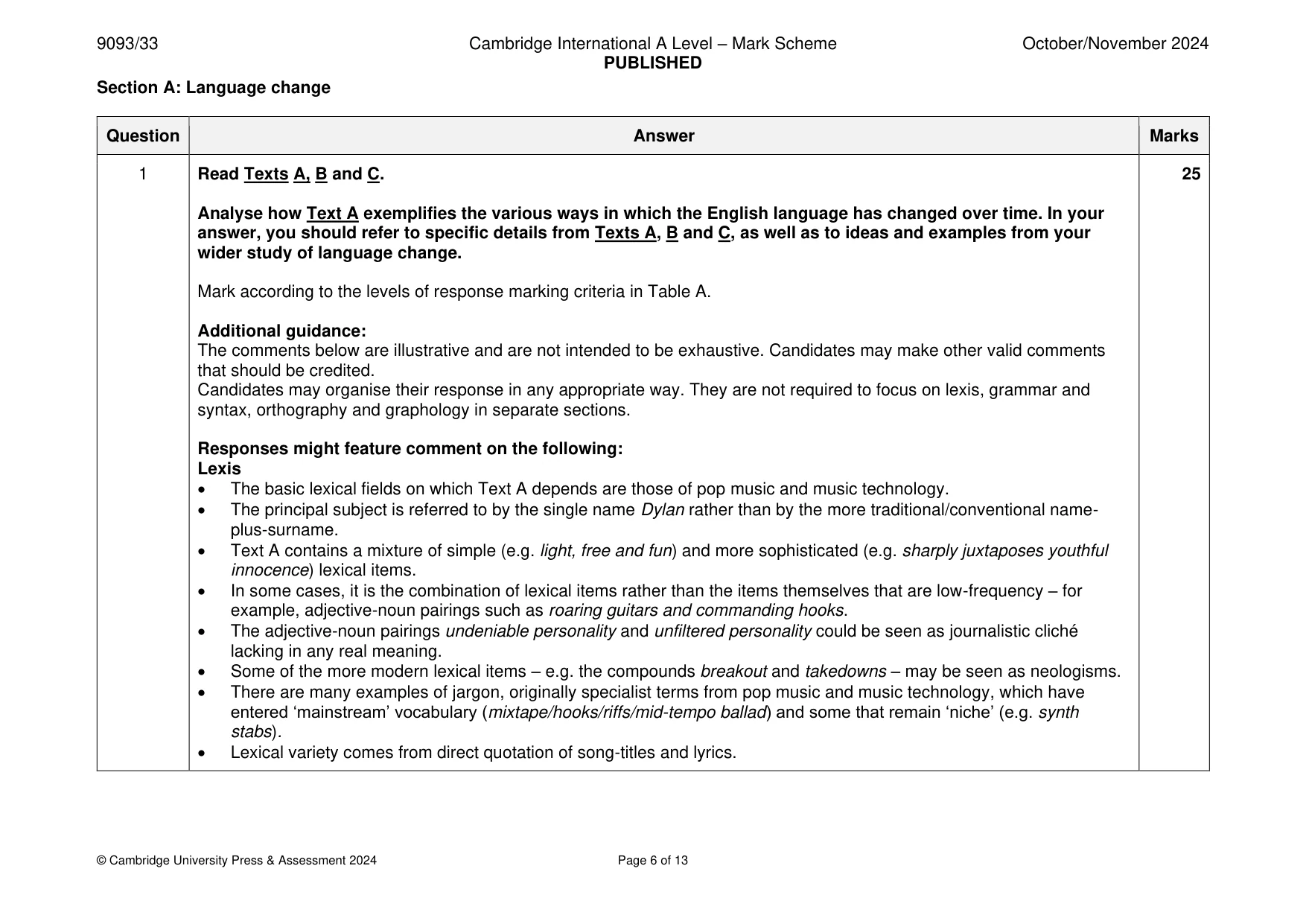
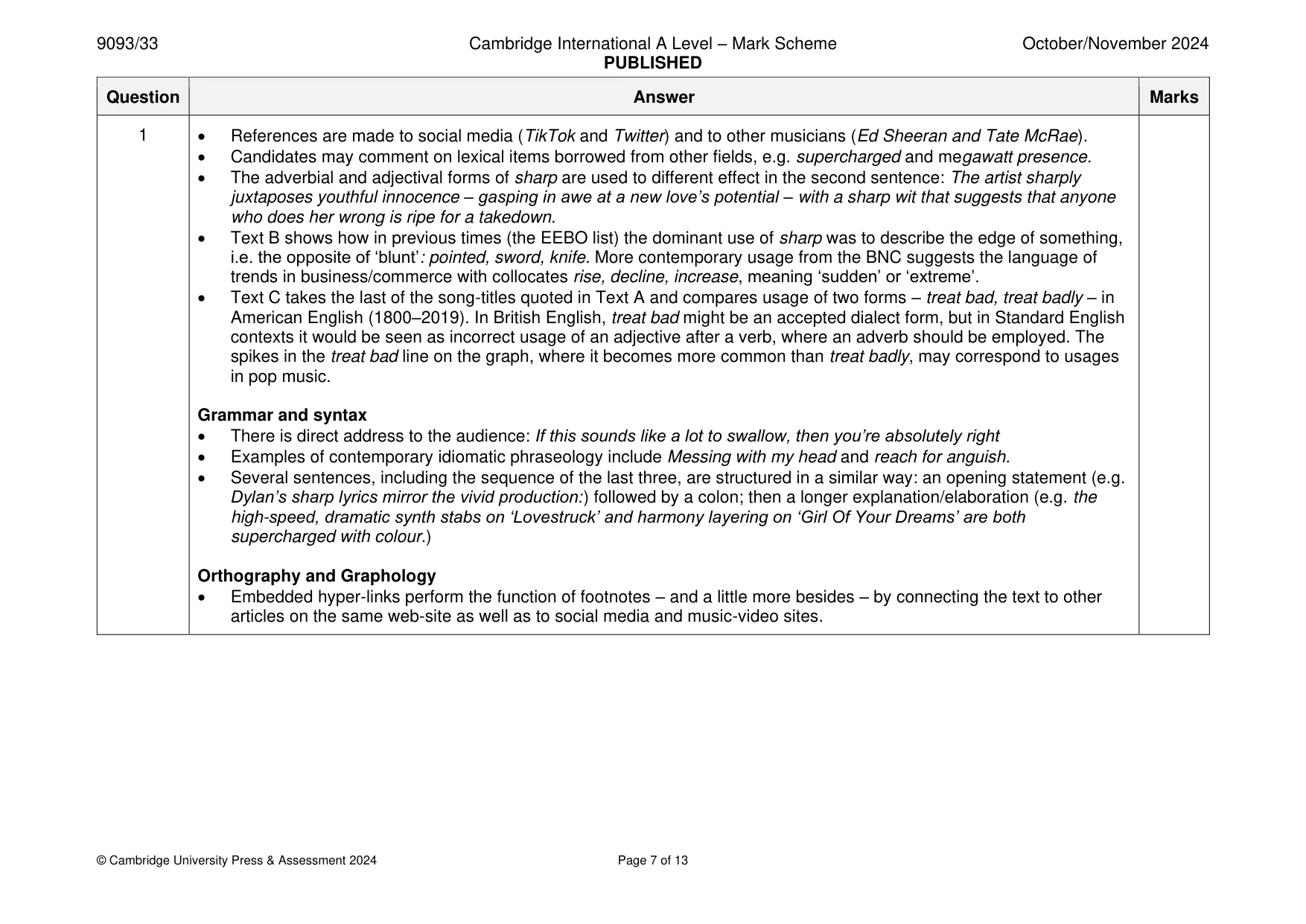
9093/33 Cambridge International A Level – Mark Scheme PUBLISHED October/November 2024 © Cambridge University Press & Assessment 2024 Page 6 of 13 Section A: Language change Question Answer Marks 1 Read Texts A, B and C. Analyse how Text A exemplifies the various ways in which the English language has changed over time. In your answer, you should refer to specific details from Texts A, B and C, as well as to ideas and examples from your wider study of language change. Mark according to the levels of response marking criteria in Table A. Additional guidance: The comments below are illustrative and are not intended to be exhaustive. Candidates may make other valid comments that should be credited. Candidates may organise their response in any appropriate way. They are not required to focus on lexis, grammar and syntax, orthography and graphology in separate sections. Responses might feature comment on the following: Lexis • The basic lexical fields on which Text A depends are those of pop music and music technology. • The principal subject is referred to by the single name Dylan rather than by the more traditional/conventional name- plus-surname. • Text A contains a mixture of simple (e.g. light, free and fun) and more sophisticated (e.g. sharply juxtaposes youthful innocence) lexical items. • In some cases, it is the combination of lexical items rather than the items themselves that are low-frequency – for example, adjective-noun pairings such as roaring guitars and commanding hooks. • The adjective-noun pairings undeniable personality and unfiltered personality could be seen as journalistic cliché lacking in any real meaning. • Some of the more modern lexical items – e.g. the compounds breakout and takedowns – may be seen as neologisms. • There are many examples of jargon, originally specialist terms from pop music and music technology, which have entered ‘mainstream’ vocabulary (mixtape/hooks/riffs/mid-tempo ballad) and some that remain ‘niche’ (e.g. synth stabs). • Lexical variety comes from direct quotation of song-titles and lyrics. 25
Mark scheme, page 7
9093/33 Cambridge International A Level – Mark Scheme PUBLISHED October/November 2024 © Cambridge University Press & Assessment 2024 Page 7 of 13 Question Answer Marks 1 • References are made to social media (TikTok and Twitter) and to other musicians (Ed Sheeran and Tate McRae). • Candidates may comment on lexical items borrowed from other fields, e.g. supercharged and megawatt presence. • The adverbial and adjectival forms of sharp are used to different effect in the second sentence: The artist sharply juxtaposes youthful innocence – gasping in awe at a new love’s potential – with a sharp wit that suggests that anyone who does her wrong is ripe for a takedown. • Text B shows how in previous times (the EEBO list) the dominant use of sharp was to describe the edge of something, i.e. the opposite of ‘blunt’: pointed, sword, knife. More contemporary usage from the BNC suggests the language of trends in business/commerce with collocates rise, decline, increase, meaning ‘sudden’ or ‘extreme’. • Text C takes the last of the song-titles quoted in Text A and compares usage of two forms – treat bad, treat badly – in American English (1800–2019). In British English, treat bad might be an accepted dialect form, but in Standard English contexts it would be seen as incorrect usage of an adjective after a verb, where an adverb should be employed. The spikes in the treat bad line on the graph, where it becomes more common than treat badly, may correspond to usages in pop music. Grammar and syntax • There is direct address to the audience: If this sounds like a lot to swallow, then you’re absolutely right • Examples of contemporary idiomatic phraseology include Messing with my head and reach for anguish. • Several sentences, including the sequence of the last three, are structured in a similar way: an opening statement (e.g. Dylan’s sharp lyrics mirror the vivid production:) followed by a colon; then a longer explanation/elaboration (e.g. the high-speed, dramatic synth stabs on ‘Lovestruck’ and harmony layering on ‘Girl Of Your Dreams’ are both supercharged with colour.) Orthography and Graphology • Embedded hyper-links perform the function of footnotes – and a little more besides – by connecting the text to other articles on the same web-site as well as to social media and music-video sites.
Mark scheme, page 8
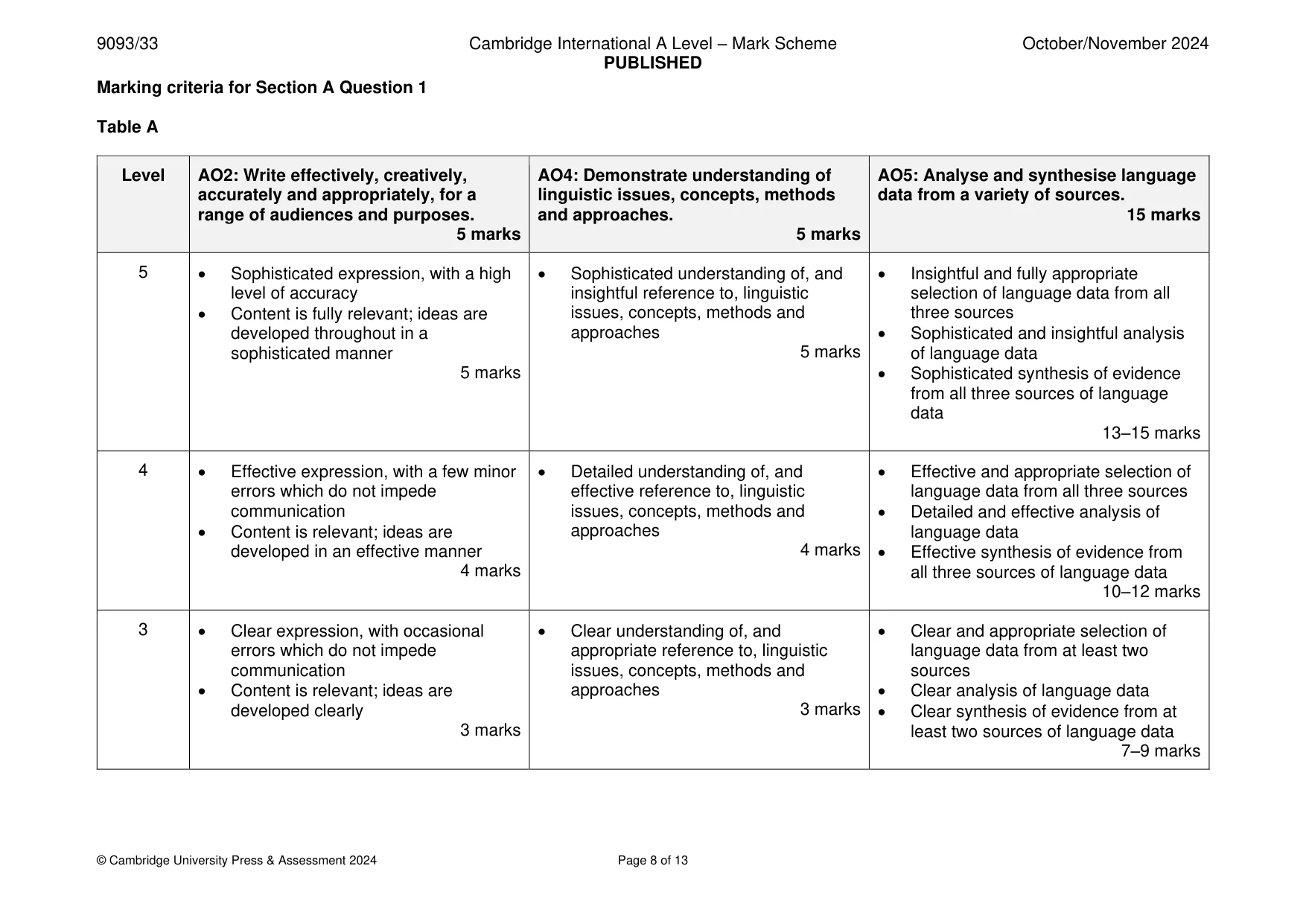
9093/33 Cambridge International A Level – Mark Scheme PUBLISHED October/November 2024 © Cambridge University Press & Assessment 2024 Page 8 of 13 Marking criteria for Section A Question 1 Table A Level AO2: Write effectively, creatively, accurately and appropriately, for a range of audiences and purposes. 5 marks AO4: Demonstrate understanding of linguistic issues, concepts, methods and approaches. 5 marks AO5: Analyse and synthesise language data from a variety of sources. 15 marks 5 • Sophisticated expression, with a high level of accuracy • Content is fully relevant; ideas are developed throughout in a sophisticated manner 5 marks • Sophisticated understanding of, and insightful reference to, linguistic issues, concepts, methods and approaches 5 marks • Insightful and fully appropriate selection of language data from all three sources • Sophisticated and insightful analysis of language data • Sophisticated synthesis of evidence from all three sources of language data 13–15 marks 4 • Effective expression, with a few minor errors which do not impede communication • Content is relevant; ideas are developed in an effective manner 4 marks • Detailed understanding of, and effective reference to, linguistic issues, concepts, methods and approaches 4 marks • Effective and appropriate selection of language data from all three sources • Detailed and effective analysis of language data • Effective synthesis of evidence from all three sources of language data 10–12 marks 3 • Clear expression, with occasional errors which do not impede communication • Content is relevant; ideas are developed clearly 3 marks • Clear understanding of, and appropriate reference to, linguistic issues, concepts, methods and approaches 3 marks • Clear and appropriate selection of language data from at least two sources • Clear analysis of language data • Clear synthesis of evidence from at least two sources of language data 7–9 marks
Mark scheme, page 9
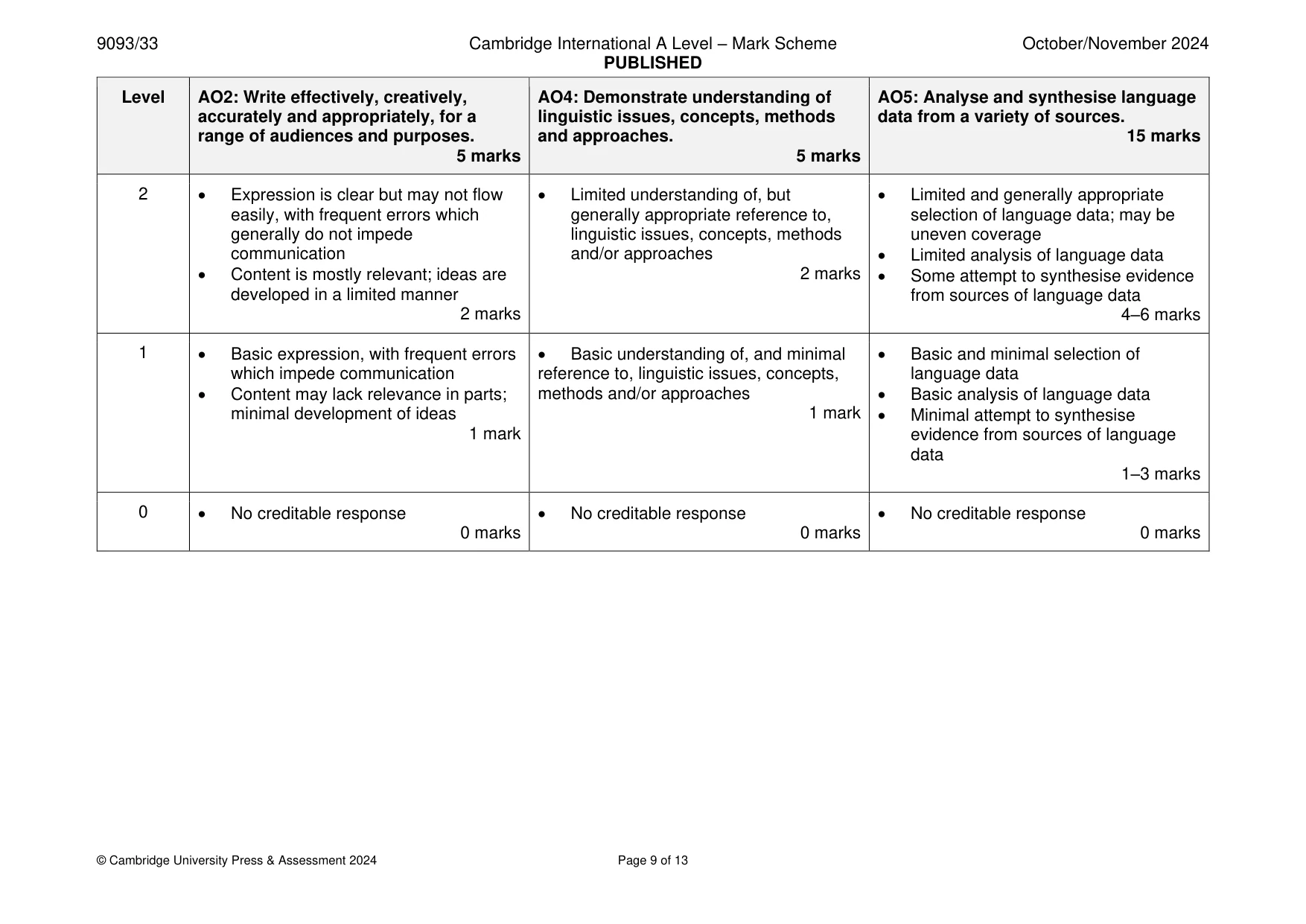
9093/33 Cambridge International A Level – Mark Scheme PUBLISHED October/November 2024 © Cambridge University Press & Assessment 2024 Page 9 of 13 Level AO2: Write effectively, creatively, accurately and appropriately, for a range of audiences and purposes. 5 marks AO4: Demonstrate understanding of linguistic issues, concepts, methods and approaches. 5 marks AO5: Analyse and synthesise language data from a variety of sources. 15 marks 2 • Expression is clear but may not flow easily, with frequent errors which generally do not impede communication • Content is mostly relevant; ideas are developed in a limited manner 2 marks • Limited understanding of, but generally appropriate reference to, linguistic issues, concepts, methods and/or approaches 2 marks • Limited and generally appropriate selection of language data; may be uneven coverage • Limited analysis of language data • Some attempt to synthesise evidence from sources of language data 4–6 marks 1 • Basic expression, with frequent errors which impede communication • Content may lack relevance in parts; minimal development of ideas 1 mark • Basic understanding of, and minimal reference to, linguistic issues, concepts, methods and/or approaches 1 mark • Basic and minimal selection of language data • Basic analysis of language data • Minimal attempt to synthesise evidence from sources of language data 1–3 marks 0 • No creditable response 0 marks • No creditable response 0 marks • No creditable response 0 marks
Mark scheme, page 10
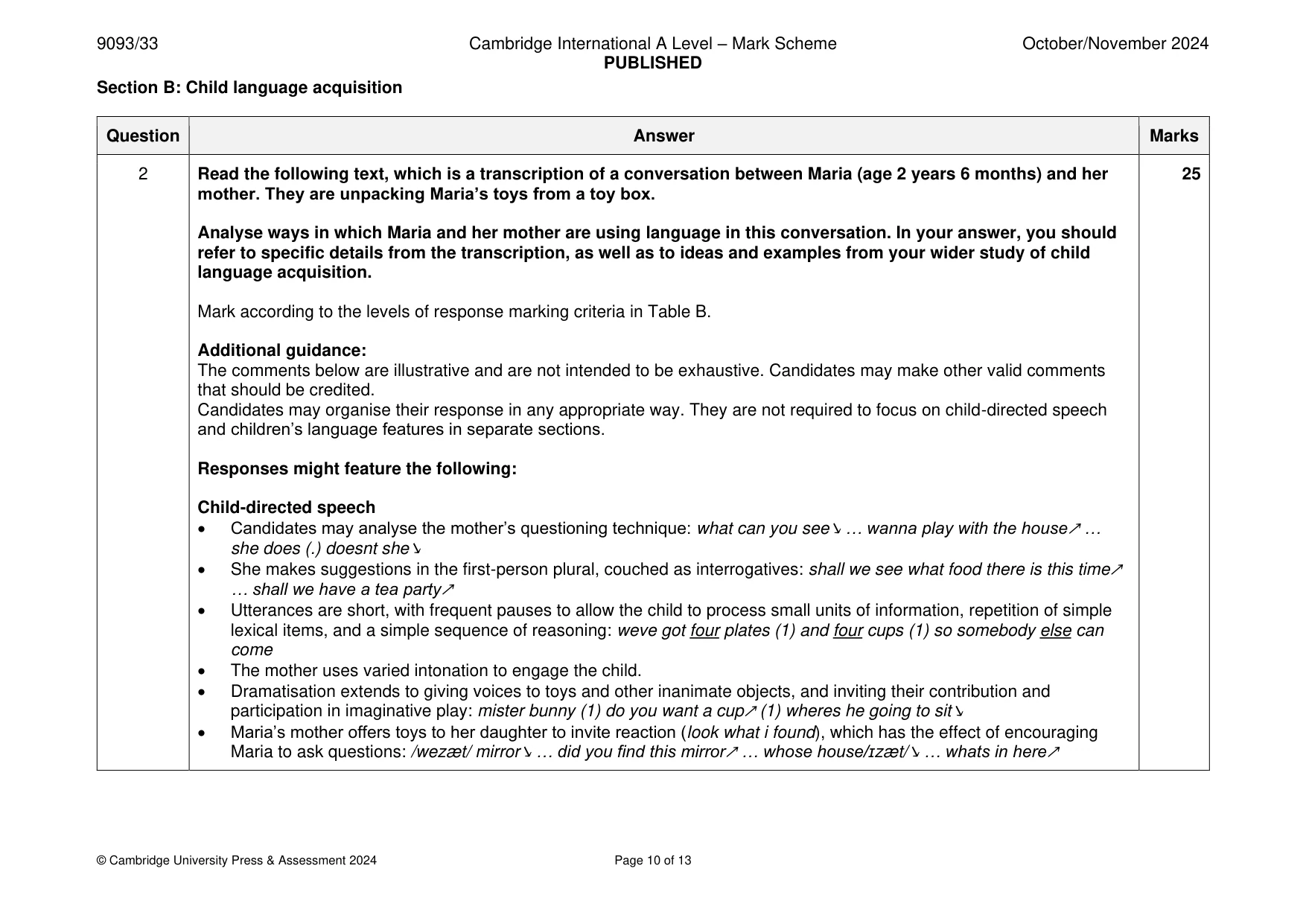
9093/33 Cambridge International A Level – Mark Scheme PUBLISHED October/November 2024 © Cambridge University Press & Assessment 2024 Page 10 of 13 Section B: Child language acquisition Question Answer Marks 2 Read the following text, which is a transcription of a conversation between Maria (age 2 years 6 months) and her mother. They are unpacking Maria’s toys from a toy box. Analyse ways in which Maria and her mother are using language in this conversation. In your answer, you should refer to specific details from the transcription, as well as to ideas and examples from your wider study of child language acquisition. Mark according to the levels of response marking criteria in Table B. Additional guidance: The comments below are illustrative and are not intended to be exhaustive. Candidates may make other valid comments that should be credited. Candidates may organise their response in any appropriate way. They are not required to focus on child-directed speech and children’s language features in separate sections. Responses might feature the following: Child-directed speech • Candidates may analyse the mother’s questioning technique: what can you see↘ … wanna play with the house↗ … she does (.) doesnt she↘ • She makes suggestions in the first-person plural, couched as interrogatives: shall we see what food there is this time↗ … shall we have a tea party↗ • Utterances are short, with frequent pauses to allow the child to process small units of information, repetition of simple lexical items, and a simple sequence of reasoning: weve got four plates (1) and four cups (1) so somebody else can come • The mother uses varied intonation to engage the child. • Dramatisation extends to giving voices to toys and other inanimate objects, and inviting their contribution and participation in imaginative play: mister bunny (1) do you want a cup↗ (1) wheres he going to sit↘ • Maria’s mother offers toys to her daughter to invite reaction (look what i found), which has the effect of encouraging Maria to ask questions: /wezæt/ mirror↘ … did you find this mirror↗ … whose house/ɪzæt/↘ … whats in here↗ 25
Mark scheme, page 11
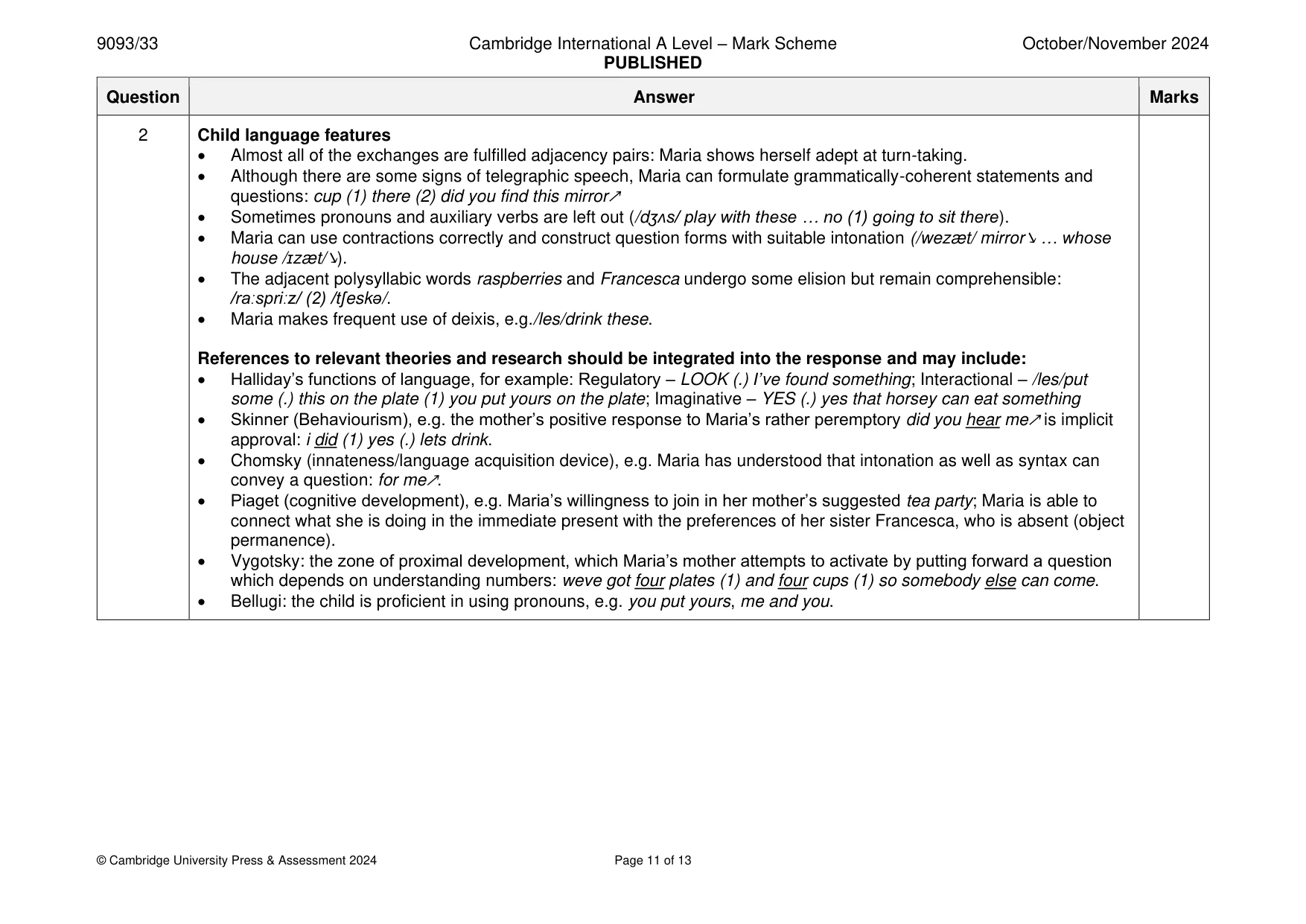
9093/33 Cambridge International A Level – Mark Scheme PUBLISHED October/November 2024 © Cambridge University Press & Assessment 2024 Page 11 of 13 Question Answer Marks 2 Child language features • Almost all of the exchanges are fulfilled adjacency pairs: Maria shows herself adept at turn-taking. • Although there are some signs of telegraphic speech, Maria can formulate grammatically-coherent statements and questions: cup (1) there (2) did you find this mirror↗ • Sometimes pronouns and auxiliary verbs are left out (/dʒʌs/ play with these … no (1) going to sit there). • Maria can use contractions correctly and construct question forms with suitable intonation (/wezæt/ mirror↘ … whose house /ɪzæt/↘). • The adjacent polysyllabic words raspberries and Francesca undergo some elision but remain comprehensible: /raːspriːz/ (2) /tʃeskə/. • Maria makes frequent use of deixis, e.g./les/drink these. References to relevant theories and research should be integrated into the response and may include: • Halliday’s functions of language, for example: Regulatory – LOOK (.) I’ve found something; Interactional – /les/put some (.) this on the plate (1) you put yours on the plate; Imaginative – YES (.) yes that horsey can eat something • Skinner (Behaviourism), e.g. the mother’s positive response to Maria’s rather peremptory did you hear me↗ is implicit approval: i did (1) yes (.) lets drink. • Chomsky (innateness/language acquisition device), e.g. Maria has understood that intonation as well as syntax can convey a question: for me↗. • Piaget (cognitive development), e.g. Maria’s willingness to join in her mother’s suggested tea party; Maria is able to connect what she is doing in the immediate present with the preferences of her sister Francesca, who is absent (object permanence). • Vygotsky: the zone of proximal development, which Maria’s mother attempts to activate by putting forward a question which depends on understanding numbers: weve got four plates (1) and four cups (1) so somebody else can come. • Bellugi: the child is proficient in using pronouns, e.g. you put yours, me and you.
Mark scheme, page 12
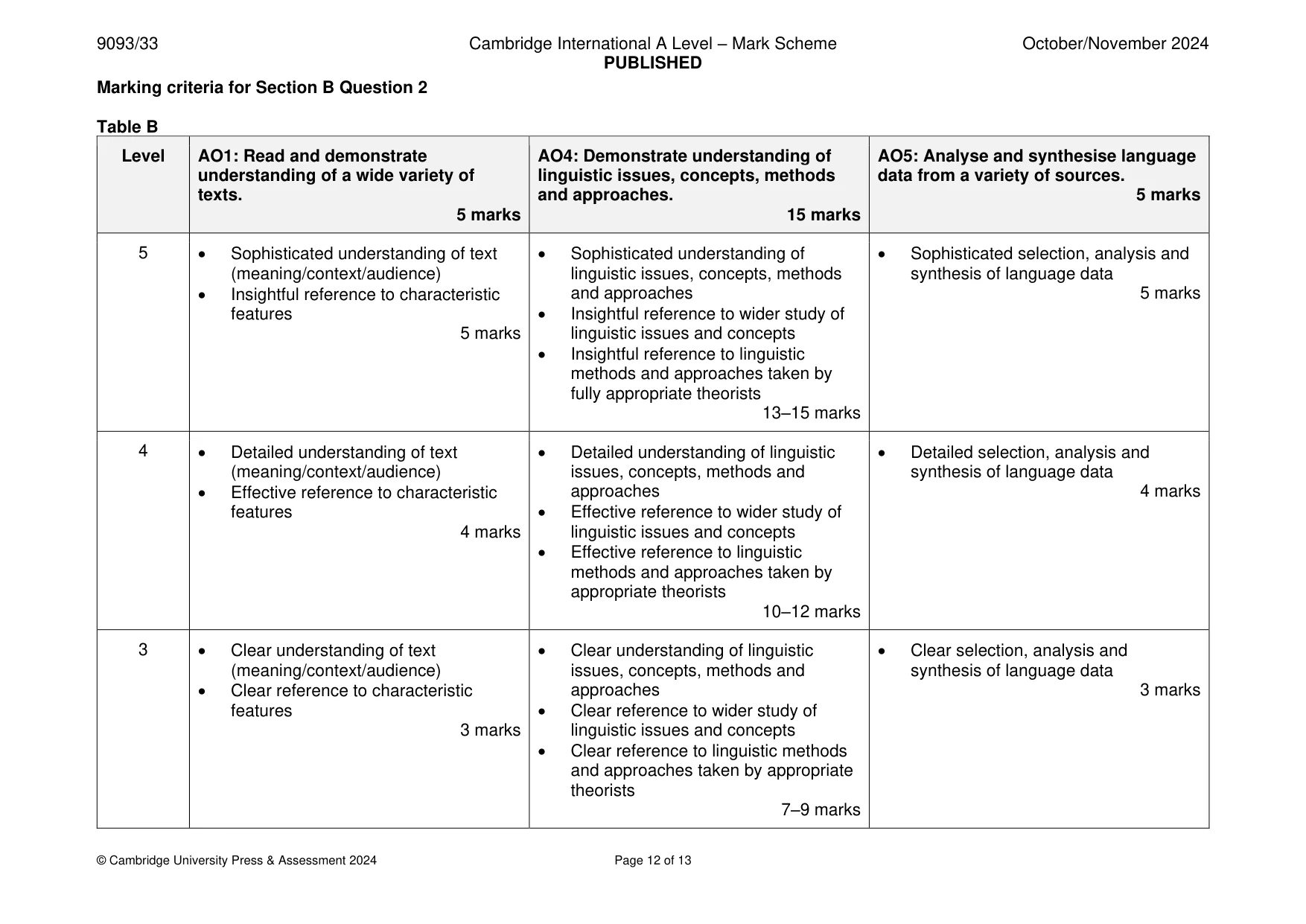
9093/33 Cambridge International A Level – Mark Scheme PUBLISHED October/November 2024 © Cambridge University Press & Assessment 2024 Page 12 of 13 Marking criteria for Section B Question 2 Table B Level AO1: Read and demonstrate understanding of a wide variety of texts. 5 marks AO4: Demonstrate understanding of linguistic issues, concepts, methods and approaches. 15 marks AO5: Analyse and synthesise language data from a variety of sources. 5 marks 5 • Sophisticated understanding of text (meaning/context/audience) • Insightful reference to characteristic features 5 marks • Sophisticated understanding of linguistic issues, concepts, methods and approaches • Insightful reference to wider study of linguistic issues and concepts • Insightful reference to linguistic methods and approaches taken by fully appropriate theorists 13–15 marks • Sophisticated selection, analysis and synthesis of language data 5 marks 4 • Detailed understanding of text (meaning/context/audience) • Effective reference to characteristic features 4 marks • Detailed understanding of linguistic issues, concepts, methods and approaches • Effective reference to wider study of linguistic issues and concepts • Effective reference to linguistic methods and approaches taken by appropriate theorists 10–12 marks • Detailed selection, analysis and synthesis of language data 4 marks 3 • Clear understanding of text (meaning/context/audience) • Clear reference to characteristic features 3 marks • Clear understanding of linguistic issues, concepts, methods and approaches • Clear reference to wider study of linguistic issues and concepts • Clear reference to linguistic methods and approaches taken by appropriate theorists 7–9 marks • Clear selection, analysis and synthesis of language data 3 marks
Mark scheme, page 13
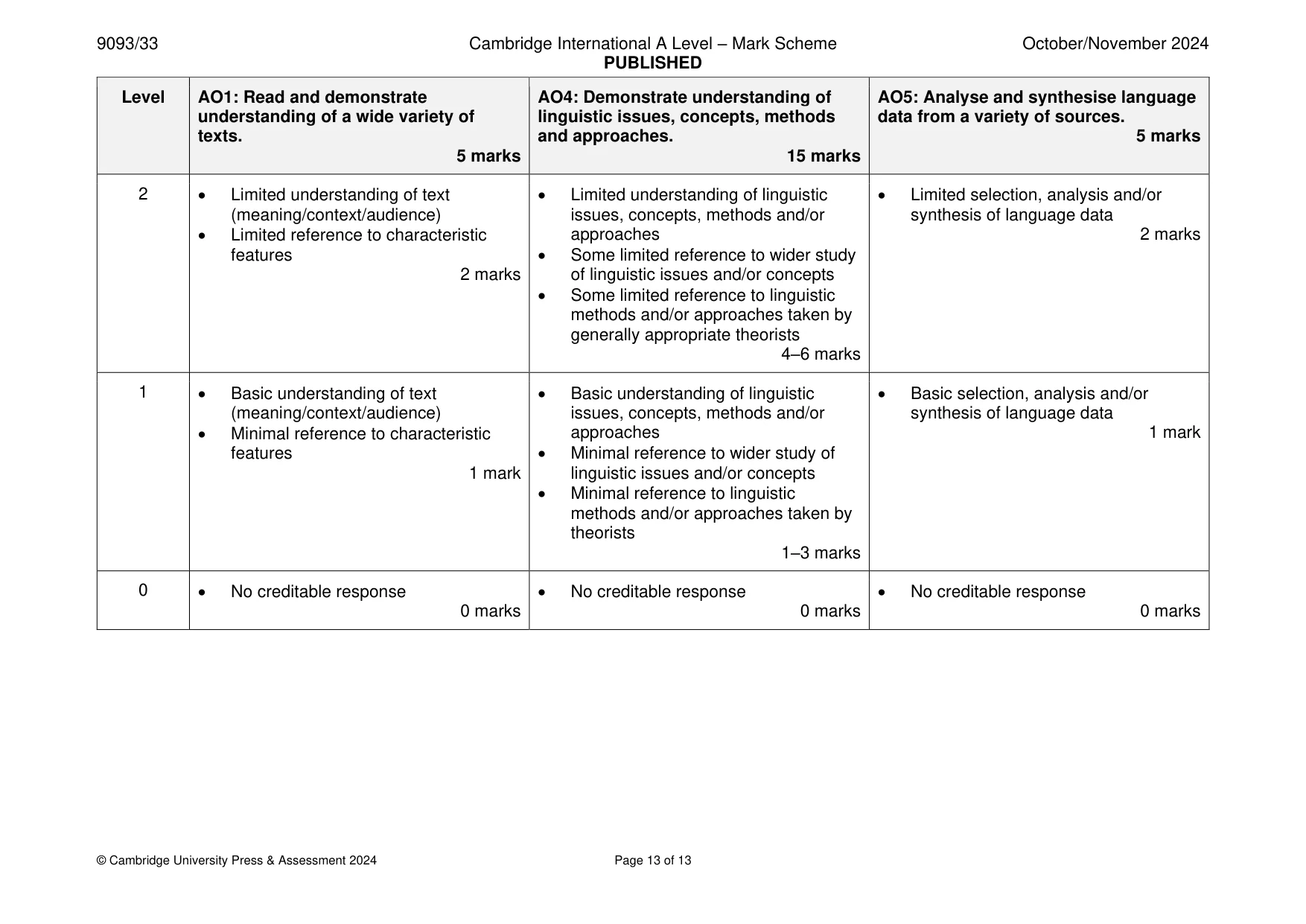
9093/33 Cambridge International A Level – Mark Scheme PUBLISHED October/November 2024 © Cambridge University Press & Assessment 2024 Page 13 of 13 Level AO1: Read and demonstrate understanding of a wide variety of texts. 5 marks AO4: Demonstrate understanding of linguistic issues, concepts, methods and approaches. 15 marks AO5: Analyse and synthesise language data from a variety of sources. 5 marks 2 • Limited understanding of text (meaning/context/audience) • Limited reference to characteristic features 2 marks • Limited understanding of linguistic issues, concepts, methods and/or approaches • Some limited reference to wider study of linguistic issues and/or concepts • Some limited reference to linguistic methods and/or approaches taken by generally appropriate theorists 4–6 marks • Limited selection, analysis and/or synthesis of language data 2 marks 1 • Basic understanding of text (meaning/context/audience) • Minimal reference to characteristic features 1 mark • Basic understanding of linguistic issues, concepts, methods and/or approaches • Minimal reference to wider study of linguistic issues and/or concepts • Minimal reference to linguistic methods and/or approaches taken by theorists 1–3 marks • Basic selection, analysis and/or synthesis of language data 1 mark 0 • No creditable response 0 marks • No creditable response 0 marks • No creditable response 0 marks
What you needed in this session
Cambridge’s own grade thresholds for 2024 Oct/Nov, Paper 3 · Variant 3. A higher threshold means an easier paper — the bar moves with how the cohort did.