Cambridge A Level English - Language AS and A Level (from 2014) 9093 — 2024 May/June Paper 4 · Variant 3
9093/43/M/J/24 · 50 marks · 135 min
The question paper and its mark scheme, free to read here and free to download. This is Cambridge’s own paper, exactly as it was sat.
Question paper8 pages



Mark scheme9 pages
Answers below. Sit the paper first if you are practising.
Paper as text
Question paper, page 1
This document has 8 pages. Any blank pages are indicated. DC (CE) 340746 © UCLES 2024 [Turn over * 9 1 8 7 6 0 7 7 8 0 * Cambridge International AS & A Level ENGLISH LANGUAGE 9093/43 Paper 4 Language Topics May/June 2024 2 hours 15 minutes You must answer on the enclosed answer booklet. You will need: Answer booklet (enclosed) INSTRUCTIONS ● Answer all questions. ● Follow the instructions on the front cover of the answer booklet. If you need additional answer paper, ask the invigilator for a continuation booklet. ● Dictionaries are not allowed. INFORMATION ● The total mark for this paper is 50. ● The number of marks for each question or part question is shown in brackets [ ].
Question paper, page 2
2 9093/43/M/J/24 © UCLES 2024 Section A: English in the world Question 1 Read the following text, which is an extract from an article posted on the BBC website in 2018. Discuss what you feel are the most important issues raised in the text relating to the causes and effects of the expansion of English around the world. You should refer to specific details from the text as well as to ideas and examples from your wider study of English in the world. [25] Dutch language besieged by English at university Students shake off their jackets and scarves as the lecturer opens up a PowerPoint presentation on ‘start-up innovations’ and prepares to give his talk, which is entirely in English. ‘The language is the university’s choice,’ Frank van Rijnsoever of Utrecht University tells me. So extensive is the spread of English in Dutch universities, a group of lecturers has predicted a looming ‘linguicide’ and demanded the government in The Hague impose a moratorium banning universities from creating any additional English language courses until an official impact analysis has been conducted. Sixty per cent of masters programmes offered at Utrecht University are in English. At the highest honours level, virtually no courses are taught in Dutch. ‘I don’t mind. Most of the literature is in English,’ says Mr van Rijnsoever. ‘So for me as a teacher it’s not that much of a problem because we also do research in English. For the students, you see they have to cross a certain barrier to properly express themselves.’ Utrecht is not alone. Some Dutch universities have completely erased the Dutch language from the campus. In Eindhoven, even the sandwiches in the canteens are sold as cheese rather than with the Dutch word ‘kaas’. And not everyone is happy with such a creeping Anglicisation at university. ‘It’s our identity, Dutch,’ complains Annette de Groot, professor of linguistics at the University of Amsterdam. ‘What happens to the identity of a people of a country where the native language is no longer the main language of higher education? The Dutch aren’t as good at English as they think they are. You shouldn’t use a weaker language in education.’ ‘If you use English in higher education, Dutch will eventually get worse. It’s use it or lose it. Dutch will deteriorate and the vitality of the language will disappear. It’s called imbalanced bilingualism. You add a bit of English and you lose a bit of Dutch.’ While English can ease students into the global market, others feel its prevalence is excluding them from their homeland. It is time, says Prof de Groot, for an honest debate. ‘We’re shifting to a more and more Anglo-Saxon view of the world. Universities want diversity, different perspectives. What you get is exactly the opposite. The Anglicisation means you end up with a much more homogeneous world.’ 5 10 15 20 25 30
Question paper, page 3
3 9093/43/M/J/24 © UCLES 2024 [Turn over Utrecht University Rector Henk Kummeling argues that moving towards English has been an organic process but accepts that when competing internationally, it makes sense to use a world language. ‘It’s not that we’re advertising for international students,’ he tells me from his office overlooking a bicycle-strewn campus. ‘Dutch culture will stay for centuries. When we talk as Dutchmen amongst ourselves, we speak Dutch.’ 35 40
Question paper, page 4
4 9093/43/M/J/24 © UCLES 2024 Section B: Language and the self Question 2 Read the following text, which is an article published in 2019 in a British newspaper. Discuss what you feel are the most important issues raised in the text relating to the ways in which language can shape and reflect personal and social identity. You should refer to specific details from the text as well as to ideas and examples from your wider study of Language and the self. [25] ‘Self-partnered’ Emma Watson1 is right: we need more ways to be single Being alone has been stigmatised by the language of it. By finding new words to describe our lives, we can find new ways to live it. When Emma Watson described herself as ‘self-partnered’ in an interview with British Vogue this week, the term was met with a mixture of ridicule and praise. Like Gwyneth Paltrow’s1 use of the phrase ‘conscious uncoupling’ to describe her separation from her husband Chris Martin1, or Mark Ronson’s1 recent (albeit accidental) announcement that he was ‘sapiosexual’ (attracted to intelligence before appearance), any deviation from the limited language we have around relationships is met with mockery. This is a shame. We need more words, people! Being able to accurately frame our current experiences is part of being human – and we need more nuanced language to better tell our story. We’re getting better at not labelling sexuality; at accepting that it’s fluid, on a continuum and sometimes hard to categorise. But we’re still stuck with outdated and limiting language around romantic relationships – and around the lack of them. On government forms – and in life – there are only a handful of categories available: single, married, separated, divorced or widowed. What small boxes we place ourselves into when describing something so varied, so vivid, so integral to who we are. The words themselves come preloaded with expectations about the nature of the experience. Take ‘divorce’, for instance: a harsh word with a lot of negative baggage. What if your experience is tender, careful, amicable and ultimately liberating? Isn’t ‘conscious uncoupling’ more apt a description? And what if describing yourself as single is technically right, but you don’t really feel single? There are so many ways of experiencing singleness – and all of them are valid. There’s being single and actively looking for a partner: asking your friends to set you up, joining a load of dating apps. Shall we call it ‘actively pre-partnered’? There’s being single and always wanting to be single because you love it. Let’s say ‘committed non-committal’. And then there is what Emma Watson described. ‘If you have not built a home, if you do not have a husband, if you do not have a baby, and you are turning 30, and you’re not in some incredibly secure, stable place in your career, or you’re still figuring things out ... There’s just this incredible amount of anxiety,’ said the Ivy League2-educated UN ambassador and Bafta3 winner, in what some have pointed out is a telling sign of the times. ‘It took me a long time, but I’m very happy [being single]. I call it being self-partnered.’ 5 10 15 20 25 30 35
Question paper, page 5
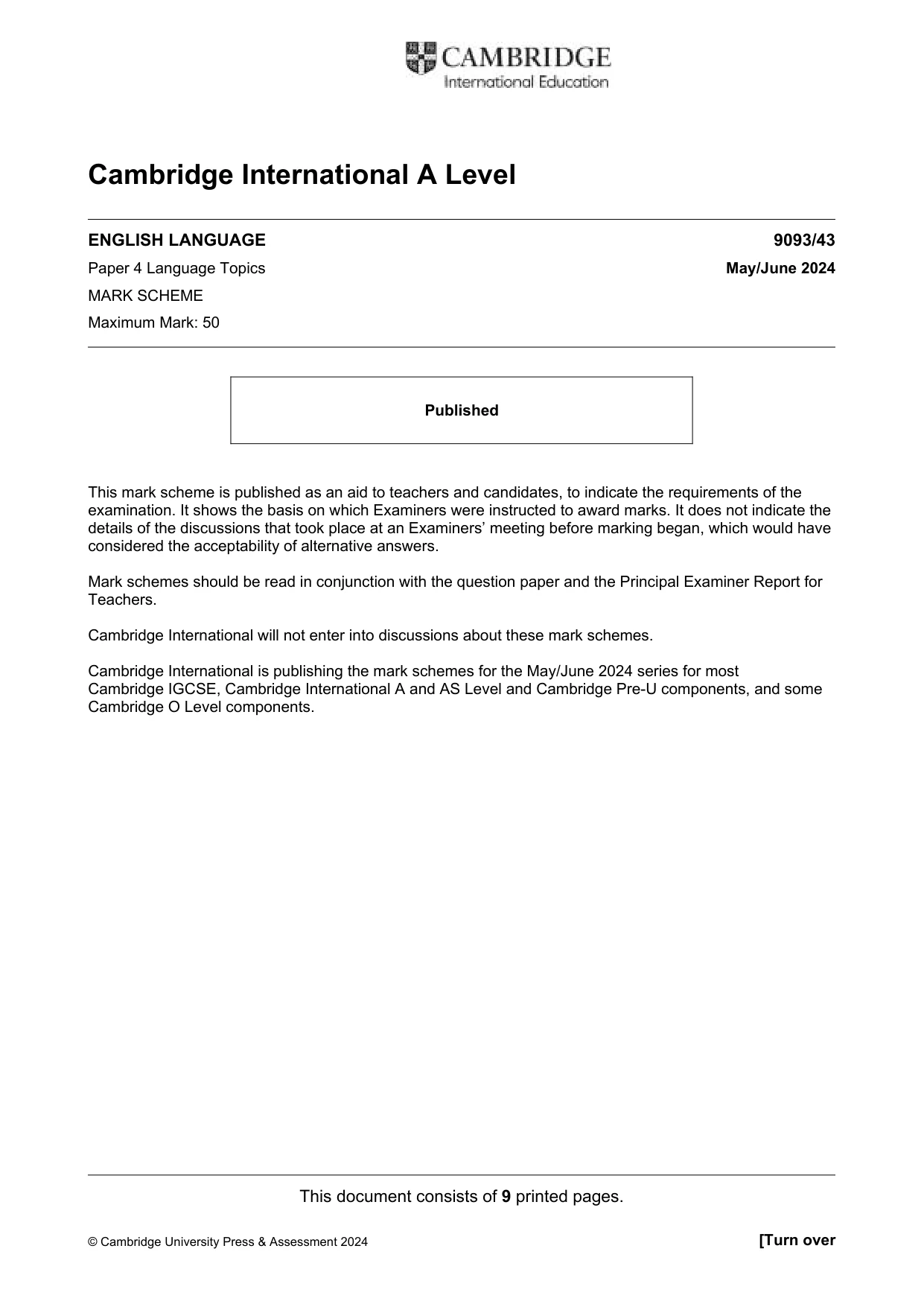
5 9093/43/M/J/24 © UCLES 2024 I see ‘self-partnership’ as just taking some time out from the merry-go-round of relationships and ‘looking for the one’, and instead getting to know yourself a bit better. It’s a good thing, actively seeking to be more self-aware; it can even prepare you for the next relationship (unless you’re a committed non-committal, of course). But self-partnering is also just great in and of itself. We’re stuck with ourselves 24/7; all of us are self-partnered for life. We may as well get to know and like the person we’ll be with forever. Notes: 1 Emma Watson, Gwyneth Paltrow, Chris Martin and Mark Ronson: famous people 2 Ivy League: a group of prestigious American universities 3 Bafta: an award presented by the British Academy of Film and Television Arts 40
Question paper, page 6
6 9093/43/M/J/24 © UCLES 2024 BLANK PAGE
Question paper, page 7
7 9093/43/M/J/24 © UCLES 2024 BLANK PAGE
Question paper, page 8
8 9093/43/M/J/24 © UCLES 2024 BLANK PAGE Permission to reproduce items where third-party owned material protected by copyright is included has been sought and cleared where possible. Every reasonable effort has been made by the publisher (UCLES) to trace copyright holders, but if any items requiring clearance have unwittingly been included, the publisher will be pleased to make amends at the earliest possible opportunity. To avoid the issue of disclosure of answer-related information to candidates, all copyright acknowledgements are reproduced online in the Cambridge Assessment International Education Copyright Acknowledgements Booklet. This is produced for each series of examinations and is freely available to download at www.cambridgeinternational.org after the live examination series. Cambridge Assessment International Education is part of Cambridge Assessment. Cambridge Assessment is the brand name of the University of Cambridge Local Examinations Syndicate (UCLES), which is a department of the University of Cambridge.
Mark scheme, page 1
This document consists of 9 printed pages. © Cambridge University Press & Assessment 2024 [Turn over Cambridge International A Level ENGLISH LANGUAGE 9093/43 Paper 4 Language Topics May/June 2024 MARK SCHEME Maximum Mark: 50 Published This mark scheme is published as an aid to teachers and candidates, to indicate the requirements of the examination. It shows the basis on which Examiners were instructed to award marks. It does not indicate the details of the discussions that took place at an Examiners’ meeting before marking began, which would have considered the acceptability of alternative answers. Mark schemes should be read in conjunction with the question paper and the Principal Examiner Report for Teachers. Cambridge International will not enter into discussions about these mark schemes. Cambridge International is publishing the mark schemes for the May/June 2024 series for most Cambridge IGCSE, Cambridge International A and AS Level and Cambridge Pre-U components, and some Cambridge O Level components.
Mark scheme, page 2
9093/43 Cambridge International A Level – Mark Scheme PUBLISHED May/June 2024 © Cambridge University Press & Assessment 2024 Page 2 of 9 Generic Marking Principles These general marking principles must be applied by all examiners when marking candidate answers. They should be applied alongside the specific content of the mark scheme or generic level descriptions for a question. Each question paper and mark scheme will also comply with these marking principles. GENERIC MARKING PRINCIPLE 1: Marks must be awarded in line with: the specific content of the mark scheme or the generic level descriptors for the question the specific skills defined in the mark scheme or in the generic level descriptors for the question the standard of response required by a candidate as exemplified by the standardisation scripts. GENERIC MARKING PRINCIPLE 2: Marks awarded are always whole marks (not half marks, or other fractions). GENERIC MARKING PRINCIPLE 3: Marks must be awarded positively: marks are awarded for correct/valid answers, as defined in the mark scheme. However, credit is given for valid answers which go beyond the scope of the syllabus and mark scheme, referring to your Team Leader as appropriate marks are awarded when candidates clearly demonstrate what they know and can do marks are not deducted for errors marks are not deducted for omissions answers should only be judged on the quality of spelling, punctuation and grammar when these features are specifically assessed by the question as indicated by the mark scheme. The meaning, however, should be unambiguous. GENERIC MARKING PRINCIPLE 4: Rules must be applied consistently, e.g. in situations where candidates have not followed instructions or in the application of generic level descriptors.
Mark scheme, page 3
9093/43 Cambridge International A Level – Mark Scheme PUBLISHED May/June 2024 © Cambridge University Press & Assessment 2024 Page 3 of 9 GENERIC MARKING PRINCIPLE 5: Marks should be awarded using the full range of marks defined in the mark scheme for the question (however; the use of the full mark range may be limited according to the quality of the candidate responses seen). GENERIC MARKING PRINCIPLE 6: Marks awarded are based solely on the requirements as defined in the mark scheme. Marks should not be awarded with grade thresholds or grade descriptors in mind.
Mark scheme, page 4
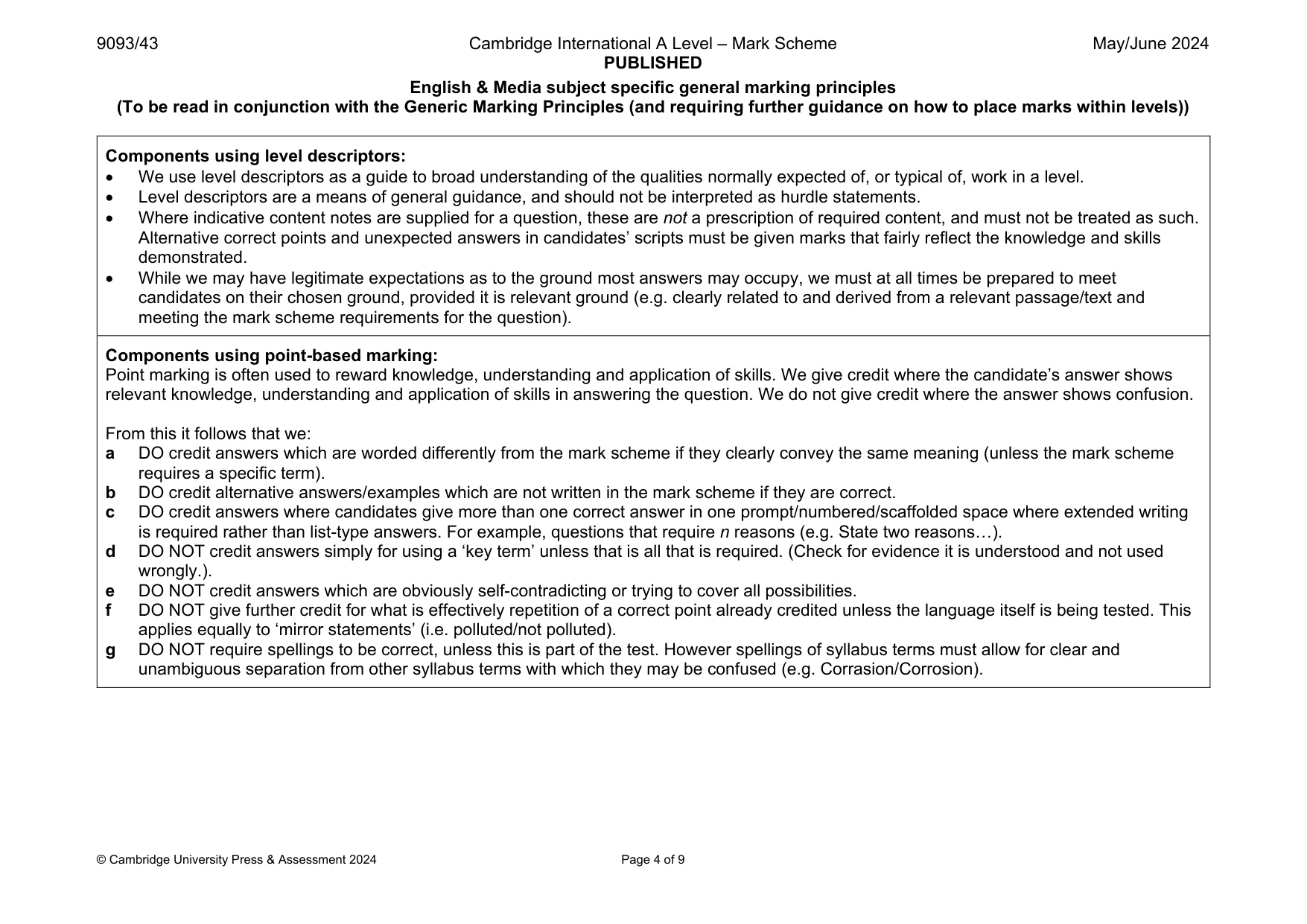
9093/43 Cambridge International A Level – Mark Scheme PUBLISHED May/June 2024 © Cambridge University Press & Assessment 2024 Page 4 of 9 English & Media subject specific general marking principles (To be read in conjunction with the Generic Marking Principles (and requiring further guidance on how to place marks within levels)) Components using level descriptors: We use level descriptors as a guide to broad understanding of the qualities normally expected of, or typical of, work in a level. Level descriptors are a means of general guidance, and should not be interpreted as hurdle statements. Where indicative content notes are supplied for a question, these are not a prescription of required content, and must not be treated as such. Alternative correct points and unexpected answers in candidates’ scripts must be given marks that fairly reflect the knowledge and skills demonstrated. While we may have legitimate expectations as to the ground most answers may occupy, we must at all times be prepared to meet candidates on their chosen ground, provided it is relevant ground (e.g. clearly related to and derived from a relevant passage/text and meeting the mark scheme requirements for the question). Components using point-based marking: Point marking is often used to reward knowledge, understanding and application of skills. We give credit where the candidate’s answer shows relevant knowledge, understanding and application of skills in answering the question. We do not give credit where the answer shows confusion. From this it follows that we: a DO credit answers which are worded differently from the mark scheme if they clearly convey the same meaning (unless the mark scheme requires a specific term). b DO credit alternative answers/examples which are not written in the mark scheme if they are correct. c DO credit answers where candidates give more than one correct answer in one prompt/numbered/scaffolded space where extended writing is required rather than list-type answers. For example, questions that require n reasons (e.g. State two reasons…). d DO NOT credit answers simply for using a ‘key term’ unless that is all that is required. (Check for evidence it is understood and not used wrongly.). e DO NOT credit answers which are obviously self-contradicting or trying to cover all possibilities. f DO NOT give further credit for what is effectively repetition of a correct point already credited unless the language itself is being tested. This applies equally to ‘mirror statements’ (i.e. polluted/not polluted). g DO NOT require spellings to be correct, unless this is part of the test. However spellings of syllabus terms must allow for clear and unambiguous separation from other syllabus terms with which they may be confused (e.g. Corrasion/Corrosion).
Mark scheme, page 5
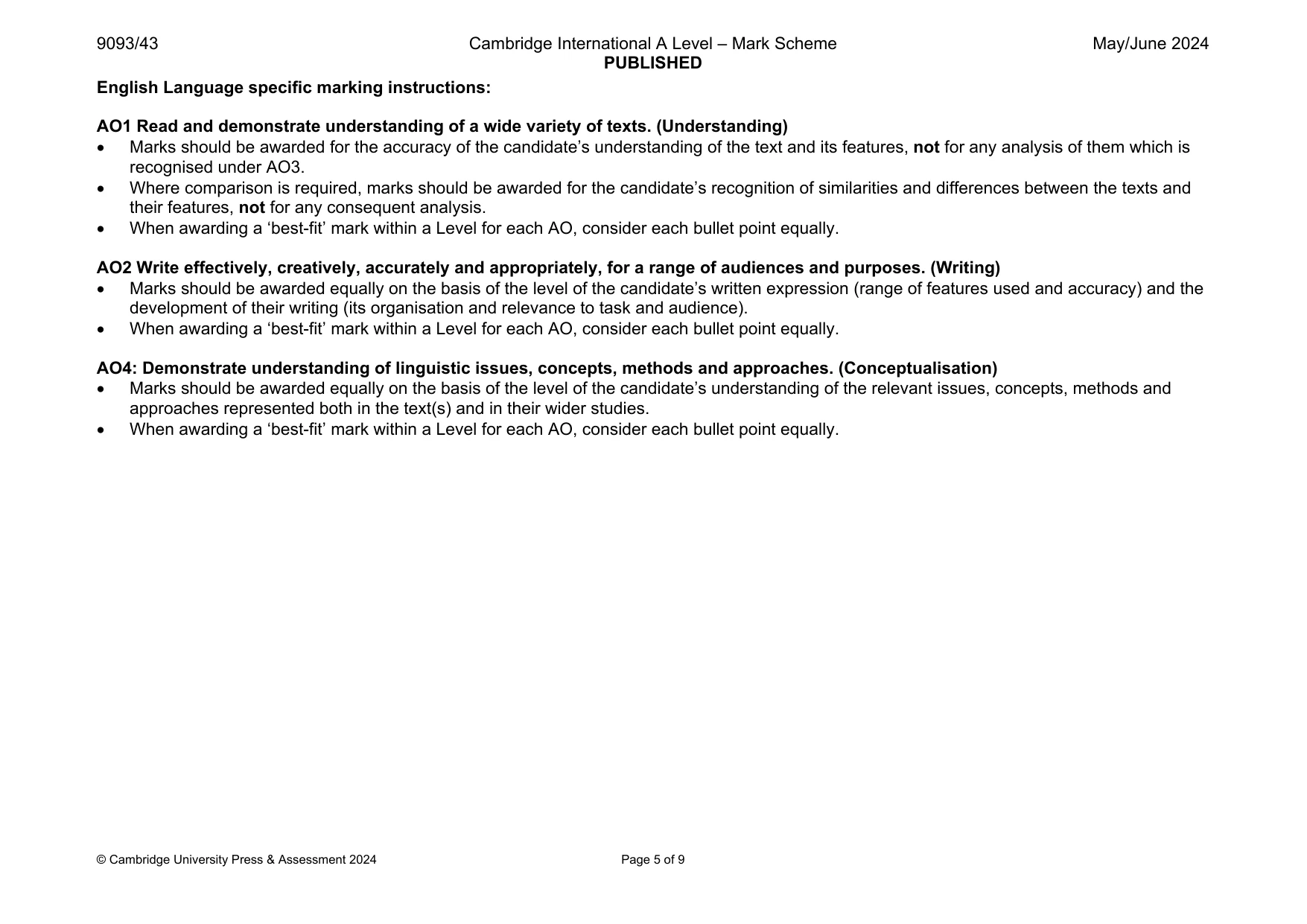
9093/43 Cambridge International A Level – Mark Scheme PUBLISHED May/June 2024 © Cambridge University Press & Assessment 2024 Page 5 of 9 English Language specific marking instructions: AO1 Read and demonstrate understanding of a wide variety of texts. (Understanding) Marks should be awarded for the accuracy of the candidate’s understanding of the text and its features, not for any analysis of them which is recognised under AO3. Where comparison is required, marks should be awarded for the candidate’s recognition of similarities and differences between the texts and their features, not for any consequent analysis. When awarding a ‘best-fit’ mark within a Level for each AO, consider each bullet point equally. AO2 Write effectively, creatively, accurately and appropriately, for a range of audiences and purposes. (Writing) Marks should be awarded equally on the basis of the level of the candidate’s written expression (range of features used and accuracy) and the development of their writing (its organisation and relevance to task and audience). When awarding a ‘best-fit’ mark within a Level for each AO, consider each bullet point equally. AO4: Demonstrate understanding of linguistic issues, concepts, methods and approaches. (Conceptualisation) Marks should be awarded equally on the basis of the level of the candidate’s understanding of the relevant issues, concepts, methods and approaches represented both in the text(s) and in their wider studies. When awarding a ‘best-fit’ mark within a Level for each AO, consider each bullet point equally.
Mark scheme, page 6
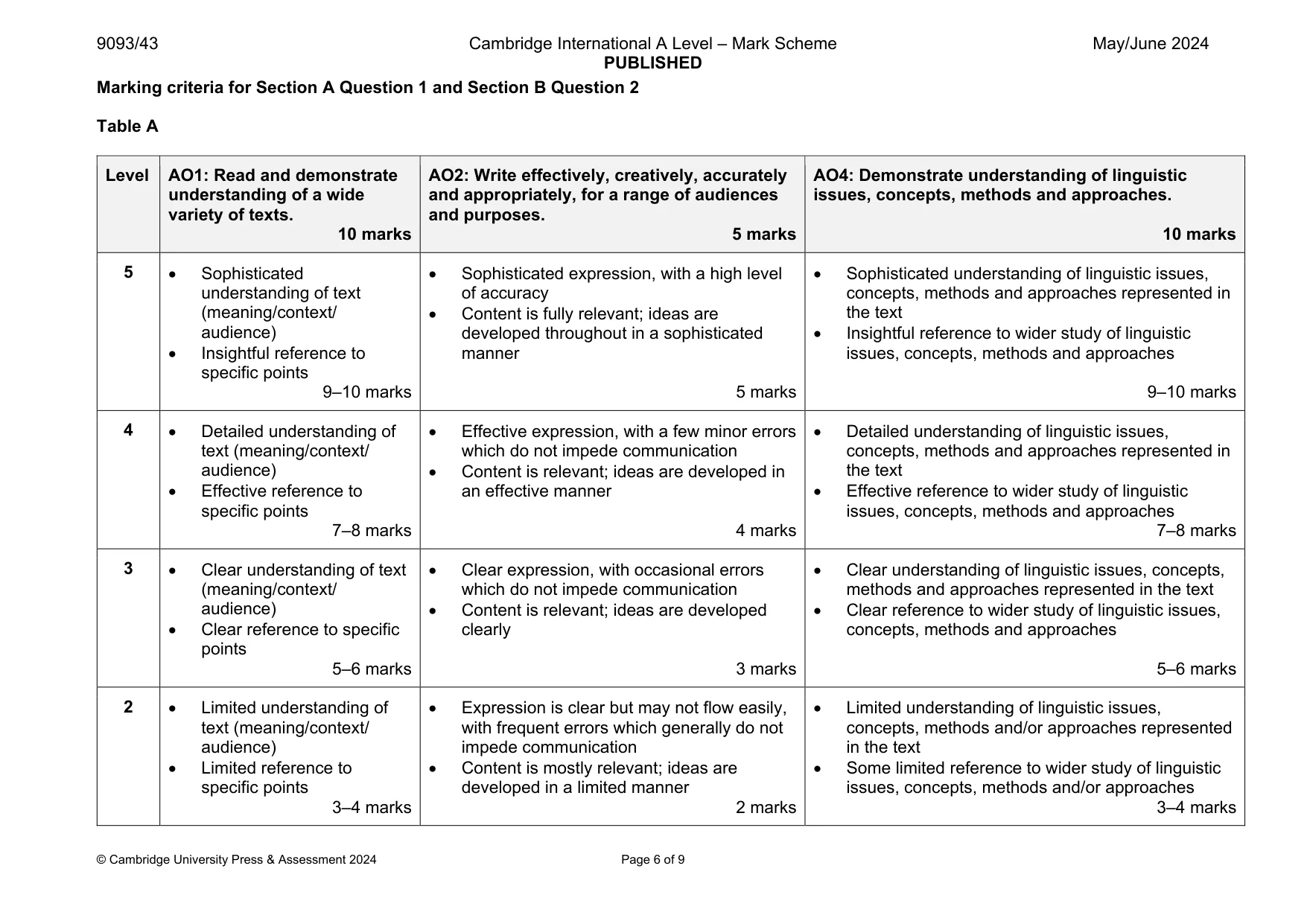
9093/43 Cambridge International A Level – Mark Scheme PUBLISHED May/June 2024 © Cambridge University Press & Assessment 2024 Page 6 of 9 Marking criteria for Section A Question 1 and Section B Question 2 Table A Level AO1: Read and demonstrate understanding of a wide variety of texts. 10 marks AO2: Write effectively, creatively, accurately and appropriately, for a range of audiences and purposes. 5 marks AO4: Demonstrate understanding of linguistic issues, concepts, methods and approaches. 10 marks 5 Sophisticated understanding of text (meaning/context/ audience) Insightful reference to specific points 9–10 marks Sophisticated expression, with a high level of accuracy Content is fully relevant; ideas are developed throughout in a sophisticated manner 5 marks Sophisticated understanding of linguistic issues, concepts, methods and approaches represented in the text Insightful reference to wider study of linguistic issues, concepts, methods and approaches 9–10 marks 4 Detailed understanding of text (meaning/context/ audience) Effective reference to specific points 7–8 marks Effective expression, with a few minor errors which do not impede communication Content is relevant; ideas are developed in an effective manner 4 marks Detailed understanding of linguistic issues, concepts, methods and approaches represented in the text Effective reference to wider study of linguistic issues, concepts, methods and approaches 7–8 marks 3 Clear understanding of text (meaning/context/ audience) Clear reference to specific points 5–6 marks Clear expression, with occasional errors which do not impede communication Content is relevant; ideas are developed clearly 3 marks Clear understanding of linguistic issues, concepts, methods and approaches represented in the text Clear reference to wider study of linguistic issues, concepts, methods and approaches 5–6 marks 2 Limited understanding of text (meaning/context/ audience) Limited reference to specific points 3–4 marks Expression is clear but may not flow easily, with frequent errors which generally do not impede communication Content is mostly relevant; ideas are developed in a limited manner 2 marks Limited understanding of linguistic issues, concepts, methods and/or approaches represented in the text Some limited reference to wider study of linguistic issues, concepts, methods and/or approaches 3–4 marks
Mark scheme, page 7
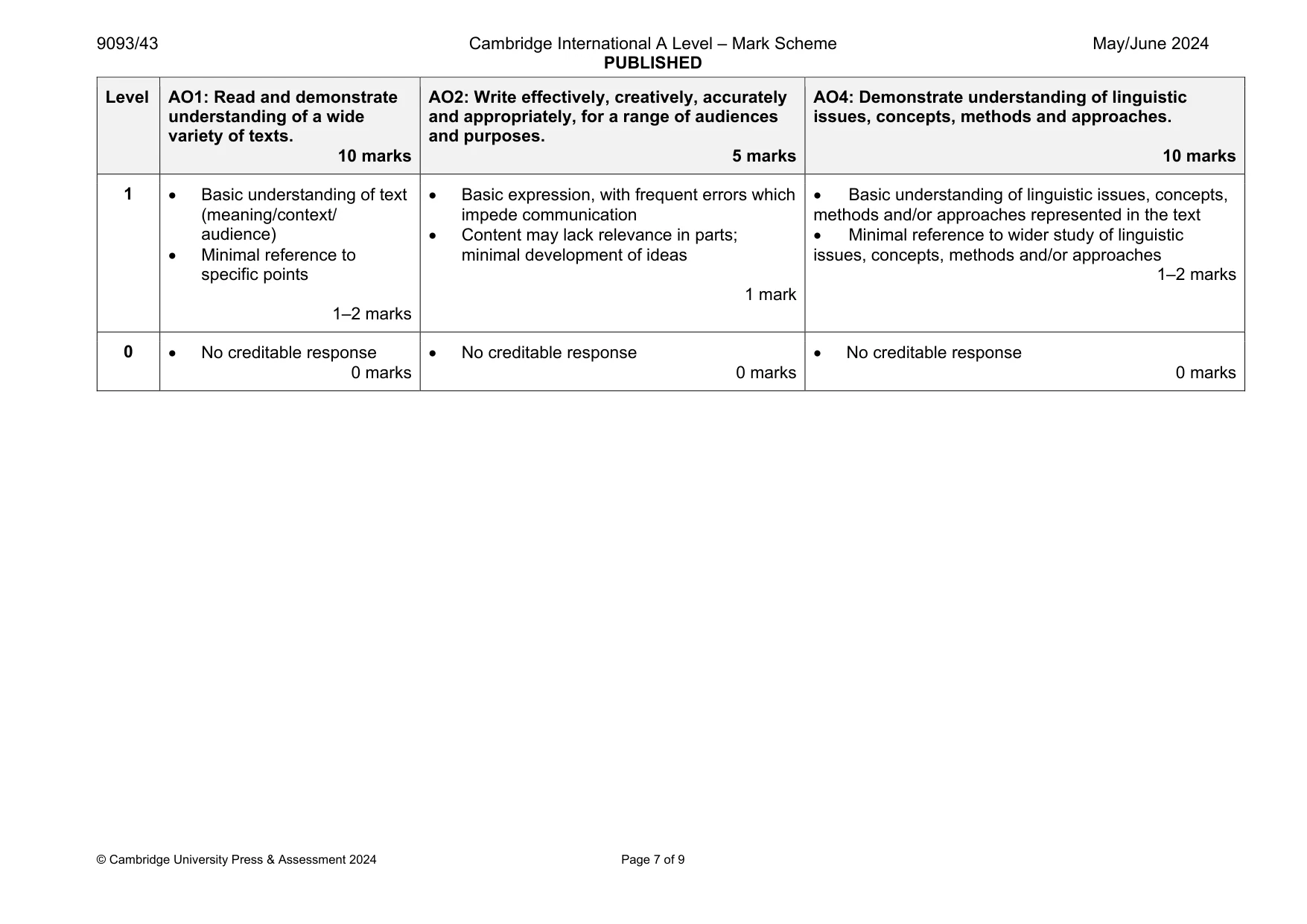
9093/43 Cambridge International A Level – Mark Scheme PUBLISHED May/June 2024 © Cambridge University Press & Assessment 2024 Page 7 of 9 Level AO1: Read and demonstrate understanding of a wide variety of texts. 10 marks AO2: Write effectively, creatively, accurately and appropriately, for a range of audiences and purposes. 5 marks AO4: Demonstrate understanding of linguistic issues, concepts, methods and approaches. 10 marks 1 Basic understanding of text (meaning/context/ audience) Minimal reference to specific points 1–2 marks Basic expression, with frequent errors which impede communication Content may lack relevance in parts; minimal development of ideas 1 mark Basic understanding of linguistic issues, concepts, methods and/or approaches represented in the text Minimal reference to wider study of linguistic issues, concepts, methods and/or approaches 1–2 marks 0 No creditable response 0 marks No creditable response 0 marks No creditable response 0 marks
Mark scheme, page 8
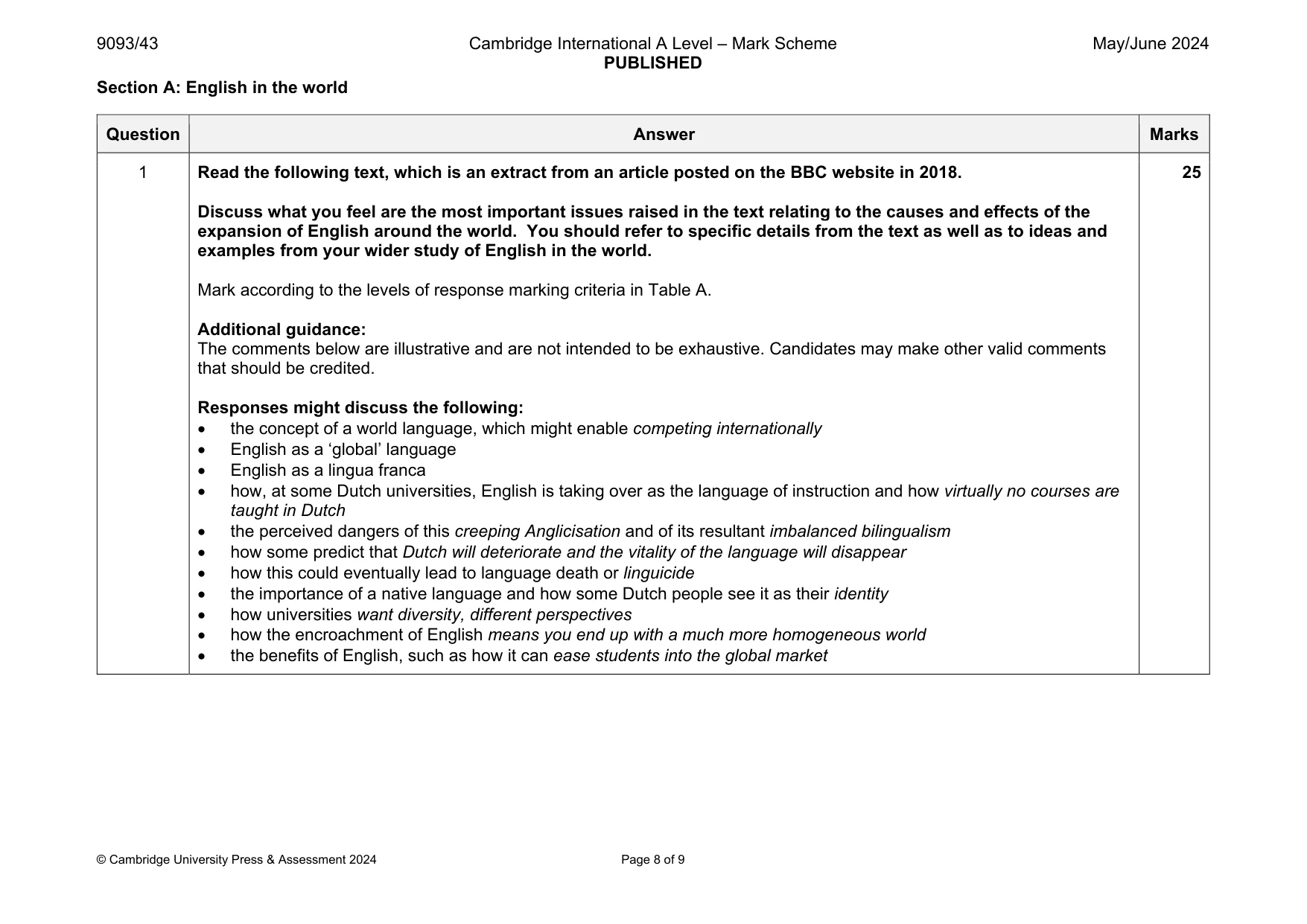
9093/43 Cambridge International A Level – Mark Scheme PUBLISHED May/June 2024 © Cambridge University Press & Assessment 2024 Page 8 of 9 Section A: English in the world Question Answer Marks 1 Read the following text, which is an extract from an article posted on the BBC website in 2018. Discuss what you feel are the most important issues raised in the text relating to the causes and effects of the expansion of English around the world. You should refer to specific details from the text as well as to ideas and examples from your wider study of English in the world. Mark according to the levels of response marking criteria in Table A. Additional guidance: The comments below are illustrative and are not intended to be exhaustive. Candidates may make other valid comments that should be credited. Responses might discuss the following: the concept of a world language, which might enable competing internationally English as a ‘global’ language English as a lingua franca how, at some Dutch universities, English is taking over as the language of instruction and how virtually no courses are taught in Dutch the perceived dangers of this creeping Anglicisation and of its resultant imbalanced bilingualism how some predict that Dutch will deteriorate and the vitality of the language will disappear how this could eventually lead to language death or linguicide the importance of a native language and how some Dutch people see it as their identity how universities want diversity, different perspectives how the encroachment of English means you end up with a much more homogeneous world the benefits of English, such as how it can ease students into the global market 25
Mark scheme, page 9
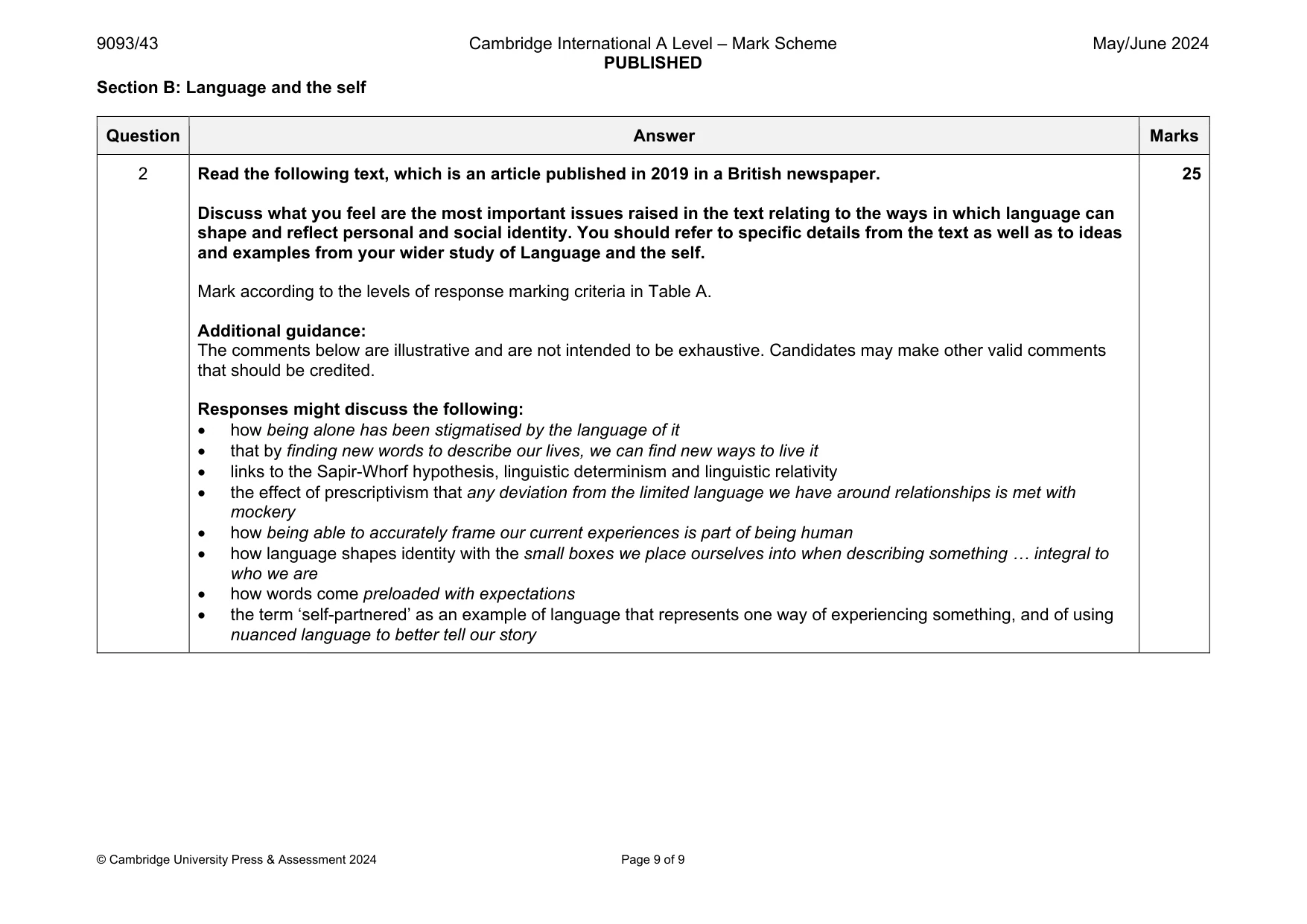
9093/43 Cambridge International A Level – Mark Scheme PUBLISHED May/June 2024 © Cambridge University Press & Assessment 2024 Page 9 of 9 Section B: Language and the self Question Answer Marks 2 Read the following text, which is an article published in 2019 in a British newspaper. Discuss what you feel are the most important issues raised in the text relating to the ways in which language can shape and reflect personal and social identity. You should refer to specific details from the text as well as to ideas and examples from your wider study of Language and the self. Mark according to the levels of response marking criteria in Table A. Additional guidance: The comments below are illustrative and are not intended to be exhaustive. Candidates may make other valid comments that should be credited. Responses might discuss the following: how being alone has been stigmatised by the language of it that by finding new words to describe our lives, we can find new ways to live it links to the Sapir-Whorf hypothesis, linguistic determinism and linguistic relativity the effect of prescriptivism that any deviation from the limited language we have around relationships is met with mockery how being able to accurately frame our current experiences is part of being human how language shapes identity with the small boxes we place ourselves into when describing something … integral to who we are how words come preloaded with expectations the term ‘self-partnered’ as an example of language that represents one way of experiencing something, and of using nuanced language to better tell our story 25
What you needed in this session
Cambridge’s own grade thresholds for 2024 May/June, Paper 4 · Variant 3. A higher threshold means an easier paper — the bar moves with how the cohort did.