Cambridge A Level English - Language AS and A Level (from 2014) 9093 — 2023 May/June Paper 3 · Variant 1
9093/31/M/J/23 · 50 marks · ≈56 min
The question paper and its mark scheme, free to read here and free to download. This is Cambridge’s own paper, exactly as it was sat.
Question paper8 pages
Mark scheme13 pages
Answers below. Sit the paper first if you are practising.
Paper as text
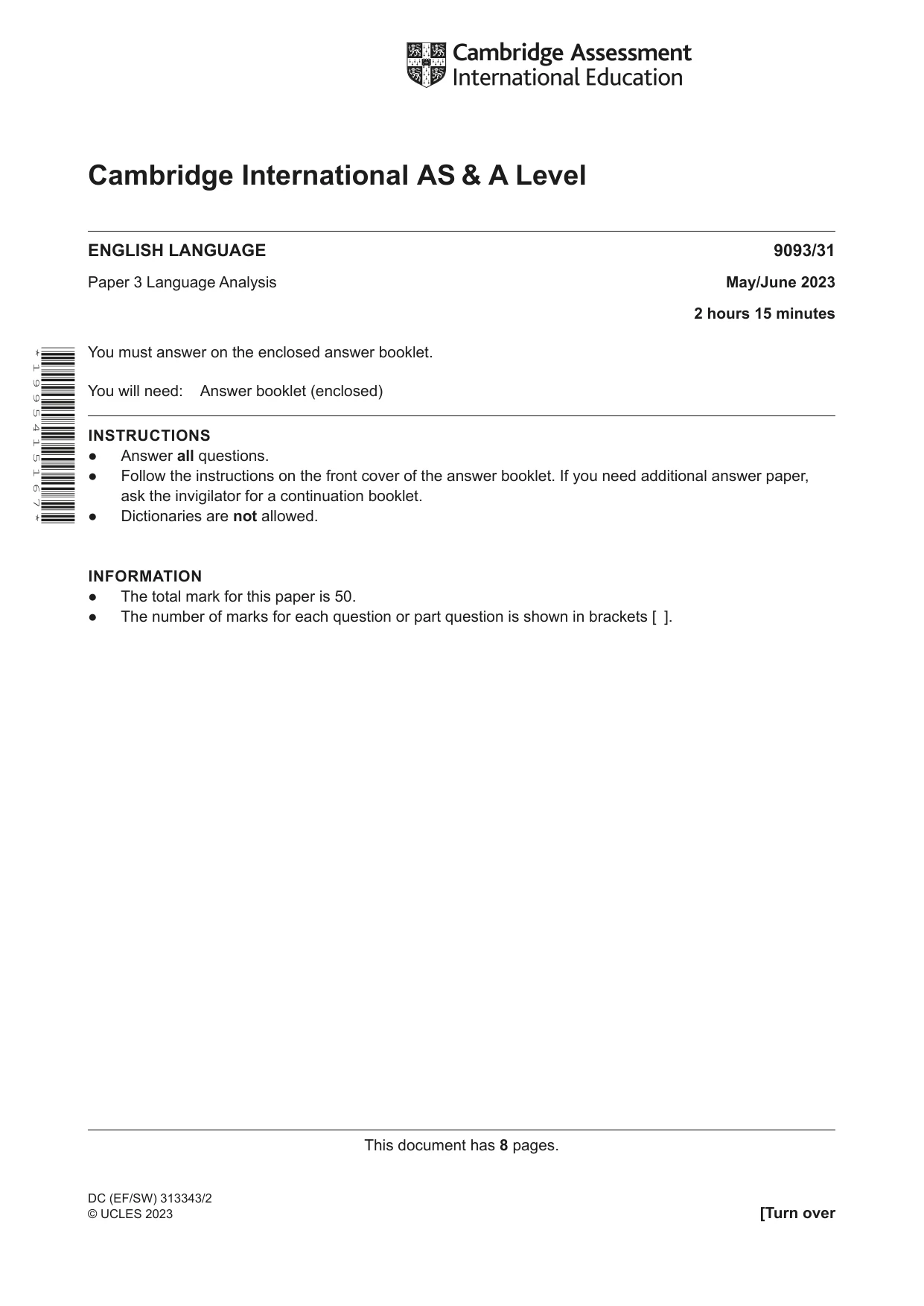
Question paper, page 1
This document has 8 pages. [Turn over Cambridge International AS & A Level * 1 9 9 5 4 1 5 1 6 7 * DC (EF/SW) 313343/2 © UCLES 2023 ENGLISH LANGUAGE 9093/31 Paper 3 Language Analysis May/June 2023 2 hours 15 minutes You must answer on the enclosed answer booklet. You will need: Answer booklet (enclosed) INSTRUCTIONS ● Answer all questions. ● Follow the instructions on the front cover of the answer booklet. If you need additional answer paper, ask the invigilator for a continuation booklet. ● Dictionaries are not allowed. INFORMATION ● The total mark for this paper is 50. ● The number of marks for each question or part question is shown in brackets [ ].
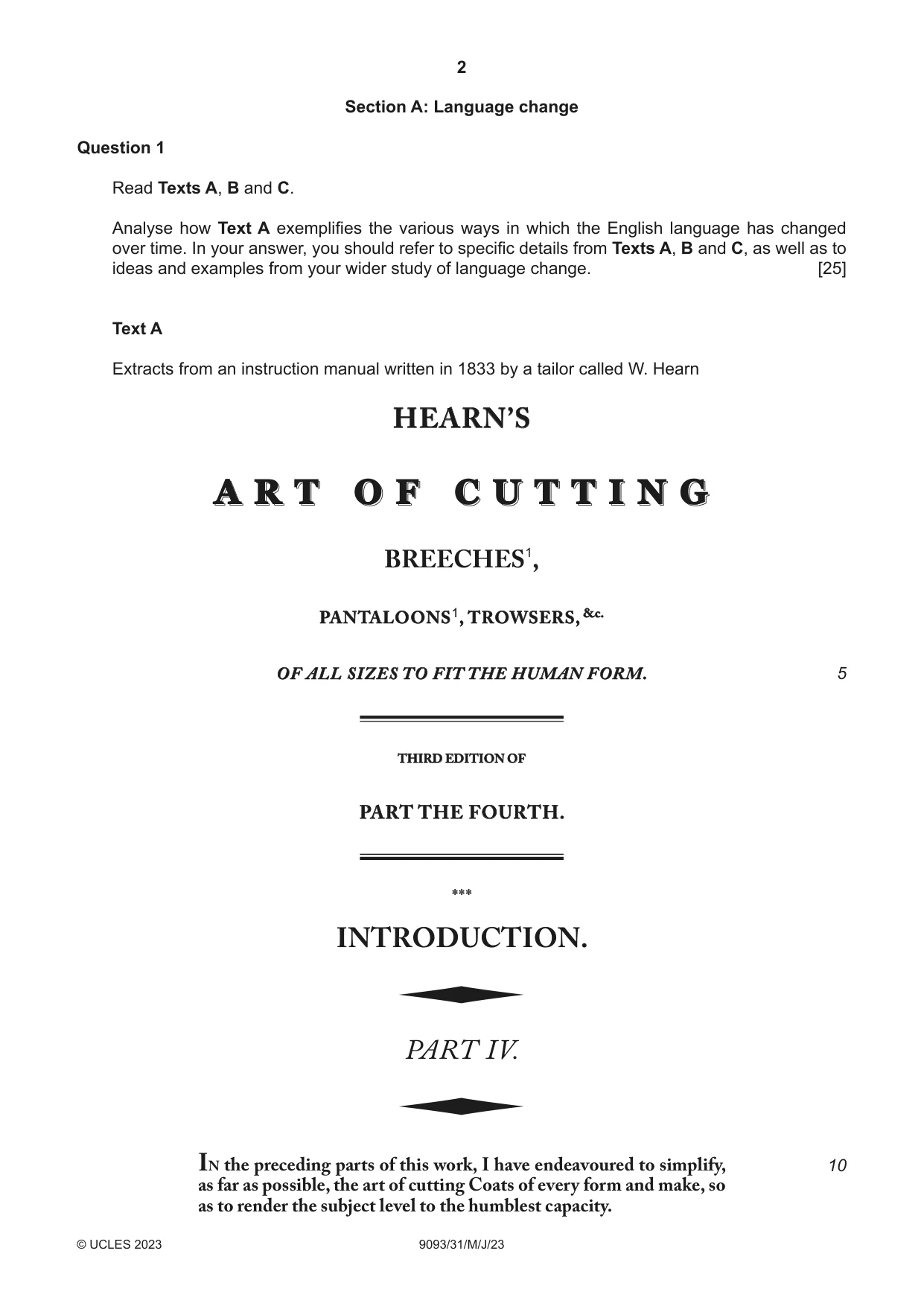
Question paper, page 2
2 9093/31/M/J/23 © UCLES 2023 Section A: Language change Question 1 Read Texts A, B and C. Analyse how Text A exemplifies the various ways in which the English language has changed over time. In your answer, you should refer to specific details from Texts A, B and C, as well as to ideas and examples from your wider study of language change. [25] Text A Extracts from an instruction manual written in 1833 by a tailor called W. Hearn HEARN’S A R T O F C U T T I N G BREECHES 1, PANTALOONS1, TROWSERS, &c. OF ALL SIZES TO FIT THE HUMAN FORM. THIRD EDITION OF PART THE FOURTH. * * * INTRODUCTION. ♦ PART IV. ♦ In the preceding parts of this work, I have endeavoured to simplify, as far as possible, the art of cutting Coats of every form and make, so as to render the subject level to the humblest capacity. 5 10
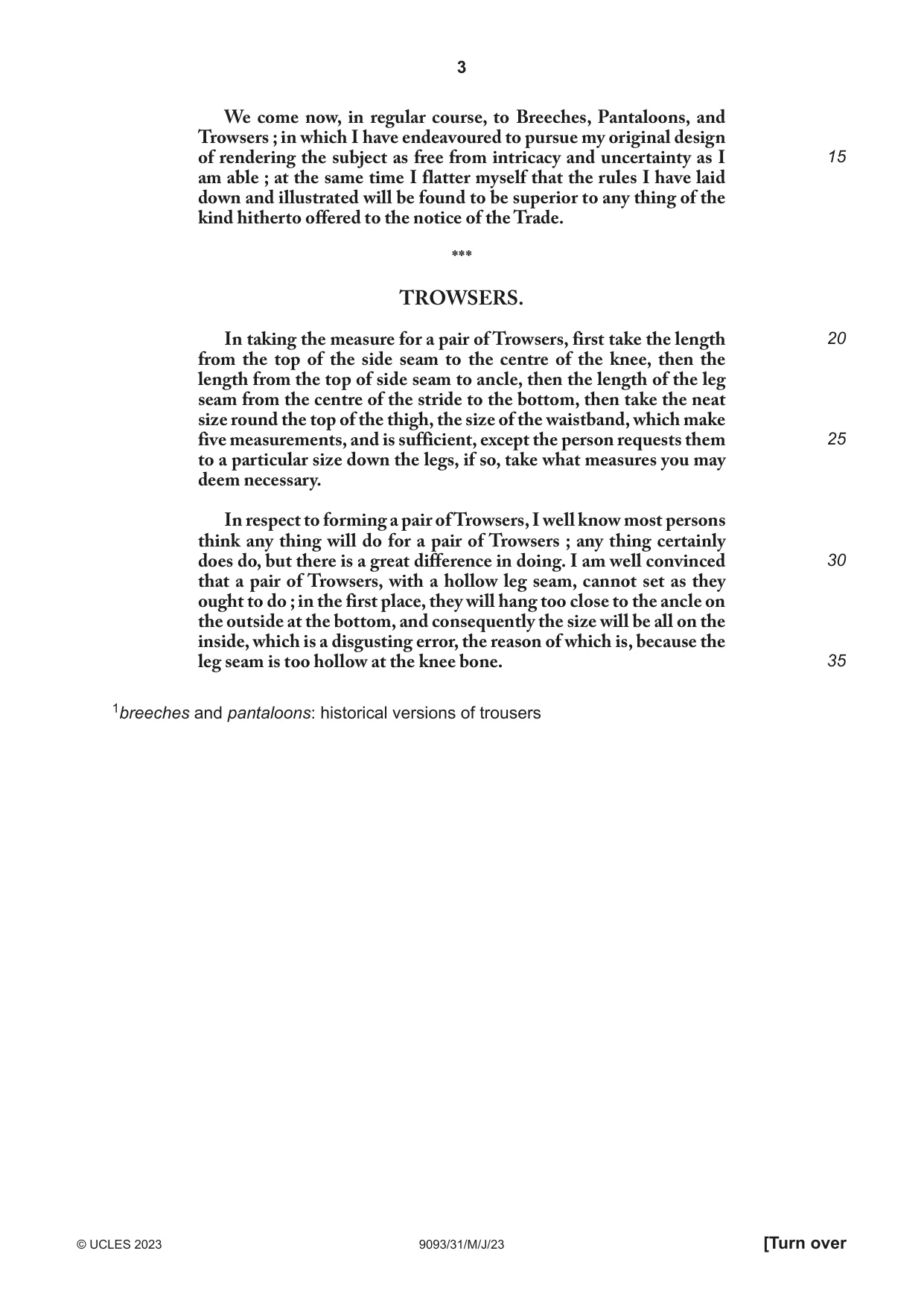
Question paper, page 3
3 9093/31/M/J/23 © UCLES 2023 [Turn over We come now, in regular course, to Breeches, Pantaloons, and Trowsers ; in which I have endeavoured to pursue my original design of rendering the subject as free from intricacy and uncertainty as I am able ; at the same time I flatter myself that the rules I have laid down and illustrated will be found to be superior to any thing of the kind hitherto offered to the notice of the Trade. * * * TROWSERS. In taking the measure for a pair of Trowsers, first take the length from the top of the side seam to the centre of the knee, then the length from the top of side seam to ancle, then the length of the leg seam from the centre of the stride to the bottom, then take the neat size round the top of the thigh, the size of the waistband, which make five measurements, and is sufficient, except the person requests them to a particular size down the legs, if so, take what measures you may deem necessary. In respect to forming a pair of Trowsers, I well know most persons think any thing will do for a pair of Trowsers ; any thing certainly does do, but there is a great difference in doing. I am well convinced that a pair of Trowsers, with a hollow leg seam, cannot set as they ought to do ; in the first place, they will hang too close to the ancle on the outside at the bottom, and consequently the size will be all on the inside, which is a disgusting error, the reason of which is, because the leg seam is too hollow at the knee bone. 1breeches and pantaloons: historical versions of trousers 15 20 25 30 35
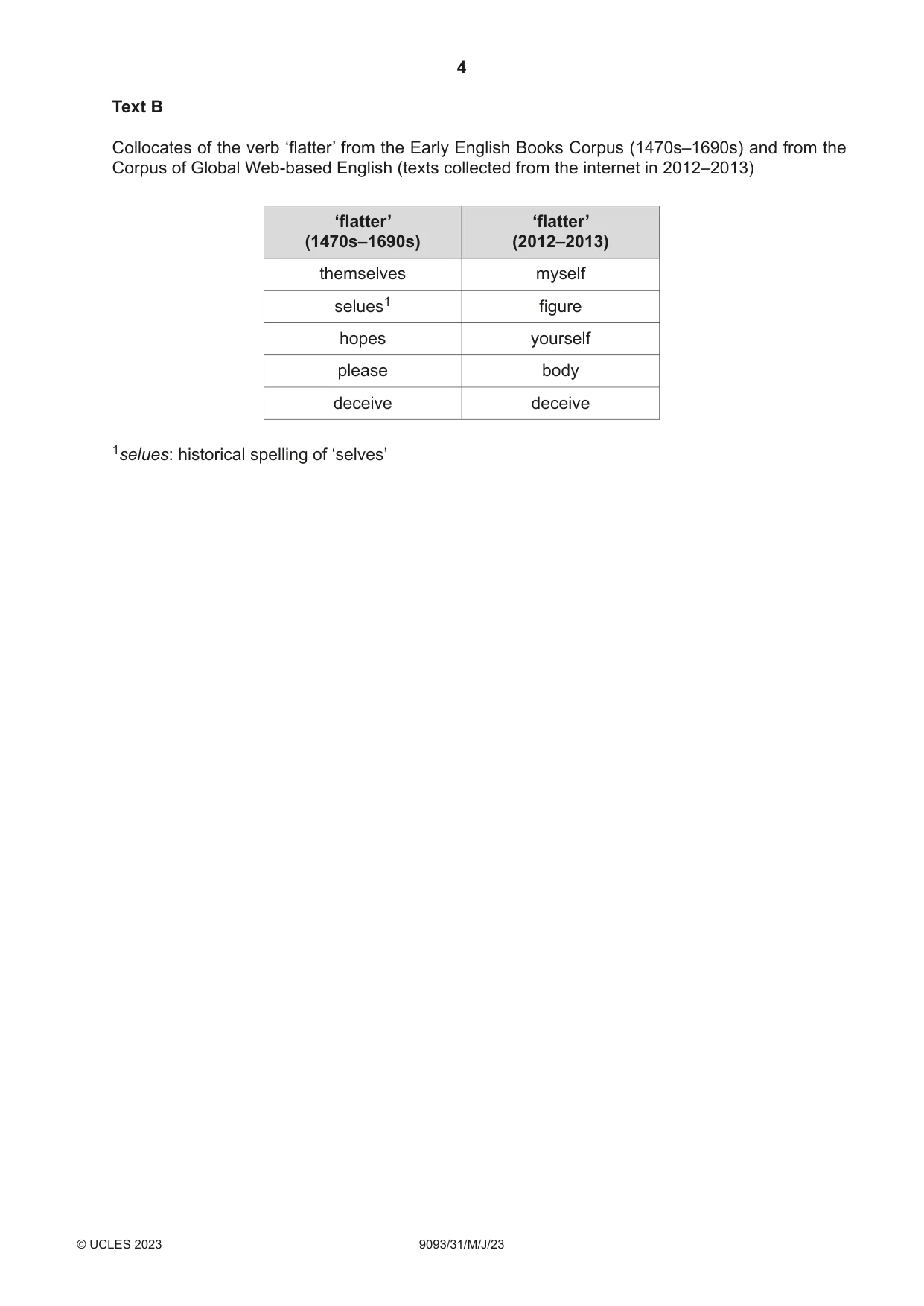
Question paper, page 4
4 9093/31/M/J/23 © UCLES 2023 Text B Collocates of the verb ‘flatter’ from the Early English Books Corpus (1470s–1690s) and from the Corpus of Global Web‑based English (texts collected from the internet in 2012–2013) ‘flatter’ (1470s–1690s) ‘flatter’ (2012–2013) themselves myself selues1 figure hopes yourself please body deceive deceive 1selues: historical spelling of ‘selves’
Question paper, page 5
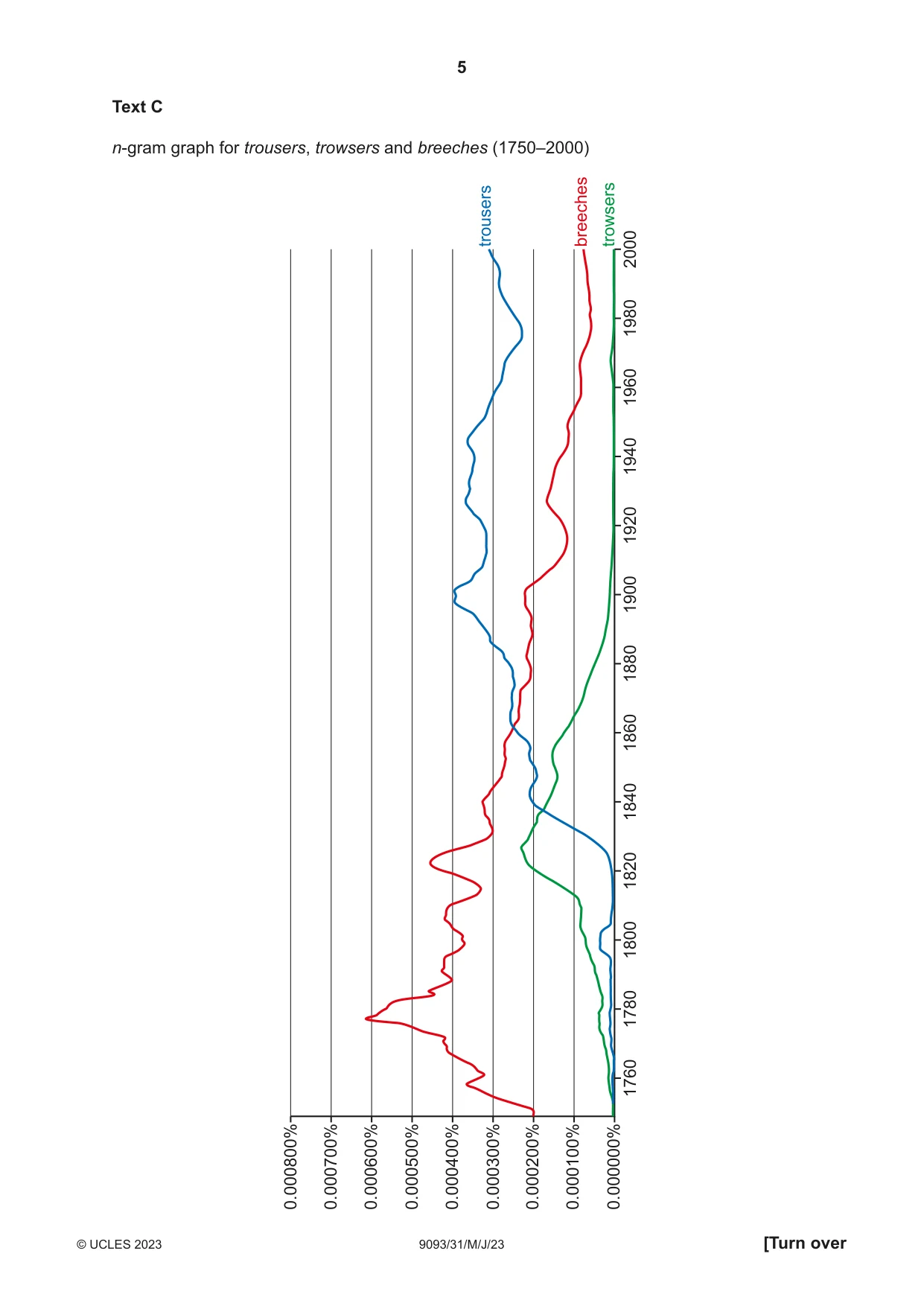
5 9093/31/M/J/23 © UCLES 2023 [Turn over Text C n‑gram graph for trousers, trowsers and breeches (1750–2000) 1760 0.000000% 0.000100% 0.000200% 0.000300% 0.000400% 0.000500% 0.000600% 0.000700% 0.000800% 1780 1800 1820 1840 1860 1880 1900 1920 1940 1960 1980 2000 trousers breeches trowsers
Question paper, page 6
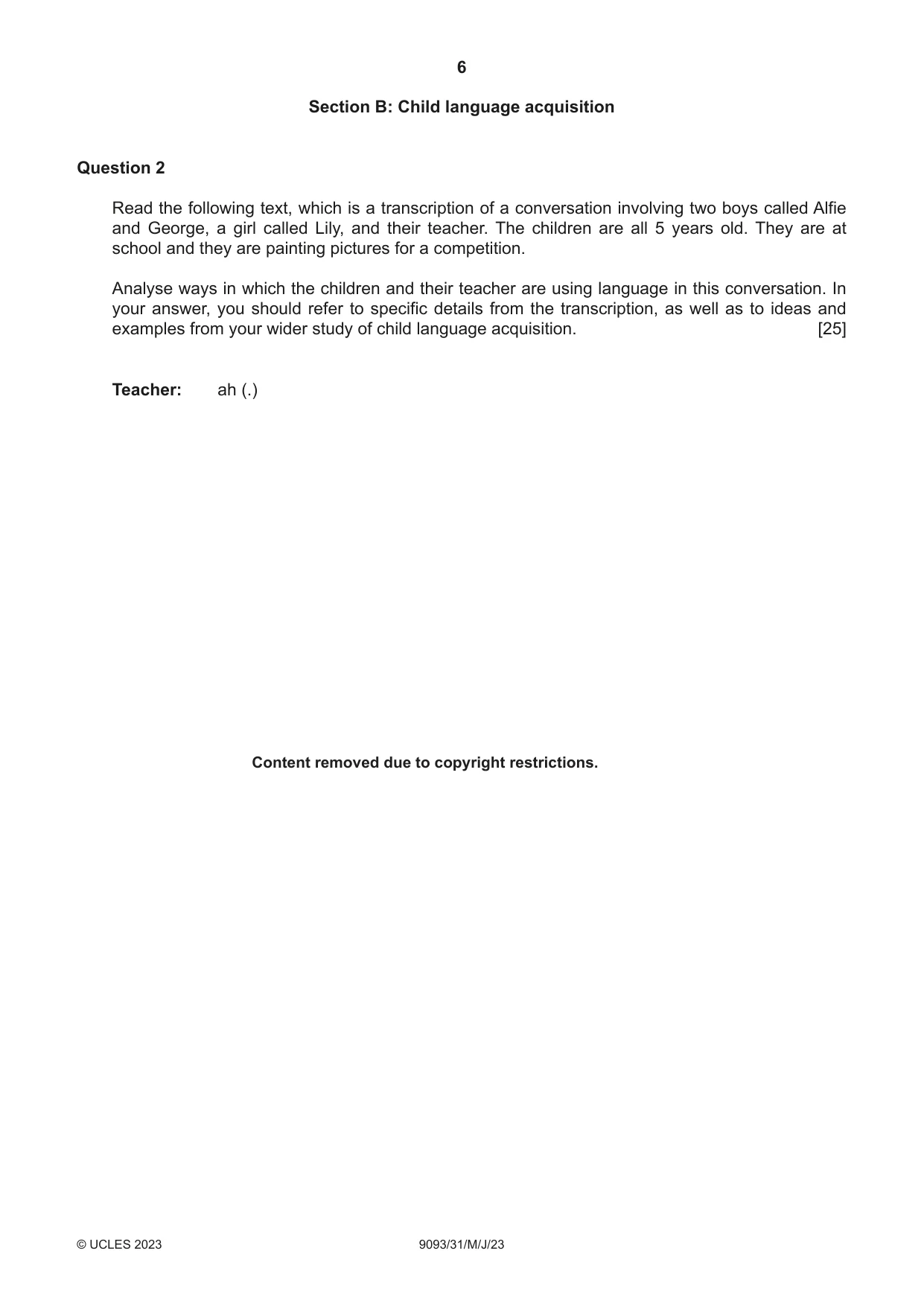
6 9093/31/M/J/23 © UCLES 2023 Section B: Child language acquisition Question 2 Read the following text, which is a transcription of a conversation involving two boys called Alfie and George, a girl called Lily, and their teacher. The children are all 5 years old. They are at school and they are painting pictures for a competition. Analyse ways in which the children and their teacher are using language in this conversation. In your answer, you should refer to specific details from the transcription, as well as to ideas and examples from your wider study of child language acquisition. [25] Teacher: ah (.) Content removed due to copyright restrictions.
Question paper, page 7
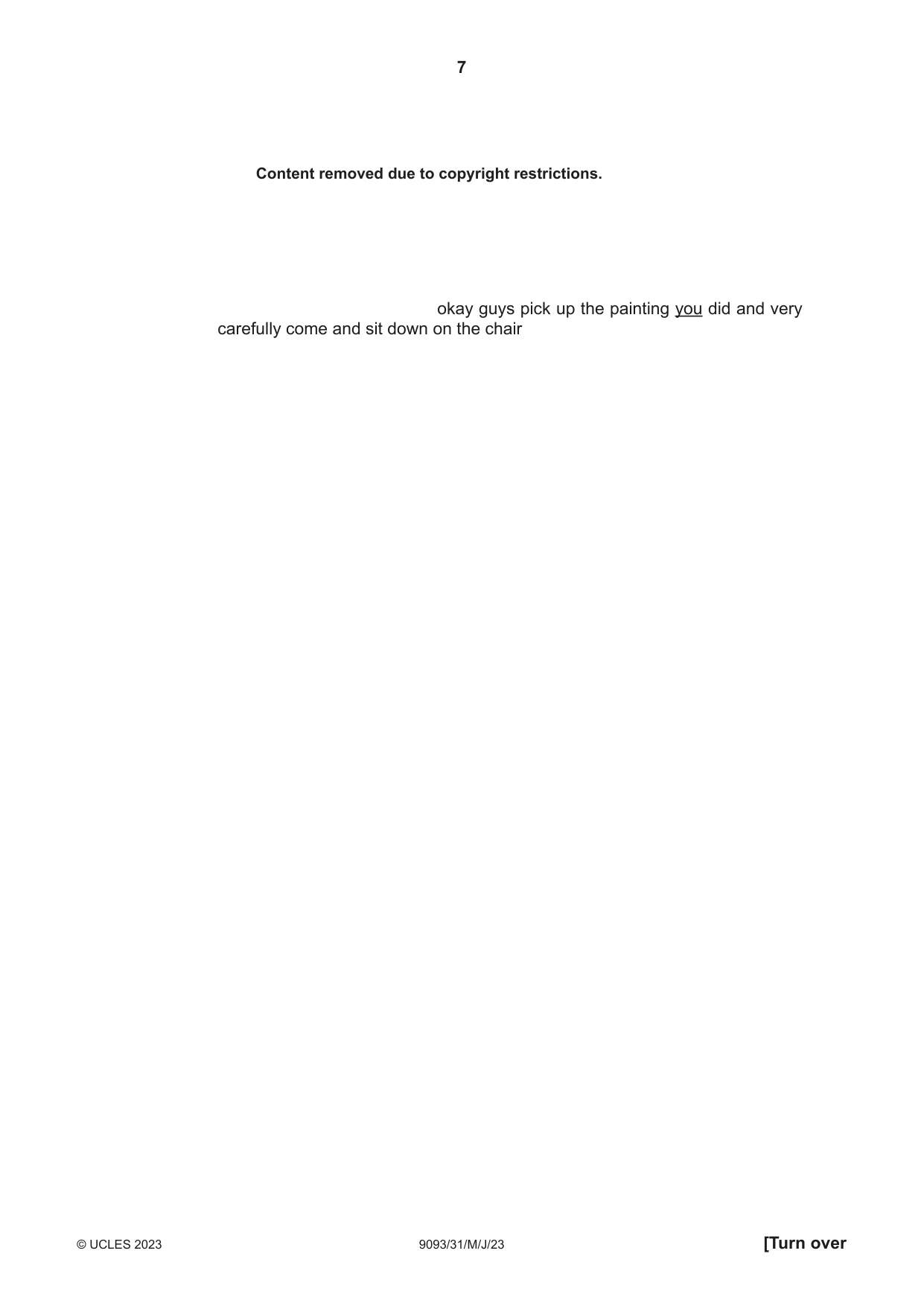
7 9093/31/M/J/23 © UCLES 2023 [Turn over okay guys pick up the painting you did and very carefully come and sit down on the chair Content removed due to copyright restrictions.
Question paper, page 8
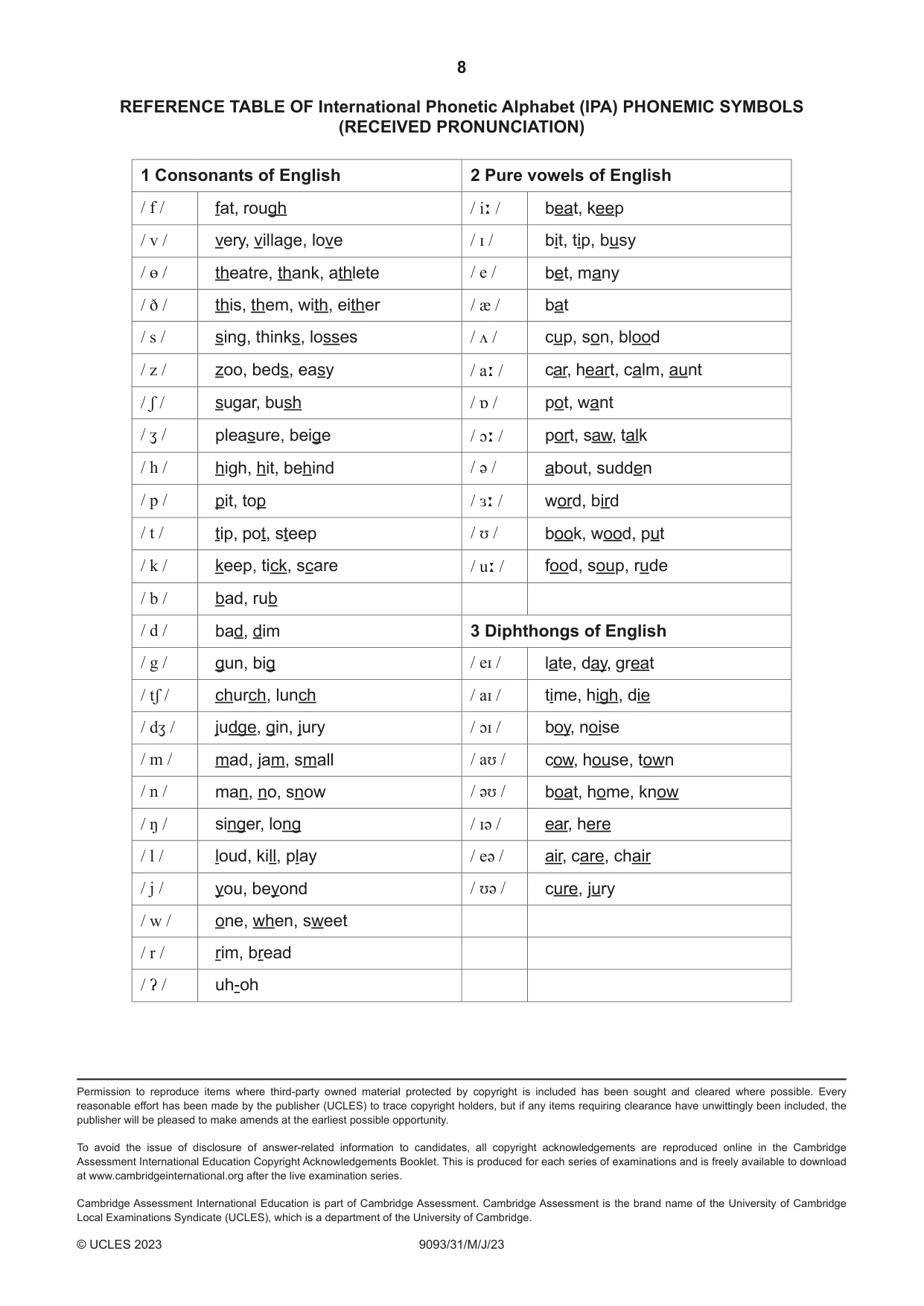
8 9093/31/M/J/23 © UCLES 2023 Permission to reproduce items where third‑party owned material protected by copyright is included has been sought and cleared where possible. Every reasonable effort has been made by the publisher (UCLES) to trace copyright holders, but if any items requiring clearance have unwittingly been included, the publisher will be pleased to make amends at the earliest possible opportunity. To avoid the issue of disclosure of answer‑related information to candidates, all copyright acknowledgements are reproduced online in the Cambridge Assessment International Education Copyright Acknowledgements Booklet. This is produced for each series of examinations and is freely available to download at www.cambridgeinternational.org after the live examination series. Cambridge Assessment International Education is part of Cambridge Assessment. Cambridge Assessment is the brand name of the University of Cambridge Local Examinations Syndicate (UCLES), which is a department of the University of Cambridge. REFERENCE TABLE OF International Phonetic Alphabet (IPA) PHONEMIC SYMBOLS (RECEIVED PRONUNCIATION) 1 Consonants of English 2 Pure vowels of English / f / fat, rough / iː / beat, keep / v / very, village, love / ɪ / bit, tip, busy / ɵ / theatre, thank, athlete / e / bet, many / ð / this, them, with, either / æ / bat / s / sing, thinks, losses / ʌ / cup, son, blood / z / zoo, beds, easy / aː / car, heart, calm, aunt / ʃ / sugar, bush / ɒ / pot, want / ʒ / pleasure, beige / ɔː / port, saw, talk / h / high, hit, behind / ə / about, sudden / p / pit, top / ɜː / word, bird / t / tip, pot, steep / ʊ / book, wood, put / k / keep, tick, scare / uː / food, soup, rude / b / bad, rub / d / bad, dim 3 Diphthongs of English / g / gun, big / eɪ / late, day, great / tʃ / church, lunch / aɪ / time, high, die / dʒ / judge, gin, jury / ɔɪ / boy, noise / m / mad, jam, small / aʊ / cow, house, town / n / man, no, snow / əʊ / boat, home, know / ŋ / singer, long / ɪə / ear, here / l / loud, kill, play / eə / air, care, chair / j / you, beyond / ʊə / cure, jury / w / one, when, sweet / r / rim, bread / ʔ / uh‑oh
Mark scheme, page 1
This document consists of 13 printed pages. © UCLES 2023 [Turn over Cambridge International A Level ENGLISH LANGUAGE 9093/31 Paper 3 Language Analysis May/June 2023 MARK SCHEME Maximum Mark: 50 Published This mark scheme is published as an aid to teachers and candidates, to indicate the requirements of the examination. It shows the basis on which Examiners were instructed to award marks. It does not indicate the details of the discussions that took place at an Examiners’ meeting before marking began, which would have considered the acceptability of alternative answers. Mark schemes should be read in conjunction with the question paper and the Principal Examiner Report for Teachers. Cambridge International will not enter into discussions about these mark schemes. Cambridge International is publishing the mark schemes for the May/June 2023 series for most Cambridge IGCSE, Cambridge International A and AS Level and Cambridge Pre-U components, and some Cambridge O Level components.
Mark scheme, page 2
9093/31 Cambridge International A Level – Mark Scheme PUBLISHED May/June 2023 © UCLES 2023 Page 2 of 13 Generic Marking Principles These general marking principles must be applied by all examiners when marking candidate answers. They should be applied alongside the specific content of the mark scheme or generic level descriptors for a question. Each question paper and mark scheme will also comply with these marking principles. GENERIC MARKING PRINCIPLE 1: Marks must be awarded in line with: the specific content of the mark scheme or the generic level descriptors for the question the specific skills defined in the mark scheme or in the generic level descriptors for the question the standard of response required by a candidate as exemplified by the standardisation scripts. GENERIC MARKING PRINCIPLE 2: Marks awarded are always whole marks (not half marks, or other fractions). GENERIC MARKING PRINCIPLE 3: Marks must be awarded positively: marks are awarded for correct/valid answers, as defined in the mark scheme. However, credit is given for valid answers which go beyond the scope of the syllabus and mark scheme, referring to your Team Leader as appropriate marks are awarded when candidates clearly demonstrate what they know and can do marks are not deducted for errors marks are not deducted for omissions answers should only be judged on the quality of spelling, punctuation and grammar when these features are specifically assessed by the question as indicated by the mark scheme. The meaning, however, should be unambiguous. GENERIC MARKING PRINCIPLE 4: Rules must be applied consistently, e.g. in situations where candidates have not followed instructions or in the application of generic level descriptors.
Mark scheme, page 3
9093/31 Cambridge International A Level – Mark Scheme PUBLISHED May/June 2023 © UCLES 2023 Page 3 of 13 GENERIC MARKING PRINCIPLE 5: Marks should be awarded using the full range of marks defined in the mark scheme for the question (however; the use of the full mark range may be limited according to the quality of the candidate responses seen). GENERIC MARKING PRINCIPLE 6: Marks awarded are based solely on the requirements as defined in the mark scheme. Marks should not be awarded with grade thresholds or grade descriptors in mind.
Mark scheme, page 4
9093/31 Cambridge International A Level – Mark Scheme PUBLISHED May/June 2023 © UCLES 2023 Page 4 of 13 English & Media subject specific general marking principles (To be read in conjunction with the Generic Marking Principles (and requiring further guidance on how to place marks within levels)) Components using level descriptors: We use level descriptors as a guide to broad understanding of the qualities normally expected of, or typical of, work in a level. Level descriptors are a means of general guidance, and should not be interpreted as hurdle statements. Where indicative content notes are supplied for a question, these are not a prescription of required content, and must not be treated as such. Alternative correct points and unexpected answers in candidates’ scripts must be given marks that fairly reflect the knowledge and skills demonstrated. While we may have legitimate expectations as to the ground most answers may occupy, we must at all times be prepared to meet candidates on their chosen ground, provided it is relevant ground (e.g. clearly related to and derived from a relevant passage/text and meeting the mark scheme requirements for the question).
Mark scheme, page 5
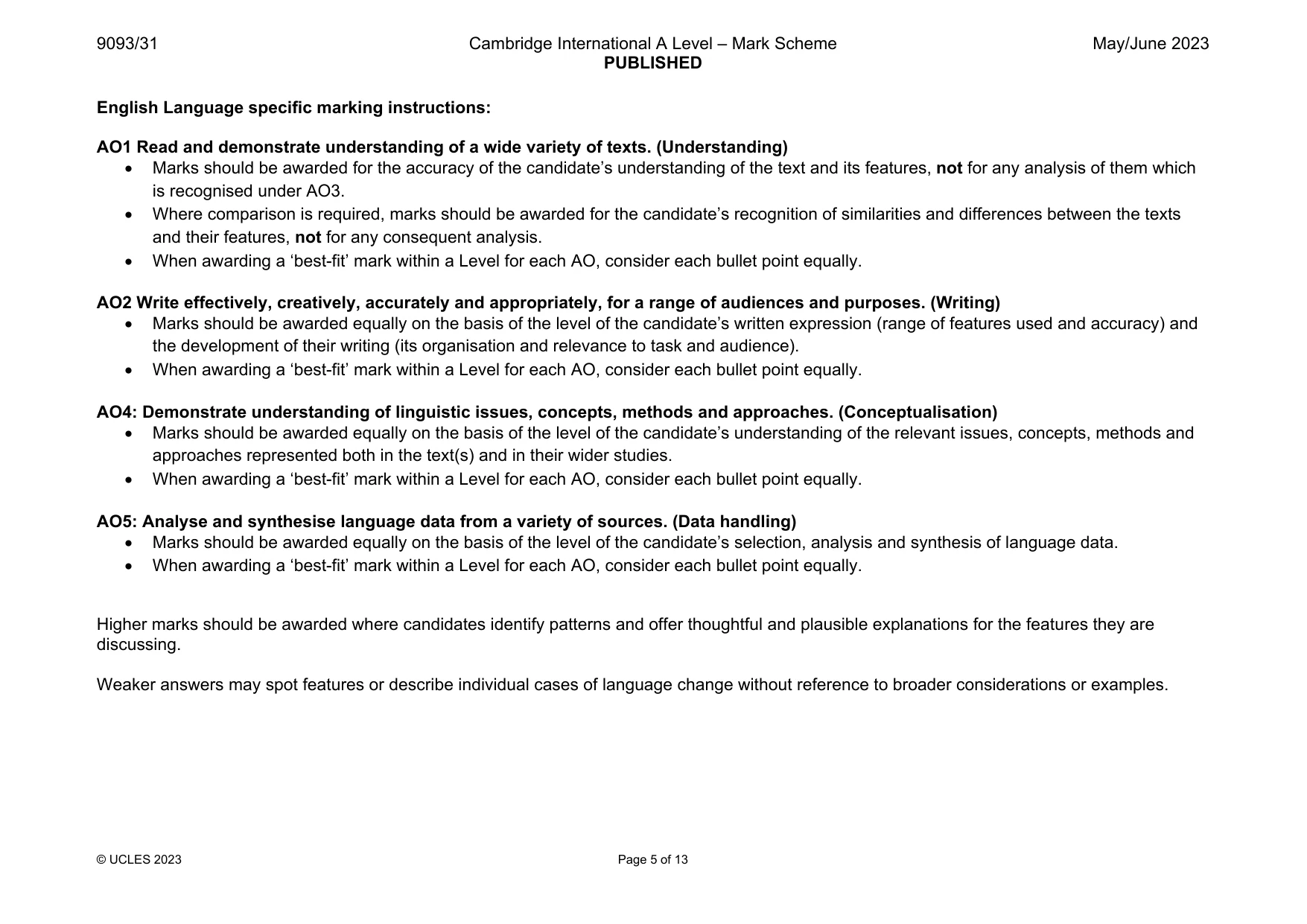
9093/31 Cambridge International A Level – Mark Scheme PUBLISHED May/June 2023 © UCLES 2023 Page 5 of 13 English Language specific marking instructions: AO1 Read and demonstrate understanding of a wide variety of texts. (Understanding) Marks should be awarded for the accuracy of the candidate’s understanding of the text and its features, not for any analysis of them which is recognised under AO3. Where comparison is required, marks should be awarded for the candidate’s recognition of similarities and differences between the texts and their features, not for any consequent analysis. When awarding a ‘best-fit’ mark within a Level for each AO, consider each bullet point equally. AO2 Write effectively, creatively, accurately and appropriately, for a range of audiences and purposes. (Writing) Marks should be awarded equally on the basis of the level of the candidate’s written expression (range of features used and accuracy) and the development of their writing (its organisation and relevance to task and audience). When awarding a ‘best-fit’ mark within a Level for each AO, consider each bullet point equally. AO4: Demonstrate understanding of linguistic issues, concepts, methods and approaches. (Conceptualisation) Marks should be awarded equally on the basis of the level of the candidate’s understanding of the relevant issues, concepts, methods and approaches represented both in the text(s) and in their wider studies. When awarding a ‘best-fit’ mark within a Level for each AO, consider each bullet point equally. AO5: Analyse and synthesise language data from a variety of sources. (Data handling) Marks should be awarded equally on the basis of the level of the candidate’s selection, analysis and synthesis of language data. When awarding a ‘best-fit’ mark within a Level for each AO, consider each bullet point equally. Higher marks should be awarded where candidates identify patterns and offer thoughtful and plausible explanations for the features they are discussing. Weaker answers may spot features or describe individual cases of language change without reference to broader considerations or examples.
Mark scheme, page 6
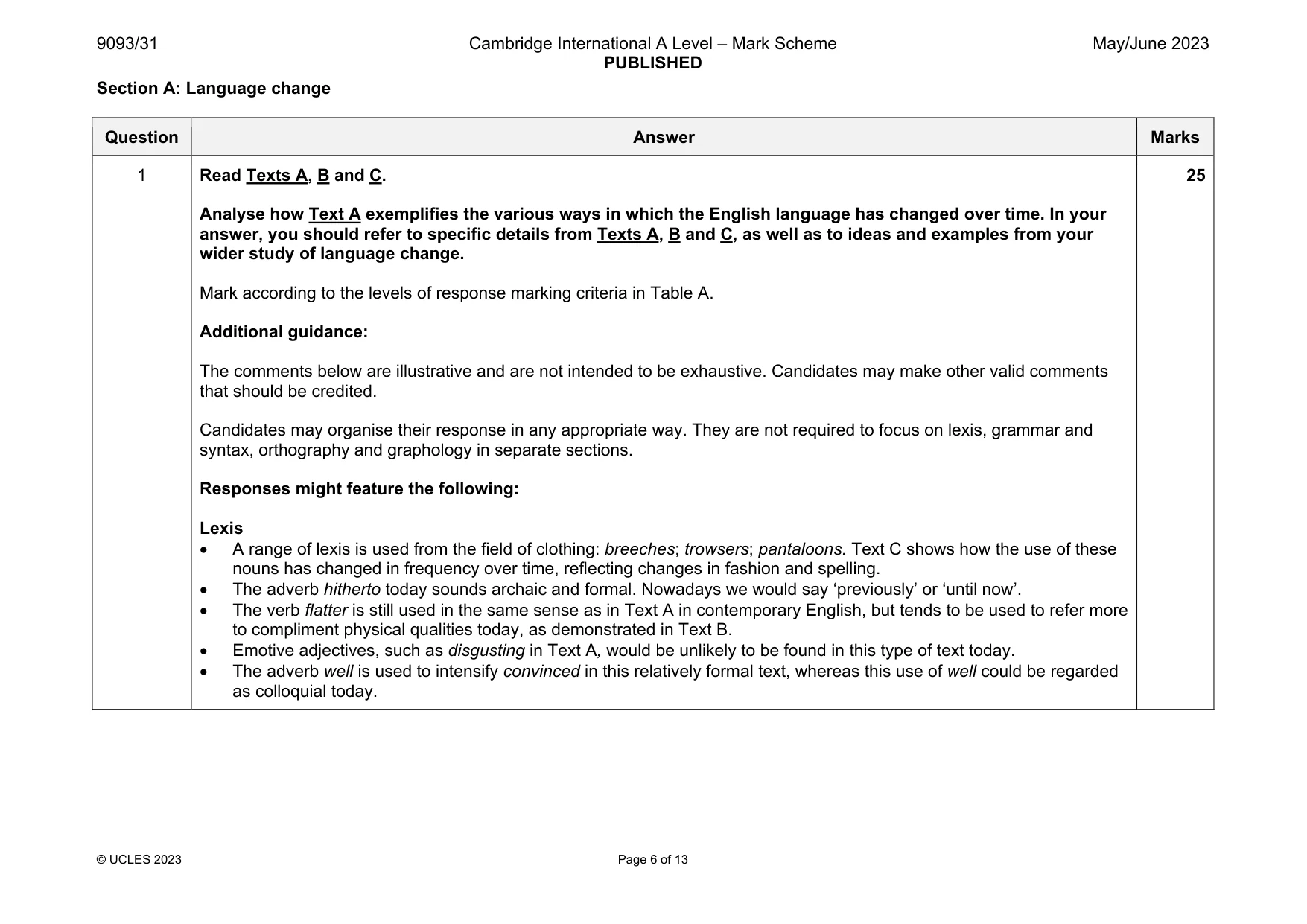
9093/31 Cambridge International A Level – Mark Scheme PUBLISHED May/June 2023 © UCLES 2023 Page 6 of 13 Section A: Language change Question Answer Marks 1 Read Texts A, B and C. Analyse how Text A exemplifies the various ways in which the English language has changed over time. In your answer, you should refer to specific details from Texts A, B and C, as well as to ideas and examples from your wider study of language change. Mark according to the levels of response marking criteria in Table A. Additional guidance: The comments below are illustrative and are not intended to be exhaustive. Candidates may make other valid comments that should be credited. Candidates may organise their response in any appropriate way. They are not required to focus on lexis, grammar and syntax, orthography and graphology in separate sections. Responses might feature the following: Lexis A range of lexis is used from the field of clothing: breeches; trowsers; pantaloons. Text C shows how the use of these nouns has changed in frequency over time, reflecting changes in fashion and spelling. The adverb hitherto today sounds archaic and formal. Nowadays we would say ‘previously’ or ‘until now’. The verb flatter is still used in the same sense as in Text A in contemporary English, but tends to be used to refer more to compliment physical qualities today, as demonstrated in Text B. Emotive adjectives, such as disgusting in Text A, would be unlikely to be found in this type of text today. The adverb well is used to intensify convinced in this relatively formal text, whereas this use of well could be regarded as colloquial today. 25
Mark scheme, page 7
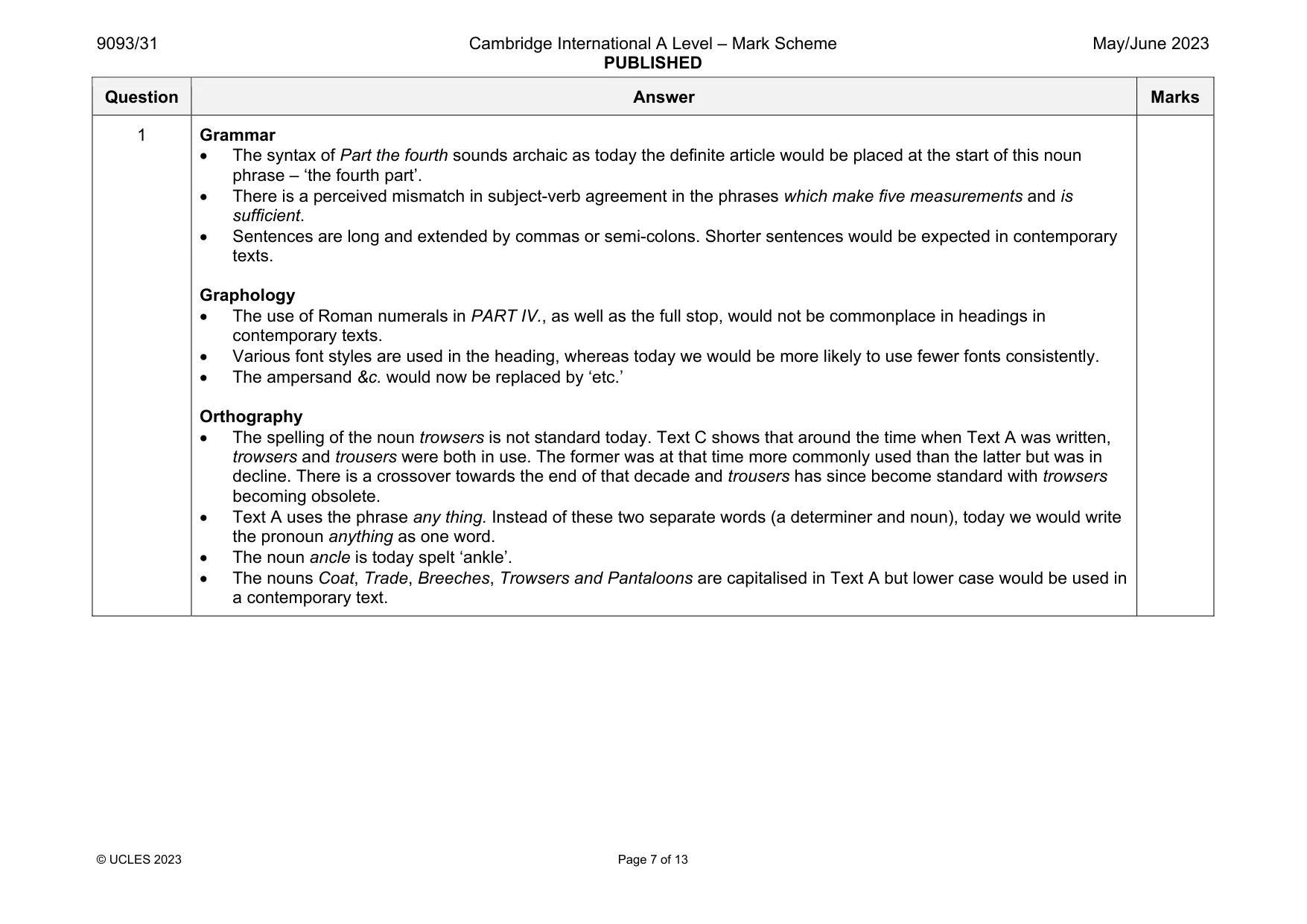
9093/31 Cambridge International A Level – Mark Scheme PUBLISHED May/June 2023 © UCLES 2023 Page 7 of 13 Question Answer Marks 1 Grammar The syntax of Part the fourth sounds archaic as today the definite article would be placed at the start of this noun phrase – ‘the fourth part’. There is a perceived mismatch in subject-verb agreement in the phrases which make five measurements and is sufficient. Sentences are long and extended by commas or semi-colons. Shorter sentences would be expected in contemporary texts. Graphology The use of Roman numerals in PART IV., as well as the full stop, would not be commonplace in headings in contemporary texts. Various font styles are used in the heading, whereas today we would be more likely to use fewer fonts consistently. The ampersand &c. would now be replaced by ‘etc.’ Orthography The spelling of the noun trowsers is not standard today. Text C shows that around the time when Text A was written, trowsers and trousers were both in use. The former was at that time more commonly used than the latter but was in decline. There is a crossover towards the end of that decade and trousers has since become standard with trowsers becoming obsolete. Text A uses the phrase any thing. Instead of these two separate words (a determiner and noun), today we would write the pronoun anything as one word. The noun ancle is today spelt ‘ankle’. The nouns Coat, Trade, Breeches, Trowsers and Pantaloons are capitalised in Text A but lower case would be used in a contemporary text.
Mark scheme, page 8
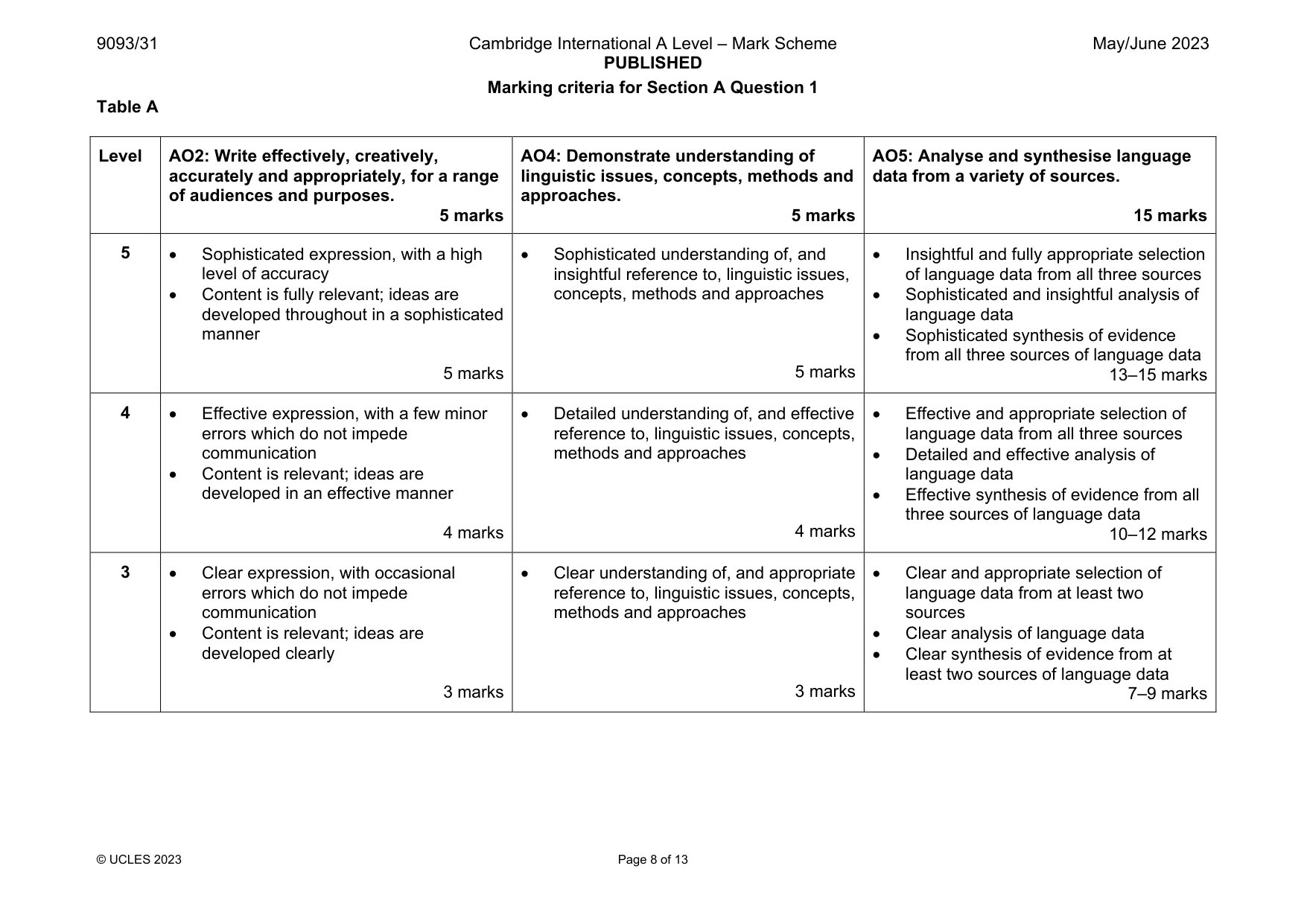
9093/31 Cambridge International A Level – Mark Scheme PUBLISHED May/June 2023 © UCLES 2023 Page 8 of 13 Marking criteria for Section A Question 1 Table A Level AO2: Write effectively, creatively, accurately and appropriately, for a range of audiences and purposes. 5 marks AO4: Demonstrate understanding of linguistic issues, concepts, methods and approaches. 5 marks AO5: Analyse and synthesise language data from a variety of sources. 15 marks 5 Sophisticated expression, with a high level of accuracy Content is fully relevant; ideas are developed throughout in a sophisticated manner 5 marks Sophisticated understanding of, and insightful reference to, linguistic issues, concepts, methods and approaches 5 marks Insightful and fully appropriate selection of language data from all three sources Sophisticated and insightful analysis of language data Sophisticated synthesis of evidence from all three sources of language data 13–15 marks 4 Effective expression, with a few minor errors which do not impede communication Content is relevant; ideas are developed in an effective manner 4 marks Detailed understanding of, and effective reference to, linguistic issues, concepts, methods and approaches 4 marks Effective and appropriate selection of language data from all three sources Detailed and effective analysis of language data Effective synthesis of evidence from all three sources of language data 10–12 marks 3 Clear expression, with occasional errors which do not impede communication Content is relevant; ideas are developed clearly 3 marks Clear understanding of, and appropriate reference to, linguistic issues, concepts, methods and approaches 3 marks Clear and appropriate selection of language data from at least two sources Clear analysis of language data Clear synthesis of evidence from at least two sources of language data 7–9 marks
Mark scheme, page 9
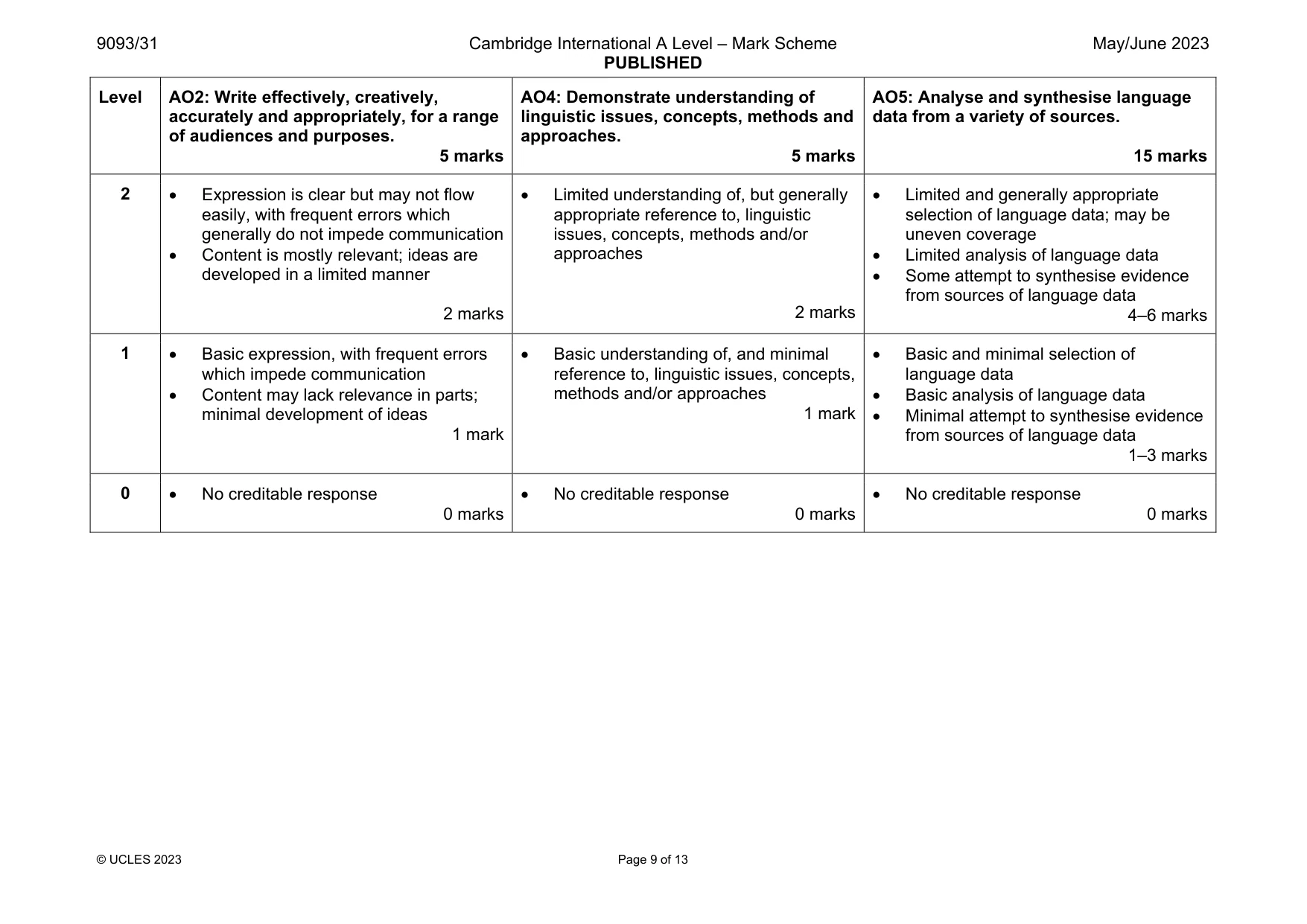
9093/31 Cambridge International A Level – Mark Scheme PUBLISHED May/June 2023 © UCLES 2023 Page 9 of 13 Level AO2: Write effectively, creatively, accurately and appropriately, for a range of audiences and purposes. 5 marks AO4: Demonstrate understanding of linguistic issues, concepts, methods and approaches. 5 marks AO5: Analyse and synthesise language data from a variety of sources. 15 marks 2 Expression is clear but may not flow easily, with frequent errors which generally do not impede communication Content is mostly relevant; ideas are developed in a limited manner 2 marks Limited understanding of, but generally appropriate reference to, linguistic issues, concepts, methods and/or approaches 2 marks Limited and generally appropriate selection of language data; may be uneven coverage Limited analysis of language data Some attempt to synthesise evidence from sources of language data 4–6 marks 1 Basic expression, with frequent errors which impede communication Content may lack relevance in parts; minimal development of ideas 1 mark Basic understanding of, and minimal reference to, linguistic issues, concepts, methods and/or approaches 1 mark Basic and minimal selection of language data Basic analysis of language data Minimal attempt to synthesise evidence from sources of language data 1–3 marks 0 No creditable response 0 marks No creditable response 0 marks No creditable response 0 marks
Mark scheme, page 10
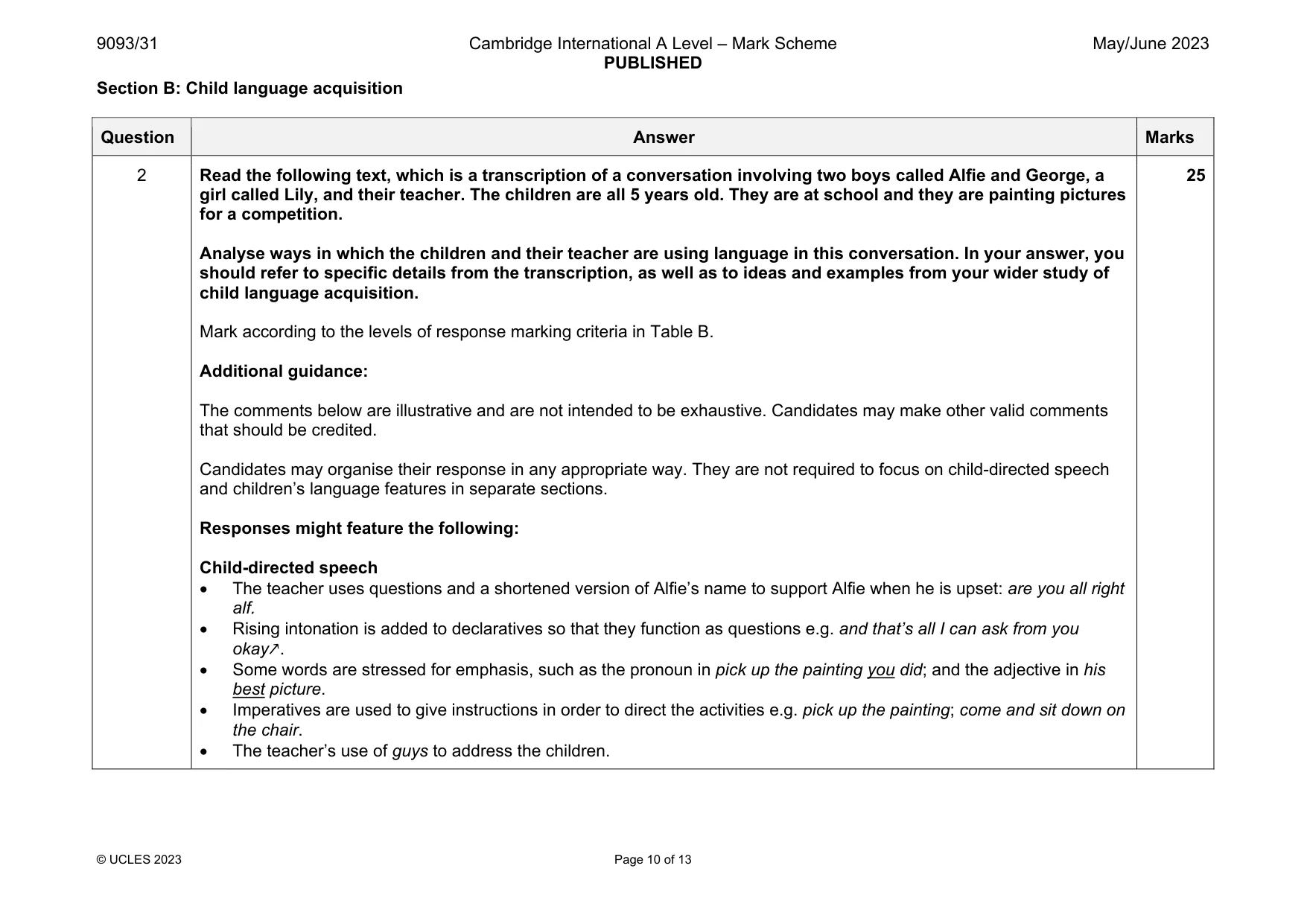
9093/31 Cambridge International A Level – Mark Scheme PUBLISHED May/June 2023 © UCLES 2023 Page 10 of 13 Section B: Child language acquisition Question Answer Marks 2 Read the following text, which is a transcription of a conversation involving two boys called Alfie and George, a girl called Lily, and their teacher. The children are all 5 years old. They are at school and they are painting pictures for a competition. Analyse ways in which the children and their teacher are using language in this conversation. In your answer, you should refer to specific details from the transcription, as well as to ideas and examples from your wider study of child language acquisition. Mark according to the levels of response marking criteria in Table B. Additional guidance: The comments below are illustrative and are not intended to be exhaustive. Candidates may make other valid comments that should be credited. Candidates may organise their response in any appropriate way. They are not required to focus on child-directed speech and children’s language features in separate sections. Responses might feature the following: Child-directed speech The teacher uses questions and a shortened version of Alfie’s name to support Alfie when he is upset: are you all right alf. Rising intonation is added to declaratives so that they function as questions e.g. and that’s all I can ask from you okay↗. Some words are stressed for emphasis, such as the pronoun in pick up the painting you did; and the adjective in his best picture. Imperatives are used to give instructions in order to direct the activities e.g. pick up the painting; come and sit down on the chair. The teacher’s use of guys to address the children. 25
Mark scheme, page 11
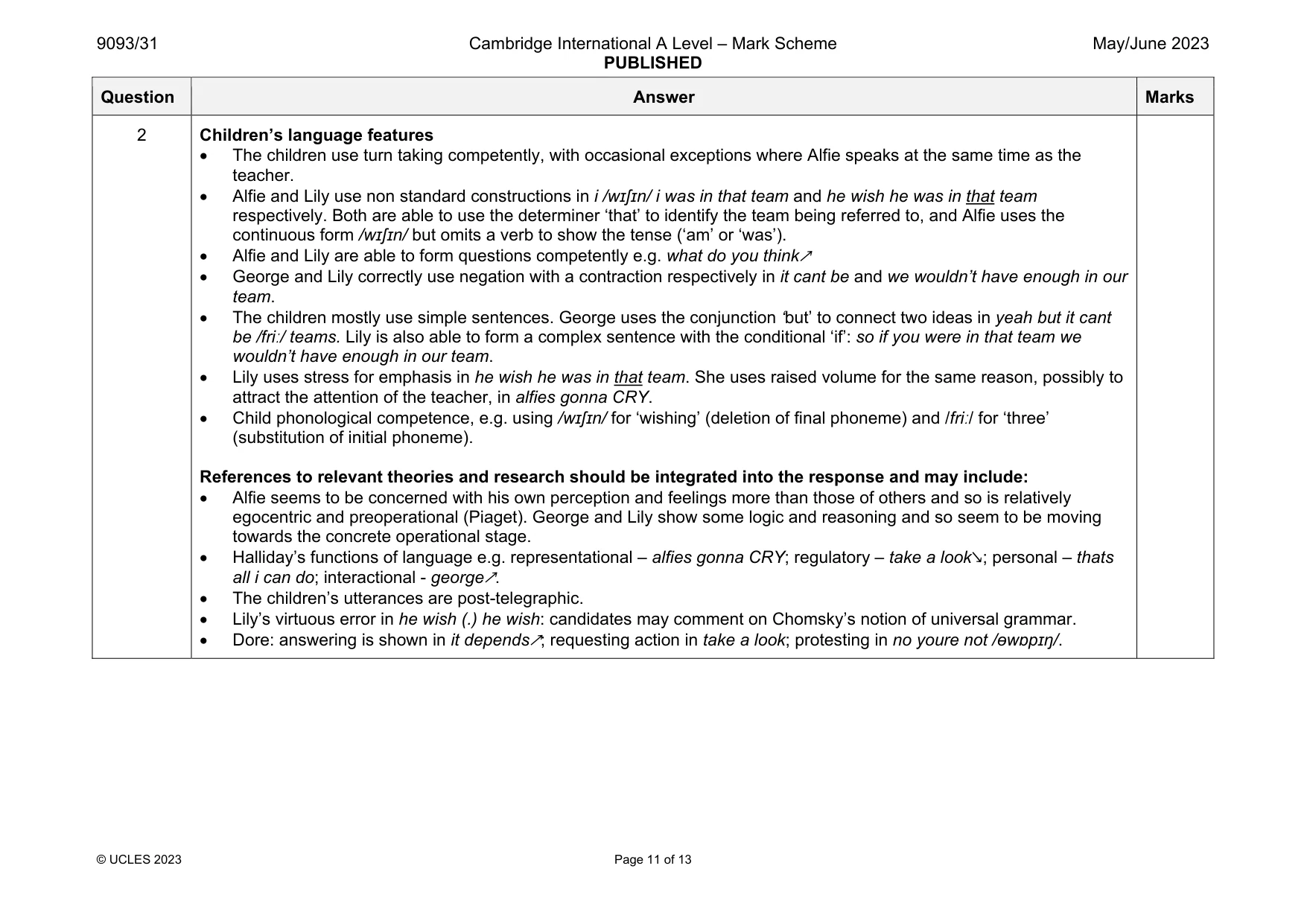
9093/31 Cambridge International A Level – Mark Scheme PUBLISHED May/June 2023 © UCLES 2023 Page 11 of 13 Question Answer Marks 2 Children’s language features The children use turn taking competently, with occasional exceptions where Alfie speaks at the same time as the teacher. Alfie and Lily use non standard constructions in i /wɪʃɪn/ i was in that team and he wish he was in that team respectively. Both are able to use the determiner ‘that’ to identify the team being referred to, and Alfie uses the continuous form /wɪʃɪn/ but omits a verb to show the tense (‘am’ or ‘was’). Alfie and Lily are able to form questions competently e.g. what do you think↗ George and Lily correctly use negation with a contraction respectively in it cant be and we wouldn’t have enough in our team. The children mostly use simple sentences. George uses the conjunction ‘but’ to connect two ideas in yeah but it cant be /friː/ teams. Lily is also able to form a complex sentence with the conditional ‘if’: so if you were in that team we wouldn’t have enough in our team. Lily uses stress for emphasis in he wish he was in that team. She uses raised volume for the same reason, possibly to attract the attention of the teacher, in alfies gonna CRY. Child phonological competence, e.g. using /wɪʃɪn/ for ‘wishing’ (deletion of final phoneme) and /friː/ for ‘three’ (substitution of initial phoneme). References to relevant theories and research should be integrated into the response and may include: Alfie seems to be concerned with his own perception and feelings more than those of others and so is relatively egocentric and preoperational (Piaget). George and Lily show some logic and reasoning and so seem to be moving towards the concrete operational stage. Halliday’s functions of language e.g. representational – alfies gonna CRY; regulatory – take a look↘; personal – thats all i can do; interactional - george↗. The children’s utterances are post-telegraphic. Lily’s virtuous error in he wish (.) he wish: candidates may comment on Chomsky’s notion of universal grammar. Dore: answering is shown in it depends↗; requesting action in take a look; protesting in no youre not /ɵwɒpɪŋ/.
Mark scheme, page 12
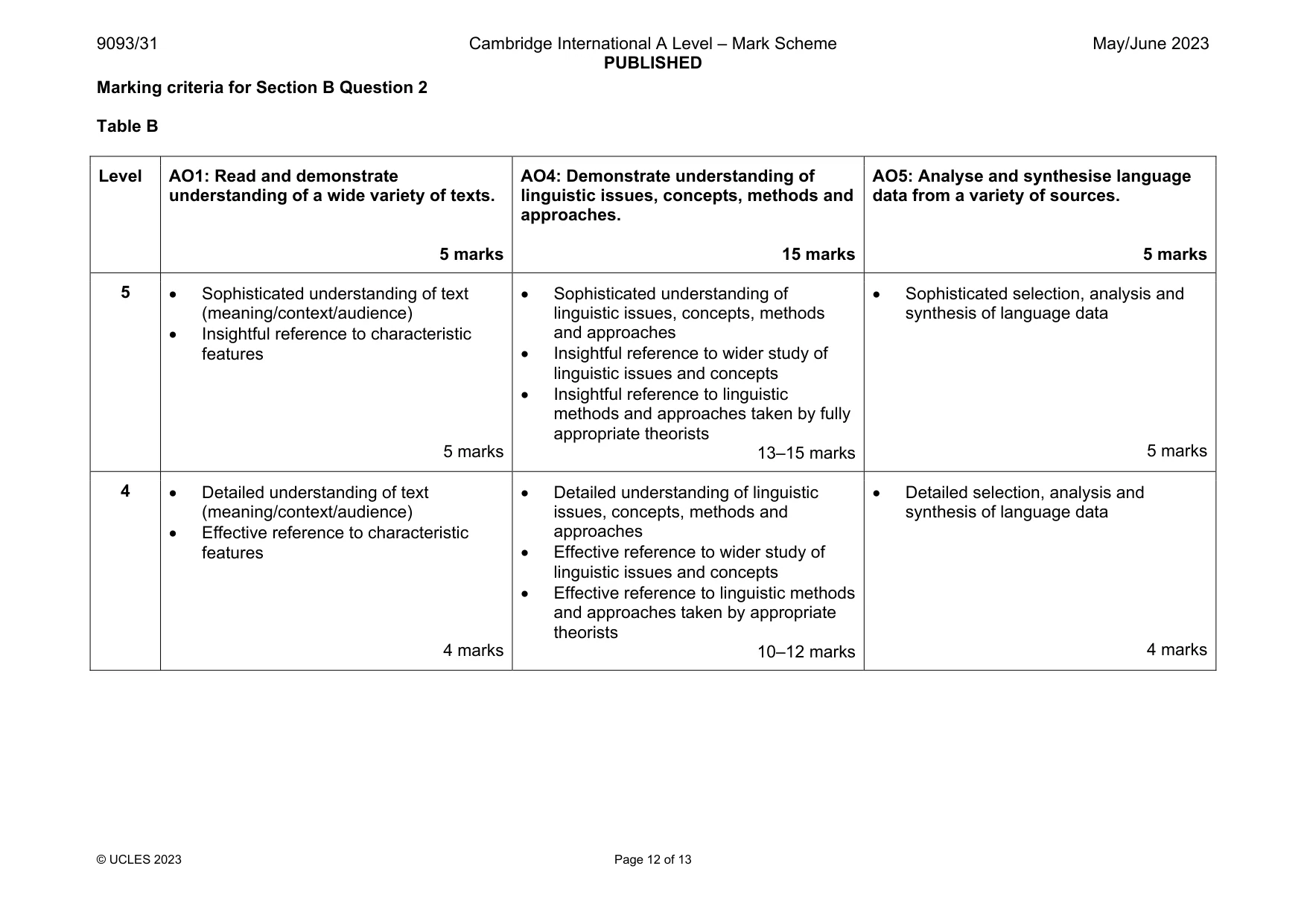
9093/31 Cambridge International A Level – Mark Scheme PUBLISHED May/June 2023 © UCLES 2023 Page 12 of 13 Marking criteria for Section B Question 2 Table B Level AO1: Read and demonstrate understanding of a wide variety of texts. 5 marks AO4: Demonstrate understanding of linguistic issues, concepts, methods and approaches. 15 marks AO5: Analyse and synthesise language data from a variety of sources. 5 marks 5 Sophisticated understanding of text (meaning/context/audience) Insightful reference to characteristic features 5 marks Sophisticated understanding of linguistic issues, concepts, methods and approaches Insightful reference to wider study of linguistic issues and concepts Insightful reference to linguistic methods and approaches taken by fully appropriate theorists 13–15 marks Sophisticated selection, analysis and synthesis of language data 5 marks 4 Detailed understanding of text (meaning/context/audience) Effective reference to characteristic features 4 marks Detailed understanding of linguistic issues, concepts, methods and approaches Effective reference to wider study of linguistic issues and concepts Effective reference to linguistic methods and approaches taken by appropriate theorists 10–12 marks Detailed selection, analysis and synthesis of language data 4 marks
Mark scheme, page 13
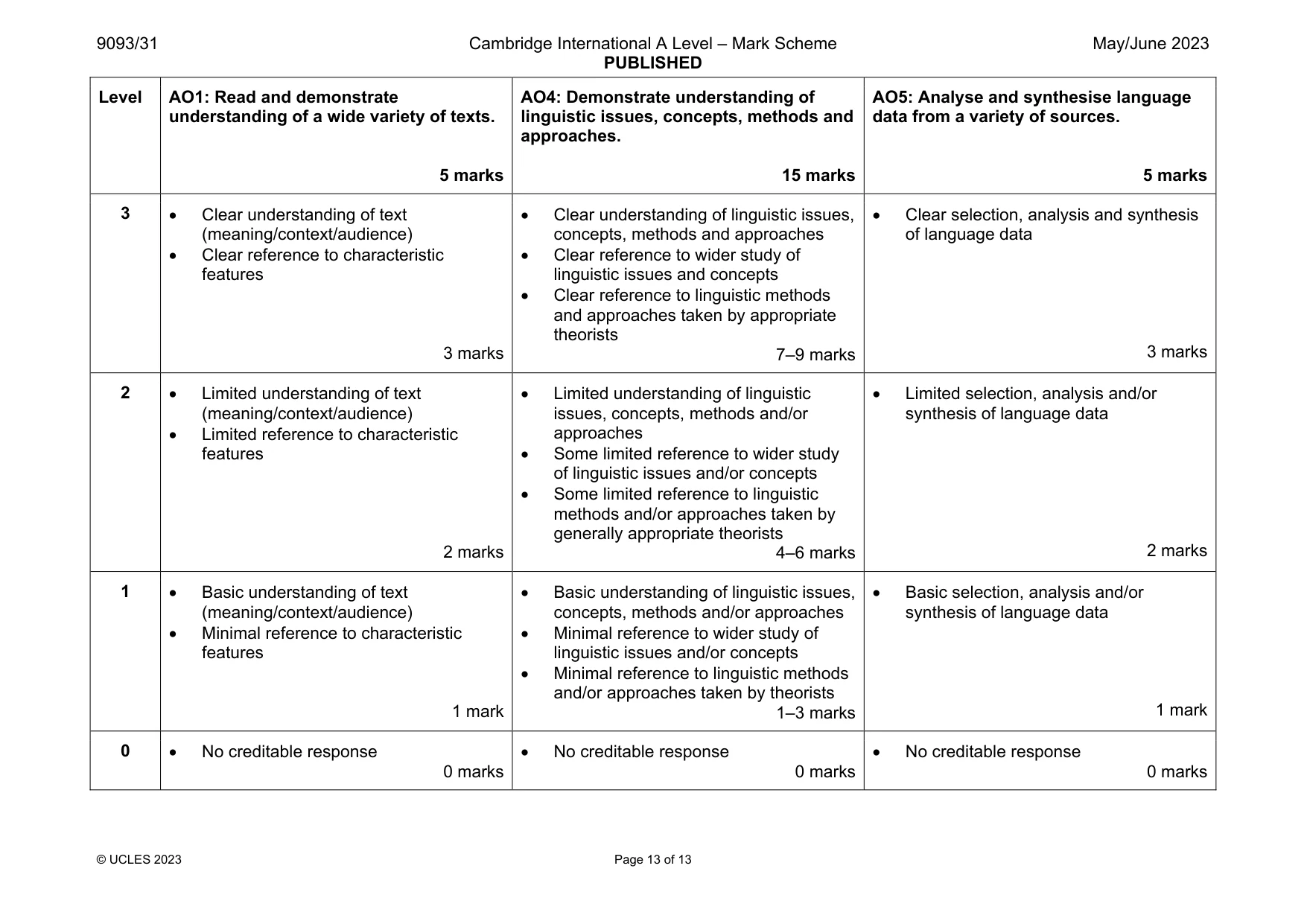
9093/31 Cambridge International A Level – Mark Scheme PUBLISHED May/June 2023 © UCLES 2023 Page 13 of 13 Level AO1: Read and demonstrate understanding of a wide variety of texts. 5 marks AO4: Demonstrate understanding of linguistic issues, concepts, methods and approaches. 15 marks AO5: Analyse and synthesise language data from a variety of sources. 5 marks 3 Clear understanding of text (meaning/context/audience) Clear reference to characteristic features 3 marks Clear understanding of linguistic issues, concepts, methods and approaches Clear reference to wider study of linguistic issues and concepts Clear reference to linguistic methods and approaches taken by appropriate theorists 7–9 marks Clear selection, analysis and synthesis of language data 3 marks 2 Limited understanding of text (meaning/context/audience) Limited reference to characteristic features 2 marks Limited understanding of linguistic issues, concepts, methods and/or approaches Some limited reference to wider study of linguistic issues and/or concepts Some limited reference to linguistic methods and/or approaches taken by generally appropriate theorists 4–6 marks Limited selection, analysis and/or synthesis of language data 2 marks 1 Basic understanding of text (meaning/context/audience) Minimal reference to characteristic features 1 mark Basic understanding of linguistic issues, concepts, methods and/or approaches Minimal reference to wider study of linguistic issues and/or concepts Minimal reference to linguistic methods and/or approaches taken by theorists 1–3 marks Basic selection, analysis and/or synthesis of language data 1 mark 0 No creditable response 0 marks No creditable response 0 marks No creditable response 0 marks
What you needed in this session
Cambridge’s own grade thresholds for 2023 May/June, Paper 3 · Variant 1. A higher threshold means an easier paper — the bar moves with how the cohort did.