Cambridge A Level English - Language AS and A Level (from 2014) 9093 — 2023 Oct/Nov Paper 3 · Variant 1
9093/31/O/N/23 · 50 marks · ≈56 min
The question paper and its mark scheme, free to read here and free to download. This is Cambridge’s own paper, exactly as it was sat.
Question paper8 pages

Mark scheme13 pages
Answers below. Sit the paper first if you are practising.
Paper as text
Question paper, page 1
This document has 8 pages. Any blank pages are indicated. [Turn over Cambridge International AS & A Level ENGLISH LANGUAGE 9093/31 Paper 3 Language Analysis October/November 2023 2 hours 15 minutes You must answer on the enclosed answer booklet. You will need: Answer booklet (enclosed) INSTRUCTIONS ● Answer all questions. ● Follow the instructions on the front cover of the answer booklet. If you need additional answer paper, ask the invigilator for a continuation booklet. ● Dictionaries are not allowed. INFORMATION ● The total mark for this paper is 50. ● The number of marks for each question or part question is shown in brackets [ ]. * 2 5 5 0 6 1 9 9 9 5 * DC (CE/CT) 331341 © UCLES 2023
Question paper, page 2
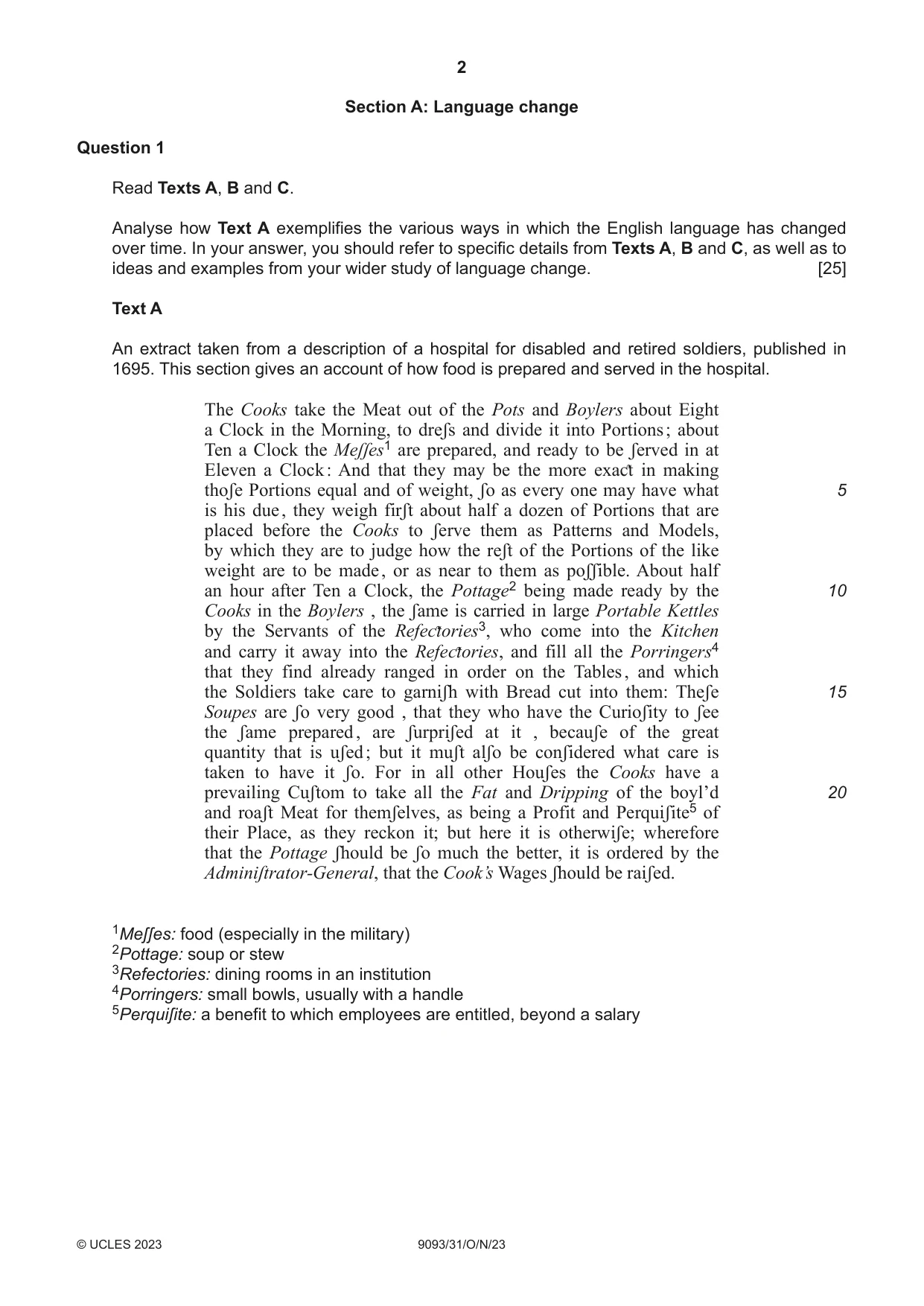
2 9093/31/O/N/23 © UCLES 2023 Section A: Language change Question 1 Read Texts A, B and C. Analyse how Text A exemplifies the various ways in which the English language has changed over time. In your answer, you should refer to specific details from Texts A, B and C, as well as to ideas and examples from your wider study of language change. [25] Text A An extract taken from a description of a hospital for disabled and retired soldiers, published in 1695. This section gives an account of how food is prepared and served in the hospital. The Cooks take the Meat out of the Pots and Boylers about Eight a Clock in the Morning, to dreʃs and divide it into Portions ; about Ten a Clock the Meʃʃes1 are prepared, and ready to be ʃerved in at Eleven a Clock : And that they may be the more exaƈt in making thoʃe Portions equal and of weight, ʃo as every one may have what is his due , they weigh firʃt about half a dozen of Portions that are placed before the Cooks to ʃerve them as Patterns and Models, by which they are to judge how the reʃt of the Portions of the like weight are to be made , or as near to them as poʃʃible. About half an hour after Ten a Clock, the Pottage2 being made ready by the Cooks in the Boylers , the ʃame is carried in large Portable Kettles by the Servants of the Refeƈtories3, who come into the Kitchen and carry it away into the Refeƈtories, and fill all the Porringers4 that they find already ranged in order on the Tables , and which the Soldiers take care to garniʃh with Bread cut into them: Theʃe Soupes are ʃo very good , that they who have the Curioʃity to ʃee the ʃame prepared , are ʃurpriʃed at it , becauʃe of the great quantity that is uʃed ; but it muʃt alʃo be conʃidered what care is taken to have it ʃo. For in all other Houʃes the Cooks have a prevailing Cuʃtom to take all the Fat and Dripping of the boyl’d and roaʃt Meat for themʃelves, as being a Profit and Perquiʃite5 of their Place, as they reckon it; but here it is otherwiʃe; wherefore that the Pottage ʃhould be ʃo much the better, it is ordered by the Adminiʃtrator-General, that the Cook’s Wages ʃhould be raiʃed. 1Meʃʃes: food (especially in the military) 2Pottage: soup or stew 3Refectories: dining rooms in an institution 4Porringers: small bowls, usually with a handle 5Perquiʃite: a benefit to which employees are entitled, beyond a salary 5 10 15 20
Question paper, page 3
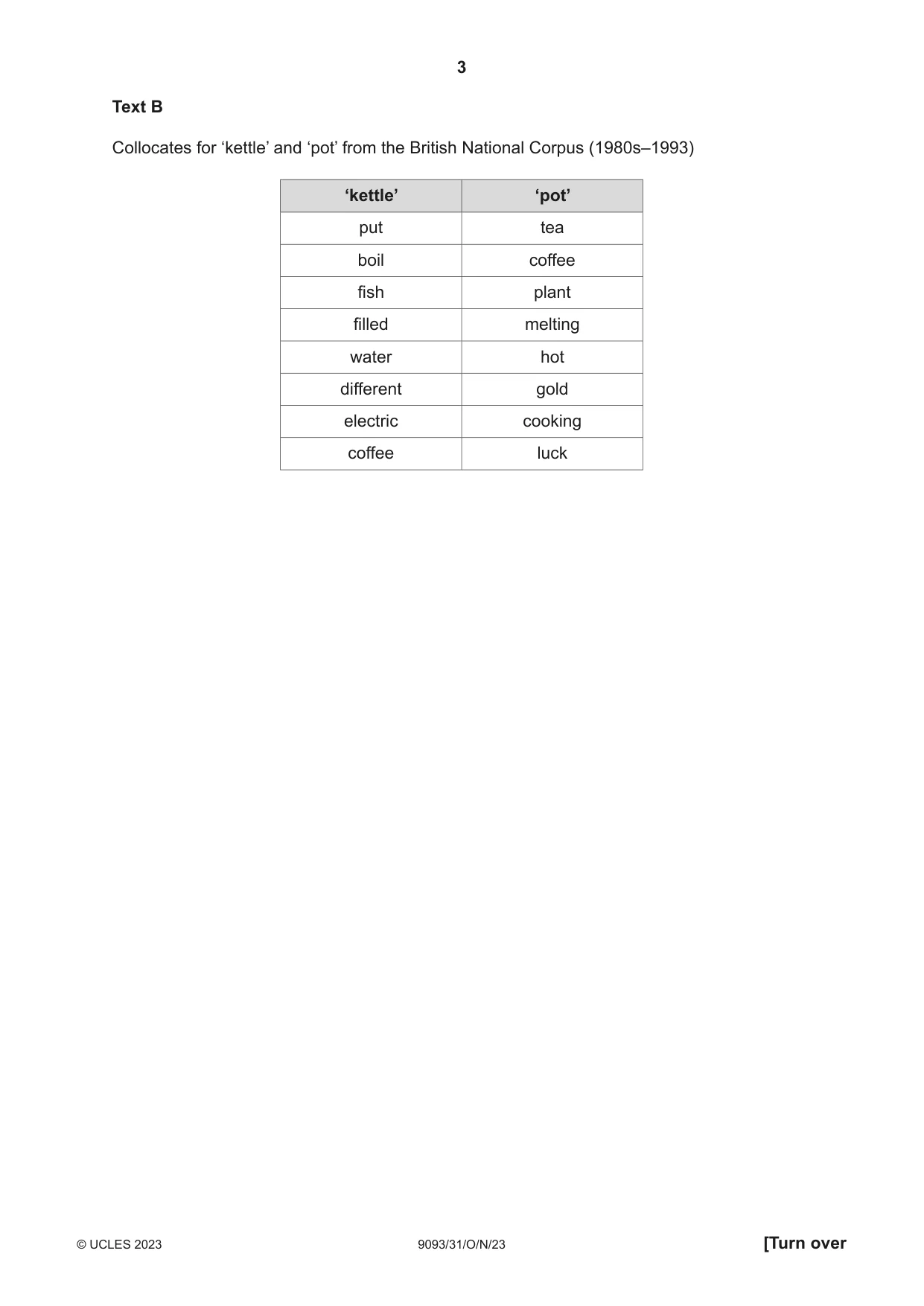
3 9093/31/O/N/23 © UCLES 2023 [Turn over Text B Collocates for ‘kettle’ and ‘pot’ from the British National Corpus (1980s–1993) ‘kettle’ ‘pot’ put tea boil coffee fish plant filled melting water hot different gold electric cooking coffee luck
Question paper, page 4
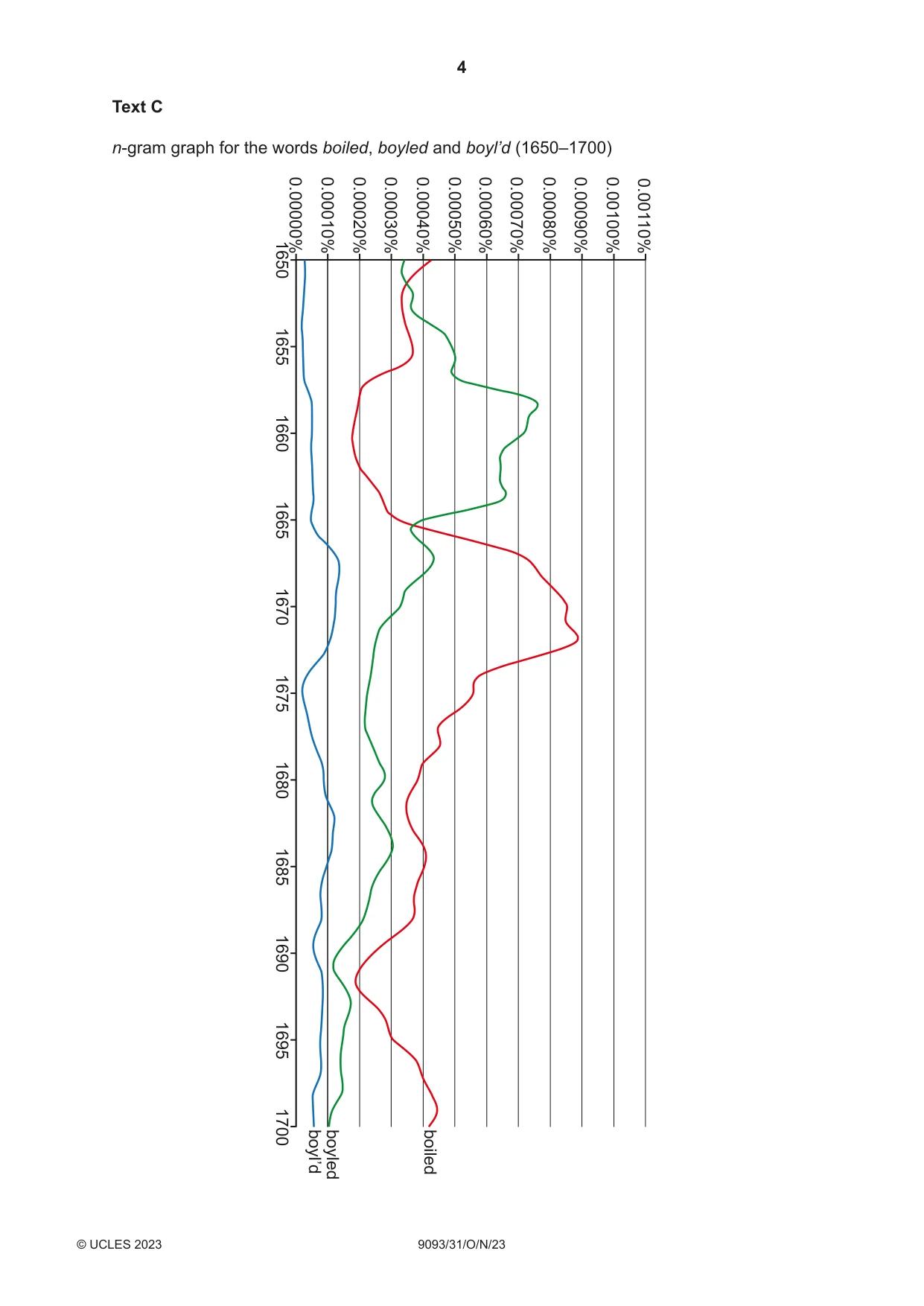
4 9093/31/O/N/23 © UCLES 2023 Text C n-gram graph for the words boiled, boyled and boyl’d (1650–1700) 0.00000% 0.00020% 0.00040% 0.00060% 0.00080% 0.00100% 1650 1655 1660 1665 1670 1675 1680 1685 1690 1695 1700 0.00010% 0.00030% 0.00050% 0.00070% 0.00090% 0.00110% boiled boyled boyl’d
Question paper, page 5
5 9093/31/O/N/23 © UCLES 2023 [Turn over BLANK PAGE
Question paper, page 6
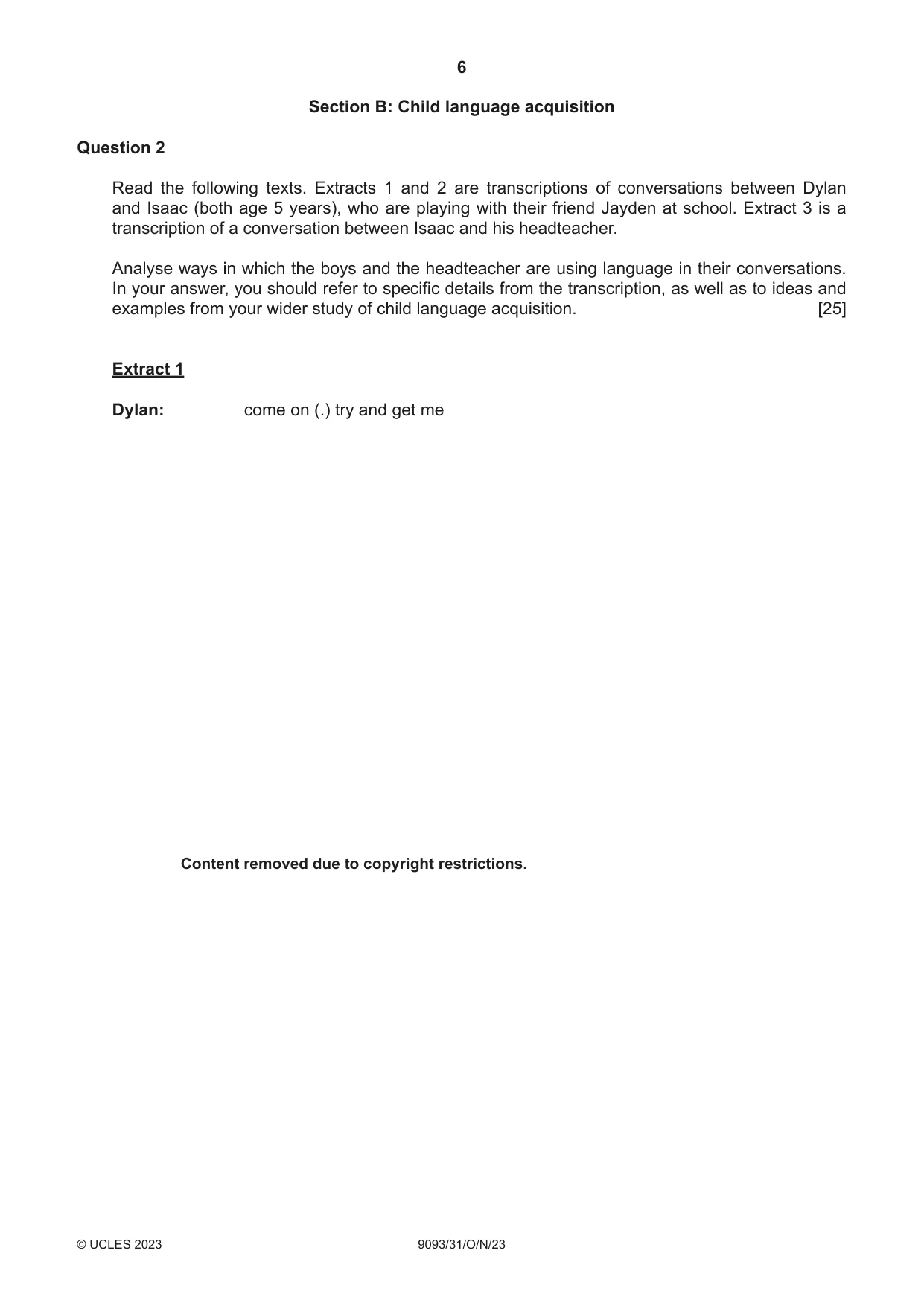
6 9093/31/O/N/23 © UCLES 2023 Section B: Child language acquisition Question 2 Read the following texts. Extracts 1 and 2 are transcriptions of conversations between Dylan and Isaac (both age 5 years), who are playing with their friend Jayden at school. Extract 3 is a transcription of a conversation between Isaac and his headteacher. Analyse ways in which the boys and the headteacher are using language in their conversations. In your answer, you should refer to specific details from the transcription, as well as to ideas and examples from your wider study of child language acquisition. [25] Extract 1 Dylan: come on (.) try and get me Content removed due to copyright restrictions.
Question paper, page 7
7 9093/31/O/N/23 © UCLES 2023 Headteacher: that would be nice isaac (.) id love that Content removed due to copyright restrictions.
Question paper, page 8
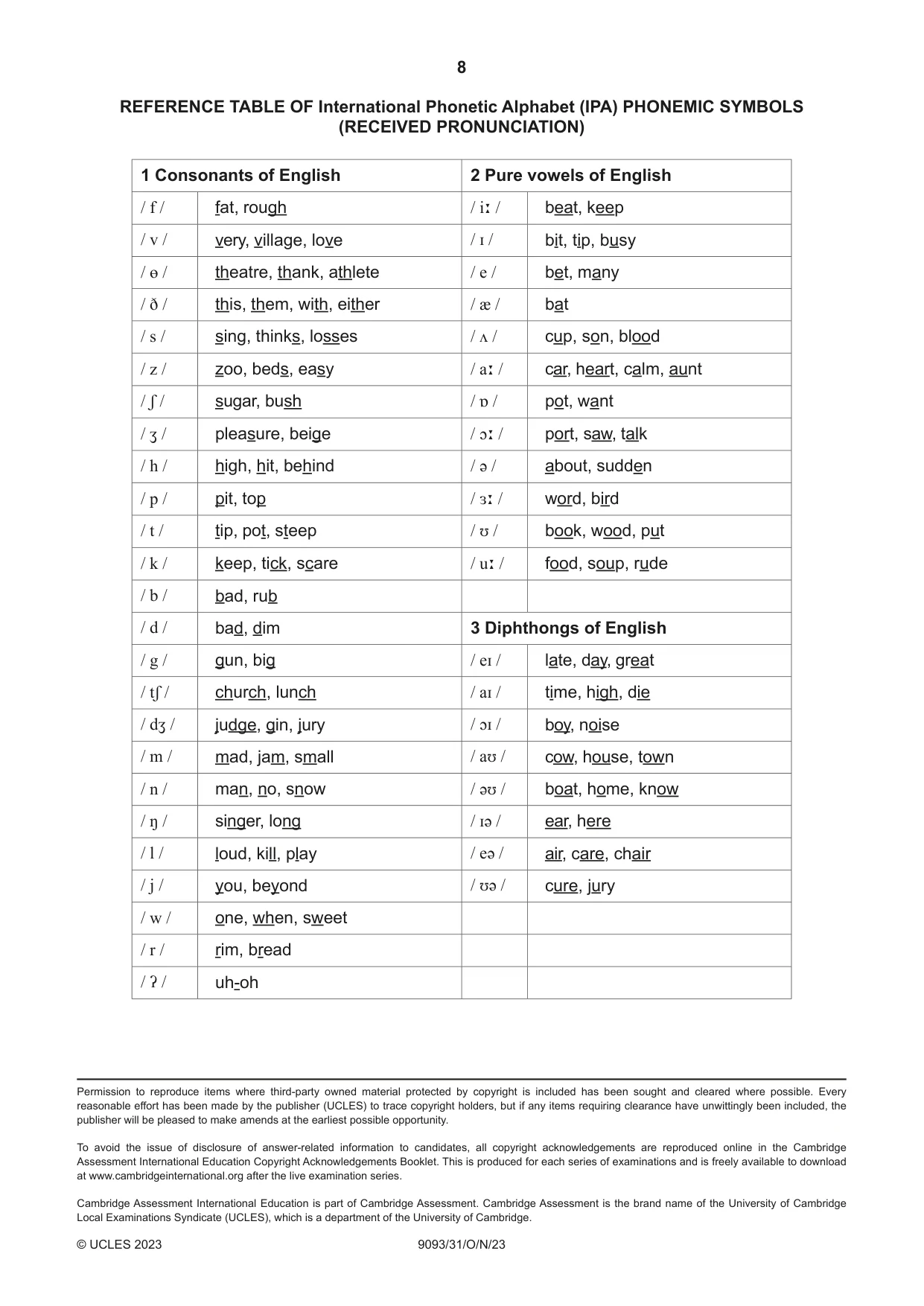
8 9093/31/O/N/23 © UCLES 2023 Permission to reproduce items where third-party owned material protected by copyright is included has been sought and cleared where possible. Every reasonable effort has been made by the publisher (UCLES) to trace copyright holders, but if any items requiring clearance have unwittingly been included, the publisher will be pleased to make amends at the earliest possible opportunity. To avoid the issue of disclosure of answer-related information to candidates, all copyright acknowledgements are reproduced online in the Cambridge Assessment International Education Copyright Acknowledgements Booklet. This is produced for each series of examinations and is freely available to download at www.cambridgeinternational.org after the live examination series. Cambridge Assessment International Education is part of Cambridge Assessment. Cambridge Assessment is the brand name of the University of Cambridge Local Examinations Syndicate (UCLES), which is a department of the University of Cambridge. REFERENCE TABLE OF International Phonetic Alphabet (IPA) PHONEMIC SYMBOLS (RECEIVED PRONUNCIATION) 1 Consonants of English 2 Pure vowels of English / f / fat, rough / iː / beat, keep / v / very, village, love / ɪ / bit, tip, busy / ɵ / theatre, thank, athlete / e / bet, many / ð / this, them, with, either / æ / bat / s / sing, thinks, losses / ʌ / cup, son, blood / z / zoo, beds, easy / aː / car, heart, calm, aunt / ʃ / sugar, bush / ɒ / pot, want / ʒ / pleasure, beige / ɔː / port, saw, talk / h / high, hit, behind / ə / about, sudden / p / pit, top / ɜː / word, bird / t / tip, pot, steep / ʊ / book, wood, put / k / keep, tick, scare / uː / food, soup, rude / b / bad, rub / d / bad, dim 3 Diphthongs of English / g / gun, big / eɪ / late, day, great / tʃ / church, lunch / aɪ / time, high, die / dʒ / judge, gin, jury / ɔɪ / boy, noise / m / mad, jam, small / aʊ / cow, house, town / n / man, no, snow / əʊ / boat, home, know / ŋ / singer, long / ɪə / ear, here / l / loud, kill, play / eə / air, care, chair / j / you, beyond / ʊə / cure, jury / w / one, when, sweet / r / rim, bread / ʔ / uh-oh
Mark scheme, page 1
This document consists of 13 printed pages. © UCLES 2023 [Turn over Cambridge International A Level ENGLISH LANGUAGE 9093/31 Paper 3 Language Analysis October/November 2023 MARK SCHEME Maximum Mark: 50 Published This mark scheme is published as an aid to teachers and candidates, to indicate the requirements of the examination. It shows the basis on which Examiners were instructed to award marks. It does not indicate the details of the discussions that took place at an Examiners’ meeting before marking began, which would have considered the acceptability of alternative answers. Mark schemes should be read in conjunction with the question paper and the Principal Examiner Report for Teachers. Cambridge International will not enter into discussions about these mark schemes. Cambridge International is publishing the mark schemes for the October/November 2023 series for most Cambridge IGCSE, Cambridge International A and AS Level components, and some Cambridge O Level components.
Mark scheme, page 2
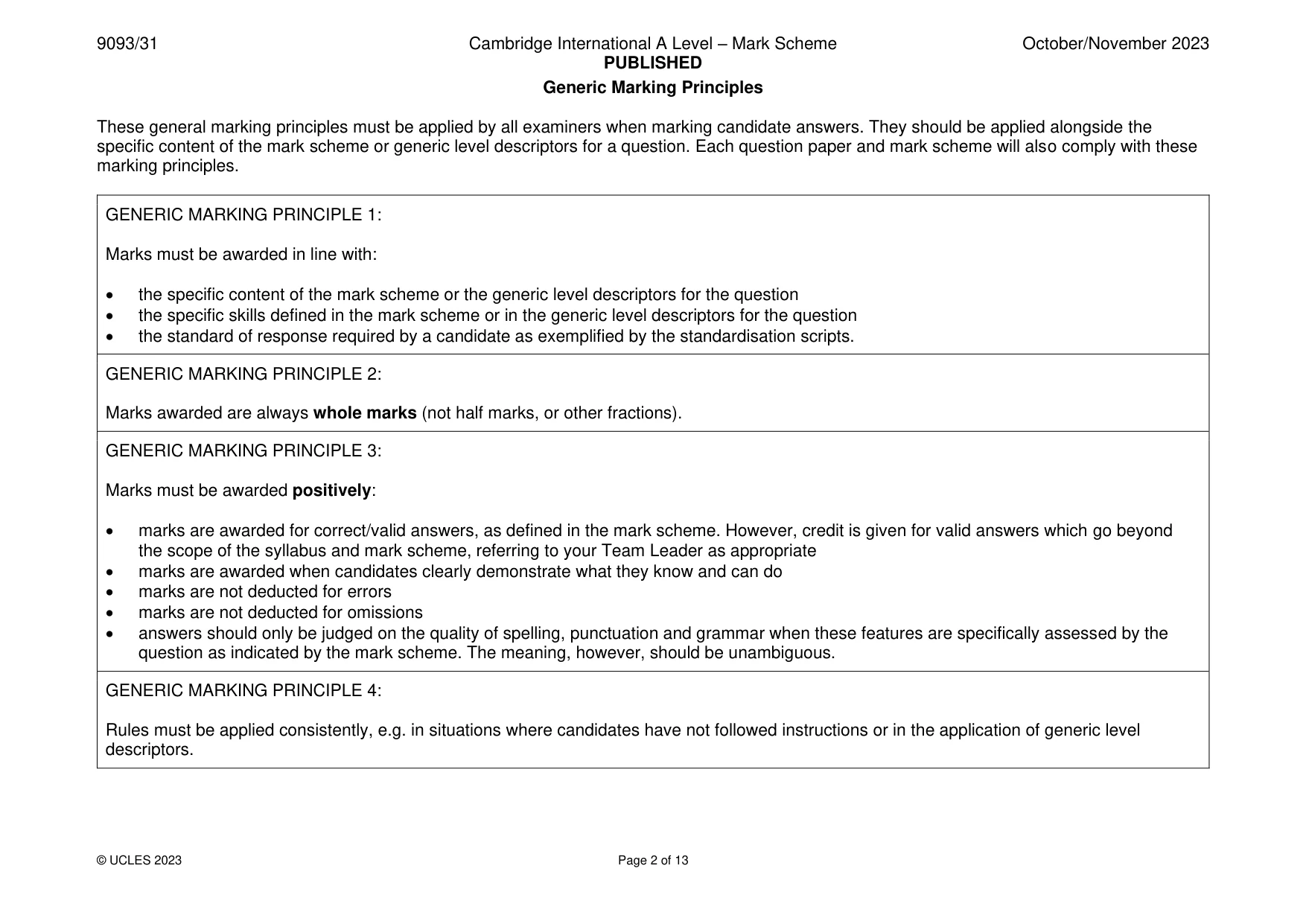
9093/31 Cambridge International A Level – Mark Scheme PUBLISHED October/November 2023 © UCLES 2023 Page 2 of 13 Generic Marking Principles These general marking principles must be applied by all examiners when marking candidate answers. They should be applied alongside the specific content of the mark scheme or generic level descriptors for a question. Each question paper and mark scheme will also comply with these marking principles. GENERIC MARKING PRINCIPLE 1: Marks must be awarded in line with: • the specific content of the mark scheme or the generic level descriptors for the question • the specific skills defined in the mark scheme or in the generic level descriptors for the question • the standard of response required by a candidate as exemplified by the standardisation scripts. GENERIC MARKING PRINCIPLE 2: Marks awarded are always whole marks (not half marks, or other fractions). GENERIC MARKING PRINCIPLE 3: Marks must be awarded positively: • marks are awarded for correct/valid answers, as defined in the mark scheme. However, credit is given for valid answers which go beyond the scope of the syllabus and mark scheme, referring to your Team Leader as appropriate • marks are awarded when candidates clearly demonstrate what they know and can do • marks are not deducted for errors • marks are not deducted for omissions • answers should only be judged on the quality of spelling, punctuation and grammar when these features are specifically assessed by the question as indicated by the mark scheme. The meaning, however, should be unambiguous. GENERIC MARKING PRINCIPLE 4: Rules must be applied consistently, e.g. in situations where candidates have not followed instructions or in the application of generic level descriptors.
Mark scheme, page 3
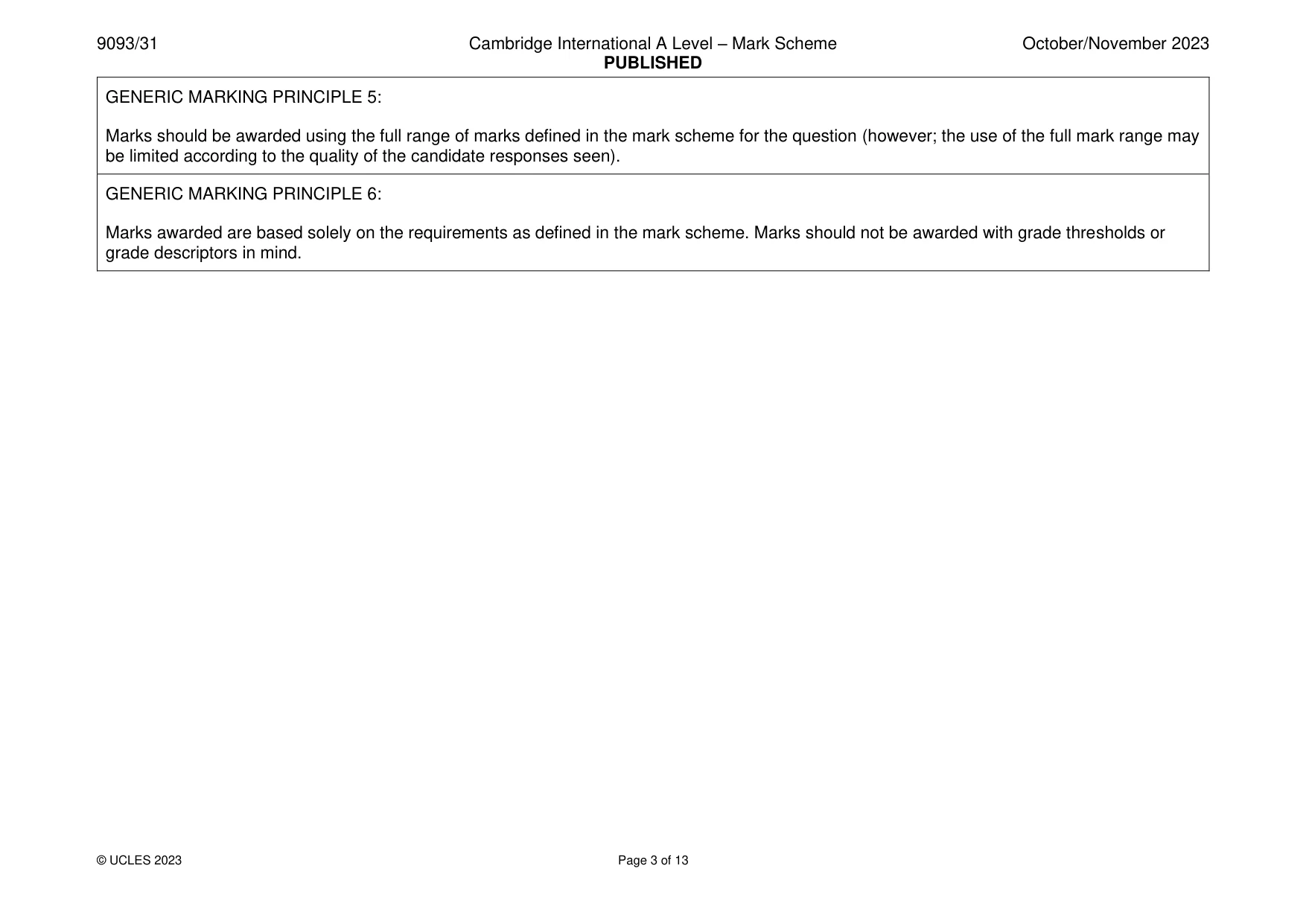
9093/31 Cambridge International A Level – Mark Scheme PUBLISHED October/November 2023 © UCLES 2023 Page 3 of 13 GENERIC MARKING PRINCIPLE 5: Marks should be awarded using the full range of marks defined in the mark scheme for the question (however; the use of the full mark range may be limited according to the quality of the candidate responses seen). GENERIC MARKING PRINCIPLE 6: Marks awarded are based solely on the requirements as defined in the mark scheme. Marks should not be awarded with grade thresholds or grade descriptors in mind.
Mark scheme, page 4
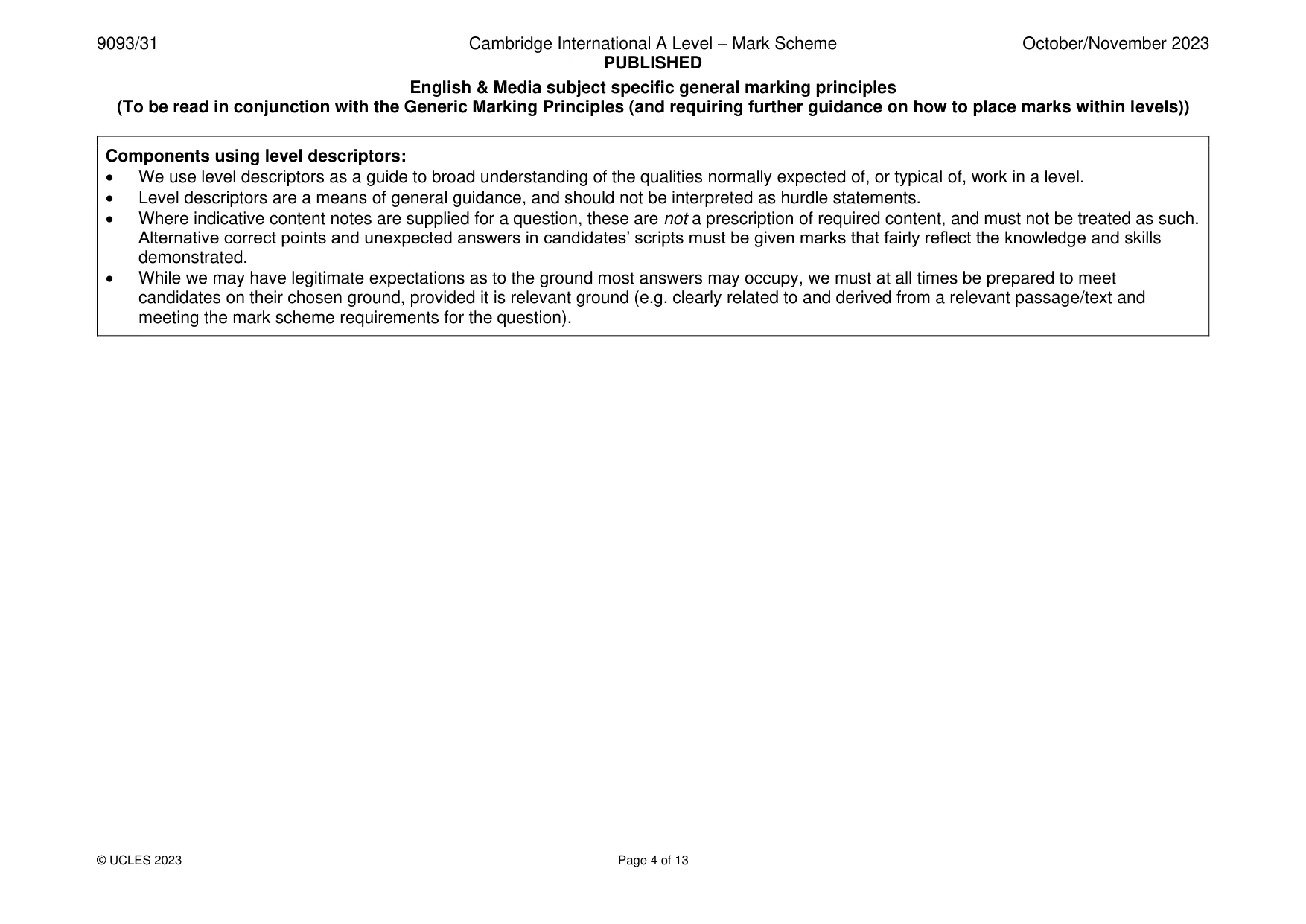
9093/31 Cambridge International A Level – Mark Scheme PUBLISHED October/November 2023 © UCLES 2023 Page 4 of 13 English & Media subject specific general marking principles (To be read in conjunction with the Generic Marking Principles (and requiring further guidance on how to place marks within levels)) Components using level descriptors: • We use level descriptors as a guide to broad understanding of the qualities normally expected of, or typical of, work in a level. • Level descriptors are a means of general guidance, and should not be interpreted as hurdle statements. • Where indicative content notes are supplied for a question, these are not a prescription of required content, and must not be treated as such. Alternative correct points and unexpected answers in candidates’ scripts must be given marks that fairly reflect the knowledge and skills demonstrated. • While we may have legitimate expectations as to the ground most answers may occupy, we must at all times be prepared to meet candidates on their chosen ground, provided it is relevant ground (e.g. clearly related to and derived from a relevant passage/text and meeting the mark scheme requirements for the question).
Mark scheme, page 5
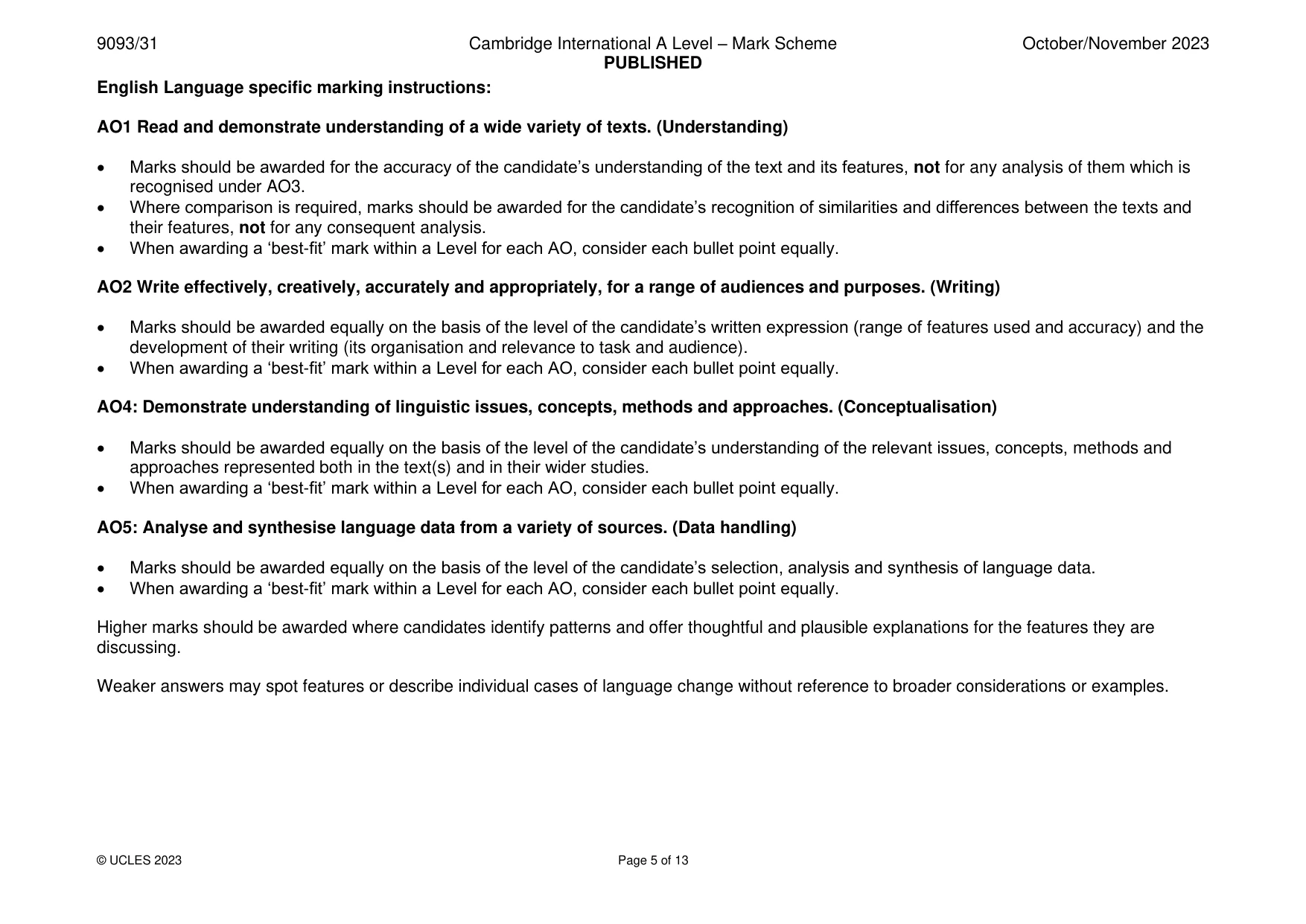
9093/31 Cambridge International A Level – Mark Scheme PUBLISHED October/November 2023 © UCLES 2023 Page 5 of 13 English Language specific marking instructions: AO1 Read and demonstrate understanding of a wide variety of texts. (Understanding) • Marks should be awarded for the accuracy of the candidate’s understanding of the text and its features, not for any analysis of them which is recognised under AO3. • Where comparison is required, marks should be awarded for the candidate’s recognition of similarities and differences between the texts and their features, not for any consequent analysis. • When awarding a ‘best-fit’ mark within a Level for each AO, consider each bullet point equally. AO2 Write effectively, creatively, accurately and appropriately, for a range of audiences and purposes. (Writing) • Marks should be awarded equally on the basis of the level of the candidate’s written expression (range of features used and accuracy) and the development of their writing (its organisation and relevance to task and audience). • When awarding a ‘best-fit’ mark within a Level for each AO, consider each bullet point equally. AO4: Demonstrate understanding of linguistic issues, concepts, methods and approaches. (Conceptualisation) • Marks should be awarded equally on the basis of the level of the candidate’s understanding of the relevant issues, concepts, methods and approaches represented both in the text(s) and in their wider studies. • When awarding a ‘best-fit’ mark within a Level for each AO, consider each bullet point equally. AO5: Analyse and synthesise language data from a variety of sources. (Data handling) • Marks should be awarded equally on the basis of the level of the candidate’s selection, analysis and synthesis of language data. • When awarding a ‘best-fit’ mark within a Level for each AO, consider each bullet point equally. Higher marks should be awarded where candidates identify patterns and offer thoughtful and plausible explanations for the features they are discussing. Weaker answers may spot features or describe individual cases of language change without reference to broader considerations or examples.
Mark scheme, page 6
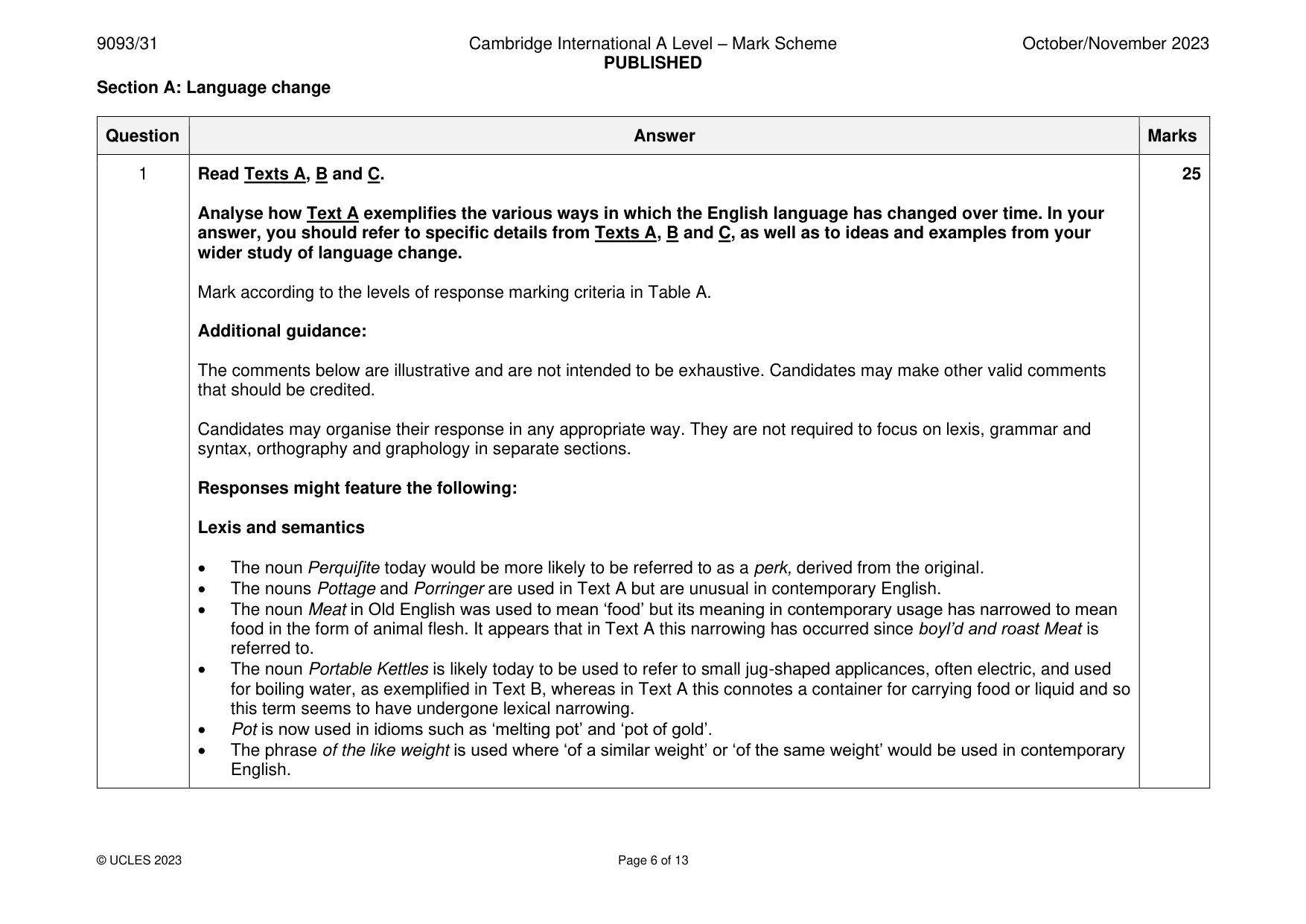
9093/31 Cambridge International A Level – Mark Scheme PUBLISHED October/November 2023 © UCLES 2023 Page 6 of 13 Section A: Language change Question Answer Marks 1 Read Texts A, B and C. Analyse how Text A exemplifies the various ways in which the English language has changed over time. In your answer, you should refer to specific details from Texts A, B and C, as well as to ideas and examples from your wider study of language change. Mark according to the levels of response marking criteria in Table A. Additional guidance: The comments below are illustrative and are not intended to be exhaustive. Candidates may make other valid comments that should be credited. Candidates may organise their response in any appropriate way. They are not required to focus on lexis, grammar and syntax, orthography and graphology in separate sections. Responses might feature the following: Lexis and semantics • The noun Perquiʃite today would be more likely to be referred to as a perk, derived from the original. • The nouns Pottage and Porringer are used in Text A but are unusual in contemporary English. • The noun Meat in Old English was used to mean ‘food’ but its meaning in contemporary usage has narrowed to mean food in the form of animal flesh. It appears that in Text A this narrowing has occurred since boyl’d and roast Meat is referred to. • The noun Portable Kettles is likely today to be used to refer to small jug-shaped applicances, often electric, and used for boiling water, as exemplified in Text B, whereas in Text A this connotes a container for carrying food or liquid and so this term seems to have undergone lexical narrowing. • Pot is now used in idioms such as ‘melting pot’ and ‘pot of gold’. • The phrase of the like weight is used where ‘of a similar weight’ or ‘of the same weight’ would be used in contemporary English. 25
Mark scheme, page 7
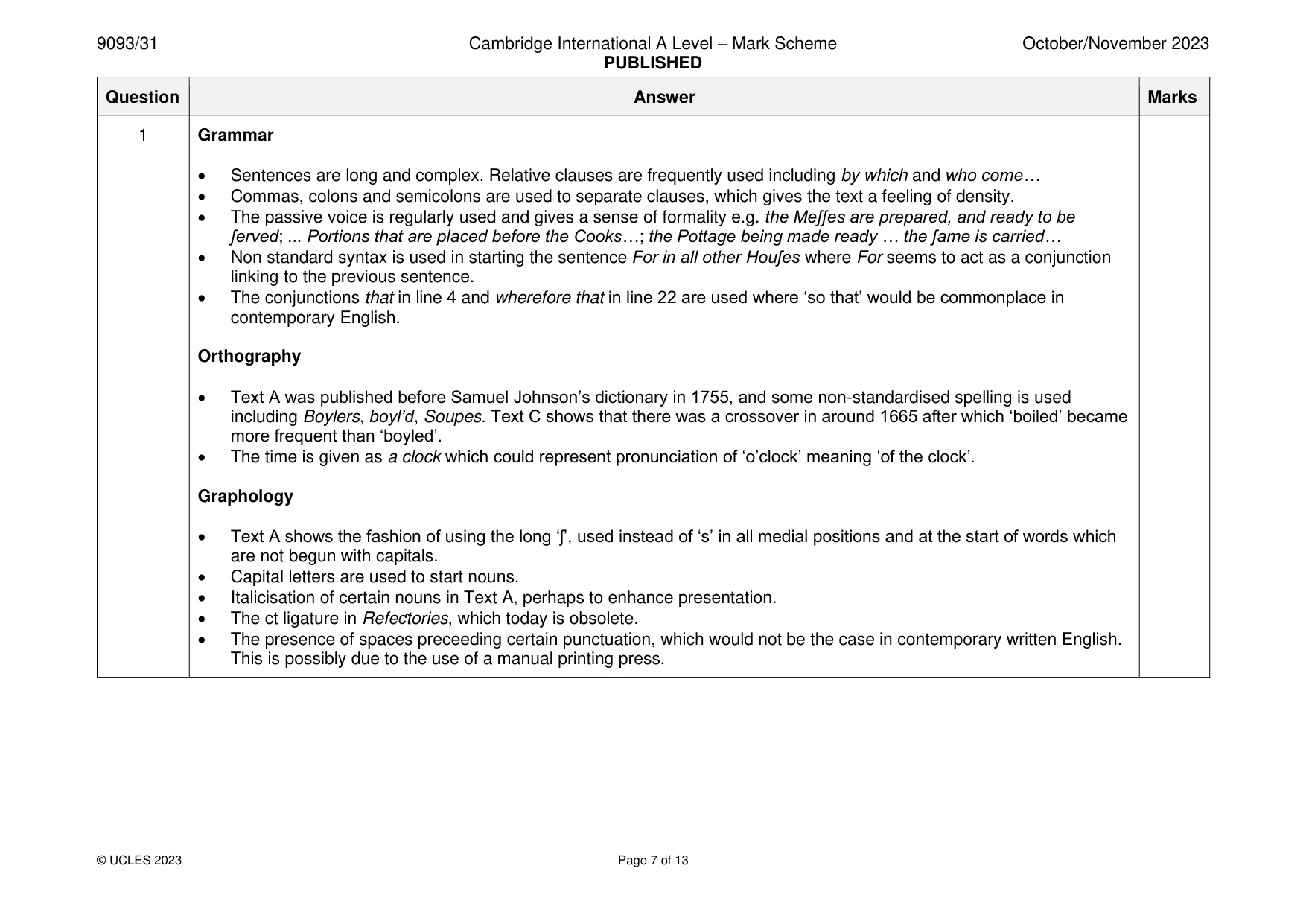
9093/31 Cambridge International A Level – Mark Scheme PUBLISHED October/November 2023 © UCLES 2023 Page 7 of 13 Question Answer Marks 1 Grammar • Sentences are long and complex. Relative clauses are frequently used including by which and who come… • Commas, colons and semicolons are used to separate clauses, which gives the text a feeling of density. • The passive voice is regularly used and gives a sense of formality e.g. the Meʃʃes are prepared, and ready to be ʃerved; ... Portions that are placed before the Cooks…; the Pottage being made ready … the ʃame is carried… • Non standard syntax is used in starting the sentence For in all other Houʃes where For seems to act as a conjunction linking to the previous sentence. • The conjunctions that in line 4 and wherefore that in line 22 are used where ‘so that’ would be commonplace in contemporary English. Orthography • Text A was published before Samuel Johnson’s dictionary in 1755, and some non-standardised spelling is used including Boylers, boyl’d, Soupes. Text C shows that there was a crossover in around 1665 after which ‘boiled’ became more frequent than ‘boyled’. • The time is given as a clock which could represent pronunciation of ‘o’clock’ meaning ‘of the clock’. Graphology • Text A shows the fashion of using the long ‘ʃ’, used instead of ‘s’ in all medial positions and at the start of words which are not begun with capitals. • Capital letters are used to start nouns. • Italicisation of certain nouns in Text A, perhaps to enhance presentation. • The ct ligature in Refeƈtories, which today is obsolete. • The presence of spaces preceeding certain punctuation, which would not be the case in contemporary written English. This is possibly due to the use of a manual printing press.
Mark scheme, page 8
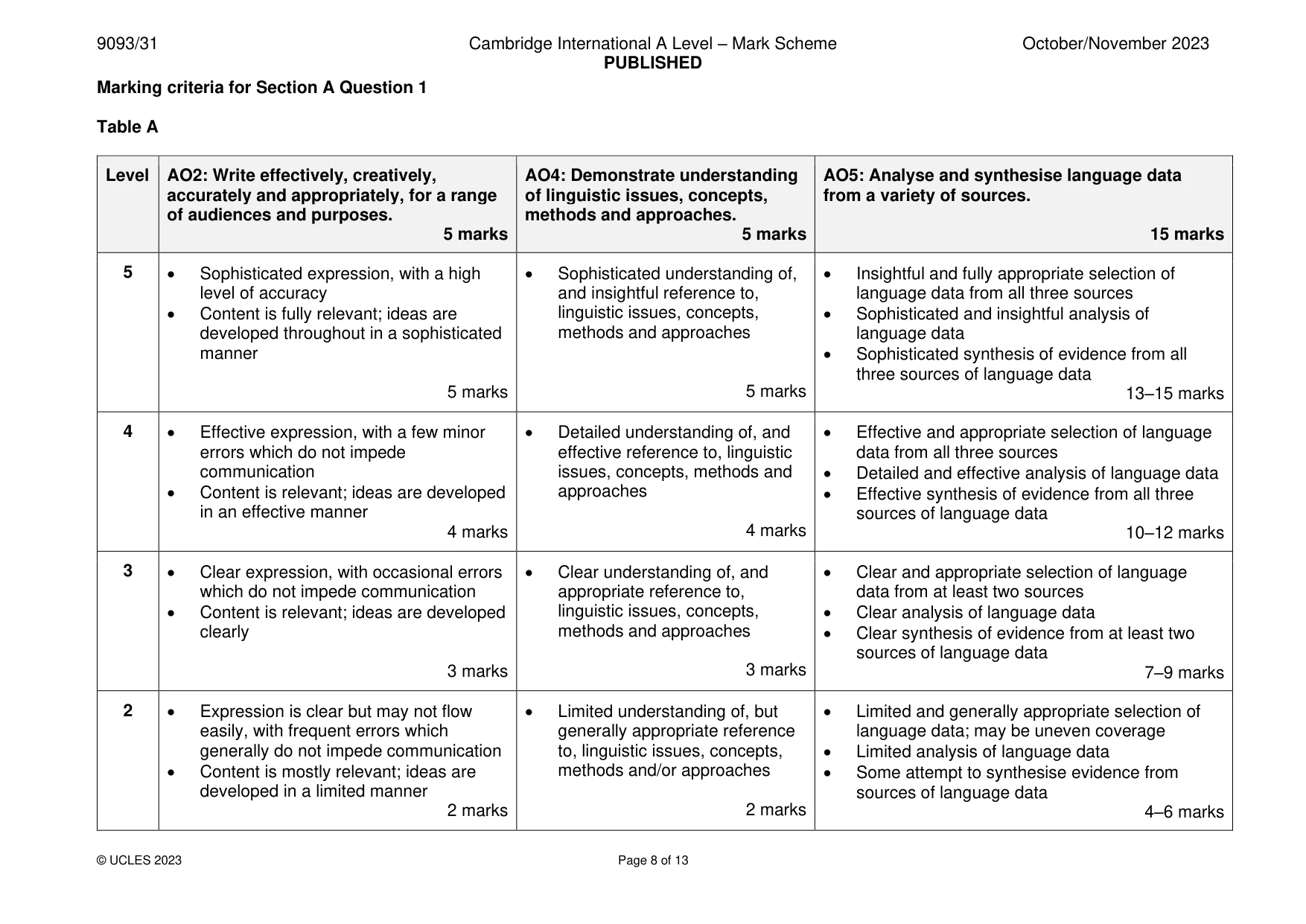
9093/31 Cambridge International A Level – Mark Scheme PUBLISHED October/November 2023 © UCLES 2023 Page 8 of 13 Marking criteria for Section A Question 1 Table A Level AO2: Write effectively, creatively, accurately and appropriately, for a range of audiences and purposes. 5 marks AO4: Demonstrate understanding of linguistic issues, concepts, methods and approaches. 5 marks AO5: Analyse and synthesise language data from a variety of sources. 15 marks 5 • Sophisticated expression, with a high level of accuracy • Content is fully relevant; ideas are developed throughout in a sophisticated manner 5 marks • Sophisticated understanding of, and insightful reference to, linguistic issues, concepts, methods and approaches 5 marks • Insightful and fully appropriate selection of language data from all three sources • Sophisticated and insightful analysis of language data • Sophisticated synthesis of evidence from all three sources of language data 13–15 marks 4 • Effective expression, with a few minor errors which do not impede communication • Content is relevant; ideas are developed in an effective manner 4 marks • Detailed understanding of, and effective reference to, linguistic issues, concepts, methods and approaches 4 marks • Effective and appropriate selection of language data from all three sources • Detailed and effective analysis of language data • Effective synthesis of evidence from all three sources of language data 10–12 marks 3 • Clear expression, with occasional errors which do not impede communication • Content is relevant; ideas are developed clearly 3 marks • Clear understanding of, and appropriate reference to, linguistic issues, concepts, methods and approaches 3 marks • Clear and appropriate selection of language data from at least two sources • Clear analysis of language data • Clear synthesis of evidence from at least two sources of language data 7–9 marks 2 • Expression is clear but may not flow easily, with frequent errors which generally do not impede communication • Content is mostly relevant; ideas are developed in a limited manner 2 marks • Limited understanding of, but generally appropriate reference to, linguistic issues, concepts, methods and/or approaches 2 marks • Limited and generally appropriate selection of language data; may be uneven coverage • Limited analysis of language data • Some attempt to synthesise evidence from sources of language data 4–6 marks
Mark scheme, page 9
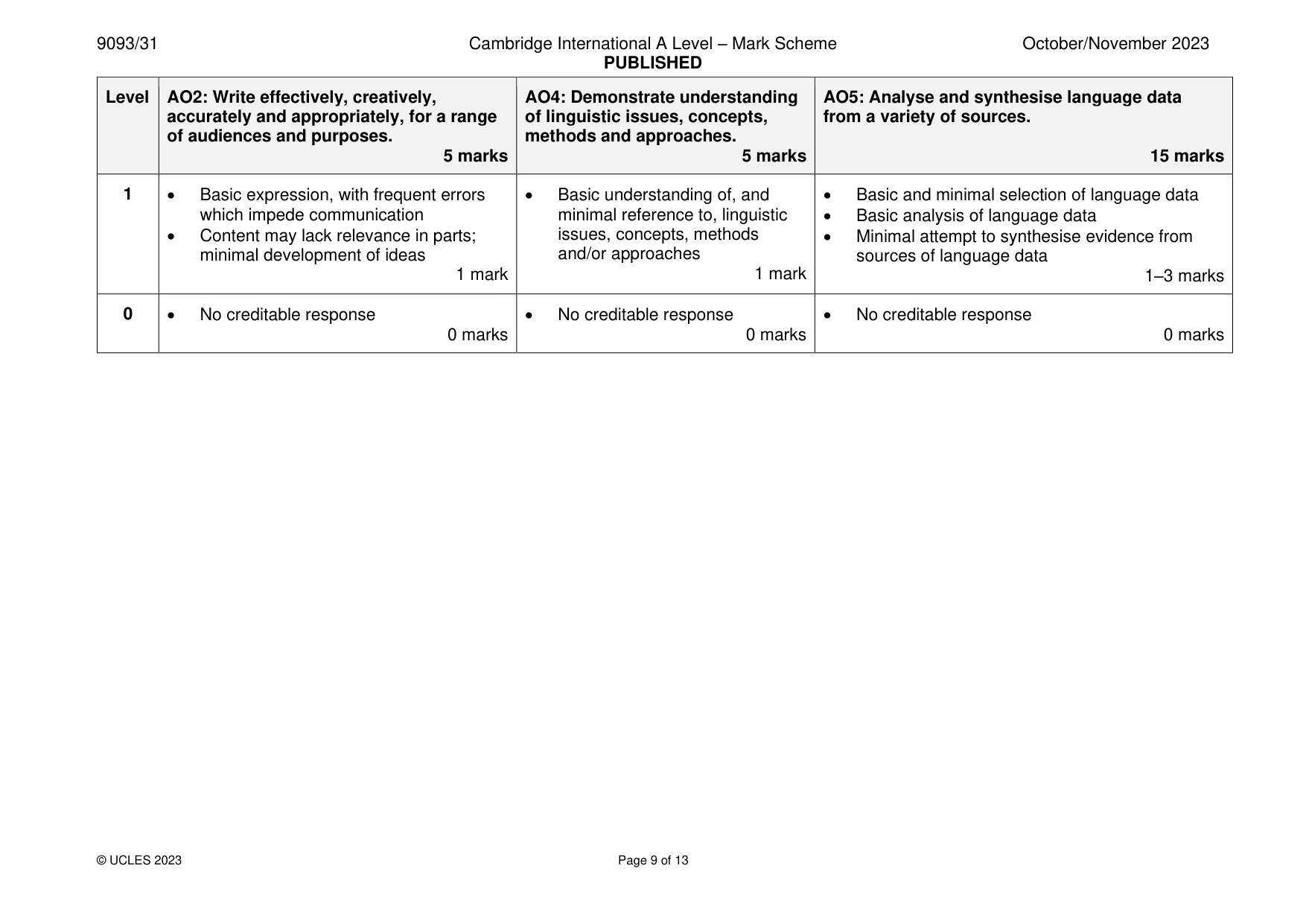
9093/31 Cambridge International A Level – Mark Scheme PUBLISHED October/November 2023 © UCLES 2023 Page 9 of 13 Level AO2: Write effectively, creatively, accurately and appropriately, for a range of audiences and purposes. 5 marks AO4: Demonstrate understanding of linguistic issues, concepts, methods and approaches. 5 marks AO5: Analyse and synthesise language data from a variety of sources. 15 marks 1 • Basic expression, with frequent errors which impede communication • Content may lack relevance in parts; minimal development of ideas 1 mark • Basic understanding of, and minimal reference to, linguistic issues, concepts, methods and/or approaches 1 mark • Basic and minimal selection of language data • Basic analysis of language data • Minimal attempt to synthesise evidence from sources of language data 1–3 marks 0 • No creditable response 0 marks • No creditable response 0 marks • No creditable response 0 marks
Mark scheme, page 10
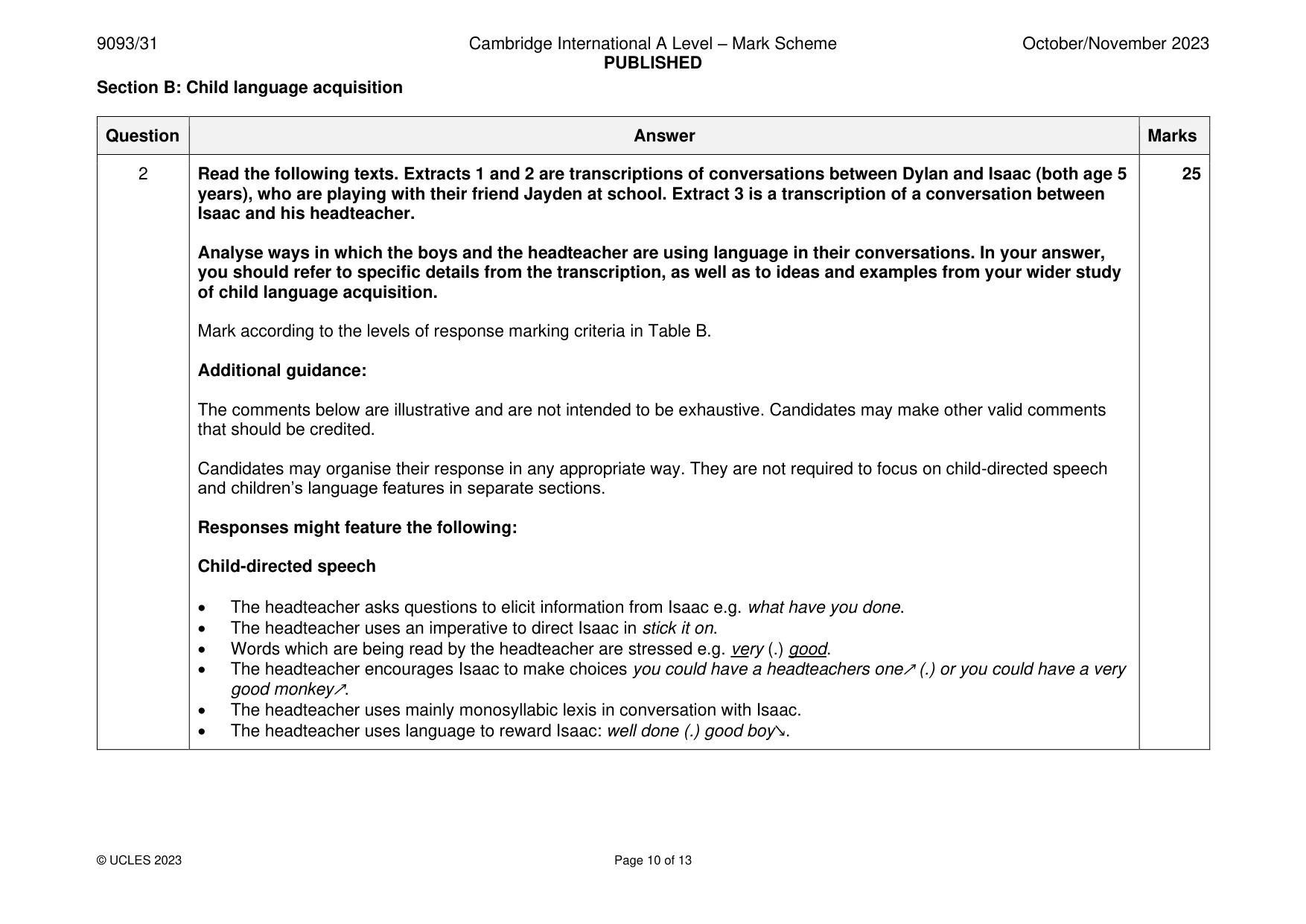
9093/31 Cambridge International A Level – Mark Scheme PUBLISHED October/November 2023 © UCLES 2023 Page 10 of 13 Section B: Child language acquisition Question Answer Marks 2 Read the following texts. Extracts 1 and 2 are transcriptions of conversations between Dylan and Isaac (both age 5 years), who are playing with their friend Jayden at school. Extract 3 is a transcription of a conversation between Isaac and his headteacher. Analyse ways in which the boys and the headteacher are using language in their conversations. In your answer, you should refer to specific details from the transcription, as well as to ideas and examples from your wider study of child language acquisition. Mark according to the levels of response marking criteria in Table B. Additional guidance: The comments below are illustrative and are not intended to be exhaustive. Candidates may make other valid comments that should be credited. Candidates may organise their response in any appropriate way. They are not required to focus on child-directed speech and children’s language features in separate sections. Responses might feature the following: Child-directed speech • The headteacher asks questions to elicit information from Isaac e.g. what have you done. • The headteacher uses an imperative to direct Isaac in stick it on. • Words which are being read by the headteacher are stressed e.g. very (.) good. • The headteacher encourages Isaac to make choices you could have a headteachers one↗ (.) or you could have a very good monkey↗. • The headteacher uses mainly monosyllabic lexis in conversation with Isaac. • The headteacher uses language to reward Isaac: well done (.) good boy↘. 25
Mark scheme, page 11
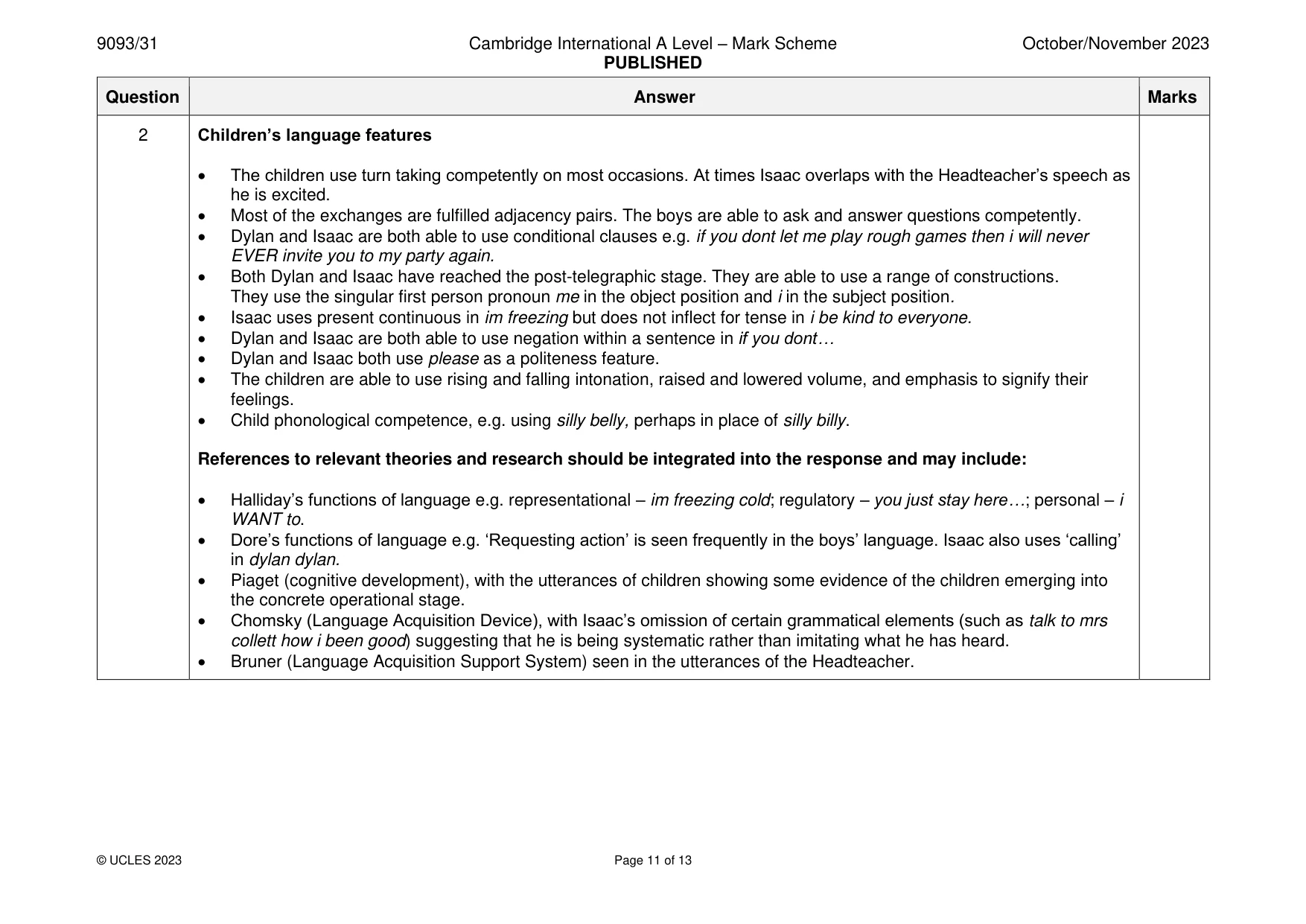
9093/31 Cambridge International A Level – Mark Scheme PUBLISHED October/November 2023 © UCLES 2023 Page 11 of 13 Question Answer Marks 2 Children’s language features • The children use turn taking competently on most occasions. At times Isaac overlaps with the Headteacher’s speech as he is excited. • Most of the exchanges are fulfilled adjacency pairs. The boys are able to ask and answer questions competently. • Dylan and Isaac are both able to use conditional clauses e.g. if you dont let me play rough games then i will never EVER invite you to my party again. • Both Dylan and Isaac have reached the post-telegraphic stage. They are able to use a range of constructions. They use the singular first person pronoun me in the object position and i in the subject position. • Isaac uses present continuous in im freezing but does not inflect for tense in i be kind to everyone. • Dylan and Isaac are both able to use negation within a sentence in if you dont… • Dylan and Isaac both use please as a politeness feature. • The children are able to use rising and falling intonation, raised and lowered volume, and emphasis to signify their feelings. • Child phonological competence, e.g. using silly belly, perhaps in place of silly billy. References to relevant theories and research should be integrated into the response and may include: • Halliday’s functions of language e.g. representational – im freezing cold; regulatory – you just stay here…; personal – i WANT to. • Dore’s functions of language e.g. ‘Requesting action’ is seen frequently in the boys’ language. Isaac also uses ‘calling’ in dylan dylan. • Piaget (cognitive development), with the utterances of children showing some evidence of the children emerging into the concrete operational stage. • Chomsky (Language Acquisition Device), with Isaac’s omission of certain grammatical elements (such as talk to mrs collett how i been good) suggesting that he is being systematic rather than imitating what he has heard. • Bruner (Language Acquisition Support System) seen in the utterances of the Headteacher.
Mark scheme, page 12
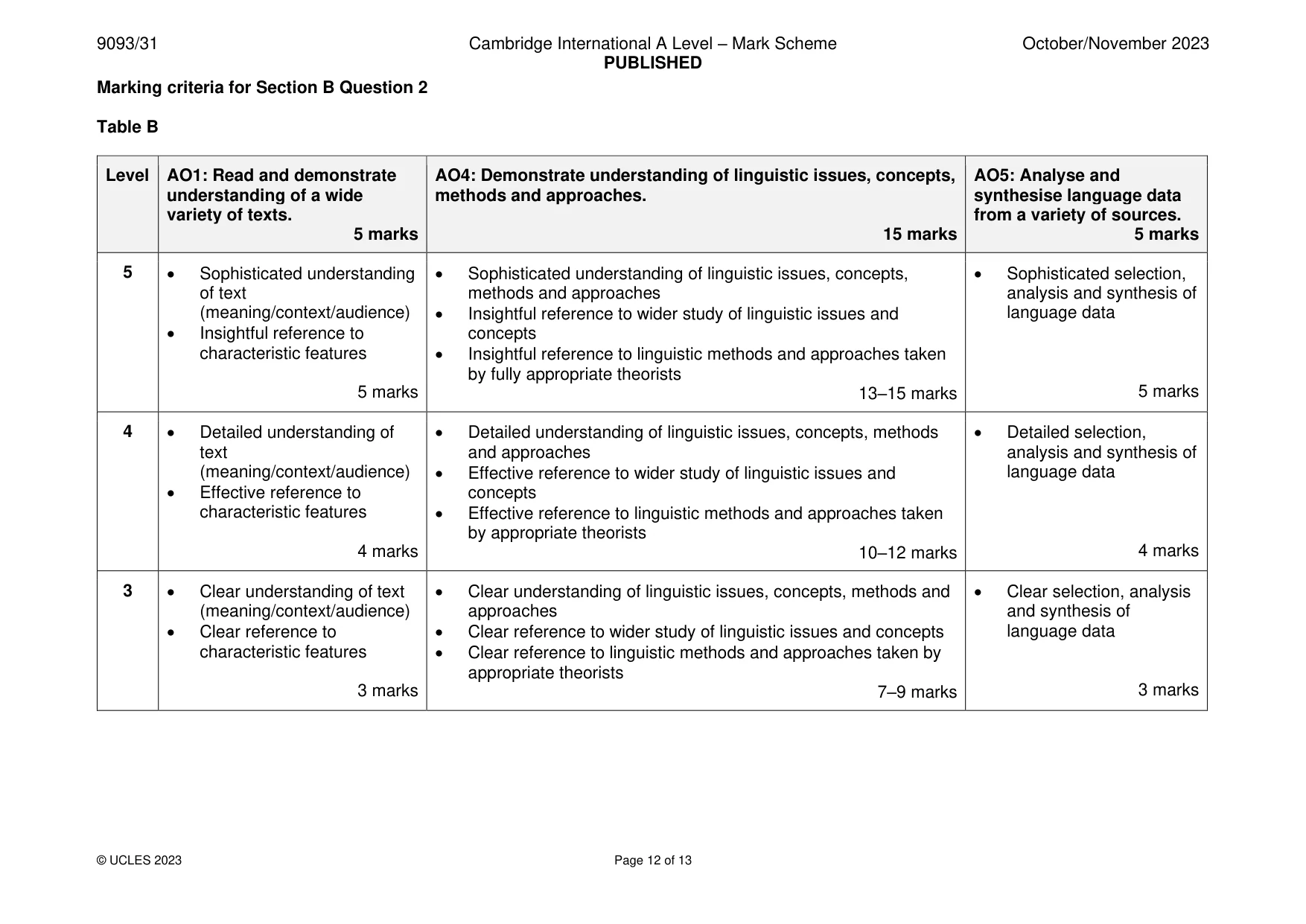
9093/31 Cambridge International A Level – Mark Scheme PUBLISHED October/November 2023 © UCLES 2023 Page 12 of 13 Marking criteria for Section B Question 2 Table B Level AO1: Read and demonstrate understanding of a wide variety of texts. 5 marks AO4: Demonstrate understanding of linguistic issues, concepts, methods and approaches. 15 marks AO5: Analyse and synthesise language data from a variety of sources. 5 marks 5 • Sophisticated understanding of text (meaning/context/audience) • Insightful reference to characteristic features 5 marks • Sophisticated understanding of linguistic issues, concepts, methods and approaches • Insightful reference to wider study of linguistic issues and concepts • Insightful reference to linguistic methods and approaches taken by fully appropriate theorists 13–15 marks • Sophisticated selection, analysis and synthesis of language data 5 marks 4 • Detailed understanding of text (meaning/context/audience) • Effective reference to characteristic features 4 marks • Detailed understanding of linguistic issues, concepts, methods and approaches • Effective reference to wider study of linguistic issues and concepts • Effective reference to linguistic methods and approaches taken by appropriate theorists 10–12 marks • Detailed selection, analysis and synthesis of language data 4 marks 3 • Clear understanding of text (meaning/context/audience) • Clear reference to characteristic features 3 marks • Clear understanding of linguistic issues, concepts, methods and approaches • Clear reference to wider study of linguistic issues and concepts • Clear reference to linguistic methods and approaches taken by appropriate theorists 7–9 marks • Clear selection, analysis and synthesis of language data 3 marks
Mark scheme, page 13
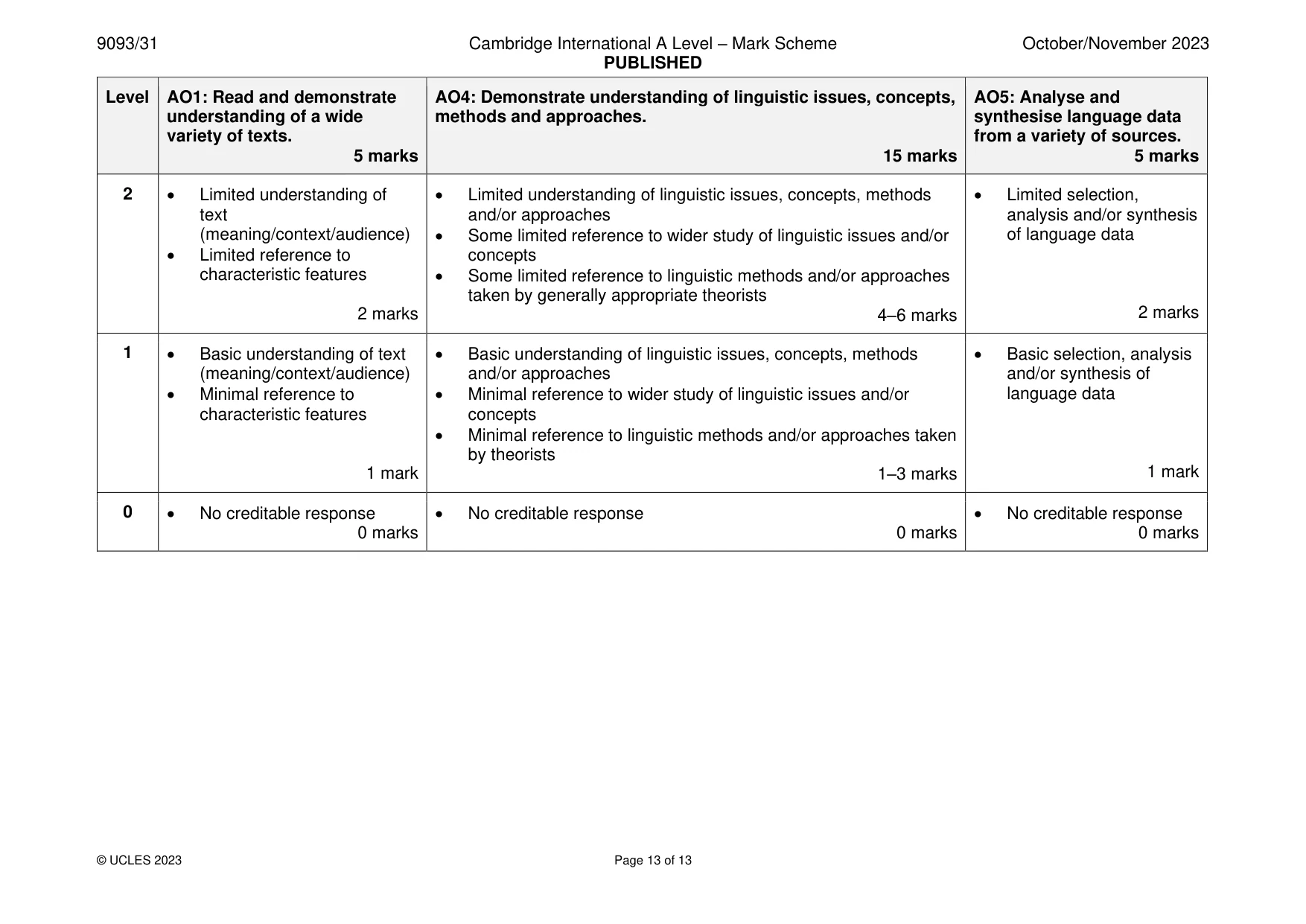
9093/31 Cambridge International A Level – Mark Scheme PUBLISHED October/November 2023 © UCLES 2023 Page 13 of 13 Level AO1: Read and demonstrate understanding of a wide variety of texts. 5 marks AO4: Demonstrate understanding of linguistic issues, concepts, methods and approaches. 15 marks AO5: Analyse and synthesise language data from a variety of sources. 5 marks 2 • Limited understanding of text (meaning/context/audience) • Limited reference to characteristic features 2 marks • Limited understanding of linguistic issues, concepts, methods and/or approaches • Some limited reference to wider study of linguistic issues and/or concepts • Some limited reference to linguistic methods and/or approaches taken by generally appropriate theorists 4–6 marks • Limited selection, analysis and/or synthesis of language data 2 marks 1 • Basic understanding of text (meaning/context/audience) • Minimal reference to characteristic features 1 mark • Basic understanding of linguistic issues, concepts, methods and/or approaches • Minimal reference to wider study of linguistic issues and/or concepts • Minimal reference to linguistic methods and/or approaches taken by theorists 1–3 marks • Basic selection, analysis and/or synthesis of language data 1 mark 0 • No creditable response 0 marks • No creditable response 0 marks • No creditable response 0 marks
What you needed in this session
Cambridge’s own grade thresholds for 2023 Oct/Nov, Paper 3 · Variant 1. A higher threshold means an easier paper — the bar moves with how the cohort did.