Cambridge A Level English - Language AS and A Level (from 2014) 9093 — 2022 May/June Paper 3 · Variant 1
9093/31/M/J/22 · 50 marks · ≈56 min
The question paper and its mark scheme, free to read here and free to download. This is Cambridge’s own paper, exactly as it was sat.
Question paper8 pages


Mark scheme13 pages
Answers below. Sit the paper first if you are practising.
Paper as text
Question paper, page 1
This document has 8 pages. Any blank pages are indicated. [Turn over DC (RW/SG) 303568/3 © UCLES 2022 * 0 8 6 0 1 1 2 9 1 1 * Cambridge International AS & A Level ENGLISH LANGUAGE 9093/31 Paper 3 Language Analysis May/June 2022 2 hours 15 minutes You must answer on the enclosed answer booklet. You will need: Answer booklet (enclosed) INSTRUCTIONS ● Answer all questions. ● Follow the instructions on the front cover of the answer booklet. If you need additional answer paper, ask the invigilator for a continuation booklet. ● Dictionaries are not allowed. INFORMATION ● The total mark for this paper is 50. ● The number of marks for each question or part question is shown in brackets [ ].
Question paper, page 2
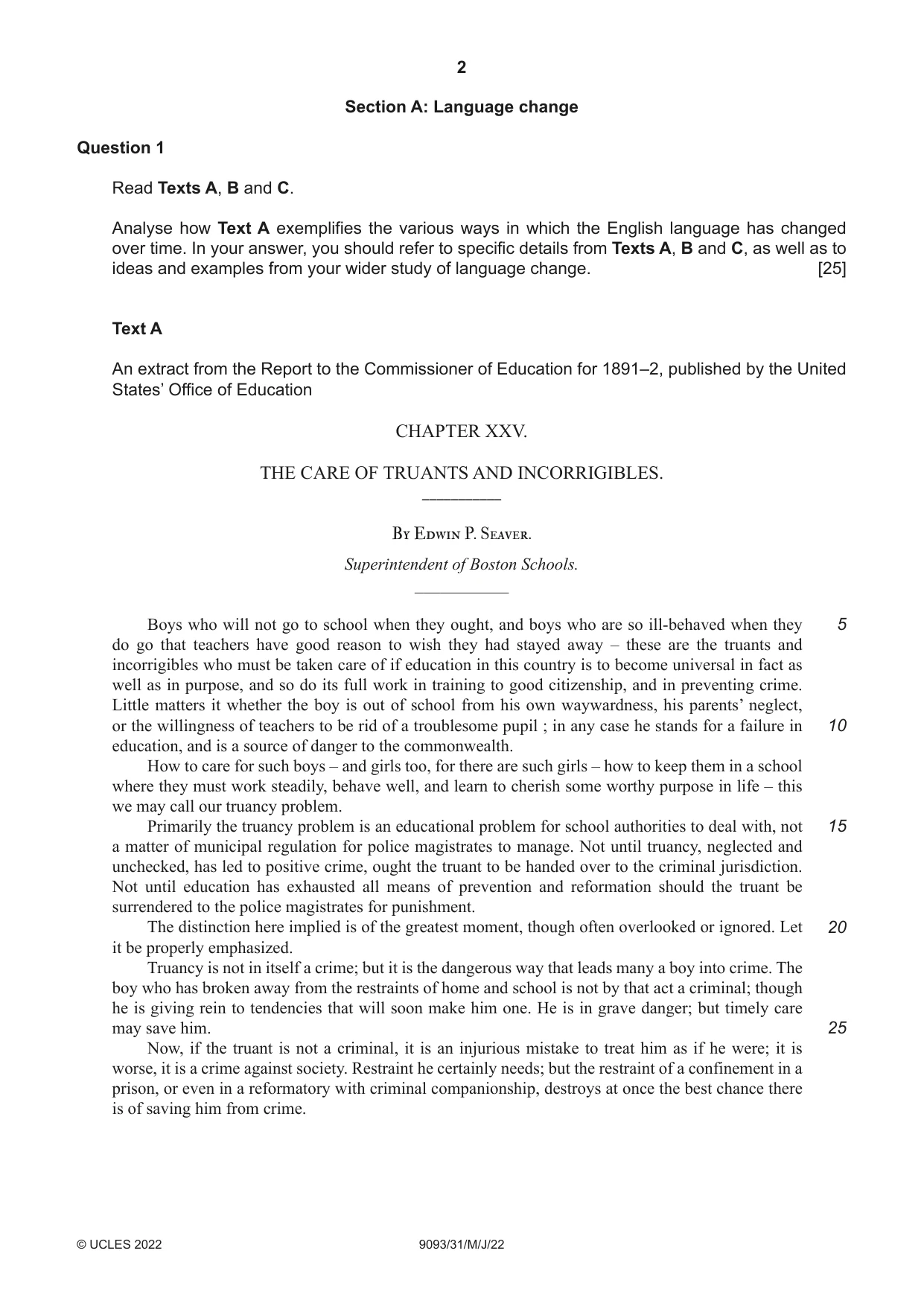
2 9093/31/M/J/22 © UCLES 2022 Section A: Language change Question 1 Read Texts A, B and C. Analyse how Text A exemplifies the various ways in which the English language has changed over time. In your answer, you should refer to specific details from Texts A, B and C, as well as to ideas and examples from your wider study of language change. [25] Text A An extract from the Report to the Commissioner of Education for 1891–2, published by the United States’ Office of Education CHAPTER XXV. THE CARE OF TRUANTS AND INCORRIGIBLES. ___________ By Edwin P. Seaver. Superintendent of Boston Schools. ___________ Boys who will not go to school when they ought, and boys who are so ill-behaved when they do go that teachers have good reason to wish they had stayed away – these are the truants and incorrigibles who must be taken care of if education in this country is to become universal in fact as well as in purpose, and so do its full work in training to good citizenship, and in preventing crime. Little matters it whether the boy is out of school from his own waywardness, his parents’ neglect, or the willingness of teachers to be rid of a troublesome pupil ; in any case he stands for a failure in education, and is a source of danger to the commonwealth. How to care for such boys – and girls too, for there are such girls – how to keep them in a school where they must work steadily, behave well, and learn to cherish some worthy purpose in life – this we may call our truancy problem. Primarily the truancy problem is an educational problem for school authorities to deal with, not a matter of municipal regulation for police magistrates to manage. Not until truancy, neglected and unchecked, has led to positive crime, ought the truant to be handed over to the criminal jurisdiction. Not until education has exhausted all means of prevention and reformation should the truant be surrendered to the police magistrates for punishment. The distinction here implied is of the greatest moment, though often overlooked or ignored. Let it be properly emphasized. Truancy is not in itself a crime; but it is the dangerous way that leads many a boy into crime. The boy who has broken away from the restraints of home and school is not by that act a criminal; though he is giving rein to tendencies that will soon make him one. He is in grave danger; but timely care may save him. Now, if the truant is not a criminal, it is an injurious mistake to treat him as if he were; it is worse, it is a crime against society. Restraint he certainly needs; but the restraint of a confinement in a prison, or even in a reformatory with criminal companionship, destroys at once the best chance there is of saving him from crime. 5 10 15 20 25
Question paper, page 3
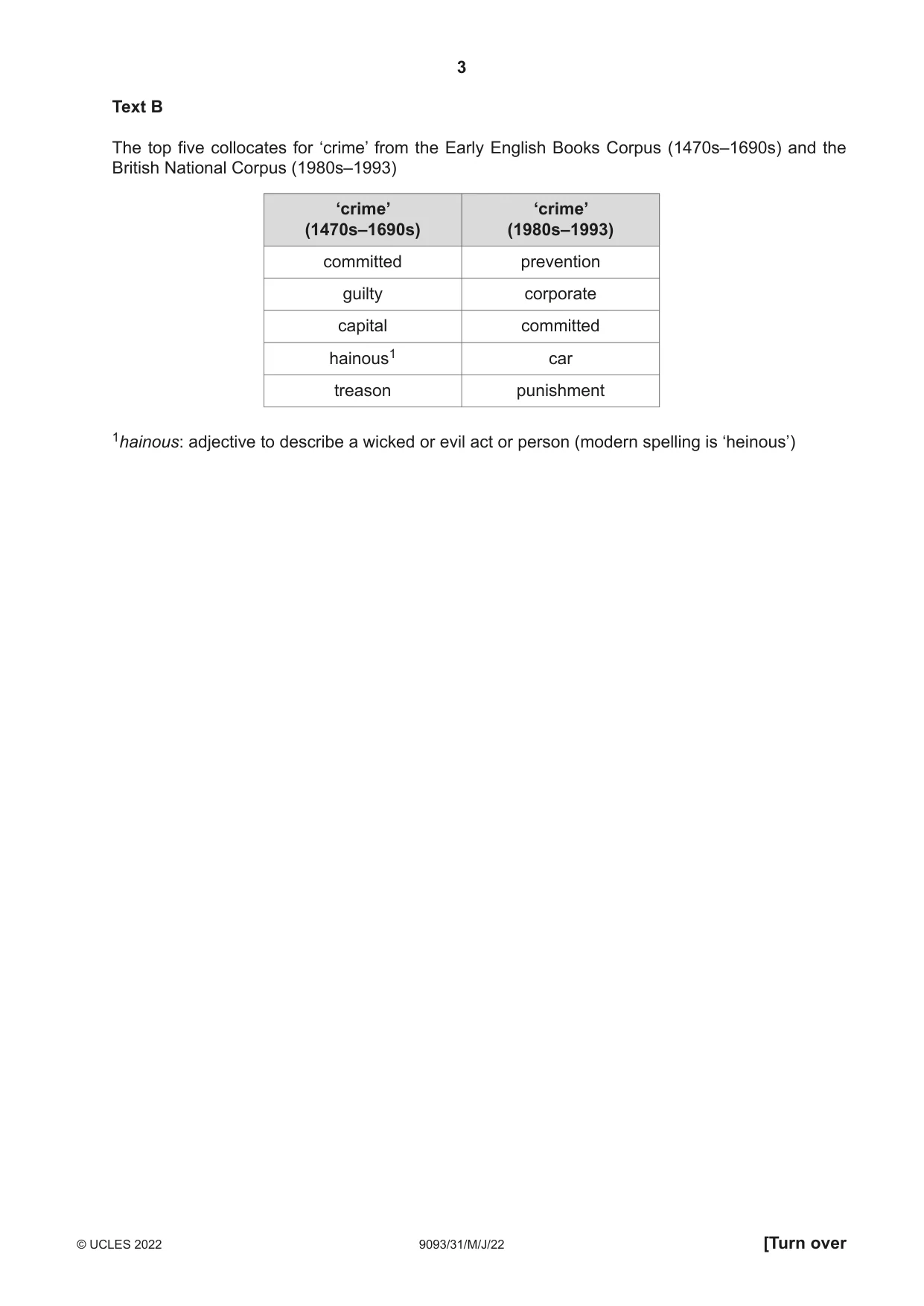
3 9093/31/M/J/22 © UCLES 2022 [Turn over Text B The top five collocates for ‘crime’ from the Early English Books Corpus (1470s–1690s) and the British National Corpus (1980s–1993) ‘crime’ (1470s–1690s) ‘crime’ (1980s–1993) committed prevention guilty corporate capital committed hainous1 car treason punishment 1hainous: adjective to describe a wicked or evil act or person (modern spelling is ‘heinous’)
Question paper, page 4
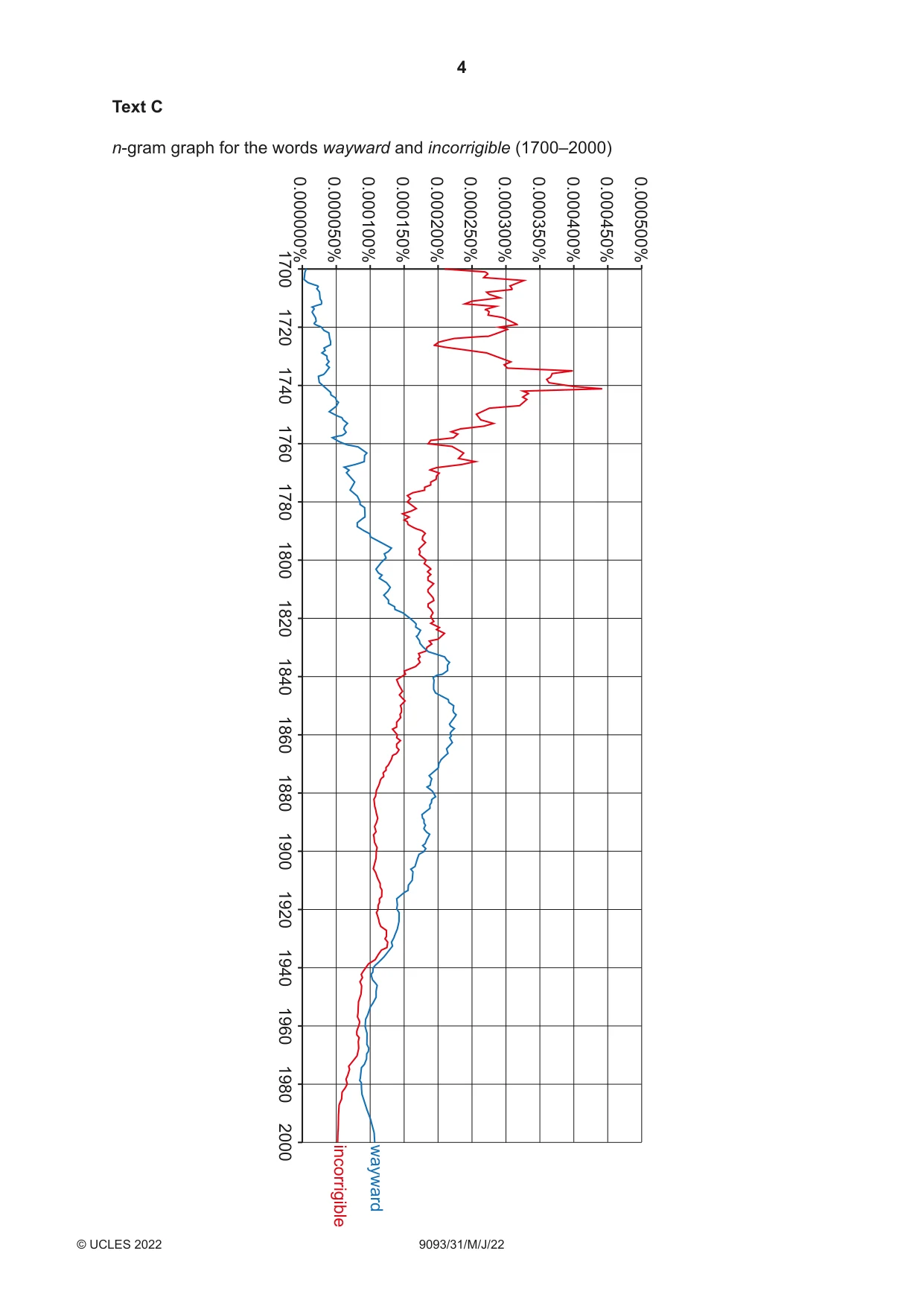
4 9093/31/M/J/22 © UCLES 2022 Text C n-gram graph for the words wayward and incorrigible (1700–2000) 0.000000% 0.000050% 0.000100% 0.000150% 0.000200% 0.000250% 0.000300% 0.000350% 0.000400% 0.000450% 0.000500% 1700 1720 1760 1740 1800 1780 1820 1840 1860 1900 1880 1940 1920 1960 1980 2000 incorrigible wayward
Question paper, page 5
5 9093/31/M/J/22 © UCLES 2022 [Turn over BLANK PAGE
Question paper, page 6
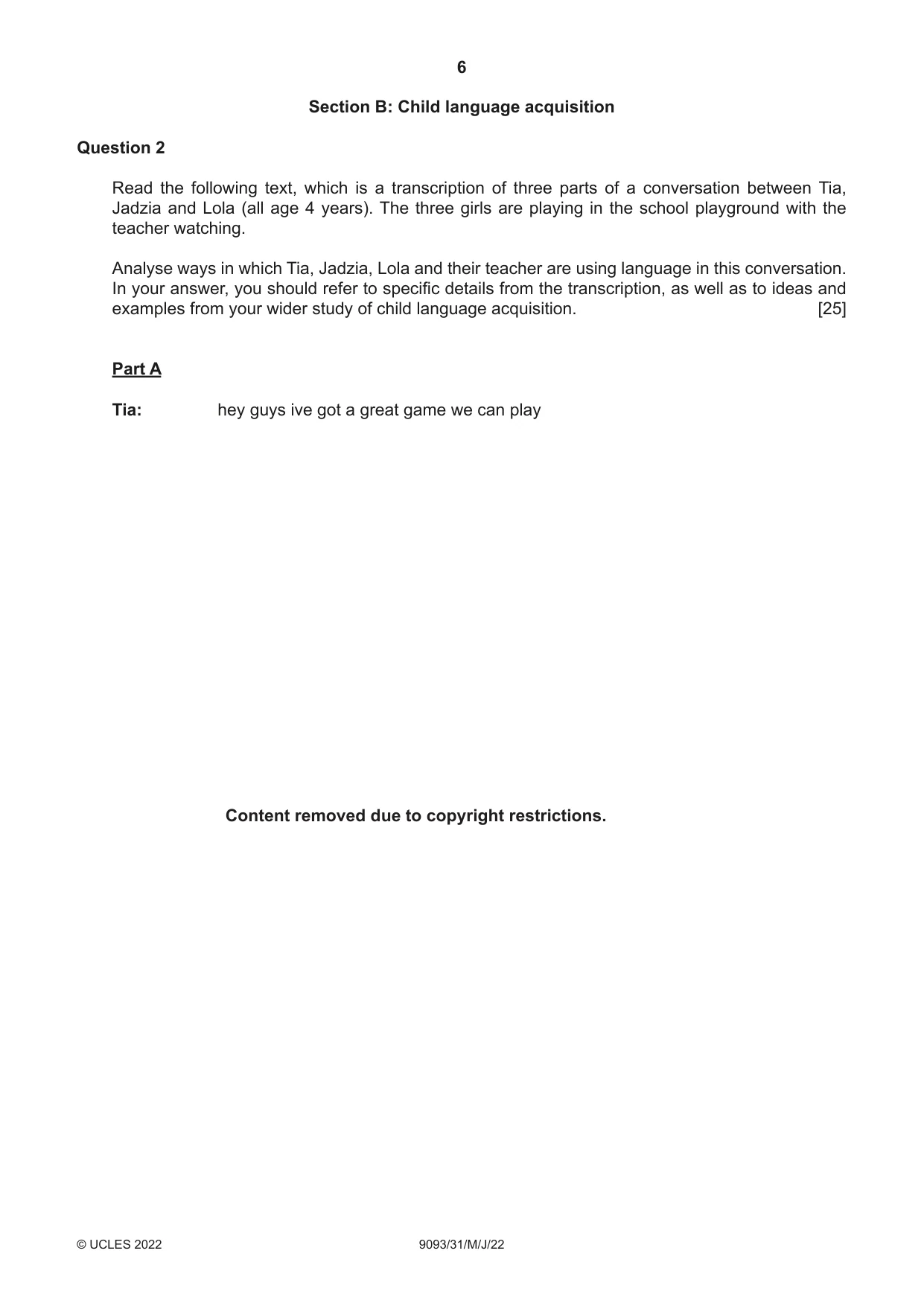
6 9093/31/M/J/22 © UCLES 2022 Section B: Child language acquisition Question 2 Read the following text, which is a transcription of three parts of a conversation between Tia, Jadzia and Lola (all age 4 years). The three girls are playing in the school playground with the teacher watching. Analyse ways in which Tia, Jadzia, Lola and their teacher are using language in this conversation. In your answer, you should refer to specific details from the transcription, as well as to ideas and examples from your wider study of child language acquisition. [25] Part A Tia: hey guys ive got a great game we can play Content removed due to copyright restrictions.
Question paper, page 7
7 9093/31/M/J/22 © UCLES 2022 [Turn over Tia: okay Content removed due to copyright restrictions.
Question paper, page 8
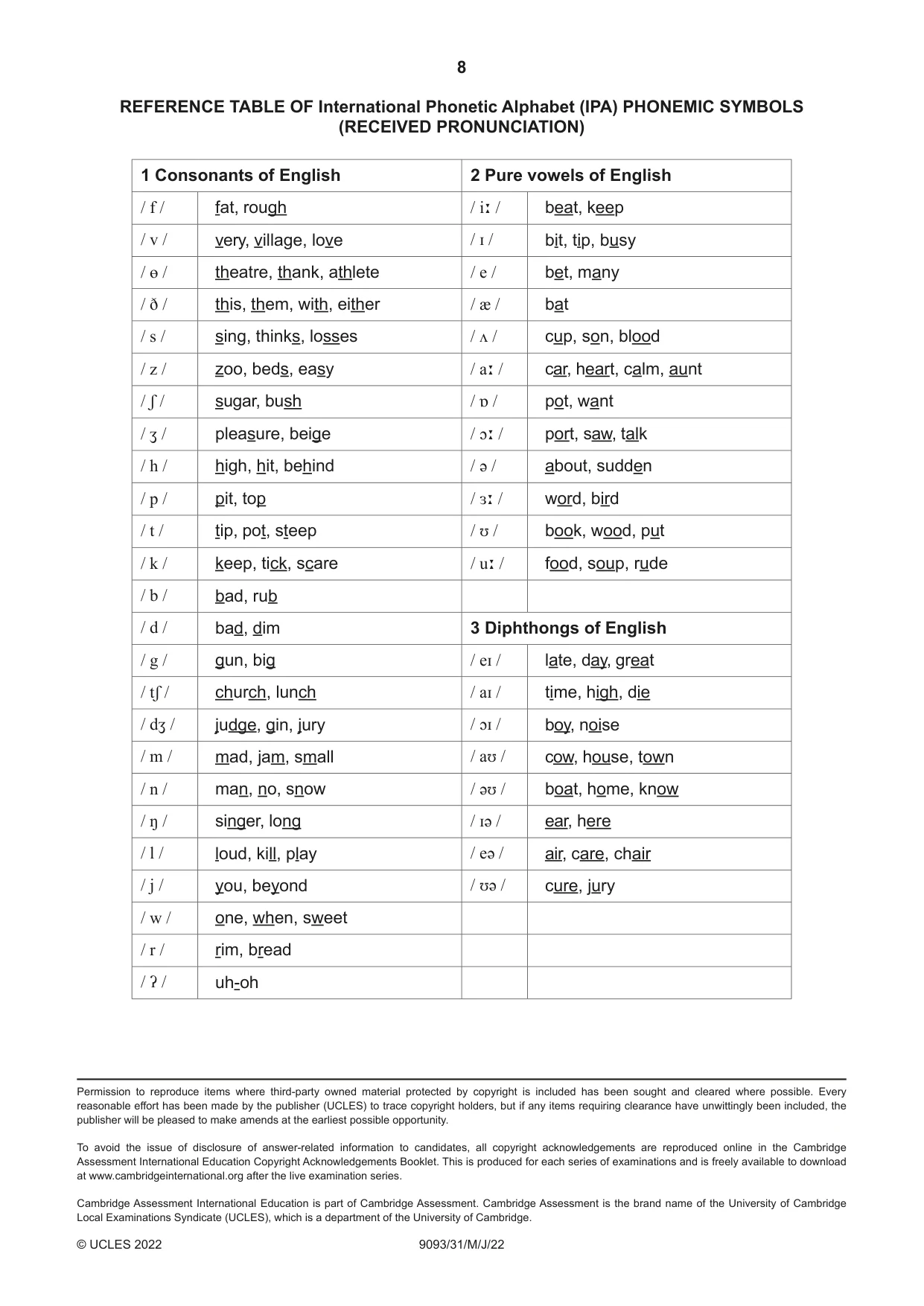
8 9093/31/M/J/22 © UCLES 2022 Permission to reproduce items where third-party owned material protected by copyright is included has been sought and cleared where possible. Every reasonable effort has been made by the publisher (UCLES) to trace copyright holders, but if any items requiring clearance have unwittingly been included, the publisher will be pleased to make amends at the earliest possible opportunity. To avoid the issue of disclosure of answer-related information to candidates, all copyright acknowledgements are reproduced online in the Cambridge Assessment International Education Copyright Acknowledgements Booklet. This is produced for each series of examinations and is freely available to download at www.cambridgeinternational.org after the live examination series. Cambridge Assessment International Education is part of Cambridge Assessment. Cambridge Assessment is the brand name of the University of Cambridge Local Examinations Syndicate (UCLES), which is a department of the University of Cambridge. REFERENCE TABLE OF International Phonetic Alphabet (IPA) PHONEMIC SYMBOLS (RECEIVED PRONUNCIATION) 1 Consonants of English 2 Pure vowels of English / f / fat, rough / iː / beat, keep / v / very, village, love / ɪ / bit, tip, busy / ɵ / theatre, thank, athlete / e / bet, many / ð / this, them, with, either / æ / bat / s / sing, thinks, losses / ʌ / cup, son, blood / z / zoo, beds, easy / aː / car, heart, calm, aunt / ʃ / sugar, bush / ɒ / pot, want / ʒ / pleasure, beige / ɔː / port, saw, talk / h / high, hit, behind / ə / about, sudden / p / pit, top / ɜː / word, bird / t / tip, pot, steep / ʊ / book, wood, put / k / keep, tick, scare / uː / food, soup, rude / b / bad, rub / d / bad, dim 3 Diphthongs of English / g / gun, big / eɪ / late, day, great / tʃ / church, lunch / aɪ / time, high, die / dʒ / judge, gin, jury / ɔɪ / boy, noise / m / mad, jam, small / aʊ / cow, house, town / n / man, no, snow / əʊ / boat, home, know / ŋ / singer, long / ɪə / ear, here / l / loud, kill, play / eə / air, care, chair / j / you, beyond / ʊə / cure, jury / w / one, when, sweet / r / rim, bread / ʔ / uh-oh
Mark scheme, page 1
This document consists of 13 printed pages. © UCLES 2022 [Turn over Cambridge International A Level ENGLISH LANGUAGE 9093/31 Paper 3 Language Analysis May/June 2022 MARK SCHEME Maximum Mark: 50 Published This mark scheme is published as an aid to teachers and candidates, to indicate the requirements of the examination. It shows the basis on which Examiners were instructed to award marks. It does not indicate the details of the discussions that took place at an Examiners’ meeting before marking began, which would have considered the acceptability of alternative answers. Mark schemes should be read in conjunction with the question paper and the Principal Examiner Report for Teachers. Cambridge International will not enter into discussions about these mark schemes. Cambridge International is publishing the mark schemes for the May/June 2022 series for most Cambridge IGCSE, Cambridge International A and AS Level and Cambridge Pre-U components, and some Cambridge O Level components.
Mark scheme, page 2
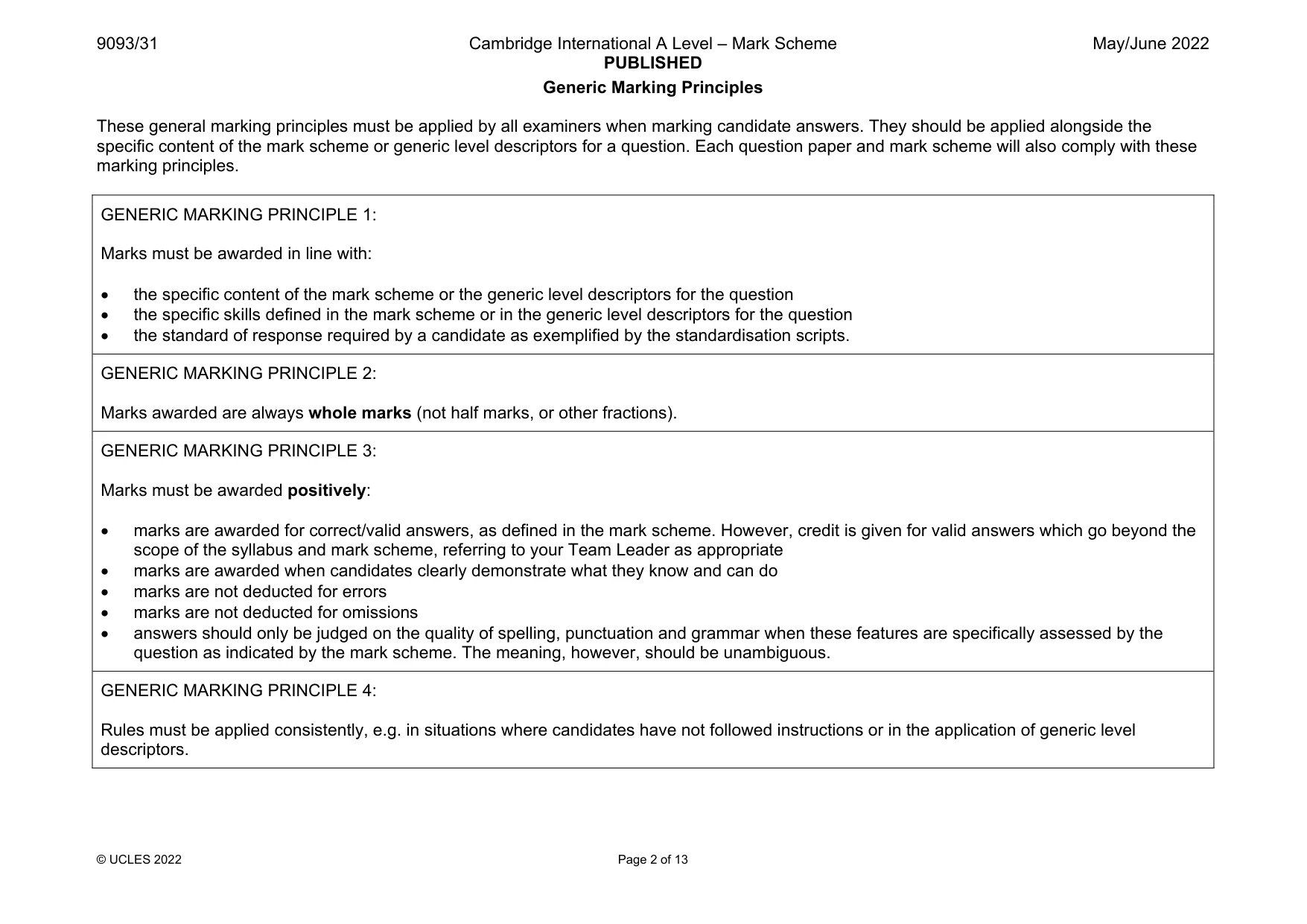
9093/31 Cambridge International A Level – Mark Scheme PUBLISHED May/June 2022 © UCLES 2022 Page 2 of 13 Generic Marking Principles These general marking principles must be applied by all examiners when marking candidate answers. They should be applied alongside the specific content of the mark scheme or generic level descriptors for a question. Each question paper and mark scheme will also comply with these marking principles. GENERIC MARKING PRINCIPLE 1: Marks must be awarded in line with: the specific content of the mark scheme or the generic level descriptors for the question the specific skills defined in the mark scheme or in the generic level descriptors for the question the standard of response required by a candidate as exemplified by the standardisation scripts. GENERIC MARKING PRINCIPLE 2: Marks awarded are always whole marks (not half marks, or other fractions). GENERIC MARKING PRINCIPLE 3: Marks must be awarded positively: marks are awarded for correct/valid answers, as defined in the mark scheme. However, credit is given for valid answers which go beyond the scope of the syllabus and mark scheme, referring to your Team Leader as appropriate marks are awarded when candidates clearly demonstrate what they know and can do marks are not deducted for errors marks are not deducted for omissions answers should only be judged on the quality of spelling, punctuation and grammar when these features are specifically assessed by the question as indicated by the mark scheme. The meaning, however, should be unambiguous. GENERIC MARKING PRINCIPLE 4: Rules must be applied consistently, e.g. in situations where candidates have not followed instructions or in the application of generic level descriptors.
Mark scheme, page 3
9093/31 Cambridge International A Level – Mark Scheme PUBLISHED May/June 2022 © UCLES 2022 Page 3 of 13 GENERIC MARKING PRINCIPLE 5: Marks should be awarded using the full range of marks defined in the mark scheme for the question (however; the use of the full mark range may be limited according to the quality of the candidate responses seen). GENERIC MARKING PRINCIPLE 6: Marks awarded are based solely on the requirements as defined in the mark scheme. Marks should not be awarded with grade thresholds or grade descriptors in mind.
Mark scheme, page 4
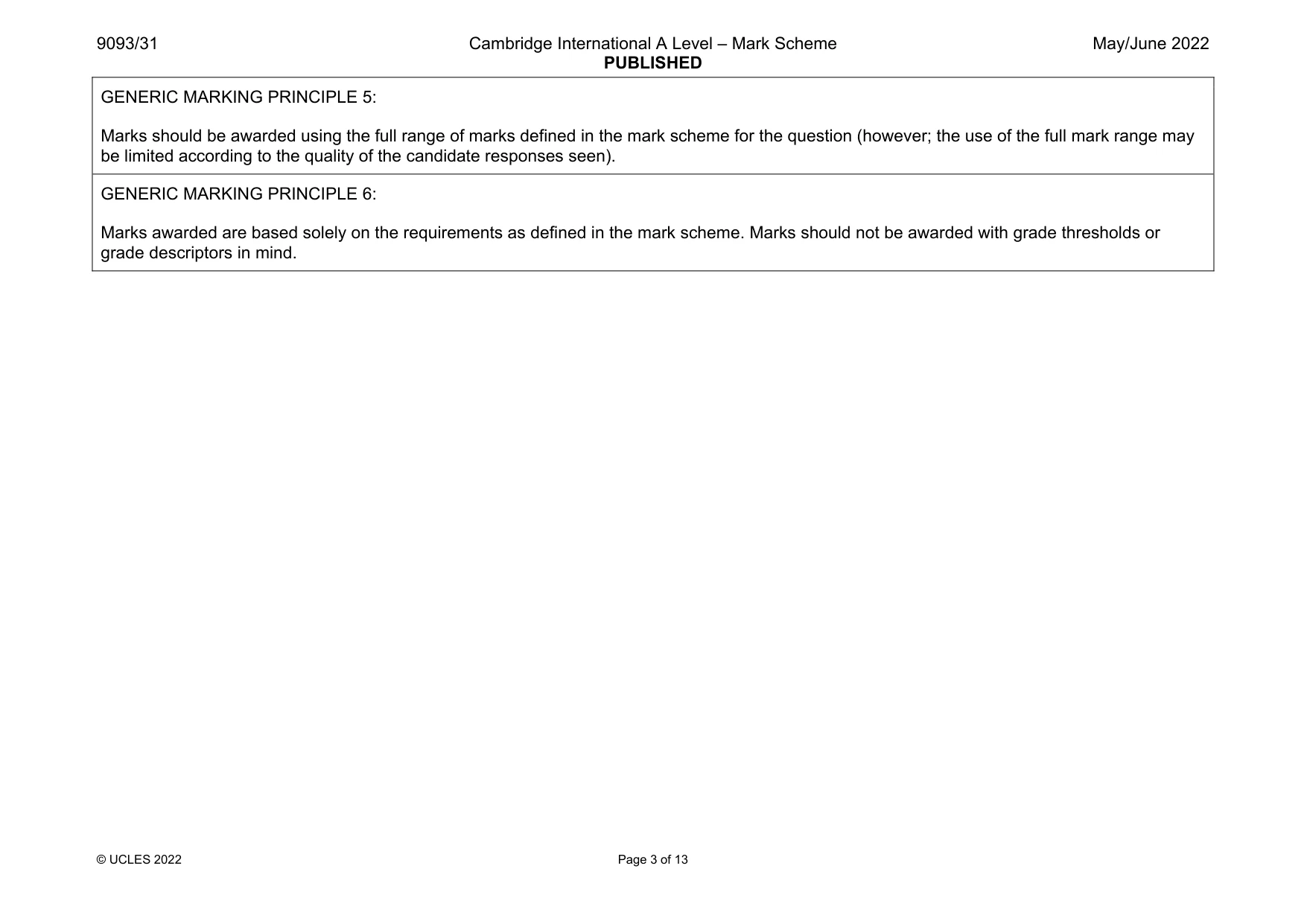
9093/31 Cambridge International A Level – Mark Scheme PUBLISHED May/June 2022 © UCLES 2022 Page 4 of 13 English & Media subject specific general marking principles (To be read in conjunction with the Generic Marking Principles (and requiring further guidance on how to place marks within levels)) Components using level descriptors: We use level descriptors as a guide to broad understanding of the qualities normally expected of, or typical of, work in a level. Level descriptors are a means of general guidance, and should not be interpreted as hurdle statements. Where indicative content notes are supplied for a question, these are not a prescription of required content, and must not be treated as such. Alternative correct points and unexpected answers in candidates’ scripts must be given marks that fairly reflect the knowledge and skills demonstrated. While we may have legitimate expectations as to the ground most answers may occupy, we must at all times be prepared to meet candidates on their chosen ground, provided it is relevant ground (e.g. clearly related to and derived from a relevant passage/text and meeting the mark scheme requirements for the question).
Mark scheme, page 5
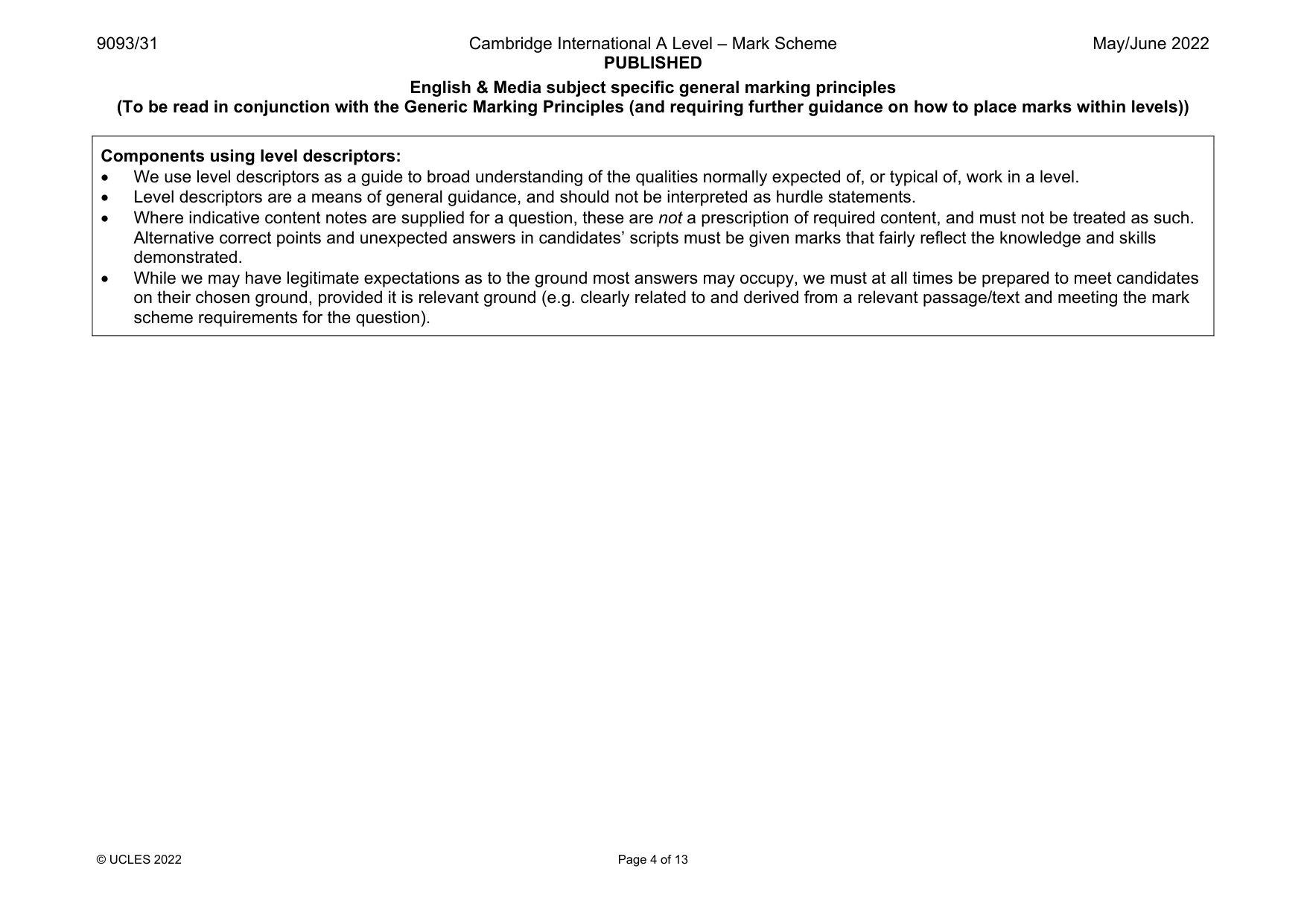
9093/31 Cambridge International A Level – Mark Scheme PUBLISHED May/June 2022 © UCLES 2022 Page 5 of 13 English Language specific marking instructions: AO1 Read and demonstrate understanding of a wide variety of texts. (Understanding) Marks should be awarded for the accuracy of the candidate’s understanding of the text and its features, not for any analysis of them which is recognised under AO3. Where comparison is required, marks should be awarded for the candidate’s recognition of similarities and differences between the texts and their features, not for any consequent analysis. When awarding a ‘best-fit’ mark within a Level for each AO, consider each bullet point equally. AO2 Write effectively, creatively, accurately and appropriately, for a range of audiences and purposes. (Writing) Marks should be awarded equally on the basis of the level of the candidate’s written expression (range of features used and accuracy) and the development of their writing (its organisation and relevance to task and audience). When awarding a ‘best-fit’ mark within a Level for each AO, consider each bullet point equally. AO4: Demonstrate understanding of linguistic issues, concepts, methods and approaches. (Conceptualisation) Marks should be awarded equally on the basis of the level of the candidate’s understanding of the relevant issues, concepts, methods and approaches represented both in the text(s) and in their wider studies. When awarding a ‘best-fit’ mark within a Level for each AO, consider each bullet point equally. AO5: Analyse and synthesise language data from a variety of sources. (Data handling) Marks should be awarded equally on the basis of the level of the candidate’s selection, analysis and synthesis of language data. When awarding a ‘best-fit’ mark within a Level for each AO, consider each bullet point equally. Higher marks should be awarded where candidates identify patterns and offer thoughtful and plausible explanations for the features they are discussing. Weaker answers may spot features or describe individual cases of language change without reference to broader considerations or examples.
Mark scheme, page 6
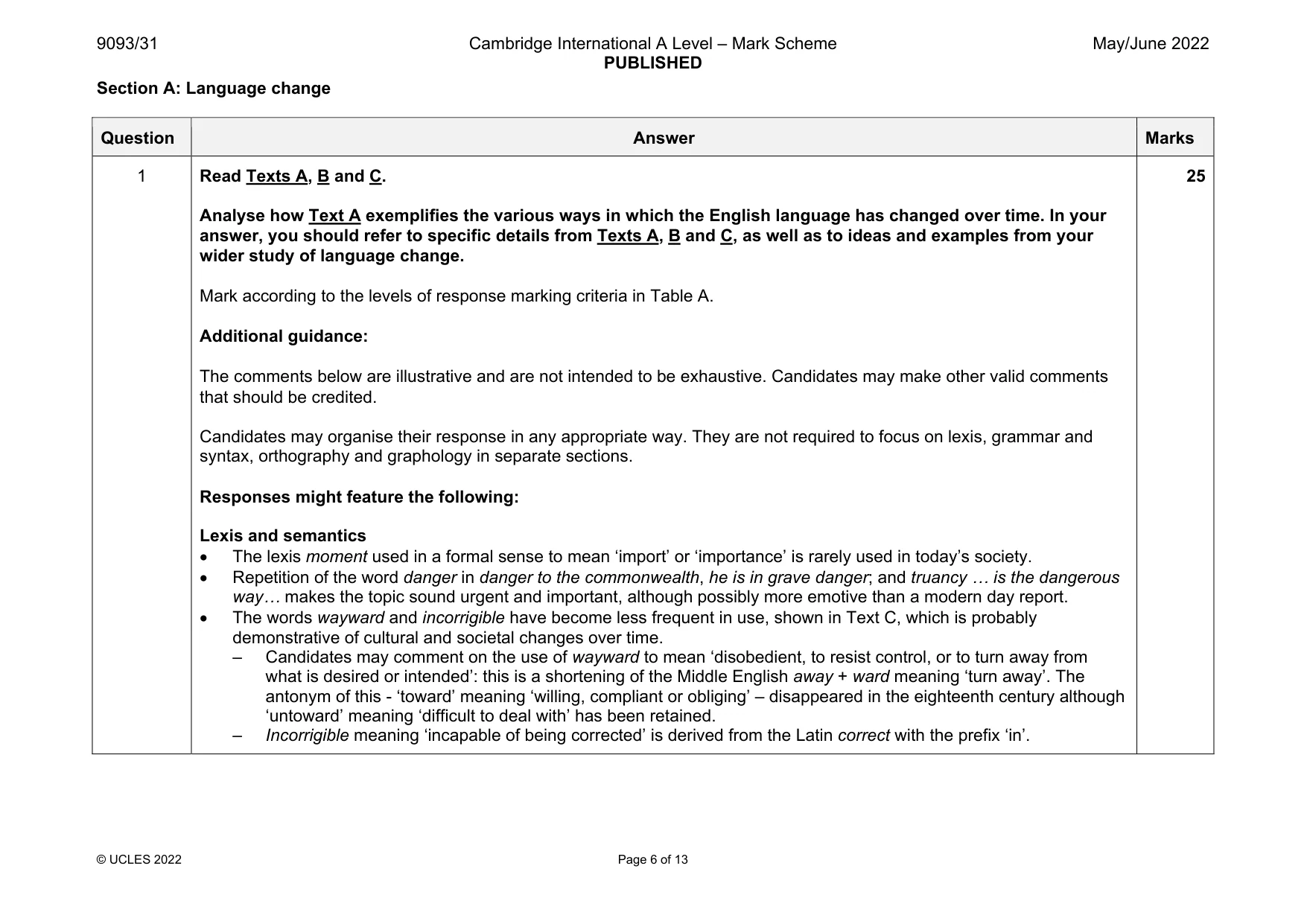
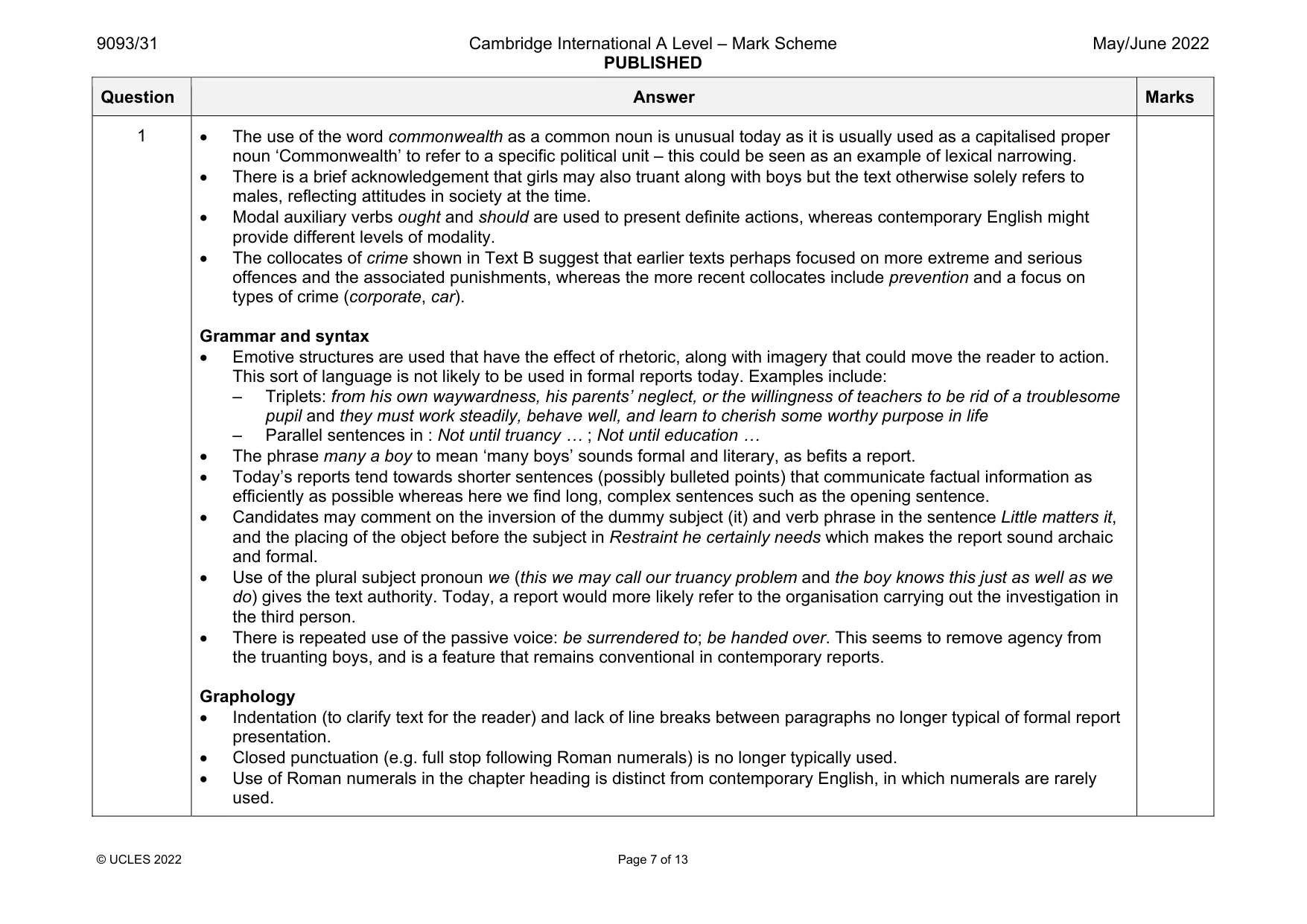
9093/31 Cambridge International A Level – Mark Scheme PUBLISHED May/June 2022 © UCLES 2022 Page 6 of 13 Section A: Language change Question Answer Marks 1 Read Texts A, B and C. Analyse how Text A exemplifies the various ways in which the English language has changed over time. In your answer, you should refer to specific details from Texts A, B and C, as well as to ideas and examples from your wider study of language change. Mark according to the levels of response marking criteria in Table A. Additional guidance: The comments below are illustrative and are not intended to be exhaustive. Candidates may make other valid comments that should be credited. Candidates may organise their response in any appropriate way. They are not required to focus on lexis, grammar and syntax, orthography and graphology in separate sections. Responses might feature the following: Lexis and semantics The lexis moment used in a formal sense to mean ‘import’ or ‘importance’ is rarely used in today’s society. Repetition of the word danger in danger to the commonwealth, he is in grave danger; and truancy … is the dangerous way… makes the topic sound urgent and important, although possibly more emotive than a modern day report. The words wayward and incorrigible have become less frequent in use, shown in Text C, which is probably demonstrative of cultural and societal changes over time. – Candidates may comment on the use of wayward to mean ‘disobedient, to resist control, or to turn away from what is desired or intended’: this is a shortening of the Middle English away + ward meaning ‘turn away’. The antonym of this - ‘toward’ meaning ‘willing, compliant or obliging’ – disappeared in the eighteenth century although ‘untoward’ meaning ‘difficult to deal with’ has been retained. – Incorrigible meaning ‘incapable of being corrected’ is derived from the Latin correct with the prefix ‘in’. 25
Mark scheme, page 7
9093/31 Cambridge International A Level – Mark Scheme PUBLISHED May/June 2022 © UCLES 2022 Page 7 of 13 Question Answer Marks 1 The use of the word commonwealth as a common noun is unusual today as it is usually used as a capitalised proper noun ‘Commonwealth’ to refer to a specific political unit – this could be seen as an example of lexical narrowing. There is a brief acknowledgement that girls may also truant along with boys but the text otherwise solely refers to males, reflecting attitudes in society at the time. Modal auxiliary verbs ought and should are used to present definite actions, whereas contemporary English might provide different levels of modality. The collocates of crime shown in Text B suggest that earlier texts perhaps focused on more extreme and serious offences and the associated punishments, whereas the more recent collocates include prevention and a focus on types of crime (corporate, car). Grammar and syntax Emotive structures are used that have the effect of rhetoric, along with imagery that could move the reader to action. This sort of language is not likely to be used in formal reports today. Examples include: – Triplets: from his own waywardness, his parents’ neglect, or the willingness of teachers to be rid of a troublesome pupil and they must work steadily, behave well, and learn to cherish some worthy purpose in life – Parallel sentences in : Not until truancy … ; Not until education … The phrase many a boy to mean ‘many boys’ sounds formal and literary, as befits a report. Today’s reports tend towards shorter sentences (possibly bulleted points) that communicate factual information as efficiently as possible whereas here we find long, complex sentences such as the opening sentence. Candidates may comment on the inversion of the dummy subject (it) and verb phrase in the sentence Little matters it, and the placing of the object before the subject in Restraint he certainly needs which makes the report sound archaic and formal. Use of the plural subject pronoun we (this we may call our truancy problem and the boy knows this just as well as we do) gives the text authority. Today, a report would more likely refer to the organisation carrying out the investigation in the third person. There is repeated use of the passive voice: be surrendered to; be handed over. This seems to remove agency from the truanting boys, and is a feature that remains conventional in contemporary reports. Graphology Indentation (to clarify text for the reader) and lack of line breaks between paragraphs no longer typical of formal report presentation. Closed punctuation (e.g. full stop following Roman numerals) is no longer typically used. Use of Roman numerals in the chapter heading is distinct from contemporary English, in which numerals are rarely used.
Mark scheme, page 8
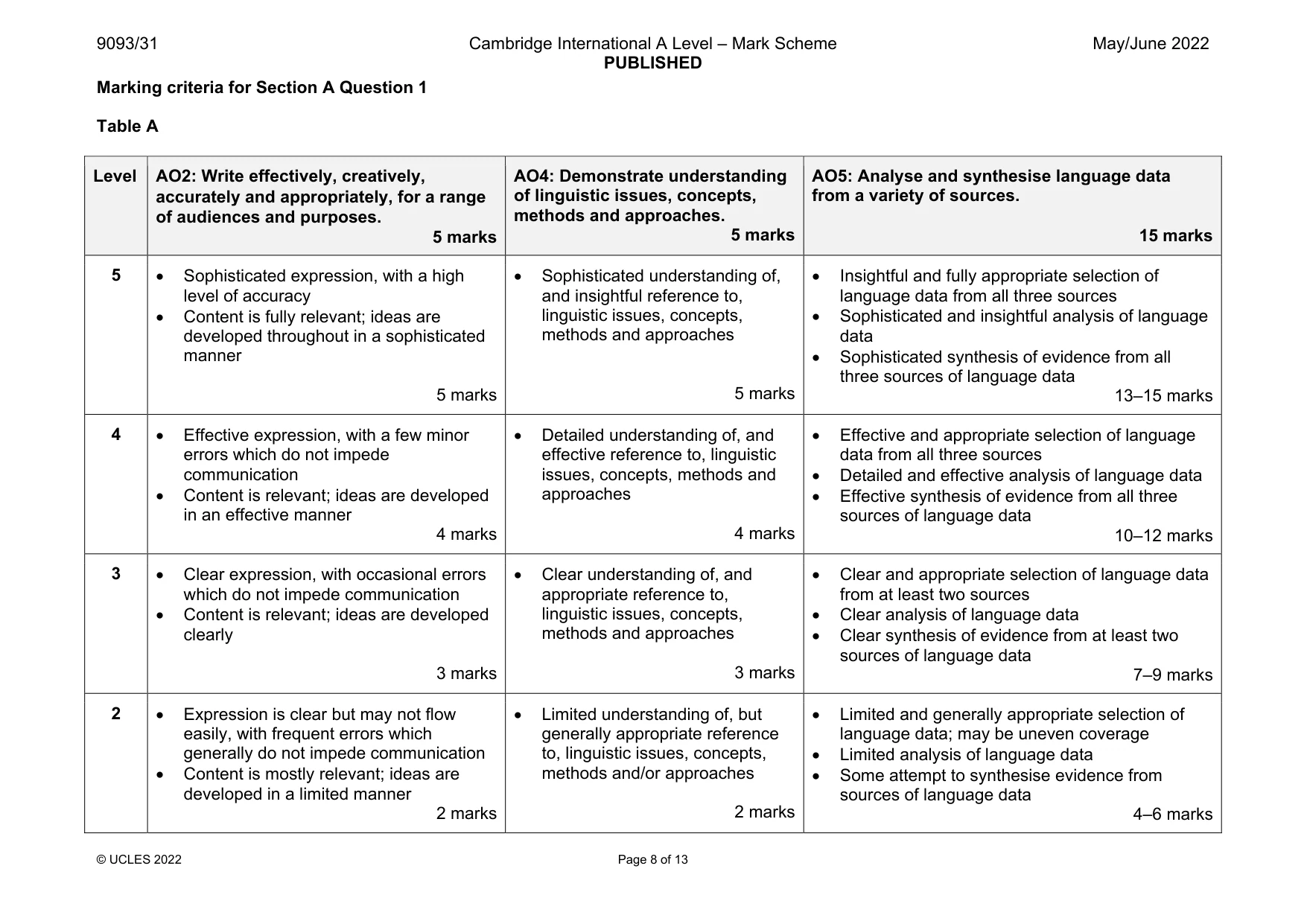
9093/31 Cambridge International A Level – Mark Scheme PUBLISHED May/June 2022 © UCLES 2022 Page 8 of 13 Marking criteria for Section A Question 1 Table A Level AO2: Write effectively, creatively, accurately and appropriately, for a range of audiences and purposes. 5 marks AO4: Demonstrate understanding of linguistic issues, concepts, methods and approaches. 5 marks AO5: Analyse and synthesise language data from a variety of sources. 15 marks 5 Sophisticated expression, with a high level of accuracy Content is fully relevant; ideas are developed throughout in a sophisticated manner 5 marks Sophisticated understanding of, and insightful reference to, linguistic issues, concepts, methods and approaches 5 marks Insightful and fully appropriate selection of language data from all three sources Sophisticated and insightful analysis of language data Sophisticated synthesis of evidence from all three sources of language data 13–15 marks 4 Effective expression, with a few minor errors which do not impede communication Content is relevant; ideas are developed in an effective manner 4 marks Detailed understanding of, and effective reference to, linguistic issues, concepts, methods and approaches 4 marks Effective and appropriate selection of language data from all three sources Detailed and effective analysis of language data Effective synthesis of evidence from all three sources of language data 10–12 marks 3 Clear expression, with occasional errors which do not impede communication Content is relevant; ideas are developed clearly 3 marks Clear understanding of, and appropriate reference to, linguistic issues, concepts, methods and approaches 3 marks Clear and appropriate selection of language data from at least two sources Clear analysis of language data Clear synthesis of evidence from at least two sources of language data 7–9 marks 2 Expression is clear but may not flow easily, with frequent errors which generally do not impede communication Content is mostly relevant; ideas are developed in a limited manner 2 marks Limited understanding of, but generally appropriate reference to, linguistic issues, concepts, methods and/or approaches 2 marks Limited and generally appropriate selection of language data; may be uneven coverage Limited analysis of language data Some attempt to synthesise evidence from sources of language data 4–6 marks
Mark scheme, page 9
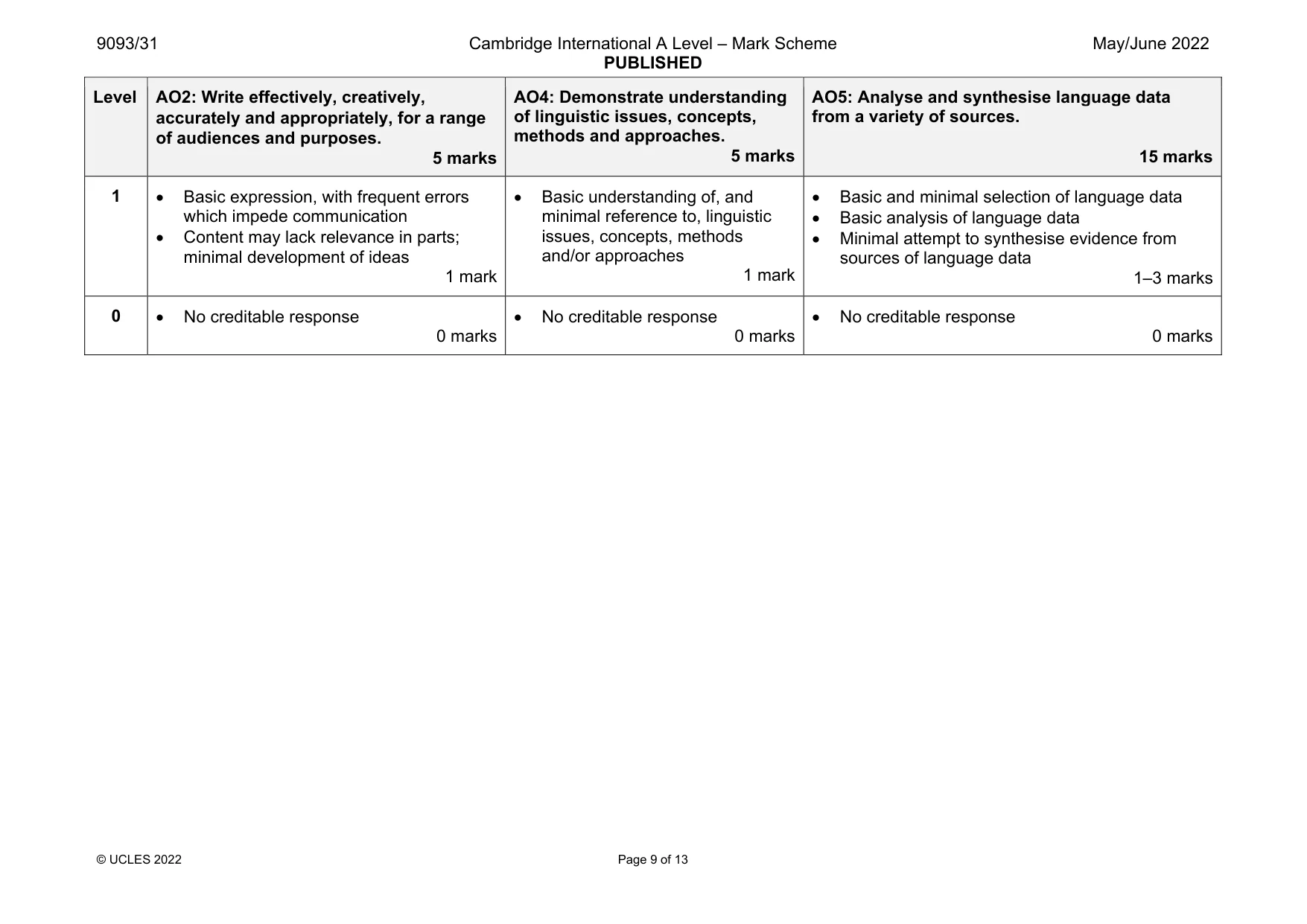
9093/31 Cambridge International A Level – Mark Scheme PUBLISHED May/June 2022 © UCLES 2022 Page 9 of 13 Level AO2: Write effectively, creatively, accurately and appropriately, for a range of audiences and purposes. 5 marks AO4: Demonstrate understanding of linguistic issues, concepts, methods and approaches. 5 marks AO5: Analyse and synthesise language data from a variety of sources. 15 marks 1 Basic expression, with frequent errors which impede communication Content may lack relevance in parts; minimal development of ideas 1 mark Basic understanding of, and minimal reference to, linguistic issues, concepts, methods and/or approaches 1 mark Basic and minimal selection of language data Basic analysis of language data Minimal attempt to synthesise evidence from sources of language data 1–3 marks 0 No creditable response 0 marks No creditable response 0 marks No creditable response 0 marks
Mark scheme, page 10
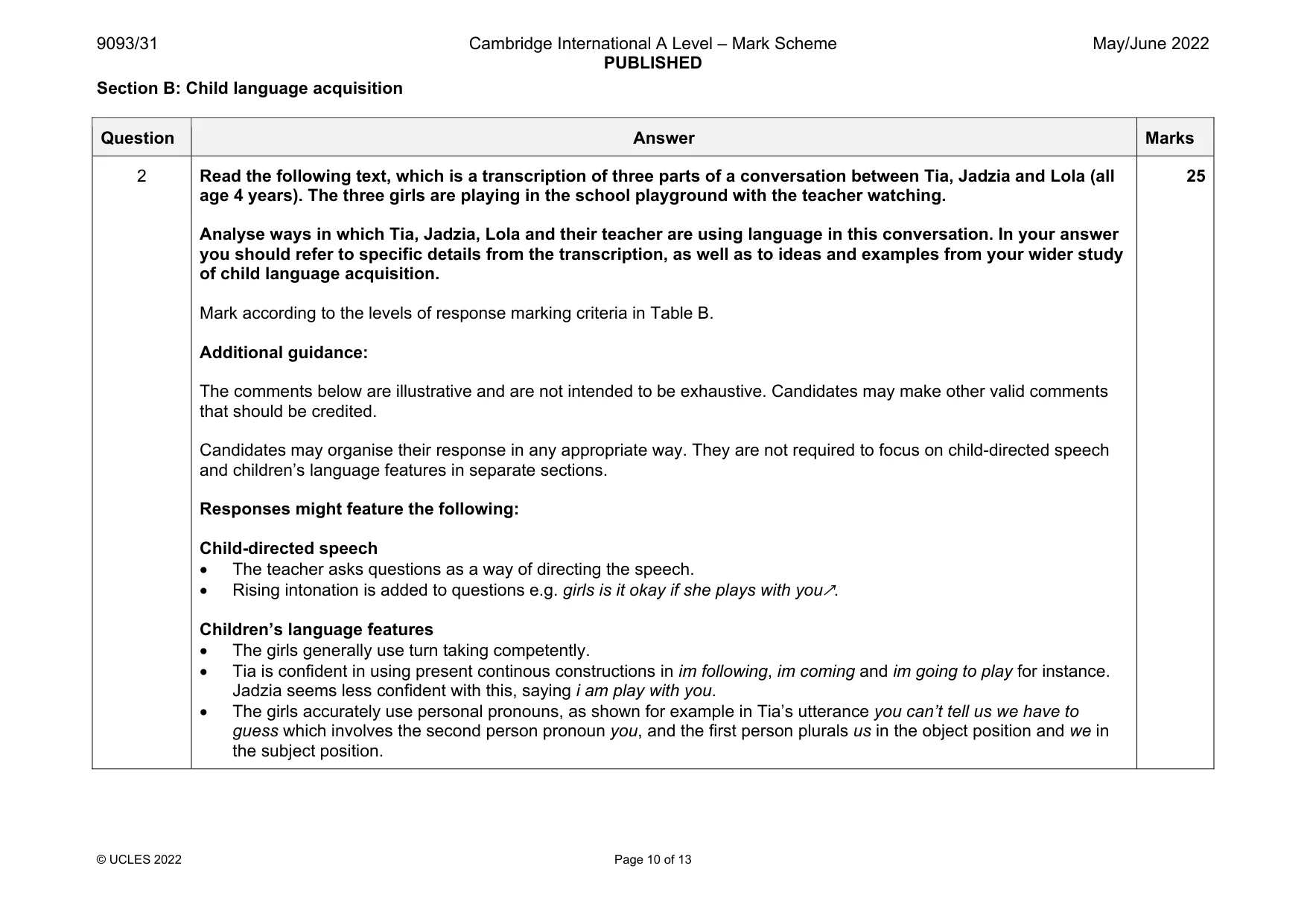
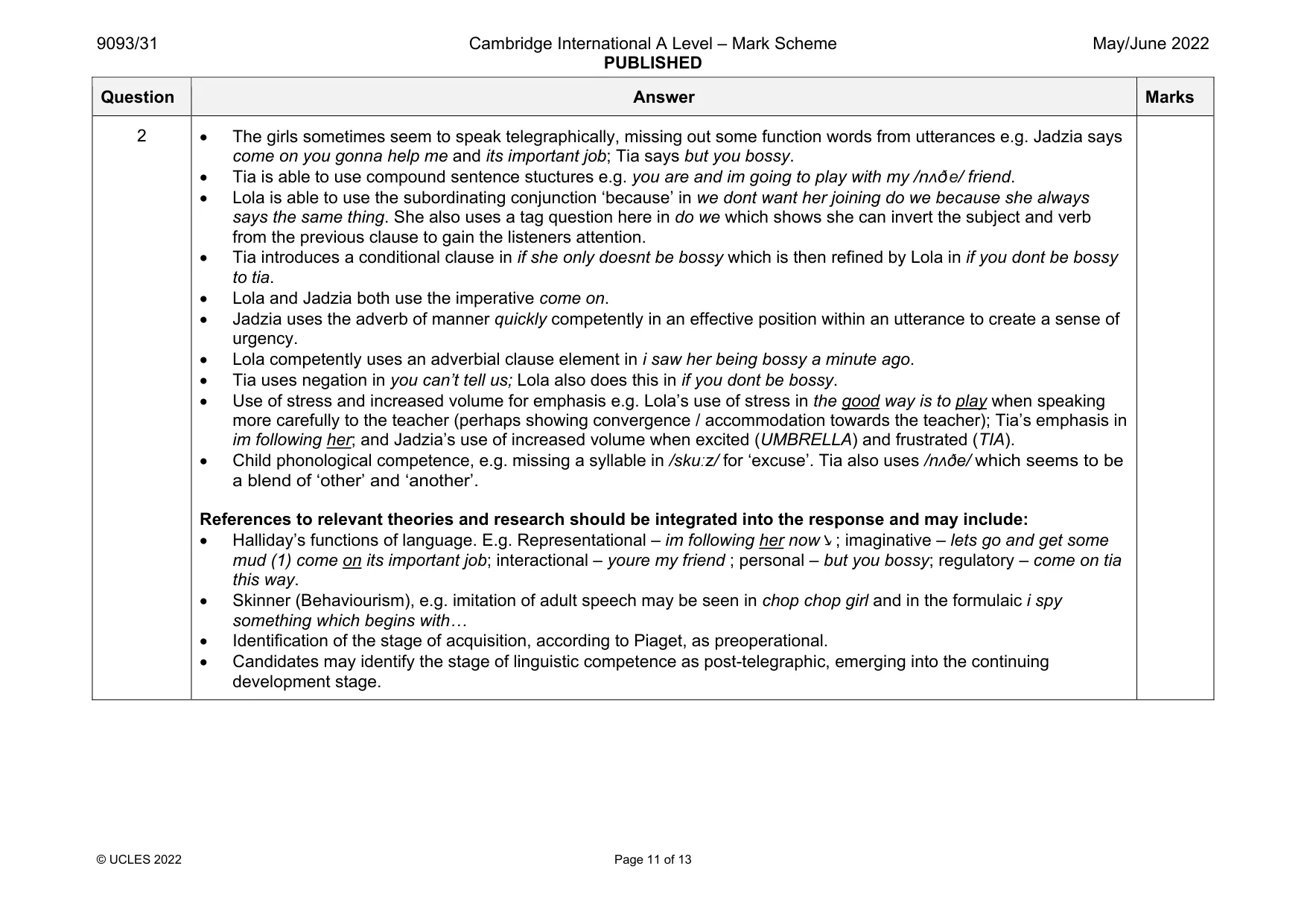
9093/31 Cambridge International A Level – Mark Scheme PUBLISHED May/June 2022 © UCLES 2022 Page 10 of 13 Section B: Child language acquisition Question Answer Marks 2 Read the following text, which is a transcription of three parts of a conversation between Tia, Jadzia and Lola (all age 4 years). The three girls are playing in the school playground with the teacher watching. Analyse ways in which Tia, Jadzia, Lola and their teacher are using language in this conversation. In your answer you should refer to specific details from the transcription, as well as to ideas and examples from your wider study of child language acquisition. Mark according to the levels of response marking criteria in Table B. Additional guidance: The comments below are illustrative and are not intended to be exhaustive. Candidates may make other valid comments that should be credited. Candidates may organise their response in any appropriate way. They are not required to focus on child-directed speech and children’s language features in separate sections. Responses might feature the following: Child-directed speech The teacher asks questions as a way of directing the speech. Rising intonation is added to questions e.g. girls is it okay if she plays with you↗. Children’s language features The girls generally use turn taking competently. Tia is confident in using present continous constructions in im following, im coming and im going to play for instance. Jadzia seems less confident with this, saying i am play with you. The girls accurately use personal pronouns, as shown for example in Tia’s utterance you can’t tell us we have to guess which involves the second person pronoun you, and the first person plurals us in the object position and we in the subject position. 25
Mark scheme, page 11
9093/31 Cambridge International A Level – Mark Scheme PUBLISHED May/June 2022 © UCLES 2022 Page 11 of 13 Question Answer Marks 2 The girls sometimes seem to speak telegraphically, missing out some function words from utterances e.g. Jadzia says come on you gonna help me and its important job; Tia says but you bossy. Tia is able to use compound sentence stuctures e.g. you are and im going to play with my /nʌðe/ friend. Lola is able to use the subordinating conjunction ‘because’ in we dont want her joining do we because she always says the same thing. She also uses a tag question here in do we which shows she can invert the subject and verb from the previous clause to gain the listeners attention. Tia introduces a conditional clause in if she only doesnt be bossy which is then refined by Lola in if you dont be bossy to tia. Lola and Jadzia both use the imperative come on. Jadzia uses the adverb of manner quickly competently in an effective position within an utterance to create a sense of urgency. Lola competently uses an adverbial clause element in i saw her being bossy a minute ago. Tia uses negation in you can’t tell us; Lola also does this in if you dont be bossy. Use of stress and increased volume for emphasis e.g. Lola’s use of stress in the good way is to play when speaking more carefully to the teacher (perhaps showing convergence / accommodation towards the teacher); Tia’s emphasis in im following her; and Jadzia’s use of increased volume when excited (UMBRELLA) and frustrated (TIA). Child phonological competence, e.g. missing a syllable in /skuːz/ for ‘excuse’. Tia also uses /nʌðe/ which seems to be a blend of ‘other’ and ‘another’. References to relevant theories and research should be integrated into the response and may include: Halliday’s functions of language. E.g. Representational – im following her now↘ ; imaginative – lets go and get some mud (1) come on its important job; interactional – youre my friend ; personal – but you bossy; regulatory – come on tia this way. Skinner (Behaviourism), e.g. imitation of adult speech may be seen in chop chop girl and in the formulaic i spy something which begins with… Identification of the stage of acquisition, according to Piaget, as preoperational. Candidates may identify the stage of linguistic competence as post-telegraphic, emerging into the continuing development stage.
Mark scheme, page 12
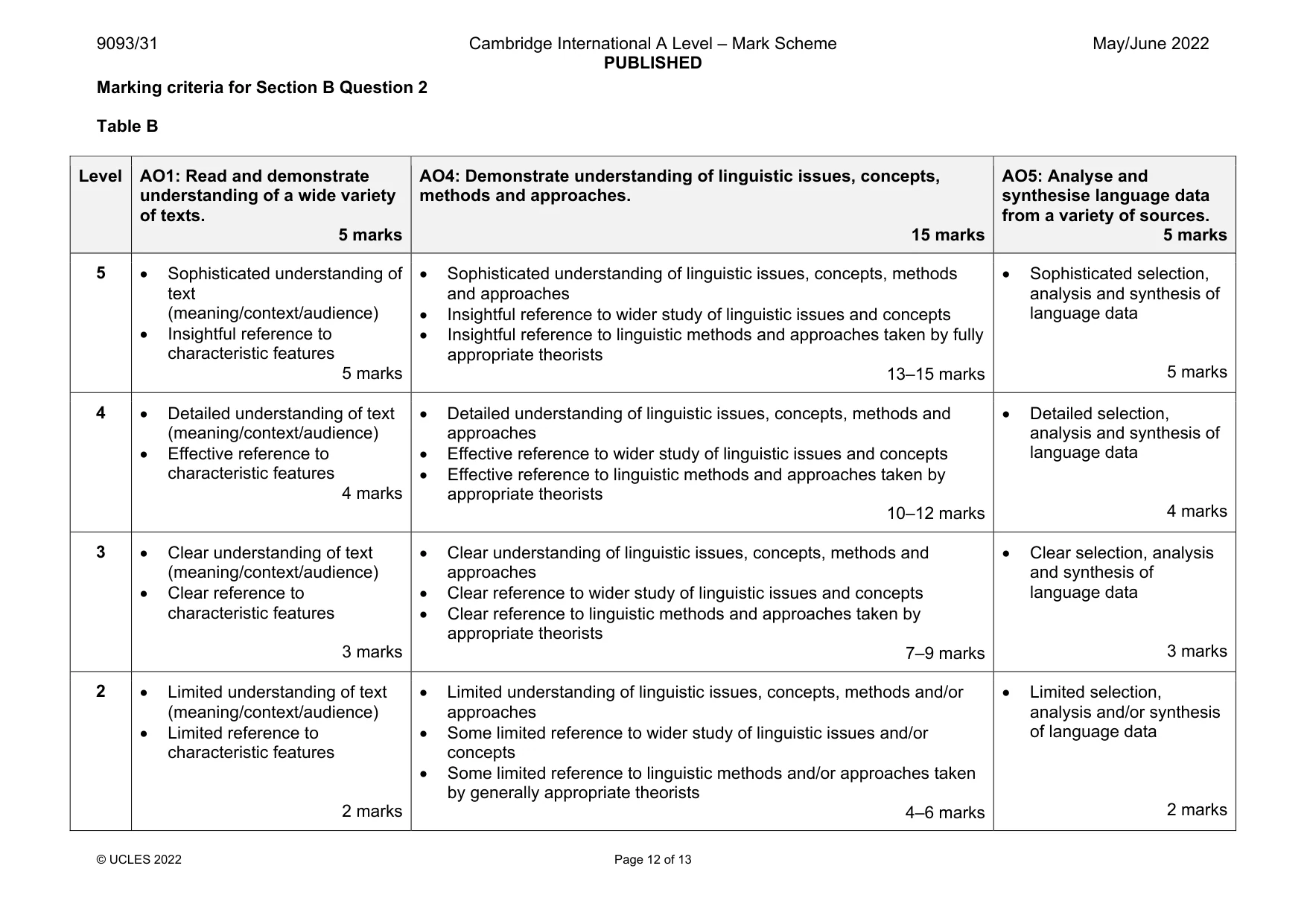
9093/31 Cambridge International A Level – Mark Scheme PUBLISHED May/June 2022 © UCLES 2022 Page 12 of 13 Marking criteria for Section B Question 2 Table B Level AO1: Read and demonstrate understanding of a wide variety of texts. 5 marks AO4: Demonstrate understanding of linguistic issues, concepts, methods and approaches. 15 marks AO5: Analyse and synthesise language data from a variety of sources. 5 marks 5 Sophisticated understanding of text (meaning/context/audience) Insightful reference to characteristic features 5 marks Sophisticated understanding of linguistic issues, concepts, methods and approaches Insightful reference to wider study of linguistic issues and concepts Insightful reference to linguistic methods and approaches taken by fully appropriate theorists 13–15 marks Sophisticated selection, analysis and synthesis of language data 5 marks 4 Detailed understanding of text (meaning/context/audience) Effective reference to characteristic features 4 marks Detailed understanding of linguistic issues, concepts, methods and approaches Effective reference to wider study of linguistic issues and concepts Effective reference to linguistic methods and approaches taken by appropriate theorists 10–12 marks Detailed selection, analysis and synthesis of language data 4 marks 3 Clear understanding of text (meaning/context/audience) Clear reference to characteristic features 3 marks Clear understanding of linguistic issues, concepts, methods and approaches Clear reference to wider study of linguistic issues and concepts Clear reference to linguistic methods and approaches taken by appropriate theorists 7–9 marks Clear selection, analysis and synthesis of language data 3 marks 2 Limited understanding of text (meaning/context/audience) Limited reference to characteristic features 2 marks Limited understanding of linguistic issues, concepts, methods and/or approaches Some limited reference to wider study of linguistic issues and/or concepts Some limited reference to linguistic methods and/or approaches taken by generally appropriate theorists 4–6 marks Limited selection, analysis and/or synthesis of language data 2 marks
Mark scheme, page 13
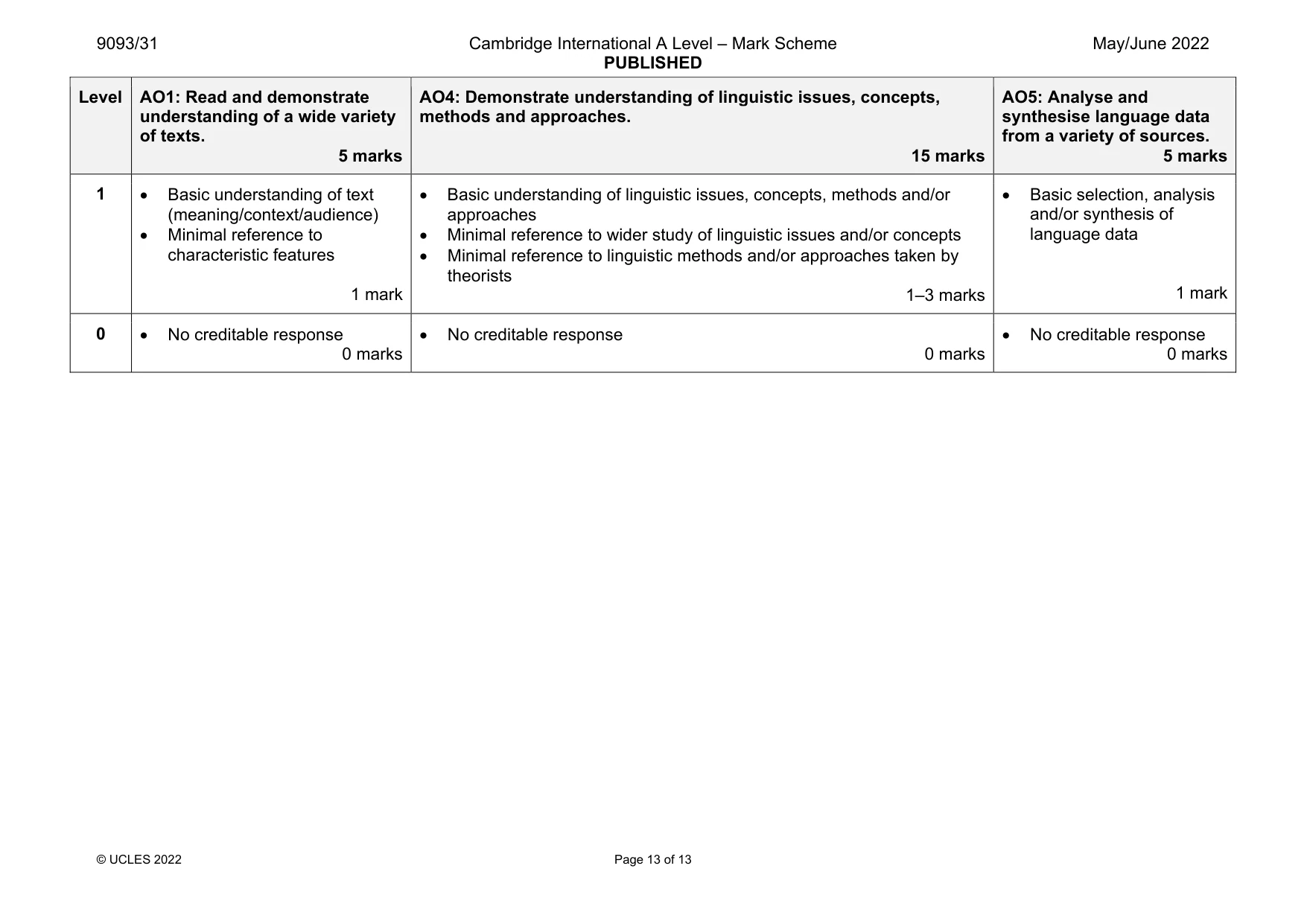
9093/31 Cambridge International A Level – Mark Scheme PUBLISHED May/June 2022 © UCLES 2022 Page 13 of 13 Level AO1: Read and demonstrate understanding of a wide variety of texts. 5 marks AO4: Demonstrate understanding of linguistic issues, concepts, methods and approaches. 15 marks AO5: Analyse and synthesise language data from a variety of sources. 5 marks 1 Basic understanding of text (meaning/context/audience) Minimal reference to characteristic features 1 mark Basic understanding of linguistic issues, concepts, methods and/or approaches Minimal reference to wider study of linguistic issues and/or concepts Minimal reference to linguistic methods and/or approaches taken by theorists 1–3 marks Basic selection, analysis and/or synthesis of language data 1 mark 0 No creditable response 0 marks No creditable response 0 marks No creditable response 0 marks
What you needed in this session
Cambridge’s own grade thresholds for 2022 May/June, Paper 3 · Variant 1. A higher threshold means an easier paper — the bar moves with how the cohort did.