Cambridge A Level English - Language AS and A Level (from 2014) 9093 — 2023 Oct/Nov Paper 4 · Variant 2
9093/42/O/N/23 · 50 marks · ≈56 min
The question paper and its mark scheme, free to read here and free to download. This is Cambridge’s own paper, exactly as it was sat.
Question paper8 pages

Mark scheme8 pages
Answers below. Sit the paper first if you are practising.
Paper as text
Question paper, page 1
This document has 8 pages. Any blank pages are indicated. [Turn over Cambridge International AS & A Level ENGLISH LANGUAGE 9093/42 Paper 4 Language Topics October/November 2023 2 hours 15 minutes You must answer on the enclosed answer booklet. You will need: Answer booklet (enclosed) INSTRUCTIONS ● Answer all questions. ● Follow the instructions on the front cover of the answer booklet. If you need additional answer paper, ask the invigilator for a continuation booklet. ● Dictionaries are not allowed. INFORMATION ● The total mark for this paper is 50. ● The number of marks for each question or part question is shown in brackets [ ]. * 8 9 4 3 4 3 6 3 0 2 * DC (CJ) 319570/5 © UCLES 2023
Question paper, page 2
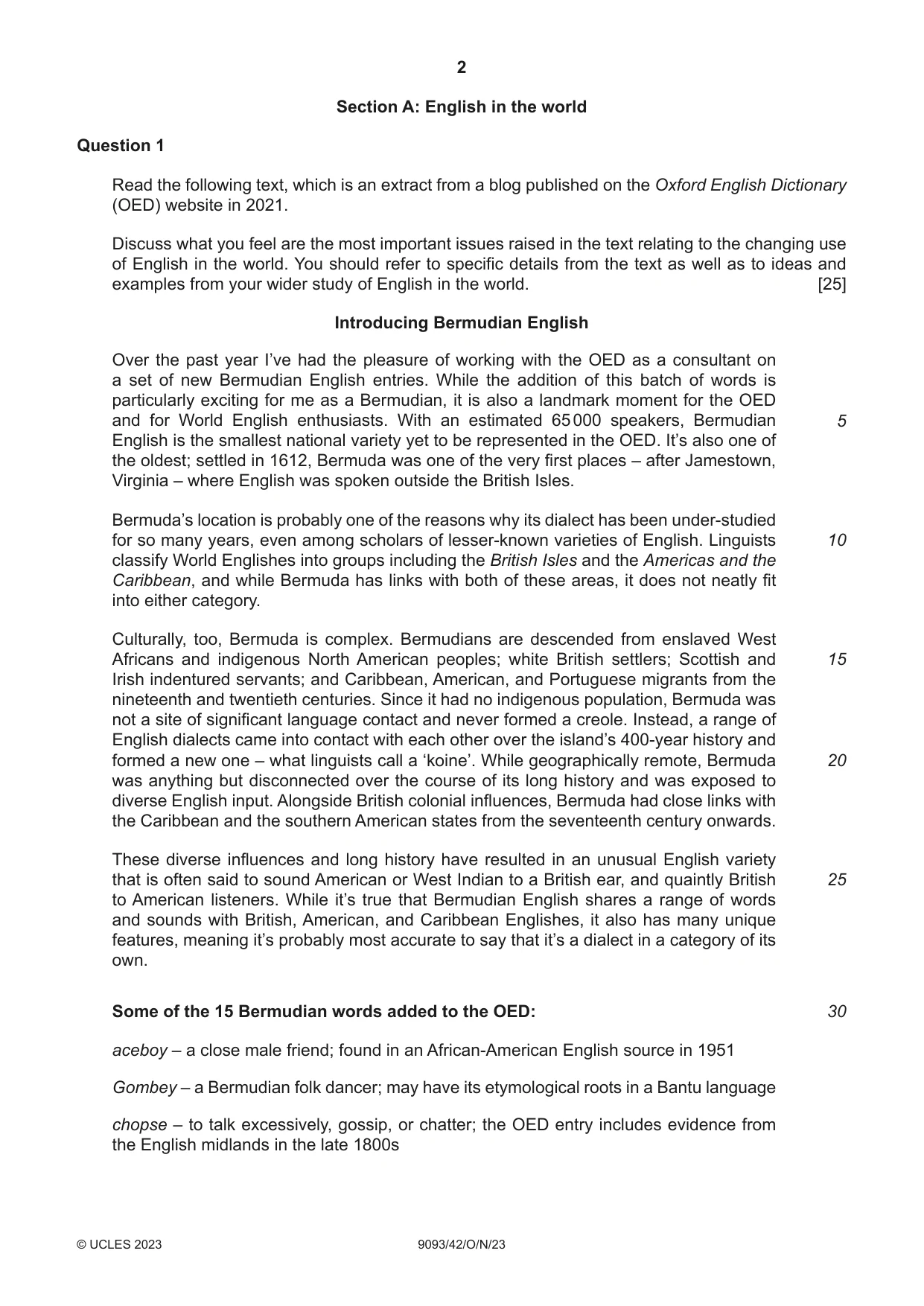
2 9093/42/O/N/23 © UCLES 2023 Section A: English in the world Question 1 Read the following text, which is an extract from a blog published on the Oxford English Dictionary (OED) website in 2021. Discuss what you feel are the most important issues raised in the text relating to the changing use of English in the world. You should refer to specific details from the text as well as to ideas and examples from your wider study of English in the world. [25] Introducing Bermudian English Over the past year I’ve had the pleasure of working with the OED as a consultant on a set of new Bermudian English entries. While the addition of this batch of words is particularly exciting for me as a Bermudian, it is also a landmark moment for the OED and for World English enthusiasts. With an estimated 65 000 speakers, Bermudian English is the smallest national variety yet to be represented in the OED. It’s also one of the oldest; settled in 1612, Bermuda was one of the very first places – after Jamestown, Virginia – where English was spoken outside the British Isles. Bermuda’s location is probably one of the reasons why its dialect has been under-studied for so many years, even among scholars of lesser-known varieties of English. Linguists classify World Englishes into groups including the British Isles and the Americas and the Caribbean, and while Bermuda has links with both of these areas, it does not neatly fit into either category. Culturally, too, Bermuda is complex. Bermudians are descended from enslaved West Africans and indigenous North American peoples; white British settlers; Scottish and Irish indentured servants; and Caribbean, American, and Portuguese migrants from the nineteenth and twentieth centuries. Since it had no indigenous population, Bermuda was not a site of significant language contact and never formed a creole. Instead, a range of English dialects came into contact with each other over the island’s 400-year history and formed a new one – what linguists call a ‘koine’. While geographically remote, Bermuda was anything but disconnected over the course of its long history and was exposed to diverse English input. Alongside British colonial influences, Bermuda had close links with the Caribbean and the southern American states from the seventeenth century onwards. These diverse influences and long history have resulted in an unusual English variety that is often said to sound American or West Indian to a British ear, and quaintly British to American listeners. While it’s true that Bermudian English shares a range of words and sounds with British, American, and Caribbean Englishes, it also has many unique features, meaning it’s probably most accurate to say that it’s a dialect in a category of its own. Some of the 15 Bermudian words added to the OED: aceboy – a close male friend; found in an African-American English source in 1951 Gombey – a Bermudian folk dancer; may have its etymological roots in a Bantu language chopse – to talk excessively, gossip, or chatter; the OED entry includes evidence from the English midlands in the late 1800s 5 10 15 20 25 30
Question paper, page 3
3 9093/42/O/N/23 © UCLES 2023 [Turn over wrinched – scolded; one of the youngest Bermudian words, with the earliest quotation coming from Twitter in 2009 Onion – a term for a Bermudian; derived from the major export crop from the 1800s until the early twentieth century. 35
Question paper, page 4
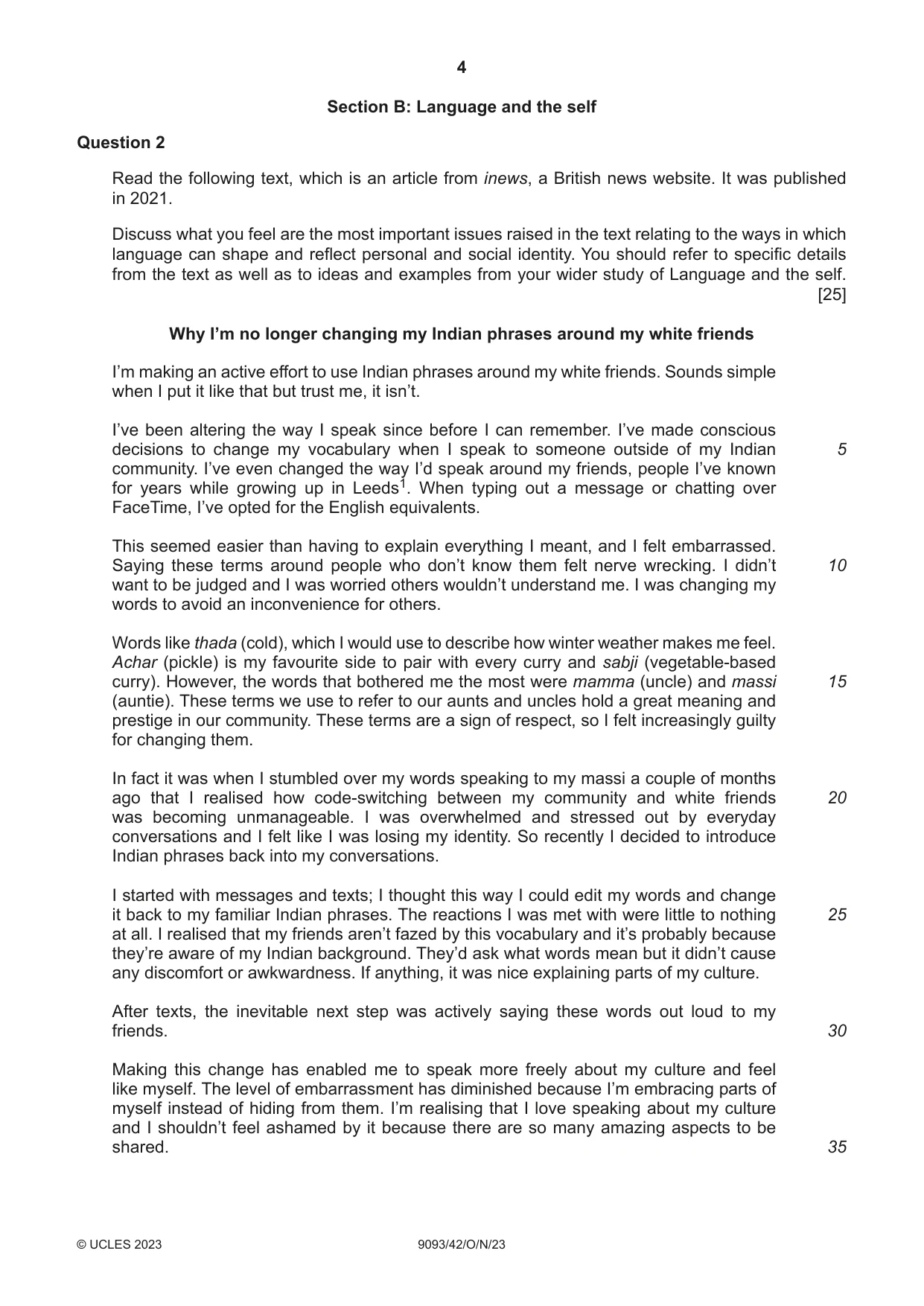
4 9093/42/O/N/23 © UCLES 2023 Section B: Language and the self Question 2 Read the following text, which is an article from inews, a British news website. It was published in 2021. Discuss what you feel are the most important issues raised in the text relating to the ways in which language can shape and reflect personal and social identity. You should refer to specific details from the text as well as to ideas and examples from your wider study of Language and the self. [25] Why I’m no longer changing my Indian phrases around my white friends I’m making an active effort to use Indian phrases around my white friends. Sounds simple when I put it like that but trust me, it isn’t. I’ve been altering the way I speak since before I can remember. I’ve made conscious decisions to change my vocabulary when I speak to someone outside of my Indian community. I’ve even changed the way I’d speak around my friends, people I’ve known for years while growing up in Leeds1. When typing out a message or chatting over FaceTime, I’ve opted for the English equivalents. This seemed easier than having to explain everything I meant, and I felt embarrassed. Saying these terms around people who don’t know them felt nerve wrecking. I didn’t want to be judged and I was worried others wouldn’t understand me. I was changing my words to avoid an inconvenience for others. Words like thada (cold), which I would use to describe how winter weather makes me feel. Achar (pickle) is my favourite side to pair with every curry and sabji (vegetable-based curry). However, the words that bothered me the most were mamma (uncle) and massi (auntie). These terms we use to refer to our aunts and uncles hold a great meaning and prestige in our community. These terms are a sign of respect, so I felt increasingly guilty for changing them. In fact it was when I stumbled over my words speaking to my massi a couple of months ago that I realised how code-switching between my community and white friends was becoming unmanageable. I was overwhelmed and stressed out by everyday conversations and I felt like I was losing my identity. So recently I decided to introduce Indian phrases back into my conversations. I started with messages and texts; I thought this way I could edit my words and change it back to my familiar Indian phrases. The reactions I was met with were little to nothing at all. I realised that my friends aren’t fazed by this vocabulary and it’s probably because they’re aware of my Indian background. They’d ask what words mean but it didn’t cause any discomfort or awkwardness. If anything, it was nice explaining parts of my culture. After texts, the inevitable next step was actively saying these words out loud to my friends. Making this change has enabled me to speak more freely about my culture and feel like myself. The level of embarrassment has diminished because I’m embracing parts of myself instead of hiding from them. I’m realising that I love speaking about my culture and I shouldn’t feel ashamed by it because there are so many amazing aspects to be shared. 5 10 15 20 25 30 35
Question paper, page 5
5 9093/42/O/N/23 © UCLES 2023 We need to normalise the use of phrases that come from our backgrounds because they’re a part of us. We should be proud of our identities, not hide away from being ourselves. There are so many communities that exist around us; instead of changing to fit into one, we need to acknowledge that there’s so much more out there. 1Leeds: a city in England
Question paper, page 6
6 9093/42/O/N/23 © UCLES 2023 BLANK PAGE
Question paper, page 7
7 9093/42/O/N/23 © UCLES 2023 BLANK PAGE
Question paper, page 8
8 9093/42/O/N/23 © UCLES 2023 Permission to reproduce items where third-party owned material protected by copyright is included has been sought and cleared where possible. Every reasonable effort has been made by the publisher (UCLES) to trace copyright holders, but if any items requiring clearance have unwittingly been included, the publisher will be pleased to make amends at the earliest possible opportunity. To avoid the issue of disclosure of answer-related information to candidates, all copyright acknowledgements are reproduced online in the Cambridge Assessment International Education Copyright Acknowledgements Booklet. This is produced for each series of examinations and is freely available to download at www.cambridgeinternational.org after the live examination series. Cambridge Assessment International Education is part of Cambridge Assessment. Cambridge Assessment is the brand name of the University of Cambridge Local Examinations Syndicate (UCLES), which is a department of the University of Cambridge. BLANK PAGE
Mark scheme, page 1
This document consists of 8 printed pages. © UCLES 2023 [Turn over Cambridge International A Level ENGLISH LANGUAGE 9093/42 Paper 4 Language Topics October/November 2023 MARK SCHEME Maximum Mark: 50 Published This mark scheme is published as an aid to teachers and candidates, to indicate the requirements of the examination. It shows the basis on which Examiners were instructed to award marks. It does not indicate the details of the discussions that took place at an Examiners’ meeting before marking began, which would have considered the acceptability of alternative answers. Mark schemes should be read in conjunction with the question paper and the Principal Examiner Report for Teachers. Cambridge International will not enter into discussions about these mark schemes. Cambridge International is publishing the mark schemes for the October/November 2023 series for most Cambridge IGCSE, Cambridge International A and AS Level components, and some Cambridge O Level components.
Mark scheme, page 2
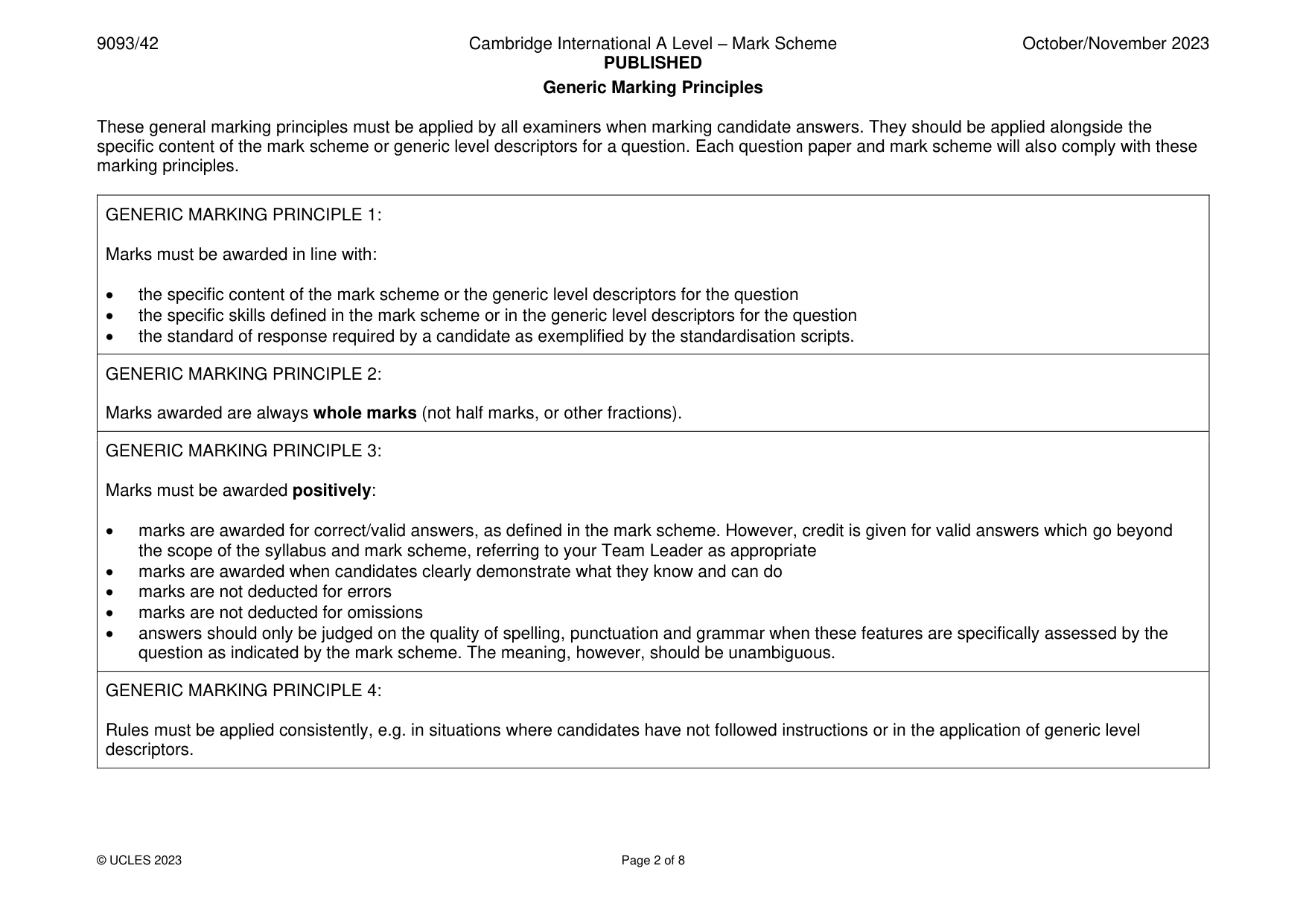
9093/42 Cambridge International A Level – Mark Scheme PUBLISHED October/November 2023 © UCLES 2023 Page 2 of 8 Generic Marking Principles These general marking principles must be applied by all examiners when marking candidate answers. They should be applied alongside the specific content of the mark scheme or generic level descriptors for a question. Each question paper and mark scheme will also comply with these marking principles. GENERIC MARKING PRINCIPLE 1: Marks must be awarded in line with: • the specific content of the mark scheme or the generic level descriptors for the question • the specific skills defined in the mark scheme or in the generic level descriptors for the question • the standard of response required by a candidate as exemplified by the standardisation scripts. GENERIC MARKING PRINCIPLE 2: Marks awarded are always whole marks (not half marks, or other fractions). GENERIC MARKING PRINCIPLE 3: Marks must be awarded positively: • marks are awarded for correct/valid answers, as defined in the mark scheme. However, credit is given for valid answers which go beyond the scope of the syllabus and mark scheme, referring to your Team Leader as appropriate • marks are awarded when candidates clearly demonstrate what they know and can do • marks are not deducted for errors • marks are not deducted for omissions • answers should only be judged on the quality of spelling, punctuation and grammar when these features are specifically assessed by the question as indicated by the mark scheme. The meaning, however, should be unambiguous. GENERIC MARKING PRINCIPLE 4: Rules must be applied consistently, e.g. in situations where candidates have not followed instructions or in the application of generic level descriptors.
Mark scheme, page 3
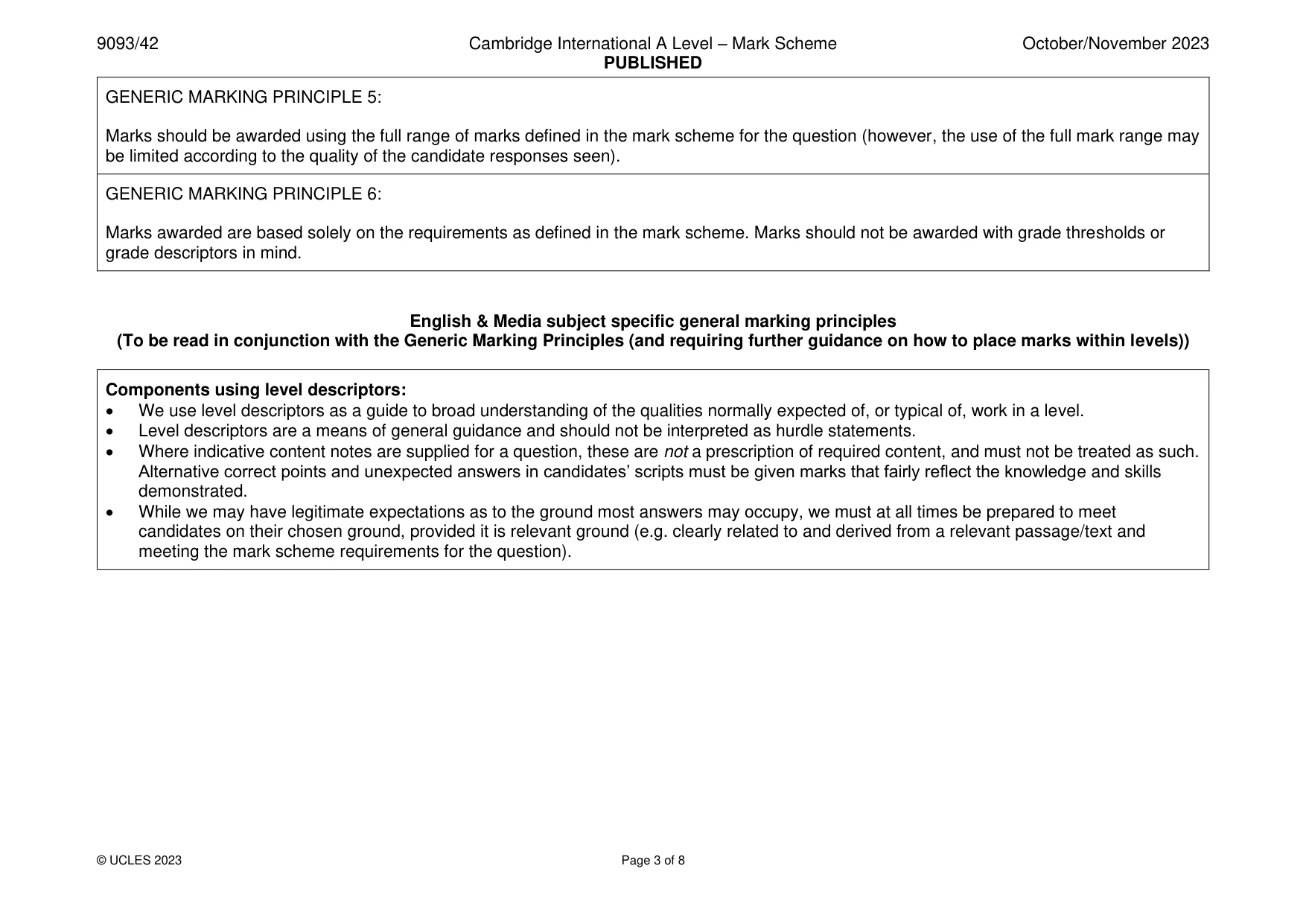
9093/42 Cambridge International A Level – Mark Scheme PUBLISHED October/November 2023 © UCLES 2023 Page 3 of 8 GENERIC MARKING PRINCIPLE 5: Marks should be awarded using the full range of marks defined in the mark scheme for the question (however, the use of the full mark range may be limited according to the quality of the candidate responses seen). GENERIC MARKING PRINCIPLE 6: Marks awarded are based solely on the requirements as defined in the mark scheme. Marks should not be awarded with grade thresholds or grade descriptors in mind. English & Media subject specific general marking principles (To be read in conjunction with the Generic Marking Principles (and requiring further guidance on how to place marks within levels)) Components using level descriptors: • We use level descriptors as a guide to broad understanding of the qualities normally expected of, or typical of, work in a level. • Level descriptors are a means of general guidance and should not be interpreted as hurdle statements. • Where indicative content notes are supplied for a question, these are not a prescription of required content, and must not be treated as such. Alternative correct points and unexpected answers in candidates’ scripts must be given marks that fairly reflect the knowledge and skills demonstrated. • While we may have legitimate expectations as to the ground most answers may occupy, we must at all times be prepared to meet candidates on their chosen ground, provided it is relevant ground (e.g. clearly related to and derived from a relevant passage/text and meeting the mark scheme requirements for the question).
Mark scheme, page 4
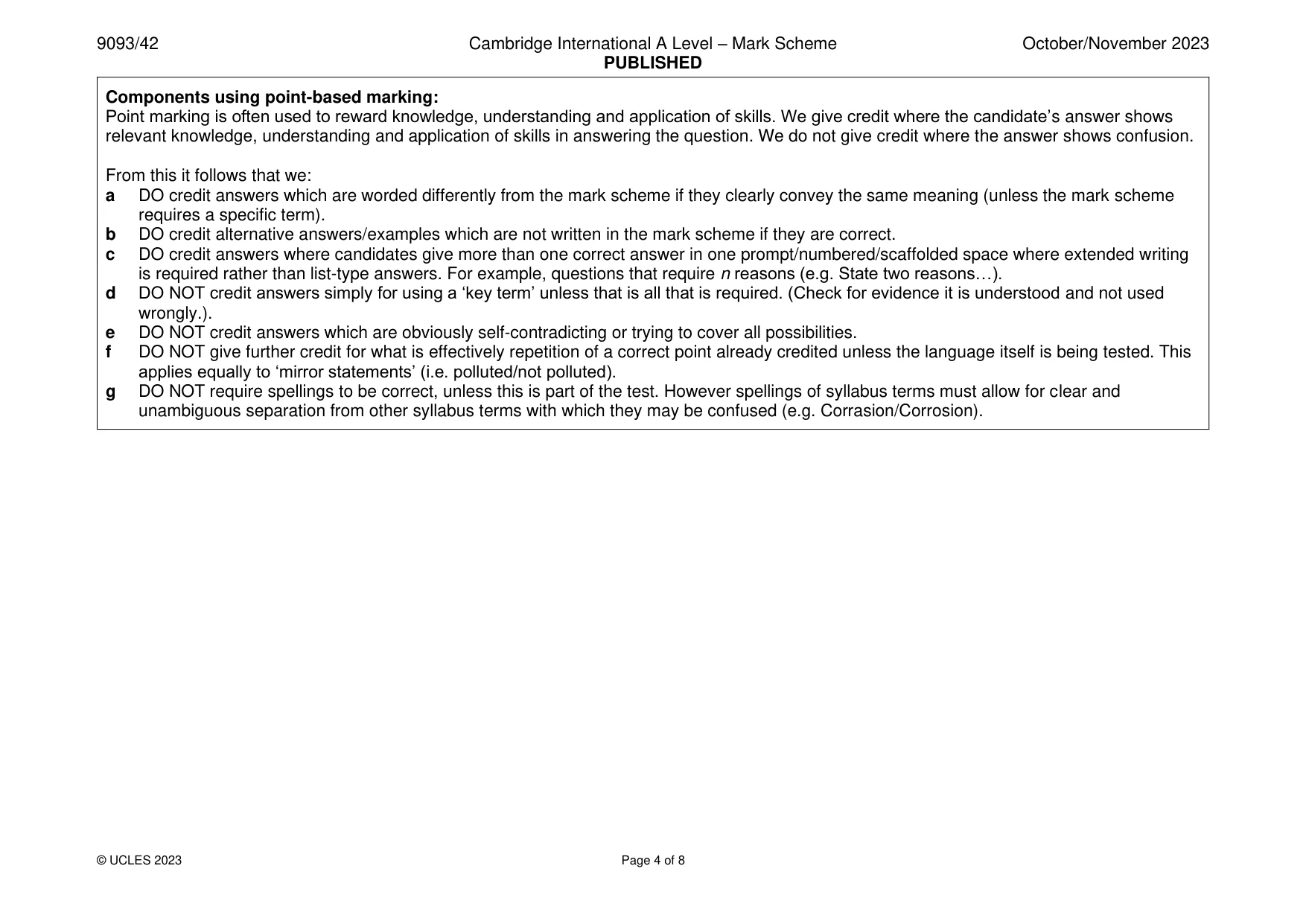
9093/42 Cambridge International A Level – Mark Scheme PUBLISHED October/November 2023 © UCLES 2023 Page 4 of 8 Components using point-based marking: Point marking is often used to reward knowledge, understanding and application of skills. We give credit where the candidate’s answer shows relevant knowledge, understanding and application of skills in answering the question. We do not give credit where the answer shows confusion. From this it follows that we: a DO credit answers which are worded differently from the mark scheme if they clearly convey the same meaning (unless the mark scheme requires a specific term). b DO credit alternative answers/examples which are not written in the mark scheme if they are correct. c DO credit answers where candidates give more than one correct answer in one prompt/numbered/scaffolded space where extended writing is required rather than list-type answers. For example, questions that require n reasons (e.g. State two reasons…). d DO NOT credit answers simply for using a ‘key term’ unless that is all that is required. (Check for evidence it is understood and not used wrongly.). e DO NOT credit answers which are obviously self-contradicting or trying to cover all possibilities. f DO NOT give further credit for what is effectively repetition of a correct point already credited unless the language itself is being tested. This applies equally to ‘mirror statements’ (i.e. polluted/not polluted). g DO NOT require spellings to be correct, unless this is part of the test. However spellings of syllabus terms must allow for clear and unambiguous separation from other syllabus terms with which they may be confused (e.g. Corrasion/Corrosion).
Mark scheme, page 5
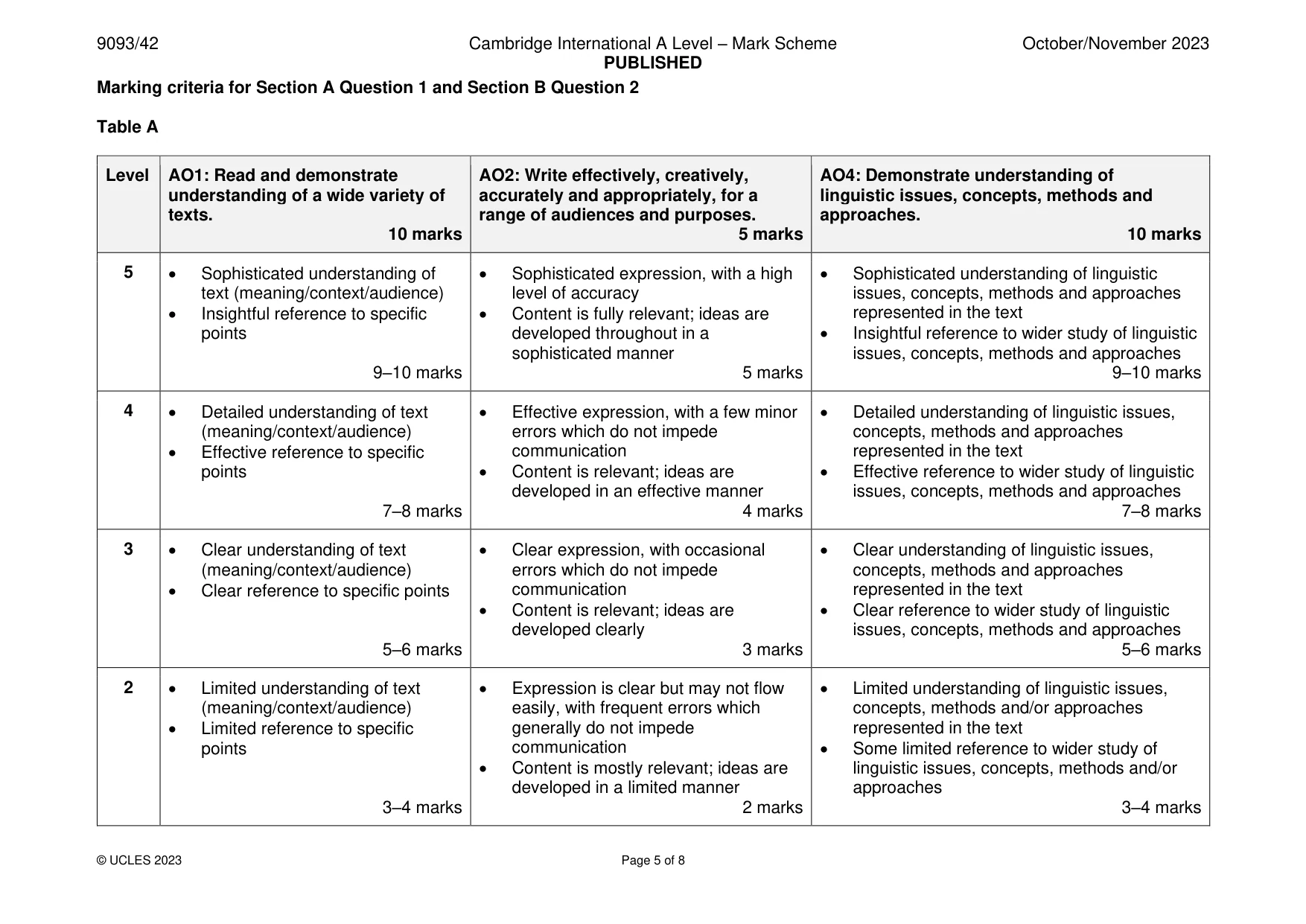
9093/42 Cambridge International A Level – Mark Scheme PUBLISHED October/November 2023 © UCLES 2023 Page 5 of 8 Marking criteria for Section A Question 1 and Section B Question 2 Table A Level AO1: Read and demonstrate understanding of a wide variety of texts. 10 marks AO2: Write effectively, creatively, accurately and appropriately, for a range of audiences and purposes. 5 marks AO4: Demonstrate understanding of linguistic issues, concepts, methods and approaches. 10 marks 5 • Sophisticated understanding of text (meaning/context/audience) • Insightful reference to specific points 9–10 marks • Sophisticated expression, with a high level of accuracy • Content is fully relevant; ideas are developed throughout in a sophisticated manner 5 marks • Sophisticated understanding of linguistic issues, concepts, methods and approaches represented in the text • Insightful reference to wider study of linguistic issues, concepts, methods and approaches 9–10 marks 4 • Detailed understanding of text (meaning/context/audience) • Effective reference to specific points 7–8 marks • Effective expression, with a few minor errors which do not impede communication • Content is relevant; ideas are developed in an effective manner 4 marks • Detailed understanding of linguistic issues, concepts, methods and approaches represented in the text • Effective reference to wider study of linguistic issues, concepts, methods and approaches 7–8 marks 3 • Clear understanding of text (meaning/context/audience) • Clear reference to specific points 5–6 marks • Clear expression, with occasional errors which do not impede communication • Content is relevant; ideas are developed clearly 3 marks • Clear understanding of linguistic issues, concepts, methods and approaches represented in the text • Clear reference to wider study of linguistic issues, concepts, methods and approaches 5–6 marks 2 • Limited understanding of text (meaning/context/audience) • Limited reference to specific points 3–4 marks • Expression is clear but may not flow easily, with frequent errors which generally do not impede communication • Content is mostly relevant; ideas are developed in a limited manner 2 marks • Limited understanding of linguistic issues, concepts, methods and/or approaches represented in the text • Some limited reference to wider study of linguistic issues, concepts, methods and/or approaches 3–4 marks
Mark scheme, page 6
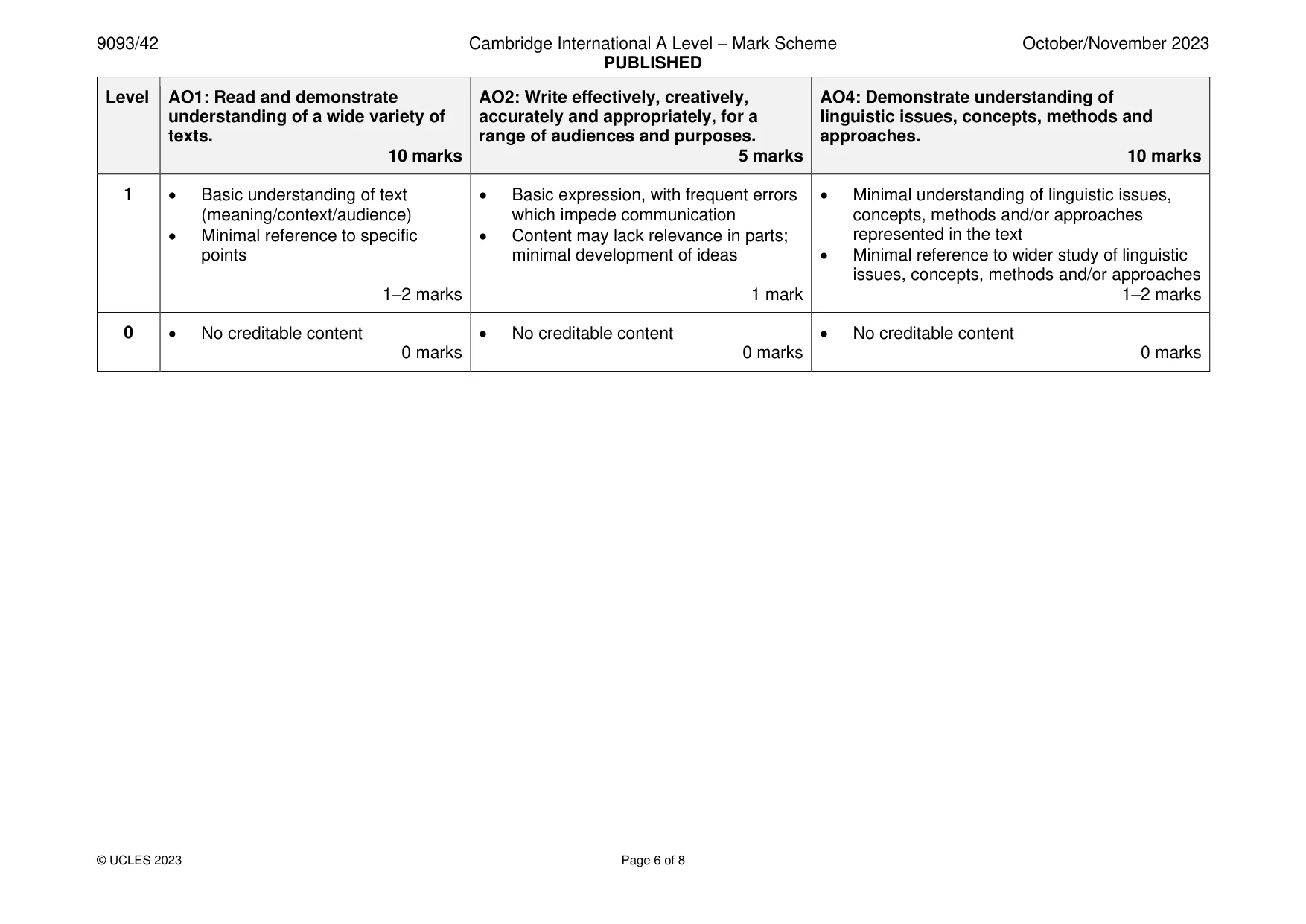
9093/42 Cambridge International A Level – Mark Scheme PUBLISHED October/November 2023 © UCLES 2023 Page 6 of 8 Level AO1: Read and demonstrate understanding of a wide variety of texts. 10 marks AO2: Write effectively, creatively, accurately and appropriately, for a range of audiences and purposes. 5 marks AO4: Demonstrate understanding of linguistic issues, concepts, methods and approaches. 10 marks 1 • Basic understanding of text (meaning/context/audience) • Minimal reference to specific points 1–2 marks • Basic expression, with frequent errors which impede communication • Content may lack relevance in parts; minimal development of ideas 1 mark • Minimal understanding of linguistic issues, concepts, methods and/or approaches represented in the text • Minimal reference to wider study of linguistic issues, concepts, methods and/or approaches 1–2 marks 0 • No creditable content 0 marks • No creditable content 0 marks • No creditable content 0 marks
Mark scheme, page 7
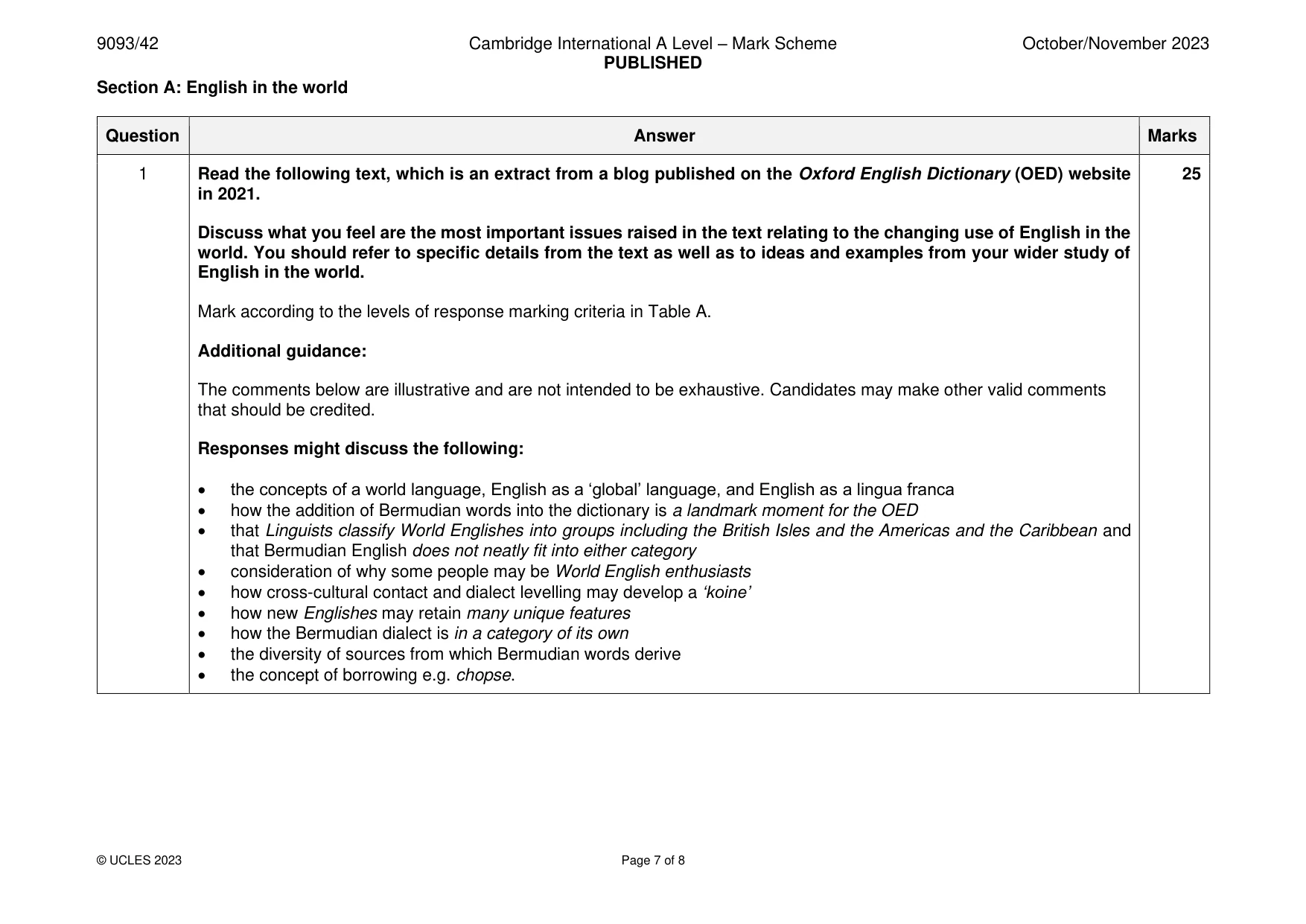
9093/42 Cambridge International A Level – Mark Scheme PUBLISHED October/November 2023 © UCLES 2023 Page 7 of 8 Section A: English in the world Question Answer Marks 1 Read the following text, which is an extract from a blog published on the Oxford English Dictionary (OED) website in 2021. Discuss what you feel are the most important issues raised in the text relating to the changing use of English in the world. You should refer to specific details from the text as well as to ideas and examples from your wider study of English in the world. Mark according to the levels of response marking criteria in Table A. Additional guidance: The comments below are illustrative and are not intended to be exhaustive. Candidates may make other valid comments that should be credited. Responses might discuss the following: • the concepts of a world language, English as a ‘global’ language, and English as a lingua franca • how the addition of Bermudian words into the dictionary is a landmark moment for the OED • that Linguists classify World Englishes into groups including the British Isles and the Americas and the Caribbean and that Bermudian English does not neatly fit into either category • consideration of why some people may be World English enthusiasts • how cross-cultural contact and dialect levelling may develop a ‘koine’ • how new Englishes may retain many unique features • how the Bermudian dialect is in a category of its own • the diversity of sources from which Bermudian words derive • the concept of borrowing e.g. chopse. 25
Mark scheme, page 8
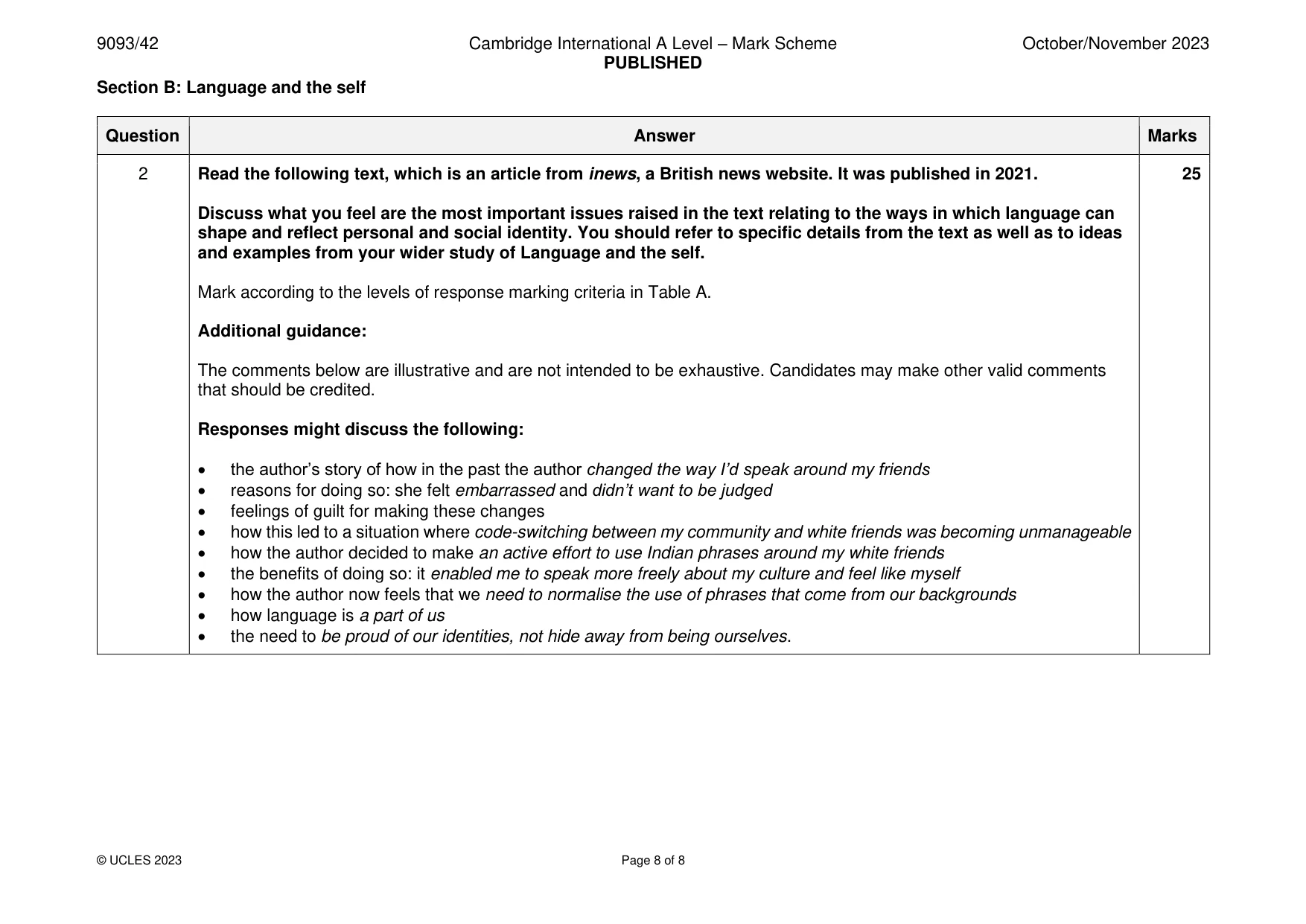
9093/42 Cambridge International A Level – Mark Scheme PUBLISHED October/November 2023 © UCLES 2023 Page 8 of 8 Section B: Language and the self Question Answer Marks 2 Read the following text, which is an article from inews, a British news website. It was published in 2021. Discuss what you feel are the most important issues raised in the text relating to the ways in which language can shape and reflect personal and social identity. You should refer to specific details from the text as well as to ideas and examples from your wider study of Language and the self. Mark according to the levels of response marking criteria in Table A. Additional guidance: The comments below are illustrative and are not intended to be exhaustive. Candidates may make other valid comments that should be credited. Responses might discuss the following: • the author’s story of how in the past the author changed the way I’d speak around my friends • reasons for doing so: she felt embarrassed and didn’t want to be judged • feelings of guilt for making these changes • how this led to a situation where code-switching between my community and white friends was becoming unmanageable • how the author decided to make an active effort to use Indian phrases around my white friends • the benefits of doing so: it enabled me to speak more freely about my culture and feel like myself • how the author now feels that we need to normalise the use of phrases that come from our backgrounds • how language is a part of us • the need to be proud of our identities, not hide away from being ourselves. 25
What you needed in this session
Cambridge’s own grade thresholds for 2023 Oct/Nov, Paper 4 · Variant 2. A higher threshold means an easier paper — the bar moves with how the cohort did.