Cambridge A Level English - Language AS and A Level (from 2014) 9093 — 2023 Oct/Nov Paper 4 · Variant 3
9093/43/O/N/23 · 50 marks · ≈56 min
The question paper and its mark scheme, free to read here and free to download. This is Cambridge’s own paper, exactly as it was sat.
Question paper8 pages




Mark scheme8 pages
Answers below. Sit the paper first if you are practising.
Paper as text
Question paper, page 1
This document has 8 pages. Any blank pages are indicated. [Turn over * 4 7 8 1 1 4 9 0 2 1 * Cambridge International AS & A Level DC (DE) 336446/3 © UCLES 2023 ENGLISH LANGUAGE 9093/43 Paper 4 Language Topics October/November 2023 2 hours 15 minutes You must answer on the enclosed answer booklet. You will need: Answer booklet (enclosed) INSTRUCTIONS ● Answer all questions. ● Follow the instructions on the front cover of the answer booklet. If you need additional answer paper, ask the invigilator for a continuation booklet. ● Dictionaries are not allowed. INFORMATION ● The total mark for this paper is 50. ● The number of marks for each question or part question is shown in brackets [ ].
Question paper, page 2
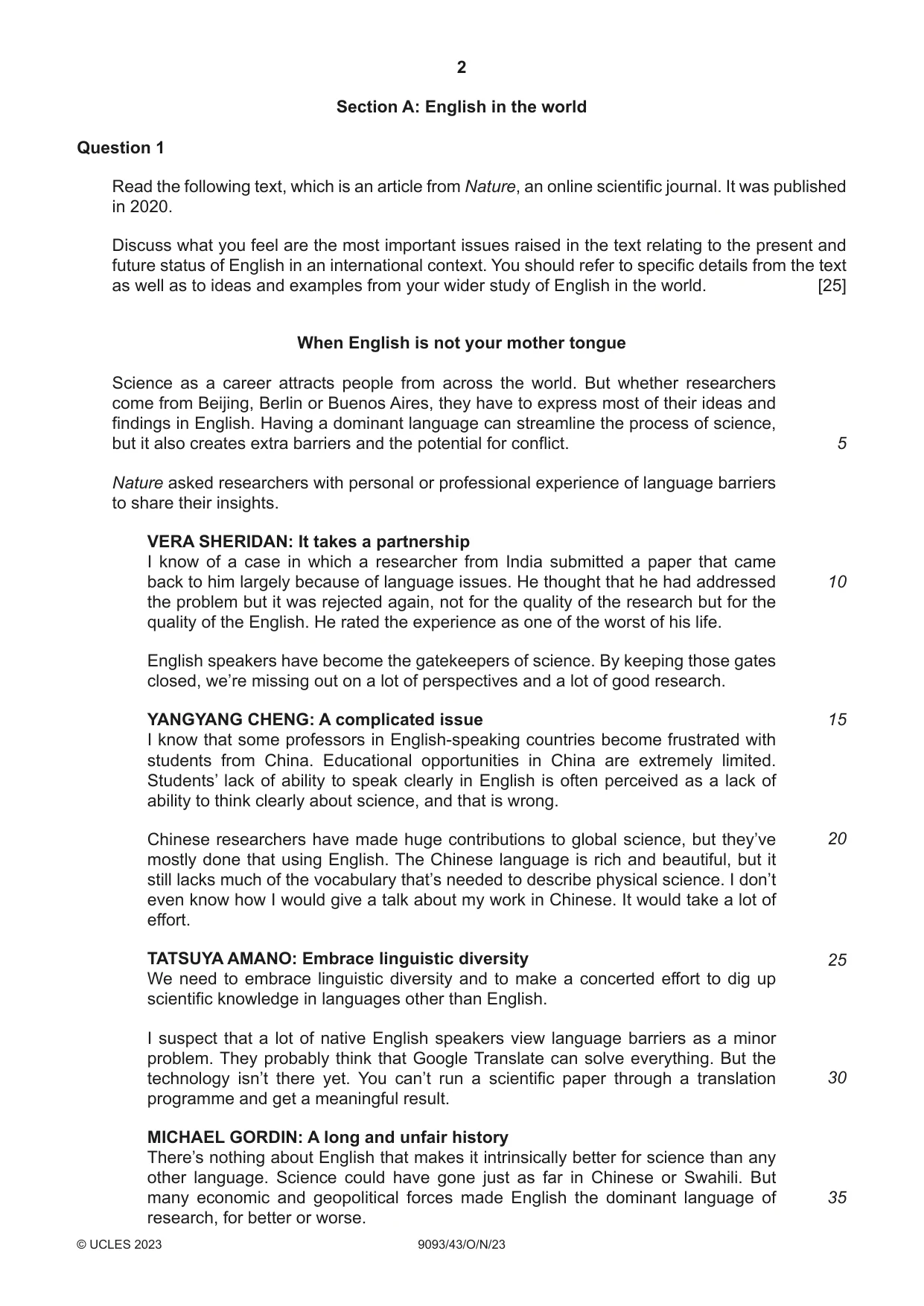
2 9093/43/O/N/23 © UCLES 2023 Section A: English in the world Question 1 Read the following text, which is an article from Nature, an online scientific journal. It was published in 2020. Discuss what you feel are the most important issues raised in the text relating to the present and future status of English in an international context. You should refer to specific details from the text as well as to ideas and examples from your wider study of English in the world. [25] When English is not your mother tongue Science as a career attracts people from across the world. But whether researchers come from Beijing, Berlin or Buenos Aires, they have to express most of their ideas and findings in English. Having a dominant language can streamline the process of science, but it also creates extra barriers and the potential for conflict. Nature asked researchers with personal or professional experience of language barriers to share their insights. VERA SHERIDAN: It takes a partnership I know of a case in which a researcher from India submitted a paper that came back to him largely because of language issues. He thought that he had addressed the problem but it was rejected again, not for the quality of the research but for the quality of the English. He rated the experience as one of the worst of his life. English speakers have become the gatekeepers of science. By keeping those gates closed, we’re missing out on a lot of perspectives and a lot of good research. YANGYANG CHENG: A complicated issue I know that some professors in English-speaking countries become frustrated with students from China. Educational opportunities in China are extremely limited. Students’ lack of ability to speak clearly in English is often perceived as a lack of ability to think clearly about science, and that is wrong. Chinese researchers have made huge contributions to global science, but they’ve mostly done that using English. The Chinese language is rich and beautiful, but it still lacks much of the vocabulary that’s needed to describe physical science. I don’t even know how I would give a talk about my work in Chinese. It would take a lot of effort. TATSUYA AMANO: Embrace linguistic diversity We need to embrace linguistic diversity and to make a concerted effort to dig up scientific knowledge in languages other than English. I suspect that a lot of native English speakers view language barriers as a minor problem. They probably think that Google Translate can solve everything. But the technology isn’t there yet. You can’t run a scientific paper through a translation programme and get a meaningful result. MICHAEL GORDIN: A long and unfair history There’s nothing about English that makes it intrinsically better for science than any other language. Science could have gone just as far in Chinese or Swahili. But many economic and geopolitical forces made English the dominant language of research, for better or worse. 5 10 15 20 25 30 35
Question paper, page 3
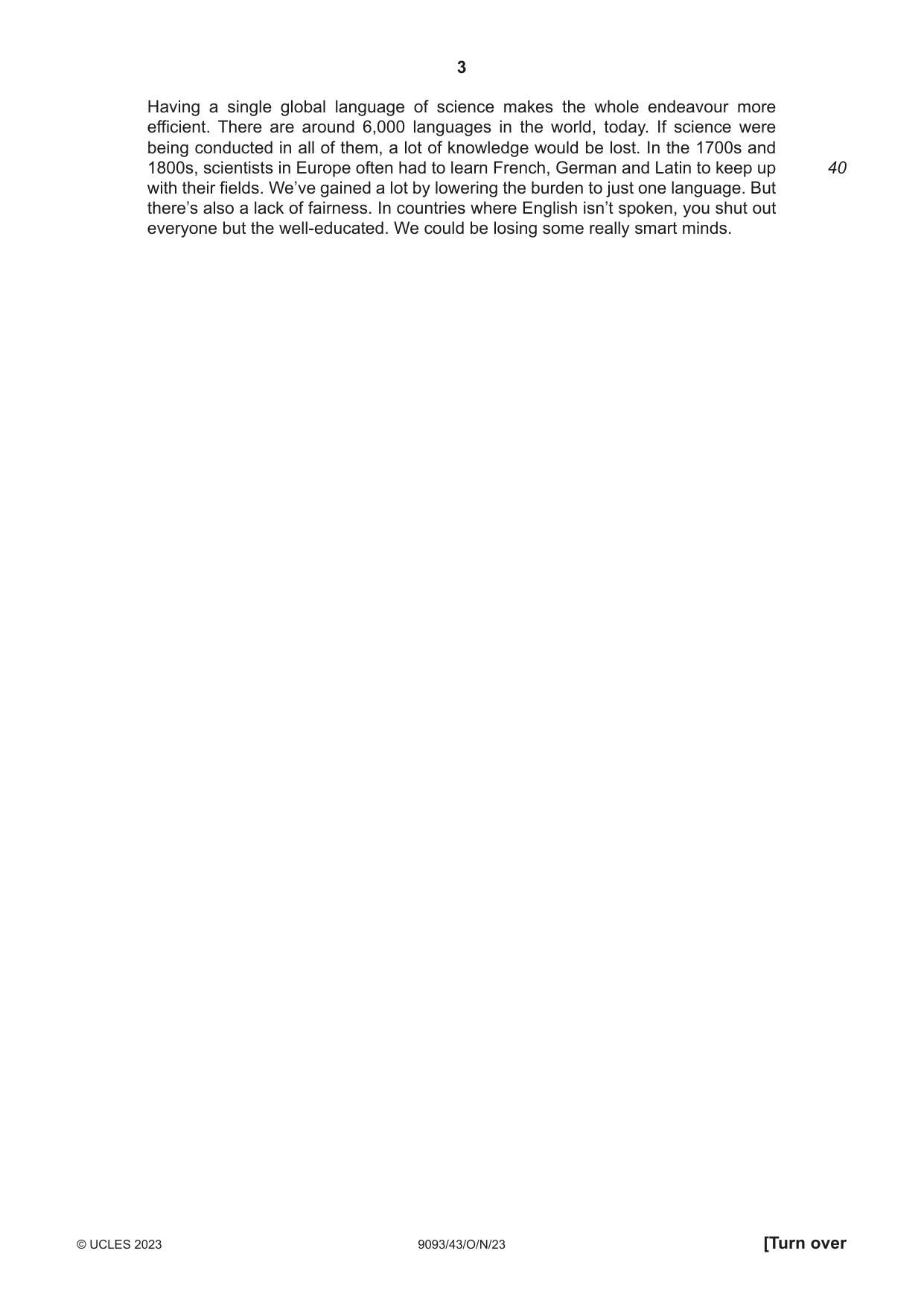
3 9093/43/O/N/23 © UCLES 2023 [Turn over Having a single global language of science makes the whole endeavour more efficient. There are around 6,000 languages in the world, today. If science were being conducted in all of them, a lot of knowledge would be lost. In the 1700s and 1800s, scientists in Europe often had to learn French, German and Latin to keep up with their fields. We’ve gained a lot by lowering the burden to just one language. But there’s also a lack of fairness. In countries where English isn’t spoken, you shut out everyone but the well-educated. We could be losing some really smart minds. 40
Question paper, page 4
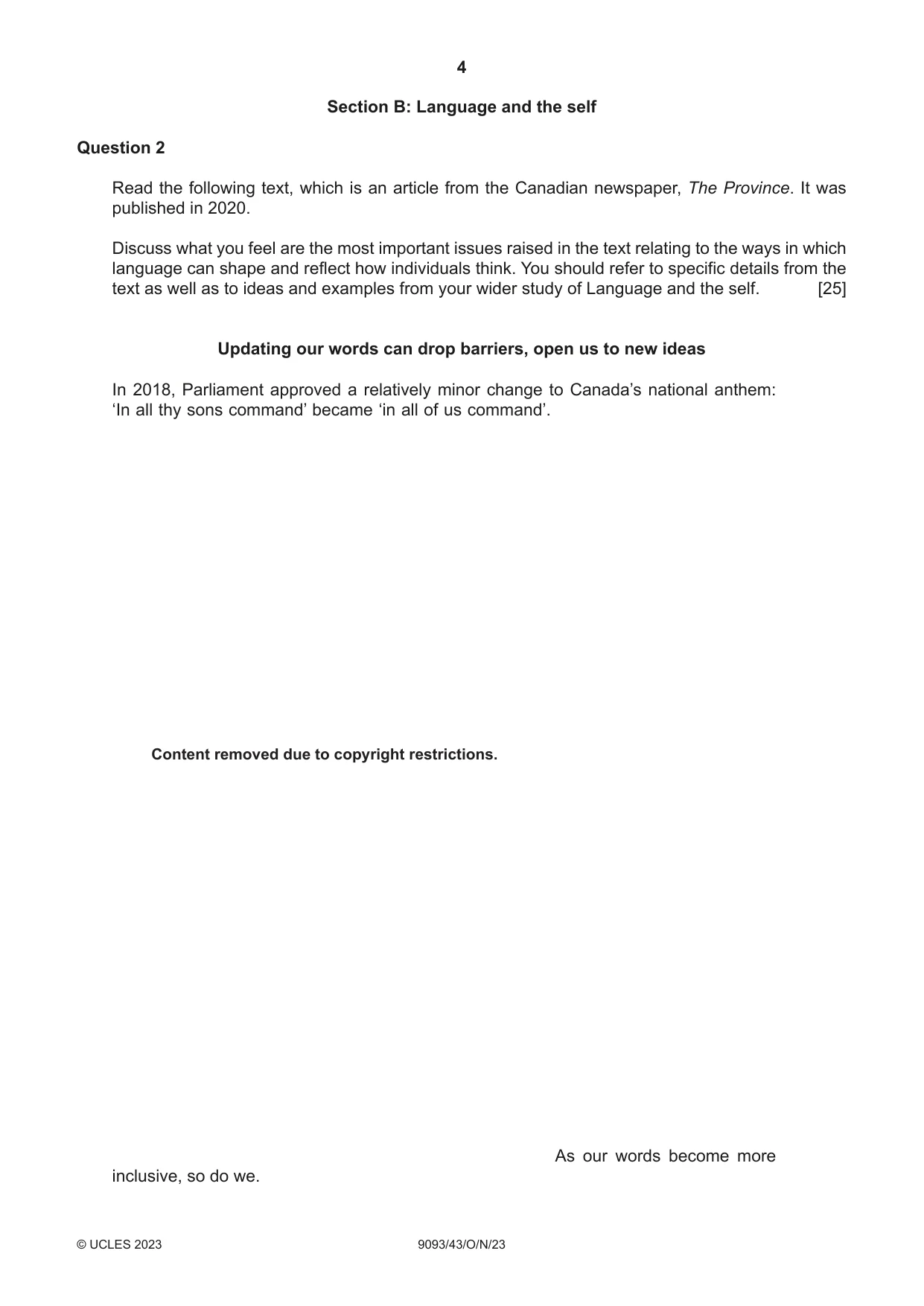
4 9093/43/O/N/23 © UCLES 2023 Section B: Language and the self Question 2 Read the following text, which is an article from the Canadian newspaper, The Province. It was published in 2020. Discuss what you feel are the most important issues raised in the text relating to the ways in which language can shape and reflect how individuals think. You should refer to specific details from the text as well as to ideas and examples from your wider study of Language and the self. [25] Updating our words can drop barriers, open us to new ideas In 2018, Parliament approved a relatively minor change to Canada’s national anthem: ‘In all thy sons command’ became ‘in all of us command’. As our words become more inclusive, so do we. Content removed due to copyright restrictions.
Question paper, page 5
5 9093/43/O/N/23 © UCLES 2023 BLANK PAGE
Question paper, page 6
6 9093/43/O/N/23 © UCLES 2023 BLANK PAGE
Question paper, page 7
7 9093/43/O/N/23 © UCLES 2023 BLANK PAGE
Question paper, page 8
8 9093/43/O/N/23 © UCLES 2023 Permission to reproduce items where third-party owned material protected by copyright is included has been sought and cleared where possible. Every reasonable effort has been made by the publisher (UCLES) to trace copyright holders, but if any items requiring clearance have unwittingly been included, the publisher will be pleased to make amends at the earliest possible opportunity. To avoid the issue of disclosure of answer-related information to candidates, all copyright acknowledgements are reproduced online in the Cambridge Assessment International Education Copyright Acknowledgements Booklet. This is produced for each series of examinations and is freely available to download at www.cambridgeinternational.org after the live examination series. Cambridge Assessment International Education is part of Cambridge Assessment. Cambridge Assessment is the brand name of the University of Cambridge Local Examinations Syndicate (UCLES), which is a department of the University of Cambridge. BLANK PAGE
Mark scheme, page 1
This document consists of 8 printed pages. © UCLES 2023 [Turn over Cambridge International A Level ENGLISH LANGUAGE 9093/43 Paper 4 Language Topics October/November 2023 MARK SCHEME Maximum Mark: 50 Published This mark scheme is published as an aid to teachers and candidates, to indicate the requirements of the examination. It shows the basis on which Examiners were instructed to award marks. It does not indicate the details of the discussions that took place at an Examiners’ meeting before marking began, which would have considered the acceptability of alternative answers. Mark schemes should be read in conjunction with the question paper and the Principal Examiner Report for Teachers. Cambridge International will not enter into discussions about these mark schemes. Cambridge International is publishing the mark schemes for the October/November 2023 series for most Cambridge IGCSE, Cambridge International A and AS Level components, and some Cambridge O Level components.
Mark scheme, page 2
9093/43 Cambridge International A Level – Mark Scheme PUBLISHED October/November 2023 © UCLES 2023 Page 2 of 8 Generic Marking Principles These general marking principles must be applied by all examiners when marking candidate answers. They should be applied alongside the specific content of the mark scheme or generic level descriptors for a question. Each question paper and mark scheme will also comply with these marking principles. GENERIC MARKING PRINCIPLE 1: Marks must be awarded in line with: • the specific content of the mark scheme or the generic level descriptors for the question • the specific skills defined in the mark scheme or in the generic level descriptors for the question • the standard of response required by a candidate as exemplified by the standardisation scripts. GENERIC MARKING PRINCIPLE 2: Marks awarded are always whole marks (not half marks, or other fractions). GENERIC MARKING PRINCIPLE 3: Marks must be awarded positively: • marks are awarded for correct/valid answers, as defined in the mark scheme. However, credit is given for valid answers which go beyond the scope of the syllabus and mark scheme, referring to your Team Leader as appropriate • marks are awarded when candidates clearly demonstrate what they know and can do • marks are not deducted for errors • marks are not deducted for omissions • answers should only be judged on the quality of spelling, punctuation and grammar when these features are specifically assessed by the question as indicated by the mark scheme. The meaning, however, should be unambiguous. GENERIC MARKING PRINCIPLE 4: Rules must be applied consistently, e.g. in situations where candidates have not followed instructions or in the application of generic level descriptors.
Mark scheme, page 3
9093/43 Cambridge International A Level – Mark Scheme PUBLISHED October/November 2023 © UCLES 2023 Page 3 of 8 GENERIC MARKING PRINCIPLE 5: Marks should be awarded using the full range of marks defined in the mark scheme for the question (however, the use of the full mark range may be limited according to the quality of the candidate responses seen). GENERIC MARKING PRINCIPLE 6: Marks awarded are based solely on the requirements as defined in the mark scheme. Marks should not be awarded with grade thresholds or grade descriptors in mind. English & Media subject specific general marking principles (To be read in conjunction with the Generic Marking Principles (and requiring further guidance on how to place marks within levels)) Components using level descriptors: • We use level descriptors as a guide to broad understanding of the qualities normally expected of, or typical of, work in a level. • Level descriptors are a means of general guidance and should not be interpreted as hurdle statements. • Where indicative content notes are supplied for a question, these are not a prescription of required content, and must not be treated as such. Alternative correct points and unexpected answers in candidates’ scripts must be given marks that fairly reflect the knowledge and skills demonstrated. • While we may have legitimate expectations as to the ground most answers may occupy, we must at all times be prepared to meet candidates on their chosen ground, provided it is relevant ground (e.g. clearly related to and derived from a relevant passage/text and meeting the mark scheme requirements for the question).
Mark scheme, page 4
9093/43 Cambridge International A Level – Mark Scheme PUBLISHED October/November 2023 © UCLES 2023 Page 4 of 8 Components using point-based marking: Point marking is often used to reward knowledge, understanding and application of skills. We give credit where the candidate’s answer shows relevant knowledge, understanding and application of skills in answering the question. We do not give credit where the answer shows confusion. From this it follows that we: a DO credit answers which are worded differently from the mark scheme if they clearly convey the same meaning (unless the mark scheme requires a specific term). b DO credit alternative answers/examples which are not written in the mark scheme if they are correct. c DO credit answers where candidates give more than one correct answer in one prompt/numbered/scaffolded space where extended writing is required rather than list-type answers. For example, questions that require n reasons (e.g. State two reasons…). d DO NOT credit answers simply for using a ‘key term’ unless that is all that is required. (Check for evidence it is understood and not used wrongly.). e DO NOT credit answers which are obviously self-contradicting or trying to cover all possibilities. f DO NOT give further credit for what is effectively repetition of a correct point already credited unless the language itself is being tested. This applies equally to ‘mirror statements’ (i.e. polluted/not polluted). g DO NOT require spellings to be correct, unless this is part of the test. However spellings of syllabus terms must allow for clear and unambiguous separation from other syllabus terms with which they may be confused (e.g. Corrasion/Corrosion).
Mark scheme, page 5
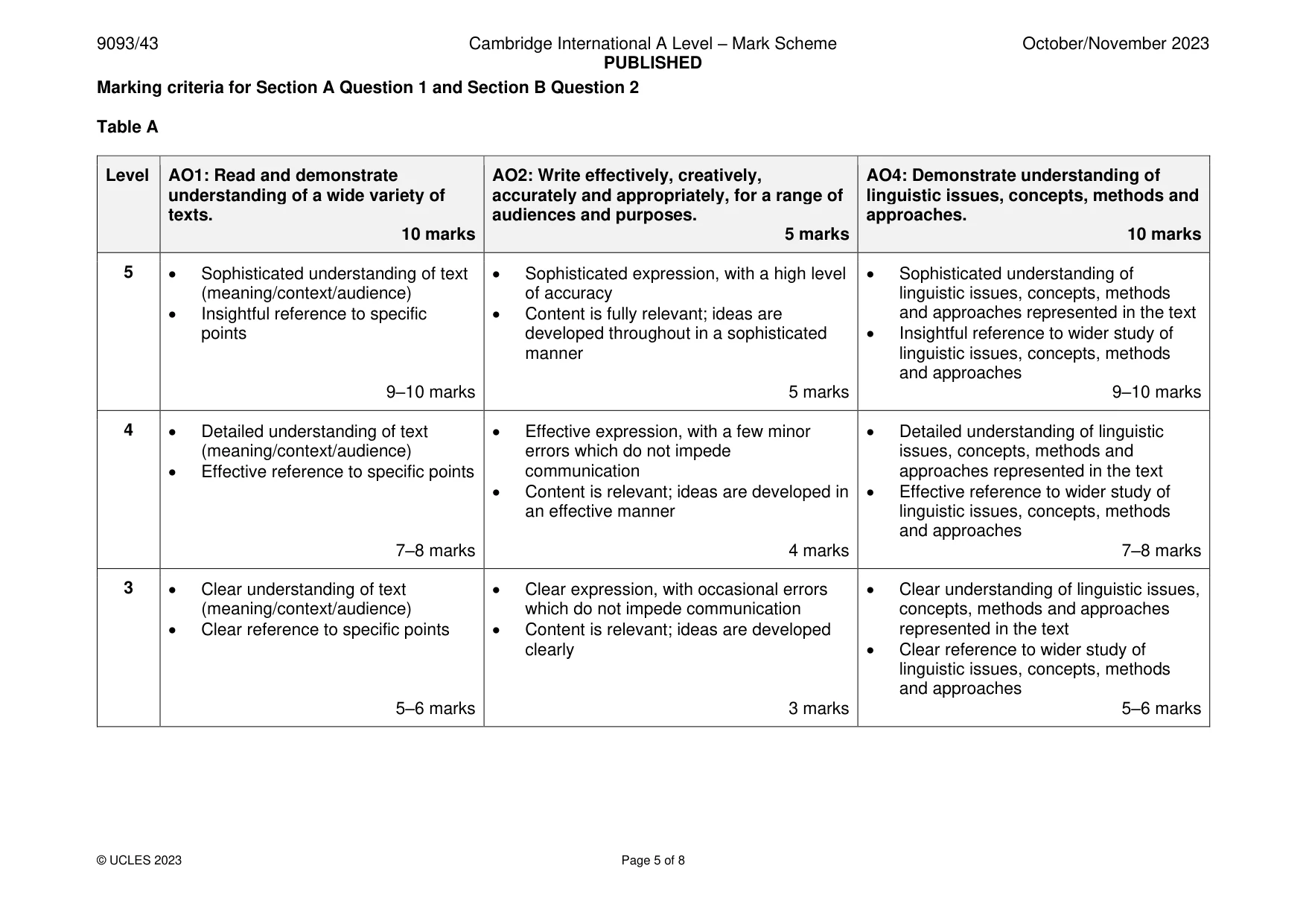
9093/43 Cambridge International A Level – Mark Scheme PUBLISHED October/November 2023 © UCLES 2023 Page 5 of 8 Marking criteria for Section A Question 1 and Section B Question 2 Table A Level AO1: Read and demonstrate understanding of a wide variety of texts. 10 marks AO2: Write effectively, creatively, accurately and appropriately, for a range of audiences and purposes. 5 marks AO4: Demonstrate understanding of linguistic issues, concepts, methods and approaches. 10 marks 5 • Sophisticated understanding of text (meaning/context/audience) • Insightful reference to specific points 9–10 marks • Sophisticated expression, with a high level of accuracy • Content is fully relevant; ideas are developed throughout in a sophisticated manner 5 marks • Sophisticated understanding of linguistic issues, concepts, methods and approaches represented in the text • Insightful reference to wider study of linguistic issues, concepts, methods and approaches 9–10 marks 4 • Detailed understanding of text (meaning/context/audience) • Effective reference to specific points 7–8 marks • Effective expression, with a few minor errors which do not impede communication • Content is relevant; ideas are developed in an effective manner 4 marks • Detailed understanding of linguistic issues, concepts, methods and approaches represented in the text • Effective reference to wider study of linguistic issues, concepts, methods and approaches 7–8 marks 3 • Clear understanding of text (meaning/context/audience) • Clear reference to specific points 5–6 marks • Clear expression, with occasional errors which do not impede communication • Content is relevant; ideas are developed clearly 3 marks • Clear understanding of linguistic issues, concepts, methods and approaches represented in the text • Clear reference to wider study of linguistic issues, concepts, methods and approaches 5–6 marks
Mark scheme, page 6
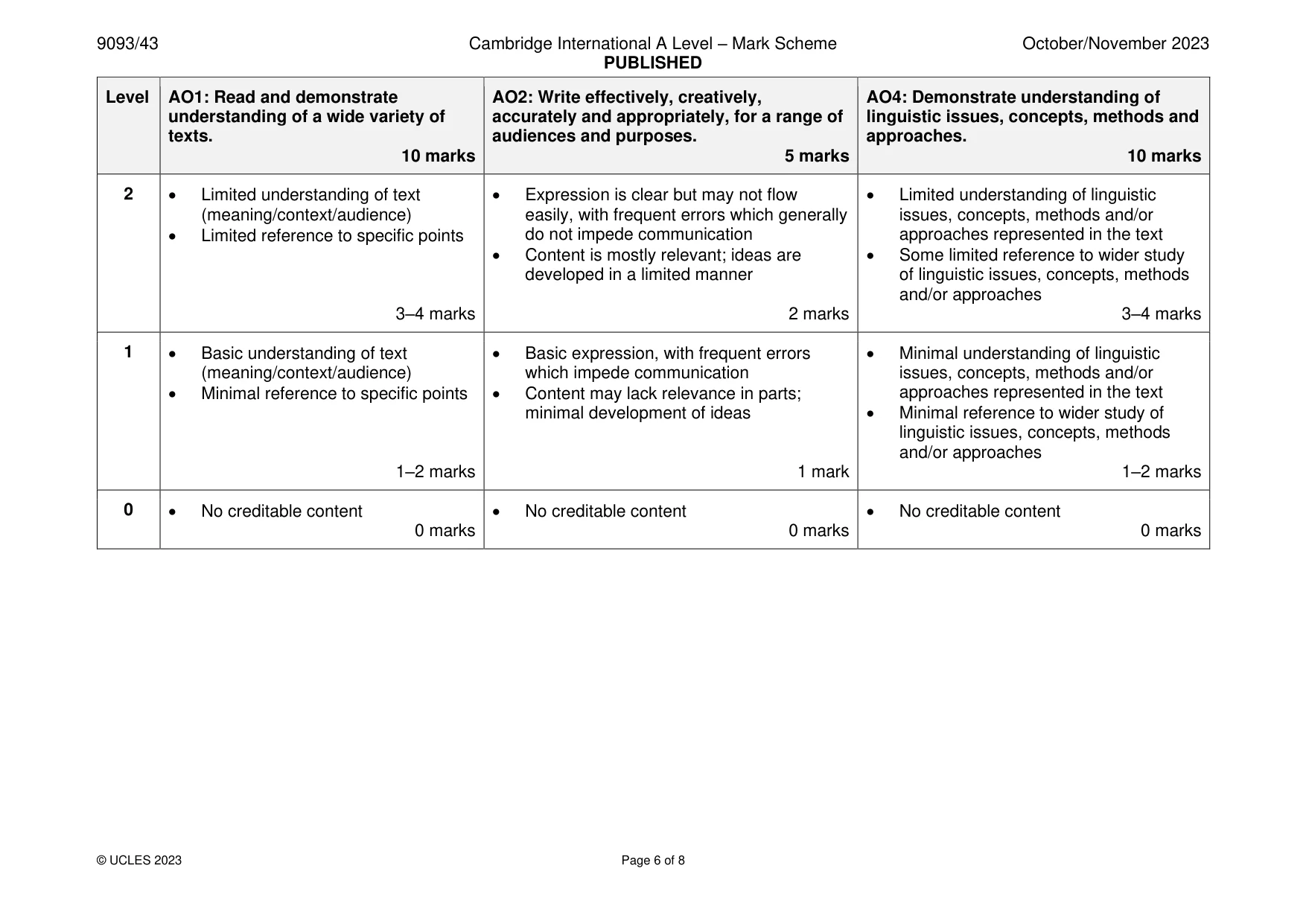
9093/43 Cambridge International A Level – Mark Scheme PUBLISHED October/November 2023 © UCLES 2023 Page 6 of 8 Level AO1: Read and demonstrate understanding of a wide variety of texts. 10 marks AO2: Write effectively, creatively, accurately and appropriately, for a range of audiences and purposes. 5 marks AO4: Demonstrate understanding of linguistic issues, concepts, methods and approaches. 10 marks 2 • Limited understanding of text (meaning/context/audience) • Limited reference to specific points 3–4 marks • Expression is clear but may not flow easily, with frequent errors which generally do not impede communication • Content is mostly relevant; ideas are developed in a limited manner 2 marks • Limited understanding of linguistic issues, concepts, methods and/or approaches represented in the text • Some limited reference to wider study of linguistic issues, concepts, methods and/or approaches 3–4 marks 1 • Basic understanding of text (meaning/context/audience) • Minimal reference to specific points 1–2 marks • Basic expression, with frequent errors which impede communication • Content may lack relevance in parts; minimal development of ideas 1 mark • Minimal understanding of linguistic issues, concepts, methods and/or approaches represented in the text • Minimal reference to wider study of linguistic issues, concepts, methods and/or approaches 1–2 marks 0 • No creditable content 0 marks • No creditable content 0 marks • No creditable content 0 marks
Mark scheme, page 7
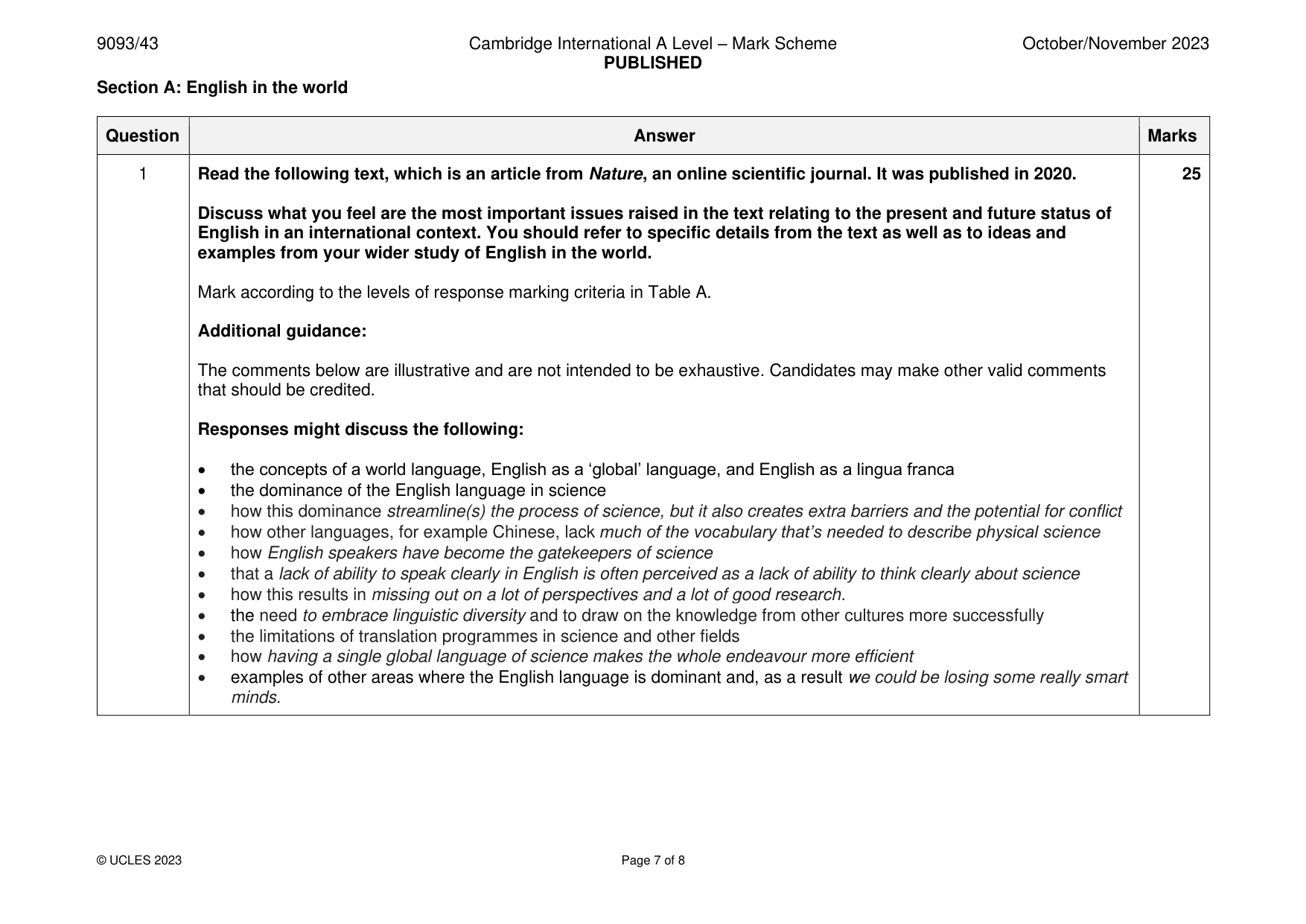
9093/43 Cambridge International A Level – Mark Scheme PUBLISHED October/November 2023 © UCLES 2023 Page 7 of 8 Section A: English in the world Question Answer Marks 1 Read the following text, which is an article from Nature, an online scientific journal. It was published in 2020. Discuss what you feel are the most important issues raised in the text relating to the present and future status of English in an international context. You should refer to specific details from the text as well as to ideas and examples from your wider study of English in the world. Mark according to the levels of response marking criteria in Table A. Additional guidance: The comments below are illustrative and are not intended to be exhaustive. Candidates may make other valid comments that should be credited. Responses might discuss the following: • the concepts of a world language, English as a ‘global’ language, and English as a lingua franca • the dominance of the English language in science • how this dominance streamline(s) the process of science, but it also creates extra barriers and the potential for conflict • how other languages, for example Chinese, lack much of the vocabulary that’s needed to describe physical science • how English speakers have become the gatekeepers of science • that a lack of ability to speak clearly in English is often perceived as a lack of ability to think clearly about science • how this results in missing out on a lot of perspectives and a lot of good research. • the need to embrace linguistic diversity and to draw on the knowledge from other cultures more successfully • the limitations of translation programmes in science and other fields • how having a single global language of science makes the whole endeavour more efficient • examples of other areas where the English language is dominant and, as a result we could be losing some really smart minds. 25
Mark scheme, page 8
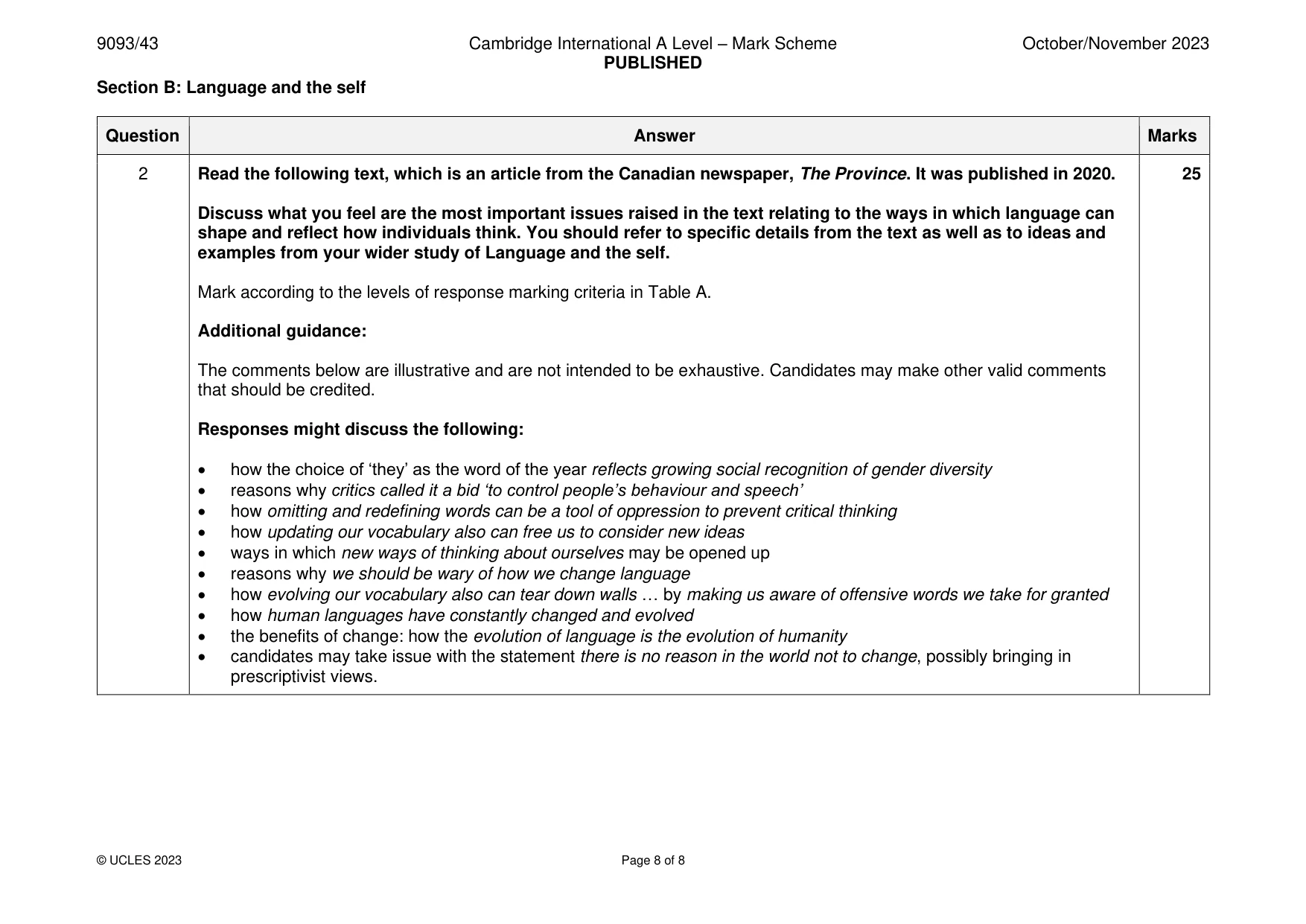
9093/43 Cambridge International A Level – Mark Scheme PUBLISHED October/November 2023 © UCLES 2023 Page 8 of 8 Section B: Language and the self Question Answer Marks 2 Read the following text, which is an article from the Canadian newspaper, The Province. It was published in 2020. Discuss what you feel are the most important issues raised in the text relating to the ways in which language can shape and reflect how individuals think. You should refer to specific details from the text as well as to ideas and examples from your wider study of Language and the self. Mark according to the levels of response marking criteria in Table A. Additional guidance: The comments below are illustrative and are not intended to be exhaustive. Candidates may make other valid comments that should be credited. Responses might discuss the following: • how the choice of ‘they’ as the word of the year reflects growing social recognition of gender diversity • reasons why critics called it a bid ‘to control people’s behaviour and speech’ • how omitting and redefining words can be a tool of oppression to prevent critical thinking • how updating our vocabulary also can free us to consider new ideas • ways in which new ways of thinking about ourselves may be opened up • reasons why we should be wary of how we change language • how evolving our vocabulary also can tear down walls … by making us aware of offensive words we take for granted • how human languages have constantly changed and evolved • the benefits of change: how the evolution of language is the evolution of humanity • candidates may take issue with the statement there is no reason in the world not to change, possibly bringing in prescriptivist views. 25
What you needed in this session
Cambridge’s own grade thresholds for 2023 Oct/Nov, Paper 4 · Variant 3. A higher threshold means an easier paper — the bar moves with how the cohort did.