Cambridge A Level English - Language AS and A Level (from 2014) 9093 — 2022 Oct/Nov Paper 4 · Variant 2
9093/42/O/N/22 · 50 marks · ≈56 min
The question paper and its mark scheme, free to read here and free to download. This is Cambridge’s own paper, exactly as it was sat.
Question paper8 pages



Mark scheme9 pages
Answers below. Sit the paper first if you are practising.
Paper as text
Question paper, page 1
This document has 8 pages. Any blank pages are indicated. [Turn over Cambridge International AS & A Level ENGLISH LANGUAGE 9093/42 Paper 4 Language Topics October/November 2022 2 hours 15 minutes You must answer on the enclosed answer booklet. You will need: Answer booklet (enclosed) INSTRUCTIONS ● Answer all questions. ● Follow the instructions on the front cover of the answer booklet. If you need additional answer paper, ask the invigilator for a continuation booklet. ● Dictionaries are not allowed. INFORMATION ● The total mark for this paper is 50. ● The number of marks for each question or part question is shown in brackets [ ]. * 2 9 7 2 9 9 8 2 1 3 * DC (CJ) 303483/3 © UCLES 2022
Question paper, page 2
2 9093/42/O/N/22 © UCLES 2022 Section A: English in the world Question 1 Read the following two texts. Text A is an extract from an article published on the website of the British newspaper The Guardian in 2018. Text B is an extract from an article published on the news website Byline Times in 2020. Discuss what you feel are the most important issues raised in the texts relating to the causes and effects of the expansion of English around the world. You should refer to specific details from the texts as well as to ideas and examples from your wider study of English in the world. [25] Text A Behemoth1, bully, thief: how the English language is taking over the planet No language in history has dominated the world quite like English does today. Is there any point in resisting? A century of immigration has done little to dislodge the status of English in North America. And everywhere it goes, it leaves behind a trail of dead: dialects crushed, languages forgotten, literatures mangled. Content removed due to copyright restrictions.
Question paper, page 3
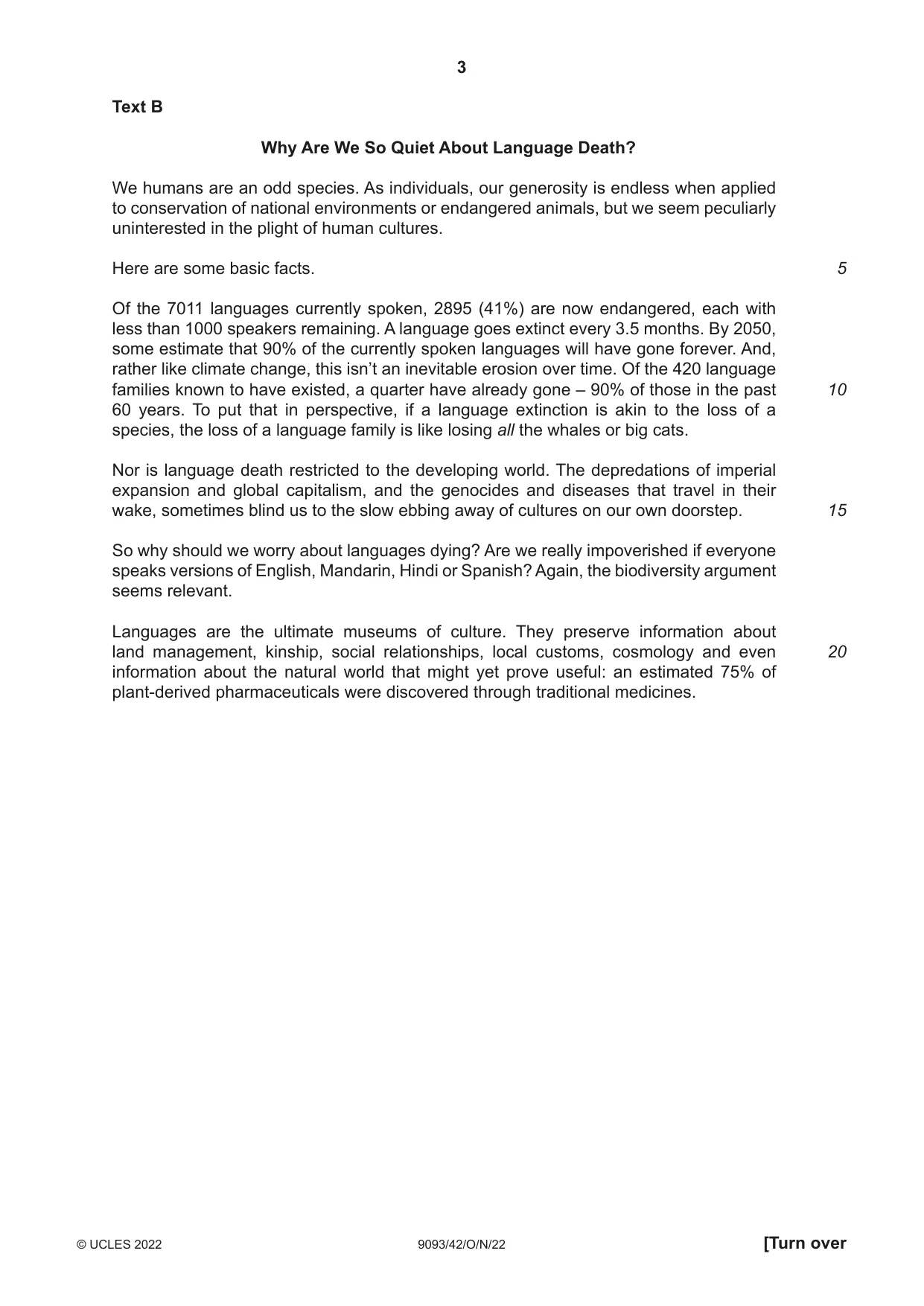
3 9093/42/O/N/22 © UCLES 2022 [Turn over Text B Why Are We So Quiet About Language Death? We humans are an odd species. As individuals, our generosity is endless when applied to conservation of national environments or endangered animals, but we seem peculiarly uninterested in the plight of human cultures. Here are some basic facts. Of the 7011 languages currently spoken, 2895 (41%) are now endangered, each with less than 1000 speakers remaining. A language goes extinct every 3.5 months. By 2050, some estimate that 90% of the currently spoken languages will have gone forever. And, rather like climate change, this isn’t an inevitable erosion over time. Of the 420 language families known to have existed, a quarter have already gone – 90% of those in the past 60 years. To put that in perspective, if a language extinction is akin to the loss of a species, the loss of a language family is like losing all the whales or big cats. Nor is language death restricted to the developing world. The depredations of imperial expansion and global capitalism, and the genocides and diseases that travel in their wake, sometimes blind us to the slow ebbing away of cultures on our own doorstep. So why should we worry about languages dying? Are we really impoverished if everyone speaks versions of English, Mandarin, Hindi or Spanish? Again, the biodiversity argument seems relevant. Languages are the ultimate museums of culture. They preserve information about land management, kinship, social relationships, local customs, cosmology and even information about the natural world that might yet prove useful: an estimated 75% of plant-derived pharmaceuticals were discovered through traditional medicines. 5 10 15 20
Question paper, page 4
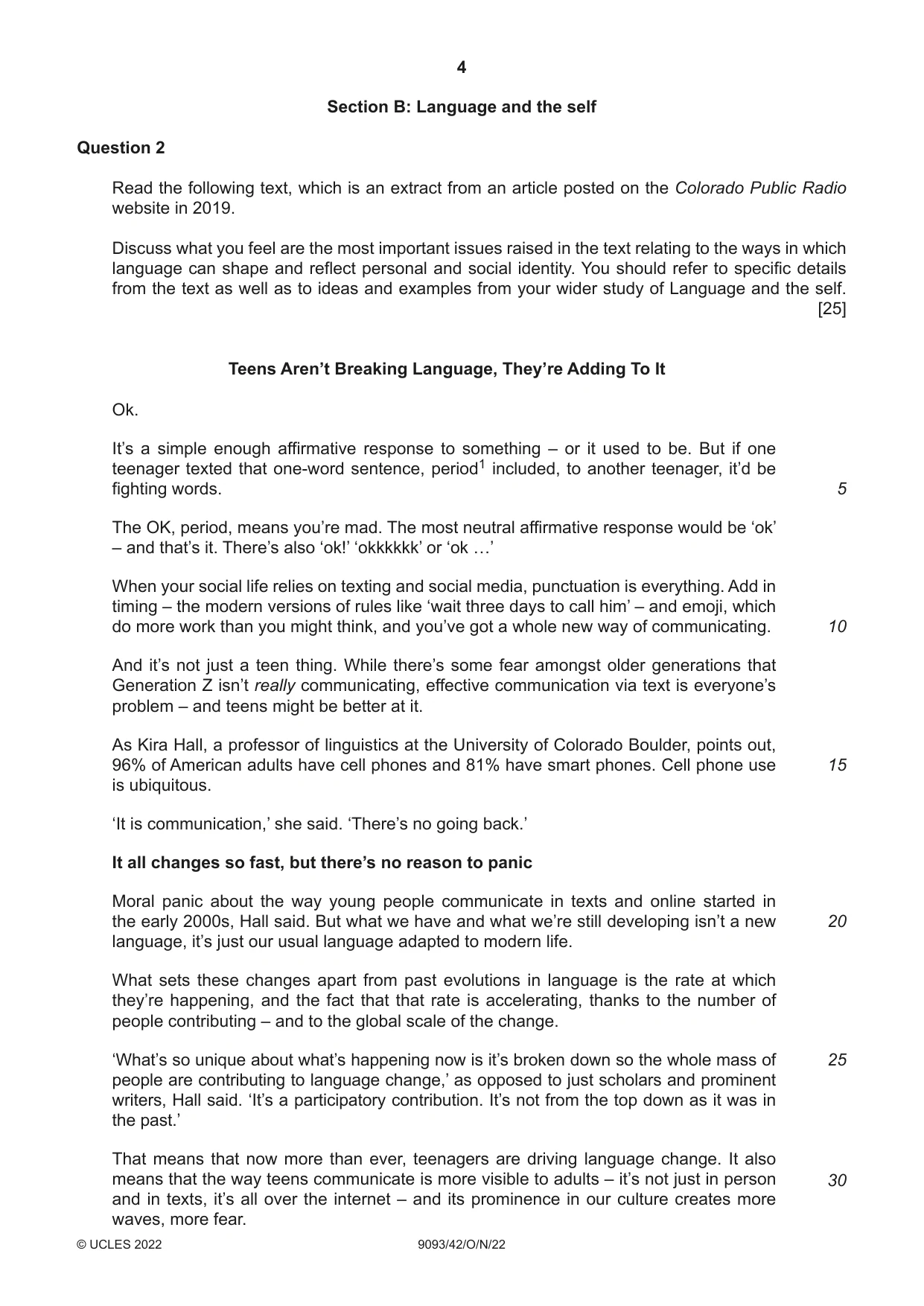
4 9093/42/O/N/22 © UCLES 2022 Section B: Language and the self Question 2 Read the following text, which is an extract from an article posted on the Colorado Public Radio website in 2019. Discuss what you feel are the most important issues raised in the text relating to the ways in which language can shape and reflect personal and social identity. You should refer to specific details from the text as well as to ideas and examples from your wider study of Language and the self. [25] Teens Aren’t Breaking Language, They’re Adding To It Ok. It’s a simple enough affirmative response to something – or it used to be. But if one teenager texted that one-word sentence, period1 included, to another teenager, it’d be fighting words. The OK, period, means you’re mad. The most neutral affirmative response would be ‘ok’ – and that’s it. There’s also ‘ok!’ ‘okkkkkk’ or ‘ok …’ When your social life relies on texting and social media, punctuation is everything. Add in timing – the modern versions of rules like ‘wait three days to call him’ – and emoji, which do more work than you might think, and you’ve got a whole new way of communicating. And it’s not just a teen thing. While there’s some fear amongst older generations that Generation Z isn’t really communicating, effective communication via text is everyone’s problem – and teens might be better at it. As Kira Hall, a professor of linguistics at the University of Colorado Boulder, points out, 96% of American adults have cell phones and 81% have smart phones. Cell phone use is ubiquitous. ‘It is communication,’ she said. ‘There’s no going back.’ It all changes so fast, but there’s no reason to panic Moral panic about the way young people communicate in texts and online started in the early 2000s, Hall said. But what we have and what we’re still developing isn’t a new language, it’s just our usual language adapted to modern life. What sets these changes apart from past evolutions in language is the rate at which they’re happening, and the fact that that rate is accelerating, thanks to the number of people contributing – and to the global scale of the change. ‘What’s so unique about what’s happening now is it’s broken down so the whole mass of people are contributing to language change,’ as opposed to just scholars and prominent writers, Hall said. ‘It’s a participatory contribution. It’s not from the top down as it was in the past.’ That means that now more than ever, teenagers are driving language change. It also means that the way teens communicate is more visible to adults – it’s not just in person and in texts, it’s all over the internet – and its prominence in our culture creates more waves, more fear. 5 10 15 20 25 30
Question paper, page 5
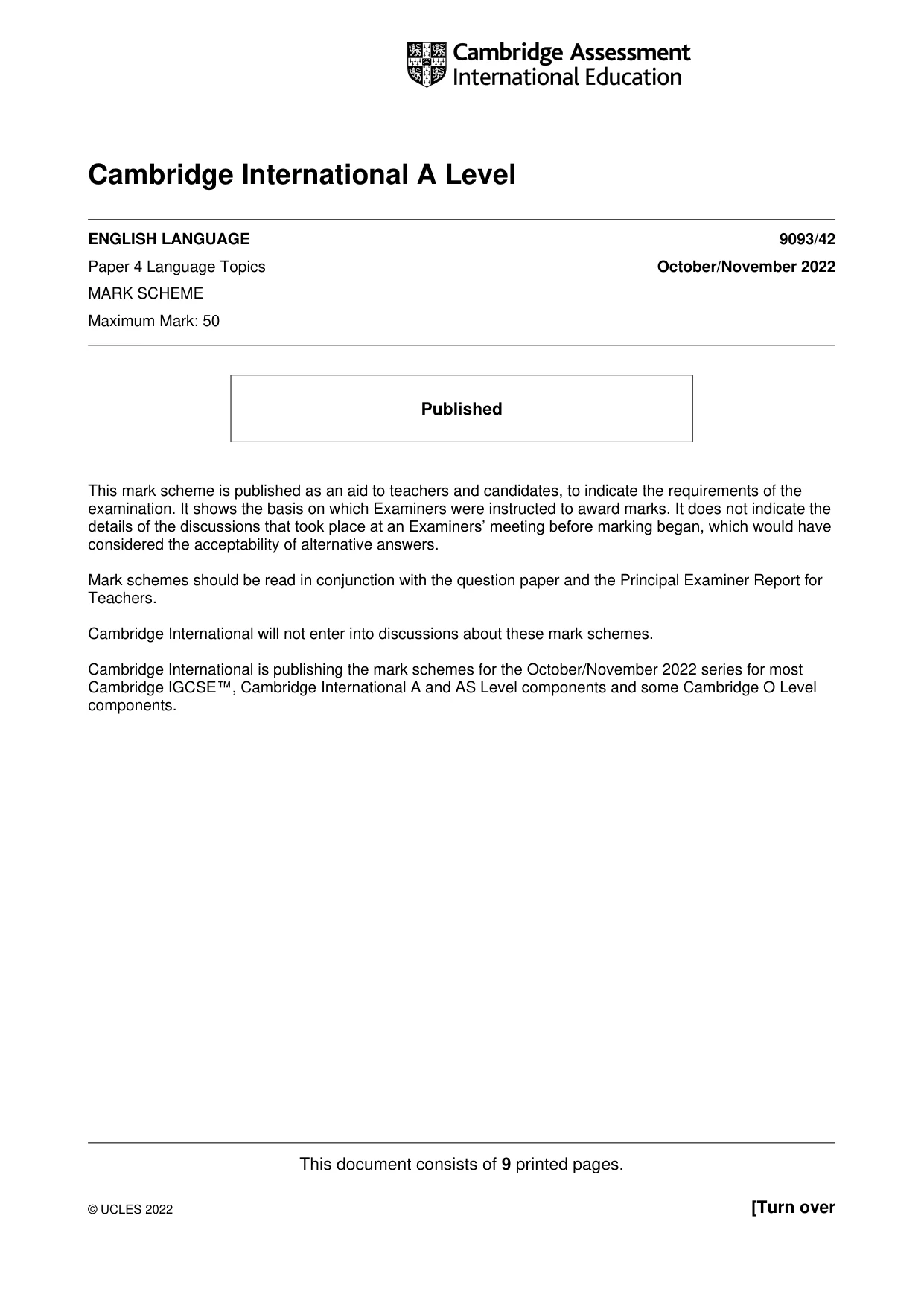
5 9093/42/O/N/22 © UCLES 2022 ‘I think even now what I see happening is it’s no longer the moral panic,’ Hall said. ‘It’s more about a fear that our kids aren’t learning literacy, they don’t know how to use standard language and punctuate and spell. And a fear that they’re socially backward, that they’re kind of hiding from social life.’ ‘I think on both accounts the literature really shows something a lot more complex. Young people are writing now more than ever before,’ Hall continued. ‘They’re writing all the time. I think they have a really good sense of what a text message is versus an email you send to your professor versus a blog post you want to sound intelligent. They know how to code-switch between formality and informality.’ 1period: full stop 35 40
Question paper, page 6
6 9093/42/O/N/22 © UCLES 2022 BLANK PAGE
Question paper, page 7
7 9093/42/O/N/22 © UCLES 2022 BLANK PAGE
Question paper, page 8
8 9093/42/O/N/22 © UCLES 2022 Permission to reproduce items where third-party owned material protected by copyright is included has been sought and cleared where possible. Every reasonable effort has been made by the publisher (UCLES) to trace copyright holders, but if any items requiring clearance have unwittingly been included, the publisher will be pleased to make amends at the earliest possible opportunity. To avoid the issue of disclosure of answer-related information to candidates, all copyright acknowledgements are reproduced online in the Cambridge Assessment International Education Copyright Acknowledgements Booklet. This is produced for each series of examinations and is freely available to download at www.cambridgeinternational.org after the live examination series. Cambridge Assessment International Education is part of Cambridge Assessment. Cambridge Assessment is the brand name of the University of Cambridge Local Examinations Syndicate (UCLES), which is a department of the University of Cambridge. BLANK PAGE
Mark scheme, page 1
This document consists of 9 printed pages. © UCLES 2022 [Turn over Cambridge International A Level ENGLISH LANGUAGE 9093/42 Paper 4 Language Topics October/November 2022 MARK SCHEME Maximum Mark: 50 Published This mark scheme is published as an aid to teachers and candidates, to indicate the requirements of the examination. It shows the basis on which Examiners were instructed to award marks. It does not indicate the details of the discussions that took place at an Examiners’ meeting before marking began, which would have considered the acceptability of alternative answers. Mark schemes should be read in conjunction with the question paper and the Principal Examiner Report for Teachers. Cambridge International will not enter into discussions about these mark schemes. Cambridge International is publishing the mark schemes for the October/November 2022 series for most Cambridge IGCSE™, Cambridge International A and AS Level components and some Cambridge O Level components.
Mark scheme, page 2
9093/42 Cambridge International A Level – Mark Scheme PUBLISHED October/November 2022 © UCLES 2022 Page 2 of 9 Generic Marking Principles These general marking principles must be applied by all examiners when marking candidate answers. They should be applied alongside the specific content of the mark scheme or generic level descriptors for a question. Each question paper and mark scheme will also comply with these marking principles. GENERIC MARKING PRINCIPLE 1: Marks must be awarded in line with: • the specific content of the mark scheme or the generic level descriptors for the question • the specific skills defined in the mark scheme or in the generic level descriptors for the question • the standard of response required by a candidate as exemplified by the standardisation scripts. GENERIC MARKING PRINCIPLE 2: Marks awarded are always whole marks (not half marks, or other fractions). GENERIC MARKING PRINCIPLE 3: Marks must be awarded positively: • marks are awarded for correct/valid answers, as defined in the mark scheme. However, credit is given for valid answers which go beyond the scope of the syllabus and mark scheme, referring to your Team Leader as appropriate • marks are awarded when candidates clearly demonstrate what they know and can do • marks are not deducted for errors • marks are not deducted for omissions • answers should only be judged on the quality of spelling, punctuation and grammar when these features are specifically assessed by the question as indicated by the mark scheme. The meaning, however, should be unambiguous. GENERIC MARKING PRINCIPLE 4: Rules must be applied consistently, e.g. in situations where candidates have not followed instructions or in the application of generic level descriptors.
Mark scheme, page 3
9093/42 Cambridge International A Level – Mark Scheme PUBLISHED October/November 2022 © UCLES 2022 Page 3 of 9 GENERIC MARKING PRINCIPLE 5: Marks should be awarded using the full range of marks defined in the mark scheme for the question (however; the use of the full mark range may be limited according to the quality of the candidate responses seen). GENERIC MARKING PRINCIPLE 6: Marks awarded are based solely on the requirements as defined in the mark scheme. Marks should not be awarded with grade thresholds or grade descriptors in mind.
Mark scheme, page 4
9093/42 Cambridge International A Level – Mark Scheme PUBLISHED October/November 2022 © UCLES 2022 Page 4 of 9 English & Media subject specific general marking principles (To be read in conjunction with the Generic Marking Principles (and requiring further guidance on how to place marks within levels)) Components using level descriptors: • We use level descriptors as a guide to broad understanding of the qualities normally expected of, or typical of, work in a level. • Level descriptors are a means of general guidance, and should not be interpreted as hurdle statements. • Where indicative content notes are supplied for a question, these are not a prescription of required content, and must not be treated as such. Alternative correct points and unexpected answers in candidates’ scripts must be given marks that fairly reflect the knowledge and skills demonstrated. • While we may have legitimate expectations as to the ground most answers may occupy, we must at all times be prepared to meet candidates on their chosen ground, provided it is relevant ground (e.g. clearly related to and derived from a relevant passage/text and meeting the mark scheme requirements for the question).
Mark scheme, page 5
9093/42 Cambridge International A Level – Mark Scheme PUBLISHED October/November 2022 © UCLES 2022 Page 5 of 9 English Language specific marking instructions: AO1 Read and demonstrate understanding of a wide variety of texts. (Understanding) • Marks should be awarded for the accuracy of the candidate’s understanding of the text and its features, not for any analysis of them which is recognised under AO3. • Where comparison is required, marks should be awarded for the candidate’s recognition of similarities and differences between the texts and their features, not for any consequent analysis. • When awarding a ‘best-fit’ mark within a Level for each AO, consider each bullet point equally. AO2 Write effectively, creatively, accurately and appropriately, for a range of audiences and purposes. (Writing) • Marks should be awarded equally on the basis of the level of the candidate’s written expression (range of features used and accuracy) and the development of their writing (its organisation and relevance to task and audience). • When awarding a ‘best-fit’ mark within a Level for each AO, consider each bullet point equally. AO4: Demonstrate understanding of linguistic issues, concepts, methods and approaches. (Conceptualisation) • Marks should be awarded equally on the basis of the level of the candidate’s understanding of the relevant issues, concepts, methods and approaches represented both in the text(s) and in their wider studies. • When awarding a ‘best-fit’ mark within a Level for each AO, consider each bullet point equally.
Mark scheme, page 6
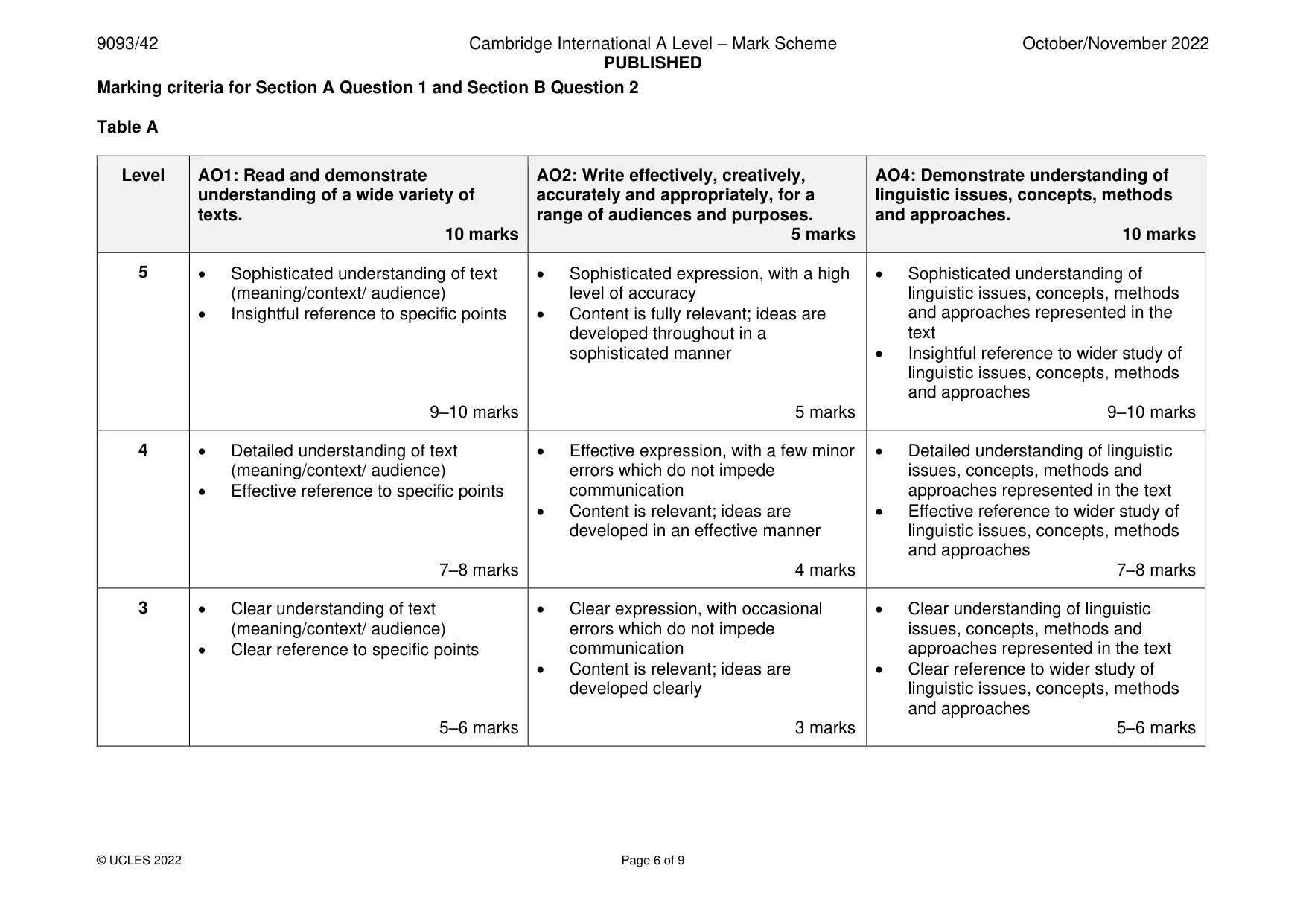
9093/42 Cambridge International A Level – Mark Scheme PUBLISHED October/November 2022 © UCLES 2022 Page 6 of 9 Marking criteria for Section A Question 1 and Section B Question 2 Table A Level AO1: Read and demonstrate understanding of a wide variety of texts. 10 marks AO2: Write effectively, creatively, accurately and appropriately, for a range of audiences and purposes. 5 marks AO4: Demonstrate understanding of linguistic issues, concepts, methods and approaches. 10 marks 5 • Sophisticated understanding of text (meaning/context/ audience) • Insightful reference to specific points 9–10 marks • Sophisticated expression, with a high level of accuracy • Content is fully relevant; ideas are developed throughout in a sophisticated manner 5 marks • Sophisticated understanding of linguistic issues, concepts, methods and approaches represented in the text • Insightful reference to wider study of linguistic issues, concepts, methods and approaches 9–10 marks 4 • Detailed understanding of text (meaning/context/ audience) • Effective reference to specific points 7–8 marks • Effective expression, with a few minor errors which do not impede communication • Content is relevant; ideas are developed in an effective manner 4 marks • Detailed understanding of linguistic issues, concepts, methods and approaches represented in the text • Effective reference to wider study of linguistic issues, concepts, methods and approaches 7–8 marks 3 • Clear understanding of text (meaning/context/ audience) • Clear reference to specific points 5–6 marks • Clear expression, with occasional errors which do not impede communication • Content is relevant; ideas are developed clearly 3 marks • Clear understanding of linguistic issues, concepts, methods and approaches represented in the text • Clear reference to wider study of linguistic issues, concepts, methods and approaches 5–6 marks
Mark scheme, page 7
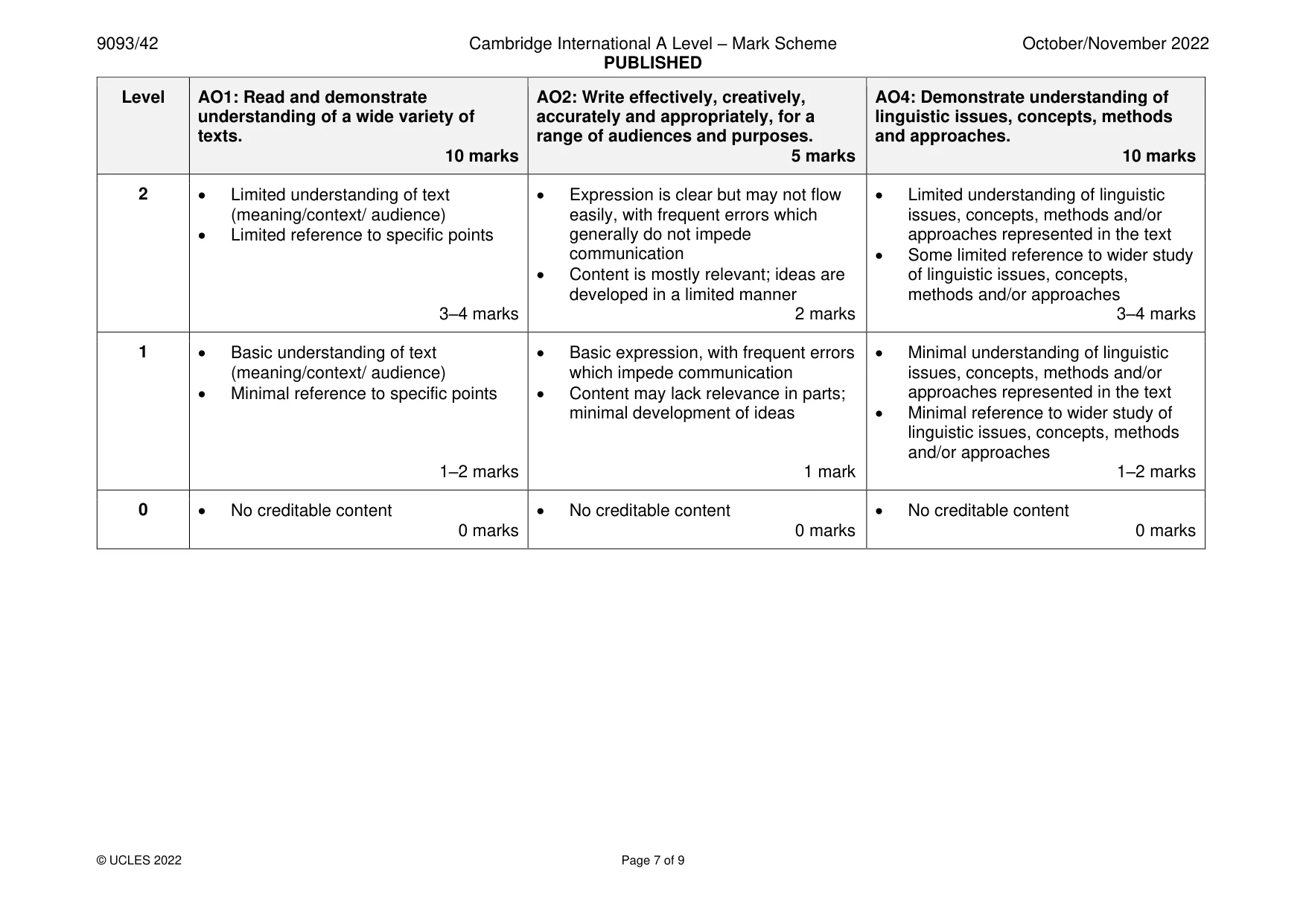
9093/42 Cambridge International A Level – Mark Scheme PUBLISHED October/November 2022 © UCLES 2022 Page 7 of 9 Level AO1: Read and demonstrate understanding of a wide variety of texts. 10 marks AO2: Write effectively, creatively, accurately and appropriately, for a range of audiences and purposes. 5 marks AO4: Demonstrate understanding of linguistic issues, concepts, methods and approaches. 10 marks 2 • Limited understanding of text (meaning/context/ audience) • Limited reference to specific points 3–4 marks • Expression is clear but may not flow easily, with frequent errors which generally do not impede communication • Content is mostly relevant; ideas are developed in a limited manner 2 marks • Limited understanding of linguistic issues, concepts, methods and/or approaches represented in the text • Some limited reference to wider study of linguistic issues, concepts, methods and/or approaches 3–4 marks 1 • Basic understanding of text (meaning/context/ audience) • Minimal reference to specific points 1–2 marks • Basic expression, with frequent errors which impede communication • Content may lack relevance in parts; minimal development of ideas 1 mark • Minimal understanding of linguistic issues, concepts, methods and/or approaches represented in the text • Minimal reference to wider study of linguistic issues, concepts, methods and/or approaches 1–2 marks 0 • No creditable content 0 marks • No creditable content 0 marks • No creditable content 0 marks
Mark scheme, page 8
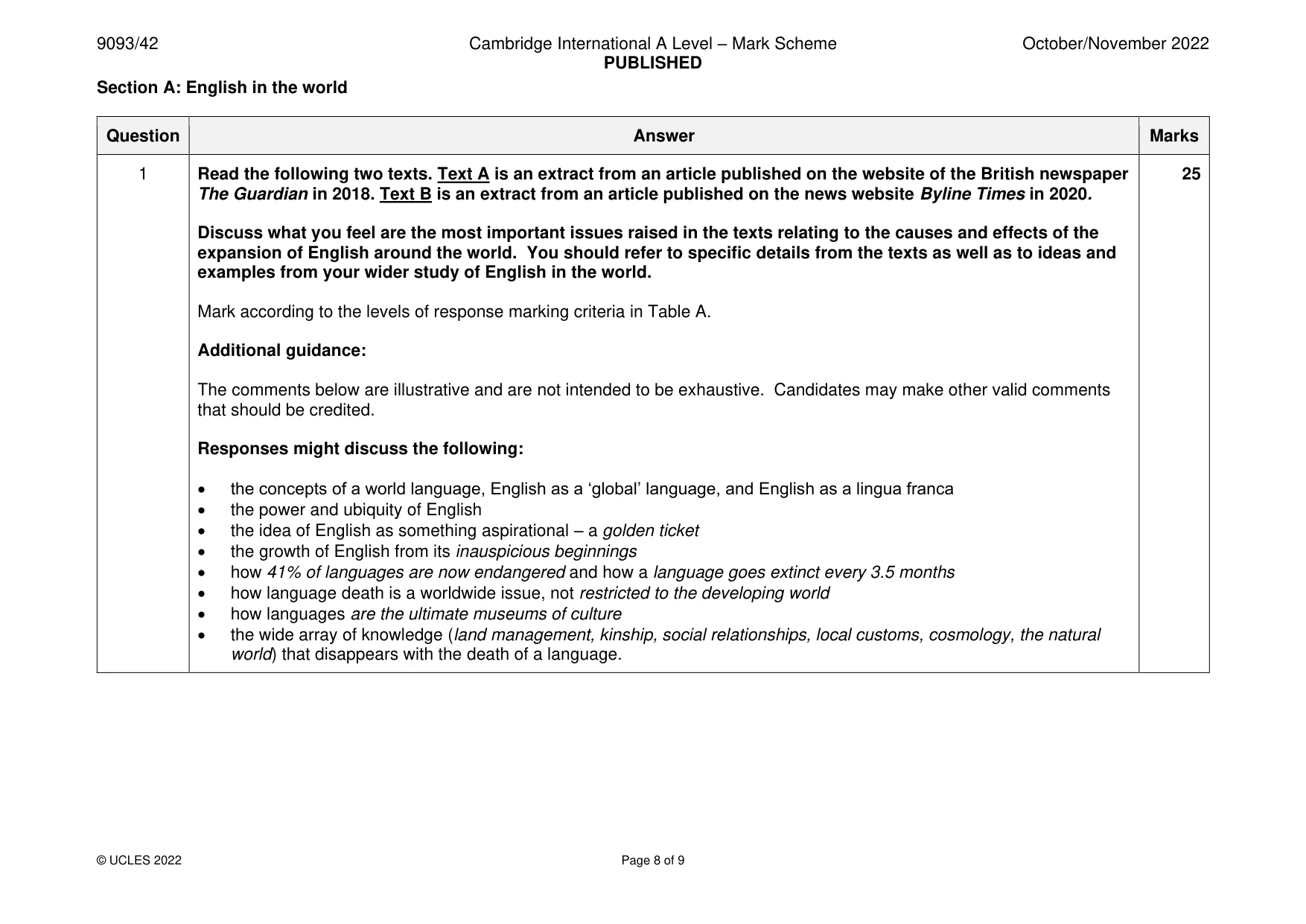
9093/42 Cambridge International A Level – Mark Scheme PUBLISHED October/November 2022 © UCLES 2022 Page 8 of 9 Section A: English in the world Question Answer Marks 1 Read the following two texts. Text A is an extract from an article published on the website of the British newspaper The Guardian in 2018. Text B is an extract from an article published on the news website Byline Times in 2020. Discuss what you feel are the most important issues raised in the texts relating to the causes and effects of the expansion of English around the world. You should refer to specific details from the texts as well as to ideas and examples from your wider study of English in the world. Mark according to the levels of response marking criteria in Table A. Additional guidance: The comments below are illustrative and are not intended to be exhaustive. Candidates may make other valid comments that should be credited. Responses might discuss the following: • the concepts of a world language, English as a ‘global’ language, and English as a lingua franca • the power and ubiquity of English • the idea of English as something aspirational – a golden ticket • the growth of English from its inauspicious beginnings • how 41% of languages are now endangered and how a language goes extinct every 3.5 months • how language death is a worldwide issue, not restricted to the developing world • how languages are the ultimate museums of culture • the wide array of knowledge (land management, kinship, social relationships, local customs, cosmology, the natural world) that disappears with the death of a language. 25
Mark scheme, page 9
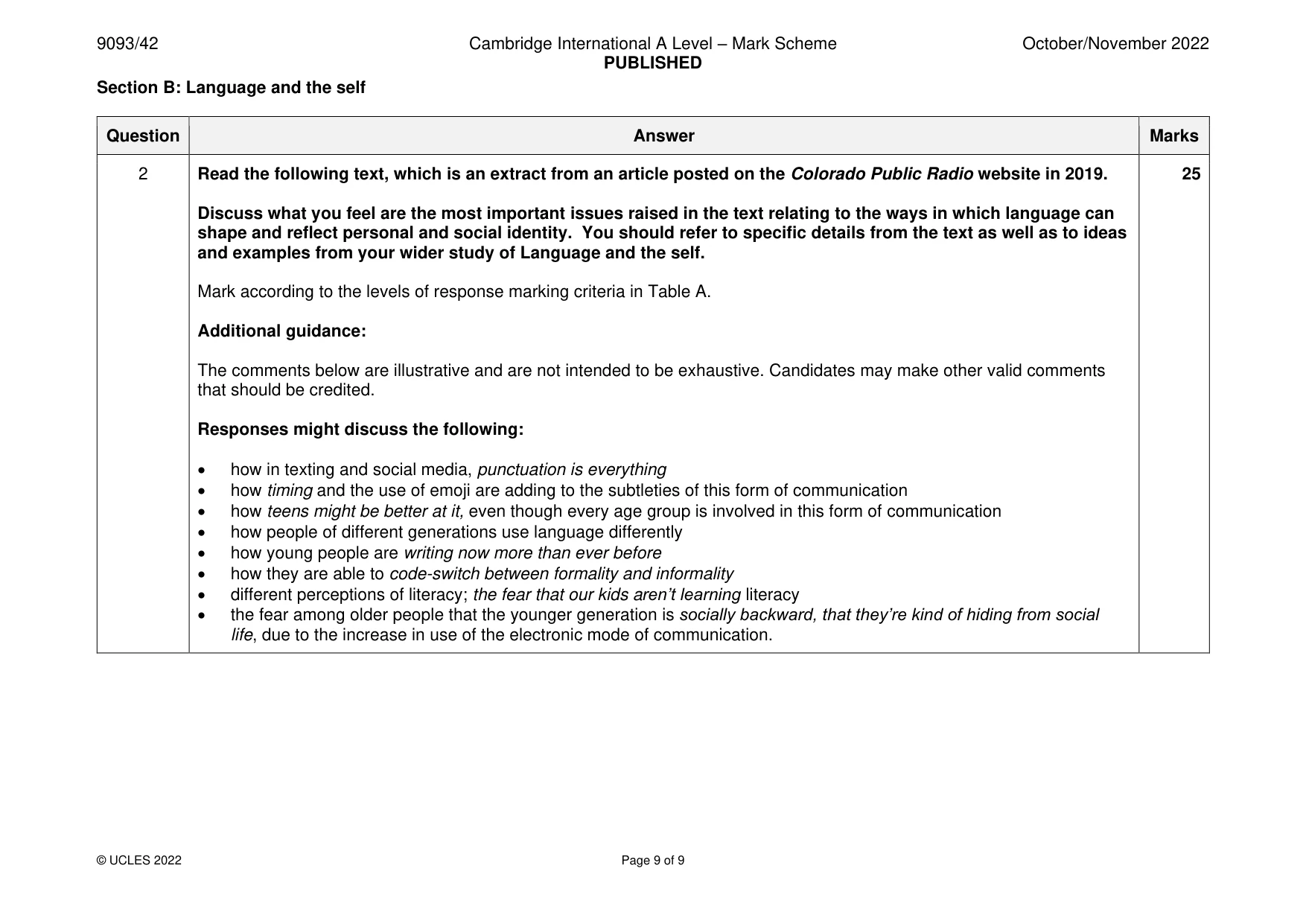
9093/42 Cambridge International A Level – Mark Scheme PUBLISHED October/November 2022 © UCLES 2022 Page 9 of 9 Section B: Language and the self Question Answer Marks 2 Read the following text, which is an extract from an article posted on the Colorado Public Radio website in 2019. Discuss what you feel are the most important issues raised in the text relating to the ways in which language can shape and reflect personal and social identity. You should refer to specific details from the text as well as to ideas and examples from your wider study of Language and the self. Mark according to the levels of response marking criteria in Table A. Additional guidance: The comments below are illustrative and are not intended to be exhaustive. Candidates may make other valid comments that should be credited. Responses might discuss the following: • how in texting and social media, punctuation is everything • how timing and the use of emoji are adding to the subtleties of this form of communication • how teens might be better at it, even though every age group is involved in this form of communication • how people of different generations use language differently • how young people are writing now more than ever before • how they are able to code-switch between formality and informality • different perceptions of literacy; the fear that our kids aren’t learning literacy • the fear among older people that the younger generation is socially backward, that they’re kind of hiding from social life, due to the increase in use of the electronic mode of communication. 25
What you needed in this session
Cambridge’s own grade thresholds for 2022 Oct/Nov, Paper 4 · Variant 2. A higher threshold means an easier paper — the bar moves with how the cohort did.