Cambridge A Level English - Language AS and A Level (from 2014) 9093 — 2022 Oct/Nov Paper 4 · Variant 3
9093/43/O/N/22 · 50 marks · ≈56 min
The question paper and its mark scheme, free to read here and free to download. This is Cambridge’s own paper, exactly as it was sat.
Question paper8 pages
Mark scheme9 pages
Answers below. Sit the paper first if you are practising.
Paper as text
Question paper, page 1
This document has 8 pages. Any blank pages are indicated. [Turn over Cambridge International AS & A Level DC (CE) 303500/2 © UCLES 2022 ENGLISH LANGUAGE 9093/43 Paper 4 Language Topics October/November 2022 2 hours 15 minutes You must answer on the enclosed answer booklet. You will need: Answer booklet (enclosed) INSTRUCTIONS ● Answer all questions. ● Follow the instructions on the front cover of the answer booklet. If you need additional answer paper, ask the invigilator for a continuation booklet. ● Dictionaries are not allowed. INFORMATION ● The total mark for this paper is 50. ● The number of marks for each question or part question is shown in brackets [ ]. * 8 3 5 8 2 9 1 4 2 5 *
Question paper, page 2
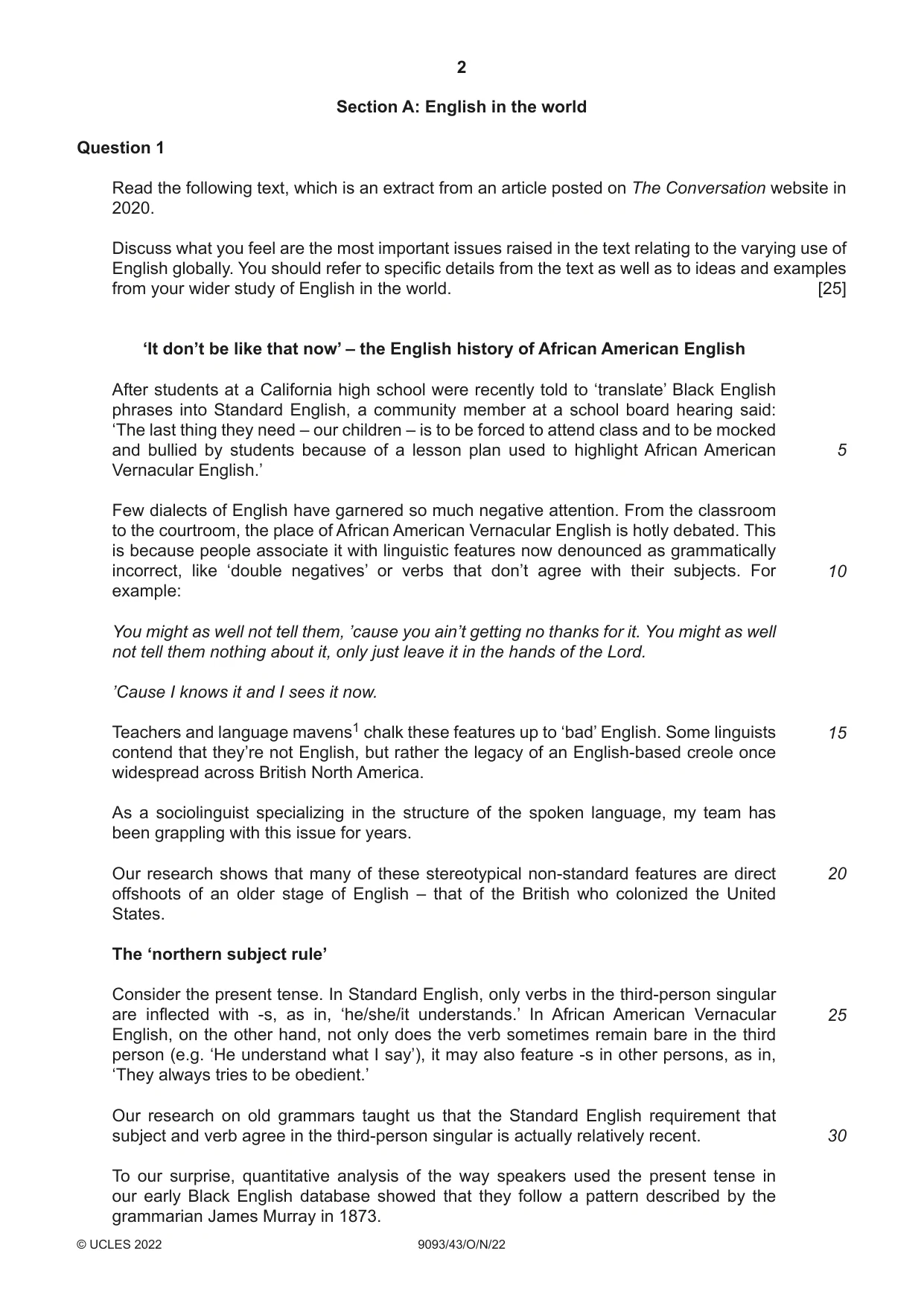
2 9093/43/O/N/22 © UCLES 2022 Section A: English in the world Question 1 Read the following text, which is an extract from an article posted on The Conversation website in 2020. Discuss what you feel are the most important issues raised in the text relating to the varying use of English globally. You should refer to specific details from the text as well as to ideas and examples from your wider study of English in the world. [25] ‘It don’t be like that now’ – the English history of African American English After students at a California high school were recently told to ‘translate’ Black English phrases into Standard English, a community member at a school board hearing said: ‘The last thing they need – our children – is to be forced to attend class and to be mocked and bullied by students because of a lesson plan used to highlight African American Vernacular English.’ Few dialects of English have garnered so much negative attention. From the classroom to the courtroom, the place of African American Vernacular English is hotly debated. This is because people associate it with linguistic features now denounced as grammatically incorrect, like ‘double negatives’ or verbs that don’t agree with their subjects. For example: You might as well not tell them, ’cause you ain’t getting no thanks for it. You might as well not tell them nothing about it, only just leave it in the hands of the Lord. ’Cause I knows it and I sees it now. Teachers and language mavens1 chalk these features up to ‘bad’ English. Some linguists contend that they’re not English, but rather the legacy of an English-based creole once widespread across British North America. As a sociolinguist specializing in the structure of the spoken language, my team has been grappling with this issue for years. Our research shows that many of these stereotypical non-standard features are direct offshoots of an older stage of English – that of the British who colonized the United States. The ‘northern subject rule’ Consider the present tense. In Standard English, only verbs in the third-person singular are inflected with -s, as in, ‘he/she/it understands.’ In African American Vernacular English, on the other hand, not only does the verb sometimes remain bare in the third person (e.g. ‘He understand what I say’), it may also feature -s in other persons, as in, ‘They always tries to be obedient.’ Our research on old grammars taught us that the Standard English requirement that subject and verb agree in the third-person singular is actually relatively recent. To our surprise, quantitative analysis of the way speakers used the present tense in our early Black English database showed that they follow a pattern described by the grammarian James Murray in 1873. 5 10 15 20 25 30
Question paper, page 3
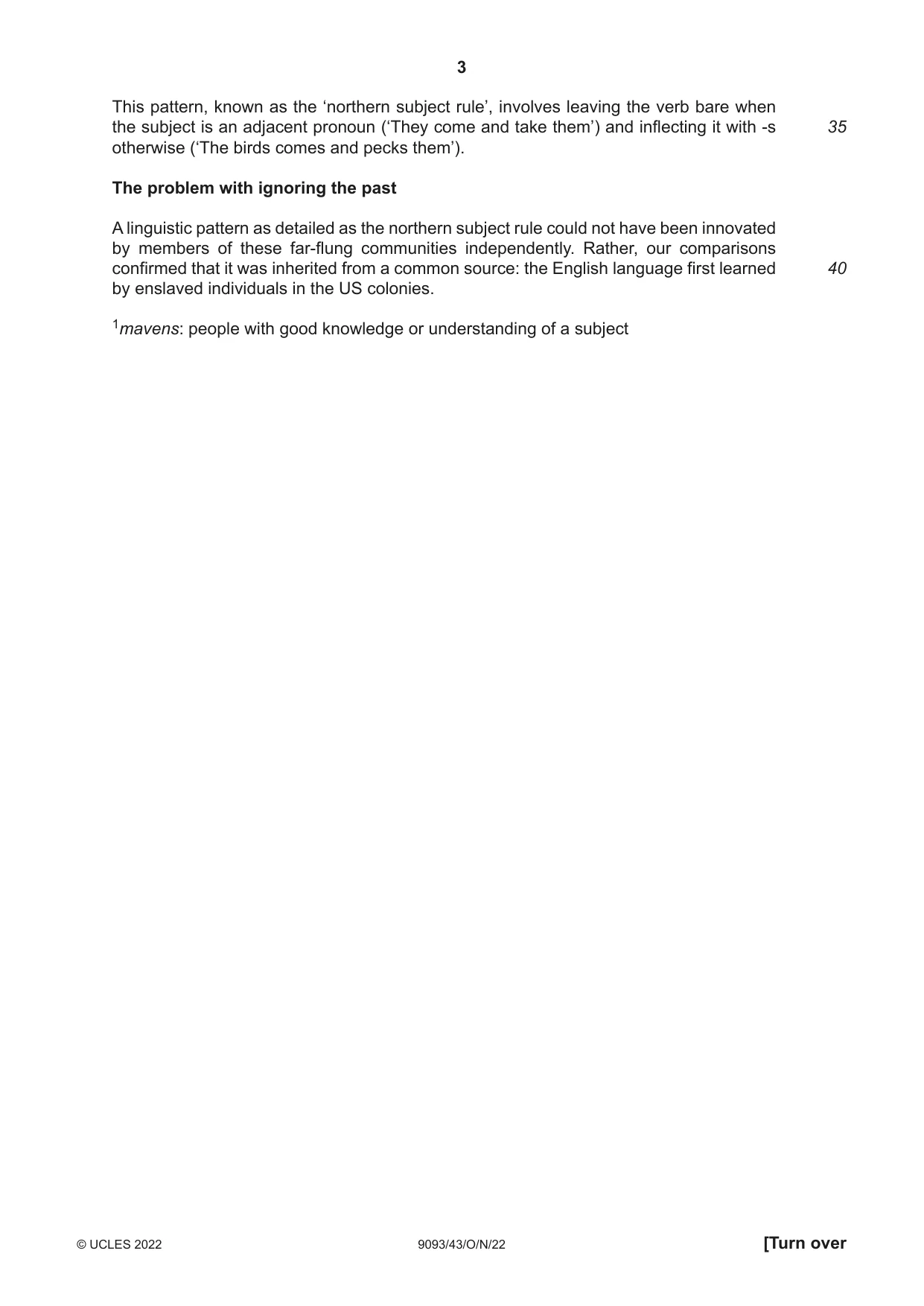
3 9093/43/O/N/22 © UCLES 2022 [Turn over This pattern, known as the ‘northern subject rule’, involves leaving the verb bare when the subject is an adjacent pronoun (‘They come and take them’) and inflecting it with -s otherwise (‘The birds comes and pecks them’). The problem with ignoring the past A linguistic pattern as detailed as the northern subject rule could not have been innovated by members of these far-flung communities independently. Rather, our comparisons confirmed that it was inherited from a common source: the English language first learned by enslaved individuals in the US colonies. 1mavens: people with good knowledge or understanding of a subject 35 40
Question paper, page 4
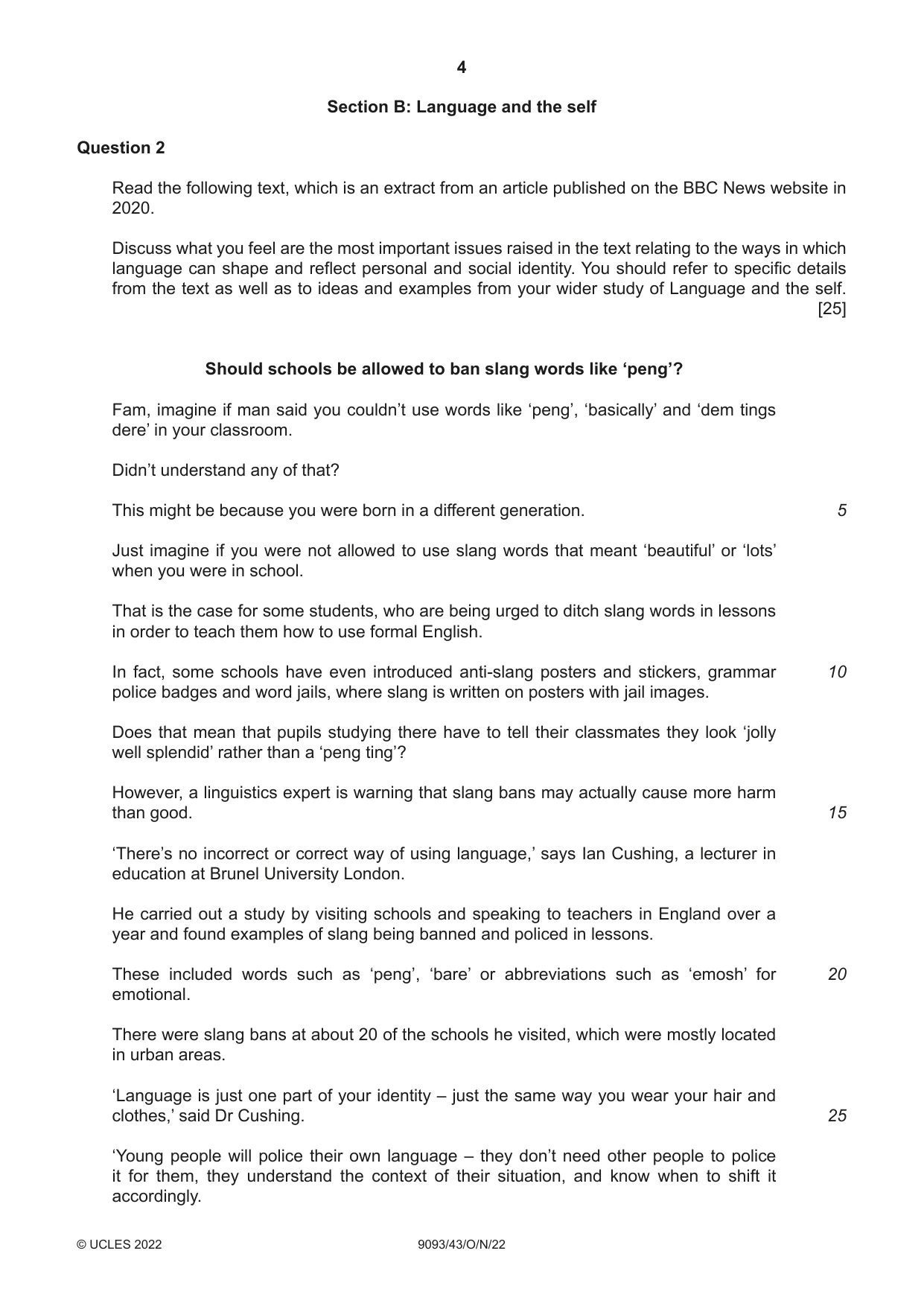
4 9093/43/O/N/22 © UCLES 2022 Section B: Language and the self Question 2 Read the following text, which is an extract from an article published on the BBC News website in 2020. Discuss what you feel are the most important issues raised in the text relating to the ways in which language can shape and reflect personal and social identity. You should refer to specific details from the text as well as to ideas and examples from your wider study of Language and the self. [25] Should schools be allowed to ban slang words like ‘peng’? Fam, imagine if man said you couldn’t use words like ‘peng’, ‘basically’ and ‘dem tings dere’ in your classroom. Didn’t understand any of that? This might be because you were born in a different generation. Just imagine if you were not allowed to use slang words that meant ‘beautiful’ or ‘lots’ when you were in school. That is the case for some students, who are being urged to ditch slang words in lessons in order to teach them how to use formal English. In fact, some schools have even introduced anti-slang posters and stickers, grammar police badges and word jails, where slang is written on posters with jail images. Does that mean that pupils studying there have to tell their classmates they look ‘jolly well splendid’ rather than a ‘peng ting’? However, a linguistics expert is warning that slang bans may actually cause more harm than good. ‘There’s no incorrect or correct way of using language,’ says Ian Cushing, a lecturer in education at Brunel University London. He carried out a study by visiting schools and speaking to teachers in England over a year and found examples of slang being banned and policed in lessons. These included words such as ‘peng’, ‘bare’ or abbreviations such as ‘emosh’ for emotional. There were slang bans at about 20 of the schools he visited, which were mostly located in urban areas. ‘Language is just one part of your identity – just the same way you wear your hair and clothes,’ said Dr Cushing. ‘Young people will police their own language – they don’t need other people to police it for them, they understand the context of their situation, and know when to shift it accordingly. 5 10 15 20 25
Question paper, page 5
5 9093/43/O/N/22 © UCLES 2022 ‘Shakespeare is full of slang and we don’t see teachers banning that – there’s a hypocrisy here, which is rooted in cultural and linguistic snobbery.’ The linguistics academic says slang is a natural way of speaking, and banning it may be a threat to a person’s identity. It may also make students feel discriminated against and less motivated to take part in lessons. ‘Young people are typically the innovators of language change, so actually we should be celebrating that rather than banning it in the classroom,’ said Dr Cushing. However, other people argue that a slang ban is indeed necessary. Chris McGovern, chairman of Campaign for Real Education, says allowing slang is not doing any favours for underprivileged children. He says they are left in an ‘employment gutter’ because of their ‘linguistic impoverishment’. ‘In the UK today, around nine million adults are functionally illiterate, and many of them suffer under-employment, unemployment or destitution as a consequence.’ 30 35 40
Question paper, page 6
6 9093/43/O/N/22 © UCLES 2022 BLANK PAGE
Question paper, page 7
7 9093/43/O/N/22 © UCLES 2022 BLANK PAGE
Question paper, page 8
8 9093/43/O/N/22 © UCLES 2022 Permission to reproduce items where third-party owned material protected by copyright is included has been sought and cleared where possible. Every reasonable effort has been made by the publisher (UCLES) to trace copyright holders, but if any items requiring clearance have unwittingly been included, the publisher will be pleased to make amends at the earliest possible opportunity. To avoid the issue of disclosure of answer-related information to candidates, all copyright acknowledgements are reproduced online in the Cambridge Assessment International Education Copyright Acknowledgements Booklet. This is produced for each series of examinations and is freely available to download at www.cambridgeinternational.org after the live examination series. Cambridge Assessment International Education is part of Cambridge Assessment. Cambridge Assessment is the brand name of the University of Cambridge Local Examinations Syndicate (UCLES), which is a department of the University of Cambridge. BLANK PAGE
Mark scheme, page 1
This document consists of 9 printed pages. © UCLES 2022 [Turn over Cambridge International A Level ENGLISH LANGUAGE 9093/43 Paper 4 Language Topics October/November 2022 MARK SCHEME Maximum Mark: 50 Published This mark scheme is published as an aid to teachers and candidates, to indicate the requirements of the examination. It shows the basis on which Examiners were instructed to award marks. It does not indicate the details of the discussions that took place at an Examiners’ meeting before marking began, which would have considered the acceptability of alternative answers. Mark schemes should be read in conjunction with the question paper and the Principal Examiner Report for Teachers. Cambridge International will not enter into discussions about these mark schemes. Cambridge International is publishing the mark schemes for the October/November 2022 series for most Cambridge IGCSE™, Cambridge International A and AS Level components and some Cambridge O Level components.
Mark scheme, page 2
9093/43 Cambridge International AS Level – Mark Scheme PUBLISHED October/November 2022 © UCLES 2022 Page 2 of 9 Generic Marking Principles These general marking principles must be applied by all examiners when marking candidate answers. They should be applied alongside the specific content of the mark scheme or generic level descriptors for a question. Each question paper and mark scheme will also comply with these marking principles. GENERIC MARKING PRINCIPLE 1: Marks must be awarded in line with: • the specific content of the mark scheme or the generic level descriptors for the question • the specific skills defined in the mark scheme or in the generic level descriptors for the question • the standard of response required by a candidate as exemplified by the standardisation scripts. GENERIC MARKING PRINCIPLE 2: Marks awarded are always whole marks (not half marks, or other fractions). GENERIC MARKING PRINCIPLE 3: Marks must be awarded positively: • marks are awarded for correct/valid answers, as defined in the mark scheme. However, credit is given for valid answers which go beyond the scope of the syllabus and mark scheme, referring to your Team Leader as appropriate • marks are awarded when candidates clearly demonstrate what they know and can do • marks are not deducted for errors • marks are not deducted for omissions • answers should only be judged on the quality of spelling, punctuation and grammar when these features are specifically assessed by the question as indicated by the mark scheme. The meaning, however, should be unambiguous. GENERIC MARKING PRINCIPLE 4: Rules must be applied consistently, e.g. in situations where candidates have not followed instructions or in the application of generic level descriptors.
Mark scheme, page 3
9093/43 Cambridge International AS Level – Mark Scheme PUBLISHED October/November 2022 © UCLES 2022 Page 3 of 9 GENERIC MARKING PRINCIPLE 5: Marks should be awarded using the full range of marks defined in the mark scheme for the question (however; the use of the full mark range may be limited according to the quality of the candidate responses seen). GENERIC MARKING PRINCIPLE 6: Marks awarded are based solely on the requirements as defined in the mark scheme. Marks should not be awarded with grade thresholds or grade descriptors in mind.
Mark scheme, page 4
9093/43 Cambridge International AS Level – Mark Scheme PUBLISHED October/November 2022 © UCLES 2022 Page 4 of 9 English & Media subject specific general marking principles (To be read in conjunction with the Generic Marking Principles (and requiring further guidance on how to place marks within levels)) Components using level descriptors: • We use level descriptors as a guide to broad understanding of the qualities normally expected of, or typical of, work in a level. • Level descriptors are a means of general guidance, and should not be interpreted as hurdle statements. • Where indicative content notes are supplied for a question, these are not a prescription of required content, and must not be treated as such. Alternative correct points and unexpected answers in candidates’ scripts must be given marks that fairly reflect the knowledge and skills demonstrated. • While we may have legitimate expectations as to the ground most answers may occupy, we must at all times be prepared to meet candidates on their chosen ground, provided it is relevant ground (e.g. clearly related to and derived from a relevant passage/text and meeting the mark scheme requirements for the question).
Mark scheme, page 5
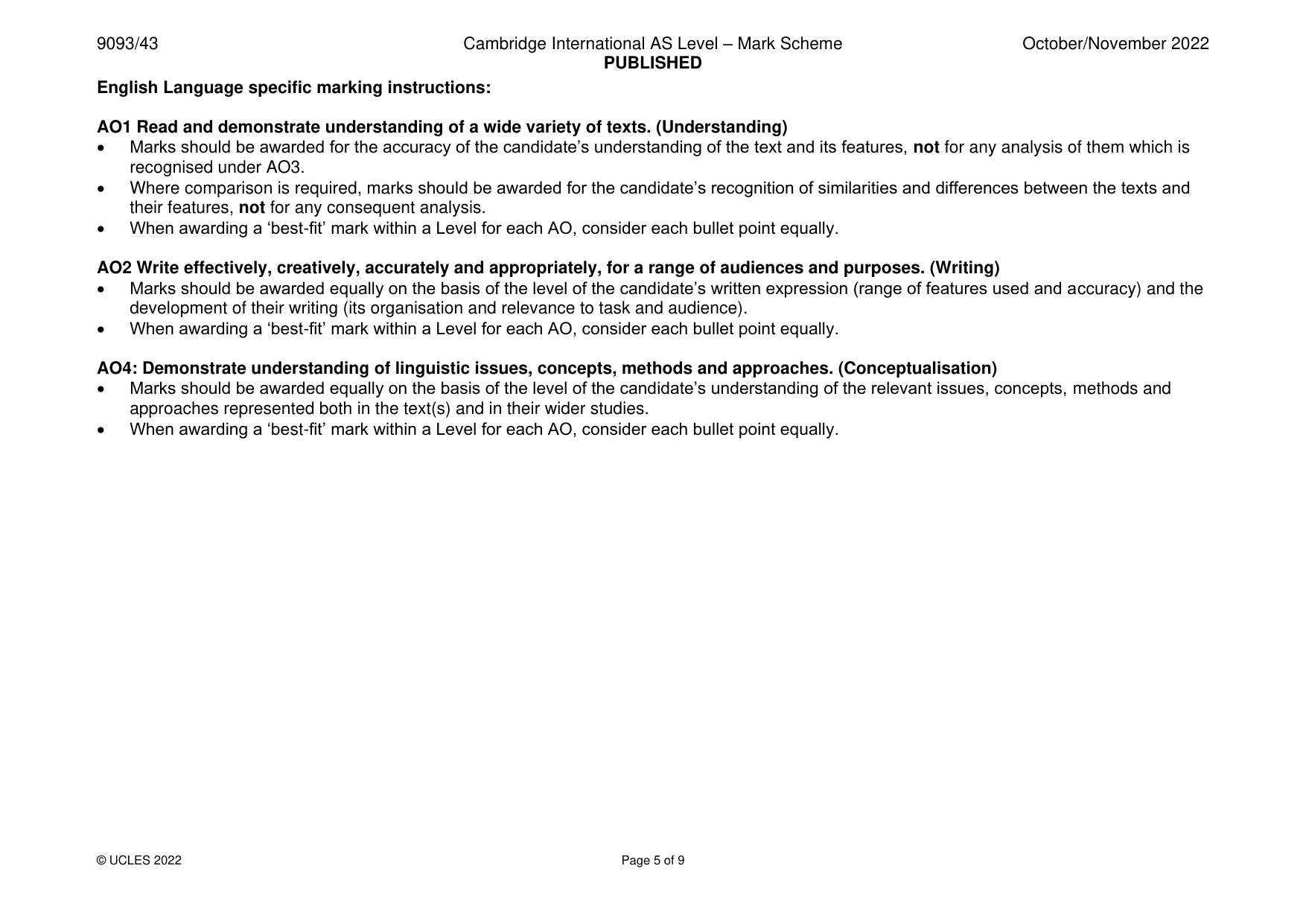
9093/43 Cambridge International AS Level – Mark Scheme PUBLISHED October/November 2022 © UCLES 2022 Page 5 of 9 English Language specific marking instructions: AO1 Read and demonstrate understanding of a wide variety of texts. (Understanding) • Marks should be awarded for the accuracy of the candidate’s understanding of the text and its features, not for any analysis of them which is recognised under AO3. • Where comparison is required, marks should be awarded for the candidate’s recognition of similarities and differences between the texts and their features, not for any consequent analysis. • When awarding a ‘best-fit’ mark within a Level for each AO, consider each bullet point equally. AO2 Write effectively, creatively, accurately and appropriately, for a range of audiences and purposes. (Writing) • Marks should be awarded equally on the basis of the level of the candidate’s written expression (range of features used and accuracy) and the development of their writing (its organisation and relevance to task and audience). • When awarding a ‘best-fit’ mark within a Level for each AO, consider each bullet point equally. AO4: Demonstrate understanding of linguistic issues, concepts, methods and approaches. (Conceptualisation) • Marks should be awarded equally on the basis of the level of the candidate’s understanding of the relevant issues, concepts, methods and approaches represented both in the text(s) and in their wider studies. • When awarding a ‘best-fit’ mark within a Level for each AO, consider each bullet point equally.
Mark scheme, page 6
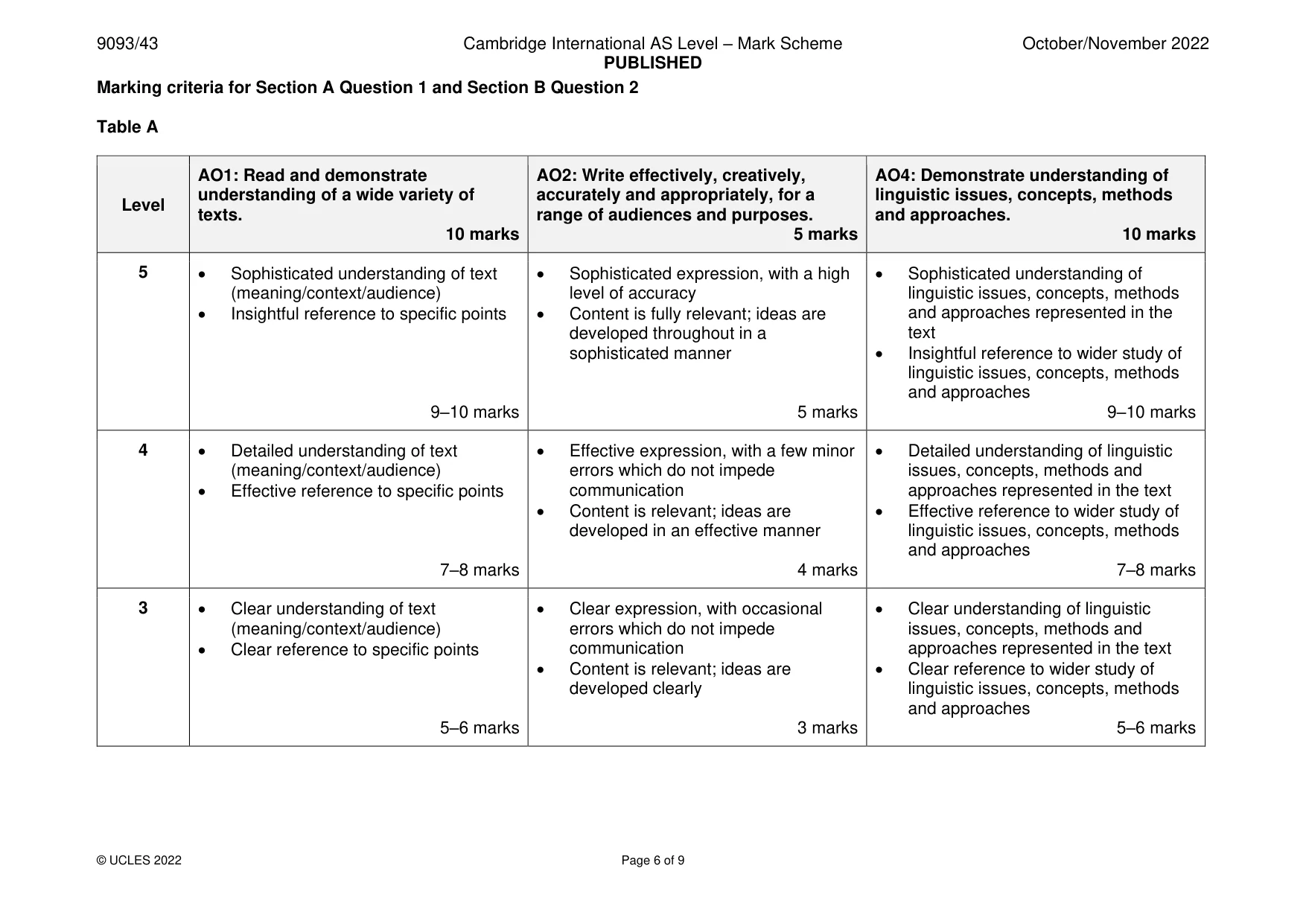
9093/43 Cambridge International AS Level – Mark Scheme PUBLISHED October/November 2022 © UCLES 2022 Page 6 of 9 Marking criteria for Section A Question 1 and Section B Question 2 Table A Level AO1: Read and demonstrate understanding of a wide variety of texts. 10 marks AO2: Write effectively, creatively, accurately and appropriately, for a range of audiences and purposes. 5 marks AO4: Demonstrate understanding of linguistic issues, concepts, methods and approaches. 10 marks 5 • Sophisticated understanding of text (meaning/context/audience) • Insightful reference to specific points 9–10 marks • Sophisticated expression, with a high level of accuracy • Content is fully relevant; ideas are developed throughout in a sophisticated manner 5 marks • Sophisticated understanding of linguistic issues, concepts, methods and approaches represented in the text • Insightful reference to wider study of linguistic issues, concepts, methods and approaches 9–10 marks 4 • Detailed understanding of text (meaning/context/audience) • Effective reference to specific points 7–8 marks • Effective expression, with a few minor errors which do not impede communication • Content is relevant; ideas are developed in an effective manner 4 marks • Detailed understanding of linguistic issues, concepts, methods and approaches represented in the text • Effective reference to wider study of linguistic issues, concepts, methods and approaches 7–8 marks 3 • Clear understanding of text (meaning/context/audience) • Clear reference to specific points 5–6 marks • Clear expression, with occasional errors which do not impede communication • Content is relevant; ideas are developed clearly 3 marks • Clear understanding of linguistic issues, concepts, methods and approaches represented in the text • Clear reference to wider study of linguistic issues, concepts, methods and approaches 5–6 marks
Mark scheme, page 7
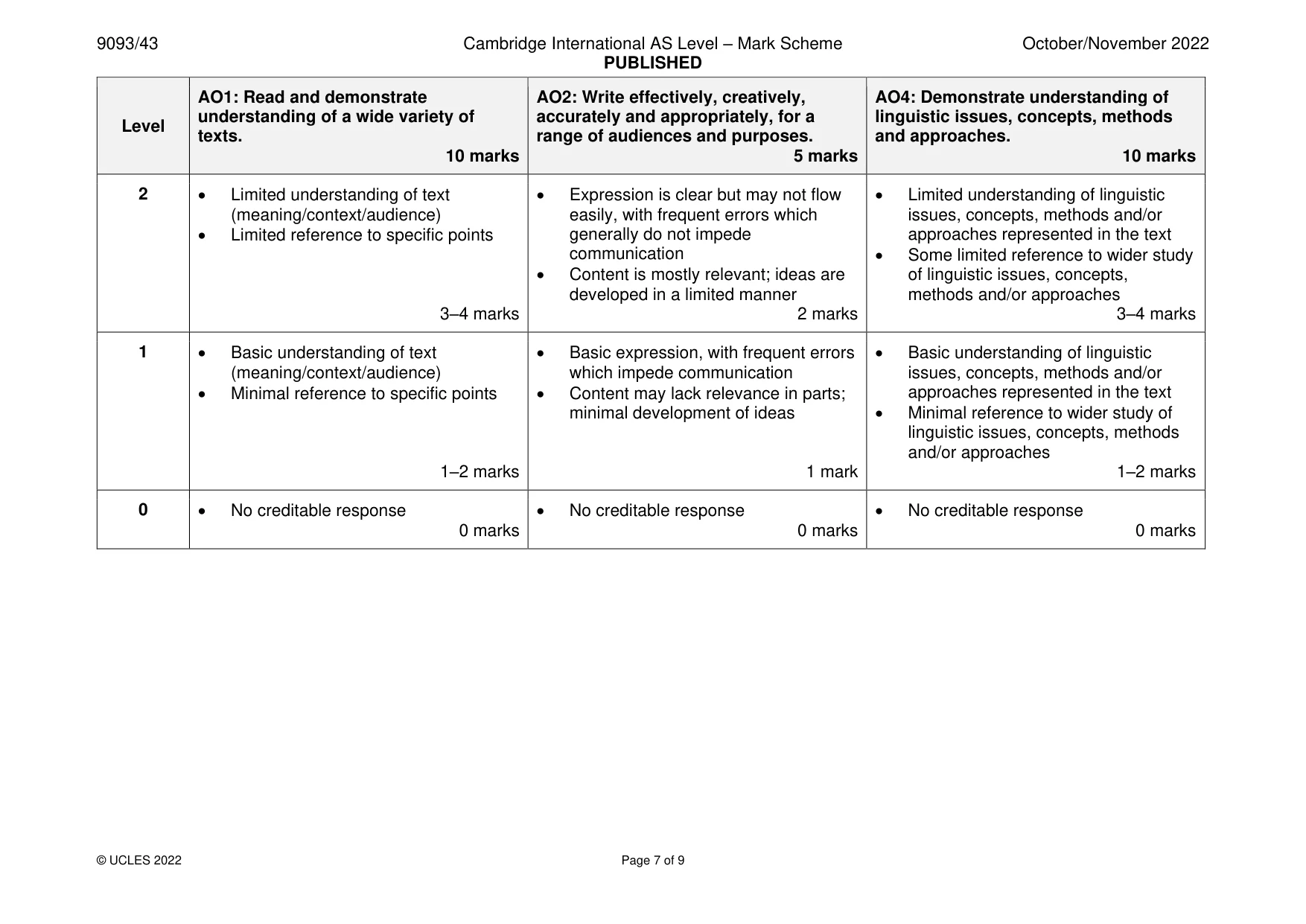
9093/43 Cambridge International AS Level – Mark Scheme PUBLISHED October/November 2022 © UCLES 2022 Page 7 of 9 Level AO1: Read and demonstrate understanding of a wide variety of texts. 10 marks AO2: Write effectively, creatively, accurately and appropriately, for a range of audiences and purposes. 5 marks AO4: Demonstrate understanding of linguistic issues, concepts, methods and approaches. 10 marks 2 • Limited understanding of text (meaning/context/audience) • Limited reference to specific points 3–4 marks • Expression is clear but may not flow easily, with frequent errors which generally do not impede communication • Content is mostly relevant; ideas are developed in a limited manner 2 marks • Limited understanding of linguistic issues, concepts, methods and/or approaches represented in the text • Some limited reference to wider study of linguistic issues, concepts, methods and/or approaches 3–4 marks 1 • Basic understanding of text (meaning/context/audience) • Minimal reference to specific points 1–2 marks • Basic expression, with frequent errors which impede communication • Content may lack relevance in parts; minimal development of ideas 1 mark • Basic understanding of linguistic issues, concepts, methods and/or approaches represented in the text • Minimal reference to wider study of linguistic issues, concepts, methods and/or approaches 1–2 marks 0 • No creditable response 0 marks • No creditable response 0 marks • No creditable response 0 marks
Mark scheme, page 8
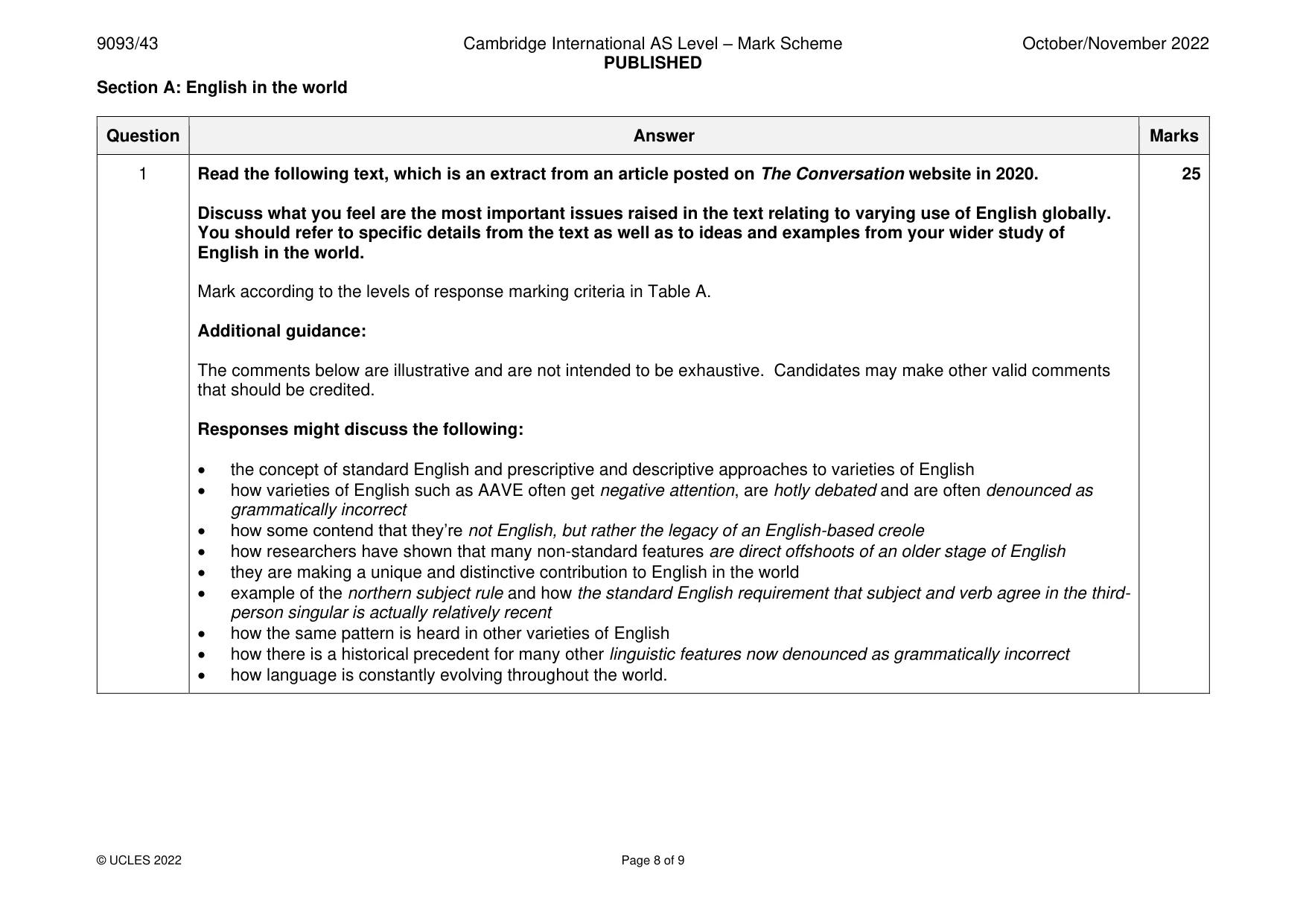
9093/43 Cambridge International AS Level – Mark Scheme PUBLISHED October/November 2022 © UCLES 2022 Page 8 of 9 Section A: English in the world Question Answer Marks 1 Read the following text, which is an extract from an article posted on The Conversation website in 2020. Discuss what you feel are the most important issues raised in the text relating to varying use of English globally. You should refer to specific details from the text as well as to ideas and examples from your wider study of English in the world. Mark according to the levels of response marking criteria in Table A. Additional guidance: The comments below are illustrative and are not intended to be exhaustive. Candidates may make other valid comments that should be credited. Responses might discuss the following: • the concept of standard English and prescriptive and descriptive approaches to varieties of English • how varieties of English such as AAVE often get negative attention, are hotly debated and are often denounced as grammatically incorrect • how some contend that they’re not English, but rather the legacy of an English-based creole • how researchers have shown that many non-standard features are direct offshoots of an older stage of English • they are making a unique and distinctive contribution to English in the world • example of the northern subject rule and how the standard English requirement that subject and verb agree in the third- person singular is actually relatively recent • how the same pattern is heard in other varieties of English • how there is a historical precedent for many other linguistic features now denounced as grammatically incorrect • how language is constantly evolving throughout the world. 25
Mark scheme, page 9
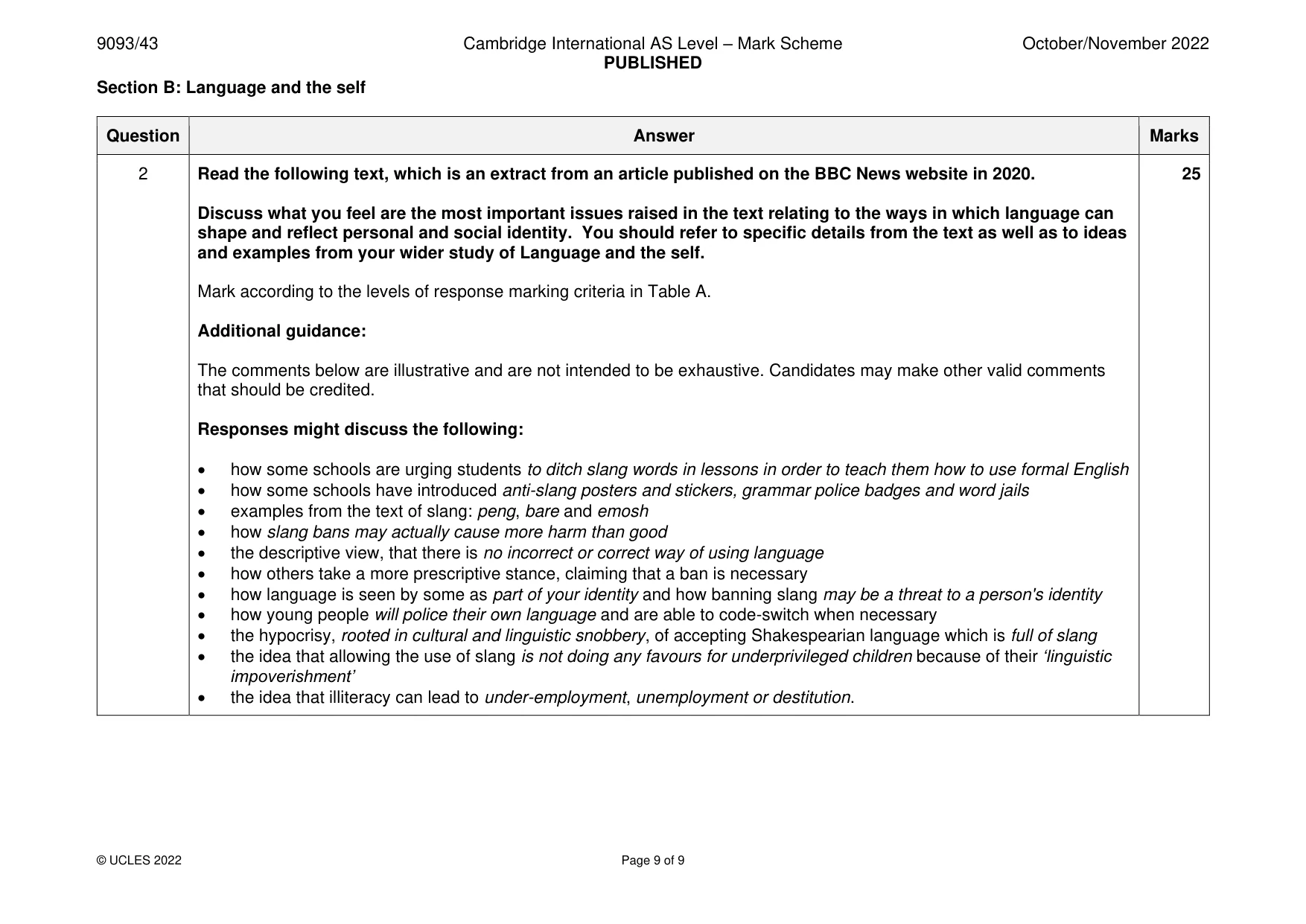
9093/43 Cambridge International AS Level – Mark Scheme PUBLISHED October/November 2022 © UCLES 2022 Page 9 of 9 Section B: Language and the self Question Answer Marks 2 Read the following text, which is an extract from an article published on the BBC News website in 2020. Discuss what you feel are the most important issues raised in the text relating to the ways in which language can shape and reflect personal and social identity. You should refer to specific details from the text as well as to ideas and examples from your wider study of Language and the self. Mark according to the levels of response marking criteria in Table A. Additional guidance: The comments below are illustrative and are not intended to be exhaustive. Candidates may make other valid comments that should be credited. Responses might discuss the following: • how some schools are urging students to ditch slang words in lessons in order to teach them how to use formal English • how some schools have introduced anti-slang posters and stickers, grammar police badges and word jails • examples from the text of slang: peng, bare and emosh • how slang bans may actually cause more harm than good • the descriptive view, that there is no incorrect or correct way of using language • how others take a more prescriptive stance, claiming that a ban is necessary • how language is seen by some as part of your identity and how banning slang may be a threat to a person's identity • how young people will police their own language and are able to code-switch when necessary • the hypocrisy, rooted in cultural and linguistic snobbery, of accepting Shakespearian language which is full of slang • the idea that allowing the use of slang is not doing any favours for underprivileged children because of their ‘linguistic impoverishment’ • the idea that illiteracy can lead to under-employment, unemployment or destitution. 25
What you needed in this session
Cambridge’s own grade thresholds for 2022 Oct/Nov, Paper 4 · Variant 3. A higher threshold means an easier paper — the bar moves with how the cohort did.