Cambridge A Level English - Language AS and A Level (from 2014) 9093 — 2022 May/June Paper 4 · Variant 2
9093/42/M/J/22 · 50 marks · ≈56 min
The question paper and its mark scheme, free to read here and free to download. This is Cambridge’s own paper, exactly as it was sat.
Question paper8 pages




Mark scheme9 pages
Answers below. Sit the paper first if you are practising.
Paper as text
Question paper, page 1
This document has 8 pages. Any blank pages are indicated. [Turn over Cambridge International AS & A Level DC (LK) 214990/1 © UCLES 2022 ENGLISH LANGUAGE 9093/42 Paper 4 Language Topics May/June 2022 2 hours 15 minutes You must answer on the enclosed answer booklet. You will need: Answer booklet (enclosed) INSTRUCTIONS ● Answer all questions. ● Follow the instructions on the front cover of the answer booklet. If you need additional answer paper, ask the invigilator for a continuation booklet. ● Dictionaries are not allowed. INFORMATION ● The total mark for this paper is 50. ● The number of marks for each question or part question is shown in brackets [ ]. * 6 9 6 7 1 8 7 6 1 7 *
Question paper, page 2
2 9093/42/M/J/22 © UCLES 2022 Section A: English in the world Question 1 Read the following text, which is an article published on the New Zealand website Stuff in 2020. Discuss what you feel are the most important issues raised in the text relating to the changing use of English in the world. You should refer to specific details from the text as well as to ideas and examples from your wider study of English in the world. [25] How Māori and English languages mix in the modern world In the world of linguists, there’s one constant rule: language changes. Content removed due to copyright restrictions.
Question paper, page 3
3 9093/42/M/J/22 © UCLES 2022 [Turn over kia ora – good luck Content removed due to copyright restrictions.
Question paper, page 4
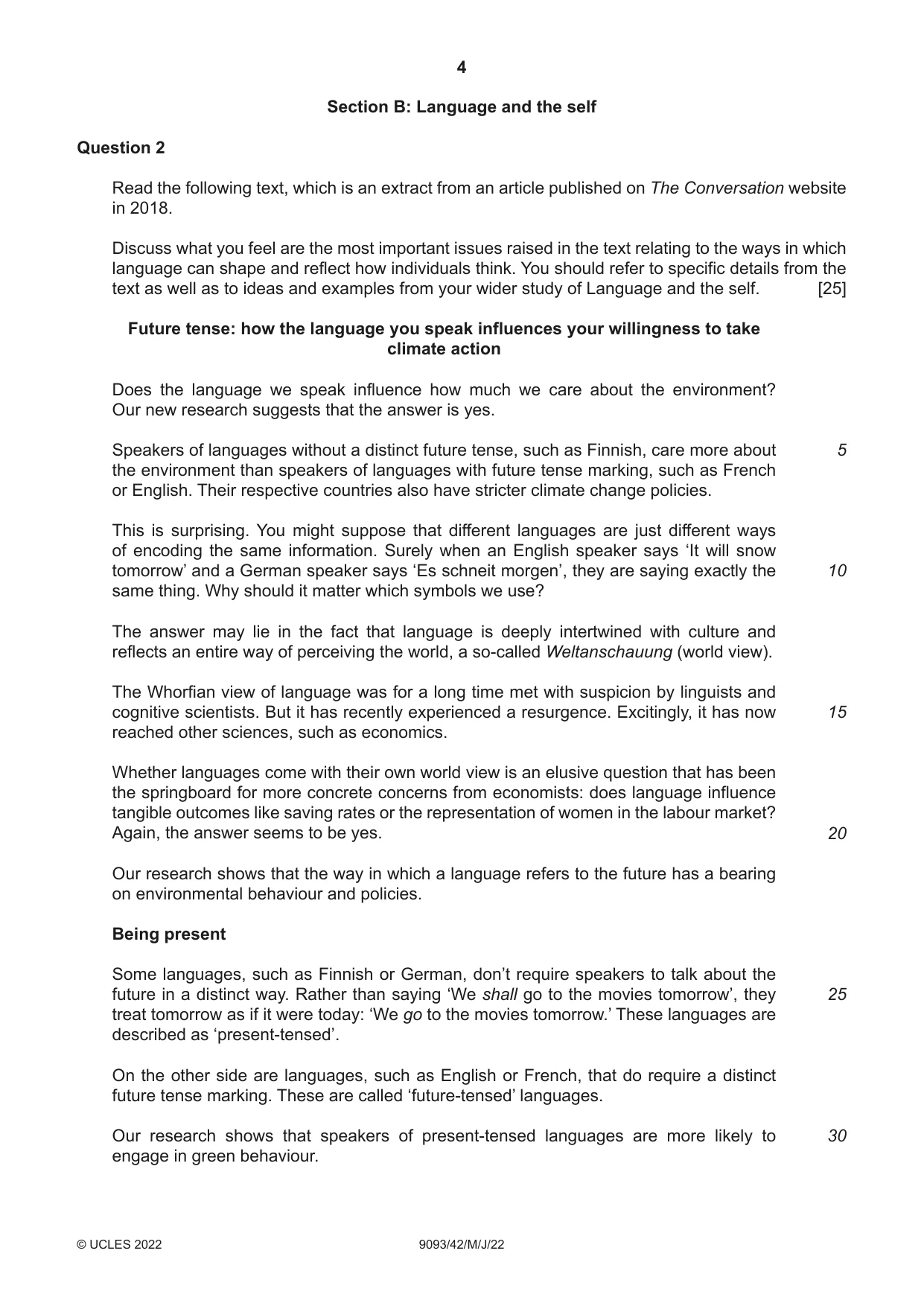
4 9093/42/M/J/22 © UCLES 2022 Section B: Language and the self Question 2 Read the following text, which is an extract from an article published on The Conversation website in 2018. Discuss what you feel are the most important issues raised in the text relating to the ways in which language can shape and reflect how individuals think. You should refer to specific details from the text as well as to ideas and examples from your wider study of Language and the self. [25] Future tense: how the language you speak influences your willingness to take climate action Does the language we speak influence how much we care about the environment? Our new research suggests that the answer is yes. Speakers of languages without a distinct future tense, such as Finnish, care more about the environment than speakers of languages with future tense marking, such as French or English. Their respective countries also have stricter climate change policies. This is surprising. You might suppose that different languages are just different ways of encoding the same information. Surely when an English speaker says ‘It will snow tomorrow’ and a German speaker says ‘Es schneit morgen’, they are saying exactly the same thing. Why should it matter which symbols we use? The answer may lie in the fact that language is deeply intertwined with culture and reflects an entire way of perceiving the world, a so-called Weltanschauung (world view). The Whorfian view of language was for a long time met with suspicion by linguists and cognitive scientists. But it has recently experienced a resurgence. Excitingly, it has now reached other sciences, such as economics. Whether languages come with their own world view is an elusive question that has been the springboard for more concrete concerns from economists: does language influence tangible outcomes like saving rates or the representation of women in the labour market? Again, the answer seems to be yes. Our research shows that the way in which a language refers to the future has a bearing on environmental behaviour and policies. Being present Some languages, such as Finnish or German, don’t require speakers to talk about the future in a distinct way. Rather than saying ‘We shall go to the movies tomorrow’, they treat tomorrow as if it were today: ‘We go to the movies tomorrow.’ These languages are described as ‘present-tensed’. On the other side are languages, such as English or French, that do require a distinct future tense marking. These are called ‘future-tensed’ languages. Our research shows that speakers of present-tensed languages are more likely to engage in green behaviour. 5 10 15 20 25 30
Question paper, page 5
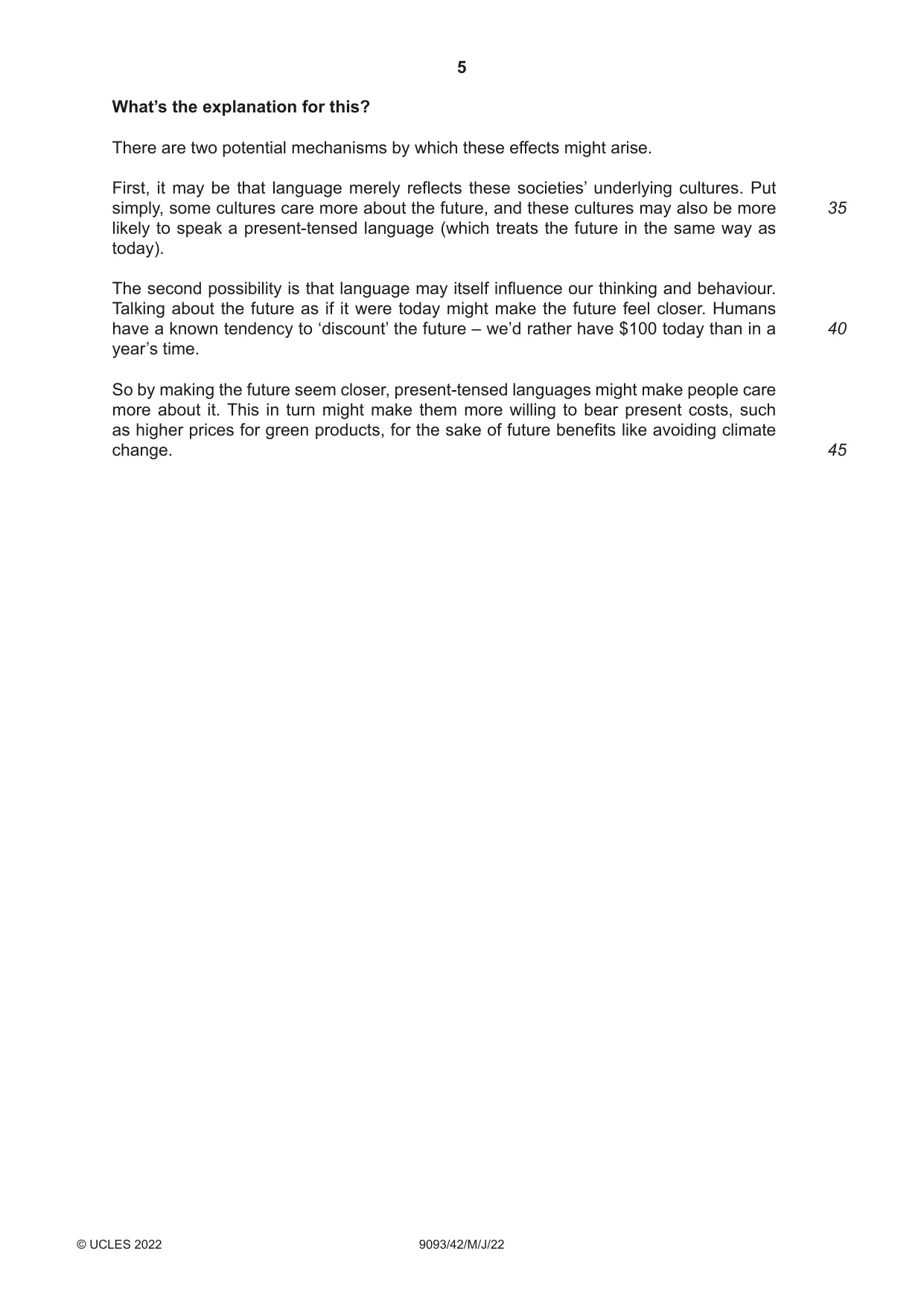
5 9093/42/M/J/22 © UCLES 2022 What’s the explanation for this? There are two potential mechanisms by which these effects might arise. First, it may be that language merely reflects these societies’ underlying cultures. Put simply, some cultures care more about the future, and these cultures may also be more likely to speak a present-tensed language (which treats the future in the same way as today). The second possibility is that language may itself influence our thinking and behaviour. Talking about the future as if it were today might make the future feel closer. Humans have a known tendency to ‘discount’ the future – we’d rather have $100 today than in a year’s time. So by making the future seem closer, present-tensed languages might make people care more about it. This in turn might make them more willing to bear present costs, such as higher prices for green products, for the sake of future benefits like avoiding climate change. 35 40 45
Question paper, page 6
6 9093/42/M/J/22 © UCLES 2022 BLANK PAGE
Question paper, page 7
7 9093/42/M/J/22 © UCLES 2022 BLANK PAGE
Question paper, page 8
8 9093/42/M/J/22 © UCLES 2022 Permission to reproduce items where third-party owned material protected by copyright is included has been sought and cleared where possible. Every reasonable effort has been made by the publisher (UCLES) to trace copyright holders, but if any items requiring clearance have unwittingly been included, the publisher will be pleased to make amends at the earliest possible opportunity. To avoid the issue of disclosure of answer-related information to candidates, all copyright acknowledgements are reproduced online in the Cambridge Assessment International Education Copyright Acknowledgements Booklet. This is produced for each series of examinations and is freely available to download at www.cambridgeinternational.org after the live examination series. Cambridge Assessment International Education is part of Cambridge Assessment. Cambridge Assessment is the brand name of the University of Cambridge Local Examinations Syndicate (UCLES), which is a department of the University of Cambridge. BLANK PAGE
Mark scheme, page 1
This document consists of 9 printed pages. © UCLES 2022 [Turn over Cambridge International A Level ENGLISH LANGUAGE 9093/42 Paper 4 Language Topics May/June 2022 MARK SCHEME Maximum Mark: 50 Published This mark scheme is published as an aid to teachers and candidates, to indicate the requirements of the examination. It shows the basis on which Examiners were instructed to award marks. It does not indicate the details of the discussions that took place at an Examiners’ meeting before marking began, which would have considered the acceptability of alternative answers. Mark schemes should be read in conjunction with the question paper and the Principal Examiner Report for Teachers. Cambridge International will not enter into discussions about these mark schemes. Cambridge International is publishing the mark schemes for the May/June 2022 series for most Cambridge IGCSE, Cambridge International A and AS Level and Cambridge Pre-U components, and some Cambridge O Level components.
Mark scheme, page 2
9093/42 Cambridge International A Level – Mark Scheme PUBLISHED May/June 2022 © UCLES 2022 Page 2 of 9 Generic Marking Principles These general marking principles must be applied by all examiners when marking candidate answers. They should be applied alongside the specific content of the mark scheme or generic level descriptors for a question. Each question paper and mark scheme will also comply with these marking principles. GENERIC MARKING PRINCIPLE 1: Marks must be awarded in line with: the specific content of the mark scheme or the generic level descriptors for the question the specific skills defined in the mark scheme or in the generic level descriptors for the question the standard of response required by a candidate as exemplified by the standardisation scripts. GENERIC MARKING PRINCIPLE 2: Marks awarded are always whole marks (not half marks, or other fractions). GENERIC MARKING PRINCIPLE 3: Marks must be awarded positively: marks are awarded for correct/valid answers, as defined in the mark scheme. However, credit is given for valid answers which go beyond the scope of the syllabus and mark scheme, referring to your Team Leader as appropriate marks are awarded when candidates clearly demonstrate what they know and can do marks are not deducted for errors marks are not deducted for omissions answers should only be judged on the quality of spelling, punctuation and grammar when these features are specifically assessed by the question as indicated by the mark scheme. The meaning, however, should be unambiguous. GENERIC MARKING PRINCIPLE 4: Rules must be applied consistently, e.g. in situations where candidates have not followed instructions or in the application of generic level descriptors.
Mark scheme, page 3
9093/42 Cambridge International A Level – Mark Scheme PUBLISHED May/June 2022 © UCLES 2022 Page 3 of 9 GENERIC MARKING PRINCIPLE 5: Marks should be awarded using the full range of marks defined in the mark scheme for the question (however; the use of the full mark range may be limited according to the quality of the candidate responses seen). GENERIC MARKING PRINCIPLE 6: Marks awarded are based solely on the requirements as defined in the mark scheme. Marks should not be awarded with grade thresholds or grade descriptors in mind.
Mark scheme, page 4
9093/42 Cambridge International A Level – Mark Scheme PUBLISHED May/June 2022 © UCLES 2022 Page 4 of 9 English & Media subject specific general marking principles (To be read in conjunction with the Generic Marking Principles (and requiring further guidance on how to place marks within levels)) Components using level descriptors: We use level descriptors as a guide to broad understanding of the qualities normally expected of, or typical of, work in a level. Level descriptors are a means of general guidance, and should not be interpreted as hurdle statements. Where indicative content notes are supplied for a question, these are not a prescription of required content, and must not be treated as such. Alternative correct points and unexpected answers in candidates’ scripts must be given marks that fairly reflect the knowledge and skills demonstrated. While we may have legitimate expectations as to the ground most answers may occupy, we must at all times be prepared to meet candidates on their chosen ground, provided it is relevant ground (e.g. clearly related to and derived from a relevant passage/text and meeting the mark scheme requirements for the question).
Mark scheme, page 5
9093/42 Cambridge International A Level – Mark Scheme PUBLISHED May/June 2022 © UCLES 2022 Page 5 of 9 English Language specific marking instructions: AO1 Read and demonstrate understanding of a wide variety of texts. (Understanding) Marks should be awarded for the accuracy of the candidate’s understanding of the text and its features, not for any analysis of them which is recognised under AO3. Where comparison is required, marks should be awarded for the candidate’s recognition of similarities and differences between the texts and their features, not for any consequent analysis. When awarding a ‘best-fit’ mark within a Level for each AO, consider each bullet point equally. AO2 Write effectively, creatively, accurately and appropriately, for a range of audiences and purposes. (Writing) Marks should be awarded equally on the basis of the level of the candidate’s written expression (range of features used and accuracy) and the development of their writing (its organisation and relevance to task and audience). When awarding a ‘best-fit’ mark within a Level for each AO, consider each bullet point equally. AO4: Demonstrate understanding of linguistic issues, concepts, methods and approaches. (Conceptualisation) Marks should be awarded equally on the basis of the level of the candidate’s understanding of the relevant issues, concepts, methods and approaches represented both in the text(s) and in their wider studies. When awarding a ‘best-fit’ mark within a Level for each AO, consider each bullet point equally.
Mark scheme, page 6
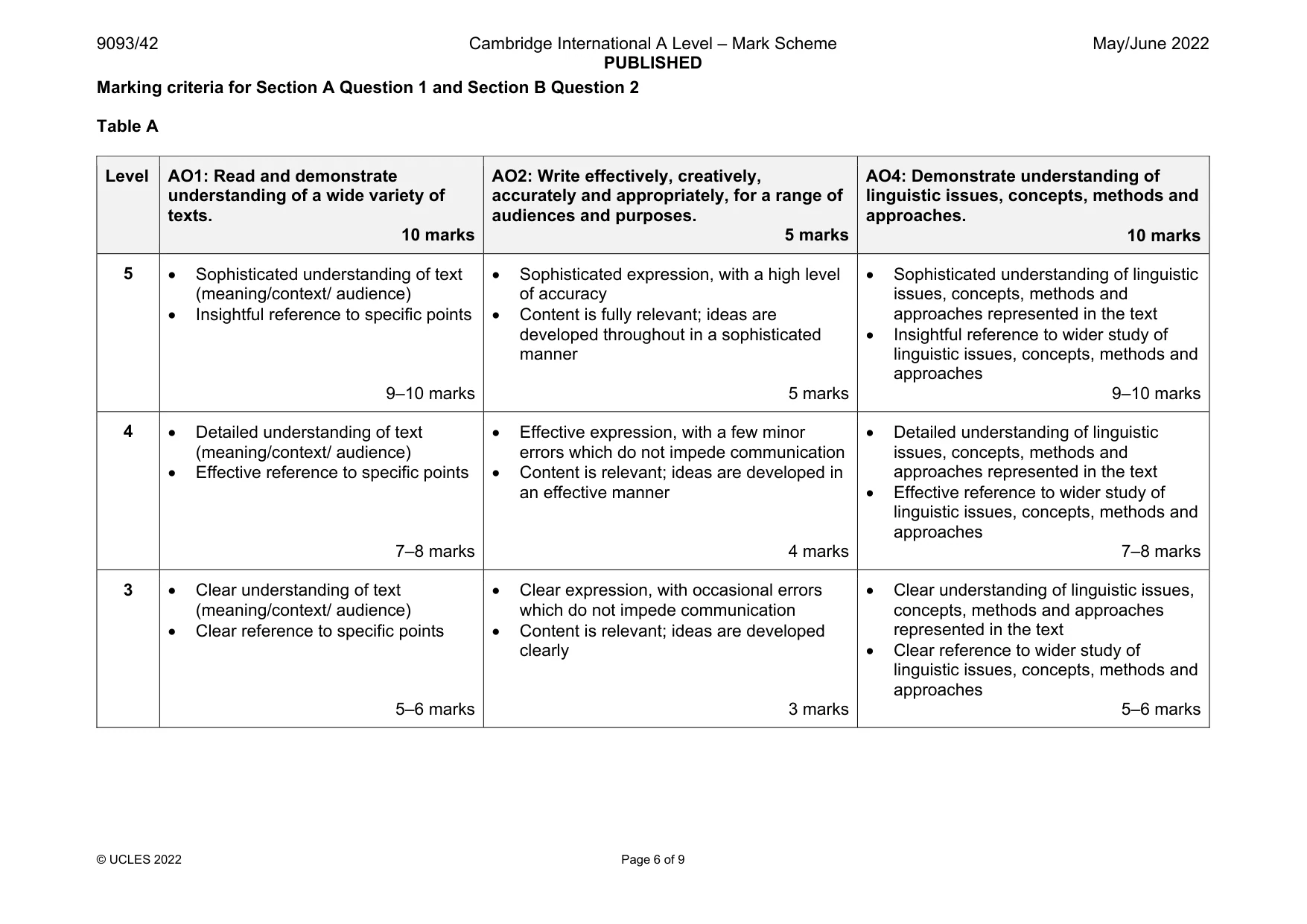
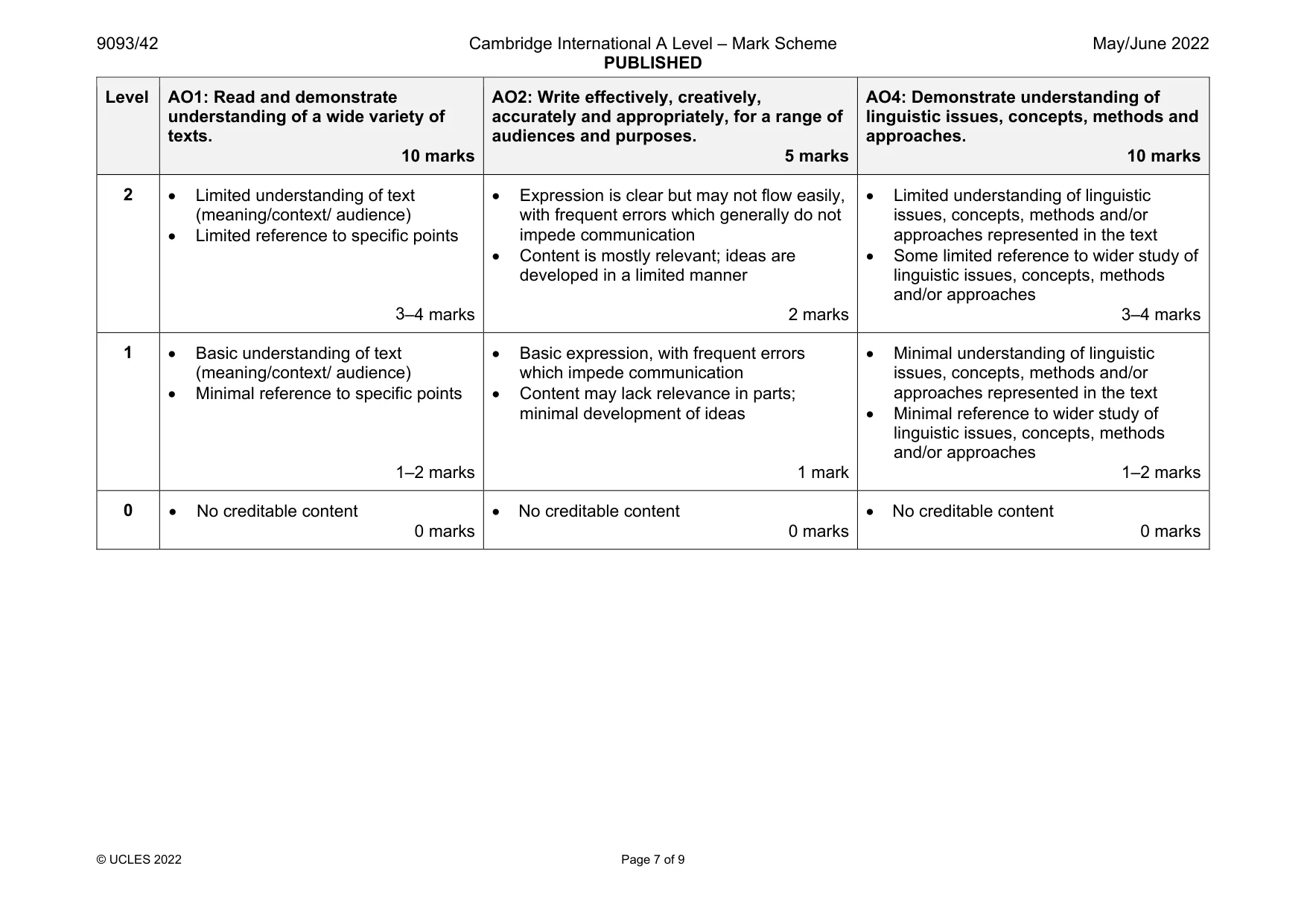
9093/42 Cambridge International A Level – Mark Scheme PUBLISHED May/June 2022 © UCLES 2022 Page 6 of 9 Marking criteria for Section A Question 1 and Section B Question 2 Table A Level AO1: Read and demonstrate understanding of a wide variety of texts. 10 marks AO2: Write effectively, creatively, accurately and appropriately, for a range of audiences and purposes. 5 marks AO4: Demonstrate understanding of linguistic issues, concepts, methods and approaches. 10 marks 5 Sophisticated understanding of text (meaning/context/ audience) Insightful reference to specific points 9–10 marks Sophisticated expression, with a high level of accuracy Content is fully relevant; ideas are developed throughout in a sophisticated manner 5 marks Sophisticated understanding of linguistic issues, concepts, methods and approaches represented in the text Insightful reference to wider study of linguistic issues, concepts, methods and approaches 9–10 marks 4 Detailed understanding of text (meaning/context/ audience) Effective reference to specific points 7–8 marks Effective expression, with a few minor errors which do not impede communication Content is relevant; ideas are developed in an effective manner 4 marks Detailed understanding of linguistic issues, concepts, methods and approaches represented in the text Effective reference to wider study of linguistic issues, concepts, methods and approaches 7–8 marks 3 Clear understanding of text (meaning/context/ audience) Clear reference to specific points 5–6 marks Clear expression, with occasional errors which do not impede communication Content is relevant; ideas are developed clearly 3 marks Clear understanding of linguistic issues, concepts, methods and approaches represented in the text Clear reference to wider study of linguistic issues, concepts, methods and approaches 5–6 marks
Mark scheme, page 7
9093/42 Cambridge International A Level – Mark Scheme PUBLISHED May/June 2022 © UCLES 2022 Page 7 of 9 Level AO1: Read and demonstrate understanding of a wide variety of texts. 10 marks AO2: Write effectively, creatively, accurately and appropriately, for a range of audiences and purposes. 5 marks AO4: Demonstrate understanding of linguistic issues, concepts, methods and approaches. 10 marks 2 Limited understanding of text (meaning/context/ audience) Limited reference to specific points 3–4 marks Expression is clear but may not flow easily, with frequent errors which generally do not impede communication Content is mostly relevant; ideas are developed in a limited manner 2 marks Limited understanding of linguistic issues, concepts, methods and/or approaches represented in the text Some limited reference to wider study of linguistic issues, concepts, methods and/or approaches 3–4 marks 1 Basic understanding of text (meaning/context/ audience) Minimal reference to specific points 1–2 marks Basic expression, with frequent errors which impede communication Content may lack relevance in parts; minimal development of ideas 1 mark Minimal understanding of linguistic issues, concepts, methods and/or approaches represented in the text Minimal reference to wider study of linguistic issues, concepts, methods and/or approaches 1–2 marks 0 No creditable content 0 marks No creditable content 0 marks No creditable content 0 marks
Mark scheme, page 8
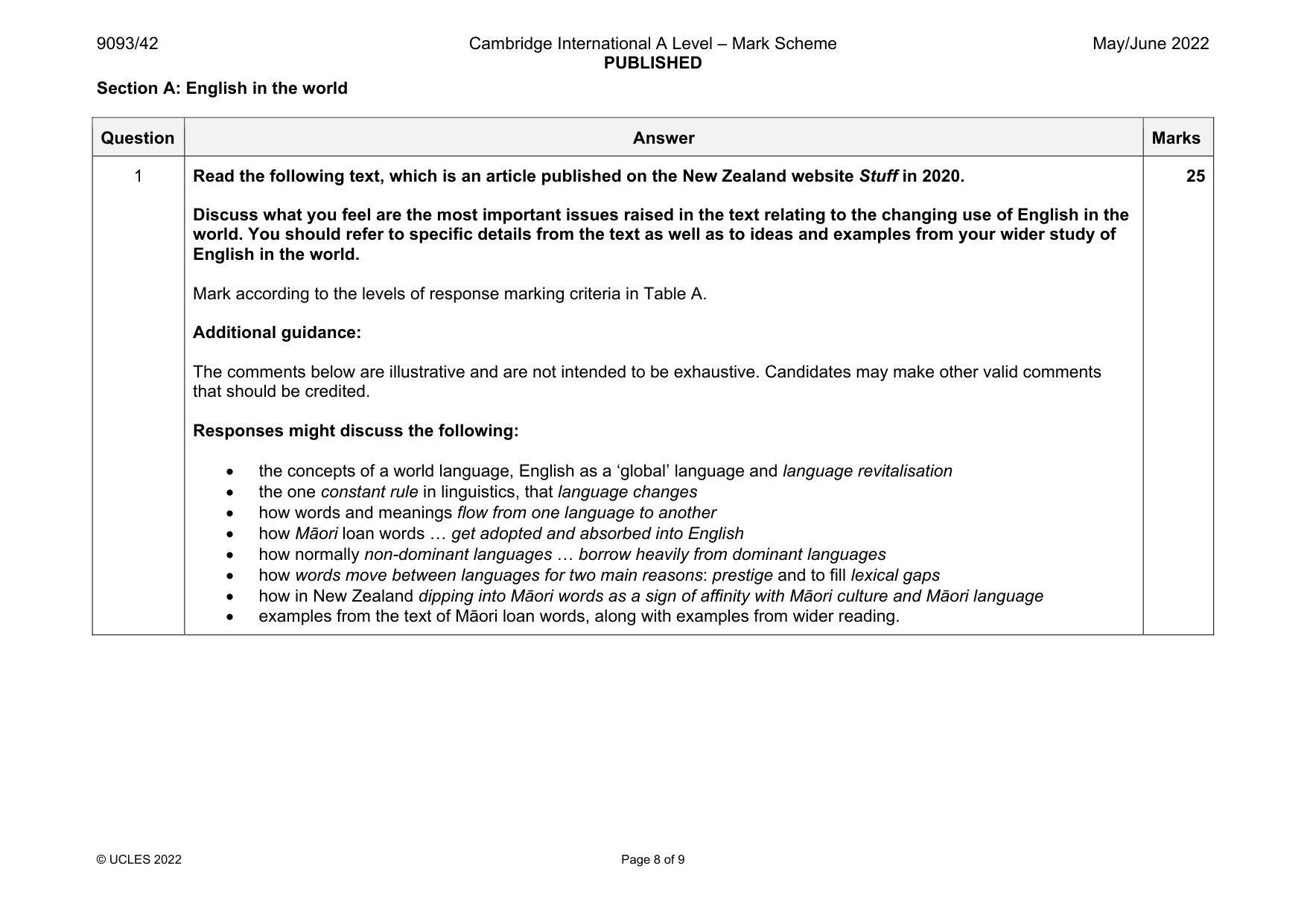
9093/42 Cambridge International A Level – Mark Scheme PUBLISHED May/June 2022 © UCLES 2022 Page 8 of 9 Section A: English in the world Question Answer Marks 1 Read the following text, which is an article published on the New Zealand website Stuff in 2020. Discuss what you feel are the most important issues raised in the text relating to the changing use of English in the world. You should refer to specific details from the text as well as to ideas and examples from your wider study of English in the world. Mark according to the levels of response marking criteria in Table A. Additional guidance: The comments below are illustrative and are not intended to be exhaustive. Candidates may make other valid comments that should be credited. Responses might discuss the following: the concepts of a world language, English as a ‘global’ language and language revitalisation the one constant rule in linguistics, that language changes how words and meanings flow from one language to another how Māori loan words … get adopted and absorbed into English how normally non-dominant languages … borrow heavily from dominant languages how words move between languages for two main reasons: prestige and to fill lexical gaps how in New Zealand dipping into Māori words as a sign of affinity with Māori culture and Māori language examples from the text of Māori loan words, along with examples from wider reading. 25
Mark scheme, page 9
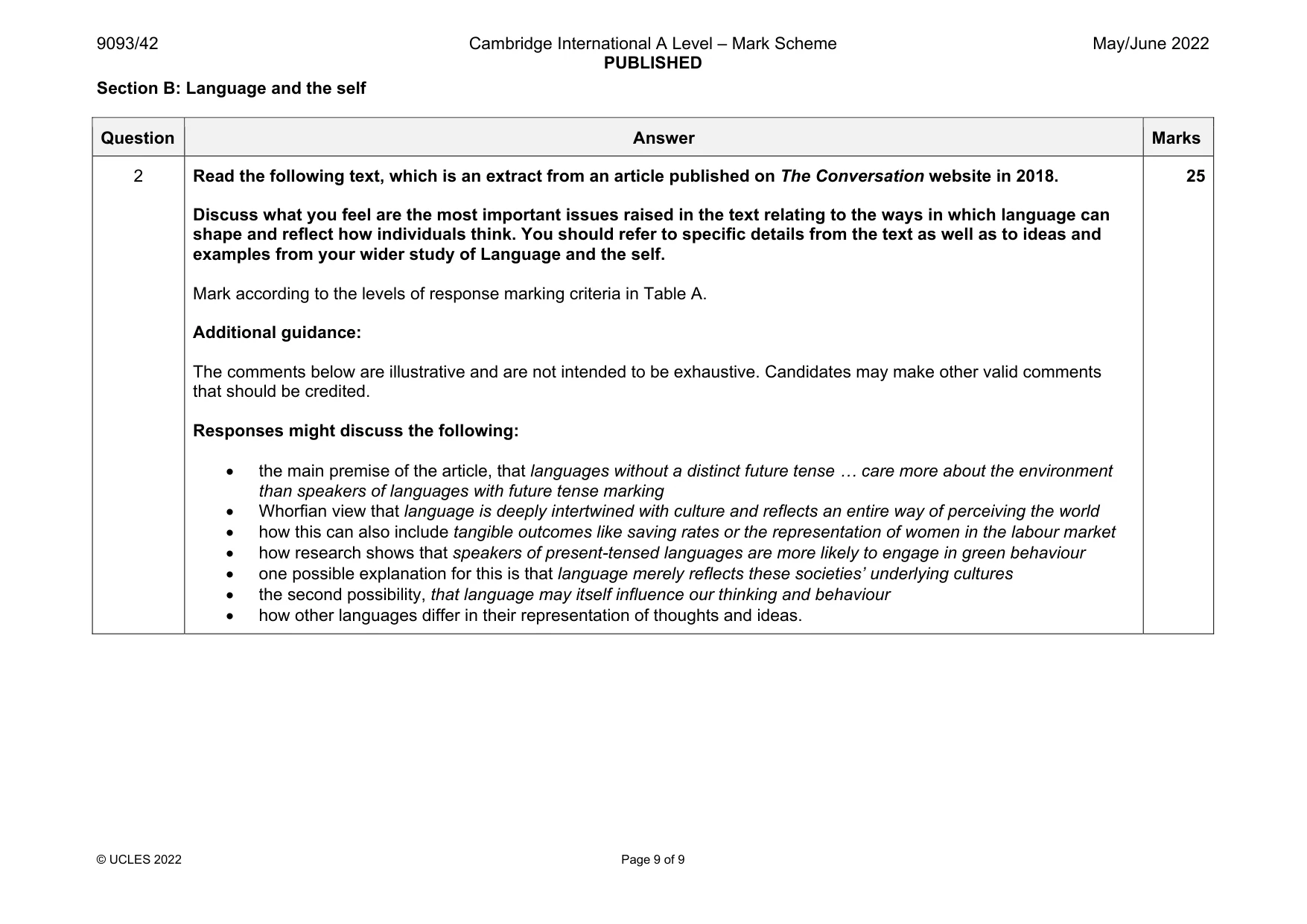
9093/42 Cambridge International A Level – Mark Scheme PUBLISHED May/June 2022 © UCLES 2022 Page 9 of 9 Section B: Language and the self Question Answer Marks 2 Read the following text, which is an extract from an article published on The Conversation website in 2018. Discuss what you feel are the most important issues raised in the text relating to the ways in which language can shape and reflect how individuals think. You should refer to specific details from the text as well as to ideas and examples from your wider study of Language and the self. Mark according to the levels of response marking criteria in Table A. Additional guidance: The comments below are illustrative and are not intended to be exhaustive. Candidates may make other valid comments that should be credited. Responses might discuss the following: the main premise of the article, that languages without a distinct future tense … care more about the environment than speakers of languages with future tense marking Whorfian view that language is deeply intertwined with culture and reflects an entire way of perceiving the world how this can also include tangible outcomes like saving rates or the representation of women in the labour market how research shows that speakers of present-tensed languages are more likely to engage in green behaviour one possible explanation for this is that language merely reflects these societies’ underlying cultures the second possibility, that language may itself influence our thinking and behaviour how other languages differ in their representation of thoughts and ideas. 25
What you needed in this session
Cambridge’s own grade thresholds for 2022 May/June, Paper 4 · Variant 2. A higher threshold means an easier paper — the bar moves with how the cohort did.