Cambridge A Level English - Language AS and A Level (from 2014) 9093 — 2022 May/June Paper 4 · Variant 1
9093/41/M/J/22 · 50 marks · ≈56 min
The question paper and its mark scheme, free to read here and free to download. This is Cambridge’s own paper, exactly as it was sat.
Question paper8 pages



Mark scheme9 pages
Answers below. Sit the paper first if you are practising.
Paper as text
Question paper, page 1
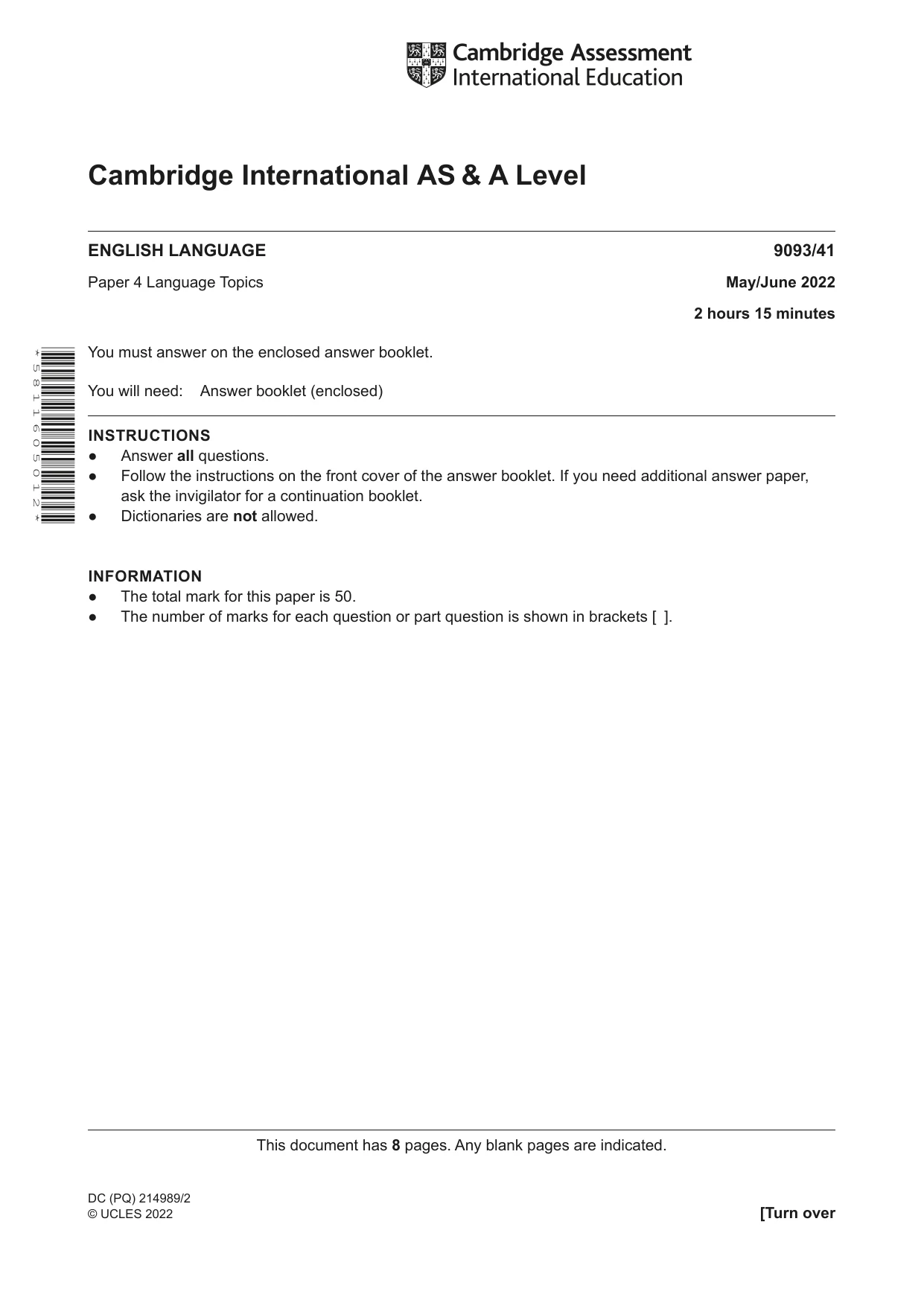
This document has 8 pages. Any blank pages are indicated. [Turn over Cambridge International AS & A Level * 5 8 1 1 6 0 5 0 1 2 * DC (PQ) 214989/2 © UCLES 2022 ENGLISH LANGUAGE 9093/41 Paper 4 Language Topics May/June 2022 2 hours 15 minutes You must answer on the enclosed answer booklet. You will need: Answer booklet (enclosed) INSTRUCTIONS ● Answer all questions. ● Follow the instructions on the front cover of the answer booklet. If you need additional answer paper, ask the invigilator for a continuation booklet. ● Dictionaries are not allowed. INFORMATION ● The total mark for this paper is 50. ● The number of marks for each question or part question is shown in brackets [ ].
Question paper, page 2
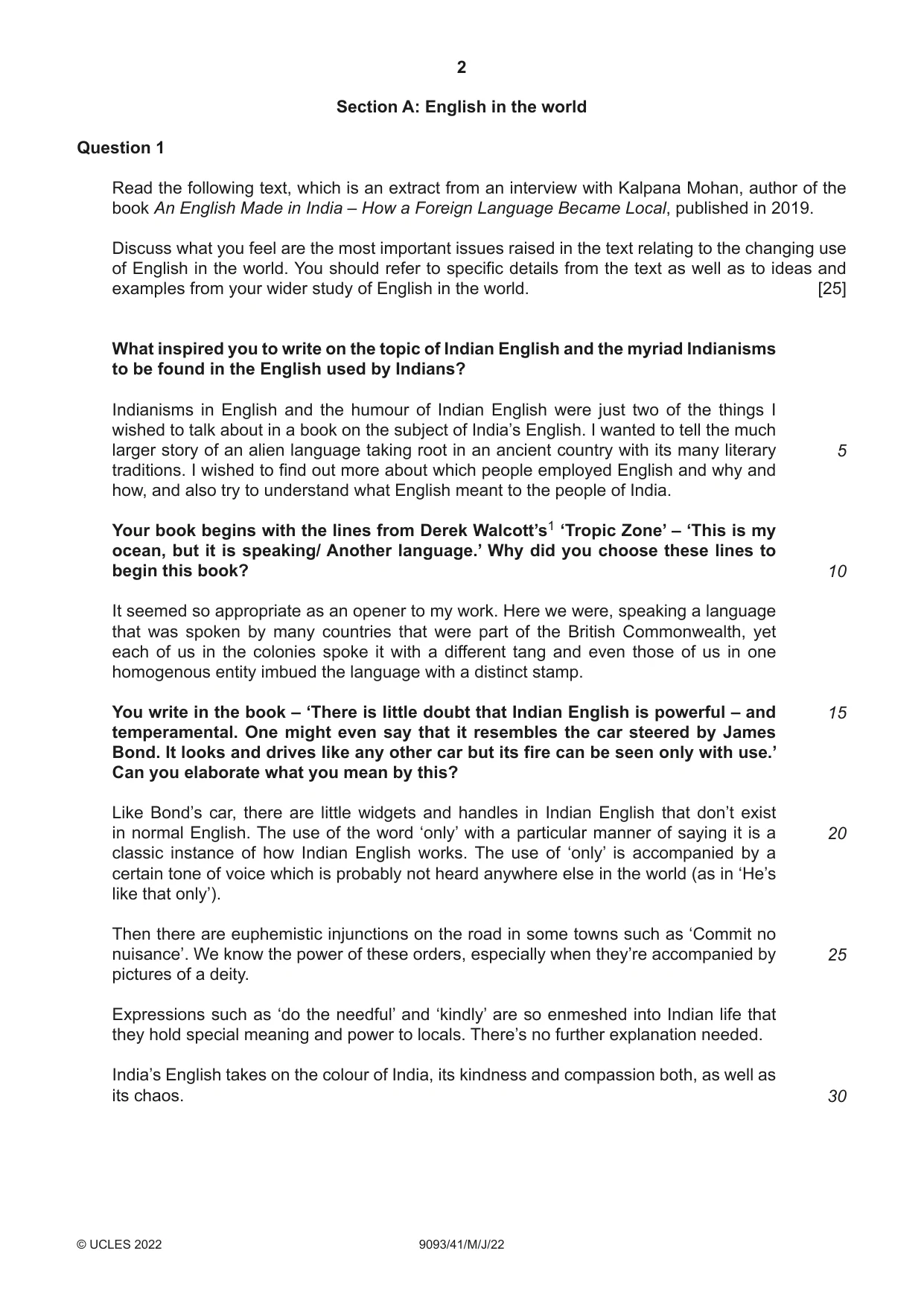
2 9093/41/M/J/22 © UCLES 2022 Section A: English in the world Question 1 Read the following text, which is an extract from an interview with Kalpana Mohan, author of the book An English Made in India – How a Foreign Language Became Local, published in 2019. Discuss what you feel are the most important issues raised in the text relating to the changing use of English in the world. You should refer to specific details from the text as well as to ideas and examples from your wider study of English in the world. [25] What inspired you to write on the topic of Indian English and the myriad Indianisms to be found in the English used by Indians? Indianisms in English and the humour of Indian English were just two of the things I wished to talk about in a book on the subject of India’s English. I wanted to tell the much larger story of an alien language taking root in an ancient country with its many literary traditions. I wished to find out more about which people employed English and why and how, and also try to understand what English meant to the people of India. Your book begins with the lines from Derek Walcott’s1 ‘Tropic Zone’ – ‘This is my ocean, but it is speaking/ Another language.’ Why did you choose these lines to begin this book? It seemed so appropriate as an opener to my work. Here we were, speaking a language that was spoken by many countries that were part of the British Commonwealth, yet each of us in the colonies spoke it with a different tang and even those of us in one homogenous entity imbued the language with a distinct stamp. You write in the book – ‘There is little doubt that Indian English is powerful – and temperamental. One might even say that it resembles the car steered by James Bond. It looks and drives like any other car but its fire can be seen only with use.’ Can you elaborate what you mean by this? Like Bond’s car, there are little widgets and handles in Indian English that don’t exist in normal English. The use of the word ‘only’ with a particular manner of saying it is a classic instance of how Indian English works. The use of ‘only’ is accompanied by a certain tone of voice which is probably not heard anywhere else in the world (as in ‘He’s like that only’). Then there are euphemistic injunctions on the road in some towns such as ‘Commit no nuisance’. We know the power of these orders, especially when they’re accompanied by pictures of a deity. Expressions such as ‘do the needful’ and ‘kindly’ are so enmeshed into Indian life that they hold special meaning and power to locals. There’s no further explanation needed. India’s English takes on the colour of India, its kindness and compassion both, as well as its chaos. 5 10 15 20 25 30
Question paper, page 3
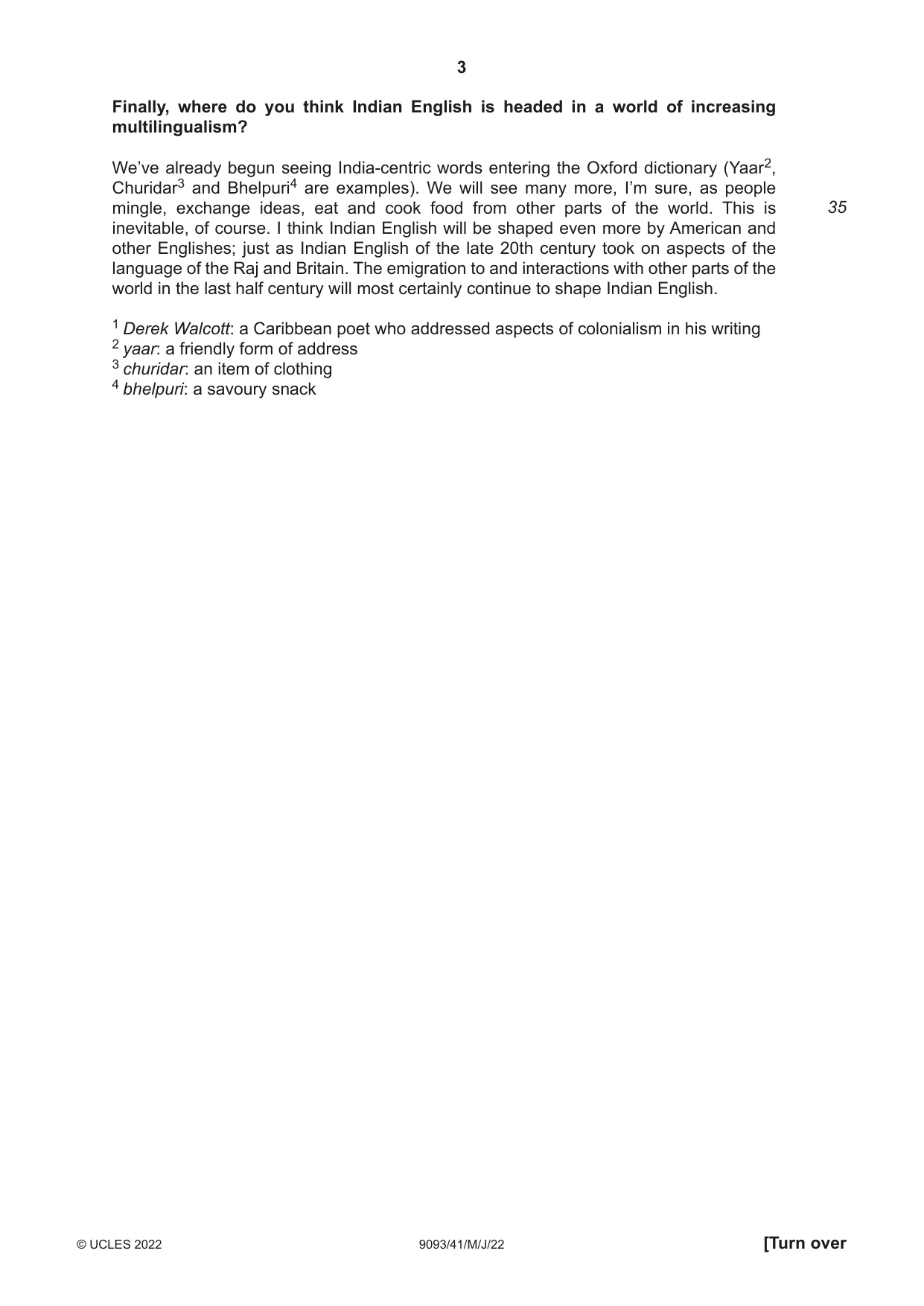
3 9093/41/M/J/22 © UCLES 2022 [Turn over Finally, where do you think Indian English is headed in a world of increasing multilingualism? We’ve already begun seeing India-centric words entering the Oxford dictionary (Yaar2, Churidar3 and Bhelpuri4 are examples). We will see many more, I’m sure, as people mingle, exchange ideas, eat and cook food from other parts of the world. This is inevitable, of course. I think Indian English will be shaped even more by American and other Englishes; just as Indian English of the late 20th century took on aspects of the language of the Raj and Britain. The emigration to and interactions with other parts of the world in the last half century will most certainly continue to shape Indian English. 35 1 Derek Walcott: a Caribbean poet who addressed aspects of colonialism in his writing 2 yaar: a friendly form of address 3 churidar: an item of clothing 4 bhelpuri: a savoury snack
Question paper, page 4
4 9093/41/M/J/22 © UCLES 2022 Section B: Language and the self Question 2 Read the following text, which is an extract from a review of Because Internet, a book published in 2019. The review was published in a British newspaper. Discuss what you feel are the most important issues raised in the text relating to the ways in which language can shape and reflect personal and social identity. You should refer to specific details from the text as well as to ideas and examples from your wider study of Language and the self. [25] Because Internet – a headlong embrace of the new How the informal language evolving online can coexist with conventional rule-bound writing Canadian linguist Gretchen McCulloch believes the internet is making us more nuanced and inventive writers. Content removed due to copyright restrictions.
Question paper, page 5
5 9093/41/M/J/22 © UCLES 2022 McCulloch offers a compelling snapshot of a world in flux, from which readers will learn a lot about language, the internet and themselves.
Question paper, page 6
6 9093/41/M/J/22 © UCLES 2022 BLANK PAGE
Question paper, page 7
7 9093/41/M/J/22 © UCLES 2022 BLANK PAGE
Question paper, page 8
8 9093/41/M/J/22 © UCLES 2022 Permission to reproduce items where third-party owned material protected by copyright is included has been sought and cleared where possible. Every reasonable effort has been made by the publisher (UCLES) to trace copyright holders, but if any items requiring clearance have unwittingly been included, the publisher will be pleased to make amends at the earliest possible opportunity. To avoid the issue of disclosure of answer-related information to candidates, all copyright acknowledgements are reproduced online in the Cambridge Assessment International Education Copyright Acknowledgements Booklet. This is produced for each series of examinations and is freely available to download at www.cambridgeinternational.org after the live examination series. Cambridge Assessment International Education is part of Cambridge Assessment. Cambridge Assessment is the brand name of the University of Cambridge Local Examinations Syndicate (UCLES), which is a department of the University of Cambridge. BLANK PAGE
Mark scheme, page 1
This document consists of 9 printed pages. © UCLES 2022 [Turn over Cambridge International A Level ENGLISH LANGUAGE 9093/41 Paper 4 Language Topics May/June 2022 MARK SCHEME Maximum Mark: 50 Published This mark scheme is published as an aid to teachers and candidates, to indicate the requirements of the examination. It shows the basis on which Examiners were instructed to award marks. It does not indicate the details of the discussions that took place at an Examiners’ meeting before marking began, which would have considered the acceptability of alternative answers. Mark schemes should be read in conjunction with the question paper and the Principal Examiner Report for Teachers. Cambridge International will not enter into discussions about these mark schemes. Cambridge International is publishing the mark schemes for the May/June 2022 series for most Cambridge IGCSE, Cambridge International A and AS Level and Cambridge Pre-U components, and some Cambridge O Level components.
Mark scheme, page 2
9093/41 Cambridge International A Level – Mark Scheme PUBLISHED May/June 2022 © UCLES 2022 Page 2 of 9 Generic Marking Principles These general marking principles must be applied by all examiners when marking candidate answers. They should be applied alongside the specific content of the mark scheme or generic level descriptors for a question. Each question paper and mark scheme will also comply with these marking principles. GENERIC MARKING PRINCIPLE 1: Marks must be awarded in line with: the specific content of the mark scheme or the generic level descriptors for the question the specific skills defined in the mark scheme or in the generic level descriptors for the question the standard of response required by a candidate as exemplified by the standardisation scripts. GENERIC MARKING PRINCIPLE 2: Marks awarded are always whole marks (not half marks, or other fractions). GENERIC MARKING PRINCIPLE 3: Marks must be awarded positively: marks are awarded for correct/valid answers, as defined in the mark scheme. However, credit is given for valid answers which go beyond the scope of the syllabus and mark scheme, referring to your Team Leader as appropriate marks are awarded when candidates clearly demonstrate what they know and can do marks are not deducted for errors marks are not deducted for omissions answers should only be judged on the quality of spelling, punctuation and grammar when these features are specifically assessed by the question as indicated by the mark scheme. The meaning, however, should be unambiguous. GENERIC MARKING PRINCIPLE 4: Rules must be applied consistently, e.g. in situations where candidates have not followed instructions or in the application of generic level descriptors.
Mark scheme, page 3
9093/41 Cambridge International A Level – Mark Scheme PUBLISHED May/June 2022 © UCLES 2022 Page 3 of 9 GENERIC MARKING PRINCIPLE 5: Marks should be awarded using the full range of marks defined in the mark scheme for the question (however; the use of the full mark range may be limited according to the quality of the candidate responses seen). GENERIC MARKING PRINCIPLE 6: Marks awarded are based solely on the requirements as defined in the mark scheme. Marks should not be awarded with grade thresholds or grade descriptors in mind.
Mark scheme, page 4
9093/41 Cambridge International A Level – Mark Scheme PUBLISHED May/June 2022 © UCLES 2022 Page 4 of 9 English & Media subject specific general marking principles (To be read in conjunction with the Generic Marking Principles (and requiring further guidance on how to place marks within levels)) Components using level descriptors: We use level descriptors as a guide to broad understanding of the qualities normally expected of, or typical of, work in a level. Level descriptors are a means of general guidance, and should not be interpreted as hurdle statements. Where indicative content notes are supplied for a question, these are not a prescription of required content, and must not be treated as such. Alternative correct points and unexpected answers in candidates’ scripts must be given marks that fairly reflect the knowledge and skills demonstrated. While we may have legitimate expectations as to the ground most answers may occupy, we must at all times be prepared to meet candidates on their chosen ground, provided it is relevant ground (e.g. clearly related to and derived from a relevant passage/text and meeting the mark scheme requirements for the question).
Mark scheme, page 5
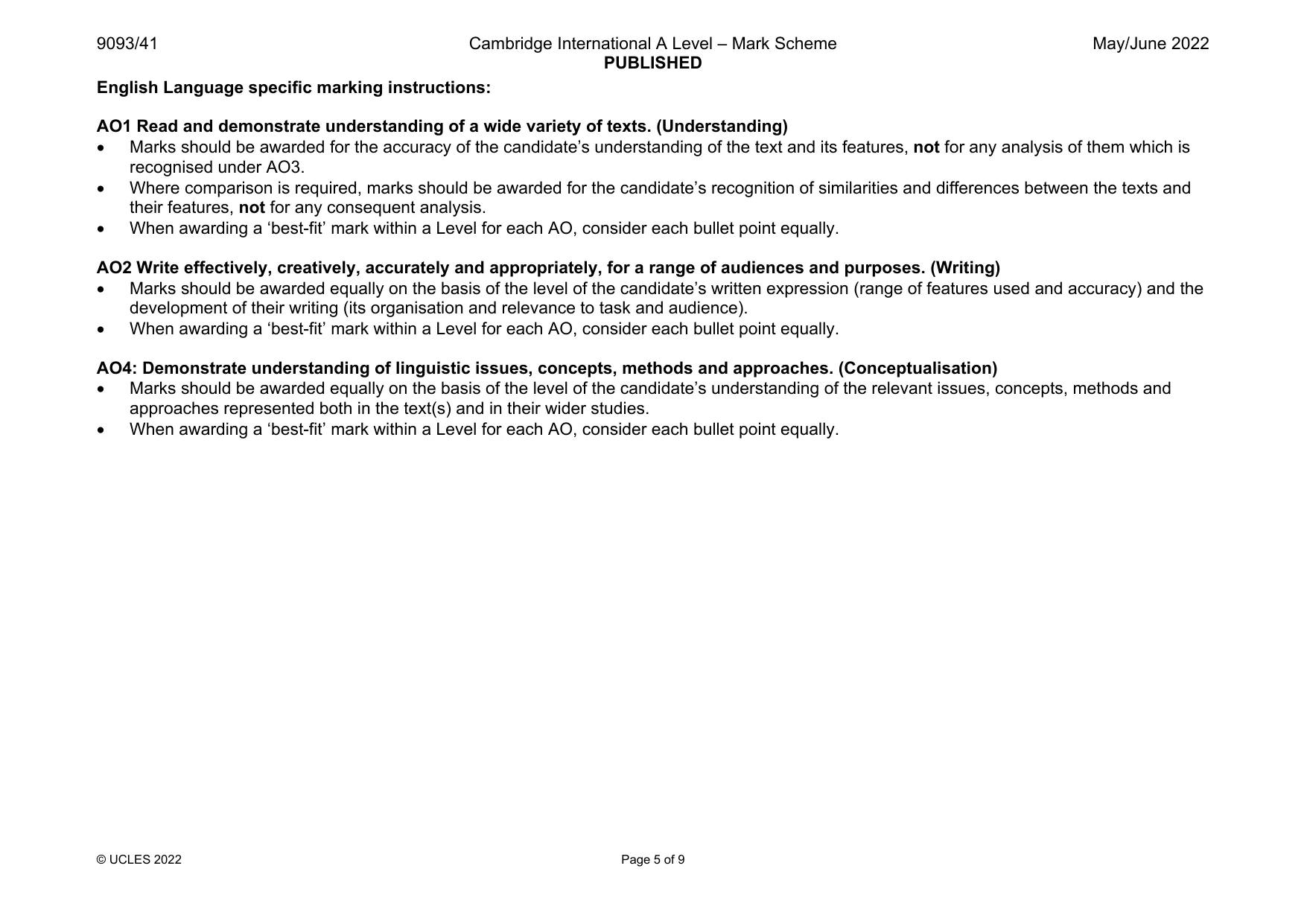
9093/41 Cambridge International A Level – Mark Scheme PUBLISHED May/June 2022 © UCLES 2022 Page 5 of 9 English Language specific marking instructions: AO1 Read and demonstrate understanding of a wide variety of texts. (Understanding) Marks should be awarded for the accuracy of the candidate’s understanding of the text and its features, not for any analysis of them which is recognised under AO3. Where comparison is required, marks should be awarded for the candidate’s recognition of similarities and differences between the texts and their features, not for any consequent analysis. When awarding a ‘best-fit’ mark within a Level for each AO, consider each bullet point equally. AO2 Write effectively, creatively, accurately and appropriately, for a range of audiences and purposes. (Writing) Marks should be awarded equally on the basis of the level of the candidate’s written expression (range of features used and accuracy) and the development of their writing (its organisation and relevance to task and audience). When awarding a ‘best-fit’ mark within a Level for each AO, consider each bullet point equally. AO4: Demonstrate understanding of linguistic issues, concepts, methods and approaches. (Conceptualisation) Marks should be awarded equally on the basis of the level of the candidate’s understanding of the relevant issues, concepts, methods and approaches represented both in the text(s) and in their wider studies. When awarding a ‘best-fit’ mark within a Level for each AO, consider each bullet point equally.
Mark scheme, page 6
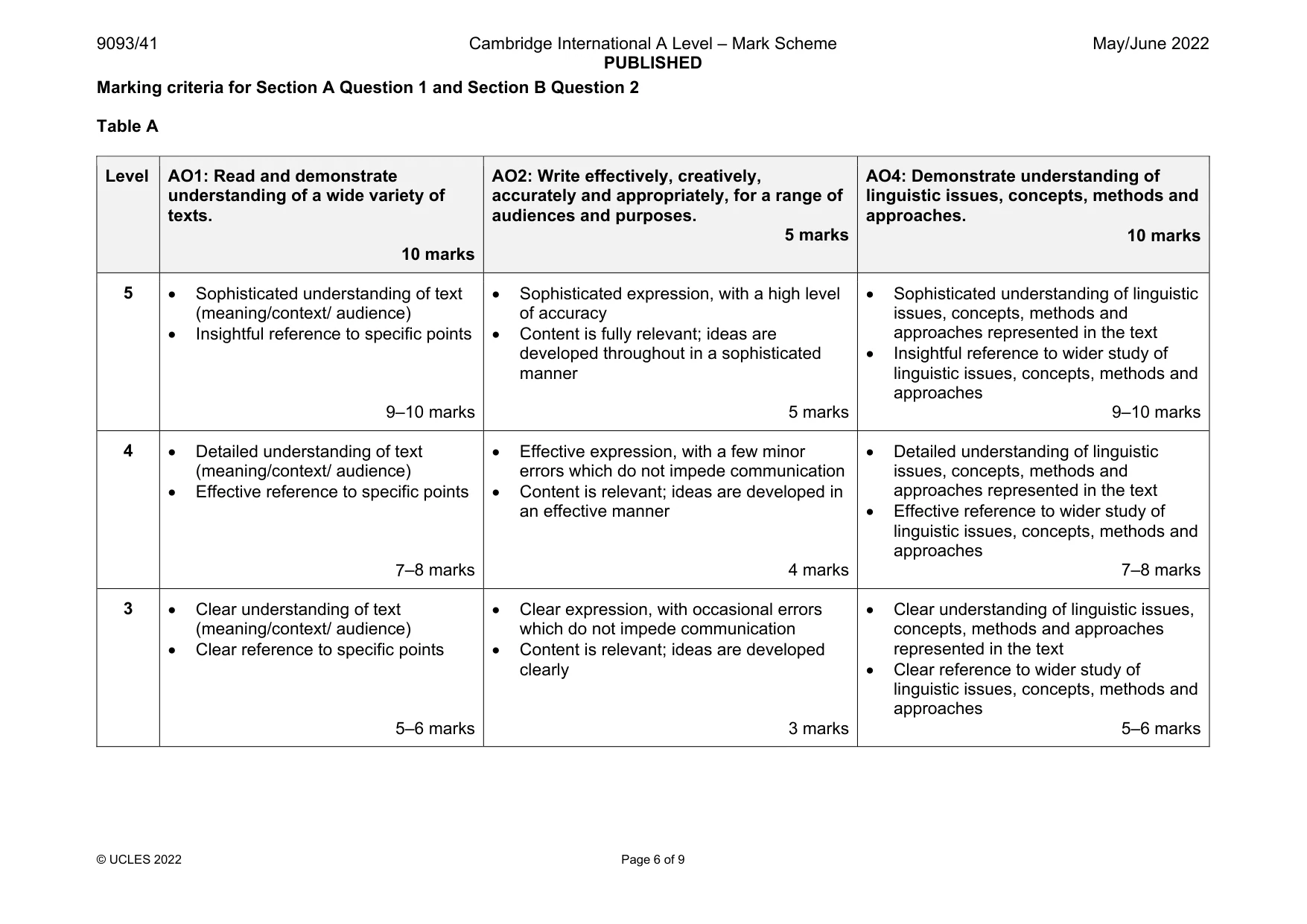
9093/41 Cambridge International A Level – Mark Scheme PUBLISHED May/June 2022 © UCLES 2022 Page 6 of 9 Marking criteria for Section A Question 1 and Section B Question 2 Table A Level AO1: Read and demonstrate understanding of a wide variety of texts. 10 marks AO2: Write effectively, creatively, accurately and appropriately, for a range of audiences and purposes. 5 marks AO4: Demonstrate understanding of linguistic issues, concepts, methods and approaches. 10 marks 5 Sophisticated understanding of text (meaning/context/ audience) Insightful reference to specific points 9–10 marks Sophisticated expression, with a high level of accuracy Content is fully relevant; ideas are developed throughout in a sophisticated manner 5 marks Sophisticated understanding of linguistic issues, concepts, methods and approaches represented in the text Insightful reference to wider study of linguistic issues, concepts, methods and approaches 9–10 marks 4 Detailed understanding of text (meaning/context/ audience) Effective reference to specific points 7–8 marks Effective expression, with a few minor errors which do not impede communication Content is relevant; ideas are developed in an effective manner 4 marks Detailed understanding of linguistic issues, concepts, methods and approaches represented in the text Effective reference to wider study of linguistic issues, concepts, methods and approaches 7–8 marks 3 Clear understanding of text (meaning/context/ audience) Clear reference to specific points 5–6 marks Clear expression, with occasional errors which do not impede communication Content is relevant; ideas are developed clearly 3 marks Clear understanding of linguistic issues, concepts, methods and approaches represented in the text Clear reference to wider study of linguistic issues, concepts, methods and approaches 5–6 marks
Mark scheme, page 7
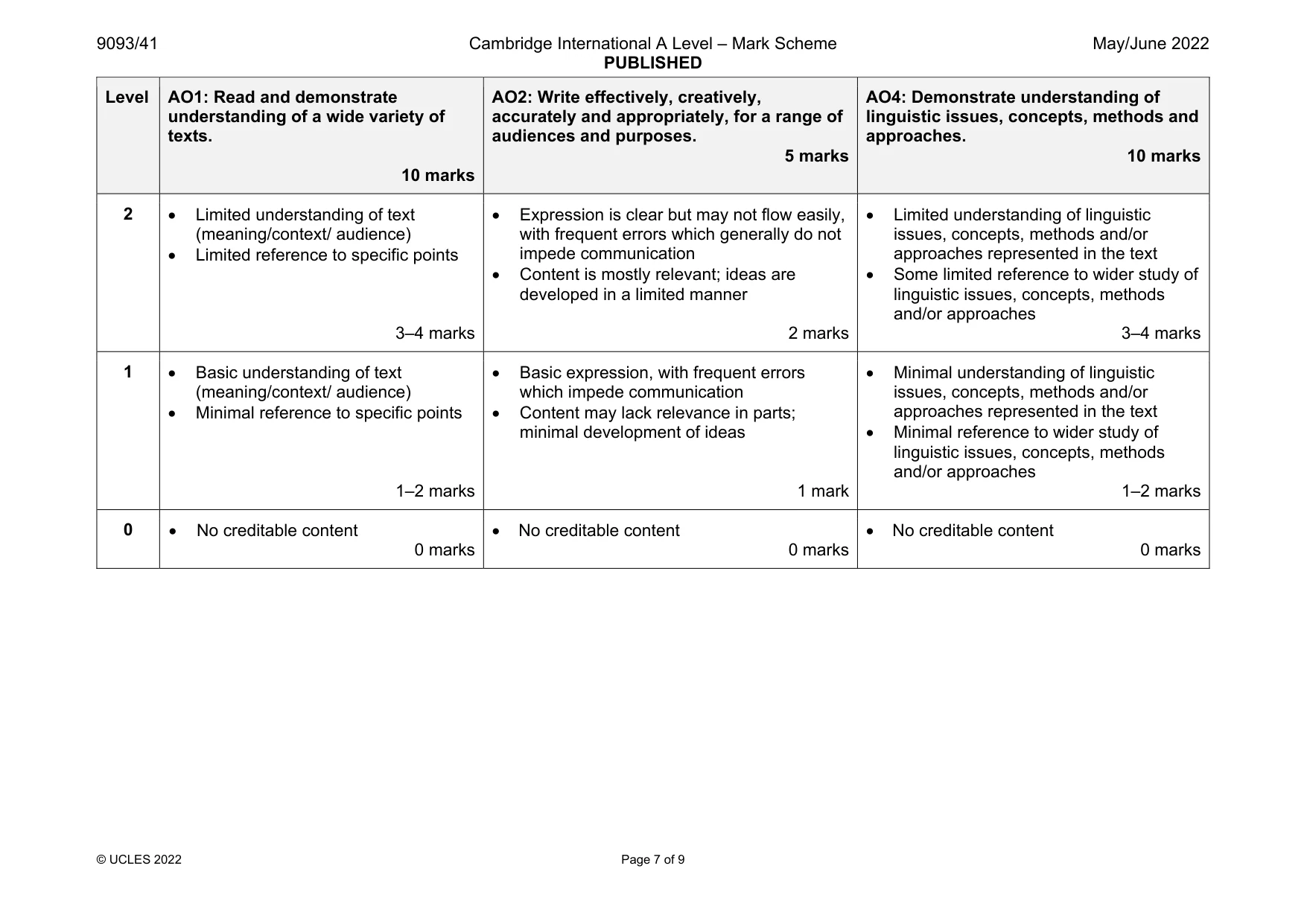
9093/41 Cambridge International A Level – Mark Scheme PUBLISHED May/June 2022 © UCLES 2022 Page 7 of 9 Level AO1: Read and demonstrate understanding of a wide variety of texts. 10 marks AO2: Write effectively, creatively, accurately and appropriately, for a range of audiences and purposes. 5 marks AO4: Demonstrate understanding of linguistic issues, concepts, methods and approaches. 10 marks 2 Limited understanding of text (meaning/context/ audience) Limited reference to specific points 3–4 marks Expression is clear but may not flow easily, with frequent errors which generally do not impede communication Content is mostly relevant; ideas are developed in a limited manner 2 marks Limited understanding of linguistic issues, concepts, methods and/or approaches represented in the text Some limited reference to wider study of linguistic issues, concepts, methods and/or approaches 3–4 marks 1 Basic understanding of text (meaning/context/ audience) Minimal reference to specific points 1–2 marks Basic expression, with frequent errors which impede communication Content may lack relevance in parts; minimal development of ideas 1 mark Minimal understanding of linguistic issues, concepts, methods and/or approaches represented in the text Minimal reference to wider study of linguistic issues, concepts, methods and/or approaches 1–2 marks 0 No creditable content 0 marks No creditable content 0 marks No creditable content 0 marks
Mark scheme, page 8
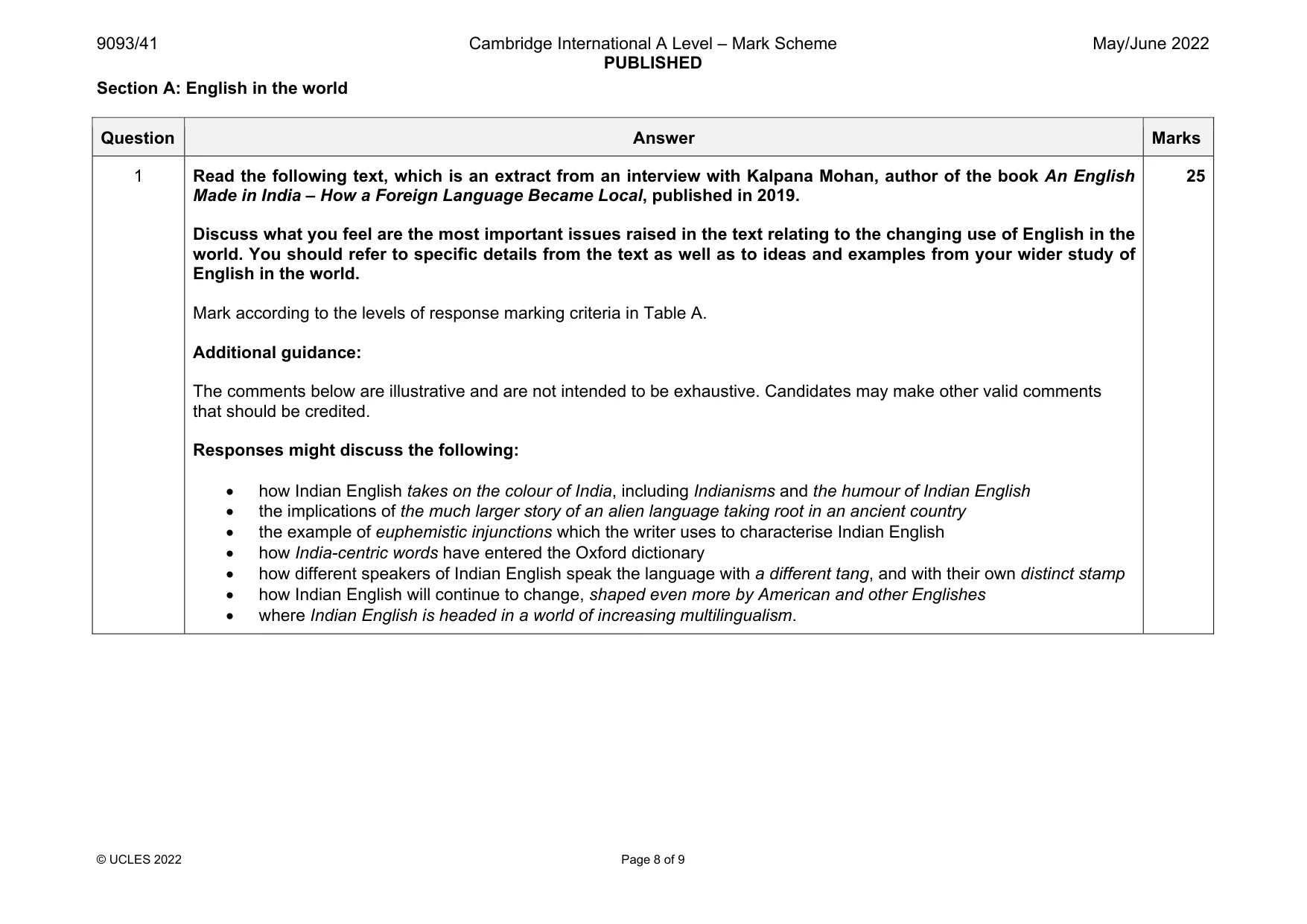
9093/41 Cambridge International A Level – Mark Scheme PUBLISHED May/June 2022 © UCLES 2022 Page 8 of 9 Section A: English in the world Question Answer Marks 1 Read the following text, which is an extract from an interview with Kalpana Mohan, author of the book An English Made in India – How a Foreign Language Became Local, published in 2019. Discuss what you feel are the most important issues raised in the text relating to the changing use of English in the world. You should refer to specific details from the text as well as to ideas and examples from your wider study of English in the world. Mark according to the levels of response marking criteria in Table A. Additional guidance: The comments below are illustrative and are not intended to be exhaustive. Candidates may make other valid comments that should be credited. Responses might discuss the following: how Indian English takes on the colour of India, including Indianisms and the humour of Indian English the implications of the much larger story of an alien language taking root in an ancient country the example of euphemistic injunctions which the writer uses to characterise Indian English how India-centric words have entered the Oxford dictionary how different speakers of Indian English speak the language with a different tang, and with their own distinct stamp how Indian English will continue to change, shaped even more by American and other Englishes where Indian English is headed in a world of increasing multilingualism. 25
Mark scheme, page 9
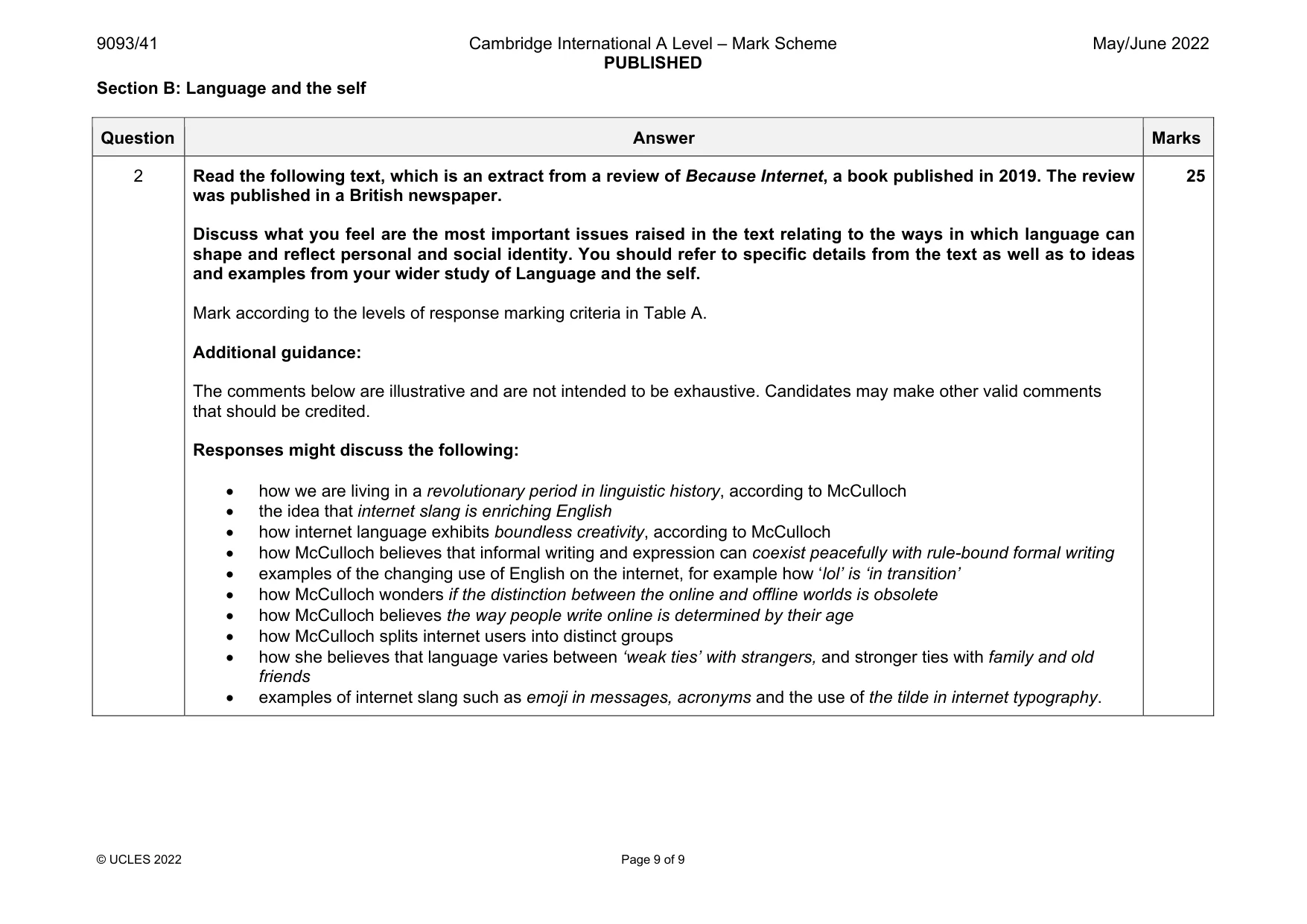
9093/41 Cambridge International A Level – Mark Scheme PUBLISHED May/June 2022 © UCLES 2022 Page 9 of 9 Section B: Language and the self Question Answer Marks 2 Read the following text, which is an extract from a review of Because Internet, a book published in 2019. The review was published in a British newspaper. Discuss what you feel are the most important issues raised in the text relating to the ways in which language can shape and reflect personal and social identity. You should refer to specific details from the text as well as to ideas and examples from your wider study of Language and the self. Mark according to the levels of response marking criteria in Table A. Additional guidance: The comments below are illustrative and are not intended to be exhaustive. Candidates may make other valid comments that should be credited. Responses might discuss the following: how we are living in a revolutionary period in linguistic history, according to McCulloch the idea that internet slang is enriching English how internet language exhibits boundless creativity, according to McCulloch how McCulloch believes that informal writing and expression can coexist peacefully with rule-bound formal writing examples of the changing use of English on the internet, for example how ‘lol’ is ‘in transition’ how McCulloch wonders if the distinction between the online and offline worlds is obsolete how McCulloch believes the way people write online is determined by their age how McCulloch splits internet users into distinct groups how she believes that language varies between ‘weak ties’ with strangers, and stronger ties with family and old friends examples of internet slang such as emoji in messages, acronyms and the use of the tilde in internet typography. 25
What you needed in this session
Cambridge’s own grade thresholds for 2022 May/June, Paper 4 · Variant 1. A higher threshold means an easier paper — the bar moves with how the cohort did.