Cambridge A Level English - Language AS and A Level (from 2014) 9093 — 2021 Oct/Nov Paper 4 · Variant 2
9093/42/O/N/21 · 50 marks · ≈56 min
The question paper and its mark scheme, free to read here and free to download. This is Cambridge’s own paper, exactly as it was sat.
Question paper8 pages


Mark scheme9 pages
Answers below. Sit the paper first if you are practising.
Paper as text
Question paper, page 1
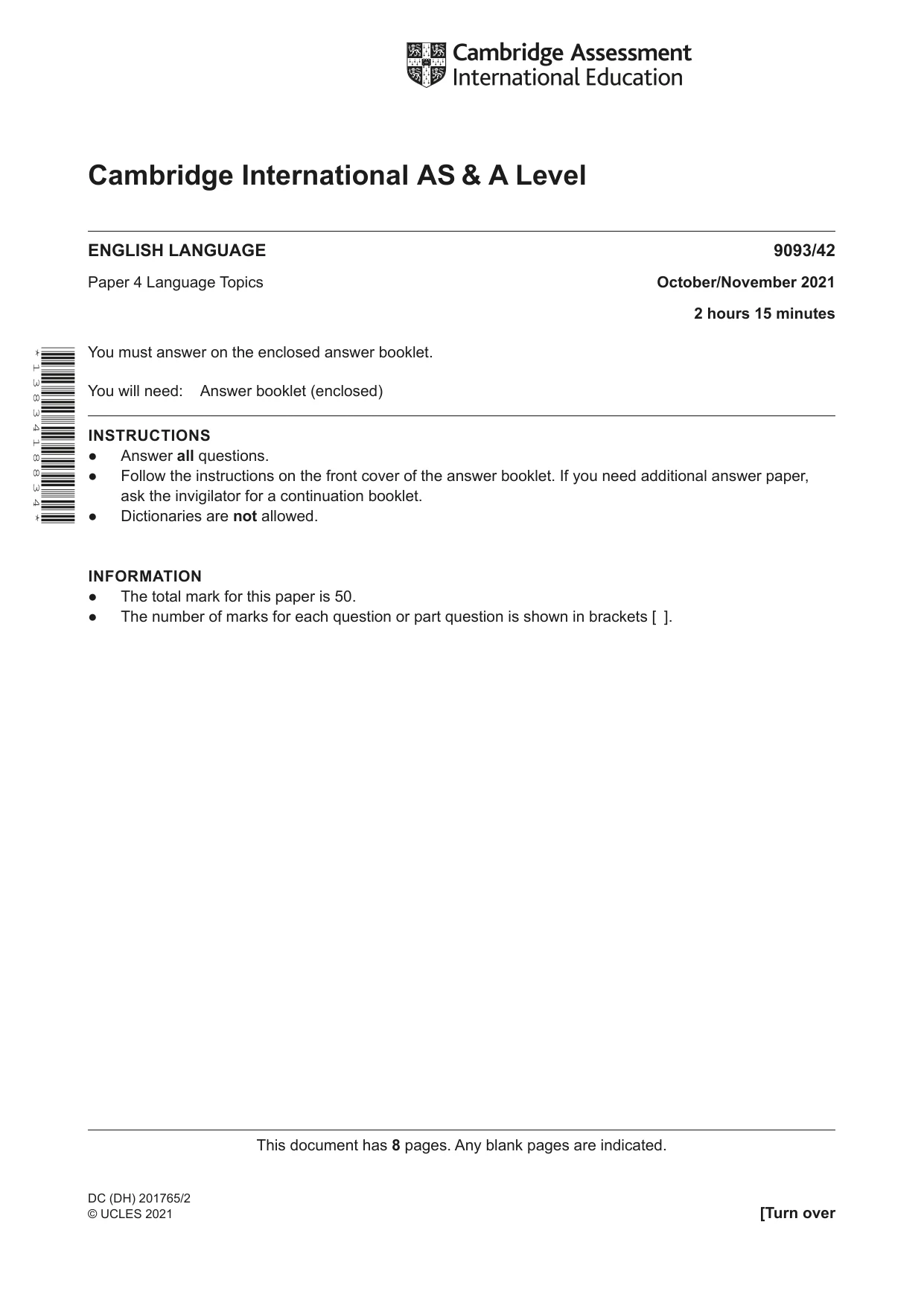
This document has 8 pages. Any blank pages are indicated. Cambridge International AS & A Level * 1 3 8 3 4 1 8 8 3 4 * DC (DH) 201765/2 © UCLES 2021 [Turn over ENGLISH LANGUAGE 9093/42 Paper 4 Language Topics October/November 2021 2 hours 15 minutes You must answer on the enclosed answer booklet. You will need: Answer booklet (enclosed) INSTRUCTIONS ● Answer all questions. ● Follow the instructions on the front cover of the answer booklet. If you need additional answer paper, ask the invigilator for a continuation booklet. ● Dictionaries are not allowed. INFORMATION ● The total mark for this paper is 50. ● The number of marks for each question or part question is shown in brackets [ ].
Question paper, page 2
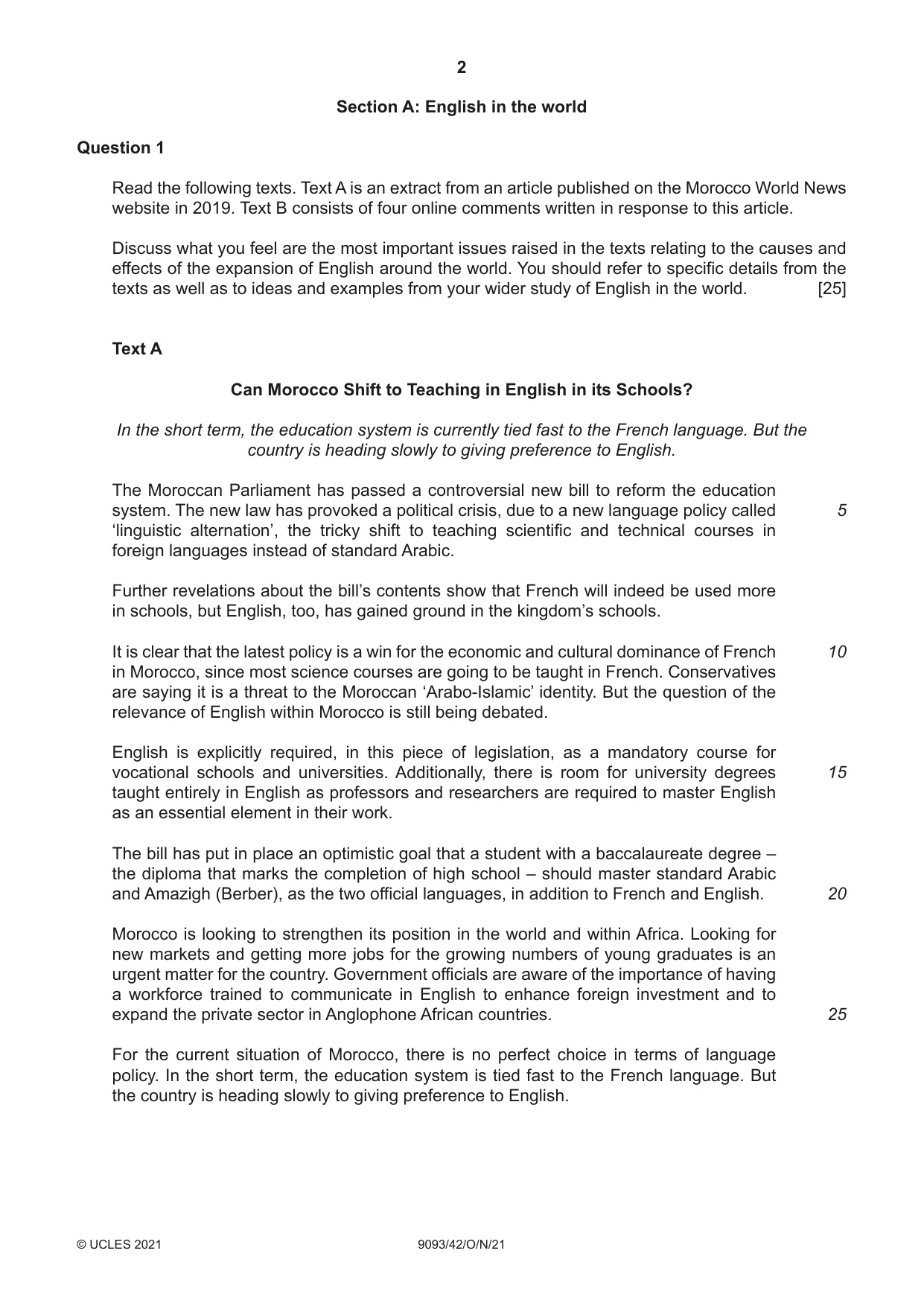
2 9093/42/O/N/21 © UCLES 2021 Section A: English in the world Question 1 Read the following texts. Text A is an extract from an article published on the Morocco World News website in 2019. Text B consists of four online comments written in response to this article. Discuss what you feel are the most important issues raised in the texts relating to the causes and effects of the expansion of English around the world. You should refer to specific details from the texts as well as to ideas and examples from your wider study of English in the world. [25] Text A Can Morocco Shift to Teaching in English in its Schools? In the short term, the education system is currently tied fast to the French language. But the country is heading slowly to giving preference to English. The Moroccan Parliament has passed a controversial new bill to reform the education system. The new law has provoked a political crisis, due to a new language policy called ‘linguistic alternation’, the tricky shift to teaching scientific and technical courses in foreign languages instead of standard Arabic. Further revelations about the bill’s contents show that French will indeed be used more in schools, but English, too, has gained ground in the kingdom’s schools. It is clear that the latest policy is a win for the economic and cultural dominance of French in Morocco, since most science courses are going to be taught in French. Conservatives are saying it is a threat to the Moroccan ‘Arabo-Islamic’ identity. But the question of the relevance of English within Morocco is still being debated. English is explicitly required, in this piece of legislation, as a mandatory course for vocational schools and universities. Additionally, there is room for university degrees taught entirely in English as professors and researchers are required to master English as an essential element in their work. The bill has put in place an optimistic goal that a student with a baccalaureate degree – the diploma that marks the completion of high school – should master standard Arabic and Amazigh (Berber), as the two official languages, in addition to French and English. Morocco is looking to strengthen its position in the world and within Africa. Looking for new markets and getting more jobs for the growing numbers of young graduates is an urgent matter for the country. Government officials are aware of the importance of having a workforce trained to communicate in English to enhance foreign investment and to expand the private sector in Anglophone African countries. For the current situation of Morocco, there is no perfect choice in terms of language policy. In the short term, the education system is tied fast to the French language. But the country is heading slowly to giving preference to English. 5 10 15 20 25
Question paper, page 3
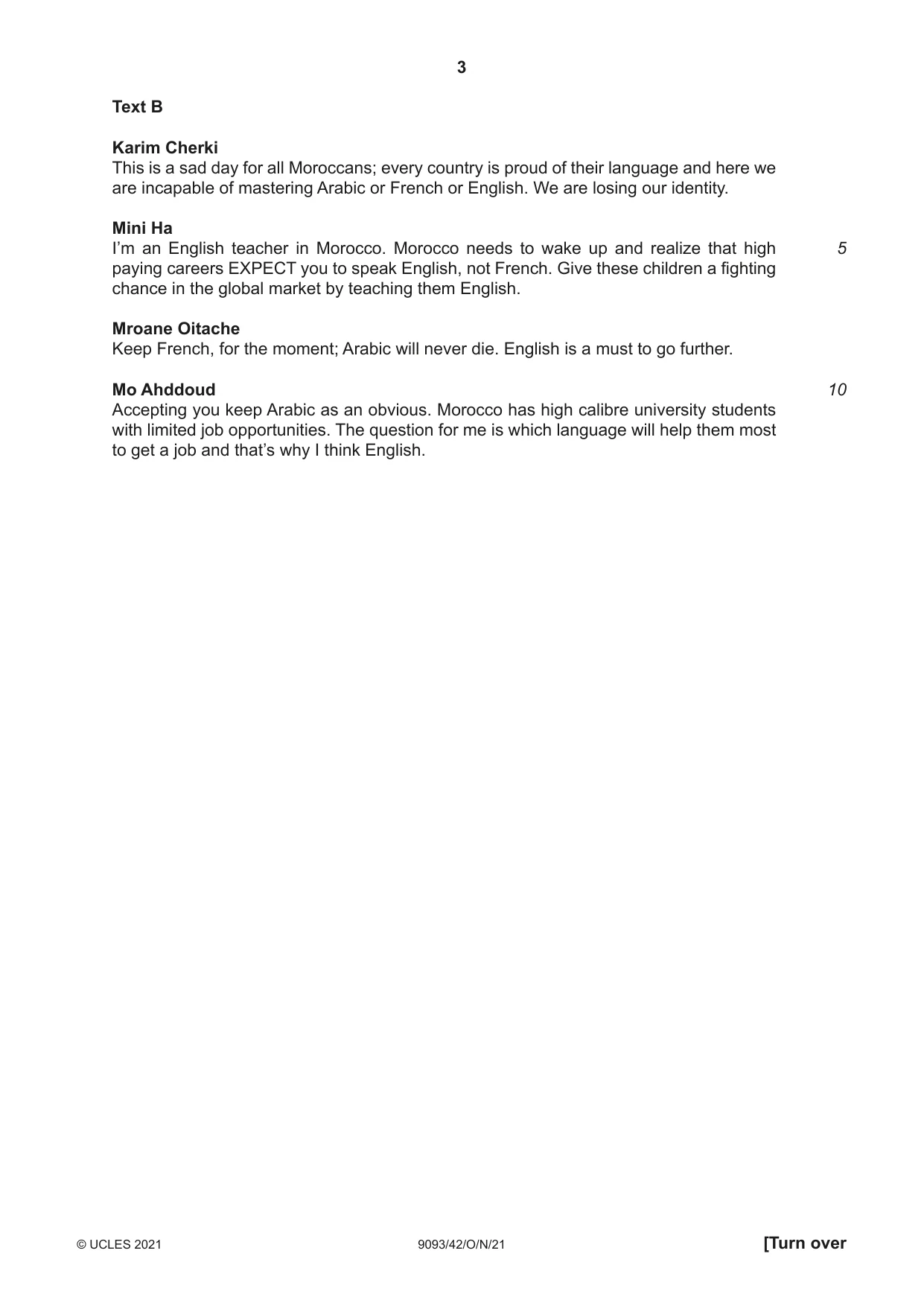
3 9093/42/O/N/21 © UCLES 2021 [Turn over Text B Karim Cherki This is a sad day for all Moroccans; every country is proud of their language and here we are incapable of mastering Arabic or French or English. We are losing our identity. Mini Ha I’m an English teacher in Morocco. Morocco needs to wake up and realize that high paying careers EXPECT you to speak English, not French. Give these children a fighting chance in the global market by teaching them English. Mroane Oitache Keep French, for the moment; Arabic will never die. English is a must to go further. Mo Ahddoud Accepting you keep Arabic as an obvious. Morocco has high calibre university students with limited job opportunities. The question for me is which language will help them most to get a job and that’s why I think English. 5 10
Question paper, page 4
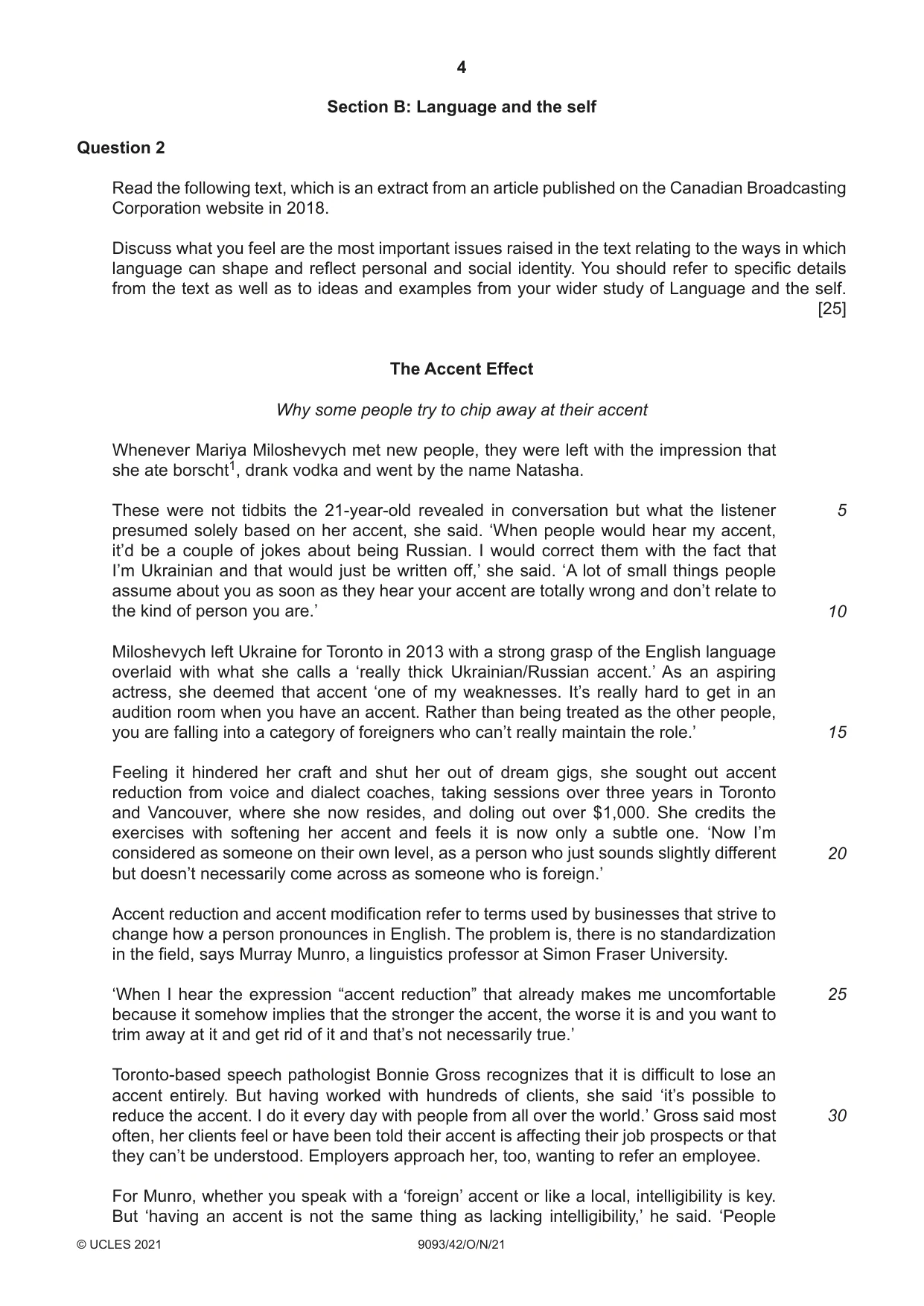
4 9093/42/O/N/21 © UCLES 2021 Section B: Language and the self Question 2 Read the following text, which is an extract from an article published on the Canadian Broadcasting Corporation website in 2018. Discuss what you feel are the most important issues raised in the text relating to the ways in which language can shape and reflect personal and social identity. You should refer to specific details from the text as well as to ideas and examples from your wider study of Language and the self. [25] The Accent Effect Why some people try to chip away at their accent Whenever Mariya Miloshevych met new people, they were left with the impression that she ate borscht1, drank vodka and went by the name Natasha. These were not tidbits the 21-year-old revealed in conversation but what the listener presumed solely based on her accent, she said. ‘When people would hear my accent, it’d be a couple of jokes about being Russian. I would correct them with the fact that I’m Ukrainian and that would just be written off,’ she said. ‘A lot of small things people assume about you as soon as they hear your accent are totally wrong and don’t relate to the kind of person you are.’ Miloshevych left Ukraine for Toronto in 2013 with a strong grasp of the English language overlaid with what she calls a ‘really thick Ukrainian/Russian accent.’ As an aspiring actress, she deemed that accent ‘one of my weaknesses. It’s really hard to get in an audition room when you have an accent. Rather than being treated as the other people, you are falling into a category of foreigners who can’t really maintain the role.’ Feeling it hindered her craft and shut her out of dream gigs, she sought out accent reduction from voice and dialect coaches, taking sessions over three years in Toronto and Vancouver, where she now resides, and doling out over $1,000. She credits the exercises with softening her accent and feels it is now only a subtle one. ‘Now I’m considered as someone on their own level, as a person who just sounds slightly different but doesn’t necessarily come across as someone who is foreign.’ Accent reduction and accent modification refer to terms used by businesses that strive to change how a person pronounces in English. The problem is, there is no standardization in the field, says Murray Munro, a linguistics professor at Simon Fraser University. ‘When I hear the expression “accent reduction” that already makes me uncomfortable because it somehow implies that the stronger the accent, the worse it is and you want to trim away at it and get rid of it and that’s not necessarily true.’ Toronto-based speech pathologist Bonnie Gross recognizes that it is difficult to lose an accent entirely. But having worked with hundreds of clients, she said ‘it’s possible to reduce the accent. I do it every day with people from all over the world.’ Gross said most often, her clients feel or have been told their accent is affecting their job prospects or that they can’t be understood. Employers approach her, too, wanting to refer an employee. For Munro, whether you speak with a ‘foreign’ accent or like a local, intelligibility is key. But ‘having an accent is not the same thing as lacking intelligibility,’ he said. ‘People 5 10 15 20 25 30
Question paper, page 5
5 9093/42/O/N/21 © UCLES 2021 often confuse the two. We’ve shown quite conclusively that it’s possible to have a very strong accent and yet be perfectly easy to understand, to be perfectly intelligible, be a good communicator.’ Notes: 1 borscht: a soup made with beetroot, common in Eastern Europe 35
Question paper, page 6
6 9093/42/O/N/21 © UCLES 2021 BLANK PAGE
Question paper, page 7
7 9093/42/O/N/21 © UCLES 2021 BLANK PAGE
Question paper, page 8
8 9093/42/O/N/21 © UCLES 2021 Permission to reproduce items where third-party owned material protected by copyright is included has been sought and cleared where possible. Every reasonable effort has been made by the publisher (UCLES) to trace copyright holders, but if any items requiring clearance have unwittingly been included, the publisher will be pleased to make amends at the earliest possible opportunity. To avoid the issue of disclosure of answer-related information to candidates, all copyright acknowledgements are reproduced online in the Cambridge Assessment International Education Copyright Acknowledgements Booklet. This is produced for each series of examinations and is freely available to download at www.cambridgeinternational.org after the live examination series. Cambridge Assessment International Education is part of the Cambridge Assessment Group. Cambridge Assessment is the brand name of the University of Cambridge Local Examinations Syndicate (UCLES), which itself is a department of the University of Cambridge. BLANK PAGE
Mark scheme, page 1
This document consists of 9 printed pages. © UCLES 2021 [Turn over Cambridge International A Level ENGLISH LANGUAGE 9093/42 Paper 4 Language Topics October/November 2021 MARK SCHEME Maximum Mark: 50 Published This mark scheme is published as an aid to teachers and candidates, to indicate the requirements of the examination. It shows the basis on which Examiners were instructed to award marks. It does not indicate the details of the discussions that took place at an Examiners’ meeting before marking began, which would have considered the acceptability of alternative answers. Mark schemes should be read in conjunction with the question paper and the Principal Examiner Report for Teachers. Cambridge International will not enter into discussions about these mark schemes. Cambridge International is publishing the mark schemes for the October/November 2021 series for most Cambridge IGCSE™, Cambridge International A and AS Level components and some Cambridge O Level components.
Mark scheme, page 2
9093/42 Cambridge International A Level – Mark Scheme PUBLISHED October/November 2021 © UCLES 2021 Page 2 of 9 Generic Marking Principles These general marking principles must be applied by all examiners when marking candidate answers. They should be applied alongside the specific content of the mark scheme or generic level descriptors for a question. Each question paper and mark scheme will also comply with these marking principles. GENERIC MARKING PRINCIPLE 1: Marks must be awarded in line with: • the specific content of the mark scheme or the generic level descriptors for the question • the specific skills defined in the mark scheme or in the generic level descriptors for the question • the standard of response required by a candidate as exemplified by the standardisation scripts. GENERIC MARKING PRINCIPLE 2: Marks awarded are always whole marks (not half marks, or other fractions). GENERIC MARKING PRINCIPLE 3: Marks must be awarded positively: • marks are awarded for correct/valid answers, as defined in the mark scheme. However, credit is given for valid answers which go beyond the scope of the syllabus and mark scheme, referring to your Team Leader as appropriate • marks are awarded when candidates clearly demonstrate what they know and can do • marks are not deducted for errors • marks are not deducted for omissions • answers should only be judged on the quality of spelling, punctuation and grammar when these features are specifically assessed by the question as indicated by the mark scheme. The meaning, however, should be unambiguous. GENERIC MARKING PRINCIPLE 4: Rules must be applied consistently, e.g. in situations where candidates have not followed instructions or in the application of generic level descriptors.
Mark scheme, page 3
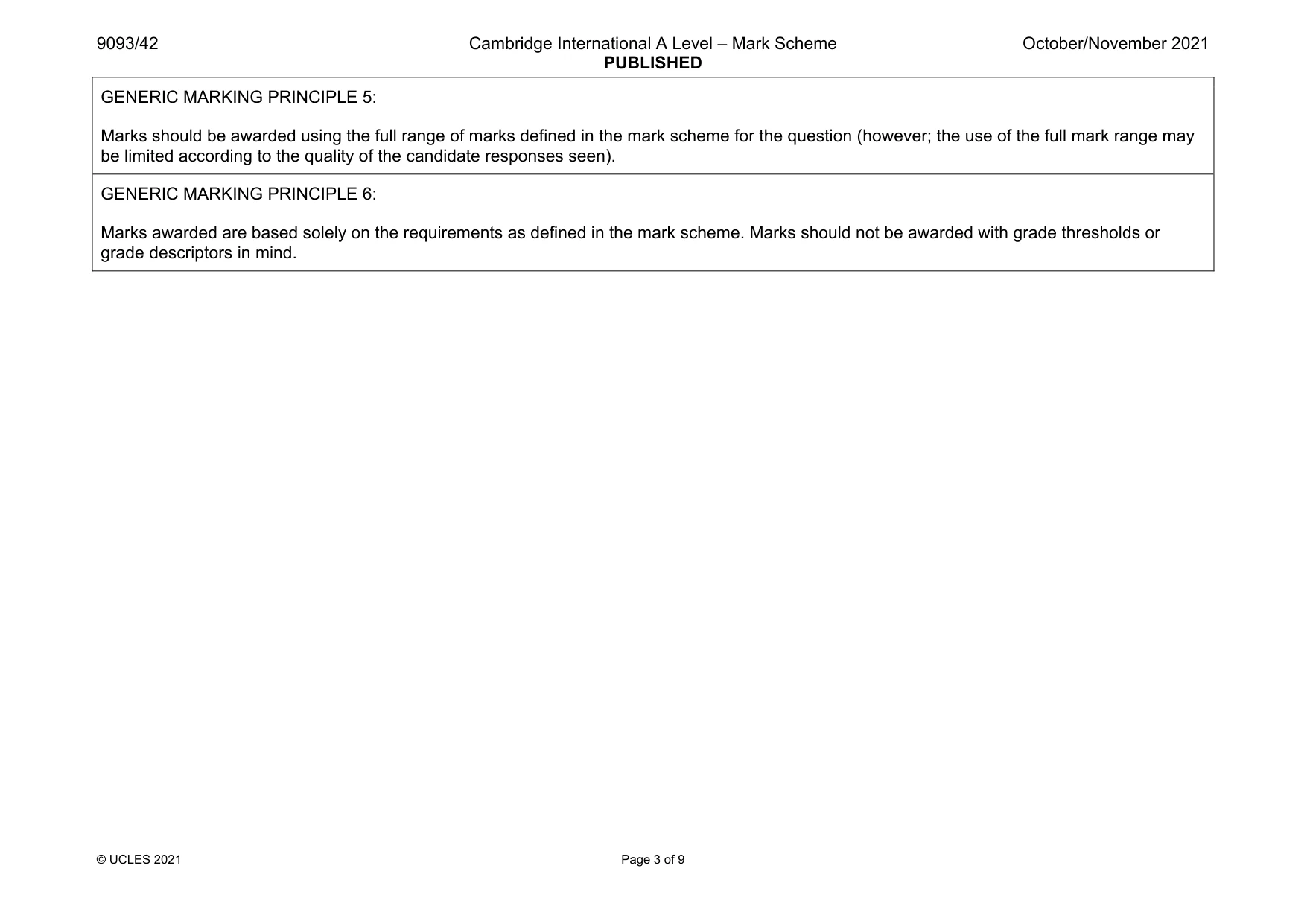
9093/42 Cambridge International A Level – Mark Scheme PUBLISHED October/November 2021 © UCLES 2021 Page 3 of 9 GENERIC MARKING PRINCIPLE 5: Marks should be awarded using the full range of marks defined in the mark scheme for the question (however; the use of the full mark range may be limited according to the quality of the candidate responses seen). GENERIC MARKING PRINCIPLE 6: Marks awarded are based solely on the requirements as defined in the mark scheme. Marks should not be awarded with grade thresholds or grade descriptors in mind.
Mark scheme, page 4
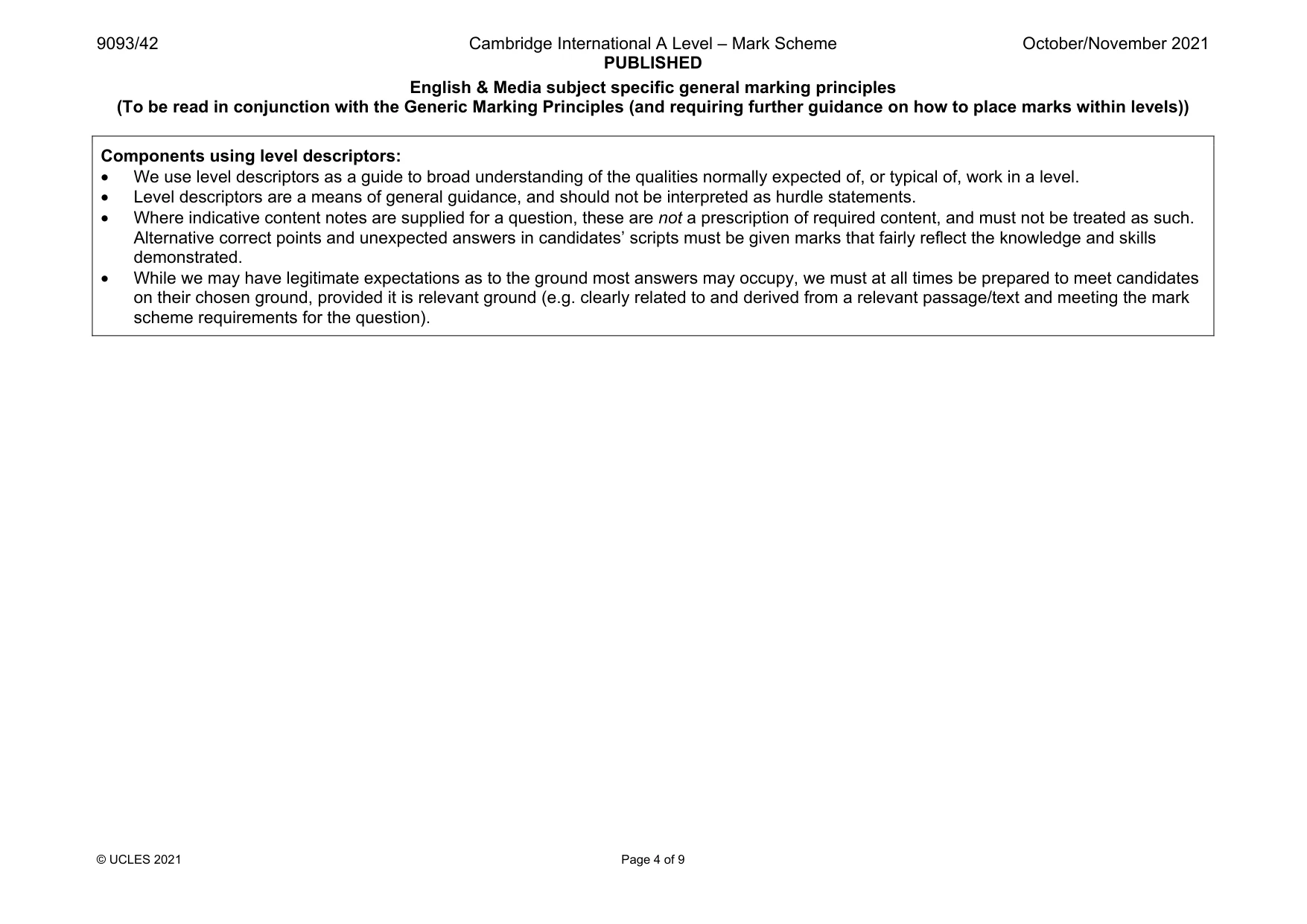
9093/42 Cambridge International A Level – Mark Scheme PUBLISHED October/November 2021 © UCLES 2021 Page 4 of 9 English & Media subject specific general marking principles (To be read in conjunction with the Generic Marking Principles (and requiring further guidance on how to place marks within levels)) Components using level descriptors: • We use level descriptors as a guide to broad understanding of the qualities normally expected of, or typical of, work in a level. • Level descriptors are a means of general guidance, and should not be interpreted as hurdle statements. • Where indicative content notes are supplied for a question, these are not a prescription of required content, and must not be treated as such. Alternative correct points and unexpected answers in candidates’ scripts must be given marks that fairly reflect the knowledge and skills demonstrated. • While we may have legitimate expectations as to the ground most answers may occupy, we must at all times be prepared to meet candidates on their chosen ground, provided it is relevant ground (e.g. clearly related to and derived from a relevant passage/text and meeting the mark scheme requirements for the question).
Mark scheme, page 5
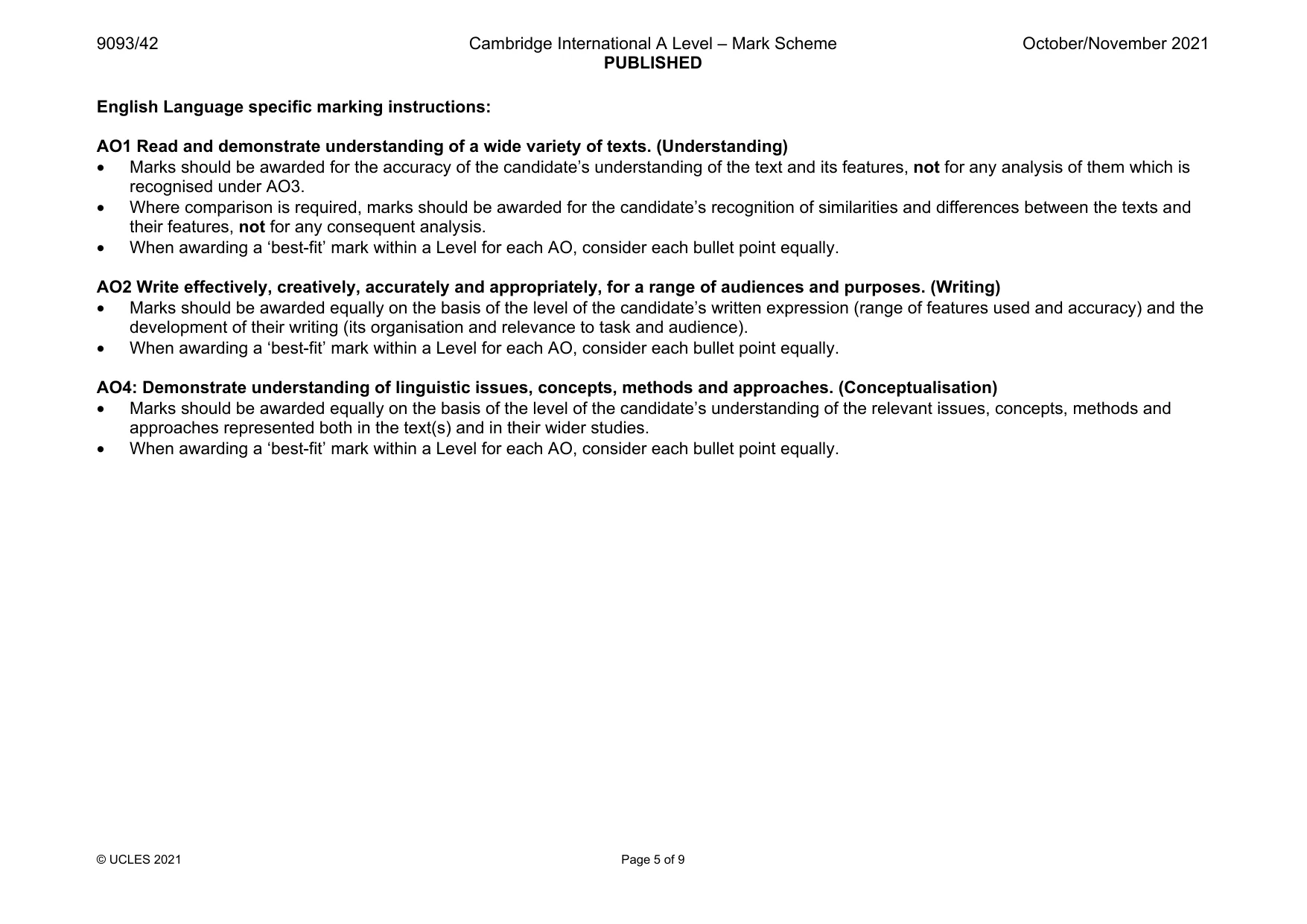
9093/42 Cambridge International A Level – Mark Scheme PUBLISHED October/November 2021 © UCLES 2021 Page 5 of 9 English Language specific marking instructions: AO1 Read and demonstrate understanding of a wide variety of texts. (Understanding) • Marks should be awarded for the accuracy of the candidate’s understanding of the text and its features, not for any analysis of them which is recognised under AO3. • Where comparison is required, marks should be awarded for the candidate’s recognition of similarities and differences between the texts and their features, not for any consequent analysis. • When awarding a ‘best-fit’ mark within a Level for each AO, consider each bullet point equally. AO2 Write effectively, creatively, accurately and appropriately, for a range of audiences and purposes. (Writing) • Marks should be awarded equally on the basis of the level of the candidate’s written expression (range of features used and accuracy) and the development of their writing (its organisation and relevance to task and audience). • When awarding a ‘best-fit’ mark within a Level for each AO, consider each bullet point equally. AO4: Demonstrate understanding of linguistic issues, concepts, methods and approaches. (Conceptualisation) • Marks should be awarded equally on the basis of the level of the candidate’s understanding of the relevant issues, concepts, methods and approaches represented both in the text(s) and in their wider studies. • When awarding a ‘best-fit’ mark within a Level for each AO, consider each bullet point equally.
Mark scheme, page 6
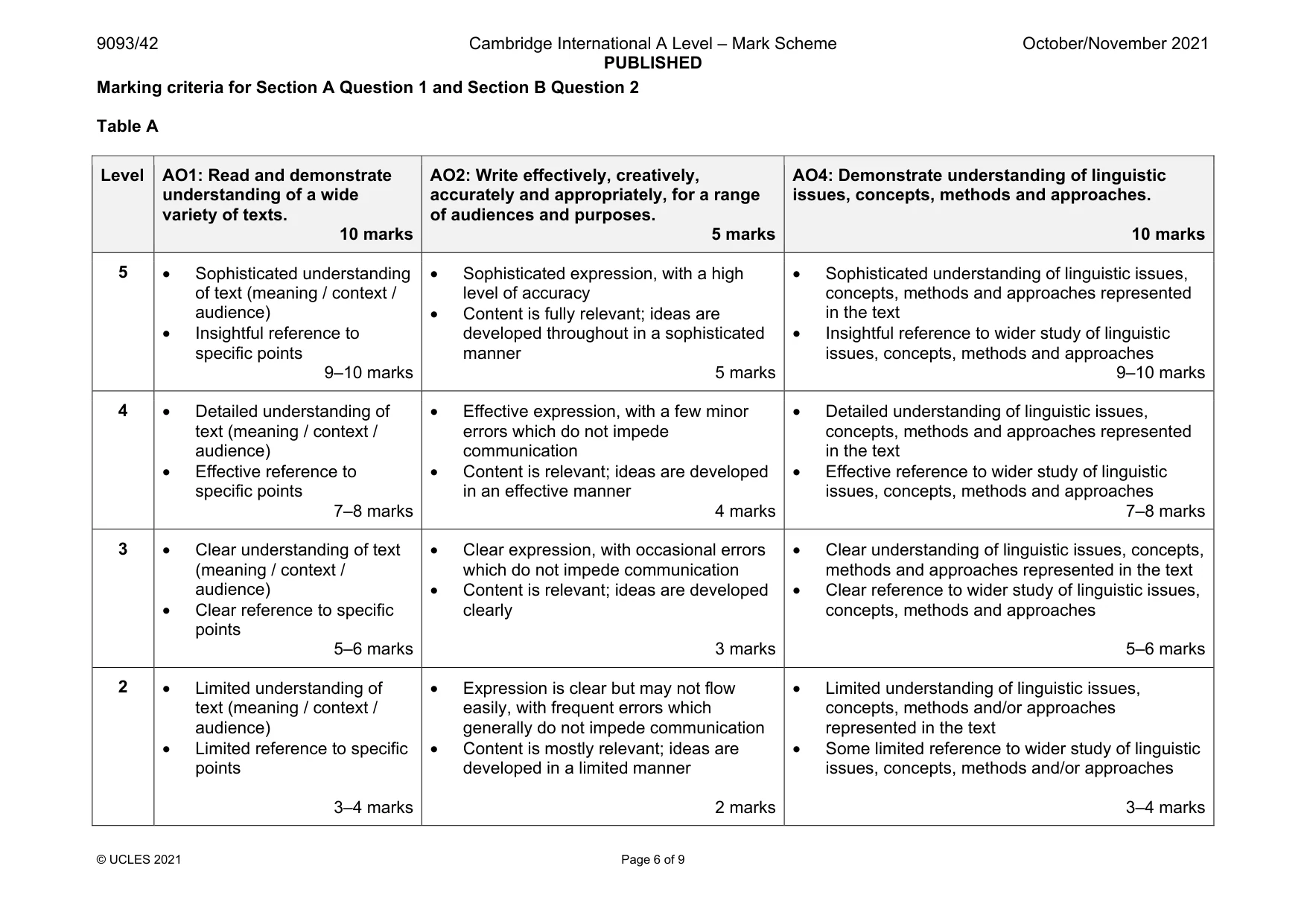
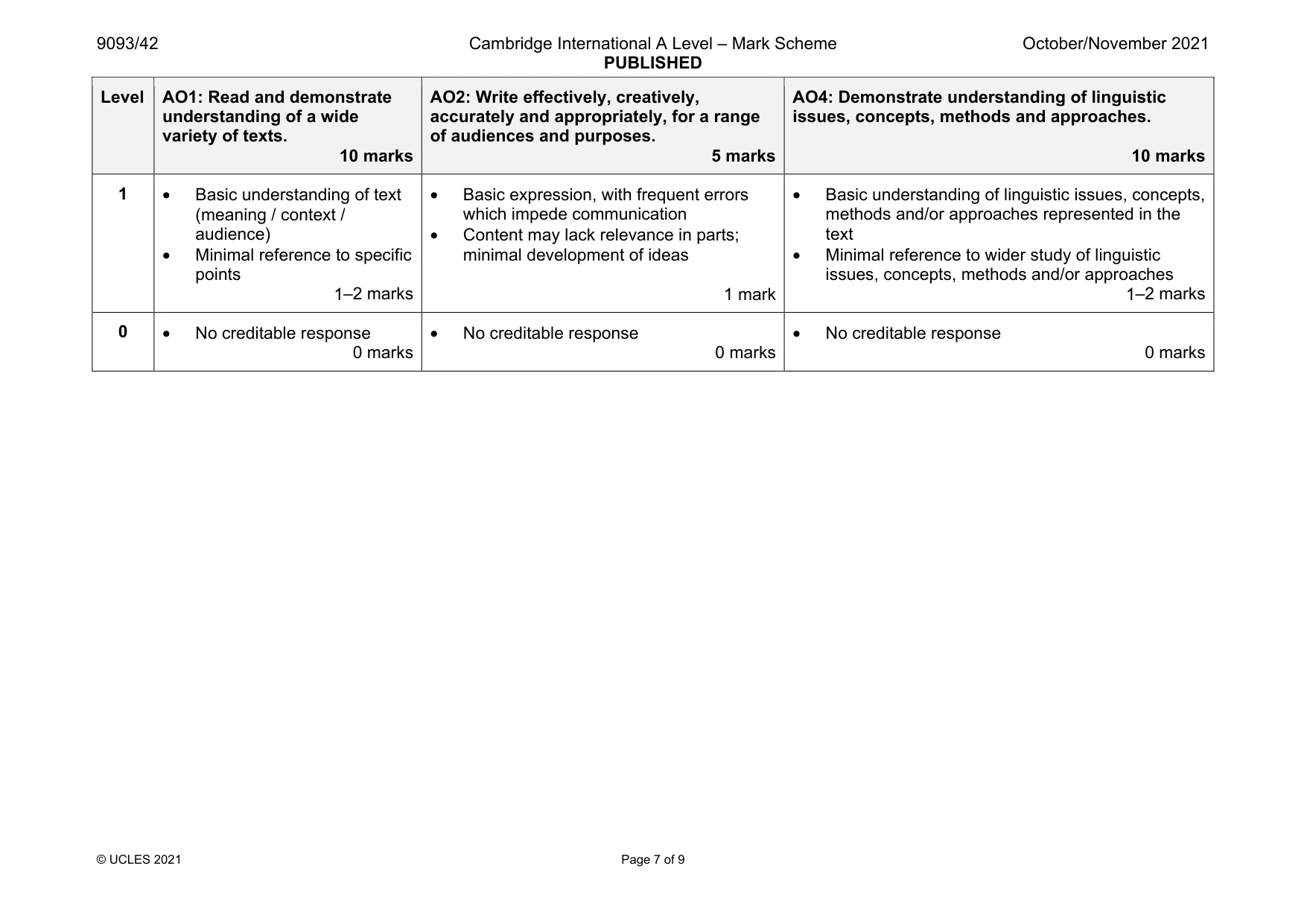
9093/42 Cambridge International A Level – Mark Scheme PUBLISHED October/November 2021 © UCLES 2021 Page 6 of 9 Marking criteria for Section A Question 1 and Section B Question 2 Table A Level AO1: Read and demonstrate understanding of a wide variety of texts. 10 marks AO2: Write effectively, creatively, accurately and appropriately, for a range of audiences and purposes. 5 marks AO4: Demonstrate understanding of linguistic issues, concepts, methods and approaches. 10 marks 5 • Sophisticated understanding of text (meaning / context / audience) • Insightful reference to specific points 9–10 marks • Sophisticated expression, with a high level of accuracy • Content is fully relevant; ideas are developed throughout in a sophisticated manner 5 marks • Sophisticated understanding of linguistic issues, concepts, methods and approaches represented in the text • Insightful reference to wider study of linguistic issues, concepts, methods and approaches 9–10 marks 4 • Detailed understanding of text (meaning / context / audience) • Effective reference to specific points 7–8 marks • Effective expression, with a few minor errors which do not impede communication • Content is relevant; ideas are developed in an effective manner 4 marks • Detailed understanding of linguistic issues, concepts, methods and approaches represented in the text • Effective reference to wider study of linguistic issues, concepts, methods and approaches 7–8 marks 3 • Clear understanding of text (meaning / context / audience) • Clear reference to specific points 5–6 marks • Clear expression, with occasional errors which do not impede communication • Content is relevant; ideas are developed clearly 3 marks • Clear understanding of linguistic issues, concepts, methods and approaches represented in the text • Clear reference to wider study of linguistic issues, concepts, methods and approaches 5–6 marks 2 • Limited understanding of text (meaning / context / audience) • Limited reference to specific points 3–4 marks • Expression is clear but may not flow easily, with frequent errors which generally do not impede communication • Content is mostly relevant; ideas are developed in a limited manner 2 marks • Limited understanding of linguistic issues, concepts, methods and/or approaches represented in the text • Some limited reference to wider study of linguistic issues, concepts, methods and/or approaches 3–4 marks
Mark scheme, page 7
9093/42 Cambridge International A Level – Mark Scheme PUBLISHED October/November 2021 © UCLES 2021 Page 7 of 9 Level AO1: Read and demonstrate understanding of a wide variety of texts. 10 marks AO2: Write effectively, creatively, accurately and appropriately, for a range of audiences and purposes. 5 marks AO4: Demonstrate understanding of linguistic issues, concepts, methods and approaches. 10 marks 1 • Basic understanding of text (meaning / context / audience) • Minimal reference to specific points 1–2 marks • Basic expression, with frequent errors which impede communication • Content may lack relevance in parts; minimal development of ideas 1 mark • Basic understanding of linguistic issues, concepts, methods and/or approaches represented in the text • Minimal reference to wider study of linguistic issues, concepts, methods and/or approaches 1–2 marks 0 • No creditable response 0 marks • No creditable response 0 marks • No creditable response 0 marks
Mark scheme, page 8
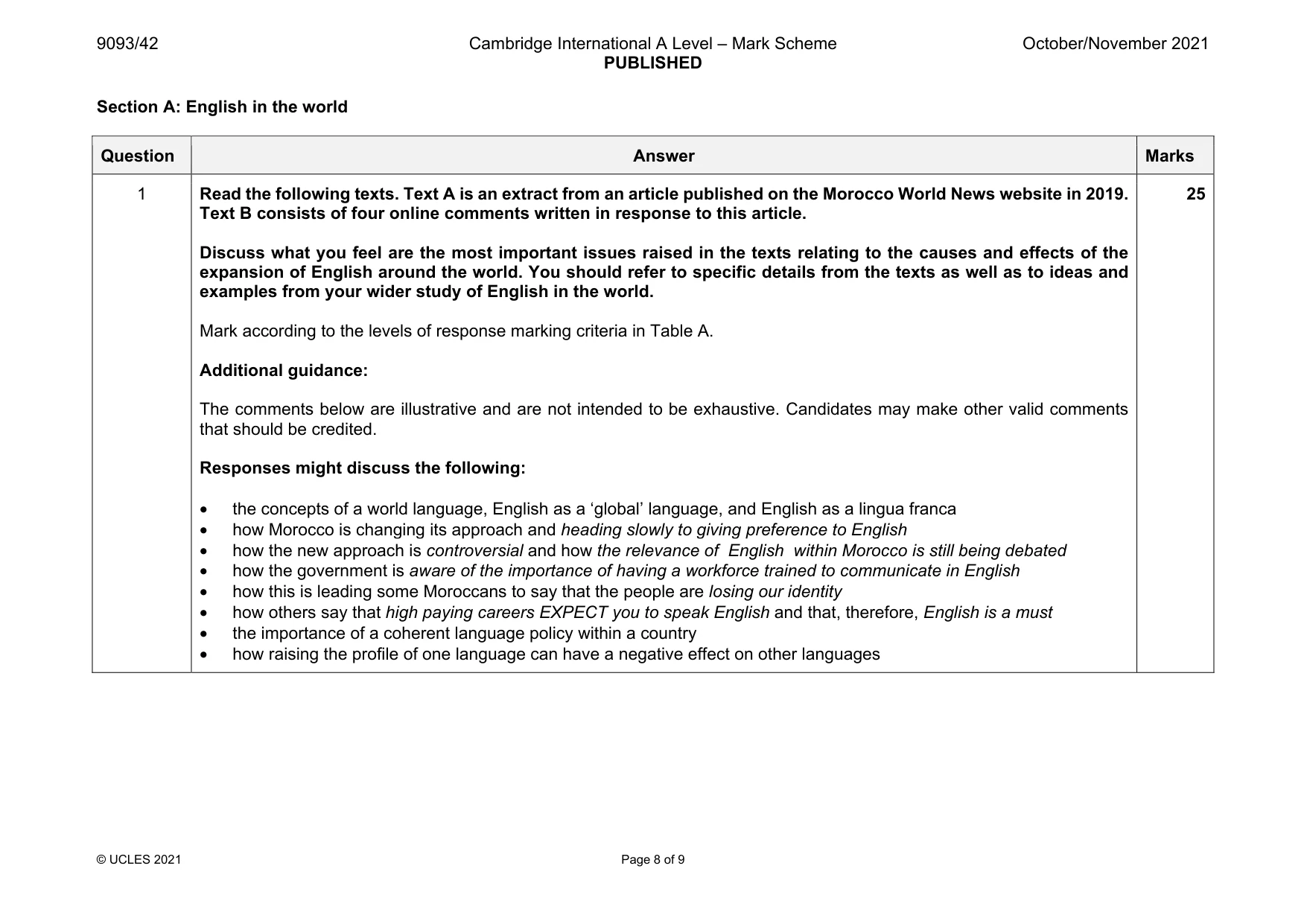
9093/42 Cambridge International A Level – Mark Scheme PUBLISHED October/November 2021 © UCLES 2021 Page 8 of 9 Section A: English in the world Question Answer Marks 1 Read the following texts. Text A is an extract from an article published on the Morocco World News website in 2019. Text B consists of four online comments written in response to this article. Discuss what you feel are the most important issues raised in the texts relating to the causes and effects of the expansion of English around the world. You should refer to specific details from the texts as well as to ideas and examples from your wider study of English in the world. Mark according to the levels of response marking criteria in Table A. Additional guidance: The comments below are illustrative and are not intended to be exhaustive. Candidates may make other valid comments that should be credited. Responses might discuss the following: • the concepts of a world language, English as a ‘global’ language, and English as a lingua franca • how Morocco is changing its approach and heading slowly to giving preference to English • how the new approach is controversial and how the relevance of English within Morocco is still being debated • how the government is aware of the importance of having a workforce trained to communicate in English • how this is leading some Moroccans to say that the people are losing our identity • how others say that high paying careers EXPECT you to speak English and that, therefore, English is a must • the importance of a coherent language policy within a country • how raising the profile of one language can have a negative effect on other languages 25
Mark scheme, page 9
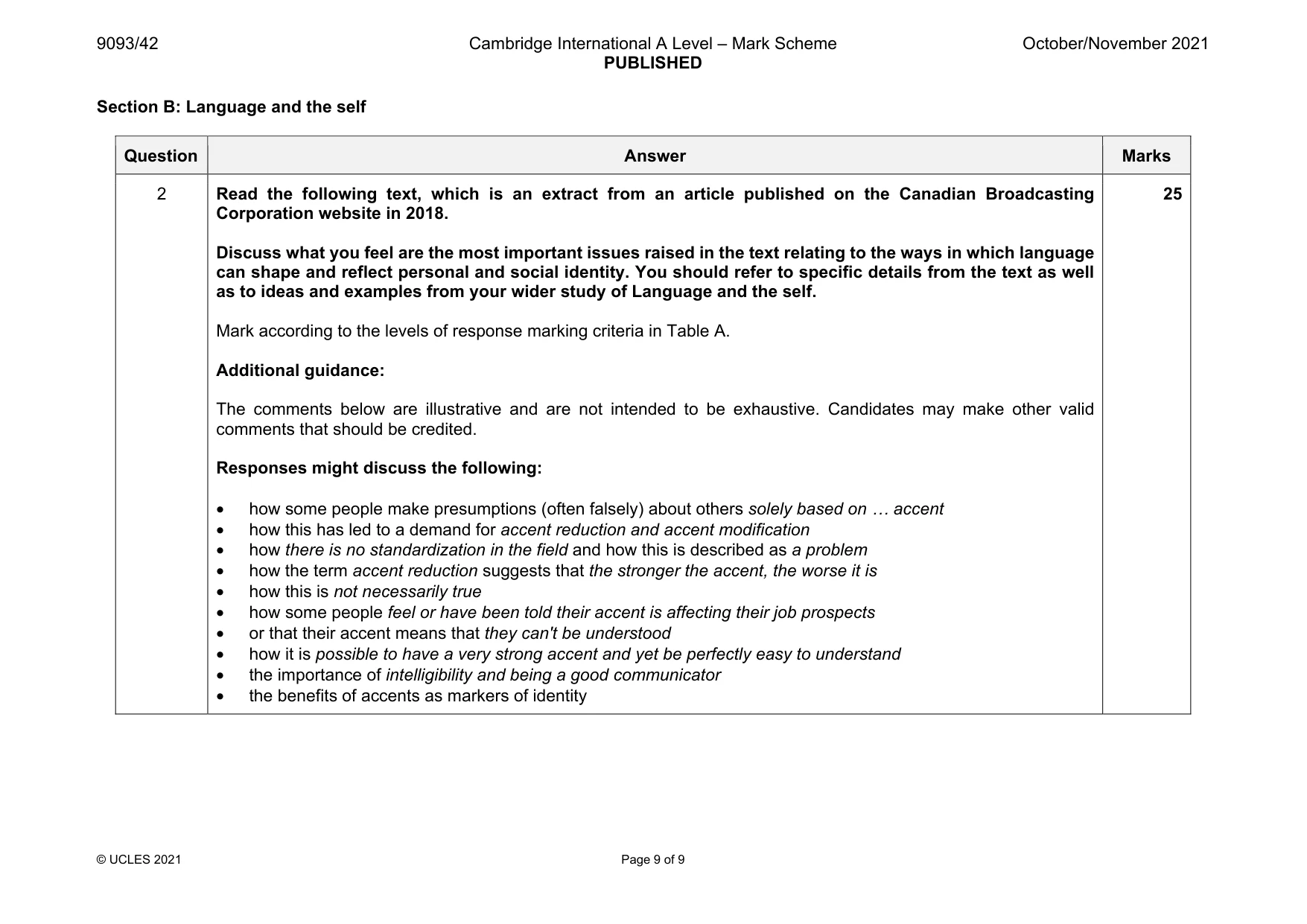
9093/42 Cambridge International A Level – Mark Scheme PUBLISHED October/November 2021 © UCLES 2021 Page 9 of 9 Section B: Language and the self Question Answer Marks 2 Read the following text, which is an extract from an article published on the Canadian Broadcasting Corporation website in 2018. Discuss what you feel are the most important issues raised in the text relating to the ways in which language can shape and reflect personal and social identity. You should refer to specific details from the text as well as to ideas and examples from your wider study of Language and the self. Mark according to the levels of response marking criteria in Table A. Additional guidance: The comments below are illustrative and are not intended to be exhaustive. Candidates may make other valid comments that should be credited. Responses might discuss the following: • how some people make presumptions (often falsely) about others solely based on … accent • how this has led to a demand for accent reduction and accent modification • how there is no standardization in the field and how this is described as a problem • how the term accent reduction suggests that the stronger the accent, the worse it is • how this is not necessarily true • how some people feel or have been told their accent is affecting their job prospects • or that their accent means that they can't be understood • how it is possible to have a very strong accent and yet be perfectly easy to understand • the importance of intelligibility and being a good communicator • the benefits of accents as markers of identity 25
What you needed in this session
Cambridge’s own grade thresholds for 2021 Oct/Nov, Paper 4 · Variant 2. A higher threshold means an easier paper — the bar moves with how the cohort did.