Cambridge A Level English - Language AS and A Level (from 2014) 9093 — 2021 Oct/Nov Paper 4 · Variant 3
9093/43/O/N/21 · 50 marks · ≈56 min
The question paper and its mark scheme, free to read here and free to download. This is Cambridge’s own paper, exactly as it was sat.
Question paper8 pages




Mark scheme9 pages
Answers below. Sit the paper first if you are practising.
Paper as text
Question paper, page 1
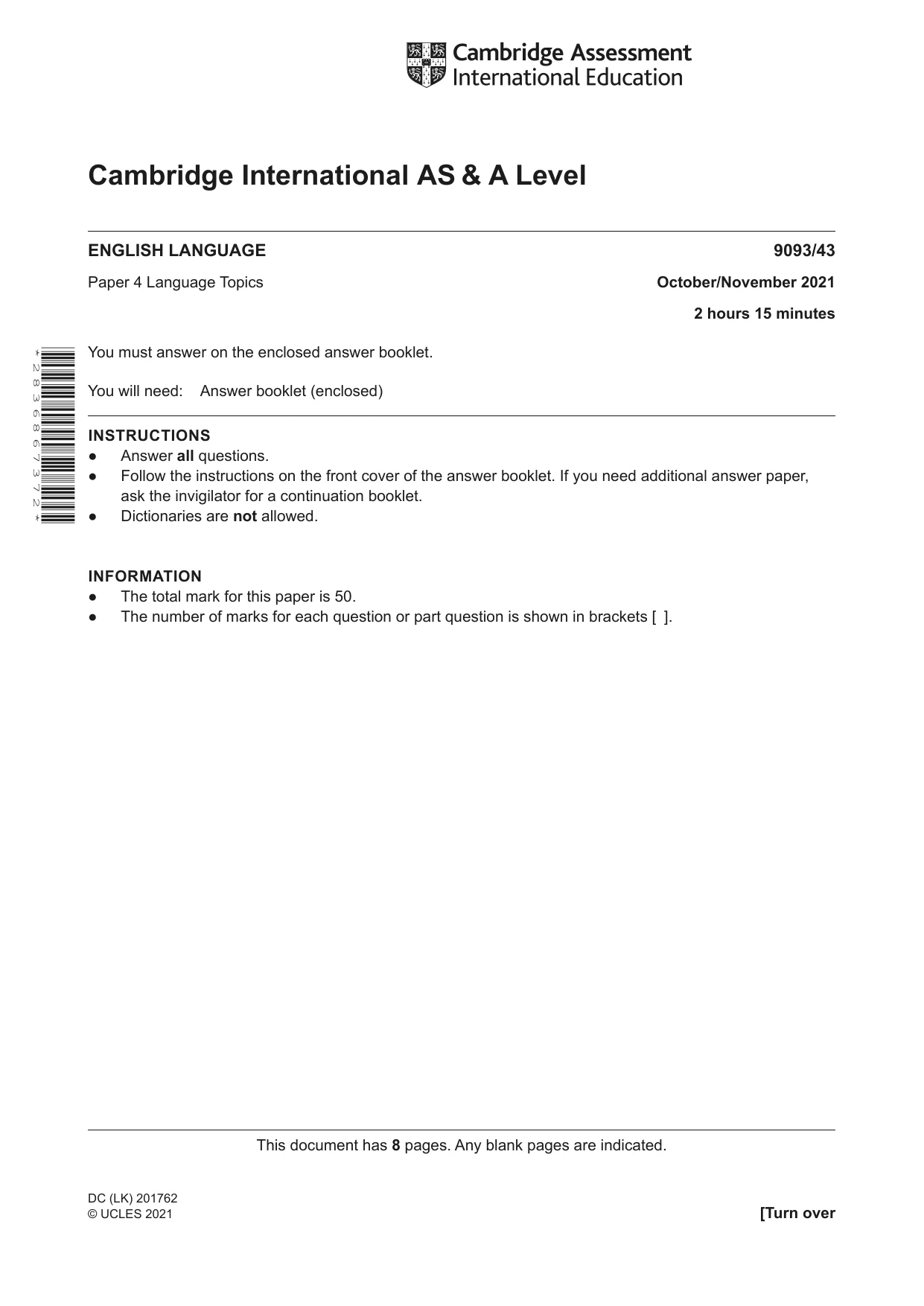
This document has 8 pages. Any blank pages are indicated. Cambridge International AS & A Level * 2 8 3 6 8 6 7 3 7 2 * ENGLISH LANGUAGE 9093/43 Paper 4 Language Topics October/November 2021 2 hours 15 minutes You must answer on the enclosed answer booklet. You will need: Answer booklet (enclosed) INSTRUCTIONS ● Answer all questions. ● Follow the instructions on the front cover of the answer booklet. If you need additional answer paper, ask the invigilator for a continuation booklet. ● Dictionaries are not allowed. INFORMATION ● The total mark for this paper is 50. ● The number of marks for each question or part question is shown in brackets [ ]. DC (LK) 201762 © UCLES 2021 [Turn over
Question paper, page 2
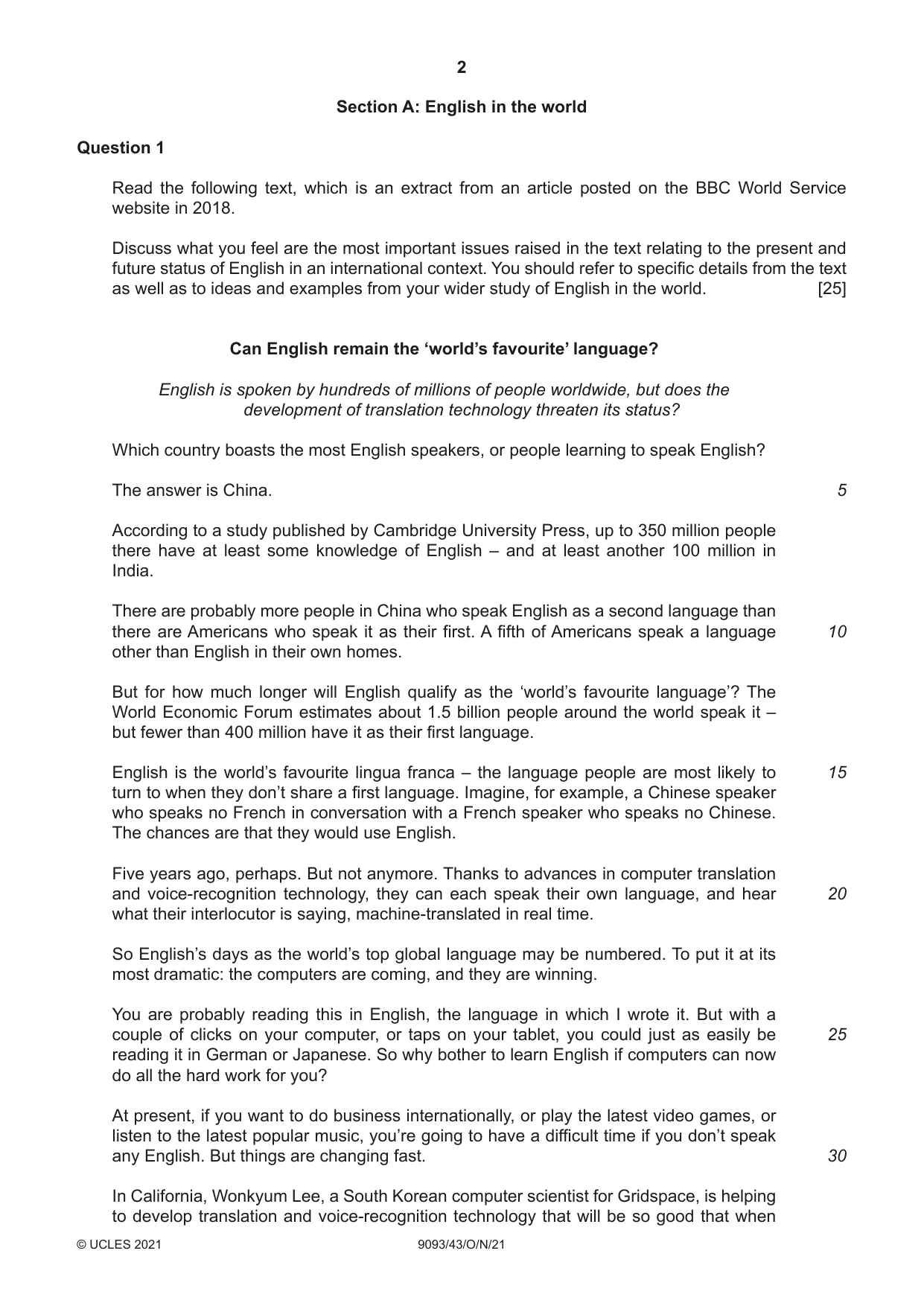
2 9093/43/O/N/21 © UCLES 2021 Section A: English in the world Question 1 Read the following text, which is an extract from an article posted on the BBC World Service website in 2018. Discuss what you feel are the most important issues raised in the text relating to the present and future status of English in an international context. You should refer to specific details from the text as well as to ideas and examples from your wider study of English in the world. [25] Can English remain the ‘world’s favourite’ language? English is spoken by hundreds of millions of people worldwide, but does the development of translation technology threaten its status? Which country boasts the most English speakers, or people learning to speak English? The answer is China. According to a study published by Cambridge University Press, up to 350 million people there have at least some knowledge of English – and at least another 100 million in India. There are probably more people in China who speak English as a second language than there are Americans who speak it as their first. A fifth of Americans speak a language other than English in their own homes. But for how much longer will English qualify as the ‘world’s favourite language’? The World Economic Forum estimates about 1.5 billion people around the world speak it – but fewer than 400 million have it as their first language. English is the world’s favourite lingua franca – the language people are most likely to turn to when they don’t share a first language. Imagine, for example, a Chinese speaker who speaks no French in conversation with a French speaker who speaks no Chinese. The chances are that they would use English. Five years ago, perhaps. But not anymore. Thanks to advances in computer translation and voice-recognition technology, they can each speak their own language, and hear what their interlocutor is saying, machine-translated in real time. So English’s days as the world’s top global language may be numbered. To put it at its most dramatic: the computers are coming, and they are winning. You are probably reading this in English, the language in which I wrote it. But with a couple of clicks on your computer, or taps on your tablet, you could just as easily be reading it in German or Japanese. So why bother to learn English if computers can now do all the hard work for you? At present, if you want to do business internationally, or play the latest video games, or listen to the latest popular music, you’re going to have a difficult time if you don’t speak any English. But things are changing fast. In California, Wonkyum Lee, a South Korean computer scientist for Gridspace, is helping to develop translation and voice-recognition technology that will be so good that when 5 10 15 20 25 30
Question paper, page 3
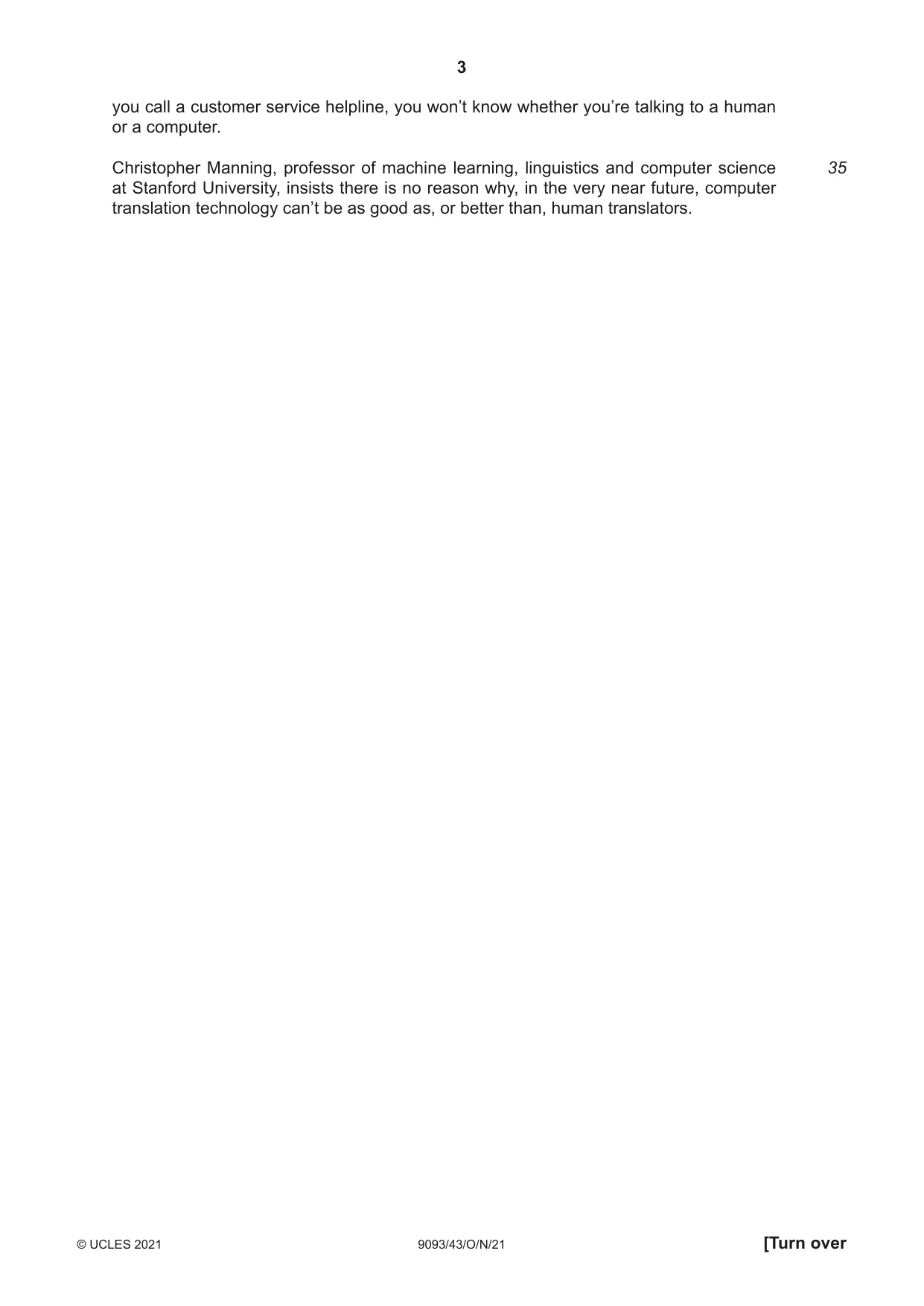
3 9093/43/O/N/21 © UCLES 2021 [Turn over you call a customer service helpline, you won’t know whether you’re talking to a human or a computer. Christopher Manning, professor of machine learning, linguistics and computer science at Stanford University, insists there is no reason why, in the very near future, computer translation technology can’t be as good as, or better than, human translators. 35
Question paper, page 4
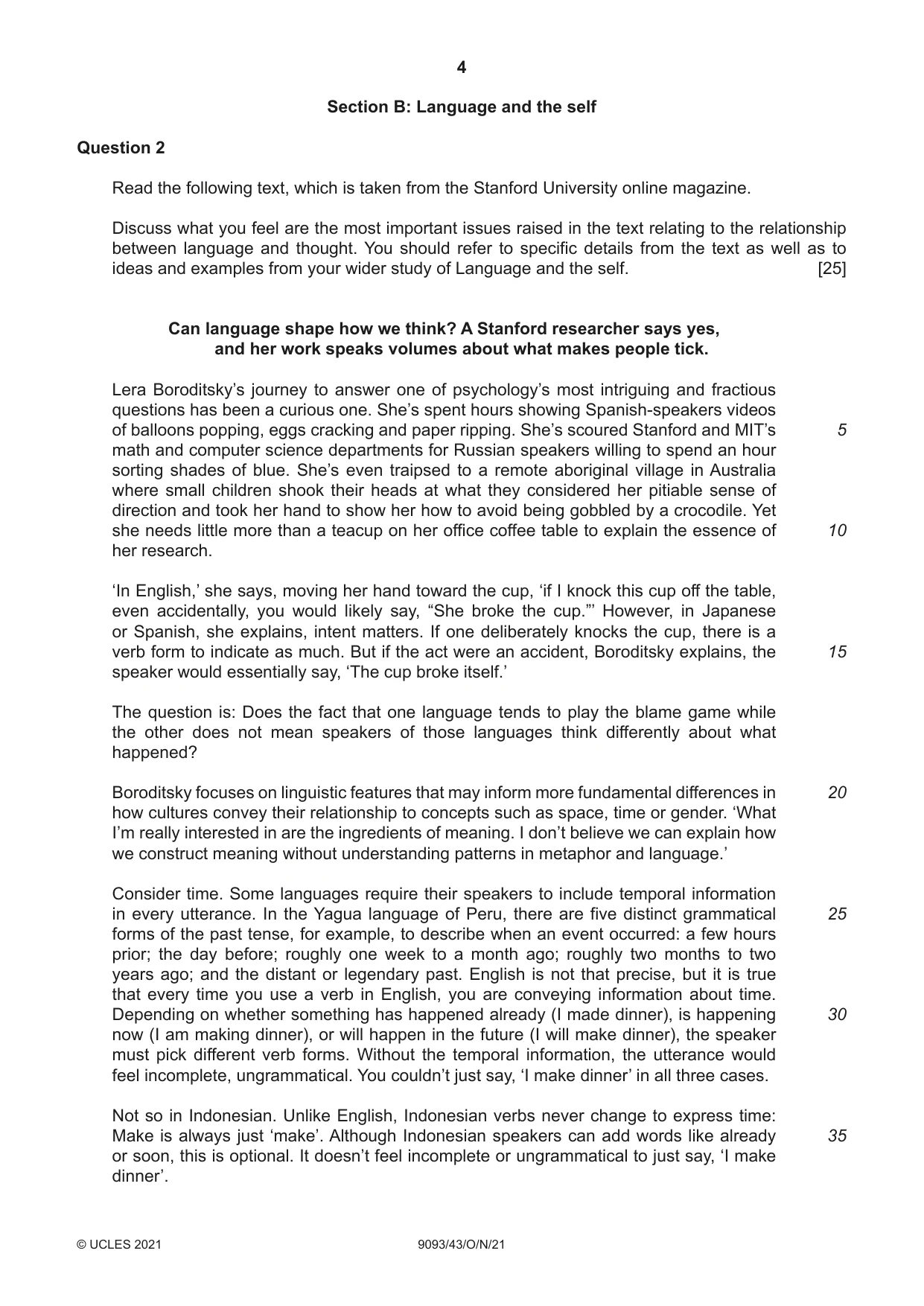
4 9093/43/O/N/21 © UCLES 2021 Section B: Language and the self Question 2 Read the following text, which is taken from the Stanford University online magazine. Discuss what you feel are the most important issues raised in the text relating to the relationship between language and thought. You should refer to specific details from the text as well as to ideas and examples from your wider study of Language and the self. [25] Can language shape how we think? A Stanford researcher says yes, and her work speaks volumes about what makes people tick. Lera Boroditsky’s journey to answer one of psychology’s most intriguing and fractious questions has been a curious one. She’s spent hours showing Spanish-speakers videos of balloons popping, eggs cracking and paper ripping. She’s scoured Stanford and MIT’s math and computer science departments for Russian speakers willing to spend an hour sorting shades of blue. She’s even traipsed to a remote aboriginal village in Australia where small children shook their heads at what they considered her pitiable sense of direction and took her hand to show her how to avoid being gobbled by a crocodile. Yet she needs little more than a teacup on her office coffee table to explain the essence of her research. ‘In English,’ she says, moving her hand toward the cup, ‘if I knock this cup off the table, even accidentally, you would likely say, “She broke the cup.”’ However, in Japanese or Spanish, she explains, intent matters. If one deliberately knocks the cup, there is a verb form to indicate as much. But if the act were an accident, Boroditsky explains, the speaker would essentially say, ‘The cup broke itself.’ The question is: Does the fact that one language tends to play the blame game while the other does not mean speakers of those languages think differently about what happened? Boroditsky focuses on linguistic features that may inform more fundamental differences in how cultures convey their relationship to concepts such as space, time or gender. ‘What I’m really interested in are the ingredients of meaning. I don’t believe we can explain how we construct meaning without understanding patterns in metaphor and language.’ Consider time. Some languages require their speakers to include temporal information in every utterance. In the Yagua language of Peru, there are five distinct grammatical forms of the past tense, for example, to describe when an event occurred: a few hours prior; the day before; roughly one week to a month ago; roughly two months to two years ago; and the distant or legendary past. English is not that precise, but it is true that every time you use a verb in English, you are conveying information about time. Depending on whether something has happened already (I made dinner), is happening now (I am making dinner), or will happen in the future (I will make dinner), the speaker must pick different verb forms. Without the temporal information, the utterance would feel incomplete, ungrammatical. You couldn’t just say, ‘I make dinner’ in all three cases. Not so in Indonesian. Unlike English, Indonesian verbs never change to express time: Make is always just ‘make’. Although Indonesian speakers can add words like already or soon, this is optional. It doesn’t feel incomplete or ungrammatical to just say, ‘I make dinner’. 5 10 15 20 25 30 35
Question paper, page 5
5 9093/43/O/N/21 © UCLES 2021 BLANK PAGE
Question paper, page 6
6 9093/43/O/N/21 © UCLES 2021 BLANK PAGE
Question paper, page 7
7 9093/43/O/N/21 © UCLES 2021 BLANK PAGE
Question paper, page 8
8 9093/43/O/N/21 © UCLES 2021 Permission to reproduce items where third-party owned material protected by copyright is included has been sought and cleared where possible. Every reasonable effort has been made by the publisher (UCLES) to trace copyright holders, but if any items requiring clearance have unwittingly been included, the publisher will be pleased to make amends at the earliest possible opportunity. To avoid the issue of disclosure of answer-related information to candidates, all copyright acknowledgements are reproduced online in the Cambridge Assessment International Education Copyright Acknowledgements Booklet. This is produced for each series of examinations and is freely available to download at www.cambridgeinternational.org after the live examination series. Cambridge Assessment International Education is part of the Cambridge Assessment Group. Cambridge Assessment is the brand name of the University of Cambridge Local Examinations Syndicate (UCLES), which itself is a department of the University of Cambridge. BLANK PAGE
Mark scheme, page 1
This document consists of 9 printed pages. © UCLES 2021 [Turn over Cambridge International A Level ENGLISH LANGUAGE 9093/43 Paper 4 Language Topics October/November 2021 MARK SCHEME Maximum Mark: 50 Published This mark scheme is published as an aid to teachers and candidates, to indicate the requirements of the examination. It shows the basis on which Examiners were instructed to award marks. It does not indicate the details of the discussions that took place at an Examiners’ meeting before marking began, which would have considered the acceptability of alternative answers. Mark schemes should be read in conjunction with the question paper and the Principal Examiner Report for Teachers. Cambridge International will not enter into discussions about these mark schemes. Cambridge International is publishing the mark schemes for the October/November 2021 series for most Cambridge IGCSE™, Cambridge International A and AS Level components and some Cambridge O Level components.
Mark scheme, page 2
9093/43 Cambridge International A Level – Mark Scheme PUBLISHED October/November 2021 © UCLES 2021 Page 2 of 9 Generic Marking Principles These general marking principles must be applied by all examiners when marking candidate answers. They should be applied alongside the specific content of the mark scheme or generic level descriptors for a question. Each question paper and mark scheme will also comply with these marking principles. GENERIC MARKING PRINCIPLE 1: Marks must be awarded in line with: • the specific content of the mark scheme or the generic level descriptors for the question • the specific skills defined in the mark scheme or in the generic level descriptors for the question • the standard of response required by a candidate as exemplified by the standardisation scripts. GENERIC MARKING PRINCIPLE 2: Marks awarded are always whole marks (not half marks, or other fractions). GENERIC MARKING PRINCIPLE 3: Marks must be awarded positively: • marks are awarded for correct/valid answers, as defined in the mark scheme. However, credit is given for valid answers which go beyond the scope of the syllabus and mark scheme, referring to your Team Leader as appropriate • marks are awarded when candidates clearly demonstrate what they know and can do • marks are not deducted for errors • marks are not deducted for omissions • answers should only be judged on the quality of spelling, punctuation and grammar when these features are specifically assessed by the question as indicated by the mark scheme. The meaning, however, should be unambiguous. GENERIC MARKING PRINCIPLE 4: Rules must be applied consistently, e.g. in situations where candidates have not followed instructions or in the application of generic level descriptors.
Mark scheme, page 3
9093/43 Cambridge International A Level – Mark Scheme PUBLISHED October/November 2021 © UCLES 2021 Page 3 of 9 GENERIC MARKING PRINCIPLE 5: Marks should be awarded using the full range of marks defined in the mark scheme for the question (however; the use of the full mark range may be limited according to the quality of the candidate responses seen). GENERIC MARKING PRINCIPLE 6: Marks awarded are based solely on the requirements as defined in the mark scheme. Marks should not be awarded with grade thresholds or grade descriptors in mind.
Mark scheme, page 4
9093/43 Cambridge International A Level – Mark Scheme PUBLISHED October/November 2021 © UCLES 2021 Page 4 of 9 English & Media subject specific general marking principles (To be read in conjunction with the Generic Marking Principles (and requiring further guidance on how to place marks within levels)) Components using level descriptors: • We use level descriptors as a guide to broad understanding of the qualities normally expected of, or typical of, work in a level. • Level descriptors are a means of general guidance, and should not be interpreted as hurdle statements. • Where indicative content notes are supplied for a question, these are not a prescription of required content, and must not be treated as such. Alternative correct points and unexpected answers in candidates’ scripts must be given marks that fairly reflect the knowledge and skills demonstrated. • While we may have legitimate expectations as to the ground most answers may occupy, we must at all times be prepared to meet candidates on their chosen ground, provided it is relevant ground (e.g. clearly related to and derived from a relevant passage/text and meeting the mark scheme requirements for the question).
Mark scheme, page 5
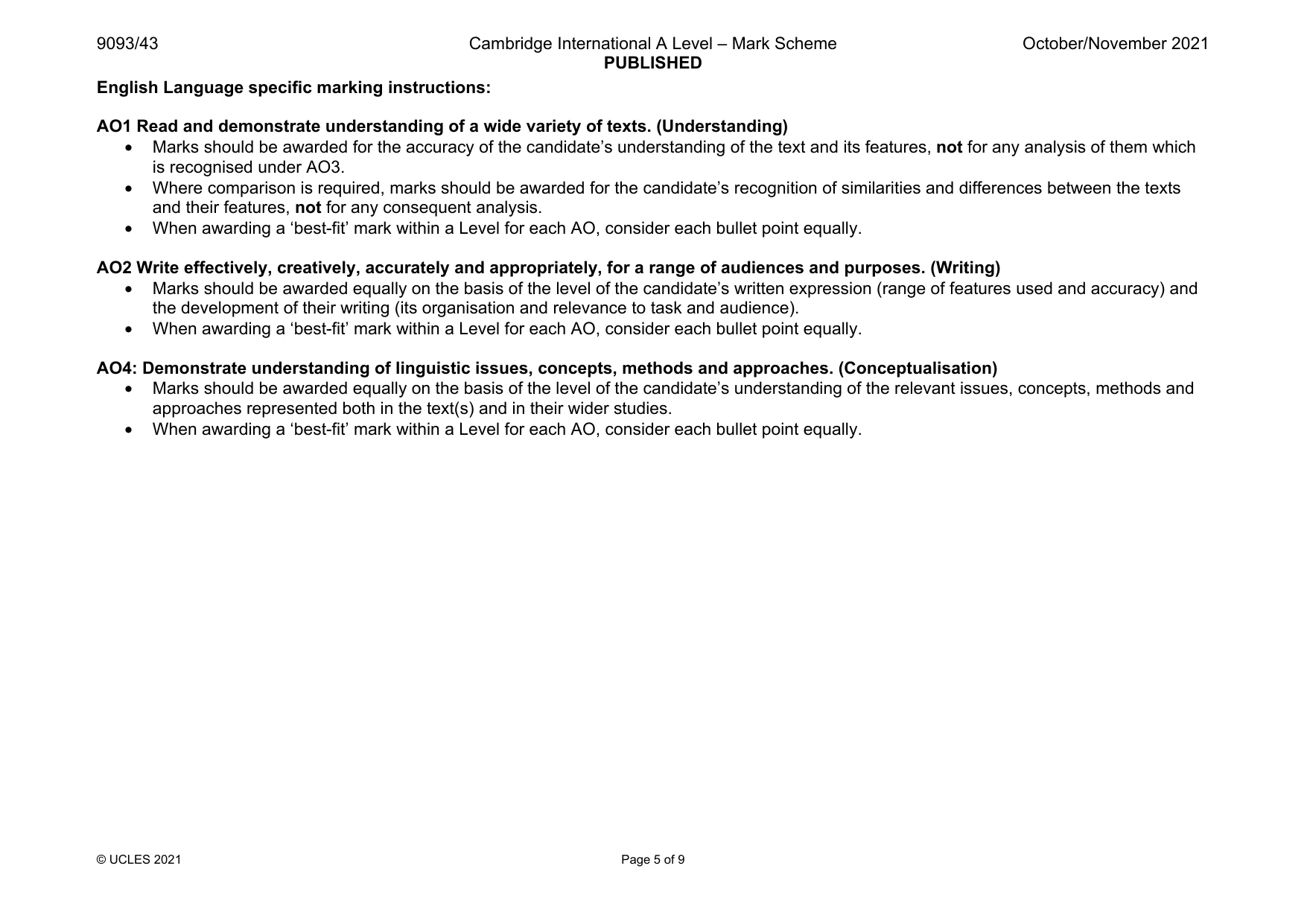
9093/43 Cambridge International A Level – Mark Scheme PUBLISHED October/November 2021 © UCLES 2021 Page 5 of 9 English Language specific marking instructions: AO1 Read and demonstrate understanding of a wide variety of texts. (Understanding) • Marks should be awarded for the accuracy of the candidate’s understanding of the text and its features, not for any analysis of them which is recognised under AO3. • Where comparison is required, marks should be awarded for the candidate’s recognition of similarities and differences between the texts and their features, not for any consequent analysis. • When awarding a ‘best-fit’ mark within a Level for each AO, consider each bullet point equally. AO2 Write effectively, creatively, accurately and appropriately, for a range of audiences and purposes. (Writing) • Marks should be awarded equally on the basis of the level of the candidate’s written expression (range of features used and accuracy) and the development of their writing (its organisation and relevance to task and audience). • When awarding a ‘best-fit’ mark within a Level for each AO, consider each bullet point equally. AO4: Demonstrate understanding of linguistic issues, concepts, methods and approaches. (Conceptualisation) • Marks should be awarded equally on the basis of the level of the candidate’s understanding of the relevant issues, concepts, methods and approaches represented both in the text(s) and in their wider studies. • When awarding a ‘best-fit’ mark within a Level for each AO, consider each bullet point equally.
Mark scheme, page 6
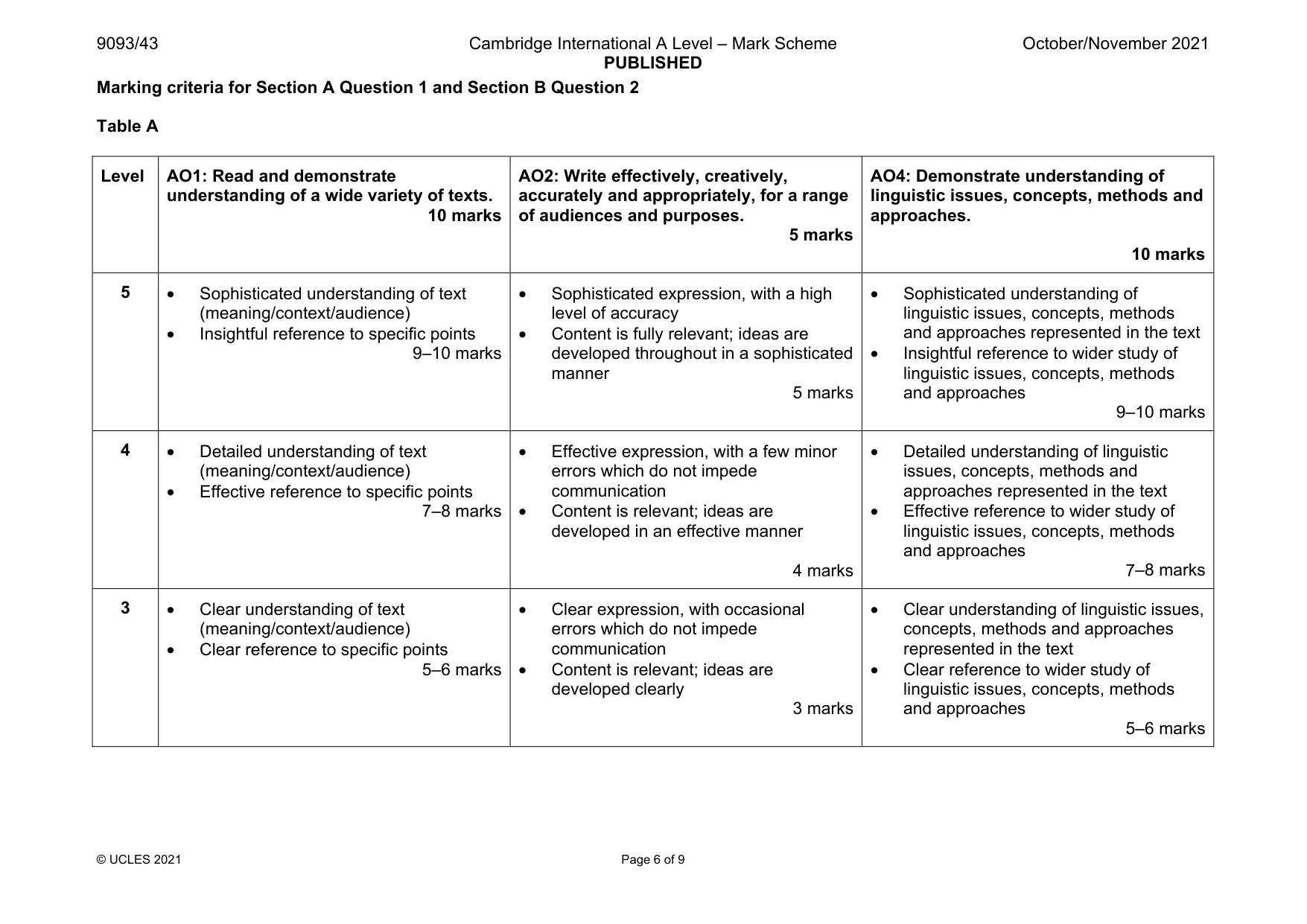
9093/43 Cambridge International A Level – Mark Scheme PUBLISHED October/November 2021 © UCLES 2021 Page 6 of 9 Marking criteria for Section A Question 1 and Section B Question 2 Table A Level AO1: Read and demonstrate understanding of a wide variety of texts. 10 marks AO2: Write effectively, creatively, accurately and appropriately, for a range of audiences and purposes. 5 marks AO4: Demonstrate understanding of linguistic issues, concepts, methods and approaches. 10 marks 5 • Sophisticated understanding of text (meaning/context/audience) • Insightful reference to specific points 9–10 marks • Sophisticated expression, with a high level of accuracy • Content is fully relevant; ideas are developed throughout in a sophisticated manner 5 marks • Sophisticated understanding of linguistic issues, concepts, methods and approaches represented in the text • Insightful reference to wider study of linguistic issues, concepts, methods and approaches 9–10 marks 4 • Detailed understanding of text (meaning/context/audience) • Effective reference to specific points 7–8 marks • Effective expression, with a few minor errors which do not impede communication • Content is relevant; ideas are developed in an effective manner 4 marks • Detailed understanding of linguistic issues, concepts, methods and approaches represented in the text • Effective reference to wider study of linguistic issues, concepts, methods and approaches 7–8 marks 3 • Clear understanding of text (meaning/context/audience) • Clear reference to specific points 5–6 marks • Clear expression, with occasional errors which do not impede communication • Content is relevant; ideas are developed clearly 3 marks • Clear understanding of linguistic issues, concepts, methods and approaches represented in the text • Clear reference to wider study of linguistic issues, concepts, methods and approaches 5–6 marks
Mark scheme, page 7
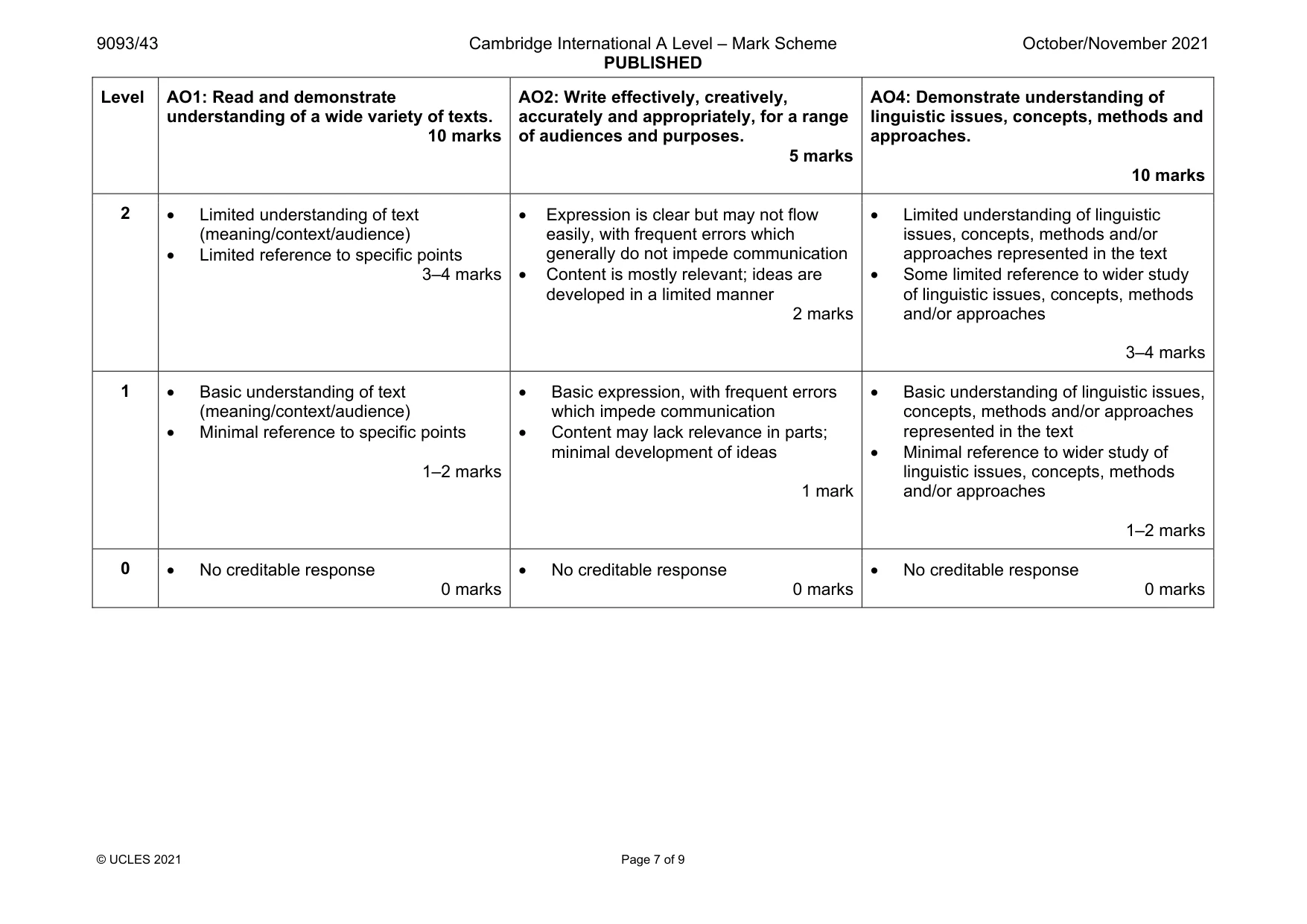
9093/43 Cambridge International A Level – Mark Scheme PUBLISHED October/November 2021 © UCLES 2021 Page 7 of 9 Level AO1: Read and demonstrate understanding of a wide variety of texts. 10 marks AO2: Write effectively, creatively, accurately and appropriately, for a range of audiences and purposes. 5 marks AO4: Demonstrate understanding of linguistic issues, concepts, methods and approaches. 10 marks 2 • Limited understanding of text (meaning/context/audience) • Limited reference to specific points 3–4 marks • Expression is clear but may not flow easily, with frequent errors which generally do not impede communication • Content is mostly relevant; ideas are developed in a limited manner 2 marks • Limited understanding of linguistic issues, concepts, methods and/or approaches represented in the text • Some limited reference to wider study of linguistic issues, concepts, methods and/or approaches 3–4 marks 1 • Basic understanding of text (meaning/context/audience) • Minimal reference to specific points 1–2 marks • Basic expression, with frequent errors which impede communication • Content may lack relevance in parts; minimal development of ideas 1 mark • Basic understanding of linguistic issues, concepts, methods and/or approaches represented in the text • Minimal reference to wider study of linguistic issues, concepts, methods and/or approaches 1–2 marks 0 • No creditable response 0 marks • No creditable response 0 marks • No creditable response 0 marks
Mark scheme, page 8
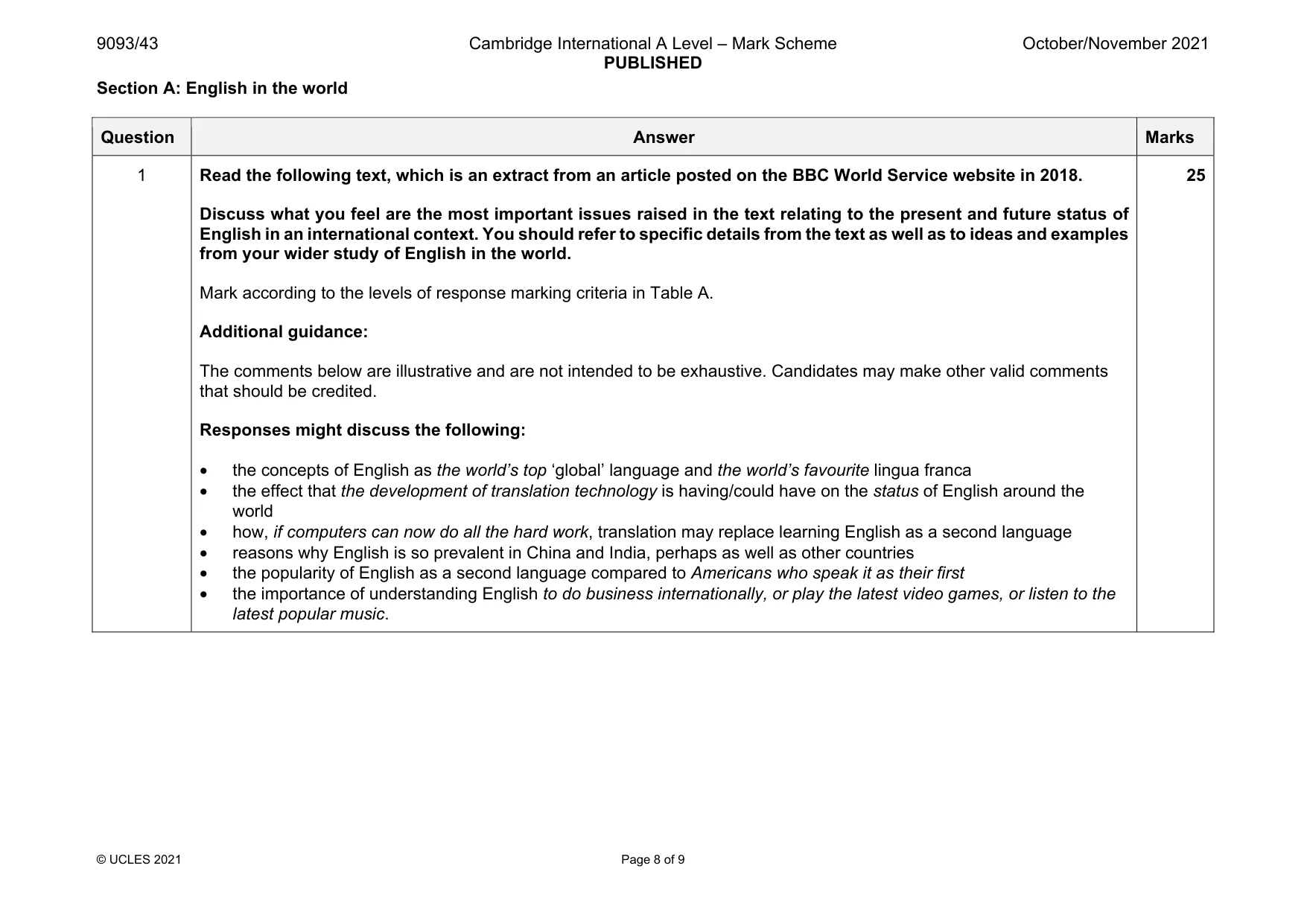
9093/43 Cambridge International A Level – Mark Scheme PUBLISHED October/November 2021 © UCLES 2021 Page 8 of 9 Section A: English in the world Question Answer Marks 1 Read the following text, which is an extract from an article posted on the BBC World Service website in 2018. Discuss what you feel are the most important issues raised in the text relating to the present and future status of English in an international context. You should refer to specific details from the text as well as to ideas and examples from your wider study of English in the world. Mark according to the levels of response marking criteria in Table A. Additional guidance: The comments below are illustrative and are not intended to be exhaustive. Candidates may make other valid comments that should be credited. Responses might discuss the following: • the concepts of English as the world’s top ‘global’ language and the world’s favourite lingua franca • the effect that the development of translation technology is having/could have on the status of English around the world • how, if computers can now do all the hard work, translation may replace learning English as a second language • reasons why English is so prevalent in China and India, perhaps as well as other countries • the popularity of English as a second language compared to Americans who speak it as their first • the importance of understanding English to do business internationally, or play the latest video games, or listen to the latest popular music. 25
Mark scheme, page 9
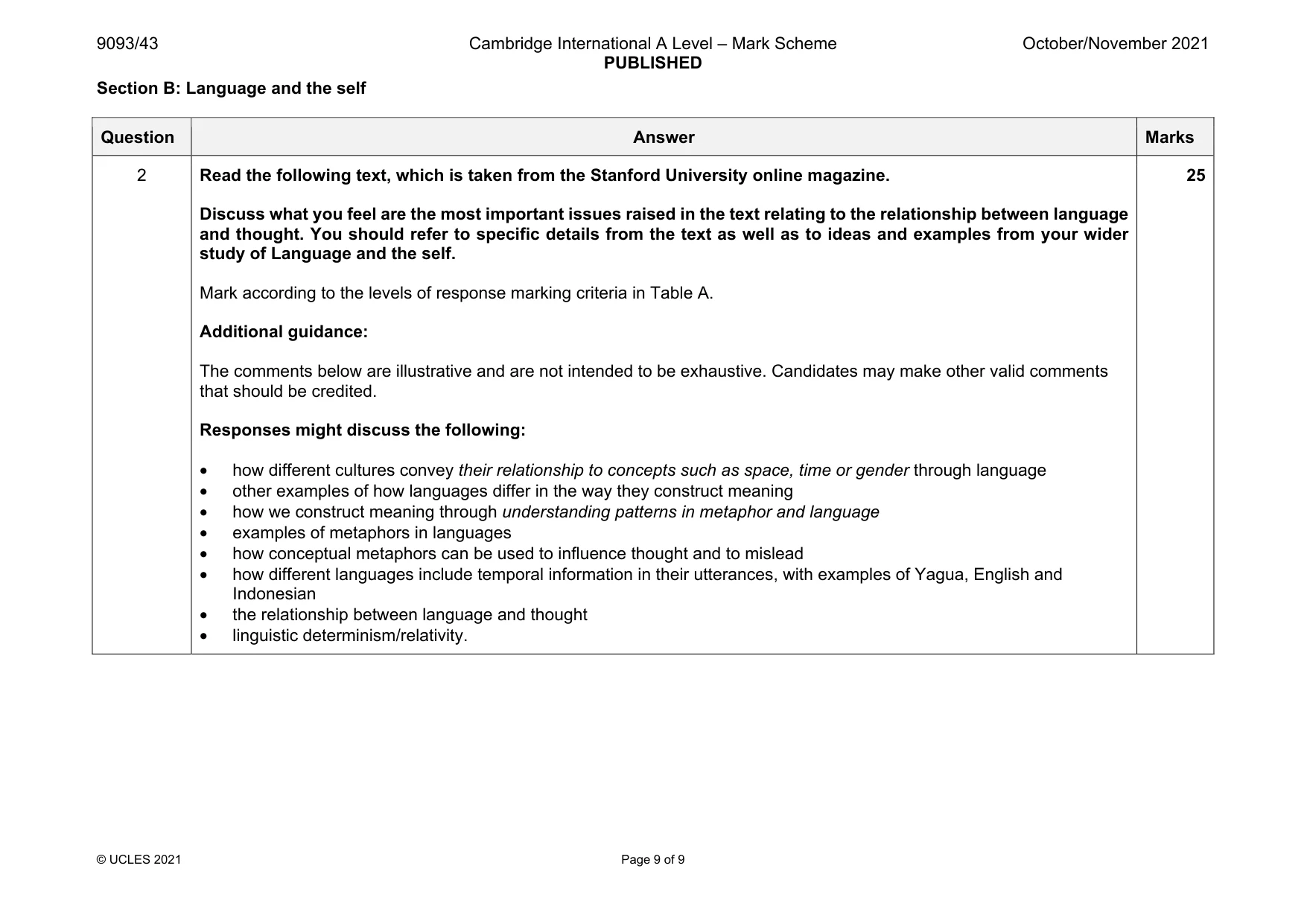
9093/43 Cambridge International A Level – Mark Scheme PUBLISHED October/November 2021 © UCLES 2021 Page 9 of 9 Section B: Language and the self Question Answer Marks 2 Read the following text, which is taken from the Stanford University online magazine. Discuss what you feel are the most important issues raised in the text relating to the relationship between language and thought. You should refer to specific details from the text as well as to ideas and examples from your wider study of Language and the self. Mark according to the levels of response marking criteria in Table A. Additional guidance: The comments below are illustrative and are not intended to be exhaustive. Candidates may make other valid comments that should be credited. Responses might discuss the following: • how different cultures convey their relationship to concepts such as space, time or gender through language • other examples of how languages differ in the way they construct meaning • how we construct meaning through understanding patterns in metaphor and language • examples of metaphors in languages • how conceptual metaphors can be used to influence thought and to mislead • how different languages include temporal information in their utterances, with examples of Yagua, English and Indonesian • the relationship between language and thought • linguistic determinism/relativity. 25
What you needed in this session
Cambridge’s own grade thresholds for 2021 Oct/Nov, Paper 4 · Variant 3. A higher threshold means an easier paper — the bar moves with how the cohort did.