Cambridge A Level English - Language AS and A Level (from 2014) 9093 — 2021 Oct/Nov Paper 1 · Variant 3
9093/13/O/N/21 · 50 marks · ≈56 min
The question paper and its mark scheme, free to read here and free to download. This is Cambridge’s own paper, exactly as it was sat.
Question paper8 pages


Mark scheme15 pages
Answers below. Sit the paper first if you are practising.
Paper as text
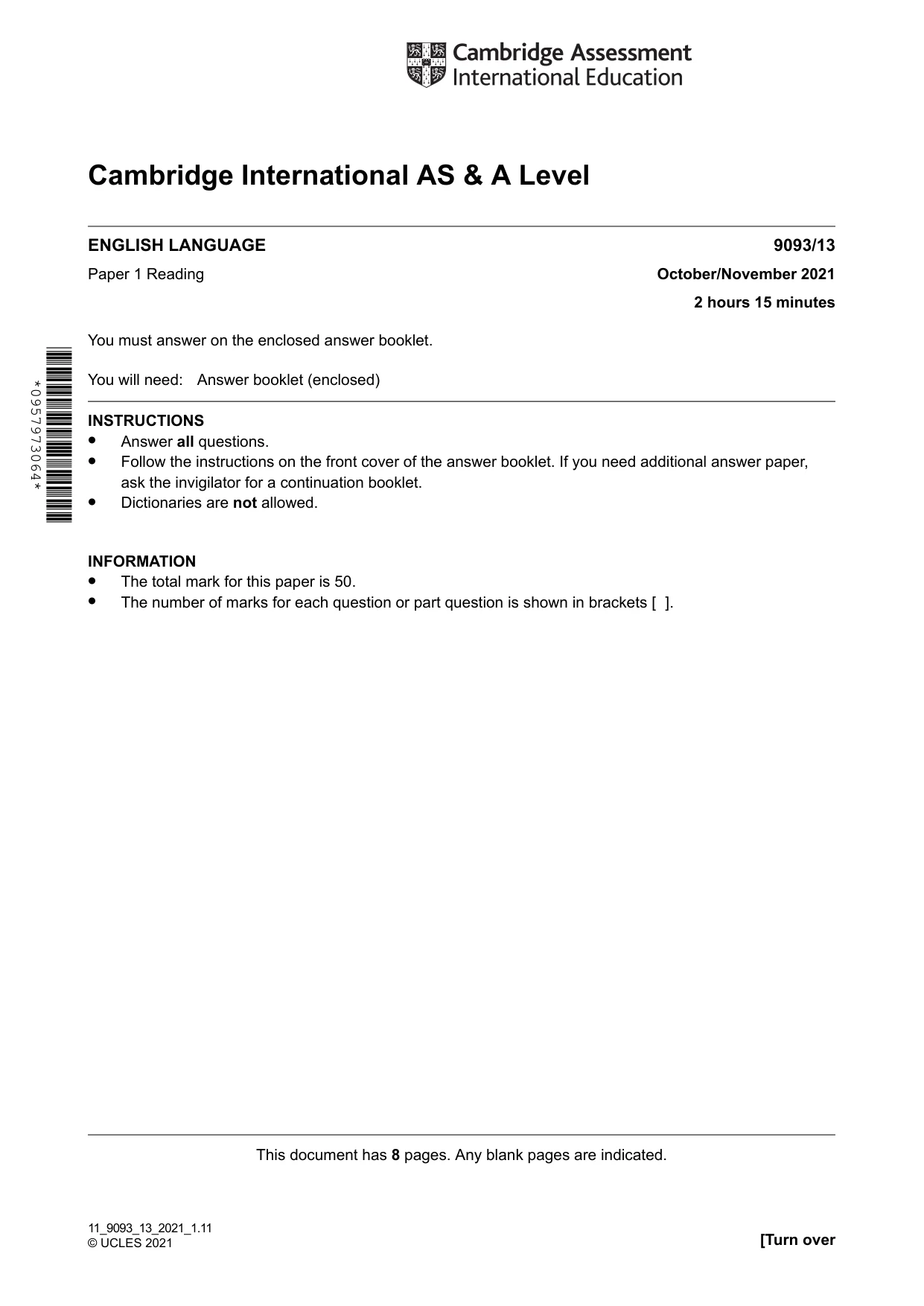
Question paper, page 1
Cambridge International AS & A Level 9093/13 ENGLISH LANGUAGE October/November 2021 Paper 1 Reading 2 hours 15 minutes You must answer on the enclosed answer booklet. You will need: Answer booklet (enclosed) INSTRUCTIONS • Answer all questions. • Follow the instructions on the front cover of the answer booklet. If you need additional answer paper, ask the invigilator for a continuation booklet. • Dictionaries are not allowed. INFORMATION • The total mark for this paper is 50. • The number of marks for each question or part question is shown in brackets [ ]. This document has 8 pages. Any blank pages are indicated. [Turn over 11_9093_13_2021_1.11 © UCLES 2021 *0957973064*
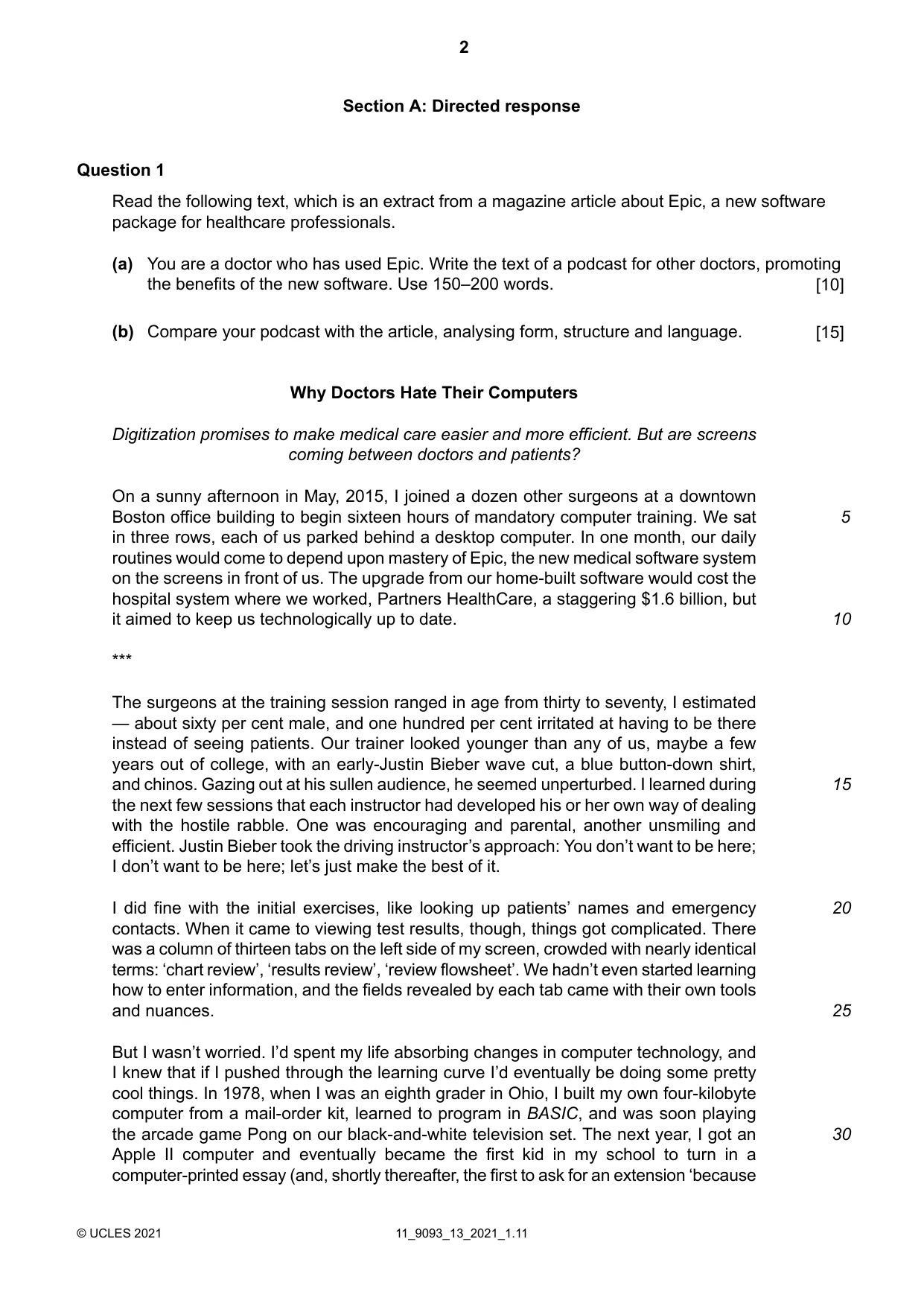
Question paper, page 2
30 25 20 15 10 5 Section A: Directed response Question 1 Read the following text, which is an extract from a magazine article about Epic, a new software package for healthcare professionals. You are a doctor who has used Epic. Write the text of a podcast for other doctors, promoting the benefits of the new software. Use 150–200 words. (a) [10] Compare your podcast with the article, analysing form, structure and language. (b) [15] Why Doctors Hate Their Computers Digitization promises to make medical care easier and more efficient. But are screens coming between doctors and patients? On a sunny afternoon in May, 2015, I joined a dozen other surgeons at a downtown Boston office building to begin sixteen hours of mandatory computer training. We sat in three rows, each of us parked behind a desktop computer. In one month, our daily routines would come to depend upon mastery of Epic, the new medical software system on the screens in front of us. The upgrade from our home-built software would cost the hospital system where we worked, Partners HealthCare, a staggering $1.6 billion, but it aimed to keep us technologically up to date. *** The surgeons at the training session ranged in age from thirty to seventy, I estimated — about sixty per cent male, and one hundred per cent irritated at having to be there instead of seeing patients. Our trainer looked younger than any of us, maybe a few years out of college, with an early-Justin Bieber wave cut, a blue button-down shirt, and chinos. Gazing out at his sullen audience, he seemed unperturbed. I learned during the next few sessions that each instructor had developed his or her own way of dealing with the hostile rabble. One was encouraging and parental, another unsmiling and efficient. Justin Bieber took the driving instructor’s approach: You don’t want to be here; I don’t want to be here; let’s just make the best of it. I did fine with the initial exercises, like looking up patients’ names and emergency contacts. When it came to viewing test results, though, things got complicated. There was a column of thirteen tabs on the left side of my screen, crowded with nearly identical terms: ‘chart review’, ‘results review’, ‘review flowsheet’. We hadn’t even started learning how to enter information, and the fields revealed by each tab came with their own tools and nuances. But I wasn’t worried. I’d spent my life absorbing changes in computer technology, and I knew that if I pushed through the learning curve I’d eventually be doing some pretty cool things. In 1978, when I was an eighth grader in Ohio, I built my own four-kilobyte computer from a mail-order kit, learned to program in BASIC, and was soon playing the arcade game Pong on our black-and-white television set. The next year, I got an Apple II computer and eventually became the first kid in my school to turn in a computer-printed essay (and, shortly thereafter, the first to ask for an extension ‘because 11_9093_13_2021_1.11 © UCLES 2021 2
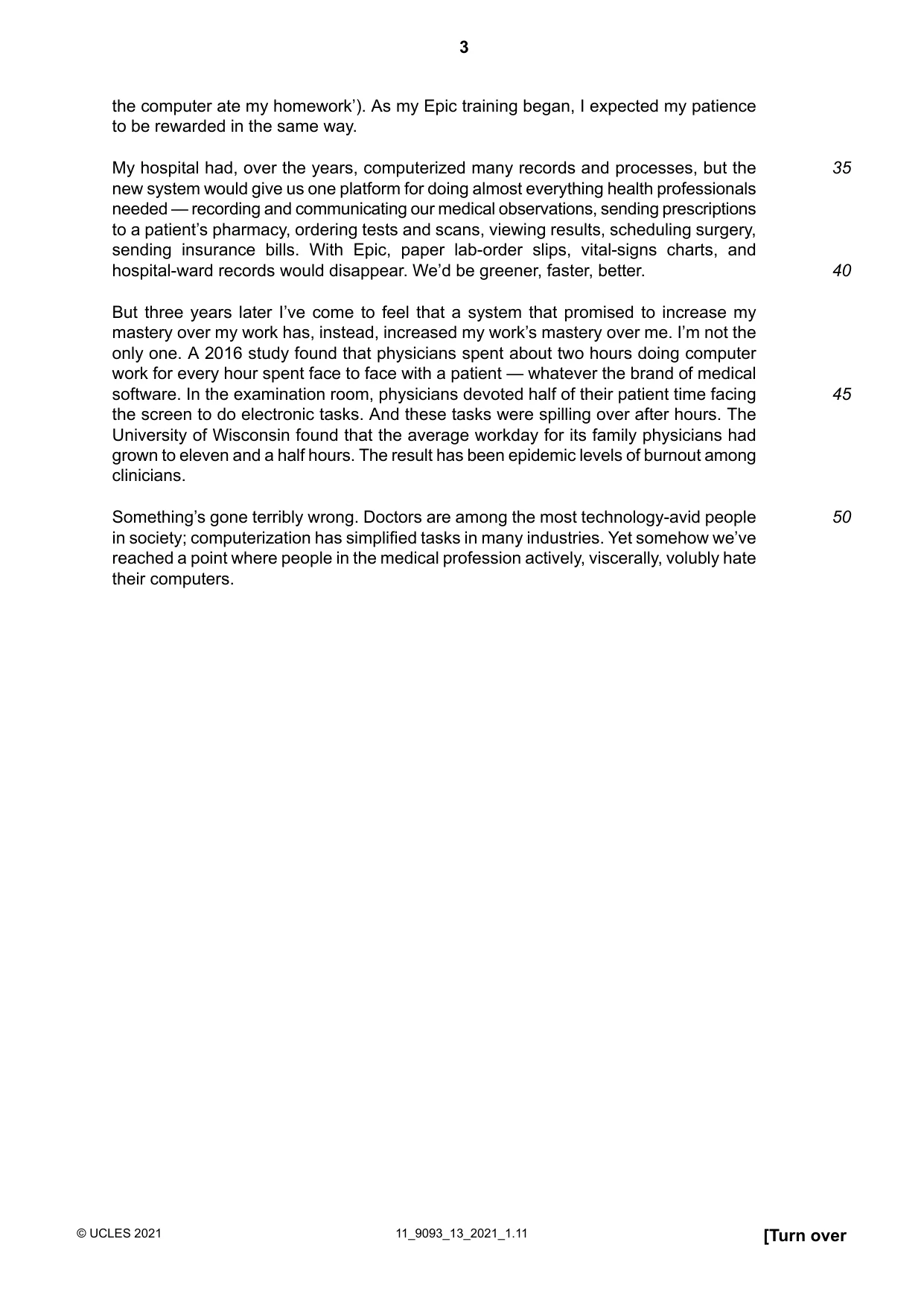
Question paper, page 3
50 45 40 35 the computer ate my homework’). As my Epic training began, I expected my patience to be rewarded in the same way. My hospital had, over the years, computerized many records and processes, but the new system would give us one platform for doing almost everything health professionals needed — recording and communicating our medical observations, sending prescriptions to a patient’s pharmacy, ordering tests and scans, viewing results, scheduling surgery, sending insurance bills. With Epic, paper lab-order slips, vital-signs charts, and hospital-ward records would disappear. We’d be greener, faster, better. But three years later I’ve come to feel that a system that promised to increase my mastery over my work has, instead, increased my work’s mastery over me. I’m not the only one. A 2016 study found that physicians spent about two hours doing computer work for every hour spent face to face with a patient — whatever the brand of medical software. In the examination room, physicians devoted half of their patient time facing the screen to do electronic tasks. And these tasks were spilling over after hours. The University of Wisconsin found that the average workday for its family physicians had grown to eleven and a half hours. The result has been epidemic levels of burnout among clinicians. Something’s gone terribly wrong. Doctors are among the most technology-avid people in society; computerization has simplified tasks in many industries. Yet somehow we’ve reached a point where people in the medical profession actively, viscerally, volubly hate their computers. [Turn over 11_9093_13_2021_1.11 © UCLES 2021 3
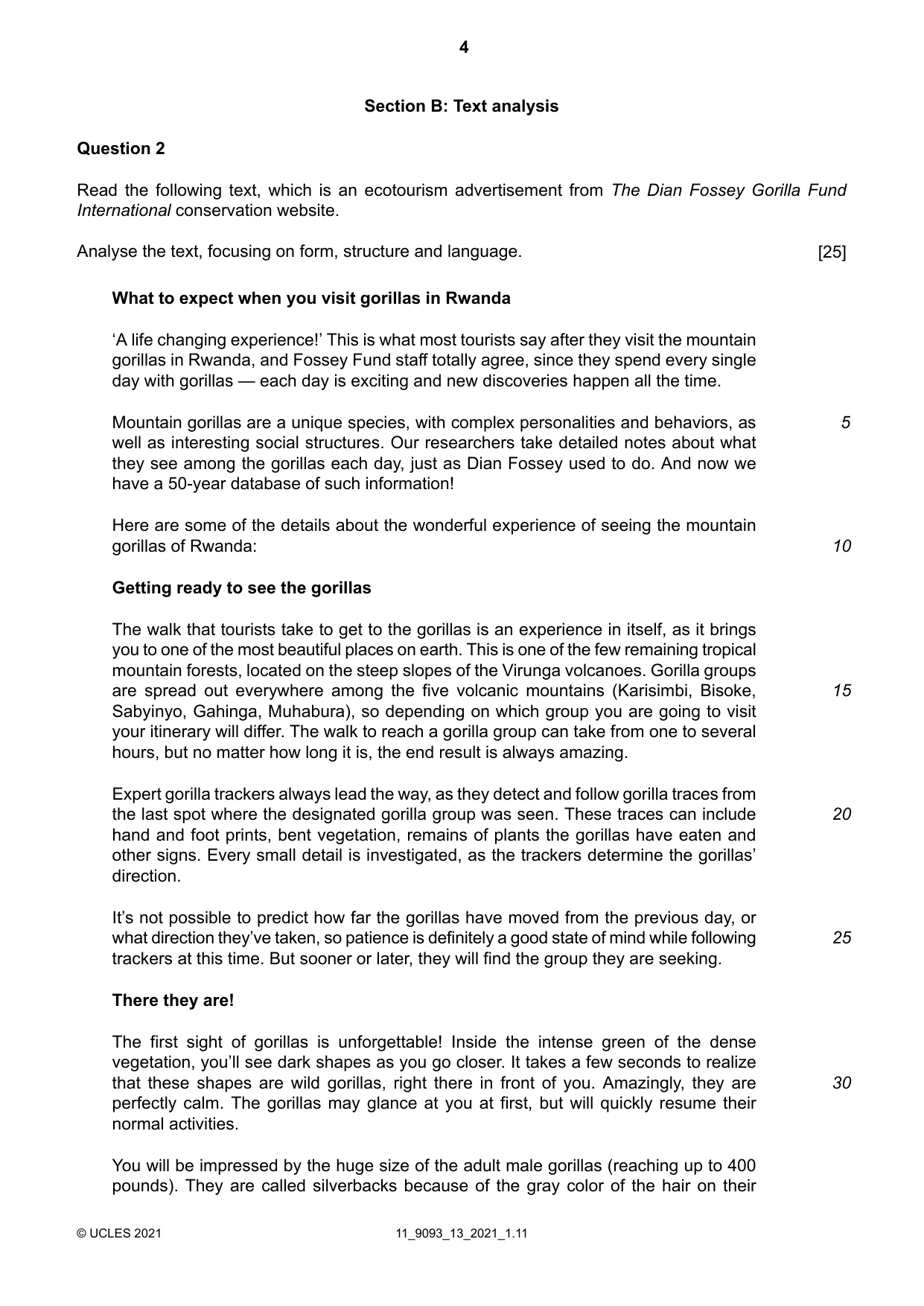
Question paper, page 4
30 25 20 15 10 5 Section B: Text analysis Question 2 Read the following text, which is an ecotourism advertisement from The Dian Fossey Gorilla Fund International conservation website. Analyse the text, focusing on form, structure and language. [25] What to expect when you visit gorillas in Rwanda ‘A life changing experience!’ This is what most tourists say after they visit the mountain gorillas in Rwanda, and Fossey Fund staff totally agree, since they spend every single day with gorillas — each day is exciting and new discoveries happen all the time. Mountain gorillas are a unique species, with complex personalities and behaviors, as well as interesting social structures. Our researchers take detailed notes about what they see among the gorillas each day, just as Dian Fossey used to do. And now we have a 50-year database of such information! Here are some of the details about the wonderful experience of seeing the mountain gorillas of Rwanda: Getting ready to see the gorillas The walk that tourists take to get to the gorillas is an experience in itself, as it brings you to one of the most beautiful places on earth. This is one of the few remaining tropical mountain forests, located on the steep slopes of the Virunga volcanoes. Gorilla groups are spread out everywhere among the five volcanic mountains (Karisimbi, Bisoke, Sabyinyo, Gahinga, Muhabura), so depending on which group you are going to visit your itinerary will differ. The walk to reach a gorilla group can take from one to several hours, but no matter how long it is, the end result is always amazing. Expert gorilla trackers always lead the way, as they detect and follow gorilla traces from the last spot where the designated gorilla group was seen. These traces can include hand and foot prints, bent vegetation, remains of plants the gorillas have eaten and other signs. Every small detail is investigated, as the trackers determine the gorillas’ direction. It’s not possible to predict how far the gorillas have moved from the previous day, or what direction they’ve taken, so patience is definitely a good state of mind while following trackers at this time. But sooner or later, they will find the group they are seeking. There they are! The first sight of gorillas is unforgettable! Inside the intense green of the dense vegetation, you’ll see dark shapes as you go closer. It takes a few seconds to realize that these shapes are wild gorillas, right there in front of you. Amazingly, they are perfectly calm. The gorillas may glance at you at first, but will quickly resume their normal activities. You will be impressed by the huge size of the adult male gorillas (reaching up to 400 pounds). They are called silverbacks because of the gray color of the hair on their 11_9093_13_2021_1.11 © UCLES 2021 4
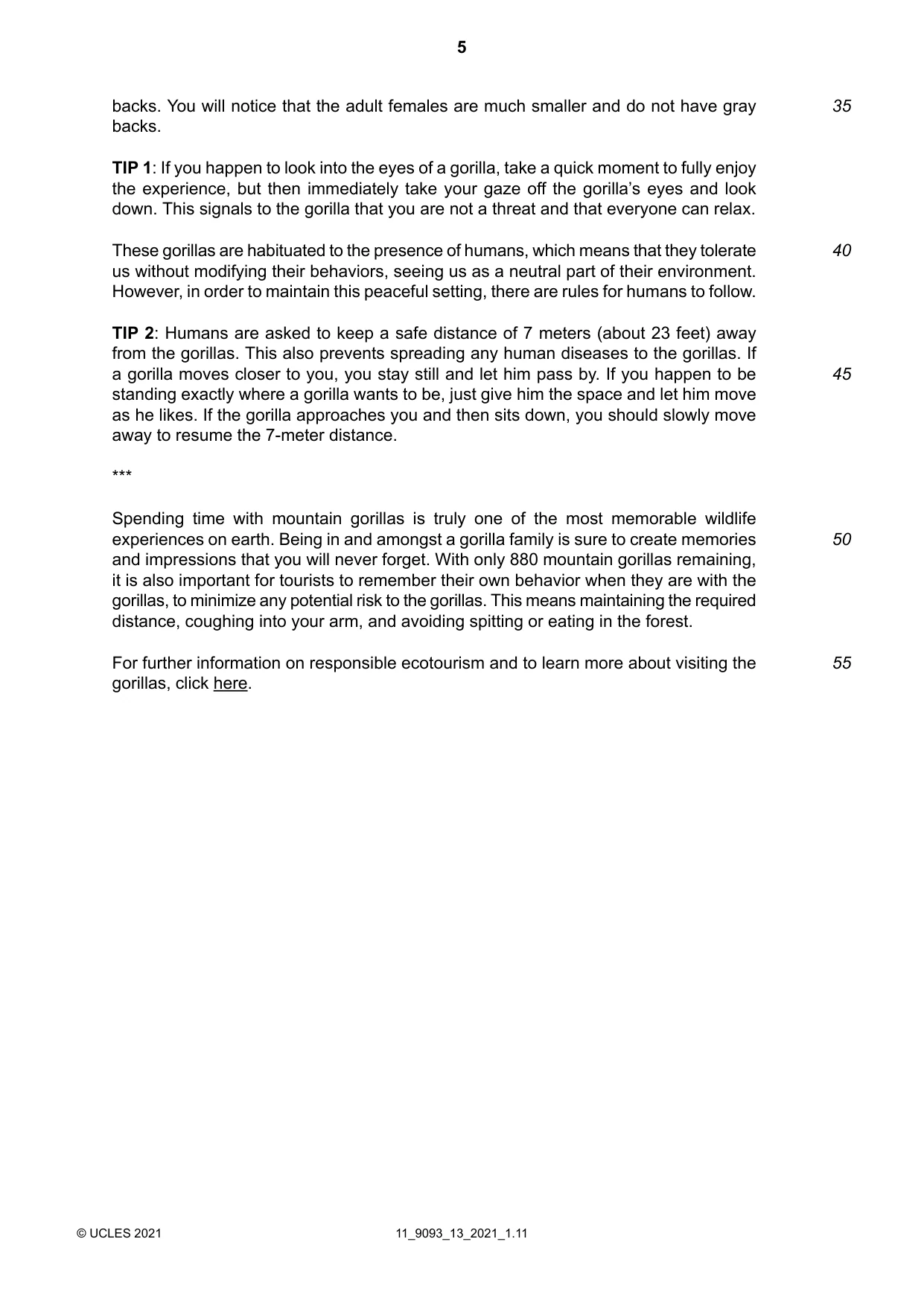
Question paper, page 5
55 50 45 40 35 backs. You will notice that the adult females are much smaller and do not have gray backs. TIP 1: If you happen to look into the eyes of a gorilla, take a quick moment to fully enjoy the experience, but then immediately take your gaze off the gorilla’s eyes and look down. This signals to the gorilla that you are not a threat and that everyone can relax. These gorillas are habituated to the presence of humans, which means that they tolerate us without modifying their behaviors, seeing us as a neutral part of their environment. However, in order to maintain this peaceful setting, there are rules for humans to follow. TIP 2: Humans are asked to keep a safe distance of 7 meters (about 23 feet) away from the gorillas. This also prevents spreading any human diseases to the gorillas. If a gorilla moves closer to you, you stay still and let him pass by. If you happen to be standing exactly where a gorilla wants to be, just give him the space and let him move as he likes. If the gorilla approaches you and then sits down, you should slowly move away to resume the 7-meter distance. *** Spending time with mountain gorillas is truly one of the most memorable wildlife experiences on earth. Being in and amongst a gorilla family is sure to create memories and impressions that you will never forget. With only 880 mountain gorillas remaining, it is also important for tourists to remember their own behavior when they are with the gorillas, to minimize any potential risk to the gorillas. This means maintaining the required distance, coughing into your arm, and avoiding spitting or eating in the forest. For further information on responsible ecotourism and to learn more about visiting the gorillas, click here. 11_9093_13_2021_1.11 © UCLES 2021 5
Question paper, page 6
BLANK PAGE 11_9093_13_2021_1.11 © UCLES 2021 6
Question paper, page 7
BLANK PAGE 11_9093_13_2021_1.11 © UCLES 2021 7
Question paper, page 8
BLANK PAGE Permission to reproduce items where third-party owned material protected by copyright is included has been sought and cleared where possible. Every reasonable effort has been made by the publisher (UCLES) to trace copyright holders, but if any items requiring clearance have unwittingly been included, the publisher will be pleased to make amends at the earliest possible opportunity. To avoid the issue of disclosure of answer-related information to candidates, all copyright acknowledgements are reproduced online in the Cambridge Assessment International Education Copyright Acknowledgements Booklet. This is produced for each series of examinations and is freely available to download at www.cambridgeinternational.org after the live examination series. Cambridge Assessment International Education is part of the Cambridge Assessment Group. Cambridge Assessment is the brand name of the University of Cambridge Local Examinations Syndicate (UCLES), which itself is a department of the University of Cambridge. 11_9093_13_2021_1.11 © UCLES 2021 8
Mark scheme, page 1
This document consists of 15 printed pages. © UCLES 2021 [Turn over Cambridge International AS & A Level ENGLISH LANGUAGE 9093/13 Paper 1 Reading October/November 2021 MARK SCHEME Maximum Mark: 50 Published This mark scheme is published as an aid to teachers and candidates, to indicate the requirements of the examination. It shows the basis on which Examiners were instructed to award marks. It does not indicate the details of the discussions that took place at an Examiners’ meeting before marking began, which would have considered the acceptability of alternative answers. Mark schemes should be read in conjunction with the question paper and the Principal Examiner Report for Teachers. Cambridge International will not enter into discussions about these mark schemes. Cambridge International is publishing the mark schemes for the October/November 2021 series for most Cambridge IGCSE™, Cambridge International A and AS Level components and some Cambridge O Level components.
Mark scheme, page 2
9093/13 Cambridge International AS & A Level – Mark Scheme PUBLISHED October/November 2021 © UCLES 2021 Page 2 of 15 Generic Marking Principles These general marking principles must be applied by all examiners when marking candidate answers. They should be applied alongside the specific content of the mark scheme or generic level descriptors for a question. Each question paper and mark scheme will also comply with these marking principles. GENERIC MARKING PRINCIPLE 1: Marks must be awarded in line with: • the specific content of the mark scheme or the generic level descriptors for the question • the specific skills defined in the mark scheme or in the generic level descriptors for the question • the standard of response required by a candidate as exemplified by the standardisation scripts. GENERIC MARKING PRINCIPLE 2: Marks awarded are always whole marks (not half marks, or other fractions). GENERIC MARKING PRINCIPLE 3: Marks must be awarded positively: • marks are awarded for correct/valid answers, as defined in the mark scheme. However, credit is given for valid answers which go beyond the scope of the syllabus and mark scheme, referring to your Team Leader as appropriate • marks are awarded when candidates clearly demonstrate what they know and can do • marks are not deducted for errors • marks are not deducted for omissions • answers should only be judged on the quality of spelling, punctuation and grammar when these features are specifically assessed by the question as indicated by the mark scheme. The meaning, however, should be unambiguous. GENERIC MARKING PRINCIPLE 4: Rules must be applied consistently, e.g. in situations where candidates have not followed instructions or in the application of generic level descriptors.
Mark scheme, page 3
9093/13 Cambridge International AS & A Level – Mark Scheme PUBLISHED October/November 2021 © UCLES 2021 Page 3 of 15 GENERIC MARKING PRINCIPLE 5: Marks should be awarded using the full range of marks defined in the mark scheme for the question (however; the use of the full mark range may be limited according to the quality of the candidate responses seen). GENERIC MARKING PRINCIPLE 6: Marks awarded are based solely on the requirements as defined in the mark scheme. Marks should not be awarded with grade thresholds or grade descriptors in mind.
Mark scheme, page 4
9093/13 Cambridge International AS & A Level – Mark Scheme PUBLISHED October/November 2021 © UCLES 2021 Page 4 of 15 English & Media subject specific general marking principles (To be read in conjunction with the Generic Marking Principles (and requiring further guidance on how to place marks within levels)) Components using level descriptors: • We use level descriptors as a guide to broad understanding of the qualities normally expected of, or typical of, work in a level. • Level descriptors are a means of general guidance, and should not be interpreted as hurdle statements. • Where indicative content notes are supplied for a question, these are not a prescription of required content, and must not be treated as such. Alternative correct points and unexpected answers in candidates’ scripts must be given marks that fairly reflect the knowledge and skills demonstrated. • While we may have legitimate expectations as to the ground most answers may occupy, we must at all times be prepared to meet candidates on their chosen ground, provided it is relevant ground (e.g. clearly related to and derived from a relevant passage/text and meeting the mark scheme requirements for the question).
Mark scheme, page 5
9093/13 Cambridge International AS & A Level – Mark Scheme PUBLISHED October/November 2021 © UCLES 2021 Page 5 of 15 English Language specific marking instructions: AO1 Read and demonstrate understanding of a wide variety of texts. (Understanding) • Marks should be awarded for the accuracy of the candidate’s understanding of the text and its features, not for any analysis of them which is recognised under AO3. • Where comparison is required, marks should be awarded for the candidate’s recognition of similarities and differences between the texts and their features, not for any consequent analysis. • When awarding a ‘best-fit’ mark within a Level for each AO, consider each bullet point equally. AO2 Write effectively, creatively, accurately and appropriately, for a range of audiences and purposes. (Writing) • Marks should be awarded equally on the basis of the level of the candidate’s written expression (range of features used and accuracy) and the development of their writing (its organisation and relevance to task and audience). • When awarding a ‘best-fit’ mark within a Level for each AO, consider each bullet point equally. AO3: Analyse the ways in which writers’ and speakers’ choices of form, structure and language produce meaning and style. (Analysis) • Marks should be awarded equally on the basis of the level of the candidate’s analysis of the text’s elements (form, structure and language) and of the writer’s stylistic choices (including how style relates to audience and shapes meaning). • When awarding a ‘best-fit’ mark within a Level for each AO, consider each bullet point equally. In response to Question 1(a), candidates are required to write between 150 and 200 words. While there is no direct penalty for failing to adhere to this requirement, examiners should consider this an aspect of the response’s ‘relevance to purpose’. As such, adherence to the word limit is assessed as part of the second bullet point of AO2.
Mark scheme, page 6
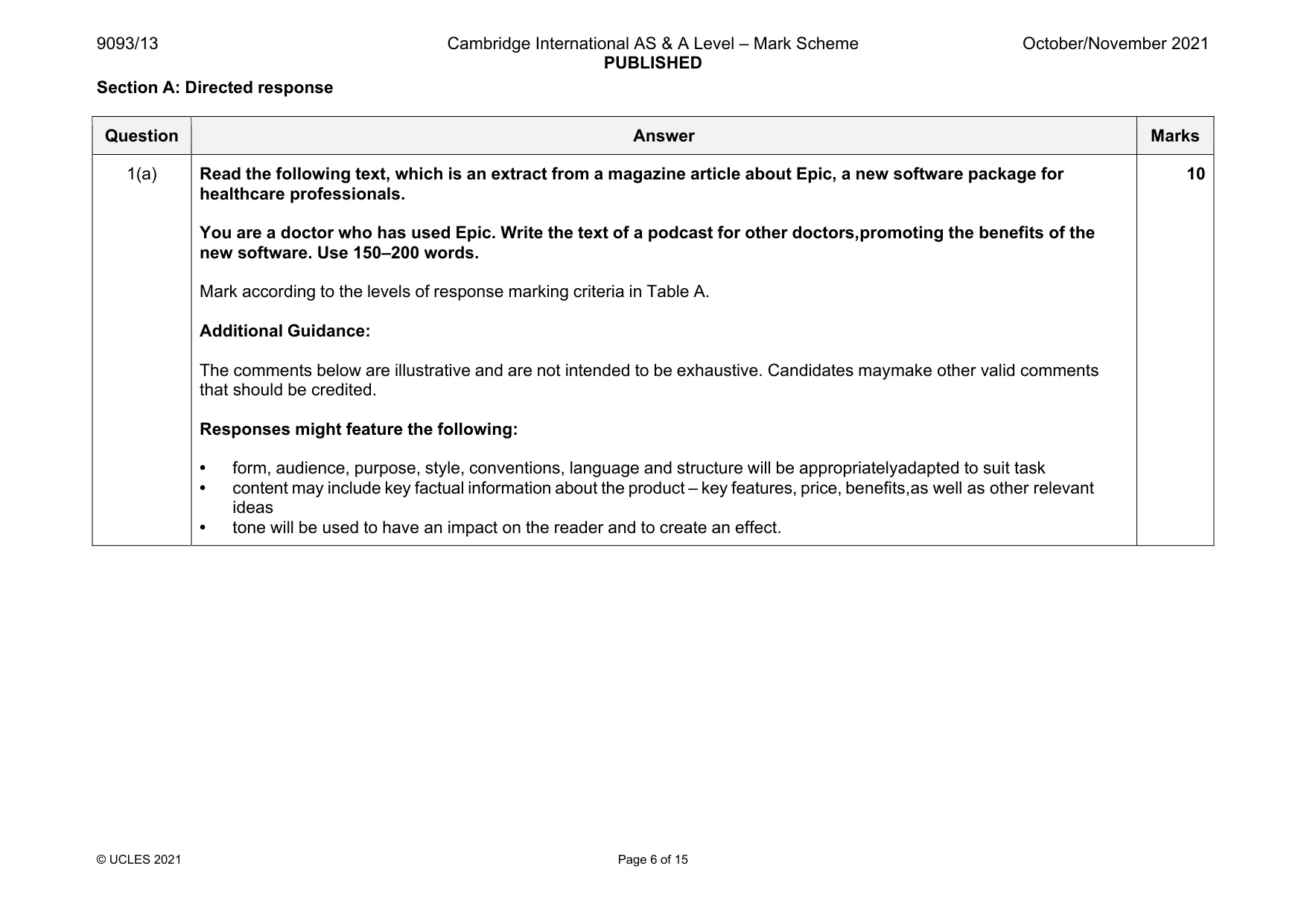
9093/13 Cambridge International AS & A Level – Mark Scheme PUBLISHED October/November 2021 © UCLES 2021 Page 6 of 15 Section A: Directed response Question Answer Marks 1(a) Read the following text, which is an extract from a magazine article about Epic, a new software package for healthcare professionals. You are a doctor who has used Epic. Write the text of a podcast for other doctors, promoting the benefits of the new software. Use 150–200 words. Mark according to the levels of response marking criteria in Table A. Additional Guidance: The comments below are illustrative and are not intended to be exhaustive. Candidates may make other valid comments that should be credited. Responses might feature the following: • form, audience, purpose, style, conventions, language and structure will be appropriately adapted to suit task • content may include key factual information about the product – key features, price, benefits, as well as other relevant ideas • tone will be used to have an impact on the reader and to create an effect. 10
Mark scheme, page 7
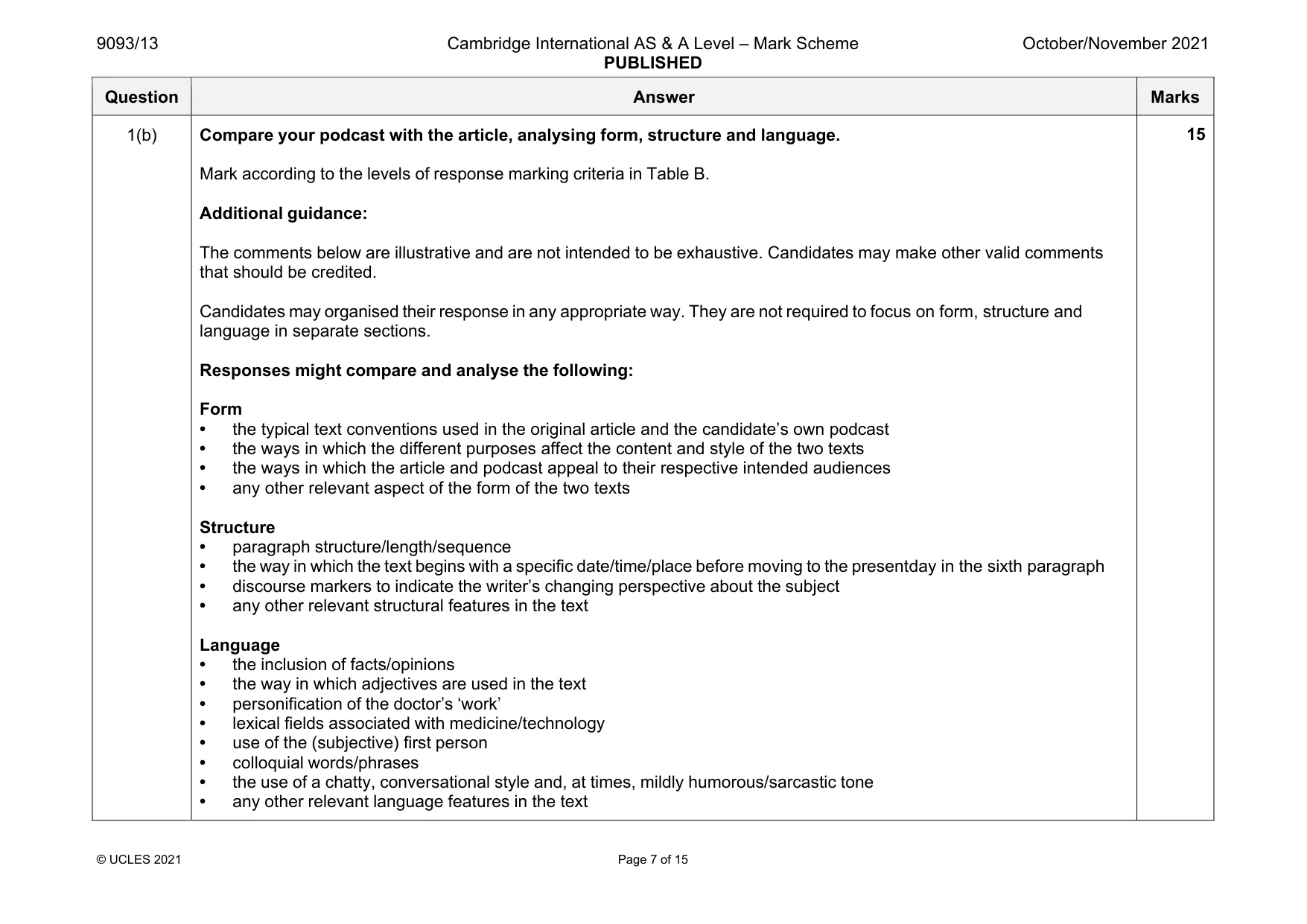
9093/13 Cambridge International AS & A Level – Mark Scheme PUBLISHED October/November 2021 © UCLES 2021 Page 7 of 15 Question Answer Marks 1(b) Compare your podcast with the article, analysing form, structure and language. Mark according to the levels of response marking criteria in Table B. Additional guidance: The comments below are illustrative and are not intended to be exhaustive. Candidates may make other valid comments that should be credited. Candidates may organised their response in any appropriate way. They are not required to focus on form, structure and language in separate sections. Responses might compare and analyse the following: Form • the typical text conventions used in the original article and the candidate’s own podcast • the ways in which the different purposes affect the content and style of the two texts • the ways in which the article and podcast appeal to their respective intended audiences • any other relevant aspect of the form of the two texts Structure • paragraph structure/length/sequence • the way in which the text begins with a specific date/time/place before moving to the present day in the sixth paragraph • discourse markers to indicate the writer’s changing perspective about the subject • any other relevant structural features in the text Language • the inclusion of facts/opinions • the way in which adjectives are used in the text • personification of the doctor’s ‘work’ • lexical fields associated with medicine/technology • use of the (subjective) first person • colloquial words/phrases • the use of a chatty, conversational style and, at times, mildly humorous/sarcastic tone • any other relevant language features in the text 15
Mark scheme, page 8
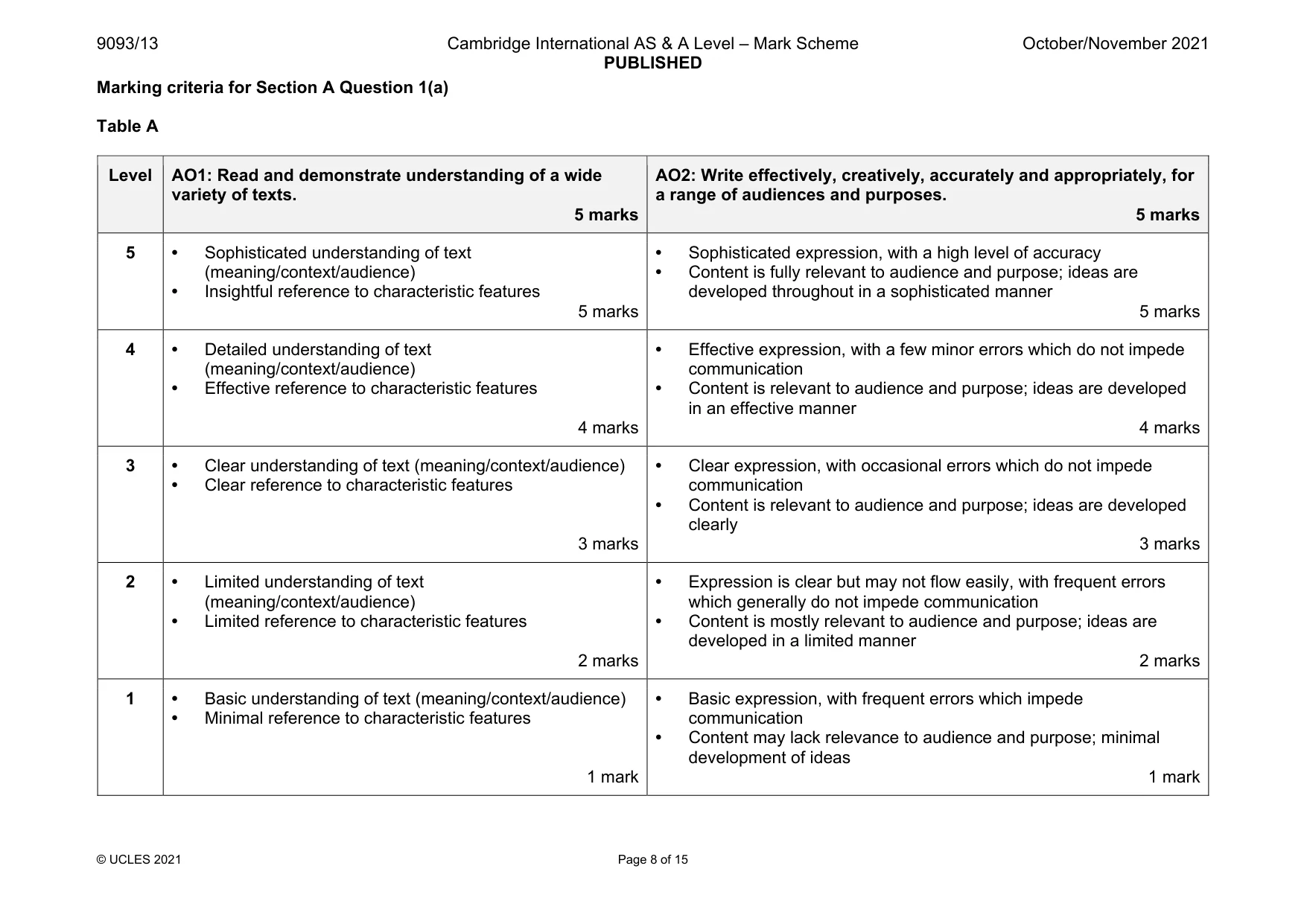
9093/13 Cambridge International AS & A Level – Mark Scheme PUBLISHED October/November 2021 © UCLES 2021 Page 8 of 15 Marking criteria for Section A Question 1(a) Table A Level AO1: Read and demonstrate understanding of a wide variety of texts. 5 marks AO2: Write effectively, creatively, accurately and appropriately, for a range of audiences and purposes. 5 marks 5 • Sophisticated understanding of text (meaning/context/audience) • Insightful reference to characteristic features 5 marks • Sophisticated expression, with a high level of accuracy • Content is fully relevant to audience and purpose; ideas are developed throughout in a sophisticated manner 5 marks 4 • Detailed understanding of text (meaning/context/audience) • Effective reference to characteristic features 4 marks • Effective expression, with a few minor errors which do not impede communication • Content is relevant to audience and purpose; ideas are developed in an effective manner 4 marks 3 • Clear understanding of text (meaning/context/audience) • Clear reference to characteristic features 3 marks • Clear expression, with occasional errors which do not impede communication • Content is relevant to audience and purpose; ideas are developed clearly 3 marks 2 • Limited understanding of text (meaning/context/audience) • Limited reference to characteristic features 2 marks • Expression is clear but may not flow easily, with frequent errors which generally do not impede communication • Content is mostly relevant to audience and purpose; ideas are developed in a limited manner 2 marks 1 • Basic understanding of text (meaning/context/audience) • Minimal reference to characteristic features 1 mark • Basic expression, with frequent errors which impede communication • Content may lack relevance to audience and purpose; minimal development of ideas 1 mark
Mark scheme, page 9
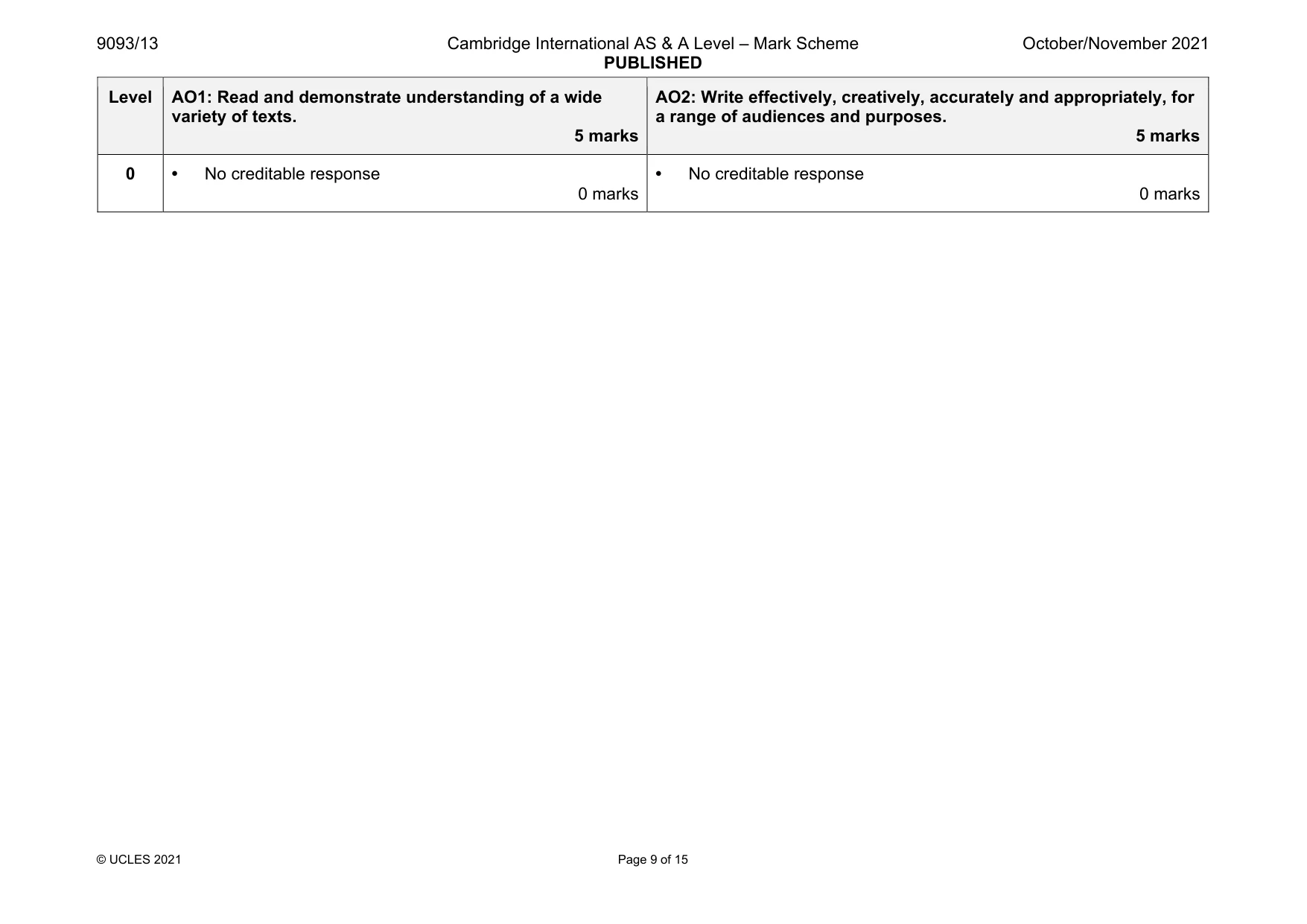
9093/13 Cambridge International AS & A Level – Mark Scheme PUBLISHED October/November 2021 © UCLES 2021 Page 9 of 15 Level AO1: Read and demonstrate understanding of a wide variety of texts. 5 marks AO2: Write effectively, creatively, accurately and appropriately, for a range of audiences and purposes. 5 marks 0 • No creditable response 0 marks • No creditable response 0 marks
Mark scheme, page 10
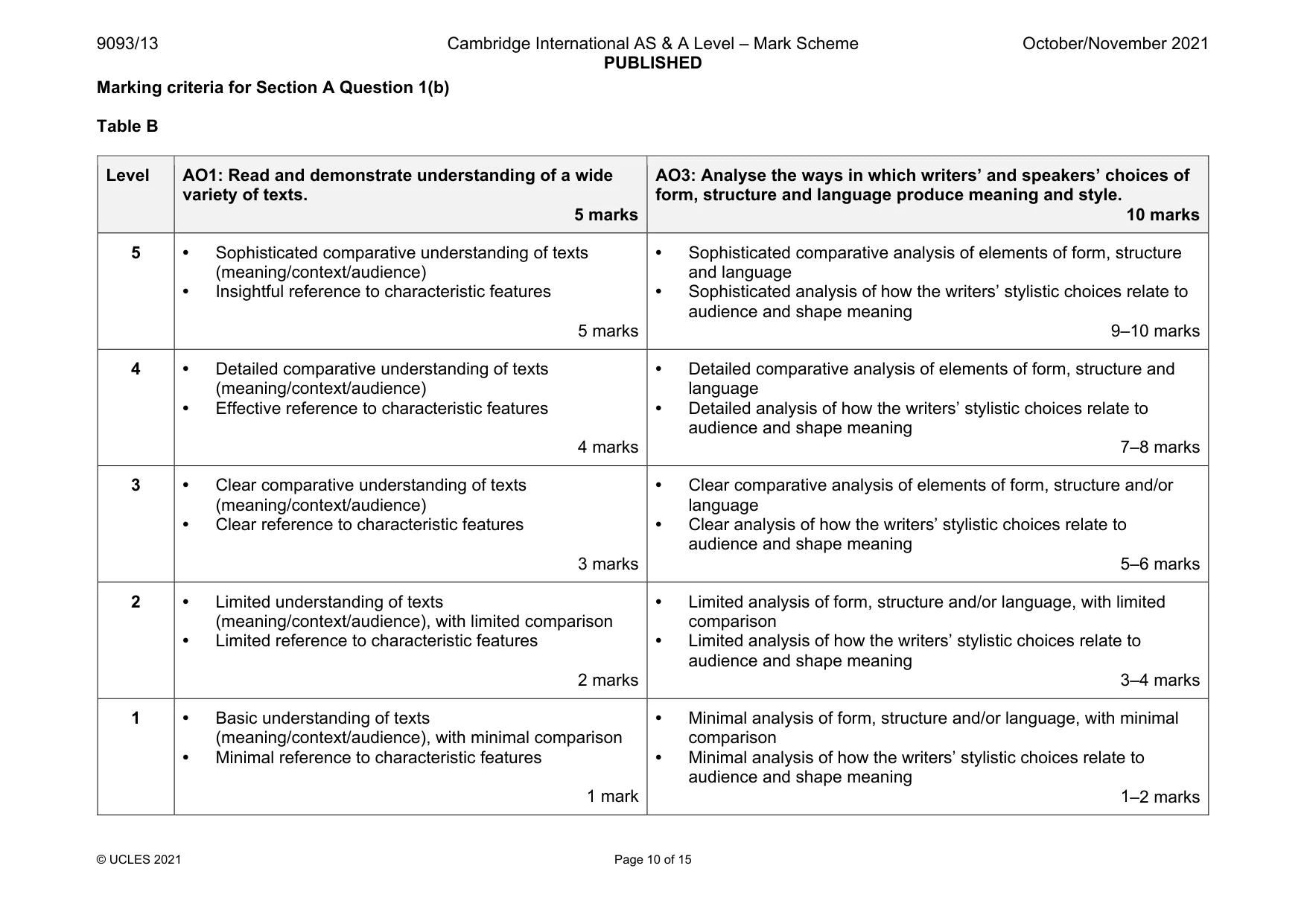
9093/13 Cambridge International AS & A Level – Mark Scheme PUBLISHED October/November 2021 © UCLES 2021 Page 10 of 15 Marking criteria for Section A Question 1(b) Table B Level AO1: Read and demonstrate understanding of a wide variety of texts. 5 marks AO3: Analyse the ways in which writers’ and speakers’ choices of form, structure and language produce meaning and style. 10 marks 5 • Sophisticated comparative understanding of texts (meaning/context/audience) • Insightful reference to characteristic features 5 marks • Sophisticated comparative analysis of elements of form, structure and language • Sophisticated analysis of how the writers’ stylistic choices relate to audience and shape meaning 9–10 marks 4 • Detailed comparative understanding of texts (meaning/context/audience) • Effective reference to characteristic features 4 marks • Detailed comparative analysis of elements of form, structure and language • Detailed analysis of how the writers’ stylistic choices relate to audience and shape meaning 7–8 marks 3 • Clear comparative understanding of texts (meaning/context/audience) • Clear reference to characteristic features 3 marks • Clear comparative analysis of elements of form, structure and/or language • Clear analysis of how the writers’ stylistic choices relate to audience and shape meaning 5–6 marks 2 • Limited understanding of texts (meaning/context/audience), with limited comparison • Limited reference to characteristic features 2 marks • Limited analysis of form, structure and/or language, with limited comparison • Limited analysis of how the writers’ stylistic choices relate to audience and shape meaning 3–4 marks 1 • Basic understanding of texts (meaning/context/audience), with minimal comparison • Minimal reference to characteristic features 1 mark • Minimal analysis of form, structure and/or language, with minimal comparison • Minimal analysis of how the writers’ stylistic choices relate to audience and shape meaning 1–2 marks
Mark scheme, page 11
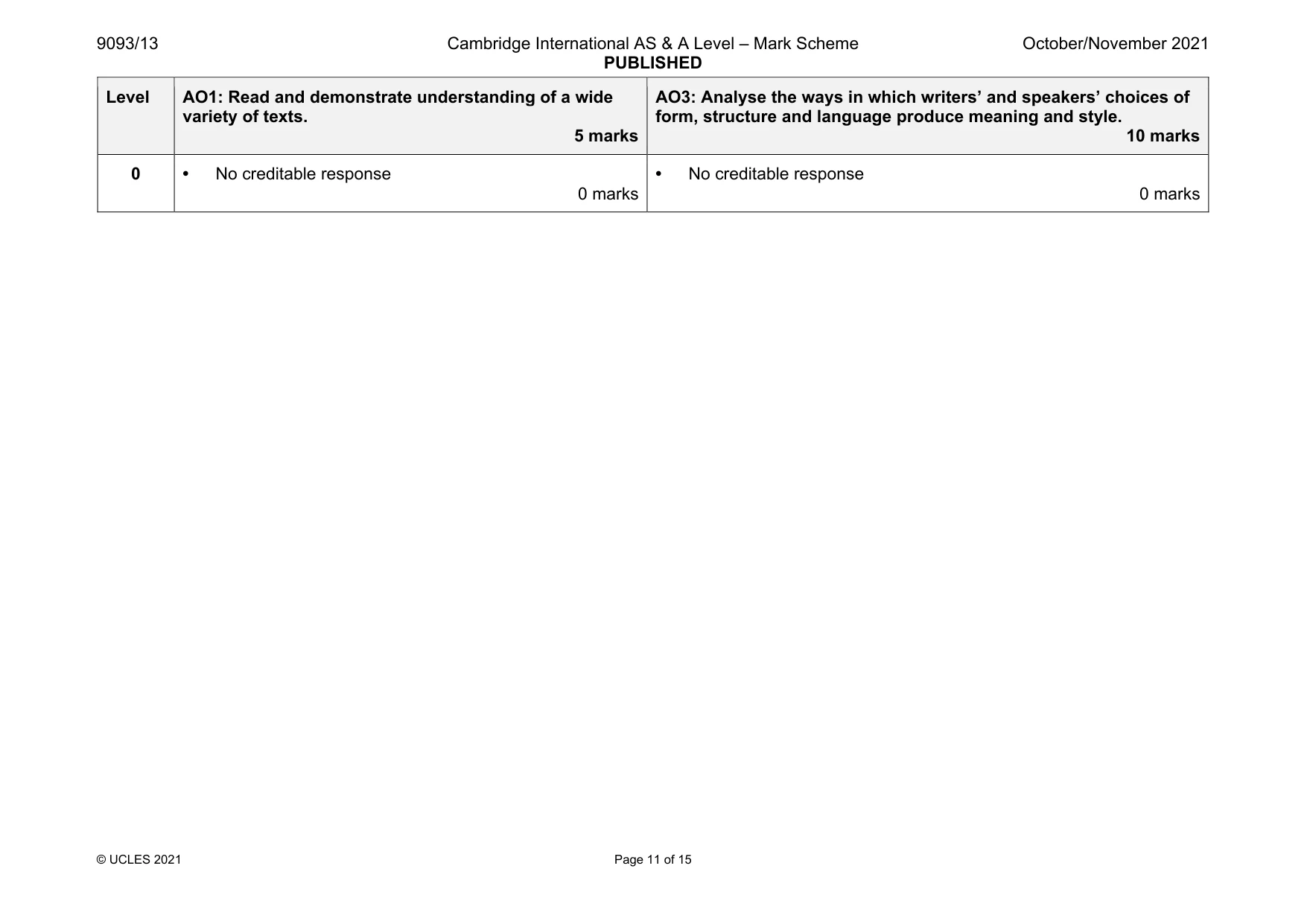
9093/13 Cambridge International AS & A Level – Mark Scheme PUBLISHED October/November 2021 © UCLES 2021 Page 11 of 15 Level AO1: Read and demonstrate understanding of a wide variety of texts. 5 marks AO3: Analyse the ways in which writers’ and speakers’ choices of form, structure and language produce meaning and style. 10 marks 0 • No creditable response 0 marks • No creditable response 0 marks
Mark scheme, page 12
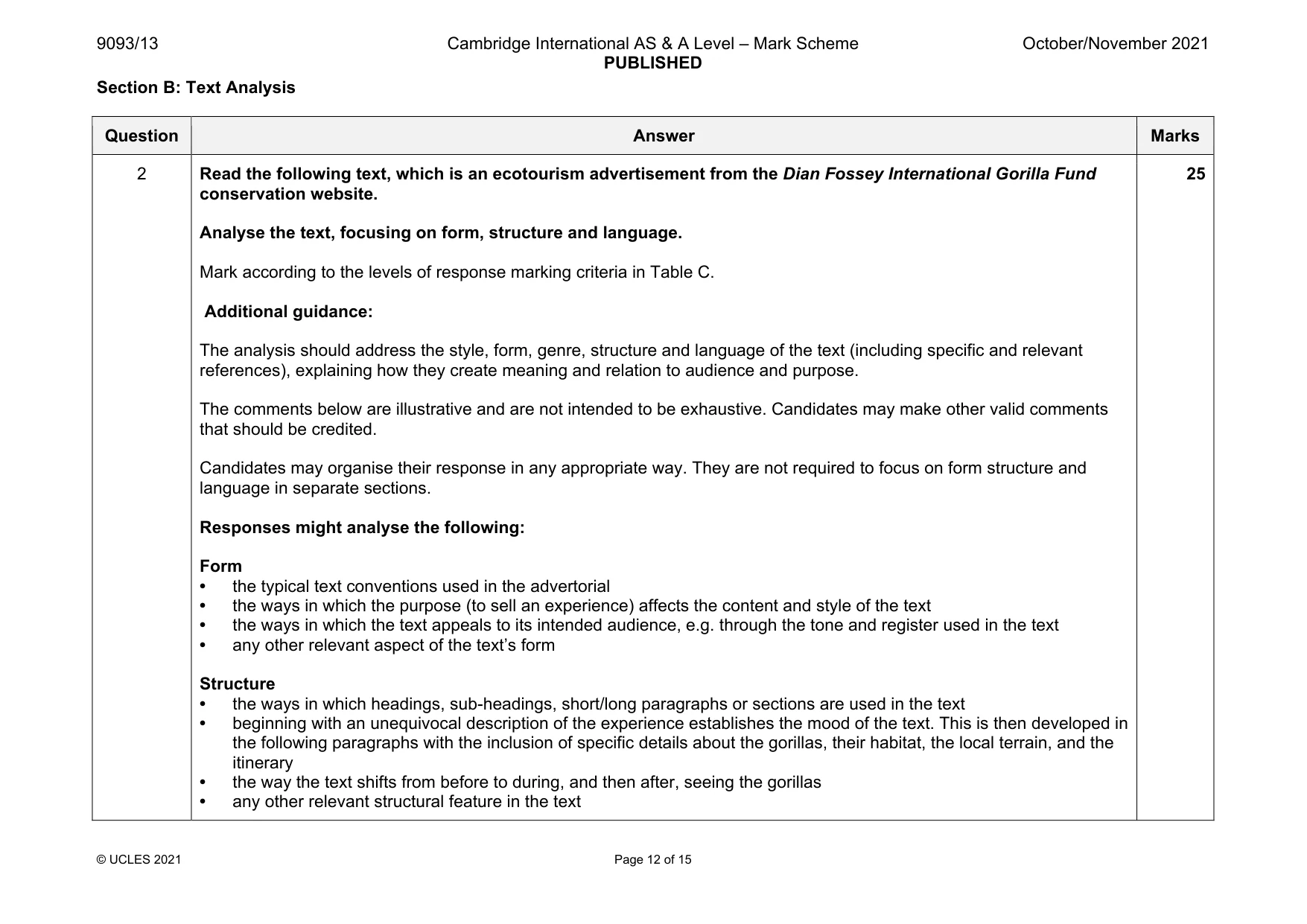
9093/13 Cambridge International AS & A Level – Mark Scheme PUBLISHED October/November 2021 © UCLES 2021 Page 12 of 15 Section B: Text Analysis Question Answer Marks 2 Read the following text, which is an ecotourism advertisement from the Dian Fossey International Gorilla Fund conservation website. Analyse the text, focusing on form, structure and language. Mark according to the levels of response marking criteria in Table C. Additional guidance: The analysis should address the style, form, genre, structure and language of the text (including specific and relevant references), explaining how they create meaning and relation to audience and purpose. The comments below are illustrative and are not intended to be exhaustive. Candidates may make other valid comments that should be credited. Candidates may organise their response in any appropriate way. They are not required to focus on form structure and language in separate sections. Responses might analyse the following: Form • the typical text conventions used in the advertorial • the ways in which the purpose (to sell an experience) affects the content and style of the text • the ways in which the text appeals to its intended audience, e.g. through the tone and register used in the text • any other relevant aspect of the text’s form Structure • the ways in which headings, sub-headings, short/long paragraphs or sections are used in the text • beginning with an unequivocal description of the experience establishes the mood of the text. This is then developed in the following paragraphs with the inclusion of specific details about the gorillas, their habitat, the local terrain, and the itinerary • the way the text shifts from before to during, and then after, seeing the gorillas • any other relevant structural feature in the text 25
Mark scheme, page 13
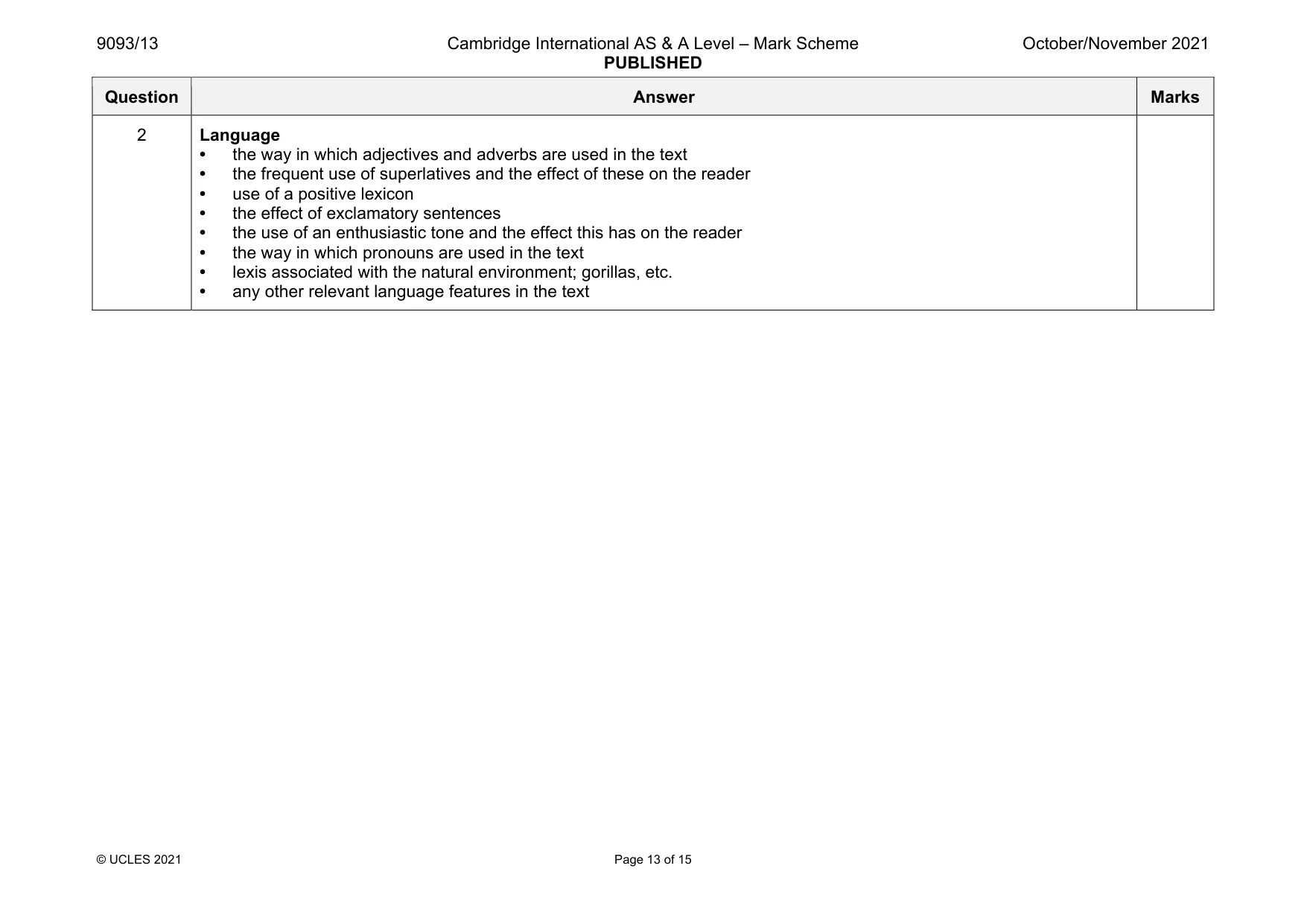
9093/13 Cambridge International AS & A Level – Mark Scheme PUBLISHED October/November 2021 © UCLES 2021 Page 13 of 15 Question Answer Marks 2 Language • the way in which adjectives and adverbs are used in the text • the frequent use of superlatives and the effect of these on the reader • use of a positive lexicon • the effect of exclamatory sentences • the use of an enthusiastic tone and the effect this has on the reader • the way in which pronouns are used in the text • lexis associated with the natural environment; gorillas, etc. • any other relevant language features in the text
Mark scheme, page 14
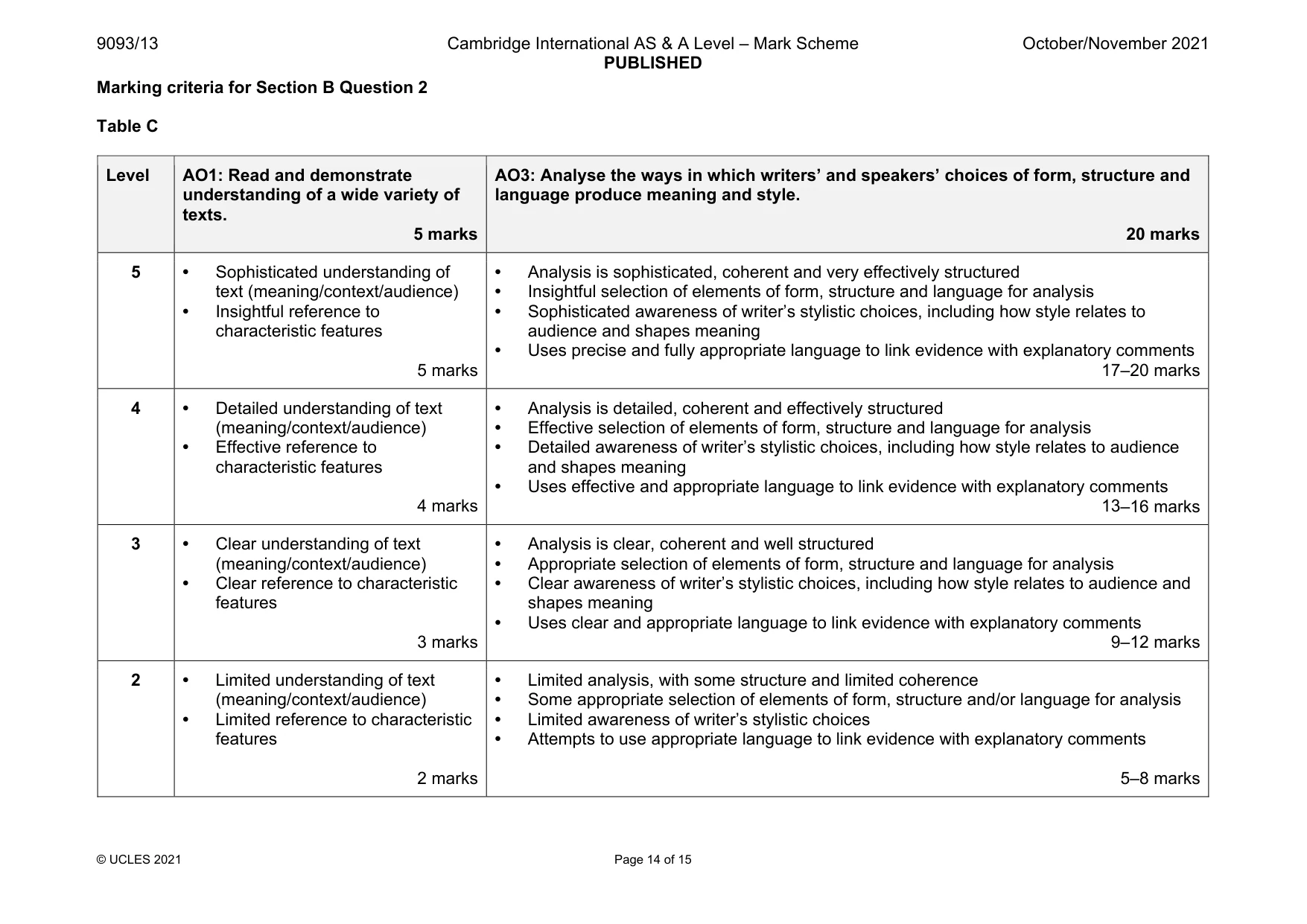
9093/13 Cambridge International AS & A Level – Mark Scheme PUBLISHED October/November 2021 © UCLES 2021 Page 14 of 15 Marking criteria for Section B Question 2 Table C Level AO1: Read and demonstrate understanding of a wide variety of texts. 5 marks AO3: Analyse the ways in which writers’ and speakers’ choices of form, structure and language produce meaning and style. 20 marks 5 • Sophisticated understanding of text (meaning/context/audience) • Insightful reference to characteristic features 5 marks • Analysis is sophisticated, coherent and very effectively structured • Insightful selection of elements of form, structure and language for analysis • Sophisticated awareness of writer’s stylistic choices, including how style relates to audience and shapes meaning • Uses precise and fully appropriate language to link evidence with explanatory comments 17–20 marks 4 • Detailed understanding of text (meaning/context/audience) • Effective reference to characteristic features 4 marks • Analysis is detailed, coherent and effectively structured • Effective selection of elements of form, structure and language for analysis • Detailed awareness of writer’s stylistic choices, including how style relates to audience and shapes meaning • Uses effective and appropriate language to link evidence with explanatory comments 13–16 marks 3 • Clear understanding of text (meaning/context/audience) • Clear reference to characteristic features 3 marks • Analysis is clear, coherent and well structured • Appropriate selection of elements of form, structure and language for analysis • Clear awareness of writer’s stylistic choices, including how style relates to audience and shapes meaning • Uses clear and appropriate language to link evidence with explanatory comments 9–12 marks 2 • Limited understanding of text (meaning/context/audience) • Limited reference to characteristic features 2 marks • Limited analysis, with some structure and limited coherence • Some appropriate selection of elements of form, structure and/or language for analysis • Limited awareness of writer’s stylistic choices • Attempts to use appropriate language to link evidence with explanatory comments 5–8 marks
Mark scheme, page 15
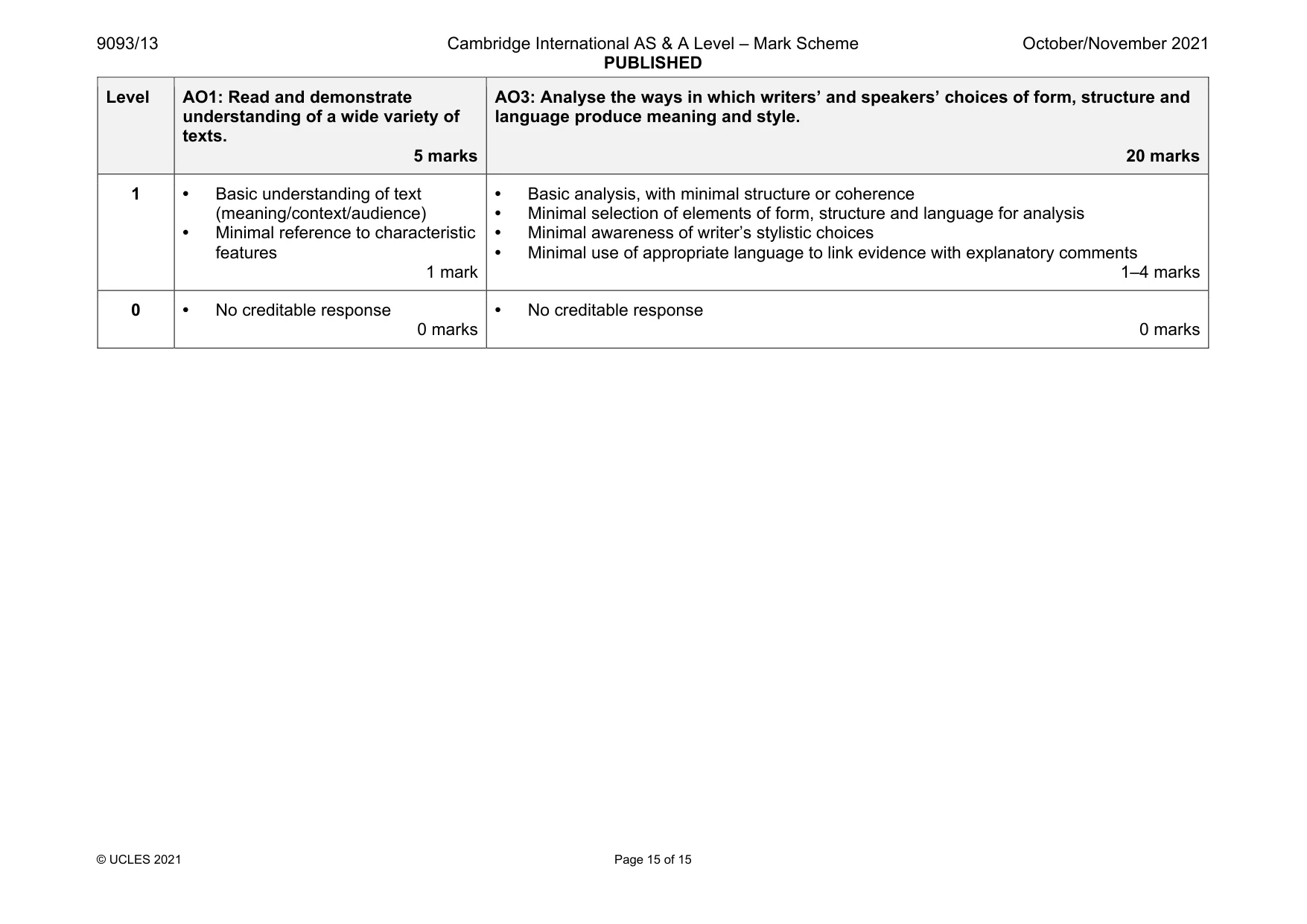
9093/13 Cambridge International AS & A Level – Mark Scheme PUBLISHED October/November 2021 © UCLES 2021 Page 15 of 15 Level AO1: Read and demonstrate understanding of a wide variety of texts. 5 marks AO3: Analyse the ways in which writers’ and speakers’ choices of form, structure and language produce meaning and style. 20 marks 1 • Basic understanding of text (meaning/context/audience) • Minimal reference to characteristic features 1 mark • Basic analysis, with minimal structure or coherence • Minimal selection of elements of form, structure and language for analysis • Minimal awareness of writer’s stylistic choices • Minimal use of appropriate language to link evidence with explanatory comments 1–4 marks 0 • No creditable response 0 marks • No creditable response 0 marks
What you needed in this session
Cambridge’s own grade thresholds for 2021 Oct/Nov, Paper 1 · Variant 3. A higher threshold means an easier paper — the bar moves with how the cohort did.