Cambridge A Level English - Language AS and A Level (from 2014) 9093 — 2021 Oct/Nov Paper 1 · Variant 1
9093/11/O/N/21 · 50 marks · ≈56 min
The question paper and its mark scheme, free to read here and free to download. This is Cambridge’s own paper, exactly as it was sat.
Question paper8 pages
Mark scheme15 pages
Answers below. Sit the paper first if you are practising.
Paper as text
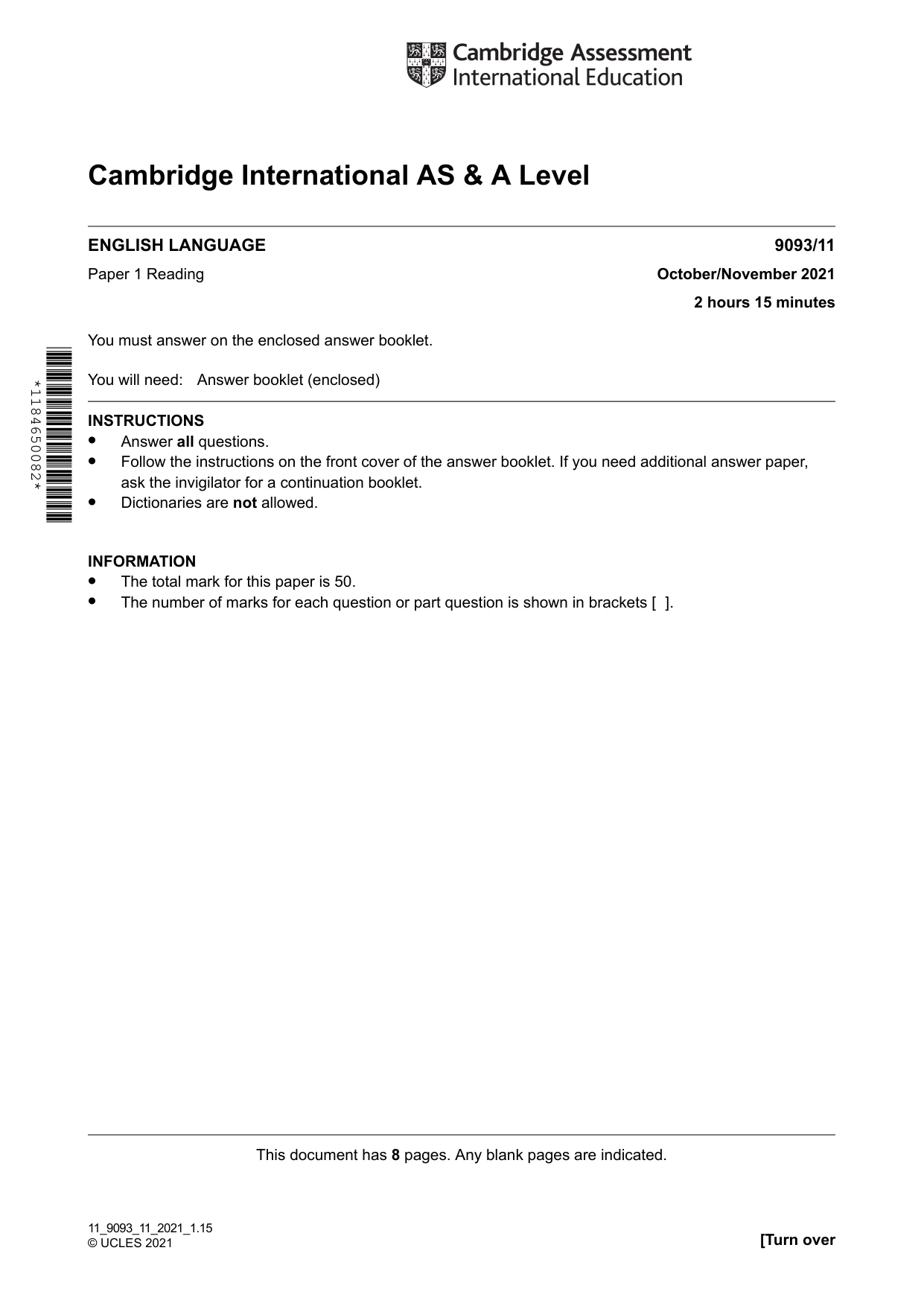
Question paper, page 1
Cambridge International AS & A Level 9093/11 October/November 2021 2 hours 15 minutes ENGLISH LANGUAGE Paper 1 Reading You must answer on the enclosed answer booklet. You will need: Answer booklet (enclosed) INSTRUCTIONS • Answer all questions. • Follow the instructions on the front cover of the answer booklet. If you need additional answer paper, ask the invigilator for a continuation booklet. • Dictionaries are not allowed. INFORMATION • The total mark for this paper is 50. • The number of marks for each question or part question is shown in brackets [ ]. This document has 8 pages. Any blank pages are indicated. [Turn over 11_9093_11_2021_1.15 © UCLES 2021 *1184650082*
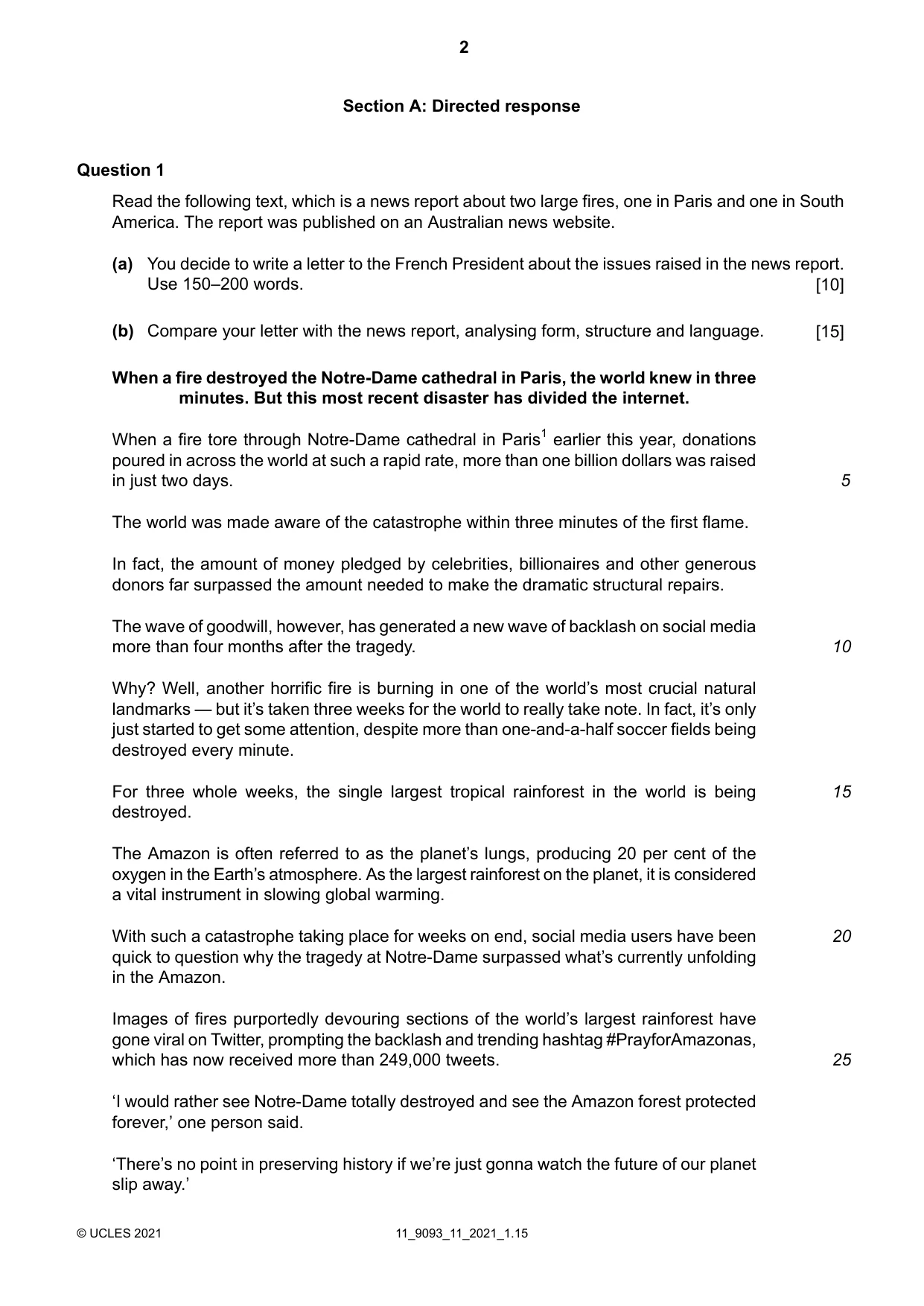
Question paper, page 2
25 20 15 10 5 Section A: Directed response Question 1 Read the following text, which is a news report about two large fires, one in Paris and one in South America. The report was published on an Australian news website. You decide to write a letter to the French President about the issues raised in the news report. Use 150–200 words. [10] (a) Compare your letter with the news report, analysing form, structure and language. [15] (b) When a fire destroyed the Notre-Dame cathedral in Paris, the world knew in three minutes. But this most recent disaster has divided the internet. When a fire tore through Notre-Dame cathedral in Paris1 earlier this year, donations poured in across the world at such a rapid rate, more than one billion dollars was raised in just two days. The world was made aware of the catastrophe within three minutes of the first flame. In fact, the amount of money pledged by celebrities, billionaires and other generous donors far surpassed the amount needed to make the dramatic structural repairs. The wave of goodwill, however, has generated a new wave of backlash on social media more than four months after the tragedy. Why? Well, another horrific fire is burning in one of the world’s most crucial natural landmarks — but it’s taken three weeks for the world to really take note. In fact, it’s only just started to get some attention, despite more than one-and-a-half soccer fields being destroyed every minute. For three whole weeks, the single largest tropical rainforest in the world is being destroyed. The Amazon is often referred to as the planet’s lungs, producing 20 per cent of the oxygen in the Earth’s atmosphere. As the largest rainforest on the planet, it is considered a vital instrument in slowing global warming. With such a catastrophe taking place for weeks on end, social media users have been quick to question why the tragedy at Notre-Dame surpassed what’s currently unfolding in the Amazon. Images of fires purportedly devouring sections of the world’s largest rainforest have gone viral on Twitter, prompting the backlash and trending hashtag #PrayforAmazonas, which has now received more than 249,000 tweets. ‘I would rather see Notre-Dame totally destroyed and see the Amazon forest protected forever,’ one person said. ‘There’s no point in preserving history if we’re just gonna watch the future of our planet slip away.’ 11_9093_11_2021_1.15 © UCLES 2021 2
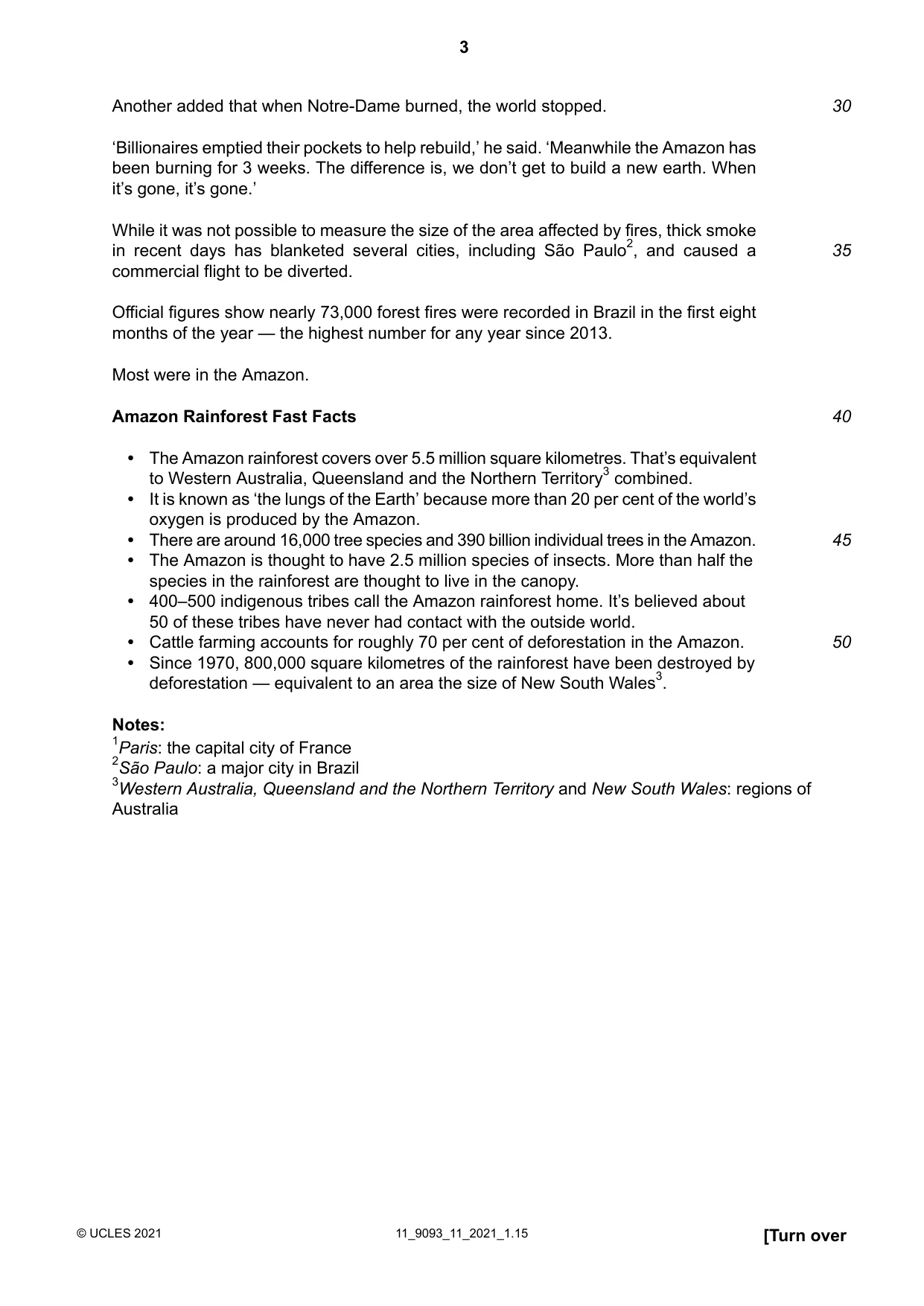
Question paper, page 3
50 45 40 35 30 Another added that when Notre-Dame burned, the world stopped. ‘Billionaires emptied their pockets to help rebuild,’ he said. ‘Meanwhile the Amazon has been burning for 3 weeks. The difference is, we don’t get to build a new earth. When it’s gone, it’s gone.’ While it was not possible to measure the size of the area affected by fires, thick smoke in recent days has blanketed several cities, including São Paulo2, and caused a commercial flight to be diverted. Official figures show nearly 73,000 forest fires were recorded in Brazil in the first eight months of the year — the highest number for any year since 2013. Most were in the Amazon. Amazon Rainforest Fast Facts • The Amazon rainforest covers over 5.5 million square kilometres. That’s equivalent to Western Australia, Queensland and the Northern Territory3 combined. • It is known as ‘the lungs of the Earth’ because more than 20 per cent of the world’s oxygen is produced by the Amazon. • There are around 16,000 tree species and 390 billion individual trees in the Amazon. • The Amazon is thought to have 2.5 million species of insects. More than half the species in the rainforest are thought to live in the canopy. • 400–500 indigenous tribes call the Amazon rainforest home. It’s believed about 50 of these tribes have never had contact with the outside world. • Cattle farming accounts for roughly 70 per cent of deforestation in the Amazon. • Since 1970, 800,000 square kilometres of the rainforest have been destroyed by deforestation — equivalent to an area the size of New South Wales3. Notes: 1Paris: the capital city of France 2São Paulo: a major city in Brazil 3Western Australia, Queensland and the Northern Territory and New South Wales: regions of Australia [Turn over 11_9093_11_2021_1.15 © UCLES 2021 3
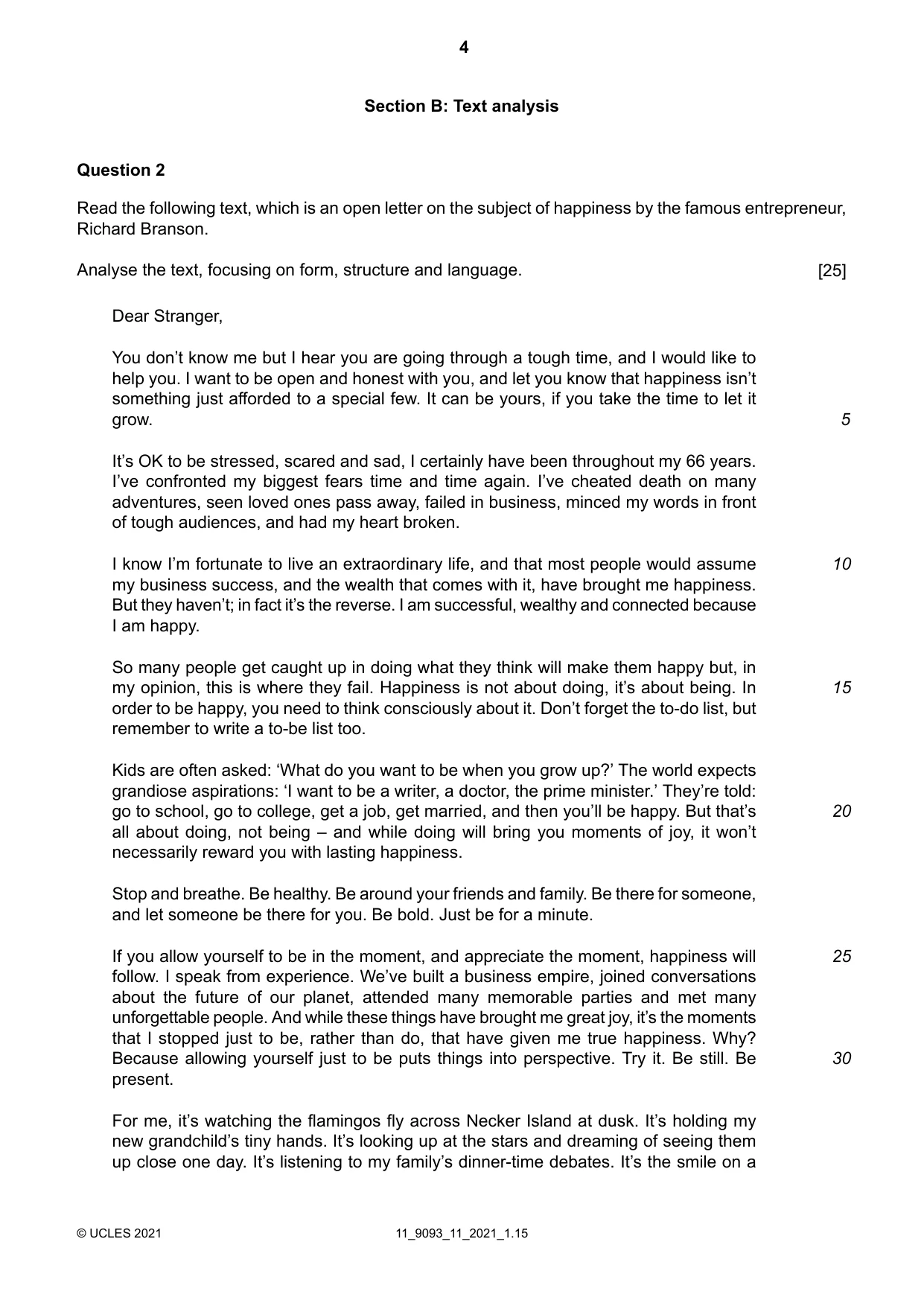
Question paper, page 4
30 25 20 15 10 5 Section B: Text analysis Question 2 Read the following text, which is an open letter on the subject of happiness by the famous entrepreneur, Richard Branson. Analyse the text, focusing on form, structure and language. [25] Dear Stranger, You don’t know me but I hear you are going through a tough time, and I would like to help you. I want to be open and honest with you, and let you know that happiness isn’t something just afforded to a special few. It can be yours, if you take the time to let it grow. It’s OK to be stressed, scared and sad, I certainly have been throughout my 66 years. I’ve confronted my biggest fears time and time again. I’ve cheated death on many adventures, seen loved ones pass away, failed in business, minced my words in front of tough audiences, and had my heart broken. I know I’m fortunate to live an extraordinary life, and that most people would assume my business success, and the wealth that comes with it, have brought me happiness. But they haven’t; in fact it’s the reverse. I am successful, wealthy and connected because I am happy. So many people get caught up in doing what they think will make them happy but, in my opinion, this is where they fail. Happiness is not about doing, it’s about being. In order to be happy, you need to think consciously about it. Don’t forget the to-do list, but remember to write a to-be list too. Kids are often asked: ‘What do you want to be when you grow up?’ The world expects grandiose aspirations: ‘I want to be a writer, a doctor, the prime minister.’ They’re told: go to school, go to college, get a job, get married, and then you’ll be happy. But that’s all about doing, not being – and while doing will bring you moments of joy, it won’t necessarily reward you with lasting happiness. Stop and breathe. Be healthy. Be around your friends and family. Be there for someone, and let someone be there for you. Be bold. Just be for a minute. If you allow yourself to be in the moment, and appreciate the moment, happiness will follow. I speak from experience. We’ve built a business empire, joined conversations about the future of our planet, attended many memorable parties and met many unforgettable people. And while these things have brought me great joy, it’s the moments that I stopped just to be, rather than do, that have given me true happiness. Why? Because allowing yourself just to be puts things into perspective. Try it. Be still. Be present. For me, it’s watching the flamingos fly across Necker Island at dusk. It’s holding my new grandchild’s tiny hands. It’s looking up at the stars and dreaming of seeing them up close one day. It’s listening to my family’s dinner-time debates. It’s the smile on a 11_9093_11_2021_1.15 © UCLES 2021 4
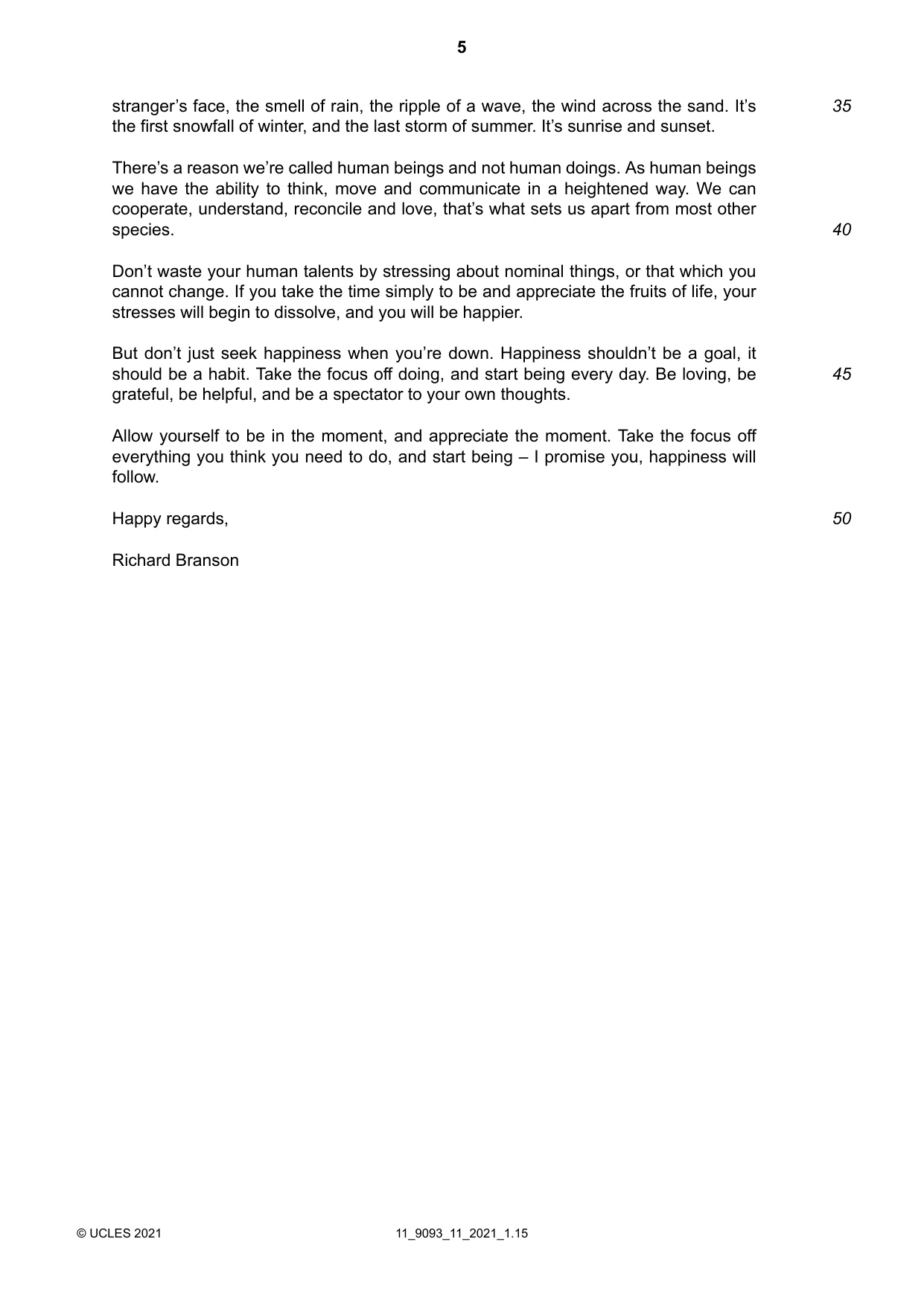
Question paper, page 5
50 45 40 35 stranger’s face, the smell of rain, the ripple of a wave, the wind across the sand. It’s the first snowfall of winter, and the last storm of summer. It’s sunrise and sunset. There’s a reason we’re called human beings and not human doings. As human beings we have the ability to think, move and communicate in a heightened way. We can cooperate, understand, reconcile and love, that’s what sets us apart from most other species. Don’t waste your human talents by stressing about nominal things, or that which you cannot change. If you take the time simply to be and appreciate the fruits of life, your stresses will begin to dissolve, and you will be happier. But don’t just seek happiness when you’re down. Happiness shouldn’t be a goal, it should be a habit. Take the focus off doing, and start being every day. Be loving, be grateful, be helpful, and be a spectator to your own thoughts. Allow yourself to be in the moment, and appreciate the moment. Take the focus off everything you think you need to do, and start being – I promise you, happiness will follow. Happy regards, Richard Branson 11_9093_11_2021_1.15 © UCLES 2021 5
Question paper, page 6
BLANK PAGE 11_9093_11_2021_1.15 © UCLES 2021 6
Question paper, page 7
BLANK PAGE 11_9093_11_2021_1.15 © UCLES 2021 7
Question paper, page 8
BLANK PAGE Permission to reproduce items where third-party owned material protected by copyright is included has been sought and cleared where possible. Every reasonable effort has been made by the publisher (UCLES) to trace copyright holders, but if any items requiring clearance have unwittingly been included, the publisher will be pleased to make amends at the earliest possible opportunity. To avoid the issue of disclosure of answer-related information to candidates, all copyright acknowledgements are reproduced online in the Cambridge Assessment International Education Copyright Acknowledgements Booklet. This is produced for each series of examinations and is freely available to download at www.cambridgeinternational.org after the live examination series. Cambridge Assessment International Education is part of the Cambridge Assessment Group. Cambridge Assessment is the brand name of the University of Cambridge Local Examinations Syndicate (UCLES), which itself is a department of the University of Cambridge. 11_9093_11_2021_1.15 © UCLES 2021 8
Mark scheme, page 1
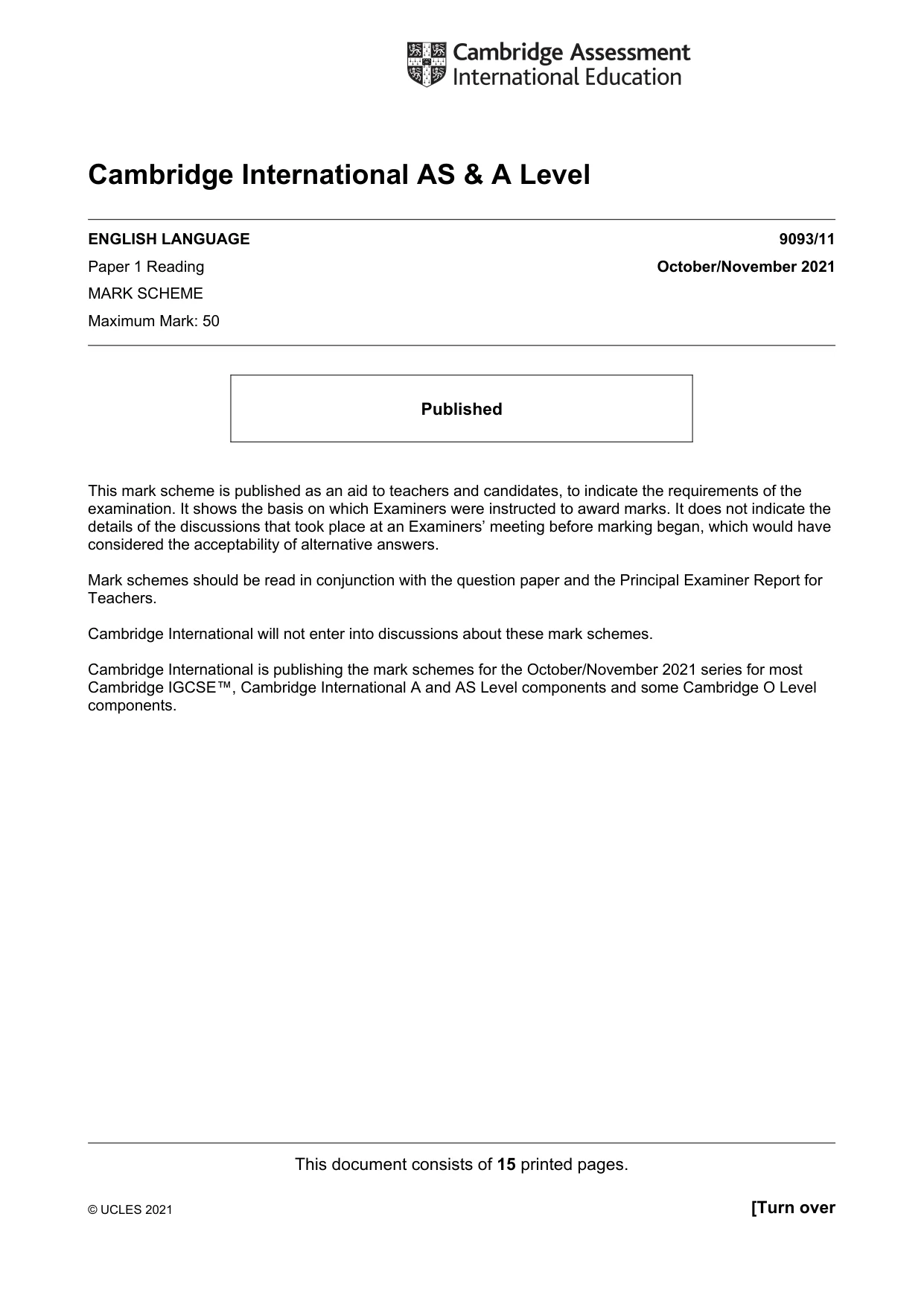
This document consists of 15 printed pages. © UCLES 2021 [Turn over Cambridge International AS & A Level ENGLISH LANGUAGE 9093/11 Paper 1 Reading October/November 2021 MARK SCHEME Maximum Mark: 50 Published This mark scheme is published as an aid to teachers and candidates, to indicate the requirements of the examination. It shows the basis on which Examiners were instructed to award marks. It does not indicate the details of the discussions that took place at an Examiners’ meeting before marking began, which would have considered the acceptability of alternative answers. Mark schemes should be read in conjunction with the question paper and the Principal Examiner Report for Teachers. Cambridge International will not enter into discussions about these mark schemes. Cambridge International is publishing the mark schemes for the October/November 2021 series for most Cambridge IGCSE™, Cambridge International A and AS Level components and some Cambridge O Level components.
Mark scheme, page 2
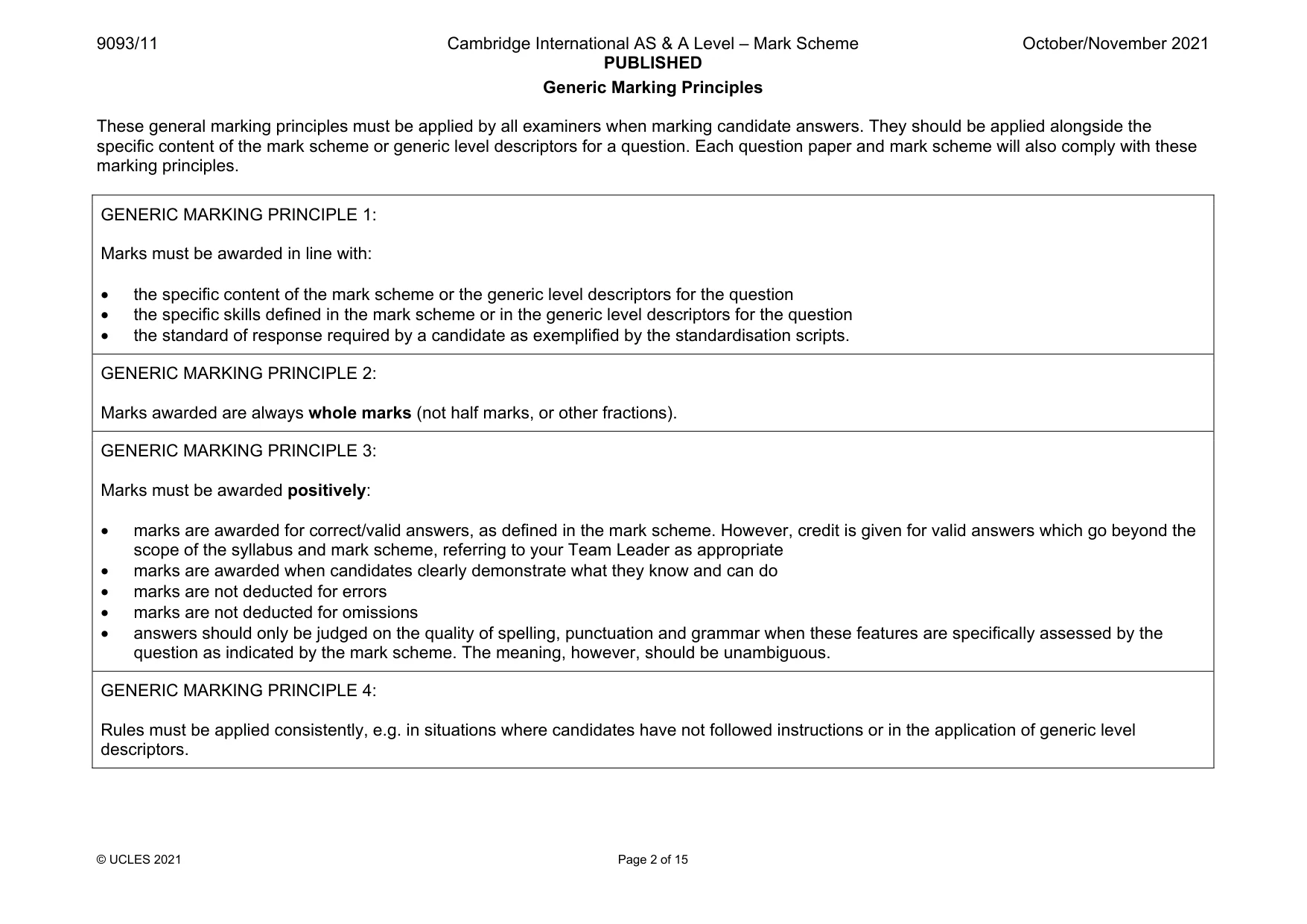
9093/11 Cambridge International AS & A Level – Mark Scheme PUBLISHED October/November 2021 © UCLES 2021 Page 2 of 15 Generic Marking Principles These general marking principles must be applied by all examiners when marking candidate answers. They should be applied alongside the specific content of the mark scheme or generic level descriptors for a question. Each question paper and mark scheme will also comply with these marking principles. GENERIC MARKING PRINCIPLE 1: Marks must be awarded in line with: • the specific content of the mark scheme or the generic level descriptors for the question • the specific skills defined in the mark scheme or in the generic level descriptors for the question • the standard of response required by a candidate as exemplified by the standardisation scripts. GENERIC MARKING PRINCIPLE 2: Marks awarded are always whole marks (not half marks, or other fractions). GENERIC MARKING PRINCIPLE 3: Marks must be awarded positively: • marks are awarded for correct/valid answers, as defined in the mark scheme. However, credit is given for valid answers which go beyond the scope of the syllabus and mark scheme, referring to your Team Leader as appropriate • marks are awarded when candidates clearly demonstrate what they know and can do • marks are not deducted for errors • marks are not deducted for omissions • answers should only be judged on the quality of spelling, punctuation and grammar when these features are specifically assessed by the question as indicated by the mark scheme. The meaning, however, should be unambiguous. GENERIC MARKING PRINCIPLE 4: Rules must be applied consistently, e.g. in situations where candidates have not followed instructions or in the application of generic level descriptors.
Mark scheme, page 3
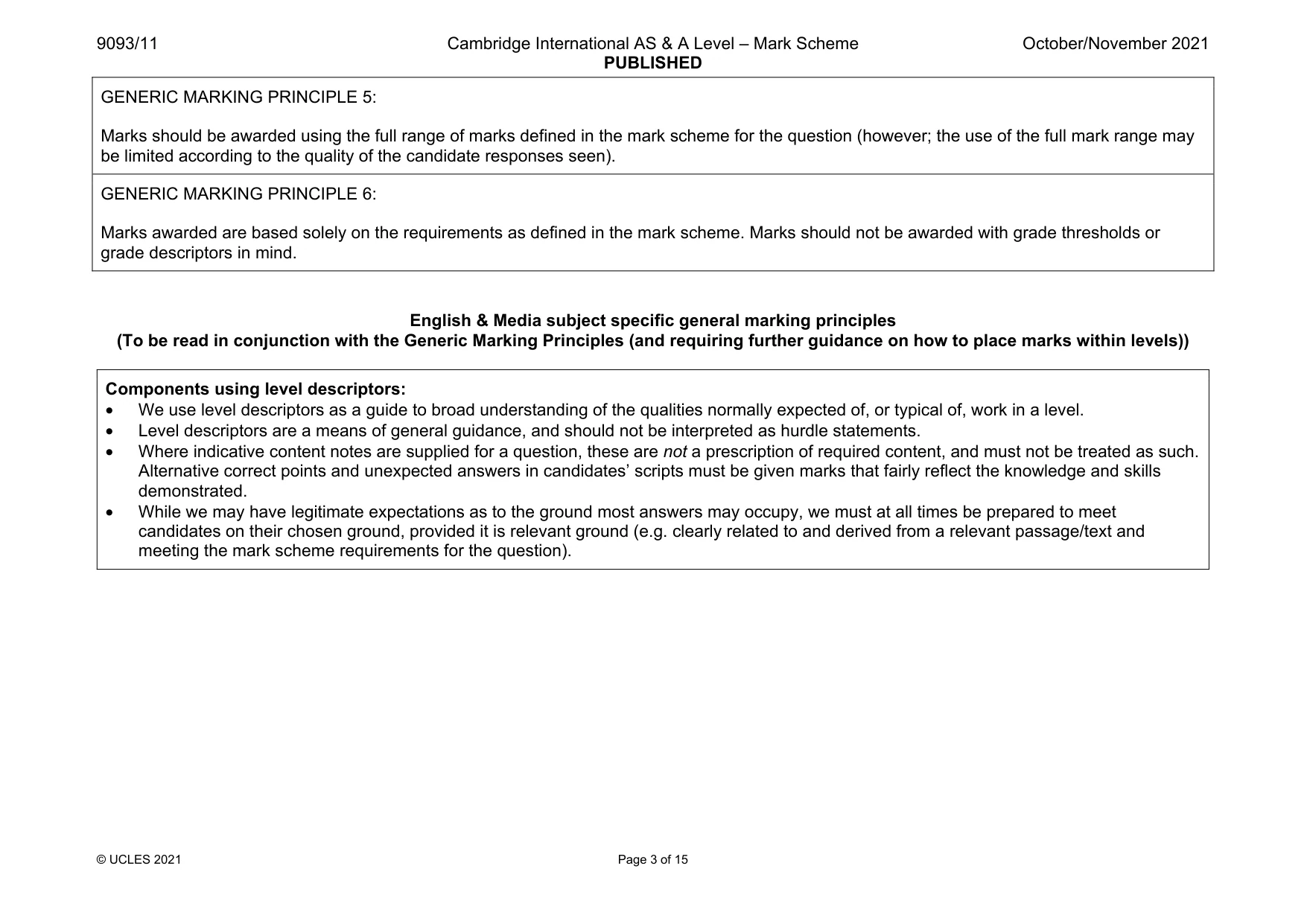
9093/11 Cambridge International AS & A Level – Mark Scheme PUBLISHED October/November 2021 © UCLES 2021 Page 3 of 15 GENERIC MARKING PRINCIPLE 5: Marks should be awarded using the full range of marks defined in the mark scheme for the question (however; the use of the full mark range may be limited according to the quality of the candidate responses seen). GENERIC MARKING PRINCIPLE 6: Marks awarded are based solely on the requirements as defined in the mark scheme. Marks should not be awarded with grade thresholds or grade descriptors in mind. English & Media subject specific general marking principles (To be read in conjunction with the Generic Marking Principles (and requiring further guidance on how to place marks within levels)) Components using level descriptors: • We use level descriptors as a guide to broad understanding of the qualities normally expected of, or typical of, work in a level. • Level descriptors are a means of general guidance, and should not be interpreted as hurdle statements. • Where indicative content notes are supplied for a question, these are not a prescription of required content, and must not be treated as such. Alternative correct points and unexpected answers in candidates’ scripts must be given marks that fairly reflect the knowledge and skills demonstrated. • While we may have legitimate expectations as to the ground most answers may occupy, we must at all times be prepared to meet candidates on their chosen ground, provided it is relevant ground (e.g. clearly related to and derived from a relevant passage/text and meeting the mark scheme requirements for the question).
Mark scheme, page 4
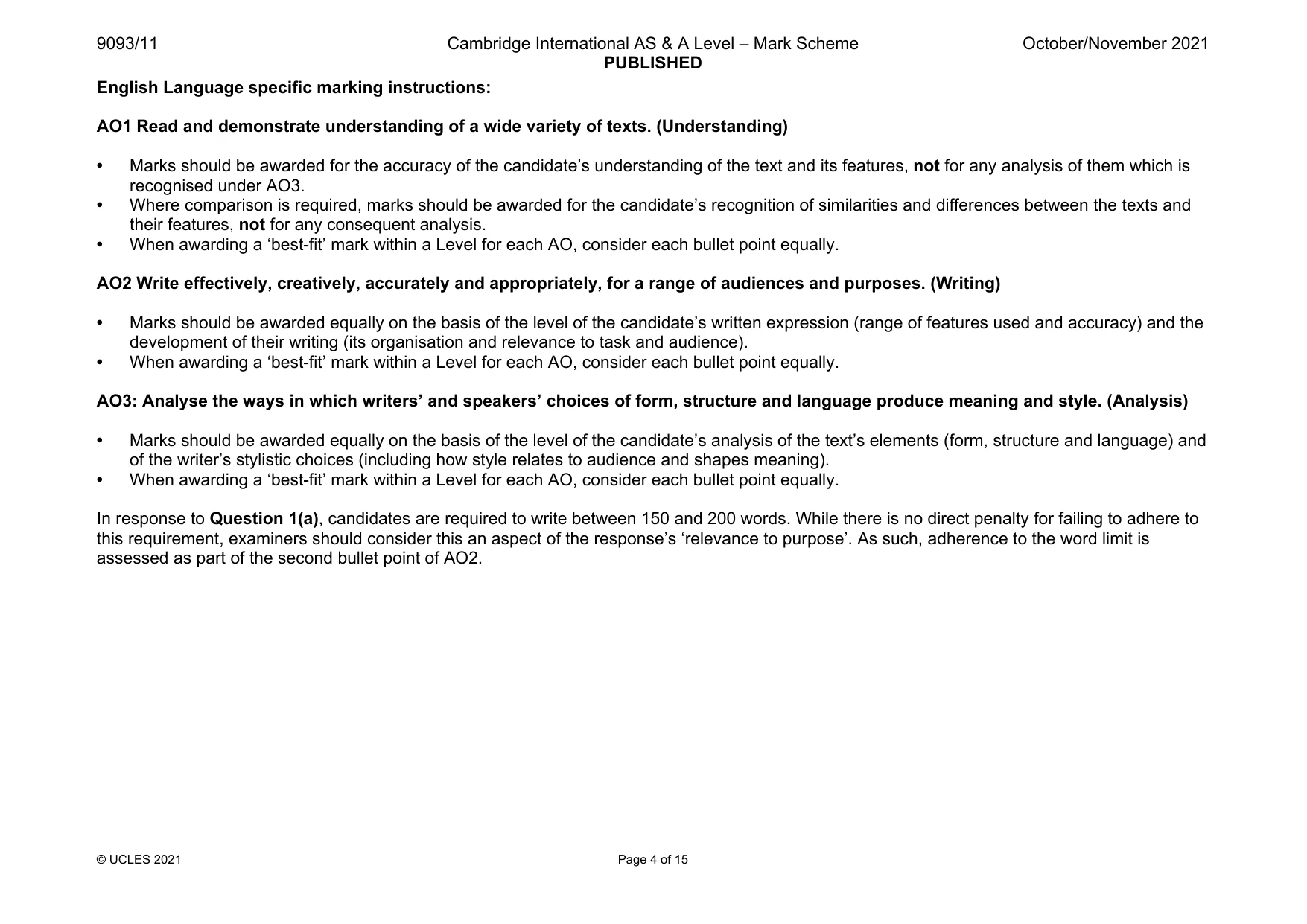
9093/11 Cambridge International AS & A Level – Mark Scheme PUBLISHED October/November 2021 © UCLES 2021 Page 4 of 15 English Language specific marking instructions: AO1 Read and demonstrate understanding of a wide variety of texts. (Understanding) • Marks should be awarded for the accuracy of the candidate’s understanding of the text and its features, not for any analysis of them which is recognised under AO3. • Where comparison is required, marks should be awarded for the candidate’s recognition of similarities and differences between the texts and their features, not for any consequent analysis. • When awarding a ‘best-fit’ mark within a Level for each AO, consider each bullet point equally. AO2 Write effectively, creatively, accurately and appropriately, for a range of audiences and purposes. (Writing) • Marks should be awarded equally on the basis of the level of the candidate’s written expression (range of features used and accuracy) and the development of their writing (its organisation and relevance to task and audience). • When awarding a ‘best-fit’ mark within a Level for each AO, consider each bullet point equally. AO3: Analyse the ways in which writers’ and speakers’ choices of form, structure and language produce meaning and style. (Analysis) • Marks should be awarded equally on the basis of the level of the candidate’s analysis of the text’s elements (form, structure and language) and of the writer’s stylistic choices (including how style relates to audience and shapes meaning). • When awarding a ‘best-fit’ mark within a Level for each AO, consider each bullet point equally. In response to Question 1(a), candidates are required to write between 150 and 200 words. While there is no direct penalty for failing to adhere to this requirement, examiners should consider this an aspect of the response’s ‘relevance to purpose’. As such, adherence to the word limit is assessed as part of the second bullet point of AO2.
Mark scheme, page 5
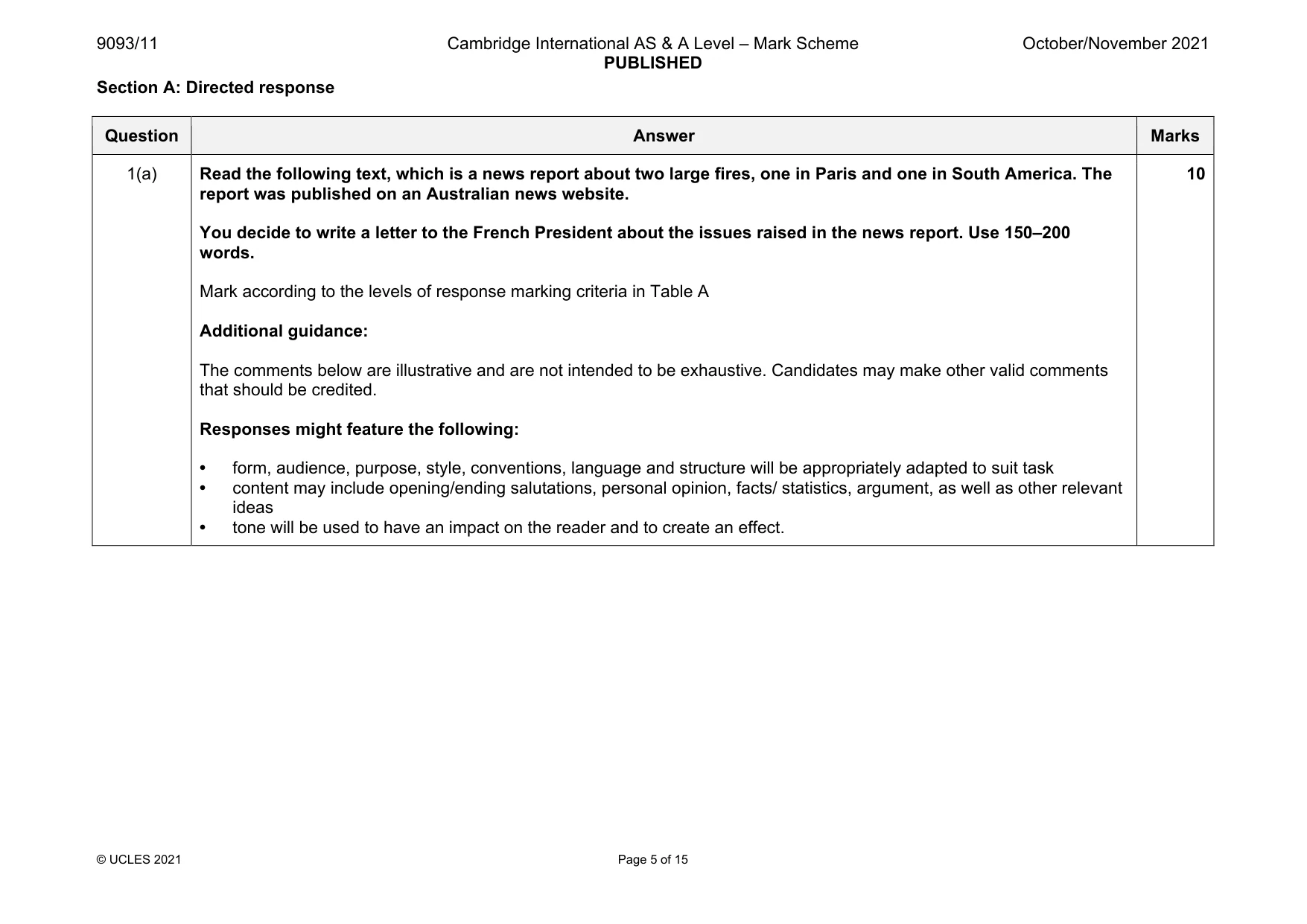
9093/11 Cambridge International AS & A Level – Mark Scheme PUBLISHED October/November 2021 © UCLES 2021 Page 5 of 15 Section A: Directed response Question Answer Marks 1(a) Read the following text, which is a news report about two large fires, one in Paris and one in South America. The report was published on an Australian news website. You decide to write a letter to the French President about the issues raised in the news report. Use 150–200 words. Mark according to the levels of response marking criteria in Table A Additional guidance: The comments below are illustrative and are not intended to be exhaustive. Candidates may make other valid comments that should be credited. Responses might feature the following: • form, audience, purpose, style, conventions, language and structure will be appropriately adapted to suit task • content may include opening/ending salutations, personal opinion, facts/ statistics, argument, as well as other relevant ideas • tone will be used to have an impact on the reader and to create an effect. 10
Mark scheme, page 6
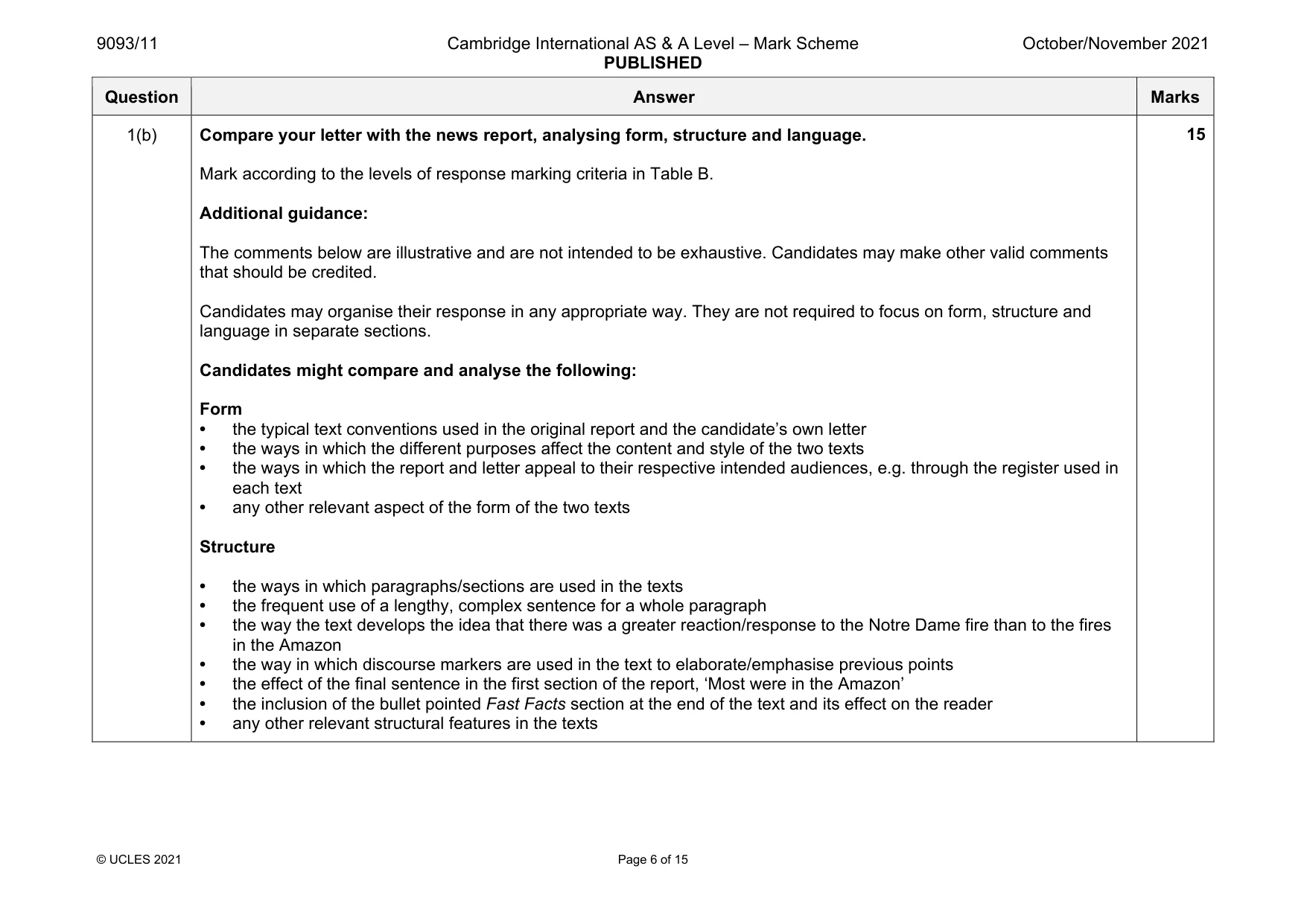
9093/11 Cambridge International AS & A Level – Mark Scheme PUBLISHED October/November 2021 © UCLES 2021 Page 6 of 15 Question Answer Marks 1(b) Compare your letter with the news report, analysing form, structure and language. Mark according to the levels of response marking criteria in Table B. Additional guidance: The comments below are illustrative and are not intended to be exhaustive. Candidates may make other valid comments that should be credited. Candidates may organise their response in any appropriate way. They are not required to focus on form, structure and language in separate sections. Candidates might compare and analyse the following: Form • the typical text conventions used in the original report and the candidate’s own letter • the ways in which the different purposes affect the content and style of the two texts • the ways in which the report and letter appeal to their respective intended audiences, e.g. through the register used in each text • any other relevant aspect of the form of the two texts Structure • the ways in which paragraphs/sections are used in the texts • the frequent use of a lengthy, complex sentence for a whole paragraph • the way the text develops the idea that there was a greater reaction/response to the Notre Dame fire than to the fires in the Amazon • the way in which discourse markers are used in the text to elaborate/emphasise previous points • the effect of the final sentence in the first section of the report, ‘Most were in the Amazon’ • the inclusion of the bullet pointed Fast Facts section at the end of the text and its effect on the reader • any other relevant structural features in the texts 15
Mark scheme, page 7
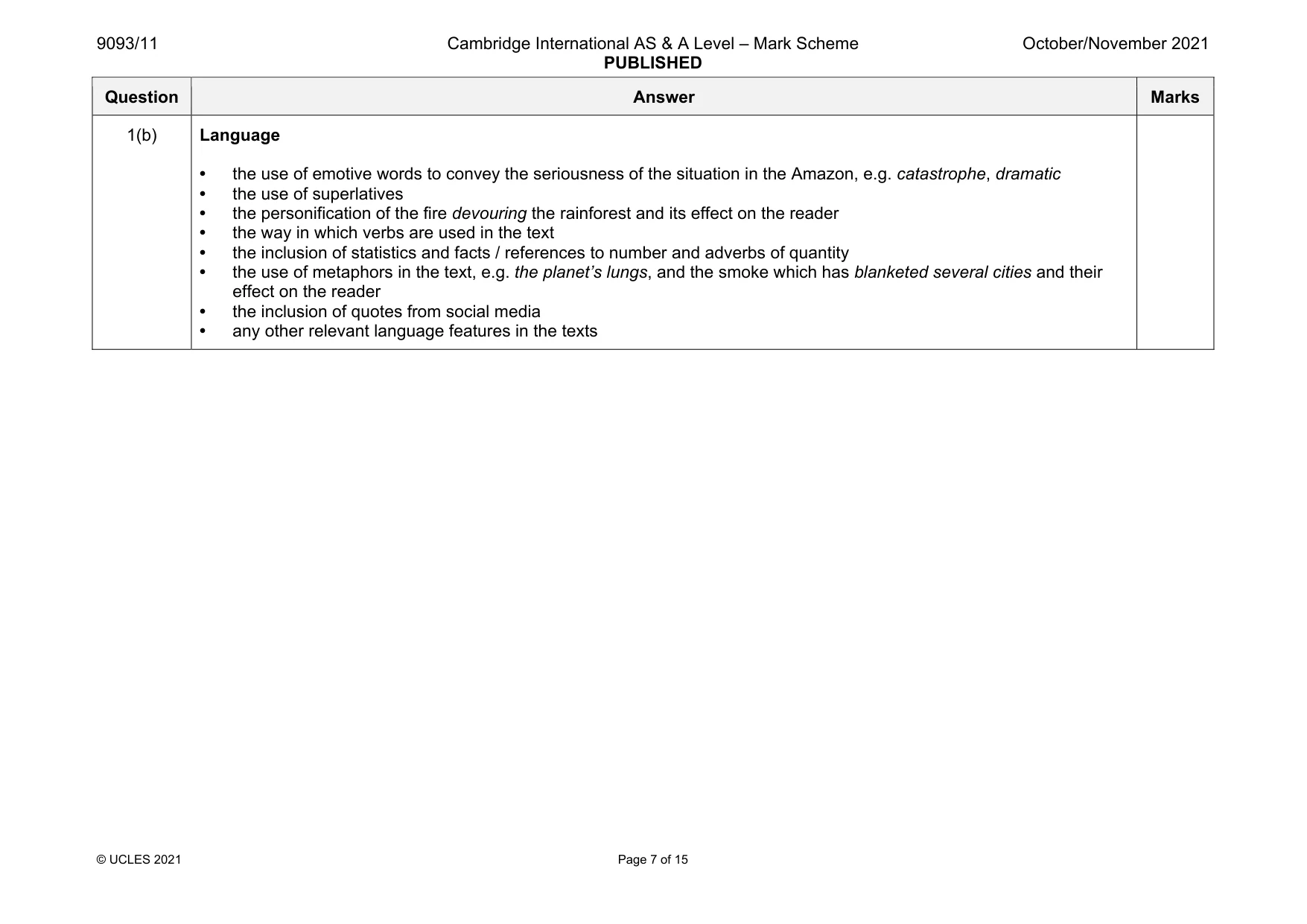
9093/11 Cambridge International AS & A Level – Mark Scheme PUBLISHED October/November 2021 © UCLES 2021 Page 7 of 15 Question Answer Marks 1(b) Language • the use of emotive words to convey the seriousness of the situation in the Amazon, e.g. catastrophe, dramatic • the use of superlatives • the personification of the fire devouring the rainforest and its effect on the reader • the way in which verbs are used in the text • the inclusion of statistics and facts / references to number and adverbs of quantity • the use of metaphors in the text, e.g. the planet’s lungs, and the smoke which has blanketed several cities and their effect on the reader • the inclusion of quotes from social media • any other relevant language features in the texts
Mark scheme, page 8
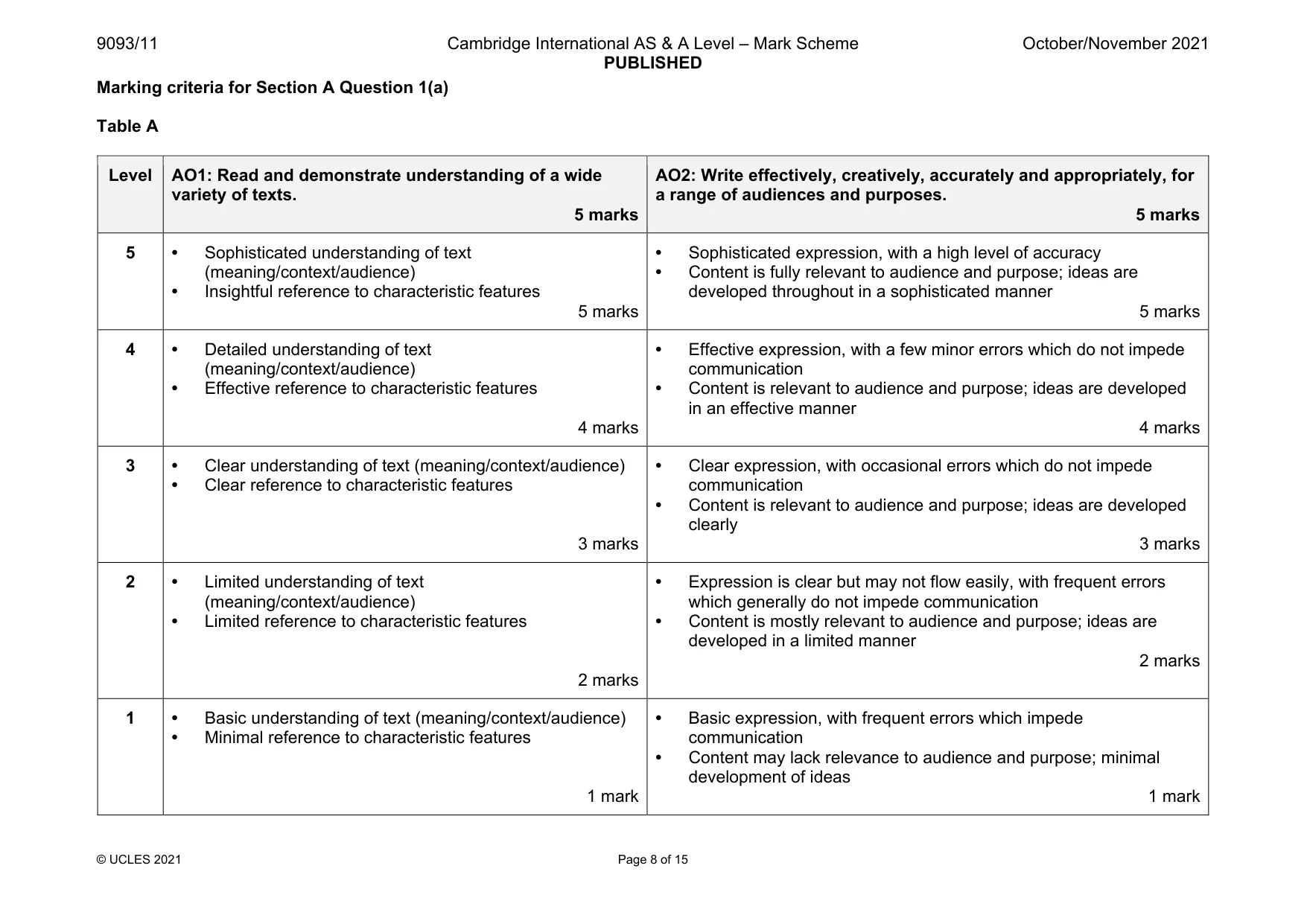
9093/11 Cambridge International AS & A Level – Mark Scheme PUBLISHED October/November 2021 © UCLES 2021 Page 8 of 15 Marking criteria for Section A Question 1(a) Table A Level AO1: Read and demonstrate understanding of a wide variety of texts. 5 marks AO2: Write effectively, creatively, accurately and appropriately, for a range of audiences and purposes. 5 marks 5 • Sophisticated understanding of text (meaning/context/audience) • Insightful reference to characteristic features 5 marks • Sophisticated expression, with a high level of accuracy • Content is fully relevant to audience and purpose; ideas are developed throughout in a sophisticated manner 5 marks 4 • Detailed understanding of text (meaning/context/audience) • Effective reference to characteristic features 4 marks • Effective expression, with a few minor errors which do not impede communication • Content is relevant to audience and purpose; ideas are developed in an effective manner 4 marks 3 • Clear understanding of text (meaning/context/audience) • Clear reference to characteristic features 3 marks • Clear expression, with occasional errors which do not impede communication • Content is relevant to audience and purpose; ideas are developed clearly 3 marks 2 • Limited understanding of text (meaning/context/audience) • Limited reference to characteristic features 2 marks • Expression is clear but may not flow easily, with frequent errors which generally do not impede communication • Content is mostly relevant to audience and purpose; ideas are developed in a limited manner 2 marks 1 • Basic understanding of text (meaning/context/audience) • Minimal reference to characteristic features 1 mark • Basic expression, with frequent errors which impede communication • Content may lack relevance to audience and purpose; minimal development of ideas 1 mark
Mark scheme, page 9
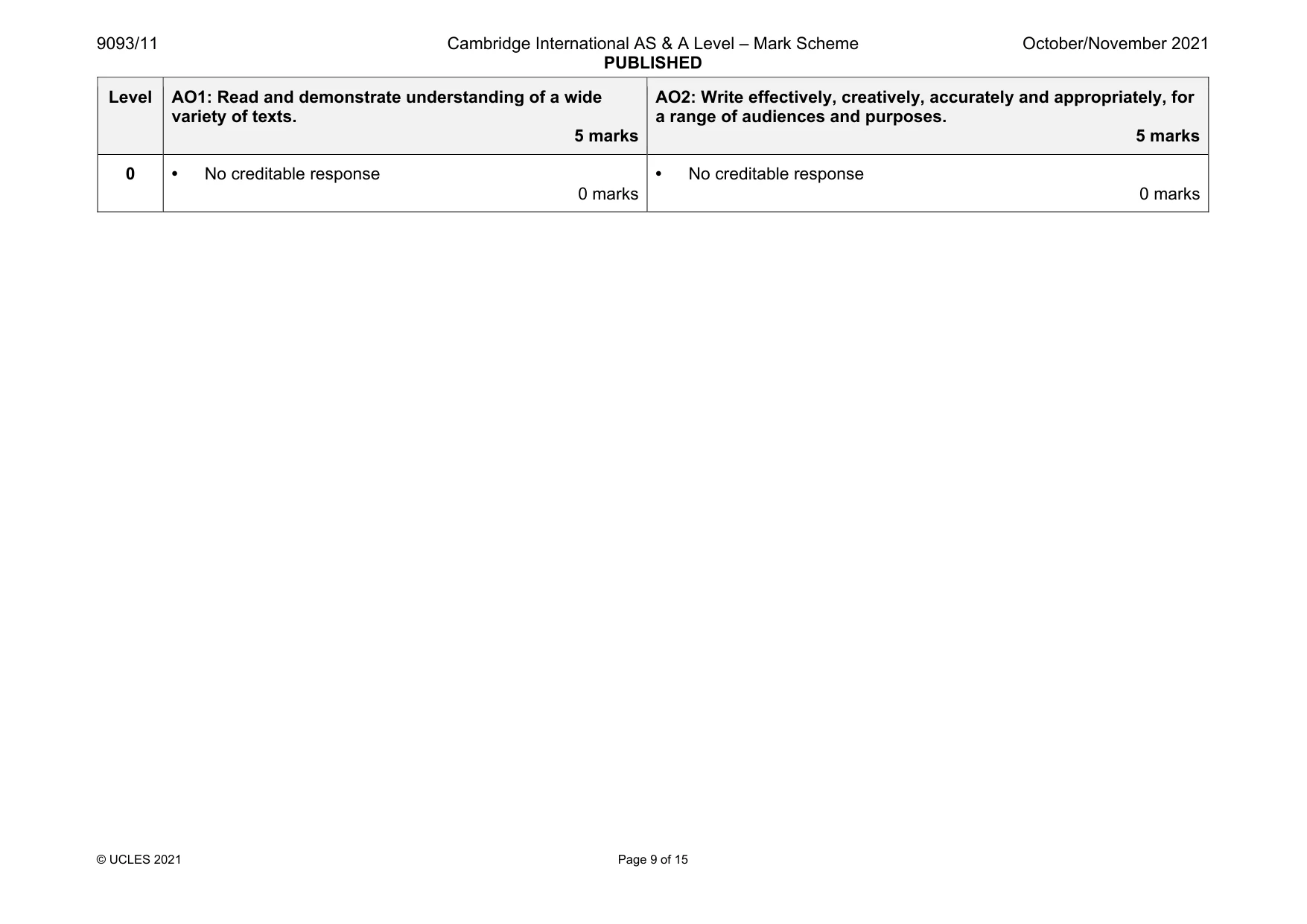
9093/11 Cambridge International AS & A Level – Mark Scheme PUBLISHED October/November 2021 © UCLES 2021 Page 9 of 15 Level AO1: Read and demonstrate understanding of a wide variety of texts. 5 marks AO2: Write effectively, creatively, accurately and appropriately, for a range of audiences and purposes. 5 marks 0 • No creditable response 0 marks • No creditable response 0 marks
Mark scheme, page 10
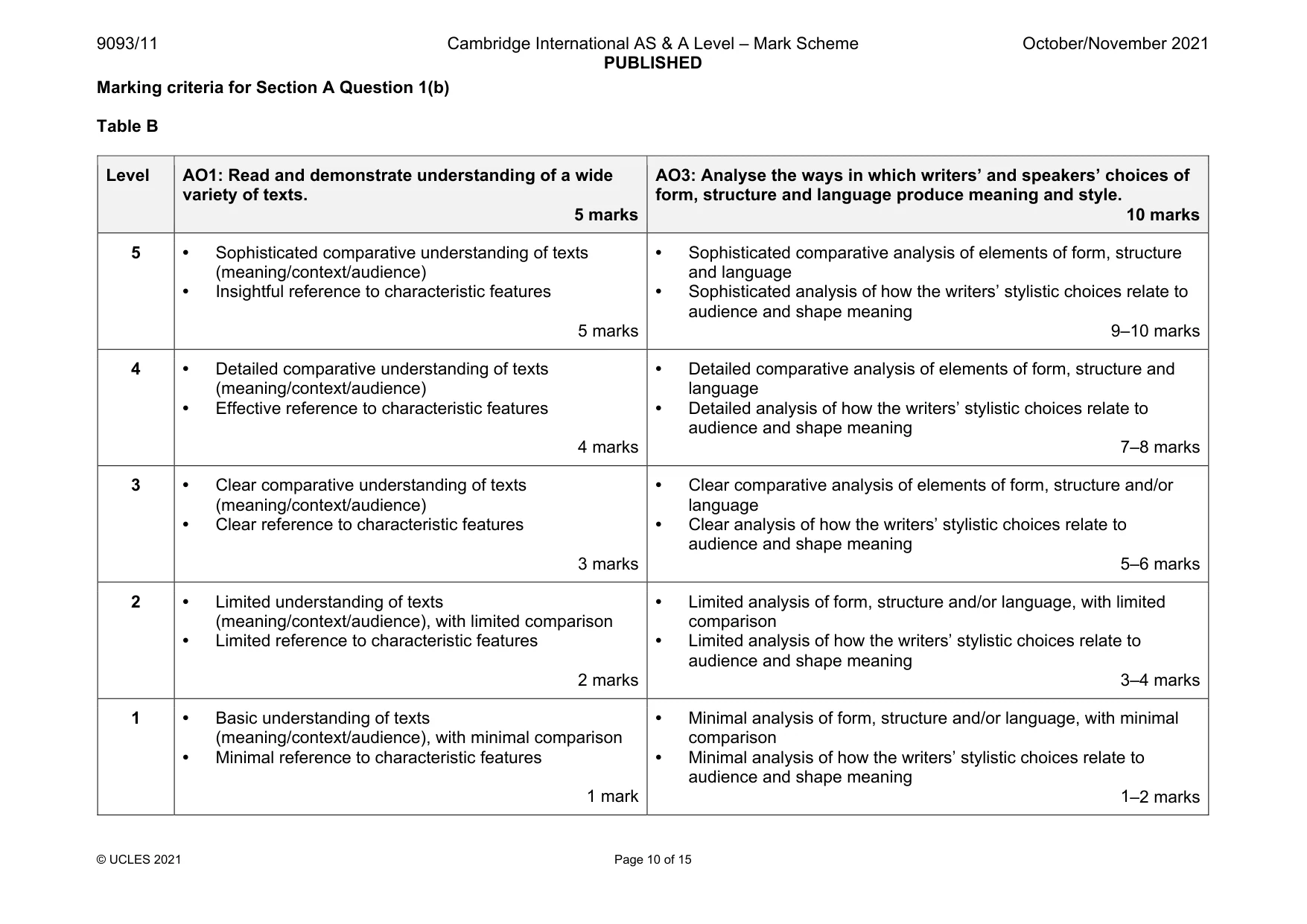
9093/11 Cambridge International AS & A Level – Mark Scheme PUBLISHED October/November 2021 © UCLES 2021 Page 10 of 15 Marking criteria for Section A Question 1(b) Table B Level AO1: Read and demonstrate understanding of a wide variety of texts. 5 marks AO3: Analyse the ways in which writers’ and speakers’ choices of form, structure and language produce meaning and style. 10 marks 5 • Sophisticated comparative understanding of texts (meaning/context/audience) • Insightful reference to characteristic features 5 marks • Sophisticated comparative analysis of elements of form, structure and language • Sophisticated analysis of how the writers’ stylistic choices relate to audience and shape meaning 9–10 marks 4 • Detailed comparative understanding of texts (meaning/context/audience) • Effective reference to characteristic features 4 marks • Detailed comparative analysis of elements of form, structure and language • Detailed analysis of how the writers’ stylistic choices relate to audience and shape meaning 7–8 marks 3 • Clear comparative understanding of texts (meaning/context/audience) • Clear reference to characteristic features 3 marks • Clear comparative analysis of elements of form, structure and/or language • Clear analysis of how the writers’ stylistic choices relate to audience and shape meaning 5–6 marks 2 • Limited understanding of texts (meaning/context/audience), with limited comparison • Limited reference to characteristic features 2 marks • Limited analysis of form, structure and/or language, with limited comparison • Limited analysis of how the writers’ stylistic choices relate to audience and shape meaning 3–4 marks 1 • Basic understanding of texts (meaning/context/audience), with minimal comparison • Minimal reference to characteristic features 1 mark • Minimal analysis of form, structure and/or language, with minimal comparison • Minimal analysis of how the writers’ stylistic choices relate to audience and shape meaning 1–2 marks
Mark scheme, page 11
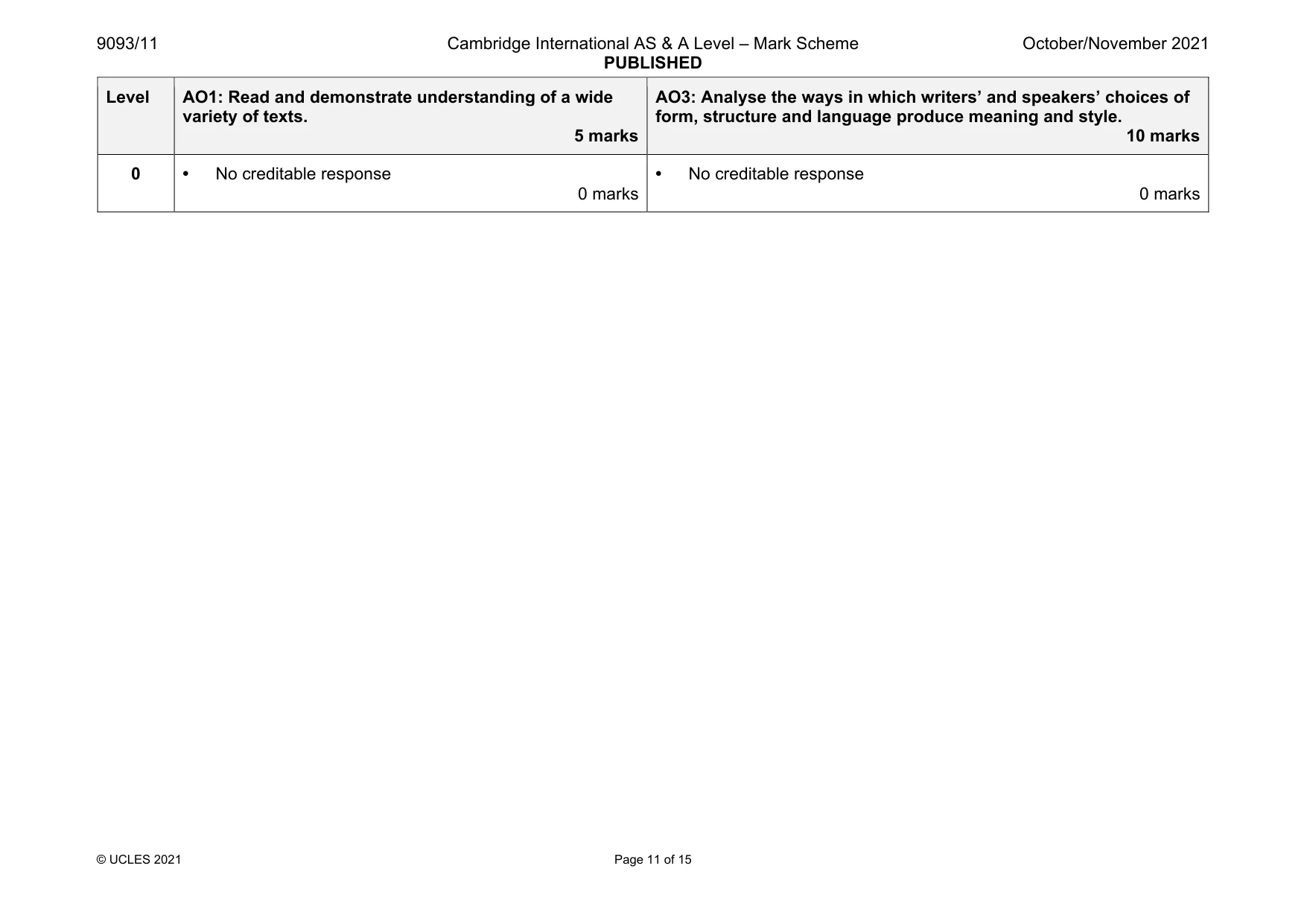
9093/11 Cambridge International AS & A Level – Mark Scheme PUBLISHED October/November 2021 © UCLES 2021 Page 11 of 15 Level AO1: Read and demonstrate understanding of a wide variety of texts. 5 marks AO3: Analyse the ways in which writers’ and speakers’ choices of form, structure and language produce meaning and style. 10 marks 0 • No creditable response 0 marks • No creditable response 0 marks
Mark scheme, page 12
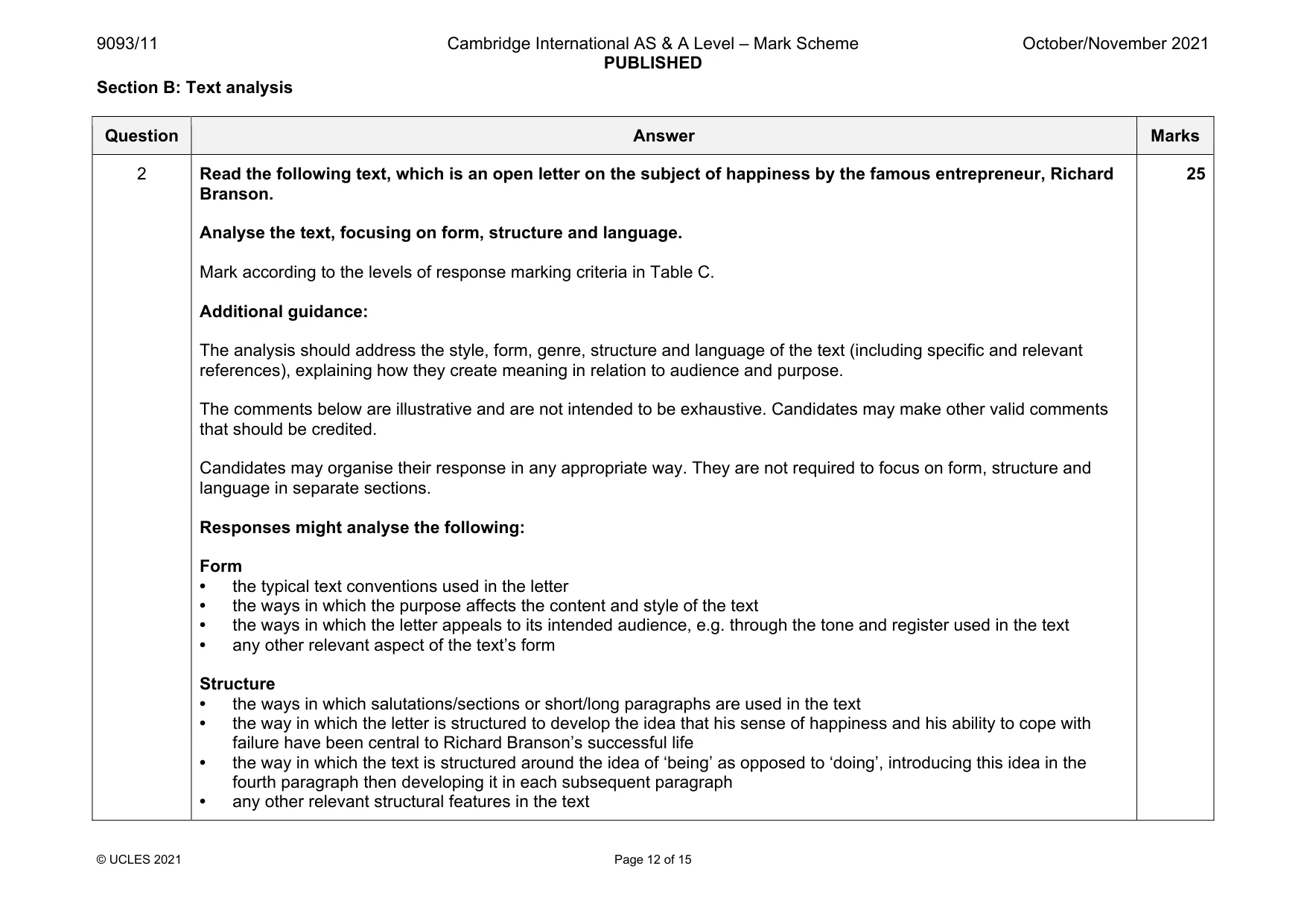
9093/11 Cambridge International AS & A Level – Mark Scheme PUBLISHED October/November 2021 © UCLES 2021 Page 12 of 15 Section B: Text analysis Question Answer Marks 2 Read the following text, which is an open letter on the subject of happiness by the famous entrepreneur, Richard Branson. Analyse the text, focusing on form, structure and language. Mark according to the levels of response marking criteria in Table C. Additional guidance: The analysis should address the style, form, genre, structure and language of the text (including specific and relevant references), explaining how they create meaning in relation to audience and purpose. The comments below are illustrative and are not intended to be exhaustive. Candidates may make other valid comments that should be credited. Candidates may organise their response in any appropriate way. They are not required to focus on form, structure and language in separate sections. Responses might analyse the following: Form • the typical text conventions used in the letter • the ways in which the purpose affects the content and style of the text • the ways in which the letter appeals to its intended audience, e.g. through the tone and register used in the text • any other relevant aspect of the text’s form Structure • the ways in which salutations/sections or short/long paragraphs are used in the text • the way in which the letter is structured to develop the idea that his sense of happiness and his ability to cope with failure have been central to Richard Branson’s successful life • the way in which the text is structured around the idea of ‘being’ as opposed to ‘doing’, introducing this idea in the fourth paragraph then developing it in each subsequent paragraph • any other relevant structural features in the text 25
Mark scheme, page 13
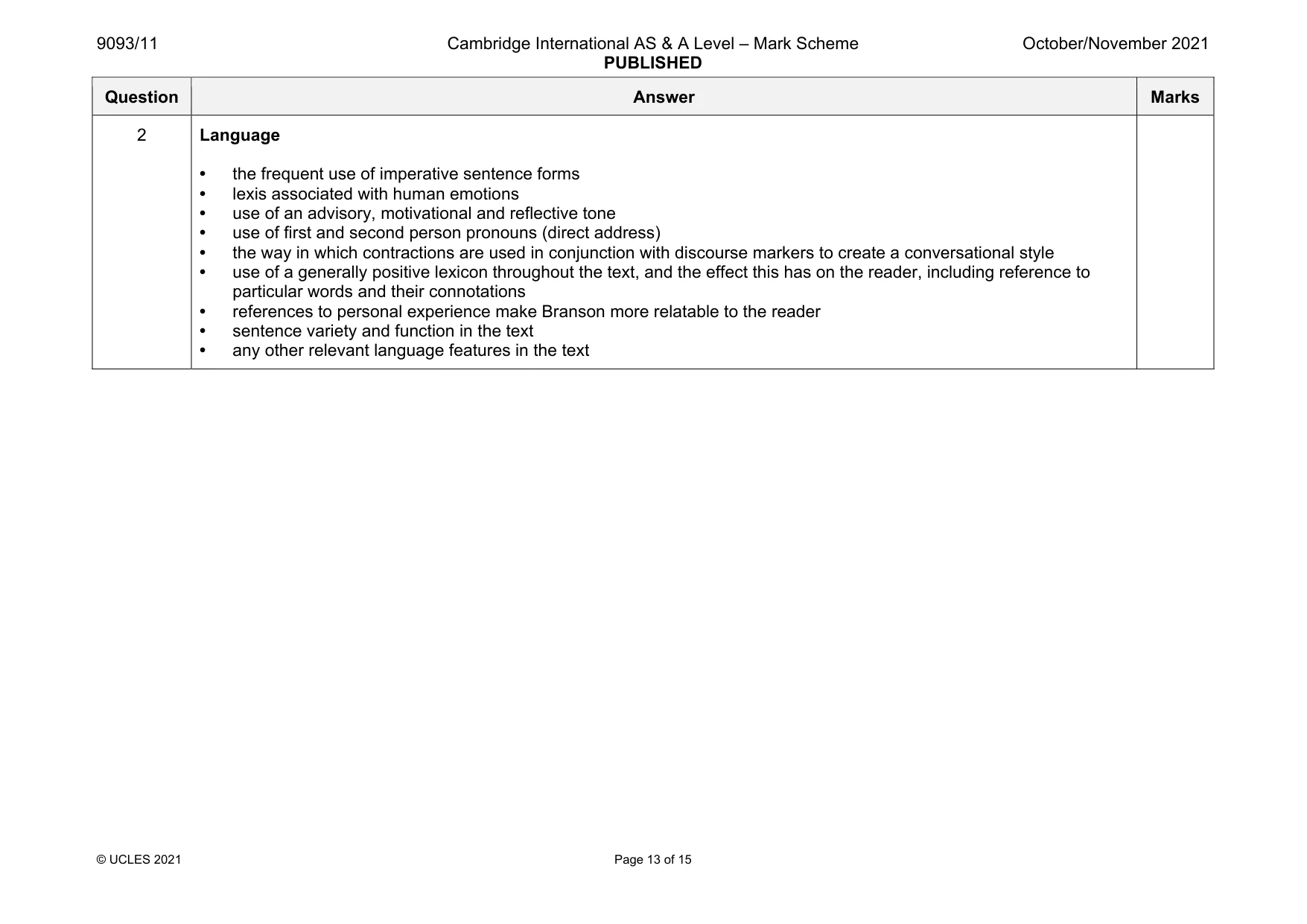
9093/11 Cambridge International AS & A Level – Mark Scheme PUBLISHED October/November 2021 © UCLES 2021 Page 13 of 15 Question Answer Marks 2 Language • the frequent use of imperative sentence forms • lexis associated with human emotions • use of an advisory, motivational and reflective tone • use of first and second person pronouns (direct address) • the way in which contractions are used in conjunction with discourse markers to create a conversational style • use of a generally positive lexicon throughout the text, and the effect this has on the reader, including reference to particular words and their connotations • references to personal experience make Branson more relatable to the reader • sentence variety and function in the text • any other relevant language features in the text
Mark scheme, page 14
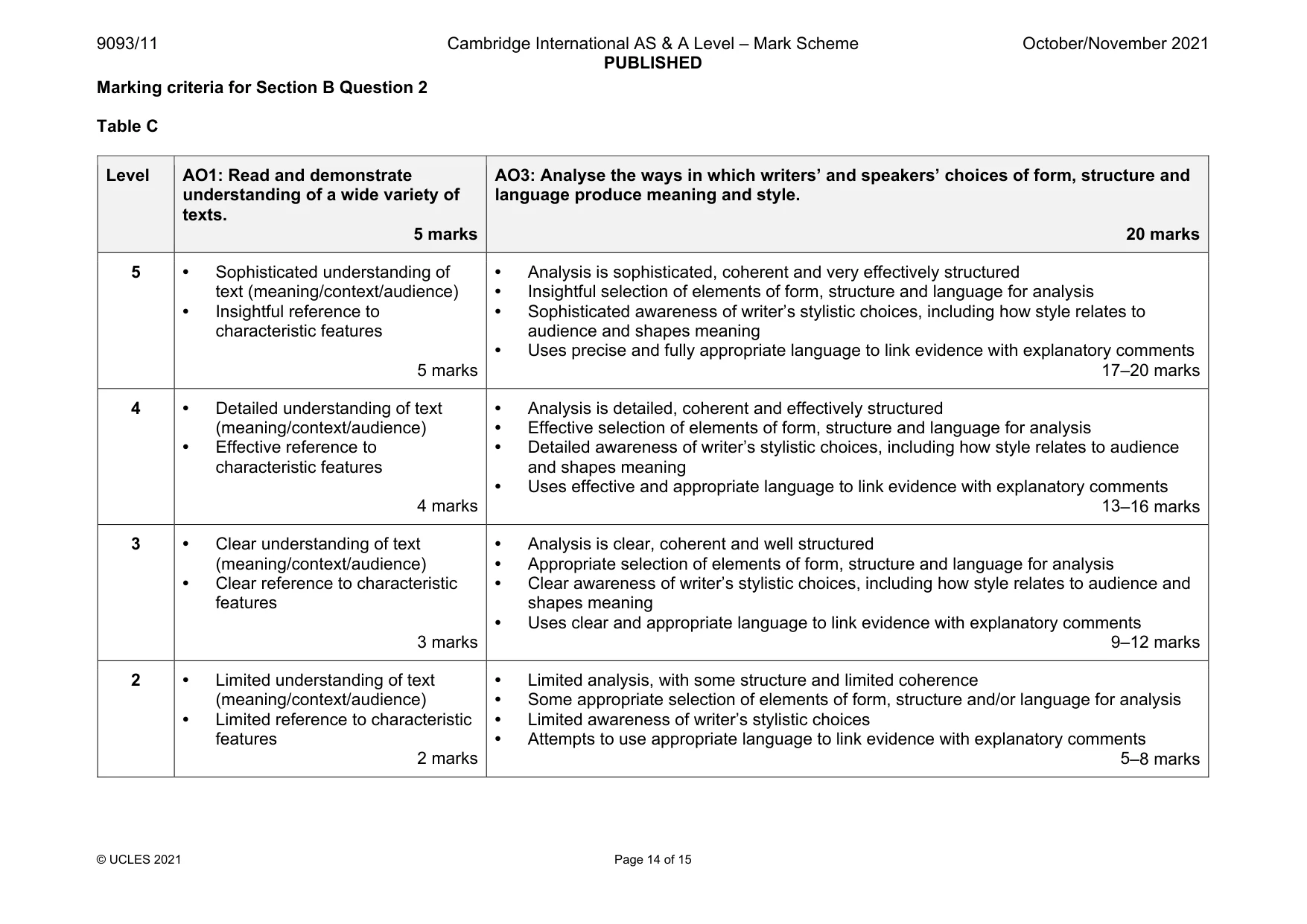
9093/11 Cambridge International AS & A Level – Mark Scheme PUBLISHED October/November 2021 © UCLES 2021 Page 14 of 15 Marking criteria for Section B Question 2 Table C Level AO1: Read and demonstrate understanding of a wide variety of texts. 5 marks AO3: Analyse the ways in which writers’ and speakers’ choices of form, structure and language produce meaning and style. 20 marks 5 • Sophisticated understanding of text (meaning/context/audience) • Insightful reference to characteristic features 5 marks • Analysis is sophisticated, coherent and very effectively structured • Insightful selection of elements of form, structure and language for analysis • Sophisticated awareness of writer’s stylistic choices, including how style relates to audience and shapes meaning • Uses precise and fully appropriate language to link evidence with explanatory comments 17–20 marks 4 • Detailed understanding of text (meaning/context/audience) • Effective reference to characteristic features 4 marks • Analysis is detailed, coherent and effectively structured • Effective selection of elements of form, structure and language for analysis • Detailed awareness of writer’s stylistic choices, including how style relates to audience and shapes meaning • Uses effective and appropriate language to link evidence with explanatory comments 13–16 marks 3 • Clear understanding of text (meaning/context/audience) • Clear reference to characteristic features 3 marks • Analysis is clear, coherent and well structured • Appropriate selection of elements of form, structure and language for analysis • Clear awareness of writer’s stylistic choices, including how style relates to audience and shapes meaning • Uses clear and appropriate language to link evidence with explanatory comments 9–12 marks 2 • Limited understanding of text (meaning/context/audience) • Limited reference to characteristic features 2 marks • Limited analysis, with some structure and limited coherence • Some appropriate selection of elements of form, structure and/or language for analysis • Limited awareness of writer’s stylistic choices • Attempts to use appropriate language to link evidence with explanatory comments 5–8 marks
Mark scheme, page 15
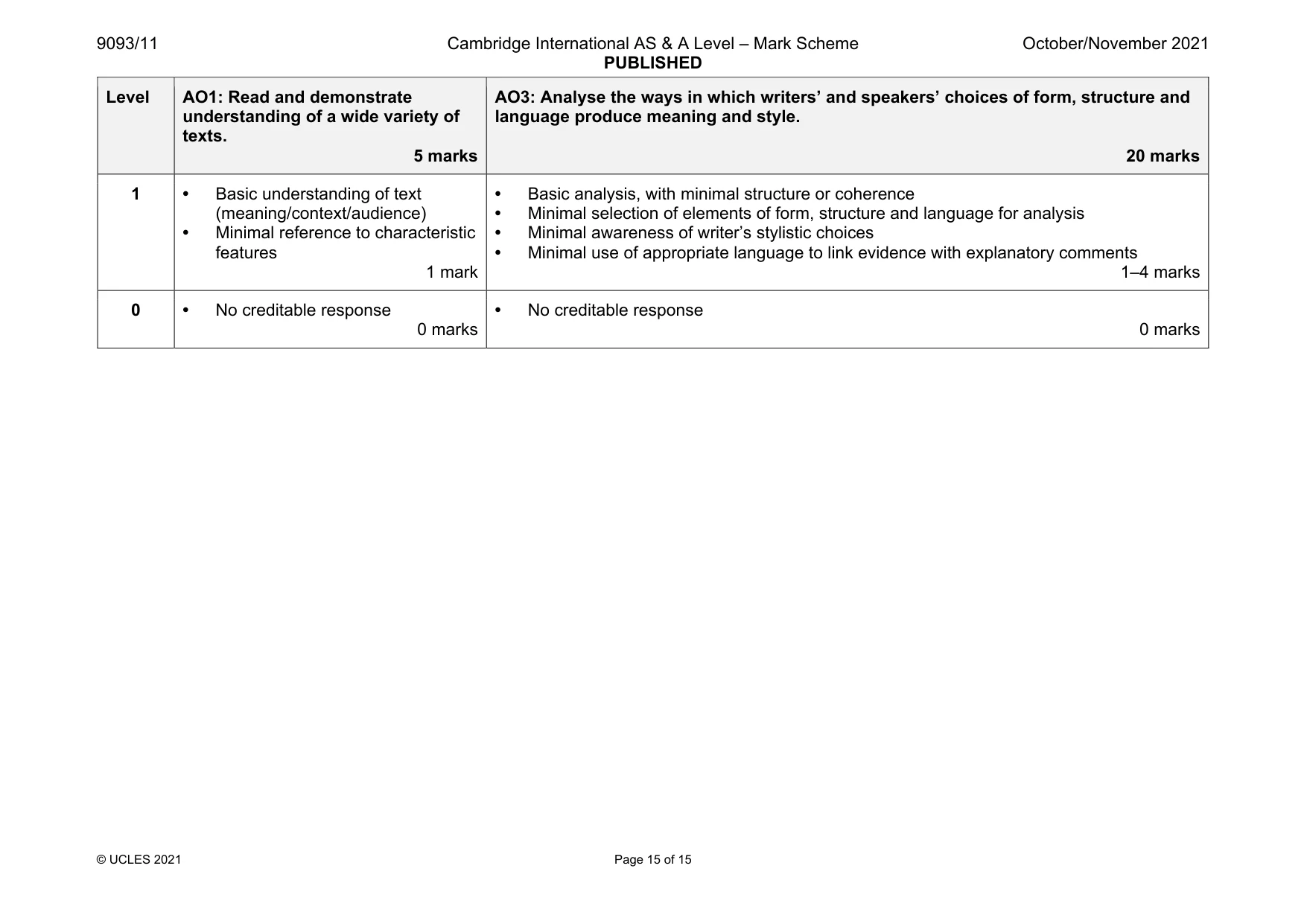
9093/11 Cambridge International AS & A Level – Mark Scheme PUBLISHED October/November 2021 © UCLES 2021 Page 15 of 15 Level AO1: Read and demonstrate understanding of a wide variety of texts. 5 marks AO3: Analyse the ways in which writers’ and speakers’ choices of form, structure and language produce meaning and style. 20 marks 1 • Basic understanding of text (meaning/context/audience) • Minimal reference to characteristic features 1 mark • Basic analysis, with minimal structure or coherence • Minimal selection of elements of form, structure and language for analysis • Minimal awareness of writer’s stylistic choices • Minimal use of appropriate language to link evidence with explanatory comments 1–4 marks 0 • No creditable response 0 marks • No creditable response 0 marks
What you needed in this session
Cambridge’s own grade thresholds for 2021 Oct/Nov, Paper 1 · Variant 1. A higher threshold means an easier paper — the bar moves with how the cohort did.