Cambridge A Level English - Language AS and A Level (from 2014) 9093 — 2021 Oct/Nov Paper 1 · Variant 2
9093/12/O/N/21 · 50 marks · ≈56 min
The question paper and its mark scheme, free to read here and free to download. This is Cambridge’s own paper, exactly as it was sat.
Question paper8 pages


Mark scheme15 pages
Answers below. Sit the paper first if you are practising.
Paper as text
Question paper, page 1
Cambridge International AS & A Level 9093/12 ENGLISH LANGUAGE October/November 2021 Paper 1 Reading 2 hours 15 minutes You must answer on the enclosed answer booklet. You will need: Answer booklet (enclosed) INSTRUCTIONS • Answer all questions. • Follow the instructions on the front cover of the answer booklet. If you need additional answer paper, ask the invigilator for a continuation booklet. • Dictionaries are not allowed. INFORMATION • The total mark for this paper is 50. • The number of marks for each question or part question is shown in brackets [ ]. This document has 8 pages. Any blank pages are indicated. [Turn over 11_9093_12_2021_1.15 © UCLES 2021 *3012415460*
Question paper, page 2
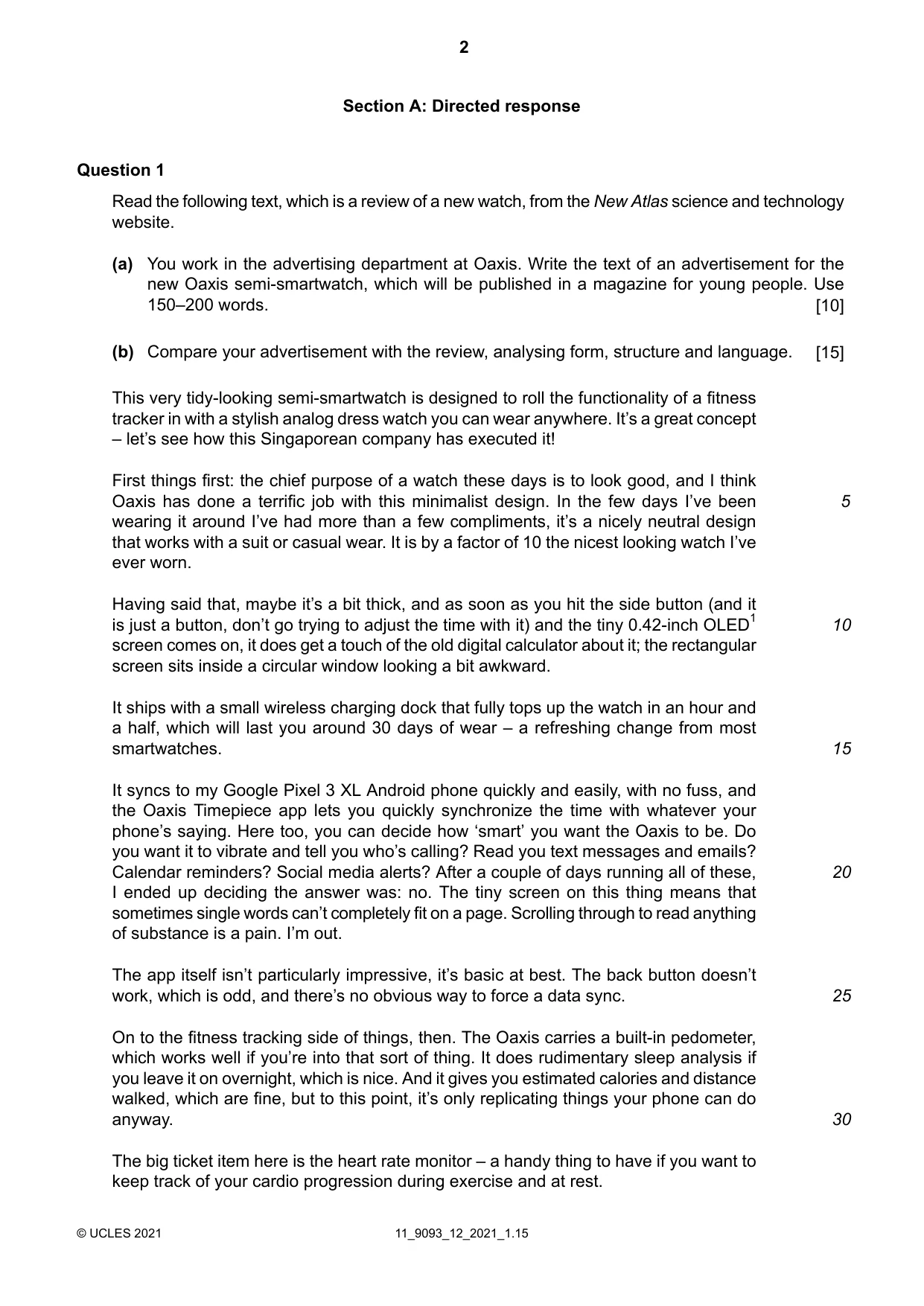
30 25 20 15 10 5 Section A: Directed response Question 1 Read the following text, which is a review of a new watch, from the New Atlas science and technology website. You work in the advertising department at Oaxis. Write the text of an advertisement for the new Oaxis semi-smartwatch, which will be published in a magazine for young people. Use 150–200 words. (a) [10] Compare your advertisement with the review, analysing form, structure and language. (b) [15] This very tidy-looking semi-smartwatch is designed to roll the functionality of a fitness tracker in with a stylish analog dress watch you can wear anywhere. It’s a great concept – let’s see how this Singaporean company has executed it! First things first: the chief purpose of a watch these days is to look good, and I think Oaxis has done a terrific job with this minimalist design. In the few days I’ve been wearing it around I’ve had more than a few compliments, it’s a nicely neutral design that works with a suit or casual wear. It is by a factor of 10 the nicest looking watch I’ve ever worn. Having said that, maybe it’s a bit thick, and as soon as you hit the side button (and it is just a button, don’t go trying to adjust the time with it) and the tiny 0.42-inch OLED1 screen comes on, it does get a touch of the old digital calculator about it; the rectangular screen sits inside a circular window looking a bit awkward. It ships with a small wireless charging dock that fully tops up the watch in an hour and a half, which will last you around 30 days of wear – a refreshing change from most smartwatches. It syncs to my Google Pixel 3 XL Android phone quickly and easily, with no fuss, and the Oaxis Timepiece app lets you quickly synchronize the time with whatever your phone’s saying. Here too, you can decide how ‘smart’ you want the Oaxis to be. Do you want it to vibrate and tell you who’s calling? Read you text messages and emails? Calendar reminders? Social media alerts? After a couple of days running all of these, I ended up deciding the answer was: no. The tiny screen on this thing means that sometimes single words can’t completely fit on a page. Scrolling through to read anything of substance is a pain. I’m out. The app itself isn’t particularly impressive, it’s basic at best. The back button doesn’t work, which is odd, and there’s no obvious way to force a data sync. On to the fitness tracking side of things, then. The Oaxis carries a built-in pedometer, which works well if you’re into that sort of thing. It does rudimentary sleep analysis if you leave it on overnight, which is nice. And it gives you estimated calories and distance walked, which are fine, but to this point, it’s only replicating things your phone can do anyway. The big ticket item here is the heart rate monitor – a handy thing to have if you want to keep track of your cardio progression during exercise and at rest. 11_9093_12_2021_1.15 © UCLES 2021 2
Question paper, page 3
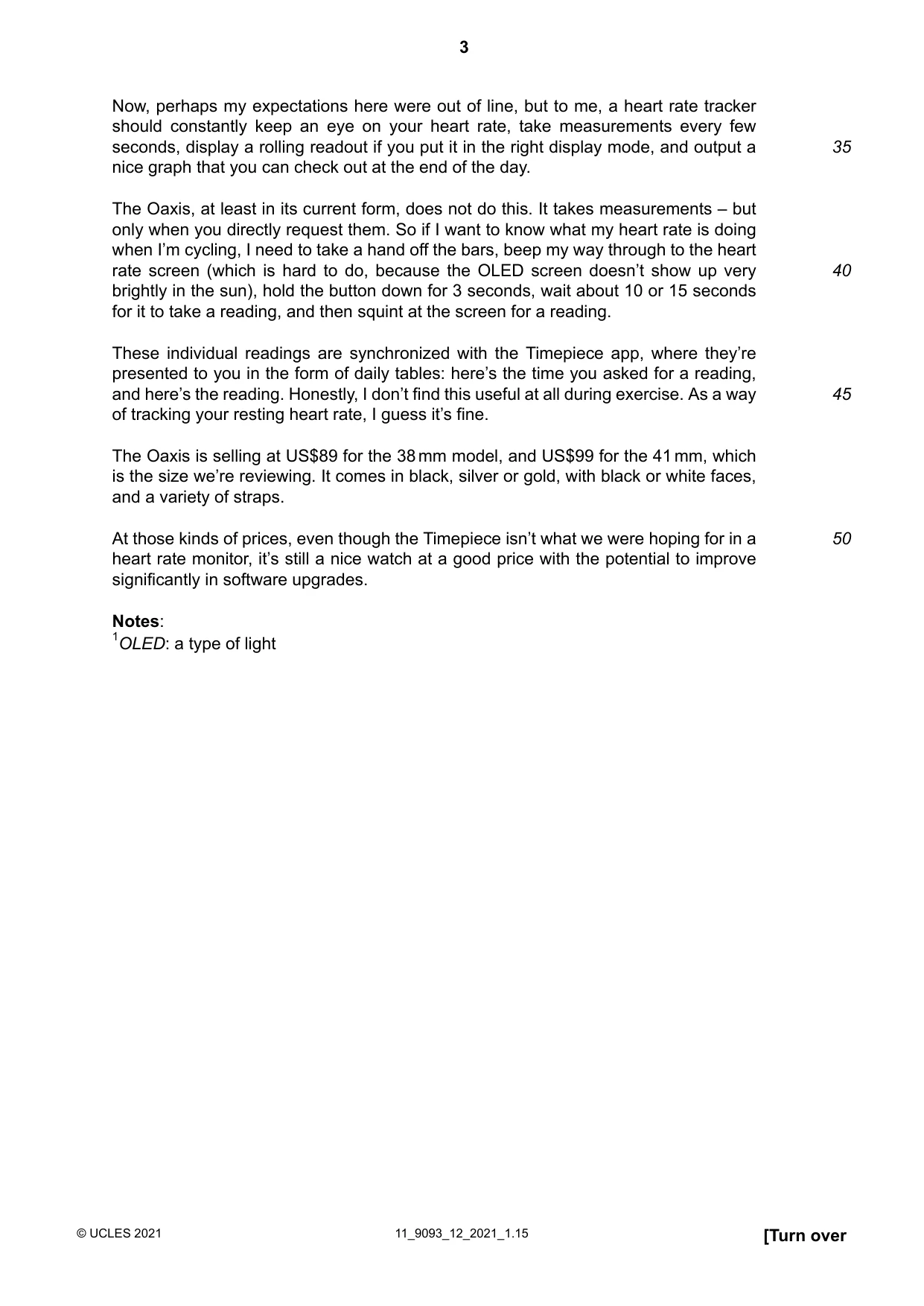
50 45 40 35 Now, perhaps my expectations here were out of line, but to me, a heart rate tracker should constantly keep an eye on your heart rate, take measurements every few seconds, display a rolling readout if you put it in the right display mode, and output a nice graph that you can check out at the end of the day. The Oaxis, at least in its current form, does not do this. It takes measurements – but only when you directly request them. So if I want to know what my heart rate is doing when I’m cycling, I need to take a hand off the bars, beep my way through to the heart rate screen (which is hard to do, because the OLED screen doesn’t show up very brightly in the sun), hold the button down for 3 seconds, wait about 10 or 15 seconds for it to take a reading, and then squint at the screen for a reading. These individual readings are synchronized with the Timepiece app, where they’re presented to you in the form of daily tables: here’s the time you asked for a reading, and here’s the reading. Honestly, I don’t find this useful at all during exercise. As a way of tracking your resting heart rate, I guess it’s fine. The Oaxis is selling at US$89 for the 38mm model, and US$99 for the 41mm, which is the size we’re reviewing. It comes in black, silver or gold, with black or white faces, and a variety of straps. At those kinds of prices, even though the Timepiece isn’t what we were hoping for in a heart rate monitor, it’s still a nice watch at a good price with the potential to improve significantly in software upgrades. Notes: 1OLED: a type of light [Turn over 11_9093_12_2021_1.15 © UCLES 2021 3
Question paper, page 4
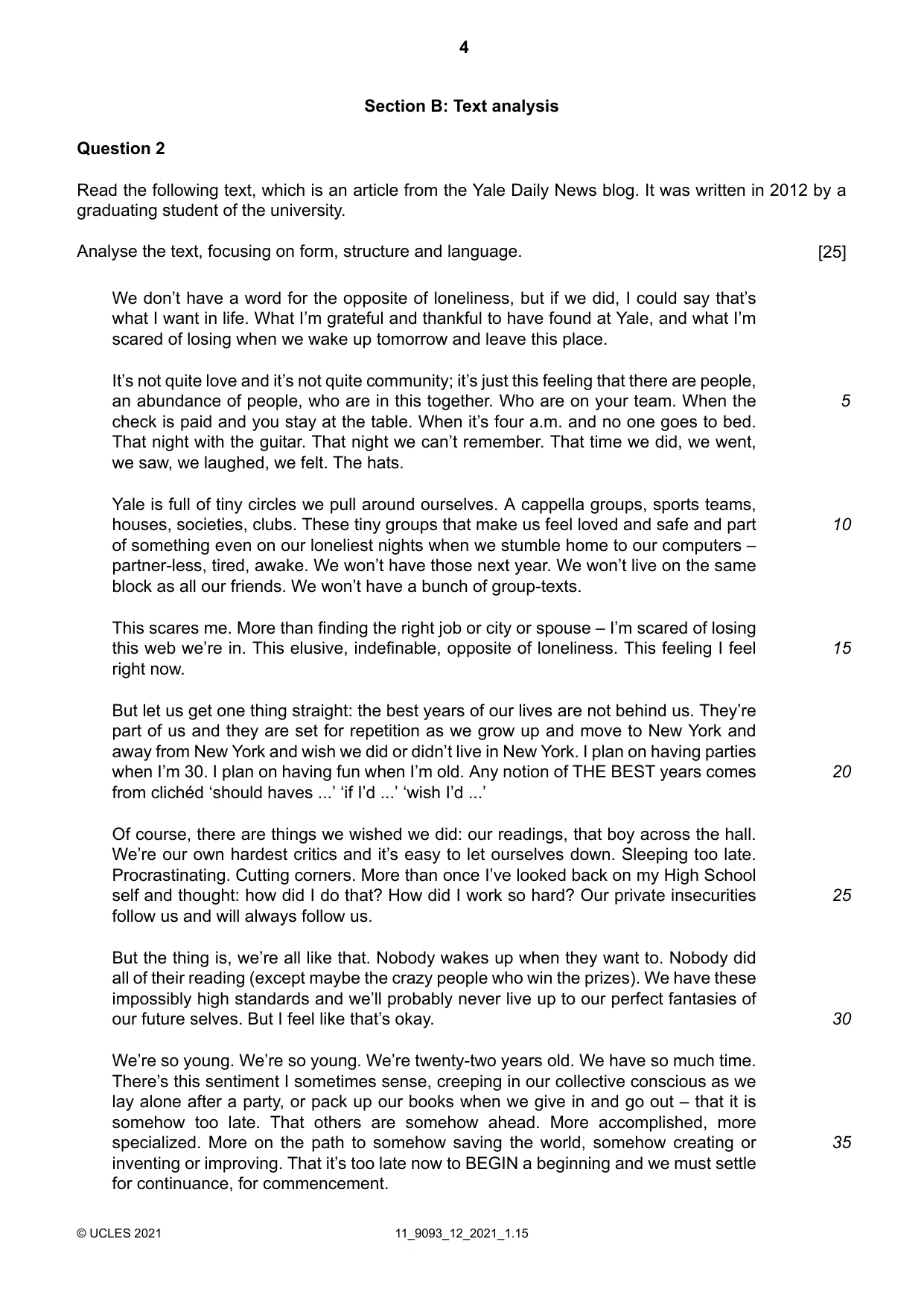
35 30 25 20 15 10 5 Section B: Text analysis Question 2 Read the following text, which is an article from the Yale Daily News blog. It was written in 2012 by a graduating student of the university. Analyse the text, focusing on form, structure and language. [25] We don’t have a word for the opposite of loneliness, but if we did, I could say that’s what I want in life. What I’m grateful and thankful to have found at Yale, and what I’m scared of losing when we wake up tomorrow and leave this place. It’s not quite love and it’s not quite community; it’s just this feeling that there are people, an abundance of people, who are in this together. Who are on your team. When the check is paid and you stay at the table. When it’s four a.m. and no one goes to bed. That night with the guitar. That night we can’t remember. That time we did, we went, we saw, we laughed, we felt. The hats. Yale is full of tiny circles we pull around ourselves. A cappella groups, sports teams, houses, societies, clubs. These tiny groups that make us feel loved and safe and part of something even on our loneliest nights when we stumble home to our computers – partner-less, tired, awake. We won’t have those next year. We won’t live on the same block as all our friends. We won’t have a bunch of group-texts. This scares me. More than finding the right job or city or spouse – I’m scared of losing this web we’re in. This elusive, indefinable, opposite of loneliness. This feeling I feel right now. But let us get one thing straight: the best years of our lives are not behind us. They’re part of us and they are set for repetition as we grow up and move to New York and away from New York and wish we did or didn’t live in New York. I plan on having parties when I’m 30. I plan on having fun when I’m old. Any notion of THE BEST years comes from clichéd ‘should haves ...’ ‘if I’d ...’ ‘wish I’d ...’ Of course, there are things we wished we did: our readings, that boy across the hall. We’re our own hardest critics and it’s easy to let ourselves down. Sleeping too late. Procrastinating. Cutting corners. More than once I’ve looked back on my High School self and thought: how did I do that? How did I work so hard? Our private insecurities follow us and will always follow us. But the thing is, we’re all like that. Nobody wakes up when they want to. Nobody did all of their reading (except maybe the crazy people who win the prizes). We have these impossibly high standards and we’ll probably never live up to our perfect fantasies of our future selves. But I feel like that’s okay. We’re so young. We’re so young. We’re twenty-two years old. We have so much time. There’s this sentiment I sometimes sense, creeping in our collective conscious as we lay alone after a party, or pack up our books when we give in and go out – that it is somehow too late. That others are somehow ahead. More accomplished, more specialized. More on the path to somehow saving the world, somehow creating or inventing or improving. That it’s too late now to BEGIN a beginning and we must settle for continuance, for commencement. 11_9093_12_2021_1.15 © UCLES 2021 4
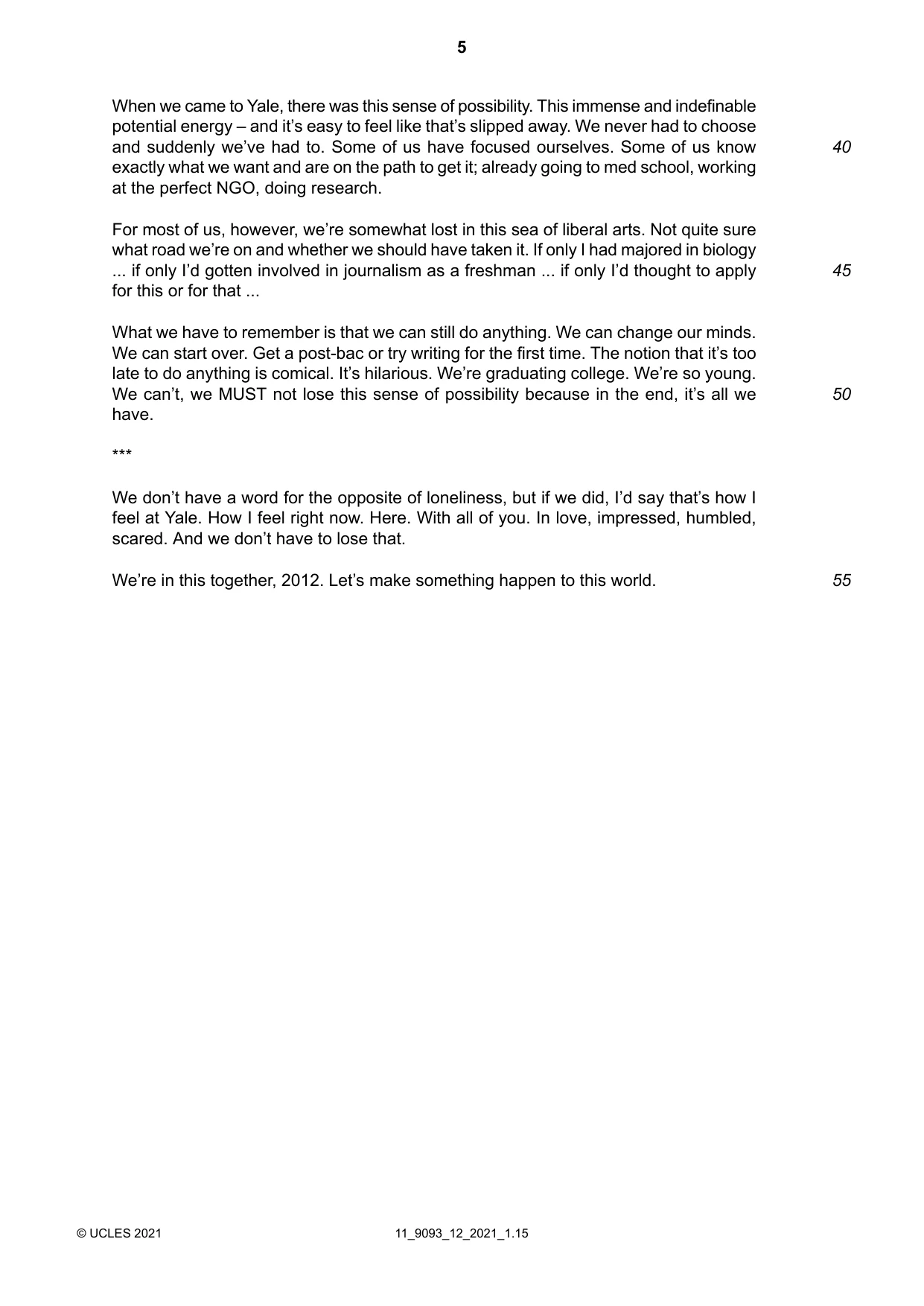
Question paper, page 5
55 50 45 40 When we came to Yale, there was this sense of possibility. This immense and indefinable potential energy – and it’s easy to feel like that’s slipped away. We never had to choose and suddenly we’ve had to. Some of us have focused ourselves. Some of us know exactly what we want and are on the path to get it; already going to med school, working at the perfect NGO, doing research. For most of us, however, we’re somewhat lost in this sea of liberal arts. Not quite sure what road we’re on and whether we should have taken it. If only I had majored in biology ... if only I’d gotten involved in journalism as a freshman ... if only I’d thought to apply for this or for that ... What we have to remember is that we can still do anything. We can change our minds. We can start over. Get a post-bac or try writing for the first time. The notion that it’s too late to do anything is comical. It’s hilarious. We’re graduating college. We’re so young. We can’t, we MUST not lose this sense of possibility because in the end, it’s all we have. *** We don’t have a word for the opposite of loneliness, but if we did, I’d say that’s how I feel at Yale. How I feel right now. Here. With all of you. In love, impressed, humbled, scared. And we don’t have to lose that. We’re in this together, 2012. Let’s make something happen to this world. 11_9093_12_2021_1.15 © UCLES 2021 5
Question paper, page 6
BLANK PAGE 11_9093_12_2021_1.15 © UCLES 2021 6
Question paper, page 7
BLANK PAGE 11_9093_12_2021_1.15 © UCLES 2021 7
Question paper, page 8
BLANK PAGE Permission to reproduce items where third-party owned material protected by copyright is included has been sought and cleared where possible. Every reasonable effort has been made by the publisher (UCLES) to trace copyright holders, but if any items requiring clearance have unwittingly been included, the publisher will be pleased to make amends at the earliest possible opportunity. To avoid the issue of disclosure of answer-related information to candidates, all copyright acknowledgements are reproduced online in the Cambridge Assessment International Education Copyright Acknowledgements Booklet. This is produced for each series of examinations and is freely available to download at www.cambridgeinternational.org after the live examination series. Cambridge Assessment International Education is part of the Cambridge Assessment Group. Cambridge Assessment is the brand name of the University of Cambridge Local Examinations Syndicate (UCLES), which itself is a department of the University of Cambridge. 11_9093_12_2021_1.15 © UCLES 2021 8
Mark scheme, page 1
This document consists of 15 printed pages. © UCLES 2021 [Turn over Cambridge International AS & A Level ENGLISH LANGUAGE 9093/12 Paper 1 Reading October/November 2021 MARK SCHEME Maximum Mark: 50 Published This mark scheme is published as an aid to teachers and candidates, to indicate the requirements of the examination. It shows the basis on which Examiners were instructed to award marks. It does not indicate the details of the discussions that took place at an Examiners’ meeting before marking began, which would have considered the acceptability of alternative answers. Mark schemes should be read in conjunction with the question paper and the Principal Examiner Report for Teachers. Cambridge International will not enter into discussions about these mark schemes. Cambridge International is publishing the mark schemes for the October/November 2021 series for most Cambridge IGCSE™, Cambridge International A and AS Level components and some Cambridge O Level components.
Mark scheme, page 2
9093/12 Cambridge International AS & A Level – Mark Scheme PUBLISHED October/November 2021 © UCLES 2021 Page 2 of 15 Generic Marking Principles These general marking principles must be applied by all examiners when marking candidate answers. They should be applied alongside the specific content of the mark scheme or generic level descriptors for a question. Each question paper and mark scheme will also comply with these marking principles. GENERIC MARKING PRINCIPLE 1: Marks must be awarded in line with: • the specific content of the mark scheme or the generic level descriptors for the question • the specific skills defined in the mark scheme or in the generic level descriptors for the question • the standard of response required by a candidate as exemplified by the standardisation scripts. GENERIC MARKING PRINCIPLE 2: Marks awarded are always whole marks (not half marks, or other fractions). GENERIC MARKING PRINCIPLE 3: Marks must be awarded positively: • marks are awarded for correct/valid answers, as defined in the mark scheme. However, credit is given for valid answers which go beyond the scope of the syllabus and mark scheme, referring to your Team Leader as appropriate • marks are awarded when candidates clearly demonstrate what they know and can do • marks are not deducted for errors • marks are not deducted for omissions • answers should only be judged on the quality of spelling, punctuation and grammar when these features are specifically assessed by the question as indicated by the mark scheme. The meaning, however, should be unambiguous. GENERIC MARKING PRINCIPLE 4: Rules must be applied consistently, e.g. in situations where candidates have not followed instructions or in the application of generic level descriptors.
Mark scheme, page 3
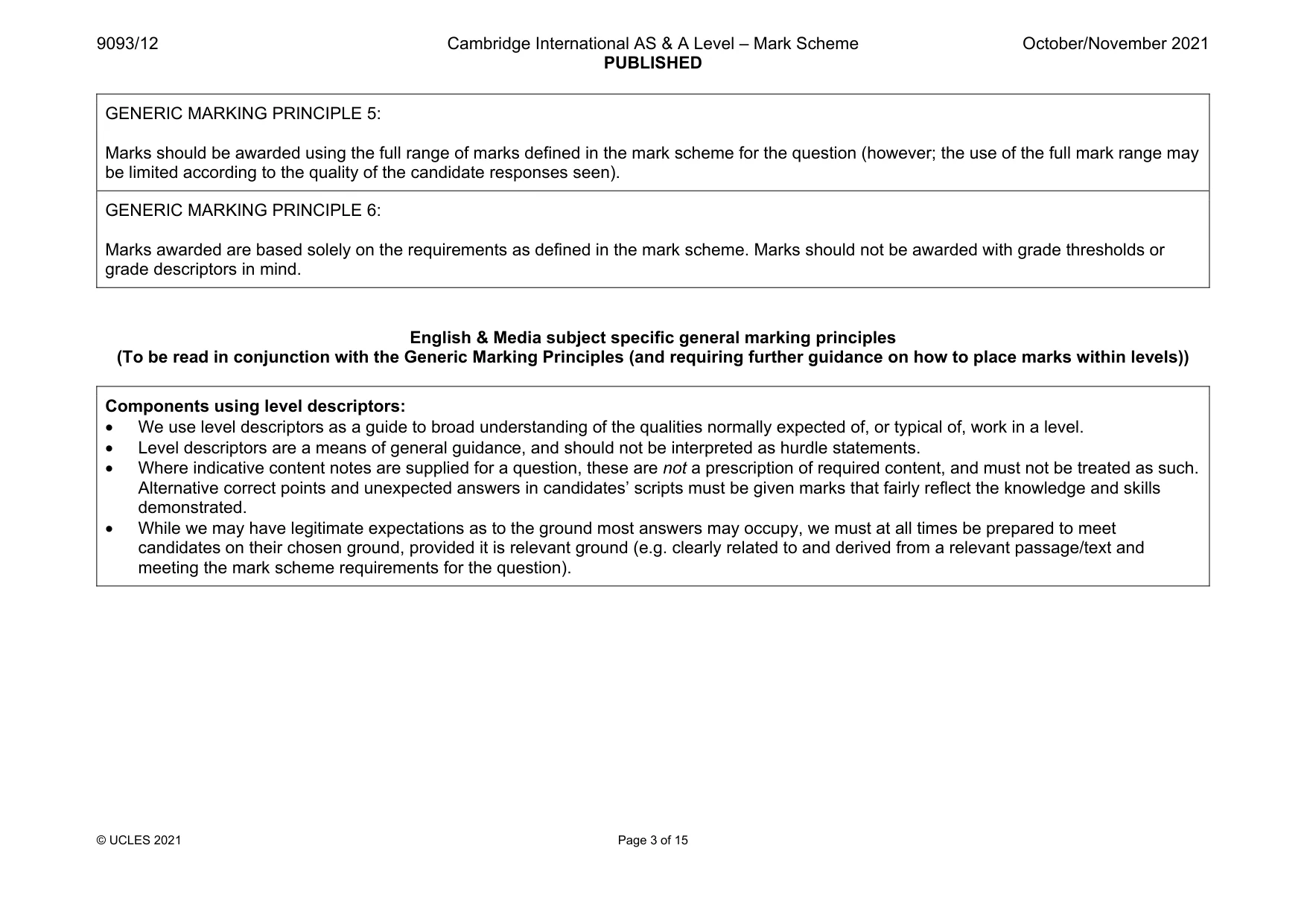
9093/12 Cambridge International AS & A Level – Mark Scheme PUBLISHED October/November 2021 © UCLES 2021 Page 3 of 15 GENERIC MARKING PRINCIPLE 5: Marks should be awarded using the full range of marks defined in the mark scheme for the question (however; the use of the full mark range may be limited according to the quality of the candidate responses seen). GENERIC MARKING PRINCIPLE 6: Marks awarded are based solely on the requirements as defined in the mark scheme. Marks should not be awarded with grade thresholds or grade descriptors in mind. English & Media subject specific general marking principles (To be read in conjunction with the Generic Marking Principles (and requiring further guidance on how to place marks within levels)) Components using level descriptors: • We use level descriptors as a guide to broad understanding of the qualities normally expected of, or typical of, work in a level. • Level descriptors are a means of general guidance, and should not be interpreted as hurdle statements. • Where indicative content notes are supplied for a question, these are not a prescription of required content, and must not be treated as such. Alternative correct points and unexpected answers in candidates’ scripts must be given marks that fairly reflect the knowledge and skills demonstrated. • While we may have legitimate expectations as to the ground most answers may occupy, we must at all times be prepared to meet candidates on their chosen ground, provided it is relevant ground (e.g. clearly related to and derived from a relevant passage/text and meeting the mark scheme requirements for the question).
Mark scheme, page 4
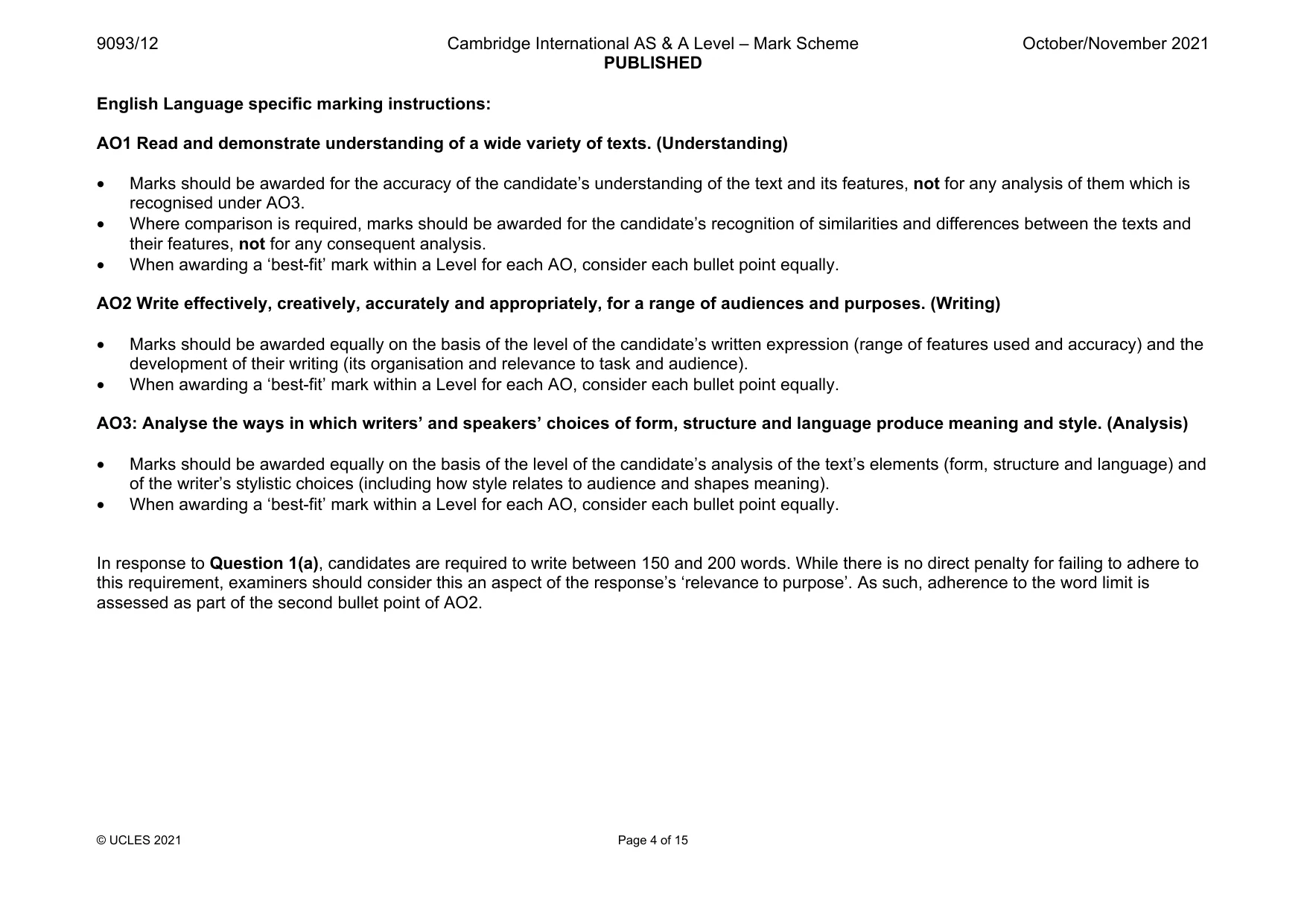
9093/12 Cambridge International AS & A Level – Mark Scheme PUBLISHED October/November 2021 © UCLES 2021 Page 4 of 15 English Language specific marking instructions: AO1 Read and demonstrate understanding of a wide variety of texts. (Understanding) • Marks should be awarded for the accuracy of the candidate’s understanding of the text and its features, not for any analysis of them which is recognised under AO3. • Where comparison is required, marks should be awarded for the candidate’s recognition of similarities and differences between the texts and their features, not for any consequent analysis. • When awarding a ‘best-fit’ mark within a Level for each AO, consider each bullet point equally. AO2 Write effectively, creatively, accurately and appropriately, for a range of audiences and purposes. (Writing) • Marks should be awarded equally on the basis of the level of the candidate’s written expression (range of features used and accuracy) and the development of their writing (its organisation and relevance to task and audience). • When awarding a ‘best-fit’ mark within a Level for each AO, consider each bullet point equally. AO3: Analyse the ways in which writers’ and speakers’ choices of form, structure and language produce meaning and style. (Analysis) • Marks should be awarded equally on the basis of the level of the candidate’s analysis of the text’s elements (form, structure and language) and of the writer’s stylistic choices (including how style relates to audience and shapes meaning). • When awarding a ‘best-fit’ mark within a Level for each AO, consider each bullet point equally. In response to Question 1(a), candidates are required to write between 150 and 200 words. While there is no direct penalty for failing to adhere to this requirement, examiners should consider this an aspect of the response’s ‘relevance to purpose’. As such, adherence to the word limit is assessed as part of the second bullet point of AO2.
Mark scheme, page 5
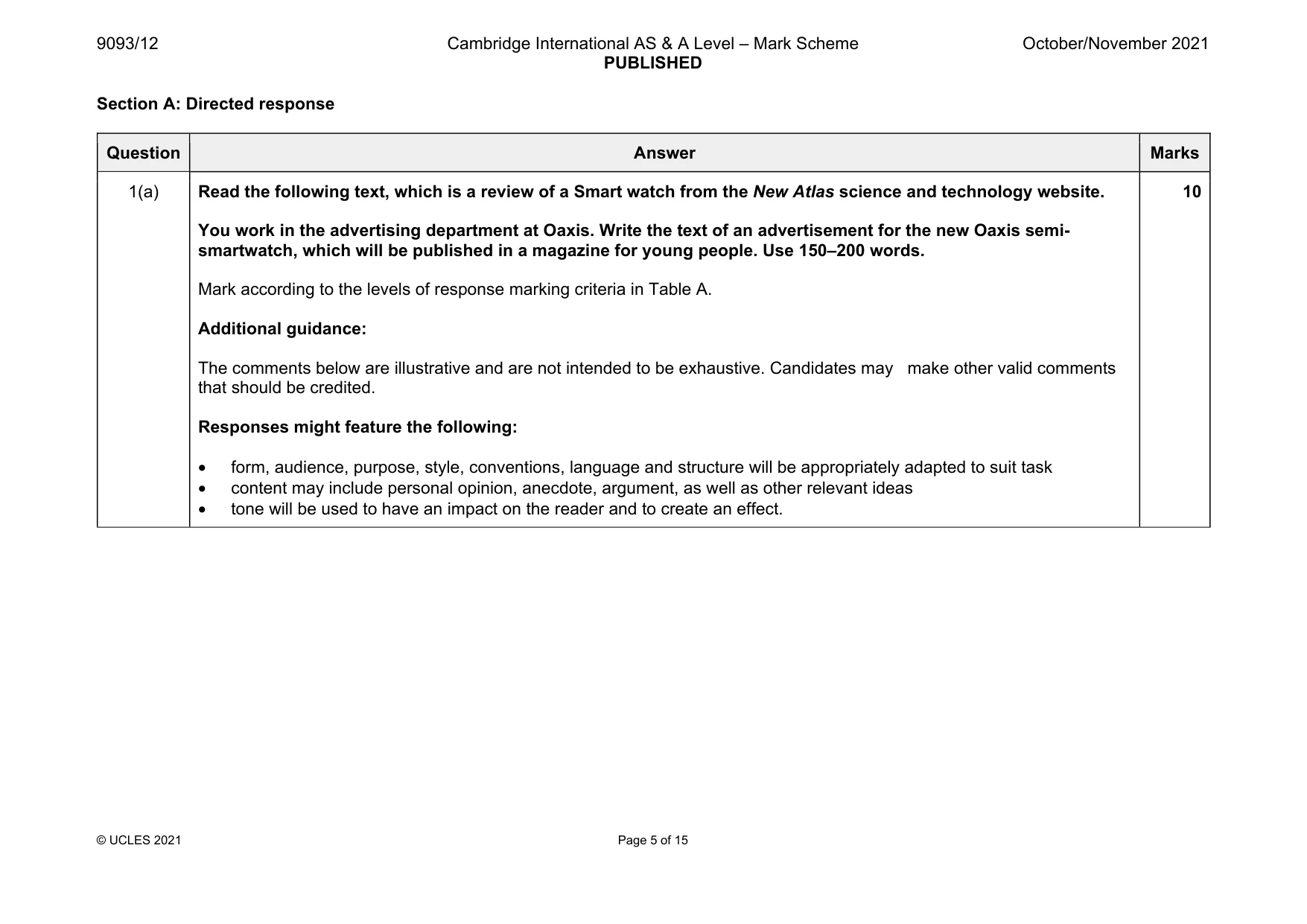
9093/12 Cambridge International AS & A Level – Mark Scheme PUBLISHED October/November 2021 © UCLES 2021 Page 5 of 15 Section A: Directed response Question Answer Marks 1(a) Read the following text, which is a review of a Smart watch from the New Atlas science and technology website. You work in the advertising department at Oaxis. Write the text of an advertisement for the new Oaxis semi- smartwatch, which will be published in a magazine for young people. Use 150–200 words. Mark according to the levels of response marking criteria in Table A. Additional guidance: The comments below are illustrative and are not intended to be exhaustive. Candidates may make other valid comments that should be credited. Responses might feature the following: • form, audience, purpose, style, conventions, language and structure will be appropriately adapted to suit task • content may include personal opinion, anecdote, argument, as well as other relevant ideas • tone will be used to have an impact on the reader and to create an effect. 10
Mark scheme, page 6
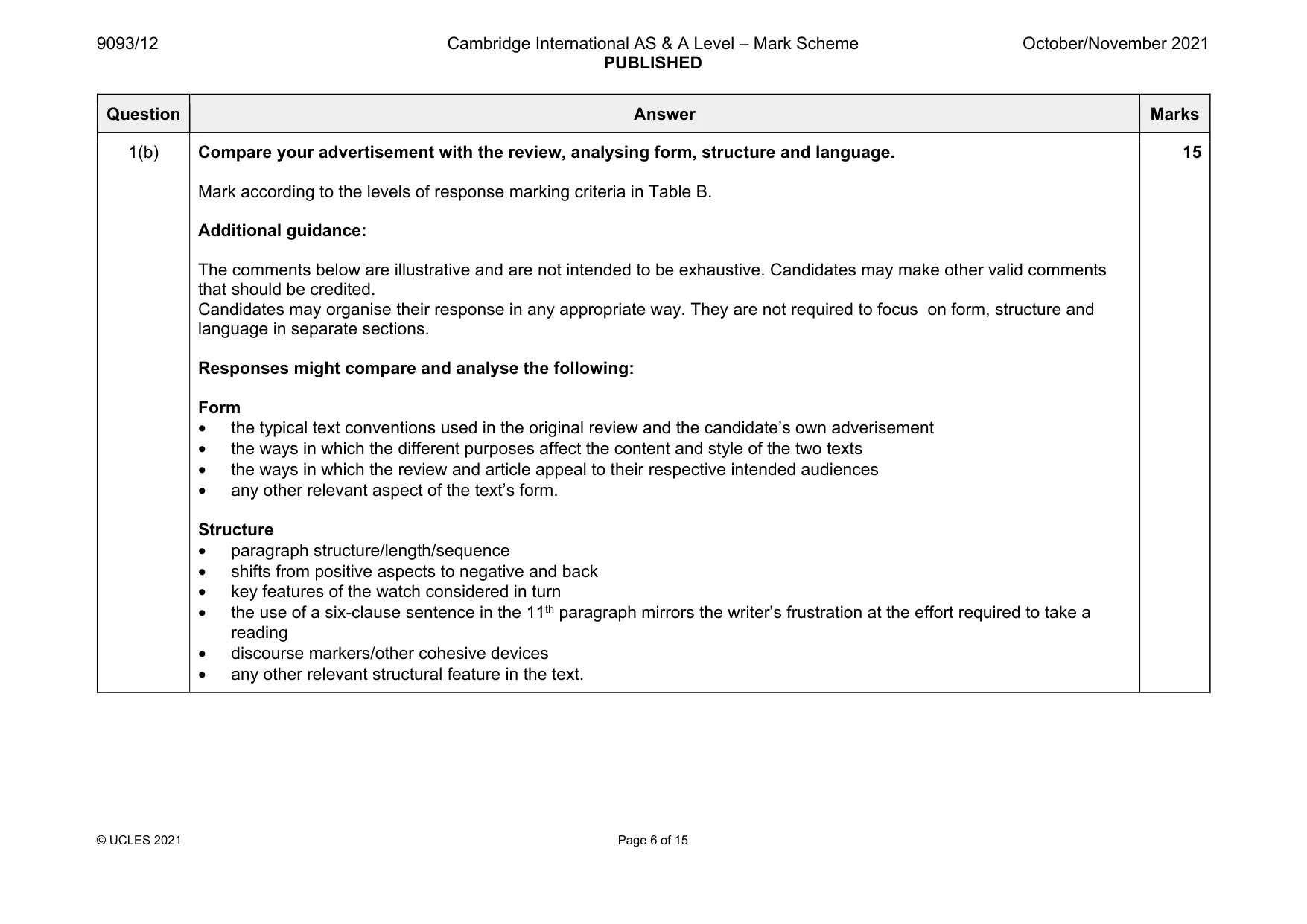
9093/12 Cambridge International AS & A Level – Mark Scheme PUBLISHED October/November 2021 © UCLES 2021 Page 6 of 15 Question Answer Marks 1(b) Compare your advertisement with the review, analysing form, structure and language. Mark according to the levels of response marking criteria in Table B. Additional guidance: The comments below are illustrative and are not intended to be exhaustive. Candidates may make other valid comments that should be credited. Candidates may organise their response in any appropriate way. They are not required to focus on form, structure and language in separate sections. Responses might compare and analyse the following: Form • the typical text conventions used in the original review and the candidate’s own adverisement • the ways in which the different purposes affect the content and style of the two texts • the ways in which the review and article appeal to their respective intended audiences • any other relevant aspect of the text’s form. Structure • paragraph structure/length/sequence • shifts from positive aspects to negative and back • key features of the watch considered in turn • the use of a six-clause sentence in the 11th paragraph mirrors the writer’s frustration at the effort required to take a reading • discourse markers/other cohesive devices • any other relevant structural feature in the text. 15
Mark scheme, page 7
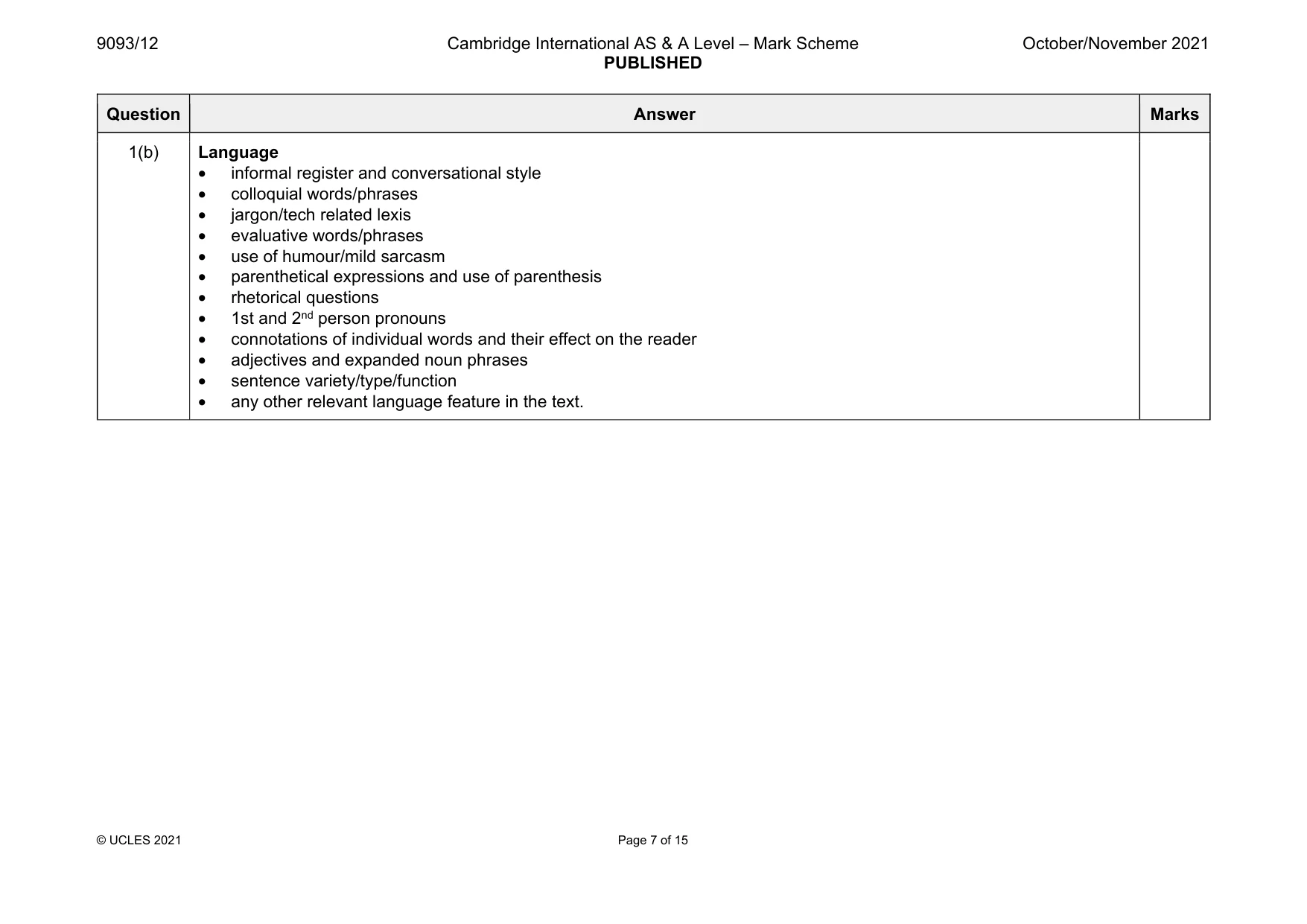
9093/12 Cambridge International AS & A Level – Mark Scheme PUBLISHED October/November 2021 © UCLES 2021 Page 7 of 15 Question Answer Marks 1(b) Language • informal register and conversational style • colloquial words/phrases • jargon/tech related lexis • evaluative words/phrases • use of humour/mild sarcasm • parenthetical expressions and use of parenthesis • rhetorical questions • 1st and 2nd person pronouns • connotations of individual words and their effect on the reader • adjectives and expanded noun phrases • sentence variety/type/function • any other relevant language feature in the text.
Mark scheme, page 8
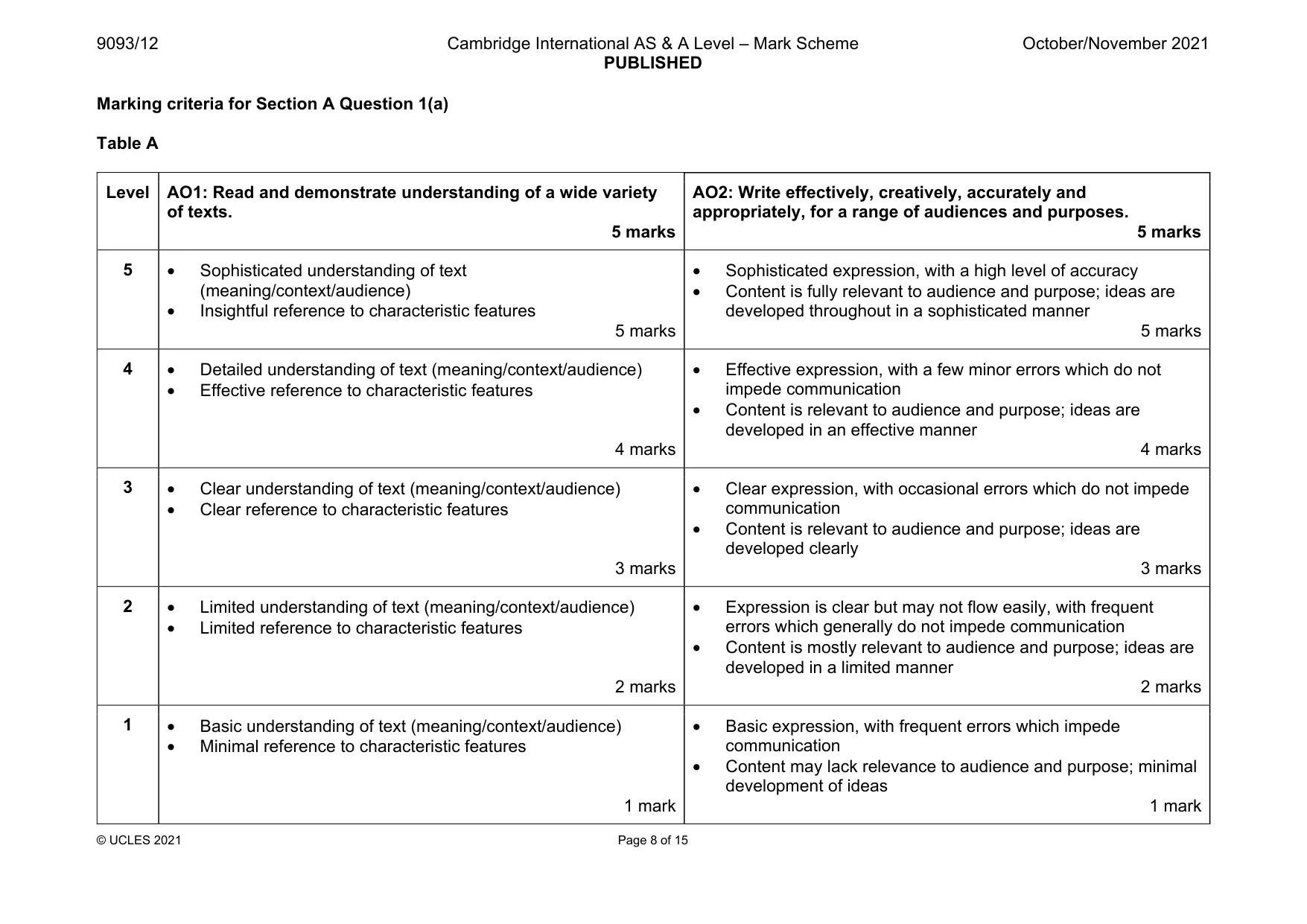
9093/12 Cambridge International AS & A Level – Mark Scheme PUBLISHED October/November 2021 © UCLES 2021 Page 8 of 15 Marking criteria for Section A Question 1(a) Table A Level AO1: Read and demonstrate understanding of a wide variety of texts. 5 marks AO2: Write effectively, creatively, accurately and appropriately, for a range of audiences and purposes. 5 marks 5 • Sophisticated understanding of text (meaning/context/audience) • Insightful reference to characteristic features 5 marks • Sophisticated expression, with a high level of accuracy • Content is fully relevant to audience and purpose; ideas are developed throughout in a sophisticated manner 5 marks 4 • Detailed understanding of text (meaning/context/audience) • Effective reference to characteristic features 4 marks • Effective expression, with a few minor errors which do not impede communication • Content is relevant to audience and purpose; ideas are developed in an effective manner 4 marks 3 • Clear understanding of text (meaning/context/audience) • Clear reference to characteristic features 3 marks • Clear expression, with occasional errors which do not impede communication • Content is relevant to audience and purpose; ideas are developed clearly 3 marks 2 • Limited understanding of text (meaning/context/audience) • Limited reference to characteristic features 2 marks • Expression is clear but may not flow easily, with frequent errors which generally do not impede communication • Content is mostly relevant to audience and purpose; ideas are developed in a limited manner 2 marks 1 • Basic understanding of text (meaning/context/audience) • Minimal reference to characteristic features 1 mark • Basic expression, with frequent errors which impede communication • Content may lack relevance to audience and purpose; minimal development of ideas 1 mark
Mark scheme, page 9
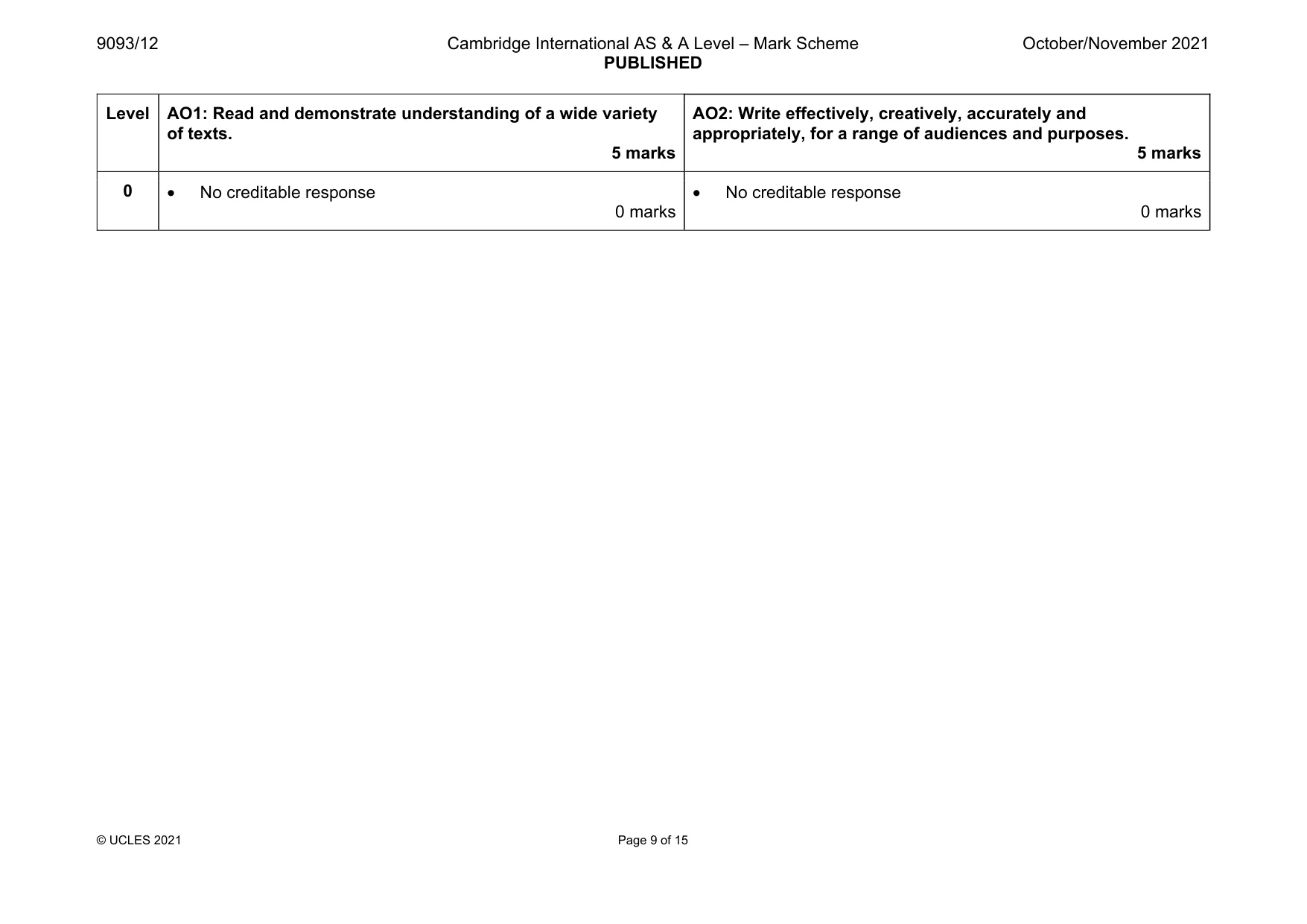
9093/12 Cambridge International AS & A Level – Mark Scheme PUBLISHED October/November 2021 © UCLES 2021 Page 9 of 15 Level AO1: Read and demonstrate understanding of a wide variety of texts. 5 marks AO2: Write effectively, creatively, accurately and appropriately, for a range of audiences and purposes. 5 marks 0 • No creditable response 0 marks • No creditable response 0 marks
Mark scheme, page 10
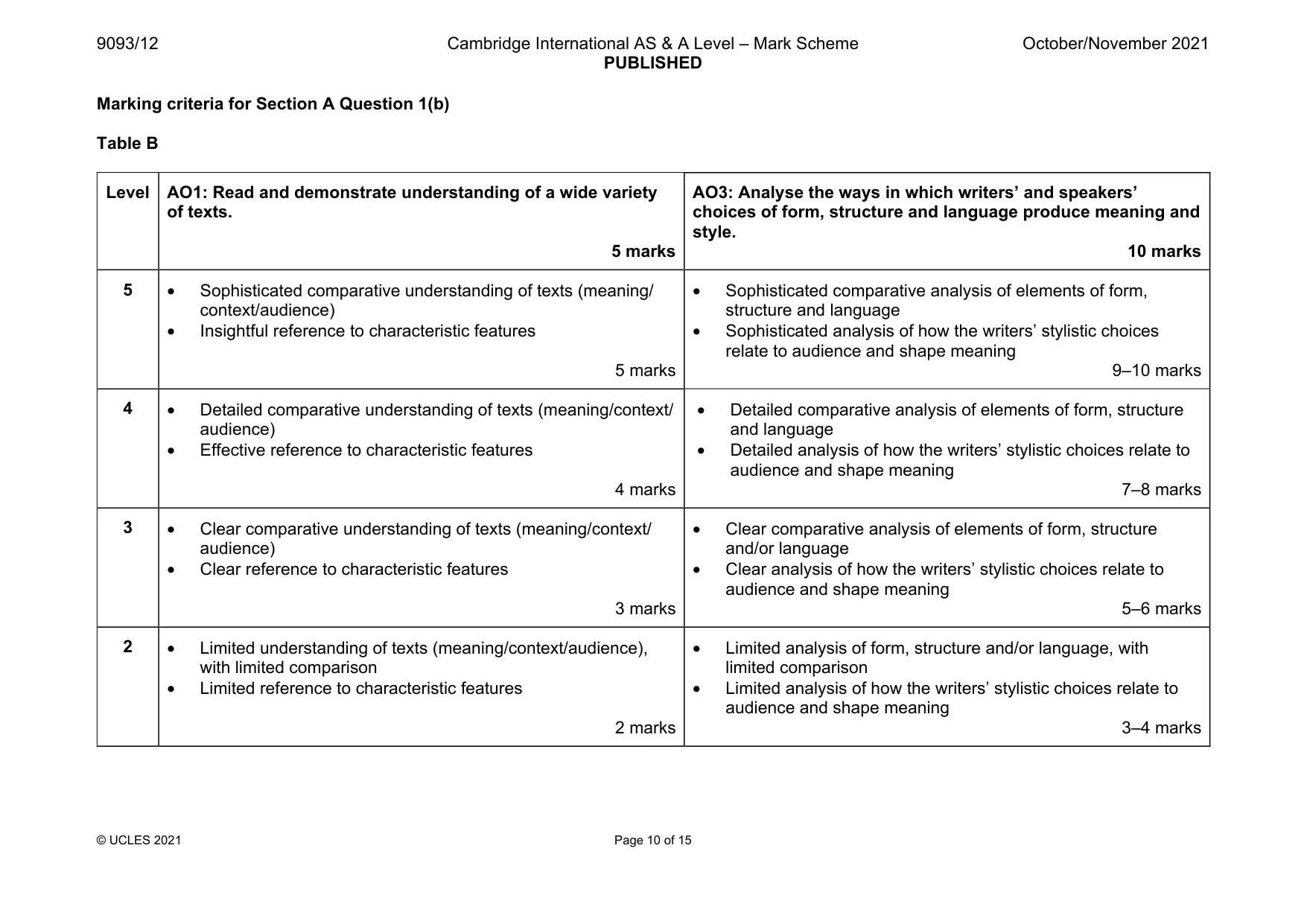
9093/12 Cambridge International AS & A Level – Mark Scheme PUBLISHED October/November 2021 © UCLES 2021 Page 10 of 15 Marking criteria for Section A Question 1(b) Table B Level AO1: Read and demonstrate understanding of a wide variety of texts. 5 marks AO3: Analyse the ways in which writers’ and speakers’ choices of form, structure and language produce meaning and style. 10 marks 5 • Sophisticated comparative understanding of texts (meaning/ context/audience) • Insightful reference to characteristic features 5 marks • Sophisticated comparative analysis of elements of form, structure and language • Sophisticated analysis of how the writers’ stylistic choices relate to audience and shape meaning 9–10 marks 4 • Detailed comparative understanding of texts (meaning/context/ audience) • Effective reference to characteristic features 4 marks • Detailed comparative analysis of elements of form, structure and language • Detailed analysis of how the writers’ stylistic choices relate to audience and shape meaning 7–8 marks 3 • Clear comparative understanding of texts (meaning/context/ audience) • Clear reference to characteristic features 3 marks • Clear comparative analysis of elements of form, structure and/or language • Clear analysis of how the writers’ stylistic choices relate to audience and shape meaning 5–6 marks 2 • Limited understanding of texts (meaning/context/audience), with limited comparison • Limited reference to characteristic features 2 marks • Limited analysis of form, structure and/or language, with limited comparison • Limited analysis of how the writers’ stylistic choices relate to audience and shape meaning 3–4 marks
Mark scheme, page 11
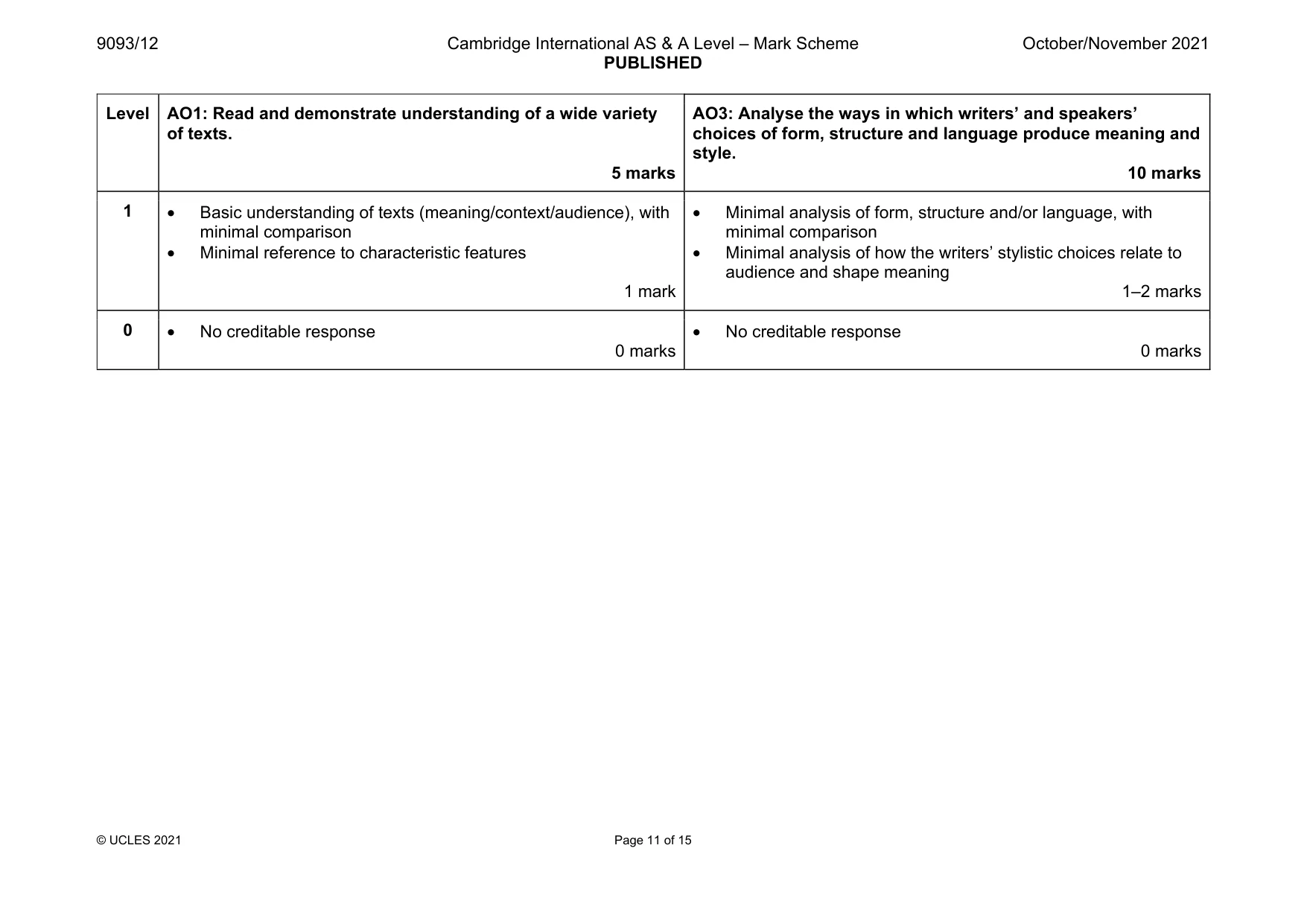
9093/12 Cambridge International AS & A Level – Mark Scheme PUBLISHED October/November 2021 © UCLES 2021 Page 11 of 15 Level AO1: Read and demonstrate understanding of a wide variety of texts. 5 marks AO3: Analyse the ways in which writers’ and speakers’ choices of form, structure and language produce meaning and style. 10 marks 1 • Basic understanding of texts (meaning/context/audience), with minimal comparison • Minimal reference to characteristic features 1 mark • Minimal analysis of form, structure and/or language, with minimal comparison • Minimal analysis of how the writers’ stylistic choices relate to audience and shape meaning 1–2 marks 0 • No creditable response 0 marks • No creditable response 0 marks
Mark scheme, page 12
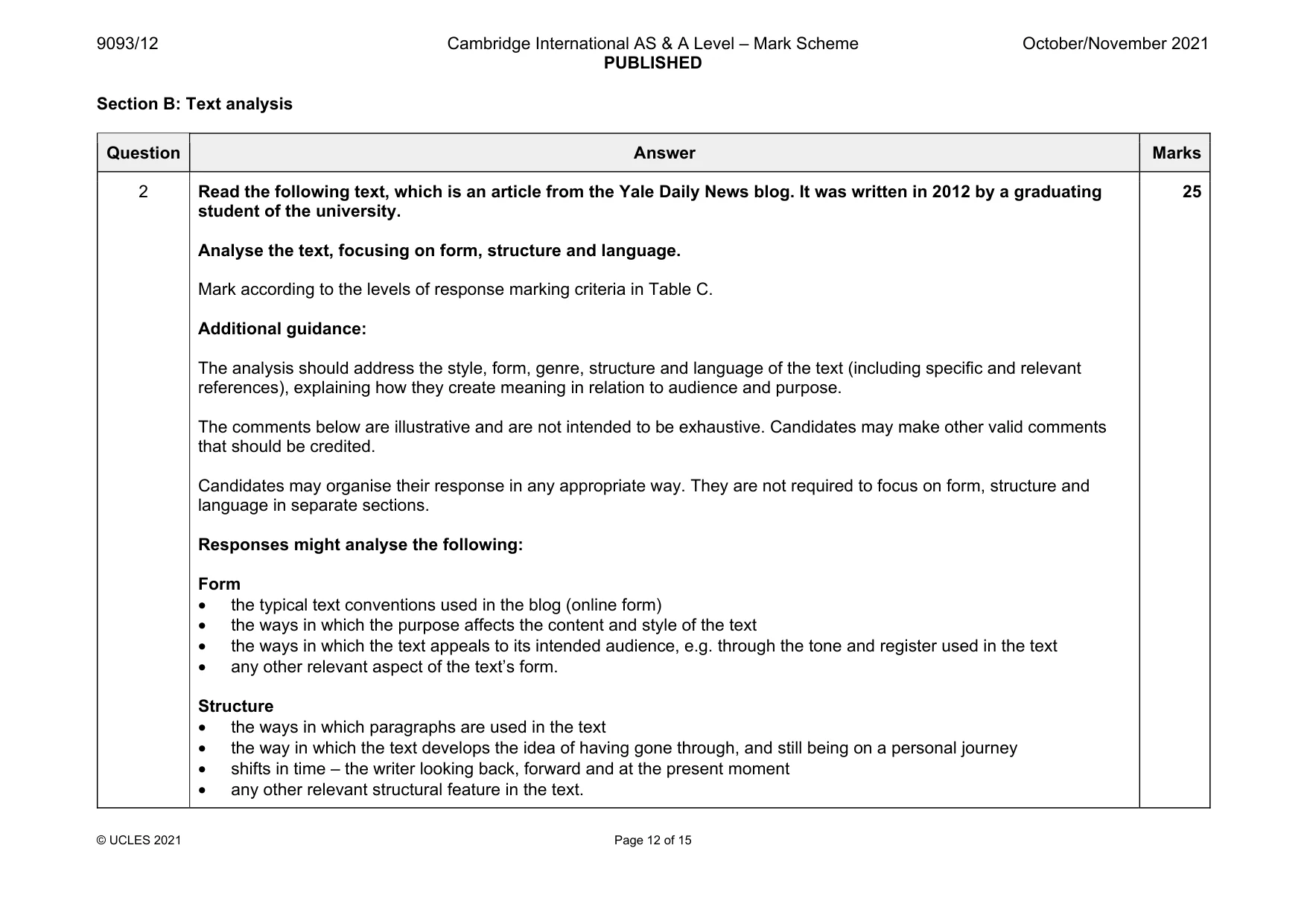
9093/12 Cambridge International AS & A Level – Mark Scheme PUBLISHED October/November 2021 © UCLES 2021 Page 12 of 15 Section B: Text analysis Question Answer Marks 2 Read the following text, which is an article from the Yale Daily News blog. It was written in 2012 by a graduating student of the university. Analyse the text, focusing on form, structure and language. Mark according to the levels of response marking criteria in Table C. Additional guidance: The analysis should address the style, form, genre, structure and language of the text (including specific and relevant references), explaining how they create meaning in relation to audience and purpose. The comments below are illustrative and are not intended to be exhaustive. Candidates may make other valid comments that should be credited. Candidates may organise their response in any appropriate way. They are not required to focus on form, structure and language in separate sections. Responses might analyse the following: Form • the typical text conventions used in the blog (online form) • the ways in which the purpose affects the content and style of the text • the ways in which the text appeals to its intended audience, e.g. through the tone and register used in the text • any other relevant aspect of the text’s form. Structure • the ways in which paragraphs are used in the text • the way in which the text develops the idea of having gone through, and still being on a personal journey • shifts in time – the writer looking back, forward and at the present moment • any other relevant structural feature in the text. 25
Mark scheme, page 13
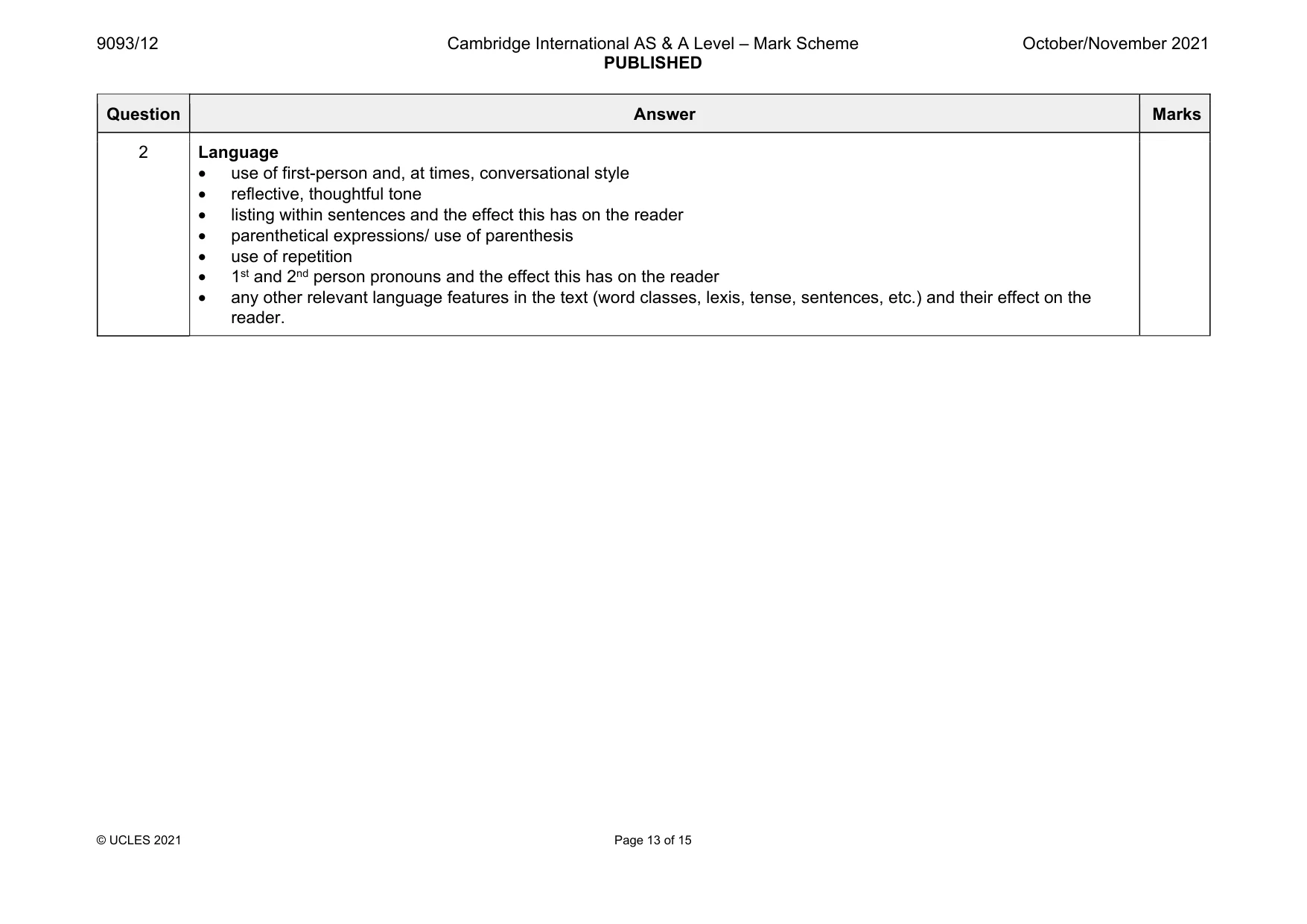
9093/12 Cambridge International AS & A Level – Mark Scheme PUBLISHED October/November 2021 © UCLES 2021 Page 13 of 15 Question Answer Marks 2 Language • use of first-person and, at times, conversational style • reflective, thoughtful tone • listing within sentences and the effect this has on the reader • parenthetical expressions/ use of parenthesis • use of repetition • 1st and 2nd person pronouns and the effect this has on the reader • any other relevant language features in the text (word classes, lexis, tense, sentences, etc.) and their effect on the reader.
Mark scheme, page 14
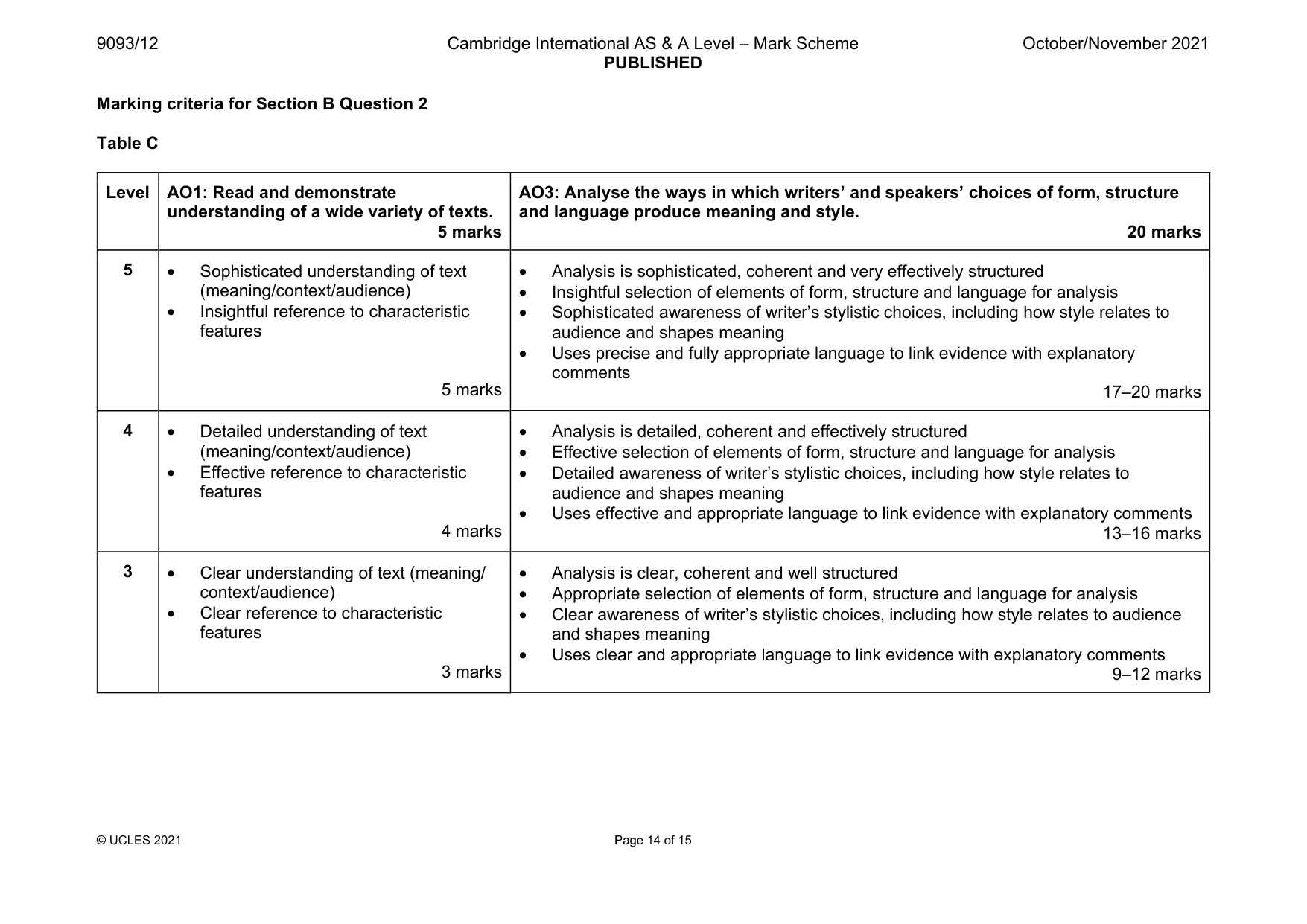
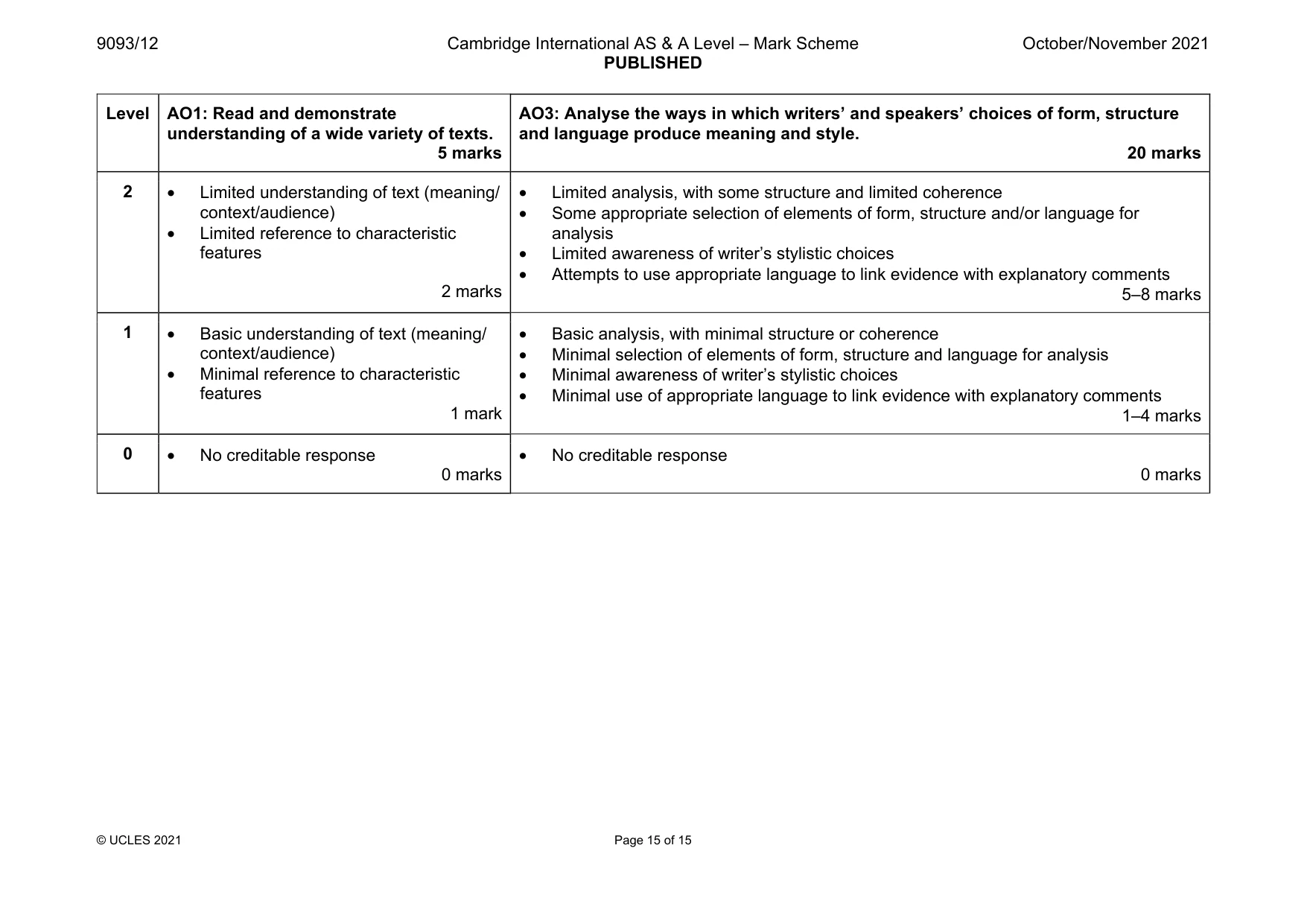
9093/12 Cambridge International AS & A Level – Mark Scheme PUBLISHED October/November 2021 © UCLES 2021 Page 14 of 15 Marking criteria for Section B Question 2 Table C Level AO1: Read and demonstrate understanding of a wide variety of texts. 5 marks AO3: Analyse the ways in which writers’ and speakers’ choices of form, structure and language produce meaning and style. 20 marks 5 • Sophisticated understanding of text (meaning/context/audience) • Insightful reference to characteristic features 5 marks • Analysis is sophisticated, coherent and very effectively structured • Insightful selection of elements of form, structure and language for analysis • Sophisticated awareness of writer’s stylistic choices, including how style relates to audience and shapes meaning • Uses precise and fully appropriate language to link evidence with explanatory comments 17–20 marks 4 • Detailed understanding of text (meaning/context/audience) • Effective reference to characteristic features 4 marks • Analysis is detailed, coherent and effectively structured • Effective selection of elements of form, structure and language for analysis • Detailed awareness of writer’s stylistic choices, including how style relates to audience and shapes meaning • Uses effective and appropriate language to link evidence with explanatory comments 13–16 marks 3 • Clear understanding of text (meaning/ context/audience) • Clear reference to characteristic features 3 marks • Analysis is clear, coherent and well structured • Appropriate selection of elements of form, structure and language for analysis • Clear awareness of writer’s stylistic choices, including how style relates to audience and shapes meaning • Uses clear and appropriate language to link evidence with explanatory comments 9–12 marks
Mark scheme, page 15
9093/12 Cambridge International AS & A Level – Mark Scheme PUBLISHED October/November 2021 © UCLES 2021 Page 15 of 15 Level AO1: Read and demonstrate understanding of a wide variety of texts. 5 marks AO3: Analyse the ways in which writers’ and speakers’ choices of form, structure and language produce meaning and style. 20 marks 2 • Limited understanding of text (meaning/ context/audience) • Limited reference to characteristic features 2 marks • Limited analysis, with some structure and limited coherence • Some appropriate selection of elements of form, structure and/or language for analysis • Limited awareness of writer’s stylistic choices • Attempts to use appropriate language to link evidence with explanatory comments 5–8 marks 1 • Basic understanding of text (meaning/ context/audience) • Minimal reference to characteristic features 1 mark • Basic analysis, with minimal structure or coherence • Minimal selection of elements of form, structure and language for analysis • Minimal awareness of writer’s stylistic choices • Minimal use of appropriate language to link evidence with explanatory comments 1–4 marks 0 • No creditable response 0 marks • No creditable response 0 marks
What you needed in this session
Cambridge’s own grade thresholds for 2021 Oct/Nov, Paper 1 · Variant 2. A higher threshold means an easier paper — the bar moves with how the cohort did.