Cambridge A Level English - Language AS and A Level (from 2014) 9093 — 2024 Oct/Nov Paper 1 · Variant 1
9093/11/O/N/24 · 50 marks · 135 min
The question paper and its mark scheme, free to read here and free to download. This is Cambridge’s own paper, exactly as it was sat.
Question paper8 pages
Mark scheme16 pages
Answers below. Sit the paper first if you are practising.
Paper as text
Question paper, page 1
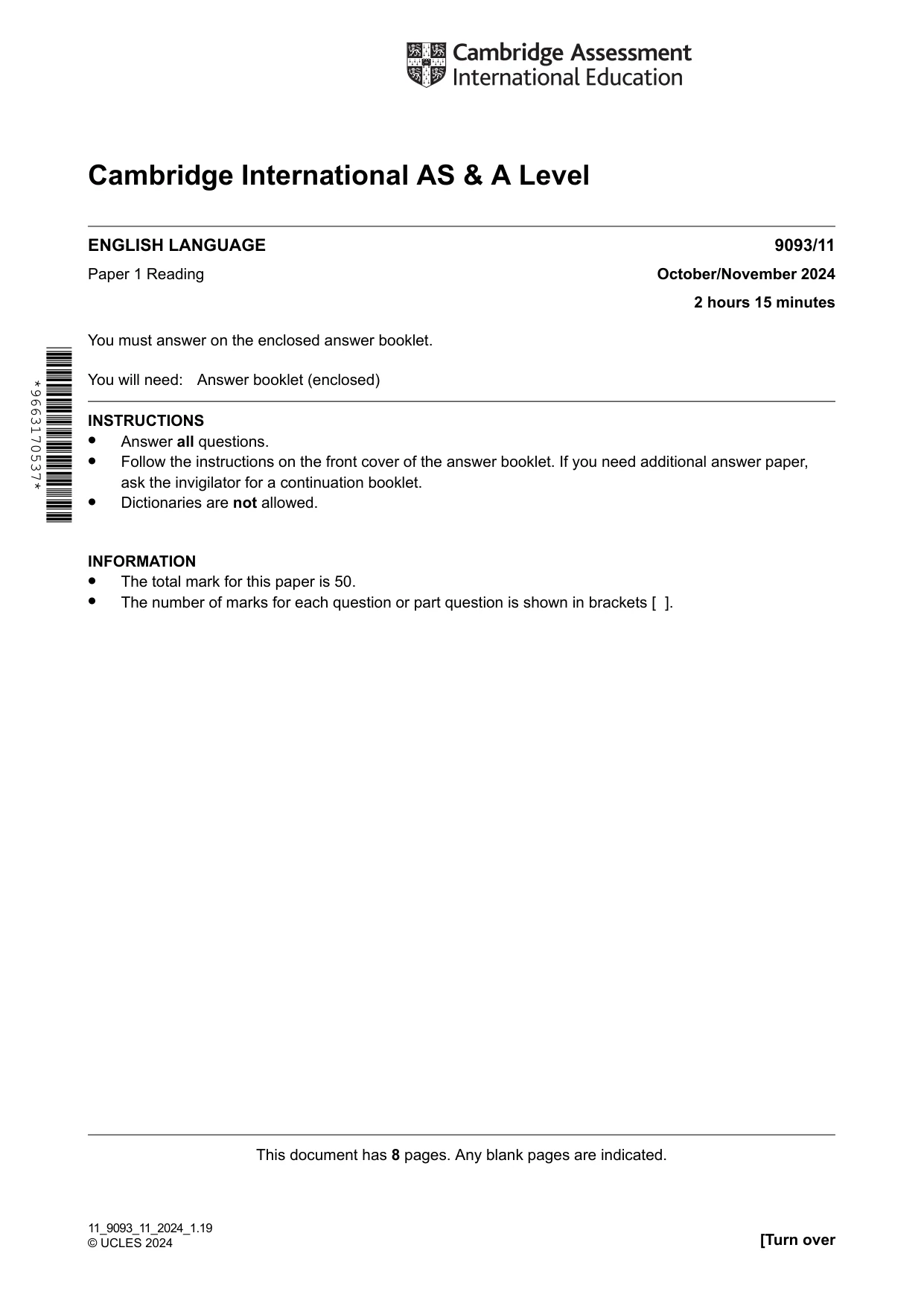
Cambridge International AS & A Level 9093/11 October/November 2024 2 hours 15 minutes ENGLISH LANGUAGE Paper 1 Reading You must answer on the enclosed answer booklet. You will need: Answer booklet (enclosed) INSTRUCTIONS • Answer all questions. • Follow the instructions on the front cover of the answer booklet. If you need additional answer paper, ask the invigilator for a continuation booklet. • Dictionaries are not allowed. INFORMATION • The total mark for this paper is 50. • The number of marks for each question or part question is shown in brackets [ ]. This document has 8 pages. Any blank pages are indicated. [Turn over 11_9093_11_2024_1.19 © UCLES 2024 *9663170537*
Question paper, page 2
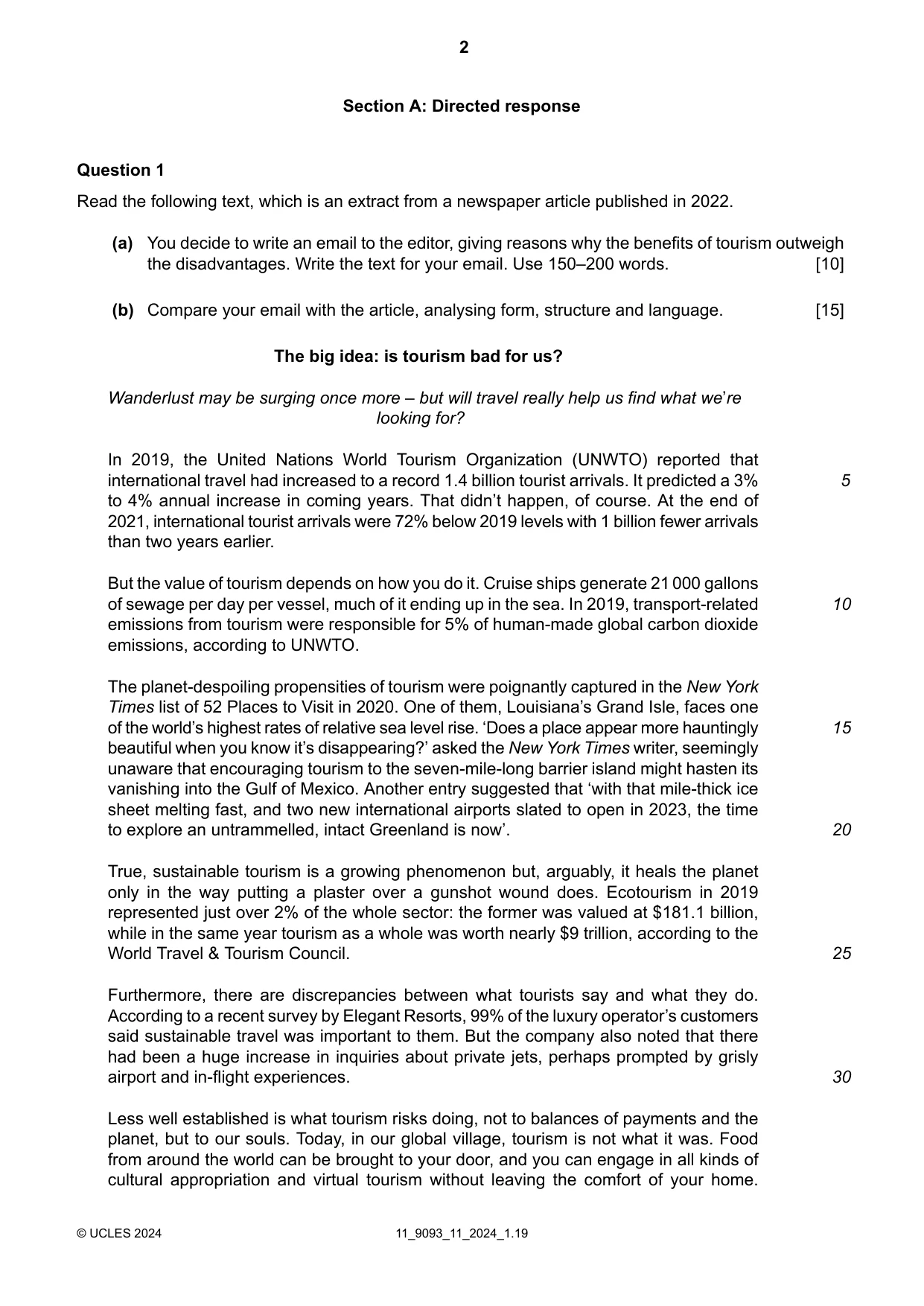
30 25 20 15 10 5 Section A: Directed response Question 1 Read the following text, which is an extract from a newspaper article published in 2022. You decide to write an email to the editor, giving reasons why the benefits of tourism outweigh the disadvantages. Write the text for your email. Use 150–200 words. [10] (a) Compare your email with the article, analysing form, structure and language. [15] (b) The big idea: is tourism bad for us? Wanderlust may be surging once more – but will travel really help us find what we’re looking for? In 2019, the United Nations World Tourism Organization (UNWTO) reported that international travel had increased to a record 1.4 billion tourist arrivals. It predicted a 3% to 4% annual increase in coming years. That didn’t happen, of course. At the end of 2021, international tourist arrivals were 72% below 2019 levels with 1 billion fewer arrivals than two years earlier. But the value of tourism depends on how you do it. Cruise ships generate 21000 gallons of sewage per day per vessel, much of it ending up in the sea. In 2019, transport-related emissions from tourism were responsible for 5% of human-made global carbon dioxide emissions, according to UNWTO. The planet-despoiling propensities of tourism were poignantly captured in the New York Times list of 52 Places to Visit in 2020. One of them, Louisiana’s Grand Isle, faces one of the world’s highest rates of relative sea level rise. ‘Does a place appear more hauntingly beautiful when you know it’s disappearing?’ asked the New York Times writer, seemingly unaware that encouraging tourism to the seven-mile-long barrier island might hasten its vanishing into the Gulf of Mexico. Another entry suggested that ‘with that mile-thick ice sheet melting fast, and two new international airports slated to open in 2023, the time to explore an untrammelled, intact Greenland is now’. True, sustainable tourism is a growing phenomenon but, arguably, it heals the planet only in the way putting a plaster over a gunshot wound does. Ecotourism in 2019 represented just over 2% of the whole sector: the former was valued at $181.1 billion, while in the same year tourism as a whole was worth nearly $9 trillion, according to the World Travel & Tourism Council. Furthermore, there are discrepancies between what tourists say and what they do. According to a recent survey by Elegant Resorts, 99% of the luxury operator’s customers said sustainable travel was important to them. But the company also noted that there had been a huge increase in inquiries about private jets, perhaps prompted by grisly airport and in-flight experiences. Less well established is what tourism risks doing, not to balances of payments and the planet, but to our souls. Today, in our global village, tourism is not what it was. Food from around the world can be brought to your door, and you can engage in all kinds of cultural appropriation and virtual tourism without leaving the comfort of your home. 11_9093_11_2024_1.19 © UCLES 2024 2
Question paper, page 3
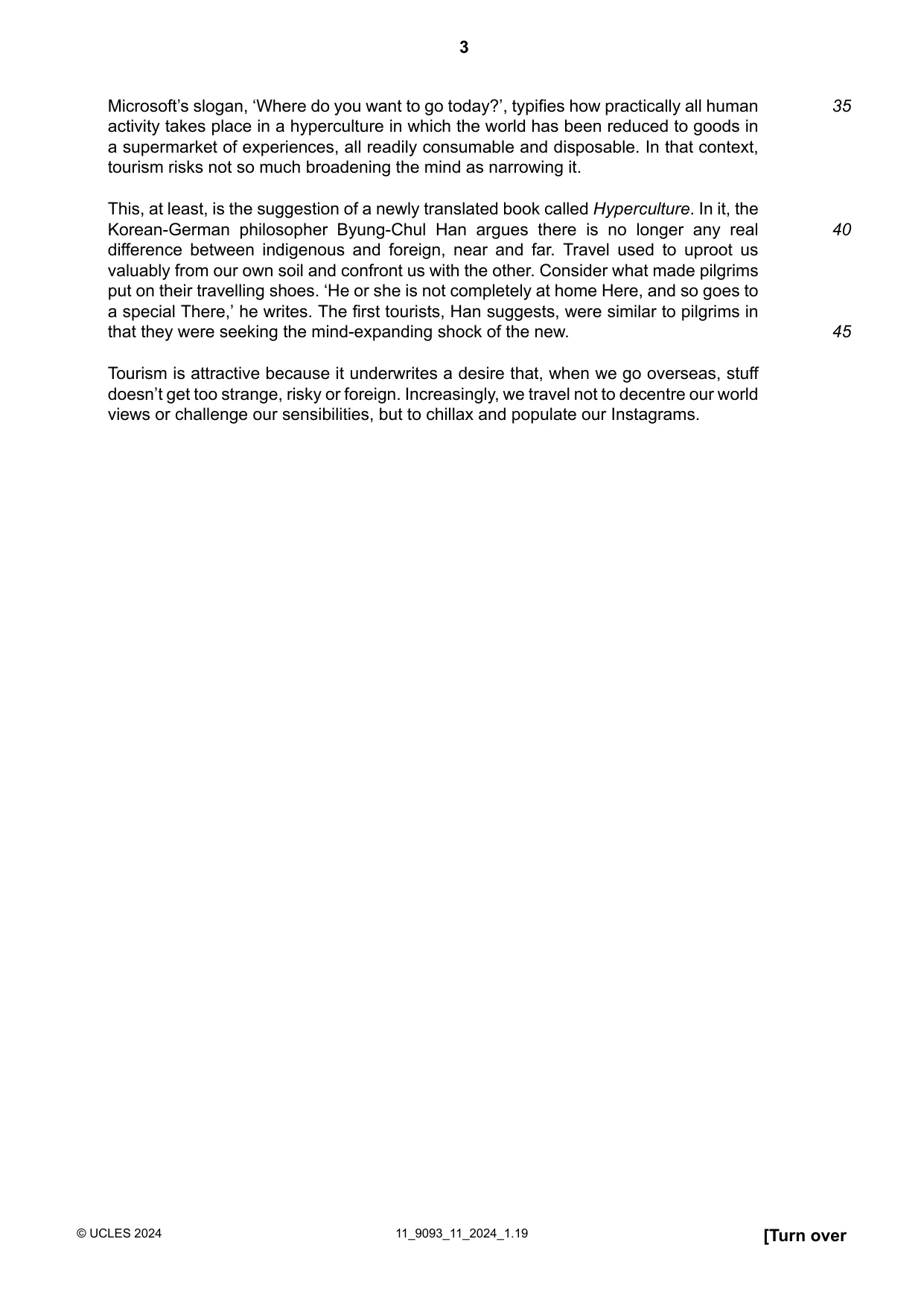
45 40 35 Microsoft’s slogan, ‘Where do you want to go today?’, typifies how practically all human activity takes place in a hyperculture in which the world has been reduced to goods in a supermarket of experiences, all readily consumable and disposable. In that context, tourism risks not so much broadening the mind as narrowing it. This, at least, is the suggestion of a newly translated book called Hyperculture. In it, the Korean-German philosopher Byung-Chul Han argues there is no longer any real difference between indigenous and foreign, near and far. Travel used to uproot us valuably from our own soil and confront us with the other. Consider what made pilgrims put on their travelling shoes. ‘He or she is not completely at home Here, and so goes to a special There,’ he writes. The first tourists, Han suggests, were similar to pilgrims in that they were seeking the mind-expanding shock of the new. Tourism is attractive because it underwrites a desire that, when we go overseas, stuff doesn’t get too strange, risky or foreign. Increasingly, we travel not to decentre our world views or challenge our sensibilities, but to chillax and populate our Instagrams. [Turn over 11_9093_11_2024_1.19 © UCLES 2024 3
Question paper, page 4
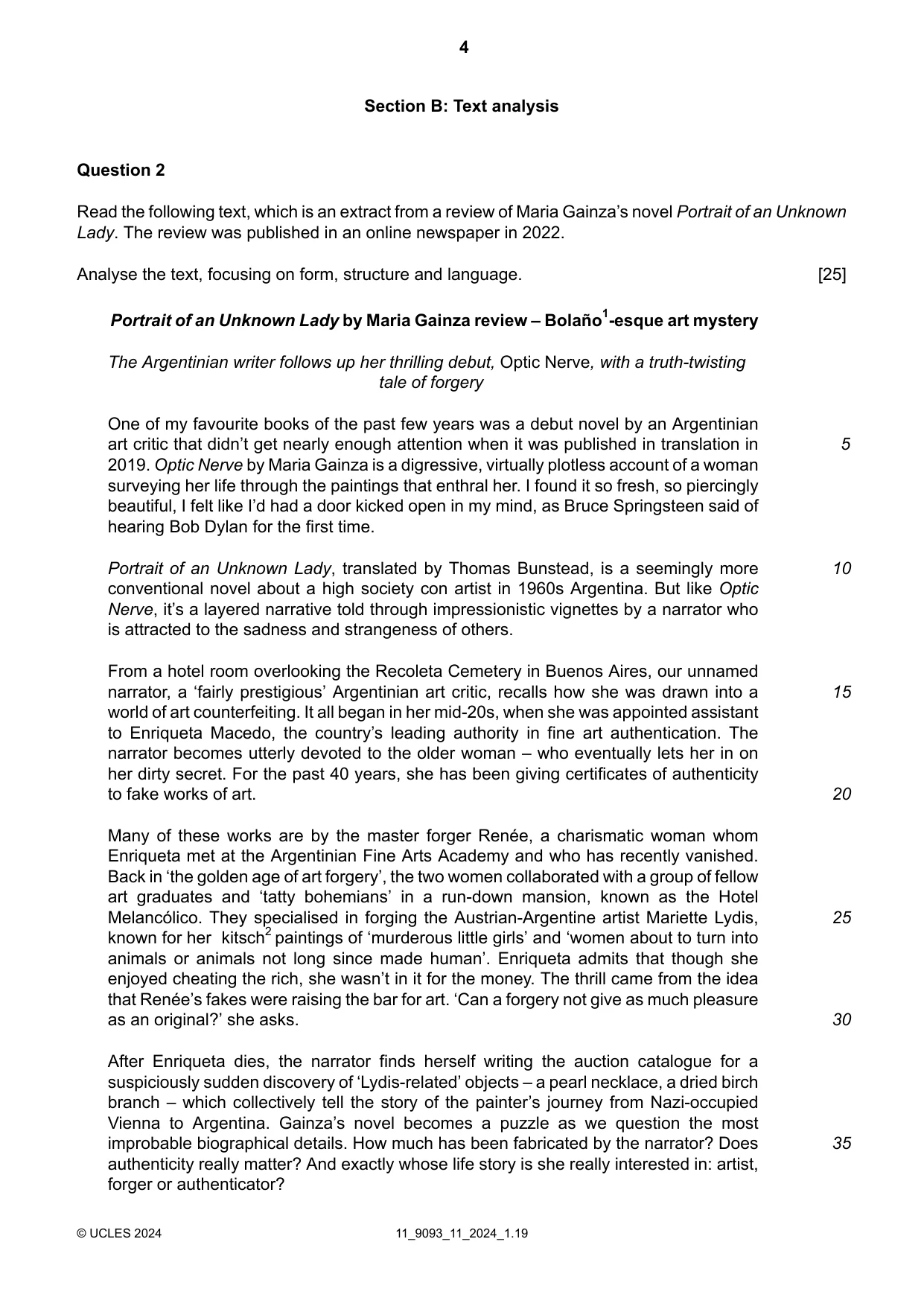
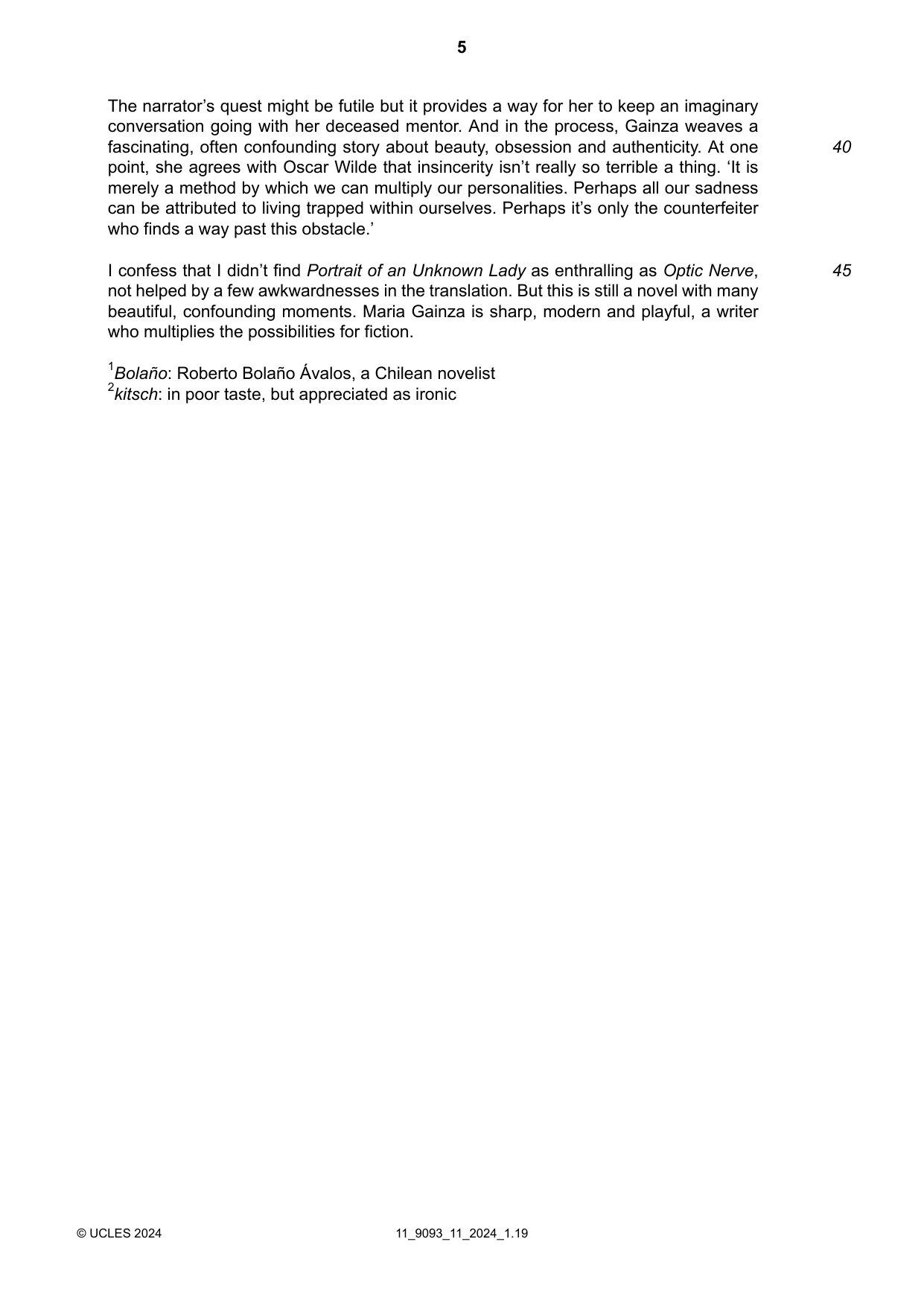
35 30 25 20 15 10 5 Section B: Text analysis Question 2 Read the following text, which is an extract from a review of Maria Gainza’s novel Portrait of an Unknown Lady. The review was published in an online newspaper in 2022. Analyse the text, focusing on form, structure and language. [25] Portrait of an Unknown Lady by Maria Gainza review – Bolaño1-esque art mystery The Argentinian writer follows up her thrilling debut, Optic Nerve, with a truth-twisting tale of forgery One of my favourite books of the past few years was a debut novel by an Argentinian art critic that didn’t get nearly enough attention when it was published in translation in 2019. Optic Nerve by Maria Gainza is a digressive, virtually plotless account of a woman surveying her life through the paintings that enthral her. I found it so fresh, so piercingly beautiful, I felt like I’d had a door kicked open in my mind, as Bruce Springsteen said of hearing Bob Dylan for the first time. Portrait of an Unknown Lady, translated by Thomas Bunstead, is a seemingly more conventional novel about a high society con artist in 1960s Argentina. But like Optic Nerve, it’s a layered narrative told through impressionistic vignettes by a narrator who is attracted to the sadness and strangeness of others. From a hotel room overlooking the Recoleta Cemetery in Buenos Aires, our unnamed narrator, a ‘fairly prestigious’ Argentinian art critic, recalls how she was drawn into a world of art counterfeiting. It all began in her mid-20s, when she was appointed assistant to Enriqueta Macedo, the country’s leading authority in fine art authentication. The narrator becomes utterly devoted to the older woman – who eventually lets her in on her dirty secret. For the past 40 years, she has been giving certificates of authenticity to fake works of art. Many of these works are by the master forger Renée, a charismatic woman whom Enriqueta met at the Argentinian Fine Arts Academy and who has recently vanished. Back in ‘the golden age of art forgery’, the two women collaborated with a group of fellow art graduates and ‘tatty bohemians’ in a run-down mansion, known as the Hotel Melancólico. They specialised in forging the Austrian-Argentine artist Mariette Lydis, known for her kitsch2 paintings of ‘murderous little girls’ and ‘women about to turn into animals or animals not long since made human’. Enriqueta admits that though she enjoyed cheating the rich, she wasn’t in it for the money. The thrill came from the idea that Renée’s fakes were raising the bar for art. ‘Can a forgery not give as much pleasure as an original?’ she asks. After Enriqueta dies, the narrator finds herself writing the auction catalogue for a suspiciously sudden discovery of ‘Lydis-related’ objects – a pearl necklace, a dried birch branch – which collectively tell the story of the painter’s journey from Nazi-occupied Vienna to Argentina. Gainza’s novel becomes a puzzle as we question the most improbable biographical details. How much has been fabricated by the narrator? Does authenticity really matter? And exactly whose life story is she really interested in: artist, forger or authenticator? 11_9093_11_2024_1.19 © UCLES 2024 4
Question paper, page 5
45 40 The narrator’s quest might be futile but it provides a way for her to keep an imaginary conversation going with her deceased mentor. And in the process, Gainza weaves a fascinating, often confounding story about beauty, obsession and authenticity. At one point, she agrees with Oscar Wilde that insincerity isn’t really so terrible a thing. ‘It is merely a method by which we can multiply our personalities. Perhaps all our sadness can be attributed to living trapped within ourselves. Perhaps it’s only the counterfeiter who finds a way past this obstacle.’ I confess that I didn’t find Portrait of an Unknown Lady as enthralling as Optic Nerve, not helped by a few awkwardnesses in the translation. But this is still a novel with many beautiful, confounding moments. Maria Gainza is sharp, modern and playful, a writer who multiplies the possibilities for fiction. 1Bolaño: Roberto Bolaño Ávalos, a Chilean novelist 2kitsch: in poor taste, but appreciated as ironic 11_9093_11_2024_1.19 © UCLES 2024 5
Question paper, page 6
BLANK PAGE 11_9093_11_2024_1.19 © UCLES 2024 6
Question paper, page 7
BLANK PAGE 11_9093_11_2024_1.19 © UCLES 2024 7
Question paper, page 8
BLANK PAGE Permission to reproduce items where third-party owned material protected by copyright is included has been sought and cleared where possible. Every reasonable effort has been made by the publisher (UCLES) to trace copyright holders, but if any items requiring clearance have unwittingly been included, the publisher will be pleased to make amends at the earliest possible opportunity. To avoid the issue of disclosure of answer-related information to candidates, all copyright acknowledgements are reproduced online in the Cambridge Assessment International Education Copyright Acknowledgements Booklet. This is produced for each series of examinations and is freely available to download at www.cambridgeinternational.org after the live examination series. Cambridge Assessment International Education is part of Cambridge Assessment. Cambridge Assessment is the brand name of the University of Cambridge Local Examinations Syndicate (UCLES), which is a department of the University of Cambridge. 11_9093_11_2024_1.19 © UCLES 2024 8
Mark scheme, page 1
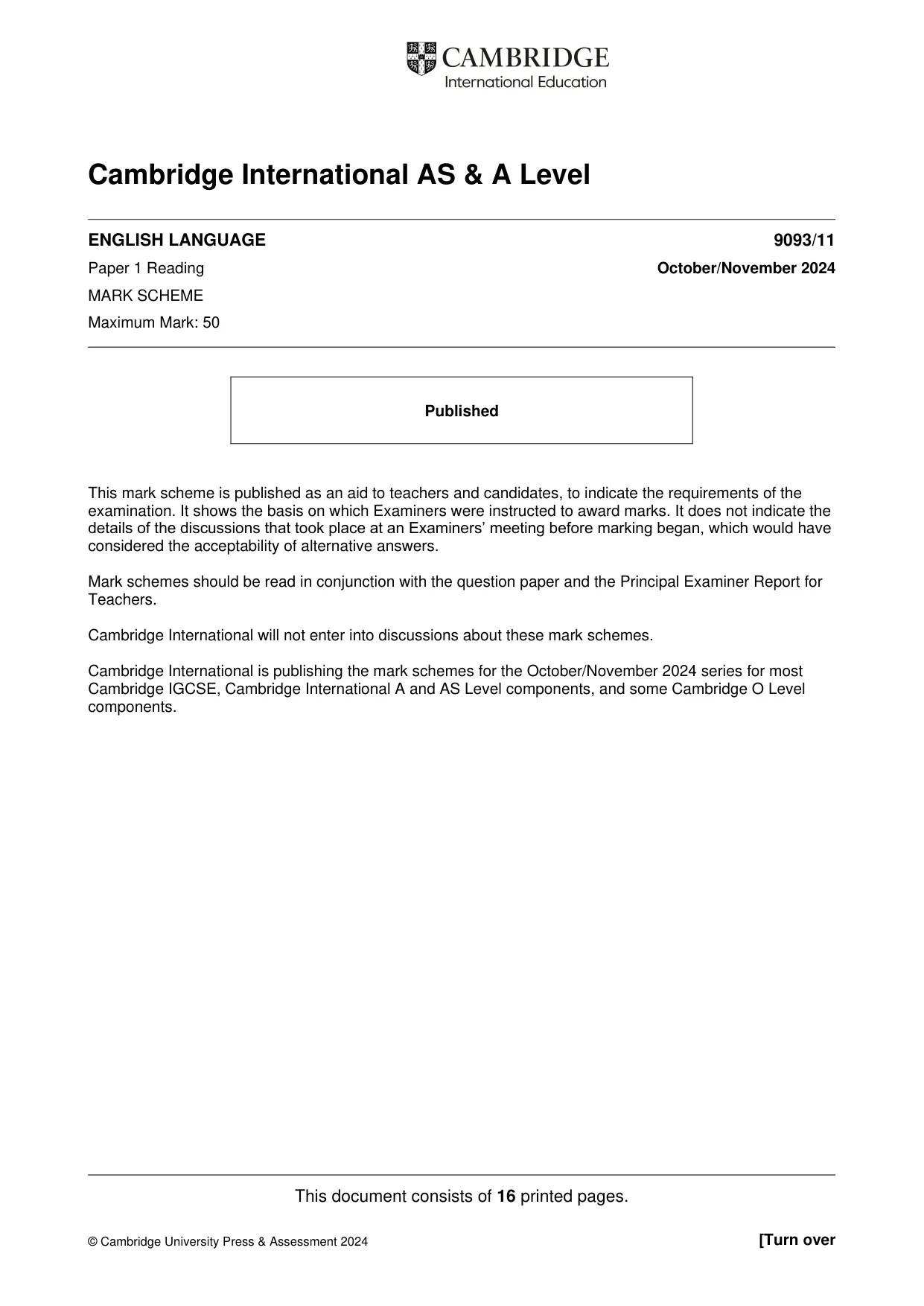
This document consists of 16 printed pages. © Cambridge University Press & Assessment 2024 [Turn over Cambridge International AS & A Level ENGLISH LANGUAGE 9093/11 Paper 1 Reading October/November 2024 MARK SCHEME Maximum Mark: 50 Published This mark scheme is published as an aid to teachers and candidates, to indicate the requirements of the examination. It shows the basis on which Examiners were instructed to award marks. It does not indicate the details of the discussions that took place at an Examiners’ meeting before marking began, which would have considered the acceptability of alternative answers. Mark schemes should be read in conjunction with the question paper and the Principal Examiner Report for Teachers. Cambridge International will not enter into discussions about these mark schemes. Cambridge International is publishing the mark schemes for the October/November 2024 series for most Cambridge IGCSE, Cambridge International A and AS Level components, and some Cambridge O Level components.
Mark scheme, page 2
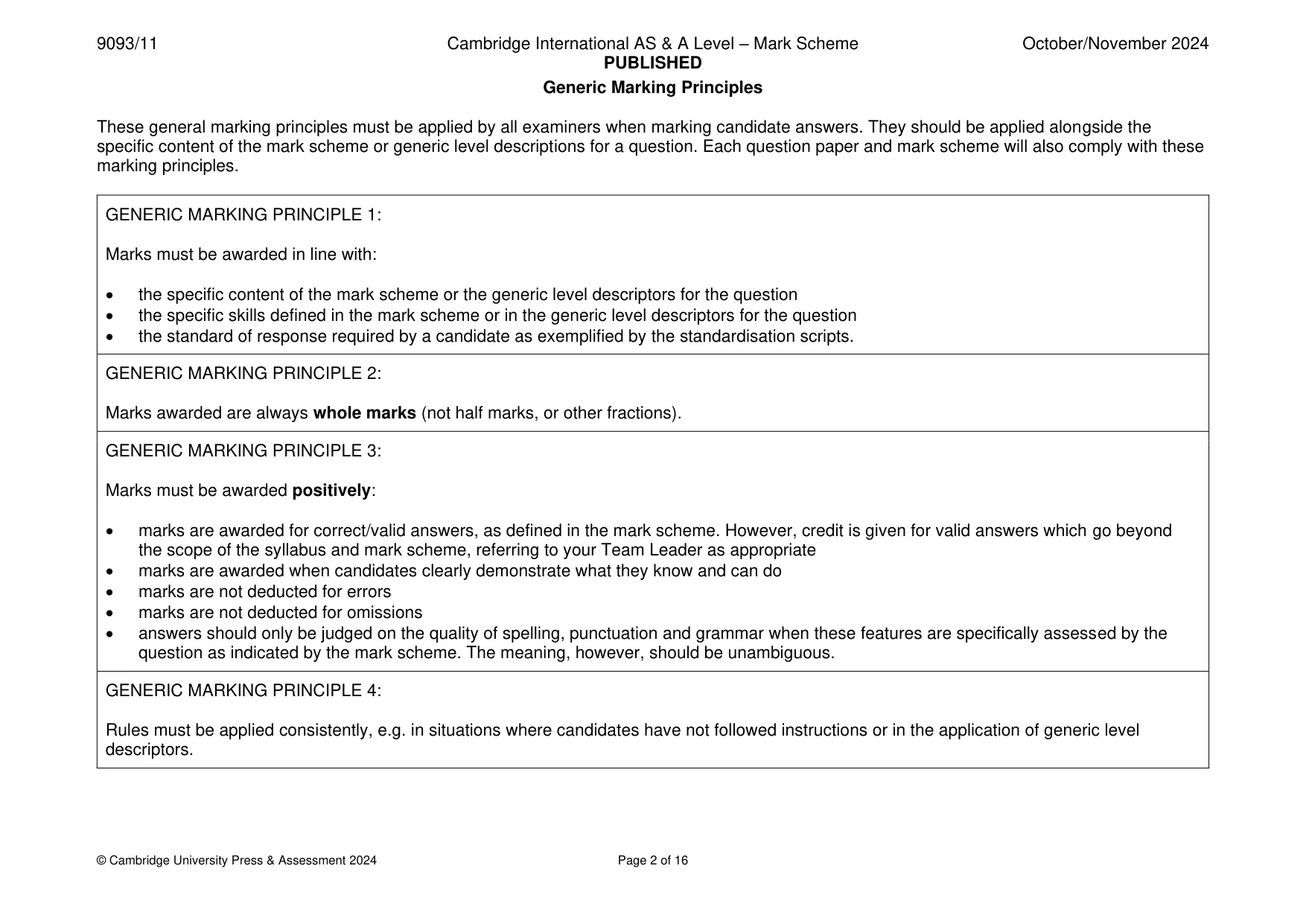
9093/11 Cambridge International AS & A Level – Mark Scheme PUBLISHED October/November 2024 © Cambridge University Press & Assessment 2024 Page 2 of 16 Generic Marking Principles These general marking principles must be applied by all examiners when marking candidate answers. They should be applied alongside the specific content of the mark scheme or generic level descriptions for a question. Each question paper and mark scheme will also comply with these marking principles. GENERIC MARKING PRINCIPLE 1: Marks must be awarded in line with: • the specific content of the mark scheme or the generic level descriptors for the question • the specific skills defined in the mark scheme or in the generic level descriptors for the question • the standard of response required by a candidate as exemplified by the standardisation scripts. GENERIC MARKING PRINCIPLE 2: Marks awarded are always whole marks (not half marks, or other fractions). GENERIC MARKING PRINCIPLE 3: Marks must be awarded positively: • marks are awarded for correct/valid answers, as defined in the mark scheme. However, credit is given for valid answers which go beyond the scope of the syllabus and mark scheme, referring to your Team Leader as appropriate • marks are awarded when candidates clearly demonstrate what they know and can do • marks are not deducted for errors • marks are not deducted for omissions • answers should only be judged on the quality of spelling, punctuation and grammar when these features are specifically assessed by the question as indicated by the mark scheme. The meaning, however, should be unambiguous. GENERIC MARKING PRINCIPLE 4: Rules must be applied consistently, e.g. in situations where candidates have not followed instructions or in the application of generic level descriptors.
Mark scheme, page 3
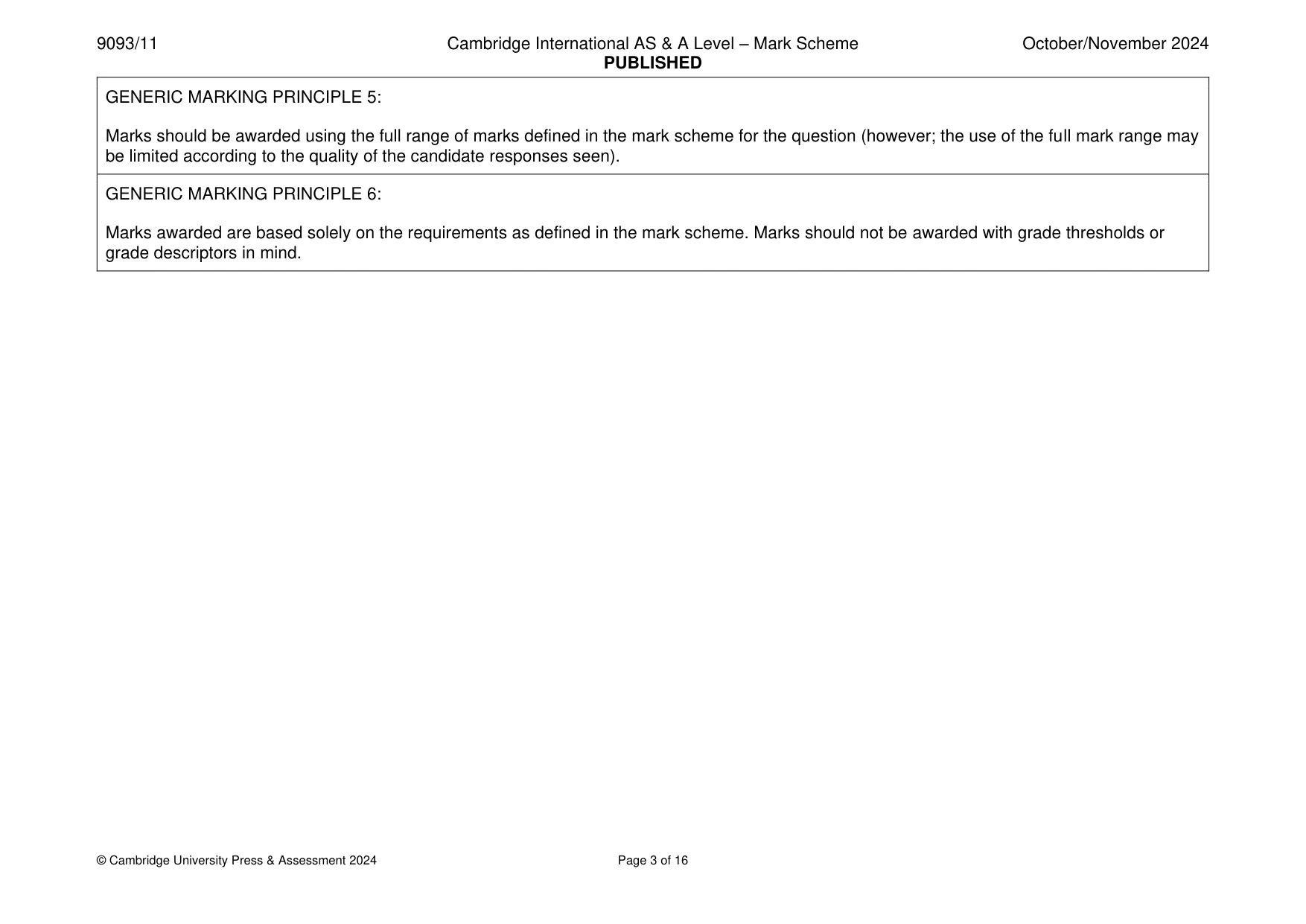
9093/11 Cambridge International AS & A Level – Mark Scheme PUBLISHED October/November 2024 © Cambridge University Press & Assessment 2024 Page 3 of 16 GENERIC MARKING PRINCIPLE 5: Marks should be awarded using the full range of marks defined in the mark scheme for the question (however; the use of the full mark range may be limited according to the quality of the candidate responses seen). GENERIC MARKING PRINCIPLE 6: Marks awarded are based solely on the requirements as defined in the mark scheme. Marks should not be awarded with grade thresholds or grade descriptors in mind.
Mark scheme, page 4
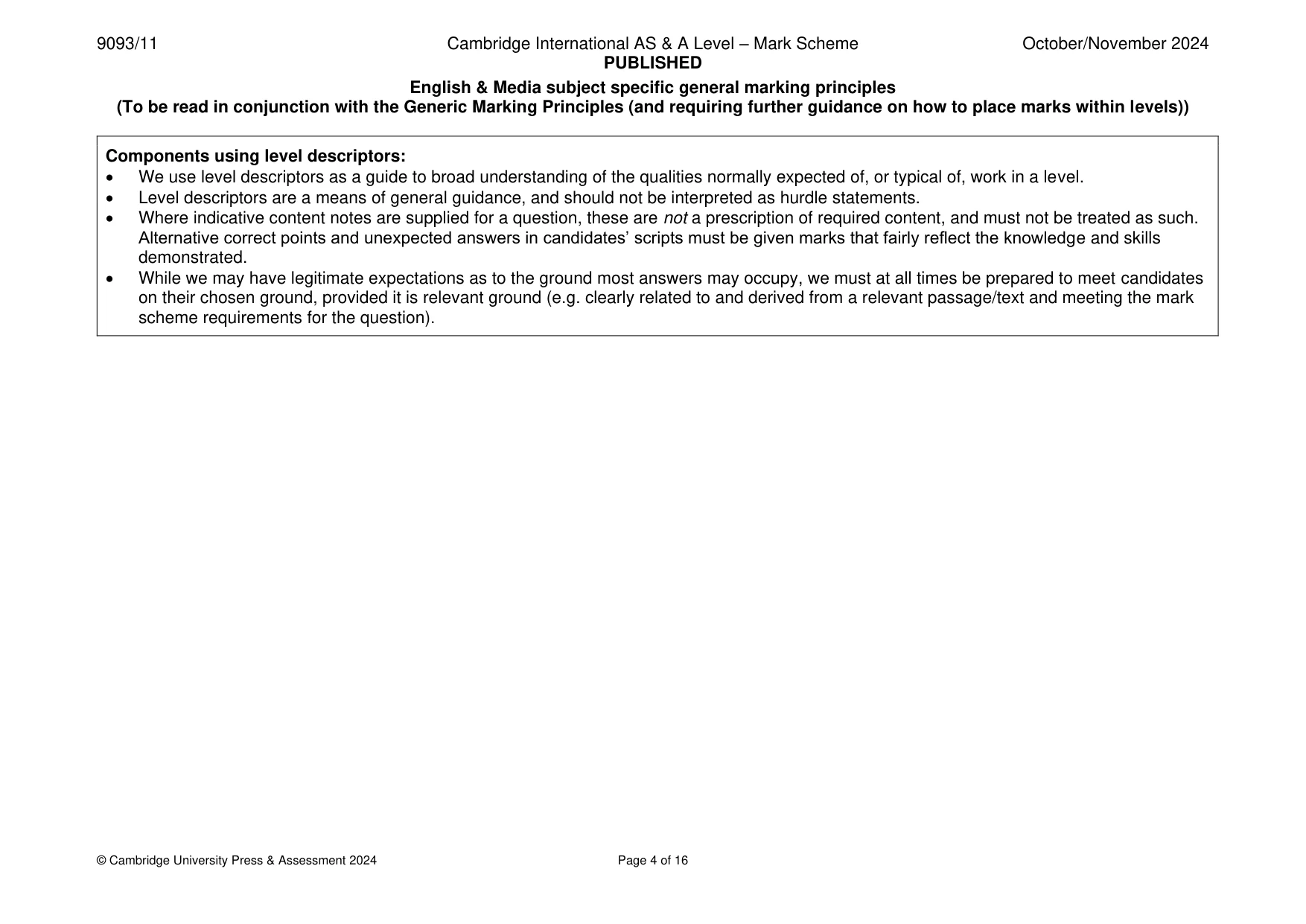
9093/11 Cambridge International AS & A Level – Mark Scheme PUBLISHED October/November 2024 © Cambridge University Press & Assessment 2024 Page 4 of 16 English & Media subject specific general marking principles (To be read in conjunction with the Generic Marking Principles (and requiring further guidance on how to place marks within levels)) Components using level descriptors: • We use level descriptors as a guide to broad understanding of the qualities normally expected of, or typical of, work in a level. • Level descriptors are a means of general guidance, and should not be interpreted as hurdle statements. • Where indicative content notes are supplied for a question, these are not a prescription of required content, and must not be treated as such. Alternative correct points and unexpected answers in candidates’ scripts must be given marks that fairly reflect the knowledge and skills demonstrated. • While we may have legitimate expectations as to the ground most answers may occupy, we must at all times be prepared to meet candidates on their chosen ground, provided it is relevant ground (e.g. clearly related to and derived from a relevant passage/text and meeting the mark scheme requirements for the question).
Mark scheme, page 5
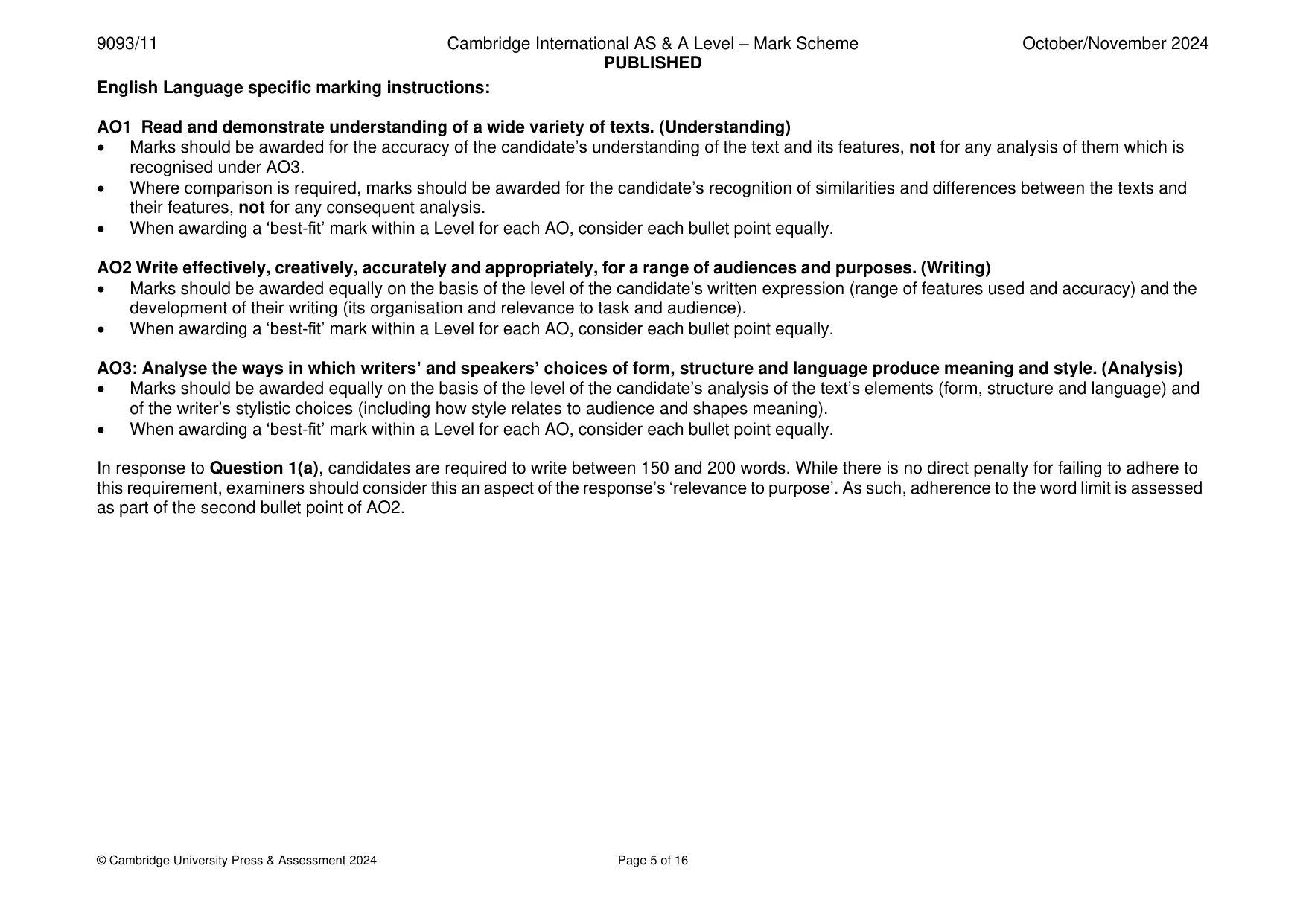
9093/11 Cambridge International AS & A Level – Mark Scheme PUBLISHED October/November 2024 © Cambridge University Press & Assessment 2024 Page 5 of 16 English Language specific marking instructions: AO1 Read and demonstrate understanding of a wide variety of texts. (Understanding) • Marks should be awarded for the accuracy of the candidate’s understanding of the text and its features, not for any analysis of them which is recognised under AO3. • Where comparison is required, marks should be awarded for the candidate’s recognition of similarities and differences between the texts and their features, not for any consequent analysis. • When awarding a ‘best-fit’ mark within a Level for each AO, consider each bullet point equally. AO2 Write effectively, creatively, accurately and appropriately, for a range of audiences and purposes. (Writing) • Marks should be awarded equally on the basis of the level of the candidate’s written expression (range of features used and accuracy) and the development of their writing (its organisation and relevance to task and audience). • When awarding a ‘best-fit’ mark within a Level for each AO, consider each bullet point equally. AO3: Analyse the ways in which writers’ and speakers’ choices of form, structure and language produce meaning and style. (Analysis) • Marks should be awarded equally on the basis of the level of the candidate’s analysis of the text’s elements (form, structure and language) and of the writer’s stylistic choices (including how style relates to audience and shapes meaning). • When awarding a ‘best-fit’ mark within a Level for each AO, consider each bullet point equally. In response to Question 1(a), candidates are required to write between 150 and 200 words. While there is no direct penalty for failing to adhere to this requirement, examiners should consider this an aspect of the response’s ‘relevance to purpose’. As such, adherence to the word limit is assessed as part of the second bullet point of AO2.
Mark scheme, page 6
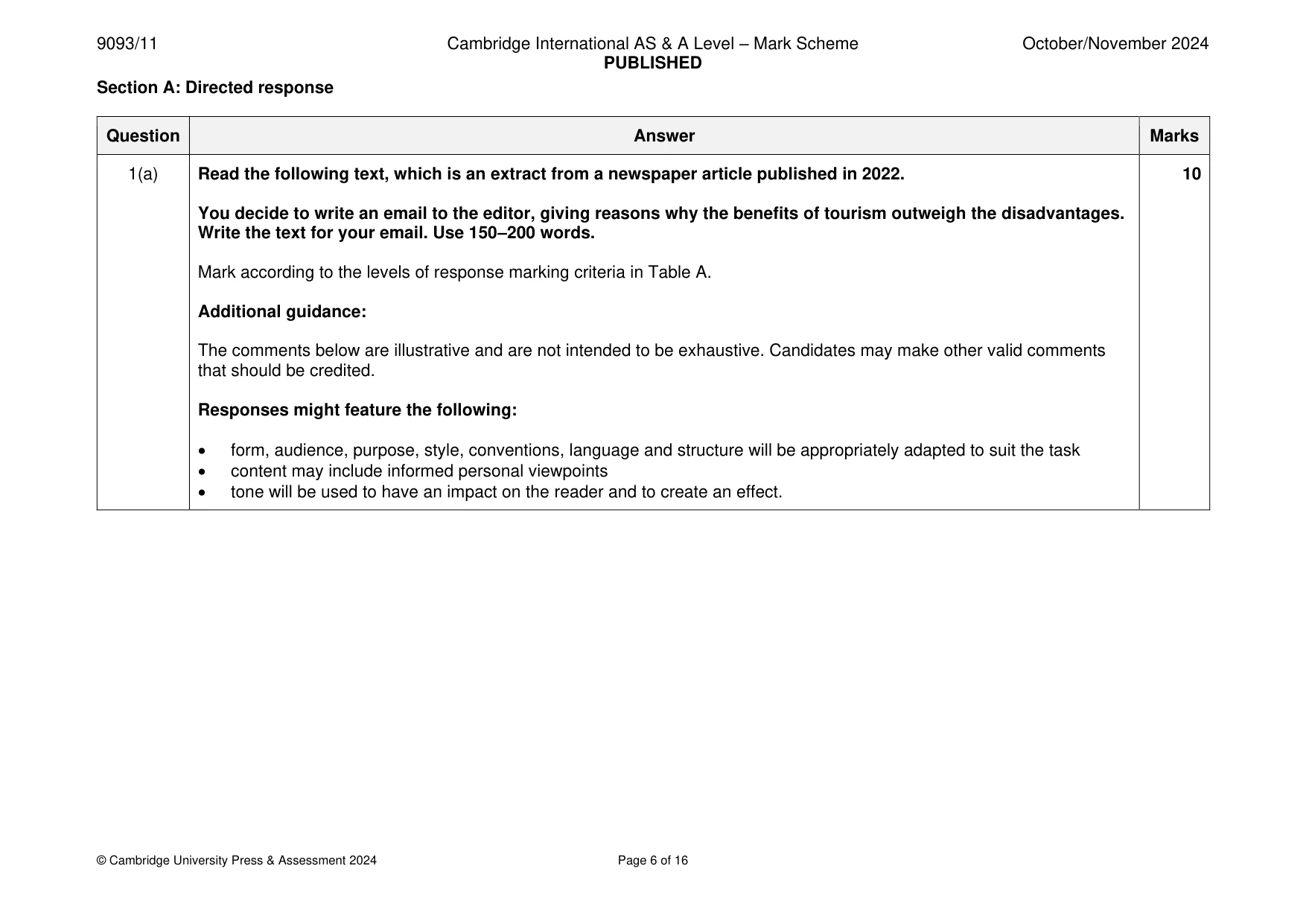
9093/11 Cambridge International AS & A Level – Mark Scheme PUBLISHED October/November 2024 © Cambridge University Press & Assessment 2024 Page 6 of 16 Section A: Directed response Question Answer Marks 1(a) Read the following text, which is an extract from a newspaper article published in 2022. You decide to write an email to the editor, giving reasons why the benefits of tourism outweigh the disadvantages. Write the text for your email. Use 150–200 words. Mark according to the levels of response marking criteria in Table A. Additional guidance: The comments below are illustrative and are not intended to be exhaustive. Candidates may make other valid comments that should be credited. Responses might feature the following: • form, audience, purpose, style, conventions, language and structure will be appropriately adapted to suit the task • content may include informed personal viewpoints • tone will be used to have an impact on the reader and to create an effect. 10
Mark scheme, page 7
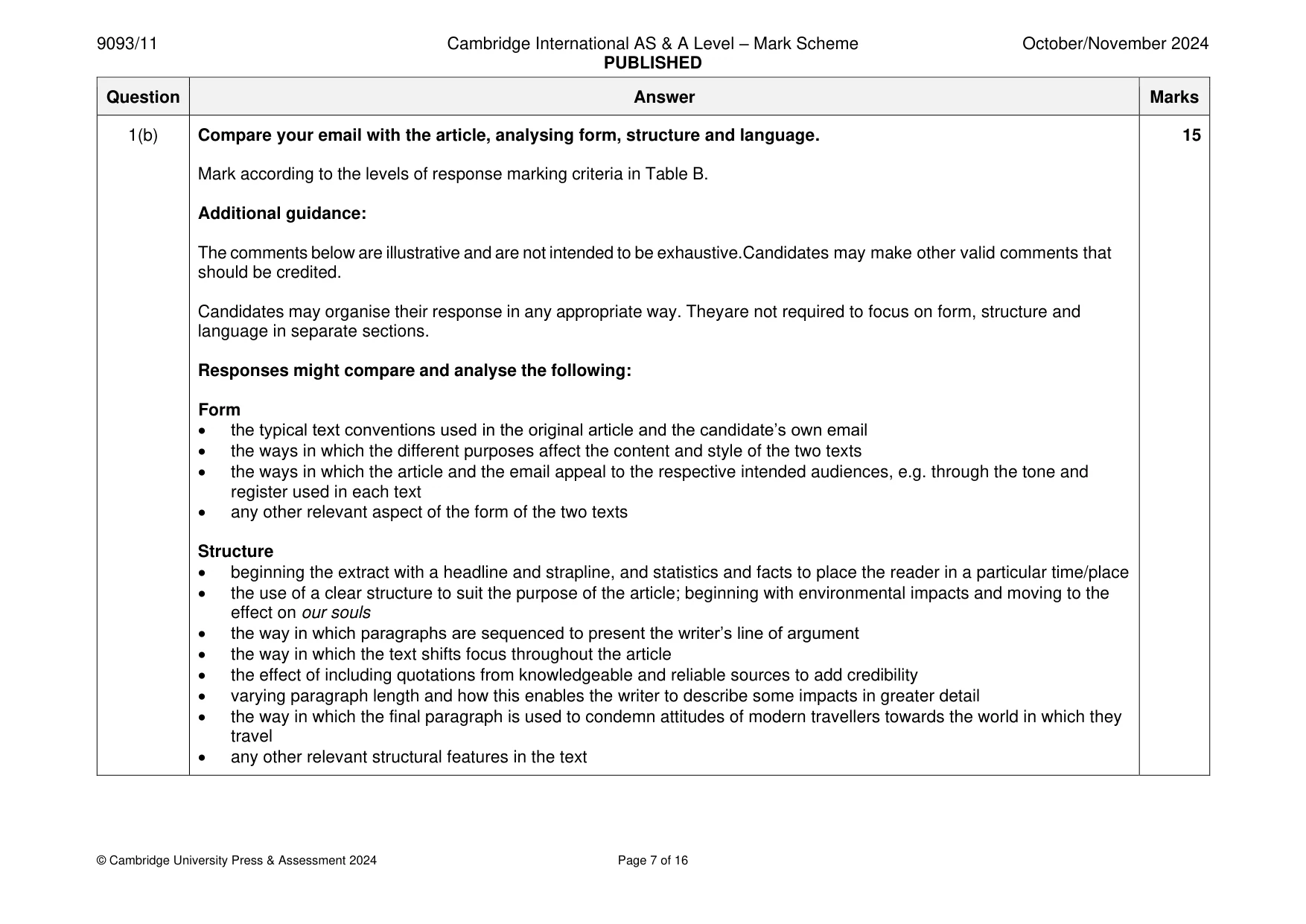
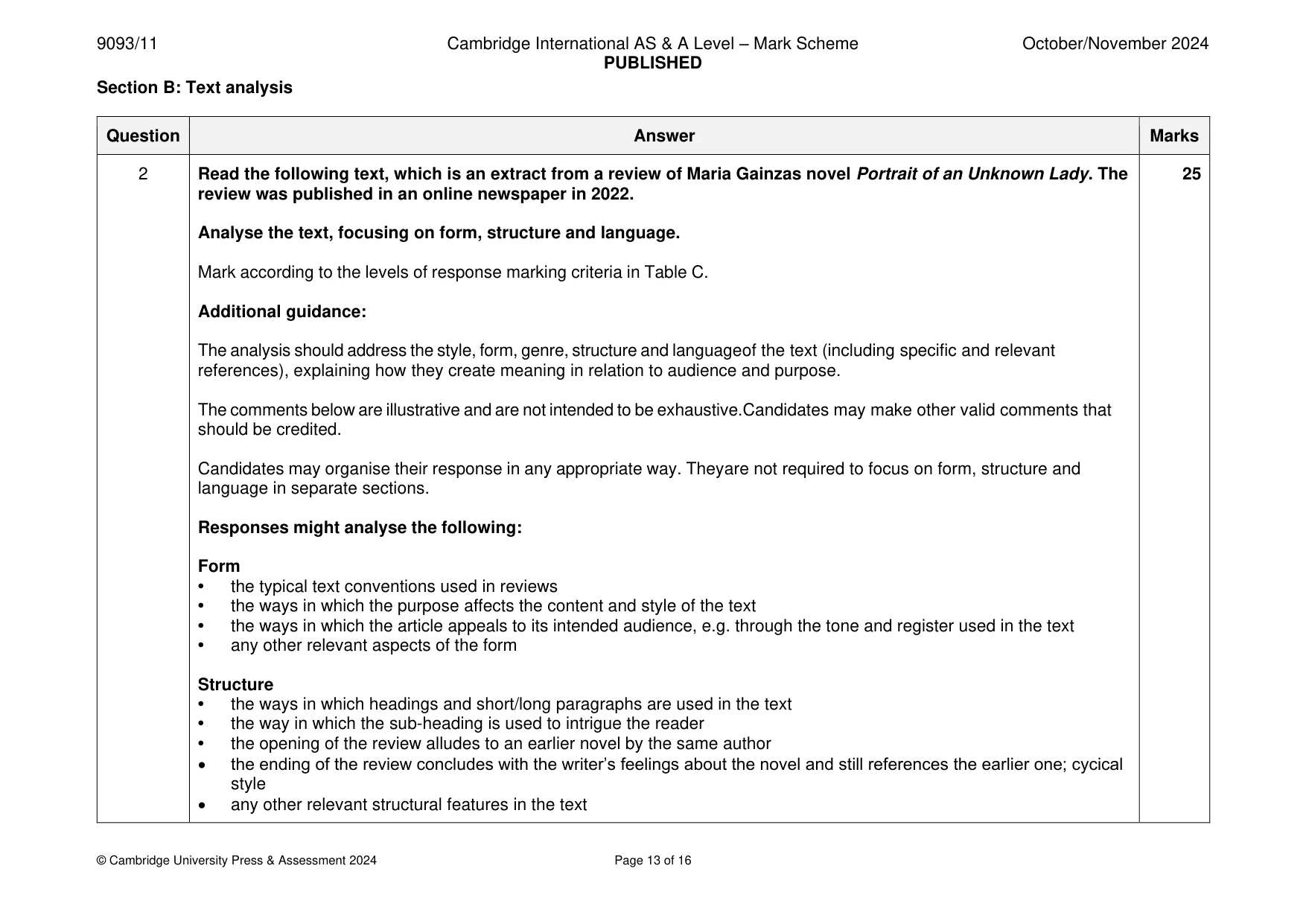
9093/11 Cambridge International AS & A Level – Mark Scheme PUBLISHED October/November 2024 © Cambridge University Press & Assessment 2024 Page 7 of 16 Question Answer Marks 1(b) Compare your email with the article, analysing form, structure and language. Mark according to the levels of response marking criteria in Table B. Additional guidance: The comments below are illustrative and are not intended to be exhaustive. Candidates may make other valid comments that should be credited. Candidates may organise their response in any appropriate way. They are not required to focus on form, structure and language in separate sections. Responses might compare and analyse the following: Form • the typical text conventions used in the original article and the candidate’s own email • the ways in which the different purposes affect the content and style of the two texts • the ways in which the article and the email appeal to the respective intended audiences, e.g. through the tone and register used in each text • any other relevant aspect of the form of the two texts Structure • beginning the extract with a headline and strapline, and statistics and facts to place the reader in a particular time/place • the use of a clear structure to suit the purpose of the article; beginning with environmental impacts and moving to the effect on our souls • the way in which paragraphs are sequenced to present the writer’s line of argument • the way in which the text shifts focus throughout the article • the effect of including quotations from knowledgeable and reliable sources to add credibility • varying paragraph length and how this enables the writer to describe some impacts in greater detail • the way in which the final paragraph is used to condemn attitudes of modern travellers towards the world in which they travel • any other relevant structural features in the text 15
Mark scheme, page 8
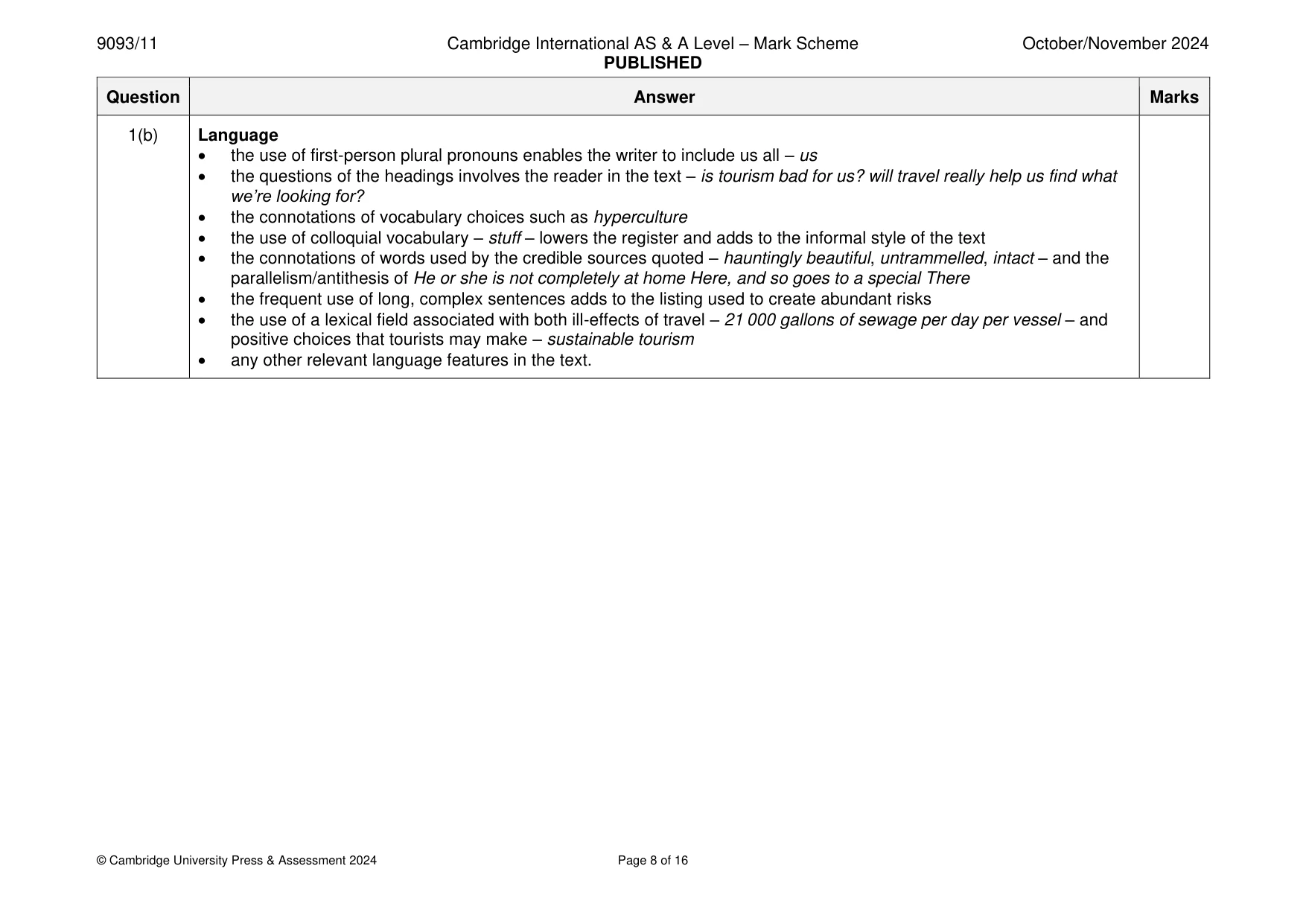
9093/11 Cambridge International AS & A Level – Mark Scheme PUBLISHED October/November 2024 © Cambridge University Press & Assessment 2024 Page 8 of 16 Question Answer Marks 1(b) Language • the use of first-person plural pronouns enables the writer to include us all – us • the questions of the headings involves the reader in the text – is tourism bad for us? will travel really help us find what we’re looking for? • the connotations of vocabulary choices such as hyperculture • the use of colloquial vocabulary – stuff – lowers the register and adds to the informal style of the text • the connotations of words used by the credible sources quoted – hauntingly beautiful, untrammelled, intact – and the parallelism/antithesis of He or she is not completely at home Here, and so goes to a special There • the frequent use of long, complex sentences adds to the listing used to create abundant risks • the use of a lexical field associated with both ill-effects of travel – 21 000 gallons of sewage per day per vessel – and positive choices that tourists may make – sustainable tourism • any other relevant language features in the text.
Mark scheme, page 9
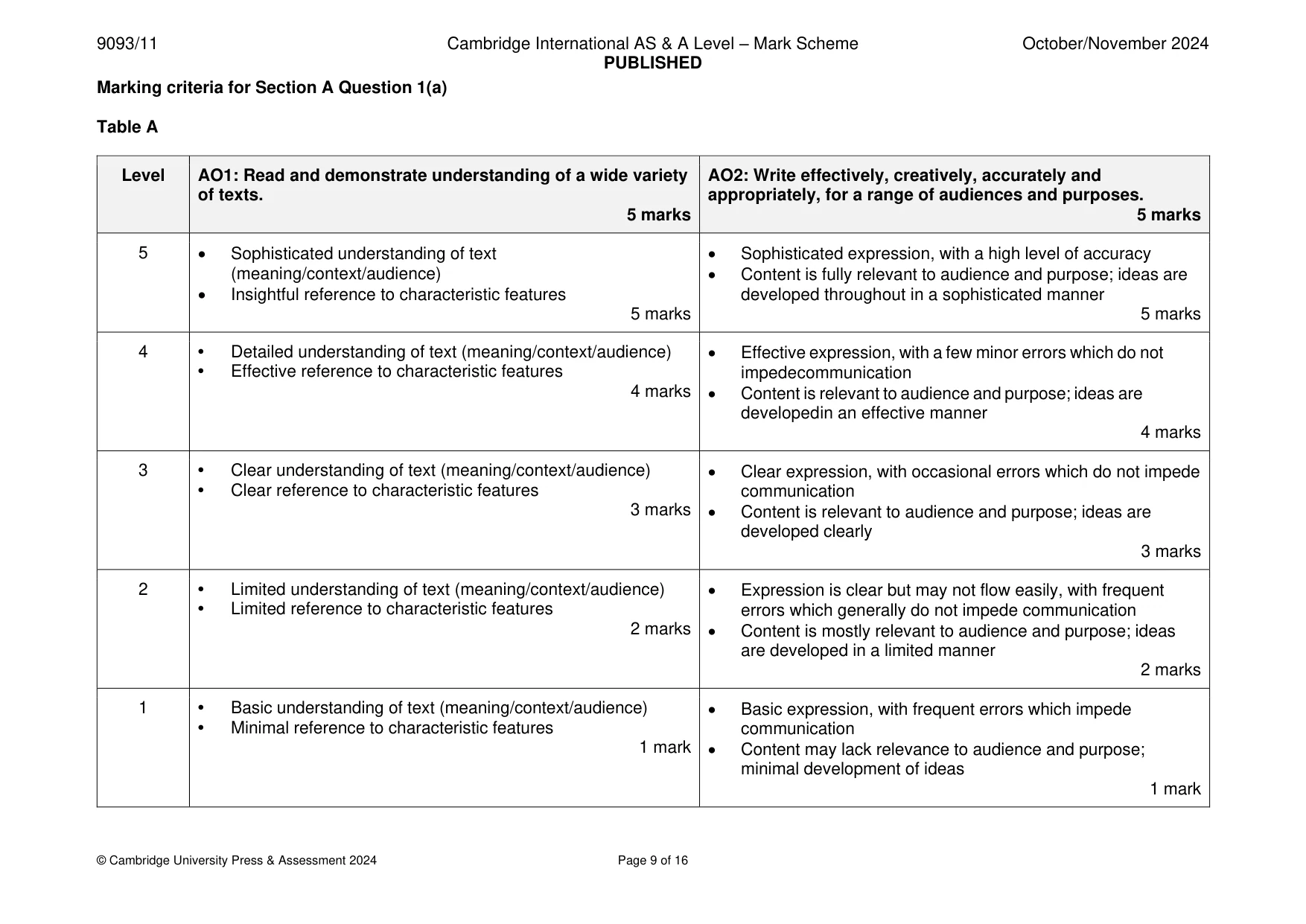
9093/11 Cambridge International AS & A Level – Mark Scheme PUBLISHED October/November 2024 © Cambridge University Press & Assessment 2024 Page 9 of 16 Marking criteria for Section A Question 1(a) Table A Level AO1: Read and demonstrate understanding of a wide variety of texts. 5 marks AO2: Write effectively, creatively, accurately and appropriately, for a range of audiences and purposes. 5 marks 5 • Sophisticated understanding of text (meaning/context/audience) • Insightful reference to characteristic features 5 marks • Sophisticated expression, with a high level of accuracy • Content is fully relevant to audience and purpose; ideas are developed throughout in a sophisticated manner 5 marks 4 • Detailed understanding of text (meaning/context/audience) • Effective reference to characteristic features 4 marks • Effective expression, with a few minor errors which do not impede communication • Content is relevant to audience and purpose; ideas are developed in an effective manner 4 marks 3 • Clear understanding of text (meaning/context/audience) • Clear reference to characteristic features 3 marks • Clear expression, with occasional errors which do not impede communication • Content is relevant to audience and purpose; ideas are developed clearly 3 marks 2 • Limited understanding of text (meaning/context/audience) • Limited reference to characteristic features 2 marks • Expression is clear but may not flow easily, with frequent errors which generally do not impede communication • Content is mostly relevant to audience and purpose; ideas are developed in a limited manner 2 marks 1 • Basic understanding of text (meaning/context/audience) • Minimal reference to characteristic features 1 mark • Basic expression, with frequent errors which impede communication • Content may lack relevance to audience and purpose; minimal development of ideas 1 mark
Mark scheme, page 10
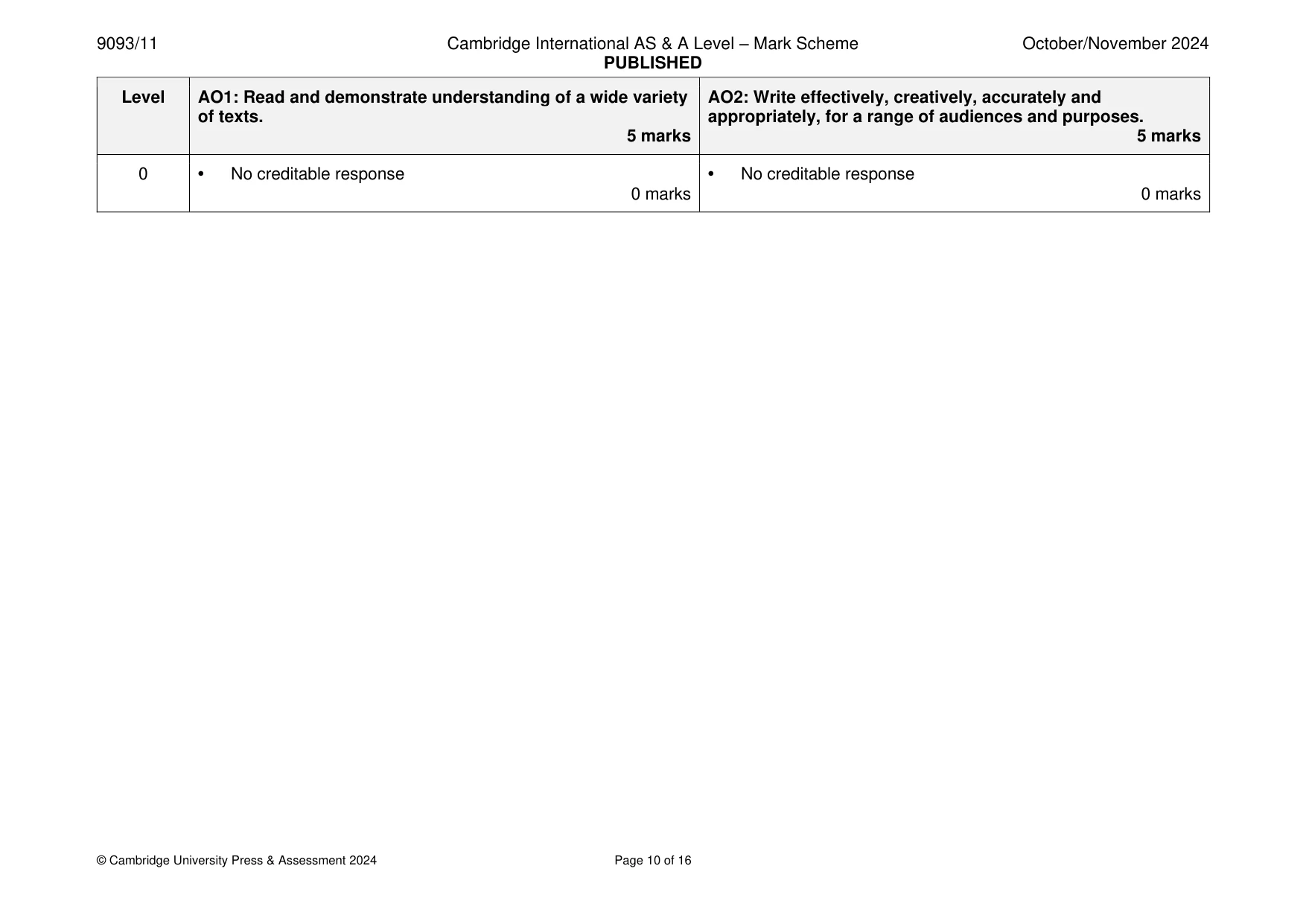
9093/11 Cambridge International AS & A Level – Mark Scheme PUBLISHED October/November 2024 © Cambridge University Press & Assessment 2024 Page 10 of 16 Level AO1: Read and demonstrate understanding of a wide variety of texts. 5 marks AO2: Write effectively, creatively, accurately and appropriately, for a range of audiences and purposes. 5 marks 0 • No creditable response 0 marks • No creditable response 0 marks
Mark scheme, page 11
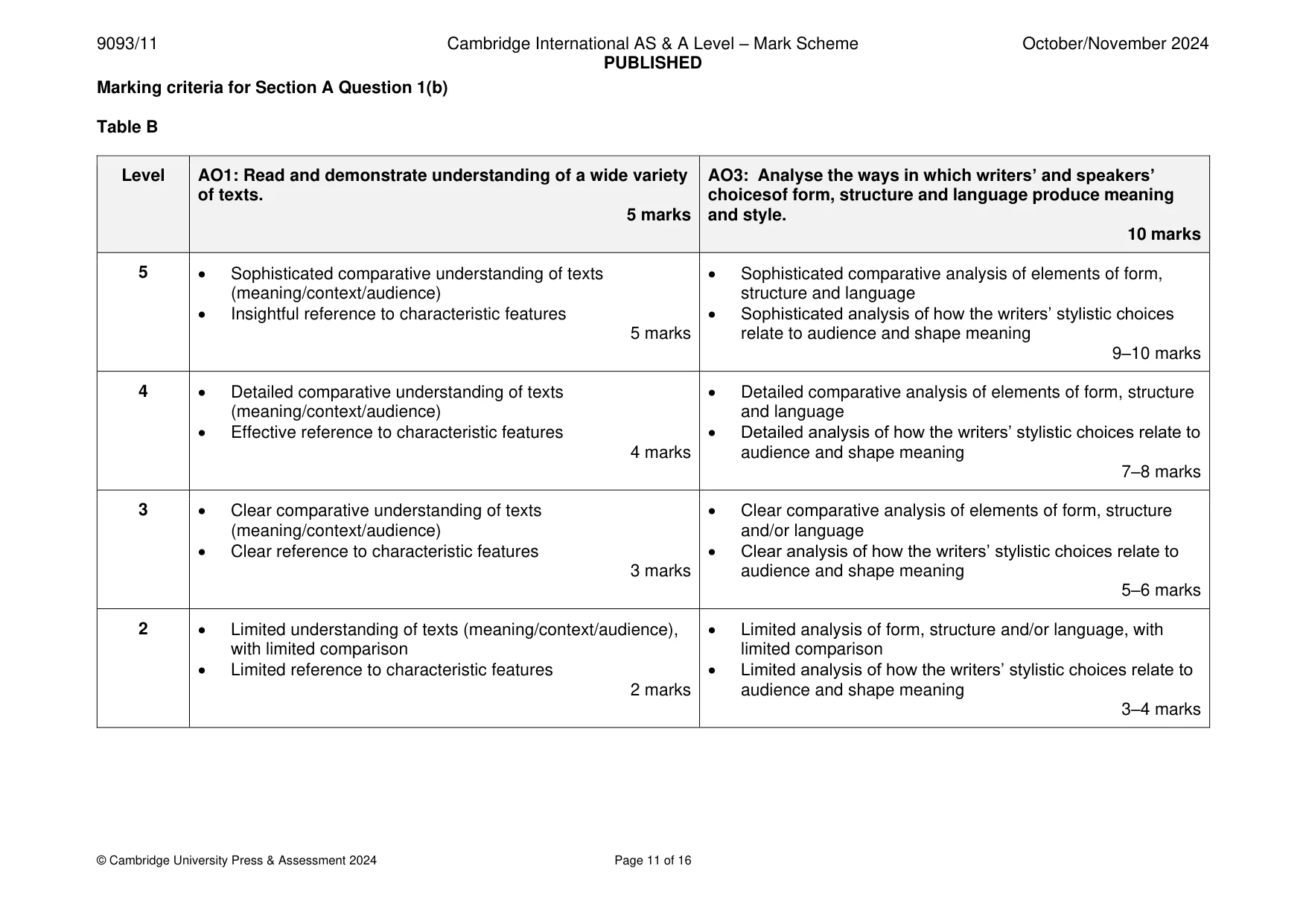
9093/11 Cambridge International AS & A Level – Mark Scheme PUBLISHED October/November 2024 © Cambridge University Press & Assessment 2024 Page 11 of 16 Marking criteria for Section A Question 1(b) Table B Level AO1: Read and demonstrate understanding of a wide variety of texts. 5 marks AO3: Analyse the ways in which writers’ and speakers’ choices of form, structure and language produce meaning and style. 10 marks 5 • Sophisticated comparative understanding of texts (meaning/context/audience) • Insightful reference to characteristic features 5 marks • Sophisticated comparative analysis of elements of form, structure and language • Sophisticated analysis of how the writers’ stylistic choices relate to audience and shape meaning 9–10 marks 4 • Detailed comparative understanding of texts (meaning/context/audience) • Effective reference to characteristic features 4 marks • Detailed comparative analysis of elements of form, structure and language • Detailed analysis of how the writers’ stylistic choices relate to audience and shape meaning 7–8 marks 3 • Clear comparative understanding of texts (meaning/context/audience) • Clear reference to characteristic features 3 marks • Clear comparative analysis of elements of form, structure and/or language • Clear analysis of how the writers’ stylistic choices relate to audience and shape meaning 5–6 marks 2 • Limited understanding of texts (meaning/context/audience), with limited comparison • Limited reference to characteristic features 2 marks • Limited analysis of form, structure and/or language, with limited comparison • Limited analysis of how the writers’ stylistic choices relate to audience and shape meaning 3–4 marks
Mark scheme, page 12
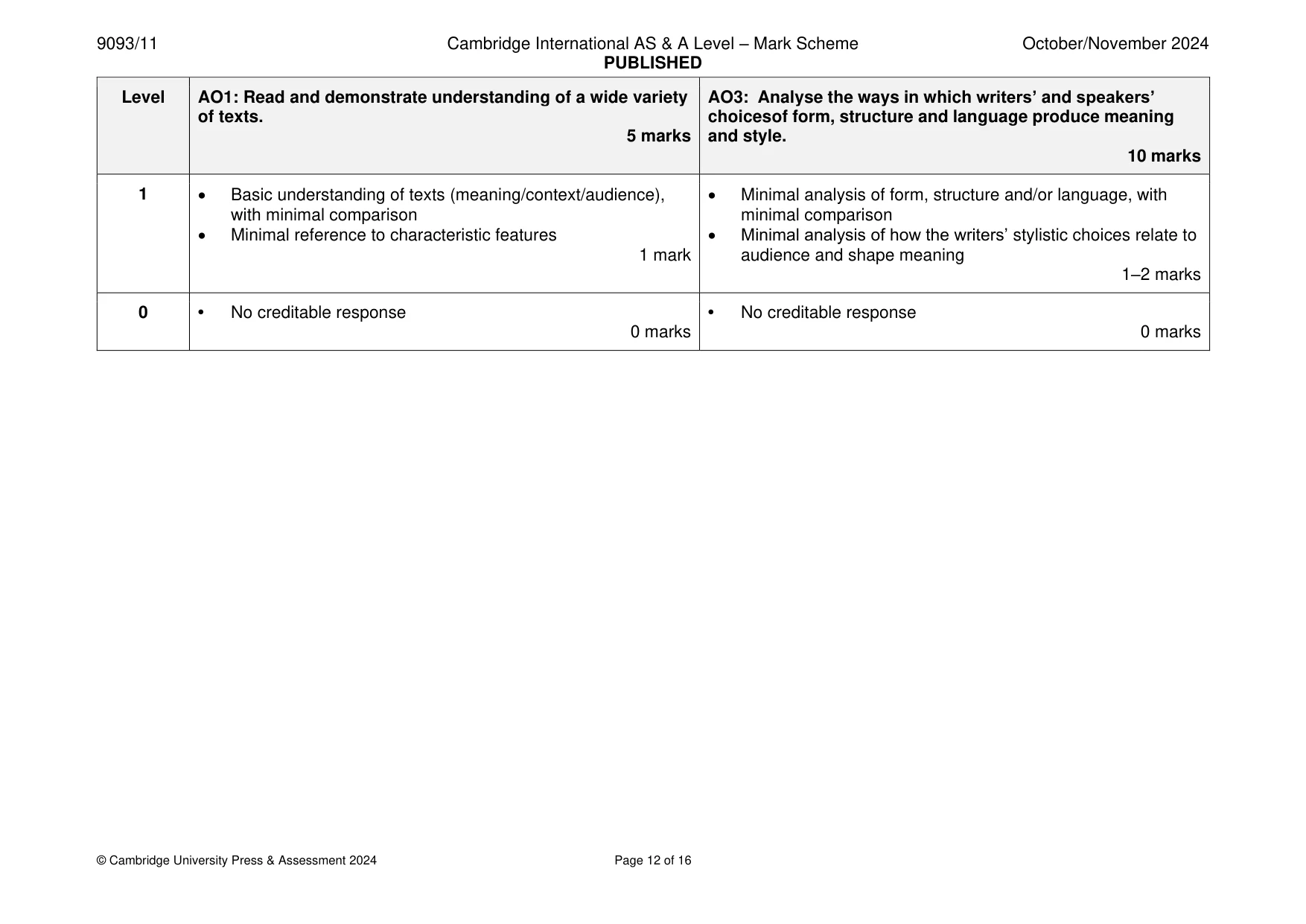
9093/11 Cambridge International AS & A Level – Mark Scheme PUBLISHED October/November 2024 © Cambridge University Press & Assessment 2024 Page 12 of 16 Level AO1: Read and demonstrate understanding of a wide variety of texts. 5 marks AO3: Analyse the ways in which writers’ and speakers’ choices of form, structure and language produce meaning and style. 10 marks 1 • Basic understanding of texts (meaning/context/audience), with minimal comparison • Minimal reference to characteristic features 1 mark • Minimal analysis of form, structure and/or language, with minimal comparison • Minimal analysis of how the writers’ stylistic choices relate to audience and shape meaning 1–2 marks 0 • No creditable response 0 marks • No creditable response 0 marks
Mark scheme, page 13
9093/11 Cambridge International AS & A Level – Mark Scheme PUBLISHED October/November 2024 © Cambridge University Press & Assessment 2024 Page 13 of 16 Section B: Text analysis Question Answer Marks 2 Read the following text, which is an extract from a review of Maria Gainzas novel Portrait of an Unknown Lady. The review was published in an online newspaper in 2022. Analyse the text, focusing on form, structure and language. Mark according to the levels of response marking criteria in Table C. Additional guidance: The analysis should address the style, form, genre, structure and language of the text (including specific and relevant references), explaining how they create meaning in relation to audience and purpose. The comments below are illustrative and are not intended to be exhaustive. Candidates may make other valid comments that should be credited. Candidates may organise their response in any appropriate way. They are not required to focus on form, structure and language in separate sections. Responses might analyse the following: Form • the typical text conventions used in reviews • the ways in which the purpose affects the content and style of the text • the ways in which the article appeals to its intended audience, e.g. through the tone and register used in the text • any other relevant aspects of the form Structure • the ways in which headings and short/long paragraphs are used in the text • the way in which the sub-heading is used to intrigue the reader • the opening of the review alludes to an earlier novel by the same author • the ending of the review concludes with the writer’s feelings about the novel and still references the earlier one; cycical style • any other relevant structural features in the text 25
Mark scheme, page 14
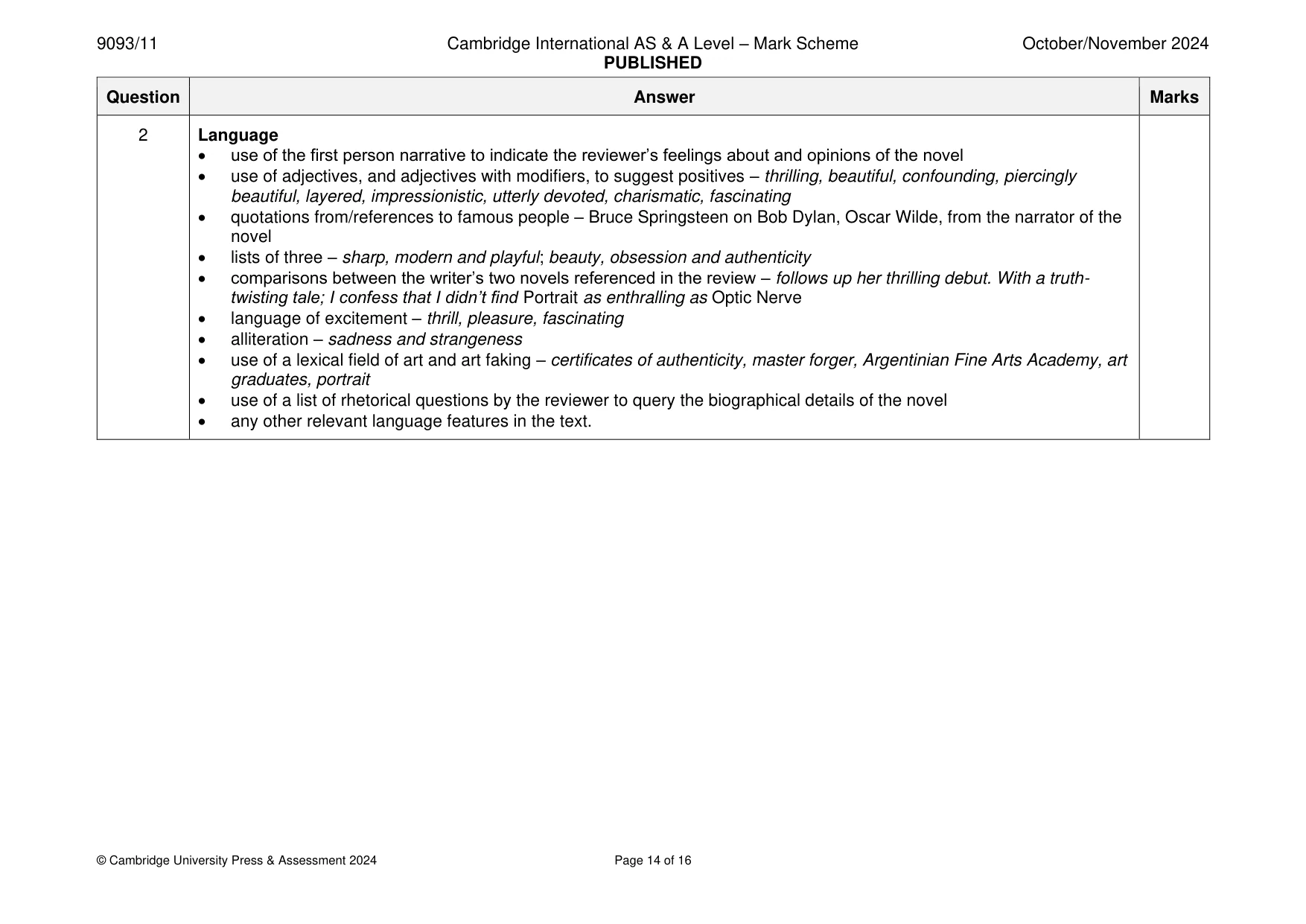
9093/11 Cambridge International AS & A Level – Mark Scheme PUBLISHED October/November 2024 © Cambridge University Press & Assessment 2024 Page 14 of 16 Question Answer Marks 2 Language • use of the first person narrative to indicate the reviewer’s feelings about and opinions of the novel • use of adjectives, and adjectives with modifiers, to suggest positives – thrilling, beautiful, confounding, piercingly beautiful, layered, impressionistic, utterly devoted, charismatic, fascinating • quotations from/references to famous people – Bruce Springsteen on Bob Dylan, Oscar Wilde, from the narrator of the novel • lists of three – sharp, modern and playful; beauty, obsession and authenticity • comparisons between the writer’s two novels referenced in the review – follows up her thrilling debut. With a truth- twisting tale; I confess that I didn’t find Portrait as enthralling as Optic Nerve • language of excitement – thrill, pleasure, fascinating • alliteration – sadness and strangeness • use of a lexical field of art and art faking – certificates of authenticity, master forger, Argentinian Fine Arts Academy, art graduates, portrait • use of a list of rhetorical questions by the reviewer to query the biographical details of the novel • any other relevant language features in the text.
Mark scheme, page 15
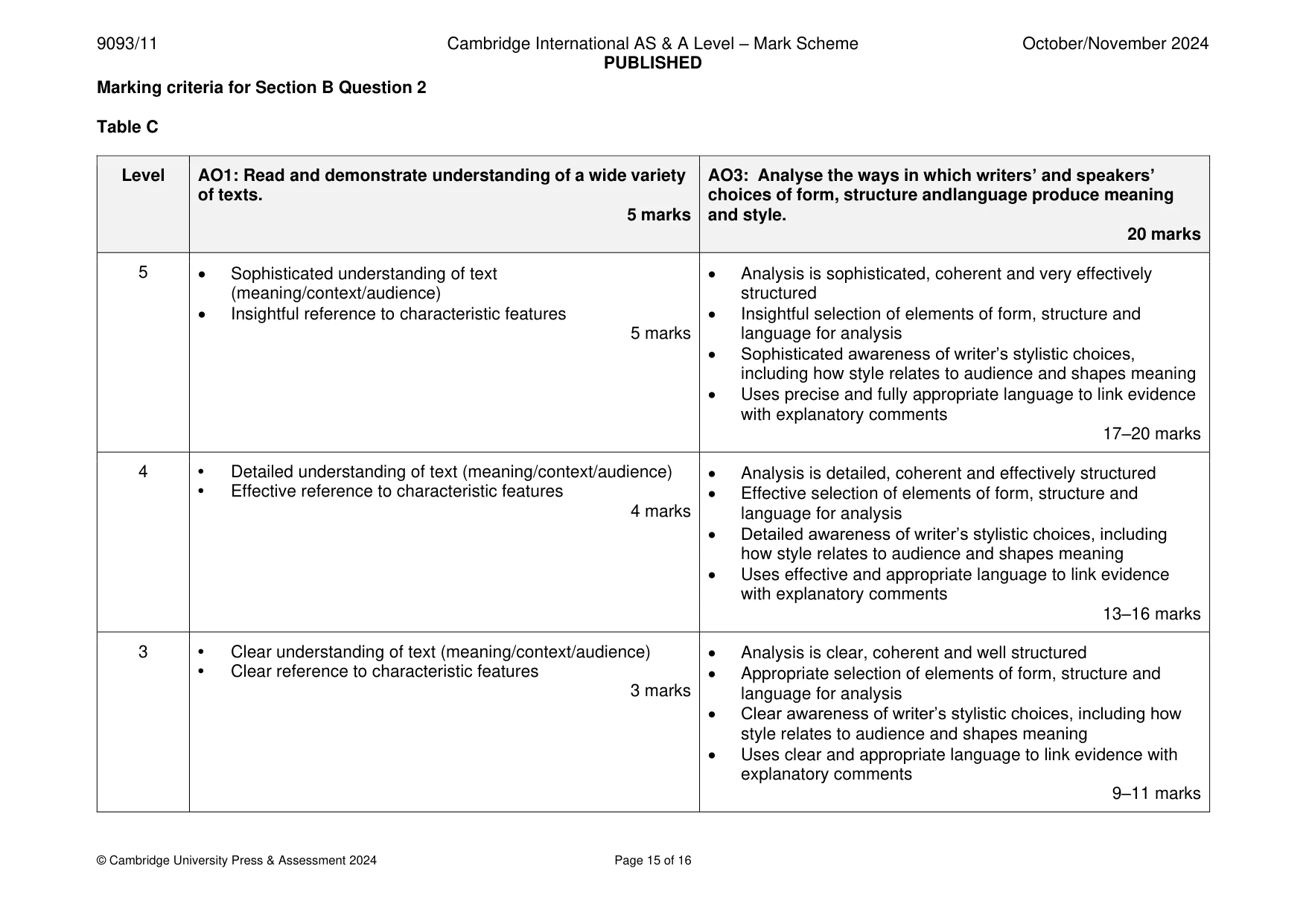
9093/11 Cambridge International AS & A Level – Mark Scheme PUBLISHED October/November 2024 © Cambridge University Press & Assessment 2024 Page 15 of 16 Marking criteria for Section B Question 2 Table C Level AO1: Read and demonstrate understanding of a wide variety of texts. 5 marks AO3: Analyse the ways in which writers’ and speakers’ choices of form, structure and language produce meaning and style. 20 marks 5 • Sophisticated understanding of text (meaning/context/audience) • Insightful reference to characteristic features 5 marks • Analysis is sophisticated, coherent and very effectively structured • Insightful selection of elements of form, structure and language for analysis • Sophisticated awareness of writer’s stylistic choices, including how style relates to audience and shapes meaning • Uses precise and fully appropriate language to link evidence with explanatory comments 17–20 marks 4 • Detailed understanding of text (meaning/context/audience) • Effective reference to characteristic features 4 marks • Analysis is detailed, coherent and effectively structured • Effective selection of elements of form, structure and language for analysis • Detailed awareness of writer’s stylistic choices, including how style relates to audience and shapes meaning • Uses effective and appropriate language to link evidence with explanatory comments 13–16 marks 3 • Clear understanding of text (meaning/context/audience) • Clear reference to characteristic features 3 marks • Analysis is clear, coherent and well structured • Appropriate selection of elements of form, structure and language for analysis • Clear awareness of writer’s stylistic choices, including how style relates to audience and shapes meaning • Uses clear and appropriate language to link evidence with explanatory comments 9–11 marks
Mark scheme, page 16
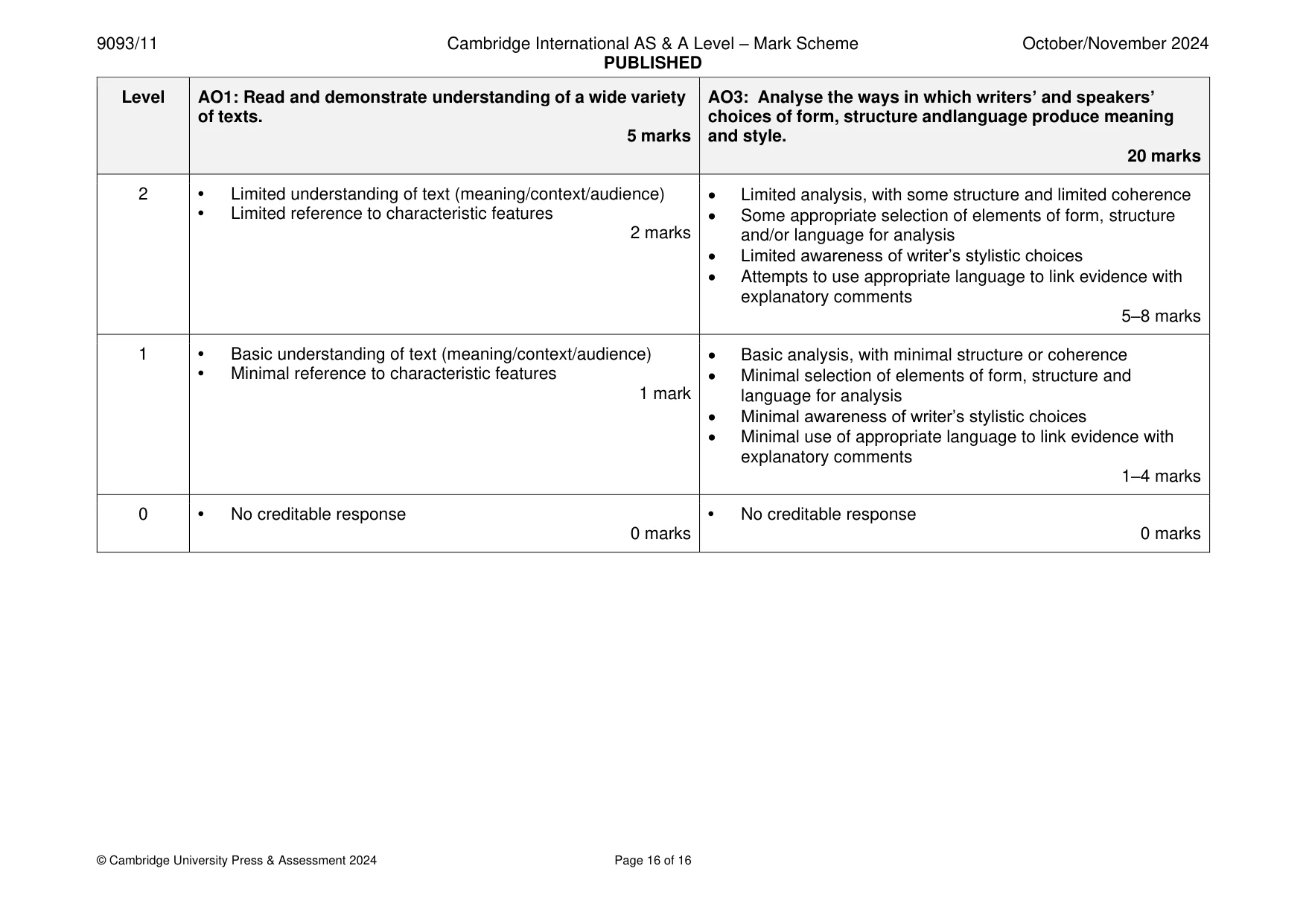
9093/11 Cambridge International AS & A Level – Mark Scheme PUBLISHED October/November 2024 © Cambridge University Press & Assessment 2024 Page 16 of 16 Level AO1: Read and demonstrate understanding of a wide variety of texts. 5 marks AO3: Analyse the ways in which writers’ and speakers’ choices of form, structure and language produce meaning and style. 20 marks 2 • Limited understanding of text (meaning/context/audience) • Limited reference to characteristic features 2 marks • Limited analysis, with some structure and limited coherence • Some appropriate selection of elements of form, structure and/or language for analysis • Limited awareness of writer’s stylistic choices • Attempts to use appropriate language to link evidence with explanatory comments 5–8 marks 1 • Basic understanding of text (meaning/context/audience) • Minimal reference to characteristic features 1 mark • Basic analysis, with minimal structure or coherence • Minimal selection of elements of form, structure and language for analysis • Minimal awareness of writer’s stylistic choices • Minimal use of appropriate language to link evidence with explanatory comments 1–4 marks 0 • No creditable response 0 marks • No creditable response 0 marks
What you needed in this session
Cambridge’s own grade thresholds for 2024 Oct/Nov, Paper 1 · Variant 1. A higher threshold means an easier paper — the bar moves with how the cohort did.