Cambridge A Level English - Language AS and A Level (from 2014) 9093 — 2025 May/June Paper 1 · Variant 1
9093/11/M/J/25 · 50 marks · 135 min
The question paper and its mark scheme, free to read here and free to download. This is Cambridge’s own paper, exactly as it was sat.
Question paper8 pages
Mark scheme18 pages
Answers below. Sit the paper first if you are practising.
Paper as text
Question paper, page 1
This document has 8 pages. Any blank pages are indicated. [Turn over Cambridge International AS & A Level ENGLISH LANGUAGE 9093/11 Paper 1 Reading May/June 2025 2 hours 15 minutes You must answer on the enclosed answer booklet. You will need: Answer booklet (enclosed) INSTRUCTIONS ● Answer all questions. ● Follow the instructions on the front cover of the answer booklet. If you need additional answer paper, ask the invigilator for a continuation booklet. ● Dictionaries are not allowed. INFORMATION ● The total mark for this paper is 50. ● The number of marks for each question or part question is shown in brackets [ ]. * 4 6 1 7 8 8 8 6 1 0 * DC (KS) 343412/1 © UCLES 2025
Question paper, page 2
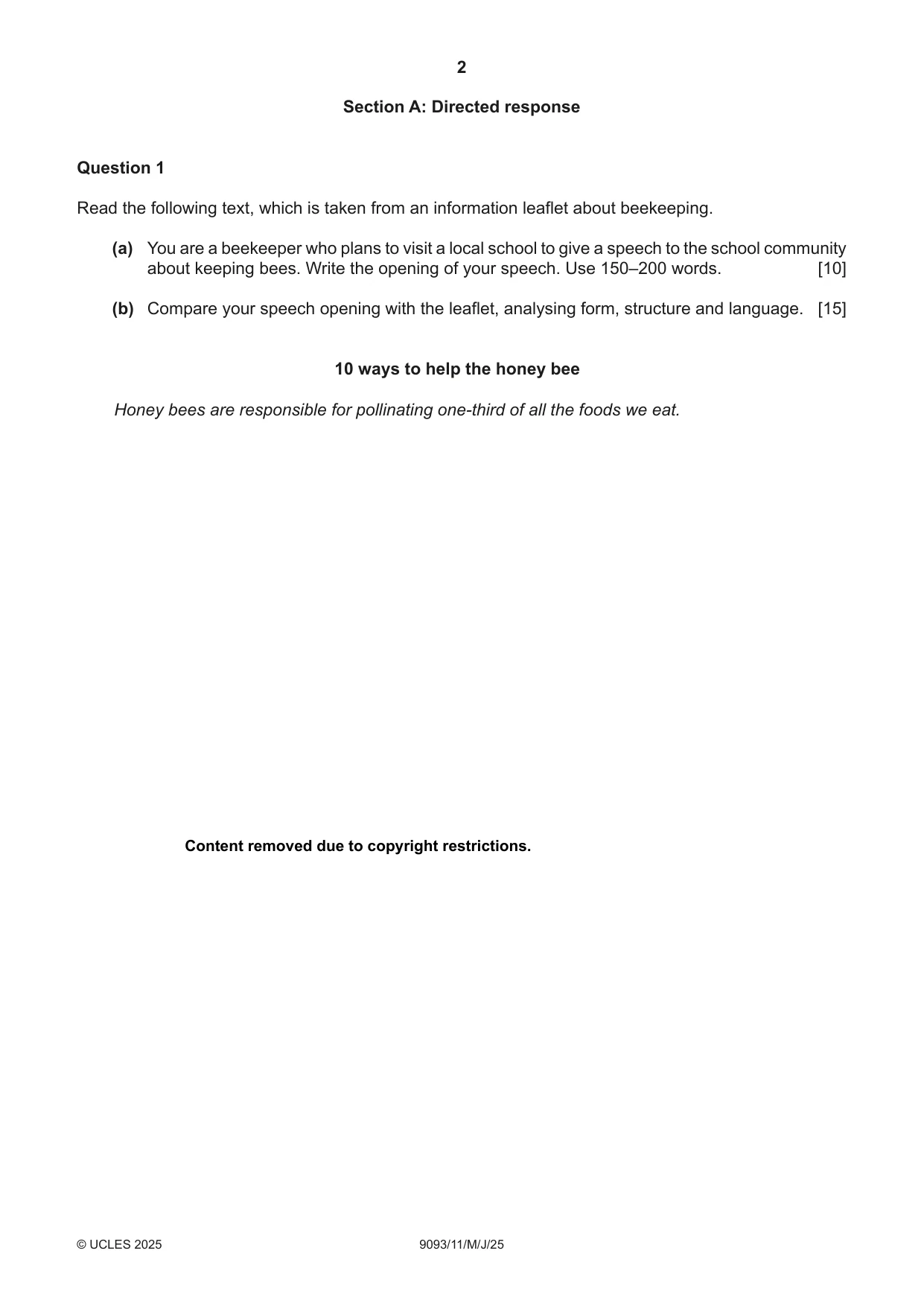
2 9093/11/M/J/25 © UCLES 2025 Section A: Directed response Question 1 Read the following text, which is taken from an information leaflet about beekeeping. (a) You are a beekeeper who plans to visit a local school to give a speech to the school community about keeping bees. Write the opening of your speech. Use 150–200 words. [10] (b) Compare your speech opening with the leaflet, analysing form, structure and language. [15] 10 ways to help the honey bee Honey bees are responsible for pollinating one-third of all the foods we eat. Content removed due to copyright restrictions.
Question paper, page 3
3 9093/11/M/J/25 © UCLES 2025 [Turn over Why not invite a local beekeeper to visit and tell you more about the facts and folklore that surround this fascinating and ancient species? Content removed due to copyright restrictions.
Question paper, page 4
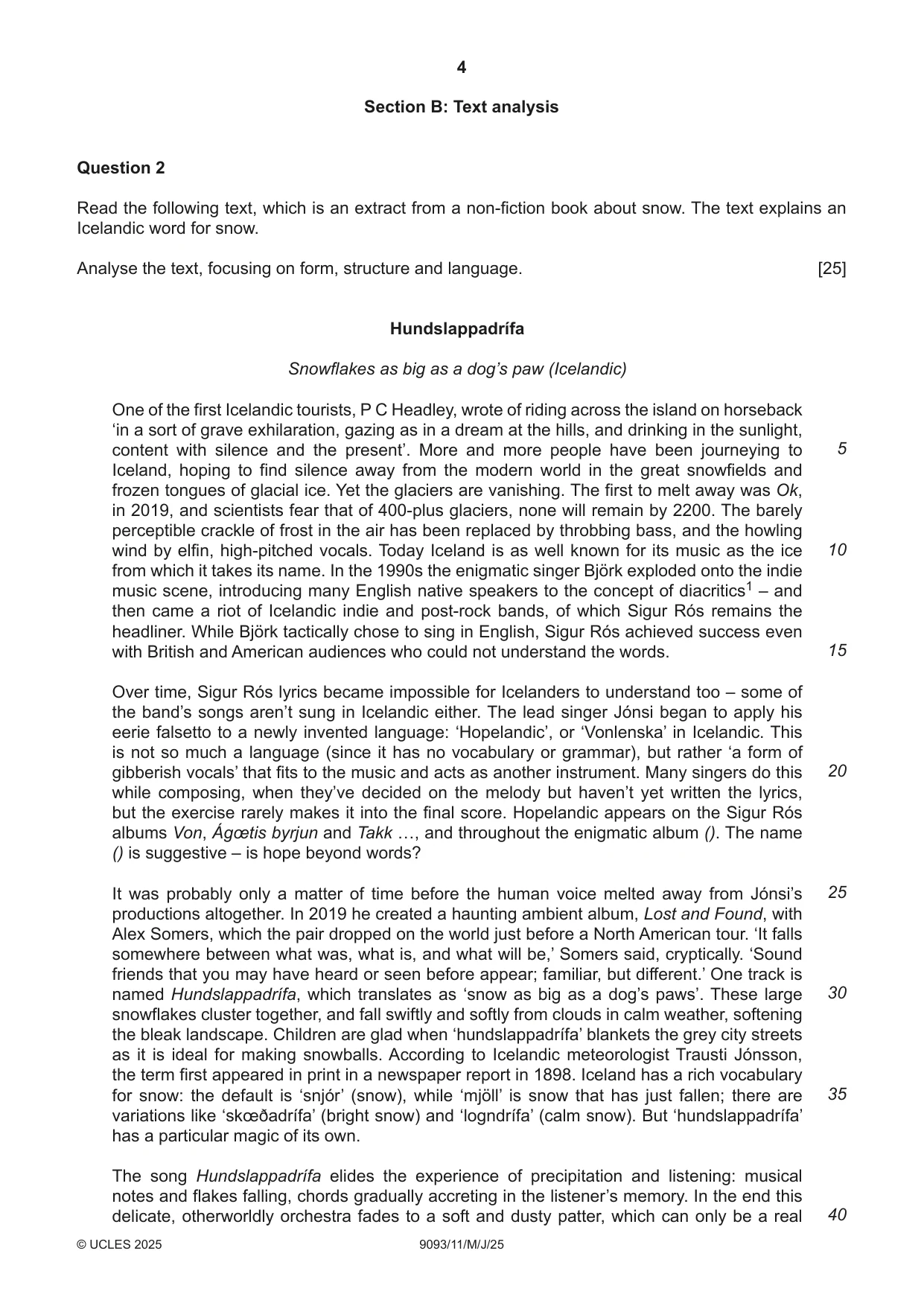
4 9093/11/M/J/25 © UCLES 2025 Section B: Text analysis Question 2 Read the following text, which is an extract from a non-fiction book about snow. The text explains an Icelandic word for snow. Analyse the text, focusing on form, structure and language. [25] Hundslappadrífa Snowflakes as big as a dog’s paw (Icelandic) One of the first Icelandic tourists, P C Headley, wrote of riding across the island on horseback ‘in a sort of grave exhilaration, gazing as in a dream at the hills, and drinking in the sunlight, content with silence and the present’. More and more people have been journeying to Iceland, hoping to find silence away from the modern world in the great snowfields and frozen tongues of glacial ice. Yet the glaciers are vanishing. The first to melt away was Ok, in 2019, and scientists fear that of 400-plus glaciers, none will remain by 2200. The barely perceptible crackle of frost in the air has been replaced by throbbing bass, and the howling wind by elfin, high-pitched vocals. Today Iceland is as well known for its music as the ice from which it takes its name. In the 1990s the enigmatic singer Björk exploded onto the indie music scene, introducing many English native speakers to the concept of diacritics1 – and then came a riot of Icelandic indie and post-rock bands, of which Sigur Rós remains the headliner. While Björk tactically chose to sing in English, Sigur Rós achieved success even with British and American audiences who could not understand the words. Over time, Sigur Rós lyrics became impossible for Icelanders to understand too – some of the band’s songs aren’t sung in Icelandic either. The lead singer Jónsi began to apply his eerie falsetto to a newly invented language: ‘Hopelandic’, or ‘Vonlenska’ in Icelandic. This is not so much a language (since it has no vocabulary or grammar), but rather ‘a form of gibberish vocals’ that fits to the music and acts as another instrument. Many singers do this while composing, when they’ve decided on the melody but haven’t yet written the lyrics, but the exercise rarely makes it into the final score. Hopelandic appears on the Sigur Rós albums Von, Ágœtis byrjun and Takk …, and throughout the enigmatic album (). The name () is suggestive – is hope beyond words? It was probably only a matter of time before the human voice melted away from Jónsi’s productions altogether. In 2019 he created a haunting ambient album, Lost and Found, with Alex Somers, which the pair dropped on the world just before a North American tour. ‘It falls somewhere between what was, what is, and what will be,’ Somers said, cryptically. ‘Sound friends that you may have heard or seen before appear; familiar, but different.’ One track is named Hundslappadrífa, which translates as ‘snow as big as a dog’s paws’. These large snowflakes cluster together, and fall swiftly and softly from clouds in calm weather, softening the bleak landscape. Children are glad when ‘hundslappadrífa’ blankets the grey city streets as it is ideal for making snowballs. According to Icelandic meteorologist Trausti Jónsson, the term first appeared in print in a newspaper report in 1898. Iceland has a rich vocabulary for snow: the default is ‘snjór’ (snow), while ‘mjöll’ is snow that has just fallen; there are variations like ‘skœðadrífa’ (bright snow) and ‘logndrífa’ (calm snow). But ‘hundslappadrífa’ has a particular magic of its own. The song Hundslappadrífa elides the experience of precipitation and listening: musical notes and flakes falling, chords gradually accreting in the listener’s memory. In the end this delicate, otherworldly orchestra fades to a soft and dusty patter, which can only be a real 5 10 15 20 25 30 35 40
Question paper, page 5
5 9093/11/M/J/25 © UCLES 2025 field recording of snowfall. The microphone is held up into swirling flakes, documenting them as other artists have angled a camera lens down upon them – and then there is silence. 1diacritics: marks written above or below letters that change their original pronunciation
Question paper, page 6
6 9093/11/M/J/25 © UCLES 2025 BLANK PAGE
Question paper, page 7
7 9093/11/M/J/25 © UCLES 2025 BLANK PAGE
Question paper, page 8
8 9093/11/M/J/25 © UCLES 2025 Permission to reproduce items where third-party owned material protected by copyright is included has been sought and cleared where possible. Every reasonable effort has been made by the publisher (UCLES) to trace copyright holders, but if any items requiring clearance have unwittingly been included, the publisher will be pleased to make amends at the earliest possible opportunity. To avoid the issue of disclosure of answer-related information to candidates, all copyright acknowledgements are reproduced online in the Cambridge Assessment International Education Copyright Acknowledgements Booklet. This is produced for each series of examinations and is freely available to download at www.cambridgeinternational.org after the live examination series. Cambridge Assessment International Education is part of Cambridge Assessment. Cambridge Assessment is the brand name of the University of Cambridge Local Examinations Syndicate (UCLES), which is a department of the University of Cambridge. BLANK PAGE
Mark scheme, page 1
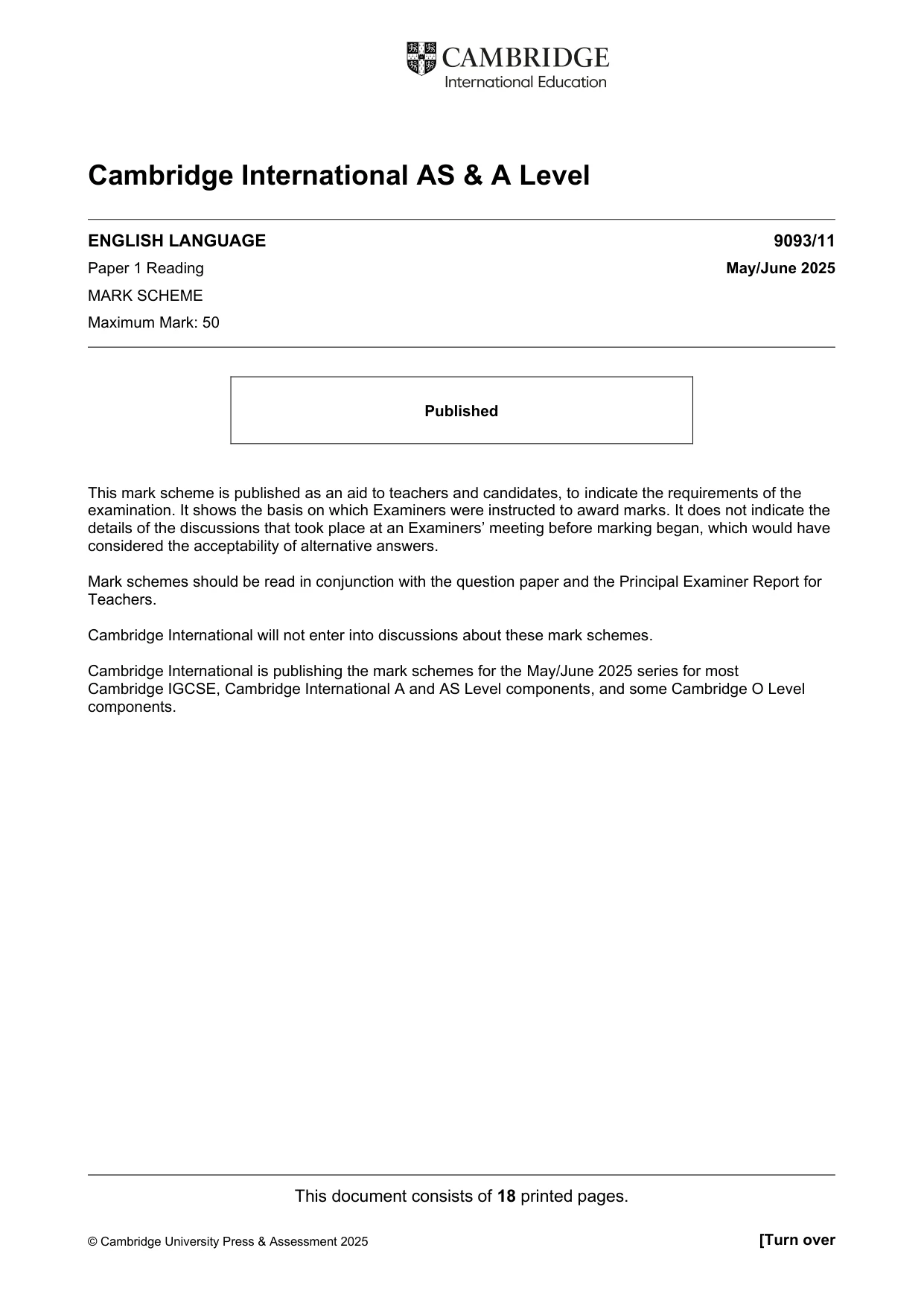
This document consists of 18 printed pages. © Cambridge University Press & Assessment 2025 [Turn over Cambridge International AS & A Level ENGLISH LANGUAGE 9093/11 Paper 1 Reading May/June 2025 MARK SCHEME Maximum Mark: 50 Published This mark scheme is published as an aid to teachers and candidates, to indicate the requirements of the examination. It shows the basis on which Examiners were instructed to award marks. It does not indicate the details of the discussions that took place at an Examiners’ meeting before marking began, which would have considered the acceptability of alternative answers. Mark schemes should be read in conjunction with the question paper and the Principal Examiner Report for Teachers. Cambridge International will not enter into discussions about these mark schemes. Cambridge International is publishing the mark schemes for the May/June 2025 series for most Cambridge IGCSE, Cambridge International A and AS Level components, and some Cambridge O Level components.
Mark scheme, page 2
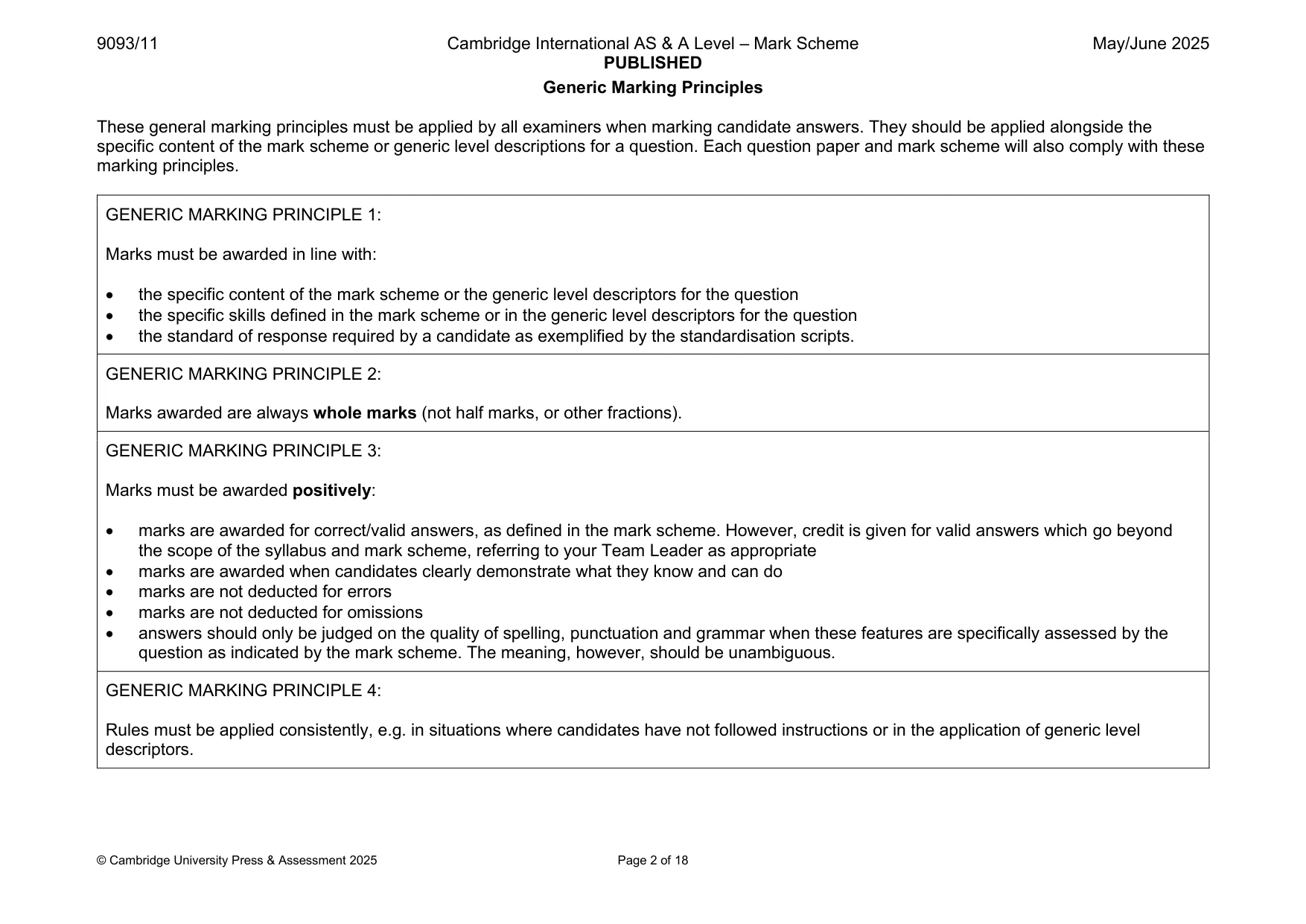
9093/11 Cambridge International AS & A Level – Mark Scheme PUBLISHED May/June 2025 © Cambridge University Press & Assessment 2025 Page 2 of 18 Generic Marking Principles These general marking principles must be applied by all examiners when marking candidate answers. They should be applied alongside the specific content of the mark scheme or generic level descriptions for a question. Each question paper and mark scheme will also comply with these marking principles. GENERIC MARKING PRINCIPLE 1: Marks must be awarded in line with: • the specific content of the mark scheme or the generic level descriptors for the question • the specific skills defined in the mark scheme or in the generic level descriptors for the question • the standard of response required by a candidate as exemplified by the standardisation scripts. GENERIC MARKING PRINCIPLE 2: Marks awarded are always whole marks (not half marks, or other fractions). GENERIC MARKING PRINCIPLE 3: Marks must be awarded positively: • marks are awarded for correct/valid answers, as defined in the mark scheme. However, credit is given for valid answers which go beyond the scope of the syllabus and mark scheme, referring to your Team Leader as appropriate • marks are awarded when candidates clearly demonstrate what they know and can do • marks are not deducted for errors • marks are not deducted for omissions • answers should only be judged on the quality of spelling, punctuation and grammar when these features are specifically assessed by the question as indicated by the mark scheme. The meaning, however, should be unambiguous. GENERIC MARKING PRINCIPLE 4: Rules must be applied consistently, e.g. in situations where candidates have not followed instructions or in the application of generic level descriptors.
Mark scheme, page 3
9093/11 Cambridge International AS & A Level – Mark Scheme PUBLISHED May/June 2025 © Cambridge University Press & Assessment 2025 Page 3 of 18 GENERIC MARKING PRINCIPLE 5: Marks should be awarded using the full range of marks defined in the mark scheme for the question (however; the use of the full mark range may be limited according to the quality of the candidate responses seen). GENERIC MARKING PRINCIPLE 6: Marks awarded are based solely on the requirements as defined in the mark scheme. Marks should not be awarded with grade thresholds or grade descriptors in mind.
Mark scheme, page 4
9093/11 Cambridge International AS & A Level – Mark Scheme PUBLISHED May/June 2025 © Cambridge University Press & Assessment 2025 Page 4 of 18 English & Media subject specific general marking principles (To be read in conjunction with the Generic Marking Principles (and requiring further guidance on how to place marks within levels)) Components using level descriptors: • We use level descriptors as a guide to broad understanding of the qualities normally expected of, or typical of, work in a level. • Level descriptors are a means of general guidance and should not be interpreted as hurdle statements. • Where indicative content notes are supplied for a question, these are not a prescription of required content, and must not be treated as such. Alternative correct points and unexpected answers in candidates’ scripts must be given marks that fairly reflect the knowledge and skills demonstrated. • While we may have legitimate expectations as to the ground most answers may occupy, we must at all times be prepared to meet candidates on their chosen ground, provided it is relevant ground (e.g. clearly related to and derived from a relevant passage/text and meeting the mark scheme requirements for the question).
Mark scheme, page 5
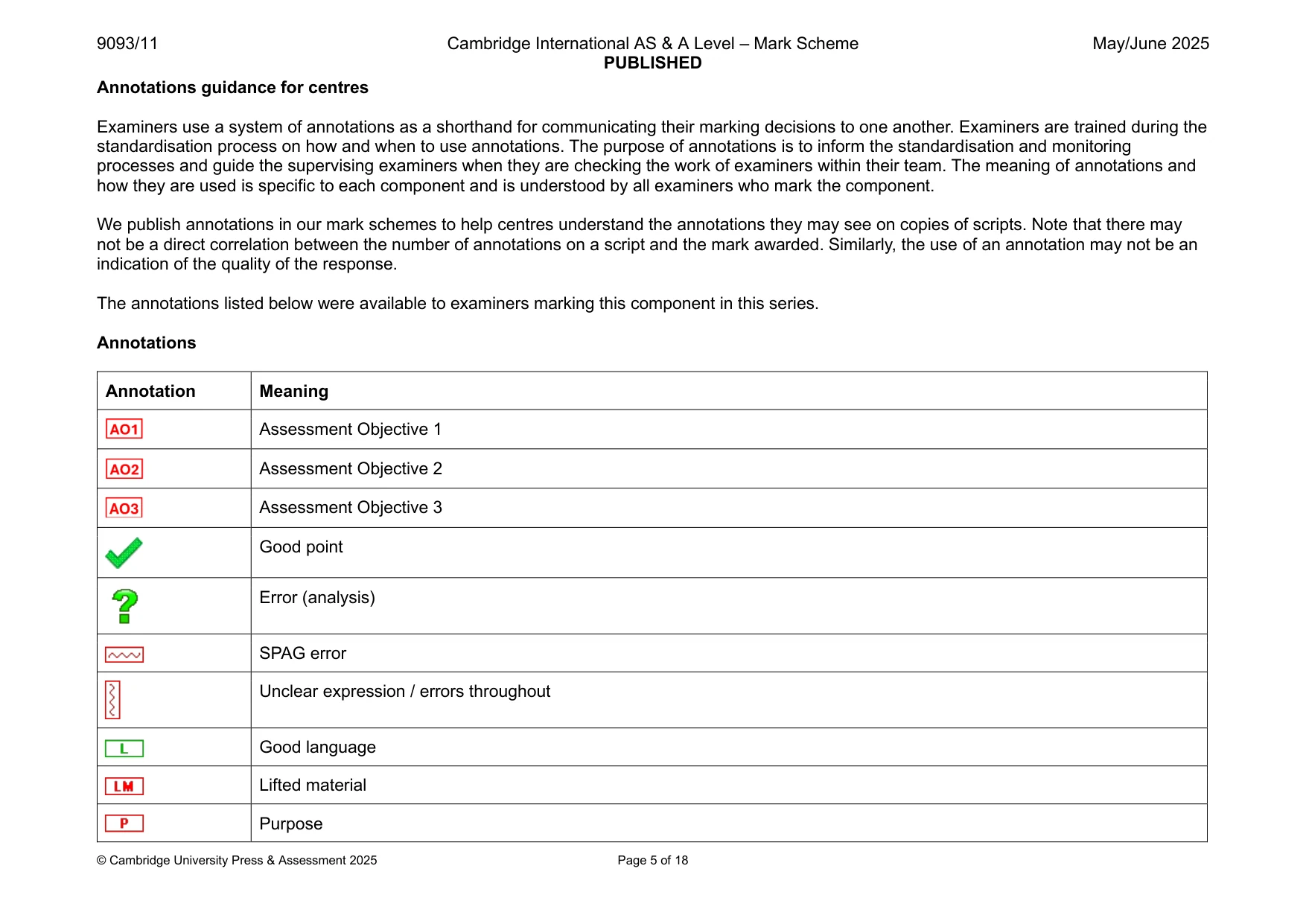
9093/11 Cambridge International AS & A Level – Mark Scheme PUBLISHED May/June 2025 © Cambridge University Press & Assessment 2025 Page 5 of 18 Annotations guidance for centres Examiners use a system of annotations as a shorthand for communicating their marking decisions to one another. Examiners are trained during the standardisation process on how and when to use annotations. The purpose of annotations is to inform the standardisation and monitoring processes and guide the supervising examiners when they are checking the work of examiners within their team. The meaning of annotations and how they are used is specific to each component and is understood by all examiners who mark the component. We publish annotations in our mark schemes to help centres understand the annotations they may see on copies of scripts. Note that there may not be a direct correlation between the number of annotations on a script and the mark awarded. Similarly, the use of an annotation may not be an indication of the quality of the response. The annotations listed below were available to examiners marking this component in this series. Annotations Annotation Meaning Assessment Objective 1 Assessment Objective 2 Assessment Objective 3 Good point Error (analysis) SPAG error Unclear expression / errors throughout Good language Lifted material Purpose
Mark scheme, page 6
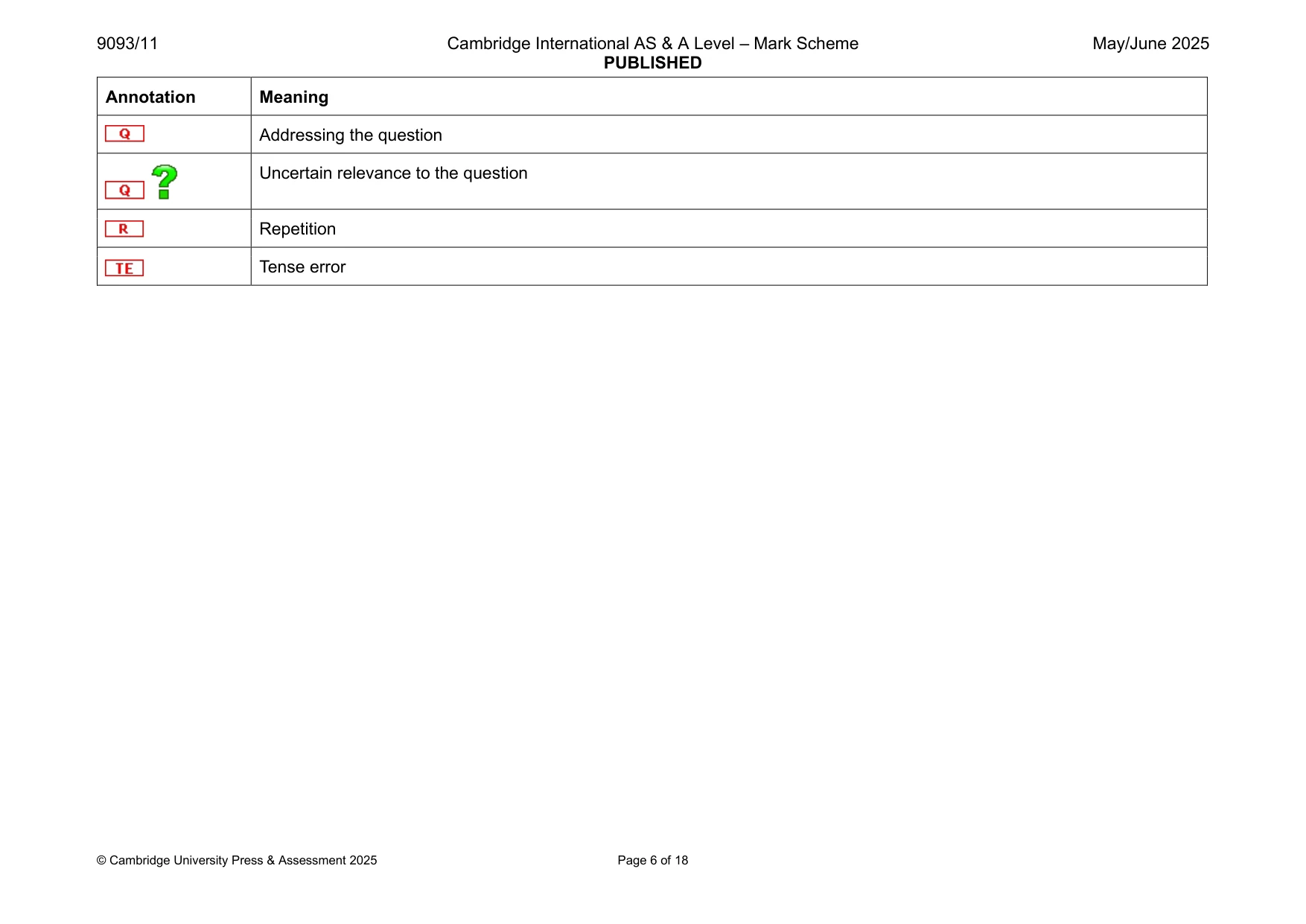
9093/11 Cambridge International AS & A Level – Mark Scheme PUBLISHED May/June 2025 © Cambridge University Press & Assessment 2025 Page 6 of 18 Annotation Meaning Addressing the question Uncertain relevance to the question Repetition Tense error
Mark scheme, page 7
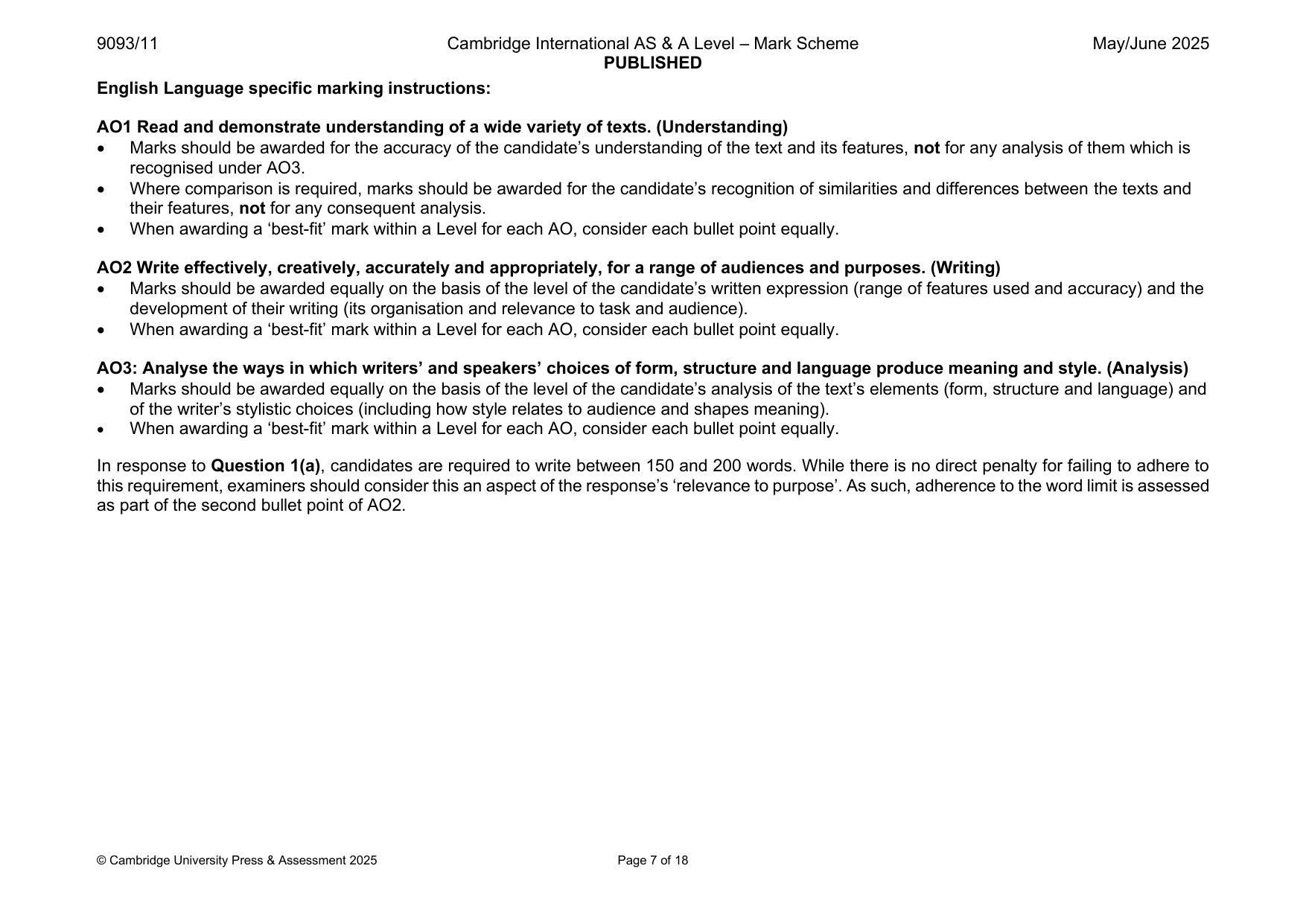
9093/11 Cambridge International AS & A Level – Mark Scheme PUBLISHED May/June 2025 © Cambridge University Press & Assessment 2025 Page 7 of 18 English Language specific marking instructions: AO1 Read and demonstrate understanding of a wide variety of texts. (Understanding) • Marks should be awarded for the accuracy of the candidate’s understanding of the text and its features, not for any analysis of them which is recognised under AO3. • Where comparison is required, marks should be awarded for the candidate’s recognition of similarities and differences between the texts and their features, not for any consequent analysis. • When awarding a ‘best-fit’ mark within a Level for each AO, consider each bullet point equally. AO2 Write effectively, creatively, accurately and appropriately, for a range of audiences and purposes. (Writing) • Marks should be awarded equally on the basis of the level of the candidate’s written expression (range of features used and accuracy) and the development of their writing (its organisation and relevance to task and audience). • When awarding a ‘best-fit’ mark within a Level for each AO, consider each bullet point equally. AO3: Analyse the ways in which writers’ and speakers’ choices of form, structure and language produce meaning and style. (Analysis) • Marks should be awarded equally on the basis of the level of the candidate’s analysis of the text’s elements (form, structure and language) and of the writer’s stylistic choices (including how style relates to audience and shapes meaning). • When awarding a ‘best-fit’ mark within a Level for each AO, consider each bullet point equally. In response to Question 1(a), candidates are required to write between 150 and 200 words. While there is no direct penalty for failing to adhere to this requirement, examiners should consider this an aspect of the response’s ‘relevance to purpose’. As such, adherence to the word limit is assessed as part of the second bullet point of AO2.
Mark scheme, page 8
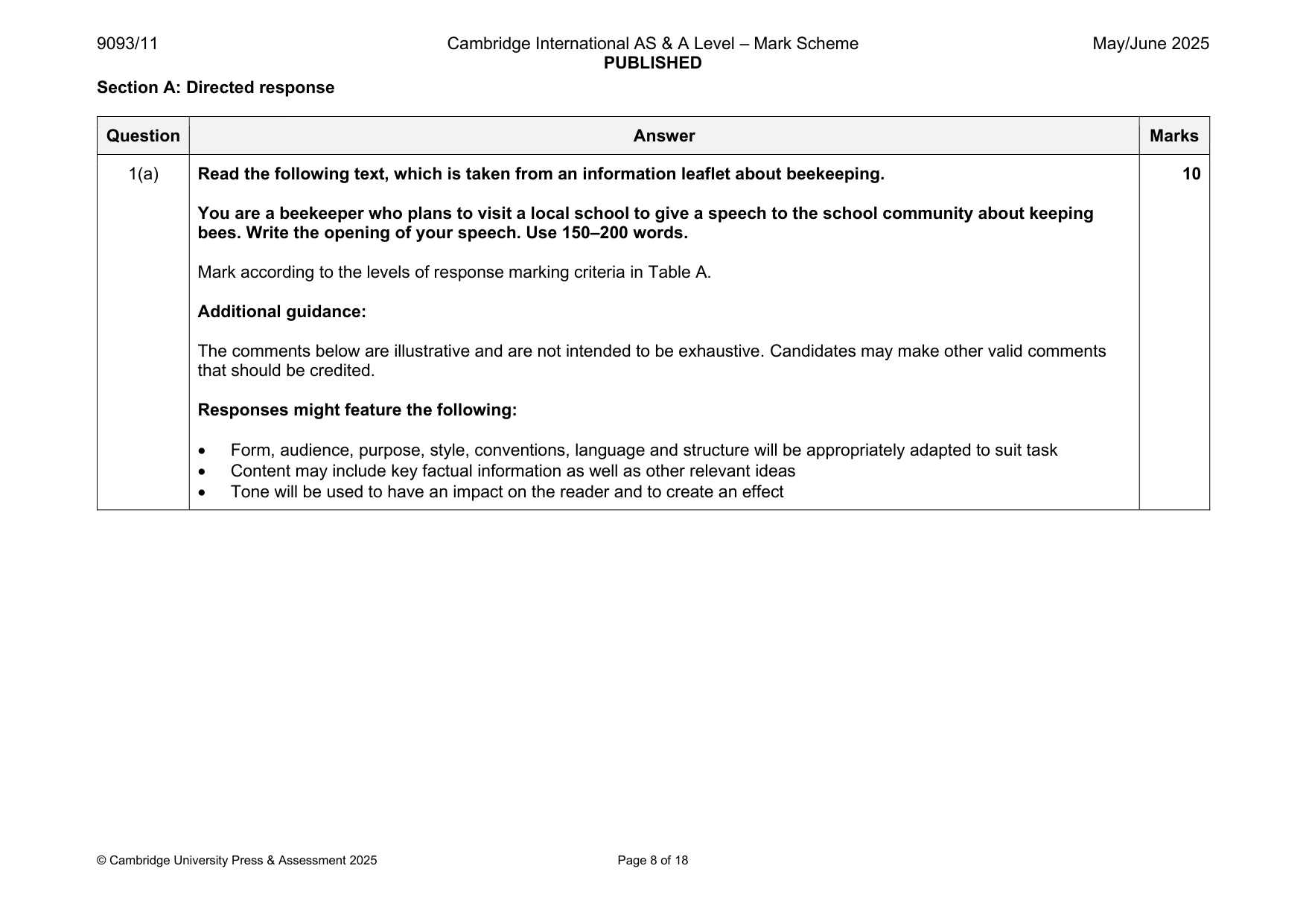
9093/11 Cambridge International AS & A Level – Mark Scheme PUBLISHED May/June 2025 © Cambridge University Press & Assessment 2025 Page 8 of 18 Section A: Directed response Question Answer Marks 1(a) Read the following text, which is taken from an information leaflet about beekeeping. You are a beekeeper who plans to visit a local school to give a speech to the school community about keeping bees. Write the opening of your speech. Use 150–200 words. Mark according to the levels of response marking criteria in Table A. Additional guidance: The comments below are illustrative and are not intended to be exhaustive. Candidates may make other valid comments that should be credited. Responses might feature the following: • Form, audience, purpose, style, conventions, language and structure will be appropriately adapted to suit task • Content may include key factual information as well as other relevant ideas • Tone will be used to have an impact on the reader and to create an effect 10
Mark scheme, page 9
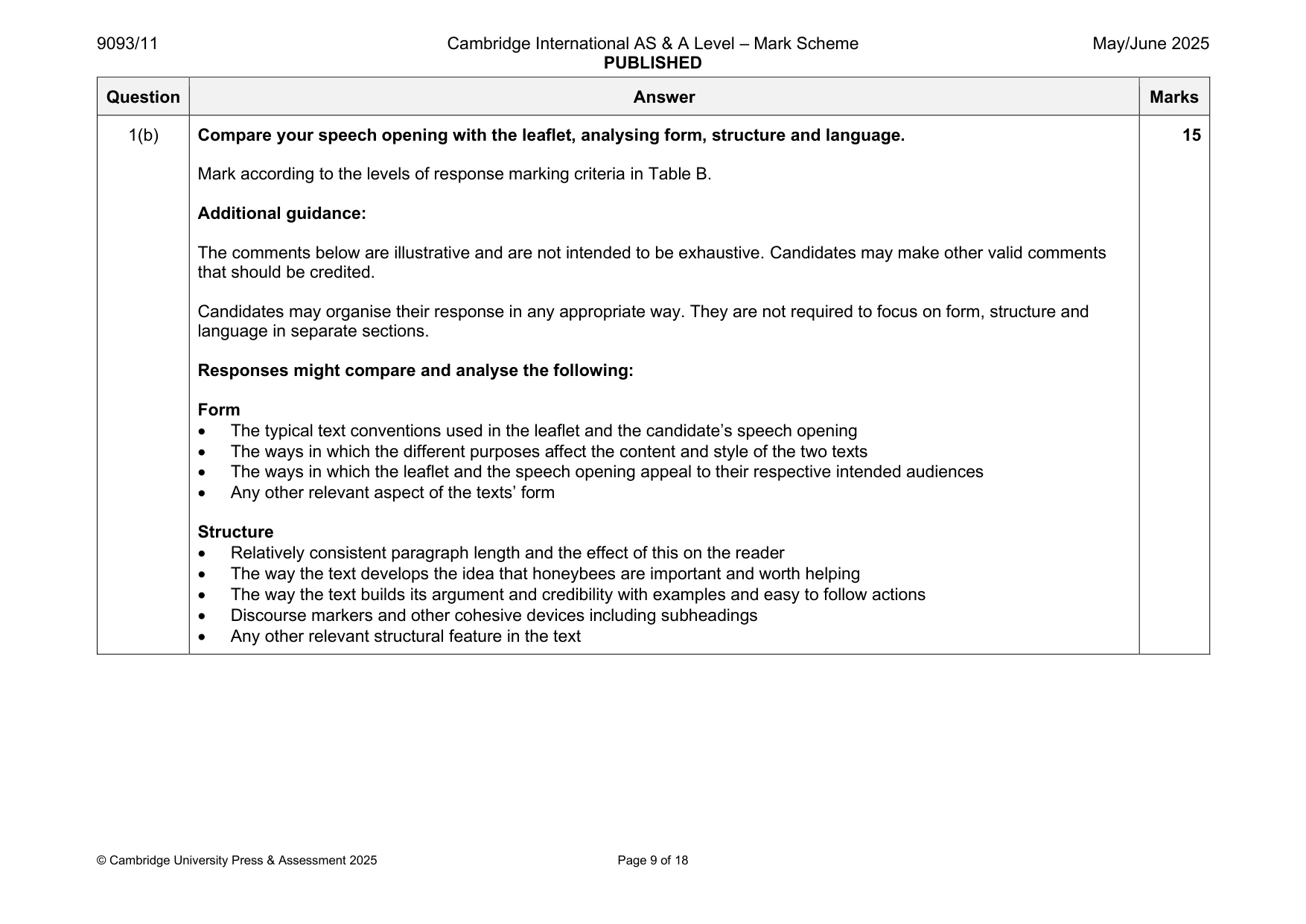
9093/11 Cambridge International AS & A Level – Mark Scheme PUBLISHED May/June 2025 © Cambridge University Press & Assessment 2025 Page 9 of 18 Question Answer Marks 1(b) Compare your speech opening with the leaflet, analysing form, structure and language. Mark according to the levels of response marking criteria in Table B. Additional guidance: The comments below are illustrative and are not intended to be exhaustive. Candidates may make other valid comments that should be credited. Candidates may organise their response in any appropriate way. They are not required to focus on form, structure and language in separate sections. Responses might compare and analyse the following: Form • The typical text conventions used in the leaflet and the candidate’s speech opening • The ways in which the different purposes affect the content and style of the two texts • The ways in which the leaflet and the speech opening appeal to their respective intended audiences • Any other relevant aspect of the texts’ form Structure • Relatively consistent paragraph length and the effect of this on the reader • The way the text develops the idea that honeybees are important and worth helping • The way the text builds its argument and credibility with examples and easy to follow actions • Discourse markers and other cohesive devices including subheadings • Any other relevant structural feature in the text 15
Mark scheme, page 10
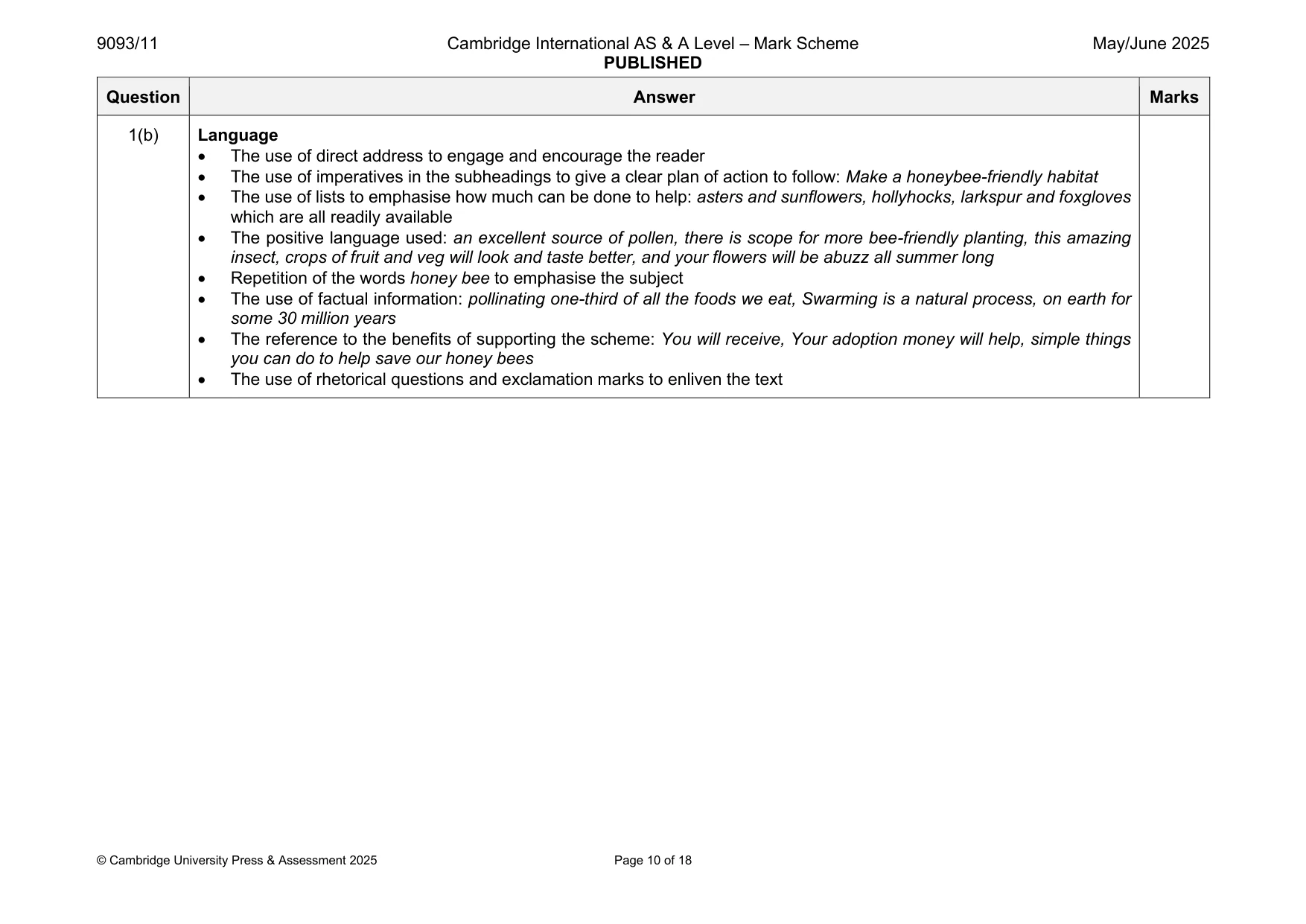
9093/11 Cambridge International AS & A Level – Mark Scheme PUBLISHED May/June 2025 © Cambridge University Press & Assessment 2025 Page 10 of 18 Question Answer Marks 1(b) Language • The use of direct address to engage and encourage the reader • The use of imperatives in the subheadings to give a clear plan of action to follow: Make a honeybee-friendly habitat • The use of lists to emphasise how much can be done to help: asters and sunflowers, hollyhocks, larkspur and foxgloves which are all readily available • The positive language used: an excellent source of pollen, there is scope for more bee-friendly planting, this amazing insect, crops of fruit and veg will look and taste better, and your flowers will be abuzz all summer long • Repetition of the words honey bee to emphasise the subject • The use of factual information: pollinating one-third of all the foods we eat, Swarming is a natural process, on earth for some 30 million years • The reference to the benefits of supporting the scheme: You will receive, Your adoption money will help, simple things you can do to help save our honey bees • The use of rhetorical questions and exclamation marks to enliven the text
Mark scheme, page 11
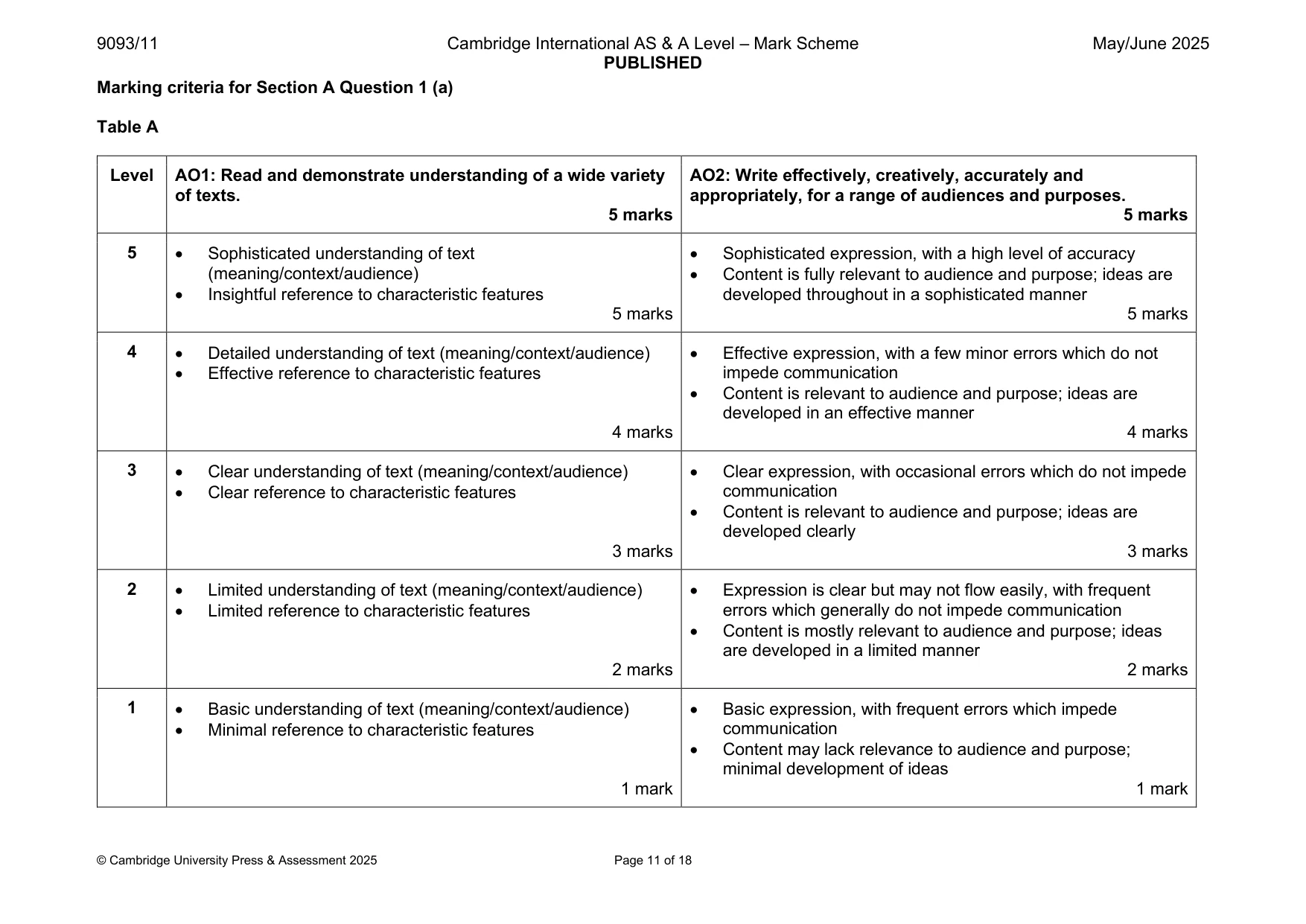
9093/11 Cambridge International AS & A Level – Mark Scheme PUBLISHED May/June 2025 © Cambridge University Press & Assessment 2025 Page 11 of 18 Marking criteria for Section A Question 1 (a) Table A Level AO1: Read and demonstrate understanding of a wide variety of texts. 5 marks AO2: Write effectively, creatively, accurately and appropriately, for a range of audiences and purposes. 5 marks 5 • Sophisticated understanding of text (meaning/context/audience) • Insightful reference to characteristic features 5 marks • Sophisticated expression, with a high level of accuracy • Content is fully relevant to audience and purpose; ideas are developed throughout in a sophisticated manner 5 marks 4 • Detailed understanding of text (meaning/context/audience) • Effective reference to characteristic features 4 marks • Effective expression, with a few minor errors which do not impede communication • Content is relevant to audience and purpose; ideas are developed in an effective manner 4 marks 3 • Clear understanding of text (meaning/context/audience) • Clear reference to characteristic features 3 marks • Clear expression, with occasional errors which do not impede communication • Content is relevant to audience and purpose; ideas are developed clearly 3 marks 2 • Limited understanding of text (meaning/context/audience) • Limited reference to characteristic features 2 marks • Expression is clear but may not flow easily, with frequent errors which generally do not impede communication • Content is mostly relevant to audience and purpose; ideas are developed in a limited manner 2 marks 1 • Basic understanding of text (meaning/context/audience) • Minimal reference to characteristic features 1 mark • Basic expression, with frequent errors which impede communication • Content may lack relevance to audience and purpose; minimal development of ideas 1 mark
Mark scheme, page 12
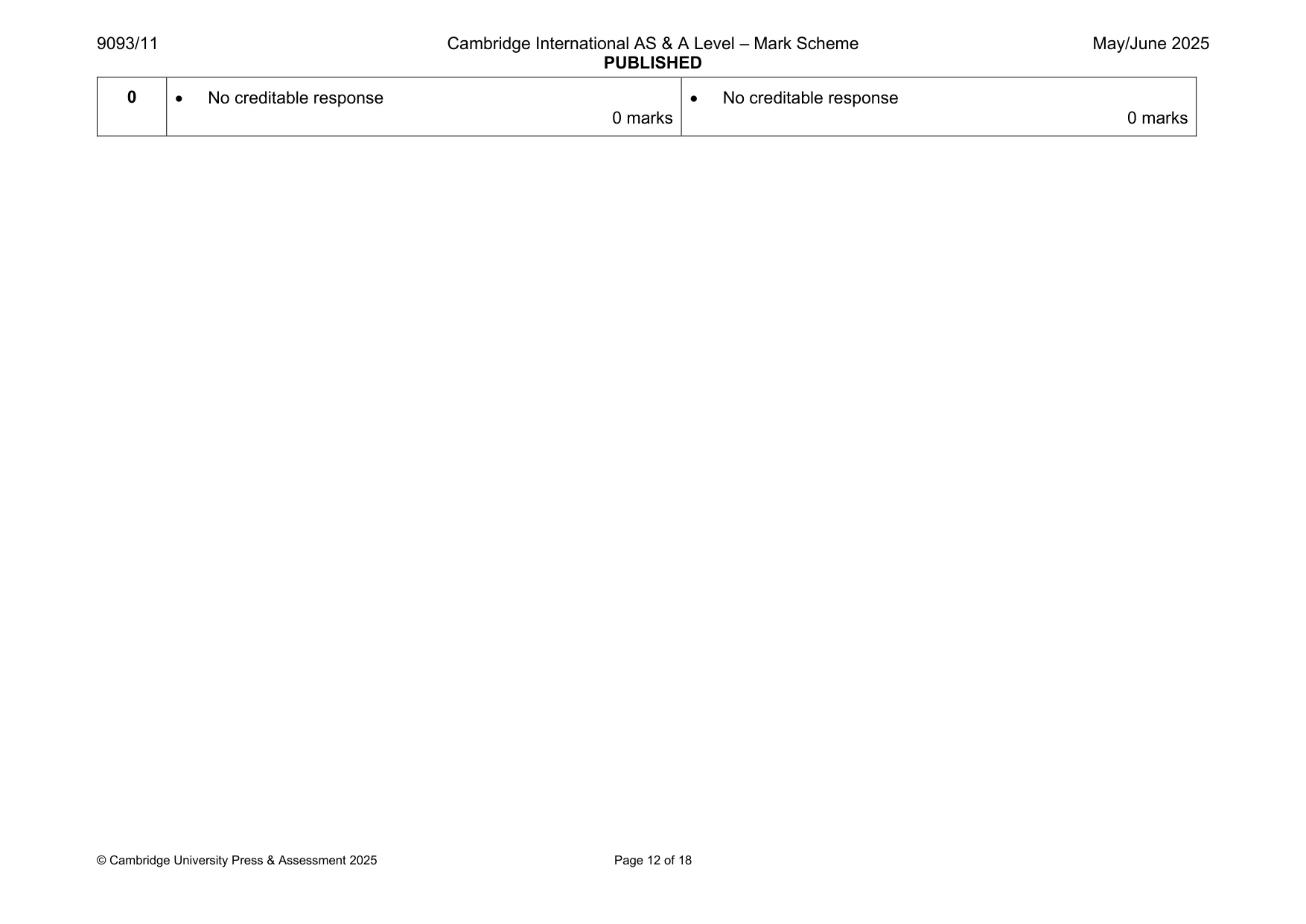
9093/11 Cambridge International AS & A Level – Mark Scheme PUBLISHED May/June 2025 © Cambridge University Press & Assessment 2025 Page 12 of 18 0 • No creditable response 0 marks • No creditable response 0 marks
Mark scheme, page 13
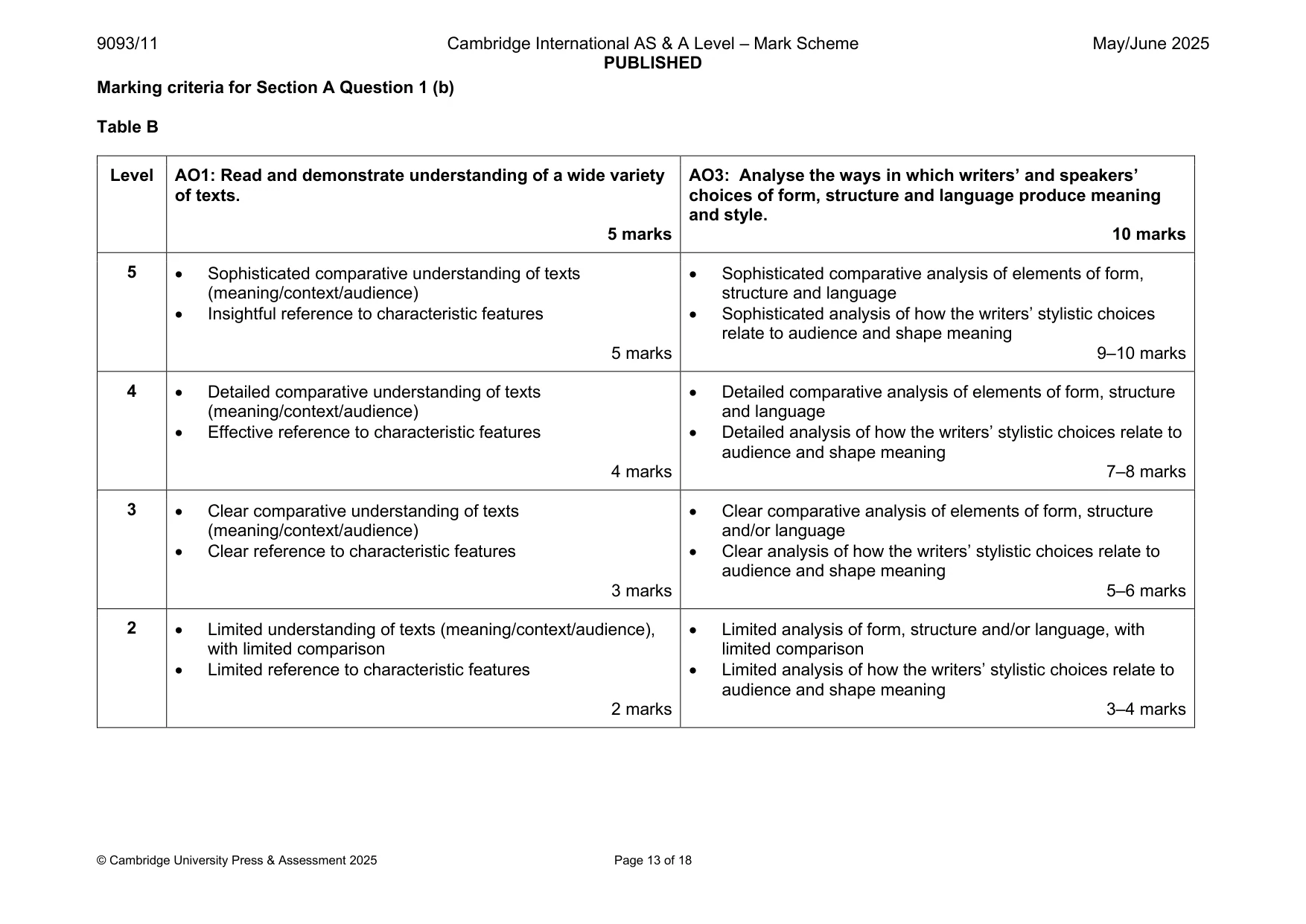
9093/11 Cambridge International AS & A Level – Mark Scheme PUBLISHED May/June 2025 © Cambridge University Press & Assessment 2025 Page 13 of 18 Marking criteria for Section A Question 1 (b) Table B Level AO1: Read and demonstrate understanding of a wide variety of texts. 5 marks AO3: Analyse the ways in which writers’ and speakers’ choices of form, structure and language produce meaning and style. 10 marks 5 • Sophisticated comparative understanding of texts (meaning/context/audience) • Insightful reference to characteristic features 5 marks • Sophisticated comparative analysis of elements of form, structure and language • Sophisticated analysis of how the writers’ stylistic choices relate to audience and shape meaning 9–10 marks 4 • Detailed comparative understanding of texts (meaning/context/audience) • Effective reference to characteristic features 4 marks • Detailed comparative analysis of elements of form, structure and language • Detailed analysis of how the writers’ stylistic choices relate to audience and shape meaning 7–8 marks 3 • Clear comparative understanding of texts (meaning/context/audience) • Clear reference to characteristic features 3 marks • Clear comparative analysis of elements of form, structure and/or language • Clear analysis of how the writers’ stylistic choices relate to audience and shape meaning 5–6 marks 2 • Limited understanding of texts (meaning/context/audience), with limited comparison • Limited reference to characteristic features 2 marks • Limited analysis of form, structure and/or language, with limited comparison • Limited analysis of how the writers’ stylistic choices relate to audience and shape meaning 3–4 marks
Mark scheme, page 14
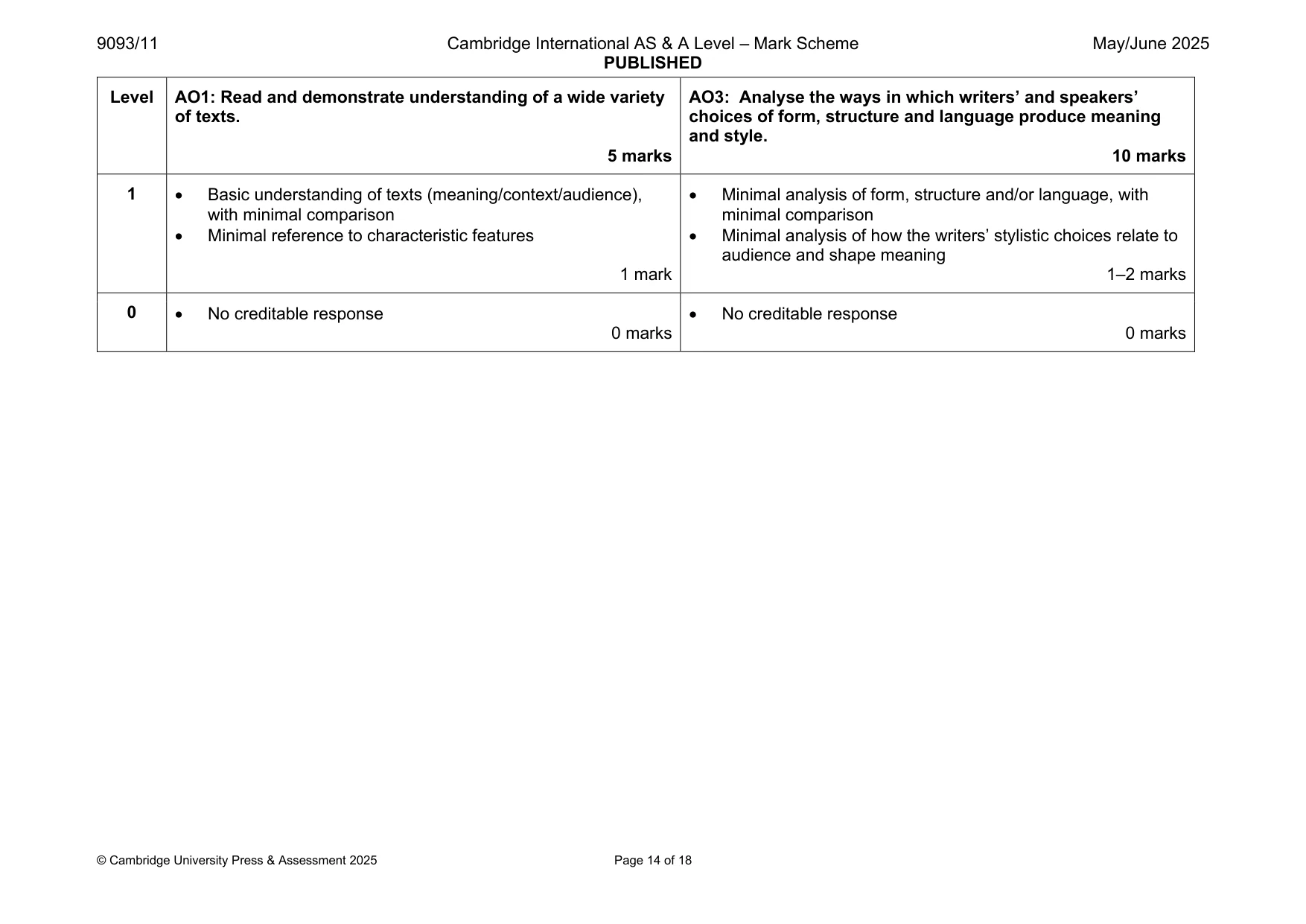
9093/11 Cambridge International AS & A Level – Mark Scheme PUBLISHED May/June 2025 © Cambridge University Press & Assessment 2025 Page 14 of 18 Level AO1: Read and demonstrate understanding of a wide variety of texts. 5 marks AO3: Analyse the ways in which writers’ and speakers’ choices of form, structure and language produce meaning and style. 10 marks 1 • Basic understanding of texts (meaning/context/audience), with minimal comparison • Minimal reference to characteristic features 1 mark • Minimal analysis of form, structure and/or language, with minimal comparison • Minimal analysis of how the writers’ stylistic choices relate to audience and shape meaning 1–2 marks 0 • No creditable response 0 marks • No creditable response 0 marks
Mark scheme, page 15
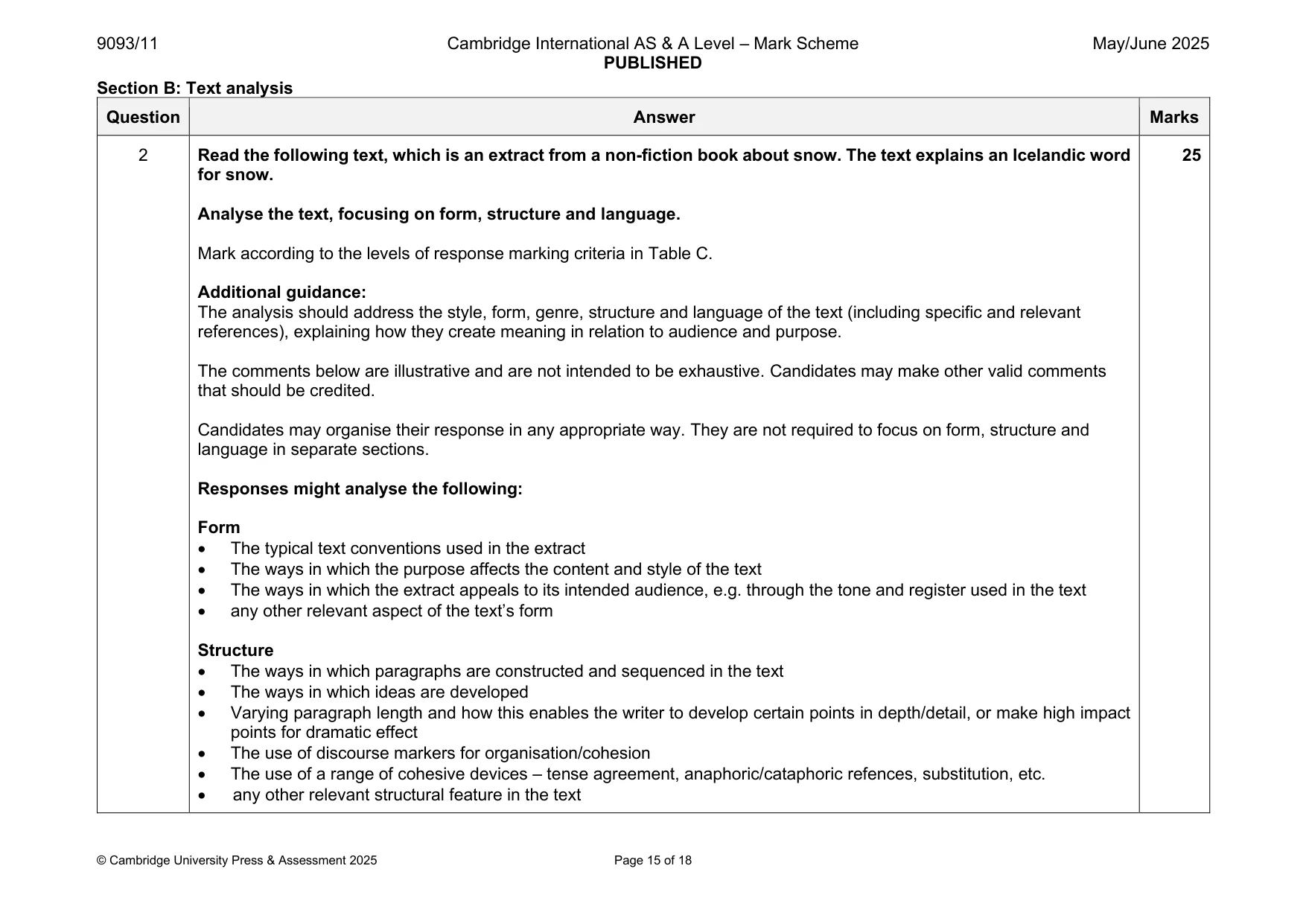
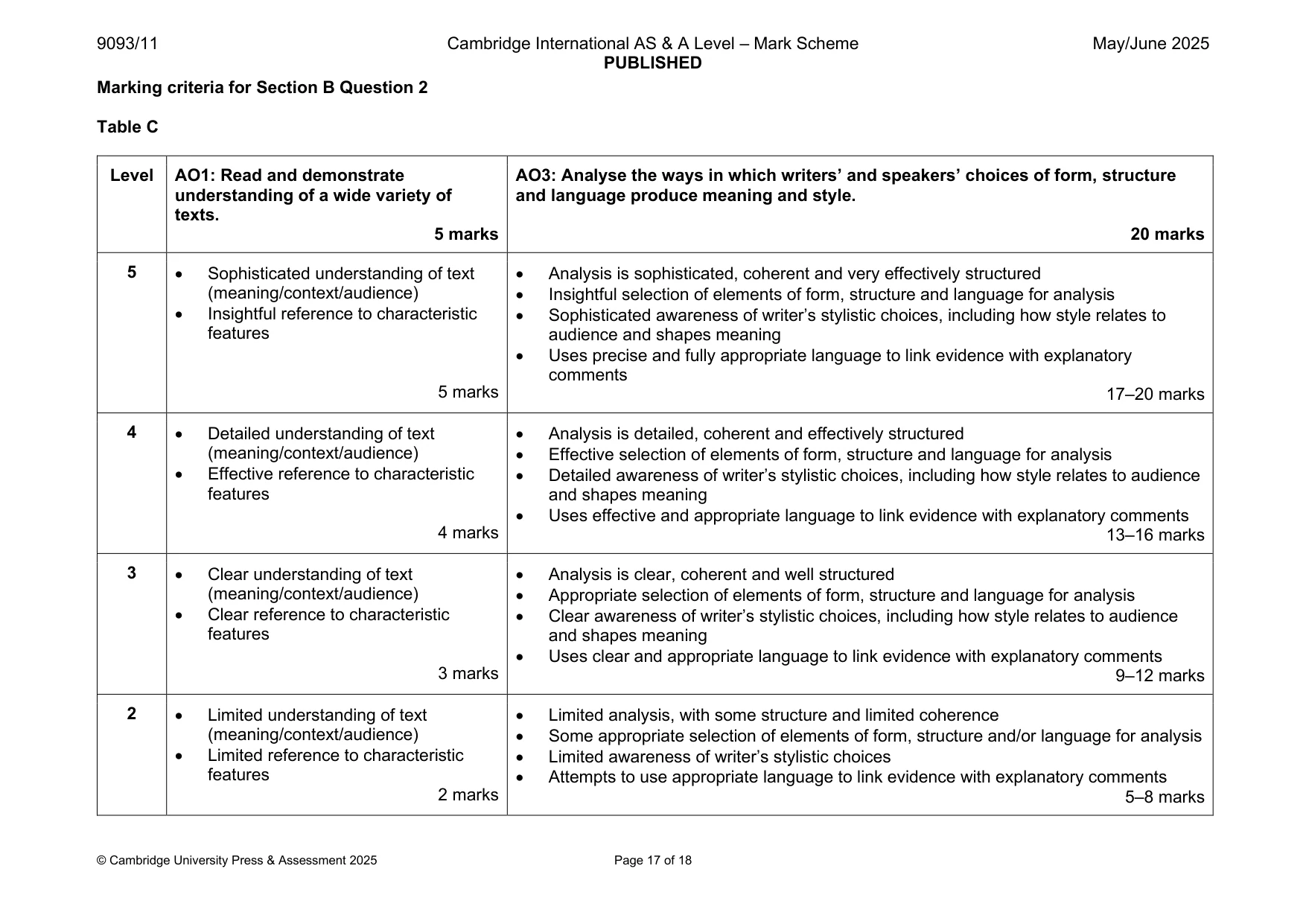
9093/11 Cambridge International AS & A Level – Mark Scheme PUBLISHED May/June 2025 © Cambridge University Press & Assessment 2025 Page 15 of 18 Section B: Text analysis Question Answer Marks 2 Read the following text, which is an extract from a non-fiction book about snow. The text explains an Icelandic word for snow. Analyse the text, focusing on form, structure and language. Mark according to the levels of response marking criteria in Table C. Additional guidance: The analysis should address the style, form, genre, structure and language of the text (including specific and relevant references), explaining how they create meaning in relation to audience and purpose. The comments below are illustrative and are not intended to be exhaustive. Candidates may make other valid comments that should be credited. Candidates may organise their response in any appropriate way. They are not required to focus on form, structure and language in separate sections. Responses might analyse the following: Form • The typical text conventions used in the extract • The ways in which the purpose affects the content and style of the text • The ways in which the extract appeals to its intended audience, e.g. through the tone and register used in the text • any other relevant aspect of the text’s form Structure • The ways in which paragraphs are constructed and sequenced in the text • The ways in which ideas are developed • Varying paragraph length and how this enables the writer to develop certain points in depth/detail, or make high impact points for dramatic effect • The use of discourse markers for organisation/cohesion • The use of a range of cohesive devices – tense agreement, anaphoric/cataphoric refences, substitution, etc. • any other relevant structural feature in the text 25
Mark scheme, page 16
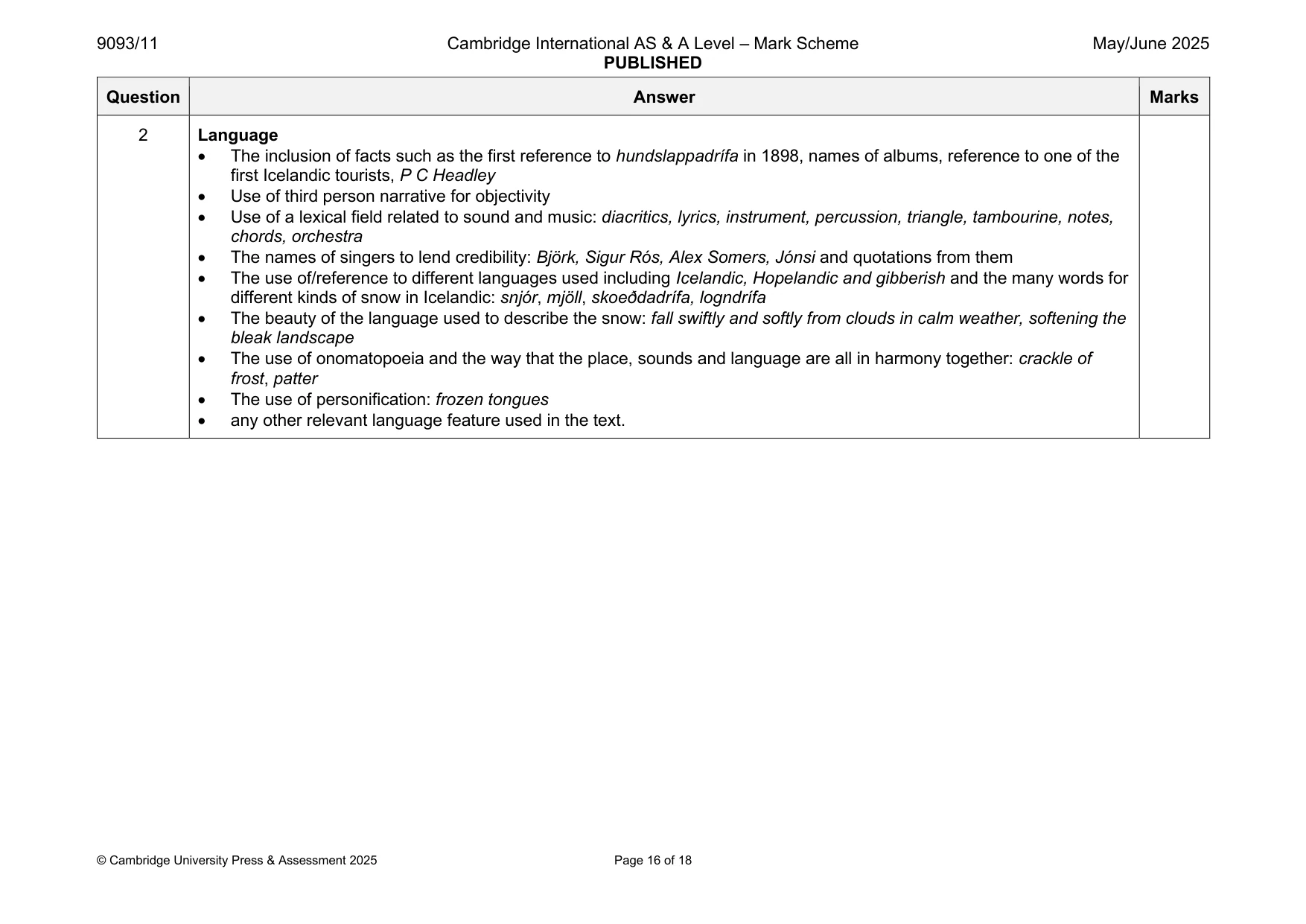
9093/11 Cambridge International AS & A Level – Mark Scheme PUBLISHED May/June 2025 © Cambridge University Press & Assessment 2025 Page 16 of 18 Question Answer Marks 2 Language • The inclusion of facts such as the first reference to hundslappadrífa in 1898, names of albums, reference to one of the first Icelandic tourists, P C Headley • Use of third person narrative for objectivity • Use of a lexical field related to sound and music: diacritics, lyrics, instrument, percussion, triangle, tambourine, notes, chords, orchestra • The names of singers to lend credibility: Björk, Sigur Rós, Alex Somers, Jónsi and quotations from them • The use of/reference to different languages used including Icelandic, Hopelandic and gibberish and the many words for different kinds of snow in Icelandic: snjór, mjöll, skoeðdadrífa, logndrífa • The beauty of the language used to describe the snow: fall swiftly and softly from clouds in calm weather, softening the bleak landscape • The use of onomatopoeia and the way that the place, sounds and language are all in harmony together: crackle of frost, patter • The use of personification: frozen tongues • any other relevant language feature used in the text.
Mark scheme, page 17
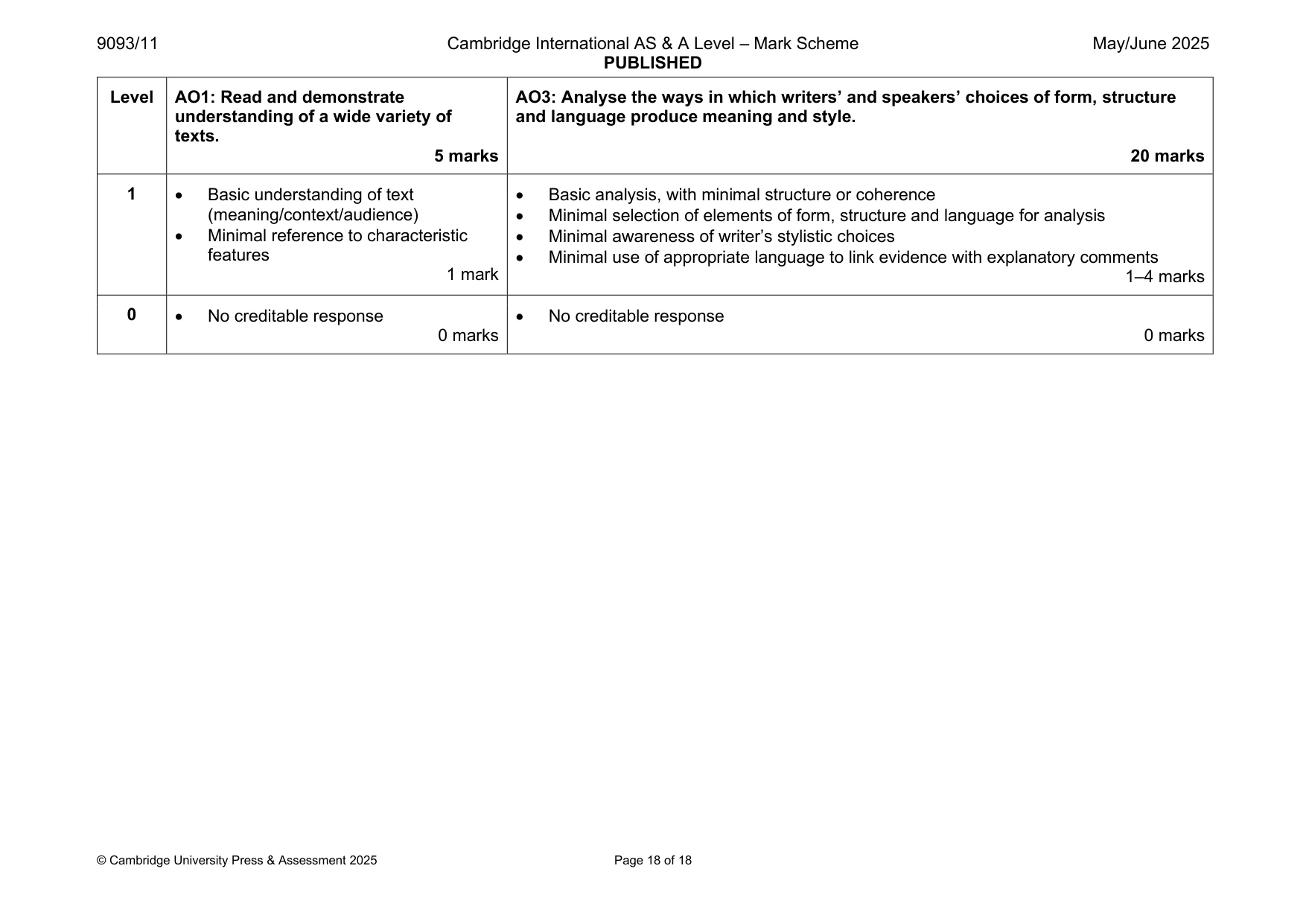
9093/11 Cambridge International AS & A Level – Mark Scheme PUBLISHED May/June 2025 © Cambridge University Press & Assessment 2025 Page 17 of 18 Marking criteria for Section B Question 2 Table C Level AO1: Read and demonstrate understanding of a wide variety of texts. 5 marks AO3: Analyse the ways in which writers’ and speakers’ choices of form, structure and language produce meaning and style. 20 marks 5 • Sophisticated understanding of text (meaning/context/audience) • Insightful reference to characteristic features 5 marks • Analysis is sophisticated, coherent and very effectively structured • Insightful selection of elements of form, structure and language for analysis • Sophisticated awareness of writer’s stylistic choices, including how style relates to audience and shapes meaning • Uses precise and fully appropriate language to link evidence with explanatory comments 17–20 marks 4 • Detailed understanding of text (meaning/context/audience) • Effective reference to characteristic features 4 marks • Analysis is detailed, coherent and effectively structured • Effective selection of elements of form, structure and language for analysis • Detailed awareness of writer’s stylistic choices, including how style relates to audience and shapes meaning • Uses effective and appropriate language to link evidence with explanatory comments 13–16 marks 3 • Clear understanding of text (meaning/context/audience) • Clear reference to characteristic features 3 marks • Analysis is clear, coherent and well structured • Appropriate selection of elements of form, structure and language for analysis • Clear awareness of writer’s stylistic choices, including how style relates to audience and shapes meaning • Uses clear and appropriate language to link evidence with explanatory comments 9–12 marks 2 • Limited understanding of text (meaning/context/audience) • Limited reference to characteristic features 2 marks • Limited analysis, with some structure and limited coherence • Some appropriate selection of elements of form, structure and/or language for analysis • Limited awareness of writer’s stylistic choices • Attempts to use appropriate language to link evidence with explanatory comments 5–8 marks
Mark scheme, page 18
9093/11 Cambridge International AS & A Level – Mark Scheme PUBLISHED May/June 2025 © Cambridge University Press & Assessment 2025 Page 18 of 18 Level AO1: Read and demonstrate understanding of a wide variety of texts. 5 marks AO3: Analyse the ways in which writers’ and speakers’ choices of form, structure and language produce meaning and style. 20 marks 1 • Basic understanding of text (meaning/context/audience) • Minimal reference to characteristic features 1 mark • Basic analysis, with minimal structure or coherence • Minimal selection of elements of form, structure and language for analysis • Minimal awareness of writer’s stylistic choices • Minimal use of appropriate language to link evidence with explanatory comments 1–4 marks 0 • No creditable response 0 marks • No creditable response 0 marks
What you needed in this session
Cambridge’s own grade thresholds for 2025 May/June, Paper 1 · Variant 1. A higher threshold means an easier paper — the bar moves with how the cohort did.