Cambridge A Level English - Language AS and A Level (from 2014) 9093 — 2023 May/June Paper 1 · Variant 1
9093/11/M/J/23 · 50 marks · ≈56 min
The question paper and its mark scheme, free to read here and free to download. This is Cambridge’s own paper, exactly as it was sat.
Question paper8 pages
Mark scheme15 pages
Answers below. Sit the paper first if you are practising.
Paper as text
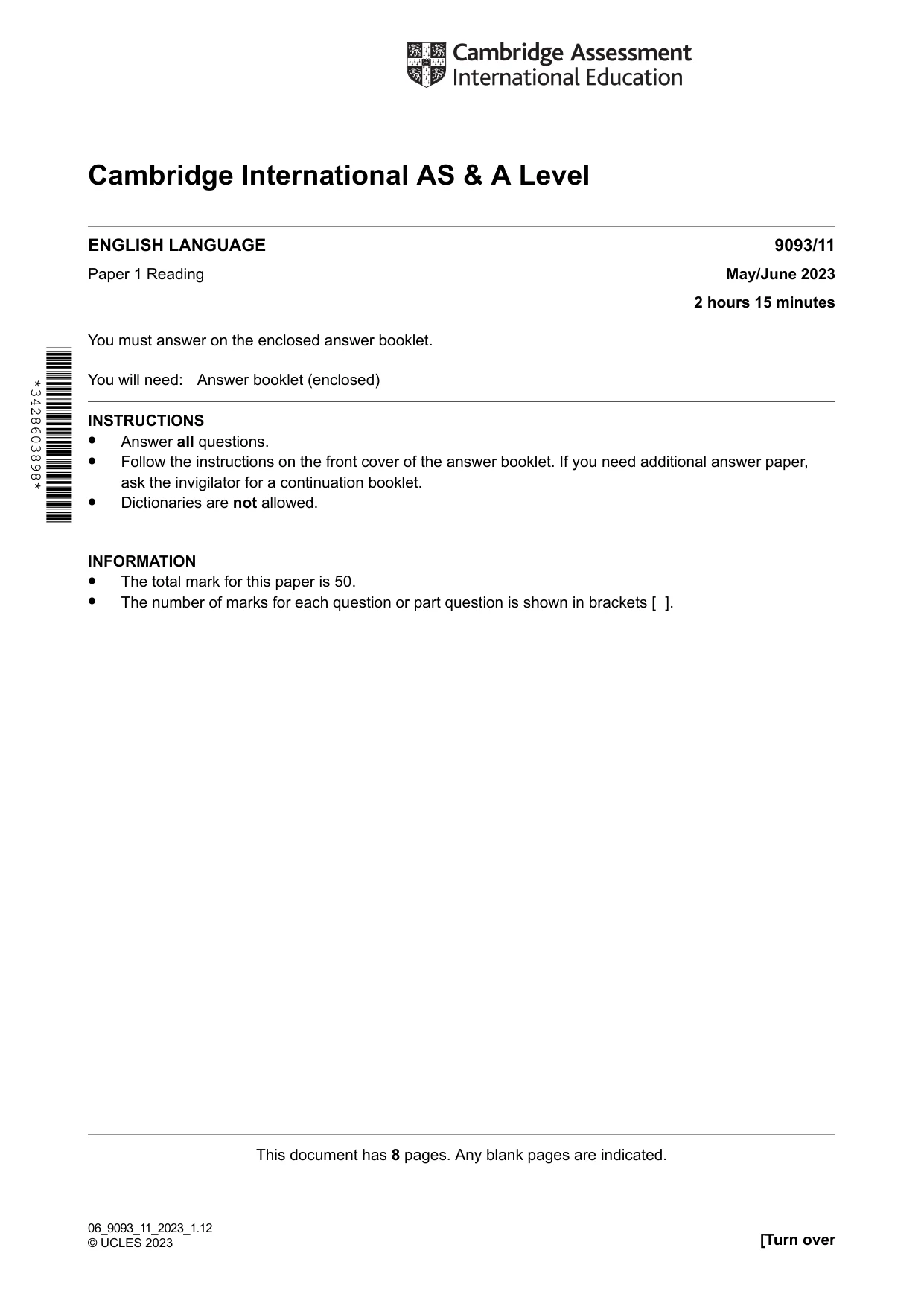
Question paper, page 1
Cambridge International AS & A Level 9093/11 May/June 2023 2 hours 15 minutes ENGLISH LANGUAGE Paper 1 Reading You must answer on the enclosed answer booklet. You will need: Answer booklet (enclosed) INSTRUCTIONS • Answer all questions. • Follow the instructions on the front cover of the answer booklet. If you need additional answer paper, ask the invigilator for a continuation booklet. • Dictionaries are not allowed. INFORMATION • The total mark for this paper is 50. • The number of marks for each question or part question is shown in brackets [ ]. This document has 8 pages. Any blank pages are indicated. [Turn over 06_9093_11_2023_1.12 © UCLES 2023 *3428603898*
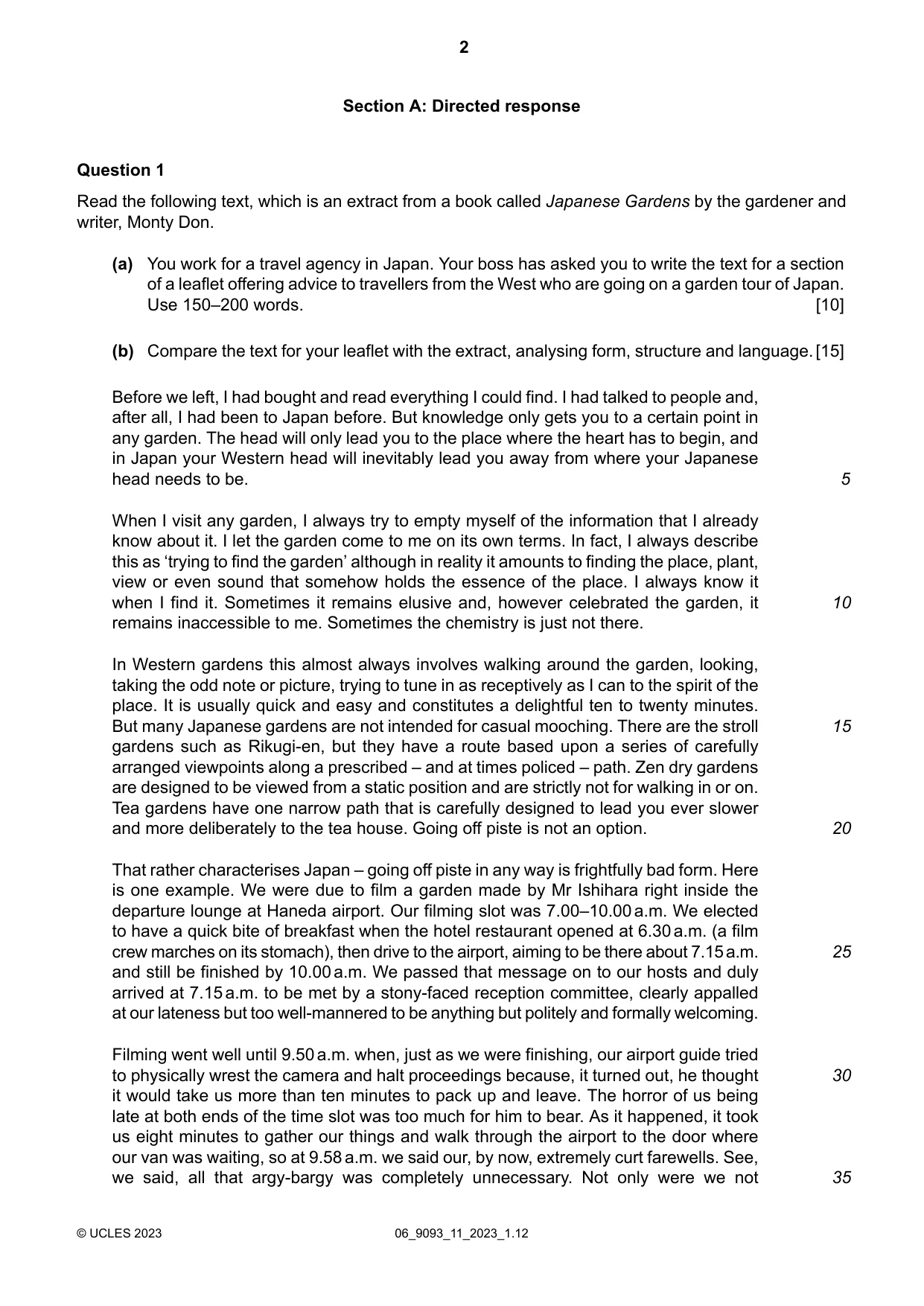
Question paper, page 2
35 30 25 20 15 10 5 Section A: Directed response Question 1 Read the following text, which is an extract from a book called Japanese Gardens by the gardener and writer, Monty Don. You work for a travel agency in Japan. Your boss has asked you to write the text for a section of a leaflet offering advice to travellers from the West who are going on a garden tour of Japan. Use 150–200 words. [10] (a) Compare the text for your leaflet with the extract, analysing form, structure and language.[15] (b) Before we left, I had bought and read everything I could find. I had talked to people and, after all, I had been to Japan before. But knowledge only gets you to a certain point in any garden. The head will only lead you to the place where the heart has to begin, and in Japan your Western head will inevitably lead you away from where your Japanese head needs to be. When I visit any garden, I always try to empty myself of the information that I already know about it. I let the garden come to me on its own terms. In fact, I always describe this as ‘trying to find the garden’ although in reality it amounts to finding the place, plant, view or even sound that somehow holds the essence of the place. I always know it when I find it. Sometimes it remains elusive and, however celebrated the garden, it remains inaccessible to me. Sometimes the chemistry is just not there. In Western gardens this almost always involves walking around the garden, looking, taking the odd note or picture, trying to tune in as receptively as I can to the spirit of the place. It is usually quick and easy and constitutes a delightful ten to twenty minutes. But many Japanese gardens are not intended for casual mooching. There are the stroll gardens such as Rikugi-en, but they have a route based upon a series of carefully arranged viewpoints along a prescribed – and at times policed – path. Zen dry gardens are designed to be viewed from a static position and are strictly not for walking in or on. Tea gardens have one narrow path that is carefully designed to lead you ever slower and more deliberately to the tea house. Going off piste is not an option. That rather characterises Japan – going off piste in any way is frightfully bad form. Here is one example. We were due to film a garden made by Mr Ishihara right inside the departure lounge at Haneda airport. Our filming slot was 7.00–10.00a.m. We elected to have a quick bite of breakfast when the hotel restaurant opened at 6.30a.m. (a film crew marches on its stomach), then drive to the airport, aiming to be there about 7.15a.m. and still be finished by 10.00a.m. We passed that message on to our hosts and duly arrived at 7.15a.m. to be met by a stony-faced reception committee, clearly appalled at our lateness but too well-mannered to be anything but politely and formally welcoming. Filming went well until 9.50a.m. when, just as we were finishing, our airport guide tried to physically wrest the camera and halt proceedings because, it turned out, he thought it would take us more than ten minutes to pack up and leave. The horror of us being late at both ends of the time slot was too much for him to bear. As it happened, it took us eight minutes to gather our things and walk through the airport to the door where our van was waiting, so at 9.58a.m. we said our, by now, extremely curt farewells. See, we said, all that argy-bargy was completely unnecessary. Not only were we not 06_9093_11_2023_1.12 © UCLES 2023 2
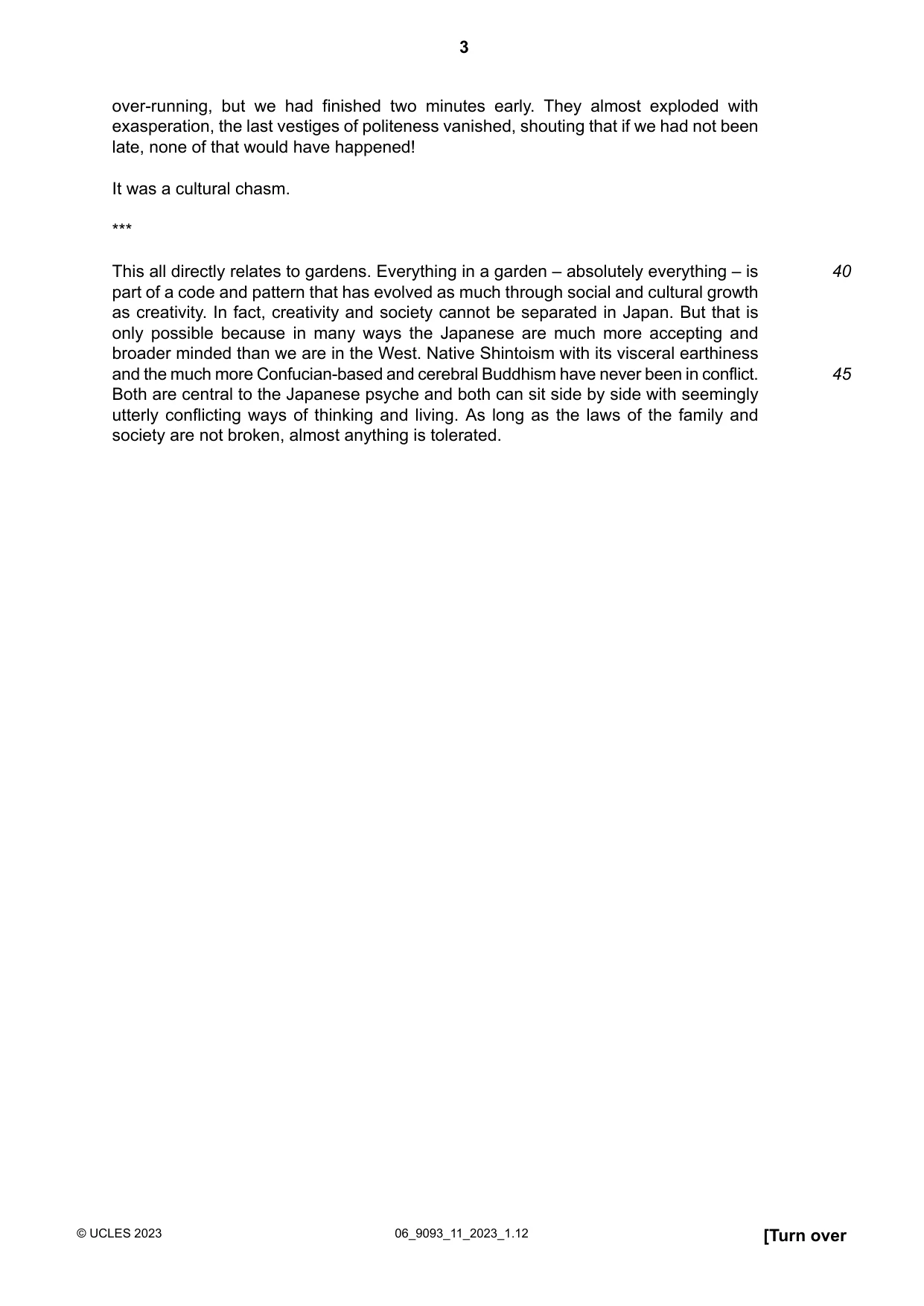
Question paper, page 3
45 40 over-running, but we had finished two minutes early. They almost exploded with exasperation, the last vestiges of politeness vanished, shouting that if we had not been late, none of that would have happened! It was a cultural chasm. *** This all directly relates to gardens. Everything in a garden – absolutely everything – is part of a code and pattern that has evolved as much through social and cultural growth as creativity. In fact, creativity and society cannot be separated in Japan. But that is only possible because in many ways the Japanese are much more accepting and broader minded than we are in the West. Native Shintoism with its visceral earthiness and the much more Confucian-based and cerebral Buddhism have never been in conflict. Both are central to the Japanese psyche and both can sit side by side with seemingly utterly conflicting ways of thinking and living. As long as the laws of the family and society are not broken, almost anything is tolerated. [Turn over 06_9093_11_2023_1.12 © UCLES 2023 3
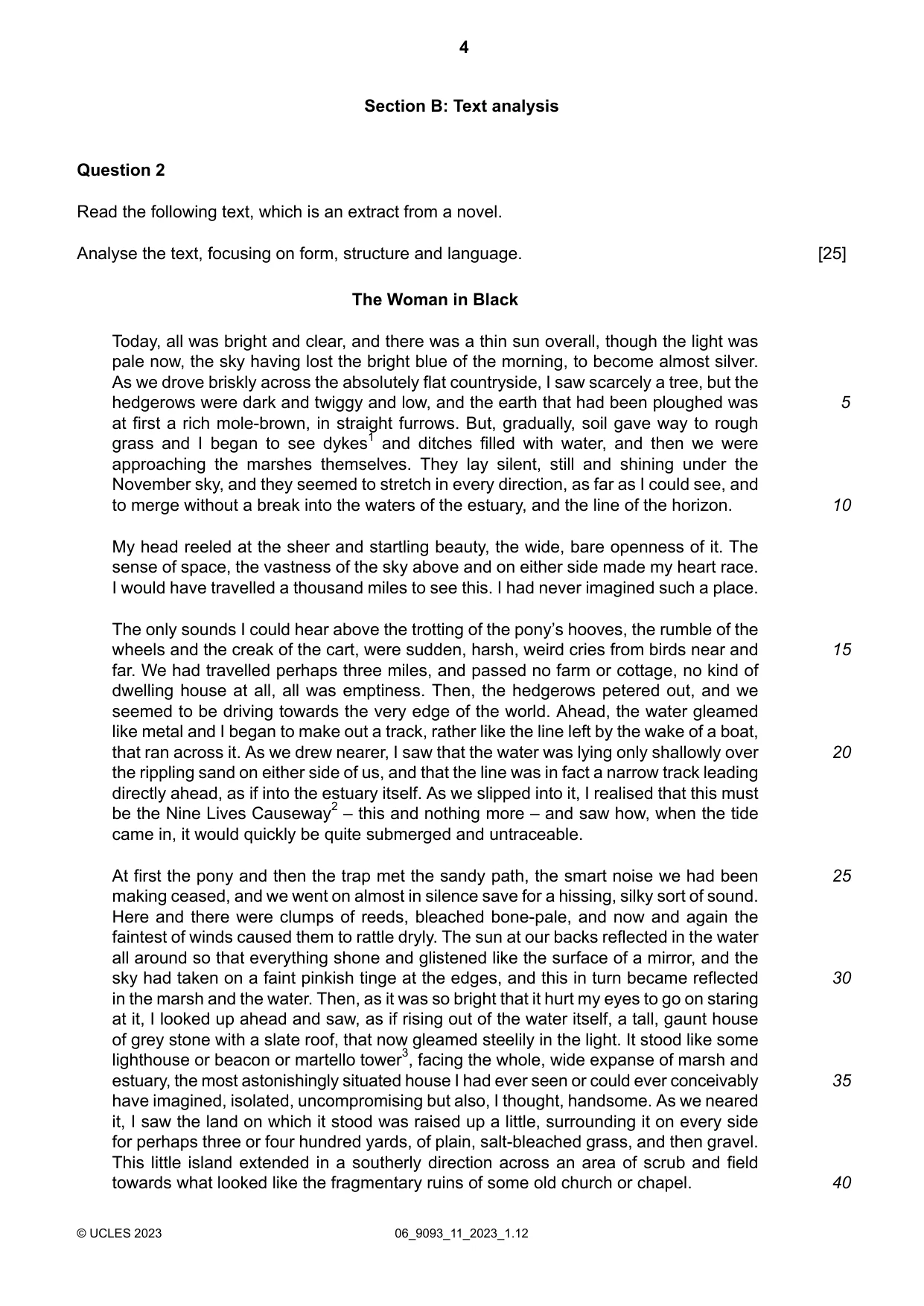
Question paper, page 4
40 35 30 25 20 15 10 5 Section B: Text analysis Question 2 Read the following text, which is an extract from a novel. Analyse the text, focusing on form, structure and language. [25] The Woman in Black Today, all was bright and clear, and there was a thin sun overall, though the light was pale now, the sky having lost the bright blue of the morning, to become almost silver. As we drove briskly across the absolutely flat countryside, I saw scarcely a tree, but the hedgerows were dark and twiggy and low, and the earth that had been ploughed was at first a rich mole-brown, in straight furrows. But, gradually, soil gave way to rough grass and I began to see dykes1 and ditches filled with water, and then we were approaching the marshes themselves. They lay silent, still and shining under the November sky, and they seemed to stretch in every direction, as far as I could see, and to merge without a break into the waters of the estuary, and the line of the horizon. My head reeled at the sheer and startling beauty, the wide, bare openness of it. The sense of space, the vastness of the sky above and on either side made my heart race. I would have travelled a thousand miles to see this. I had never imagined such a place. The only sounds I could hear above the trotting of the pony’s hooves, the rumble of the wheels and the creak of the cart, were sudden, harsh, weird cries from birds near and far. We had travelled perhaps three miles, and passed no farm or cottage, no kind of dwelling house at all, all was emptiness. Then, the hedgerows petered out, and we seemed to be driving towards the very edge of the world. Ahead, the water gleamed like metal and I began to make out a track, rather like the line left by the wake of a boat, that ran across it. As we drew nearer, I saw that the water was lying only shallowly over the rippling sand on either side of us, and that the line was in fact a narrow track leading directly ahead, as if into the estuary itself. As we slipped into it, I realised that this must be the Nine Lives Causeway2 – this and nothing more – and saw how, when the tide came in, it would quickly be quite submerged and untraceable. At first the pony and then the trap met the sandy path, the smart noise we had been making ceased, and we went on almost in silence save for a hissing, silky sort of sound. Here and there were clumps of reeds, bleached bone-pale, and now and again the faintest of winds caused them to rattle dryly. The sun at our backs reflected in the water all around so that everything shone and glistened like the surface of a mirror, and the sky had taken on a faint pinkish tinge at the edges, and this in turn became reflected in the marsh and the water. Then, as it was so bright that it hurt my eyes to go on staring at it, I looked up ahead and saw, as if rising out of the water itself, a tall, gaunt house of grey stone with a slate roof, that now gleamed steelily in the light. It stood like some lighthouse or beacon or martello tower3, facing the whole, wide expanse of marsh and estuary, the most astonishingly situated house I had ever seen or could ever conceivably have imagined, isolated, uncompromising but also, I thought, handsome. As we neared it, I saw the land on which it stood was raised up a little, surrounding it on every side for perhaps three or four hundred yards, of plain, salt-bleached grass, and then gravel. This little island extended in a southerly direction across an area of scrub and field towards what looked like the fragmentary ruins of some old church or chapel. 06_9093_11_2023_1.12 © UCLES 2023 4
Question paper, page 5
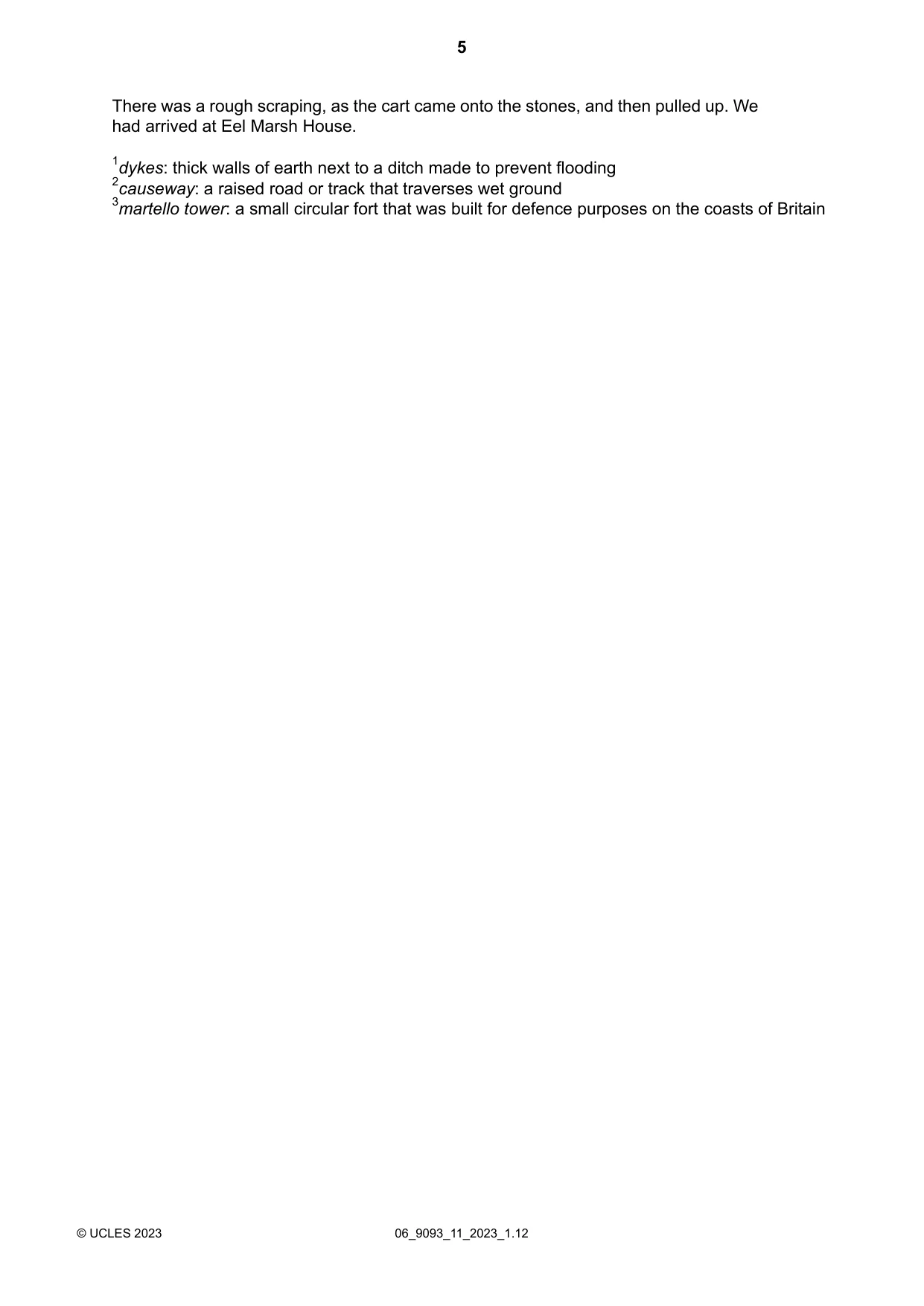
There was a rough scraping, as the cart came onto the stones, and then pulled up. We had arrived at Eel Marsh House. 1dykes: thick walls of earth next to a ditch made to prevent flooding 2causeway: a raised road or track that traverses wet ground 3martello tower: a small circular fort that was built for defence purposes on the coasts of Britain 06_9093_11_2023_1.12 © UCLES 2023 5
Question paper, page 6
BLANK PAGE 06_9093_11_2023_1.12 © UCLES 2023 6
Question paper, page 7
BLANK PAGE 06_9093_11_2023_1.12 © UCLES 2023 7
Question paper, page 8
BLANK PAGE Permission to reproduce items where third-party owned material protected by copyright is included has been sought and cleared where possible. Every reasonable effort has been made by the publisher (UCLES) to trace copyright holders, but if any items requiring clearance have unwittingly been included, the publisher will be pleased to make amends at the earliest possible opportunity. To avoid the issue of disclosure of answer-related information to candidates, all copyright acknowledgements are reproduced online in the Cambridge Assessment International Education Copyright Acknowledgements Booklet. This is produced for each series of examinations and is freely available to download at www.cambridgeinternational.org after the live examination series. Cambridge Assessment International Education is part of Cambridge Assessment. Cambridge Assessment is the brand name of the University of Cambridge Local Examinations Syndicate (UCLES), which is a department of the University of Cambridge. 06_9093_11_2023_1.12 © UCLES 2023 8
Mark scheme, page 1
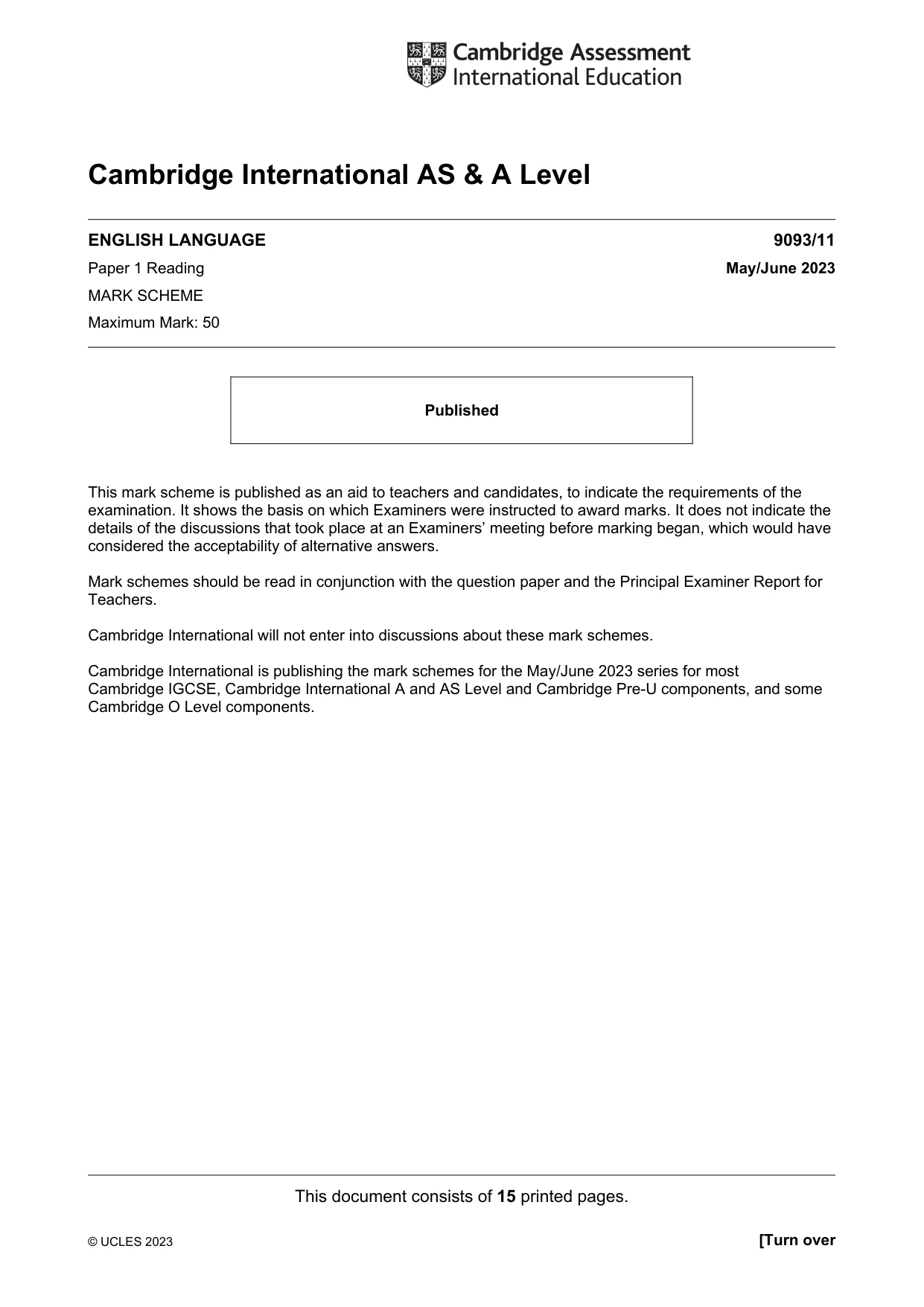
This document consists of 15 printed pages. © UCLES 2023 [Turn over Cambridge International AS & A Level ENGLISH LANGUAGE 9093/11 Paper 1 Reading May/June 2023 MARK SCHEME Maximum Mark: 50 Published This mark scheme is published as an aid to teachers and candidates, to indicate the requirements of the examination. It shows the basis on which Examiners were instructed to award marks. It does not indicate the details of the discussions that took place at an Examiners’ meeting before marking began, which would have considered the acceptability of alternative answers. Mark schemes should be read in conjunction with the question paper and the Principal Examiner Report for Teachers. Cambridge International will not enter into discussions about these mark schemes. Cambridge International is publishing the mark schemes for the May/June 2023 series for most Cambridge IGCSE, Cambridge International A and AS Level and Cambridge Pre-U components, and some Cambridge O Level components.
Mark scheme, page 2
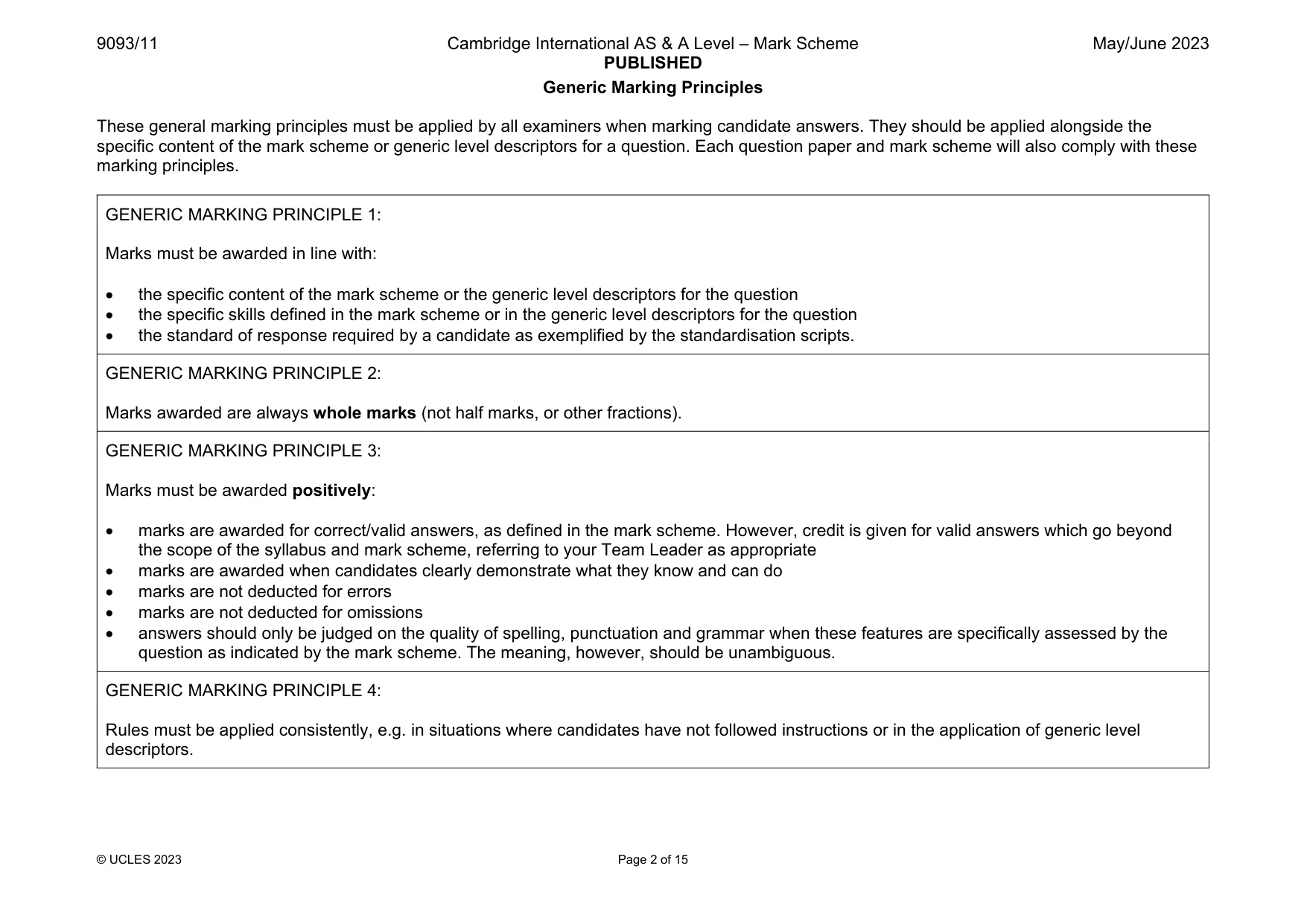
9093/11 Cambridge International AS & A Level – Mark Scheme PUBLISHED May/June 2023 © UCLES 2023 Page 2 of 15 Generic Marking Principles These general marking principles must be applied by all examiners when marking candidate answers. They should be applied alongside the specific content of the mark scheme or generic level descriptors for a question. Each question paper and mark scheme will also comply with these marking principles. GENERIC MARKING PRINCIPLE 1: Marks must be awarded in line with: the specific content of the mark scheme or the generic level descriptors for the question the specific skills defined in the mark scheme or in the generic level descriptors for the question the standard of response required by a candidate as exemplified by the standardisation scripts. GENERIC MARKING PRINCIPLE 2: Marks awarded are always whole marks (not half marks, or other fractions). GENERIC MARKING PRINCIPLE 3: Marks must be awarded positively: marks are awarded for correct/valid answers, as defined in the mark scheme. However, credit is given for valid answers which go beyond the scope of the syllabus and mark scheme, referring to your Team Leader as appropriate marks are awarded when candidates clearly demonstrate what they know and can do marks are not deducted for errors marks are not deducted for omissions answers should only be judged on the quality of spelling, punctuation and grammar when these features are specifically assessed by the question as indicated by the mark scheme. The meaning, however, should be unambiguous. GENERIC MARKING PRINCIPLE 4: Rules must be applied consistently, e.g. in situations where candidates have not followed instructions or in the application of generic level descriptors.
Mark scheme, page 3
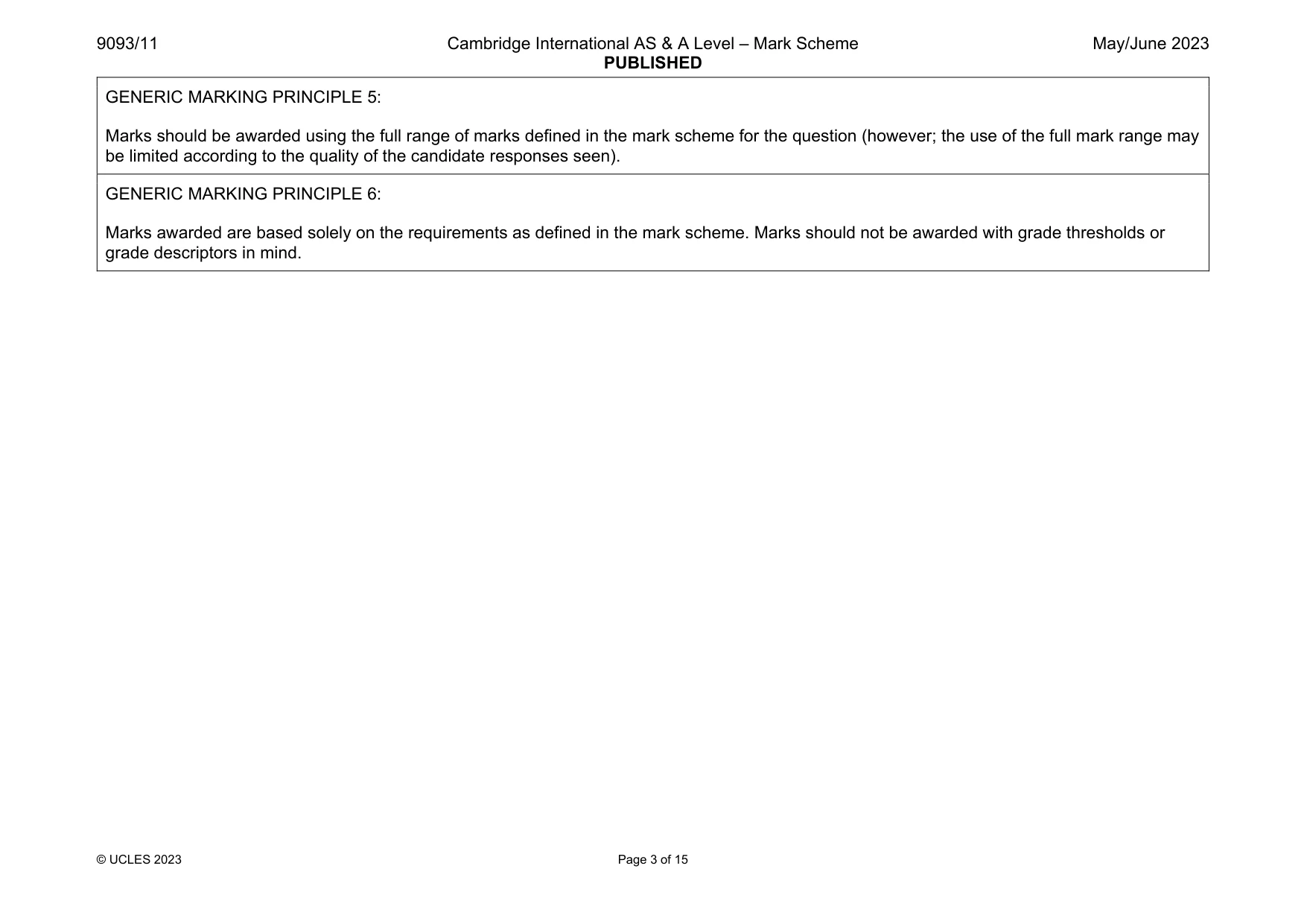
9093/11 Cambridge International AS & A Level – Mark Scheme PUBLISHED May/June 2023 © UCLES 2023 Page 3 of 15 GENERIC MARKING PRINCIPLE 5: Marks should be awarded using the full range of marks defined in the mark scheme for the question (however; the use of the full mark range may be limited according to the quality of the candidate responses seen). GENERIC MARKING PRINCIPLE 6: Marks awarded are based solely on the requirements as defined in the mark scheme. Marks should not be awarded with grade thresholds or grade descriptors in mind.
Mark scheme, page 4
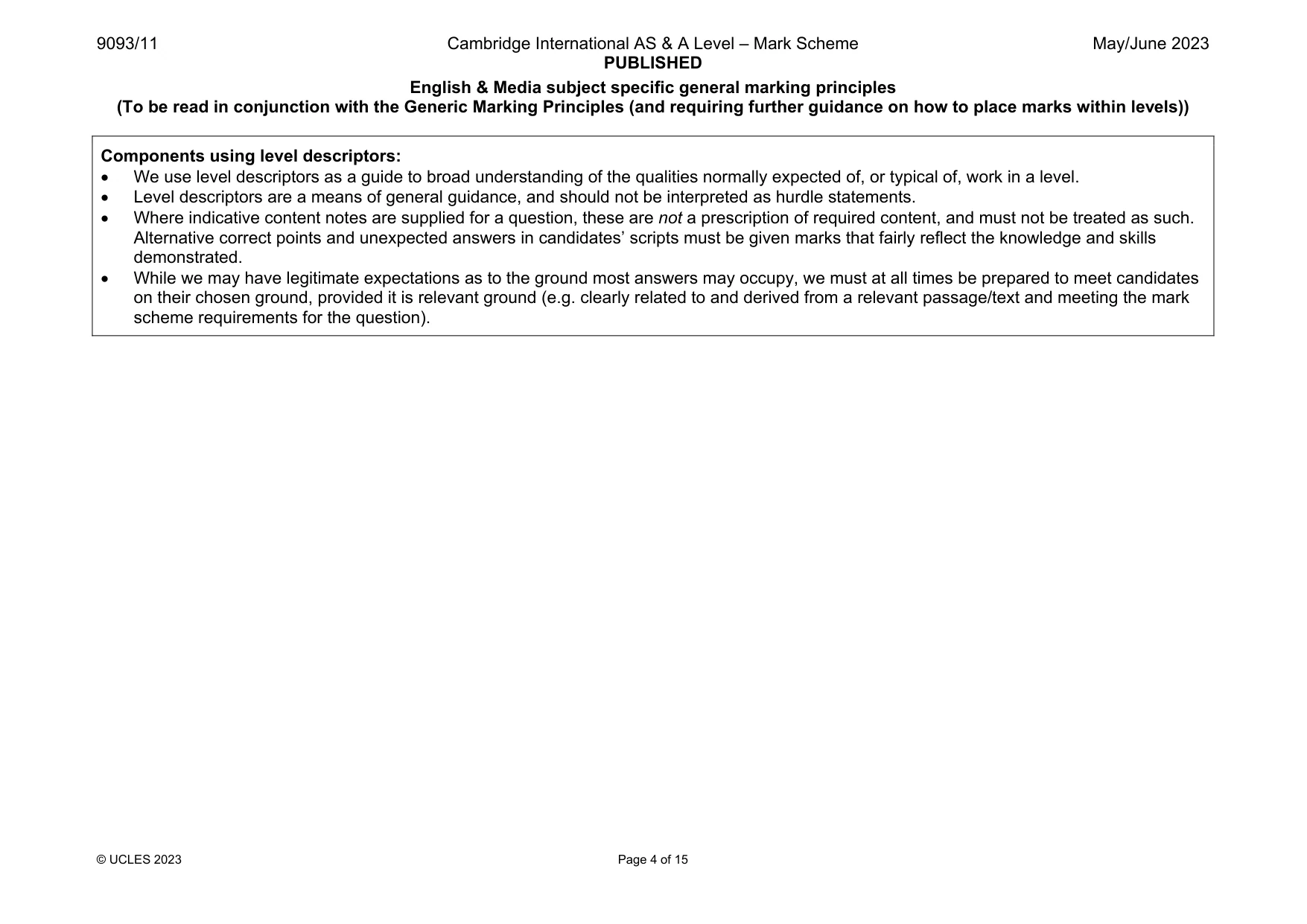
9093/11 Cambridge International AS & A Level – Mark Scheme PUBLISHED May/June 2023 © UCLES 2023 Page 4 of 15 English & Media subject specific general marking principles (To be read in conjunction with the Generic Marking Principles (and requiring further guidance on how to place marks within levels)) Components using level descriptors: We use level descriptors as a guide to broad understanding of the qualities normally expected of, or typical of, work in a level. Level descriptors are a means of general guidance, and should not be interpreted as hurdle statements. Where indicative content notes are supplied for a question, these are not a prescription of required content, and must not be treated as such. Alternative correct points and unexpected answers in candidates’ scripts must be given marks that fairly reflect the knowledge and skills demonstrated. While we may have legitimate expectations as to the ground most answers may occupy, we must at all times be prepared to meet candidates on their chosen ground, provided it is relevant ground (e.g. clearly related to and derived from a relevant passage/text and meeting the mark scheme requirements for the question).
Mark scheme, page 5
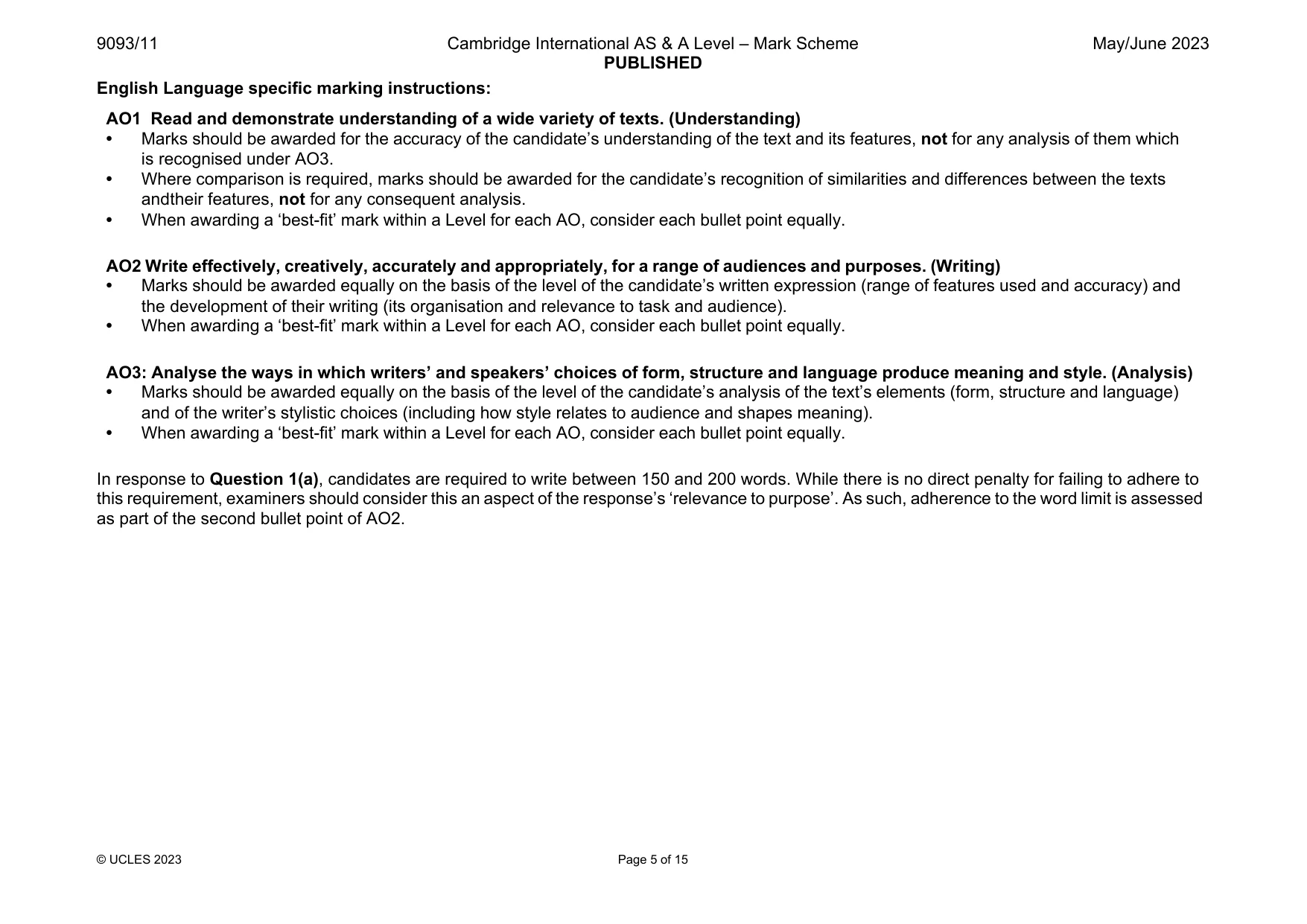
9093/11 Cambridge International AS & A Level – Mark Scheme PUBLISHED May/June 2023 © UCLES 2023 Page 5 of 15 English Language specific marking instructions: AO1 Read and demonstrate understanding of a wide variety of texts. (Understanding) • Marks should be awarded for the accuracy of the candidate’s understanding of the text and its features, not for any analysis of them which is recognised under AO3. • Where comparison is required, marks should be awarded for the candidate’s recognition of similarities and differences between the texts and their features, not for any consequent analysis. • When awarding a ‘best-fit’ mark within a Level for each AO, consider each bullet point equally. AO2 Write effectively, creatively, accurately and appropriately, for a range of audiences and purposes. (Writing) • Marks should be awarded equally on the basis of the level of the candidate’s written expression (range of features used and accuracy) and the development of their writing (its organisation and relevance to task and audience). • When awarding a ‘best-fit’ mark within a Level for each AO, consider each bullet point equally. AO3: Analyse the ways in which writers’ and speakers’ choices of form, structure and language produce meaning and style. (Analysis) • Marks should be awarded equally on the basis of the level of the candidate’s analysis of the text’s elements (form, structure and language) and of the writer’s stylistic choices (including how style relates to audience and shapes meaning). • When awarding a ‘best-fit’ mark within a Level for each AO, consider each bullet point equally. In response to Question 1(a), candidates are required to write between 150 and 200 words. While there is no direct penalty for failing to adhere to this requirement, examiners should consider this an aspect of the response’s ‘relevance to purpose’. As such, adherence to the word limit is assessed as part of the second bullet point of AO2.
Mark scheme, page 6
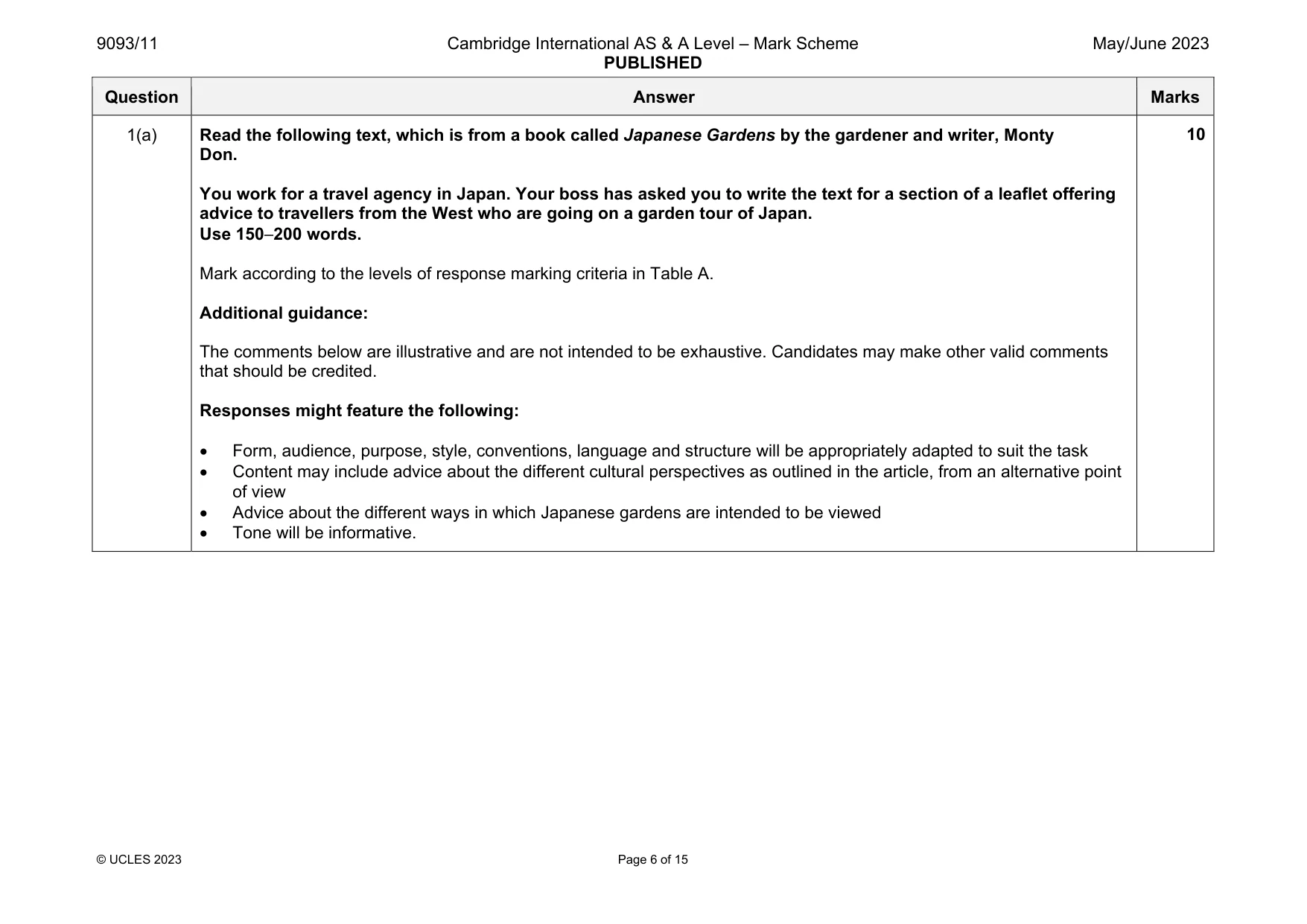
9093/11 Cambridge International AS & A Level – Mark Scheme PUBLISHED May/June 2023 © UCLES 2023 Page 6 of 15 Question Answer Marks 1(a) Read the following text, which is from a book called Japanese Gardens by the gardener and writer, Monty Don. You work for a travel agency in Japan. Your boss has asked you to write the text for a section of a leaflet offering advice to travellers from the West who are going on a garden tour of Japan. Use 150200 words. Mark according to the levels of response marking criteria in Table A. Additional guidance: The comments below are illustrative and are not intended to be exhaustive. Candidates may make other valid comments that should be credited. Responses might feature the following: Form, audience, purpose, style, conventions, language and structure will be appropriately adapted to suit the task Content may include advice about the different cultural perspectives as outlined in the article, from an alternative point of view Advice about the different ways in which Japanese gardens are intended to be viewed Tone will be informative. 10
Mark scheme, page 7
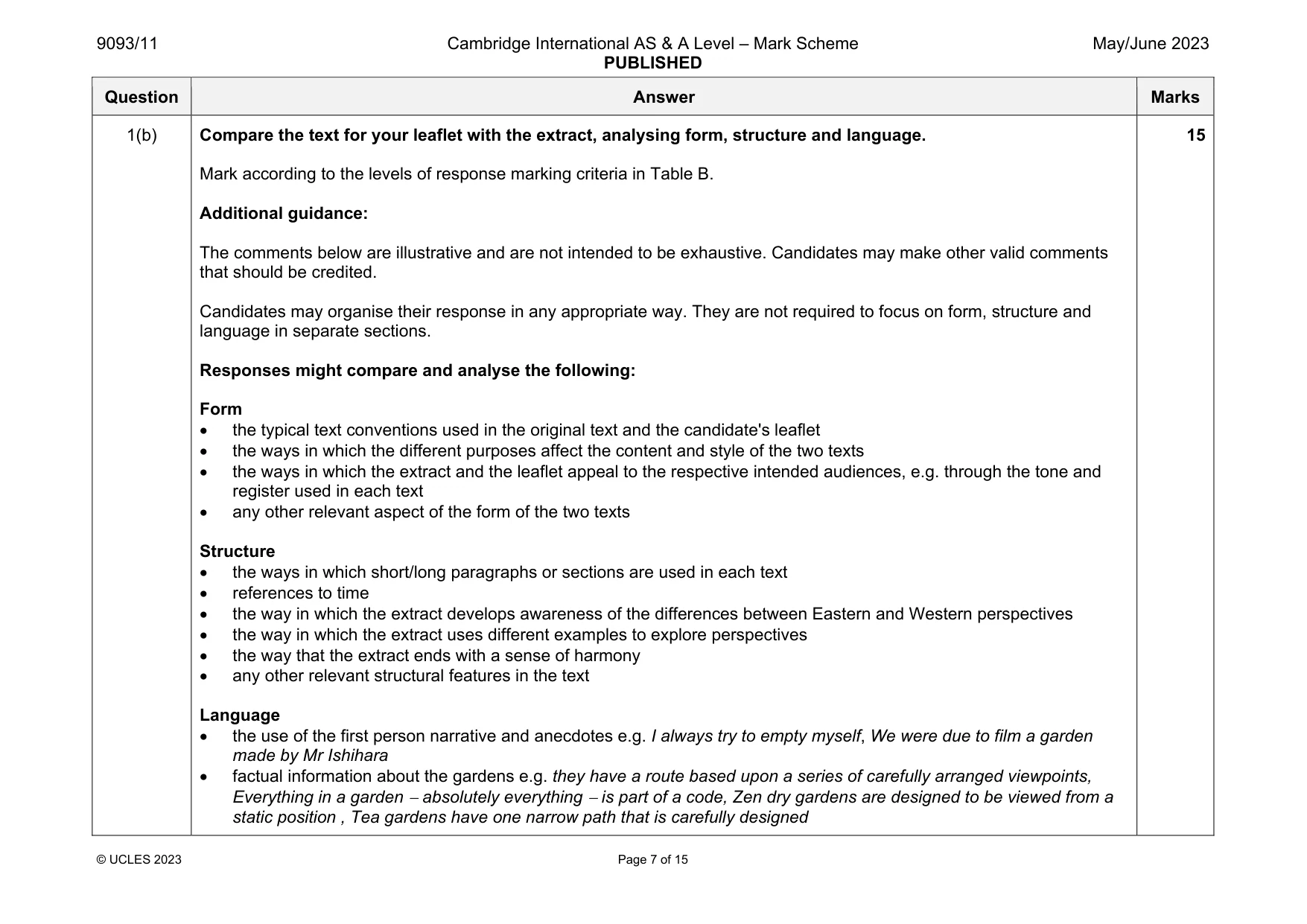
9093/11 Cambridge International AS & A Level – Mark Scheme PUBLISHED May/June 2023 © UCLES 2023 Page 7 of 15 Question Answer Marks 1(b) Compare the text for your leaflet with the extract, analysing form, structure and language. Mark according to the levels of response marking criteria in Table B. Additional guidance: The comments below are illustrative and are not intended to be exhaustive. Candidates may make other valid comments that should be credited. Candidates may organise their response in any appropriate way. They are not required to focus on form, structure and language in separate sections. Responses might compare and analyse the following: Form the typical text conventions used in the original text and the candidate's leaflet the ways in which the different purposes affect the content and style of the two texts the ways in which the extract and the leaflet appeal to the respective intended audiences, e.g. through the tone and register used in each text any other relevant aspect of the form of the two texts Structure the ways in which short/long paragraphs or sections are used in each text references to time the way in which the extract develops awareness of the differences between Eastern and Western perspectives the way in which the extract uses different examples to explore perspectives the way that the extract ends with a sense of harmony any other relevant structural features in the text Language the use of the first person narrative and anecdotes e.g. I always try to empty myself, We were due to film a garden made by Mr Ishihara factual information about the gardens e.g. they have a route based upon a series of carefully arranged viewpoints, Everything in a garden absolutely everything is part of a code, Zen dry gardens are designed to be viewed from a static position , Tea gardens have one narrow path that is carefully designed 15
Mark scheme, page 8
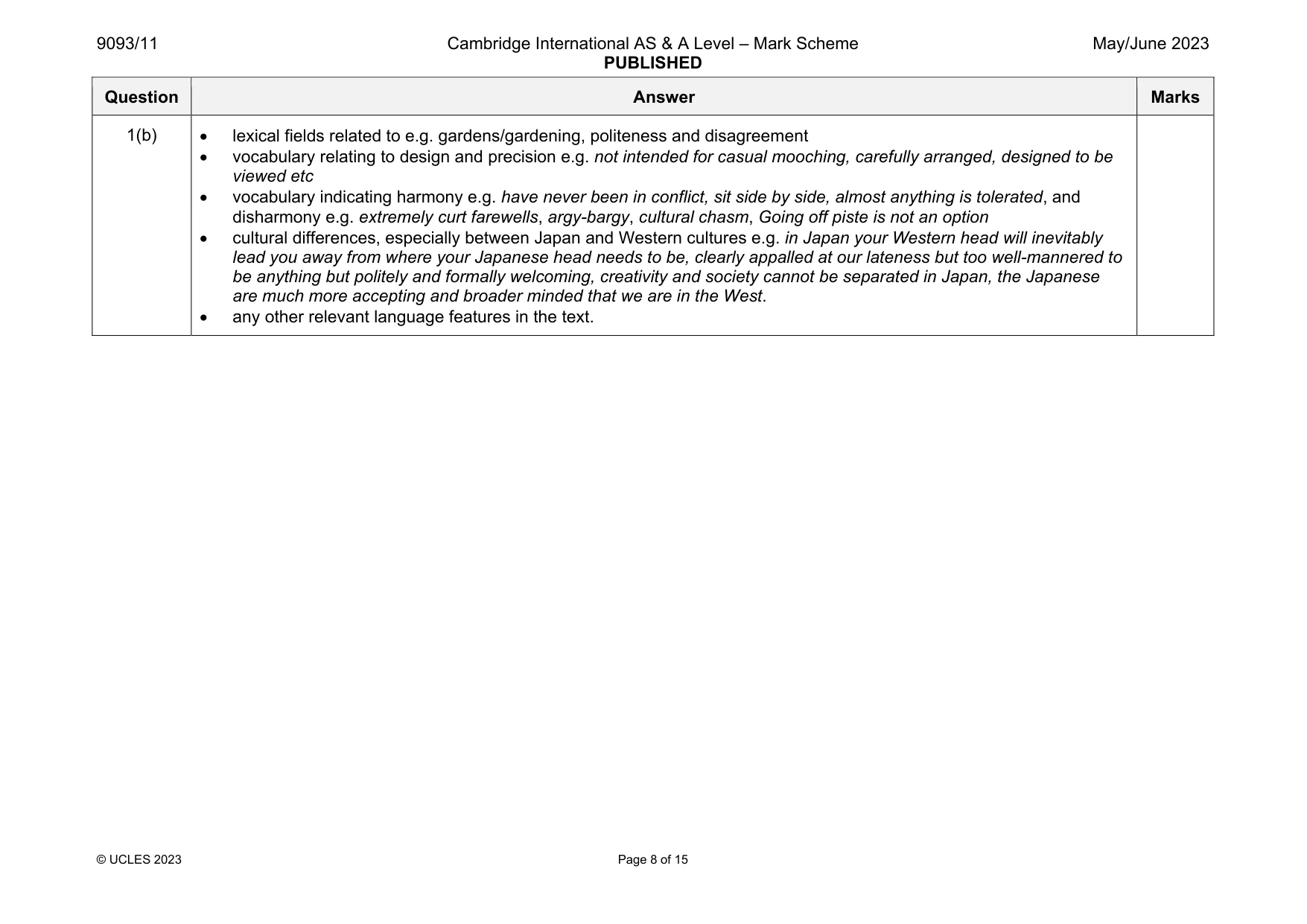
9093/11 Cambridge International AS & A Level – Mark Scheme PUBLISHED May/June 2023 © UCLES 2023 Page 8 of 15 Question Answer Marks 1(b) lexical fields related to e.g. gardens/gardening, politeness and disagreement vocabulary relating to design and precision e.g. not intended for casual mooching, carefully arranged, designed to be viewed etc vocabulary indicating harmony e.g. have never been in conflict, sit side by side, almost anything is tolerated, and disharmony e.g. extremely curt farewells, argy-bargy, cultural chasm, Going off piste is not an option cultural differences, especially between Japan and Western cultures e.g. in Japan your Western head will inevitably lead you away from where your Japanese head needs to be, clearly appalled at our lateness but too well-mannered to be anything but politely and formally welcoming, creativity and society cannot be separated in Japan, the Japanese are much more accepting and broader minded that we are in the West. any other relevant language features in the text.
Mark scheme, page 9
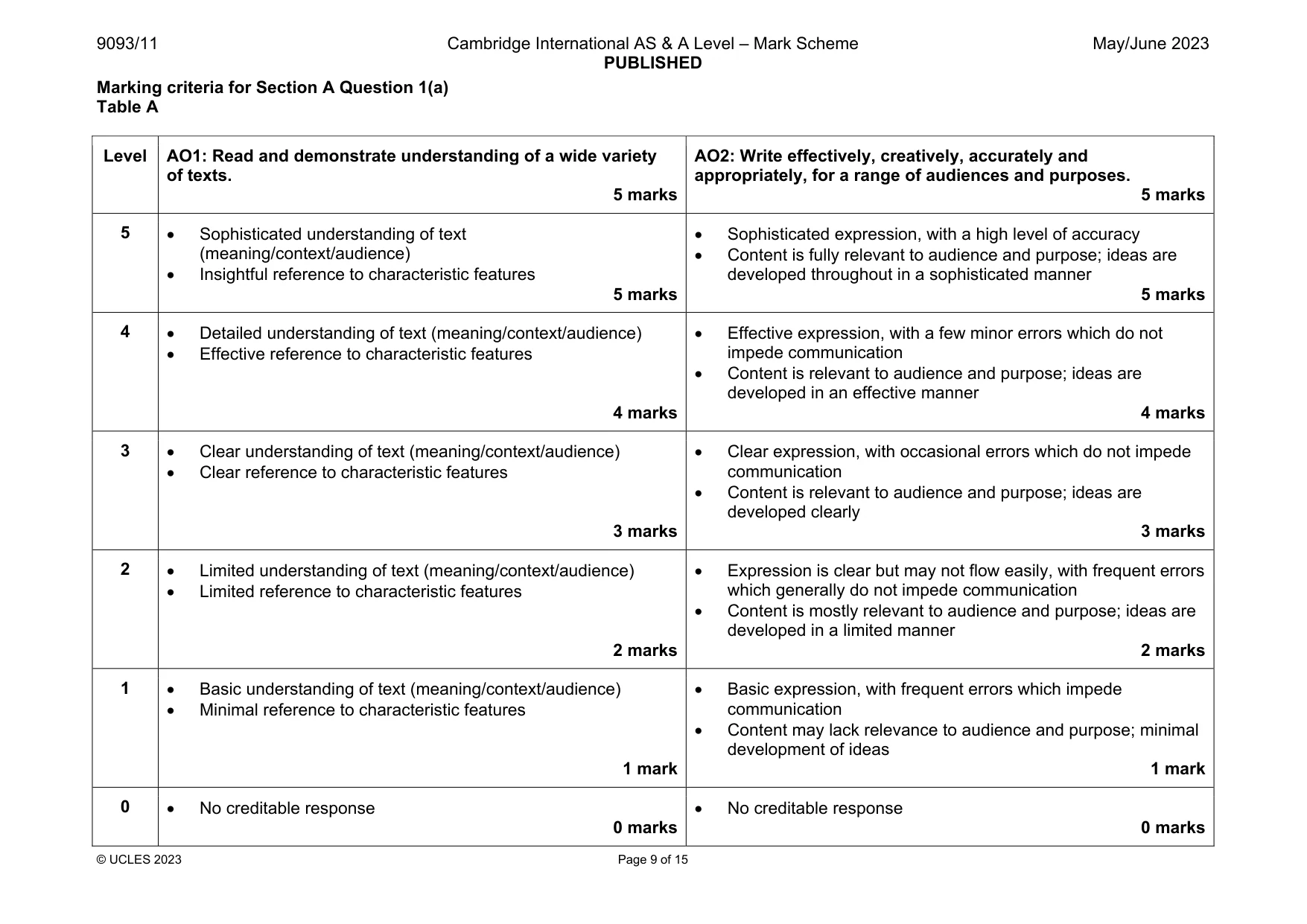
9093/11 Cambridge International AS & A Level – Mark Scheme PUBLISHED May/June 2023 © UCLES 2023 Page 9 of 15 Marking criteria for Section A Question 1(a) Table A Level AO1: Read and demonstrate understanding of a wide variety of texts. 5 marks AO2: Write effectively, creatively, accurately and appropriately, for a range of audiences and purposes. 5 marks 5 Sophisticated understanding of text (meaning/context/audience) Insightful reference to characteristic features 5 marks Sophisticated expression, with a high level of accuracy Content is fully relevant to audience and purpose; ideas are developed throughout in a sophisticated manner 5 marks 4 Detailed understanding of text (meaning/context/audience) Effective reference to characteristic features 4 marks Effective expression, with a few minor errors which do not impede communication Content is relevant to audience and purpose; ideas are developed in an effective manner 4 marks 3 Clear understanding of text (meaning/context/audience) Clear reference to characteristic features 3 marks Clear expression, with occasional errors which do not impede communication Content is relevant to audience and purpose; ideas are developed clearly 3 marks 2 Limited understanding of text (meaning/context/audience) Limited reference to characteristic features 2 marks Expression is clear but may not flow easily, with frequent errors which generally do not impede communication Content is mostly relevant to audience and purpose; ideas are developed in a limited manner 2 marks 1 Basic understanding of text (meaning/context/audience) Minimal reference to characteristic features 1 mark Basic expression, with frequent errors which impede communication Content may lack relevance to audience and purpose; minimal development of ideas 1 mark 0 No creditable response 0 marks No creditable response 0 marks
Mark scheme, page 10
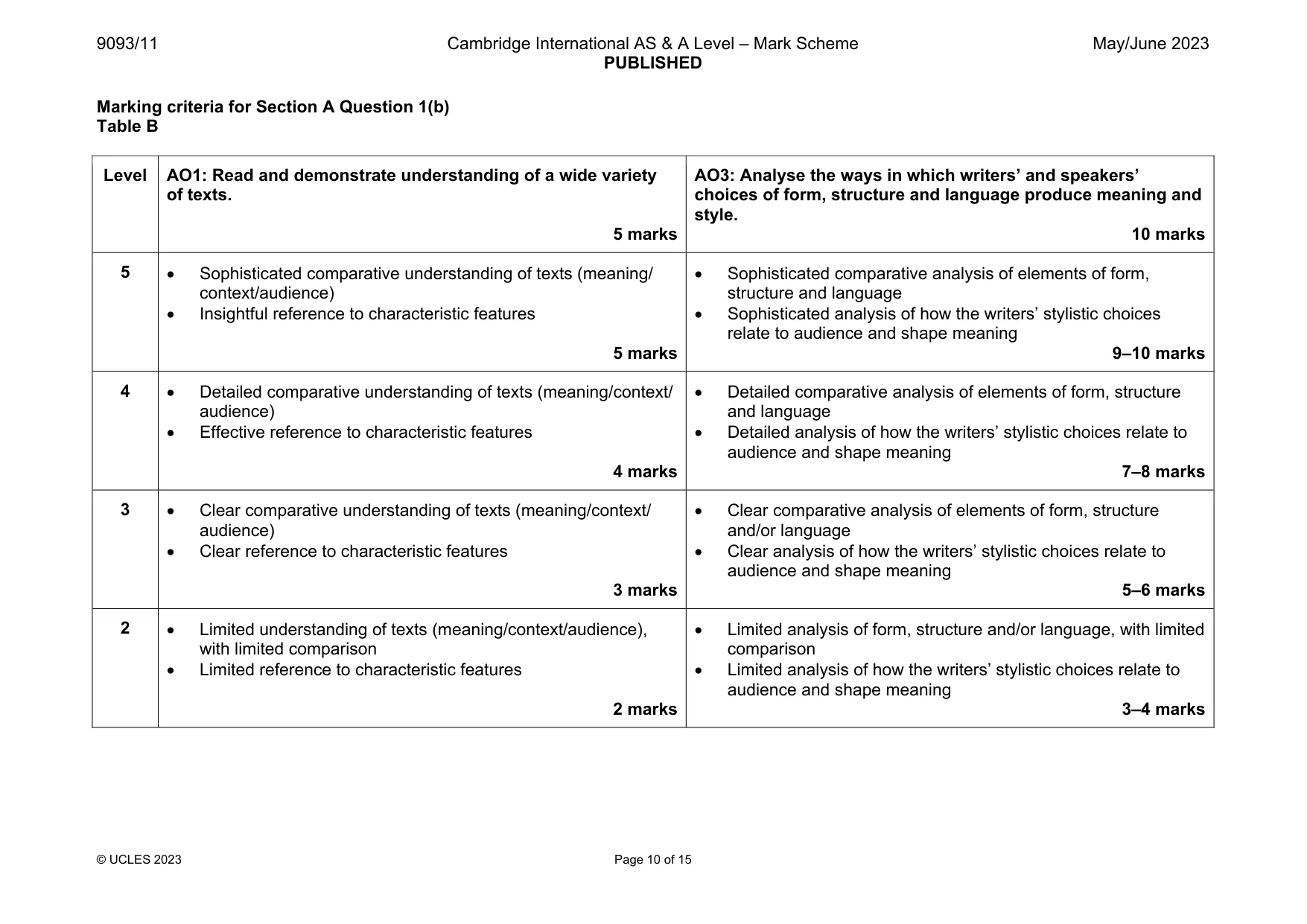
9093/11 Cambridge International AS & A Level – Mark Scheme PUBLISHED May/June 2023 © UCLES 2023 Page 10 of 15 Marking criteria for Section A Question 1(b) Table B Level AO1: Read and demonstrate understanding of a wide variety of texts. 5 marks AO3: Analyse the ways in which writers’ and speakers’ choices of form, structure and language produce meaning and style. 10 marks 5 Sophisticated comparative understanding of texts (meaning/ context/audience) Insightful reference to characteristic features 5 marks Sophisticated comparative analysis of elements of form, structure and language Sophisticated analysis of how the writers’ stylistic choices relate to audience and shape meaning 9–10 marks 4 Detailed comparative understanding of texts (meaning/context/ audience) Effective reference to characteristic features 4 marks Detailed comparative analysis of elements of form, structure and language Detailed analysis of how the writers’ stylistic choices relate to audience and shape meaning 7–8 marks 3 Clear comparative understanding of texts (meaning/context/ audience) Clear reference to characteristic features 3 marks Clear comparative analysis of elements of form, structure and/or language Clear analysis of how the writers’ stylistic choices relate to audience and shape meaning 5–6 marks 2 Limited understanding of texts (meaning/context/audience), with limited comparison Limited reference to characteristic features 2 marks Limited analysis of form, structure and/or language, with limited comparison Limited analysis of how the writers’ stylistic choices relate to audience and shape meaning 3–4 marks
Mark scheme, page 11
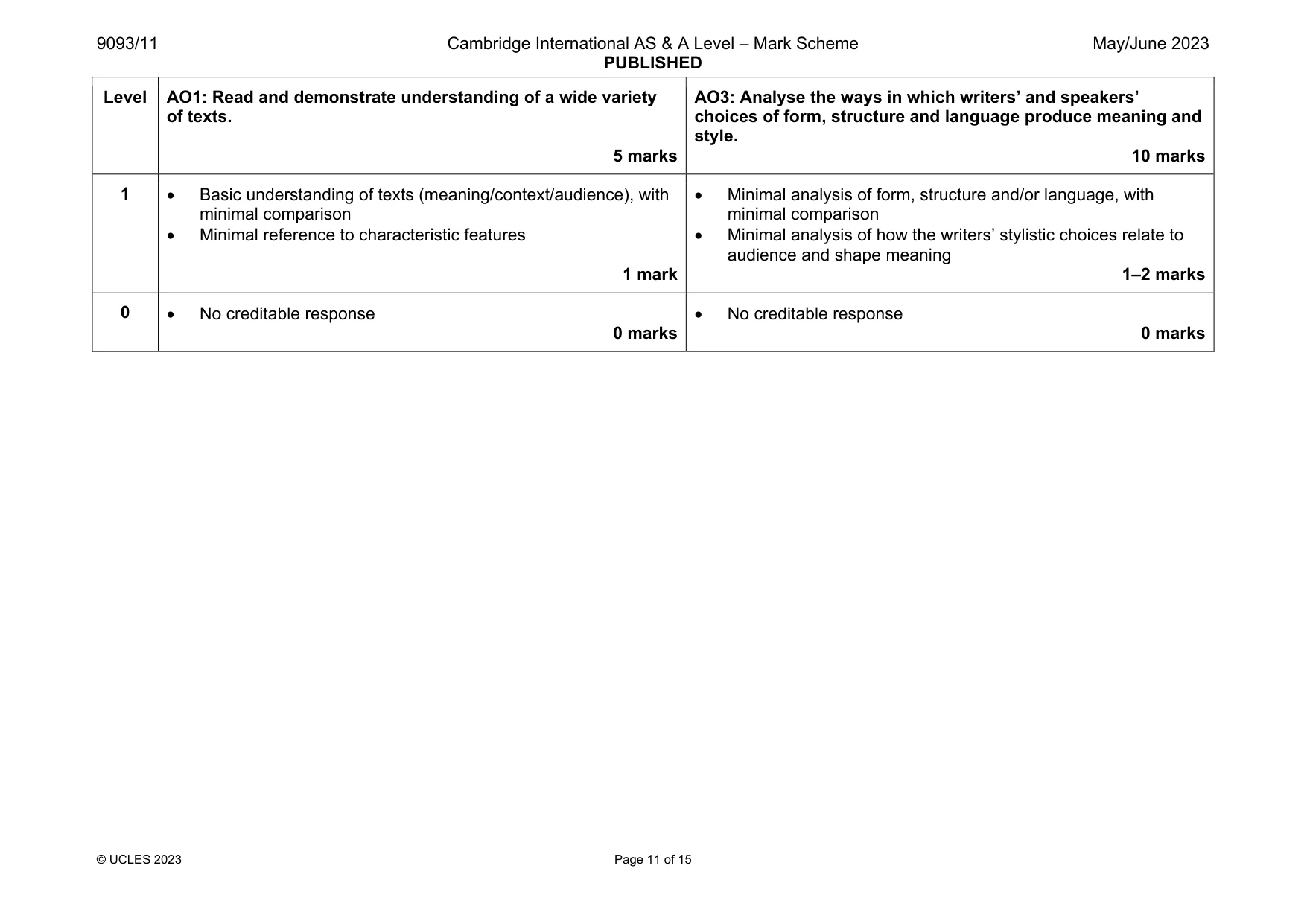
9093/11 Cambridge International AS & A Level – Mark Scheme PUBLISHED May/June 2023 © UCLES 2023 Page 11 of 15 Level AO1: Read and demonstrate understanding of a wide variety of texts. 5 marks AO3: Analyse the ways in which writers’ and speakers’ choices of form, structure and language produce meaning and style. 10 marks 1 Basic understanding of texts (meaning/context/audience), with minimal comparison Minimal reference to characteristic features 1 mark Minimal analysis of form, structure and/or language, with minimal comparison Minimal analysis of how the writers’ stylistic choices relate to audience and shape meaning 1–2 marks 0 No creditable response 0 marks No creditable response 0 marks
Mark scheme, page 12
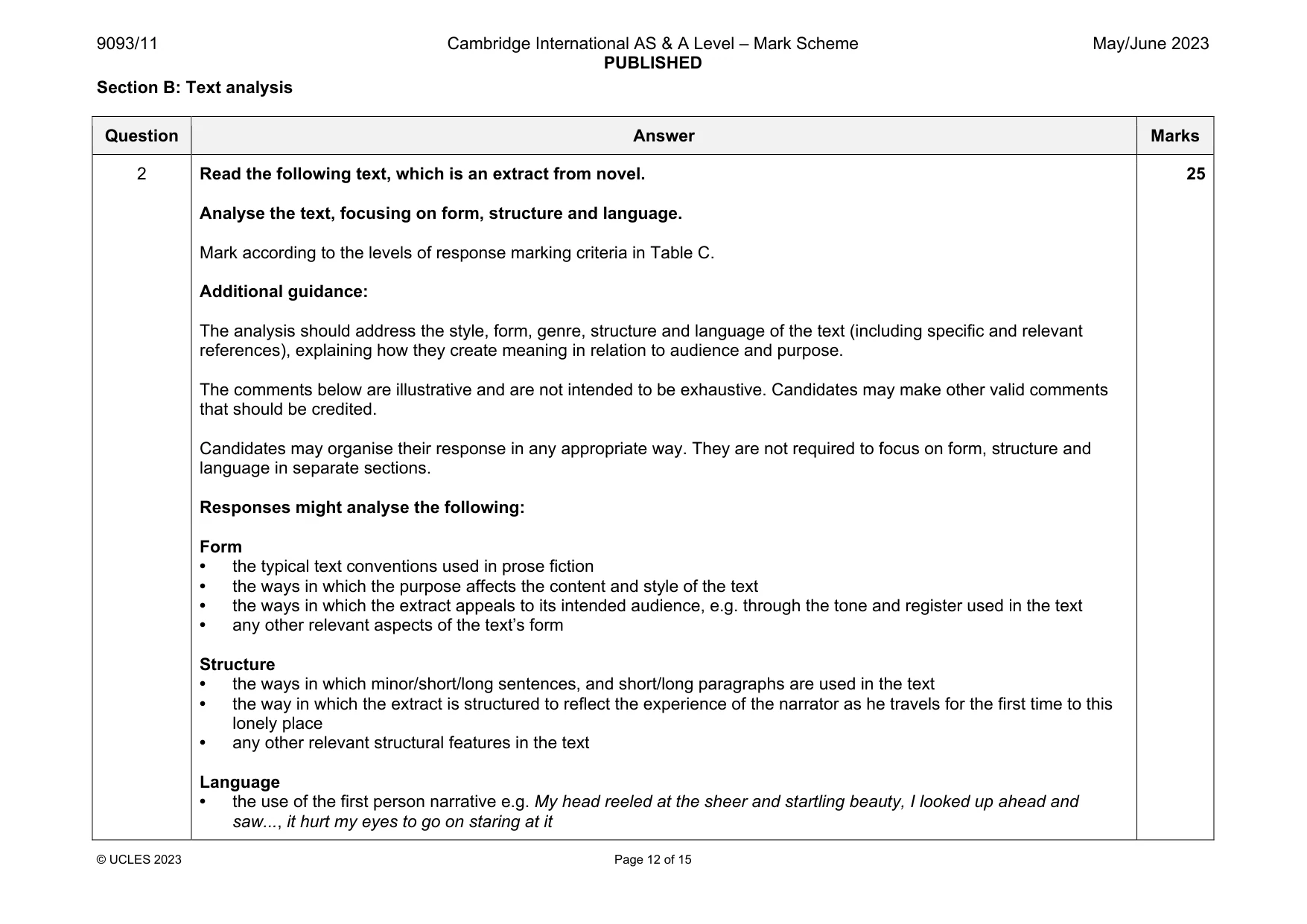
9093/11 Cambridge International AS & A Level – Mark Scheme PUBLISHED May/June 2023 © UCLES 2023 Page 12 of 15 Section B: Text analysis Question Answer Marks 2 Read the following text, which is an extract from novel. Analyse the text, focusing on form, structure and language. Mark according to the levels of response marking criteria in Table C. Additional guidance: The analysis should address the style, form, genre, structure and language of the text (including specific and relevant references), explaining how they create meaning in relation to audience and purpose. The comments below are illustrative and are not intended to be exhaustive. Candidates may make other valid comments that should be credited. Candidates may organise their response in any appropriate way. They are not required to focus on form, structure and language in separate sections. Responses might analyse the following: Form • the typical text conventions used in prose fiction • the ways in which the purpose affects the content and style of the text • the ways in which the extract appeals to its intended audience, e.g. through the tone and register used in the text • any other relevant aspects of the text’s form Structure • the ways in which minor/short/long sentences, and short/long paragraphs are used in the text • the way in which the extract is structured to reflect the experience of the narrator as he travels for the first time to this lonely place • any other relevant structural features in the text Language • the use of the first person narrative e.g. My head reeled at the sheer and startling beauty, I looked up ahead and saw..., it hurt my eyes to go on staring at it 25
Mark scheme, page 13
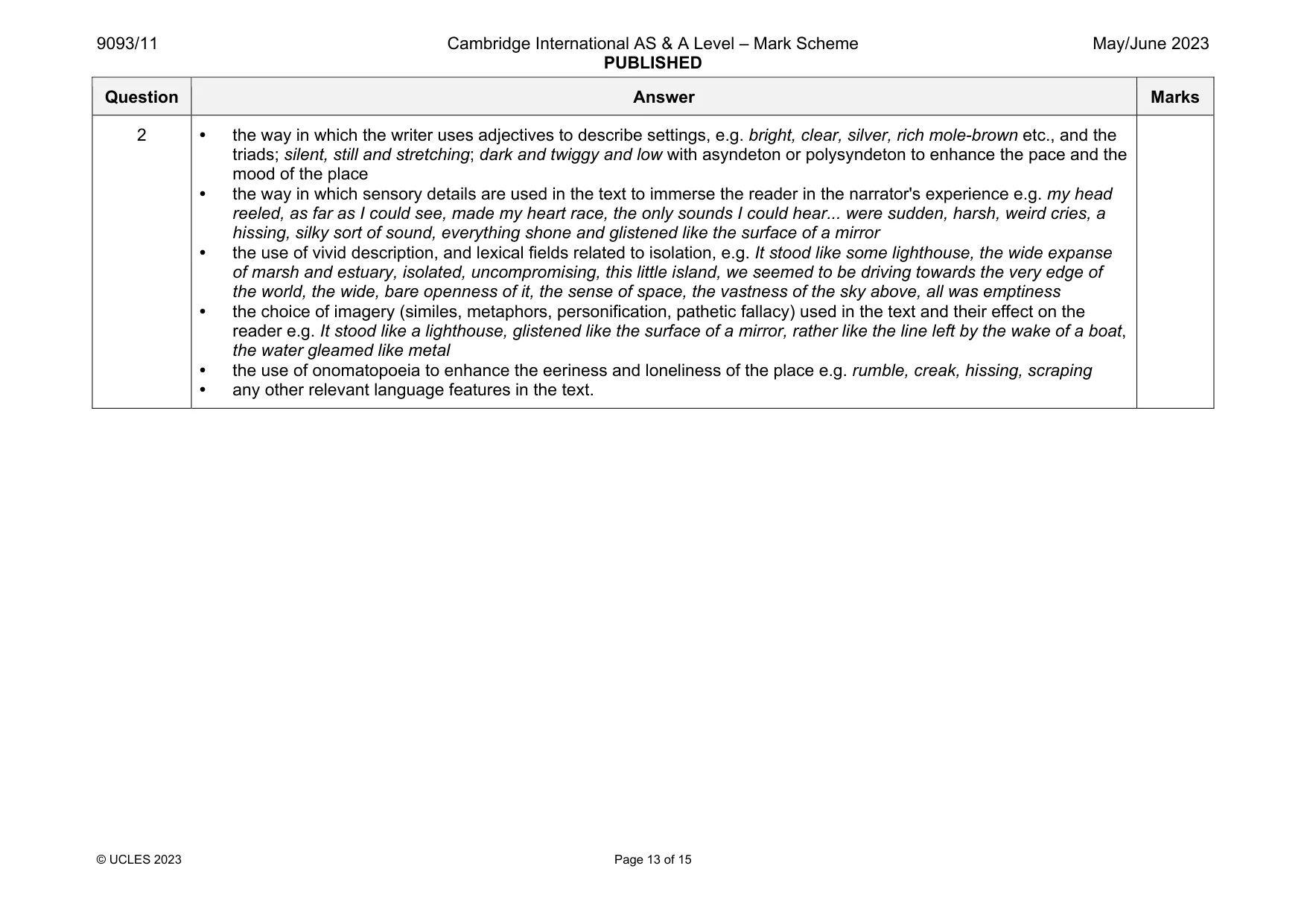
9093/11 Cambridge International AS & A Level – Mark Scheme PUBLISHED May/June 2023 © UCLES 2023 Page 13 of 15 Question Answer Marks 2 • the way in which the writer uses adjectives to describe settings, e.g. bright, clear, silver, rich mole-brown etc., and the triads; silent, still and stretching; dark and twiggy and low with asyndeton or polysyndeton to enhance the pace and the mood of the place • the way in which sensory details are used in the text to immerse the reader in the narrator's experience e.g. my head reeled, as far as I could see, made my heart race, the only sounds I could hear... were sudden, harsh, weird cries, a hissing, silky sort of sound, everything shone and glistened like the surface of a mirror • the use of vivid description, and lexical fields related to isolation, e.g. It stood like some lighthouse, the wide expanse of marsh and estuary, isolated, uncompromising, this little island, we seemed to be driving towards the very edge of the world, the wide, bare openness of it, the sense of space, the vastness of the sky above, all was emptiness • the choice of imagery (similes, metaphors, personification, pathetic fallacy) used in the text and their effect on the reader e.g. It stood like a lighthouse, glistened like the surface of a mirror, rather like the line left by the wake of a boat, the water gleamed like metal • the use of onomatopoeia to enhance the eeriness and loneliness of the place e.g. rumble, creak, hissing, scraping • any other relevant language features in the text.
Mark scheme, page 14
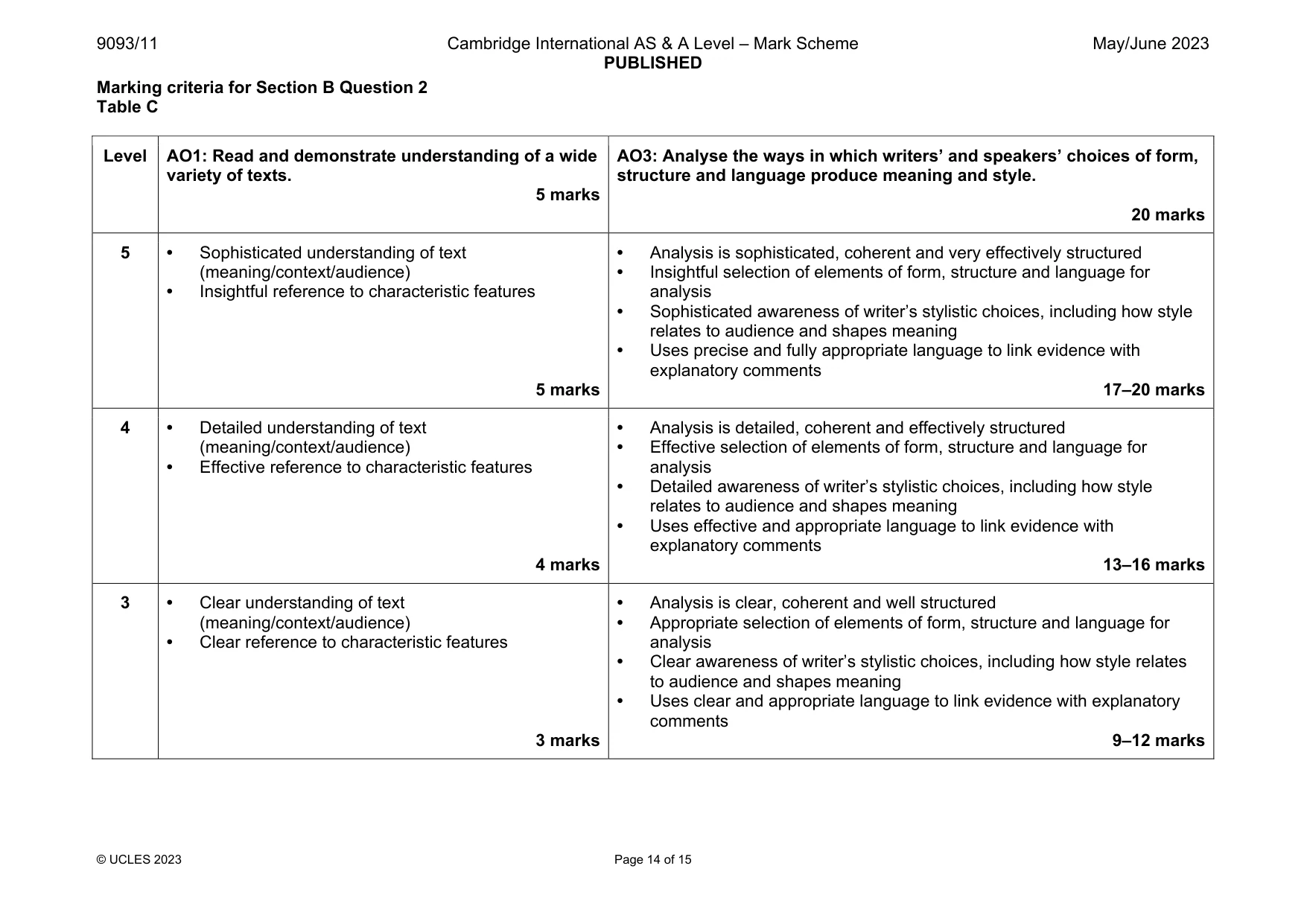
9093/11 Cambridge International AS & A Level – Mark Scheme PUBLISHED May/June 2023 © UCLES 2023 Page 14 of 15 Marking criteria for Section B Question 2 Table C Level AO1: Read and demonstrate understanding of a wide variety of texts. 5 marks AO3: Analyse the ways in which writers’ and speakers’ choices of form, structure and language produce meaning and style. 20 marks 5 • Sophisticated understanding of text (meaning/context/audience) • Insightful reference to characteristic features 5 marks • Analysis is sophisticated, coherent and very effectively structured • Insightful selection of elements of form, structure and language for analysis • Sophisticated awareness of writer’s stylistic choices, including how style relates to audience and shapes meaning • Uses precise and fully appropriate language to link evidence with explanatory comments 17–20 marks 4 • Detailed understanding of text (meaning/context/audience) • Effective reference to characteristic features 4 marks • Analysis is detailed, coherent and effectively structured • Effective selection of elements of form, structure and language for analysis • Detailed awareness of writer’s stylistic choices, including how style relates to audience and shapes meaning • Uses effective and appropriate language to link evidence with explanatory comments 13–16 marks 3 • Clear understanding of text (meaning/context/audience) • Clear reference to characteristic features 3 marks • Analysis is clear, coherent and well structured • Appropriate selection of elements of form, structure and language for analysis • Clear awareness of writer’s stylistic choices, including how style relates to audience and shapes meaning • Uses clear and appropriate language to link evidence with explanatory comments 9–12 marks
Mark scheme, page 15
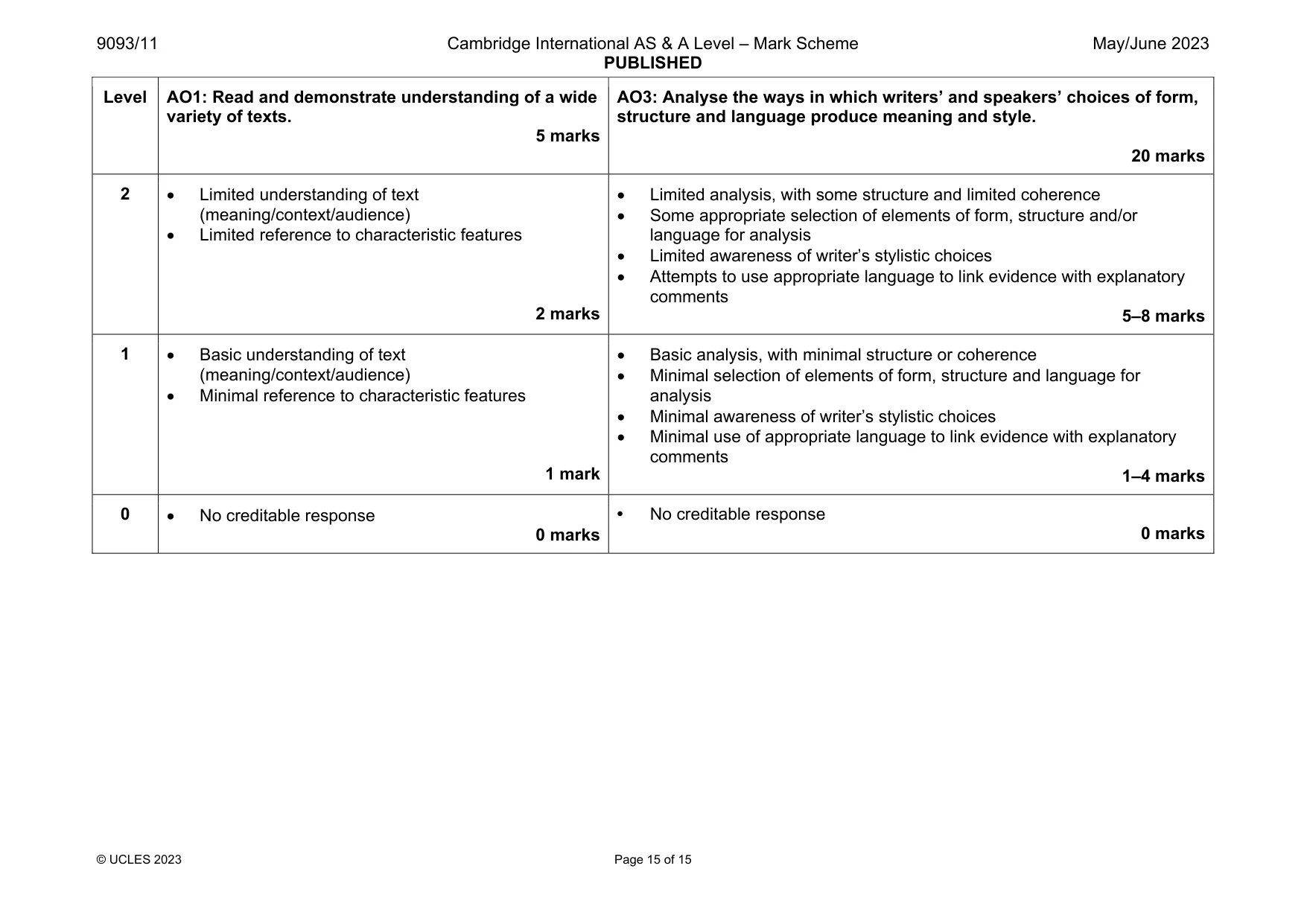
9093/11 Cambridge International AS & A Level – Mark Scheme PUBLISHED May/June 2023 © UCLES 2023 Page 15 of 15 Level AO1: Read and demonstrate understanding of a wide variety of texts. 5 marks AO3: Analyse the ways in which writers’ and speakers’ choices of form, structure and language produce meaning and style. 20 marks 2 Limited understanding of text (meaning/context/audience) Limited reference to characteristic features 2 marks Limited analysis, with some structure and limited coherence Some appropriate selection of elements of form, structure and/or language for analysis Limited awareness of writer’s stylistic choices Attempts to use appropriate language to link evidence with explanatory comments 5–8 marks 1 Basic understanding of text (meaning/context/audience) Minimal reference to characteristic features 1 mark Basic analysis, with minimal structure or coherence Minimal selection of elements of form, structure and language for analysis Minimal awareness of writer’s stylistic choices Minimal use of appropriate language to link evidence with explanatory comments 1–4 marks 0 No creditable response 0 marks • No creditable response 0 marks
What you needed in this session
Cambridge’s own grade thresholds for 2023 May/June, Paper 1 · Variant 1. A higher threshold means an easier paper — the bar moves with how the cohort did.