Cambridge A Level English - Language AS and A Level (from 2014) 9093 — 2021 Feb/March Paper 3 · Variant 2
9093/32/F/M/21 · 50 marks · ≈56 min
The question paper and its mark scheme, free to read here and free to download. This is Cambridge’s own paper, exactly as it was sat.
Question paper8 pages

Mark scheme13 pages
Answers below. Sit the paper first if you are practising.
Paper as text
Question paper, page 1
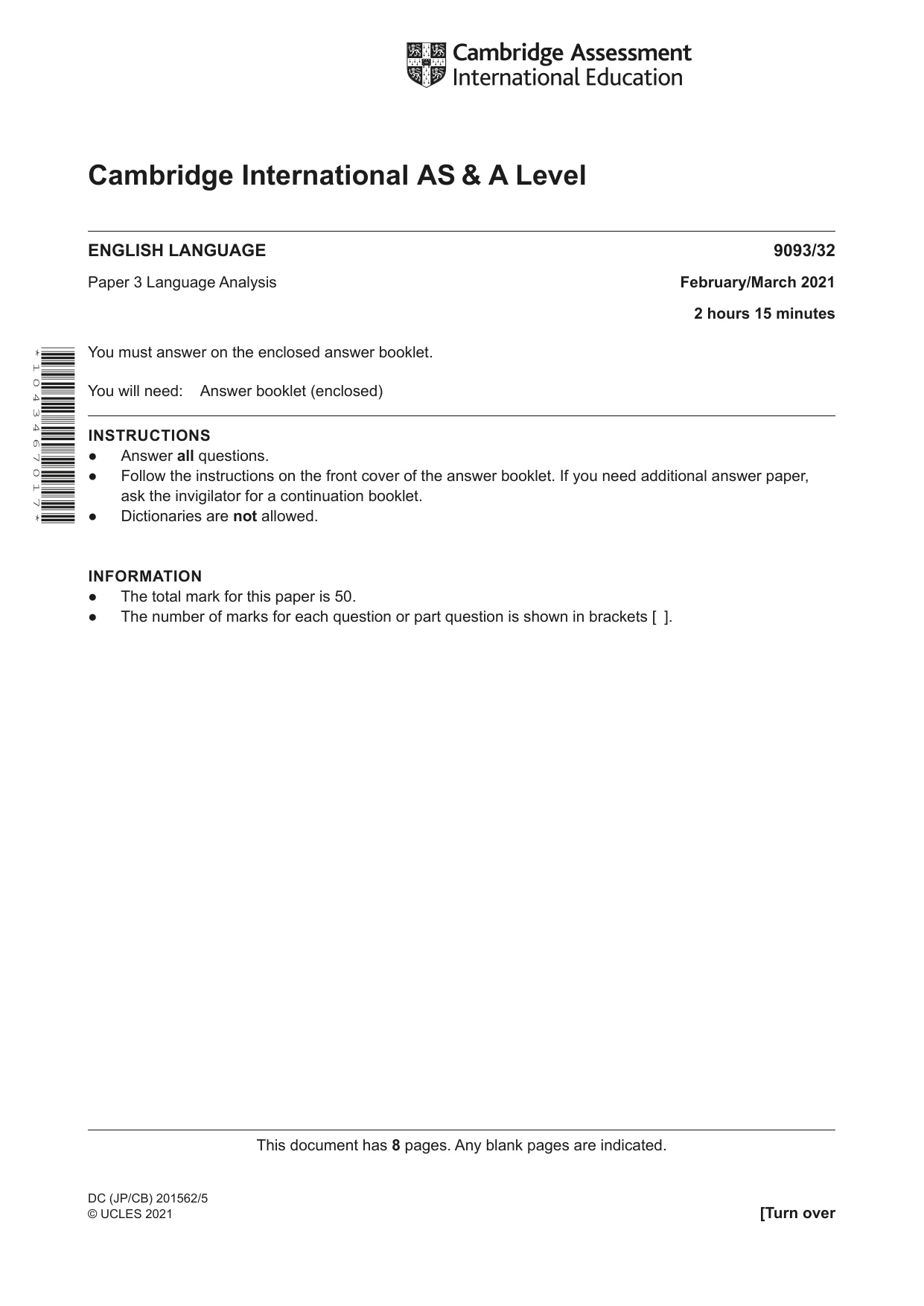
This document has 8 pages. Any blank pages are indicated. DC (JP/CB) 201562/5 © UCLES 2021 [Turn over * 1 0 4 3 4 6 7 0 1 7 * Cambridge International AS & A Level ENGLISH LANGUAGE 9093/32 Paper 3 Language Analysis February/March 2021 2 hours 15 minutes You must answer on the enclosed answer booklet. You will need: Answer booklet (enclosed) INSTRUCTIONS ● Answer all questions. ● Follow the instructions on the front cover of the answer booklet. If you need additional answer paper, ask the invigilator for a continuation booklet. ● Dictionaries are not allowed. INFORMATION ● The total mark for this paper is 50. ● The number of marks for each question or part question is shown in brackets [ ].
Question paper, page 2
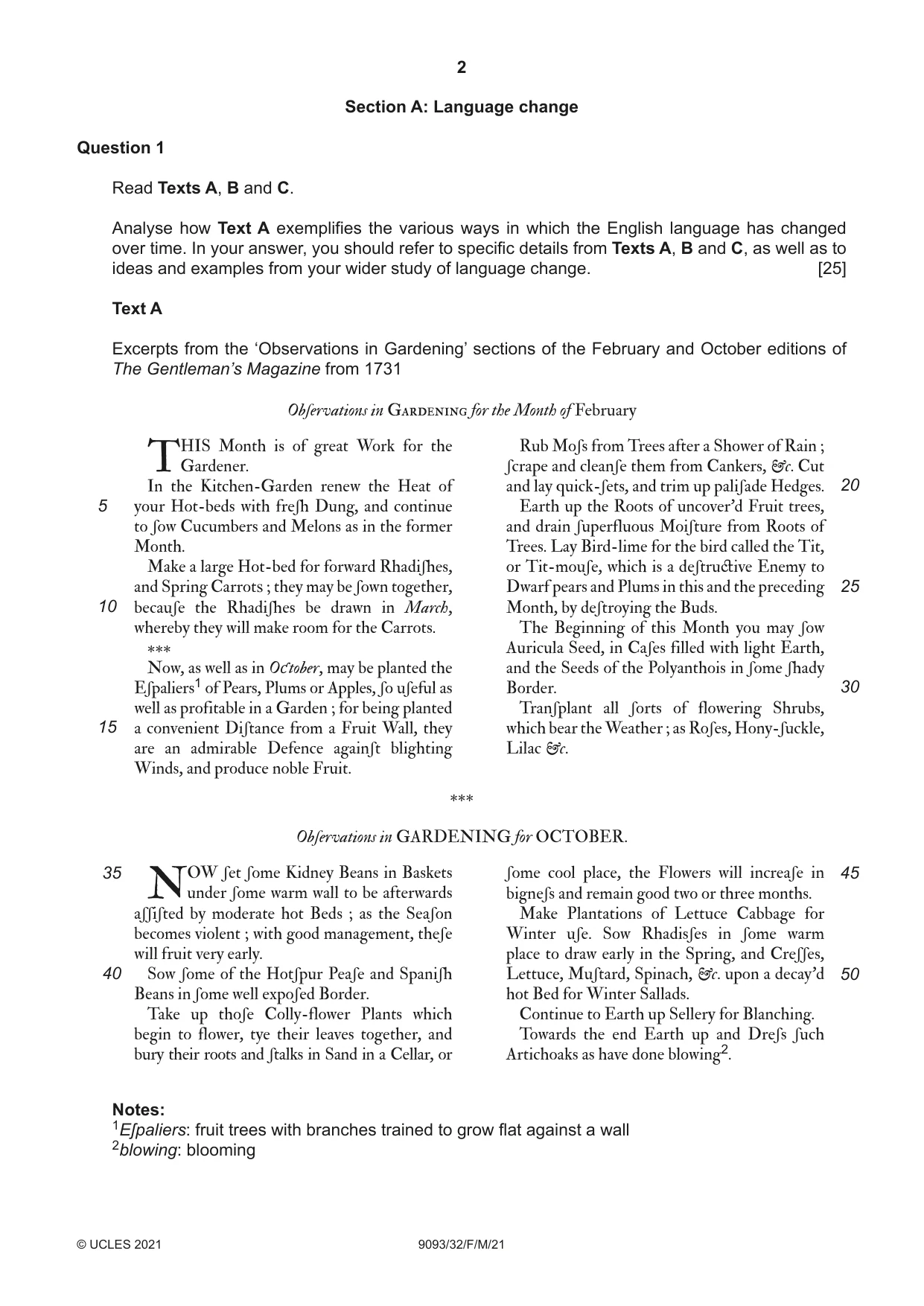
2 9093/32/F/M/21 © UCLES 2021 Section A: Language change Question 1 Read Texts A, B and C. Analyse how Text A exemplifies the various ways in which the English language has changed over time. In your answer, you should refer to specific details from Texts A, B and C, as well as to ideas and examples from your wider study of language change. [25] Text A Excerpts from the ‘Observations in Gardening’ sections of the February and October editions of The Gentleman’s Magazine from 1731 Obʃervations in Gardening for the Month of February T HIS Month is of great Work for the Gardener. In the Kitchen-Garden renew the Heat of your Hot-beds with freʃh Dung, and continue to ʃow Cucumbers and Melons as in the former Month. Make a large Hot-bed for forward Rhadiʃhes, and Spring Carrots ; they may be ʃown together, becauʃe the Rhadiʃhes be drawn in March, whereby they will make room for the Carrots. *** Now, as well as in Oƈtober, may be planted the Eʃpaliers1 of Pears, Plums or Apples, ʃo uʃeful as well as profitable in a Garden ; for being planted a convenient Diʃtance from a Fruit Wall, they are an admirable Defence againʃt blighting Winds, and produce noble Fruit. Rub Moʃs from Trees after a Shower of Rain ; ʃcrape and cleanʃe them from Cankers, &c. Cut and lay quick-ʃets, and trim up paliʃade Hedges. Earth up the Roots of uncover’d Fruit trees, and drain ʃuperfluous Moiʃture from Roots of Trees. Lay Bird-lime for the bird called the Tit, or Tit-mouʃe, which is a deʃtructive Enemy to Dwarf pears and Plums in this and the preceding Month, by deʃtroying the Buds. The Beginning of this Month you may ʃow Auricula Seed, in Caʃes filled with light Earth, and the Seeds of the Polyanthois in ʃome ʃhady Border. Tranʃplant all ʃorts of flowering Shrubs, which bear the Weather ; as Roʃes, Hony-ʃuckle, Lilac &c. *** Obʃervations in GARDENING for OCTOBER. N OW ʃet ʃome Kidney Beans in Baskets under ʃome warm wall to be afterwards aʃʃiʃted by moderate hot Beds ; as the Seaʃon becomes violent ; with good management, theʃe will fruit very early. Sow ʃome of the Hotʃpur Peaʃe and Spaniʃh Beans in ʃome well expoʃed Border. Take up thoʃe Colly-flower Plants which begin to flower, tye their leaves together, and bury their roots and ʃtalks in Sand in a Cellar, or ʃome cool place, the Flowers will increaʃe in bigneʃs and remain good two or three months. Make Plantations of Lettuce Cabbage for Winter uʃe. Sow Rhadisʃes in ʃome warm place to draw early in the Spring, and Creʃʃes, Lettuce, Muʃtard, Spinach, &c. upon a decay’d hot Bed for Winter Sallads. Continue to Earth up Sellery for Blanching. Towards the end Earth up and Dreʃs ʃuch Artichoaks as have done blowing2. Notes: 1Eʃpaliers: fruit trees with branches trained to grow flat against a wall 2blowing: blooming 5 10 15 20 25 30 35 40 45 50
Question paper, page 3
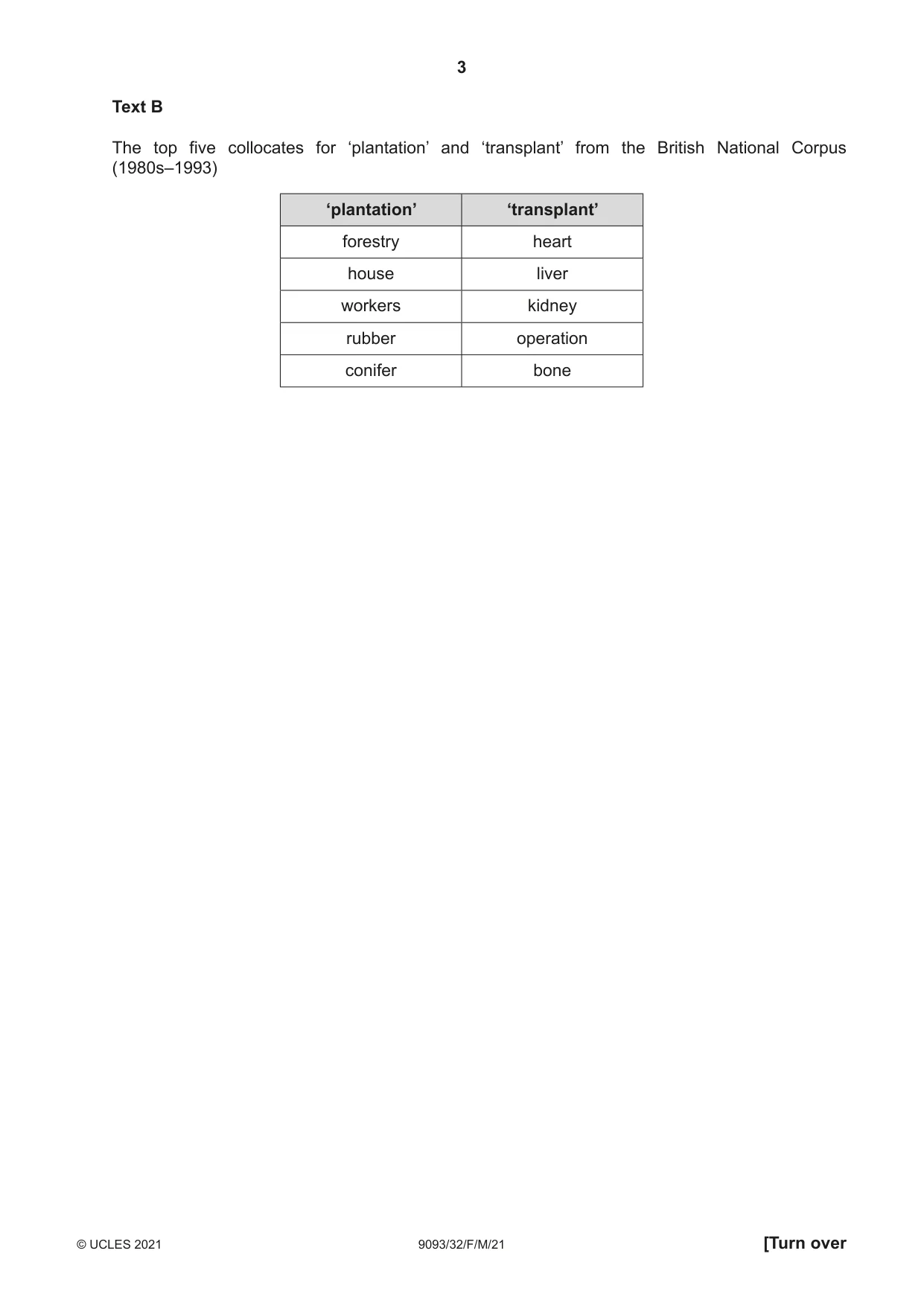
3 9093/32/F/M/21 © UCLES 2021 [Turn over Text B The top five collocates for ‘plantation’ and ‘transplant’ from the British National Corpus (1980s–1993) ‘plantation’ ‘transplant’ forestry heart house liver workers kidney rubber operation conifer bone
Question paper, page 4
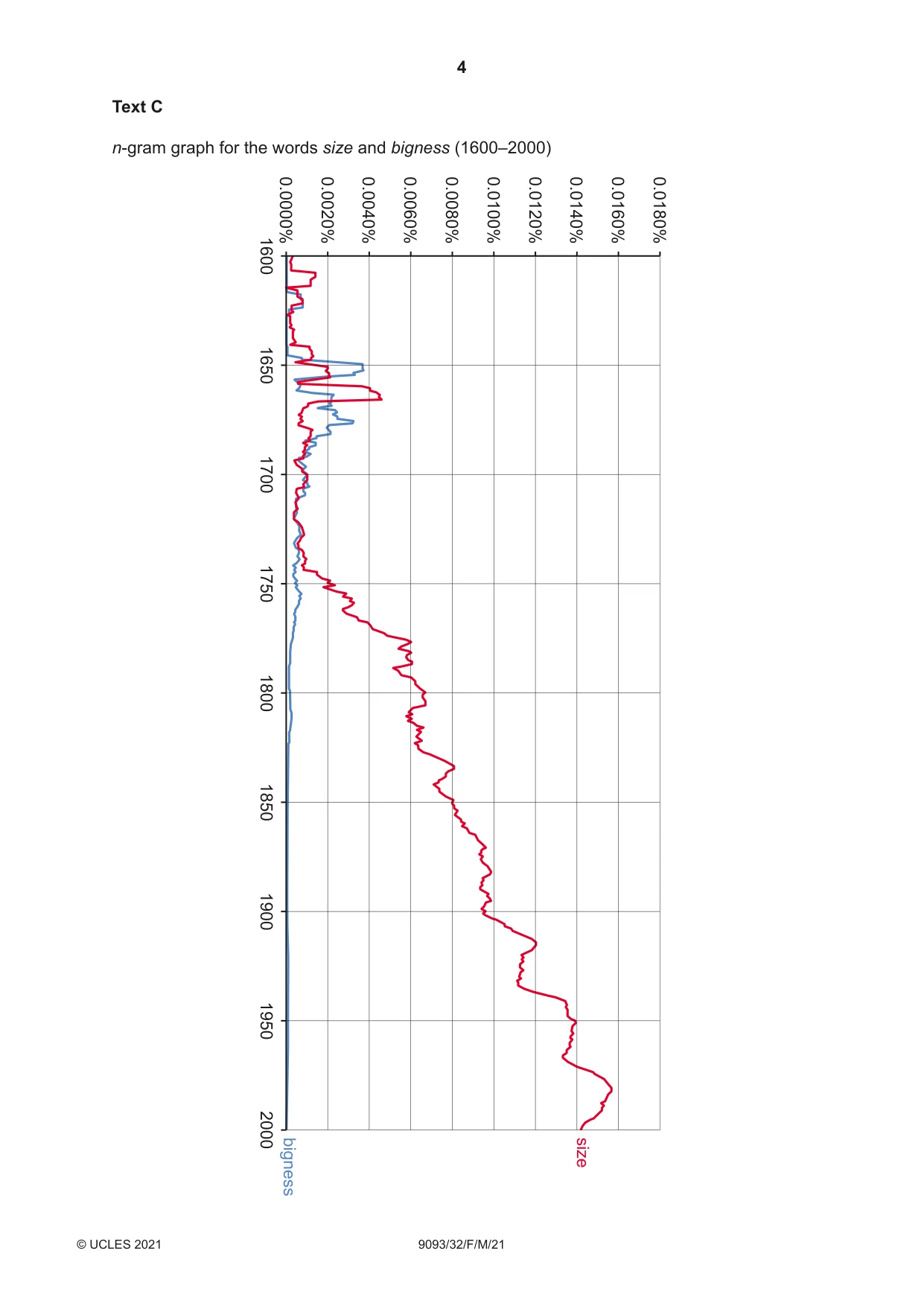
4 9093/32/F/M/21 © UCLES 2021 Text C n-gram graph for the words size and bigness (1600–2000) 1600 1650 1700 1750 1800 1850 1900 1950 0.0000% 0.0020% 0.0040% 0.0060% 0.0080% 0.0100% 0.0120% 0.0140% 0.0160% 0.0180% 2000 bigness size
Question paper, page 5
5 9093/32/F/M/21 © UCLES 2021 [Turn over BLANK PAGE
Question paper, page 6
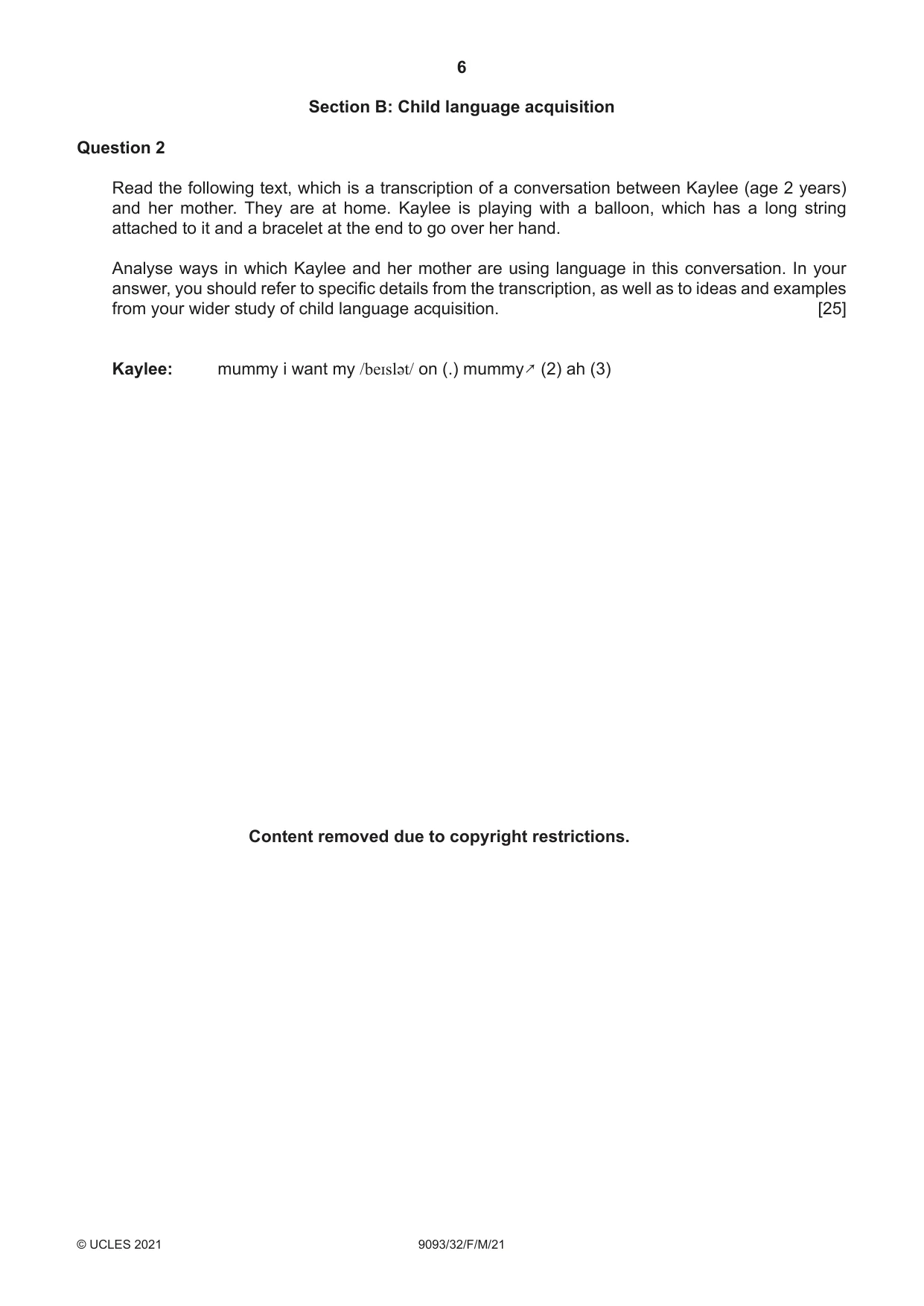
6 9093/32/F/M/21 © UCLES 2021 Section B: Child language acquisition Question 2 Read the following text, which is a transcription of a conversation between Kaylee (age 2 years) and her mother. They are at home. Kaylee is playing with a balloon, which has a long string attached to it and a bracelet at the end to go over her hand. Analyse ways in which Kaylee and her mother are using language in this conversation. In your answer, you should refer to specific details from the transcription, as well as to ideas and examples from your wider study of child language acquisition. [25] Kaylee: mummy i want my /beɪslət/ on (.) mummy↗ (2) ah (3) Content removed due to copyright restrictions.
Question paper, page 7
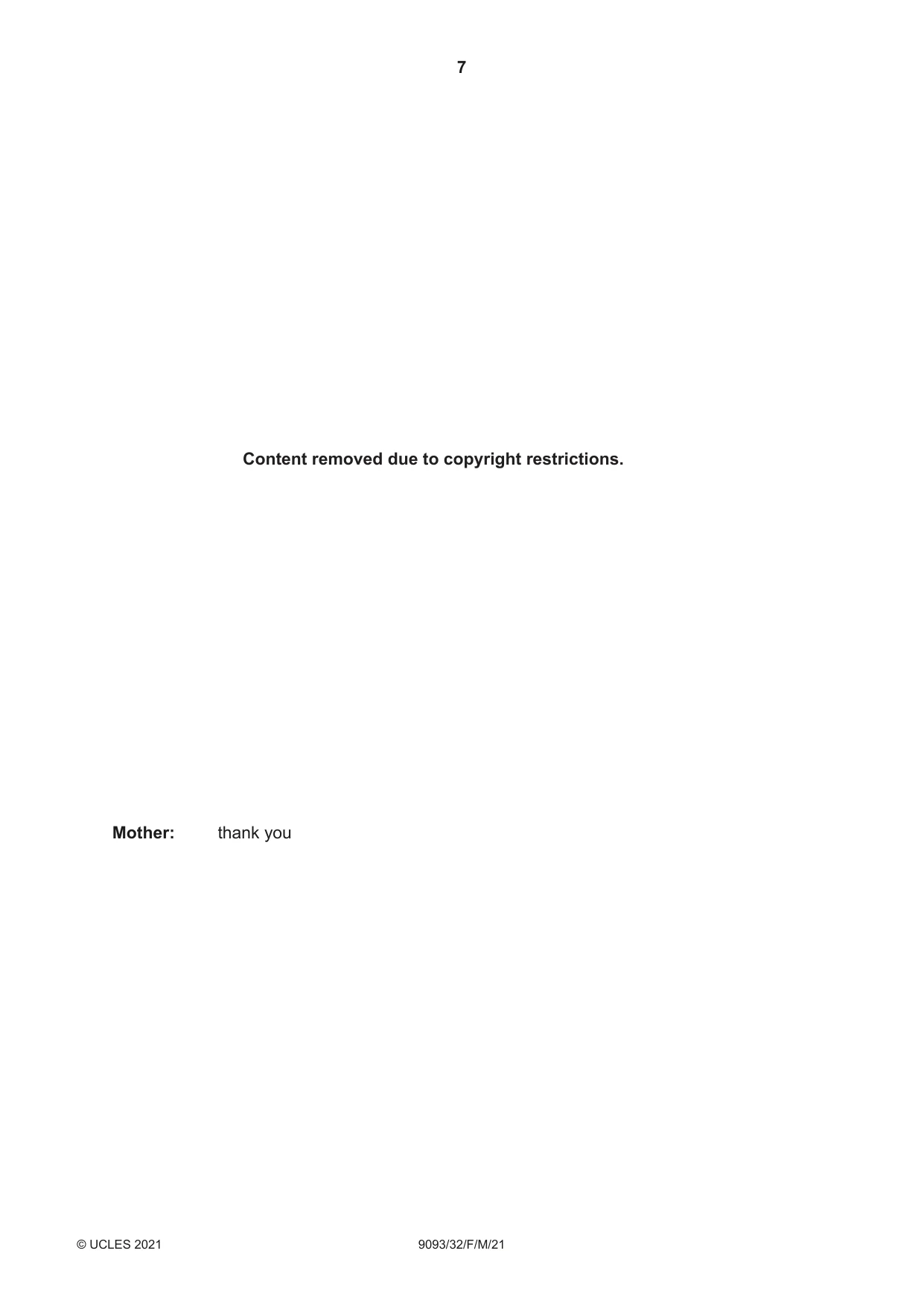
7 9093/32/F/M/21 © UCLES 2021 Mother: thank you Content removed due to copyright restrictions.
Question paper, page 8
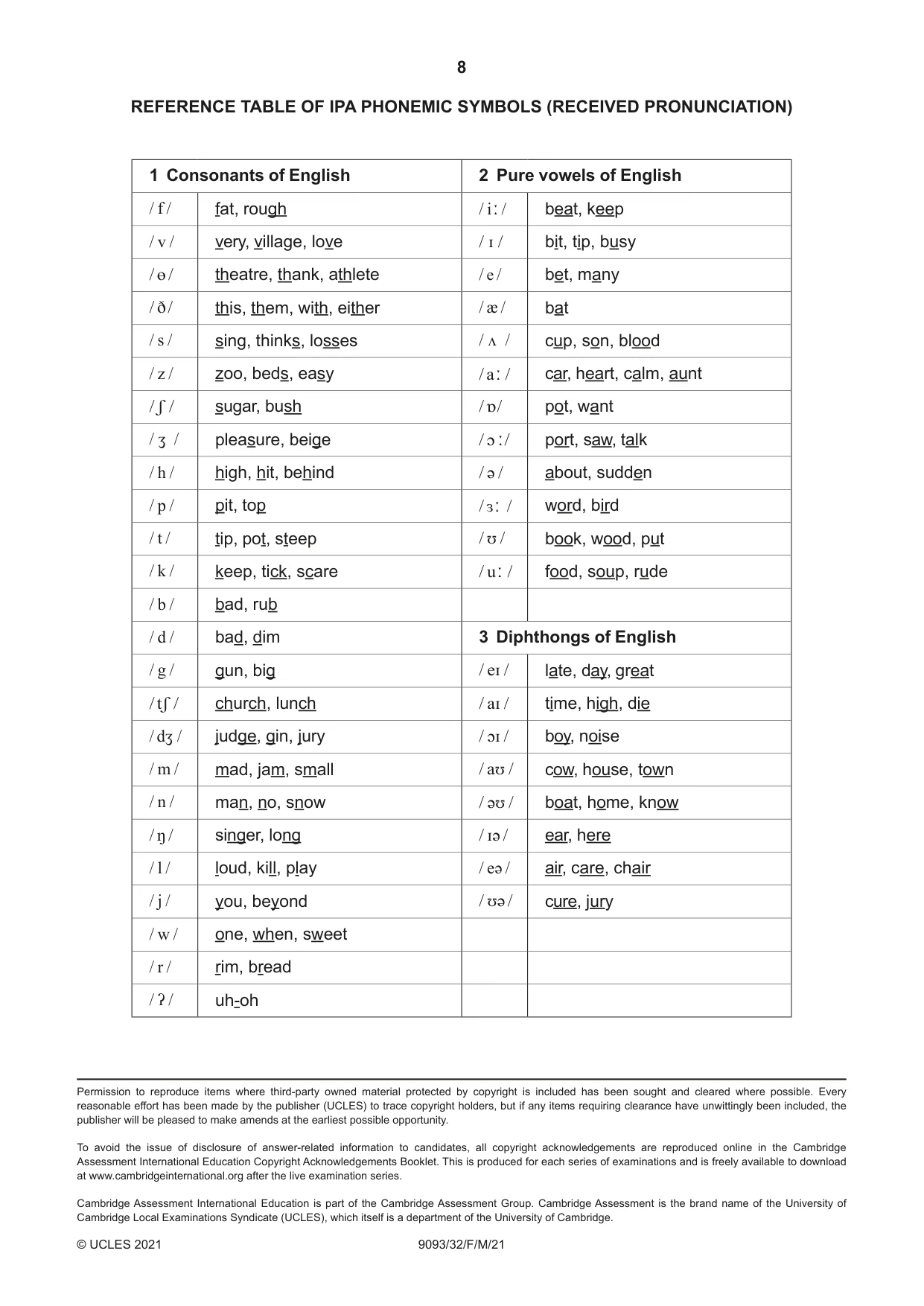
8 9093/32/F/M/21 © UCLES 2021 Permission to reproduce items where third-party owned material protected by copyright is included has been sought and cleared where possible. Every reasonable effort has been made by the publisher (UCLES) to trace copyright holders, but if any items requiring clearance have unwittingly been included, the publisher will be pleased to make amends at the earliest possible opportunity. To avoid the issue of disclosure of answer-related information to candidates, all copyright acknowledgements are reproduced online in the Cambridge Assessment International Education Copyright Acknowledgements Booklet. This is produced for each series of examinations and is freely available to download at www.cambridgeinternational.org after the live examination series. Cambridge Assessment International Education is part of the Cambridge Assessment Group. Cambridge Assessment is the brand name of the University of Cambridge Local Examinations Syndicate (UCLES), which itself is a department of the University of Cambridge. REFERENCE TABLE OF IPA PHONEMIC SYMBOLS (RECEIVED PRONUNCIATION) 1 Consonants of English 2 Pure vowels of English / f / fat, rough / i / beat, keep / v / very, village, love / ɪ / bit, tip, busy / ɵ / theatre, thank, athlete / e / bet, many / ð/ this, them, with, either / æ / bat / s / sing, thinks, losses / ʌ / cup, son, blood / z / zoo, beds, easy / a / car, heart, calm, aunt / ʃ / sugar, bush / ɒ / pot, want / ʒ / pleasure, beige / ɔ/ port, saw, talk / h / high, hit, behind / ə / about, sudden / p / pit, top / ɜ / word, bird / t / tip, pot, steep / ʊ / book, wood, put / k / keep, tick, scare / u / food, soup, rude / b / bad, rub / d / bad, dim 3 Diphthongs of English / g / gun, big / eɪ / late, day, great / tʃ / church, lunch / aɪ / time, high, die / dʒ / judge, gin, jury / ɔɪ / boy, noise / m / mad, jam, small / aʊ / cow, house, town / n / man, no, snow / əʊ / boat, home, know / ŋ / singer, long / ɪə / ear, here / l / loud, kill, play / eə / air, care, chair / j / you, beyond / ʊə / cure, jury / w / one, when, sweet / r / rim, bread / ʔ / uh-oh
Mark scheme, page 1
This document consists of 13 printed pages. © UCLES 2021 [Turn over Cambridge International A Level ENGLISH LANGUAGE 9093/32 Paper 3 Language Analysis March 2021 MARK SCHEME Maximum Mark: 50 Published This mark scheme is published as an aid to teachers and candidates, to indicate the requirements of the examination. It shows the basis on which Examiners were instructed to award marks. It does not indicate the details of the discussions that took place at an Examiners’ meeting before marking began, which would have considered the acceptability of alternative answers. Mark schemes should be read in conjunction with the question paper and the Principal Examiner Report for Teachers. Cambridge International will not enter into discussions about these mark schemes. Cambridge International is publishing the mark schemes for the March 2021 series for most Cambridge IGCSE™, Cambridge International A and AS Level components and some Cambridge O Level components.
Mark scheme, page 2
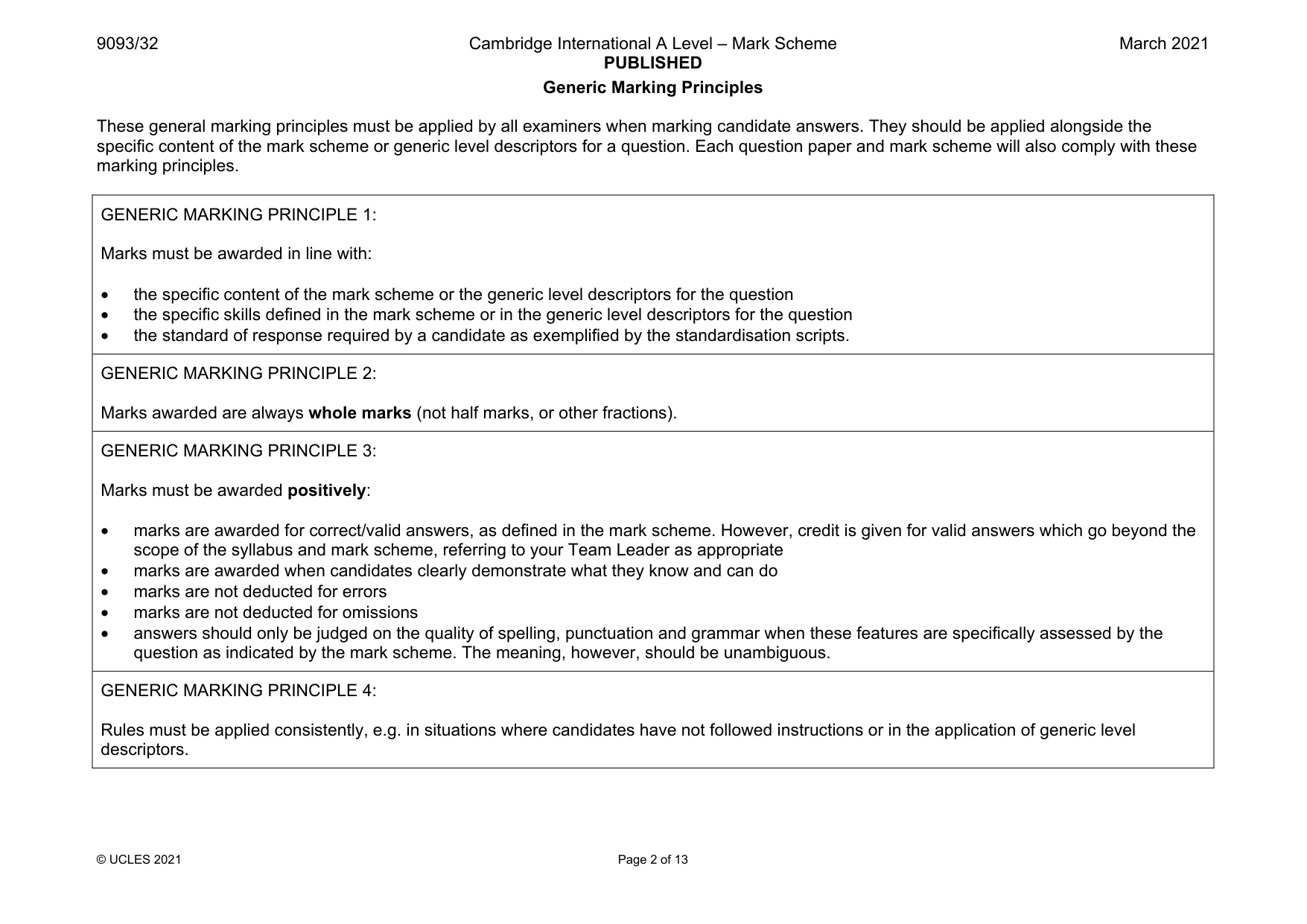
9093/32 Cambridge International A Level – Mark Scheme PUBLISHED March 2021 © UCLES 2021 Page 2 of 13 Generic Marking Principles These general marking principles must be applied by all examiners when marking candidate answers. They should be applied alongside the specific content of the mark scheme or generic level descriptors for a question. Each question paper and mark scheme will also comply with these marking principles. GENERIC MARKING PRINCIPLE 1: Marks must be awarded in line with: • the specific content of the mark scheme or the generic level descriptors for the question • the specific skills defined in the mark scheme or in the generic level descriptors for the question • the standard of response required by a candidate as exemplified by the standardisation scripts. GENERIC MARKING PRINCIPLE 2: Marks awarded are always whole marks (not half marks, or other fractions). GENERIC MARKING PRINCIPLE 3: Marks must be awarded positively: • marks are awarded for correct/valid answers, as defined in the mark scheme. However, credit is given for valid answers which go beyond the scope of the syllabus and mark scheme, referring to your Team Leader as appropriate • marks are awarded when candidates clearly demonstrate what they know and can do • marks are not deducted for errors • marks are not deducted for omissions • answers should only be judged on the quality of spelling, punctuation and grammar when these features are specifically assessed by the question as indicated by the mark scheme. The meaning, however, should be unambiguous. GENERIC MARKING PRINCIPLE 4: Rules must be applied consistently, e.g. in situations where candidates have not followed instructions or in the application of generic level descriptors.
Mark scheme, page 3
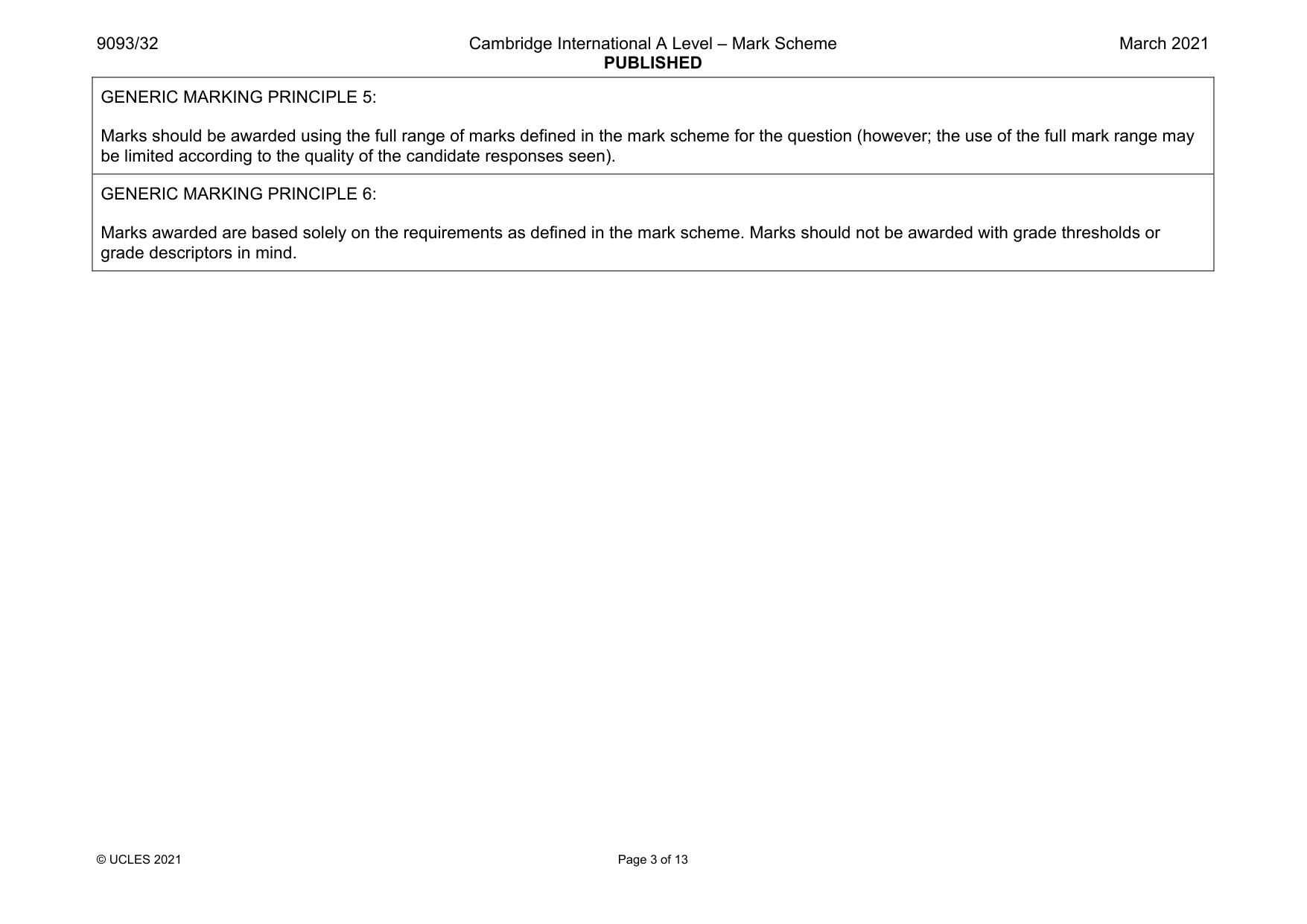
9093/32 Cambridge International A Level – Mark Scheme PUBLISHED March 2021 © UCLES 2021 Page 3 of 13 GENERIC MARKING PRINCIPLE 5: Marks should be awarded using the full range of marks defined in the mark scheme for the question (however; the use of the full mark range may be limited according to the quality of the candidate responses seen). GENERIC MARKING PRINCIPLE 6: Marks awarded are based solely on the requirements as defined in the mark scheme. Marks should not be awarded with grade thresholds or grade descriptors in mind.
Mark scheme, page 4
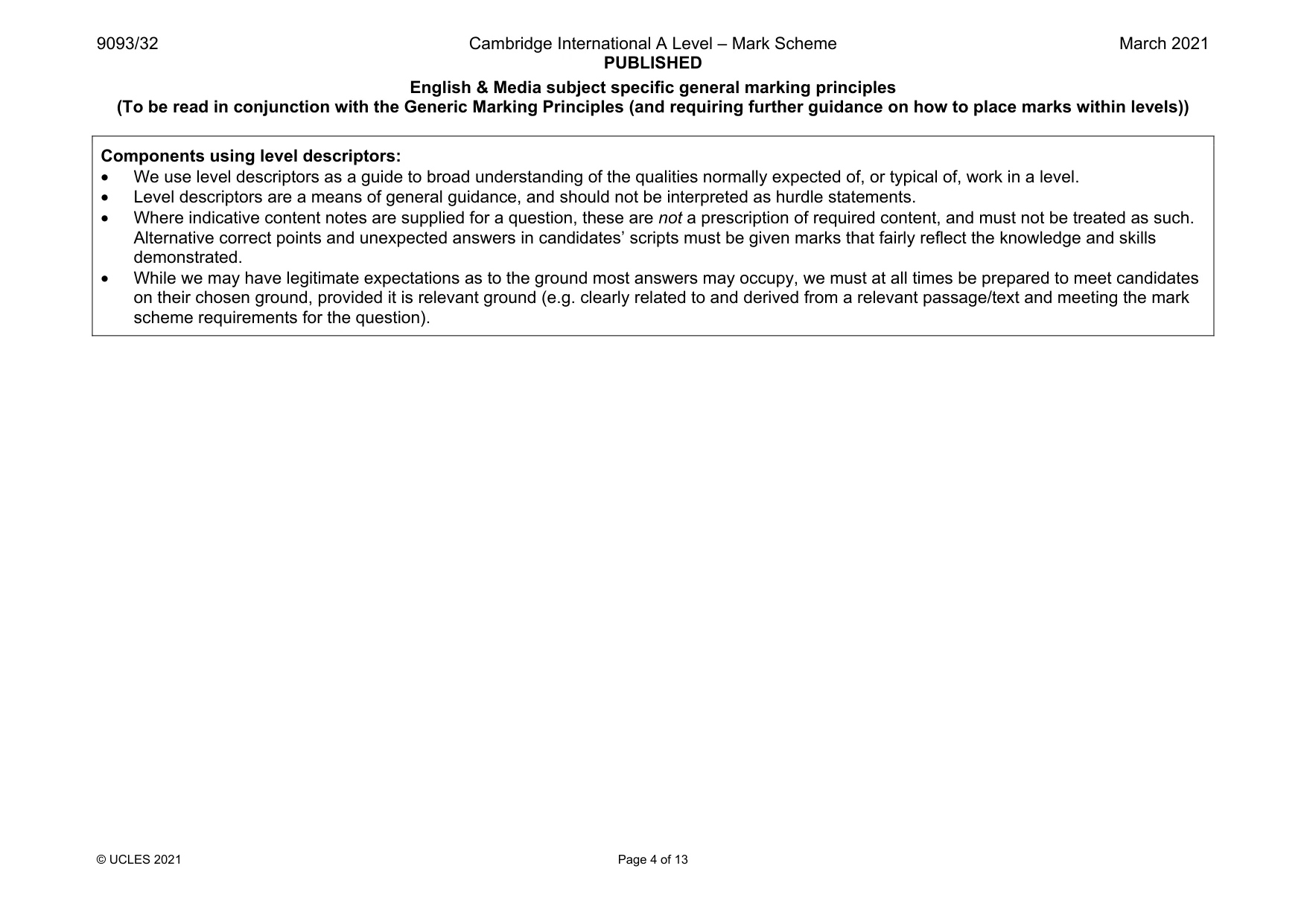
9093/32 Cambridge International A Level – Mark Scheme PUBLISHED March 2021 © UCLES 2021 Page 4 of 13 English & Media subject specific general marking principles (To be read in conjunction with the Generic Marking Principles (and requiring further guidance on how to place marks within levels)) Components using level descriptors: • We use level descriptors as a guide to broad understanding of the qualities normally expected of, or typical of, work in a level. • Level descriptors are a means of general guidance, and should not be interpreted as hurdle statements. • Where indicative content notes are supplied for a question, these are not a prescription of required content, and must not be treated as such. Alternative correct points and unexpected answers in candidates’ scripts must be given marks that fairly reflect the knowledge and skills demonstrated. • While we may have legitimate expectations as to the ground most answers may occupy, we must at all times be prepared to meet candidates on their chosen ground, provided it is relevant ground (e.g. clearly related to and derived from a relevant passage/text and meeting the mark scheme requirements for the question).
Mark scheme, page 5
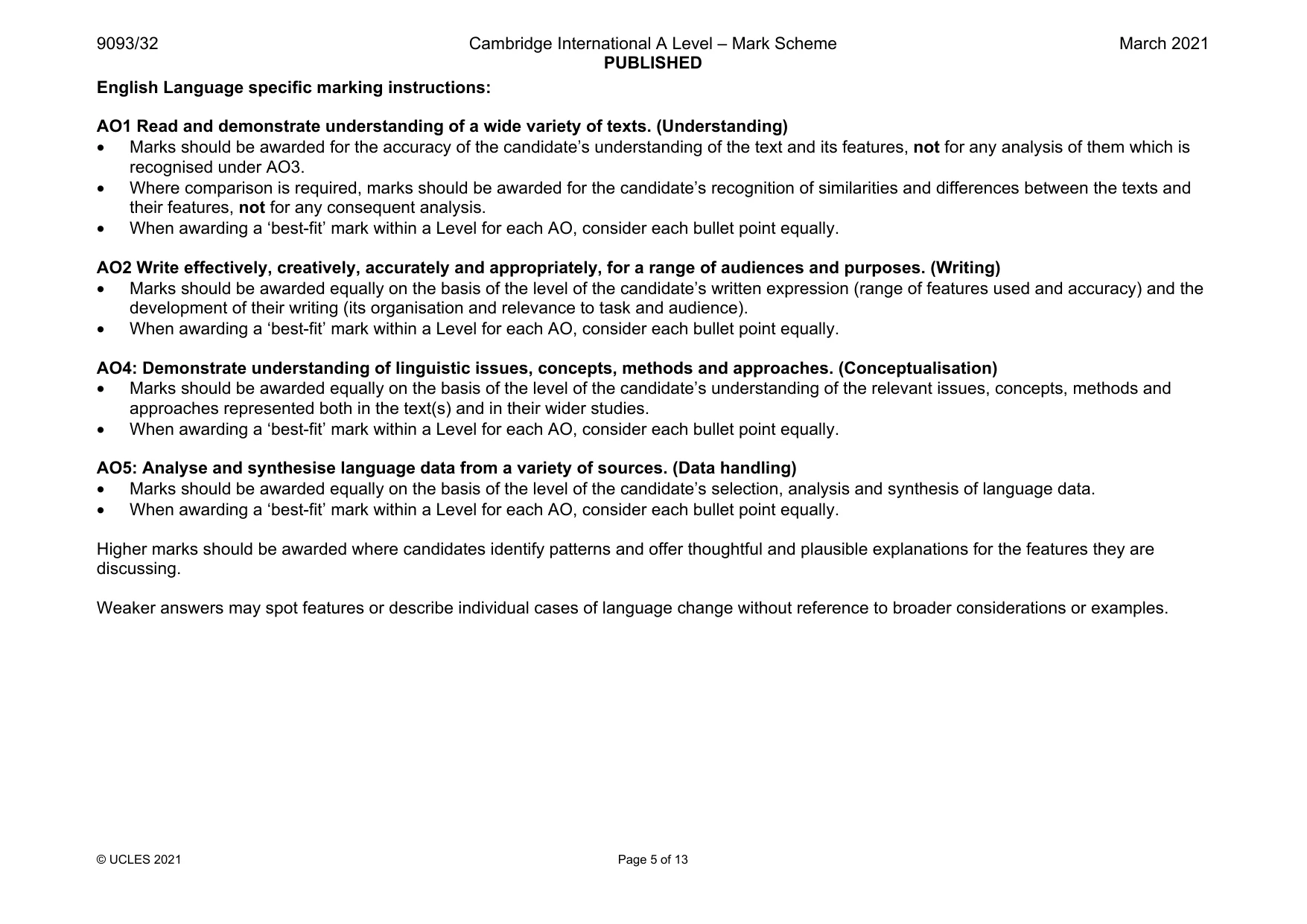
9093/32 Cambridge International A Level – Mark Scheme PUBLISHED March 2021 © UCLES 2021 Page 5 of 13 English Language specific marking instructions: AO1 Read and demonstrate understanding of a wide variety of texts. (Understanding) • Marks should be awarded for the accuracy of the candidate’s understanding of the text and its features, not for any analysis of them which is recognised under AO3. • Where comparison is required, marks should be awarded for the candidate’s recognition of similarities and differences between the texts and their features, not for any consequent analysis. • When awarding a ‘best-fit’ mark within a Level for each AO, consider each bullet point equally. AO2 Write effectively, creatively, accurately and appropriately, for a range of audiences and purposes. (Writing) • Marks should be awarded equally on the basis of the level of the candidate’s written expression (range of features used and accuracy) and the development of their writing (its organisation and relevance to task and audience). • When awarding a ‘best-fit’ mark within a Level for each AO, consider each bullet point equally. AO4: Demonstrate understanding of linguistic issues, concepts, methods and approaches. (Conceptualisation) • Marks should be awarded equally on the basis of the level of the candidate’s understanding of the relevant issues, concepts, methods and approaches represented both in the text(s) and in their wider studies. • When awarding a ‘best-fit’ mark within a Level for each AO, consider each bullet point equally. AO5: Analyse and synthesise language data from a variety of sources. (Data handling) • Marks should be awarded equally on the basis of the level of the candidate’s selection, analysis and synthesis of language data. • When awarding a ‘best-fit’ mark within a Level for each AO, consider each bullet point equally. Higher marks should be awarded where candidates identify patterns and offer thoughtful and plausible explanations for the features they are discussing. Weaker answers may spot features or describe individual cases of language change without reference to broader considerations or examples.
Mark scheme, page 6
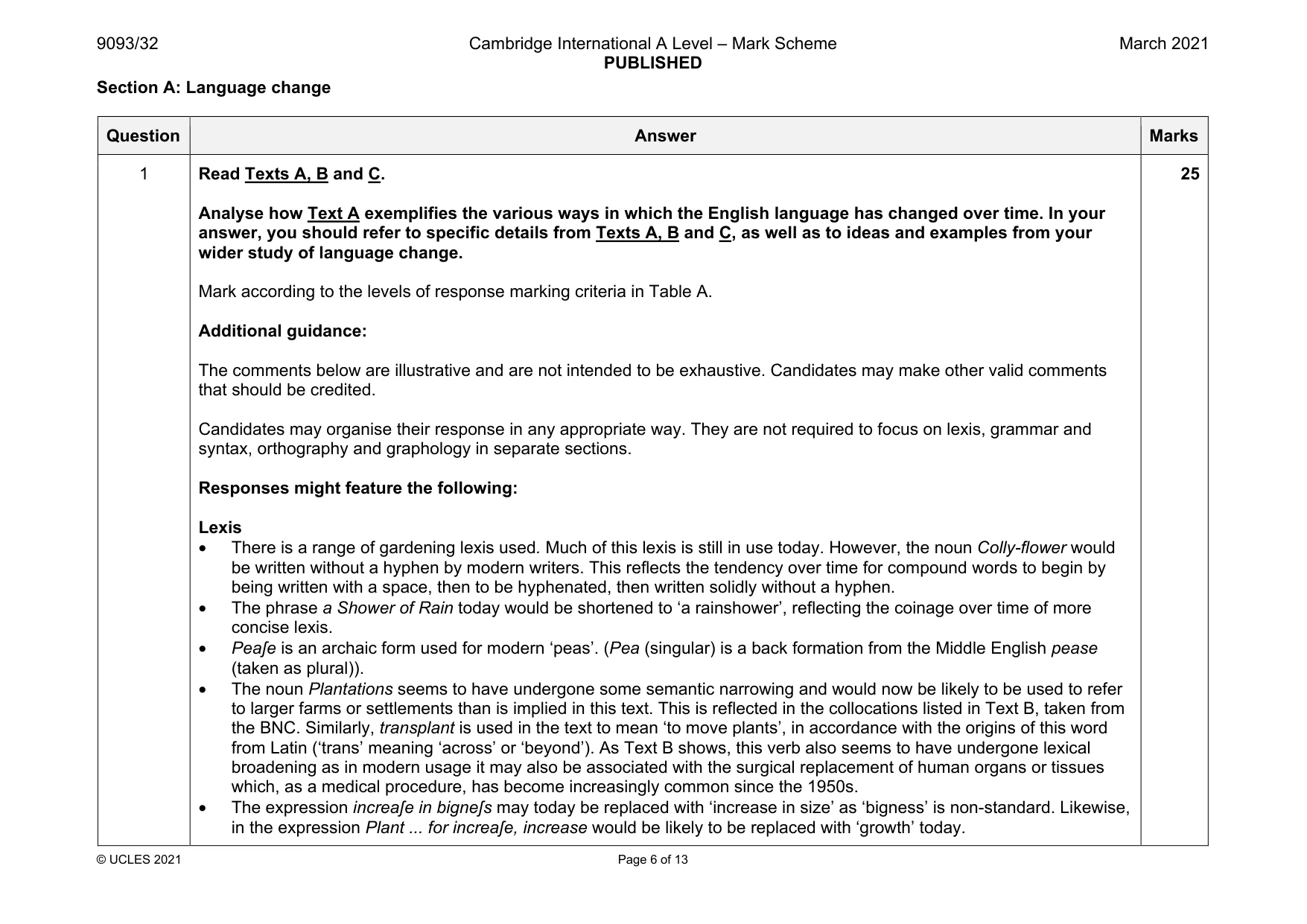
9093/32 Cambridge International A Level – Mark Scheme PUBLISHED March 2021 © UCLES 2021 Page 6 of 13 Section A: Language change Question Answer Marks 1 Read Texts A, B and C. Analyse how Text A exemplifies the various ways in which the English language has changed over time. In your answer, you should refer to specific details from Texts A, B and C, as well as to ideas and examples from your wider study of language change. Mark according to the levels of response marking criteria in Table A. Additional guidance: The comments below are illustrative and are not intended to be exhaustive. Candidates may make other valid comments that should be credited. Candidates may organise their response in any appropriate way. They are not required to focus on lexis, grammar and syntax, orthography and graphology in separate sections. Responses might feature the following: Lexis • There is a range of gardening lexis used. Much of this lexis is still in use today. However, the noun Colly-flower would be written without a hyphen by modern writers. This reflects the tendency over time for compound words to begin by being written with a space, then to be hyphenated, then written solidly without a hyphen. • The phrase a Shower of Rain today would be shortened to ‘a rainshower’, reflecting the coinage over time of more concise lexis. • Peaʃe is an archaic form used for modern ‘peas’. (Pea (singular) is a back formation from the Middle English pease (taken as plural)). • The noun Plantations seems to have undergone some semantic narrowing and would now be likely to be used to refer to larger farms or settlements than is implied in this text. This is reflected in the collocations listed in Text B, taken from the BNC. Similarly, transplant is used in the text to mean ‘to move plants’, in accordance with the origins of this word from Latin (‘trans’ meaning ‘across’ or ‘beyond’). As Text B shows, this verb also seems to have undergone lexical broadening as in modern usage it may also be associated with the surgical replacement of human organs or tissues which, as a medical procedure, has become increasingly common since the 1950s. • The expression increaʃe in bigneʃs may today be replaced with ‘increase in size’ as ‘bigness’ is non-standard. Likewise, in the expression Plant ... for increaʃe, increase would be likely to be replaced with ‘growth’ today. 25
Mark scheme, page 7
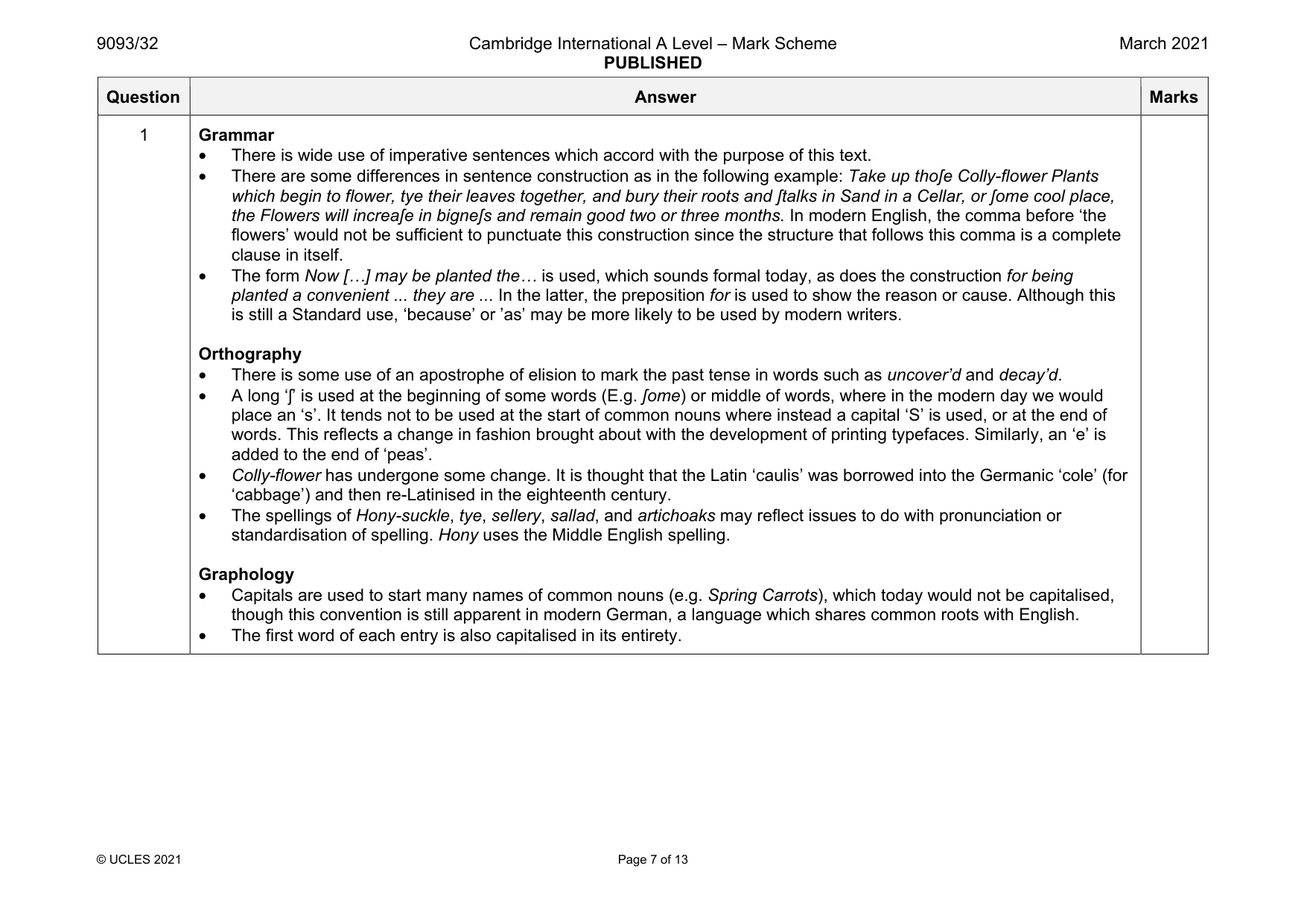
9093/32 Cambridge International A Level – Mark Scheme PUBLISHED March 2021 © UCLES 2021 Page 7 of 13 Question Answer Marks 1 Grammar • There is wide use of imperative sentences which accord with the purpose of this text. • There are some differences in sentence construction as in the following example: Take up thoʃe Colly-flower Plants which begin to flower, tye their leaves together, and bury their roots and ʃtalks in Sand in a Cellar, or ʃome cool place, the Flowers will increaʃe in bigneʃs and remain good two or three months. In modern English, the comma before ‘the flowers’ would not be sufficient to punctuate this construction since the structure that follows this comma is a complete clause in itself. • The form Now […] may be planted the… is used, which sounds formal today, as does the construction for being planted a convenient ... they are ... In the latter, the preposition for is used to show the reason or cause. Although this is still a Standard use, ‘because’ or ’as’ may be more likely to be used by modern writers. Orthography • There is some use of an apostrophe of elision to mark the past tense in words such as uncover’d and decay’d. • A long ‘ʃ’ is used at the beginning of some words (E.g. ʃome) or middle of words, where in the modern day we would place an ‘s’. It tends not to be used at the start of common nouns where instead a capital ‘S’ is used, or at the end of words. This reflects a change in fashion brought about with the development of printing typefaces. Similarly, an ‘e’ is added to the end of ‘peas’. • Colly-flower has undergone some change. It is thought that the Latin ‘caulis’ was borrowed into the Germanic ‘cole’ (for ‘cabbage’) and then re-Latinised in the eighteenth century. • The spellings of Hony-suckle, tye, sellery, sallad, and artichoaks may reflect issues to do with pronunciation or standardisation of spelling. Hony uses the Middle English spelling. Graphology • Capitals are used to start many names of common nouns (e.g. Spring Carrots), which today would not be capitalised, though this convention is still apparent in modern German, a language which shares common roots with English. • The first word of each entry is also capitalised in its entirety.
Mark scheme, page 8
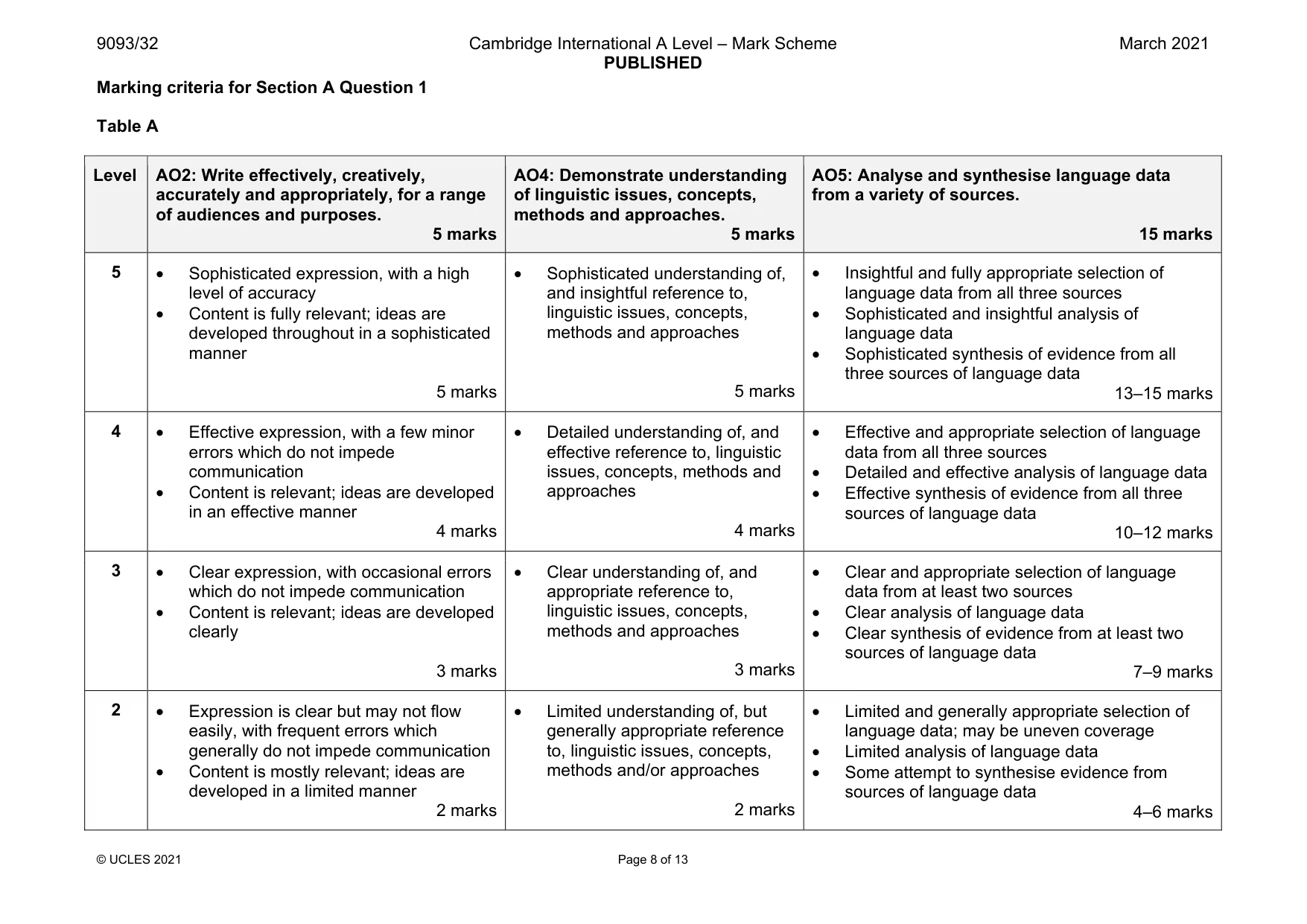
9093/32 Cambridge International A Level – Mark Scheme PUBLISHED March 2021 © UCLES 2021 Page 8 of 13 Marking criteria for Section A Question 1 Table A Level AO2: Write effectively, creatively, accurately and appropriately, for a range of audiences and purposes. 5 marks AO4: Demonstrate understanding of linguistic issues, concepts, methods and approaches. 5 marks AO5: Analyse and synthesise language data from a variety of sources. 15 marks 5 • Sophisticated expression, with a high level of accuracy • Content is fully relevant; ideas are developed throughout in a sophisticated manner 5 marks • Sophisticated understanding of, and insightful reference to, linguistic issues, concepts, methods and approaches 5 marks • Insightful and fully appropriate selection of language data from all three sources • Sophisticated and insightful analysis of language data • Sophisticated synthesis of evidence from all three sources of language data 13–15 marks 4 • Effective expression, with a few minor errors which do not impede communication • Content is relevant; ideas are developed in an effective manner 4 marks • Detailed understanding of, and effective reference to, linguistic issues, concepts, methods and approaches 4 marks • Effective and appropriate selection of language data from all three sources • Detailed and effective analysis of language data • Effective synthesis of evidence from all three sources of language data 10–12 marks 3 • Clear expression, with occasional errors which do not impede communication • Content is relevant; ideas are developed clearly 3 marks • Clear understanding of, and appropriate reference to, linguistic issues, concepts, methods and approaches 3 marks • Clear and appropriate selection of language data from at least two sources • Clear analysis of language data • Clear synthesis of evidence from at least two sources of language data 7–9 marks 2 • Expression is clear but may not flow easily, with frequent errors which generally do not impede communication • Content is mostly relevant; ideas are developed in a limited manner 2 marks • Limited understanding of, but generally appropriate reference to, linguistic issues, concepts, methods and/or approaches 2 marks • Limited and generally appropriate selection of language data; may be uneven coverage • Limited analysis of language data • Some attempt to synthesise evidence from sources of language data 4–6 marks
Mark scheme, page 9
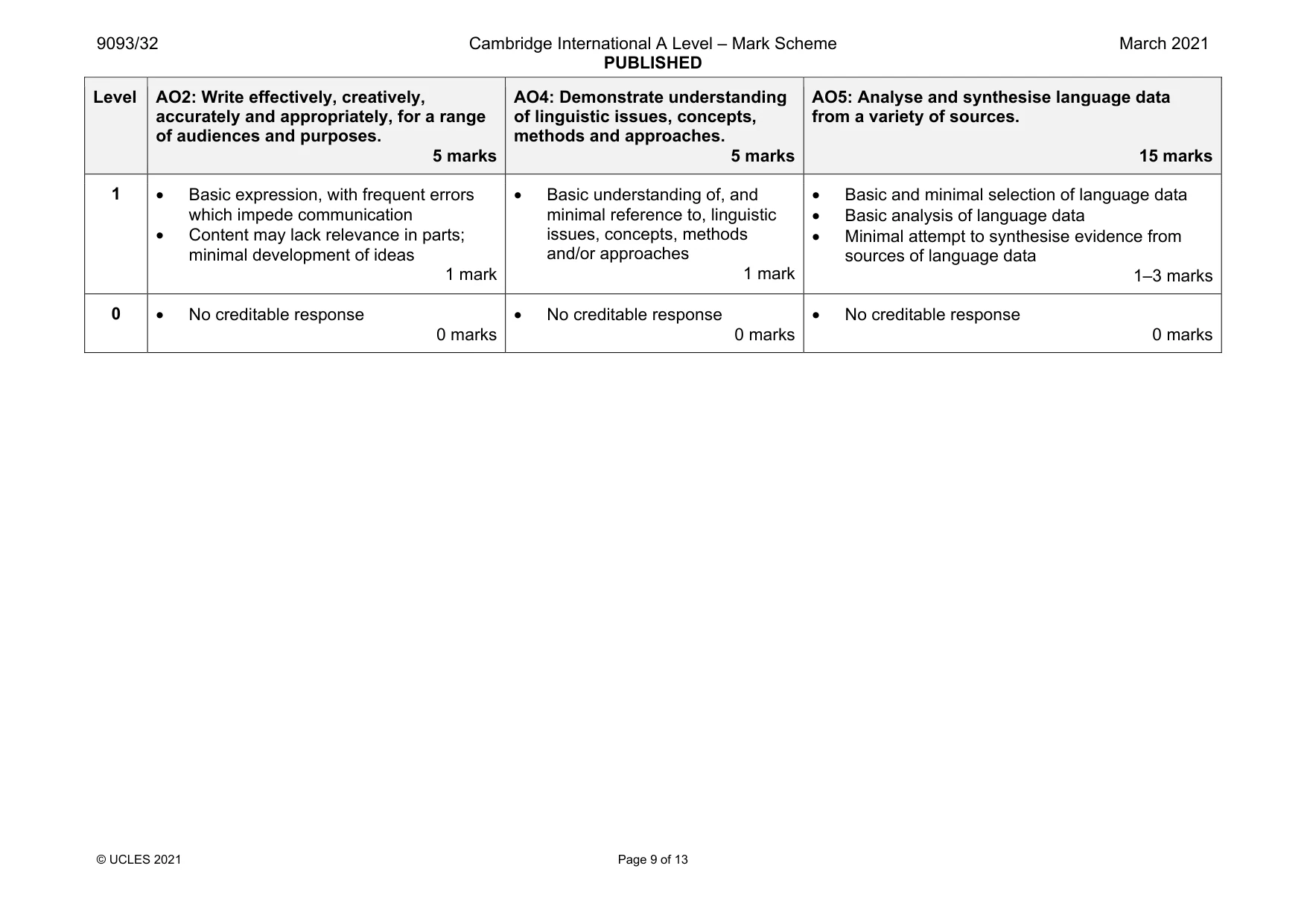
9093/32 Cambridge International A Level – Mark Scheme PUBLISHED March 2021 © UCLES 2021 Page 9 of 13 Level AO2: Write effectively, creatively, accurately and appropriately, for a range of audiences and purposes. 5 marks AO4: Demonstrate understanding of linguistic issues, concepts, methods and approaches. 5 marks AO5: Analyse and synthesise language data from a variety of sources. 15 marks 1 • Basic expression, with frequent errors which impede communication • Content may lack relevance in parts; minimal development of ideas 1 mark • Basic understanding of, and minimal reference to, linguistic issues, concepts, methods and/or approaches 1 mark • Basic and minimal selection of language data • Basic analysis of language data • Minimal attempt to synthesise evidence from sources of language data 1–3 marks 0 • No creditable response 0 marks • No creditable response 0 marks • No creditable response 0 marks
Mark scheme, page 10
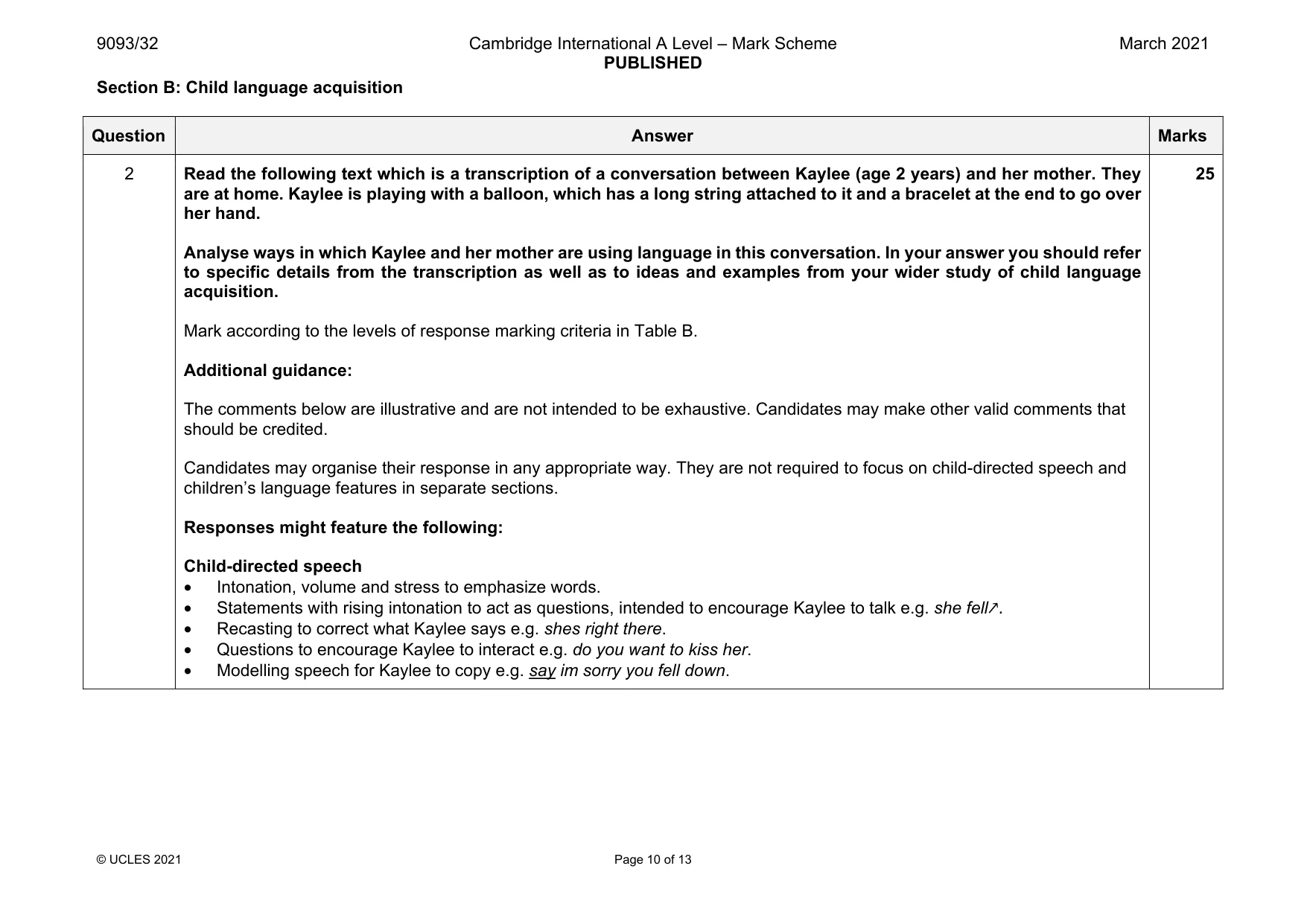
9093/32 Cambridge International A Level – Mark Scheme PUBLISHED March 2021 © UCLES 2021 Page 10 of 13 Section B: Child language acquisition Question Answer Marks 2 Read the following text which is a transcription of a conversation between Kaylee (age 2 years) and her mother. They are at home. Kaylee is playing with a balloon, which has a long string attached to it and a bracelet at the end to go over her hand. Analyse ways in which Kaylee and her mother are using language in this conversation. In your answer you should refer to specific details from the transcription as well as to ideas and examples from your wider study of child language acquisition. Mark according to the levels of response marking criteria in Table B. Additional guidance: The comments below are illustrative and are not intended to be exhaustive. Candidates may make other valid comments that should be credited. Candidates may organise their response in any appropriate way. They are not required to focus on child-directed speech and children’s language features in separate sections. Responses might feature the following: Child-directed speech • Intonation, volume and stress to emphasize words. • Statements with rising intonation to act as questions, intended to encourage Kaylee to talk e.g. she fell↗. • Recasting to correct what Kaylee says e.g. shes right there. • Questions to encourage Kaylee to interact e.g. do you want to kiss her. • Modelling speech for Kaylee to copy e.g. say im sorry you fell down. 25
Mark scheme, page 11
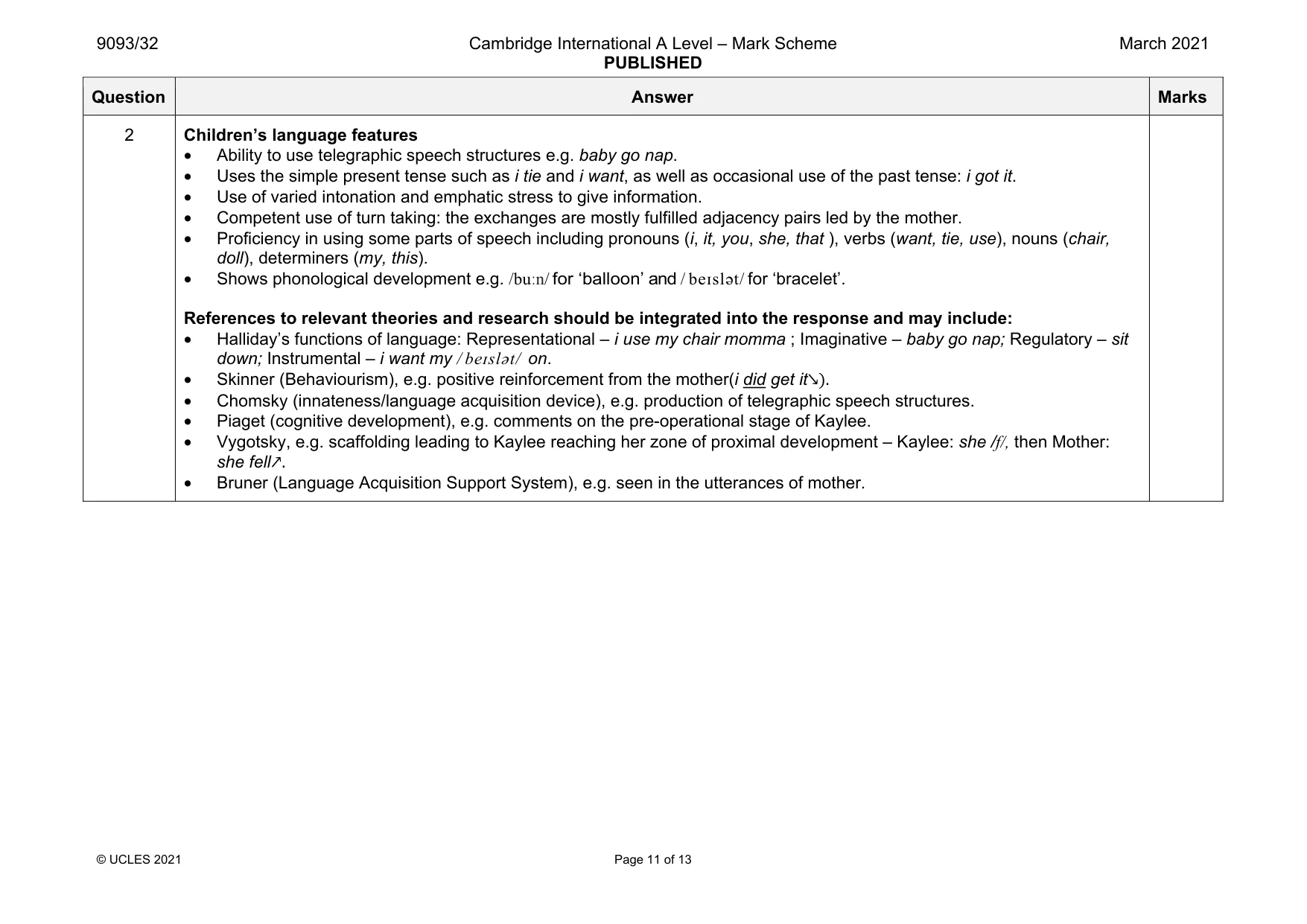
9093/32 Cambridge International A Level – Mark Scheme PUBLISHED March 2021 © UCLES 2021 Page 11 of 13 Question Answer Marks 2 Children’s language features • Ability to use telegraphic speech structures e.g. baby go nap. • Uses the simple present tense such as i tie and i want, as well as occasional use of the past tense: i got it. • Use of varied intonation and emphatic stress to give information. • Competent use of turn taking: the exchanges are mostly fulfilled adjacency pairs led by the mother. • Proficiency in using some parts of speech including pronouns (i, it, you, she, that ), verbs (want, tie, use), nouns (chair, doll), determiners (my, this). • Shows phonological development e.g. /buːn/ for ‘balloon’ and / beɪslət/ for ‘bracelet’. References to relevant theories and research should be integrated into the response and may include: • Halliday’s functions of language: Representational – i use my chair momma ; Imaginative – baby go nap; Regulatory – sit down; Instrumental – i want my / beɪslət/ on. • Skinner (Behaviourism), e.g. positive reinforcement from the mother(i did get it↘). • Chomsky (innateness/language acquisition device), e.g. production of telegraphic speech structures. • Piaget (cognitive development), e.g. comments on the pre-operational stage of Kaylee. • Vygotsky, e.g. scaffolding leading to Kaylee reaching her zone of proximal development – Kaylee: she /f/, then Mother: she fell↗. • Bruner (Language Acquisition Support System), e.g. seen in the utterances of mother.
Mark scheme, page 12
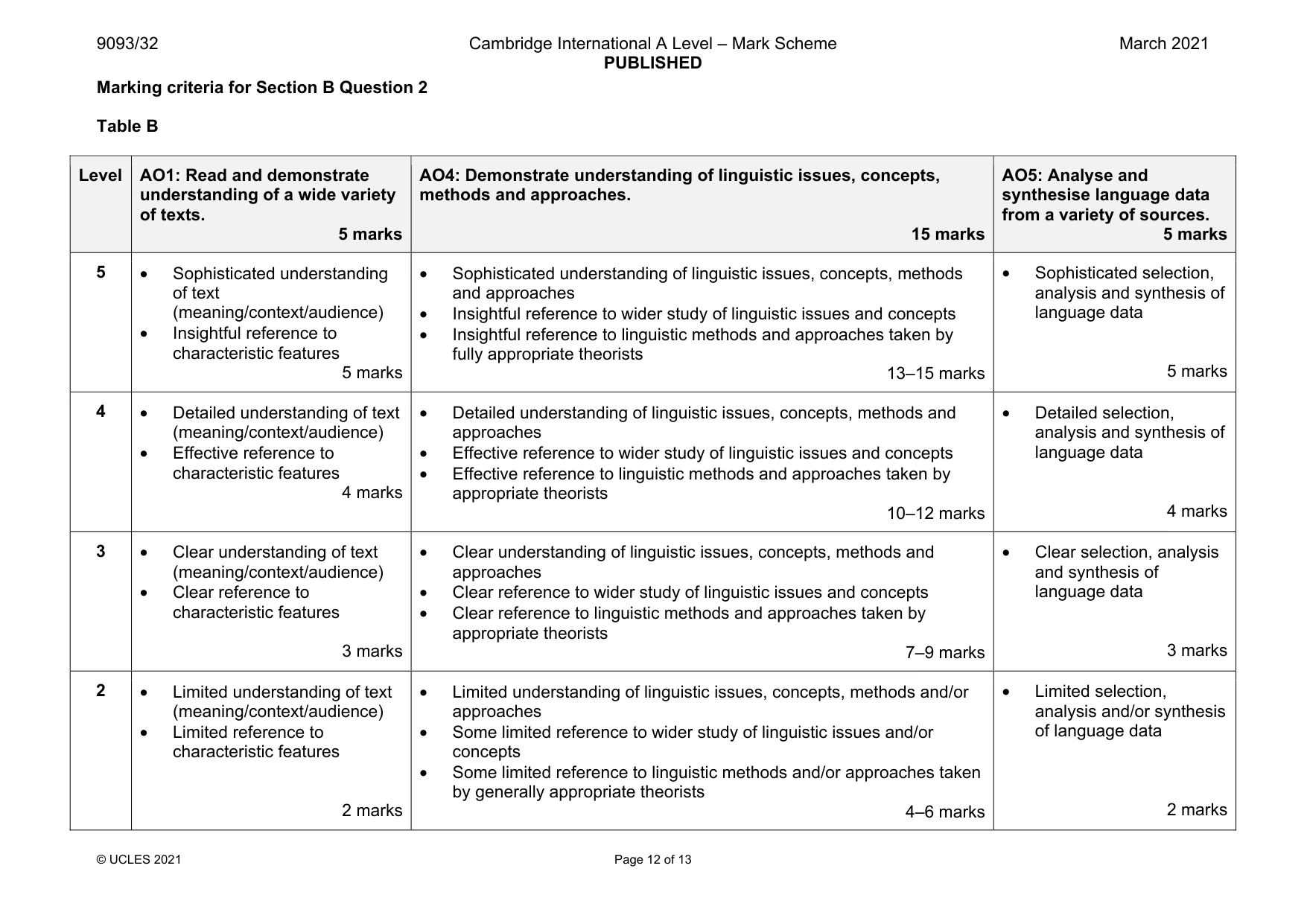
9093/32 Cambridge International A Level – Mark Scheme PUBLISHED March 2021 © UCLES 2021 Page 12 of 13 Marking criteria for Section B Question 2 Table B Level AO1: Read and demonstrate understanding of a wide variety of texts. 5 marks AO4: Demonstrate understanding of linguistic issues, concepts, methods and approaches. 15 marks AO5: Analyse and synthesise language data from a variety of sources. 5 marks 5 • Sophisticated understanding of text (meaning/context/audience) • Insightful reference to characteristic features 5 marks • Sophisticated understanding of linguistic issues, concepts, methods and approaches • Insightful reference to wider study of linguistic issues and concepts • Insightful reference to linguistic methods and approaches taken by fully appropriate theorists 13–15 marks • Sophisticated selection, analysis and synthesis of language data 5 marks 4 • Detailed understanding of text (meaning/context/audience) • Effective reference to characteristic features 4 marks • Detailed understanding of linguistic issues, concepts, methods and approaches • Effective reference to wider study of linguistic issues and concepts • Effective reference to linguistic methods and approaches taken by appropriate theorists 10–12 marks • Detailed selection, analysis and synthesis of language data 4 marks 3 • Clear understanding of text (meaning/context/audience) • Clear reference to characteristic features 3 marks • Clear understanding of linguistic issues, concepts, methods and approaches • Clear reference to wider study of linguistic issues and concepts • Clear reference to linguistic methods and approaches taken by appropriate theorists 7–9 marks • Clear selection, analysis and synthesis of language data 3 marks 2 • Limited understanding of text (meaning/context/audience) • Limited reference to characteristic features 2 marks • Limited understanding of linguistic issues, concepts, methods and/or approaches • Some limited reference to wider study of linguistic issues and/or concepts • Some limited reference to linguistic methods and/or approaches taken by generally appropriate theorists 4–6 marks • Limited selection, analysis and/or synthesis of language data 2 marks
Mark scheme, page 13
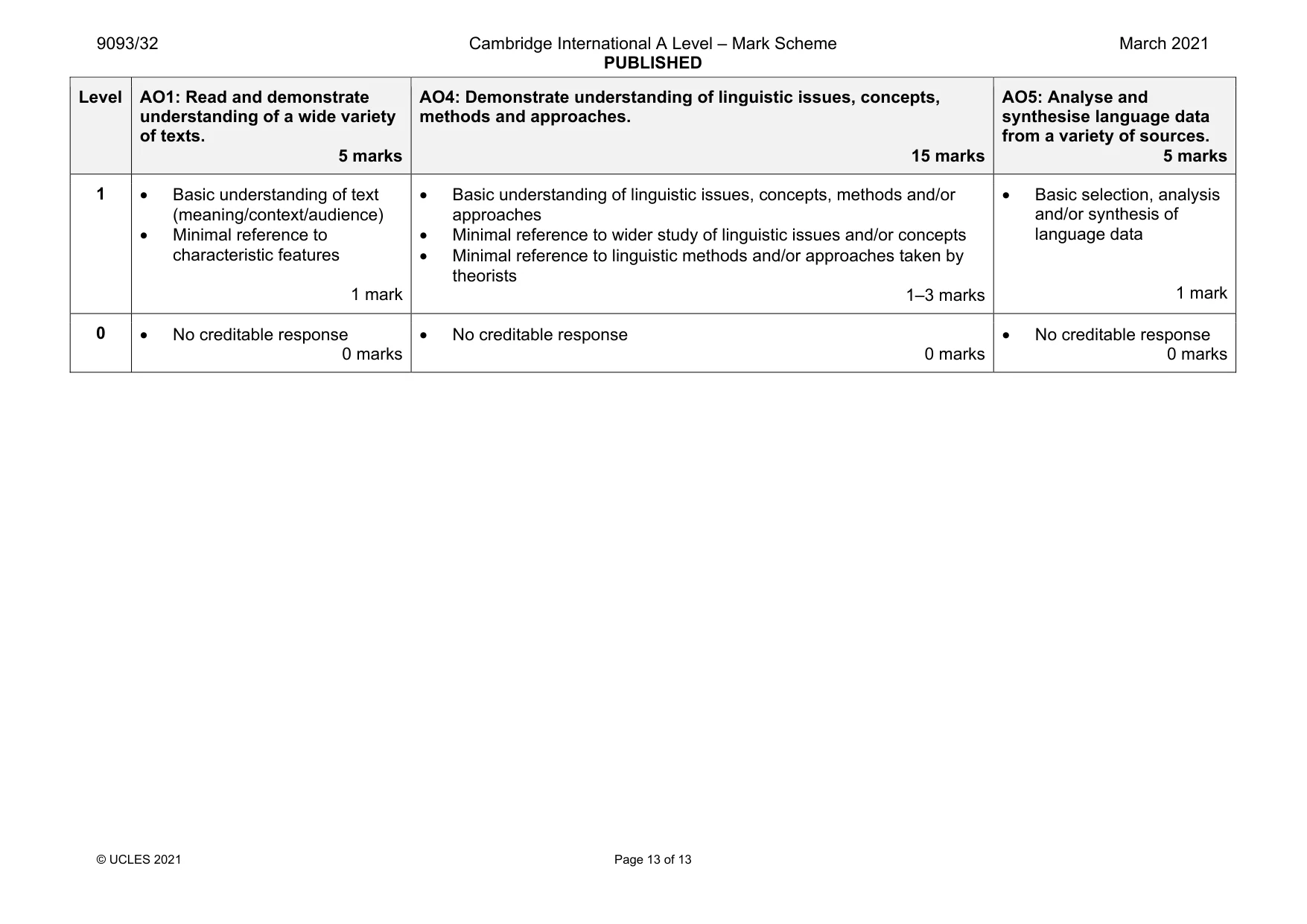
9093/32 Cambridge International A Level – Mark Scheme PUBLISHED March 2021 © UCLES 2021 Page 13 of 13 Level AO1: Read and demonstrate understanding of a wide variety of texts. 5 marks AO4: Demonstrate understanding of linguistic issues, concepts, methods and approaches. 15 marks AO5: Analyse and synthesise language data from a variety of sources. 5 marks 1 • Basic understanding of text (meaning/context/audience) • Minimal reference to characteristic features 1 mark • Basic understanding of linguistic issues, concepts, methods and/or approaches • Minimal reference to wider study of linguistic issues and/or concepts • Minimal reference to linguistic methods and/or approaches taken by theorists 1–3 marks • Basic selection, analysis and/or synthesis of language data 1 mark 0 • No creditable response 0 marks • No creditable response 0 marks • No creditable response 0 marks
What you needed in this session
Cambridge’s own grade thresholds for 2021 Feb/March, Paper 3 · Variant 2. A higher threshold means an easier paper — the bar moves with how the cohort did.