Cambridge A Level English - Language AS and A Level (from 2014) 9093 — 2020 Oct/Nov Paper 1 · Variant 3
9093/13/O/N/20 · 50 marks · ≈56 min
The question paper and its mark scheme, free to read here and free to download. This is Cambridge’s own paper, exactly as it was sat.
Question paper8 pages


Mark scheme5 pages
Answers below. Sit the paper first if you are practising.
Paper as text
Question paper, page 1
Cambridge International AS & A Level DC (PQ) 186785/2 © UCLES 2020 [Turn over This document has 8 pages. Blank pages are indicated. * 7 5 8 3 7 4 6 7 2 4 * ENGLISH LANGUAGE 9093/13 Paper 1 Passages October/November 2020 2 hours 15 minutes You must answer on the enclosed answer booklet. You will need: Answer booklet (enclosed) INSTRUCTIONS ● Answer two questions in total: Answer Question 1. Answer either Question 2 or Question 3. ● Follow the instructions on the front cover of the answer booklet. If you need additional answer paper, ask the invigilator for a continuation booklet. ● You are reminded of the need for good English and clear presentation in your answers. INFORMATION ● The total mark for this paper is 50. ● The number of marks for each question or part question is shown in brackets [ ].
Question paper, page 2
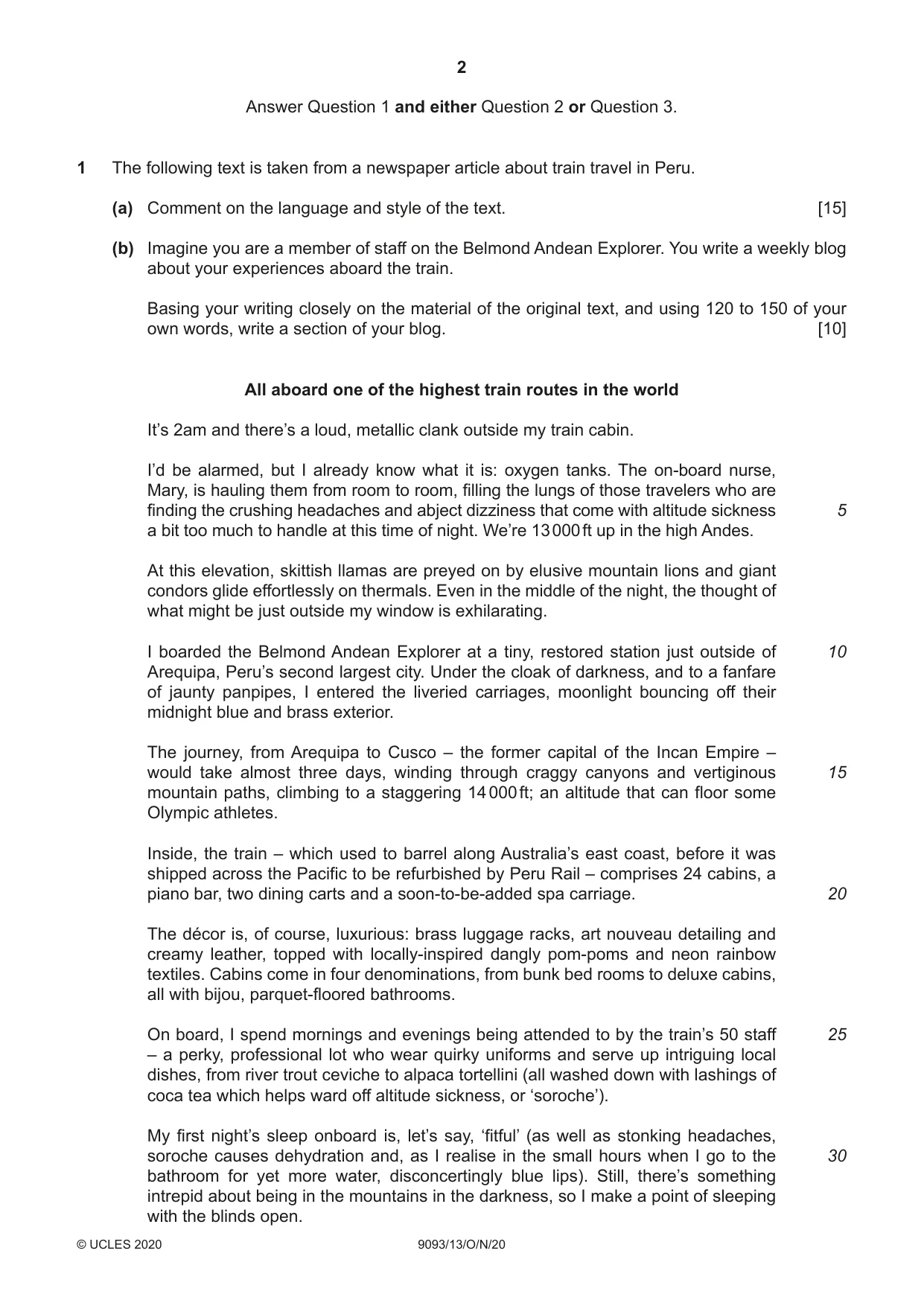
2 9093/13/O/N/20 © UCLES 2020 Answer Question 1 and either Question 2 or Question 3. 1 The following text is taken from a newspaper article about train travel in Peru. (a) Comment on the language and style of the text. [15] (b) Imagine you are a member of staff on the Belmond Andean Explorer. You write a weekly blog about your experiences aboard the train. Basing your writing closely on the material of the original text, and using 120 to 150 of your own words, write a section of your blog. [10] All aboard one of the highest train routes in the world It’s 2am and there’s a loud, metallic clank outside my train cabin. I’d be alarmed, but I already know what it is: oxygen tanks. The on-board nurse, Mary, is hauling them from room to room, filling the lungs of those travelers who are finding the crushing headaches and abject dizziness that come with altitude sickness a bit too much to handle at this time of night. We’re 13 000 ft up in the high Andes. At this elevation, skittish llamas are preyed on by elusive mountain lions and giant condors glide effortlessly on thermals. Even in the middle of the night, the thought of what might be just outside my window is exhilarating. I boarded the Belmond Andean Explorer at a tiny, restored station just outside of Arequipa, Peru’s second largest city. Under the cloak of darkness, and to a fanfare of jaunty panpipes, I entered the liveried carriages, moonlight bouncing off their midnight blue and brass exterior. The journey, from Arequipa to Cusco – the former capital of the Incan Empire – would take almost three days, winding through craggy canyons and vertiginous mountain paths, climbing to a staggering 14 000 ft; an altitude that can floor some Olympic athletes. Inside, the train – which used to barrel along Australia’s east coast, before it was shipped across the Pacific to be refurbished by Peru Rail – comprises 24 cabins, a piano bar, two dining carts and a soon-to-be-added spa carriage. The décor is, of course, luxurious: brass luggage racks, art nouveau detailing and creamy leather, topped with locally-inspired dangly pom-poms and neon rainbow textiles. Cabins come in four denominations, from bunk bed rooms to deluxe cabins, all with bijou, parquet-floored bathrooms. On board, I spend mornings and evenings being attended to by the train’s 50 staff – a perky, professional lot who wear quirky uniforms and serve up intriguing local dishes, from river trout ceviche to alpaca tortellini (all washed down with lashings of coca tea which helps ward off altitude sickness, or ‘soroche’). My first night’s sleep onboard is, let’s say, ‘fitful’ (as well as stonking headaches, soroche causes dehydration and, as I realise in the small hours when I go to the bathroom for yet more water, disconcertingly blue lips). Still, there’s something intrepid about being in the mountains in the darkness, so I make a point of sleeping with the blinds open. 5 10 15 20 25 30
Question paper, page 3
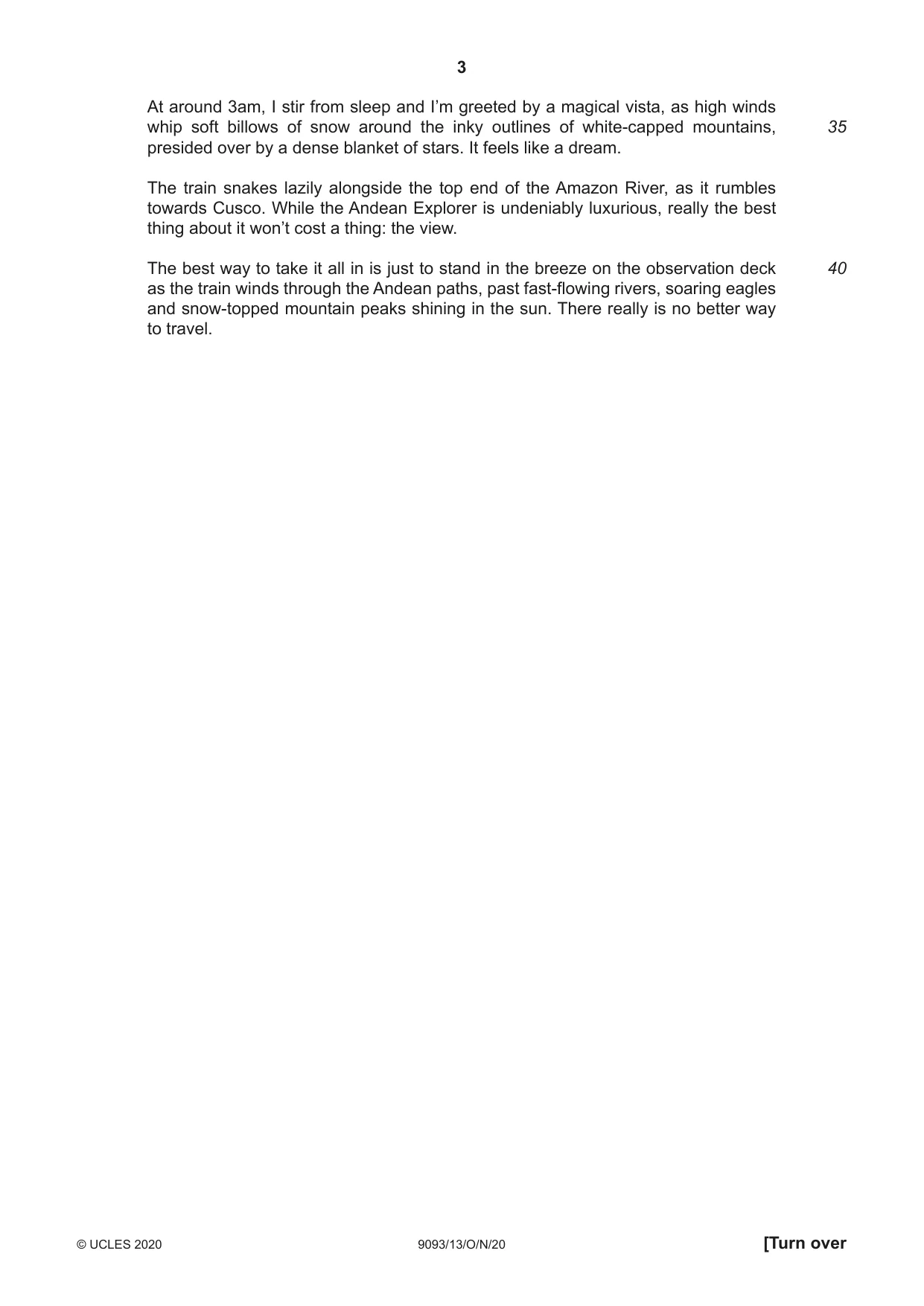
3 9093/13/O/N/20 © UCLES 2020 [Turn over At around 3am, I stir from sleep and I’m greeted by a magical vista, as high winds whip soft billows of snow around the inky outlines of white-capped mountains, presided over by a dense blanket of stars. It feels like a dream. The train snakes lazily alongside the top end of the Amazon River, as it rumbles towards Cusco. While the Andean Explorer is undeniably luxurious, really the best thing about it won’t cost a thing: the view. The best way to take it all in is just to stand in the breeze on the observation deck as the train winds through the Andean paths, past fast-flowing rivers, soaring eagles and snow-topped mountain peaks shining in the sun. There really is no better way to travel. 35 40
Question paper, page 4
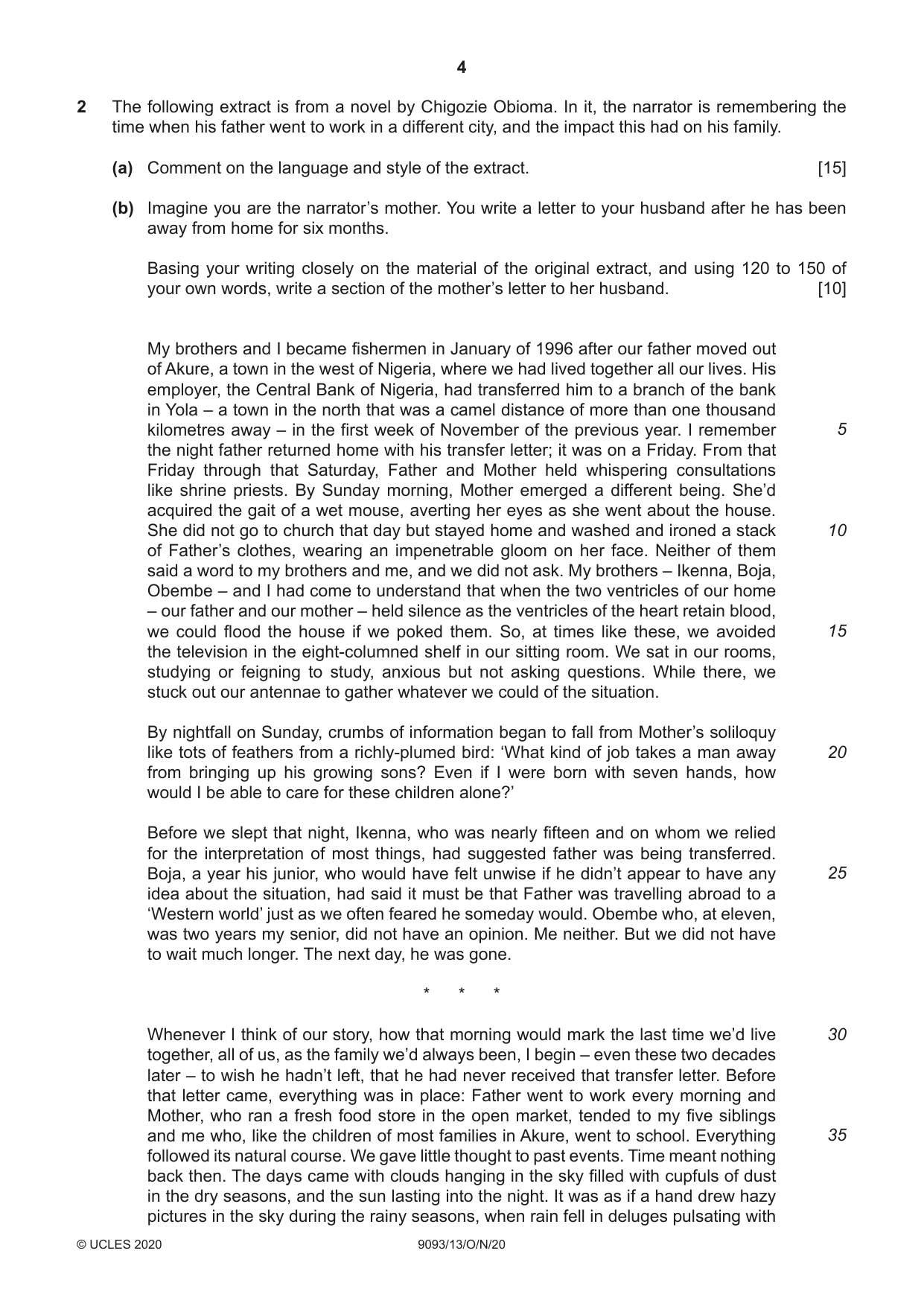
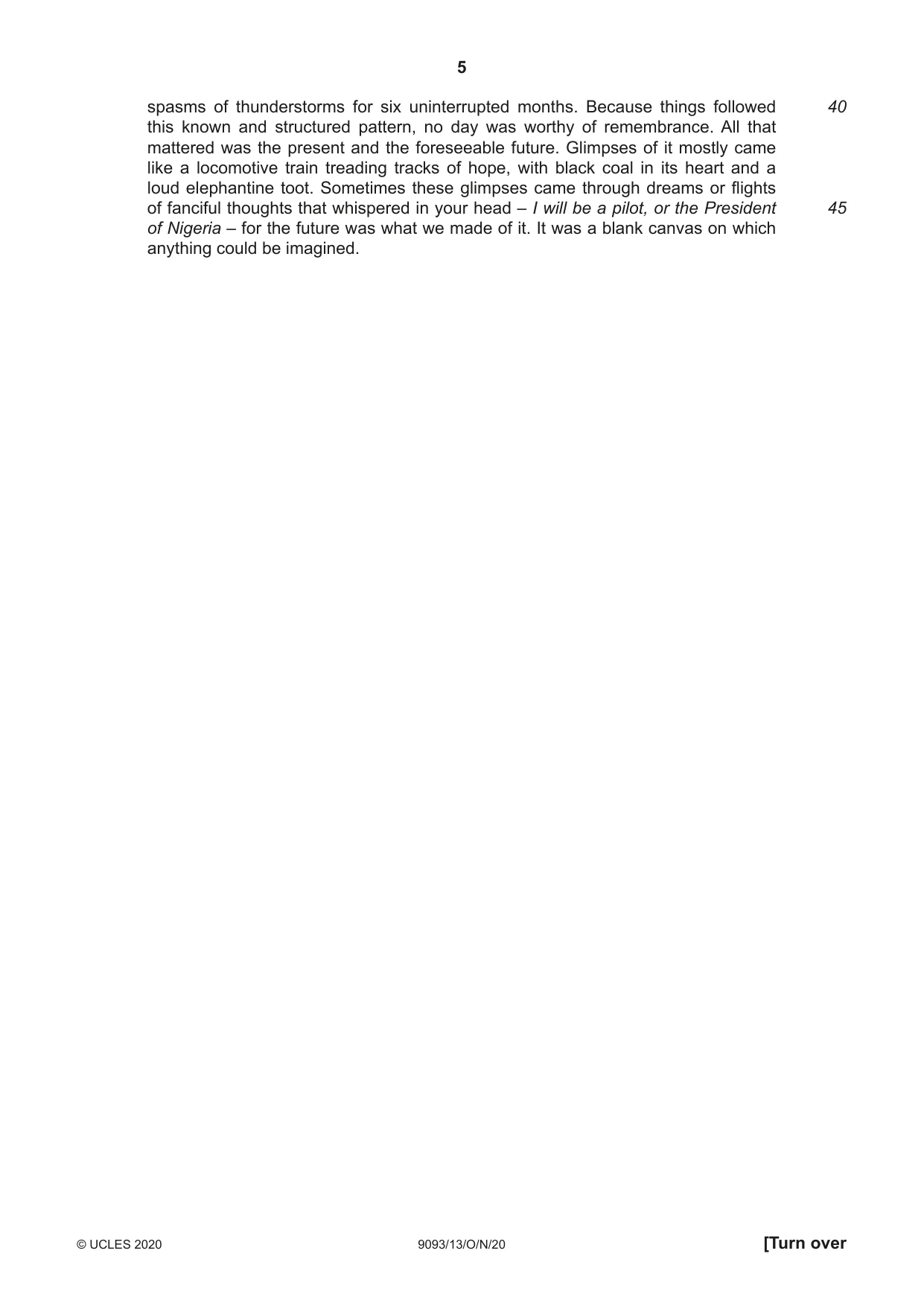
4 9093/13/O/N/20 © UCLES 2020 2 The following extract is from a novel by Chigozie Obioma. In it, the narrator is remembering the time when his father went to work in a different city, and the impact this had on his family. (a) Comment on the language and style of the extract. [15] (b) Imagine you are the narrator’s mother. You write a letter to your husband after he has been away from home for six months. Basing your writing closely on the material of the original extract, and using 120 to 150 of your own words, write a section of the mother’s letter to her husband. [10] My brothers and I became fishermen in January of 1996 after our father moved out of Akure, a town in the west of Nigeria, where we had lived together all our lives. His employer, the Central Bank of Nigeria, had transferred him to a branch of the bank in Yola – a town in the north that was a camel distance of more than one thousand kilometres away – in the first week of November of the previous year. I remember the night father returned home with his transfer letter; it was on a Friday. From that Friday through that Saturday, Father and Mother held whispering consultations like shrine priests. By Sunday morning, Mother emerged a different being. She’d acquired the gait of a wet mouse, averting her eyes as she went about the house. She did not go to church that day but stayed home and washed and ironed a stack of Father’s clothes, wearing an impenetrable gloom on her face. Neither of them said a word to my brothers and me, and we did not ask. My brothers – Ikenna, Boja, Obembe – and I had come to understand that when the two ventricles of our home – our father and our mother – held silence as the ventricles of the heart retain blood, we could flood the house if we poked them. So, at times like these, we avoided the television in the eight-columned shelf in our sitting room. We sat in our rooms, studying or feigning to study, anxious but not asking questions. While there, we stuck out our antennae to gather whatever we could of the situation. By nightfall on Sunday, crumbs of information began to fall from Mother’s soliloquy like tots of feathers from a richly-plumed bird: ‘What kind of job takes a man away from bringing up his growing sons? Even if I were born with seven hands, how would I be able to care for these children alone?’ Before we slept that night, Ikenna, who was nearly fifteen and on whom we relied for the interpretation of most things, had suggested father was being transferred. Boja, a year his junior, who would have felt unwise if he didn’t appear to have any idea about the situation, had said it must be that Father was travelling abroad to a ‘Western world’ just as we often feared he someday would. Obembe who, at eleven, was two years my senior, did not have an opinion. Me neither. But we did not have to wait much longer. The next day, he was gone. * * * Whenever I think of our story, how that morning would mark the last time we’d live together, all of us, as the family we’d always been, I begin – even these two decades later – to wish he hadn’t left, that he had never received that transfer letter. Before that letter came, everything was in place: Father went to work every morning and Mother, who ran a fresh food store in the open market, tended to my five siblings and me who, like the children of most families in Akure, went to school. Everything followed its natural course. We gave little thought to past events. Time meant nothing back then. The days came with clouds hanging in the sky filled with cupfuls of dust in the dry seasons, and the sun lasting into the night. It was as if a hand drew hazy pictures in the sky during the rainy seasons, when rain fell in deluges pulsating with 5 10 15 20 25 30 35
Question paper, page 5
5 9093/13/O/N/20 © UCLES 2020 [Turn over spasms of thunderstorms for six uninterrupted months. Because things followed this known and structured pattern, no day was worthy of remembrance. All that mattered was the present and the foreseeable future. Glimpses of it mostly came like a locomotive train treading tracks of hope, with black coal in its heart and a loud elephantine toot. Sometimes these glimpses came through dreams or flights of fanciful thoughts that whispered in your head – I will be a pilot, or the President of Nigeria – for the future was what we made of it. It was a blank canvas on which anything could be imagined. 40 45
Question paper, page 6
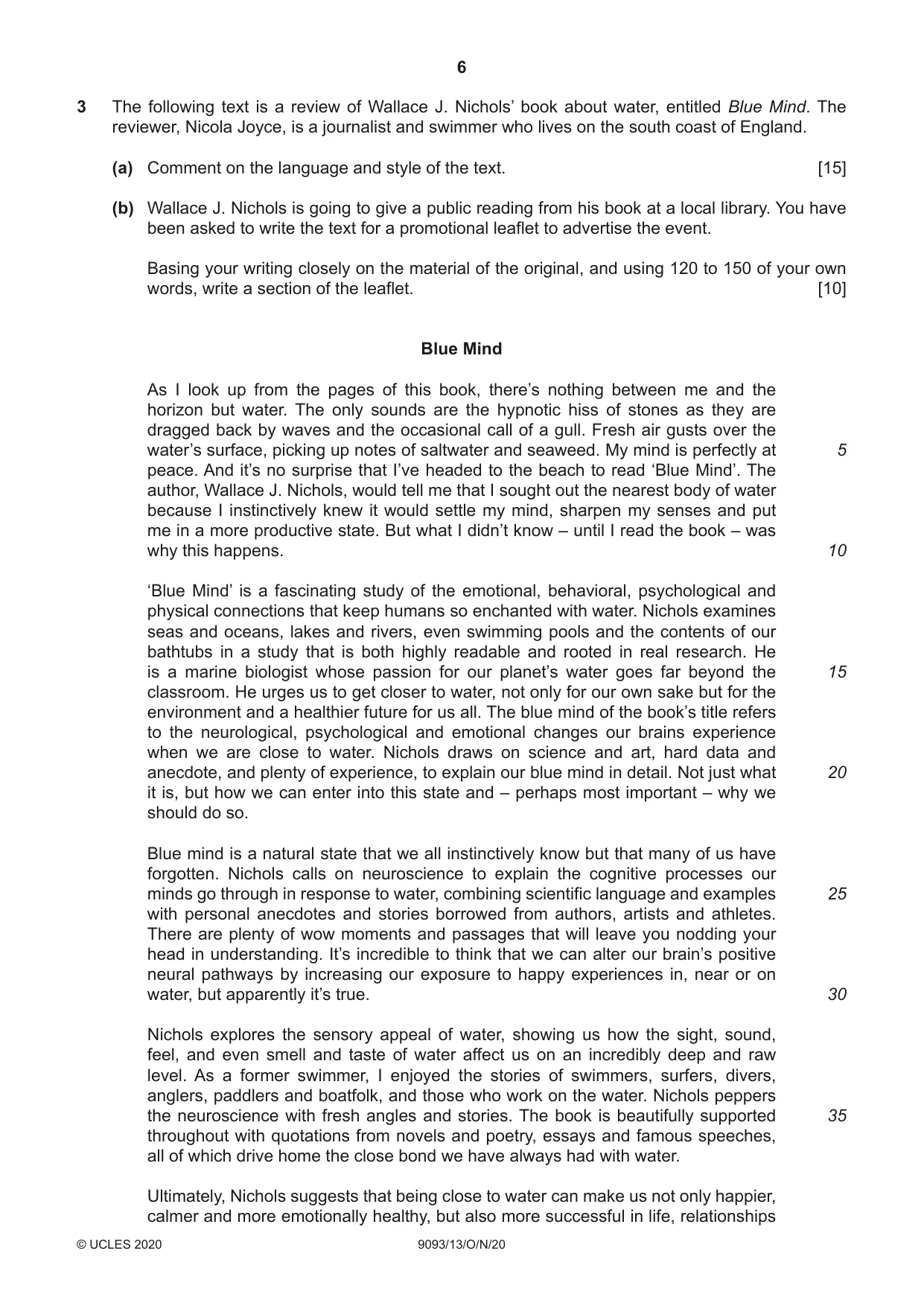
6 9093/13/O/N/20 © UCLES 2020 3 The following text is a review of Wallace J. Nichols’ book about water, entitled Blue Mind. The reviewer, Nicola Joyce, is a journalist and swimmer who lives on the south coast of England. (a) Comment on the language and style of the text. [15] (b) Wallace J. Nichols is going to give a public reading from his book at a local library. You have been asked to write the text for a promotional leaflet to advertise the event. Basing your writing closely on the material of the original, and using 120 to 150 of your own words, write a section of the leaflet. [10] Blue Mind As I look up from the pages of this book, there’s nothing between me and the horizon but water. The only sounds are the hypnotic hiss of stones as they are dragged back by waves and the occasional call of a gull. Fresh air gusts over the water’s surface, picking up notes of saltwater and seaweed. My mind is perfectly at peace. And it’s no surprise that I’ve headed to the beach to read ‘Blue Mind’. The author, Wallace J. Nichols, would tell me that I sought out the nearest body of water because I instinctively knew it would settle my mind, sharpen my senses and put me in a more productive state. But what I didn’t know – until I read the book – was why this happens. ‘Blue Mind’ is a fascinating study of the emotional, behavioral, psychological and physical connections that keep humans so enchanted with water. Nichols examines seas and oceans, lakes and rivers, even swimming pools and the contents of our bathtubs in a study that is both highly readable and rooted in real research. He is a marine biologist whose passion for our planet’s water goes far beyond the classroom. He urges us to get closer to water, not only for our own sake but for the environment and a healthier future for us all. The blue mind of the book’s title refers to the neurological, psychological and emotional changes our brains experience when we are close to water. Nichols draws on science and art, hard data and anecdote, and plenty of experience, to explain our blue mind in detail. Not just what it is, but how we can enter into this state and – perhaps most important – why we should do so. Blue mind is a natural state that we all instinctively know but that many of us have forgotten. Nichols calls on neuroscience to explain the cognitive processes our minds go through in response to water, combining scientific language and examples with personal anecdotes and stories borrowed from authors, artists and athletes. There are plenty of wow moments and passages that will leave you nodding your head in understanding. It’s incredible to think that we can alter our brain’s positive neural pathways by increasing our exposure to happy experiences in, near or on water, but apparently it’s true. Nichols explores the sensory appeal of water, showing us how the sight, sound, feel, and even smell and taste of water affect us on an incredibly deep and raw level. As a former swimmer, I enjoyed the stories of swimmers, surfers, divers, anglers, paddlers and boatfolk, and those who work on the water. Nichols peppers the neuroscience with fresh angles and stories. The book is beautifully supported throughout with quotations from novels and poetry, essays and famous speeches, all of which drive home the close bond we have always had with water. Ultimately, Nichols suggests that being close to water can make us not only happier, calmer and more emotionally healthy, but also more successful in life, relationships 5 10 15 20 25 30 35
Question paper, page 7
7 9093/13/O/N/20 © UCLES 2020 and even business. By tapping into an evolutionary urge that lies dormant in us all, we can access a powerful mental capacity for greatness. It’s something we all have the ability to do. This book shows us how to recognize it, stop ignoring it and tune in to it. If you grew up near water, if you eagerly look forward to vacations at the shore, if you swim, surf, sail, dive or snorkel, get a copy of this book. You’ll read it once and then come back to it time and again as you begin to realize how your love for water has always shaped your decisions, feelings, behavior, choices and lifestyle. As for me? I moved back to the coast two years ago when the landlocked life I knew suddenly fell apart and I found myself floating, anchorless and unmoored. The seaside of my childhood called me back, and I followed, not knowing why the decision felt so good. Now I know: I was honoring my blue mind. It all makes perfect sense. 40 45 50
Question paper, page 8
8 9093/13/O/N/20 © UCLES 2020 Permission to reproduce items where third-party owned material protected by copyright is included has been sought and cleared where possible. Every reasonable effort has been made by the publisher (UCLES) to trace copyright holders, but if any items requiring clearance have unwittingly been included, the publisher will be pleased to make amends at the earliest possible opportunity. To avoid the issue of disclosure of answer-related information to candidates, all copyright acknowledgements are reproduced online in the Cambridge Assessment International Education Copyright Acknowledgements Booklet. This is produced for each series of examinations and is freely available to download at www.cambridgeinternational.org after the live examination series. Cambridge Assessment International Education is part of the Cambridge Assessment Group. Cambridge Assessment is the brand name of the University of Cambridge Local Examinations Syndicate (UCLES), which itself is a department of the University of Cambridge. BLANK PAGE
Mark scheme, page 1
This document consists of 5 printed pages. © UCLES 2020 [Turn over Cambridge International AS & A Level ENGLISH LANGUAGE 9093/13 Paper 1 Passages October/November 2020 MARK SCHEME Maximum Mark: 50 Published This mark scheme is published as an aid to teachers and candidates, to indicate the requirements of the examination. It shows the basis on which Examiners were instructed to award marks. It does not indicate the details of the discussions that took place at an Examiners’ meeting before marking began, which would have considered the acceptability of alternative answers. Mark schemes should be read in conjunction with the question paper and the Principal Examiner Report for Teachers. Cambridge International will not enter into discussions about these mark schemes. Cambridge International is publishing the mark schemes for the October/November 2020 series for most Cambridge IGCSE™, Cambridge International A and AS Level and Cambridge Pre-U components, and some Cambridge O Level components.
Mark scheme, page 2
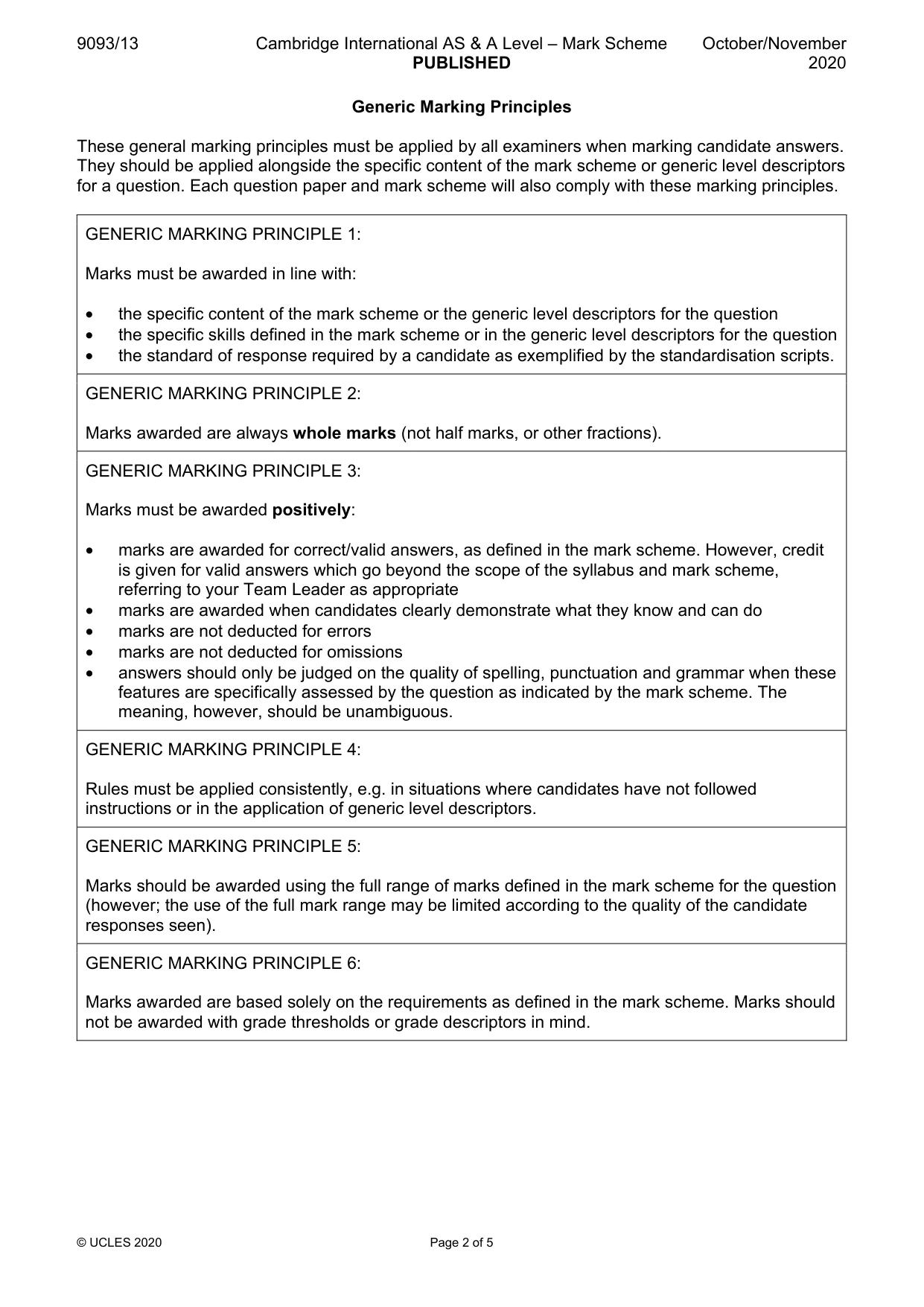
9093/13 Cambridge International AS & A Level – Mark Scheme PUBLISHED October/November 2020 © UCLES 2020 Page 2 of 5 Generic Marking Principles These general marking principles must be applied by all examiners when marking candidate answers. They should be applied alongside the specific content of the mark scheme or generic level descriptors for a question. Each question paper and mark scheme will also comply with these marking principles. GENERIC MARKING PRINCIPLE 1: Marks must be awarded in line with: • the specific content of the mark scheme or the generic level descriptors for the question • the specific skills defined in the mark scheme or in the generic level descriptors for the question • the standard of response required by a candidate as exemplified by the standardisation scripts. GENERIC MARKING PRINCIPLE 2: Marks awarded are always whole marks (not half marks, or other fractions). GENERIC MARKING PRINCIPLE 3: Marks must be awarded positively: • marks are awarded for correct/valid answers, as defined in the mark scheme. However, credit is given for valid answers which go beyond the scope of the syllabus and mark scheme, referring to your Team Leader as appropriate • marks are awarded when candidates clearly demonstrate what they know and can do • marks are not deducted for errors • marks are not deducted for omissions • answers should only be judged on the quality of spelling, punctuation and grammar when these features are specifically assessed by the question as indicated by the mark scheme. The meaning, however, should be unambiguous. GENERIC MARKING PRINCIPLE 4: Rules must be applied consistently, e.g. in situations where candidates have not followed instructions or in the application of generic level descriptors. GENERIC MARKING PRINCIPLE 5: Marks should be awarded using the full range of marks defined in the mark scheme for the question (however; the use of the full mark range may be limited according to the quality of the candidate responses seen). GENERIC MARKING PRINCIPLE 6: Marks awarded are based solely on the requirements as defined in the mark scheme. Marks should not be awarded with grade thresholds or grade descriptors in mind.
Mark scheme, page 3
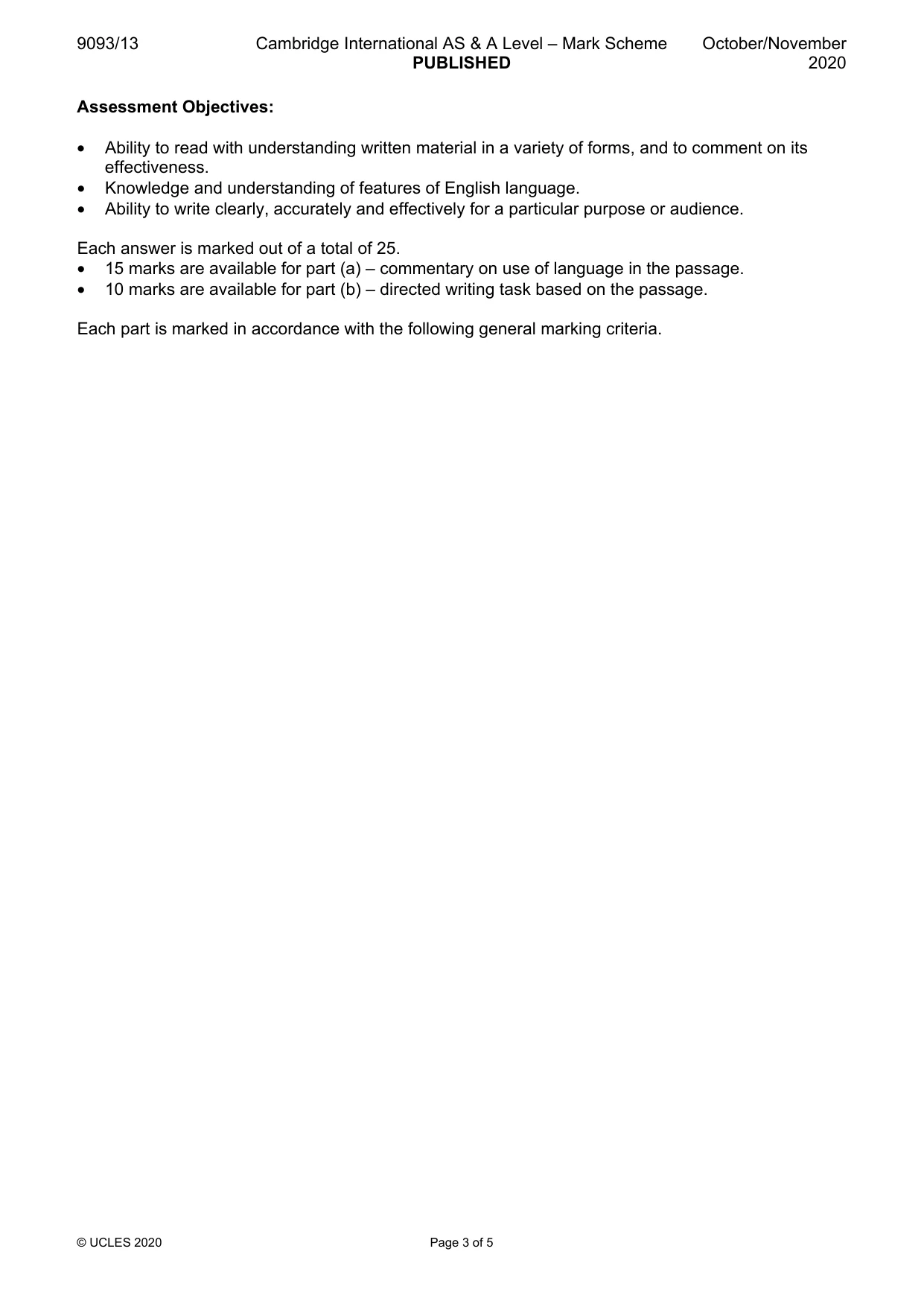
9093/13 Cambridge International AS & A Level – Mark Scheme PUBLISHED October/November 2020 © UCLES 2020 Page 3 of 5 Assessment Objectives: • Ability to read with understanding written material in a variety of forms, and to comment on its effectiveness. • Knowledge and understanding of features of English language. • Ability to write clearly, accurately and effectively for a particular purpose or audience. Each answer is marked out of a total of 25. • 15 marks are available for part (a) – commentary on use of language in the passage. • 10 marks are available for part (b) – directed writing task based on the passage. Each part is marked in accordance with the following general marking criteria.
Mark scheme, page 4
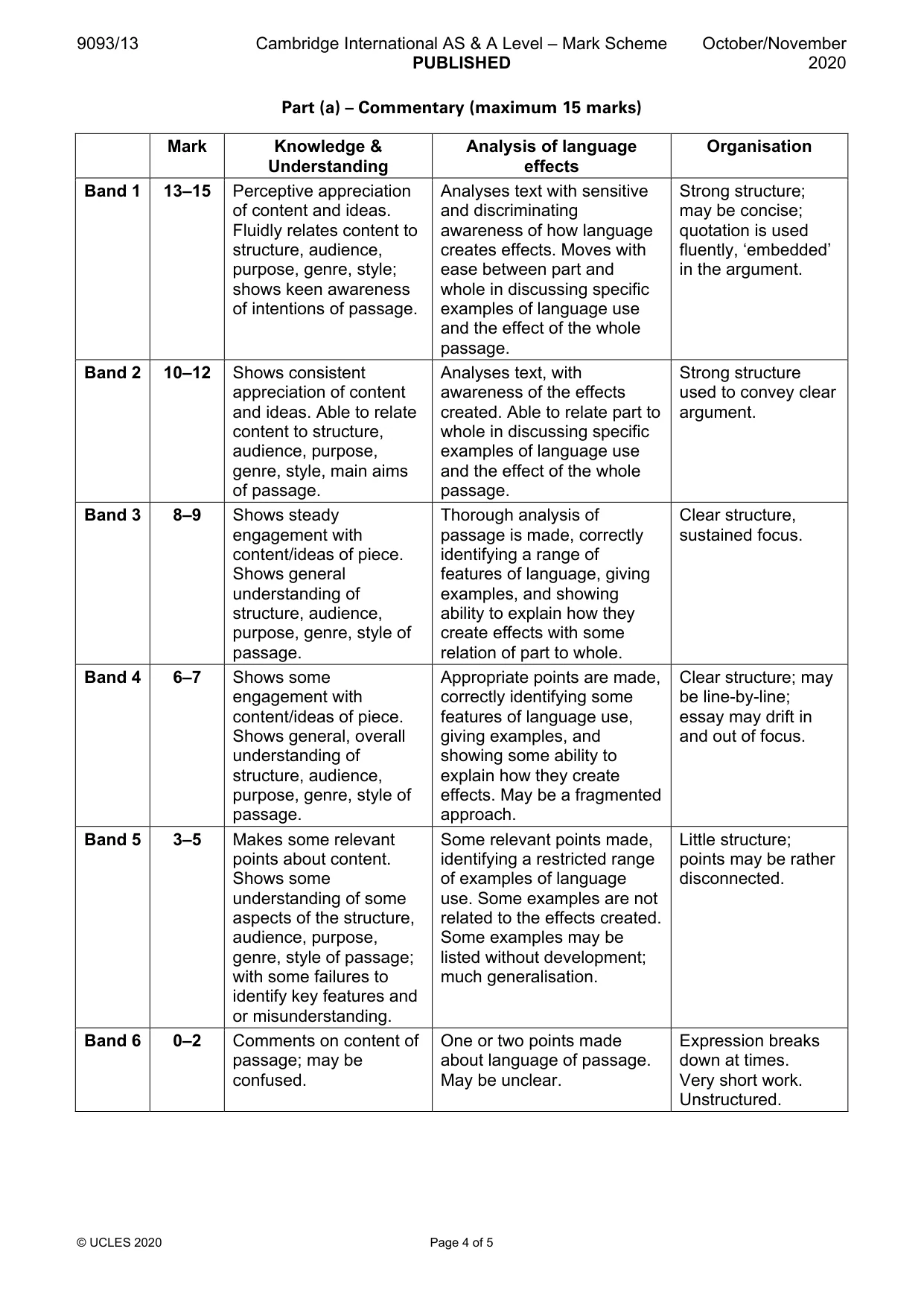
9093/13 Cambridge International AS & A Level – Mark Scheme PUBLISHED October/November 2020 © UCLES 2020 Page 4 of 5 Part (a) – Commentary (maximum 15 marks) Mark Knowledge & Understanding Analysis of language effects Organisation Band 1 13–15 Perceptive appreciation of content and ideas. Fluidly relates content to structure, audience, purpose, genre, style; shows keen awareness of intentions of passage. Analyses text with sensitive and discriminating awareness of how language creates effects. Moves with ease between part and whole in discussing specific examples of language use and the effect of the whole passage. Strong structure; may be concise; quotation is used fluently, ‘embedded’ in the argument. Band 2 10–12 Shows consistent appreciation of content and ideas. Able to relate content to structure, audience, purpose, genre, style, main aims of passage. Analyses text, with awareness of the effects created. Able to relate part to whole in discussing specific examples of language use and the effect of the whole passage. Strong structure used to convey clear argument. Band 3 8–9 Shows steady engagement with content/ideas of piece. Shows general understanding of structure, audience, purpose, genre, style of passage. Thorough analysis of passage is made, correctly identifying a range of features of language, giving examples, and showing ability to explain how they create effects with some relation of part to whole. Clear structure, sustained focus. Band 4 6–7 Shows some engagement with content/ideas of piece. Shows general, overall understanding of structure, audience, purpose, genre, style of passage. Appropriate points are made, correctly identifying some features of language use, giving examples, and showing some ability to explain how they create effects. May be a fragmented approach. Clear structure; may be line-by-line; essay may drift in and out of focus. Band 5 3–5 Makes some relevant points about content. Shows some understanding of some aspects of the structure, audience, purpose, genre, style of passage; with some failures to identify key features and or misunderstanding. Some relevant points made, identifying a restricted range of examples of language use. Some examples are not related to the effects created. Some examples may be listed without development; much generalisation. Little structure; points may be rather disconnected. Band 6 0–2 Comments on content of passage; may be confused. One or two points made about language of passage. May be unclear. Expression breaks down at times. Very short work. Unstructured.
Mark scheme, page 5
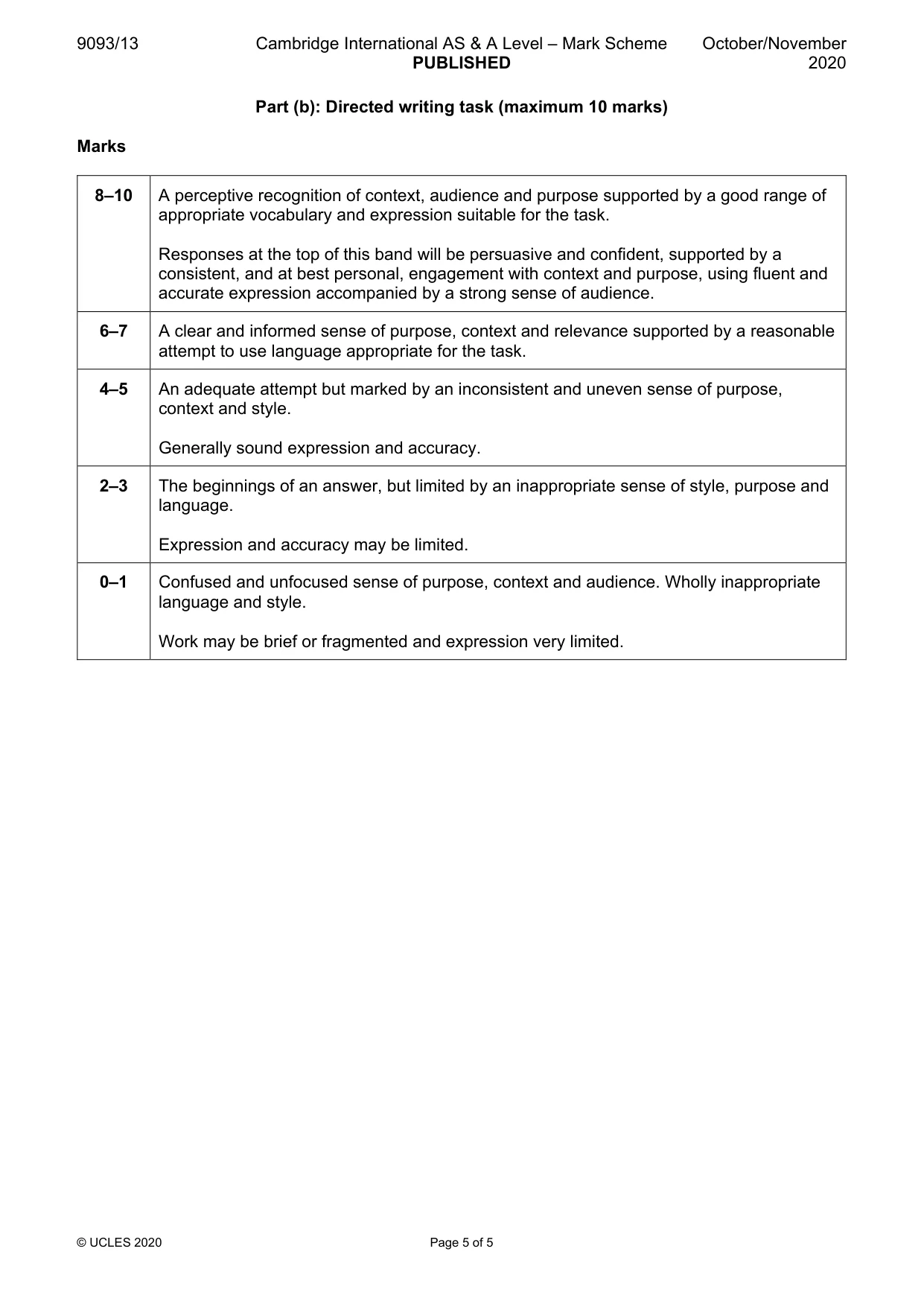
9093/13 Cambridge International AS & A Level – Mark Scheme PUBLISHED October/November 2020 © UCLES 2020 Page 5 of 5 Part (b): Directed writing task (maximum 10 marks) Marks 8–10 A perceptive recognition of context, audience and purpose supported by a good range of appropriate vocabulary and expression suitable for the task. Responses at the top of this band will be persuasive and confident, supported by a consistent, and at best personal, engagement with context and purpose, using fluent and accurate expression accompanied by a strong sense of audience. 6–7 A clear and informed sense of purpose, context and relevance supported by a reasonable attempt to use language appropriate for the task. 4–5 An adequate attempt but marked by an inconsistent and uneven sense of purpose, context and style. Generally sound expression and accuracy. 2–3 The beginnings of an answer, but limited by an inappropriate sense of style, purpose and language. Expression and accuracy may be limited. 0–1 Confused and unfocused sense of purpose, context and audience. Wholly inappropriate language and style. Work may be brief or fragmented and expression very limited.
What you needed in this session
Cambridge’s own grade thresholds for 2020 Oct/Nov, Paper 1 · Variant 3. A higher threshold means an easier paper — the bar moves with how the cohort did.