Cambridge A Level English - Language AS and A Level (from 2014) 9093 — 2020 Oct/Nov Paper 1 · Variant 2
9093/12/O/N/20 · 50 marks · ≈56 min
The question paper and its mark scheme, free to read here and free to download. This is Cambridge’s own paper, exactly as it was sat.
Question paper8 pages

Mark scheme5 pages
Answers below. Sit the paper first if you are practising.
Paper as text
Question paper, page 1
Cambridge International AS & A Level * 1 9 8 8 2 1 7 7 8 2 * This document has 8 pages. Blank pages are indicated. DC (PQ) 186784/1 © UCLES 2020 [Turn over ENGLISH LANGUAGE 9093/12 Paper 1 Passages October/November 2020 2 hours 15 minutes You must answer on the enclosed answer booklet. You will need: Answer booklet (enclosed) INSTRUCTIONS ● Answer two questions in total: Answer Question 1. Answer either Question 2 or Question 3. ● Follow the instructions on the front cover of the answer booklet. If you need additional answer paper, ask the invigilator for a continuation booklet. ● You are reminded of the need for good English and clear presentation in your answers. INFORMATION ● The total mark for this paper is 50. ● The number of marks for each question or part question is shown in brackets [ ].
Question paper, page 2
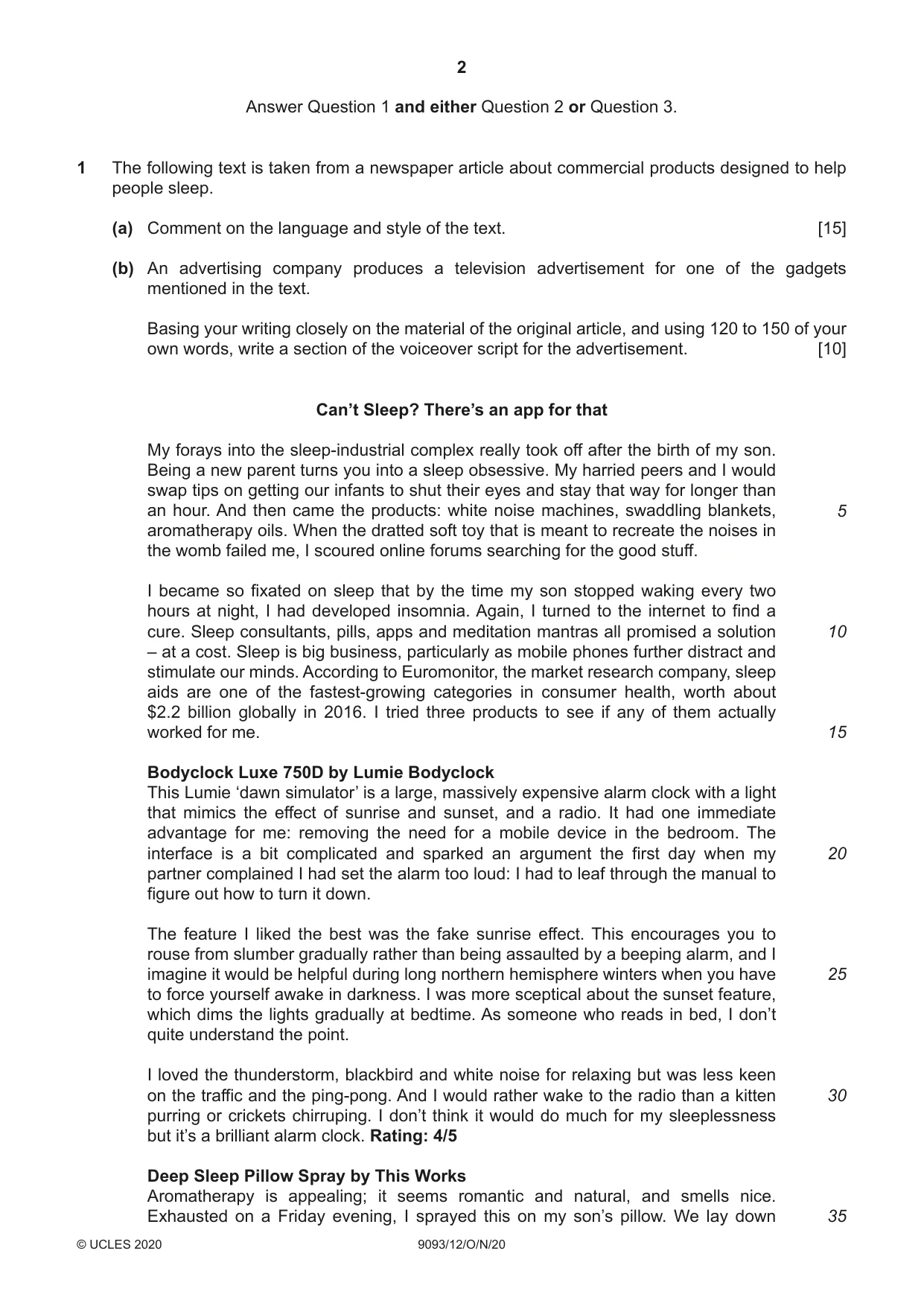
2 9093/12/O/N/20 © UCLES 2020 Answer Question 1 and either Question 2 or Question 3. 1 The following text is taken from a newspaper article about commercial products designed to help people sleep. (a) Comment on the language and style of the text. [15] (b) An advertising company produces a television advertisement for one of the gadgets mentioned in the text. Basing your writing closely on the material of the original article, and using 120 to 150 of your own words, write a section of the voiceover script for the advertisement. [10] Can’t Sleep? There’s an app for that My forays into the sleep-industrial complex really took off after the birth of my son. Being a new parent turns you into a sleep obsessive. My harried peers and I would swap tips on getting our infants to shut their eyes and stay that way for longer than an hour. And then came the products: white noise machines, swaddling blankets, aromatherapy oils. When the dratted soft toy that is meant to recreate the noises in the womb failed me, I scoured online forums searching for the good stuff. I became so fixated on sleep that by the time my son stopped waking every two hours at night, I had developed insomnia. Again, I turned to the internet to find a cure. Sleep consultants, pills, apps and meditation mantras all promised a solution – at a cost. Sleep is big business, particularly as mobile phones further distract and stimulate our minds. According to Euromonitor, the market research company, sleep aids are one of the fastest-growing categories in consumer health, worth about $2.2 billion globally in 2016. I tried three products to see if any of them actually worked for me. Bodyclock Luxe 750D by Lumie Bodyclock This Lumie ‘dawn simulator’ is a large, massively expensive alarm clock with a light that mimics the effect of sunrise and sunset, and a radio. It had one immediate advantage for me: removing the need for a mobile device in the bedroom. The interface is a bit complicated and sparked an argument the first day when my partner complained I had set the alarm too loud: I had to leaf through the manual to figure out how to turn it down. The feature I liked the best was the fake sunrise effect. This encourages you to rouse from slumber gradually rather than being assaulted by a beeping alarm, and I imagine it would be helpful during long northern hemisphere winters when you have to force yourself awake in darkness. I was more sceptical about the sunset feature, which dims the lights gradually at bedtime. As someone who reads in bed, I don’t quite understand the point. I loved the thunderstorm, blackbird and white noise for relaxing but was less keen on the traffic and the ping-pong. And I would rather wake to the radio than a kitten purring or crickets chirruping. I don’t think it would do much for my sleeplessness but it’s a brilliant alarm clock. Rating: 4/5 Deep Sleep Pillow Spray by This Works Aromatherapy is appealing; it seems romantic and natural, and smells nice. Exhausted on a Friday evening, I sprayed this on my son’s pillow. We lay down 5 10 15 20 25 30 35
Question paper, page 3
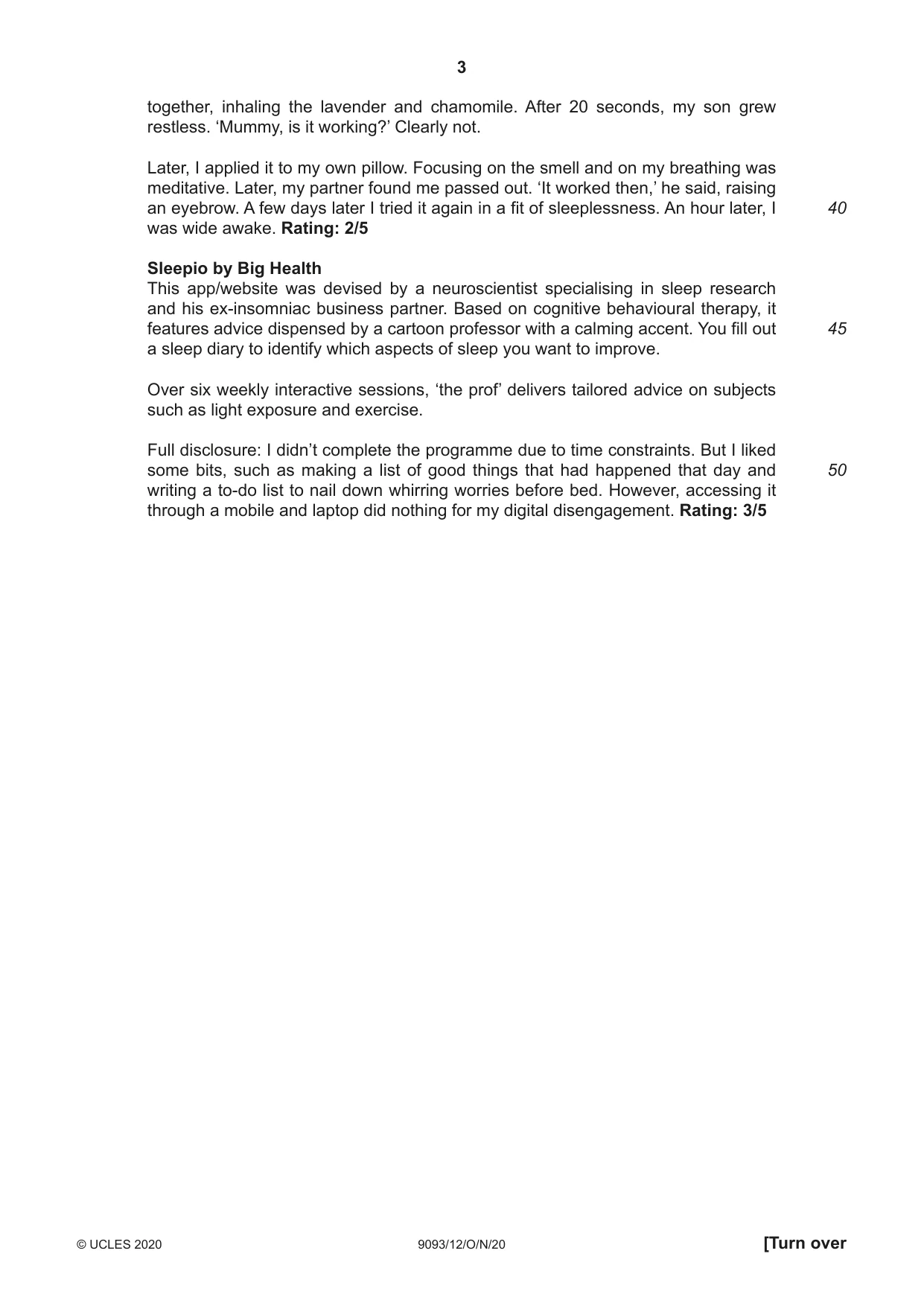
3 9093/12/O/N/20 © UCLES 2020 [Turn over together, inhaling the lavender and chamomile. After 20 seconds, my son grew restless. ‘Mummy, is it working?’ Clearly not. Later, I applied it to my own pillow. Focusing on the smell and on my breathing was meditative. Later, my partner found me passed out. ‘It worked then,’ he said, raising an eyebrow. A few days later I tried it again in a fit of sleeplessness. An hour later, I was wide awake. Rating: 2/5 Sleepio by Big Health This app/website was devised by a neuroscientist specialising in sleep research and his ex-insomniac business partner. Based on cognitive behavioural therapy, it features advice dispensed by a cartoon professor with a calming accent. You fill out a sleep diary to identify which aspects of sleep you want to improve. Over six weekly interactive sessions, ‘the prof’ delivers tailored advice on subjects such as light exposure and exercise. Full disclosure: I didn’t complete the programme due to time constraints. But I liked some bits, such as making a list of good things that had happened that day and writing a to-do list to nail down whirring worries before bed. However, accessing it through a mobile and laptop did nothing for my digital disengagement. Rating: 3/5 40 45 50
Question paper, page 4
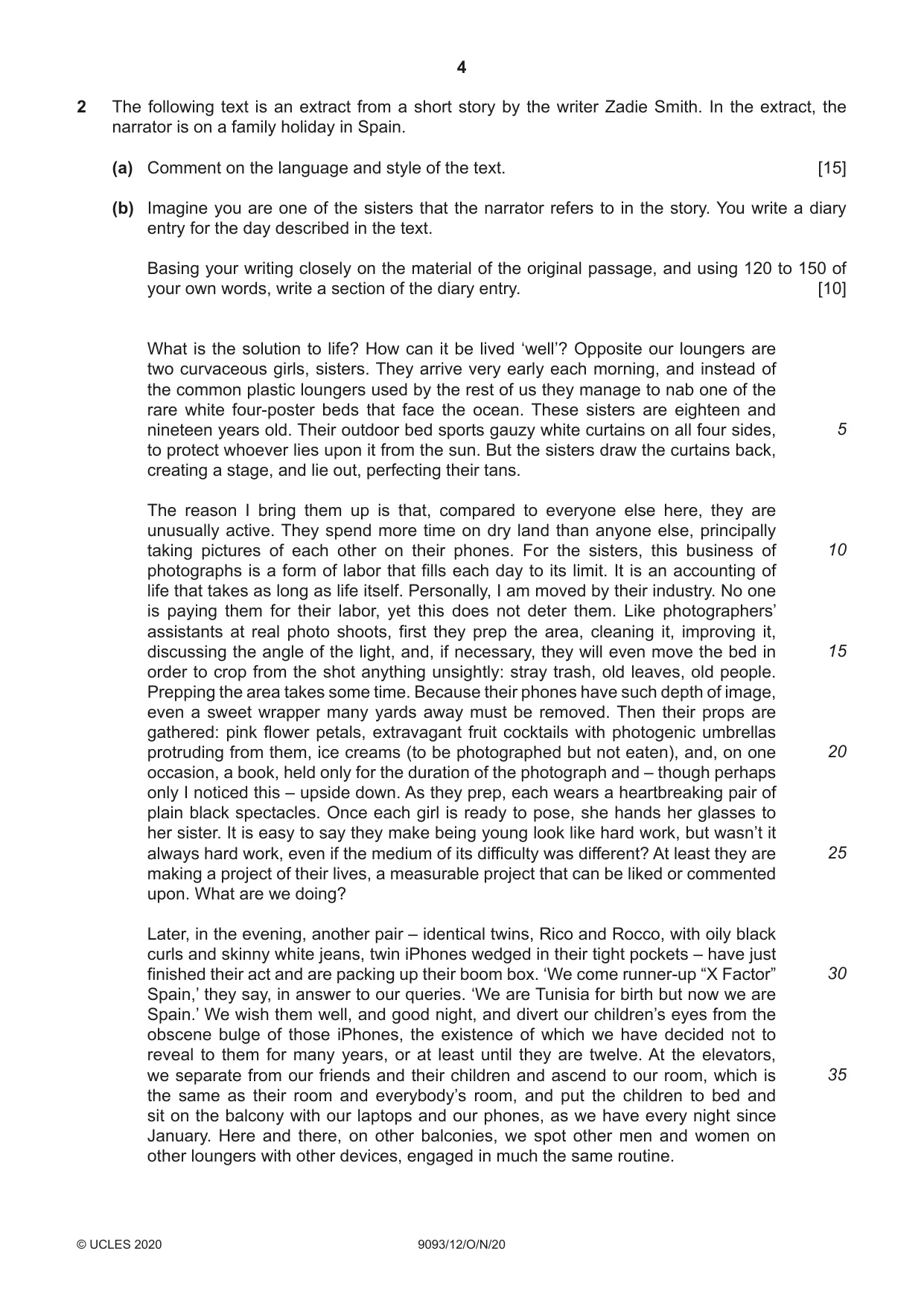
4 9093/12/O/N/20 © UCLES 2020 2 The following text is an extract from a short story by the writer Zadie Smith. In the extract, the narrator is on a family holiday in Spain. (a) Comment on the language and style of the text. [15] (b) Imagine you are one of the sisters that the narrator refers to in the story. You write a diary entry for the day described in the text. Basing your writing closely on the material of the original passage, and using 120 to 150 of your own words, write a section of the diary entry. [10] What is the solution to life? How can it be lived ‘well’? Opposite our loungers are two curvaceous girls, sisters. They arrive very early each morning, and instead of the common plastic loungers used by the rest of us they manage to nab one of the rare white four-poster beds that face the ocean. These sisters are eighteen and nineteen years old. Their outdoor bed sports gauzy white curtains on all four sides, to protect whoever lies upon it from the sun. But the sisters draw the curtains back, creating a stage, and lie out, perfecting their tans. The reason I bring them up is that, compared to everyone else here, they are unusually active. They spend more time on dry land than anyone else, principally taking pictures of each other on their phones. For the sisters, this business of photographs is a form of labor that fills each day to its limit. It is an accounting of life that takes as long as life itself. Personally, I am moved by their industry. No one is paying them for their labor, yet this does not deter them. Like photographers’ assistants at real photo shoots, first they prep the area, cleaning it, improving it, discussing the angle of the light, and, if necessary, they will even move the bed in order to crop from the shot anything unsightly: stray trash, old leaves, old people. Prepping the area takes some time. Because their phones have such depth of image, even a sweet wrapper many yards away must be removed. Then their props are gathered: pink flower petals, extravagant fruit cocktails with photogenic umbrellas protruding from them, ice creams (to be photographed but not eaten), and, on one occasion, a book, held only for the duration of the photograph and – though perhaps only I noticed this – upside down. As they prep, each wears a heartbreaking pair of plain black spectacles. Once each girl is ready to pose, she hands her glasses to her sister. It is easy to say they make being young look like hard work, but wasn’t it always hard work, even if the medium of its difficulty was different? At least they are making a project of their lives, a measurable project that can be liked or commented upon. What are we doing? Later, in the evening, another pair – identical twins, Rico and Rocco, with oily black curls and skinny white jeans, twin iPhones wedged in their tight pockets – have just finished their act and are packing up their boom box. ‘We come runner-up “X Factor” Spain,’ they say, in answer to our queries. ‘We are Tunisia for birth but now we are Spain.’ We wish them well, and good night, and divert our children’s eyes from the obscene bulge of those iPhones, the existence of which we have decided not to reveal to them for many years, or at least until they are twelve. At the elevators, we separate from our friends and their children and ascend to our room, which is the same as their room and everybody’s room, and put the children to bed and sit on the balcony with our laptops and our phones, as we have every night since January. Here and there, on other balconies, we spot other men and women on other loungers with other devices, engaged in much the same routine. 5 10 15 20 25 30 35
Question paper, page 5
5 9093/12/O/N/20 © UCLES 2020 [Turn over BLANK PAGE
Question paper, page 6
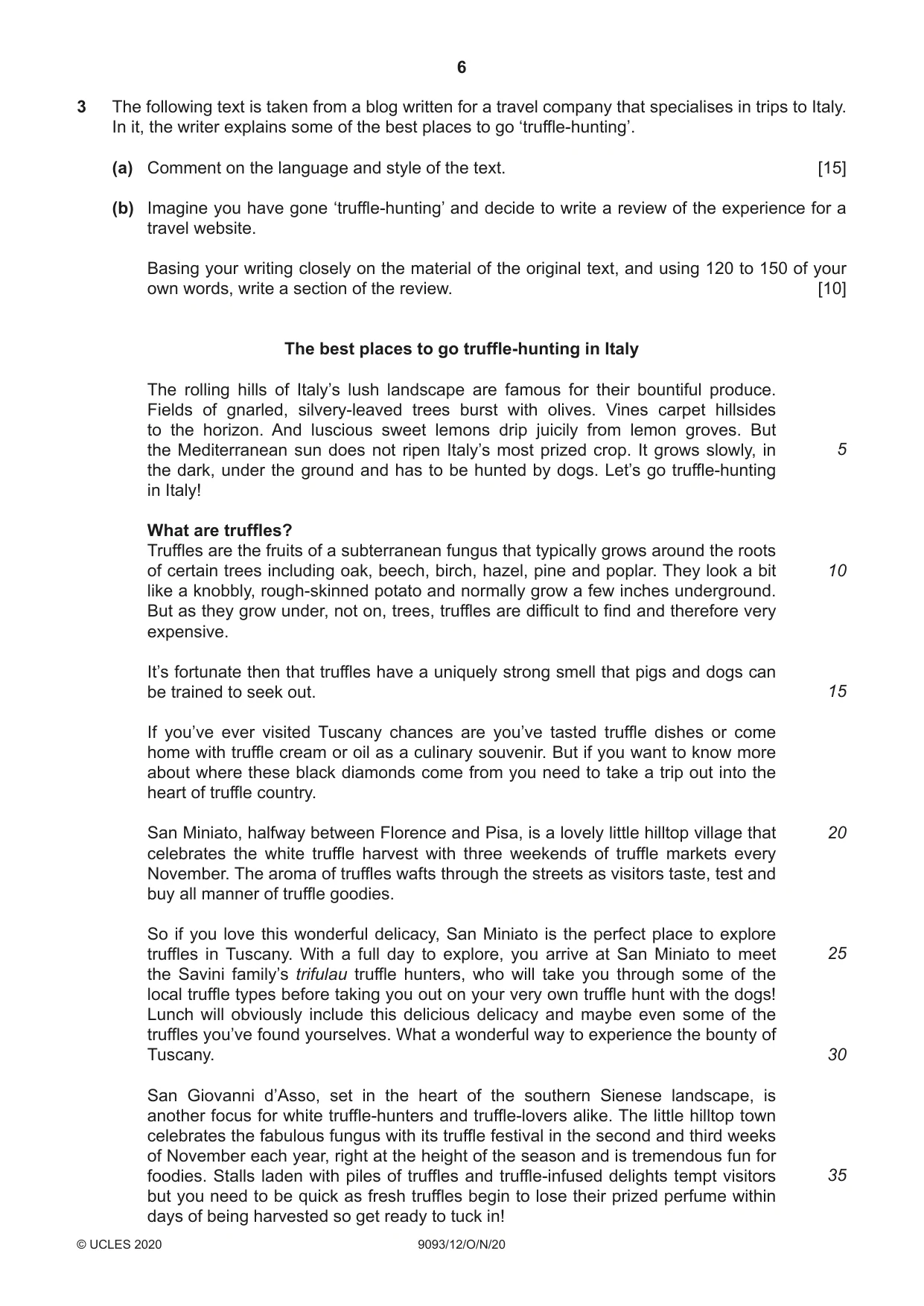
6 9093/12/O/N/20 © UCLES 2020 3 The following text is taken from a blog written for a travel company that specialises in trips to Italy. In it, the writer explains some of the best places to go ‘truffle-hunting’. (a) Comment on the language and style of the text. [15] (b) Imagine you have gone ‘truffle-hunting’ and decide to write a review of the experience for a travel website. Basing your writing closely on the material of the original text, and using 120 to 150 of your own words, write a section of the review. [10] The best places to go truffle-hunting in Italy The rolling hills of Italy’s lush landscape are famous for their bountiful produce. Fields of gnarled, silvery-leaved trees burst with olives. Vines carpet hillsides to the horizon. And luscious sweet lemons drip juicily from lemon groves. But the Mediterranean sun does not ripen Italy’s most prized crop. It grows slowly, in the dark, under the ground and has to be hunted by dogs. Let’s go truffle-hunting in Italy! What are truffles? Truffles are the fruits of a subterranean fungus that typically grows around the roots of certain trees including oak, beech, birch, hazel, pine and poplar. They look a bit like a knobbly, rough-skinned potato and normally grow a few inches underground. But as they grow under, not on, trees, truffles are difficult to find and therefore very expensive. It’s fortunate then that truffles have a uniquely strong smell that pigs and dogs can be trained to seek out. If you’ve ever visited Tuscany chances are you’ve tasted truffle dishes or come home with truffle cream or oil as a culinary souvenir. But if you want to know more about where these black diamonds come from you need to take a trip out into the heart of truffle country. San Miniato, halfway between Florence and Pisa, is a lovely little hilltop village that celebrates the white truffle harvest with three weekends of truffle markets every November. The aroma of truffles wafts through the streets as visitors taste, test and buy all manner of truffle goodies. So if you love this wonderful delicacy, San Miniato is the perfect place to explore truffles in Tuscany. With a full day to explore, you arrive at San Miniato to meet the Savini family’s trifulau truffle hunters, who will take you through some of the local truffle types before taking you out on your very own truffle hunt with the dogs! Lunch will obviously include this delicious delicacy and maybe even some of the truffles you’ve found yourselves. What a wonderful way to experience the bounty of Tuscany. San Giovanni d’Asso, set in the heart of the southern Sienese landscape, is another focus for white truffle-hunters and truffle-lovers alike. The little hilltop town celebrates the fabulous fungus with its truffle festival in the second and third weeks of November each year, right at the height of the season and is tremendous fun for foodies. Stalls laden with piles of truffles and truffle-infused delights tempt visitors but you need to be quick as fresh truffles begin to lose their prized perfume within days of being harvested so get ready to tuck in! 5 10 15 20 25 30 35
Question paper, page 7
7 9093/12/O/N/20 © UCLES 2020 Ultimately Italian truffles are some of the most prized and treasured in the world. Their scarcity, cultivation difficulties and short, localized seasons make them a culinary luxury. And their unique earthy flavor enriches dishes from pasta to cheeses to salami. It’s a delicacy for which gourmets and gastronomes will pay handsomely. So scouring the misty, autumnal countryside of Tuscany to go truffle hunting in Italy is an experience that will stay with you for a lifetime. Our travel experts are on standby to help you find these buried treasures and in the meantime make sure you leave us a comment with your favorite truffle recipes to whet our appetites! Buon apetito! 40 45
Question paper, page 8
8 9093/12/O/N/20 © UCLES 2020 Permission to reproduce items where third-party owned material protected by copyright is included has been sought and cleared where possible. Every reasonable effort has been made by the publisher (UCLES) to trace copyright holders, but if any items requiring clearance have unwittingly been included, the publisher will be pleased to make amends at the earliest possible opportunity. To avoid the issue of disclosure of answer-related information to candidates, all copyright acknowledgements are reproduced online in the Cambridge Assessment International Education Copyright Acknowledgements Booklet. This is produced for each series of examinations and is freely available to download at www.cambridgeinternational.org after the live examination series. Cambridge Assessment International Education is part of the Cambridge Assessment Group. Cambridge Assessment is the brand name of the University of Cambridge Local Examinations Syndicate (UCLES), which itself is a department of the University of Cambridge. BLANK PAGE
Mark scheme, page 1
This document consists of 5 printed pages. © UCLES 2020 [Turn over Cambridge International AS & A Level ENGLISH LANGUAGE 9093/12 Paper 1 Passages October/November 2020 MARK SCHEME Maximum Mark: 50 Published This mark scheme is published as an aid to teachers and candidates, to indicate the requirements of the examination. It shows the basis on which Examiners were instructed to award marks. It does not indicate the details of the discussions that took place at an Examiners’ meeting before marking began, which would have considered the acceptability of alternative answers. Mark schemes should be read in conjunction with the question paper and the Principal Examiner Report for Teachers. Cambridge International will not enter into discussions about these mark schemes. Cambridge International is publishing the mark schemes for the October/November 2020 series for most Cambridge IGCSE™, Cambridge International A and AS Level and Cambridge Pre-U components, and some Cambridge O Level components.
Mark scheme, page 2
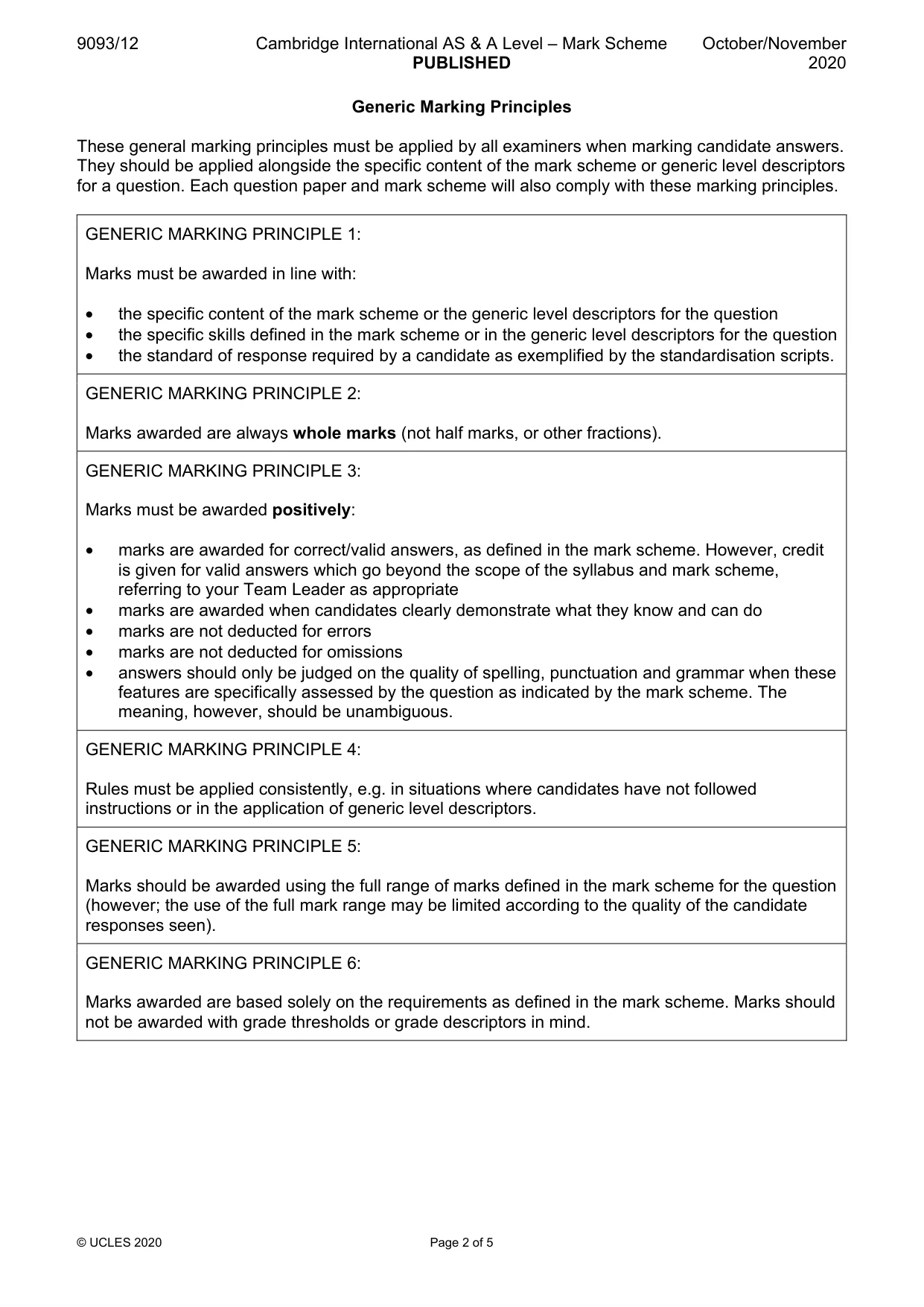
9093/12 Cambridge International AS & A Level – Mark Scheme PUBLISHED October/November 2020 © UCLES 2020 Page 2 of 5 Generic Marking Principles These general marking principles must be applied by all examiners when marking candidate answers. They should be applied alongside the specific content of the mark scheme or generic level descriptors for a question. Each question paper and mark scheme will also comply with these marking principles. GENERIC MARKING PRINCIPLE 1: Marks must be awarded in line with: • the specific content of the mark scheme or the generic level descriptors for the question • the specific skills defined in the mark scheme or in the generic level descriptors for the question • the standard of response required by a candidate as exemplified by the standardisation scripts. GENERIC MARKING PRINCIPLE 2: Marks awarded are always whole marks (not half marks, or other fractions). GENERIC MARKING PRINCIPLE 3: Marks must be awarded positively: • marks are awarded for correct/valid answers, as defined in the mark scheme. However, credit is given for valid answers which go beyond the scope of the syllabus and mark scheme, referring to your Team Leader as appropriate • marks are awarded when candidates clearly demonstrate what they know and can do • marks are not deducted for errors • marks are not deducted for omissions • answers should only be judged on the quality of spelling, punctuation and grammar when these features are specifically assessed by the question as indicated by the mark scheme. The meaning, however, should be unambiguous. GENERIC MARKING PRINCIPLE 4: Rules must be applied consistently, e.g. in situations where candidates have not followed instructions or in the application of generic level descriptors. GENERIC MARKING PRINCIPLE 5: Marks should be awarded using the full range of marks defined in the mark scheme for the question (however; the use of the full mark range may be limited according to the quality of the candidate responses seen). GENERIC MARKING PRINCIPLE 6: Marks awarded are based solely on the requirements as defined in the mark scheme. Marks should not be awarded with grade thresholds or grade descriptors in mind.
Mark scheme, page 3
9093/12 Cambridge International AS & A Level – Mark Scheme PUBLISHED October/November 2020 © UCLES 2020 Page 3 of 5 Assessment Objectives: • Ability to read with understanding written material in a variety of forms, and to comment on its effectiveness. • Knowledge and understanding of features of English language. • Ability to write clearly, accurately and effectively for a particular purpose or audience. Each answer is marked out of a total of 25. • 15 marks are available for part (a) – commentary on use of language in the passage. • 10 marks are available for part (b) – directed writing task based on the passage. Each part is marked in accordance with the following general marking criteria.
Mark scheme, page 4
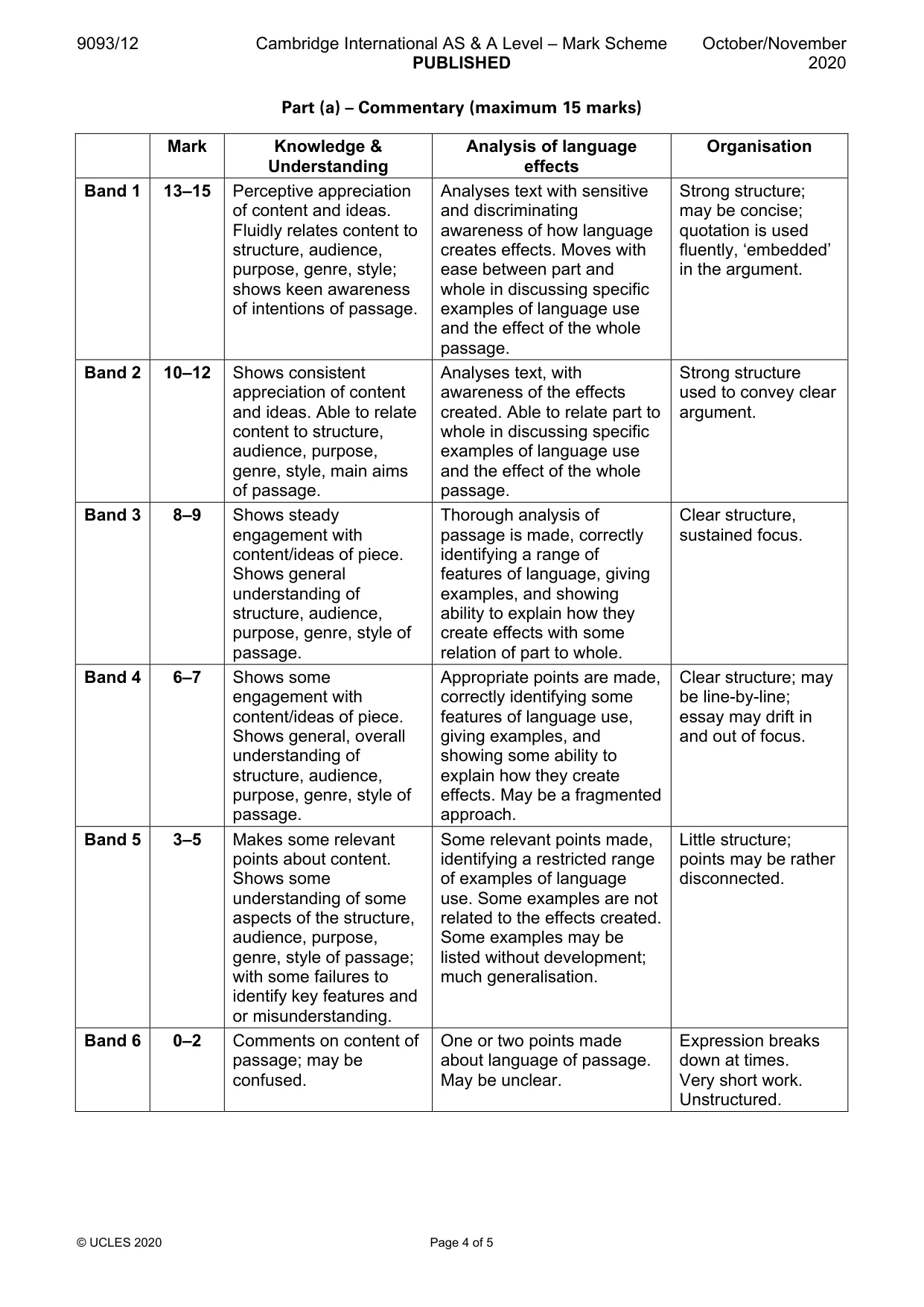
9093/12 Cambridge International AS & A Level – Mark Scheme PUBLISHED October/November 2020 © UCLES 2020 Page 4 of 5 Part (a) – Commentary (maximum 15 marks) Mark Knowledge & Understanding Analysis of language effects Organisation Band 1 13–15 Perceptive appreciation of content and ideas. Fluidly relates content to structure, audience, purpose, genre, style; shows keen awareness of intentions of passage. Analyses text with sensitive and discriminating awareness of how language creates effects. Moves with ease between part and whole in discussing specific examples of language use and the effect of the whole passage. Strong structure; may be concise; quotation is used fluently, ‘embedded’ in the argument. Band 2 10–12 Shows consistent appreciation of content and ideas. Able to relate content to structure, audience, purpose, genre, style, main aims of passage. Analyses text, with awareness of the effects created. Able to relate part to whole in discussing specific examples of language use and the effect of the whole passage. Strong structure used to convey clear argument. Band 3 8–9 Shows steady engagement with content/ideas of piece. Shows general understanding of structure, audience, purpose, genre, style of passage. Thorough analysis of passage is made, correctly identifying a range of features of language, giving examples, and showing ability to explain how they create effects with some relation of part to whole. Clear structure, sustained focus. Band 4 6–7 Shows some engagement with content/ideas of piece. Shows general, overall understanding of structure, audience, purpose, genre, style of passage. Appropriate points are made, correctly identifying some features of language use, giving examples, and showing some ability to explain how they create effects. May be a fragmented approach. Clear structure; may be line-by-line; essay may drift in and out of focus. Band 5 3–5 Makes some relevant points about content. Shows some understanding of some aspects of the structure, audience, purpose, genre, style of passage; with some failures to identify key features and or misunderstanding. Some relevant points made, identifying a restricted range of examples of language use. Some examples are not related to the effects created. Some examples may be listed without development; much generalisation. Little structure; points may be rather disconnected. Band 6 0–2 Comments on content of passage; may be confused. One or two points made about language of passage. May be unclear. Expression breaks down at times. Very short work. Unstructured.
Mark scheme, page 5
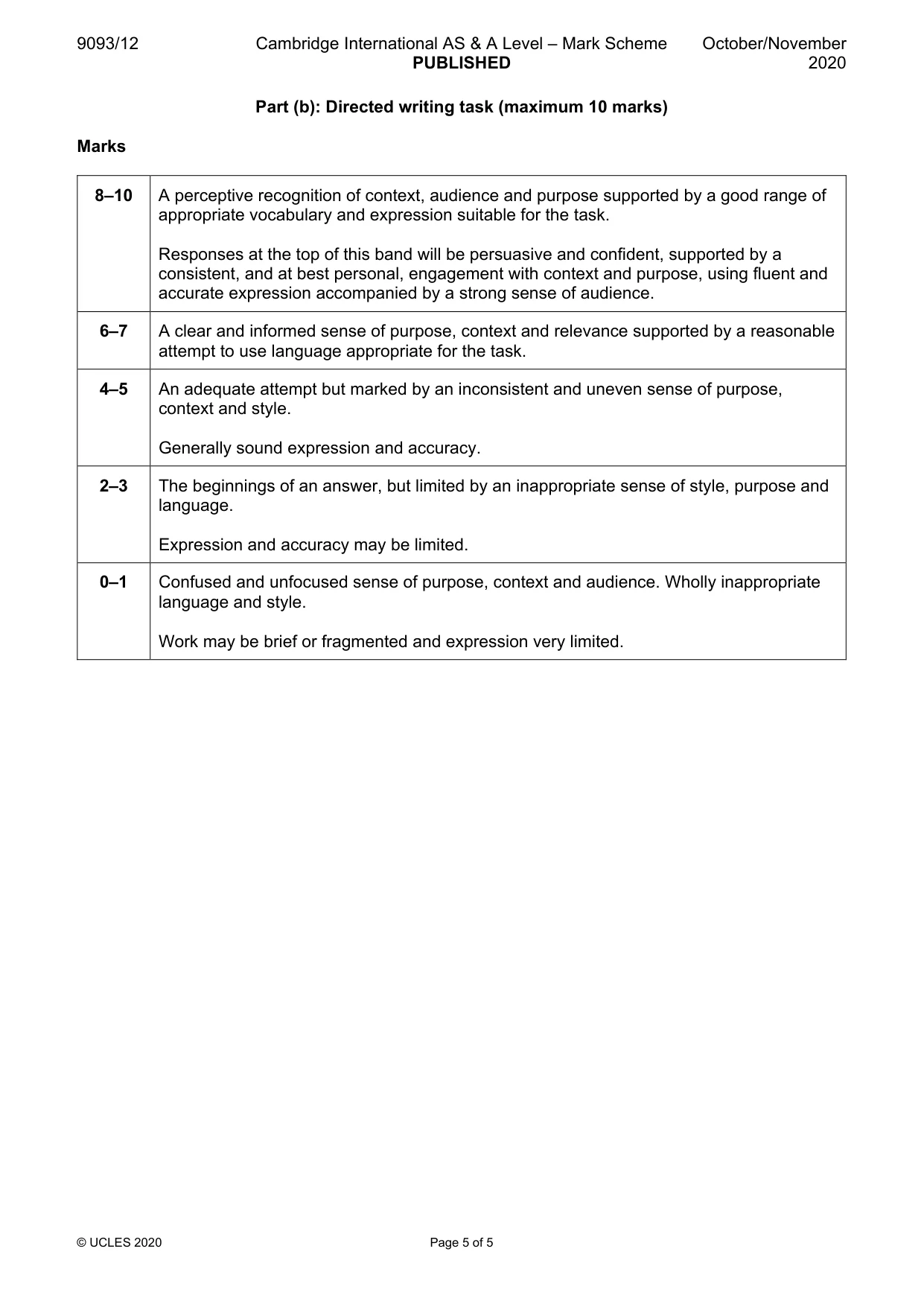
9093/12 Cambridge International AS & A Level – Mark Scheme PUBLISHED October/November 2020 © UCLES 2020 Page 5 of 5 Part (b): Directed writing task (maximum 10 marks) Marks 8–10 A perceptive recognition of context, audience and purpose supported by a good range of appropriate vocabulary and expression suitable for the task. Responses at the top of this band will be persuasive and confident, supported by a consistent, and at best personal, engagement with context and purpose, using fluent and accurate expression accompanied by a strong sense of audience. 6–7 A clear and informed sense of purpose, context and relevance supported by a reasonable attempt to use language appropriate for the task. 4–5 An adequate attempt but marked by an inconsistent and uneven sense of purpose, context and style. Generally sound expression and accuracy. 2–3 The beginnings of an answer, but limited by an inappropriate sense of style, purpose and language. Expression and accuracy may be limited. 0–1 Confused and unfocused sense of purpose, context and audience. Wholly inappropriate language and style. Work may be brief or fragmented and expression very limited.
What you needed in this session
Cambridge’s own grade thresholds for 2020 Oct/Nov, Paper 1 · Variant 2. A higher threshold means an easier paper — the bar moves with how the cohort did.