Cambridge A Level English - Language AS and A Level (from 2014) 9093 — 2020 Oct/Nov Paper 1 · Variant 1
9093/11/O/N/20 · 50 marks · ≈56 min
The question paper and its mark scheme, free to read here and free to download. This is Cambridge’s own paper, exactly as it was sat.
Question paper8 pages

Mark scheme5 pages
Answers below. Sit the paper first if you are practising.
Paper as text
Question paper, page 1
Cambridge International AS & A Level * 7 0 6 9 2 3 9 7 4 6 * DC (PQ) 186783 © UCLES 2020 [Turn over This document has 8 pages. Blank pages are indicated. ENGLISH LANGUAGE 9093/11 Paper 1 Passages October/November 2020 2 hours 15 minutes You must answer on the enclosed answer booklet. You will need: Answer booklet (enclosed) INSTRUCTIONS ● Answer two questions in total: Answer Question 1. Answer either Question 2 or Question 3. ● Follow the instructions on the front cover of the answer booklet. If you need additional answer paper, ask the invigilator for a continuation booklet. ● You are reminded of the need for good English and clear presentation in your answers. INFORMATION ● The total mark for this paper is 50. ● The number of marks for each question or part question is shown in brackets [ ].
Question paper, page 2
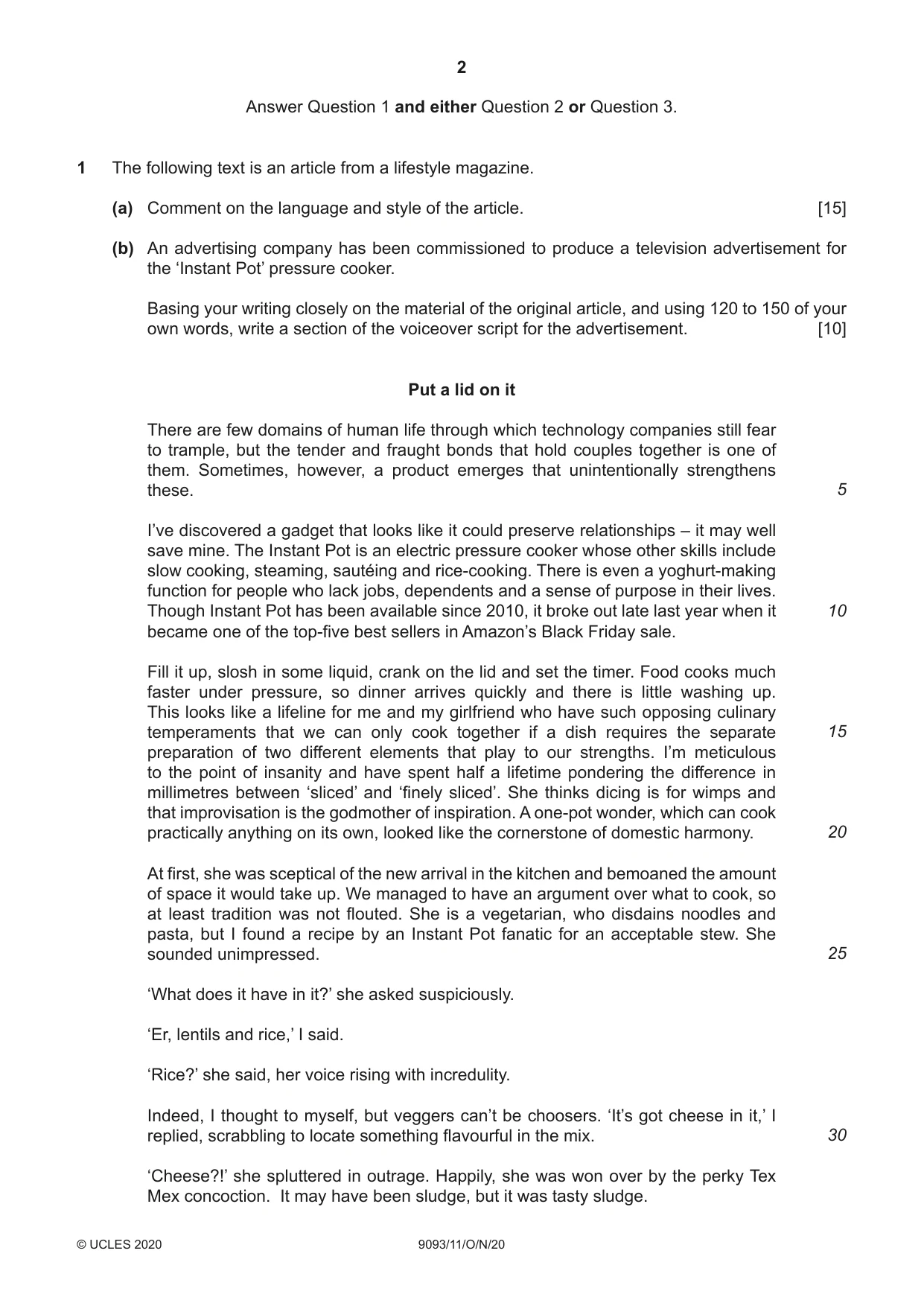
2 9093/11/O/N/20 © UCLES 2020 Answer Question 1 and either Question 2 or Question 3. 1 The following text is an article from a lifestyle magazine. (a) Comment on the language and style of the article. [15] (b) An advertising company has been commissioned to produce a television advertisement for the ‘Instant Pot’ pressure cooker. Basing your writing closely on the material of the original article, and using 120 to 150 of your own words, write a section of the voiceover script for the advertisement. [10] Put a lid on it There are few domains of human life through which technology companies still fear to trample, but the tender and fraught bonds that hold couples together is one of them. Sometimes, however, a product emerges that unintentionally strengthens these. I’ve discovered a gadget that looks like it could preserve relationships – it may well save mine. The Instant Pot is an electric pressure cooker whose other skills include slow cooking, steaming, sautéing and rice-cooking. There is even a yoghurt-making function for people who lack jobs, dependents and a sense of purpose in their lives. Though Instant Pot has been available since 2010, it broke out late last year when it became one of the top-five best sellers in Amazon’s Black Friday sale. Fill it up, slosh in some liquid, crank on the lid and set the timer. Food cooks much faster under pressure, so dinner arrives quickly and there is little washing up. This looks like a lifeline for me and my girlfriend who have such opposing culinary temperaments that we can only cook together if a dish requires the separate preparation of two different elements that play to our strengths. I’m meticulous to the point of insanity and have spent half a lifetime pondering the difference in millimetres between ‘sliced’ and ‘finely sliced’. She thinks dicing is for wimps and that improvisation is the godmother of inspiration. A one-pot wonder, which can cook practically anything on its own, looked like the cornerstone of domestic harmony. At first, she was sceptical of the new arrival in the kitchen and bemoaned the amount of space it would take up. We managed to have an argument over what to cook, so at least tradition was not flouted. She is a vegetarian, who disdains noodles and pasta, but I found a recipe by an Instant Pot fanatic for an acceptable stew. She sounded unimpressed. ‘What does it have in it?’ she asked suspiciously. ‘Er, lentils and rice,’ I said. ‘Rice?’ she said, her voice rising with incredulity. Indeed, I thought to myself, but veggers can’t be choosers. ‘It’s got cheese in it,’ I replied, scrabbling to locate something flavourful in the mix. ‘Cheese?!’ she spluttered in outrage. Happily, she was won over by the perky Tex Mex concoction. It may have been sludge, but it was tasty sludge. 5 10 15 20 25 30
Question paper, page 3
3 9093/11/O/N/20 © UCLES 2020 [Turn over My family has history with pressure cookers. My mother used one to make salt beef, a bay leaf, an onion and a carrot bobbing alongside the brisket. This low-grade meat required prolonged slow-cooking and it was one of the few that my ancestors could afford (brisket is a staple of African-American barbecue for the same reason). Immigrants sustain their heritage by cooking the old favourites, even as they move up in their new world. While my great-grandmother would have sat for hours over simmering pans, my mother sorted out her salt beef in a quarter of the time. The pressure cooker was a small but powerful symbol of the meeting of modernity and tradition. It represented assimilation and advancement into the middle class. The Instant Pot’s success in America should be no surprise. It has always prided itself as the melting pot of nations. On thousands of kitchen counters, a newer pot is keeping small spoonfuls of the country’s soul warm. 35 40
Question paper, page 4
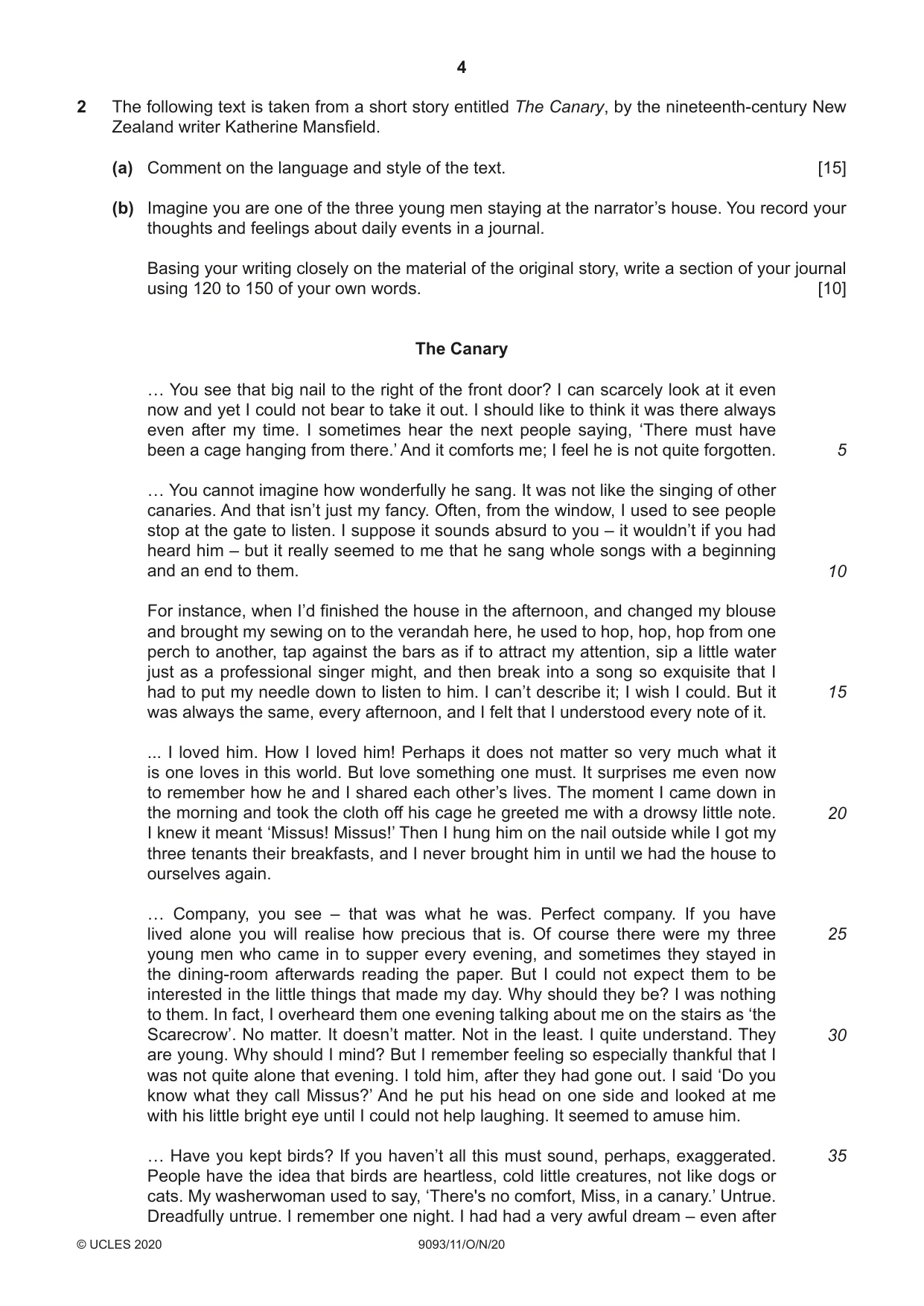
4 9093/11/O/N/20 © UCLES 2020 2 The following text is taken from a short story entitled The Canary, by the nineteenth-century New Zealand writer Katherine Mansfield. (a) Comment on the language and style of the text. [15] (b) Imagine you are one of the three young men staying at the narrator’s house. You record your thoughts and feelings about daily events in a journal. Basing your writing closely on the material of the original story, write a section of your journal using 120 to 150 of your own words. [10] The Canary … You see that big nail to the right of the front door? I can scarcely look at it even now and yet I could not bear to take it out. I should like to think it was there always even after my time. I sometimes hear the next people saying, ‘There must have been a cage hanging from there.’ And it comforts me; I feel he is not quite forgotten. … You cannot imagine how wonderfully he sang. It was not like the singing of other canaries. And that isn’t just my fancy. Often, from the window, I used to see people stop at the gate to listen. I suppose it sounds absurd to you – it wouldn’t if you had heard him – but it really seemed to me that he sang whole songs with a beginning and an end to them. For instance, when I’d finished the house in the afternoon, and changed my blouse and brought my sewing on to the verandah here, he used to hop, hop, hop from one perch to another, tap against the bars as if to attract my attention, sip a little water just as a professional singer might, and then break into a song so exquisite that I had to put my needle down to listen to him. I can’t describe it; I wish I could. But it was always the same, every afternoon, and I felt that I understood every note of it. ... I loved him. How I loved him! Perhaps it does not matter so very much what it is one loves in this world. But love something one must. It surprises me even now to remember how he and I shared each other’s lives. The moment I came down in the morning and took the cloth off his cage he greeted me with a drowsy little note. I knew it meant ‘Missus! Missus!’ Then I hung him on the nail outside while I got my three tenants their breakfasts, and I never brought him in until we had the house to ourselves again. … Company, you see – that was what he was. Perfect company. If you have lived alone you will realise how precious that is. Of course there were my three young men who came in to supper every evening, and sometimes they stayed in the dining-room afterwards reading the paper. But I could not expect them to be interested in the little things that made my day. Why should they be? I was nothing to them. In fact, I overheard them one evening talking about me on the stairs as ‘the Scarecrow’. No matter. It doesn’t matter. Not in the least. I quite understand. They are young. Why should I mind? But I remember feeling so especially thankful that I was not quite alone that evening. I told him, after they had gone out. I said ‘Do you know what they call Missus?’ And he put his head on one side and looked at me with his little bright eye until I could not help laughing. It seemed to amuse him. … Have you kept birds? If you haven’t all this must sound, perhaps, exaggerated. People have the idea that birds are heartless, cold little creatures, not like dogs or cats. My washerwoman used to say, ‘There's no comfort, Miss, in a canary.’ Untrue. Dreadfully untrue. I remember one night. I had had a very awful dream – even after 5 10 15 20 25 30 35
Question paper, page 5
5 9093/11/O/N/20 © UCLES 2020 [Turn over I had woken up I could not get over it. So I put on my dressing-gown and went down to the kitchen for a glass of water. It was a winter night and raining hard. I suppose I was still half asleep. And suddenly I felt it was unbearable that I had no one to whom I could say ‘I’ve had such a dreadful dream.’ And then there came a little ‘Sweet! Sweet!’ His cage was on the table, and the cloth had slipped so that a chink of light shone through. ‘Sweet! Sweet!’ said the darling little fellow again, softly, as much as to say, ‘I’m here, Missus! I'm here!’ That was so beautifully comforting that I nearly cried. … And now he’s gone. I shall never have another bird, another pet of any kind. How could I? When I found him, lying on his back, with his eye dim and his claws wrung, when I realised that never again should I hear my darling sing, something seemed to die in me. My heart felt hollow, as if it was his cage. I shall get over it. Of course. I must. One can get over anything in time. And people always say I have a cheerful disposition. They are quite right, and I am thankful for it. 40 45 50
Question paper, page 6
6 9093/11/O/N/20 © UCLES 2020 3 The following text is taken from the travel section of a British newspaper’s website. (a) Comment on the language and style of the text. [15] (b) Imagine you have recently returned from a visit to Antarctica, and were disappointed by the experience. You decide to write a letter to the newspaper to express your dissatisfaction. Basing your writing closely on the material of the original text, and using 120 to 150 of your own words, write a section of your letter. [10] Everything you need to know about visiting Antarctica It’s hard to escape the rat race these days. There are queues to reach the summit of Everest, direct flights to remote Pacific islands and luxurious hotels in the rainforest. We’ve tamed and colonised most of the world, but one vast stretch of the planet remains beyond our grasp: Antarctica. This frozen continent at the end of the Earth has never been permanently occupied by man. Accessible only from November to March, it has no towns or villages, no habitation bar the odd research station or expedition hut; just grand, icy, unpredictable wilderness. Even if you’re travelling there on a cruise ship, as most people do, the solitude and the emptiness will envelop you and bring you down to scale. Not that solitude is the first thing that comes to mind when you’re standing in the middle of a penguin colony on an Antarctic shoreline. When I visited, in early February, there were thousands of birds packed tightly on every rock, both shy gentoo penguins and the bolder adélies, which seemed happy for us to wander among them, cameras clicking furiously at the grey fluff-ball chicks tapping their parents’ beaks to be fed. Adult penguins nudged each other into the sea and ‘porpoised’ through the water like leaping salmon, their oiled white feathers gleaming silver in the sun. Later in the trip we came across chinstrap penguins on Livingstone Island, looking for all the world as if they were sporting old-fashioned motorcycle helmets. Penguins are by no means the only stars of the show here. It was equally thrilling to see a wandering albatross circling above our ship, dipping its great wings into the rolling waters of the Drake Passage. Or fat elephant seals lolling on the beach in a soup of algae, snorting and bellowing at each other like elderly members of a gentlemen’s club. Most exciting of all, though, were the whales. As the call went up from the bridge – ‘Humpbacks!’ – we spotted three of them leaping from the water beside the ship – their magnificent tails emerging and dipping as if in slow motion, so close that we could see their great barnacled heads, their eyes and blowholes. One even swam under the ship, flippers outstretched like an enormous aeroplane, clearly visible in the clear turquoise water. Later, several whales played alongside us as we took a dinghy cruise among the icebergs. Ah, the icebergs. The glassy world of the Weddell Sea is a surreal panorama of icy skyscrapers stretching to the horizon. Some are whipped by wind and water into fantastical shapes – oriental palaces, ruined fortresses, even an Art Deco cinema. In others you can glimpse arches and grottos of such intense blue they look as though they’re lined with topaz or aquamarine. ‘Of course many of the people who go on those big Alaskan cruise ships would hate this,’ a fellow passenger said to me as we were buffeted by winds and showered 5 10 15 20 25 30 35
Question paper, page 7
7 9093/11/O/N/20 © UCLES 2020 with icy water on one of our Zodiac trips ashore. ‘There’s no disco and no spa. It would be too rough and remote for them, too strange, too adventurous.’ But that is precisely what makes a voyage here so wonderful and extraordinary. A journey to Antarctica is about as other-worldly a travel experience as you can have, short of a flight to the Moon. Afterwards you’ll never look at the natural world in quite the same way again. Who to travel with Discover the World (discover-the-world.co.uk) has a good range of cruises on various expedition ships. If you want a deeper level of comfort, opt for a cruise on Abercrombie & Kent’s Le Boreal or Le Lyrial (abercrombiekent.co.uk). Noble Caledonia (noble-caledonia.co.uk) also offers a range of expedition cruises in the area, and even a combined Arctic and Antarctic trip by private jet – a snip at £69,995. See the IAATO website for details of other operators and cruise lines visiting the region. 40 45 50
Question paper, page 8
8 9093/11/O/N/20 © UCLES 2020 Permission to reproduce items where third-party owned material protected by copyright is included has been sought and cleared where possible. Every reasonable effort has been made by the publisher (UCLES) to trace copyright holders, but if any items requiring clearance have unwittingly been included, the publisher will be pleased to make amends at the earliest possible opportunity. To avoid the issue of disclosure of answer-related information to candidates, all copyright acknowledgements are reproduced online in the Cambridge Assessment International Education Copyright Acknowledgements Booklet. This is produced for each series of examinations and is freely available to download at www.cambridgeinternational.org after the live examination series. Cambridge Assessment International Education is part of the Cambridge Assessment Group. Cambridge Assessment is the brand name of the University of Cambridge Local Examinations Syndicate (UCLES), which itself is a department of the University of Cambridge. BLANK PAGE
Mark scheme, page 1
This document consists of 5 printed pages. © UCLES 2020 [Turn over Cambridge International AS & A Level ENGLISH LANGUAGE 9093/11 Paper 1 Passages October/November 2020 MARK SCHEME Maximum Mark: 50 Published This mark scheme is published as an aid to teachers and candidates, to indicate the requirements of the examination. It shows the basis on which Examiners were instructed to award marks. It does not indicate the details of the discussions that took place at an Examiners’ meeting before marking began, which would have considered the acceptability of alternative answers. Mark schemes should be read in conjunction with the question paper and the Principal Examiner Report for Teachers. Cambridge International will not enter into discussions about these mark schemes. Cambridge International is publishing the mark schemes for the October/November 2020 series for most Cambridge IGCSE™, Cambridge International A and AS Level and Cambridge Pre-U components, and some Cambridge O Level components.
Mark scheme, page 2
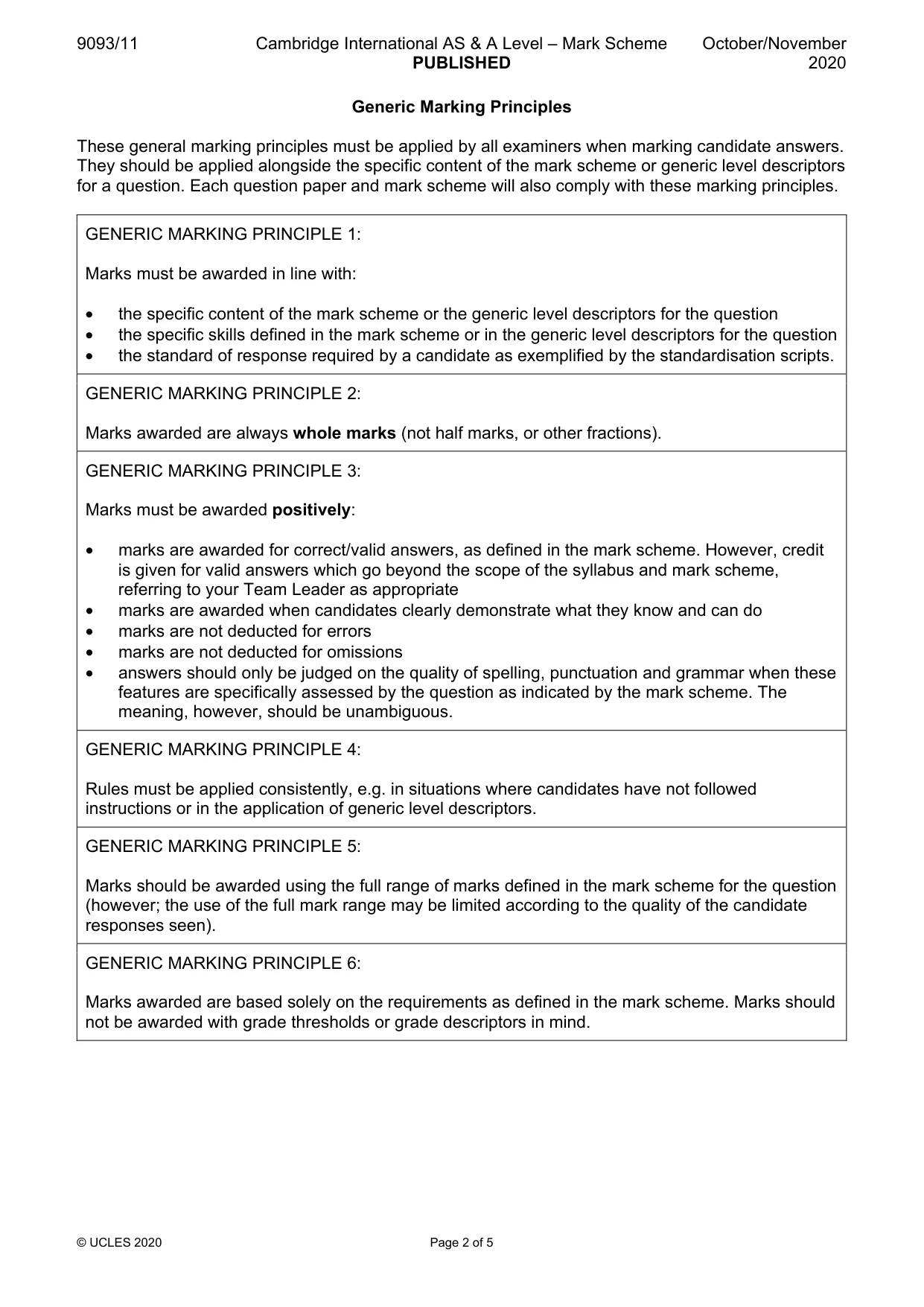
9093/11 Cambridge International AS & A Level – Mark Scheme PUBLISHED October/November 2020 © UCLES 2020 Page 2 of 5 Generic Marking Principles These general marking principles must be applied by all examiners when marking candidate answers. They should be applied alongside the specific content of the mark scheme or generic level descriptors for a question. Each question paper and mark scheme will also comply with these marking principles. GENERIC MARKING PRINCIPLE 1: Marks must be awarded in line with: • the specific content of the mark scheme or the generic level descriptors for the question • the specific skills defined in the mark scheme or in the generic level descriptors for the question • the standard of response required by a candidate as exemplified by the standardisation scripts. GENERIC MARKING PRINCIPLE 2: Marks awarded are always whole marks (not half marks, or other fractions). GENERIC MARKING PRINCIPLE 3: Marks must be awarded positively: • marks are awarded for correct/valid answers, as defined in the mark scheme. However, credit is given for valid answers which go beyond the scope of the syllabus and mark scheme, referring to your Team Leader as appropriate • marks are awarded when candidates clearly demonstrate what they know and can do • marks are not deducted for errors • marks are not deducted for omissions • answers should only be judged on the quality of spelling, punctuation and grammar when these features are specifically assessed by the question as indicated by the mark scheme. The meaning, however, should be unambiguous. GENERIC MARKING PRINCIPLE 4: Rules must be applied consistently, e.g. in situations where candidates have not followed instructions or in the application of generic level descriptors. GENERIC MARKING PRINCIPLE 5: Marks should be awarded using the full range of marks defined in the mark scheme for the question (however; the use of the full mark range may be limited according to the quality of the candidate responses seen). GENERIC MARKING PRINCIPLE 6: Marks awarded are based solely on the requirements as defined in the mark scheme. Marks should not be awarded with grade thresholds or grade descriptors in mind.
Mark scheme, page 3
9093/11 Cambridge International AS & A Level – Mark Scheme PUBLISHED October/November 2020 © UCLES 2020 Page 3 of 5 Assessment Objectives: • Ability to read with understanding written material in a variety of forms, and to comment on its effectiveness. • Knowledge and understanding of features of English language. • Ability to write clearly, accurately and effectively for a particular purpose or audience. Each answer is marked out of a total of 25. • 15 marks are available for part (a) – commentary on use of language in the passage. • 10 marks are available for part (b) – directed writing task based on the passage. Each part is marked in accordance with the following general marking criteria.
Mark scheme, page 4
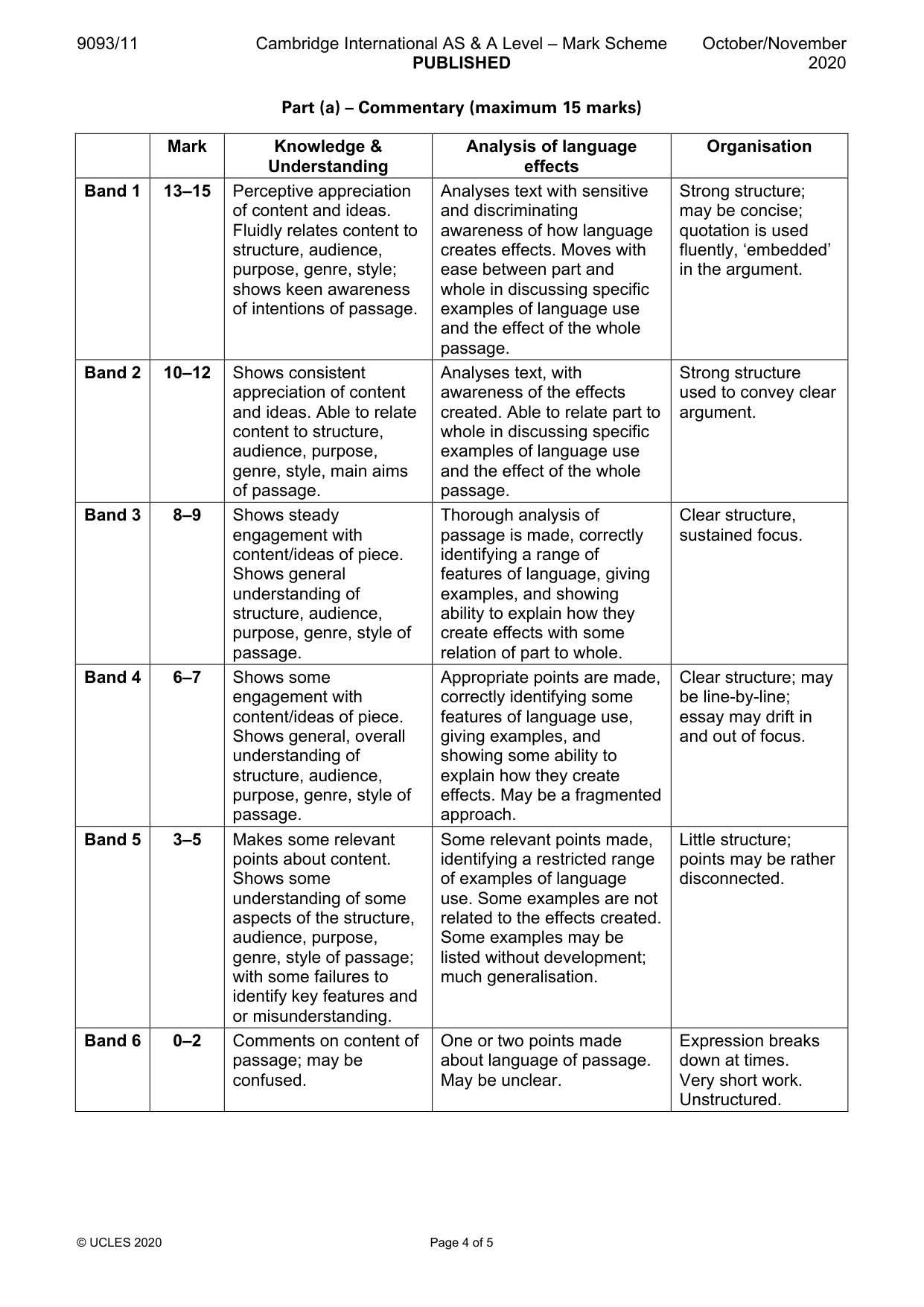
9093/11 Cambridge International AS & A Level – Mark Scheme PUBLISHED October/November 2020 © UCLES 2020 Page 4 of 5 Part (a) – Commentary (maximum 15 marks) Mark Knowledge & Understanding Analysis of language effects Organisation Band 1 13–15 Perceptive appreciation of content and ideas. Fluidly relates content to structure, audience, purpose, genre, style; shows keen awareness of intentions of passage. Analyses text with sensitive and discriminating awareness of how language creates effects. Moves with ease between part and whole in discussing specific examples of language use and the effect of the whole passage. Strong structure; may be concise; quotation is used fluently, ‘embedded’ in the argument. Band 2 10–12 Shows consistent appreciation of content and ideas. Able to relate content to structure, audience, purpose, genre, style, main aims of passage. Analyses text, with awareness of the effects created. Able to relate part to whole in discussing specific examples of language use and the effect of the whole passage. Strong structure used to convey clear argument. Band 3 8–9 Shows steady engagement with content/ideas of piece. Shows general understanding of structure, audience, purpose, genre, style of passage. Thorough analysis of passage is made, correctly identifying a range of features of language, giving examples, and showing ability to explain how they create effects with some relation of part to whole. Clear structure, sustained focus. Band 4 6–7 Shows some engagement with content/ideas of piece. Shows general, overall understanding of structure, audience, purpose, genre, style of passage. Appropriate points are made, correctly identifying some features of language use, giving examples, and showing some ability to explain how they create effects. May be a fragmented approach. Clear structure; may be line-by-line; essay may drift in and out of focus. Band 5 3–5 Makes some relevant points about content. Shows some understanding of some aspects of the structure, audience, purpose, genre, style of passage; with some failures to identify key features and or misunderstanding. Some relevant points made, identifying a restricted range of examples of language use. Some examples are not related to the effects created. Some examples may be listed without development; much generalisation. Little structure; points may be rather disconnected. Band 6 0–2 Comments on content of passage; may be confused. One or two points made about language of passage. May be unclear. Expression breaks down at times. Very short work. Unstructured.
Mark scheme, page 5
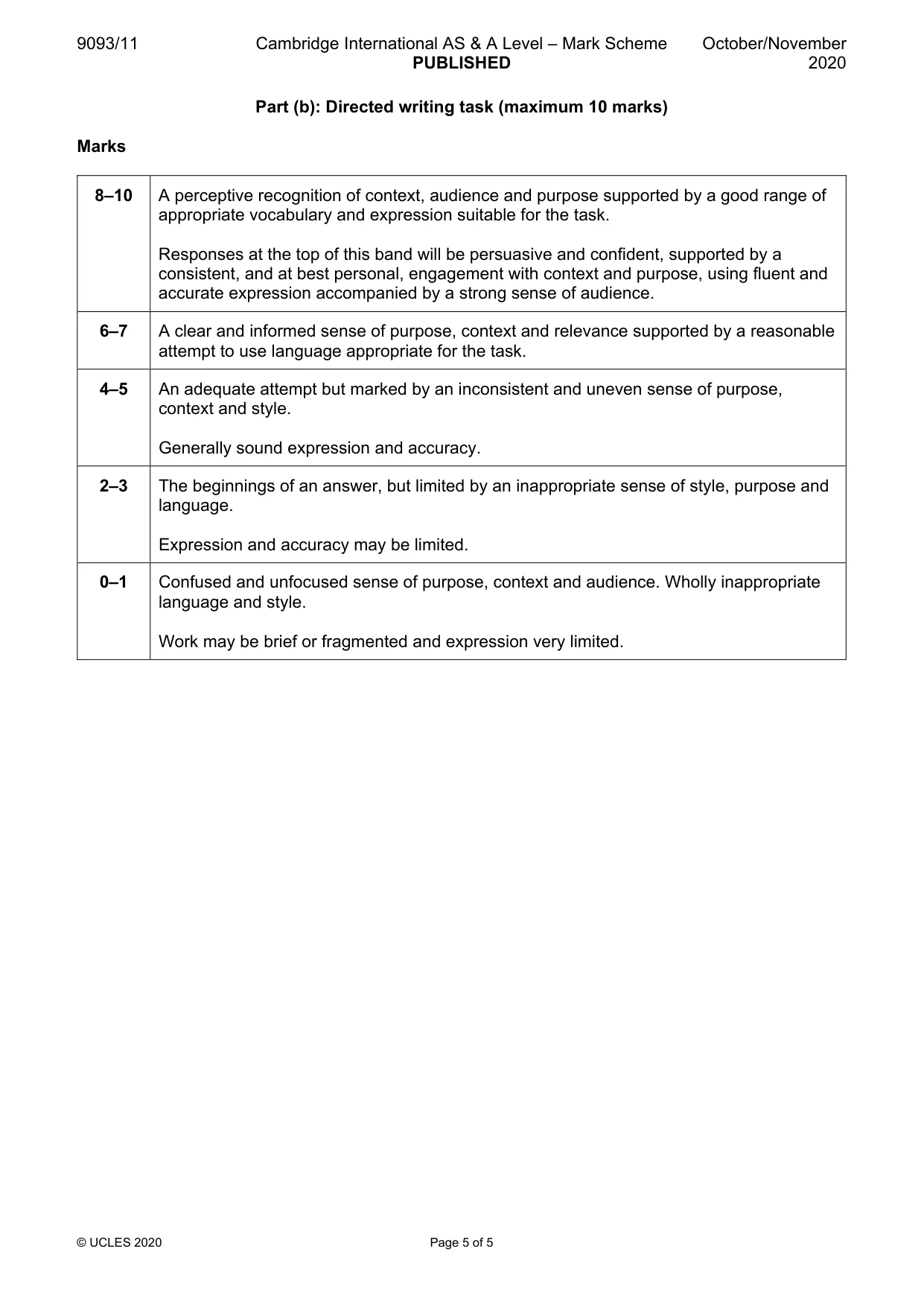
9093/11 Cambridge International AS & A Level – Mark Scheme PUBLISHED October/November 2020 © UCLES 2020 Page 5 of 5 Part (b): Directed writing task (maximum 10 marks) Marks 8–10 A perceptive recognition of context, audience and purpose supported by a good range of appropriate vocabulary and expression suitable for the task. Responses at the top of this band will be persuasive and confident, supported by a consistent, and at best personal, engagement with context and purpose, using fluent and accurate expression accompanied by a strong sense of audience. 6–7 A clear and informed sense of purpose, context and relevance supported by a reasonable attempt to use language appropriate for the task. 4–5 An adequate attempt but marked by an inconsistent and uneven sense of purpose, context and style. Generally sound expression and accuracy. 2–3 The beginnings of an answer, but limited by an inappropriate sense of style, purpose and language. Expression and accuracy may be limited. 0–1 Confused and unfocused sense of purpose, context and audience. Wholly inappropriate language and style. Work may be brief or fragmented and expression very limited.
What you needed in this session
Cambridge’s own grade thresholds for 2020 Oct/Nov, Paper 1 · Variant 1. A higher threshold means an easier paper — the bar moves with how the cohort did.