Cambridge A Level English - Language AS and A Level (from 2014) 9093 — 2020 May/June Paper 1 · Variant 3
9093/13/M/J/20
The question paper and its mark scheme, free to read here and free to download. This is Cambridge’s own paper, exactly as it was sat.
Question paper8 pages
Mark scheme4 pages
Answers below. Sit the paper first if you are practising.
Paper as text
Question paper, page 1
Cambridge International AS & A Level This document has 8 pages. Blank pages are indicated. DC (LK) 186782/2 © UCLES 2020 [Turn over ENGLISH LANGUAGE 9093/13 Paper 1 Passages May/June 2020 2 hours 15 minutes You must answer on the enclosed answer booklet. You will need: Answer booklet (enclosed) INSTRUCTIONS ● Answer two questions in total: Answer Question 1. Answer either Question 2 or Question 3. ● Follow the instructions on the front cover of the answer booklet. If you need additional answer paper, ask the invigilator for a continuation booklet. ● You are reminded of the need for good English and clear presentation in your answers. INFORMATION ● The total mark for this paper is 50. ● The number of marks for each question or part question is shown in brackets [ ]. * 3 3 1 8 6 8 2 4 6 5 *
Question paper, page 2
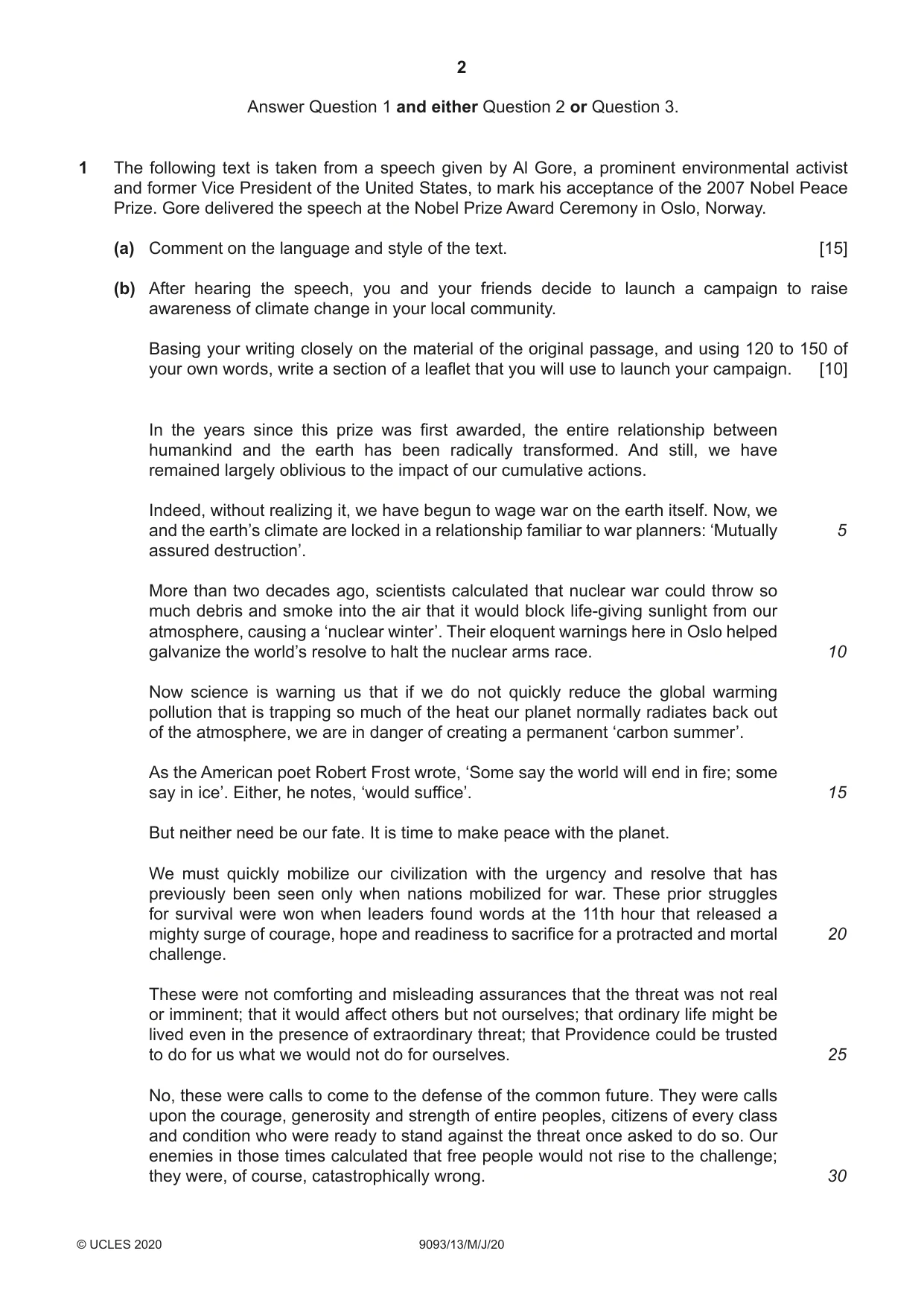
2 9093/13/M/J/20 © UCLES 2020 Answer Question 1 and either Question 2 or Question 3. 1 The following text is taken from a speech given by Al Gore, a prominent environmental activist and former Vice President of the United States, to mark his acceptance of the 2007 Nobel Peace Prize. Gore delivered the speech at the Nobel Prize Award Ceremony in Oslo, Norway. (a) Comment on the language and style of the text. [15] (b) After hearing the speech, you and your friends decide to launch a campaign to raise awareness of climate change in your local community. Basing your writing closely on the material of the original passage, and using 120 to 150 of your own words, write a section of a leaflet that you will use to launch your campaign. [10] In the years since this prize was first awarded, the entire relationship between humankind and the earth has been radically transformed. And still, we have remained largely oblivious to the impact of our cumulative actions. Indeed, without realizing it, we have begun to wage war on the earth itself. Now, we and the earth’s climate are locked in a relationship familiar to war planners: ‘Mutually assured destruction’. More than two decades ago, scientists calculated that nuclear war could throw so much debris and smoke into the air that it would block life-giving sunlight from our atmosphere, causing a ‘nuclear winter’. Their eloquent warnings here in Oslo helped galvanize the world’s resolve to halt the nuclear arms race. Now science is warning us that if we do not quickly reduce the global warming pollution that is trapping so much of the heat our planet normally radiates back out of the atmosphere, we are in danger of creating a permanent ‘carbon summer’. As the American poet Robert Frost wrote, ‘Some say the world will end in fire; some say in ice’. Either, he notes, ‘would suffice’. But neither need be our fate. It is time to make peace with the planet. We must quickly mobilize our civilization with the urgency and resolve that has previously been seen only when nations mobilized for war. These prior struggles for survival were won when leaders found words at the 11th hour that released a mighty surge of courage, hope and readiness to sacrifice for a protracted and mortal challenge. These were not comforting and misleading assurances that the threat was not real or imminent; that it would affect others but not ourselves; that ordinary life might be lived even in the presence of extraordinary threat; that Providence could be trusted to do for us what we would not do for ourselves. No, these were calls to come to the defense of the common future. They were calls upon the courage, generosity and strength of entire peoples, citizens of every class and condition who were ready to stand against the threat once asked to do so. Our enemies in those times calculated that free people would not rise to the challenge; they were, of course, catastrophically wrong. 5 10 15 20 25 30
Question paper, page 3
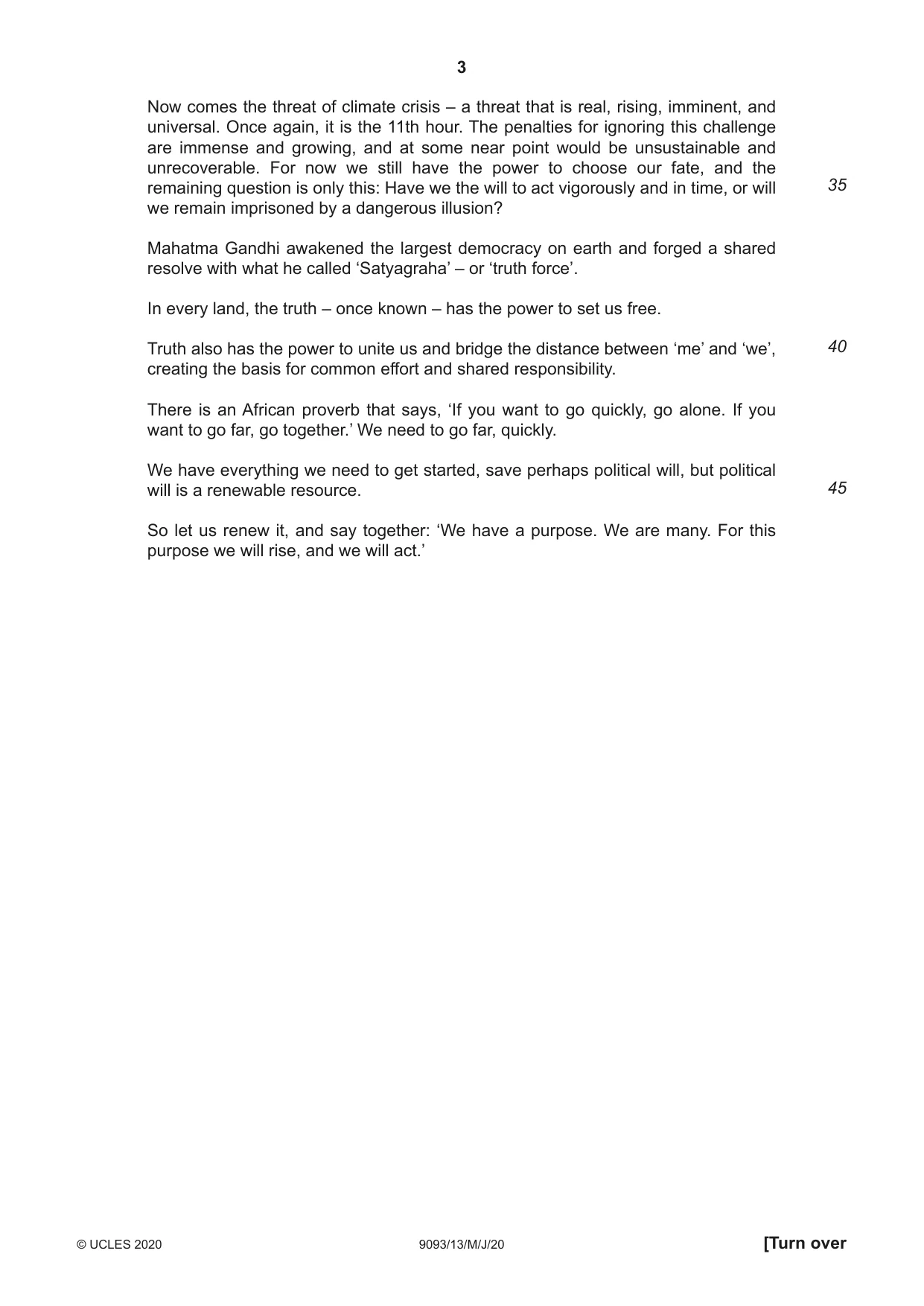
3 9093/13/M/J/20 © UCLES 2020 [Turn over Now comes the threat of climate crisis – a threat that is real, rising, imminent, and universal. Once again, it is the 11th hour. The penalties for ignoring this challenge are immense and growing, and at some near point would be unsustainable and unrecoverable. For now we still have the power to choose our fate, and the remaining question is only this: Have we the will to act vigorously and in time, or will we remain imprisoned by a dangerous illusion? Mahatma Gandhi awakened the largest democracy on earth and forged a shared resolve with what he called ‘Satyagraha’ – or ‘truth force’. In every land, the truth – once known – has the power to set us free. Truth also has the power to unite us and bridge the distance between ‘me’ and ‘we’, creating the basis for common effort and shared responsibility. There is an African proverb that says, ‘If you want to go quickly, go alone. If you want to go far, go together.’ We need to go far, quickly. We have everything we need to get started, save perhaps political will, but political will is a renewable resource. So let us renew it, and say together: ‘We have a purpose. We are many. For this purpose we will rise, and we will act.’ 35 40 45
Question paper, page 4
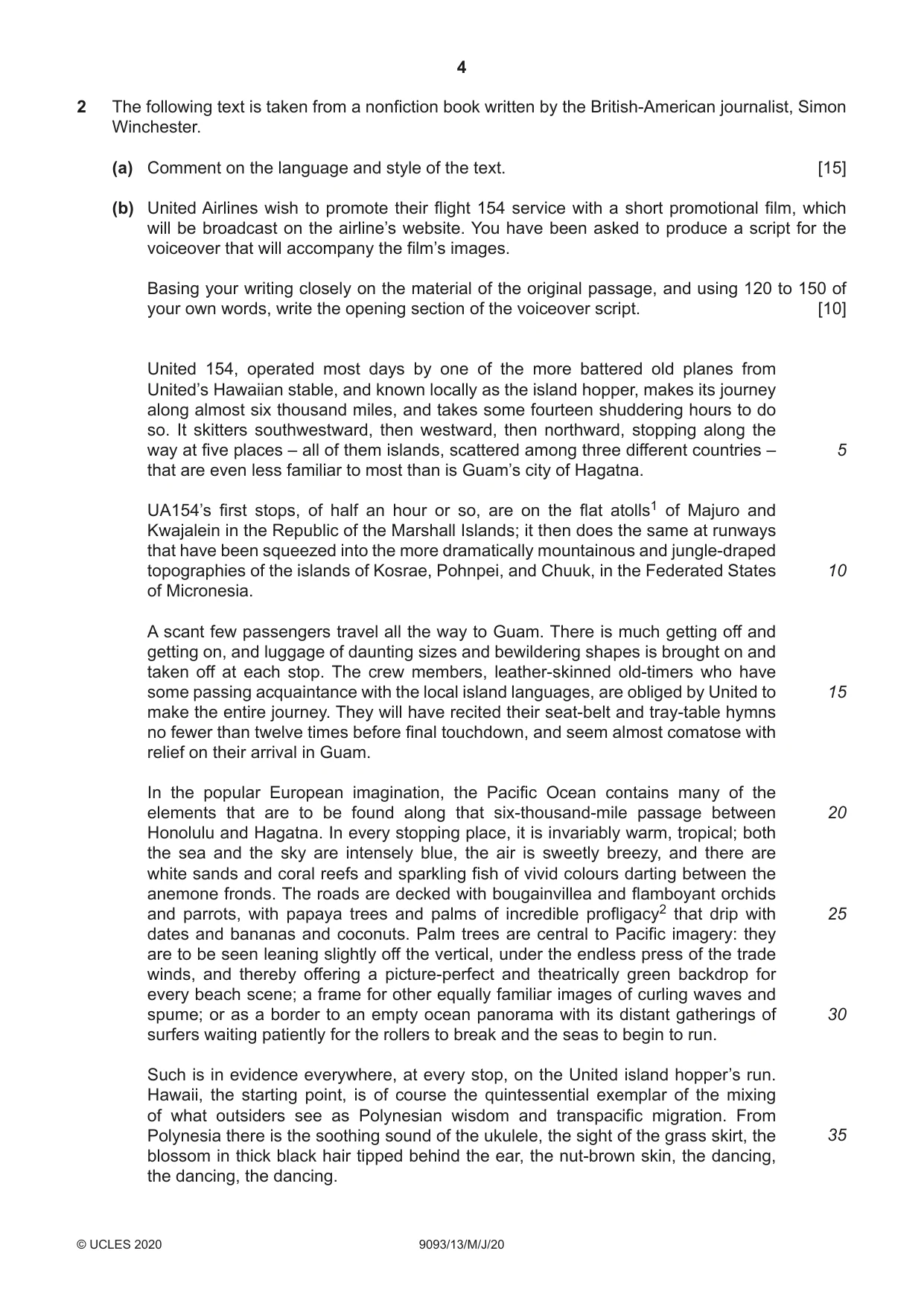
4 9093/13/M/J/20 © UCLES 2020 2 The following text is taken from a nonfiction book written by the British-American journalist, Simon Winchester. (a) Comment on the language and style of the text. [15] (b) United Airlines wish to promote their flight 154 service with a short promotional film, which will be broadcast on the airline’s website. You have been asked to produce a script for the voiceover that will accompany the film’s images. Basing your writing closely on the material of the original passage, and using 120 to 150 of your own words, write the opening section of the voiceover script. [10] United 154, operated most days by one of the more battered old planes from United’s Hawaiian stable, and known locally as the island hopper, makes its journey along almost six thousand miles, and takes some fourteen shuddering hours to do so. It skitters southwestward, then westward, then northward, stopping along the way at five places – all of them islands, scattered among three different countries – that are even less familiar to most than is Guam’s city of Hagatna. UA154’s first stops, of half an hour or so, are on the flat atolls1 of Majuro and Kwajalein in the Republic of the Marshall Islands; it then does the same at runways that have been squeezed into the more dramatically mountainous and jungle-draped topographies of the islands of Kosrae, Pohnpei, and Chuuk, in the Federated States of Micronesia. A scant few passengers travel all the way to Guam. There is much getting off and getting on, and luggage of daunting sizes and bewildering shapes is brought on and taken off at each stop. The crew members, leather-skinned old-timers who have some passing acquaintance with the local island languages, are obliged by United to make the entire journey. They will have recited their seat-belt and tray-table hymns no fewer than twelve times before final touchdown, and seem almost comatose with relief on their arrival in Guam. In the popular European imagination, the Pacific Ocean contains many of the elements that are to be found along that six-thousand-mile passage between Honolulu and Hagatna. In every stopping place, it is invariably warm, tropical; both the sea and the sky are intensely blue, the air is sweetly breezy, and there are white sands and coral reefs and sparkling fish of vivid colours darting between the anemone fronds. The roads are decked with bougainvillea and flamboyant orchids and parrots, with papaya trees and palms of incredible profligacy2 that drip with dates and bananas and coconuts. Palm trees are central to Pacific imagery: they are to be seen leaning slightly off the vertical, under the endless press of the trade winds, and thereby offering a picture-perfect and theatrically green backdrop for every beach scene; a frame for other equally familiar images of curling waves and spume; or as a border to an empty ocean panorama with its distant gatherings of surfers waiting patiently for the rollers to break and the seas to begin to run. Such is in evidence everywhere, at every stop, on the United island hopper’s run. Hawaii, the starting point, is of course the quintessential exemplar of the mixing of what outsiders see as Polynesian wisdom and transpacific migration. From Polynesia there is the soothing sound of the ukulele, the sight of the grass skirt, the blossom in thick black hair tipped behind the ear, the nut-brown skin, the dancing, the dancing, the dancing. 5 10 15 20 25 30 35
Question paper, page 5
5 9093/13/M/J/20 © UCLES 2020 [Turn over 1atolls: ring-shaped coral islands 2profligacy: excessive abundance
Question paper, page 6
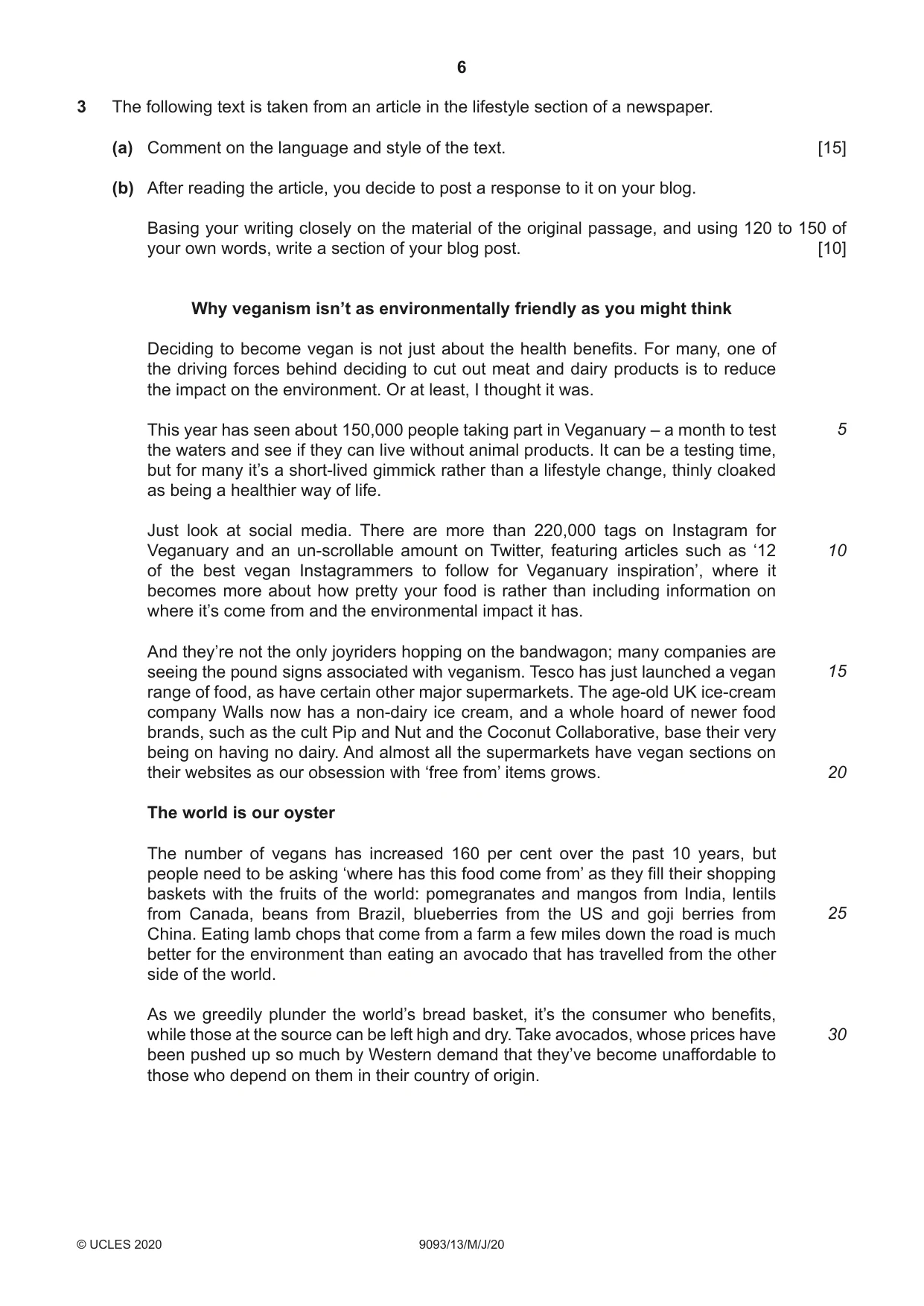
6 9093/13/M/J/20 © UCLES 2020 3 The following text is taken from an article in the lifestyle section of a newspaper. (a) Comment on the language and style of the text. [15] (b) After reading the article, you decide to post a response to it on your blog. Basing your writing closely on the material of the original passage, and using 120 to 150 of your own words, write a section of your blog post. [10] Why veganism isn’t as environmentally friendly as you might think Deciding to become vegan is not just about the health benefits. For many, one of the driving forces behind deciding to cut out meat and dairy products is to reduce the impact on the environment. Or at least, I thought it was. This year has seen about 150,000 people taking part in Veganuary – a month to test the waters and see if they can live without animal products. It can be a testing time, but for many it’s a short-lived gimmick rather than a lifestyle change, thinly cloaked as being a healthier way of life. Just look at social media. There are more than 220,000 tags on Instagram for Veganuary and an un-scrollable amount on Twitter, featuring articles such as ‘12 of the best vegan Instagrammers to follow for Veganuary inspiration’, where it becomes more about how pretty your food is rather than including information on where it’s come from and the environmental impact it has. And they’re not the only joyriders hopping on the bandwagon; many companies are seeing the pound signs associated with veganism. Tesco has just launched a vegan range of food, as have certain other major supermarkets. The age-old UK ice-cream company Walls now has a non-dairy ice cream, and a whole hoard of newer food brands, such as the cult Pip and Nut and the Coconut Collaborative, base their very being on having no dairy. And almost all the supermarkets have vegan sections on their websites as our obsession with ‘free from’ items grows. The world is our oyster The number of vegans has increased 160 per cent over the past 10 years, but people need to be asking ‘where has this food come from’ as they fill their shopping baskets with the fruits of the world: pomegranates and mangos from India, lentils from Canada, beans from Brazil, blueberries from the US and goji berries from China. Eating lamb chops that come from a farm a few miles down the road is much better for the environment than eating an avocado that has travelled from the other side of the world. As we greedily plunder the world’s bread basket, it’s the consumer who benefits, while those at the source can be left high and dry. Take avocados, whose prices have been pushed up so much by Western demand that they’ve become unaffordable to those who depend on them in their country of origin. 5 10 15 20 25 30
Question paper, page 7
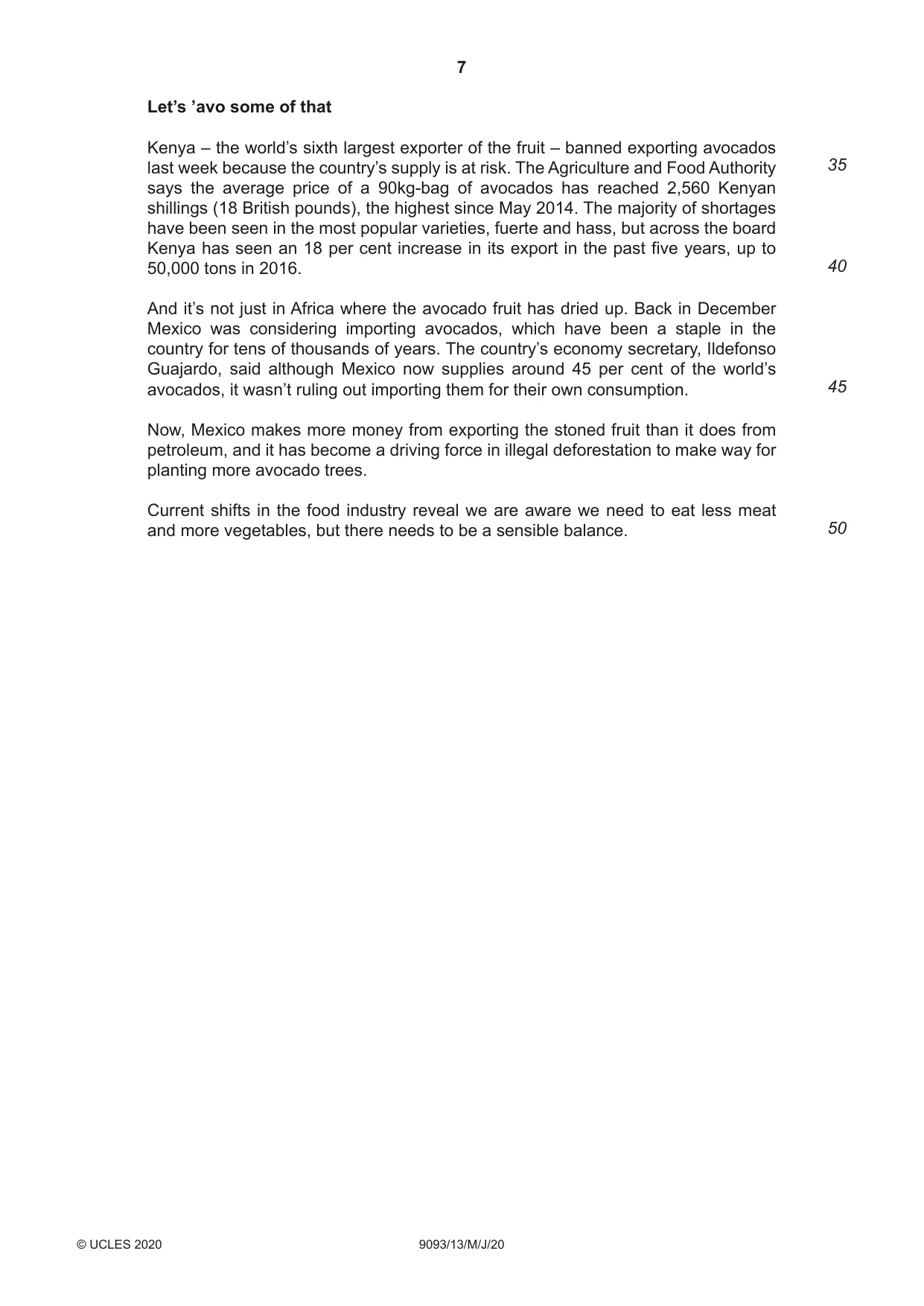
7 9093/13/M/J/20 © UCLES 2020 Let’s ’avo some of that Kenya – the world’s sixth largest exporter of the fruit – banned exporting avocados last week because the country’s supply is at risk. The Agriculture and Food Authority says the average price of a 90kg-bag of avocados has reached 2,560 Kenyan shillings (18 British pounds), the highest since May 2014. The majority of shortages have been seen in the most popular varieties, fuerte and hass, but across the board Kenya has seen an 18 per cent increase in its export in the past five years, up to 50,000 tons in 2016. And it’s not just in Africa where the avocado fruit has dried up. Back in December Mexico was considering importing avocados, which have been a staple in the country for tens of thousands of years. The country’s economy secretary, Ildefonso Guajardo, said although Mexico now supplies around 45 per cent of the world’s avocados, it wasn’t ruling out importing them for their own consumption. Now, Mexico makes more money from exporting the stoned fruit than it does from petroleum, and it has become a driving force in illegal deforestation to make way for planting more avocado trees. Current shifts in the food industry reveal we are aware we need to eat less meat and more vegetables, but there needs to be a sensible balance. 35 40 45 50
Question paper, page 8
8 9093/13/M/J/20 © UCLES 2020 Permission to reproduce items where third-party owned material protected by copyright is included has been sought and cleared where possible. Every reasonable effort has been made by the publisher (UCLES) to trace copyright holders, but if any items requiring clearance have unwittingly been included, the publisher will be pleased to make amends at the earliest possible opportunity. To avoid the issue of disclosure of answer-related information to candidates, all copyright acknowledgements are reproduced online in the Cambridge Assessment International Education Copyright Acknowledgements Booklet. This is produced for each series of examinations and is freely available to download at www.cambridgeinternational.org after the live examination series. Cambridge Assessment International Education is part of the Cambridge Assessment Group. Cambridge Assessment is the brand name of the University of Cambridge Local Examinations Syndicate (UCLES), which itself is a department of the University of Cambridge. BLANK PAGE
Mark scheme, page 1
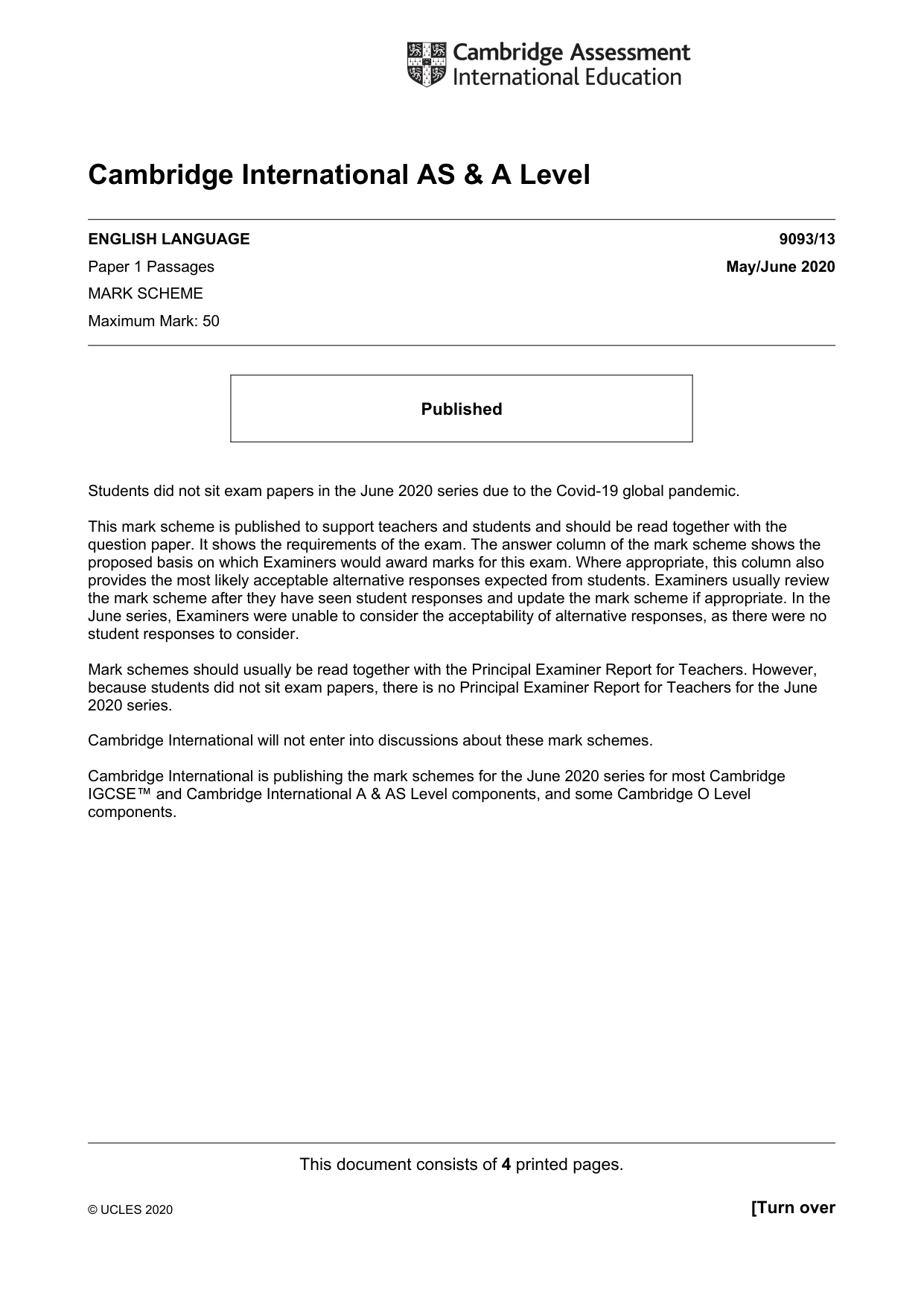
This document consists of 4 printed pages. © UCLES 2020 [Turn over Cambridge International AS & A Level ENGLISH LANGUAGE 9093/13 Paper 1 Passages May/June 2020 MARK SCHEME Maximum Mark: 50 Published Students did not sit exam papers in the June 2020 series due to the Covid-19 global pandemic. This mark scheme is published to support teachers and students and should be read together with the question paper. It shows the requirements of the exam. The answer column of the mark scheme shows the proposed basis on which Examiners would award marks for this exam. Where appropriate, this column also provides the most likely acceptable alternative responses expected from students. Examiners usually review the mark scheme after they have seen student responses and update the mark scheme if appropriate. In the June series, Examiners were unable to consider the acceptability of alternative responses, as there were no student responses to consider. Mark schemes should usually be read together with the Principal Examiner Report for Teachers. However, because students did not sit exam papers, there is no Principal Examiner Report for Teachers for the June 2020 series. Cambridge International will not enter into discussions about these mark schemes. Cambridge International is publishing the mark schemes for the June 2020 series for most Cambridge IGCSE™ and Cambridge International A & AS Level components, and some Cambridge O Level components.
Mark scheme, page 2
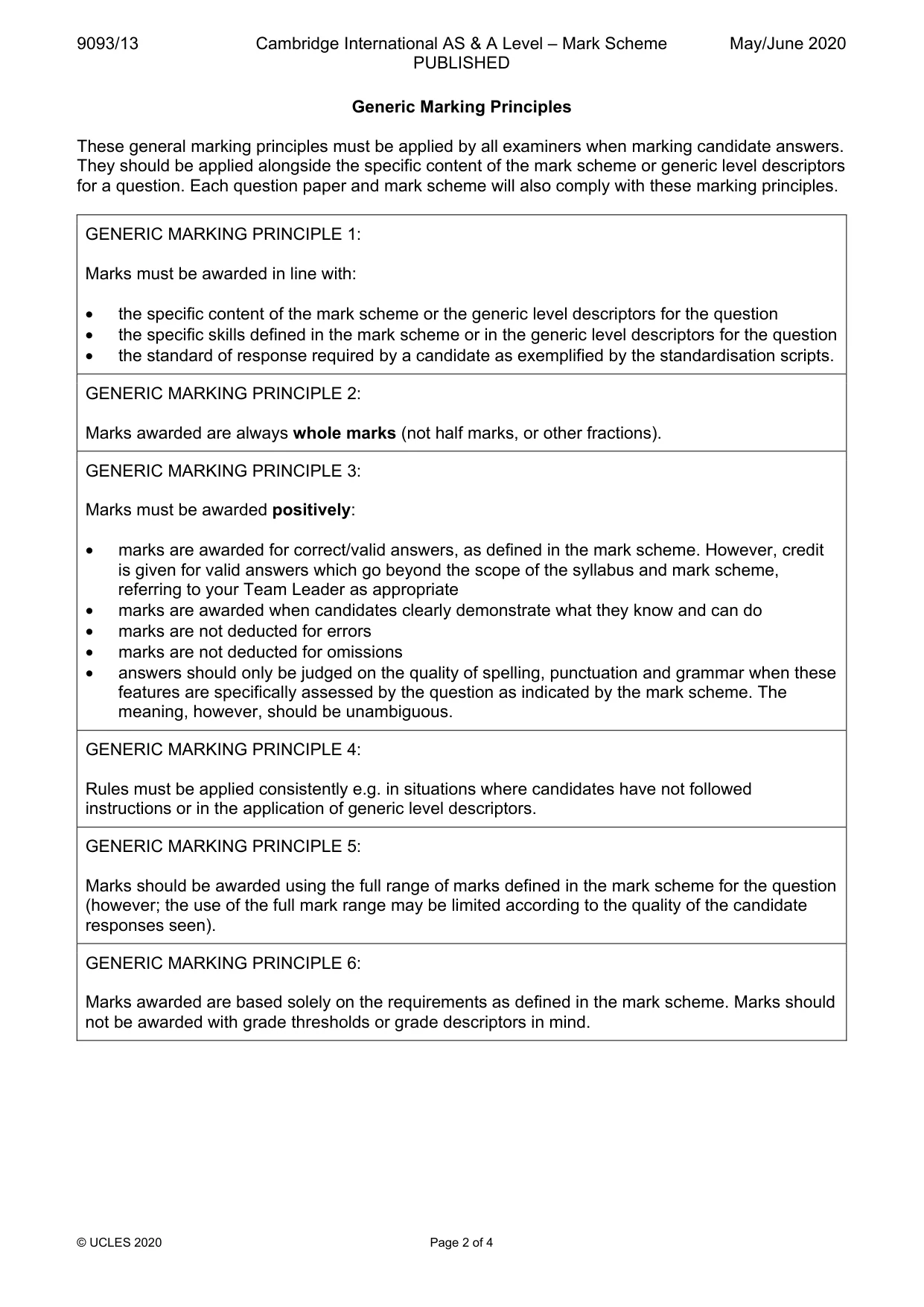
9093/13 Cambridge International AS & A Level – Mark Scheme PUBLISHED May/June 2020 © UCLES 2020 Page 2 of 4 Generic Marking Principles These general marking principles must be applied by all examiners when marking candidate answers. They should be applied alongside the specific content of the mark scheme or generic level descriptors for a question. Each question paper and mark scheme will also comply with these marking principles. GENERIC MARKING PRINCIPLE 1: Marks must be awarded in line with: • the specific content of the mark scheme or the generic level descriptors for the question • the specific skills defined in the mark scheme or in the generic level descriptors for the question • the standard of response required by a candidate as exemplified by the standardisation scripts. GENERIC MARKING PRINCIPLE 2: Marks awarded are always whole marks (not half marks, or other fractions). GENERIC MARKING PRINCIPLE 3: Marks must be awarded positively: • marks are awarded for correct/valid answers, as defined in the mark scheme. However, credit is given for valid answers which go beyond the scope of the syllabus and mark scheme, referring to your Team Leader as appropriate • marks are awarded when candidates clearly demonstrate what they know and can do • marks are not deducted for errors • marks are not deducted for omissions • answers should only be judged on the quality of spelling, punctuation and grammar when these features are specifically assessed by the question as indicated by the mark scheme. The meaning, however, should be unambiguous. GENERIC MARKING PRINCIPLE 4: Rules must be applied consistently e.g. in situations where candidates have not followed instructions or in the application of generic level descriptors. GENERIC MARKING PRINCIPLE 5: Marks should be awarded using the full range of marks defined in the mark scheme for the question (however; the use of the full mark range may be limited according to the quality of the candidate responses seen). GENERIC MARKING PRINCIPLE 6: Marks awarded are based solely on the requirements as defined in the mark scheme. Marks should not be awarded with grade thresholds or grade descriptors in mind.
Mark scheme, page 3
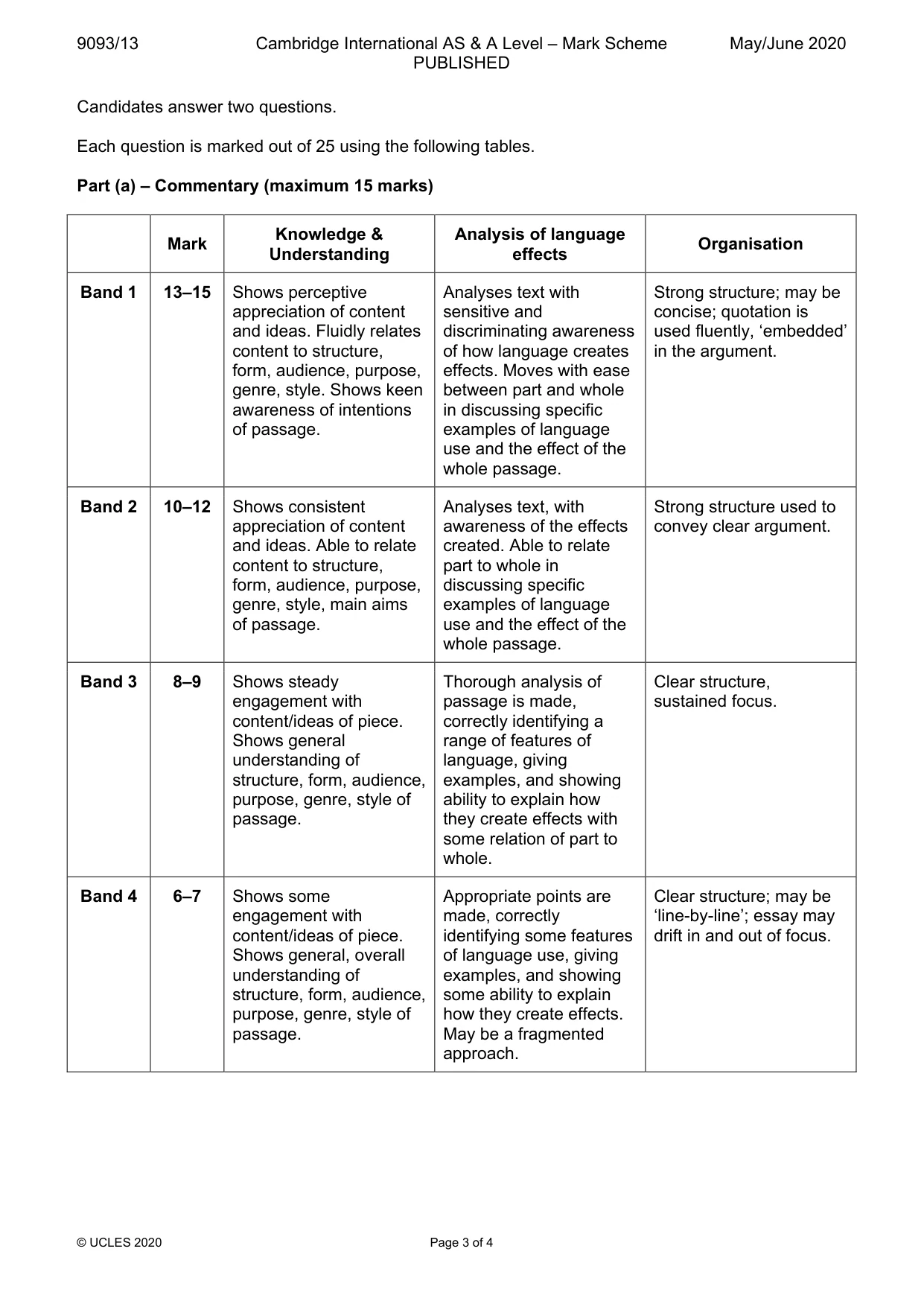
9093/13 Cambridge International AS & A Level – Mark Scheme PUBLISHED May/June 2020 © UCLES 2020 Page 3 of 4 Candidates answer two questions. Each question is marked out of 25 using the following tables. Part (a) – Commentary (maximum 15 marks) Mark Knowledge & Understanding Analysis of language effects Organisation Band 1 13–15 Shows perceptive appreciation of content and ideas. Fluidly relates content to structure, form, audience, purpose, genre, style. Shows keen awareness of intentions of passage. Analyses text with sensitive and discriminating awareness of how language creates effects. Moves with ease between part and whole in discussing specific examples of language use and the effect of the whole passage. Strong structure; may be concise; quotation is used fluently, ‘embedded’ in the argument. Band 2 10–12 Shows consistent appreciation of content and ideas. Able to relate content to structure, form, audience, purpose, genre, style, main aims of passage. Analyses text, with awareness of the effects created. Able to relate part to whole in discussing specific examples of language use and the effect of the whole passage. Strong structure used to convey clear argument. Band 3 8–9 Shows steady engagement with content/ideas of piece. Shows general understanding of structure, form, audience, purpose, genre, style of passage. Thorough analysis of passage is made, correctly identifying a range of features of language, giving examples, and showing ability to explain how they create effects with some relation of part to whole. Clear structure, sustained focus. Band 4 6–7 Shows some engagement with content/ideas of piece. Shows general, overall understanding of structure, form, audience, purpose, genre, style of passage. Appropriate points are made, correctly identifying some features of language use, giving examples, and showing some ability to explain how they create effects. May be a fragmented approach. Clear structure; may be ‘line-by-line’; essay may drift in and out of focus.
Mark scheme, page 4
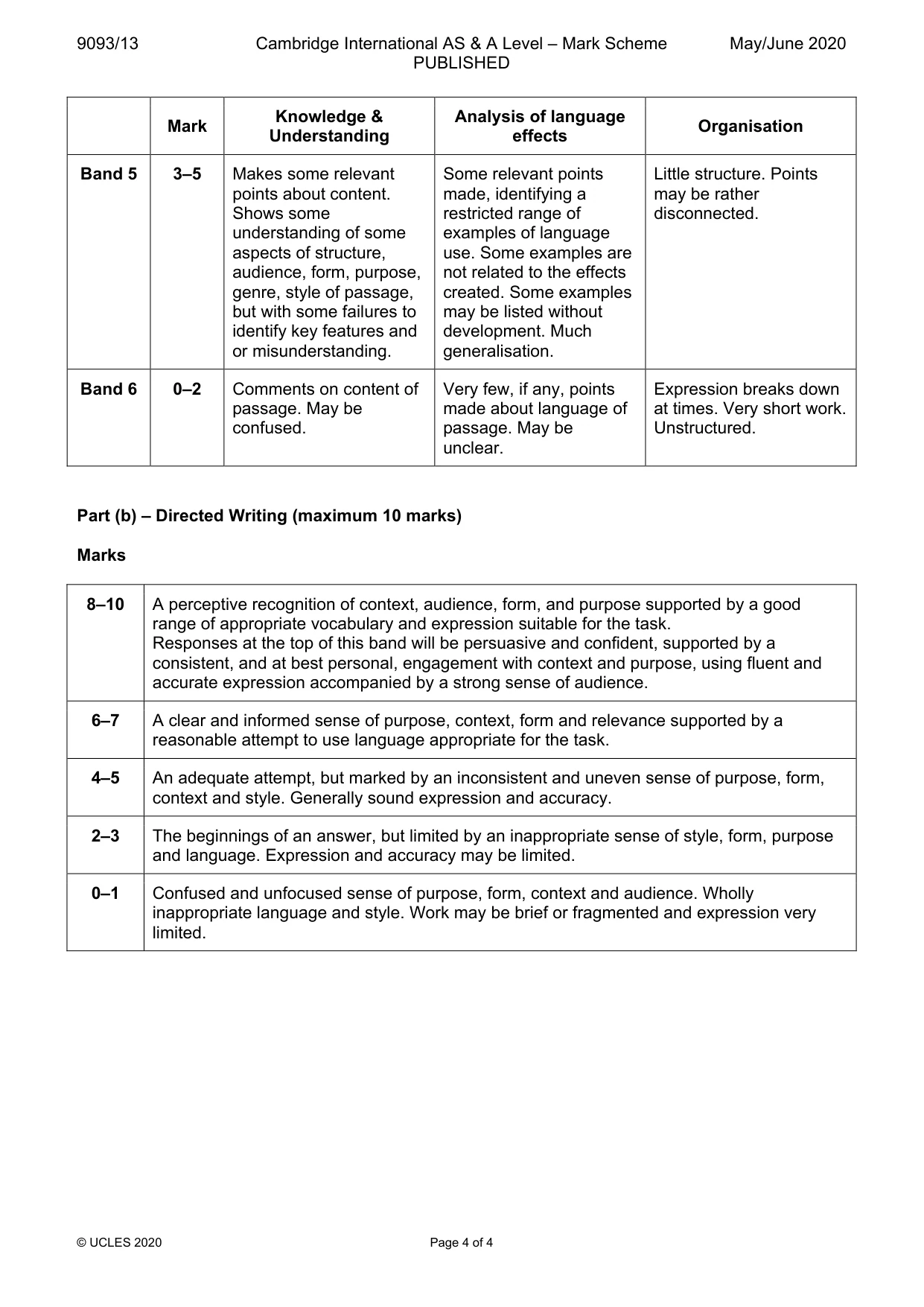
9093/13 Cambridge International AS & A Level – Mark Scheme PUBLISHED May/June 2020 © UCLES 2020 Page 4 of 4 Mark Knowledge & Understanding Analysis of language effects Organisation Band 5 3–5 Makes some relevant points about content. Shows some understanding of some aspects of structure, audience, form, purpose, genre, style of passage, but with some failures to identify key features and or misunderstanding. Some relevant points made, identifying a restricted range of examples of language use. Some examples are not related to the effects created. Some examples may be listed without development. Much generalisation. Little structure. Points may be rather disconnected. Band 6 0–2 Comments on content of passage. May be confused. Very few, if any, points made about language of passage. May be unclear. Expression breaks down at times. Very short work. Unstructured. Part (b) – Directed Writing (maximum 10 marks) Marks 8–10 A perceptive recognition of context, audience, form, and purpose supported by a good range of appropriate vocabulary and expression suitable for the task. Responses at the top of this band will be persuasive and confident, supported by a consistent, and at best personal, engagement with context and purpose, using fluent and accurate expression accompanied by a strong sense of audience. 6–7 A clear and informed sense of purpose, context, form and relevance supported by a reasonable attempt to use language appropriate for the task. 4–5 An adequate attempt, but marked by an inconsistent and uneven sense of purpose, form, context and style. Generally sound expression and accuracy. 2–3 The beginnings of an answer, but limited by an inappropriate sense of style, form, purpose and language. Expression and accuracy may be limited. 0–1 Confused and unfocused sense of purpose, form, context and audience. Wholly inappropriate language and style. Work may be brief or fragmented and expression very limited.