Cambridge A Level English - Language AS and A Level (from 2014) 9093 — 2020 May/June Paper 1 · Variant 2
9093/12/M/J/20
The question paper and its mark scheme, free to read here and free to download. This is Cambridge’s own paper, exactly as it was sat.
Question paper8 pages
Mark scheme4 pages
Answers below. Sit the paper first if you are practising.
Paper as text
Question paper, page 1
Cambridge International AS & A Level This document has 8 pages. Blank pages are indicated. DC (LK) 186781/1 © UCLES 2020 [Turn over ENGLISH LANGUAGE 9093/12 Paper 1 Passages May/June 2020 2 hours 15 minutes You must answer on the enclosed answer booklet. You will need: Answer booklet (enclosed) INSTRUCTIONS ● Answer two questions in total: Answer Question 1. Answer either Question 2 or Question 3. ● Follow the instructions on the front cover of the answer booklet. If you need additional answer paper, ask the invigilator for a continuation booklet. ● You are reminded of the need for good English and clear presentation in your answers. INFORMATION ● The total mark for this paper is 50. ● The number of marks for each question or part question is shown in brackets [ ]. * 4 3 3 8 7 7 4 2 4 8 *
Question paper, page 2
2 9093/12/M/J/20 © UCLES 2020 Answer Question 1 and either Question 2 or Question 3. 1 The following text is taken from a letter written in 1973 by the famous American novelist Kurt Vonnegut to Charles McCarthy, the Chairman of the Drake High School Board. Considering one of Vonnegut’s novels to be obscene, McCarthy had ordered the school to burn their copies of it. (a) Comment on the language and style of the text. [15] (b) Imagine you are a journalist and, having read Vonnegut’s letter many years later, you decide to write an editorial piece about his life. Basing your writing closely on the material of the original text, and using 120 to 150 of your own words, write a section of the editorial. [10] November 16, 1973 Dear Mr McCarthy: I am writing to you in your capacity as Chairman of the Drake School Board. I am among those American writers whose books have been destroyed in the now famous furnace of your school. Certain members of your community have suggested that my work is evil. This is extraordinarily insulting to me. The news from Drake indicates to me that books and writers are very unreal to you people. I am writing this letter to let you know how real I am. I want you to know, too, that my publisher and I have done absolutely nothing to exploit the disgusting news from Drake. We are not clapping each other on the back, crowing about all the books we will sell because of the news. We have declined to go on television, have written no fiery letters to editorial pages, have granted no lengthy interviews. We are angered and sickened and saddened. And no copies of this letter have been sent to anybody else. You now hold the only copy in your hands. It is a strictly private letter from me to the people of Drake, who have done so much to damage my reputation in the eyes of their children and then in the eyes of the world. Do you have the courage and ordinary decency to show this letter to the people, or will it, too, be consigned to the fires of your furnace? I gather from what I read in the papers and hear on television that you imagine me, and some other writers, too, as being sort of rat-like people who enjoy making money from poisoning the minds of young people. I am in fact a large, strong person, fifty-one years old, who did a lot of farm work as a boy, who is good with tools. I have raised six children, three my own, and three adopted. They have all turned out well. Two of them are farmers. I am a combat infantry veteran from World War II, and hold a Purple Heart1. I have earned whatever I own by hard work. I have never been arrested or sued for anything. I am so much trusted with young people and by young people that I have served on the faculties of the University of Iowa, Harvard, and the City College of New York. Every year, I receive at least a dozen invitations to be commencement speaker at colleges and high schools. My books are probably more widely used in schools than those of any other living American fiction writer. If you were to bother to read my books, to behave as educated persons would, you would learn that they are not sexy, and do not argue in favour of wildness of any 5 10 15 20 25 30
Question paper, page 3
3 9093/12/M/J/20 © UCLES 2020 [Turn over kind. They beg that people be kinder and more responsible than they often are. It is true that some of the characters speak coarsely. That is because people speak coarsely in real life. Especially soldiers and hard-working men speak coarsely, and even our most sheltered children know that. And we all know, too, that those words really don’t damage children much. They didn’t damage us when we were young. It was evil deeds and lying that hurt us. If you and your board are now determined to show that you in fact have wisdom and maturity when you exercise your powers over the education of your young, then you should acknowledge that it was a rotten lesson you taught young people in a free society when you denounced and then burned books – books you hadn’t even read. You should also resolve to expose your children to all sorts of opinions and information, in order that they will be better equipped to make decisions and to survive. Again: you have insulted me, and I am a good citizen, and I am very real. Kurt Vonnegut 1Purple Heart: an American military medal 35 40 45
Question paper, page 4
4 9093/12/M/J/20 © UCLES 2020 2 The following text is taken from the website of a travel agency that specialises in holidays in Brazil. The text includes details of the first two days of a seven-day trip to Rio de Janeiro, set to take place around the time of the 2016 Summer Olympics. (a) Comment on the language and style of the text. [15] (b) Imagine you decided to go on the trip described in the text, and have just returned to your hotel on the evening of Day 2. You decide to share your thoughts and feelings about the trip on your personal travel blog. Basing your writing closely on the material of the original passage, and using 120 to 150 of your own words, write a section of your blog post. [10] Rio Olympics Travel Packages Rio Olympics Travel Packages Synopsis Aug 5th to 21st, the 2016 Summer Olympics will take place in the ‘Marvelous City’, Rio de Janeiro. On this tour, not only will you get to experience the wonders of a truly distinct, vibrant and geographically beautiful city but you will be there, live, during the Summer Olympics, one of the largest events in the world! Given the magnitude of this event, there will be a huge influx of people visiting the city simultaneously. Rio will be bustling. However, by leaving all the logistics to us, you can rest assured that everything will be taken care of and you can simply focus on enjoying your experience to the maximum! Remember that our Rio Olympics Travel Packages can be customized to fit your particular needs. Rio de Janeiro Info Situated between lush, Atlantic Rainforest-covered mountains and breathtaking beaches, the Cidade Maravilhosa (Marvelous City) has an allure like no other. Rio’s passion and zeal are instantly felt upon arrival as a result of the carioca1 way of life, where every day seems like a celebration. While large-scale festivities such as Carnaval make Rio famous, there are countless occasions to enjoy all year long: Saturday at Ipanema Beach where some of the bikini-clad Brazilians bask in the tropical sun; a festa (party) in Lapa; football at Maracanã; or an impromptu roda de samba (samba circle) on the sidewalks of Leblon, Copacabana or Lagoa. The spectacular landscape is another of Rio’s virtues. Majestic peaks, golden beaches and deep blue sea offer a range of adventure. The Christ the Redeemer statue and Sugarloaf Mountain are just the beginning of Rio’s wonderful offerings; ride great surf breaks, trek through Tijuca’s rainforest, or hike up Morro Dois Irmaos (Two Brothers Hill) for one of the most impressive views of the city. Rio Olympics Travel Packages Itinerary: Day by Day Day 1: Aug 4th, 2016: Arrive in Rio de Janeiro Start one of our many possible Rio Olympics Travel Packages at the Rio airport where our tour representative will be waiting for you to escort you to your accommodation by air-conditioned coach. Embrace the lively carioca lifestyle by going for a stroll along the boardwalk, relaxing on the beach, going shopping, and people-watching. For dinner, enjoy a delicious Brazilian barbecue at one of the most highly touted churrascarias in the city, included in your tour. 5 10 15 20 25 30
Question paper, page 5
5 9093/12/M/J/20 © UCLES 2020 [Turn over Day 2: Aug 5th, 2016: Rio de Janeiro City Tour After a fresh Brazilian breakfast at the hotel, our English speaking guide will pick you up by air-conditioned coach for a half-day tour of Rio de Janeiro. First head up to Sugarloaf Mountain, a granite peak that towers over Guanabara Bay and is right in the midst of the city. Take the cable car ride to the top of Urca Mountain. The views of the city, the ocean, the islands in the bay, and the jungle-covered peaks are truly amazing. Then ascend the most famous peak in Rio de Janeiro, Corcovado Mountain where the iconic Christ the Redeemer statue sits on top, gazing with outstretched arms over Rio. Enjoy panoramic views of the city’s incredible natural terrain as well as close-ups of the statue. Go back to the hotel to freshen up, get a bite to eat then and transfer by private coach to the 2016 Summer Olympics Opening Ceremony in Maracanã stadium. Our tour representative will be waiting for you at the designated pick up location to take you back to your hotel afterwards. 1carioca: a native inhabitant of the city of Rio de Janeiro 35 40 45
Question paper, page 6
6 9093/12/M/J/20 © UCLES 2020 3 The following text is taken from a memoir entitled The Man Who Climbs Trees by James Aldred. (a) Comment on the language and style of the text. [15] (b) Imagine you have been asked to write a review of Aldred’s book for a nature magazine. Basing your writing closely on the material of the original passage, and using 120 to 150 of your own words, write a section of the book review. [10] I had been woken by a sudden downdraft of air that left my hammock gently swaying. Lying on my side, I stared in drowsy amazement at the huge pre-historic looking bird that had just landed next to me. The two of us were 200 feet off the ground in the top of a tree in Borneo, and I’d never seen a rhinoceros hornbill so close-up before. It hadn’t noticed me yet and was using its long beak to preen its breast feathers. A huge colourful casque1 curled up from the top of its head like a flamboyant Turkish slipper – fiery reds and yellows glowing brightly in the half light of dawn. I was entranced. A few seconds later it froze, then raised its pterodactyl head to peer at me with a ruby-red eye before launching off the branch into space. Immense black wings unfurled to catch its weight and it was gone. Swallowed in an instant by the thick morning mist. Rolling onto my back I lay staring up into the giant branches above. It had been a long night. The sweat from yesterday’s climb had long since congealed into a clammy grime all over me. My clothes were dank, gritty and torn and my skin crawled with biting ants. I had a burning rash on my chest from who knows what, and I’d been stung twice on the face by a night wasp sometime around midnight. But it was worth it – all of it. Encountering a hornbill like that was what it was all about. I was immersed in my very own dreamworld of swirling mists and fairy-tale creatures. There was nowhere else I’d rather be. The sun hadn’t yet risen and I was cold for the first time since arriving in Borneo, a welcome change from the usual stifling heat of the rainforest. Sunrise couldn’t be far off, but for now I was happy to lie back and watch the individual droplets of water drift past. They swirled in the visible currents of air, condensing as shiny beads on the metal of my climbing gear. I had slept in my safety harness attached to a rope, my only direct link to the other world far below. * * * Ten storeys above ground I was halfway up and the tree trunk still measured five feet in diameter. These Borneo trees are on a different scale to any other hardwoods in the world. I span round to take a look at the view. I had been saving this moment until I was way above the understorey, in a place that would do it justice. But I had felt its presence lurking behind me the whole time as I climbed. An almost palpable, brooding watchfulness, as if a thousand pairs of hidden eyes were boring into me from the surrounding jungle. 5 10 15 20 25 30
Question paper, page 7
7 9093/12/M/J/20 © UCLES 2020 As I twisted round, I was greeted by one of the most breath-taking views I’d ever seen. Dense rainforest swept away from me, cascading steeply down from the ridge to merge into an enticing landscape of giant trees far below. Many miles away on the horizon the forest rose back up to swarm over a ridge of tall, rugged hills. A vast ocean of unexplored, virgin jungle. What hidden wonders lay out there in those trees? 1casque: a decorative growth on the beak 35
Question paper, page 8
8 9093/12/M/J/20 © UCLES 2020 Permission to reproduce items where third-party owned material protected by copyright is included has been sought and cleared where possible. Every reasonable effort has been made by the publisher (UCLES) to trace copyright holders, but if any items requiring clearance have unwittingly been included, the publisher will be pleased to make amends at the earliest possible opportunity. To avoid the issue of disclosure of answer-related information to candidates, all copyright acknowledgements are reproduced online in the Cambridge Assessment International Education Copyright Acknowledgements Booklet. This is produced for each series of examinations and is freely available to download at www.cambridgeinternational.org after the live examination series. Cambridge Assessment International Education is part of the Cambridge Assessment Group. Cambridge Assessment is the brand name of the University of Cambridge Local Examinations Syndicate (UCLES), which itself is a department of the University of Cambridge. BLANK PAGE
Mark scheme, page 1
This document consists of 4 printed pages. © UCLES 2020 [Turn over Cambridge International AS & A Level ENGLISH LANGUAGE 9093/12 Paper 1 Passages May/June 2020 MARK SCHEME Maximum Mark: 50 Published Students did not sit exam papers in the June 2020 series due to the Covid-19 global pandemic. This mark scheme is published to support teachers and students and should be read together with the question paper. It shows the requirements of the exam. The answer column of the mark scheme shows the proposed basis on which Examiners would award marks for this exam. Where appropriate, this column also provides the most likely acceptable alternative responses expected from students. Examiners usually review the mark scheme after they have seen student responses and update the mark scheme if appropriate. In the June series, Examiners were unable to consider the acceptability of alternative responses, as there were no student responses to consider. Mark schemes should usually be read together with the Principal Examiner Report for Teachers. However, because students did not sit exam papers, there is no Principal Examiner Report for Teachers for the June 2020 series. Cambridge International will not enter into discussions about these mark schemes. Cambridge International is publishing the mark schemes for the June 2020 series for most Cambridge IGCSE™ and Cambridge International A & AS Level components, and some Cambridge O Level components.
Mark scheme, page 2
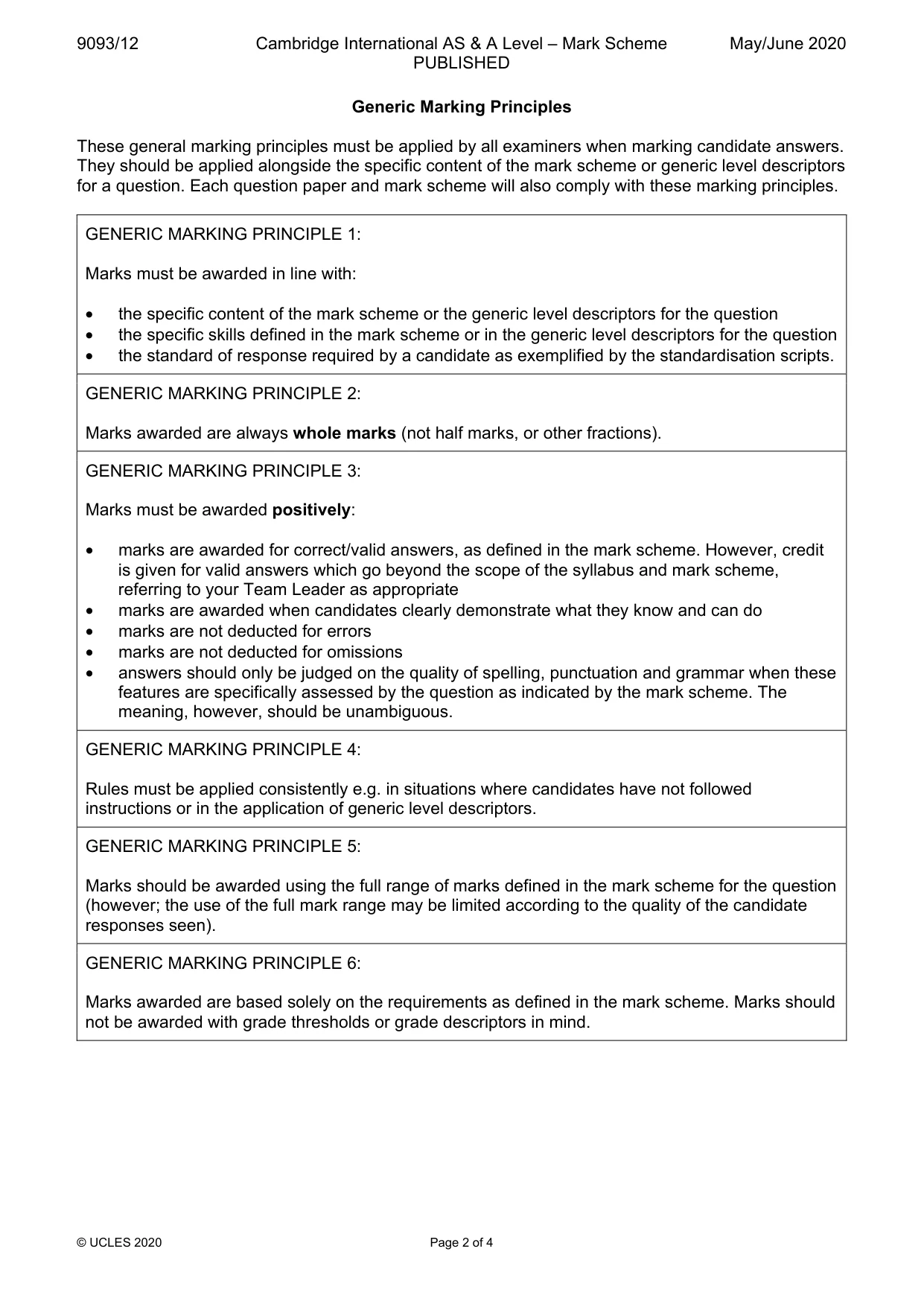
9093/12 Cambridge International AS & A Level – Mark Scheme PUBLISHED May/June 2020 © UCLES 2020 Page 2 of 4 Generic Marking Principles These general marking principles must be applied by all examiners when marking candidate answers. They should be applied alongside the specific content of the mark scheme or generic level descriptors for a question. Each question paper and mark scheme will also comply with these marking principles. GENERIC MARKING PRINCIPLE 1: Marks must be awarded in line with: • the specific content of the mark scheme or the generic level descriptors for the question • the specific skills defined in the mark scheme or in the generic level descriptors for the question • the standard of response required by a candidate as exemplified by the standardisation scripts. GENERIC MARKING PRINCIPLE 2: Marks awarded are always whole marks (not half marks, or other fractions). GENERIC MARKING PRINCIPLE 3: Marks must be awarded positively: • marks are awarded for correct/valid answers, as defined in the mark scheme. However, credit is given for valid answers which go beyond the scope of the syllabus and mark scheme, referring to your Team Leader as appropriate • marks are awarded when candidates clearly demonstrate what they know and can do • marks are not deducted for errors • marks are not deducted for omissions • answers should only be judged on the quality of spelling, punctuation and grammar when these features are specifically assessed by the question as indicated by the mark scheme. The meaning, however, should be unambiguous. GENERIC MARKING PRINCIPLE 4: Rules must be applied consistently e.g. in situations where candidates have not followed instructions or in the application of generic level descriptors. GENERIC MARKING PRINCIPLE 5: Marks should be awarded using the full range of marks defined in the mark scheme for the question (however; the use of the full mark range may be limited according to the quality of the candidate responses seen). GENERIC MARKING PRINCIPLE 6: Marks awarded are based solely on the requirements as defined in the mark scheme. Marks should not be awarded with grade thresholds or grade descriptors in mind.
Mark scheme, page 3
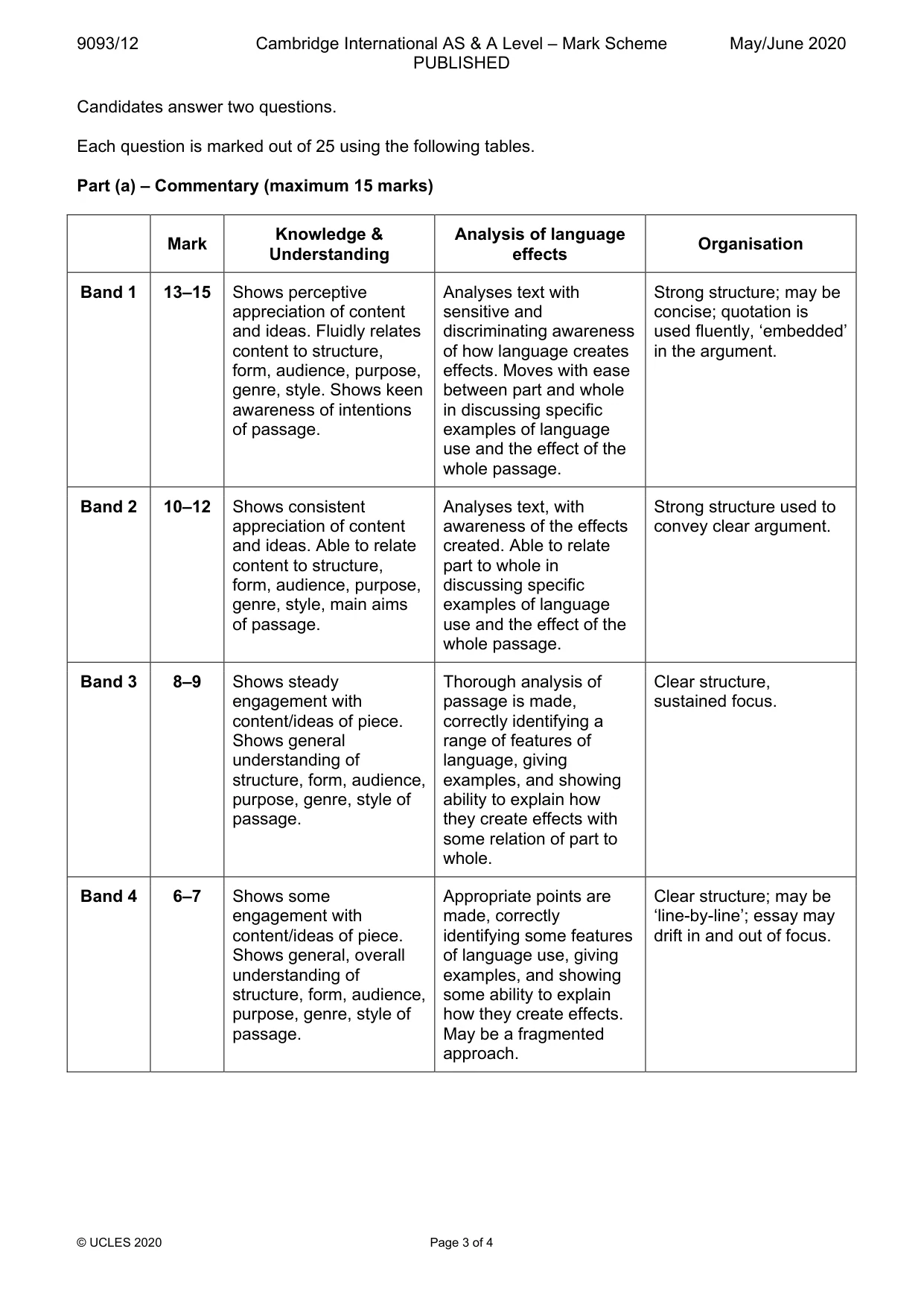
9093/12 Cambridge International AS & A Level – Mark Scheme PUBLISHED May/June 2020 © UCLES 2020 Page 3 of 4 Candidates answer two questions. Each question is marked out of 25 using the following tables. Part (a) – Commentary (maximum 15 marks) Mark Knowledge & Understanding Analysis of language effects Organisation Band 1 13–15 Shows perceptive appreciation of content and ideas. Fluidly relates content to structure, form, audience, purpose, genre, style. Shows keen awareness of intentions of passage. Analyses text with sensitive and discriminating awareness of how language creates effects. Moves with ease between part and whole in discussing specific examples of language use and the effect of the whole passage. Strong structure; may be concise; quotation is used fluently, ‘embedded’ in the argument. Band 2 10–12 Shows consistent appreciation of content and ideas. Able to relate content to structure, form, audience, purpose, genre, style, main aims of passage. Analyses text, with awareness of the effects created. Able to relate part to whole in discussing specific examples of language use and the effect of the whole passage. Strong structure used to convey clear argument. Band 3 8–9 Shows steady engagement with content/ideas of piece. Shows general understanding of structure, form, audience, purpose, genre, style of passage. Thorough analysis of passage is made, correctly identifying a range of features of language, giving examples, and showing ability to explain how they create effects with some relation of part to whole. Clear structure, sustained focus. Band 4 6–7 Shows some engagement with content/ideas of piece. Shows general, overall understanding of structure, form, audience, purpose, genre, style of passage. Appropriate points are made, correctly identifying some features of language use, giving examples, and showing some ability to explain how they create effects. May be a fragmented approach. Clear structure; may be ‘line-by-line’; essay may drift in and out of focus.
Mark scheme, page 4
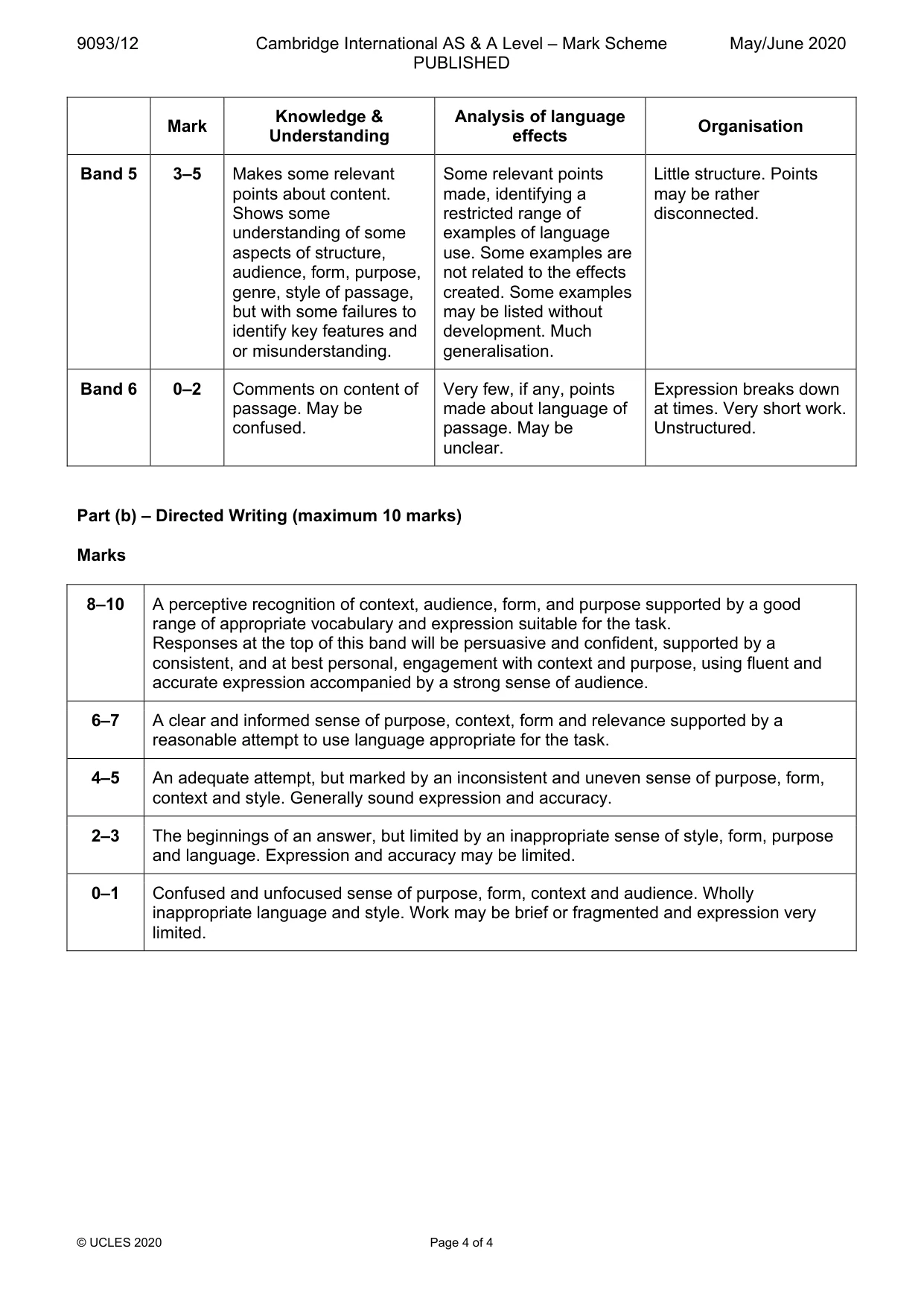
9093/12 Cambridge International AS & A Level – Mark Scheme PUBLISHED May/June 2020 © UCLES 2020 Page 4 of 4 Mark Knowledge & Understanding Analysis of language effects Organisation Band 5 3–5 Makes some relevant points about content. Shows some understanding of some aspects of structure, audience, form, purpose, genre, style of passage, but with some failures to identify key features and or misunderstanding. Some relevant points made, identifying a restricted range of examples of language use. Some examples are not related to the effects created. Some examples may be listed without development. Much generalisation. Little structure. Points may be rather disconnected. Band 6 0–2 Comments on content of passage. May be confused. Very few, if any, points made about language of passage. May be unclear. Expression breaks down at times. Very short work. Unstructured. Part (b) – Directed Writing (maximum 10 marks) Marks 8–10 A perceptive recognition of context, audience, form, and purpose supported by a good range of appropriate vocabulary and expression suitable for the task. Responses at the top of this band will be persuasive and confident, supported by a consistent, and at best personal, engagement with context and purpose, using fluent and accurate expression accompanied by a strong sense of audience. 6–7 A clear and informed sense of purpose, context, form and relevance supported by a reasonable attempt to use language appropriate for the task. 4–5 An adequate attempt, but marked by an inconsistent and uneven sense of purpose, form, context and style. Generally sound expression and accuracy. 2–3 The beginnings of an answer, but limited by an inappropriate sense of style, form, purpose and language. Expression and accuracy may be limited. 0–1 Confused and unfocused sense of purpose, form, context and audience. Wholly inappropriate language and style. Work may be brief or fragmented and expression very limited.