Cambridge A Level English - Language AS and A Level (from 2014) 9093 — 2020 May/June Paper 1 · Variant 1
9093/11/M/J/20
The question paper and its mark scheme, free to read here and free to download. This is Cambridge’s own paper, exactly as it was sat.
Question paper8 pages
Mark scheme4 pages
Answers below. Sit the paper first if you are practising.
Paper as text
Question paper, page 1
Cambridge International AS & A Level This document has 8 pages. Blank pages are indicated. DC (LK) 186780/2 © UCLES 2020 [Turn over ENGLISH LANGUAGE 9093/11 Paper 1 Passages May/June 2020 2 hours 15 minutes You must answer on the enclosed answer booklet. You will need: Answer booklet (enclosed) INSTRUCTIONS ● Answer two questions in total: Answer Question 1. Answer either Question 2 or Question 3. ● Follow the instructions on the front cover of the answer booklet. If you need additional answer paper, ask the invigilator for a continuation booklet. ● You are reminded of the need for good English and clear presentation in your answers. INFORMATION ● The total mark for this paper is 50. ● The number of marks for each question or part question is shown in brackets [ ]. * 3 9 3 1 1 7 3 6 4 9 *
Question paper, page 2
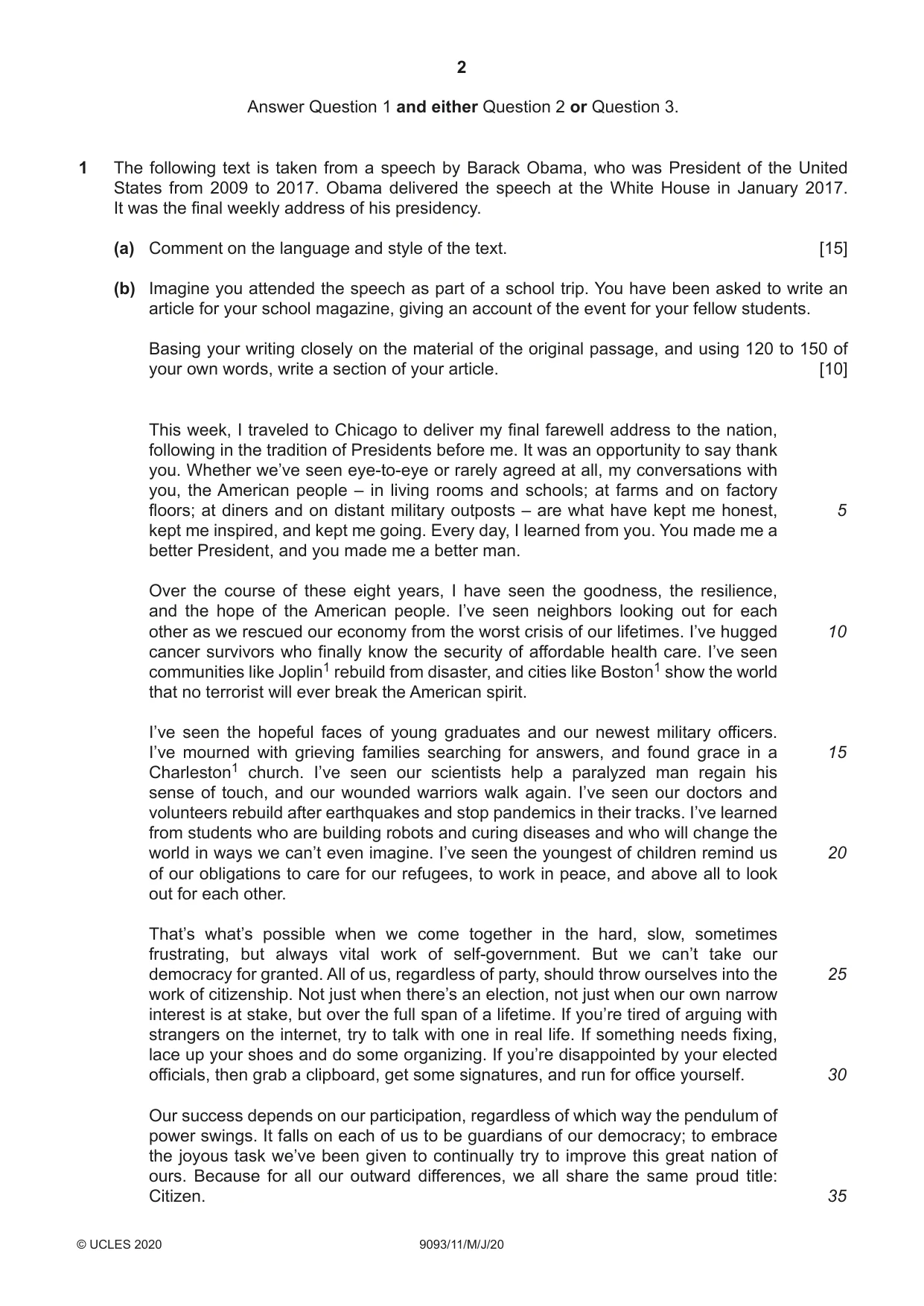
2 9093/11/M/J/20 © UCLES 2020 Answer Question 1 and either Question 2 or Question 3. 1 The following text is taken from a speech by Barack Obama, who was President of the United States from 2009 to 2017. Obama delivered the speech at the White House in January 2017. It was the final weekly address of his presidency. (a) Comment on the language and style of the text. [15] (b) Imagine you attended the speech as part of a school trip. You have been asked to write an article for your school magazine, giving an account of the event for your fellow students. Basing your writing closely on the material of the original passage, and using 120 to 150 of your own words, write a section of your article. [10] This week, I traveled to Chicago to deliver my final farewell address to the nation, following in the tradition of Presidents before me. It was an opportunity to say thank you. Whether we’ve seen eye-to-eye or rarely agreed at all, my conversations with you, the American people – in living rooms and schools; at farms and on factory floors; at diners and on distant military outposts – are what have kept me honest, kept me inspired, and kept me going. Every day, I learned from you. You made me a better President, and you made me a better man. Over the course of these eight years, I have seen the goodness, the resilience, and the hope of the American people. I’ve seen neighbors looking out for each other as we rescued our economy from the worst crisis of our lifetimes. I’ve hugged cancer survivors who finally know the security of affordable health care. I’ve seen communities like Joplin1 rebuild from disaster, and cities like Boston1 show the world that no terrorist will ever break the American spirit. I’ve seen the hopeful faces of young graduates and our newest military officers. I’ve mourned with grieving families searching for answers, and found grace in a Charleston1 church. I’ve seen our scientists help a paralyzed man regain his sense of touch, and our wounded warriors walk again. I’ve seen our doctors and volunteers rebuild after earthquakes and stop pandemics in their tracks. I’ve learned from students who are building robots and curing diseases and who will change the world in ways we can’t even imagine. I’ve seen the youngest of children remind us of our obligations to care for our refugees, to work in peace, and above all to look out for each other. That’s what’s possible when we come together in the hard, slow, sometimes frustrating, but always vital work of self-government. But we can’t take our democracy for granted. All of us, regardless of party, should throw ourselves into the work of citizenship. Not just when there’s an election, not just when our own narrow interest is at stake, but over the full span of a lifetime. If you’re tired of arguing with strangers on the internet, try to talk with one in real life. If something needs fixing, lace up your shoes and do some organizing. If you’re disappointed by your elected officials, then grab a clipboard, get some signatures, and run for office yourself. Our success depends on our participation, regardless of which way the pendulum of power swings. It falls on each of us to be guardians of our democracy; to embrace the joyous task we’ve been given to continually try to improve this great nation of ours. Because for all our outward differences, we all share the same proud title: Citizen. 5 10 15 20 25 30 35
Question paper, page 3
3 9093/11/M/J/20 © UCLES 2020 [Turn over It has been the honor of my life to serve you as President. Eight years later, I am even more optimistic about our country’s promise. And I look forward to working along your side, as a citizen, for all my days that remain. Thanks, everybody. God bless you, and God bless the United States of America. 1Joplin, Boston, Charleston: American cities that had suffered tragedies during Barack Obama’s presidency
Question paper, page 4
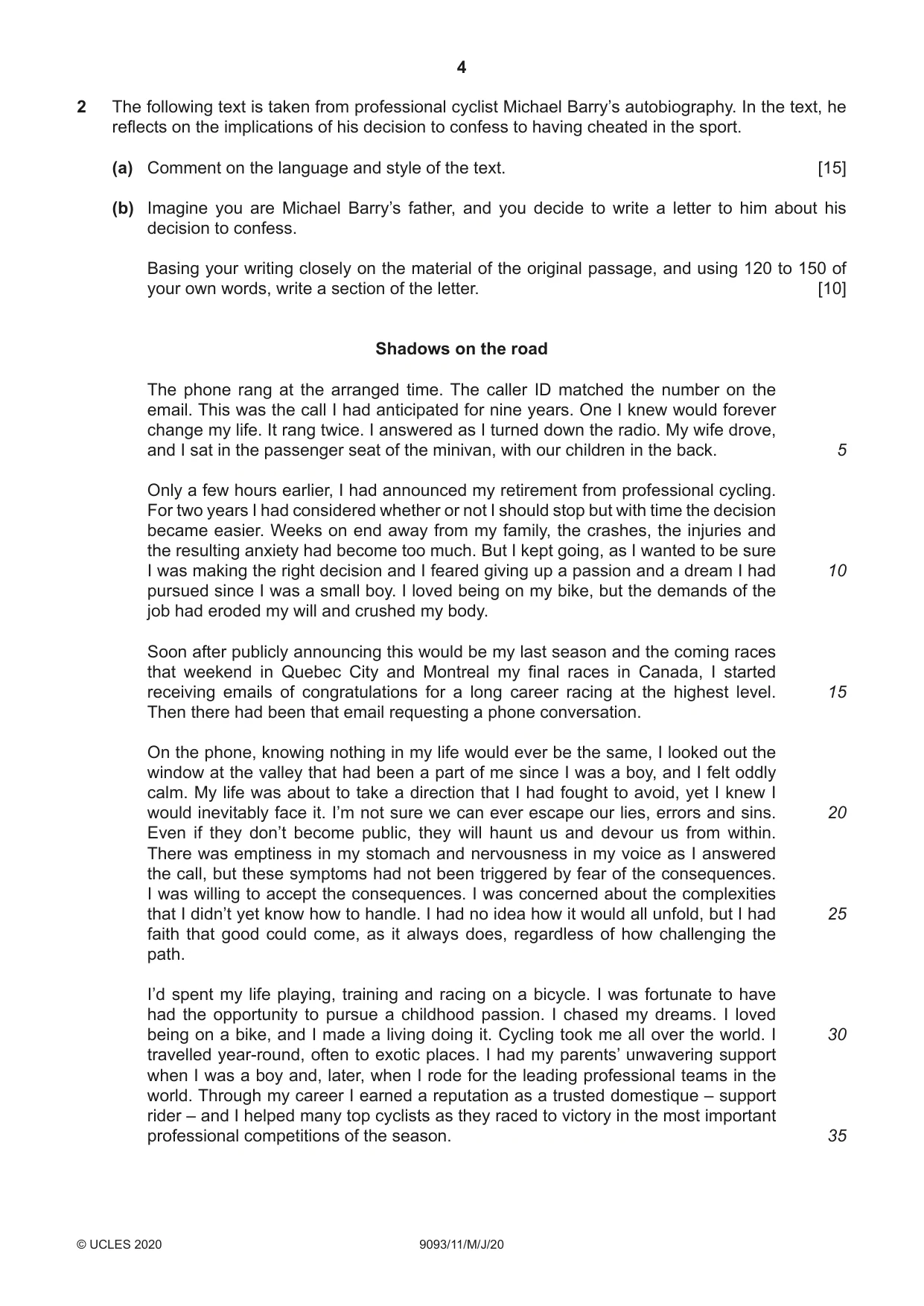
4 9093/11/M/J/20 © UCLES 2020 2 The following text is taken from professional cyclist Michael Barry’s autobiography. In the text, he reflects on the implications of his decision to confess to having cheated in the sport. (a) Comment on the language and style of the text. [15] (b) Imagine you are Michael Barry’s father, and you decide to write a letter to him about his decision to confess. Basing your writing closely on the material of the original passage, and using 120 to 150 of your own words, write a section of the letter. [10] Shadows on the road The phone rang at the arranged time. The caller ID matched the number on the email. This was the call I had anticipated for nine years. One I knew would forever change my life. It rang twice. I answered as I turned down the radio. My wife drove, and I sat in the passenger seat of the minivan, with our children in the back. Only a few hours earlier, I had announced my retirement from professional cycling. For two years I had considered whether or not I should stop but with time the decision became easier. Weeks on end away from my family, the crashes, the injuries and the resulting anxiety had become too much. But I kept going, as I wanted to be sure I was making the right decision and I feared giving up a passion and a dream I had pursued since I was a small boy. I loved being on my bike, but the demands of the job had eroded my will and crushed my body. Soon after publicly announcing this would be my last season and the coming races that weekend in Quebec City and Montreal my final races in Canada, I started receiving emails of congratulations for a long career racing at the highest level. Then there had been that email requesting a phone conversation. On the phone, knowing nothing in my life would ever be the same, I looked out the window at the valley that had been a part of me since I was a boy, and I felt oddly calm. My life was about to take a direction that I had fought to avoid, yet I knew I would inevitably face it. I’m not sure we can ever escape our lies, errors and sins. Even if they don’t become public, they will haunt us and devour us from within. There was emptiness in my stomach and nervousness in my voice as I answered the call, but these symptoms had not been triggered by fear of the consequences. I was willing to accept the consequences. I was concerned about the complexities that I didn’t yet know how to handle. I had no idea how it would all unfold, but I had faith that good could come, as it always does, regardless of how challenging the path. I’d spent my life playing, training and racing on a bicycle. I was fortunate to have had the opportunity to pursue a childhood passion. I chased my dreams. I loved being on a bike, and I made a living doing it. Cycling took me all over the world. I travelled year-round, often to exotic places. I had my parents’ unwavering support when I was a boy and, later, when I rode for the leading professional teams in the world. Through my career I earned a reputation as a trusted domestique – support rider – and I helped many top cyclists as they raced to victory in the most important professional competitions of the season. 5 10 15 20 25 30 35
Question paper, page 5
5 9093/11/M/J/20 © UCLES 2020 [Turn over A love of riding, the liberty of going distances at speed, alone or with friends, pushed me to get back on my bike when, perhaps, I should have given up. I’d felt the same emotion on the bike today as I’d felt as a boy when I first learned to ride. That emotion carried me to places I would never have imagined, drove me to do things that were wrong, crushed me, matured me, challenged me every day, cemented relationships, and informed my life’s pursuit. I wondered how I would tell my boys, and how they would deal with knowing their father had cheated. The people closest to me would be the hardest to tell. I wondered how they would react and if they would ever forgive me. I hoped that, through my testimony and through the investigation, these kids would never face the same realities as I had or have to make the same decisions as I did if they wanted to become professional cyclists. I still loved to ride. Racing had worn me out, but cycling had kept me going. It still does. 40 45
Question paper, page 6
6 9093/11/M/J/20 © UCLES 2020 3 The following text is taken from a promotional feature on the website of a company that specialises in unusual holidays in Africa. (a) Comment on the language and style of the text. [15] (b) Imagine that you are a writer for another holiday company that also specialises in unusual holidays. You have been asked to write a promotional feature for their website about the holidays they offer. Basing your writing closely on the language and style of the text, and using 120 to 150 of your own words, write a section of your promotional feature. [10] Here at Mahlatini we tailor-make each person’s holiday to their own unique requirements. Below are just a few of the holidays that we have suggested for clients who wished to experience something a little more unusual. Yoga & Pilates safaris What better place is there for people to recognise their place within the Universe and to reconnect with nature than the African wilderness? The combination of an exciting safari adventure with the wellness gained through yoga and meditation offers an incredible holistic experience that is not only good for the soul but also a wonderful opportunity to reconnect with yourself and others. A canoe safari down the Selinda Spillway in Botswana Imagine you are one of the early pioneers of this amazing area when the days were spent exploring the water channels by canoe and the nights were spent camping on the banks of the river. This trip is four days long, consisting of two full days and two half days of easy paddling. You get the opportunity to stop where and when you want and explore the area on foot. You can expect to encounter all manner of wildlife on this trip with the area particularly well known for its birdlife, along with elephant, buffalo, sable, roan and wild dog. Quirimbas Archipelago dhow1 safaris For those wanting a bit more out of their beach holiday than just a book and a sun lounger, why not take a unique safari by dhow between islands in the pristine Quirimbas Archipelago off Mozambique’s north coast? You will journey the islands by dhow, stop to snorkel on remote reefs, meet the local fishermen to haggle for your dinner and explore the uninhabited islands for birdlife and giant coconut crabs. Spend your evenings cooking fresh fish on an open fire under the stars, after which you climb into a comfortable bed in a tent pitched on the sandy beach. On Ibo Island you will stay in an old Portuguese mansion, now a beautiful lodge, and wander the streets surrounded by the vibe of the coastal culture. Vet safaris Vet safaris offer people the chance to get involved in conservation efforts and go on a life-altering adventure of a lifetime. Join African vets on wildlife immobilisation procedures or a species-specific interactive safari that takes you behind the scenes. With elements engaging to both the general public and to those already involved in the veterinary practice, your safari can be tailor-made to suit your needs. These safaris provide the irresistible opportunity to gain hands-on experience and up-close- and-personal encounters with some of Africa’s most famous and ferocious wildlife. 5 10 15 20 25 30 35
Question paper, page 7
7 9093/11/M/J/20 © UCLES 2020 A mountain biking safari in Botswana’s Mashatu Game Reserve The Cycle Mashatu Wilderness Trail is a unique four-day mountain biking getaway in the Mashatu Game Reserve, a big game area within the Northern Tuli Game Reserve of Botswana. It provides an extraordinary opportunity to ride at leisure along ancient elephant migration paths, cycle through vast herds of wildlife and to sleep under starlit African skies. Each group will have their distance, pace and routes tailored but the aim is to ride 4–5 hours per day, covering 30–40 km. Generally the pace is easy-going with regular game sightings and scenic picnic stops. Namaqualand and Cedarberg flower tours The spring flowers of South Africa’s Cape West Coast, Cedarberg and Namaqualand have a worldwide reputation. After the winter rains of May to July/August, the normally dry landscape becomes a carpet of wild flowers with vibrant bands of gousblomme and vygies, as well as nemesias, lachenalias, babiana, ixias and certain species found nowhere else in the world. The area is best visited in early August and late September. You can self-drive, join an escorted specialist flower tour or take a day trip from Cape Town. 1dhow: a long, thin sailing boat with one or two masts 40 45 50
Question paper, page 8
8 9093/11/M/J/20 © UCLES 2020 Permission to reproduce items where third-party owned material protected by copyright is included has been sought and cleared where possible. Every reasonable effort has been made by the publisher (UCLES) to trace copyright holders, but if any items requiring clearance have unwittingly been included, the publisher will be pleased to make amends at the earliest possible opportunity. To avoid the issue of disclosure of answer-related information to candidates, all copyright acknowledgements are reproduced online in the Cambridge Assessment International Education Copyright Acknowledgements Booklet. This is produced for each series of examinations and is freely available to download at www.cambridgeinternational.org after the live examination series. Cambridge Assessment International Education is part of the Cambridge Assessment Group. Cambridge Assessment is the brand name of the University of Cambridge Local Examinations Syndicate (UCLES), which itself is a department of the University of Cambridge. BLANK PAGE
Mark scheme, page 1
This document consists of 4 printed pages. © UCLES 2020 [Turn over Cambridge International AS & A Level ENGLISH LANGUAGE 9093/11 Paper 1 Passages May/June 2020 MARK SCHEME Maximum Mark: 50 Published Students did not sit exam papers in the June 2020 series due to the Covid-19 global pandemic. This mark scheme is published to support teachers and students and should be read together with the question paper. It shows the requirements of the exam. The answer column of the mark scheme shows the proposed basis on which Examiners would award marks for this exam. Where appropriate, this column also provides the most likely acceptable alternative responses expected from students. Examiners usually review the mark scheme after they have seen student responses and update the mark scheme if appropriate. In the June series, Examiners were unable to consider the acceptability of alternative responses, as there were no student responses to consider. Mark schemes should usually be read together with the Principal Examiner Report for Teachers. However, because students did not sit exam papers, there is no Principal Examiner Report for Teachers for the June 2020 series. Cambridge International will not enter into discussions about these mark schemes. Cambridge International is publishing the mark schemes for the June 2020 series for most Cambridge IGCSE™ and Cambridge International A & AS Level components, and some Cambridge O Level components.
Mark scheme, page 2
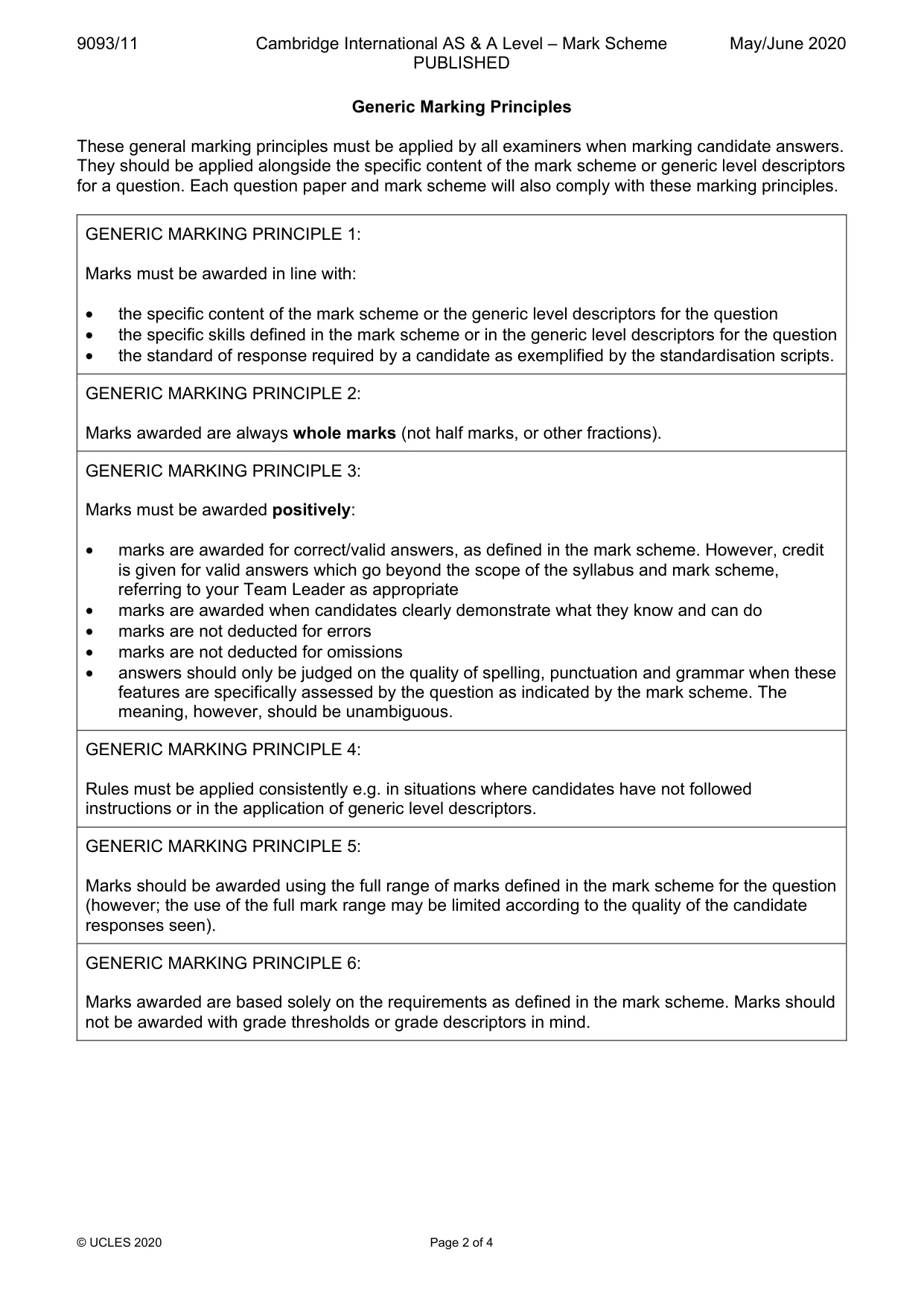
9093/11 Cambridge International AS & A Level – Mark Scheme PUBLISHED May/June 2020 © UCLES 2020 Page 2 of 4 Generic Marking Principles These general marking principles must be applied by all examiners when marking candidate answers. They should be applied alongside the specific content of the mark scheme or generic level descriptors for a question. Each question paper and mark scheme will also comply with these marking principles. GENERIC MARKING PRINCIPLE 1: Marks must be awarded in line with: • the specific content of the mark scheme or the generic level descriptors for the question • the specific skills defined in the mark scheme or in the generic level descriptors for the question • the standard of response required by a candidate as exemplified by the standardisation scripts. GENERIC MARKING PRINCIPLE 2: Marks awarded are always whole marks (not half marks, or other fractions). GENERIC MARKING PRINCIPLE 3: Marks must be awarded positively: • marks are awarded for correct/valid answers, as defined in the mark scheme. However, credit is given for valid answers which go beyond the scope of the syllabus and mark scheme, referring to your Team Leader as appropriate • marks are awarded when candidates clearly demonstrate what they know and can do • marks are not deducted for errors • marks are not deducted for omissions • answers should only be judged on the quality of spelling, punctuation and grammar when these features are specifically assessed by the question as indicated by the mark scheme. The meaning, however, should be unambiguous. GENERIC MARKING PRINCIPLE 4: Rules must be applied consistently e.g. in situations where candidates have not followed instructions or in the application of generic level descriptors. GENERIC MARKING PRINCIPLE 5: Marks should be awarded using the full range of marks defined in the mark scheme for the question (however; the use of the full mark range may be limited according to the quality of the candidate responses seen). GENERIC MARKING PRINCIPLE 6: Marks awarded are based solely on the requirements as defined in the mark scheme. Marks should not be awarded with grade thresholds or grade descriptors in mind.
Mark scheme, page 3
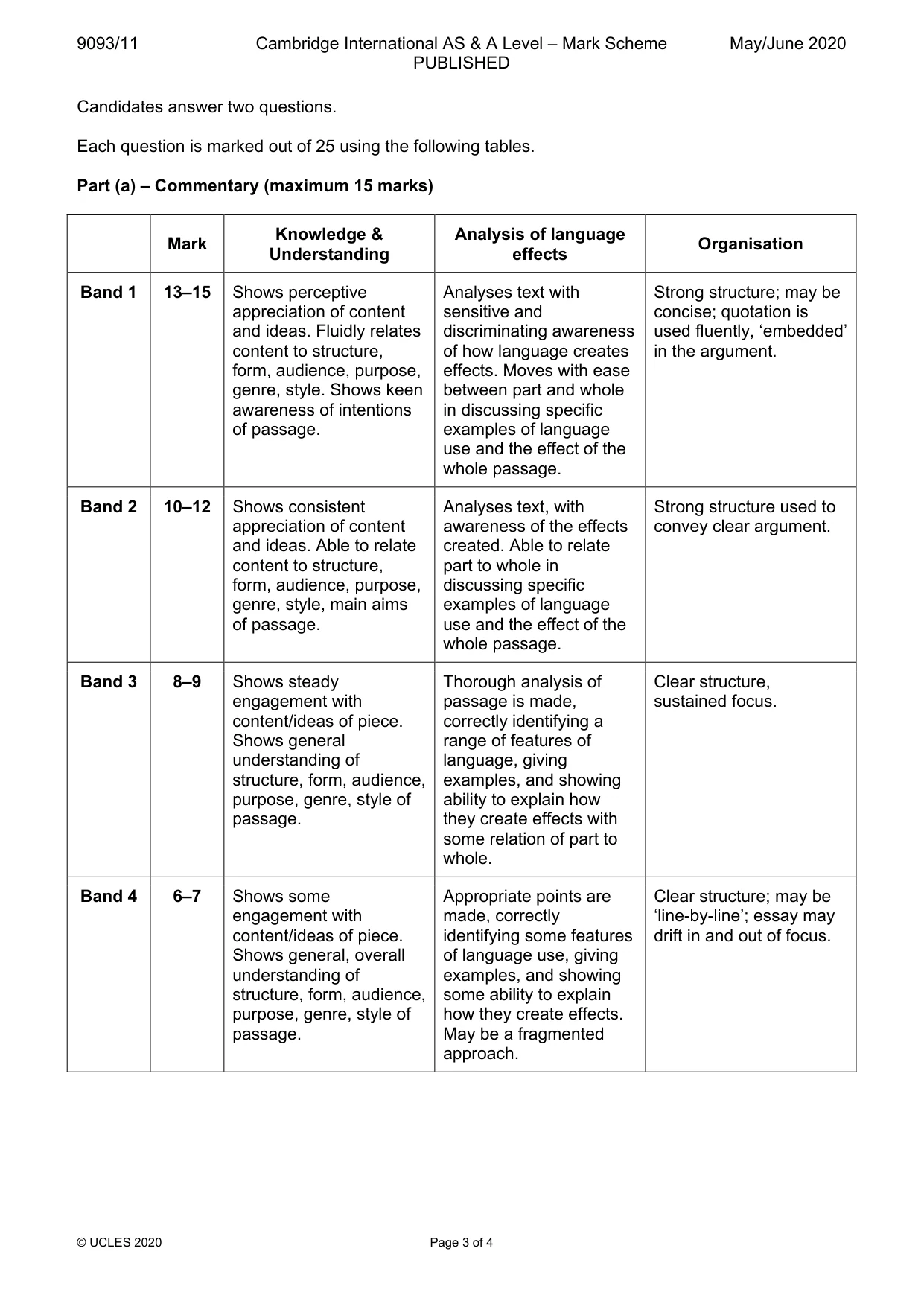
9093/11 Cambridge International AS & A Level – Mark Scheme PUBLISHED May/June 2020 © UCLES 2020 Page 3 of 4 Candidates answer two questions. Each question is marked out of 25 using the following tables. Part (a) – Commentary (maximum 15 marks) Mark Knowledge & Understanding Analysis of language effects Organisation Band 1 13–15 Shows perceptive appreciation of content and ideas. Fluidly relates content to structure, form, audience, purpose, genre, style. Shows keen awareness of intentions of passage. Analyses text with sensitive and discriminating awareness of how language creates effects. Moves with ease between part and whole in discussing specific examples of language use and the effect of the whole passage. Strong structure; may be concise; quotation is used fluently, ‘embedded’ in the argument. Band 2 10–12 Shows consistent appreciation of content and ideas. Able to relate content to structure, form, audience, purpose, genre, style, main aims of passage. Analyses text, with awareness of the effects created. Able to relate part to whole in discussing specific examples of language use and the effect of the whole passage. Strong structure used to convey clear argument. Band 3 8–9 Shows steady engagement with content/ideas of piece. Shows general understanding of structure, form, audience, purpose, genre, style of passage. Thorough analysis of passage is made, correctly identifying a range of features of language, giving examples, and showing ability to explain how they create effects with some relation of part to whole. Clear structure, sustained focus. Band 4 6–7 Shows some engagement with content/ideas of piece. Shows general, overall understanding of structure, form, audience, purpose, genre, style of passage. Appropriate points are made, correctly identifying some features of language use, giving examples, and showing some ability to explain how they create effects. May be a fragmented approach. Clear structure; may be ‘line-by-line’; essay may drift in and out of focus.
Mark scheme, page 4
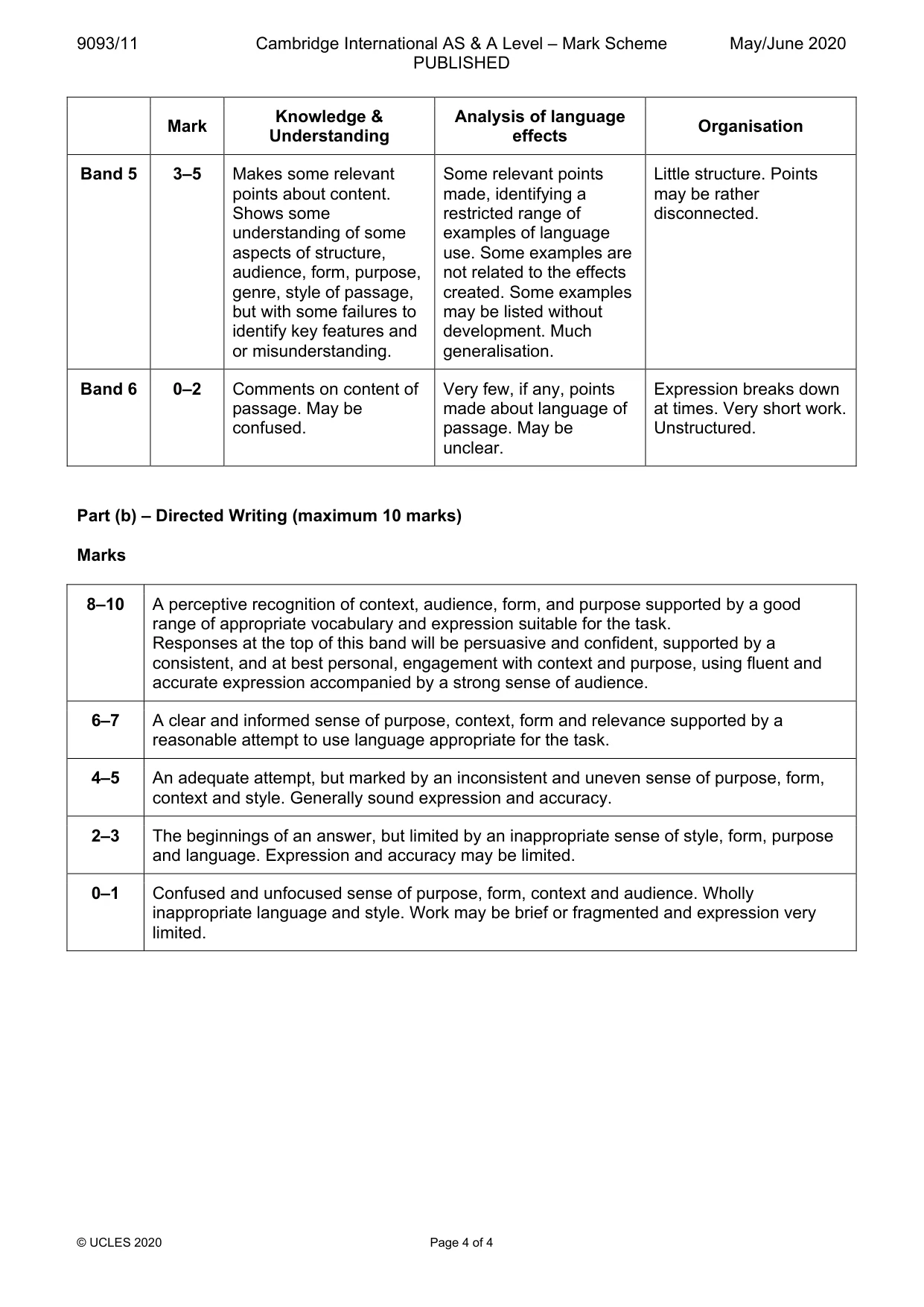
9093/11 Cambridge International AS & A Level – Mark Scheme PUBLISHED May/June 2020 © UCLES 2020 Page 4 of 4 Mark Knowledge & Understanding Analysis of language effects Organisation Band 5 3–5 Makes some relevant points about content. Shows some understanding of some aspects of structure, audience, form, purpose, genre, style of passage, but with some failures to identify key features and or misunderstanding. Some relevant points made, identifying a restricted range of examples of language use. Some examples are not related to the effects created. Some examples may be listed without development. Much generalisation. Little structure. Points may be rather disconnected. Band 6 0–2 Comments on content of passage. May be confused. Very few, if any, points made about language of passage. May be unclear. Expression breaks down at times. Very short work. Unstructured. Part (b) – Directed Writing (maximum 10 marks) Marks 8–10 A perceptive recognition of context, audience, form, and purpose supported by a good range of appropriate vocabulary and expression suitable for the task. Responses at the top of this band will be persuasive and confident, supported by a consistent, and at best personal, engagement with context and purpose, using fluent and accurate expression accompanied by a strong sense of audience. 6–7 A clear and informed sense of purpose, context, form and relevance supported by a reasonable attempt to use language appropriate for the task. 4–5 An adequate attempt, but marked by an inconsistent and uneven sense of purpose, form, context and style. Generally sound expression and accuracy. 2–3 The beginnings of an answer, but limited by an inappropriate sense of style, form, purpose and language. Expression and accuracy may be limited. 0–1 Confused and unfocused sense of purpose, form, context and audience. Wholly inappropriate language and style. Work may be brief or fragmented and expression very limited.