Cambridge A Level English - Language AS and A Level (from 2014) 9093 — 2020 Feb/March Paper 3 · Variant 2
9093/32/F/M/20 · 50 marks · ≈56 min
The question paper and its mark scheme, free to read here and free to download. This is Cambridge’s own paper, exactly as it was sat.
Question paper8 pages


Mark scheme7 pages
Answers below. Sit the paper first if you are practising.
Paper as text
Question paper, page 1
Cambridge International AS & A Level * 7 7 9 9 8 8 9 4 4 0 * DC (ST) 181190 © UCLES 2020 [Turn over This document has 8 pages. Blank pages are indicated. ENGLISH LANGUAGE 9093/32 Paper 3 Text Analysis February/March 2020 2 hours 15 minutes You must answer on the enclosed answer booklet. You will need: Answer booklet (enclosed) INSTRUCTIONS ● Answer two questions. ● Follow the instructions on the front cover of the answer booklet. If you need additional answer paper, ask the invigilator for a continuation booklet. ● You are reminded of the need for good English and clear presentation in your answers. INFORMATION ● The total mark for this paper is 50. ● The number of marks for each question or part question is shown in brackets [ ].
Question paper, page 2
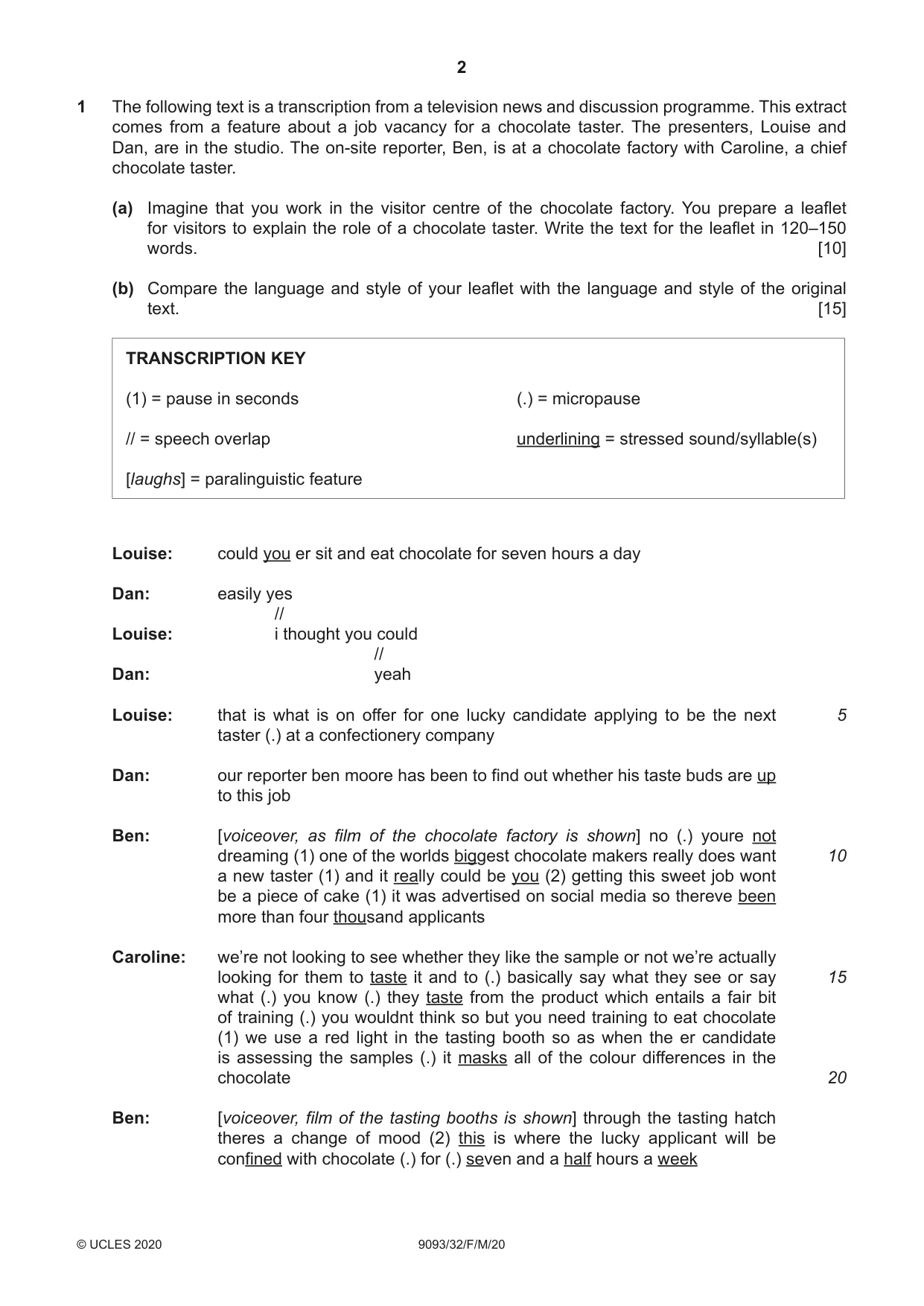
2 9093/32/F/M/20 © UCLES 2020 1 The following text is a transcription from a television news and discussion programme. This extract comes from a feature about a job vacancy for a chocolate taster. The presenters, Louise and Dan, are in the studio. The on-site reporter, Ben, is at a chocolate factory with Caroline, a chief chocolate taster. (a) Imagine that you work in the visitor centre of the chocolate factory. You prepare a leaflet for visitors to explain the role of a chocolate taster. Write the text for the leaflet in 120–150 words. [10] (b) Compare the language and style of your leaflet with the language and style of the original text. [15] TRANSCRIPTION KEY (1) = pause in seconds (.) = micropause // = speech overlap underlining = stressed sound/syllable(s) [laughs] = paralinguistic feature Louise: could you er sit and eat chocolate for seven hours a day Dan: easily yes // Louise: i thought you could // Dan: yeah Louise: that is what is on offer for one lucky candidate applying to be the next taster (.) at a confectionery company Dan: our reporter ben moore has been to find out whether his taste buds are up to this job Ben: [voiceover, as film of the chocolate factory is shown] no (.) youre not dreaming (1) one of the worlds biggest chocolate makers really does want a new taster (1) and it really could be you (2) getting this sweet job wont be a piece of cake (1) it was advertised on social media so thereve been more than four thousand applicants Caroline: we’re not looking to see whether they like the sample or not we’re actually looking for them to taste it and to (.) basically say what they see or say what (.) you know (.) they taste from the product which entails a fair bit of training (.) you wouldnt think so but you need training to eat chocolate (1) we use a red light in the tasting booth so as when the er candidate is assessing the samples (.) it masks all of the colour differences in the chocolate Ben: [voiceover, film of the tasting booths is shown] through the tasting hatch theres a change of mood (2) this is where the lucky applicant will be confined with chocolate (.) for (.) seven and a half hours a week 5 10 15 20
Question paper, page 3
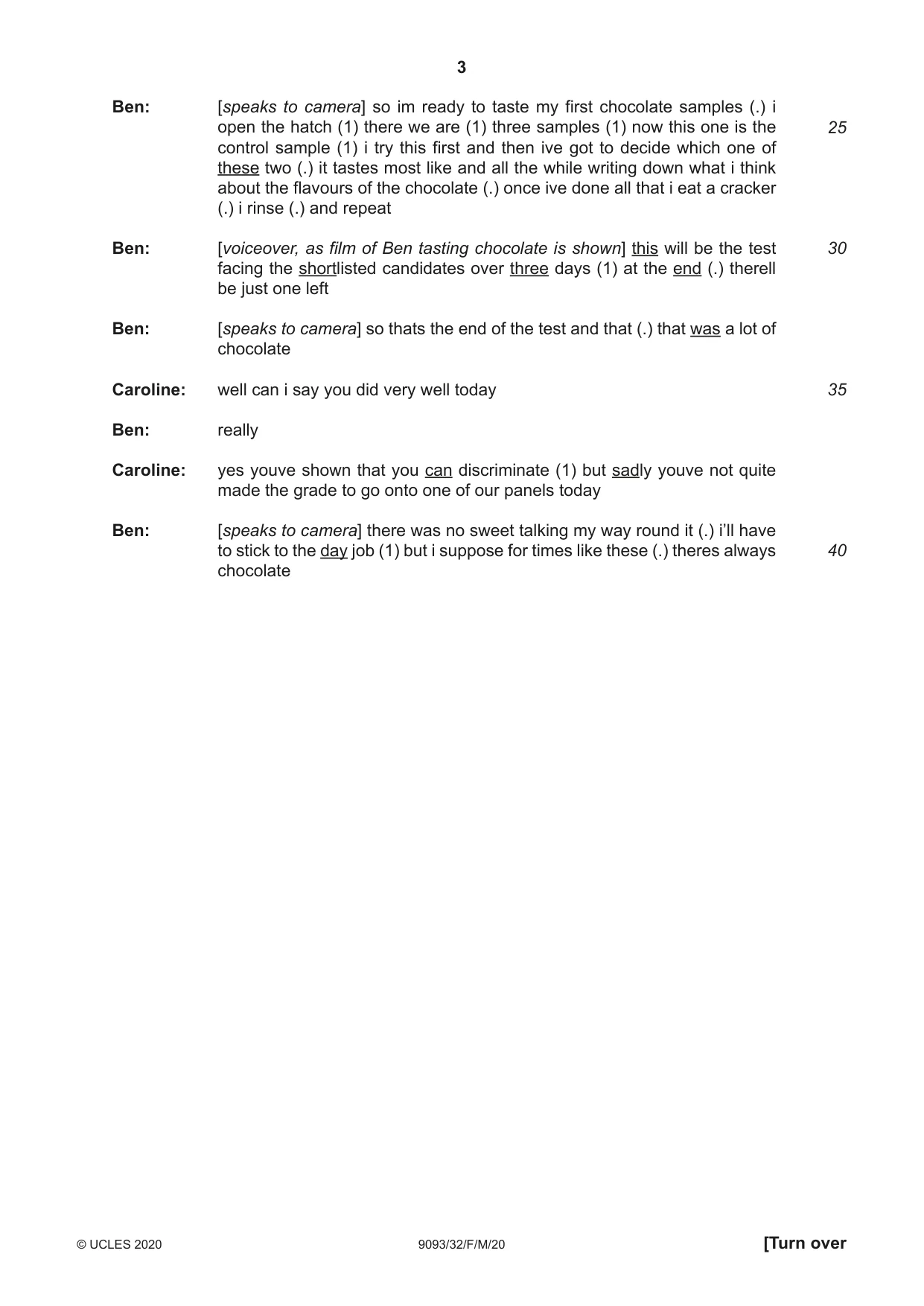
3 9093/32/F/M/20 © UCLES 2020 [Turn over Ben: [speaks to camera] so im ready to taste my first chocolate samples (.) i open the hatch (1) there we are (1) three samples (1) now this one is the control sample (1) i try this first and then ive got to decide which one of these two (.) it tastes most like and all the while writing down what i think about the flavours of the chocolate (.) once ive done all that i eat a cracker (.) i rinse (.) and repeat Ben: [voiceover, as film of Ben tasting chocolate is shown] this will be the test facing the shortlisted candidates over three days (1) at the end (.) therell be just one left Ben: [speaks to camera] so thats the end of the test and that (.) that was a lot of chocolate Caroline: well can i say you did very well today Ben: really Caroline: yes youve shown that you can discriminate (1) but sadly youve not quite made the grade to go onto one of our panels today Ben: [speaks to camera] there was no sweet talking my way round it (.) i’ll have to stick to the day job (1) but i suppose for times like these (.) theres always chocolate 25 30 35 40
Question paper, page 4
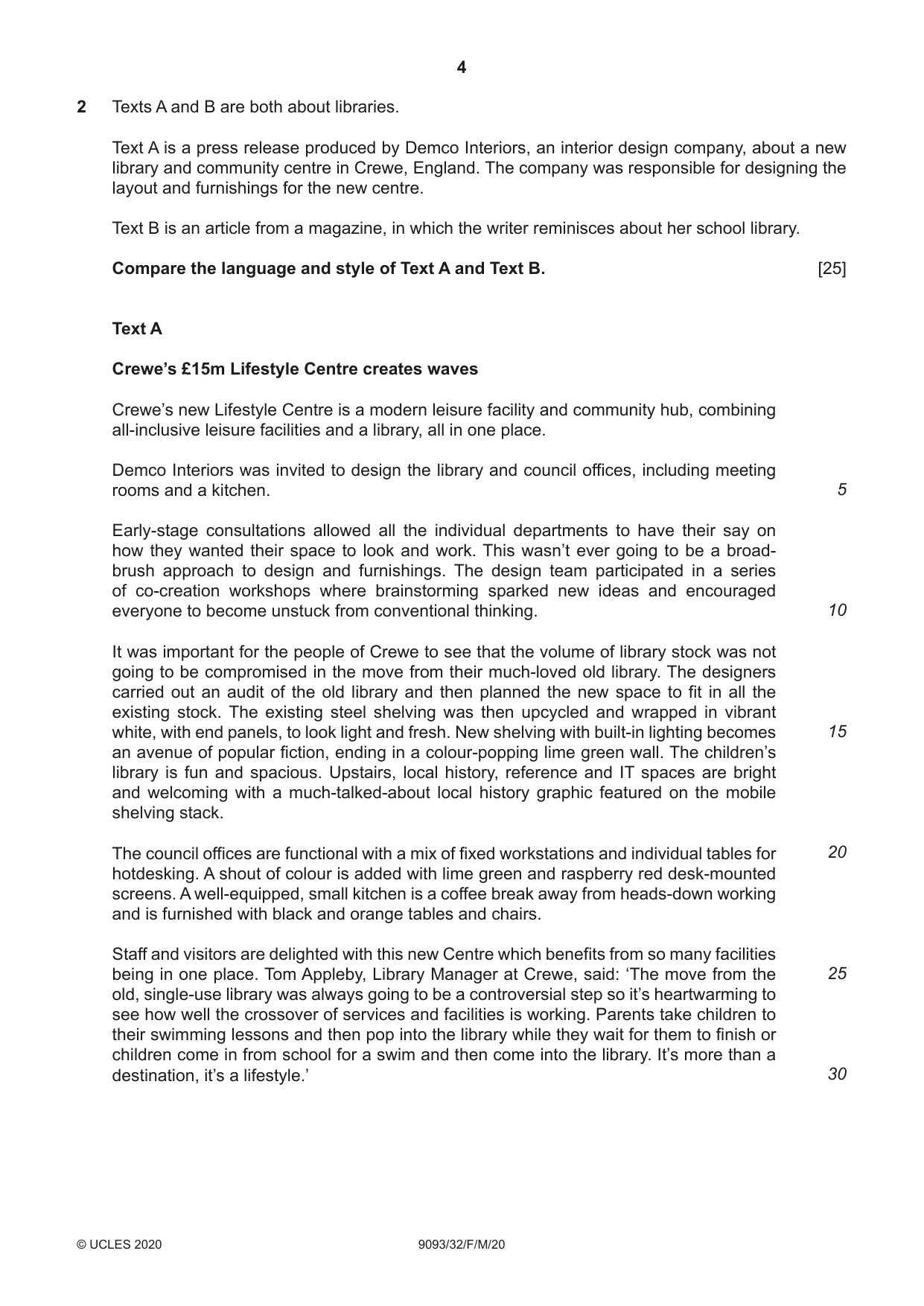
4 9093/32/F/M/20 © UCLES 2020 2 Texts A and B are both about libraries. Text A is a press release produced by Demco Interiors, an interior design company, about a new library and community centre in Crewe, England. The company was responsible for designing the layout and furnishings for the new centre. Text B is an article from a magazine, in which the writer reminisces about her school library. Compare the language and style of Text A and Text B. [25] Text A Crewe’s £15m Lifestyle Centre creates waves Crewe’s new Lifestyle Centre is a modern leisure facility and community hub, combining all-inclusive leisure facilities and a library, all in one place. Demco Interiors was invited to design the library and council offices, including meeting rooms and a kitchen. Early-stage consultations allowed all the individual departments to have their say on how they wanted their space to look and work. This wasn’t ever going to be a broad- brush approach to design and furnishings. The design team participated in a series of co-creation workshops where brainstorming sparked new ideas and encouraged everyone to become unstuck from conventional thinking. It was important for the people of Crewe to see that the volume of library stock was not going to be compromised in the move from their much-loved old library. The designers carried out an audit of the old library and then planned the new space to fit in all the existing stock. The existing steel shelving was then upcycled and wrapped in vibrant white, with end panels, to look light and fresh. New shelving with built-in lighting becomes an avenue of popular fiction, ending in a colour-popping lime green wall. The children’s library is fun and spacious. Upstairs, local history, reference and IT spaces are bright and welcoming with a much-talked-about local history graphic featured on the mobile shelving stack. The council offices are functional with a mix of fixed workstations and individual tables for hotdesking. A shout of colour is added with lime green and raspberry red desk-mounted screens. A well-equipped, small kitchen is a coffee break away from heads-down working and is furnished with black and orange tables and chairs. Staff and visitors are delighted with this new Centre which benefits from so many facilities being in one place. Tom Appleby, Library Manager at Crewe, said: ‘The move from the old, single-use library was always going to be a controversial step so it’s heartwarming to see how well the crossover of services and facilities is working. Parents take children to their swimming lessons and then pop into the library while they wait for them to finish or children come in from school for a swim and then come into the library. It’s more than a destination, it’s a lifestyle.’ 5 10 15 20 25 30
Question paper, page 5
5 9093/32/F/M/20 © UCLES 2020 Text B As a child, slightly geeky and wholeheartedly contrary, libraries were my destination of choice. In the holidays, while others dreamt of the beach, I sought out Loughton Library. I loved everything about it; the ritual of walking up the hill, going swimming in the public pool next door, and the scent of chlorine rising to meet musty old book as I rifled through pages. In term time, I had to shift my focus to the top of a long staircase in our school. Right at the very summit, if you turned right, there was a corridor, which, unlike any of our other corridors, led to only one room: our library. In my memory it is a cavernous, fabulous place, with big windows and high ceilings. I had a favourite place to sit – a big, beaten-up oak table squatting in the middle of the room. It was the perfect spot and, in all my years, I have never found one to match it. It was solid, and scored by the compass points of pupils past. Hargreave (whoever he was) had left his full name carved with heavy hand and in enviably neat writing. The librarian was a lovely but uncompromisingly stern woman called Ms Parker. She presided from her ‘pulpit’ at the front. Ms Parker’s shhhhhhhhhh was a prolonged sound of rage and disappointment, more destructive than stormy waves upon jagged rocks. It was often followed by a ban from the library – an unbearable torment for someone like me. I laid my books out on the big, scarred table like a banquet, flitting between courses. I have never read with such hunger since. I could have a starter of Yeats, followed by a main course of Sylvia Plath. And dessert? Well that really was the most interesting course of all. For dessert, I chose books that nobody else cared about. Rather grandly I imagined myself the patron saint of the unloved and forgotten tome. In our library, slips of paper sat in envelopes fastened to the inside cover of the books. On one half, the borrowers would write a name and date of issue. Ms Parker would take the slip and keep it till you brought the book back. Then she would stamp its return date and put it back on the shelf. The slips, like the oak table, whispered of those who had gone before you. Searching for the neglected books, I would often turn to the slips before I even looked at the titles. A ‘forgotten book’ would be one that had not been issued for at least seven years. The more I read, the more I knew I needed to read. At times it felt maddening. I still feel that way today. Libraries fed me and kept me hungry. 5 10 15 20 25 30
Question paper, page 6
6 9093/32/F/M/20 © UCLES 2020 BLANK PAGE
Question paper, page 7
7 9093/32/F/M/20 © UCLES 2020 BLANK PAGE
Question paper, page 8
8 9093/32/F/M/20 © UCLES 2020 Permission to reproduce items where third-party owned material protected by copyright is included has been sought and cleared where possible. Every reasonable effort has been made by the publisher (UCLES) to trace copyright holders, but if any items requiring clearance have unwittingly been included, the publisher will be pleased to make amends at the earliest possible opportunity. To avoid the issue of disclosure of answer-related information to candidates, all copyright acknowledgements are reproduced online in the Cambridge Assessment International Education Copyright Acknowledgements Booklet. This is produced for each series of examinations and is freely available to download at www.cambridgeinternational.org after the live examination series. Cambridge Assessment International Education is part of the Cambridge Assessment Group. Cambridge Assessment is the brand name of the University of Cambridge Local Examinations Syndicate (UCLES), which itself is a department of the University of Cambridge. BLANK PAGE
Mark scheme, page 1
This document consists of 7 printed pages. © UCLES 2020 [Turn over Cambridge International A Level ENGLISH LANGUAGE 9093/32 Paper 3 Text Analysis March 2020 MARK SCHEME Maximum Mark: 50 Published This mark scheme is published as an aid to teachers and candidates, to indicate the requirements of the examination. It shows the basis on which Examiners were instructed to award marks. It does not indicate the details of the discussions that took place at an Examiners’ meeting before marking began, which would have considered the acceptability of alternative answers. Mark schemes should be read in conjunction with the question paper and the Principal Examiner Report for Teachers. Cambridge International will not enter into discussions about these mark schemes. Cambridge International is publishing the mark schemes for the March 2020 series for most Cambridge IGCSE™, Cambridge International A and AS Level components and some Cambridge O Level components.
Mark scheme, page 2
9093/32 Cambridge International A Level – Mark Scheme PUBLISHED March 2020 © UCLES 2020 Page 2 of 7 Generic Marking Principles These general marking principles must be applied by all examiners when marking candidate answers. They should be applied alongside the specific content of the mark scheme or generic level descriptors for a question. Each question paper and mark scheme will also comply with these marking principles. GENERIC MARKING PRINCIPLE 1: Marks must be awarded in line with: • the specific content of the mark scheme or the generic level descriptors for the question • the specific skills defined in the mark scheme or in the generic level descriptors for the question • the standard of response required by a candidate as exemplified by the standardisation scripts. GENERIC MARKING PRINCIPLE 2: Marks awarded are always whole marks (not half marks, or other fractions). GENERIC MARKING PRINCIPLE 3: Marks must be awarded positively: • marks are awarded for correct/valid answers, as defined in the mark scheme. However, credit is given for valid answers which go beyond the scope of the syllabus and mark scheme, referring to your Team Leader as appropriate • marks are awarded when candidates clearly demonstrate what they know and can do • marks are not deducted for errors • marks are not deducted for omissions • answers should only be judged on the quality of spelling, punctuation and grammar when these features are specifically assessed by the question as indicated by the mark scheme. The meaning, however, should be unambiguous. GENERIC MARKING PRINCIPLE 4: Rules must be applied consistently e.g. in situations where candidates have not followed instructions or in the application of generic level descriptors. GENERIC MARKING PRINCIPLE 5: Marks should be awarded using the full range of marks defined in the mark scheme for the question (however; the use of the full mark range may be limited according to the quality of the candidate responses seen). GENERIC MARKING PRINCIPLE 6: Marks awarded are based solely on the requirements as defined in the mark scheme. Marks should not be awarded with grade thresholds or grade descriptors in mind.
Mark scheme, page 3
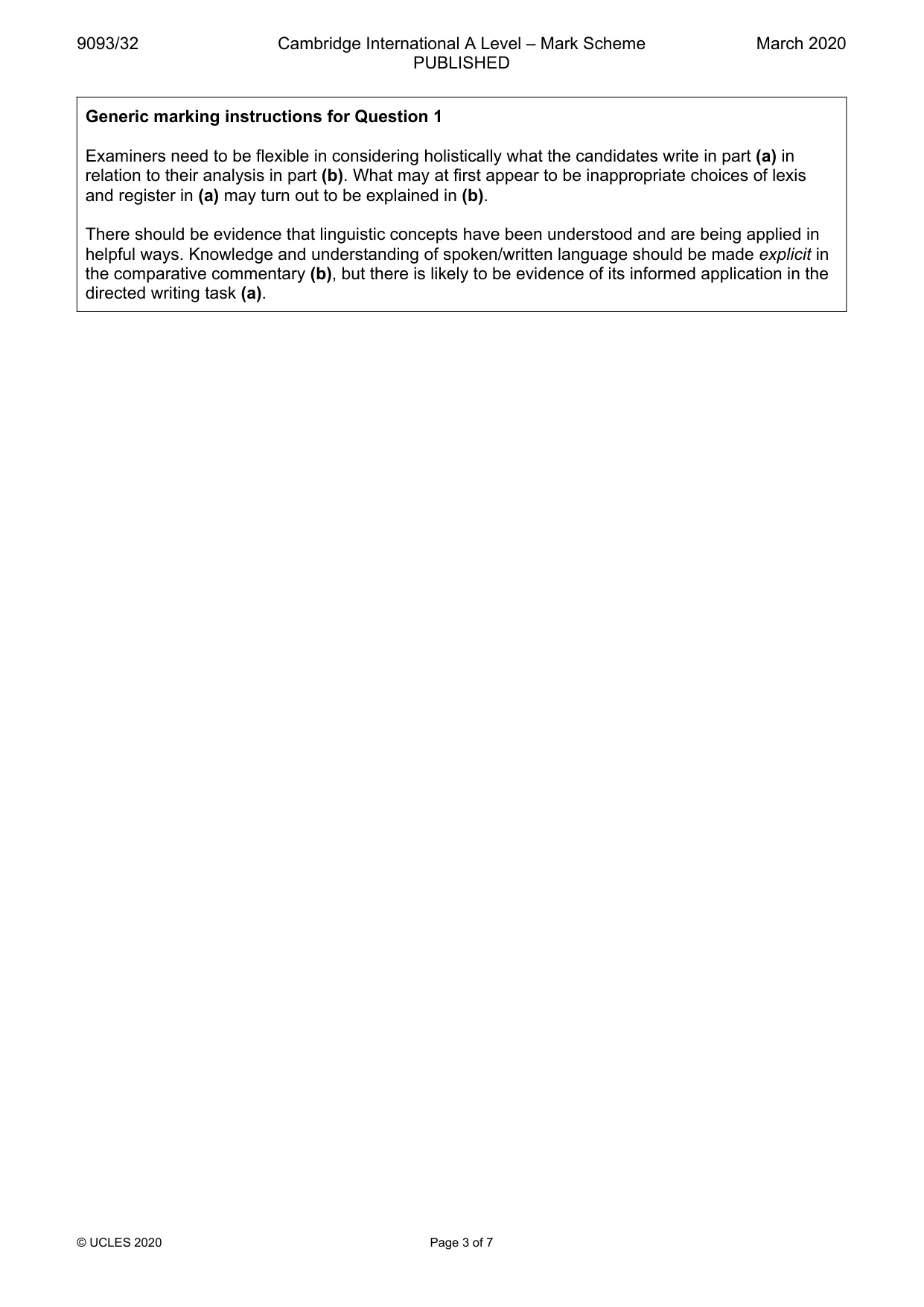
9093/32 Cambridge International A Level – Mark Scheme PUBLISHED March 2020 © UCLES 2020 Page 3 of 7 Generic marking instructions for Question 1 Examiners need to be flexible in considering holistically what the candidates write in part (a) in relation to their analysis in part (b). What may at first appear to be inappropriate choices of lexis and register in (a) may turn out to be explained in (b). There should be evidence that linguistic concepts have been understood and are being applied in helpful ways. Knowledge and understanding of spoken/written language should be made explicit in the comparative commentary (b), but there is likely to be evidence of its informed application in the directed writing task (a).
Mark scheme, page 4
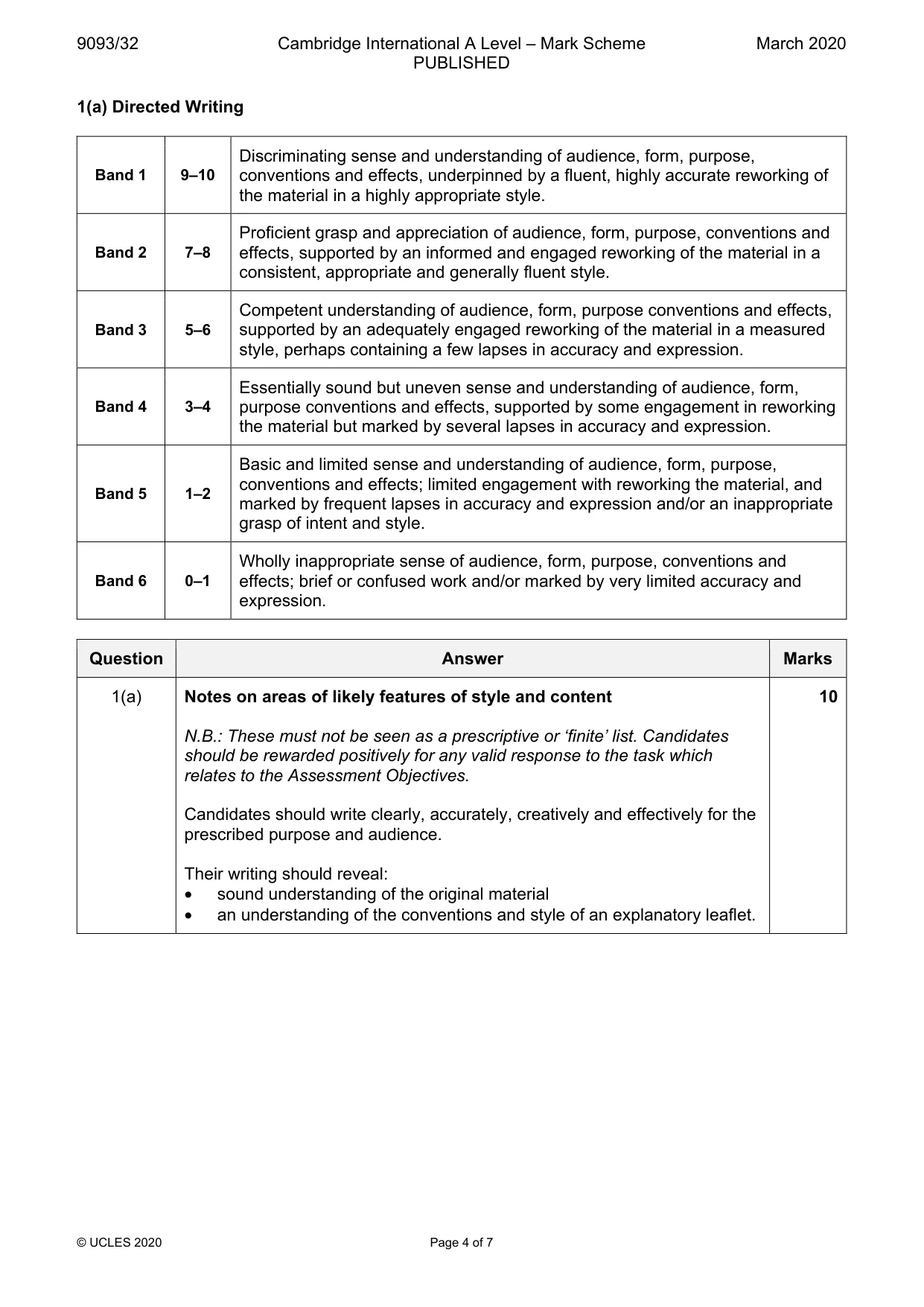
9093/32 Cambridge International A Level – Mark Scheme PUBLISHED March 2020 © UCLES 2020 Page 4 of 7 1(a) Directed Writing Band 1 9–10 Discriminating sense and understanding of audience, form, purpose, conventions and effects, underpinned by a fluent, highly accurate reworking of the material in a highly appropriate style. Band 2 7–8 Proficient grasp and appreciation of audience, form, purpose, conventions and effects, supported by an informed and engaged reworking of the material in a consistent, appropriate and generally fluent style. Band 3 5–6 Competent understanding of audience, form, purpose conventions and effects, supported by an adequately engaged reworking of the material in a measured style, perhaps containing a few lapses in accuracy and expression. Band 4 3–4 Essentially sound but uneven sense and understanding of audience, form, purpose conventions and effects, supported by some engagement in reworking the material but marked by several lapses in accuracy and expression. Band 5 1–2 Basic and limited sense and understanding of audience, form, purpose, conventions and effects; limited engagement with reworking the material, and marked by frequent lapses in accuracy and expression and/or an inappropriate grasp of intent and style. Band 6 0–1 Wholly inappropriate sense of audience, form, purpose, conventions and effects; brief or confused work and/or marked by very limited accuracy and expression. Question Answer Marks 1(a) Notes on areas of likely features of style and content N.B.: These must not be seen as a prescriptive or ‘finite’ list. Candidates should be rewarded positively for any valid response to the task which relates to the Assessment Objectives. Candidates should write clearly, accurately, creatively and effectively for the prescribed purpose and audience. Their writing should reveal: • sound understanding of the original material • an understanding of the conventions and style of an explanatory leaflet. 10
Mark scheme, page 5
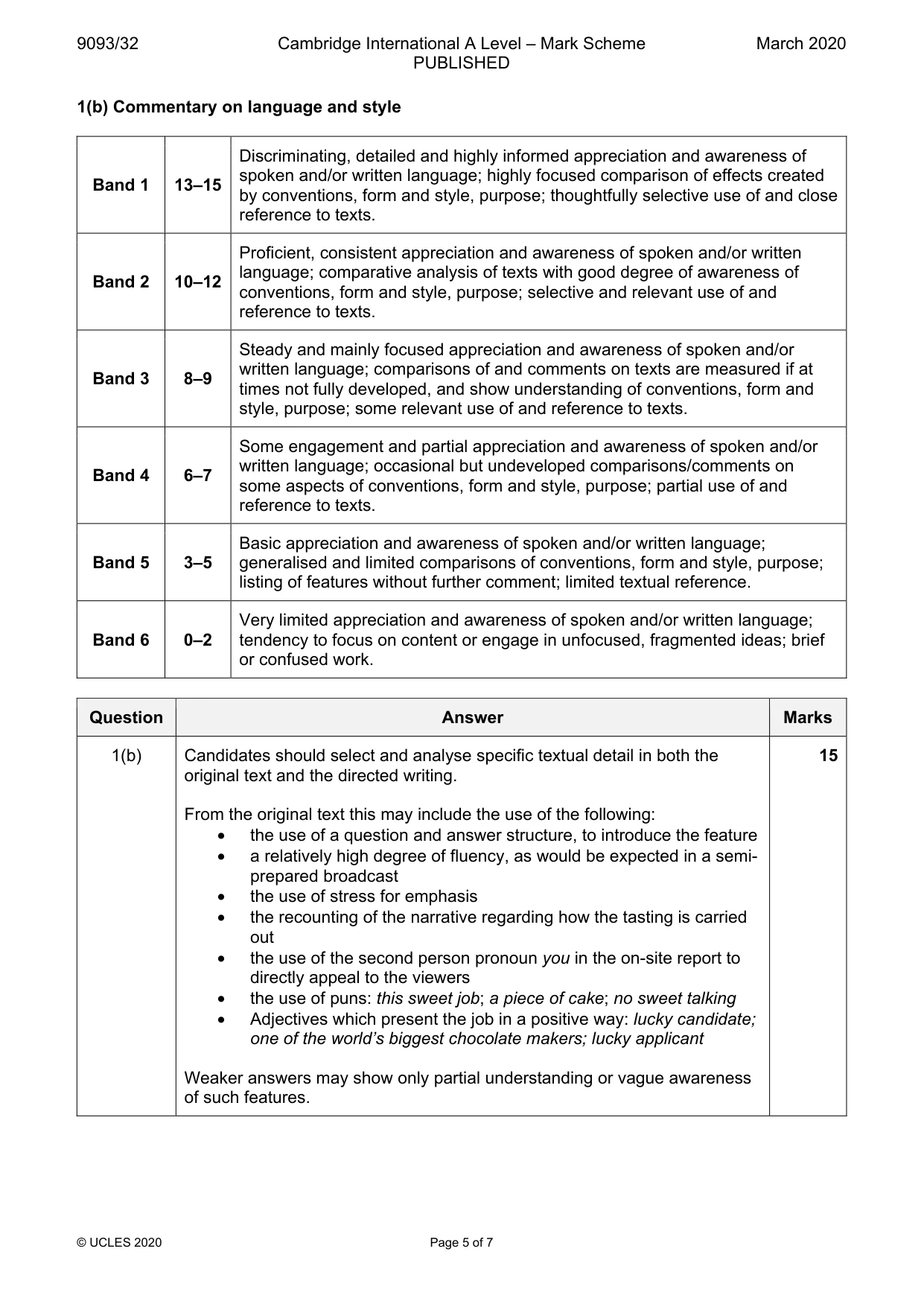
9093/32 Cambridge International A Level – Mark Scheme PUBLISHED March 2020 © UCLES 2020 Page 5 of 7 1(b) Commentary on language and style Band 1 13–15 Discriminating, detailed and highly informed appreciation and awareness of spoken and/or written language; highly focused comparison of effects created by conventions, form and style, purpose; thoughtfully selective use of and close reference to texts. Band 2 10–12 Proficient, consistent appreciation and awareness of spoken and/or written language; comparative analysis of texts with good degree of awareness of conventions, form and style, purpose; selective and relevant use of and reference to texts. Band 3 8–9 Steady and mainly focused appreciation and awareness of spoken and/or written language; comparisons of and comments on texts are measured if at times not fully developed, and show understanding of conventions, form and style, purpose; some relevant use of and reference to texts. Band 4 6–7 Some engagement and partial appreciation and awareness of spoken and/or written language; occasional but undeveloped comparisons/comments on some aspects of conventions, form and style, purpose; partial use of and reference to texts. Band 5 3–5 Basic appreciation and awareness of spoken and/or written language; generalised and limited comparisons of conventions, form and style, purpose; listing of features without further comment; limited textual reference. Band 6 0–2 Very limited appreciation and awareness of spoken and/or written language; tendency to focus on content or engage in unfocused, fragmented ideas; brief or confused work. Question Answer Marks 1(b) Candidates should select and analyse specific textual detail in both the original text and the directed writing. From the original text this may include the use of the following: • the use of a question and answer structure, to introduce the feature • a relatively high degree of fluency, as would be expected in a semi- prepared broadcast • the use of stress for emphasis • the recounting of the narrative regarding how the tasting is carried out • the use of the second person pronoun you in the on-site report to directly appeal to the viewers • the use of puns: this sweet job; a piece of cake; no sweet talking • Adjectives which present the job in a positive way: lucky candidate; one of the world’s biggest chocolate makers; lucky applicant Weaker answers may show only partial understanding or vague awareness of such features. 15
Mark scheme, page 6
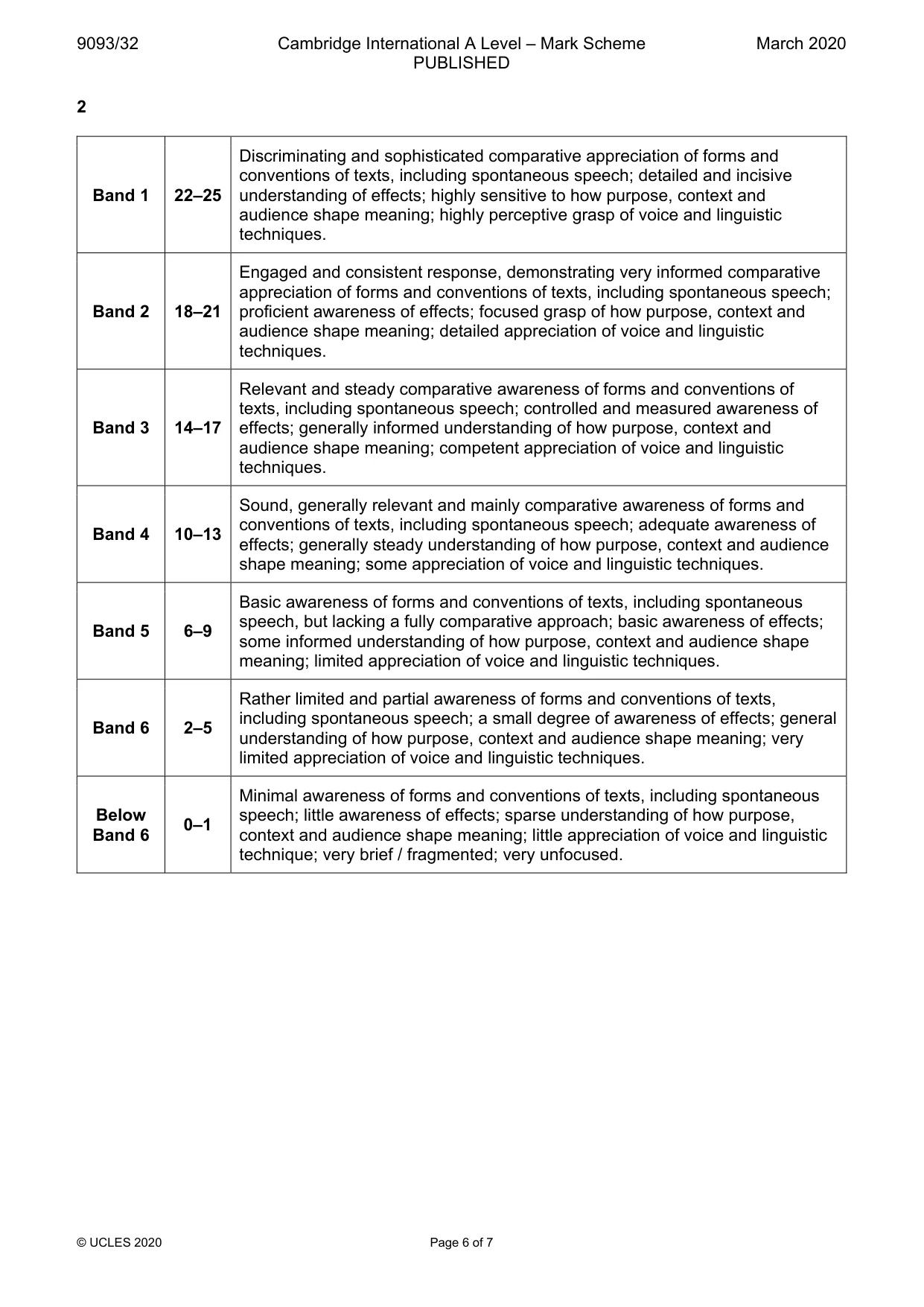
9093/32 Cambridge International A Level – Mark Scheme PUBLISHED March 2020 © UCLES 2020 Page 6 of 7 2 Band 1 22–25 Discriminating and sophisticated comparative appreciation of forms and conventions of texts, including spontaneous speech; detailed and incisive understanding of effects; highly sensitive to how purpose, context and audience shape meaning; highly perceptive grasp of voice and linguistic techniques. Band 2 18–21 Engaged and consistent response, demonstrating very informed comparative appreciation of forms and conventions of texts, including spontaneous speech; proficient awareness of effects; focused grasp of how purpose, context and audience shape meaning; detailed appreciation of voice and linguistic techniques. Band 3 14–17 Relevant and steady comparative awareness of forms and conventions of texts, including spontaneous speech; controlled and measured awareness of effects; generally informed understanding of how purpose, context and audience shape meaning; competent appreciation of voice and linguistic techniques. Band 4 10–13 Sound, generally relevant and mainly comparative awareness of forms and conventions of texts, including spontaneous speech; adequate awareness of effects; generally steady understanding of how purpose, context and audience shape meaning; some appreciation of voice and linguistic techniques. Band 5 6–9 Basic awareness of forms and conventions of texts, including spontaneous speech, but lacking a fully comparative approach; basic awareness of effects; some informed understanding of how purpose, context and audience shape meaning; limited appreciation of voice and linguistic techniques. Band 6 2–5 Rather limited and partial awareness of forms and conventions of texts, including spontaneous speech; a small degree of awareness of effects; general understanding of how purpose, context and audience shape meaning; very limited appreciation of voice and linguistic techniques. Below Band 6 0–1 Minimal awareness of forms and conventions of texts, including spontaneous speech; little awareness of effects; sparse understanding of how purpose, context and audience shape meaning; little appreciation of voice and linguistic technique; very brief / fragmented; very unfocused.
Mark scheme, page 7
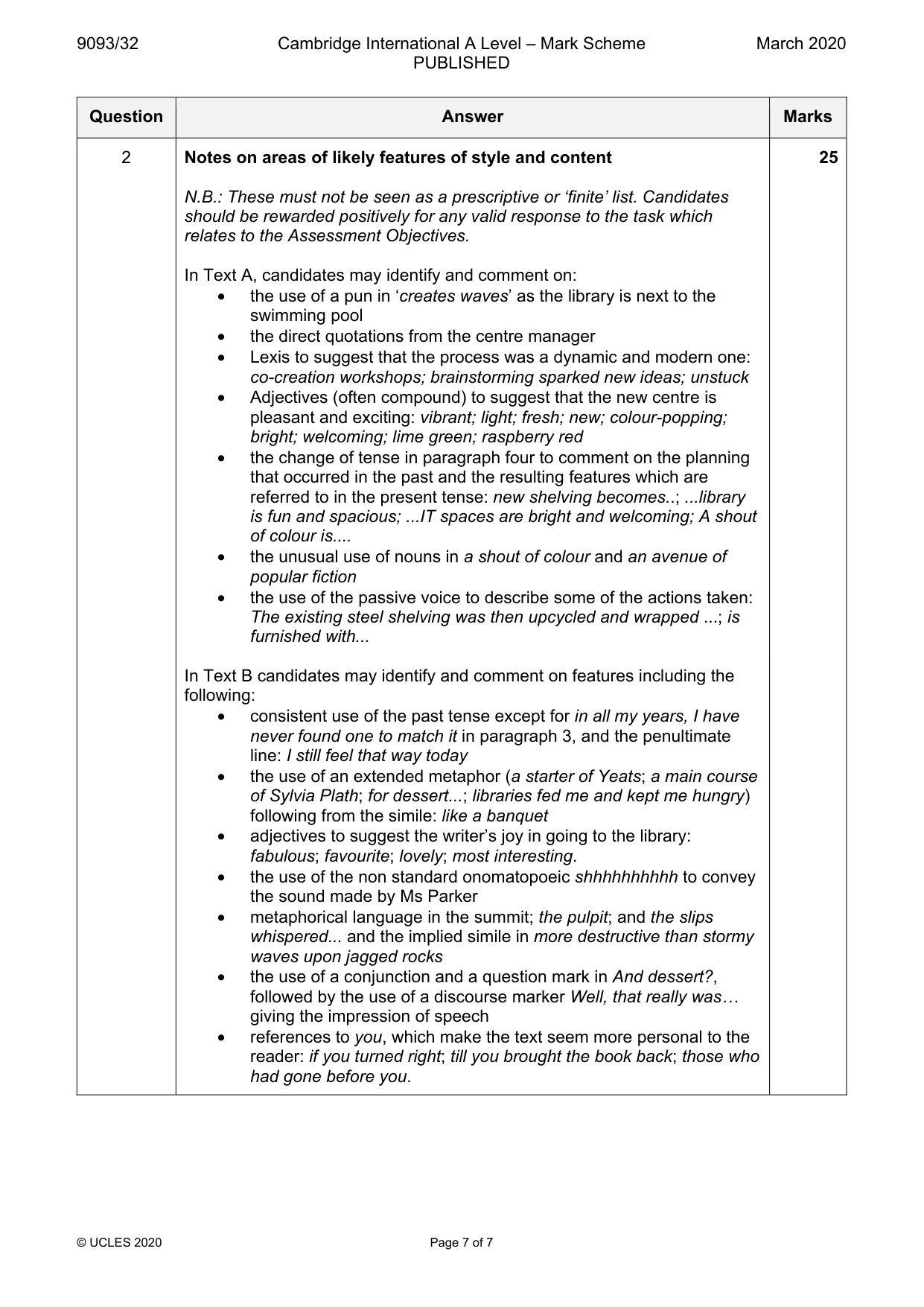
9093/32 Cambridge International A Level – Mark Scheme PUBLISHED March 2020 © UCLES 2020 Page 7 of 7 Question Answer Marks 2 Notes on areas of likely features of style and content N.B.: These must not be seen as a prescriptive or ‘finite’ list. Candidates should be rewarded positively for any valid response to the task which relates to the Assessment Objectives. In Text A, candidates may identify and comment on: • the use of a pun in ‘creates waves’ as the library is next to the swimming pool • the direct quotations from the centre manager • Lexis to suggest that the process was a dynamic and modern one: co-creation workshops; brainstorming sparked new ideas; unstuck • Adjectives (often compound) to suggest that the new centre is pleasant and exciting: vibrant; light; fresh; new; colour-popping; bright; welcoming; lime green; raspberry red • the change of tense in paragraph four to comment on the planning that occurred in the past and the resulting features which are referred to in the present tense: new shelving becomes..; ...library is fun and spacious; ...IT spaces are bright and welcoming; A shout of colour is… • the unusual use of nouns in a shout of colour and an avenue of popular fiction • the use of the passive voice to describe some of the actions taken: The existing steel shelving was then upcycled and wrapped ...; is furnished with... In Text B candidates may identify and comment on features including the following: • consistent use of the past tense except for in all my years, I have never found one to match it in paragraph 3, and the penultimate line: I still feel that way today • the use of an extended metaphor (a starter of Yeats; a main course of Sylvia Plath; for dessert...; libraries fed me and kept me hungry) following from the simile: like a banquet • adjectives to suggest the writer’s joy in going to the library: fabulous; favourite; lovely; most interesting. • the use of the non standard onomatopoeic shhhhhhhhhh to convey the sound made by Ms Parker • metaphorical language in the summit; the pulpit; and the slips whispered... and the implied simile in more destructive than stormy waves upon jagged rocks • the use of a conjunction and a question mark in And dessert?, followed by the use of a discourse marker Well, that really was… giving the impression of speech • references to you, which make the text seem more personal to the reader: if you turned right; till you brought the book back; those who had gone before you. 25
What you needed in this session
Cambridge’s own grade thresholds for 2020 Feb/March, Paper 3 · Variant 2. A higher threshold means an easier paper — the bar moves with how the cohort did.