Cambridge A Level English - Language AS and A Level (from 2014) 9093 — 2019 Oct/Nov Paper 1 · Variant 3
9093/13/O/N/19 · 50 marks · ≈56 min
The question paper and its mark scheme, free to read here and free to download. This is Cambridge’s own paper, exactly as it was sat.
Question paper8 pages

Mark scheme5 pages
Answers below. Sit the paper first if you are practising.

Paper as text
Question paper, page 1
This document consists of 7 printed pages, 1 blank page and 1 Insert. DC (ST) 167694/2 © UCLES 2019 [Turn over Cambridge Assessment International Education Cambridge International Advanced Subsidiary and Advanced Level * 8 6 7 6 4 5 2 3 7 1 * ENGLISH LANGUAGE 9093/13 Paper 1 Passages October/November 2019 2 hours 15 minutes No Additional Materials are required. READ THESE INSTRUCTIONS FIRST An answer booklet is provided inside this question paper. You should follow the instructions on the front cover of the answer booklet. If you need additional answer paper, ask the invigilator for a continuation booklet. Answer two questions: Question 1 and either Question 2 or Question 3. You should spend about 15 minutes reading the passages and questions before you start writing your answers. You are reminded of the need for good English and clear presentation in your answers. The number of marks is given in brackets [ ] at the end of each question or part question.
Question paper, page 2
2 9093/13/O/N/19 © UCLES 2019 Answer Question 1 and either Question 2 or Question 3. 1 The following text is from the autobiography of Carlos Magdalena – or ‘The Plant Messiah’ as he is commonly known. (a) Comment on the language and style of the passage. [15] (b) After reading the extract, you and a group of friends decide to start a campaign to promote nature preservation and conservation in your local area. Basing your writing closely on the material of the original extract, write the opening section of a leaflet which will be used to launch your campaign. You should use between 120 and 150 of your own words. [10] The Plant Messiah There is plenty of communication going on under ground. Believe it or not, plants can interact via vast webs of underground fungi at their roots. This ‘wood wide web’ weaves its way through forests, gardens and arboreta1. Nobody knows quite how far some of these networks might go. Plants use this fungal network to help out their neighbours by sharing nutrients and information. Mature trees support seedlings and younger specimens in the same way as parents care for children: seedlings growing in shade, for example, where food is scarce, receive more carbon from donor trees than those growing in favourable conditions. But plants are not always happy to accommodate all comers. Some, like the tree of heaven (Ailanthus altissima), deploy chemical warfare, exuding chemicals from their roots into the underground web and the surrounding soil; others, like eucalyptus, add volatile oils to their fallen leaves, permeating the soil to create a toxic barrier and prevent other seeds from germinating. They are nature’s weedkillers. Plants do not have a brain or nervous system as we understand them, but they nonetheless manage to communicate and respond to stimuli. They receive information, translate it, then respond; they attract pollinators and use natural phenomena for reproduction and seed dispersal; they host bacteria to provide nutrients, and establish an Internet-like network through fungi in the soil. In a single leaf there are constellations of millions of cells, each delivering messages at a chemical level. Researchers are discovering that it is through these messages that plants actually ‘talk’ to other kingdoms, such as insects. This is not magic or witchcraft, but another frontier of knowledge – and one that we have barely begun to unravel. Each gene is a word; each organism, a book. Each plant species that dies out contains words that have been written only in that book. If a plant species becomes extinct, one book is lost, and with it the words and messages it carried. We are burning a great library every time we destroy a hectare of pristine habitat. If it was up to just one person to decide how to treat the earth, only a fool would allow this to happen, yet collectively humanity behaves like a headless chicken. So what can we do? There are many things to choose from, but here are my top three: 1. Stop burning fossil fuels. 2. Keep population growth at a sustainable level. 3. Harness the power of plants. 5 10 15 20 25 30 35
Question paper, page 3
3 9093/13/O/N/19 © UCLES 2019 [Turn over After all, plants are the only things in the universe capable of capturing and storing energy, and creating myriads of different materials and molecules, while absorbing and locking up carbon dioxide from the atmosphere. What we exhale, they inhale; what we inhale, they exhale. They are the key to our long term survival. For those who study nature, the reality of climate change is as clear as the earth’s roundness was to sailors. But this time, the final photographic evidence will be too late. Discovering the shape of the earth could wait; climate stability can’t. We won’t find another planet and move to it: the chances of this happening are nil. We have been given one earth and we are not managing it properly. We don’t deserve another. Instead, let’s turn things around and garden our way out of this apocalypse, green up the world and plant our future. Amen. 1arboreta: plots of land where trees and shrubs are cultivated for scientific study 40 45
Question paper, page 4
4 9093/13/O/N/19 © UCLES 2019 2 The following editorial is taken from a magazine about business. In it, the writer considers how new technologies could shape the future. (a) Comment on the language and style of the article. [15] (b) After reading the editorial, you decide your school should adopt the OneLife concept. Basing your writing closely on the material of the original text, write the opening of a letter to persuade your Head Teacher of the benefits this will bring. You should use 120 to 150 of your own words. [10] OneLife – Work. Learn. Play. The blending of our physical and digital worlds is a defining characteristic of the 21st century. As the internet and new computing breakthroughs turn tens of billions of everyday ‘things’ into smart ‘things’, technology will affect nearly every aspect of our lives. We’re beginning to see this future in early applications of virtual and augmented reality: ‘intelligent’ devices, 3D printing, and the IoT (Internet of Things). Computing has become ubiquitous, transforming the way we work, learn and play. Remember those comfy days when we had a true work life and a home life? We had office devices and personal devices, and more rigid 9-to-5, Monday to Friday work schedules doing jobs that were defined by function, rather than by projects. Look around; everything is changing. Office of the Future A new state of mind and set of behaviours, inspired by the rise of Millennials1 in the workplace, is trending across today’s workforce and will influence those that follow. By 2020 they will be a majority of the workforce, and they don’t accept the rules of prior generations. They want to work wherever, whenever, and with connected mobile devices that are fun as well as functional, stylish, not boring, and powerful and easy to use, all at the same time. We’ve found that 62 percent of Millennials work from more than one location, and the biggest artificial boundary in the office, the cubicle, is giving way to open floor plans. They want the flexibility to work from the café down the street or order food to be delivered to their office workspace. Which might be a comfy sofa. When asked about job perks, they rank ‘flexible work schedule’ higher than a top salary or benefits. Even the concept of ‘job’ is changing; defined job functions are becoming so 20th century. The workspace today is collaborative, flexible, project-oriented, and unbounded by time, geography, or even wardrobe. An astonishing 94 percent of Millennials say collaboration is ‘critically important’ to their work, and 40 percent of their time is spent in conference calls. Sometimes in their pyjamas. In other words, we no longer have a work life entirely distinct from a home life. Instead, we have OneLife. And we want to work the way we live. 5 10 15 20 25 30
Question paper, page 5
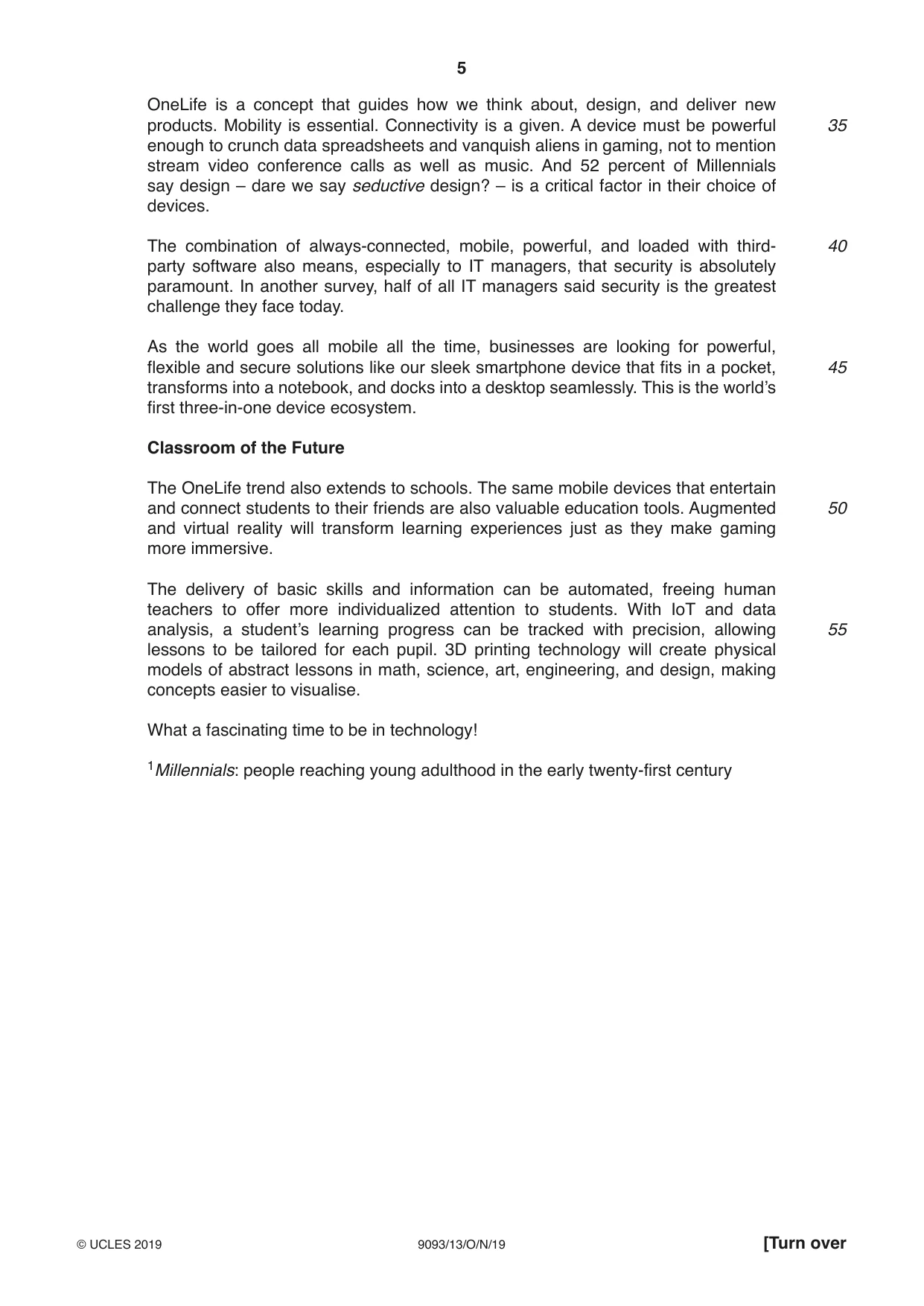
5 9093/13/O/N/19 © UCLES 2019 [Turn over OneLife is a concept that guides how we think about, design, and deliver new products. Mobility is essential. Connectivity is a given. A device must be powerful enough to crunch data spreadsheets and vanquish aliens in gaming, not to mention stream video conference calls as well as music. And 52 percent of Millennials say design – dare we say seductive design? – is a critical factor in their choice of devices. The combination of always-connected, mobile, powerful, and loaded with third- party software also means, especially to IT managers, that security is absolutely paramount. In another survey, half of all IT managers said security is the greatest challenge they face today. As the world goes all mobile all the time, businesses are looking for powerful, flexible and secure solutions like our sleek smartphone device that fits in a pocket, transforms into a notebook, and docks into a desktop seamlessly. This is the world’s first three-in-one device ecosystem. Classroom of the Future The OneLife trend also extends to schools. The same mobile devices that entertain and connect students to their friends are also valuable education tools. Augmented and virtual reality will transform learning experiences just as they make gaming more immersive. The delivery of basic skills and information can be automated, freeing human teachers to offer more individualized attention to students. With IoT and data analysis, a student’s learning progress can be tracked with precision, allowing lessons to be tailored for each pupil. 3D printing technology will create physical models of abstract lessons in math, science, art, engineering, and design, making concepts easier to visualise. What a fascinating time to be in technology! 1Millennials: people reaching young adulthood in the early twenty-first century 35 40 45 50 55
Question paper, page 6
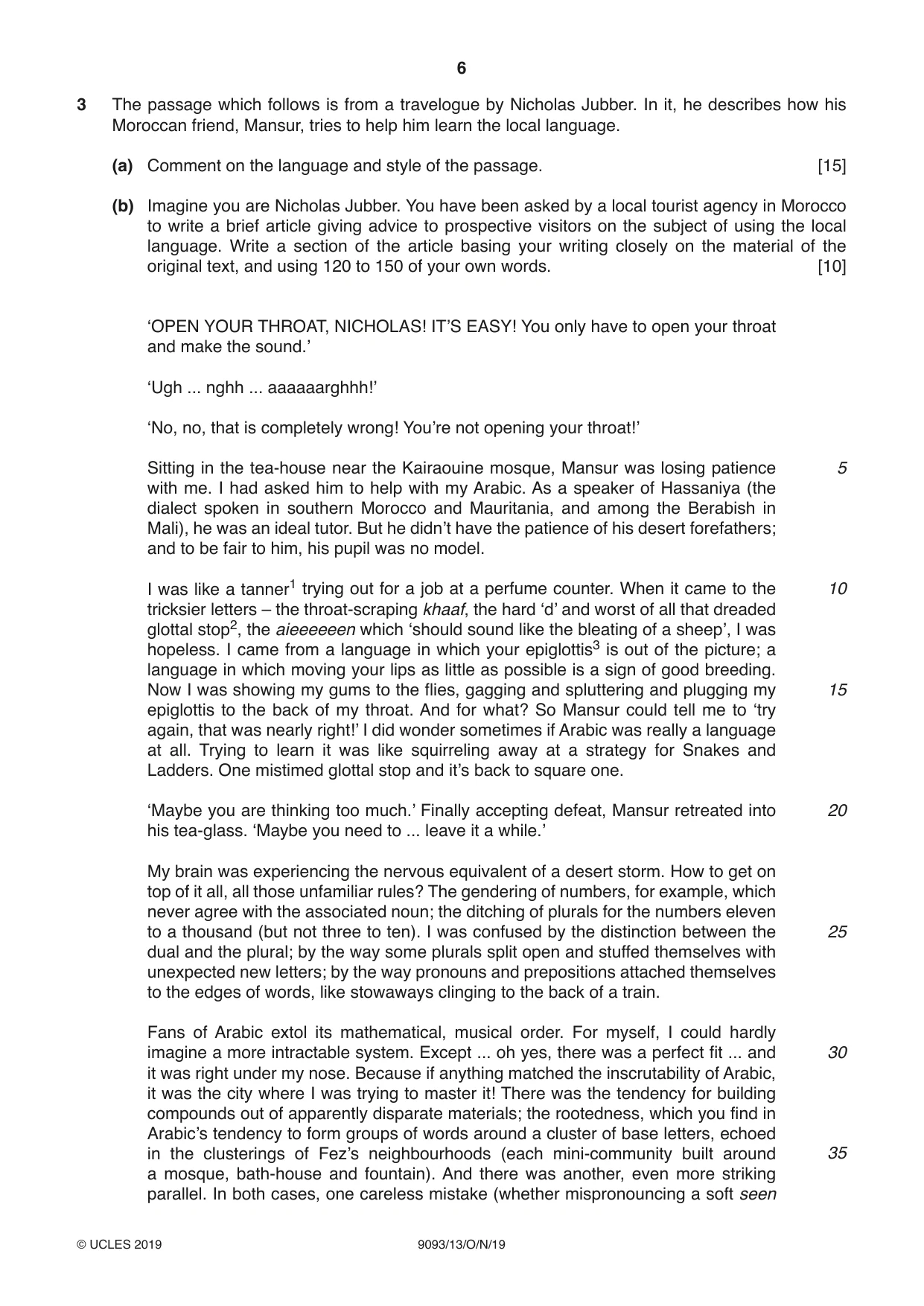
6 9093/13/O/N/19 © UCLES 2019 3 The passage which follows is from a travelogue by Nicholas Jubber. In it, he describes how his Moroccan friend, Mansur, tries to help him learn the local language. (a) Comment on the language and style of the passage. [15] (b) Imagine you are Nicholas Jubber. You have been asked by a local tourist agency in Morocco to write a brief article giving advice to prospective visitors on the subject of using the local language. Write a section of the article basing your writing closely on the material of the original text, and using 120 to 150 of your own words. [10] ‘OPEN YOUR THROAT, NICHOLAS! IT’S EASY! You only have to open your throat and make the sound.’ ‘Ugh ... nghh ... aaaaaarghhh!’ ‘No, no, that is completely wrong! You’re not opening your throat!’ Sitting in the tea-house near the Kairaouine mosque, Mansur was losing patience with me. I had asked him to help with my Arabic. As a speaker of Hassaniya (the dialect spoken in southern Morocco and Mauritania, and among the Berabish in Mali), he was an ideal tutor. But he didn’t have the patience of his desert forefathers; and to be fair to him, his pupil was no model. I was like a tanner1 trying out for a job at a perfume counter. When it came to the tricksier letters – the throat-scraping khaaf, the hard ‘d’ and worst of all that dreaded glottal stop2, the aieeeeeen which ‘should sound like the bleating of a sheep’, I was hopeless. I came from a language in which your epiglottis3 is out of the picture; a language in which moving your lips as little as possible is a sign of good breeding. Now I was showing my gums to the flies, gagging and spluttering and plugging my epiglottis to the back of my throat. And for what? So Mansur could tell me to ‘try again, that was nearly right!’ I did wonder sometimes if Arabic was really a language at all. Trying to learn it was like squirreling away at a strategy for Snakes and Ladders. One mistimed glottal stop and it’s back to square one. ‘Maybe you are thinking too much.’ Finally accepting defeat, Mansur retreated into his tea-glass. ‘Maybe you need to ... leave it a while.’ My brain was experiencing the nervous equivalent of a desert storm. How to get on top of it all, all those unfamiliar rules? The gendering of numbers, for example, which never agree with the associated noun; the ditching of plurals for the numbers eleven to a thousand (but not three to ten). I was confused by the distinction between the dual and the plural; by the way some plurals split open and stuffed themselves with unexpected new letters; by the way pronouns and prepositions attached themselves to the edges of words, like stowaways clinging to the back of a train. Fans of Arabic extol its mathematical, musical order. For myself, I could hardly imagine a more intractable system. Except ... oh yes, there was a perfect fit ... and it was right under my nose. Because if anything matched the inscrutability of Arabic, it was the city where I was trying to master it! There was the tendency for building compounds out of apparently disparate materials; the rootedness, which you find in Arabic’s tendency to form groups of words around a cluster of base letters, echoed in the clusterings of Fez’s neighbourhoods (each mini-community built around a mosque, bath-house and fountain). And there was another, even more striking parallel. In both cases, one careless mistake (whether mispronouncing a soft seen 5 10 15 20 25 30 35
Question paper, page 7
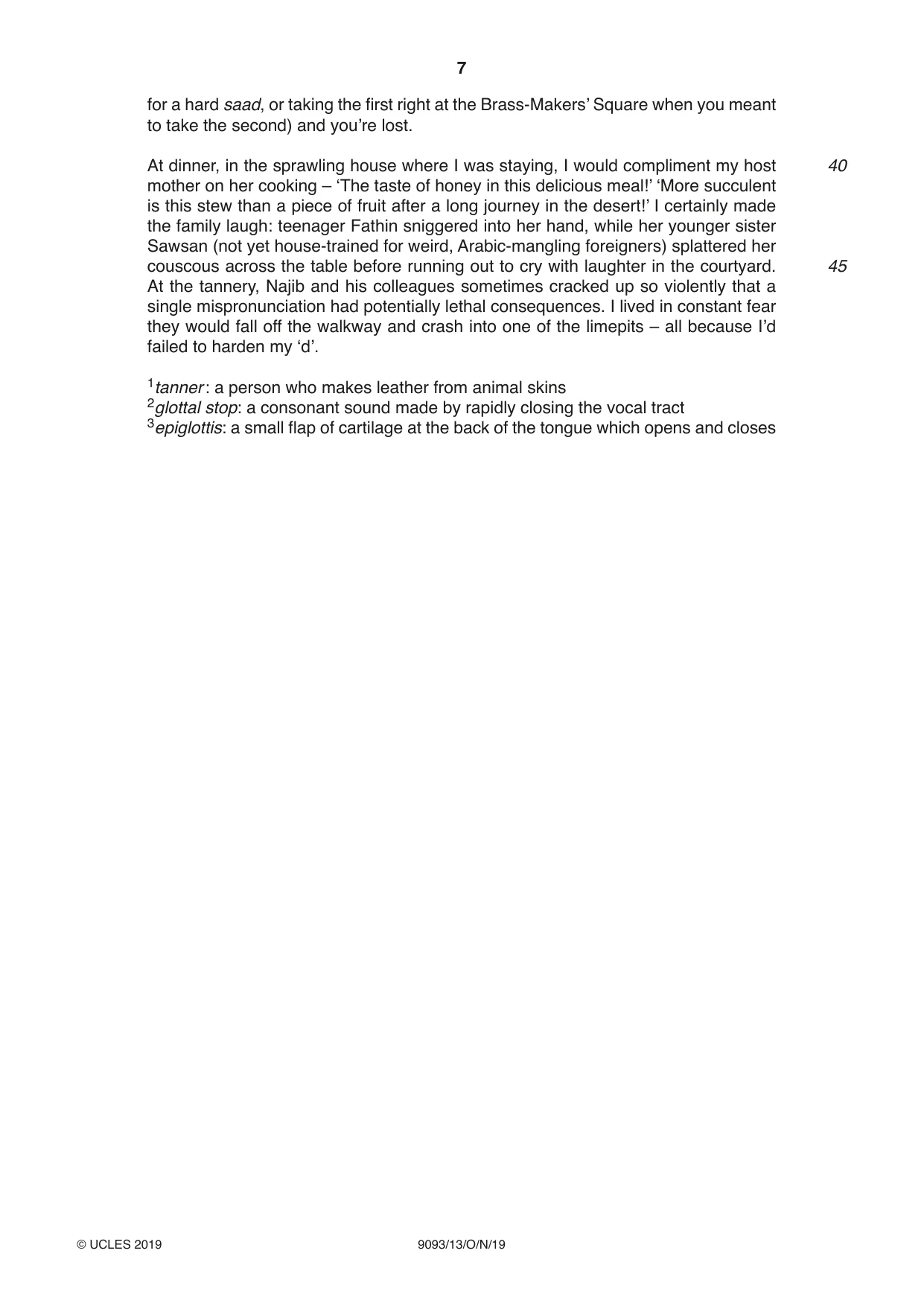
7 9093/13/O/N/19 © UCLES 2019 for a hard saad, or taking the first right at the Brass-Makers’ Square when you meant to take the second) and you’re lost. At dinner, in the sprawling house where I was staying, I would compliment my host mother on her cooking – ‘The taste of honey in this delicious meal!’ ‘More succulent is this stew than a piece of fruit after a long journey in the desert!’ I certainly made the family laugh: teenager Fathin sniggered into her hand, while her younger sister Sawsan (not yet house-trained for weird, Arabic-mangling foreigners) splattered her couscous across the table before running out to cry with laughter in the courtyard. At the tannery, Najib and his colleagues sometimes cracked up so violently that a single mispronunciation had potentially lethal consequences. I lived in constant fear they would fall off the walkway and crash into one of the limepits – all because I’d failed to harden my ‘d’. 1tanner : a person who makes leather from animal skins 2glottal stop: a consonant sound made by rapidly closing the vocal tract 3epiglottis: a small flap of cartilage at the back of the tongue which opens and closes 40 45
Question paper, page 8
8 9093/13/O/N/19 © UCLES 2019 BLANK PAGE Permission to reproduce items where third-party owned material protected by copyright is included has been sought and cleared where possible. Every reasonable effort has been made by the publisher (UCLES) to trace copyright holders, but if any items requiring clearance have unwittingly been included, the publisher will be pleased to make amends at the earliest possible opportunity. To avoid the issue of disclosure of answer-related information to candidates, all copyright acknowledgements are reproduced online in the Cambridge Assessment International Education Copyright Acknowledgements Booklet. This is produced for each series of examinations and is freely available to download at www.cambridgeinternational.org after the live examination series. Cambridge Assessment International Education is part of the Cambridge Assessment Group. Cambridge Assessment is the brand name of the University of Cambridge Local Examinations Syndicate (UCLES), which itself is a department of the University of Cambridge.
Mark scheme, page 1
This document consists of 5 printed pages. © UCLES 2019 [Turn over Cambridge Assessment International Education Cambridge International Advanced Subsidiary and Advanced Level ENGLISH LANGUAGE 9093/13 Paper 1 Passages October/November 2019 MARK SCHEME Maximum Mark: 50 Published This mark scheme is published as an aid to teachers and candidates, to indicate the requirements of the examination. It shows the basis on which Examiners were instructed to award marks. It does not indicate the details of the discussions that took place at an Examiners’ meeting before marking began, which would have considered the acceptability of alternative answers. Mark schemes should be read in conjunction with the question paper and the Principal Examiner Report for Teachers. Cambridge International will not enter into discussions about these mark schemes. Cambridge International is publishing the mark schemes for the October/November 2019 series for most Cambridge IGCSE™, Cambridge International A and AS Level components and some Cambridge O Level components.
Mark scheme, page 2
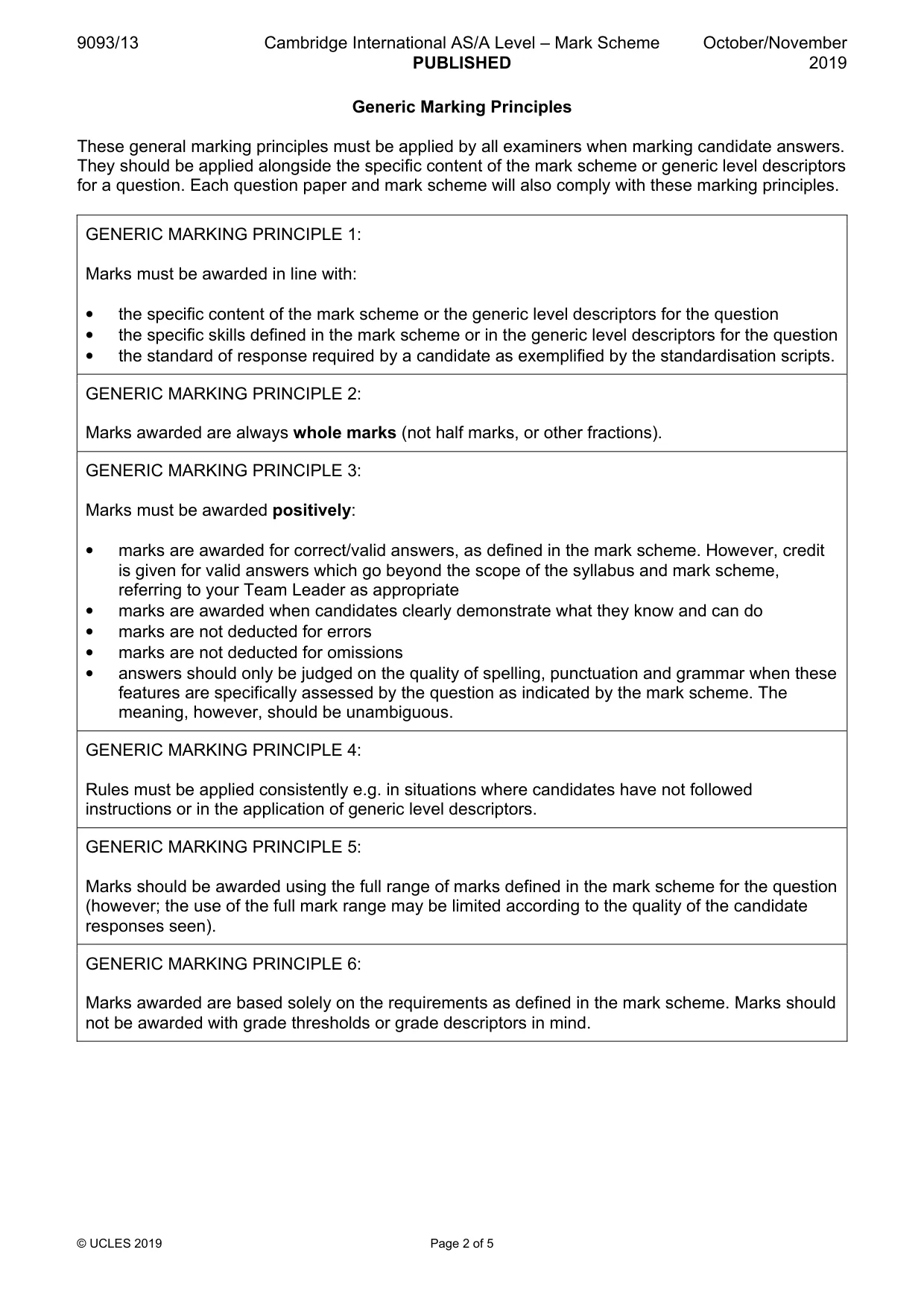
9093/13 Cambridge International AS/A Level – Mark Scheme PUBLISHED October/November 2019 © UCLES 2019 Page 2 of 5 Generic Marking Principles These general marking principles must be applied by all examiners when marking candidate answers. They should be applied alongside the specific content of the mark scheme or generic level descriptors for a question. Each question paper and mark scheme will also comply with these marking principles. GENERIC MARKING PRINCIPLE 1: Marks must be awarded in line with: • the specific content of the mark scheme or the generic level descriptors for the question • the specific skills defined in the mark scheme or in the generic level descriptors for the question • the standard of response required by a candidate as exemplified by the standardisation scripts. GENERIC MARKING PRINCIPLE 2: Marks awarded are always whole marks (not half marks, or other fractions). GENERIC MARKING PRINCIPLE 3: Marks must be awarded positively: • marks are awarded for correct/valid answers, as defined in the mark scheme. However, credit is given for valid answers which go beyond the scope of the syllabus and mark scheme, referring to your Team Leader as appropriate • marks are awarded when candidates clearly demonstrate what they know and can do • marks are not deducted for errors • marks are not deducted for omissions • answers should only be judged on the quality of spelling, punctuation and grammar when these features are specifically assessed by the question as indicated by the mark scheme. The meaning, however, should be unambiguous. GENERIC MARKING PRINCIPLE 4: Rules must be applied consistently e.g. in situations where candidates have not followed instructions or in the application of generic level descriptors. GENERIC MARKING PRINCIPLE 5: Marks should be awarded using the full range of marks defined in the mark scheme for the question (however; the use of the full mark range may be limited according to the quality of the candidate responses seen). GENERIC MARKING PRINCIPLE 6: Marks awarded are based solely on the requirements as defined in the mark scheme. Marks should not be awarded with grade thresholds or grade descriptors in mind.
Mark scheme, page 3
9093/13 Cambridge International AS/A Level – Mark Scheme PUBLISHED October/November 2019 © UCLES 2019 Page 3 of 5 Assessment Objectives: • Ability to read with understanding written material in a variety of forms, and to comment on its effectiveness. • Knowledge and understanding of features of English language. • Ability to write clearly, accurately and effectively for a particular purpose or audience. Each answer is marked out of a total of 25. • 15 marks are available for part (a) – commentary on use of language in the passage. • 10 marks are available for part (b) – directed writing task based on the passage. Each part is marked in accordance with the following general marking criteria.
Mark scheme, page 4
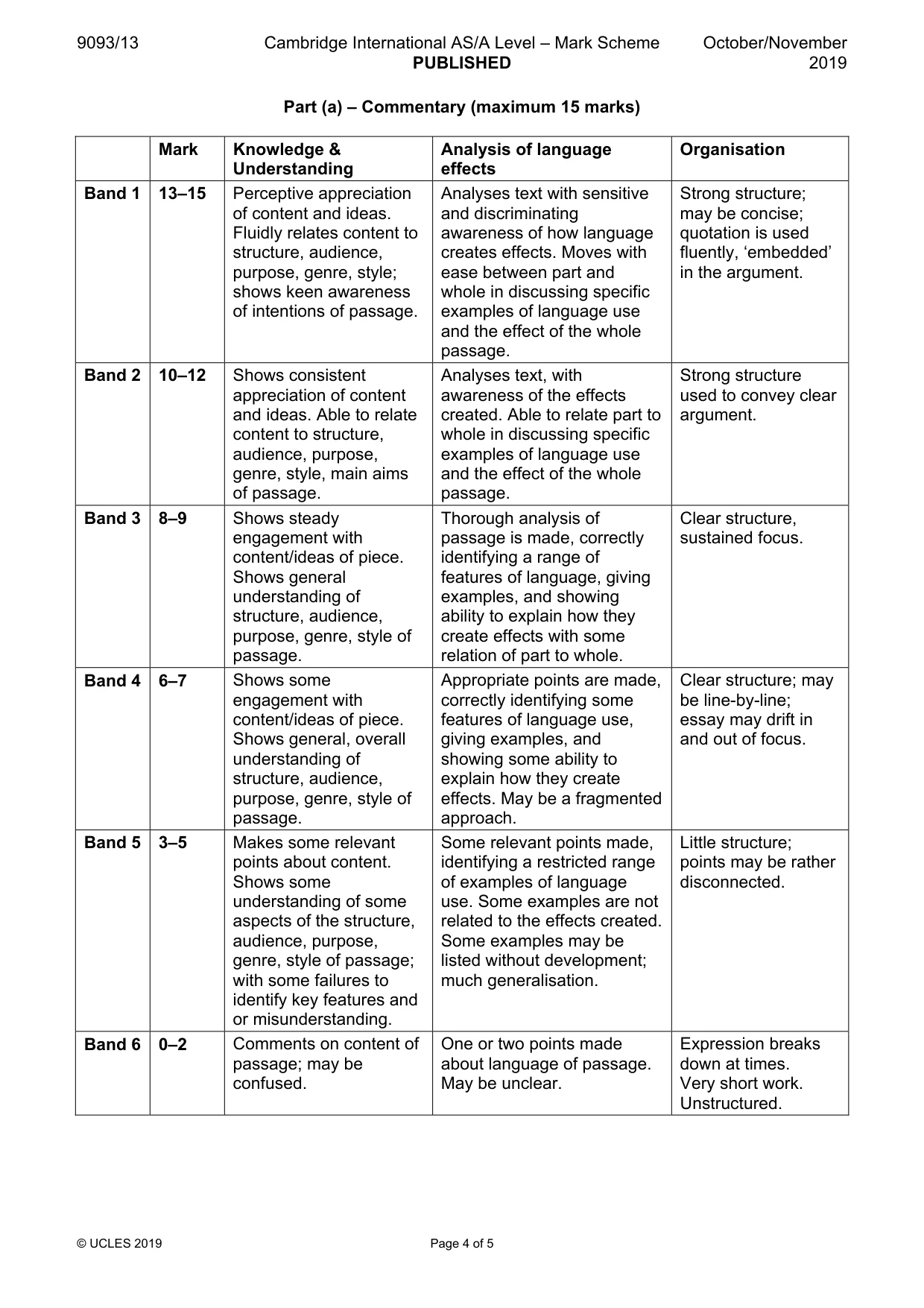
9093/13 Cambridge International AS/A Level – Mark Scheme PUBLISHED October/November 2019 © UCLES 2019 Page 4 of 5 Part (a) – Commentary (maximum 15 marks) Mark Knowledge & Understanding Analysis of language effects Organisation Band 1 13–15 Perceptive appreciation of content and ideas. Fluidly relates content to structure, audience, purpose, genre, style; shows keen awareness of intentions of passage. Analyses text with sensitive and discriminating awareness of how language creates effects. Moves with ease between part and whole in discussing specific examples of language use and the effect of the whole passage. Strong structure; may be concise; quotation is used fluently, ‘embedded’ in the argument. Band 2 10–12 Shows consistent appreciation of content and ideas. Able to relate content to structure, audience, purpose, genre, style, main aims of passage. Analyses text, with awareness of the effects created. Able to relate part to whole in discussing specific examples of language use and the effect of the whole passage. Strong structure used to convey clear argument. Band 3 8–9 Shows steady engagement with content/ideas of piece. Shows general understanding of structure, audience, purpose, genre, style of passage. Thorough analysis of passage is made, correctly identifying a range of features of language, giving examples, and showing ability to explain how they create effects with some relation of part to whole. Clear structure, sustained focus. Band 4 6–7 Shows some engagement with content/ideas of piece. Shows general, overall understanding of structure, audience, purpose, genre, style of passage. Appropriate points are made, correctly identifying some features of language use, giving examples, and showing some ability to explain how they create effects. May be a fragmented approach. Clear structure; may be line-by-line; essay may drift in and out of focus. Band 5 3–5 Makes some relevant points about content. Shows some understanding of some aspects of the structure, audience, purpose, genre, style of passage; with some failures to identify key features and or misunderstanding. Some relevant points made, identifying a restricted range of examples of language use. Some examples are not related to the effects created. Some examples may be listed without development; much generalisation. Little structure; points may be rather disconnected. Band 6 0–2 Comments on content of passage; may be confused. One or two points made about language of passage. May be unclear. Expression breaks down at times. Very short work. Unstructured.
Mark scheme, page 5
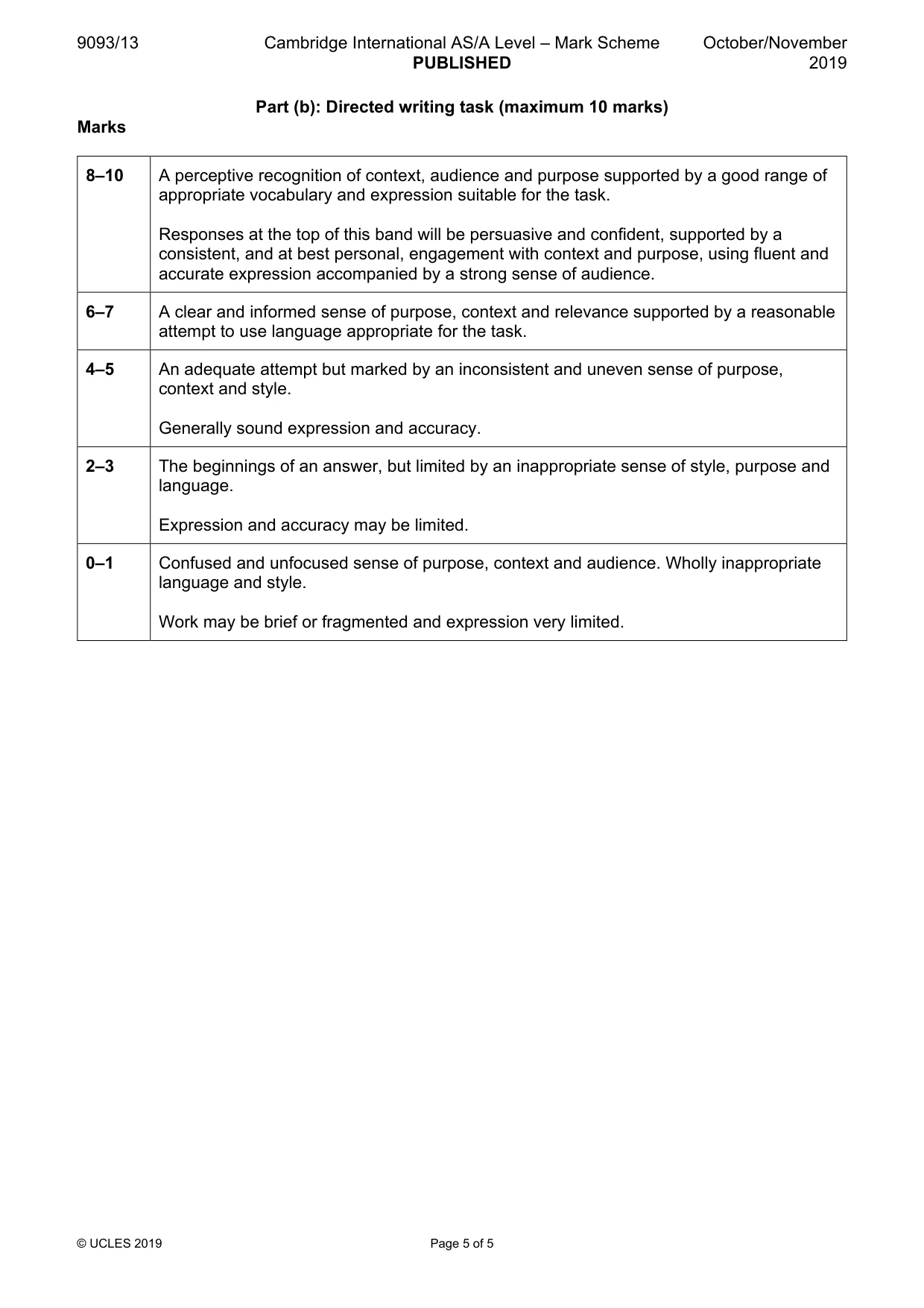
9093/13 Cambridge International AS/A Level – Mark Scheme PUBLISHED October/November 2019 © UCLES 2019 Page 5 of 5 Part (b): Directed writing task (maximum 10 marks) Marks 8–10 A perceptive recognition of context, audience and purpose supported by a good range of appropriate vocabulary and expression suitable for the task. Responses at the top of this band will be persuasive and confident, supported by a consistent, and at best personal, engagement with context and purpose, using fluent and accurate expression accompanied by a strong sense of audience. 6–7 A clear and informed sense of purpose, context and relevance supported by a reasonable attempt to use language appropriate for the task. 4–5 An adequate attempt but marked by an inconsistent and uneven sense of purpose, context and style. Generally sound expression and accuracy. 2–3 The beginnings of an answer, but limited by an inappropriate sense of style, purpose and language. Expression and accuracy may be limited. 0–1 Confused and unfocused sense of purpose, context and audience. Wholly inappropriate language and style. Work may be brief or fragmented and expression very limited.
What you needed in this session
Cambridge’s own grade thresholds for 2019 Oct/Nov, Paper 1 · Variant 3. A higher threshold means an easier paper — the bar moves with how the cohort did.