Cambridge A Level English - Language AS and A Level (from 2014) 9093 — 2019 Oct/Nov Paper 1 · Variant 1
9093/11/O/N/19 · 50 marks · ≈56 min
The question paper and its mark scheme, free to read here and free to download. This is Cambridge’s own paper, exactly as it was sat.
Question paper8 pages
Mark scheme5 pages
Answers below. Sit the paper first if you are practising.
Paper as text
Question paper, page 1
This document consists of 7 printed pages, 1 blank page and 1 Insert. DC (ST) 167695/1 © UCLES 2019 [Turn over Cambridge Assessment International Education Cambridge International Advanced Subsidiary and Advanced Level * 5 3 4 3 8 6 0 4 0 5 * ENGLISH LANGUAGE 9093/11 Paper 1 Passages October/November 2019 2 hours 15 minutes No Additional Materials are required. READ THESE INSTRUCTIONS FIRST An answer booklet is provided inside this question paper. You should follow the instructions on the front cover of the answer booklet. If you need additional answer paper, ask the invigilator for a continuation booklet. Answer two questions: Question 1 and either Question 2 or Question 3. You should spend about 15 minutes reading the passages and questions before you start writing your answers. You are reminded of the need for good English and clear presentation in your answers. The number of marks is given in brackets [ ] at the end of each question or part question.
Question paper, page 2
2 9093/11/O/N/19 © UCLES 2019 Answer Question 1 and either Question 2 or Question 3. 1 The following is a magazine article by the famous novelist, Toni Morrison. (a) Comment on the language and style of the article. [15] (b) Imagine you are the employer referred to in the passage. You decide to write a letter to Toni Morrison’s father thanking him for his daughter’s work after her employment has ended. Basing your writing closely on the material of the original passage, write the opening of the letter using 120 to 150 of your own words. [10] The Work You Do, the Person You Are All I had to do for the two dollars was clean Her house for a few hours after school. It was a beautiful house, too, with a plastic-covered sofa and chairs, wall-to-wall blue- and-white carpeting, a white enamel stove, a washing machine and a dryer – things that were common in Her neighbourhood, absent in mine. In the middle of the war, She had butter, sugar, steaks, and seam-up-the-back stockings. I knew how to scrub floors on my knees and how to wash clothes in our zinc tub, but I had never seen a Hoover vacuum cleaner or an iron that wasn’t heated by fire. Part of my pride in working for Her was earning money I could squander: on movies, candy, toys, ice-cream cones. But a larger part of my pride was based on the fact that I gave half my wages to my mother, which meant that some of my earnings were used for real things – an insurance-policy payment or what was owed to the milkman or the iceman. The pleasure of being necessary to my parents was profound. I was not like the children in folktales: burdensome mouths to feed, nuisances to be corrected, problems so severe that they were abandoned to the forest. I had a status that doing routine chores in my house did not provide – and it earned me a slow smile, an approving nod from an adult. Confirmations that I was adult-like, not childlike. In those days, the forties, children were not just loved or liked; they were needed. They could earn money; they could care for children younger than themselves; they could work the farm, take care of the herd, run errands, and much more. I suspect that children aren’t needed in that way now. They are loved, doted on, protected, and helped. Fine, and yet … Little by little, I got better at cleaning Her house – good enough to be given more to do, much more. I was ordered to carry bookcases upstairs and, once, to move a piano from one side of a room to the other. I fell carrying the bookcases. And after pushing the piano my arms and legs hurt so badly. I wanted to refuse, or at least to complain, but I was afraid She would fire me, and I would lose the freedom the dollar gave me, as well as the standing I had at home – although both were slowly being eroded. She began to offer me her clothes, for a price. Impressed by these worn things, which looked simply gorgeous to a little girl who had only two dresses to wear to school, I bought a few. Until my mother asked me if I really wanted to work for castoffs. So I learned to say ‘No, thank you’ to a faded sweater offered for a quarter of a week’s pay. Still, I had trouble summoning the courage to discuss or object to the increasing demands She made. And I knew that if I told my mother how unhappy I was she would tell me to quit. Then one day, alone in the kitchen with my father, I let drop 5 10 15 20 25 30 35
Question paper, page 3
3 9093/11/O/N/19 © UCLES 2019 [Turn over a few whines about the job. I gave him details, examples of what troubled me, yet although he listened intently, I saw no sympathy in his eyes. No ‘Oh, you poor little thing.’ Perhaps he understood that what I wanted was a solution to the job, not an escape from it. In any case, he put down his cup of coffee and said, ‘Listen. You don’t live there. You live here. With your people. Go to work. Get your money. And come on home.’ That was what he said. This was what I heard: 1. Whatever the work is, do it well – not for the boss but for yourself. 2. You make the job; it doesn’t make you. 3. Your real life is with us, your family. 4. You are not the work you do; you are the person you are. I have worked for all sorts of people since then, geniuses and morons, quick- witted and dull, bighearted and narrow. I’ve had many kinds of jobs, but since that conversation with my father I have never considered the level of labour to be the measure of myself, and I have never placed the security of a job above the value of home. 40 45 50
Question paper, page 4
4 9093/11/O/N/19 © UCLES 2019 2 The following extract is from the opening of Carl Sagan’s book, Pale Blue Dot: A Vision of the Human Future in Space, which was inspired by a photograph of the Earth taken from outer space. (a) Comment on the language and style of the passage. [15] (b) Imagine that a documentary film has been commissioned based on Carl Sagan’s book. Basing your writing closely on the material of the original text, write the voiceover script for the opening scene of the documentary. You should use 120 to 150 of your own words. [10] While almost everyone is taught that the Earth is a sphere with all of us somehow glued to it by gravity, the reality of our circumstance did not really begin to sink in until the famous frame-filling Apollo 17 photograph of the whole Earth – the one taken by astronauts on the last journey of humans to the Moon. It has become a kind of icon of our age. There’s Antarctica at what Americans and Europeans so readily regard as the bottom, and then all of Africa stretching up above it: you can see Ethiopia, Tanzania, and Kenya, where the earliest humans lived. At the top right are Saudi Arabia and what Europeans call the Near East. Just barely peeking out at the top is the Mediterranean Sea, around which so much of our global civilization emerged. You can make out the blue of the ocean, the yellow- red of the Sahara and the Arabian desert, the brown-green of forest and grassland. And yet there is no sign of humans in this picture, not our reworking of the Earth’s surface, not our machines, not ourselves: we are too small and our statecraft is too feeble to be seen by a spacecraft between the Earth and the Moon. From this vantage point, our obsession with nationalism is nowhere in evidence. The Apollo pictures of the whole Earth conveyed to multitudes something well known to astronomers: on the scale of worlds – to say nothing of stars or galaxies – humans are inconsequential, a thin film of life on an obscure and solitary lump of rock and metal. It seemed to me that another picture of the Earth, this one taken from a hundred thousand times farther away, might help in the continuing process of revealing to ourselves our true circumstance and condition. From this distant perspective, the Earth might not seem of any particular interest. But for us, it’s different. Look again at that dot. That’s here. That’s home. That’s us. On it everyone you love, everyone you know, everyone you ever heard of, every human being who ever was, lived out their lives. The aggregate of our joy and suffering, thousands of confident religions, ideologies, and economic doctrines, every hunter and forager, every hero and coward, every creator and destroyer of civilization, every king and peasant, every young couple in love, every mother and father, hopeful child, inventor and explorer, every teacher of morals, every corrupt politician, every ‘superstar’, every ‘supreme leader’, every saint and sinner in the history of our species lived there – on a mote of dust suspended in a sunbeam. The Earth is a very small stage in a vast cosmic arena. Think of the rivers of blood spilled by all those generals and emperors so that, in glory and triumph, they could become momentary masters of a fraction of a dot. Think of the endless cruelties visited by the inhabitants of one corner of this pixel on the scarcely distinguishable inhabitants of some other corner, how frequent their misunderstandings, how eager they are to kill one another, how fervent their hatreds. Our posturings, our imagined self-importance, the delusion that we have some privileged position in the Universe, are challenged by this point of pale light. Our 5 10 15 20 25 30 35 40
Question paper, page 5
5 9093/11/O/N/19 © UCLES 2019 [Turn over planet is a lonely speck in the great enveloping cosmic dark. In our obscurity, in all this vastness, there is no hint that help will come from elsewhere to save us from ourselves. The Earth is the only world known so far to harbour life. There is nowhere else, at least in the near future, to which our species could migrate. Visit, yes. Settle, not yet. Like it or not, for the moment the Earth is where we make our stand. It has been said that astronomy is a humbling and character-building experience. There is perhaps no better demonstration of the folly of human conceits than this distant image of our tiny world. To me, it underscores our responsibility to deal more kindly with one another, and to preserve and cherish the pale blue dot, the only home we’ve ever known. 45 50
Question paper, page 6
6 9093/11/O/N/19 © UCLES 2019 3 The following text is a biographical account of an Afghan woman called Bakhtawara. In this extract, the unusual circumstances of Bakhtawara’s life are revealed by the writer. (a) Comment on the language and style of the passage. [15] (b) Imagine that Bakhtawara is able to record her experiences in a private journal. Basing your writing on the material of the original passage, and using 120 to 150 of your own words, write a section of the journal. [10] Bakhtawara walked into the house and the women and girls greeted her. Her sister- in-law stood up and offered her seat to Bakhtawara as a mark of respect. She sat on the thin mattress near the window in the room, took off her large black turban, heavy with the scent of fresh sweat, and put it on the window shelf. In its place Bakhtawara wore a white-embroidered cap, although the dust and dirt had given it a yellow tinge. The children gathered around their auntie, eagerly waiting for her to hand out sweets, as she often did when she got home. They giggled around Bakhtawara, their hands delving into the pockets of her black waistcoat, which she wore over her shalwar kamiz1. The family gathered around and plates and bowls of food were laid on the ground. Bakhtawara’s sister-in-law brought out the meat on a separate plate with some onions and fiery fresh green chillies on a side plate. The meat was put in front of Bakhtawara. As head of the family she was expected to distribute it fairly amongst everyone. After the family had finished eating, her young nephew brought water for the family to clean their hands. It was offered first to Bakhtawara and then to the rest of the family. Bakhtawara would usually tell everyone what she had been up to that day; the women would listen carefully to every word. Bakhtawara’s sister-in-law gradually got the feeling that Bakhtawara was tired after a long day working hard on the land and trying to resolve other people’s problems. So she quietly said, ‘May God give you strength and blessing for doing all this and looking after my family too. I will let you rest and sleep now.’ Bakhtawara said to her sister-in-law, ‘You are my family. If I don’t look after you and the children, God won’t forgive me. When Father died he gave me this responsibility; and I am obeying my father’s wishes.’ Bakhtawara put her cup on the floor and got up to get some much-needed rest. Alone in her room she took off her cap and her long brown hair fell onto her shoulders. As she stood near the open window a cool breeze brushed her skin; the body of a woman was emerging from her male clothing. Bakhtawara’s parents had transformed her appearance from female to male by dressing her as a boy, even as a baby. To dress baby girls as boys in childhood is a common practice among some families all across Afghanistan. Having a son is vital for every Afghan family. A son represents the future prosperity of a family; he perpetuates the family name, and he is the one that his parents will eventually rely on to look after them in their old age. Girls are looked on as temporary guests in the family because when they grow up and marry they will make a family for someone else’s son and take their skills to another family. Bakhtawara looked at her reflection in the small mirror hanging by the door. Her green eyes felt like those of a woman and yet they looked back at her with the unswerving determination and stoicism of a man. She stroked her cheeks and lips, which felt like those of a normal woman but her hands were rough where her skin 5 10 15 20 25 30 35 40
Question paper, page 7
7 9093/11/O/N/19 © UCLES 2019 had been burnt after working long days outside in the sun. Like any other woman, Bakhtawara craved love. She looked in the mirror at her broad shoulders and stocky body and sighed. She was tired of always caring for others and wanted someone to care for her. She wanted a dashing young man to hold her hand; she wanted to be the special person on her wedding day. Bakhtawara would often conjure up her own wedding scene in her head. The man of her dreams would come to her family to ask for her hand and her parents would demand a lot of money for her because she was so valuable. In her fantasies her suitor wants to marry Bakhtawara so badly that he doesn’t care how much he has to pay. Bakhtawara smiled as she enjoyed the dream world she had conjured up. She only thought about this imaginary life alone in her room, unseen by others. Bakhtawara was thirty-five years old but her skin was lined and tanned like that of the older men in her village. So many times she had wished to put on mascara, or yearned to decorate her hands with henna, and dress her hair with different coloured clips, or wear glass bangles like other girls in her family. 1shalwar kamiz: traditional clothing worn in South-central Asia 45 50 55
Question paper, page 8
8 9093/11/O/N/19 © UCLES 2019 BLANK PAGE Permission to reproduce items where third-party owned material protected by copyright is included has been sought and cleared where possible. Every reasonable effort has been made by the publisher (UCLES) to trace copyright holders, but if any items requiring clearance have unwittingly been included, the publisher will be pleased to make amends at the earliest possible opportunity. To avoid the issue of disclosure of answer-related information to candidates, all copyright acknowledgements are reproduced online in the Cambridge Assessment International Education Copyright Acknowledgements Booklet. This is produced for each series of examinations and is freely available to download at www.cambridgeinternational.org after the live examination series. Cambridge Assessment International Education is part of the Cambridge Assessment Group. Cambridge Assessment is the brand name of the University of Cambridge Local Examinations Syndicate (UCLES), which itself is a department of the University of Cambridge.
Mark scheme, page 1
This document consists of 5 printed pages. © UCLES 2019 [Turn over Cambridge Assessment International Education Cambridge International Advanced Subsidiary and Advanced Level ENGLISH LANGUAGE 9093/11 Paper 1 Passages October/November 2019 MARK SCHEME Maximum Mark: 50 Published This mark scheme is published as an aid to teachers and candidates, to indicate the requirements of the examination. It shows the basis on which Examiners were instructed to award marks. It does not indicate the details of the discussions that took place at an Examiners’ meeting before marking began, which would have considered the acceptability of alternative answers. Mark schemes should be read in conjunction with the question paper and the Principal Examiner Report for Teachers. Cambridge International will not enter into discussions about these mark schemes. Cambridge International is publishing the mark schemes for the October/November 2019 series for most Cambridge IGCSE™, Cambridge International A and AS Level components and some Cambridge O Level components.
Mark scheme, page 2
9093/11 Cambridge International AS/A Level – Mark Scheme PUBLISHED October/November 2019 © UCLES 2019 Page 2 of 5 Generic Marking Principles These general marking principles must be applied by all examiners when marking candidate answers. They should be applied alongside the specific content of the mark scheme or generic level descriptors for a question. Each question paper and mark scheme will also comply with these marking principles. GENERIC MARKING PRINCIPLE 1: Marks must be awarded in line with: • the specific content of the mark scheme or the generic level descriptors for the question • the specific skills defined in the mark scheme or in the generic level descriptors for the question • the standard of response required by a candidate as exemplified by the standardisation scripts. GENERIC MARKING PRINCIPLE 2: Marks awarded are always whole marks (not half marks, or other fractions). GENERIC MARKING PRINCIPLE 3: Marks must be awarded positively: • marks are awarded for correct/valid answers, as defined in the mark scheme. However, credit is given for valid answers which go beyond the scope of the syllabus and mark scheme, referring to your Team Leader as appropriate • marks are awarded when candidates clearly demonstrate what they know and can do • marks are not deducted for errors • marks are not deducted for omissions • answers should only be judged on the quality of spelling, punctuation and grammar when these features are specifically assessed by the question as indicated by the mark scheme. The meaning, however, should be unambiguous. GENERIC MARKING PRINCIPLE 4: Rules must be applied consistently e.g. in situations where candidates have not followed instructions or in the application of generic level descriptors. GENERIC MARKING PRINCIPLE 5: Marks should be awarded using the full range of marks defined in the mark scheme for the question (however; the use of the full mark range may be limited according to the quality of the candidate responses seen). GENERIC MARKING PRINCIPLE 6: Marks awarded are based solely on the requirements as defined in the mark scheme. Marks should not be awarded with grade thresholds or grade descriptors in mind.
Mark scheme, page 3
9093/11 Cambridge International AS/A Level – Mark Scheme PUBLISHED October/November 2019 © UCLES 2019 Page 3 of 5 Assessment Objectives: • Ability to read with understanding written material in a variety of forms, and to comment on its effectiveness. • Knowledge and understanding of features of English language. • Ability to write clearly, accurately and effectively for a particular purpose or audience. Each answer is marked out of a total of 25. • 15 marks are available for part (a) – commentary on use of language in the passage. • 10 marks are available for part (b) – directed writing task based on the passage. Each part is marked in accordance with the following general marking criteria.
Mark scheme, page 4
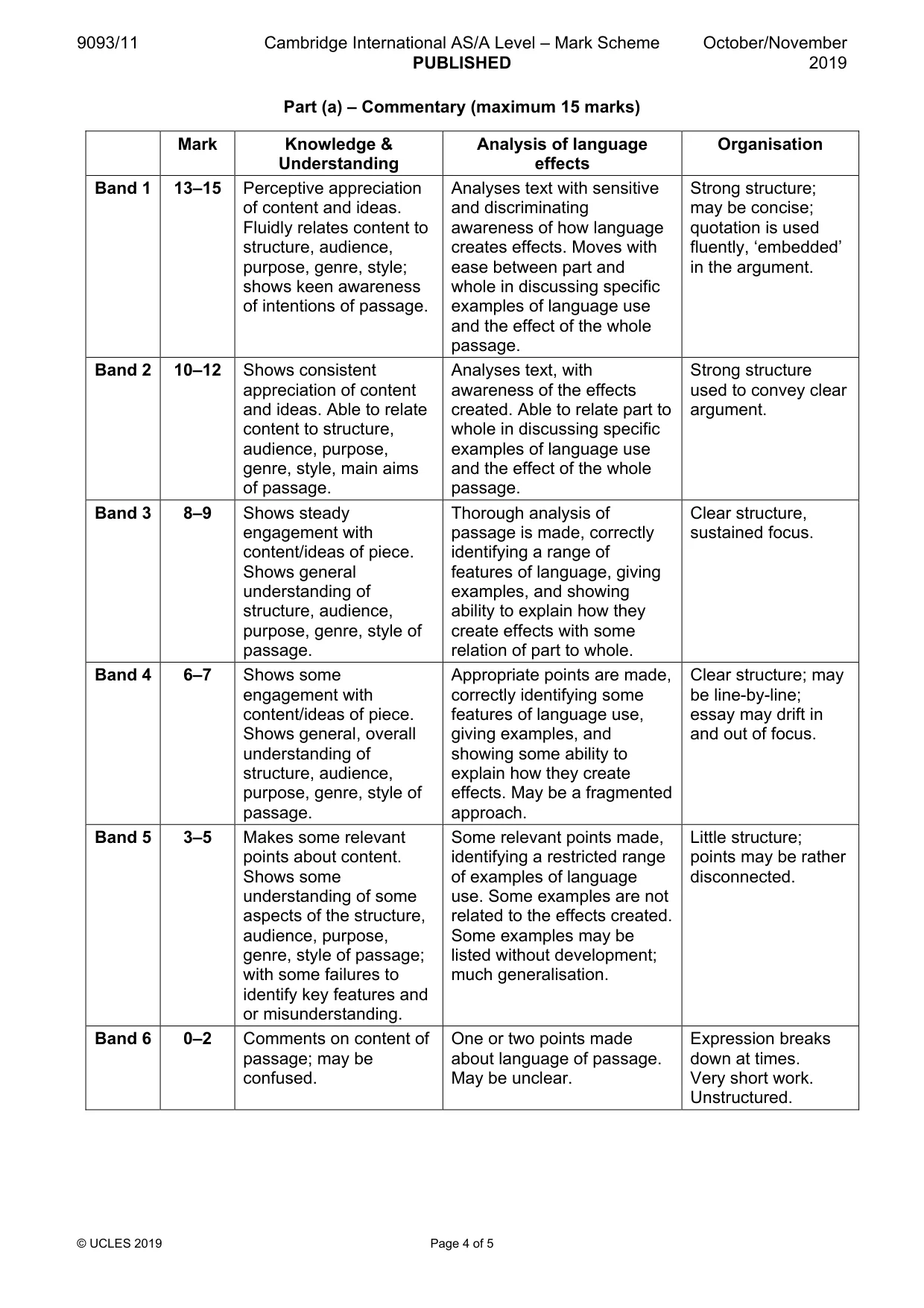
9093/11 Cambridge International AS/A Level – Mark Scheme PUBLISHED October/November 2019 © UCLES 2019 Page 4 of 5 Part (a) – Commentary (maximum 15 marks) Mark Knowledge & Understanding Analysis of language effects Organisation Band 1 13–15 Perceptive appreciation of content and ideas. Fluidly relates content to structure, audience, purpose, genre, style; shows keen awareness of intentions of passage. Analyses text with sensitive and discriminating awareness of how language creates effects. Moves with ease between part and whole in discussing specific examples of language use and the effect of the whole passage. Strong structure; may be concise; quotation is used fluently, ‘embedded’ in the argument. Band 2 10–12 Shows consistent appreciation of content and ideas. Able to relate content to structure, audience, purpose, genre, style, main aims of passage. Analyses text, with awareness of the effects created. Able to relate part to whole in discussing specific examples of language use and the effect of the whole passage. Strong structure used to convey clear argument. Band 3 8–9 Shows steady engagement with content/ideas of piece. Shows general understanding of structure, audience, purpose, genre, style of passage. Thorough analysis of passage is made, correctly identifying a range of features of language, giving examples, and showing ability to explain how they create effects with some relation of part to whole. Clear structure, sustained focus. Band 4 6–7 Shows some engagement with content/ideas of piece. Shows general, overall understanding of structure, audience, purpose, genre, style of passage. Appropriate points are made, correctly identifying some features of language use, giving examples, and showing some ability to explain how they create effects. May be a fragmented approach. Clear structure; may be line-by-line; essay may drift in and out of focus. Band 5 3–5 Makes some relevant points about content. Shows some understanding of some aspects of the structure, audience, purpose, genre, style of passage; with some failures to identify key features and or misunderstanding. Some relevant points made, identifying a restricted range of examples of language use. Some examples are not related to the effects created. Some examples may be listed without development; much generalisation. Little structure; points may be rather disconnected. Band 6 0–2 Comments on content of passage; may be confused. One or two points made about language of passage. May be unclear. Expression breaks down at times. Very short work. Unstructured.
Mark scheme, page 5
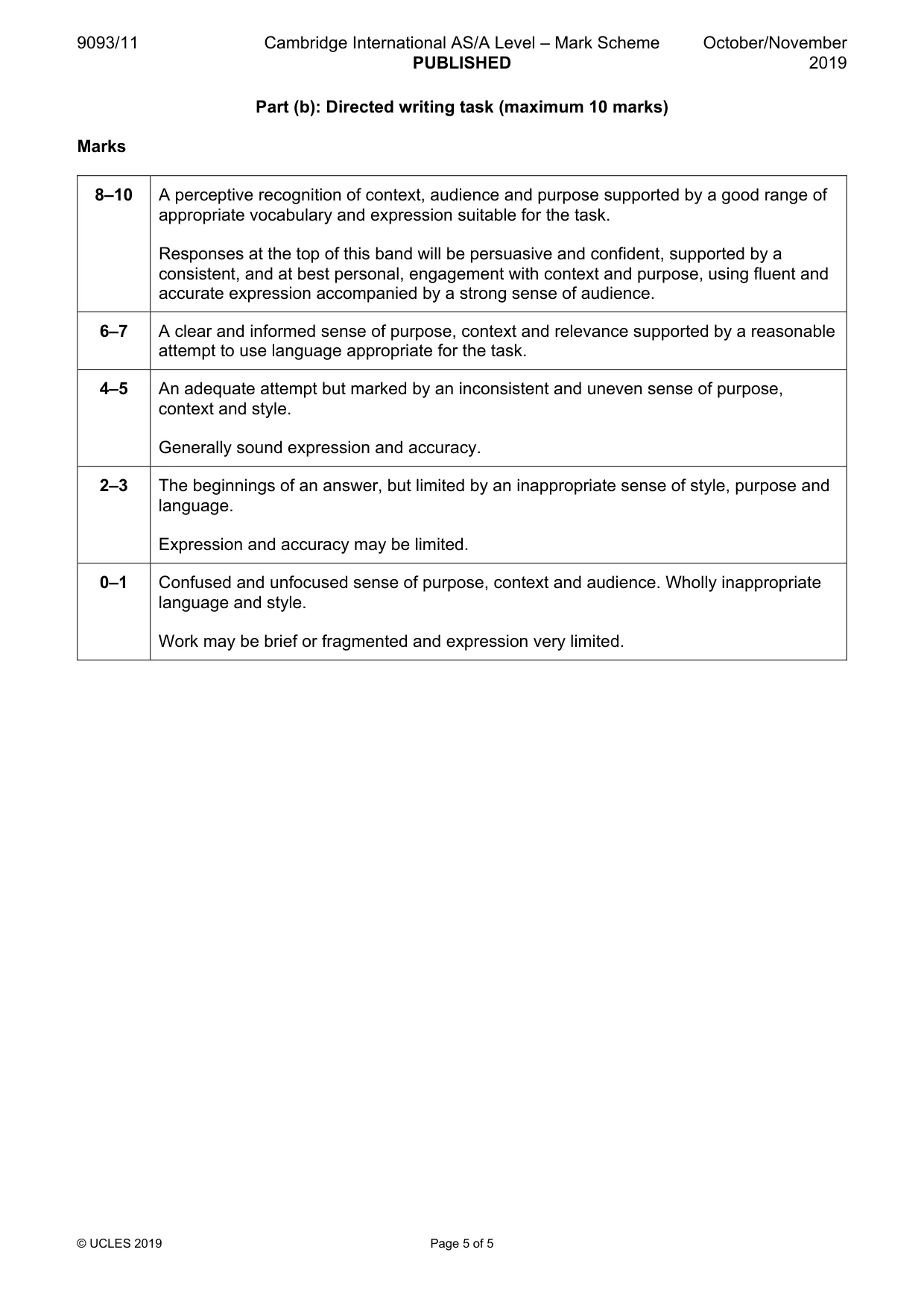
9093/11 Cambridge International AS/A Level – Mark Scheme PUBLISHED October/November 2019 © UCLES 2019 Page 5 of 5 Part (b): Directed writing task (maximum 10 marks) Marks 8–10 A perceptive recognition of context, audience and purpose supported by a good range of appropriate vocabulary and expression suitable for the task. Responses at the top of this band will be persuasive and confident, supported by a consistent, and at best personal, engagement with context and purpose, using fluent and accurate expression accompanied by a strong sense of audience. 6–7 A clear and informed sense of purpose, context and relevance supported by a reasonable attempt to use language appropriate for the task. 4–5 An adequate attempt but marked by an inconsistent and uneven sense of purpose, context and style. Generally sound expression and accuracy. 2–3 The beginnings of an answer, but limited by an inappropriate sense of style, purpose and language. Expression and accuracy may be limited. 0–1 Confused and unfocused sense of purpose, context and audience. Wholly inappropriate language and style. Work may be brief or fragmented and expression very limited.
What you needed in this session
Cambridge’s own grade thresholds for 2019 Oct/Nov, Paper 1 · Variant 1. A higher threshold means an easier paper — the bar moves with how the cohort did.