Cambridge A Level English - Language AS and A Level (from 2014) 9093 — 2019 Oct/Nov Paper 1 · Variant 2
9093/12/O/N/19 · 50 marks · ≈56 min
The question paper and its mark scheme, free to read here and free to download. This is Cambridge’s own paper, exactly as it was sat.
Question paper8 pages

Mark scheme5 pages
Answers below. Sit the paper first if you are practising.
Paper as text
Question paper, page 1
This document consists of 7 printed pages, 1 blank page and 1 Insert. DC (KS) 130750/3 R © UCLES 2019 [Turn over Cambridge Assessment International Education Cambridge International Advanced Subsidiary and Advanced Level ENGLISH LANGUAGE 9093/12 Paper 1 Passages October/November 2019 2 hours 15 minutes No Additional Materials are required. READ THESE INSTRUCTIONS FIRST An answer booklet is provided inside this question paper. You should follow the instructions on the front cover of the answer booklet. If you need additional answer paper, ask the invigilator for a continuation booklet. Answer two questions: Question 1 and either Question 2 or Question 3. You should spend about 15 minutes reading the passages and questions before you start writing your answers. You are reminded of the need for good English and clear presentation in your answers. The number of marks is given in brackets [ ] at the end of each question or part question. * 2 9 9 3 8 9 9 1 2 3 *
Question paper, page 2
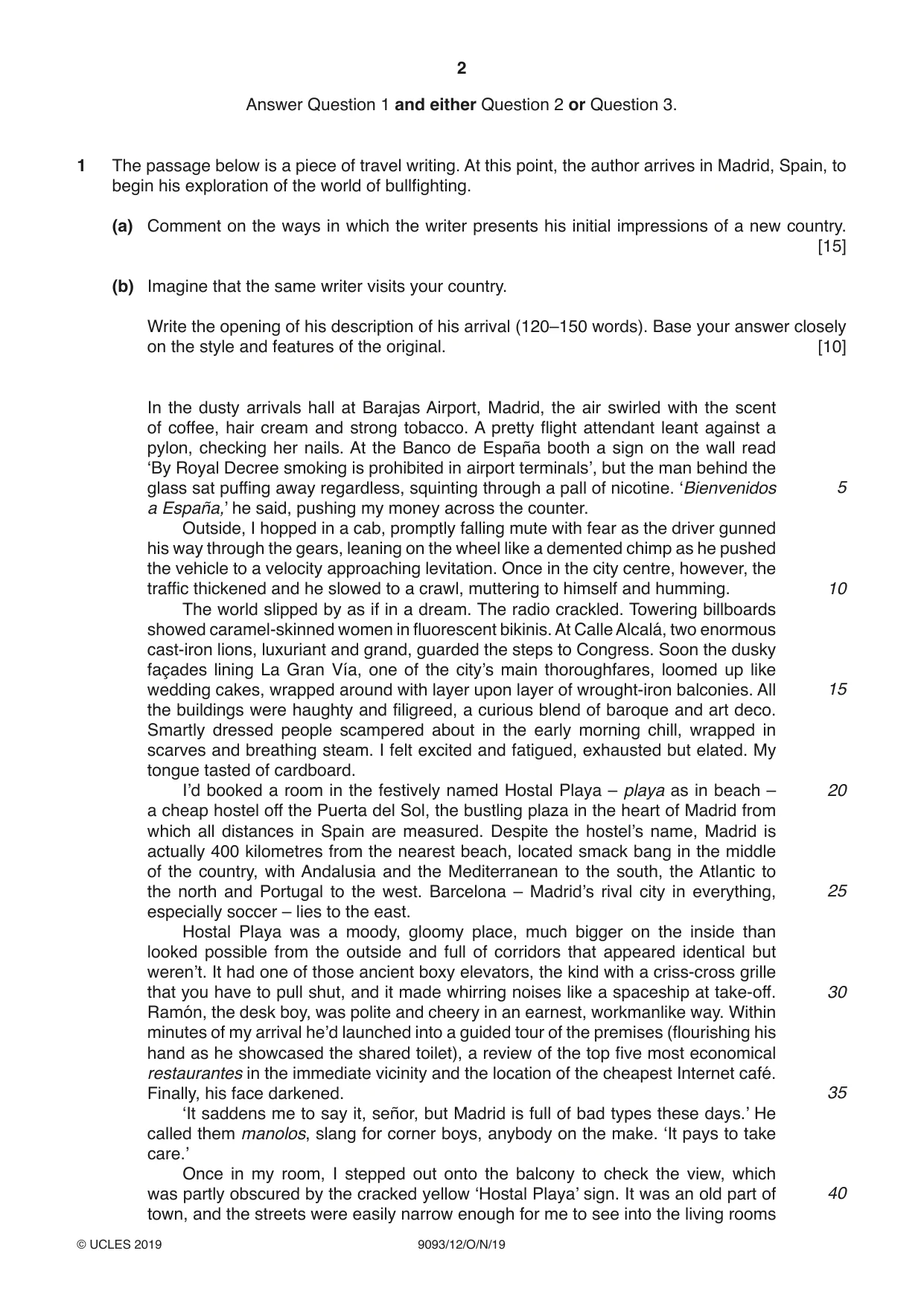
2 9093/12/O/N/19 © UCLES 2019 Answer Question 1 and either Question 2 or Question 3. 1 The passage below is a piece of travel writing. At this point, the author arrives in Madrid, Spain, to begin his exploration of the world of bullfighting. (a) Comment on the ways in which the writer presents his initial impressions of a new country. [15] (b) Imagine that the same writer visits your country. Write the opening of his description of his arrival (120–150 words). Base your answer closely on the style and features of the original. [10] In the dusty arrivals hall at Barajas Airport, Madrid, the air swirled with the scent of coffee, hair cream and strong tobacco. A pretty flight attendant leant against a pylon, checking her nails. At the Banco de España booth a sign on the wall read ‘By Royal Decree smoking is prohibited in airport terminals’, but the man behind the glass sat puffing away regardless, squinting through a pall of nicotine. ‘Bienvenidos a España,’ he said, pushing my money across the counter. Outside, I hopped in a cab, promptly falling mute with fear as the driver gunned his way through the gears, leaning on the wheel like a demented chimp as he pushed the vehicle to a velocity approaching levitation. Once in the city centre, however, the traffic thickened and he slowed to a crawl, muttering to himself and humming. The world slipped by as if in a dream. The radio crackled. Towering billboards showed caramel-skinned women in fluorescent bikinis. At Calle Alcalá, two enormous cast-iron lions, luxuriant and grand, guarded the steps to Congress. Soon the dusky façades lining La Gran Vía, one of the city’s main thoroughfares, loomed up like wedding cakes, wrapped around with layer upon layer of wrought-iron balconies. All the buildings were haughty and filigreed, a curious blend of baroque and art deco. Smartly dressed people scampered about in the early morning chill, wrapped in scarves and breathing steam. I felt excited and fatigued, exhausted but elated. My tongue tasted of cardboard. I’d booked a room in the festively named Hostal Playa – playa as in beach – a cheap hostel off the Puerta del Sol, the bustling plaza in the heart of Madrid from which all distances in Spain are measured. Despite the hostel’s name, Madrid is actually 400 kilometres from the nearest beach, located smack bang in the middle of the country, with Andalusia and the Mediterranean to the south, the Atlantic to the north and Portugal to the west. Barcelona – Madrid’s rival city in everything, especially soccer – lies to the east. Hostal Playa was a moody, gloomy place, much bigger on the inside than looked possible from the outside and full of corridors that appeared identical but weren’t. It had one of those ancient boxy elevators, the kind with a criss-cross grille that you have to pull shut, and it made whirring noises like a spaceship at take-off. Ramón, the desk boy, was polite and cheery in an earnest, workmanlike way. Within minutes of my arrival he’d launched into a guided tour of the premises (flourishing his hand as he showcased the shared toilet), a review of the top five most economical restaurantes in the immediate vicinity and the location of the cheapest Internet café. Finally, his face darkened. ‘It saddens me to say it, señor, but Madrid is full of bad types these days.’ He called them manolos, slang for corner boys, anybody on the make. ‘It pays to take care.’ Once in my room, I stepped out onto the balcony to check the view, which was partly obscured by the cracked yellow ‘Hostal Playa’ sign. It was an old part of town, and the streets were easily narrow enough for me to see into the living rooms 5 10 15 20 25 30 35 40
Question paper, page 3
3 9093/12/O/N/19 © UCLES 2019 [Turn over across the way. I stood there for some time, peering across, hoping to see something dramatic happening, but no such luck. Instead, I looked down into the street. A baker rushed past carrying a tray of piping hot churros, twists of deep fried batter dusted in sugar. In the café opposite, businessmen breakfasted on cigarettes and anis. In the cool moist air of the mid-March morning, the sounds of the city came curdling up like a fat man clearing his throat; car alarms, cat whistles and shop shutters, a steadily swelling cacophony of clanging, banging and cursing. The busier the city got, however, the lonelier I felt. What was I doing here? And who, I wondered, could care less about bullfighting? 45 50
Question paper, page 4
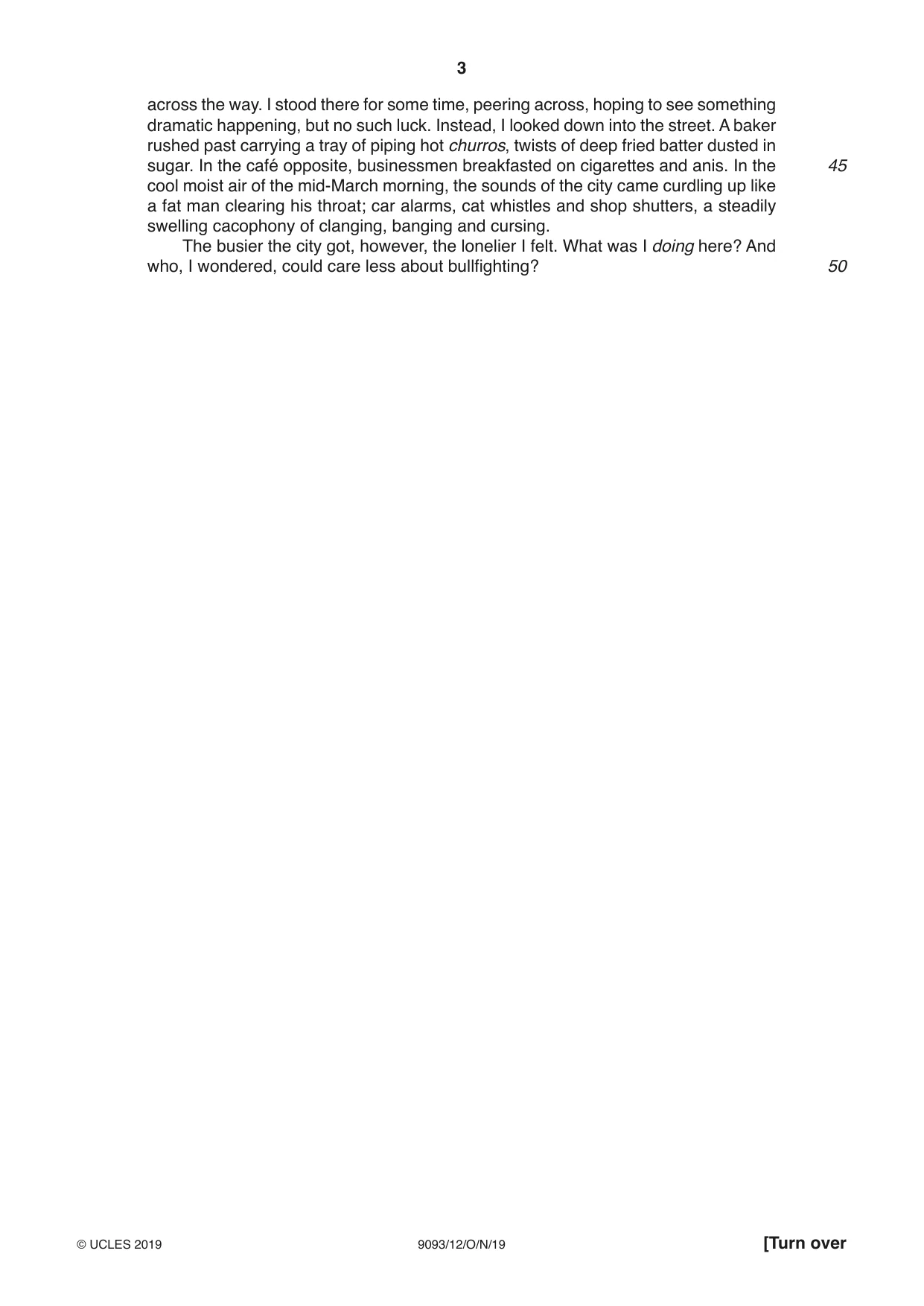
4 9093/12/O/N/19 © UCLES 2019 2 The passage below is a web advertisement/advertorial for holidays in Dubai, sponsored by an international hotel chain. (a) Comment on the ways in which the language and style of the passage help to promote Dubai as a holiday destination. [15] (b) Imagine that the same hotel chain also has a hotel in a tourist destination that you have visited. Write a section of the advertisement that might be produced for that destination (120–150 words). Base your answer closely on the style and features of the original extract. [10] How long have you got? Three, five or seven days in Dubai Audacious Dubai is a city unlike any other. Futuristic skyscrapers rub shoulders with lively souks,1 Bedouin heritage collides with 21st-century shopping and cutting edge bars and restaurants sit atop some of the world’s leading hotels. Three days in Dubai Dubai is hot all year round so you won’t want to be walking too far. Book your stay at Hilton Dubai Jumeirah Resort and you won’t have to; you’ll be based right on the city’s best beach. You’ll also be close to the metro, so use this to travel to the Al Fahidi Fort, the city’s oldest building, which dates from 1787. The area has been inhabited for far longer though, and the museum the fort houses has the evidence, including Bronze Age alabaster and plenty of other artefacts. After a morning of culture, get high in the afternoon with a flight above the city. Go by seaplane with Seawings, taking off from the Creek for a scenic tour above the coastline, or dip and dive above the city’s tallest towers by helicopter with HeliDubai. Either way you’ll get to see The World, a series of manmade islands laid out like a world map. Come back down to earth on day two – literally – with a spot of dune bashing. Head out into the desert with Desert Safari Dubai and you’ll get 20 to 30 minutes of racing through the dunes as well as camel rides, belly dancing, shisha2 – and one of the best sunsets of your life. On day three indulge in Dubai’s favourite pastime: shopping. Visit the Gold Souk to haggle over affordable gold jewellery, the Spice Souk to pick up every spice you’ve ever heard of – plus plenty you haven’t – and the Perfume Souk to find your new scent, before hitting the world’s biggest shopping mall, the Dubai Mall. For your final sunset in Dubai head to At the Top, on the 124th floor of the Burj Khalifa, the world’s tallest building at 830 metres. This is the world’s highest public outdoor observation terrace and you’re unlikely to forget the view in a hurry. Even better, you can stay up here as long as you like. Five days With two more days you can really get to grips with Dubai’s culture. Head to the Sheikh Mohammed Centre for Cultural Understanding for an engaging overview of Islamic culture and make time for a tour of the Jumeirah Mosque, the only mosque 5 10 15 20 25 30
Question paper, page 5
5 9093/12/O/N/19 © UCLES 2019 [Turn over in the city open to non-Muslims. Here you can see a demonstration of ablutions and prayers and ask those burning questions in a Q&A session. Dubai is unbeatable for an opulent night out and the best place to start yours is the Conrad Dubai’s Marco Pierre White Grill. The open kitchen here cooks up perfectly tender steaks, from wagyu3 tenderloin to the whopping 28 oz tomahawk. Seven days With a full week here you can afford a second day at the beach, just make it a more active one. Mark Andrew Kite School at Kite Beach provides kitesurfing lessons, while Xtreme Wake UAE takes anyone brave enough out from Dubai Marina for an afternoon of high-octane wakeboarding4 and plenty of laughs along the way. Spend your last day back at the beginning, in Bastakiya, the atmospheric Persian quarter and home to the city’s oldest buildings. Then head over to Shindagha to see the historic coral-walled creekside homes that once housed the city’s elite. Finish at Uptown, one of Dubai’s most stylish bars, which affords views back over it all, from the Burj Khalifa to the Burj Al Arab, the creek to the coast. 1souks: market places 2shisha: a pipe for smoking flavoured tobacco 3wagyu: Japanese-style luxury beef 4wakeboarding: acrobatics on a towed surfboard 35 40 45
Question paper, page 6
6 9093/12/O/N/19 © UCLES 2019 3 The blog below gives advice for ‘rookies’ (inexperienced presenters) on how to speak in public. (a) Comment on the language and style of the blog. [15] (b) Write a post to the blog from an inexperienced speaker which comments on whether the advice was useful. You should base your answer closely on the style and language of the original blog. You should write between 120–150 words. [10] Top Rookie Mistakes in Public Speaking Having coached clients on presentation skills since 1997, I’ve noticed some clear patterns in the behavior of inexperienced presenters. SPEAKING WITH LOW ENERGY. Actually, this problem is not restricted solely to rookie presenters. 80–90% of the presenters that I observe do not expend enough energy. Hence, they come across as uninvolved, uninteresting, and unenthusiastic. Crank up the energy level! You will command more attention and project more confidence and charisma. I cannot stress this strongly enough. For more, check out our video on Speaking With Passion. NOT PREPARING ENOUGH. Granted, many rookie presenters don’t know how to prepare effectively other than preparing their media. Experienced speakers do plenty of research so that they feel confident in their material and their ability to respond to any question the audience might throw at them. They daydream about their topic and often find the most creative ideas when doing other activities. I often come up with great ideas while driving, shopping, or running. It’s important to go through multiple drafts of your material, revising and editing, to arrive at the most finished form of your talk. NOT PRACTICING ENOUGH. Not practicing your talks and presentations on your feet is one of the single biggest mistakes you can make. Experienced speakers will often do a dry run of their material with a trusted audience of friends, family, or colleagues. They will simulate the environment of their presentation using a projector and slide remote. They’ll choreograph their movements and gestures which will dramatically increase their ability to remember their material. They recognize areas of challenge and come up with tricks and tactics to help them flow seamlessly through their material. PLAYING IT SAFE. Many presenters, rookies included, avoid taking risks. As my mentor and co-founder of our company often said, ‘Not taking a risk is also a risk.’ When your presentation content is too safe, it usually comes across as boring. When the most important ability as a speaker is the ability to generate audience attention, can you afford to avoid taking risks? TAKING ONESELF WAY TOO SERIOUSLY. Many speakers tend to be very serious and formal. If they could bring more of their natural, informal style into their presentations, they would be more authentic and engaging. The stiff formality and rigid ‘professionalism’ many tend to slip into when presenting may gain respect, but respect only has value if people actually want to spend time with you. If you defer too much to your audience, you are projecting that you are not of an equal stature. Respect the audience’s professionalism but relate to their humanity informally. By speaking to them more informally, you project that you are equal. They will read that as confidence. As I often say to clients, ‘If you are not having fun, you are not doing it right.’ 5 10 15 20 25 30 35 40
Question paper, page 7
7 9093/12/O/N/19 © UCLES 2019 PRESENTING TOO MUCH MATERIAL. Though it’s always better to have more material than you need, you also need to know what you will cut if you run out of time. Rookie presenters feel compelled to get through all their material even if it means going past their allotted time. I’ve heard of speakers who have gone as much as 45 minutes over their time commitment. This is inexcusable. If you want to estimate how much time your talk will actually take in front of an audience, practice on your feet and time yourself. RUSHING. Rushing further exacerbates any existing delivery or content problems you may already have. Phrases will lose impact because you are rushing. Slowing down will make you seem far more poised and confident and experienced. Using more pauses will also: a) Increase audience perception as well as your feeling of confidence and ease. b) Give your audience time to digest your key points and give those points greater impact. c) Give you time to formulate your thoughts into more succinct and cogent sentences. S-l-o-w d-o-w-n! 45 50 55
Question paper, page 8
8 9093/12/O/N/19 © UCLES 2019 BLANK PAGE Permission to reproduce items where third-party owned material protected by copyright is included has been sought and cleared where possible. Every reasonable effort has been made by the publisher (UCLES) to trace copyright holders, but if any items requiring clearance have unwittingly been included, the publisher will be pleased to make amends at the earliest possible opportunity. To avoid the issue of disclosure of answer-related information to candidates, all copyright acknowledgements are reproduced online in the Cambridge Assessment International Education Copyright Acknowledgements Booklet. This is produced for each series of examinations and is freely available to download at www.cambridgeinternational.org after the live examination series. Cambridge Assessment International Education is part of the Cambridge Assessment Group. Cambridge Assessment is the brand name of the University of Cambridge Local Examinations Syndicate (UCLES), which itself is a department of the University of Cambridge.
Mark scheme, page 1
This document consists of 5 printed pages. © UCLES 2019 [Turn over Cambridge Assessment International Education Cambridge International Advanced Subsidiary and Advanced Level ENGLISH LANGUAGE 9093/12 Paper 1 Passages October/November 2019 MARK SCHEME Maximum Mark: 50 Published This mark scheme is published as an aid to teachers and candidates, to indicate the requirements of the examination. It shows the basis on which Examiners were instructed to award marks. It does not indicate the details of the discussions that took place at an Examiners’ meeting before marking began, which would have considered the acceptability of alternative answers. Mark schemes should be read in conjunction with the question paper and the Principal Examiner Report for Teachers. Cambridge International will not enter into discussions about these mark schemes. Cambridge International is publishing the mark schemes for the October/November 2019 series for most Cambridge IGCSE™, Cambridge International A and AS Level components and some Cambridge O Level components.
Mark scheme, page 2
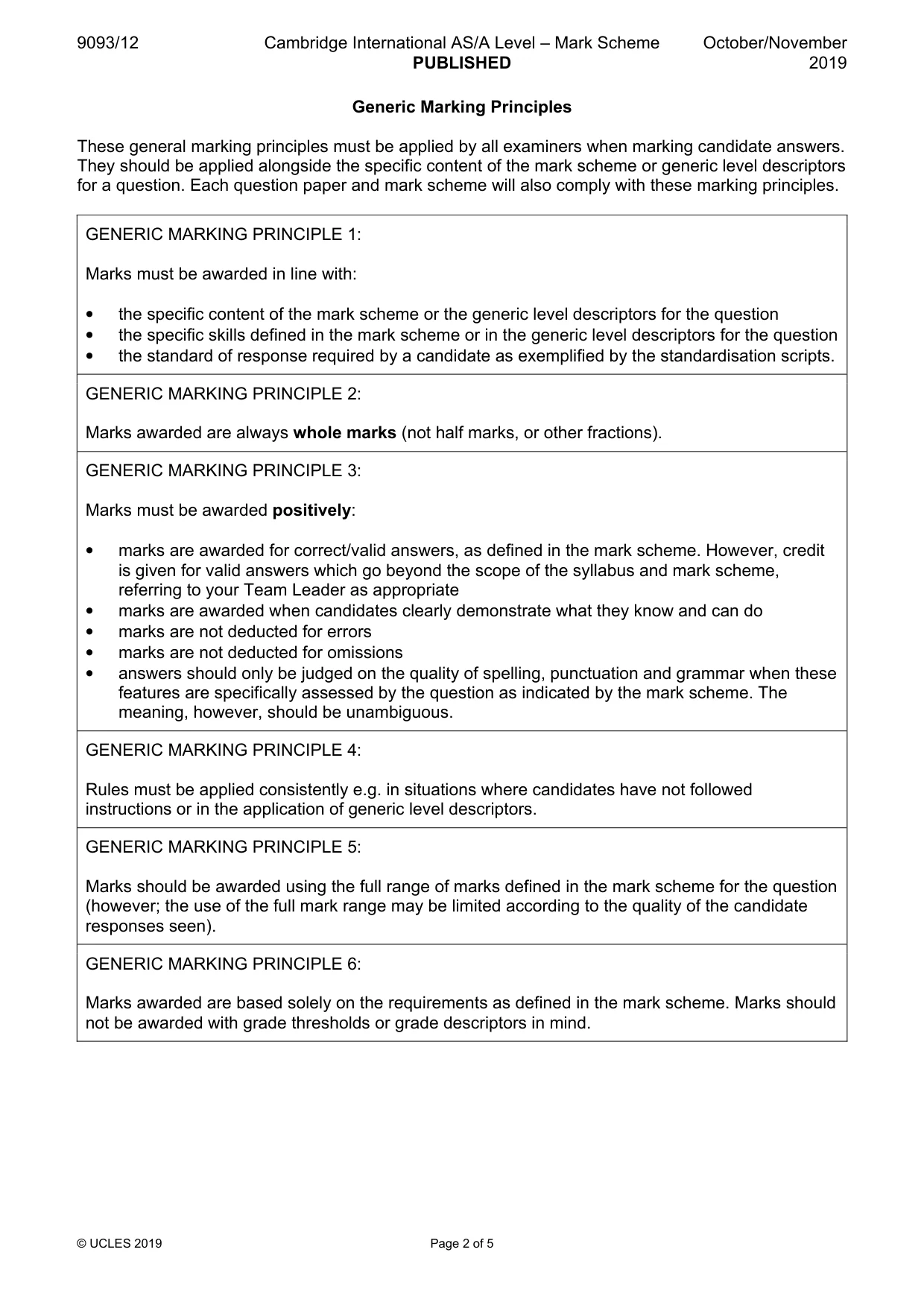
9093/12 Cambridge International AS/A Level – Mark Scheme PUBLISHED October/November 2019 © UCLES 2019 Page 2 of 5 Generic Marking Principles These general marking principles must be applied by all examiners when marking candidate answers. They should be applied alongside the specific content of the mark scheme or generic level descriptors for a question. Each question paper and mark scheme will also comply with these marking principles. GENERIC MARKING PRINCIPLE 1: Marks must be awarded in line with: • the specific content of the mark scheme or the generic level descriptors for the question • the specific skills defined in the mark scheme or in the generic level descriptors for the question • the standard of response required by a candidate as exemplified by the standardisation scripts. GENERIC MARKING PRINCIPLE 2: Marks awarded are always whole marks (not half marks, or other fractions). GENERIC MARKING PRINCIPLE 3: Marks must be awarded positively: • marks are awarded for correct/valid answers, as defined in the mark scheme. However, credit is given for valid answers which go beyond the scope of the syllabus and mark scheme, referring to your Team Leader as appropriate • marks are awarded when candidates clearly demonstrate what they know and can do • marks are not deducted for errors • marks are not deducted for omissions • answers should only be judged on the quality of spelling, punctuation and grammar when these features are specifically assessed by the question as indicated by the mark scheme. The meaning, however, should be unambiguous. GENERIC MARKING PRINCIPLE 4: Rules must be applied consistently e.g. in situations where candidates have not followed instructions or in the application of generic level descriptors. GENERIC MARKING PRINCIPLE 5: Marks should be awarded using the full range of marks defined in the mark scheme for the question (however; the use of the full mark range may be limited according to the quality of the candidate responses seen). GENERIC MARKING PRINCIPLE 6: Marks awarded are based solely on the requirements as defined in the mark scheme. Marks should not be awarded with grade thresholds or grade descriptors in mind.
Mark scheme, page 3
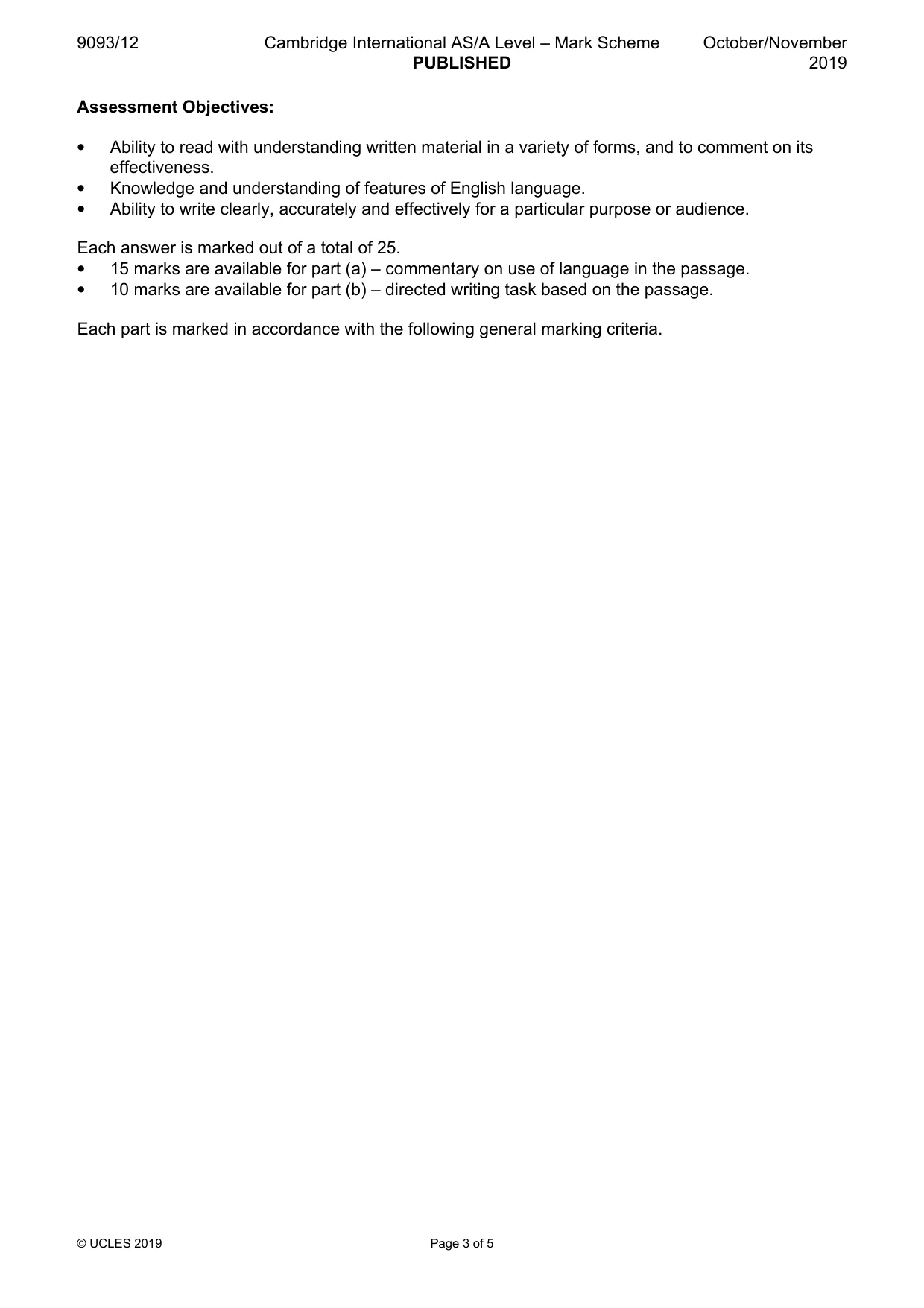
9093/12 Cambridge International AS/A Level – Mark Scheme PUBLISHED October/November 2019 © UCLES 2019 Page 3 of 5 Assessment Objectives: • Ability to read with understanding written material in a variety of forms, and to comment on its effectiveness. • Knowledge and understanding of features of English language. • Ability to write clearly, accurately and effectively for a particular purpose or audience. Each answer is marked out of a total of 25. • 15 marks are available for part (a) – commentary on use of language in the passage. • 10 marks are available for part (b) – directed writing task based on the passage. Each part is marked in accordance with the following general marking criteria.
Mark scheme, page 4
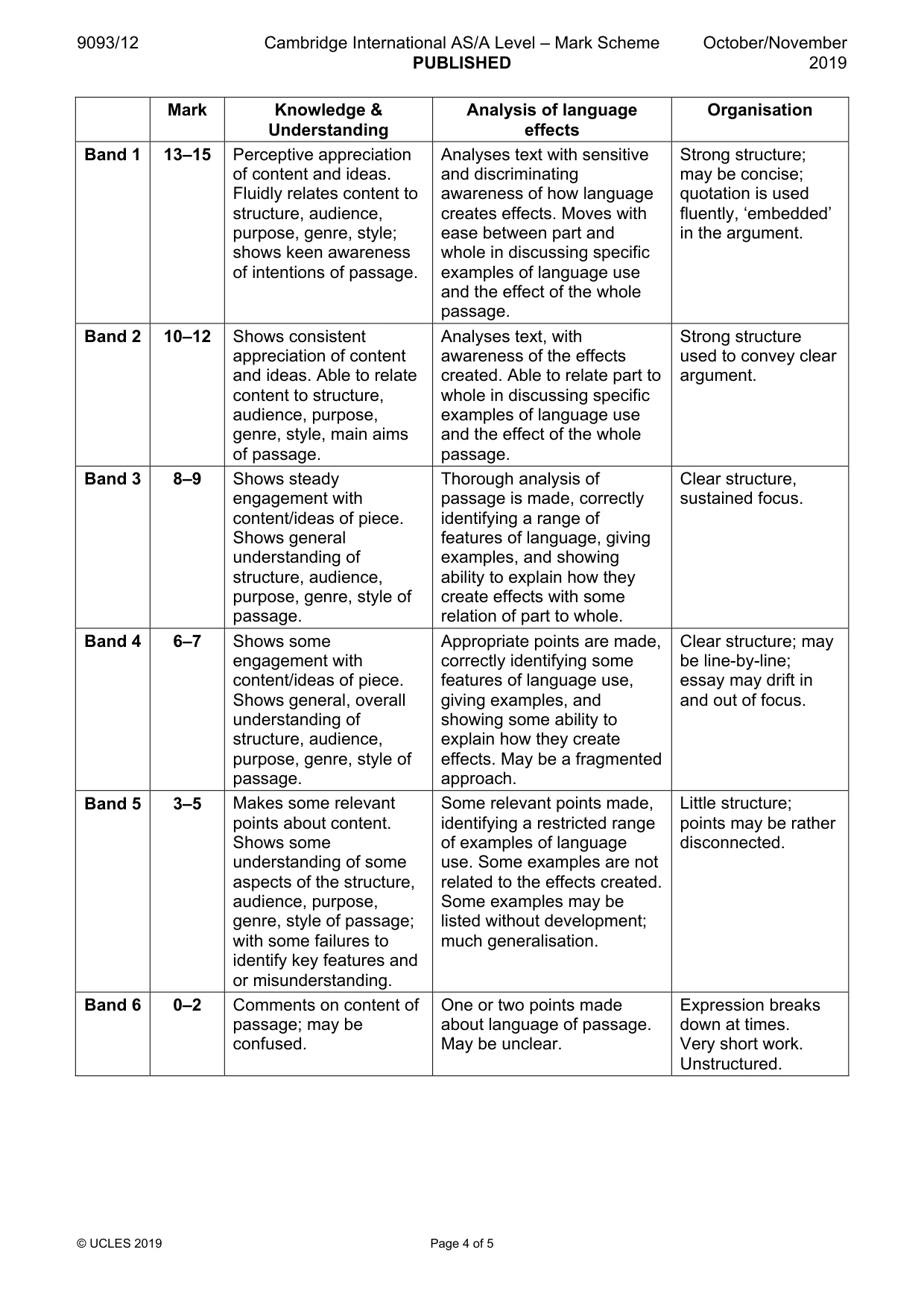
9093/12 Cambridge International AS/A Level – Mark Scheme PUBLISHED October/November 2019 © UCLES 2019 Page 4 of 5 Mark Knowledge & Understanding Analysis of language effects Organisation Band 1 13–15 Perceptive appreciation of content and ideas. Fluidly relates content to structure, audience, purpose, genre, style; shows keen awareness of intentions of passage. Analyses text with sensitive and discriminating awareness of how language creates effects. Moves with ease between part and whole in discussing specific examples of language use and the effect of the whole passage. Strong structure; may be concise; quotation is used fluently, ‘embedded’ in the argument. Band 2 10–12 Shows consistent appreciation of content and ideas. Able to relate content to structure, audience, purpose, genre, style, main aims of passage. Analyses text, with awareness of the effects created. Able to relate part to whole in discussing specific examples of language use and the effect of the whole passage. Strong structure used to convey clear argument. Band 3 8–9 Shows steady engagement with content/ideas of piece. Shows general understanding of structure, audience, purpose, genre, style of passage. Thorough analysis of passage is made, correctly identifying a range of features of language, giving examples, and showing ability to explain how they create effects with some relation of part to whole. Clear structure, sustained focus. Band 4 6–7 Shows some engagement with content/ideas of piece. Shows general, overall understanding of structure, audience, purpose, genre, style of passage. Appropriate points are made, correctly identifying some features of language use, giving examples, and showing some ability to explain how they create effects. May be a fragmented approach. Clear structure; may be line-by-line; essay may drift in and out of focus. Band 5 3–5 Makes some relevant points about content. Shows some understanding of some aspects of the structure, audience, purpose, genre, style of passage; with some failures to identify key features and or misunderstanding. Some relevant points made, identifying a restricted range of examples of language use. Some examples are not related to the effects created. Some examples may be listed without development; much generalisation. Little structure; points may be rather disconnected. Band 6 0–2 Comments on content of passage; may be confused. One or two points made about language of passage. May be unclear. Expression breaks down at times. Very short work. Unstructured.
Mark scheme, page 5
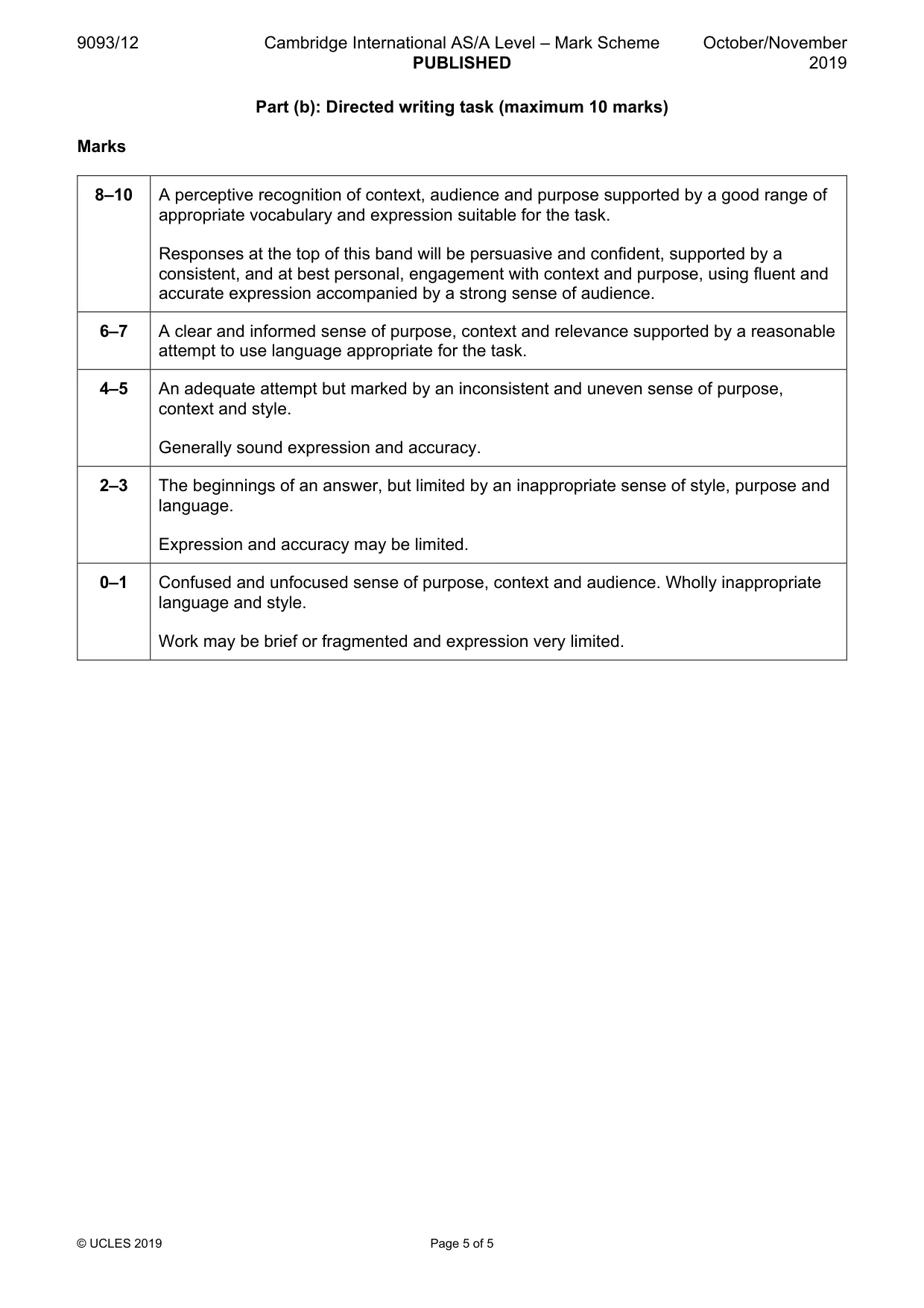
9093/12 Cambridge International AS/A Level – Mark Scheme PUBLISHED October/November 2019 © UCLES 2019 Page 5 of 5 Part (b): Directed writing task (maximum 10 marks) Marks 8–10 A perceptive recognition of context, audience and purpose supported by a good range of appropriate vocabulary and expression suitable for the task. Responses at the top of this band will be persuasive and confident, supported by a consistent, and at best personal, engagement with context and purpose, using fluent and accurate expression accompanied by a strong sense of audience. 6–7 A clear and informed sense of purpose, context and relevance supported by a reasonable attempt to use language appropriate for the task. 4–5 An adequate attempt but marked by an inconsistent and uneven sense of purpose, context and style. Generally sound expression and accuracy. 2–3 The beginnings of an answer, but limited by an inappropriate sense of style, purpose and language. Expression and accuracy may be limited. 0–1 Confused and unfocused sense of purpose, context and audience. Wholly inappropriate language and style. Work may be brief or fragmented and expression very limited.
What you needed in this session
Cambridge’s own grade thresholds for 2019 Oct/Nov, Paper 1 · Variant 2. A higher threshold means an easier paper — the bar moves with how the cohort did.