Cambridge A Level English - Language AS and A Level (from 2014) 9093 — 2019 May/June Paper 1 · Variant 3
9093/13/M/J/19 · 50 marks · ≈56 min
The question paper and its mark scheme, free to read here and free to download. This is Cambridge’s own paper, exactly as it was sat.
Question paper8 pages
Mark scheme4 pages
Answers below. Sit the paper first if you are practising.
Paper as text
Question paper, page 1
This document consists of 7 printed pages, 1 blank page and 1 Insert. DC (ST) 167696/2 © UCLES 2019 [Turn over Cambridge Assessment International Education Cambridge International Advanced Subsidiary and Advanced Level * 2 8 3 1 4 7 3 1 2 5 * ENGLISH LANGUAGE 9093/13 Paper 1 Passages May/June 2019 2 hours 15 minutes No Additional Materials are required. READ THESE INSTRUCTIONS FIRST An answer booklet is provided inside this question paper. You should follow the instructions on the front cover of the answer booklet. If you need additional answer paper, ask the invigilator for a continuation booklet. Answer two questions: Question 1 and either Question 2 or Question 3. You should spend about 15 minutes reading the passages and questions before you start writing your answers. You are reminded of the need for good English and clear presentation in your answers. The number of marks is given in brackets [ ] at the end of each question or part question.
Question paper, page 2
2 9093/13/M/J/19 © UCLES 2019 Answer Question 1 and either Question 2 or Question 3. 1 The following blog post is taken from the website of a company which sells lifestyle events and experiences. In it, the writer explains why he likes to walk outside without wearing shoes. (a) Comment on the language and style of the text. [15] (b) Imagine you have joined the writer on the ‘barefoot hike’ and wish to comment on the experience on a travel review website. Basing your writing closely on the material of the original passage, write the review using between 120 and 150 of your own words. [10] The Surprising Benefits of Going Barefoot It wasn’t until 2006 that I realized the power of connecting directly to the earth without shoes. I was on a camping trip with five friends in Canada, and one of my friends from South Africa was visiting. He braved the entire four day canoe trip through forests, rocks, mountains, rivers, ravines, lakes, and parking lots without anything protecting his feet. I couldn’t believe it. Under a slippery waterfall near Canoe Lake he turned to me and spoke from his heart, ‘I’m telling you, you’ve just got to try it. You and your feet will be liberated.’ He grew up in the ‘bush’ of Africa and the mere thought of anything preventing him from gripping the earth with his bare soles while in nature made no sense. I emphatically threw my shoes into the lake. My toes met the slimy moss of the rock as water from the waterfall rushed between my toes. A smile washed over me. I was converted. Since that transformative trip, I’ve found myself wearing shoes less and less to the point where sometimes I’ll pack for a trip and not even bring anything for my feet. While finding the specific words to describe why I do it is difficult, I am very confident in knowing that the process of ‘earthing’ just feels right. And being a person who is inspired by feeling, I don’t need much more convincing that this is how I want to live my life. The term ‘earthing’ has recently entered pop-culture, and is now somewhat of a trend, depending who you hang out with. Earthing: The Most Important Health Discovery Ever states that walking enables us to feel the Earth’s natural surface charge, which is naturally discharging and can help prevent chronic inflammation. Studies have even shown that earthing plays a significant role in the aging process itself. Yep, that’s right. Save money by not buying anti-aging creams AND not buying shoes by grounding into the Earth. There is also a plethora of new scientific research that directly supports the health benefits of connecting with the electrons of the earth, a process triggered when walking outside barefoot. Tests have shown that a human’s separation from connection to the Earth’s energy can be a significant contributor to physiological dysfunctions and diseases. Who knew?! From a naturalist perspective, walking barefoot is a beneficial practice because it brings us back to our natural state, how we were brought into the world. No one came out of the womb in top of the range boots. Clever marketing and the massively lucrative footwear industry has trained us to assume that we always need to be in shoes and need so many shoes for every type of activity. This blinds us from the 5 10 15 20 25 30 35
Question paper, page 3
3 9093/13/M/J/19 © UCLES 2019 [Turn over process of earthing, where we become closer to Pachamama1 by directly interacting and feeling her, letting her feel and interact with us at the same time. On a personal level, the medicinal and health benefits to walking without shoes are new revelations and don’t particularly fuel my fire. I’ve always enjoyed how walking barefoot has forced me to be so present with every footstep. You can’t really afford to take a wrong step without shoes, so you literally need to look where you are walking with every step you take. And I love how the practice slows everything down. You can only walk so fast without shoes, especially when going over rocks or tiny pebbles. Just as in meditation, we bring attention to each inhale and exhale, with barefoot walking, we connect with every left step and right step. This forces you to appreciate everything around you. It forces you off auto-pilot. Suddenly, every step counts and because these steps happen so slowly or carefully, you stop and take notice of your surroundings. I want to see this beauty, which is why earthing is how I choose to live my life. The invitation is open for you all to join me. I’ve got some amazing games and activities planned for our barefoot hike (including barefoot dancing in the forest!) and look forward to everyone taking one step forward to a healthier and happier life. 1Pachamama: a nature goddess revered by the indigenous people of the Andes 40 45 50
Question paper, page 4
4 9093/13/M/J/19 © UCLES 2019 2 In the following nonfiction account, the writer recalls being at work in her beauty salon on the morning of her friend Roshanna’s engagement party. (a) Comment on the language and style of the account. [15] (b) Basing your writing closely on the language and style of the original passage, continue the account. Write between 120 and 150 of your own words. [10] The women arrive at the salon just before eight in the morning. If it were any other day, I’d still be in bed, trying to sink into a few more minutes of sleep. I’d probably still be cursing the neighbour’s rooster for waking me up again at dawn. I might even still be groaning about the vegetable dealers who come down the street at three in the morning with their noisy, horse-drawn wagons, or the neighbourhood mullah1, who warbles out his long, mournful call to prayer at four-thirty. But this is the day of Roshanna’s engagement party, so I’m dressed and ready for work. I’ve already had two cups of instant coffee, which I had to make by myself because the cook has not yet arrived. This is more of a trial than you might think, since I’ve barely learned how to boil water in Afghanistan. When I have to do it myself, I put a lit wooden match on each of the burners of the cranky, old gas stove, turn one of the knobs, and back off to see which of the burners explodes into flame. Then I settle a pot of water there and pray that whatever bacteria are floating in the Kabul water today are killed by the boiling. The mother-in-law comes into the salon first, and we exchange the traditional Afghan greeting: we clasp hands and kiss each other’s cheeks three times. Roshanna is behind her, a tiny, awkward, blue ghost wearing the traditional burqa that covers her, head to toe, with only a small piece of netting for her to see out the front. But the netting has been pulled crooked, across her nose, and she bumps into the doorway. She laughs and flutters her arms inside the billowing fabric, and two of her sisters- in-law help her navigate her way through the door. Once inside, Roshanna snatches the outer garment off and drapes it over the top of one of the hair dryers. Roshanna usually wears clothes that she sews herself – brilliant shalwar kameezes2 or saris in shades of orchid and peach, lime green and peacock blue. Roshanna usually stands out like a butterfly against the grey dustiness of the city and even against the other women on the streets, in their mostly drab, dark clothing. But today she observes the traditional behaviour of a bride on the day of her engagement party or wedding. She has left her parents’ house under the cover of a burqa and will emerge six hours later wearing her body weight in eye shadow, false eyelashes the size of sparrows, monumentally big hair, and clothes with more bling3 than a fairground ride. The cook arrives just behind the women, whispering that she’ll make the tea, and Topekai, Baseera, and Bahar, the other beauticians, rush into the salon and take off their head scarves. Then we begin the joyful, gossipy, daylong ordeal of transforming twenty-year-old Roshanna into a traditional Afghan bride. Most salons would charge up to two-hundred-and-fifty-dollars – about half of the annual income for a typical Afghan – for the bride’s services alone. But I am not only Roshanna’s former teacher but also her best friend, even though I’m more than twenty years older. She is my first and best friend in Afghanistan. I love her dearly, so the salon services are just one of my gifts to her. 5 10 15 20 25 30 35 40
Question paper, page 5
5 9093/13/M/J/19 © UCLES 2019 [Turn over 1mullah: a scholarly or educated person in Islamic law and theology 2shalwar kameezes: traditional clothing worn in many south-central Asian countries 3bling: a slang term in popular culture meaning flamboyant or showy in appearance
Question paper, page 6
6 9093/13/M/J/19 © UCLES 2019 3 The following extract is from the opening chapter of Barbara Kingsolver’s novel, The Lacuna. (a) Comment on the language and style of the passage. [15] (b) The young boy’s mother records her thoughts and feelings about her new life with Enrique. Basing your writing closely on the material of the original extract, write an entry in the mother’s journal after a typical day during her first year in Mexico. [10] In the beginning were the howlers. They always commenced their bellowing in the first hour of dawn, just as the hem of the sky began to whiten. It would start with just one: his forced, rhythmic groaning, like a saw blade. That aroused others near him, nudging them to bawl along with his monstrous tune. Soon the maroon-throated howls would echo back from other trees, farther down the beach, until the whole jungle filled with roaring trees. As it was in the beginning, so it is every morning of the world. The boy and his mother believed it was saucer-eyed devils screaming in those trees, fighting over the territorial right to consume human flesh. The first year after moving to Mexico to stay at Enrique’s house, they woke up terrified at every day’s dawn to the howling. Sometimes she ran down the tiled hallway to her son’s bedroom, appearing in the doorway with her hair loose, her feet like iced fish in the bed, pulling the crocheted bedspread tight as a web around the two of them, listening. It should have been like a storybook here. That is what she’d promised him, back in the cold little bedroom in Virginia, North America: if they ran away to Mexico with Enrique she could be the bride of a wealthy man and her son would be the young squire, in a hacienda1 surrounded by pineapple fields. The island would be encircled with a shiny band of sea like a wedding ring, and somewhere on the mainland was its gem, the oil fields where Enrique made his fortune. But the storybook was The Prisoner of Zenda. He was not a young squire, and his mother after many months was still no bride. Enrique was their captor, surveying their terror with a cool eye while eating his breakfast. ‘That howling is the aullaros,’ he would say, as he pulled the white napkin out of its silver ring into his silver-ringed fingers, lacing it on his lap and slicing into his breakfast with a fork and knife. ‘They howl at one another to settle out their territories, before they begin a day of hunting for food.’ Their food might be us, mother and son agreed, when they huddled together inside the spiderweb of bedspread, listening to a rising tide of toothsome roars. You had better write all this in your notebook, she said, the story of what happened to us in Mexico. So when nothing is left of us but bones, someone will know where we went. She said to start this way: In the beginning were the aullaros, crying for our blood. Enrique had lived his whole life in that hacienda, ever since his father built it and flogged the native people into planting his pineapple fields. He had been raised to understand the usefulness of fear. So it was nearly a year before he told them the truth: the howling is only monkeys. He didn’t even look across the table when he said it, only at the important eggs on his plate. He hid a scornful smile under his moustache, which is not a good hiding place. ‘Every ignorant Indian in the village knows what they are. You would too, if you went out in the morning instead of hiding in bed like a pair of sloths.’ 5 10 15 20 25 30 35
Question paper, page 7
7 9093/13/M/J/19 © UCLES 2019 It was true: the creatures were long-tailed monkeys, eating leaves. How could such a howling come from a thing so honestly ordinary? But it did. The boy crept outdoors early and learnt to spot them, high in the veil of branches against white sky. Hunched, woolly bodies balanced on swaying limbs, their tails reaching out to stroke the branches like guitar strings. Sometimes the mother monkeys cradled little babes, born to precarious altitudes, clinging for their lives. So there weren’t any tree demons. And Enrique was not really a wicked king, he was only a man. He looked like the tiny man on top of a wedding cake: the same round head with parted, shiny hair, the same small moustache. But the boy’s mother was not the tiny bride, and of course there is no place on that cake for a child. When Enrique wanted to ridicule him after that, he didn’t even need to mention devils, he only rolled his eyes up at the trees. ‘The devil here is a boy with too much imagination,’ he usually said. That was like a mathematics problem, it gave the boy a headache because he couldn’t work out which was the wrong part of the equation: being a Boy, or being Imaginative. Enrique felt a successful man needed no imagination at all. 1hacienda: a large estate, especially in a Spanish-speaking country 40 45 50 55
Question paper, page 8
8 9093/13/M/J/19 © UCLES 2019 BLANK PAGE Permission to reproduce items where third-party owned material protected by copyright is included has been sought and cleared where possible. Every reasonable effort has been made by the publisher (UCLES) to trace copyright holders, but if any items requiring clearance have unwittingly been included, the publisher will be pleased to make amends at the earliest possible opportunity. To avoid the issue of disclosure of answer-related information to candidates, all copyright acknowledgements are reproduced online in the Cambridge Assessment International Education Copyright Acknowledgements Booklet. This is produced for each series of examinations and is freely available to download at www.cambridgeinternational.org after the live examination series. Cambridge Assessment International Education is part of the Cambridge Assessment Group. Cambridge Assessment is the brand name of the University of Cambridge Local Examinations Syndicate (UCLES), which itself is a department of the University of Cambridge.
Mark scheme, page 1
This document consists of 4 printed pages. © UCLES 2019 [Turn over Cambridge Assessment International Education Cambridge International Advanced Subsidiary Level ENGLISH LANGUAGE 9093/13 Paper 1 Passages May/June 2019 MARK SCHEME Maximum Mark: 50 Published This mark scheme is published as an aid to teachers and candidates, to indicate the requirements of the examination. It shows the basis on which Examiners were instructed to award marks. It does not indicate the details of the discussions that took place at an Examiners’ meeting before marking began, which would have considered the acceptability of alternative answers. Mark schemes should be read in conjunction with the question paper and the Principal Examiner Report for Teachers. Cambridge International will not enter into discussions about these mark schemes. Cambridge International is publishing the mark schemes for the May/June 2019 series for most Cambridge IGCSE™, Cambridge International A and AS Level and Cambridge Pre-U components, and some Cambridge O Level components.
Mark scheme, page 2
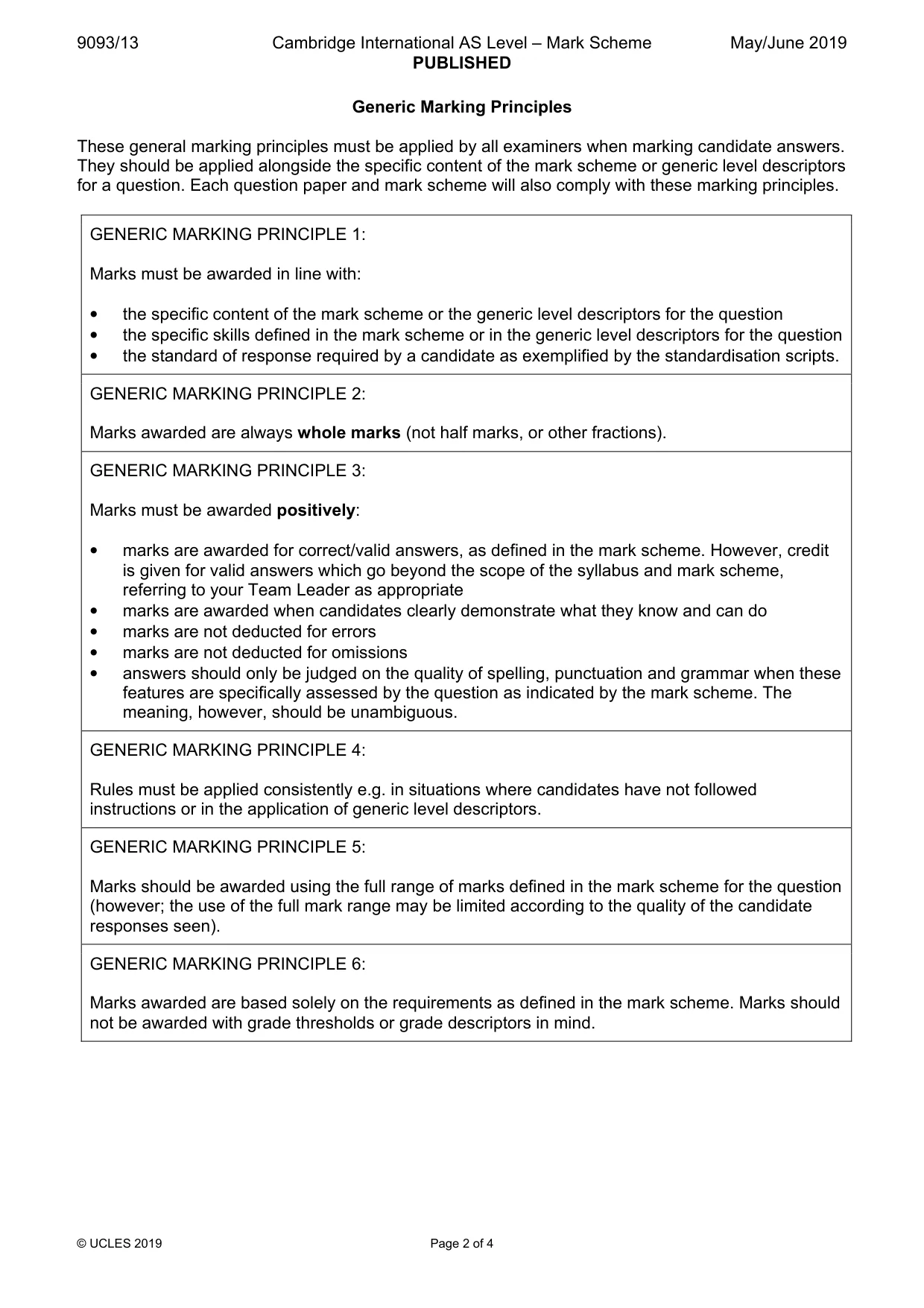
9093/13 Cambridge International AS Level – Mark Scheme PUBLISHED May/June 2019 © UCLES 2019 Page 2 of 4 Generic Marking Principles These general marking principles must be applied by all examiners when marking candidate answers. They should be applied alongside the specific content of the mark scheme or generic level descriptors for a question. Each question paper and mark scheme will also comply with these marking principles. GENERIC MARKING PRINCIPLE 1: Marks must be awarded in line with: • the specific content of the mark scheme or the generic level descriptors for the question • the specific skills defined in the mark scheme or in the generic level descriptors for the question • the standard of response required by a candidate as exemplified by the standardisation scripts. GENERIC MARKING PRINCIPLE 2: Marks awarded are always whole marks (not half marks, or other fractions). GENERIC MARKING PRINCIPLE 3: Marks must be awarded positively: • marks are awarded for correct/valid answers, as defined in the mark scheme. However, credit is given for valid answers which go beyond the scope of the syllabus and mark scheme, referring to your Team Leader as appropriate • marks are awarded when candidates clearly demonstrate what they know and can do • marks are not deducted for errors • marks are not deducted for omissions • answers should only be judged on the quality of spelling, punctuation and grammar when these features are specifically assessed by the question as indicated by the mark scheme. The meaning, however, should be unambiguous. GENERIC MARKING PRINCIPLE 4: Rules must be applied consistently e.g. in situations where candidates have not followed instructions or in the application of generic level descriptors. GENERIC MARKING PRINCIPLE 5: Marks should be awarded using the full range of marks defined in the mark scheme for the question (however; the use of the full mark range may be limited according to the quality of the candidate responses seen). GENERIC MARKING PRINCIPLE 6: Marks awarded are based solely on the requirements as defined in the mark scheme. Marks should not be awarded with grade thresholds or grade descriptors in mind.
Mark scheme, page 3
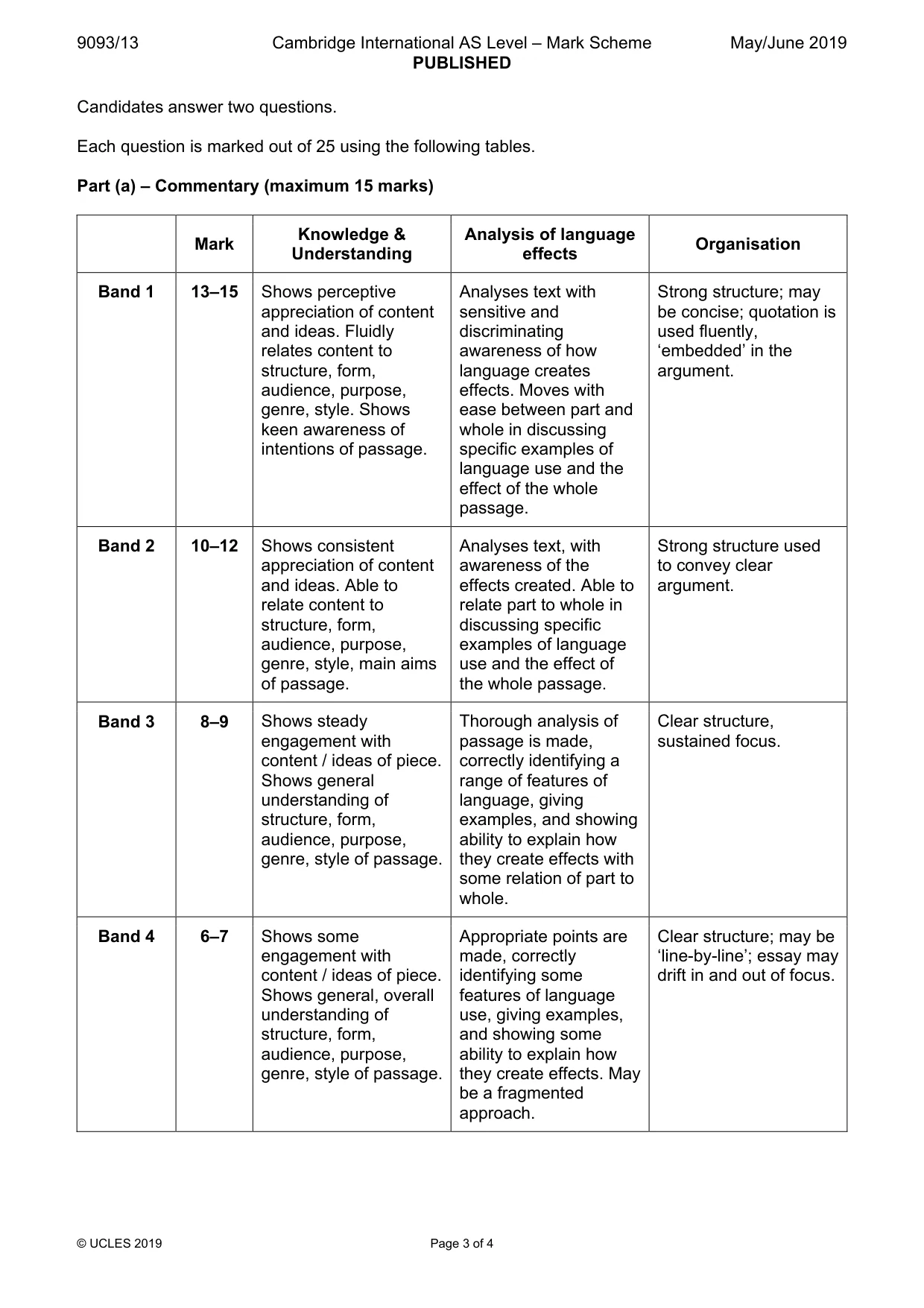
9093/13 Cambridge International AS Level – Mark Scheme PUBLISHED May/June 2019 © UCLES 2019 Page 3 of 4 Candidates answer two questions. Each question is marked out of 25 using the following tables. Part (a) – Commentary (maximum 15 marks) Mark Knowledge & Understanding Analysis of language effects Organisation Band 1 13–15 Shows perceptive appreciation of content and ideas. Fluidly relates content to structure, form, audience, purpose, genre, style. Shows keen awareness of intentions of passage. Analyses text with sensitive and discriminating awareness of how language creates effects. Moves with ease between part and whole in discussing specific examples of language use and the effect of the whole passage. Strong structure; may be concise; quotation is used fluently, ‘embedded’ in the argument. Band 2 10–12 Shows consistent appreciation of content and ideas. Able to relate content to structure, form, audience, purpose, genre, style, main aims of passage. Analyses text, with awareness of the effects created. Able to relate part to whole in discussing specific examples of language use and the effect of the whole passage. Strong structure used to convey clear argument. Band 3 8–9 Shows steady engagement with content / ideas of piece. Shows general understanding of structure, form, audience, purpose, genre, style of passage. Thorough analysis of passage is made, correctly identifying a range of features of language, giving examples, and showing ability to explain how they create effects with some relation of part to whole. Clear structure, sustained focus. Band 4 6–7 Shows some engagement with content / ideas of piece. Shows general, overall understanding of structure, form, audience, purpose, genre, style of passage. Appropriate points are made, correctly identifying some features of language use, giving examples, and showing some ability to explain how they create effects. May be a fragmented approach. Clear structure; may be ‘line-by-line’; essay may drift in and out of focus.
Mark scheme, page 4
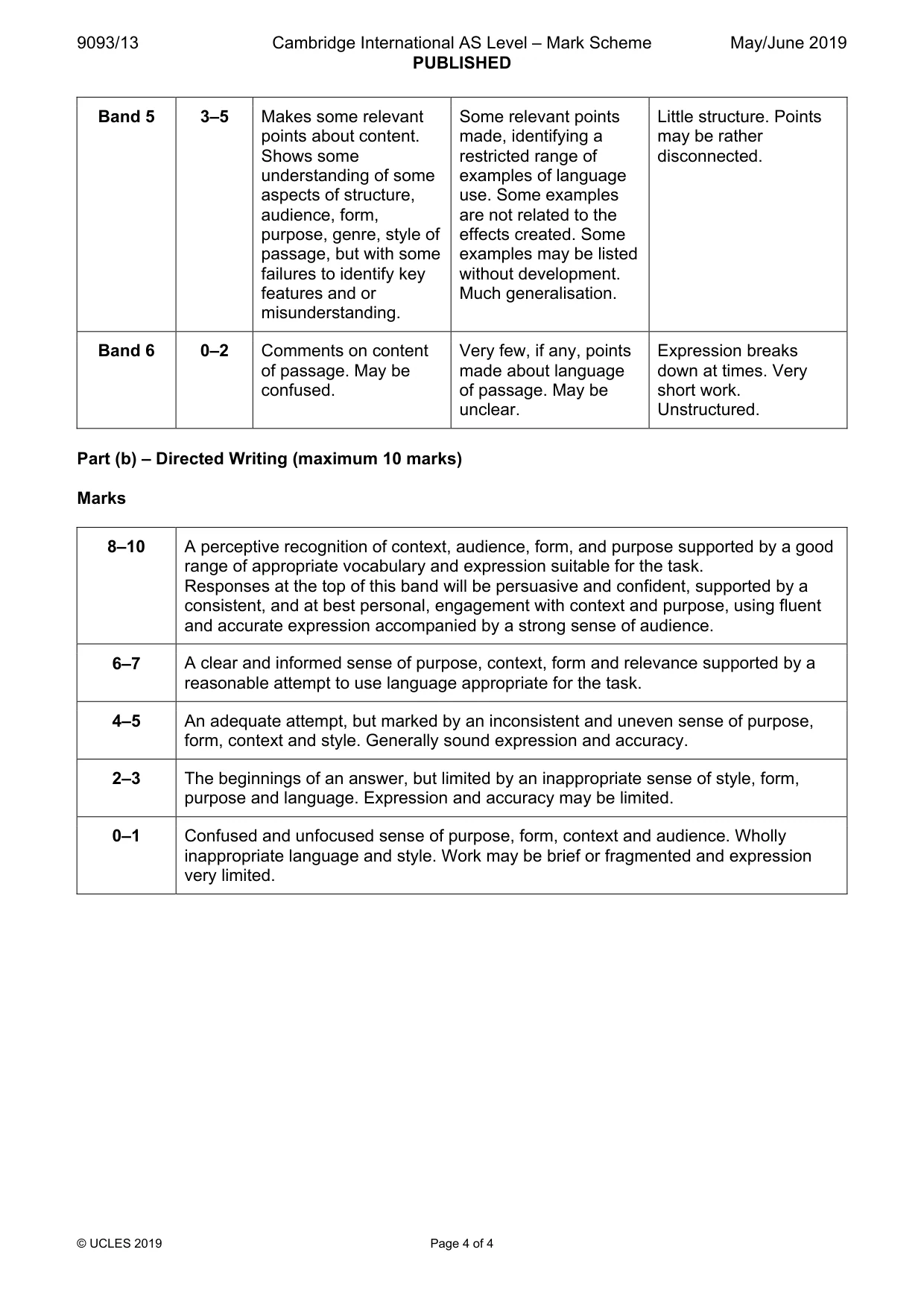
9093/13 Cambridge International AS Level – Mark Scheme PUBLISHED May/June 2019 © UCLES 2019 Page 4 of 4 Band 5 3–5 Makes some relevant points about content. Shows some understanding of some aspects of structure, audience, form, purpose, genre, style of passage, but with some failures to identify key features and or misunderstanding. Some relevant points made, identifying a restricted range of examples of language use. Some examples are not related to the effects created. Some examples may be listed without development. Much generalisation. Little structure. Points may be rather disconnected. Band 6 0–2 Comments on content of passage. May be confused. Very few, if any, points made about language of passage. May be unclear. Expression breaks down at times. Very short work. Unstructured. Part (b) – Directed Writing (maximum 10 marks) Marks 8–10 A perceptive recognition of context, audience, form, and purpose supported by a good range of appropriate vocabulary and expression suitable for the task. Responses at the top of this band will be persuasive and confident, supported by a consistent, and at best personal, engagement with context and purpose, using fluent and accurate expression accompanied by a strong sense of audience. 6–7 A clear and informed sense of purpose, context, form and relevance supported by a reasonable attempt to use language appropriate for the task. 4–5 An adequate attempt, but marked by an inconsistent and uneven sense of purpose, form, context and style. Generally sound expression and accuracy. 2–3 The beginnings of an answer, but limited by an inappropriate sense of style, form, purpose and language. Expression and accuracy may be limited. 0–1 Confused and unfocused sense of purpose, form, context and audience. Wholly inappropriate language and style. Work may be brief or fragmented and expression very limited.
What you needed in this session
Cambridge’s own grade thresholds for 2019 May/June, Paper 1 · Variant 3. A higher threshold means an easier paper — the bar moves with how the cohort did.