Cambridge A Level English - Language AS and A Level (from 2014) 9093 — 2019 May/June Paper 1 · Variant 2
9093/12/M/J/19 · 50 marks · ≈56 min
The question paper and its mark scheme, free to read here and free to download. This is Cambridge’s own paper, exactly as it was sat.
Question paper8 pages

Mark scheme4 pages
Answers below. Sit the paper first if you are practising.
Paper as text
Question paper, page 1
This document consists of 7 printed pages, 1 blank page and 1 Insert. DC (ST) 167697/1 © UCLES 2019 [Turn over Cambridge Assessment International Education Cambridge International Advanced Subsidiary and Advanced Level * 6 3 6 7 9 9 4 2 3 7 * ENGLISH LANGUAGE 9093/12 Paper 1 Passages May/June 2019 2 hours 15 minutes No Additional Materials are required. READ THESE INSTRUCTIONS FIRST An answer booklet is provided inside this question paper. You should follow the instructions on the front cover of the answer booklet. If you need additional answer paper, ask the invigilator for a continuation booklet. Answer two questions: Question 1 and either Question 2 or Question 3. You should spend about 15 minutes reading the passages and questions before you start writing your answers. You are reminded of the need for good English and clear presentation in your answers. The number of marks is given in brackets [ ] at the end of each question or part question.
Question paper, page 2
2 9093/12/M/J/19 © UCLES 2019 Answer Question 1 and either Question 2 or Question 3. 1 In the following passage from his autobiography, Sooyong Park writes about his search for the elusive white tiger in Siberia. (a) Comment on the language and style of the passage. [15] (b) A reporter for an international environmental organisation writes a formal report on the first sighting of Mary, the rare white tigress. Basing your writing closely on the material of the original passage, and using between 120 and 150 of your own words, write the opening of the report. [10] Tigress in the Basin of Skeletons Soaring, majestic swells of dark blue raged toward the shore. The breeze was cool. Winter was finally coming to an end. Nearly all of the snow had gone, except on the mountain peaks. The forest and hills were cloaked in gray and mustard yellow, the dreariest palette of the year. Dark and light patches stretched on like a rag stitched and mended too many times, and the ice in the brooks and rivers cracked and broke apart as the muddy currents carried it away. The arctic warbler had not begun to sing yet, and there were no flourishes of green, but the tremendous energy of life heaved just beneath the surface of the faded earth as it pushed through its final toil. The perilous Tachinko Cliff towered over the sea that threatened to pull the onlooker into its dizzying waves. An eagle circled the sky and landed on a peak on the other side of the cliff. Heat shimmers rose in the warm sunlight amid azalea buds ripe and ready to burst. Click, clack. Click click clack. A couple of stones rolled down the cliff on the other side. The eagles descended from the air and touched down. Two Ussuri deer carefully made their way down the steep cliff. More stones rolled down the rock face, then a heap of rocks crashed to the bottom. One deer fell off the cliff in the mess of rocks. Later, we found deer tracks on the beach covered with tiger paw-prints. It looked like a tigress had pounced on the deer. The Basin of Skeletons is densely populated by cork oaks. The yellow-brown leaves on the ground, the dark bark of the cork oaks, the dry blades of grass, and the field of reeds on the edge of the basin provide perfect camouflage for tigers stalking and hunting prey. Some of the deer that feed on the dry oak leaves in the basin on their way down to the shore meet their ends here. The ghostly white skulls and bones of deer that tigers have preyed on over the ages are scattered throughout the forest. On a sunny day with a gentle breeze, the forest is inviting. The dry leaves cover the ground like a cosy blanket and create a languid, sleepy atmosphere. It is a soporific place. But on days when the fog rolls in from the shore, the dank bark of the wet cork oak and deer bones look eerie in the milky darkness. Sometimes it seemed the bitter ghosts of the dead deer were rising from the ground and gazing out through the thick fog, and other times I expected Mary, the elusive white tigress at the heart of my search, to approach soundlessly from behind and pounce on me at any second. In those moments, the forest was transformed into a ghostly, wet swamp I did not want to cross. It is probably worse for the deer that 5 10 15 20 25 30 35
Question paper, page 3
3 9093/12/M/J/19 © UCLES 2019 [Turn over have to pass through the basin every year – hence its name: the Basin of Skeletons. I found at least two skulls from deer that had died within the previous month or so. I imagined they were Mary’s kills. Only then did I know why she didn’t have to lick the meat clean off the deer bones. Spring was a terrifying time in Tachinko for the deer. The spring that felt slow to come finally arrived, but the fallen deer did not live to see it. The Basin of Skeletons was a harrowing place for the deer, but perfect for Mary to raise her cubs, especially in the spring. Her choice territory was another reason she was known for being a good mother. I started to wonder what she looked like. I didn’t know then where this journey would take me. Never could I have imagined that I would one day feel the warmth of her breath and her long, stiff whiskers on the back of my hand, and that I would be there, as well, to witness her death. 40 45
Question paper, page 4
4 9093/12/M/J/19 © UCLES 2019 2 The following text is a blog post taken from the website of a company which sells lifestyle events and experiences. (a) Comment on the language and style used in the text. [15] (b) After reading this blog post you want to hold a ‘silent disco’ in your school. Write a letter to your Head Teacher explaining how students will benefit from this. Write a section of the letter (120 to 150 words). You should use your own words and base your writing closely on the material of the original text. [10] Breaking Down the Silent Disco It’s the soundtrack of your life. Imagine yourself walking home from work, ear-buds plugged into your latest favourite album. Sun’s out. It’s Friday night, and you have plans to meet up with a funky, fun friend who’s always up for getting down. Moments like these can feel like you’re on top of the world. All the pieces fit. The path is lit up with a melody so perfectly aligned with your natural pace, and it’s as if the lyrics were written for you. Only you. After what feels like floating to the night’s destination, your friend leads you to the surprise, post-dinner, secret, invite-only event. In an empty unit between two of your favourite boutiques in the city, there is… a silent disco. Yeah, what’s a silent disco? you ask. Grab a pair of headphones, she responds. Peering in, the scene is like any other dance party: uninhibited moves, glistening brows, some mad auditory scientist spinning obscure technology you might not know the name of. It’s a disco alright, but where is the sound? You immediately lose your friend to the buzz of whatever is going on. After fixing wireless headphones upon your arrival, now you hear it: the faded beat to the beat of another drum in between two songs, as if the DJ is reading vibes entering the space. Yes, you are the vibes! Disco Never Dies While Disco music achieved popularity in the mid 70s, silent discos are relatively new. Well, when considering the evolution of technology and its marriage to the music-listening experience, relatively new-ish. The concept emerged in the early 1990s. Events in cities gained momentum as part of an eco-activist effort to minimise noise pollution, and continued in popularity out of curiosity and … plain ol’ fun. First appearing for a while as a rave or dance party, other industries have adopted the format for its personal, experimental, and meditative reasons. Now silent discos take shape alongside other stages at modern music festivals, as well as in smaller, intimate spaces like silent yoga classes. Equipped with wireless headphones, a group of people who are up for trying something new are led by an instructor and a DJ tuning into the vibes of the room. If you’re interested in dancing to the beat of your own drum (or bass, we should say), then you’re in luck. This year DJ Jesse Blake is appearing at a majority of the summer festivals. He’ll be running the silent disco – an area that he’s all too familiar with. 5 10 15 20 25 30 35
Question paper, page 5
5 9093/12/M/J/19 © UCLES 2019 [Turn over Jesse Blake has DJ’ed all over the Western Hemisphere, from NYC to Mexico to Lollapalooza. While originally hailing from Chicago, Jesse ventured out to explore his music, sharing the DJ booth with Cut Copy, Jamie xx, Aeroplane, Glass Animals, and Wild Belle. He hosts DJs weekly classes for would-be DJs, all while holding down club dates all over Los Angeles. The Gift of Personal Space Awareness of noise pollution within a community is not the only benefit. Sometimes big events like a festival, conference, or even the pressures of going to a new studio can feel overwhelming, to the point where the experience is muted and clouded by its vastness. Fear not! It’s much more personal than the world at large. The technology allows for customisation and you can set the volume to your liking. Take a silent yoga class at the beach, for example. The waves are roaring, nearby children are splashing, and the seabirds chime louder than the instructor at times. Did they say Bhujangasana1, or … Shavasana1? In a classroom, some people want to rock out and others want a background effect, where yoga lovers can tune in or out based on their own needs. The same principles hold true for dance or party events: the listener can either turn the music way up, or have it quieter so they can still interact with friends. Coupled with the customisation of volume, silent discos and silent yoga classes or events provide an incredible measurement of immersion. The listener, the dancer, the yogi can close their eyes, and tune out from everything. Truly be with one’s self. How often do you look within? Jesse Blake proves that his DJ skills extend beyond crafting killer jams – the music and the moment of a silent disco promote mindfulness. And while we love doing this in a yoga class, our hands firmly on the mat while we kick a leg up, it’s also nice to forget the asana2, and just move. 1Bhujangasana, Shavasana: yoga positions 2asana: a yoga position in which the person sits still 40 45 50 55 60
Question paper, page 6
6 9093/12/M/J/19 © UCLES 2019 3 The following passage is the opening of V S Naipaul’s novel, A House for Mr Biswas. (a) Comment on the language and style of the passage. [15] (b) Continue the narrative in your own words. Base your writing closely on the style and language of the original extract and write between 120 and 150 words. You do not need to bring your narrative to a conclusion. [10] Shortly before he was born, there had been another quarrel between Mr. Biswas’s mother Bipti and his father Raghu, and Bipti had taken her three children and walked all the way in the hot sun to the village where her mother Bissoondaye lived. There, Bipti had cried and told the old story of Raghu’s miserliness: how he kept a check on every penny he gave her, counted every biscuit in the tin, and how he would walk ten miles rather than pay a cart a penny. Bipti’s father, futile with asthma, propped himself up on his string bed and said, as he always did on unhappy occasions, ‘Fate. There is nothing we can do about it.’ No one paid him any attention. Fate had brought him from India to the sugar-estate, aged him quickly and left him to die in a crumbling mud hut in the swamplands; yet he spoke of Fate often and affectionately, as though, merely by surviving, he had been particularly favoured. While the old man talked on, Bissoondaye sent for the midwife, made a meal for Bipti’s children and prepared beds for them. When the midwife came the children were asleep. Some time later they were awakened by the screams of Mr. Biswas and the shrieks of the midwife. ‘What is it?’ the old man asked. ‘Boy or girl?’ ‘Boy, boy,’ the midwife cried. ‘But what sort of boy? Six-fingered, and born in the wrong way.’ The old man groaned and Bissoondaye said, ‘I knew it. There is no luck for me.’ At once, though it was night and the way was lonely, she left the hut and walked to the next village, where there was a hedge of cactus. She brought back leaves of cactus, cut them into strips and hung a strip over every door, every window, every aperture through which an evil spirit might enter the hut. But the midwife said, ‘Whatever you do, this boy will eat up his own mother and father.’ The next morning, when in the bright light it seemed that all evil spirits had surely left the earth, the pundit1 came, a small, thin man with a sharp satirical face and a dismissing manner. Bissoondaye seated him on the string bed, from which the old man had been turned out, and told him what had happened. ‘Hm. Born in the wrong way. At midnight, you said.’ Bissoondaye had no means of telling the time, but both she and the midwife had assumed that it was midnight, the inauspicious hour. Abruptly, as Bissoondaye sat before him with bowed and covered head, the pundit brightened, ‘Oh, well. It doesn’t matter. There are always ways and means of getting over these unhappy things.’ He undid his red bundle and took out his astrological almanac, a sheaf of loose thick leaves, long and narrow, between boards. The leaves were brown with age and their musty smell was mixed with that of the red and ochre sandalwood paste that had been spattered on them. The pundit lifted a leaf, read a little, wet his forefinger on his tongue and lifted another leaf. At last he said, ‘First of all, the features of this unfortunate boy. He will have good teeth but they will be rather wide, and there will 5 10 15 20 25 30 35 40
Question paper, page 7
7 9093/12/M/J/19 © UCLES 2019 be spaces between them. I suppose you know what that means. The boy will be a lecher and a spendthrift. Possibly a liar as well. It is hard to be sure about those gaps between the teeth. They might mean only one of those things or they might mean all three.’ ‘What about the six fingers, pundit?’ ‘That’s a shocking sign, of course. The only thing I can advise is to keep him away from trees and water. Particularly water.’ ‘Never bath him?’ ‘I don’t mean exactly that.’ He raised his right hand, bunched the fingers and, with his head on one side, said slowly, ‘One has to interpret what the book says.’ He tapped the wobbly almanac with his left hand. ‘And when the book says water, I think it means water in its natural form.’ ‘Natural form.’ ‘Natural form,’ the pundit repeated, but uncertainly. ‘I mean,’ he said quickly, and with some annoyance, ‘keep him away from rivers and ponds. And of course the sea. And another thing,’ he added with satisfaction. ‘He will have an unlucky sneeze.’ He began to pack the long leaves of his almanac. ‘Much of the evil this boy will undoubtedly bring will be mitigated if his father is forbidden to see him for twenty- one days.’ ‘That will be easy,’ Bissoondaye said, speaking with emotion for the first time. 1pundit : fortune-teller 45 50 55 60
Question paper, page 8
8 9093/12/M/J/19 © UCLES 2019 BLANK PAGE Permission to reproduce items where third-party owned material protected by copyright is included has been sought and cleared where possible. Every reasonable effort has been made by the publisher (UCLES) to trace copyright holders, but if any items requiring clearance have unwittingly been included, the publisher will be pleased to make amends at the earliest possible opportunity. To avoid the issue of disclosure of answer-related information to candidates, all copyright acknowledgements are reproduced online in the Cambridge Assessment International Education Copyright Acknowledgements Booklet. This is produced for each series of examinations and is freely available to download at www.cambridgeinternational.org after the live examination series. Cambridge Assessment International Education is part of the Cambridge Assessment Group. Cambridge Assessment is the brand name of the University of Cambridge Local Examinations Syndicate (UCLES), which itself is a department of the University of Cambridge.
Mark scheme, page 1
This document consists of 4 printed pages. © UCLES 2019 [Turn over Cambridge Assessment International Education Cambridge International Advanced Subsidiary Level ENGLISH LANGUAGE 9093/12 Paper 1 Passages May/June 2019 MARK SCHEME Maximum Mark: 50 Published This mark scheme is published as an aid to teachers and candidates, to indicate the requirements of the examination. It shows the basis on which Examiners were instructed to award marks. It does not indicate the details of the discussions that took place at an Examiners’ meeting before marking began, which would have considered the acceptability of alternative answers. Mark schemes should be read in conjunction with the question paper and the Principal Examiner Report for Teachers. Cambridge International will not enter into discussions about these mark schemes. Cambridge International is publishing the mark schemes for the May/June 2019 series for most Cambridge IGCSE™, Cambridge International A and AS Level and Cambridge Pre-U components, and some Cambridge O Level components.
Mark scheme, page 2
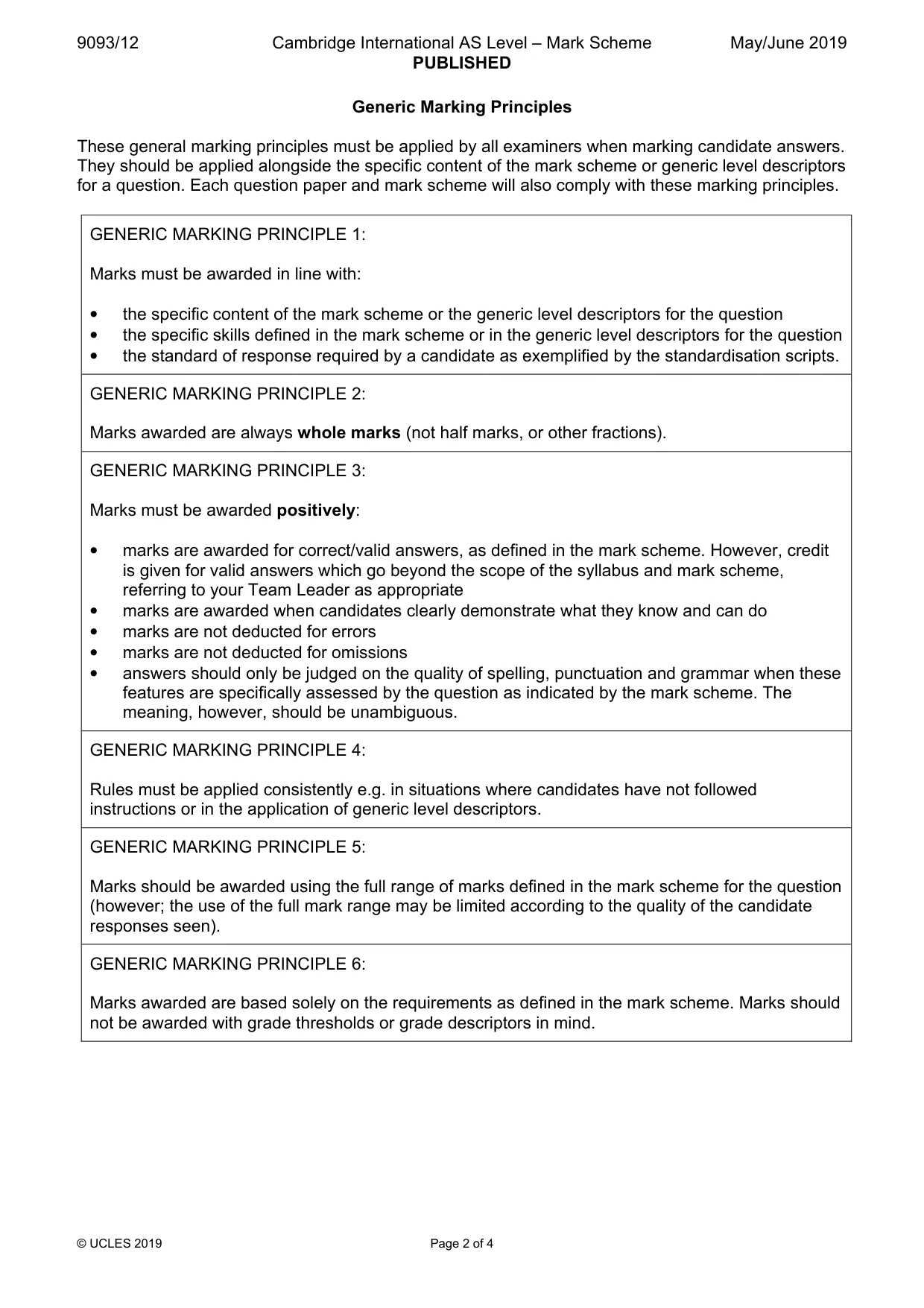
9093/12 Cambridge International AS Level – Mark Scheme PUBLISHED May/June 2019 © UCLES 2019 Page 2 of 4 Generic Marking Principles These general marking principles must be applied by all examiners when marking candidate answers. They should be applied alongside the specific content of the mark scheme or generic level descriptors for a question. Each question paper and mark scheme will also comply with these marking principles. GENERIC MARKING PRINCIPLE 1: Marks must be awarded in line with: • the specific content of the mark scheme or the generic level descriptors for the question • the specific skills defined in the mark scheme or in the generic level descriptors for the question • the standard of response required by a candidate as exemplified by the standardisation scripts. GENERIC MARKING PRINCIPLE 2: Marks awarded are always whole marks (not half marks, or other fractions). GENERIC MARKING PRINCIPLE 3: Marks must be awarded positively: • marks are awarded for correct/valid answers, as defined in the mark scheme. However, credit is given for valid answers which go beyond the scope of the syllabus and mark scheme, referring to your Team Leader as appropriate • marks are awarded when candidates clearly demonstrate what they know and can do • marks are not deducted for errors • marks are not deducted for omissions • answers should only be judged on the quality of spelling, punctuation and grammar when these features are specifically assessed by the question as indicated by the mark scheme. The meaning, however, should be unambiguous. GENERIC MARKING PRINCIPLE 4: Rules must be applied consistently e.g. in situations where candidates have not followed instructions or in the application of generic level descriptors. GENERIC MARKING PRINCIPLE 5: Marks should be awarded using the full range of marks defined in the mark scheme for the question (however; the use of the full mark range may be limited according to the quality of the candidate responses seen). GENERIC MARKING PRINCIPLE 6: Marks awarded are based solely on the requirements as defined in the mark scheme. Marks should not be awarded with grade thresholds or grade descriptors in mind.
Mark scheme, page 3
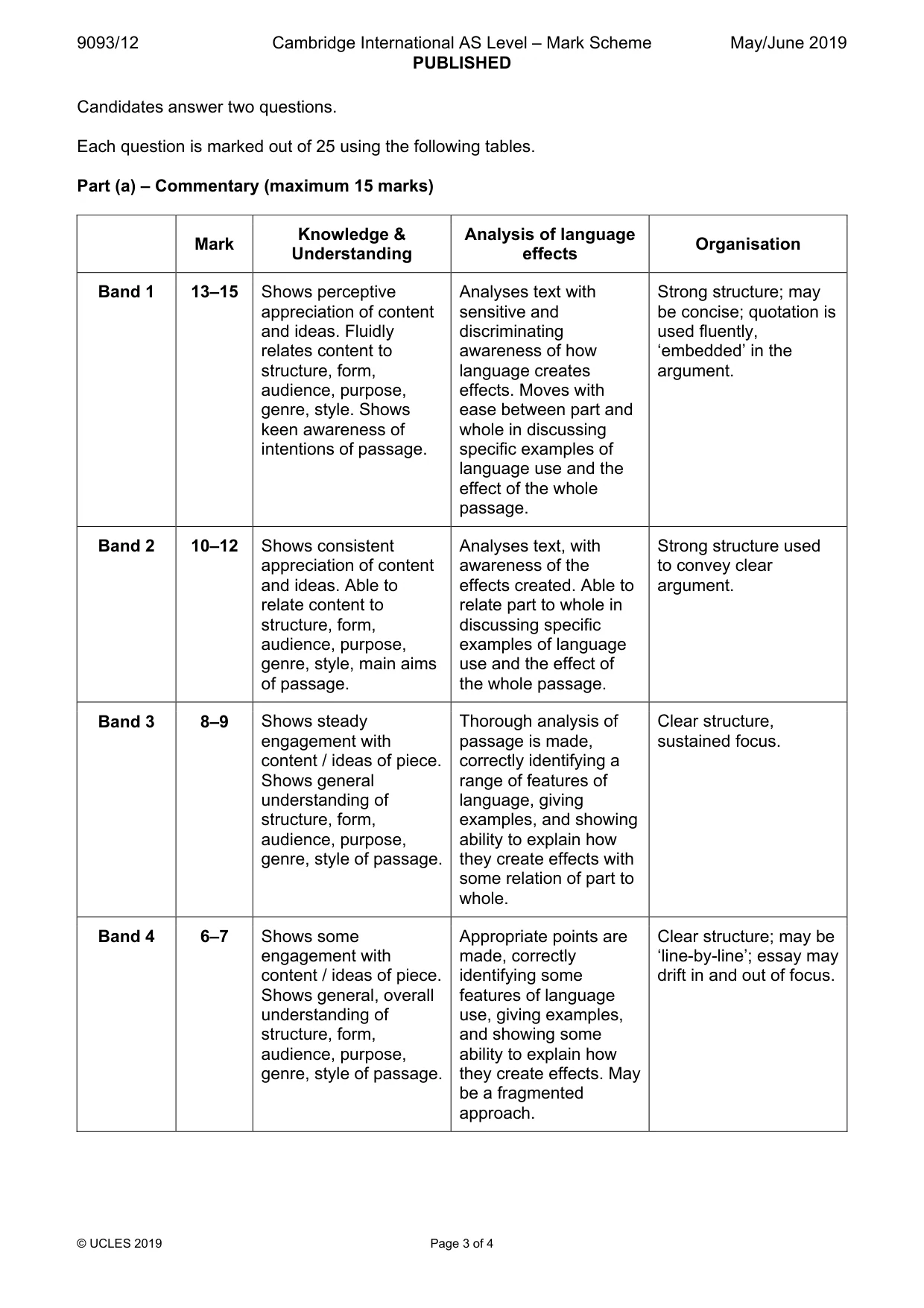
9093/12 Cambridge International AS Level – Mark Scheme PUBLISHED May/June 2019 © UCLES 2019 Page 3 of 4 Candidates answer two questions. Each question is marked out of 25 using the following tables. Part (a) – Commentary (maximum 15 marks) Mark Knowledge & Understanding Analysis of language effects Organisation Band 1 13–15 Shows perceptive appreciation of content and ideas. Fluidly relates content to structure, form, audience, purpose, genre, style. Shows keen awareness of intentions of passage. Analyses text with sensitive and discriminating awareness of how language creates effects. Moves with ease between part and whole in discussing specific examples of language use and the effect of the whole passage. Strong structure; may be concise; quotation is used fluently, ‘embedded’ in the argument. Band 2 10–12 Shows consistent appreciation of content and ideas. Able to relate content to structure, form, audience, purpose, genre, style, main aims of passage. Analyses text, with awareness of the effects created. Able to relate part to whole in discussing specific examples of language use and the effect of the whole passage. Strong structure used to convey clear argument. Band 3 8–9 Shows steady engagement with content / ideas of piece. Shows general understanding of structure, form, audience, purpose, genre, style of passage. Thorough analysis of passage is made, correctly identifying a range of features of language, giving examples, and showing ability to explain how they create effects with some relation of part to whole. Clear structure, sustained focus. Band 4 6–7 Shows some engagement with content / ideas of piece. Shows general, overall understanding of structure, form, audience, purpose, genre, style of passage. Appropriate points are made, correctly identifying some features of language use, giving examples, and showing some ability to explain how they create effects. May be a fragmented approach. Clear structure; may be ‘line-by-line’; essay may drift in and out of focus.
Mark scheme, page 4
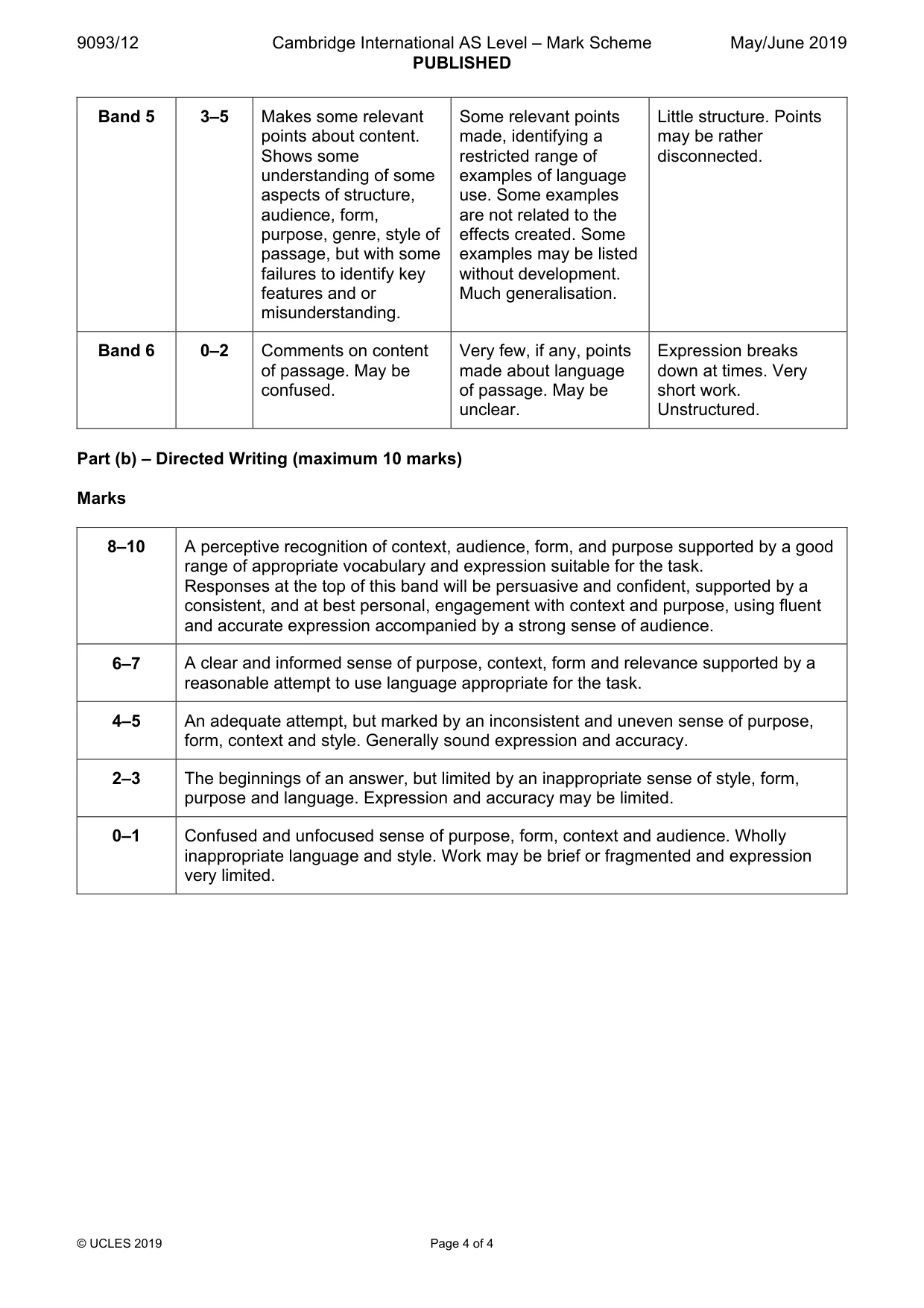
9093/12 Cambridge International AS Level – Mark Scheme PUBLISHED May/June 2019 © UCLES 2019 Page 4 of 4 Band 5 3–5 Makes some relevant points about content. Shows some understanding of some aspects of structure, audience, form, purpose, genre, style of passage, but with some failures to identify key features and or misunderstanding. Some relevant points made, identifying a restricted range of examples of language use. Some examples are not related to the effects created. Some examples may be listed without development. Much generalisation. Little structure. Points may be rather disconnected. Band 6 0–2 Comments on content of passage. May be confused. Very few, if any, points made about language of passage. May be unclear. Expression breaks down at times. Very short work. Unstructured. Part (b) – Directed Writing (maximum 10 marks) Marks 8–10 A perceptive recognition of context, audience, form, and purpose supported by a good range of appropriate vocabulary and expression suitable for the task. Responses at the top of this band will be persuasive and confident, supported by a consistent, and at best personal, engagement with context and purpose, using fluent and accurate expression accompanied by a strong sense of audience. 6–7 A clear and informed sense of purpose, context, form and relevance supported by a reasonable attempt to use language appropriate for the task. 4–5 An adequate attempt, but marked by an inconsistent and uneven sense of purpose, form, context and style. Generally sound expression and accuracy. 2–3 The beginnings of an answer, but limited by an inappropriate sense of style, form, purpose and language. Expression and accuracy may be limited. 0–1 Confused and unfocused sense of purpose, form, context and audience. Wholly inappropriate language and style. Work may be brief or fragmented and expression very limited.
What you needed in this session
Cambridge’s own grade thresholds for 2019 May/June, Paper 1 · Variant 2. A higher threshold means an easier paper — the bar moves with how the cohort did.