Cambridge A Level English - Language AS and A Level (from 2014) 9093 — 2019 May/June Paper 1 · Variant 1
9093/11/M/J/19 · 50 marks · ≈56 min
The question paper and its mark scheme, free to read here and free to download. This is Cambridge’s own paper, exactly as it was sat.
Question paper8 pages
Mark scheme4 pages
Answers below. Sit the paper first if you are practising.
Paper as text
Question paper, page 1
This document consists of 7 printed pages, 1 blank page and 1 Insert. DC (ST) 167698/1 © UCLES 2019 [Turn over Cambridge Assessment International Education Cambridge International Advanced Subsidiary and Advanced Level * 6 8 1 0 4 6 8 5 6 3 * ENGLISH LANGUAGE 9093/11 Paper 1 Passages May/June 2019 2 hours 15 minutes No Additional Materials are required. READ THESE INSTRUCTIONS FIRST An answer booklet is provided inside this question paper. You should follow the instructions on the front cover of the answer booklet. If you need additional answer paper, ask the invigilator for a continuation booklet. Answer two questions: Question 1 and either Question 2 or Question 3. You should spend about 15 minutes reading the passages and questions before you start writing your answers. You are reminded of the need for good English and clear presentation in your answers. The number of marks is given in brackets [ ] at the end of each question or part question.
Question paper, page 2
2 9093/11/M/J/19 © UCLES 2019 Answer Question 1 and either Question 2 or Question 3. 1 The passage which follows is a journalist’s account of the famous San Francisco earthquake of 1906. (a) Comment on the style and language of the passage. [15] (b) The same journalist returns to San Francisco a month later to write a follow-up report. Basing your writing on the style and language of the original text, write a section of the report. Use between 120 and 150 of your own words. [10] San Francisco is gone. Nothing remains of it but memories and a fringe of dwelling- houses on its outskirts. Its industrial section is wiped out. Its business section is wiped out. Its social and residential section is wiped out. The factories and warehouses, the great stores and newspaper buildings, the hotels and the palaces of the nabobs1, are all gone. All that remains is the fringe of dwelling houses on the outskirts of what was once San Francisco. Within an hour after the earthquake shock, the smoke of San Francisco’s burning was a lurid tower visible a hundred miles away. And for three days and nights this lurid tower swayed in the sky, reddening the sun, darkening the day, and filling the land with smoke. On Wednesday morning at a quarter past five came the earthquake. A minute later the flames were leaping upward. In a dozen different quarters south of Market Street, in the working-class ghetto, and in the factories, fires started. There was no opposing the flames. There was no organization, no communication. All the cunning adjustments of a twentieth century city had been smashed by the earthquake. The streets were humped into ridges and depressions, and piled with the debris of fallen walls. The steel rails were twisted into perpendicular and horizontal angles. The telephone and telegraph systems were disrupted. And the great water-mains had burst. All the shrewd clever methods and safeguards of man had been thrown out of gear by thirty seconds’ twitching of the Earth’s crust. By Wednesday afternoon, inside of twelve hours, half the heart of the city was gone. At that time I watched the vast conflagration2 from out on the bay. It was dead calm. Not a flicker of wind stirred. Yet from every side wind was pouring in upon the city. East, west, north, and south, strong winds were blowing upon the doomed city. The heated air rising made an enormous suck. Thus did the fire of itself build its own colossal chimney through the atmosphere. Day and night this dead calm continued, and yet, near to the flames, the wind was often half a gale, so mighty was the suck. Wednesday night saw the destruction of the very heart of the city. Dynamite was lavishly used, and many of San Francisco’s proudest structures were crumbled by man himself into ruins, but there was no withstanding the onrush of the flames. Time and again successful stands were made by the fire-fighters, and every time the flames flanked around on either side or came up from the rear, and turned to defeat the hard-won victory... At nine o’clock Wednesday evening I walked down through the very heart of the city. I walked through miles and miles of magnificent buildings and towering skyscrapers. Here was no fire. All was in perfect order. The police patrolled the streets. Every building had its watchman at the door. At one o’clock in the morning I walked down through the same section. Everything still stood intact. There was no fire. And yet 5 10 15 20 25 30 35
Question paper, page 3
3 9093/11/M/J/19 © UCLES 2019 [Turn over there was a change. A rain of ashes was falling. The watchmen at the doors were gone. The police had been withdrawn. There were no firemen, no fire-engines, no men fighting with dynamite. The district had been absolutely abandoned. I stood on a deserted street corner in the heart of San Francisco. Half a dozen blocks away the fire was burning on both sides. The street was a wall of flame. Surrender was complete. There was no water. The sewers had long since been pumped dry. There was no dynamite. Another fire had broken out further uptown, and now from three sides conflagrations were sweeping down. The fourth side had been burned earlier in the day. The following will illustrate the sweep of the flames and the inability of men to calculate their spread. At half past one in the morning three sides of Union Square were in flames. The fourth side, where stood the great St. Francis Hotel was still holding out. An hour later, ignited from top and sides, the St. Francis was flaming heavenward. Union Square was deserted. Troops, refugees, and all had retreated. 1nabob: a rich and powerful person 2conflagration: a large fire that causes a lot of damage 40 45 50
Question paper, page 4
4 9093/11/M/J/19 © UCLES 2019 2 In the following text from the website of a company which sells lifestyle events and experiences, the writer suggests a variety of activities for promoting personal wellbeing. (a) Comment on the language and style of the passage. [15] (b) In another feature for the same website, the writer considers the value of spending time with family and friends. In your own words, and basing your writing closely on the style and language of the original text, write a section (between 120 and 150 words) of the feature. [10] How to Realign Yourself with Mother Earth Find connection and introspection through mindful outdoor activity When was the last time you stepped out? Not just a scurry out the door and into your car for work, or a quick glance at the sky above, but the last time you really stepped out to revel in the natural landscape around you? When did you last savour the smell of fresh flowers, the cool breeze against your skin, or the beauty in the contrast of the clouds resting against a blue sky? When was the last time you listened to the secrets of the wind through the ancient trees or opened your ears to a songbird’s melody? Nature is our playground and humble home. If the message above speaks to you, it’s time to discover new ways to reconnect with Mother Earth. The benefits are limitless – when we tune in to the natural elements, we begin to reveal our potential to increase awareness and find creativity. Make time for yoga, dancing, eating local foods, art, hiking, and swimming in nature. Collect leaves and stones. Reconnecting with nature can be as simple as grabbing a book and enjoying your patio or backyard. Start small and work your way up to wild adventures as you learn the value of taking the time in the outdoors. Below are some of our favourite activities to encourage a connection to the arts and the outdoors. Open the door and start to play. Mountain Biking Grab your mountain bike or rent one from a local bike shop and hit the trails. This can be done solo for a bit of soul-searching, or with a group of friends or co-workers. Luckily, most public parks and recreational areas have an abundance of trails suited for all levels of riders. If you’re new to bike-riding, stick with an easy route and work your way up to the more difficult routes. Make sure to bring water and a snack for your journey ahead. Bike-riding is not only good for the soul, but it has tremendously positive effects on the joints, improves posture and coordination, decreases levels of stress, and gets your energy flowing freely throughout the body. The surrounding trees, spring flowers, sunshine, and native creatures will also heighten your senses. Hop on and enjoy the ride. Setting Intention Through Clay You can use the earth to create art. Clay is a wonderful, culturally-rich material that has been used for hundreds of years in order to fashion one-of-a-kind jewellery. Use clay to create homemade beads, pairing the pieces with your personal astrological chart, current planetary transits, and mythology in order to make a work of art that is unique to you. Feel the Earth in what you wear. 5 10 15 20 25 30 35
Question paper, page 5
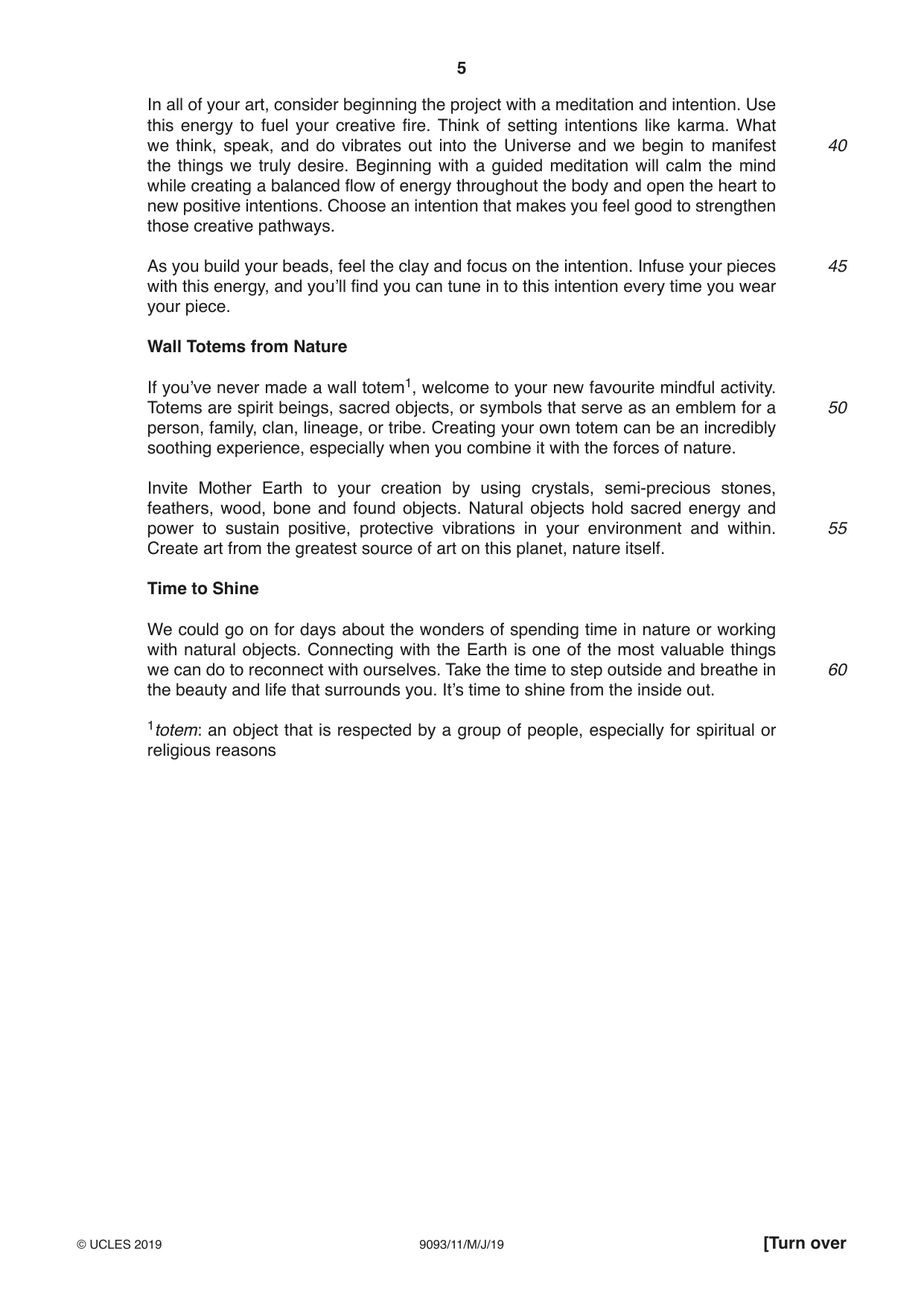
5 9093/11/M/J/19 © UCLES 2019 [Turn over In all of your art, consider beginning the project with a meditation and intention. Use this energy to fuel your creative fire. Think of setting intentions like karma. What we think, speak, and do vibrates out into the Universe and we begin to manifest the things we truly desire. Beginning with a guided meditation will calm the mind while creating a balanced flow of energy throughout the body and open the heart to new positive intentions. Choose an intention that makes you feel good to strengthen those creative pathways. As you build your beads, feel the clay and focus on the intention. Infuse your pieces with this energy, and you’ll find you can tune in to this intention every time you wear your piece. Wall Totems from Nature If you’ve never made a wall totem1, welcome to your new favourite mindful activity. Totems are spirit beings, sacred objects, or symbols that serve as an emblem for a person, family, clan, lineage, or tribe. Creating your own totem can be an incredibly soothing experience, especially when you combine it with the forces of nature. Invite Mother Earth to your creation by using crystals, semi-precious stones, feathers, wood, bone and found objects. Natural objects hold sacred energy and power to sustain positive, protective vibrations in your environment and within. Create art from the greatest source of art on this planet, nature itself. Time to Shine We could go on for days about the wonders of spending time in nature or working with natural objects. Connecting with the Earth is one of the most valuable things we can do to reconnect with ourselves. Take the time to step outside and breathe in the beauty and life that surrounds you. It’s time to shine from the inside out. 1totem: an object that is respected by a group of people, especially for spiritual or religious reasons 40 45 50 55 60
Question paper, page 6
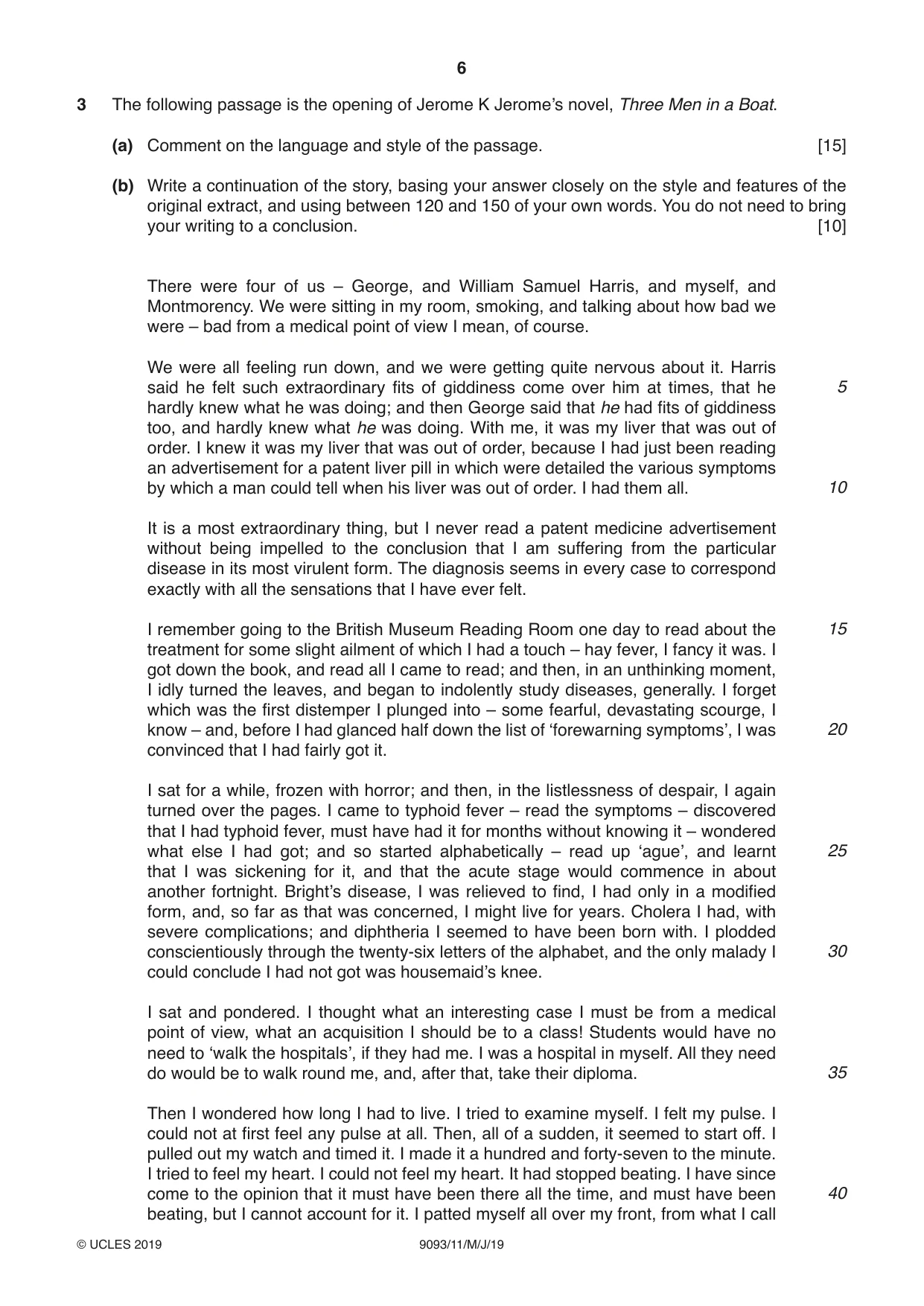
6 9093/11/M/J/19 © UCLES 2019 3 The following passage is the opening of Jerome K Jerome’s novel, Three Men in a Boat. (a) Comment on the language and style of the passage. [15] (b) Write a continuation of the story, basing your answer closely on the style and features of the original extract, and using between 120 and 150 of your own words. You do not need to bring your writing to a conclusion. [10] There were four of us – George, and William Samuel Harris, and myself, and Montmorency. We were sitting in my room, smoking, and talking about how bad we were – bad from a medical point of view I mean, of course. We were all feeling run down, and we were getting quite nervous about it. Harris said he felt such extraordinary fits of giddiness come over him at times, that he hardly knew what he was doing; and then George said that he had fits of giddiness too, and hardly knew what he was doing. With me, it was my liver that was out of order. I knew it was my liver that was out of order, because I had just been reading an advertisement for a patent liver pill in which were detailed the various symptoms by which a man could tell when his liver was out of order. I had them all. It is a most extraordinary thing, but I never read a patent medicine advertisement without being impelled to the conclusion that I am suffering from the particular disease in its most virulent form. The diagnosis seems in every case to correspond exactly with all the sensations that I have ever felt. I remember going to the British Museum Reading Room one day to read about the treatment for some slight ailment of which I had a touch – hay fever, I fancy it was. I got down the book, and read all I came to read; and then, in an unthinking moment, I idly turned the leaves, and began to indolently study diseases, generally. I forget which was the first distemper I plunged into – some fearful, devastating scourge, I know – and, before I had glanced half down the list of ‘forewarning symptoms’, I was convinced that I had fairly got it. I sat for a while, frozen with horror; and then, in the listlessness of despair, I again turned over the pages. I came to typhoid fever – read the symptoms – discovered that I had typhoid fever, must have had it for months without knowing it – wondered what else I had got; and so started alphabetically – read up ‘ague’, and learnt that I was sickening for it, and that the acute stage would commence in about another fortnight. Bright’s disease, I was relieved to find, I had only in a modified form, and, so far as that was concerned, I might live for years. Cholera I had, with severe complications; and diphtheria I seemed to have been born with. I plodded conscientiously through the twenty-six letters of the alphabet, and the only malady I could conclude I had not got was housemaid’s knee. I sat and pondered. I thought what an interesting case I must be from a medical point of view, what an acquisition I should be to a class! Students would have no need to ‘walk the hospitals’, if they had me. I was a hospital in myself. All they need do would be to walk round me, and, after that, take their diploma. Then I wondered how long I had to live. I tried to examine myself. I felt my pulse. I could not at first feel any pulse at all. Then, all of a sudden, it seemed to start off. I pulled out my watch and timed it. I made it a hundred and forty-seven to the minute. I tried to feel my heart. I could not feel my heart. It had stopped beating. I have since come to the opinion that it must have been there all the time, and must have been beating, but I cannot account for it. I patted myself all over my front, from what I call 5 10 15 20 25 30 35 40
Question paper, page 7
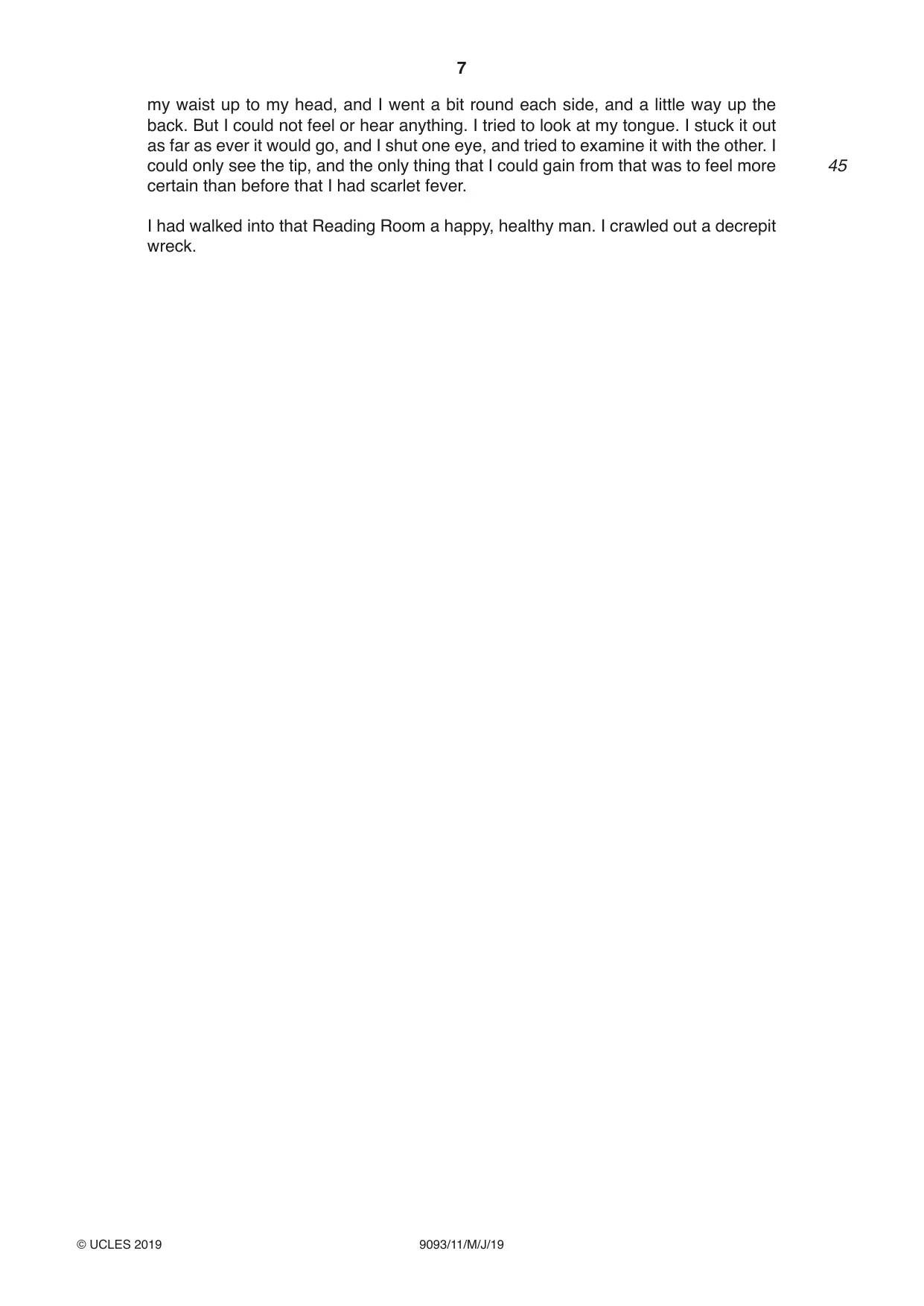
7 9093/11/M/J/19 © UCLES 2019 my waist up to my head, and I went a bit round each side, and a little way up the back. But I could not feel or hear anything. I tried to look at my tongue. I stuck it out as far as ever it would go, and I shut one eye, and tried to examine it with the other. I could only see the tip, and the only thing that I could gain from that was to feel more certain than before that I had scarlet fever. I had walked into that Reading Room a happy, healthy man. I crawled out a decrepit wreck. 45
Question paper, page 8
8 9093/11/M/J/19 © UCLES 2019 BLANK PAGE Permission to reproduce items where third-party owned material protected by copyright is included has been sought and cleared where possible. Every reasonable effort has been made by the publisher (UCLES) to trace copyright holders, but if any items requiring clearance have unwittingly been included, the publisher will be pleased to make amends at the earliest possible opportunity. To avoid the issue of disclosure of answer-related information to candidates, all copyright acknowledgements are reproduced online in the Cambridge Assessment International Education Copyright Acknowledgements Booklet. This is produced for each series of examinations and is freely available to download at www.cambridgeinternational.org after the live examination series. Cambridge Assessment International Education is part of the Cambridge Assessment Group. Cambridge Assessment is the brand name of the University of Cambridge Local Examinations Syndicate (UCLES), which itself is a department of the University of Cambridge.
Mark scheme, page 1
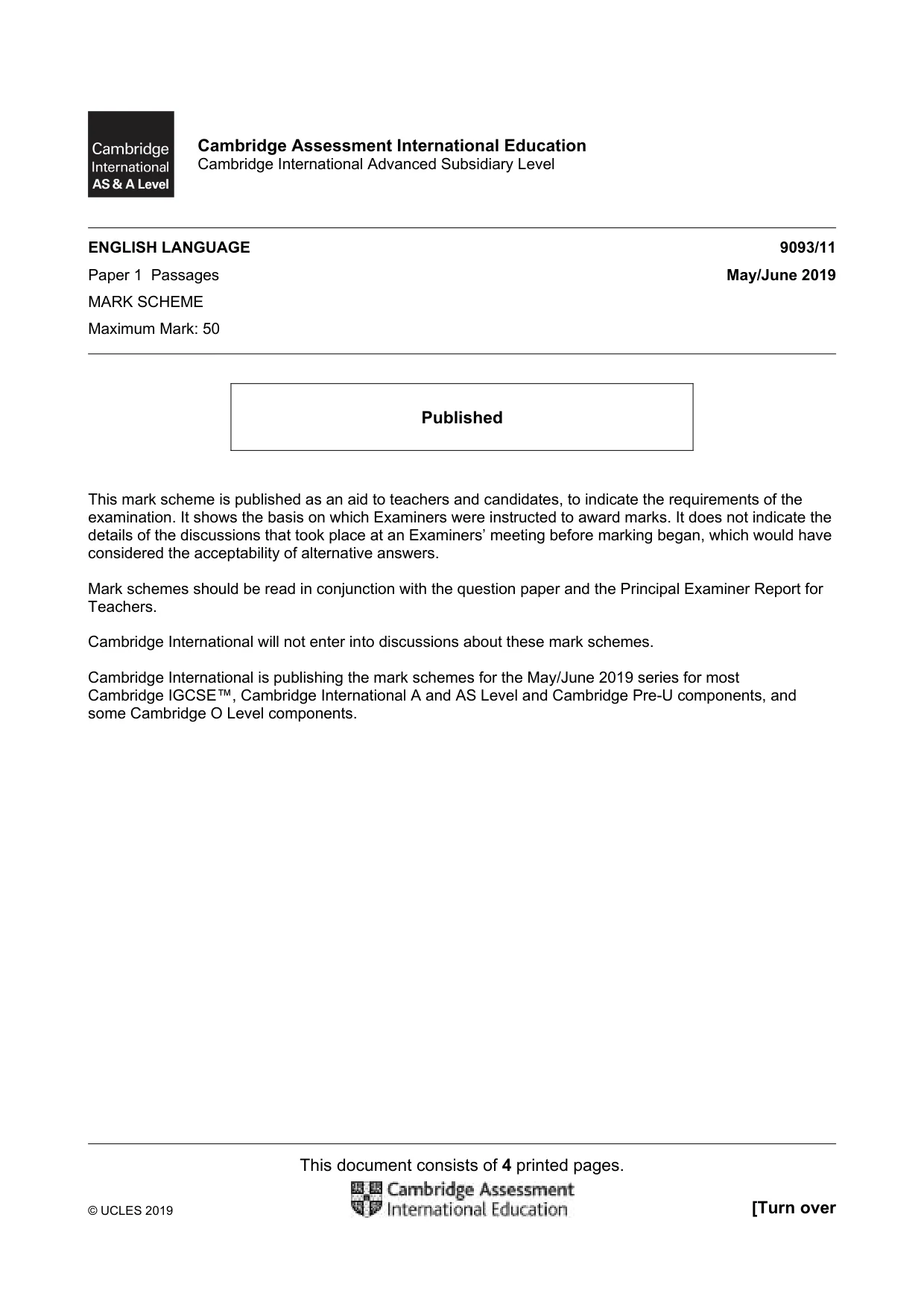
This document consists of 4 printed pages. © UCLES 2019 [Turn over Cambridge Assessment International Education Cambridge International Advanced Subsidiary Level ENGLISH LANGUAGE 9093/11 Paper 1 Passages May/June 2019 MARK SCHEME Maximum Mark: 50 Published This mark scheme is published as an aid to teachers and candidates, to indicate the requirements of the examination. It shows the basis on which Examiners were instructed to award marks. It does not indicate the details of the discussions that took place at an Examiners’ meeting before marking began, which would have considered the acceptability of alternative answers. Mark schemes should be read in conjunction with the question paper and the Principal Examiner Report for Teachers. Cambridge International will not enter into discussions about these mark schemes. Cambridge International is publishing the mark schemes for the May/June 2019 series for most Cambridge IGCSE™, Cambridge International A and AS Level and Cambridge Pre-U components, and some Cambridge O Level components.
Mark scheme, page 2
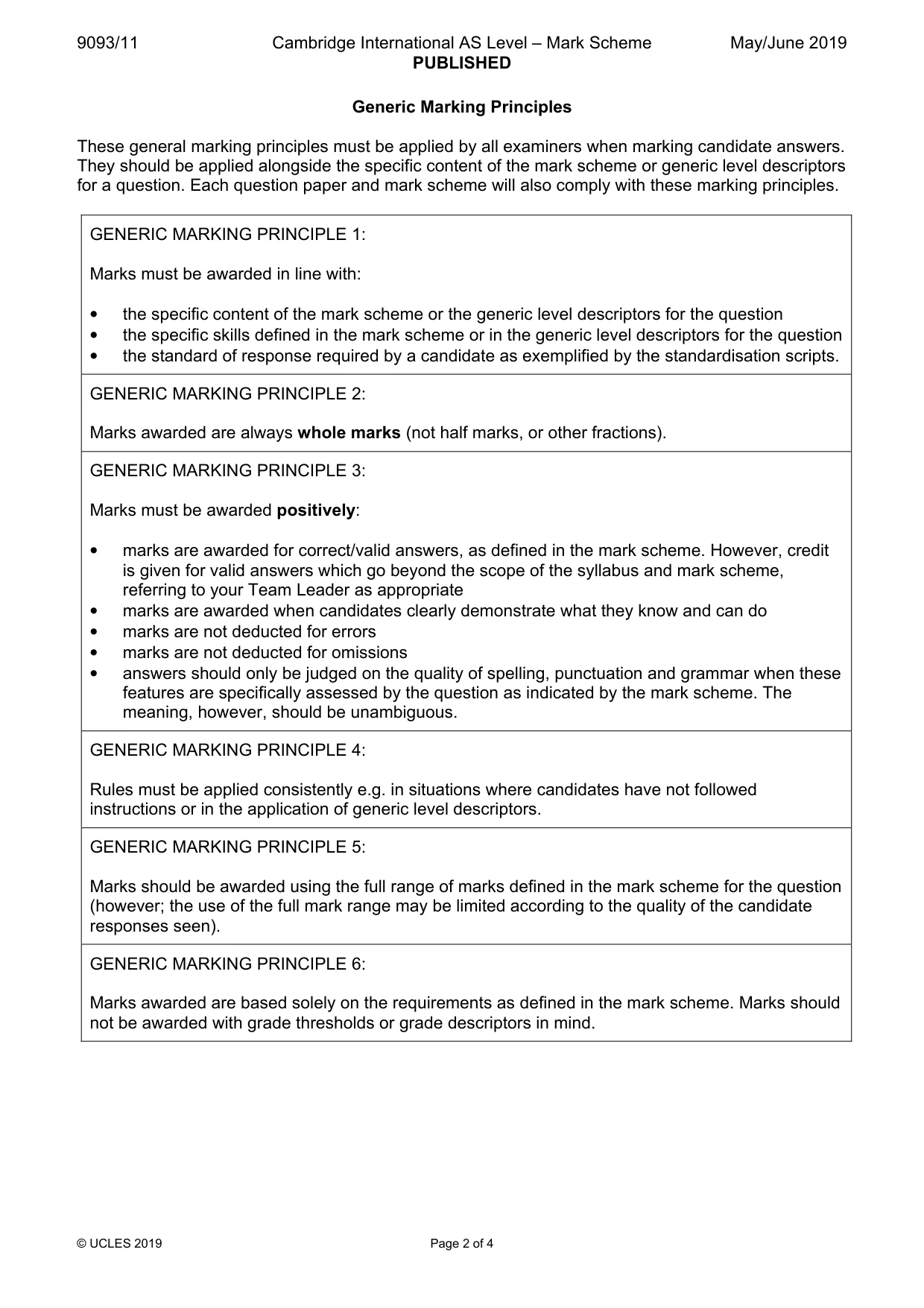
9093/11 Cambridge International AS Level – Mark Scheme PUBLISHED May/June 2019 © UCLES 2019 Page 2 of 4 Generic Marking Principles These general marking principles must be applied by all examiners when marking candidate answers. They should be applied alongside the specific content of the mark scheme or generic level descriptors for a question. Each question paper and mark scheme will also comply with these marking principles. GENERIC MARKING PRINCIPLE 1: Marks must be awarded in line with: • the specific content of the mark scheme or the generic level descriptors for the question • the specific skills defined in the mark scheme or in the generic level descriptors for the question • the standard of response required by a candidate as exemplified by the standardisation scripts. GENERIC MARKING PRINCIPLE 2: Marks awarded are always whole marks (not half marks, or other fractions). GENERIC MARKING PRINCIPLE 3: Marks must be awarded positively: • marks are awarded for correct/valid answers, as defined in the mark scheme. However, credit is given for valid answers which go beyond the scope of the syllabus and mark scheme, referring to your Team Leader as appropriate • marks are awarded when candidates clearly demonstrate what they know and can do • marks are not deducted for errors • marks are not deducted for omissions • answers should only be judged on the quality of spelling, punctuation and grammar when these features are specifically assessed by the question as indicated by the mark scheme. The meaning, however, should be unambiguous. GENERIC MARKING PRINCIPLE 4: Rules must be applied consistently e.g. in situations where candidates have not followed instructions or in the application of generic level descriptors. GENERIC MARKING PRINCIPLE 5: Marks should be awarded using the full range of marks defined in the mark scheme for the question (however; the use of the full mark range may be limited according to the quality of the candidate responses seen). GENERIC MARKING PRINCIPLE 6: Marks awarded are based solely on the requirements as defined in the mark scheme. Marks should not be awarded with grade thresholds or grade descriptors in mind.
Mark scheme, page 3
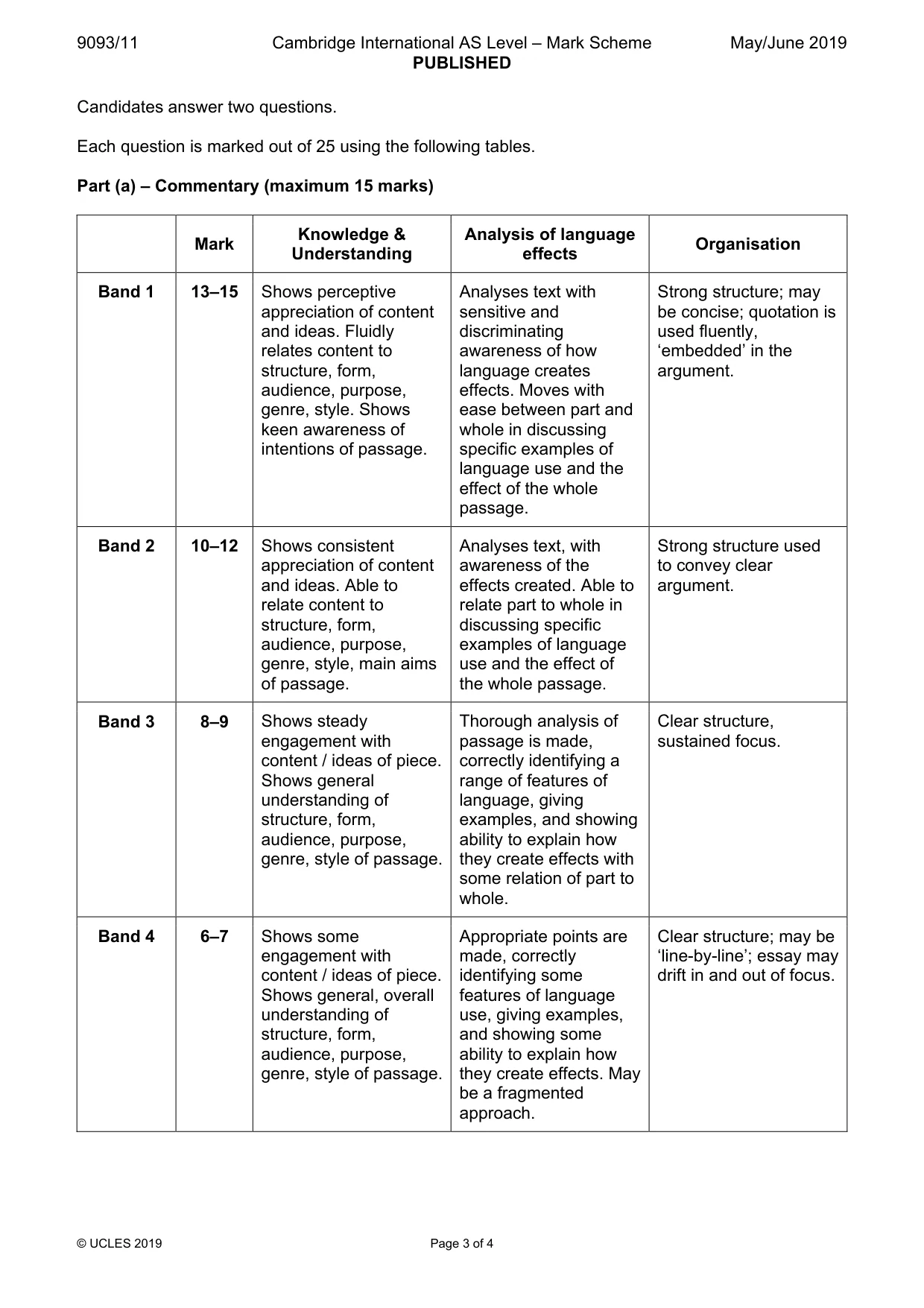
9093/11 Cambridge International AS Level – Mark Scheme PUBLISHED May/June 2019 © UCLES 2019 Page 3 of 4 Candidates answer two questions. Each question is marked out of 25 using the following tables. Part (a) – Commentary (maximum 15 marks) Mark Knowledge & Understanding Analysis of language effects Organisation Band 1 13–15 Shows perceptive appreciation of content and ideas. Fluidly relates content to structure, form, audience, purpose, genre, style. Shows keen awareness of intentions of passage. Analyses text with sensitive and discriminating awareness of how language creates effects. Moves with ease between part and whole in discussing specific examples of language use and the effect of the whole passage. Strong structure; may be concise; quotation is used fluently, ‘embedded’ in the argument. Band 2 10–12 Shows consistent appreciation of content and ideas. Able to relate content to structure, form, audience, purpose, genre, style, main aims of passage. Analyses text, with awareness of the effects created. Able to relate part to whole in discussing specific examples of language use and the effect of the whole passage. Strong structure used to convey clear argument. Band 3 8–9 Shows steady engagement with content / ideas of piece. Shows general understanding of structure, form, audience, purpose, genre, style of passage. Thorough analysis of passage is made, correctly identifying a range of features of language, giving examples, and showing ability to explain how they create effects with some relation of part to whole. Clear structure, sustained focus. Band 4 6–7 Shows some engagement with content / ideas of piece. Shows general, overall understanding of structure, form, audience, purpose, genre, style of passage. Appropriate points are made, correctly identifying some features of language use, giving examples, and showing some ability to explain how they create effects. May be a fragmented approach. Clear structure; may be ‘line-by-line’; essay may drift in and out of focus.
Mark scheme, page 4
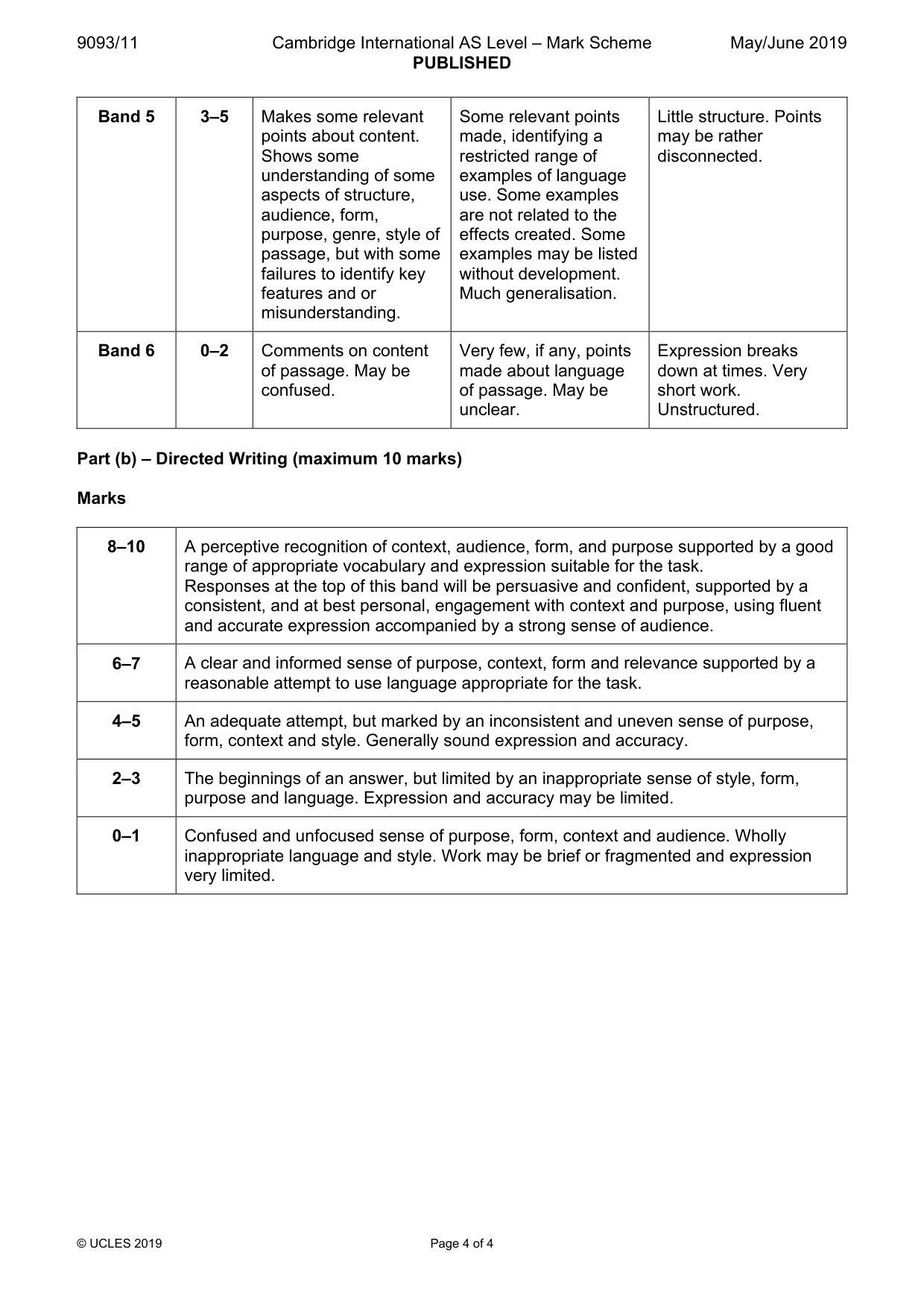
9093/11 Cambridge International AS Level – Mark Scheme PUBLISHED May/June 2019 © UCLES 2019 Page 4 of 4 Band 5 3–5 Makes some relevant points about content. Shows some understanding of some aspects of structure, audience, form, purpose, genre, style of passage, but with some failures to identify key features and or misunderstanding. Some relevant points made, identifying a restricted range of examples of language use. Some examples are not related to the effects created. Some examples may be listed without development. Much generalisation. Little structure. Points may be rather disconnected. Band 6 0–2 Comments on content of passage. May be confused. Very few, if any, points made about language of passage. May be unclear. Expression breaks down at times. Very short work. Unstructured. Part (b) – Directed Writing (maximum 10 marks) Marks 8–10 A perceptive recognition of context, audience, form, and purpose supported by a good range of appropriate vocabulary and expression suitable for the task. Responses at the top of this band will be persuasive and confident, supported by a consistent, and at best personal, engagement with context and purpose, using fluent and accurate expression accompanied by a strong sense of audience. 6–7 A clear and informed sense of purpose, context, form and relevance supported by a reasonable attempt to use language appropriate for the task. 4–5 An adequate attempt, but marked by an inconsistent and uneven sense of purpose, form, context and style. Generally sound expression and accuracy. 2–3 The beginnings of an answer, but limited by an inappropriate sense of style, form, purpose and language. Expression and accuracy may be limited. 0–1 Confused and unfocused sense of purpose, form, context and audience. Wholly inappropriate language and style. Work may be brief or fragmented and expression very limited.
What you needed in this session
Cambridge’s own grade thresholds for 2019 May/June, Paper 1 · Variant 1. A higher threshold means an easier paper — the bar moves with how the cohort did.