Cambridge A Level English - Language AS and A Level (from 2014) 9093 — 2019 Feb/March Paper 3 · Variant 2
9093/32/F/M/19 · 50 marks · ≈56 min
The question paper and its mark scheme, free to read here and free to download. This is Cambridge’s own paper, exactly as it was sat.
Question paper8 pages


Mark scheme7 pages
Answers below. Sit the paper first if you are practising.
Paper as text
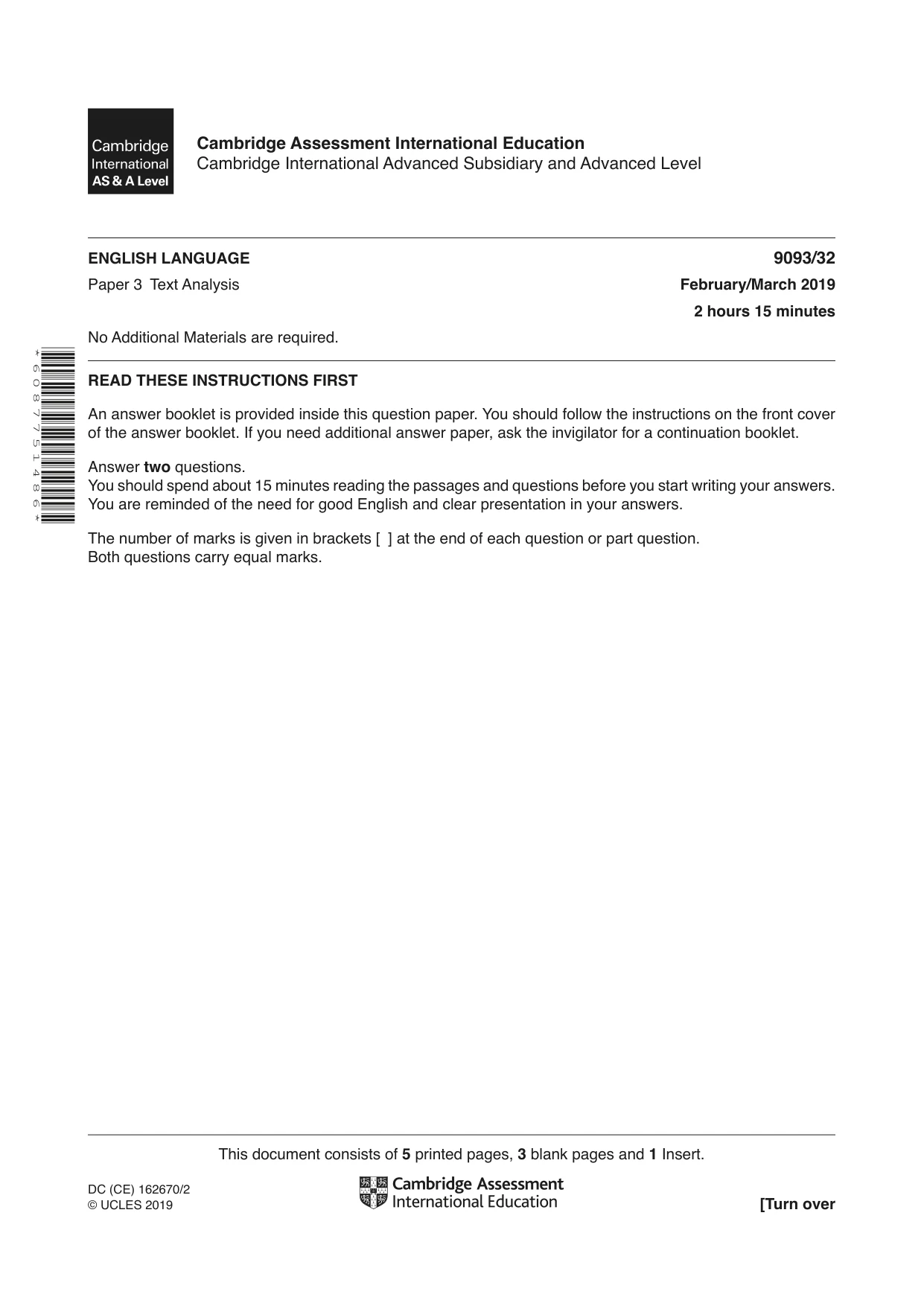
Question paper, page 1
This document consists of 5 printed pages, 3 blank pages and 1 Insert. DC (CE) 162670/2 © UCLES 2019 [Turn over Cambridge Assessment International Education Cambridge International Advanced Subsidiary and Advanced Level * 6 0 8 7 7 5 1 4 8 6 * ENGLISH LANGUAGE 9093/32 Paper 3 Text Analysis February/March 2019 2 hours 15 minutes No Additional Materials are required. READ THESE INSTRUCTIONS FIRST An answer booklet is provided inside this question paper. You should follow the instructions on the front cover of the answer booklet. If you need additional answer paper, ask the invigilator for a continuation booklet. Answer two questions. You should spend about 15 minutes reading the passages and questions before you start writing your answers. You are reminded of the need for good English and clear presentation in your answers. The number of marks is given in brackets [ ] at the end of each question or part question. Both questions carry equal marks.
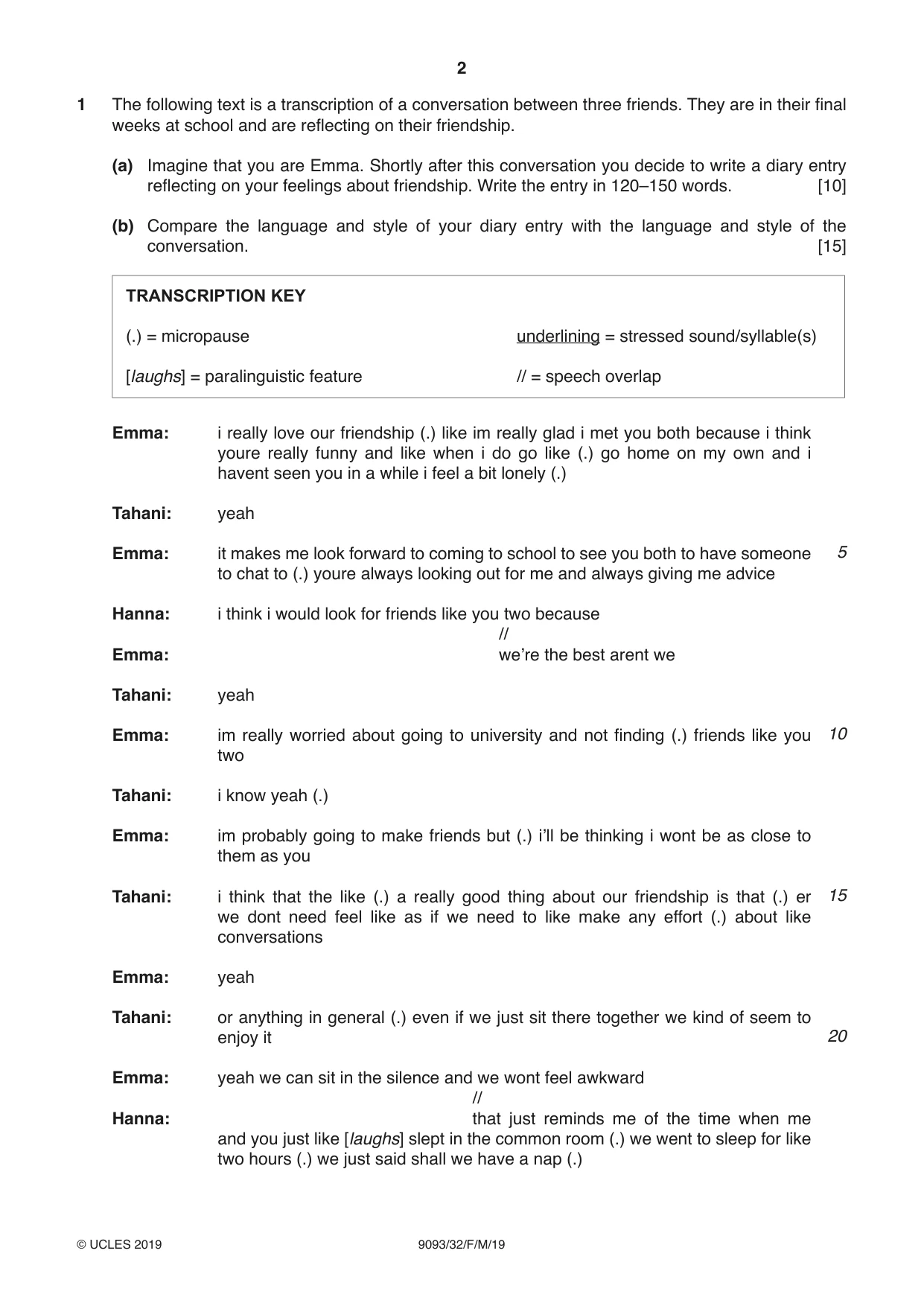
Question paper, page 2
2 9093/32/F/M/19 © UCLES 2019 1 The following text is a transcription of a conversation between three friends. They are in their final weeks at school and are reflecting on their friendship. (a) Imagine that you are Emma. Shortly after this conversation you decide to write a diary entry reflecting on your feelings about friendship. Write the entry in 120–150 words. [10] (b) Compare the language and style of your diary entry with the language and style of the conversation. [15] TRANSCRIPTION KEY (.) = micropause underlining = stressed sound/syllable(s) [laughs] = paralinguistic feature // = speech overlap Emma: i really love our friendship (.) like im really glad i met you both because i think youre really funny and like when i do go like (.) go home on my own and i havent seen you in a while i feel a bit lonely (.) Tahani: yeah Emma: it makes me look forward to coming to school to see you both to have someone to chat to (.) youre always looking out for me and always giving me advice Hanna: i think i would look for friends like you two because // Emma: we’re the best arent we Tahani: yeah Emma: im really worried about going to university and not finding (.) friends like you two Tahani: i know yeah (.) Emma: im probably going to make friends but (.) i’ll be thinking i wont be as close to them as you Tahani: i think that the like (.) a really good thing about our friendship is that (.) er we dont need feel like as if we need to like make any effort (.) about like conversations Emma: yeah Tahani: or anything in general (.) even if we just sit there together we kind of seem to enjoy it Emma: yeah we can sit in the silence and we wont feel awkward // Hanna: that just reminds me of the time when me and you just like [laughs] slept in the common room (.) we went to sleep for like two hours (.) we just said shall we have a nap (.) 5 10 15 20
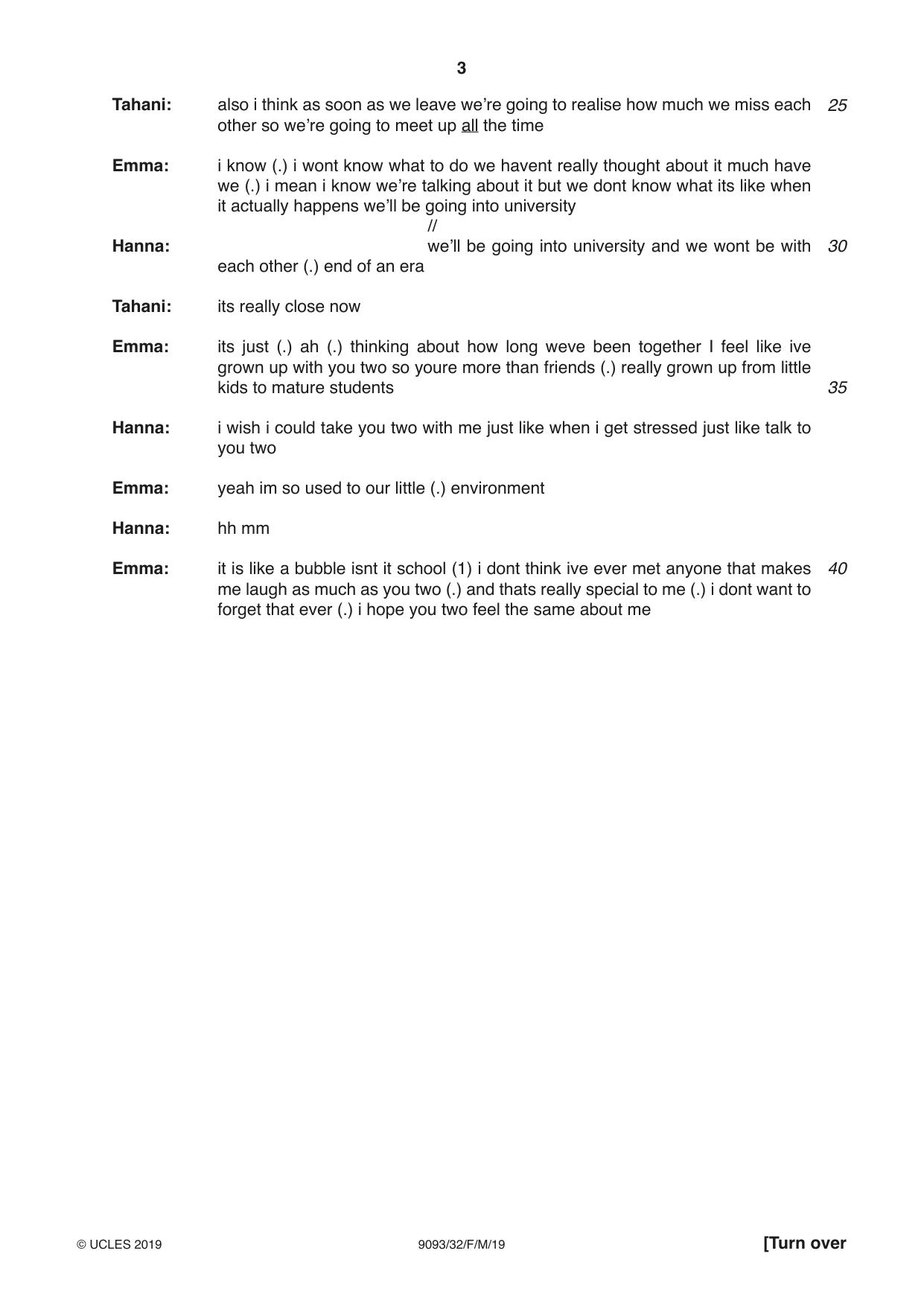
Question paper, page 3
3 9093/32/F/M/19 © UCLES 2019 [Turn over Tahani: also i think as soon as we leave we’re going to realise how much we miss each other so we’re going to meet up all the time Emma: i know (.) i wont know what to do we havent really thought about it much have we (.) i mean i know we’re talking about it but we dont know what its like when it actually happens we’ll be going into university // Hanna: we’ll be going into university and we wont be with each other (.) end of an era Tahani: its really close now Emma: its just (.) ah (.) thinking about how long weve been together I feel like ive grown up with you two so youre more than friends (.) really grown up from little kids to mature students Hanna: i wish i could take you two with me just like when i get stressed just like talk to you two Emma: yeah im so used to our little (.) environment Hanna: hh mm Emma: it is like a bubble isnt it school (1) i dont think ive ever met anyone that makes me laugh as much as you two (.) and thats really special to me (.) i dont want to forget that ever (.) i hope you two feel the same about me 25 30 35 40
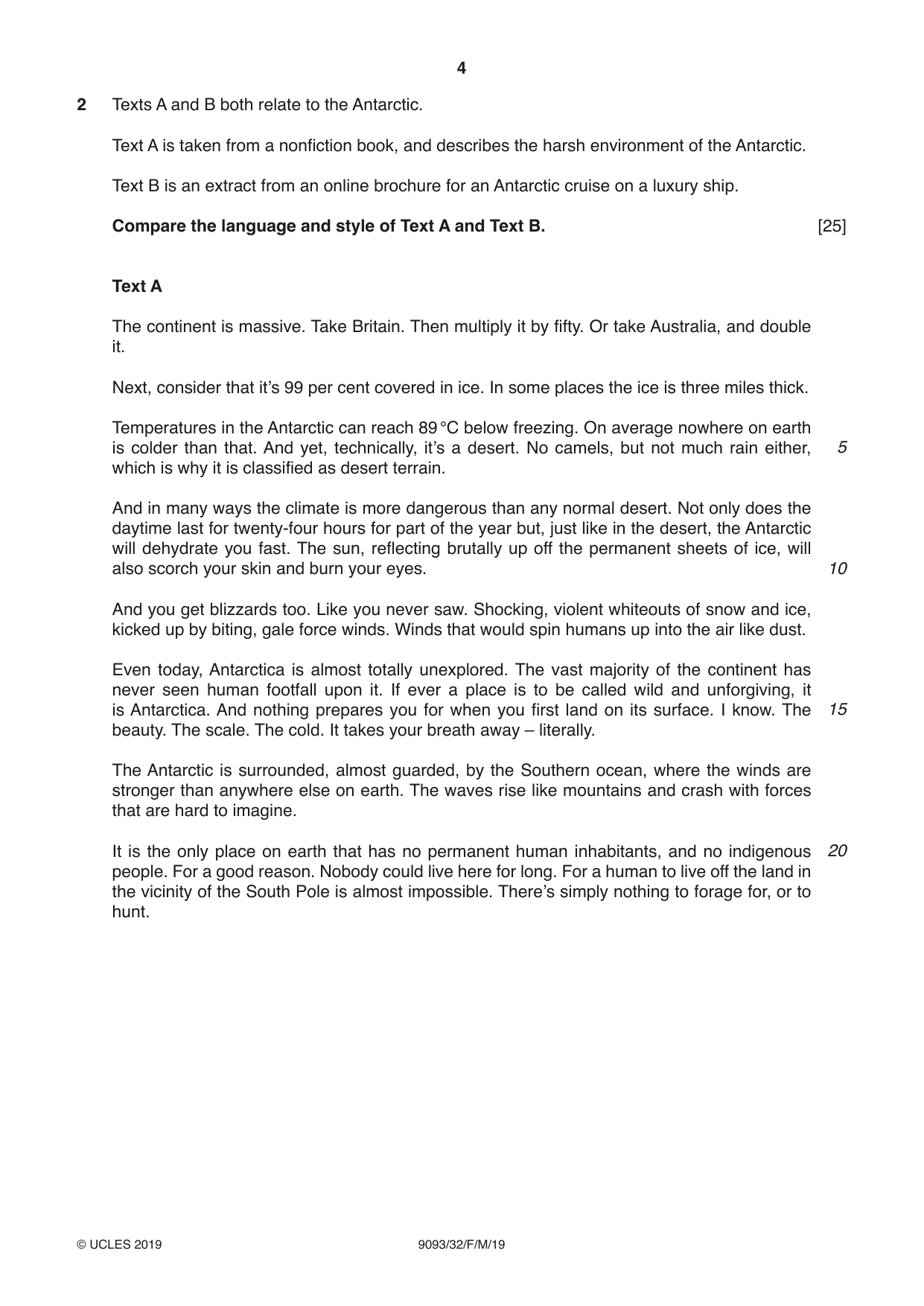
Question paper, page 4
4 9093/32/F/M/19 © UCLES 2019 2 Texts A and B both relate to the Antarctic. Text A is taken from a nonfiction book, and describes the harsh environment of the Antarctic. Text B is an extract from an online brochure for an Antarctic cruise on a luxury ship. Compare the language and style of Text A and Text B. [25] Text A The continent is massive. Take Britain. Then multiply it by fifty. Or take Australia, and double it. Next, consider that it’s 99 per cent covered in ice. In some places the ice is three miles thick. Temperatures in the Antarctic can reach 89 °C below freezing. On average nowhere on earth is colder than that. And yet, technically, it’s a desert. No camels, but not much rain either, which is why it is classified as desert terrain. And in many ways the climate is more dangerous than any normal desert. Not only does the daytime last for twenty-four hours for part of the year but, just like in the desert, the Antarctic will dehydrate you fast. The sun, reflecting brutally up off the permanent sheets of ice, will also scorch your skin and burn your eyes. And you get blizzards too. Like you never saw. Shocking, violent whiteouts of snow and ice, kicked up by biting, gale force winds. Winds that would spin humans up into the air like dust. Even today, Antarctica is almost totally unexplored. The vast majority of the continent has never seen human footfall upon it. If ever a place is to be called wild and unforgiving, it is Antarctica. And nothing prepares you for when you first land on its surface. I know. The beauty. The scale. The cold. It takes your breath away – literally. The Antarctic is surrounded, almost guarded, by the Southern ocean, where the winds are stronger than anywhere else on earth. The waves rise like mountains and crash with forces that are hard to imagine. It is the only place on earth that has no permanent human inhabitants, and no indigenous people. For a good reason. Nobody could live here for long. For a human to live off the land in the vicinity of the South Pole is almost impossible. There’s simply nothing to forage for, or to hunt. 5 10 15 20
Question paper, page 5
5 9093/32/F/M/19 © UCLES 2019 Text B ANTARCTICA The ‘White Continent’ is a photogenic dream, and the last frontier for intrepid explorers. Enter a frozen world where seals lazily watch the ships go by, and stark white icebergs stand out vividly against the deep blue sea. A once-in-a-lifetime adventure awaits anyone making this voyage across the sea. Despite the harsh conditions, Antarctica holds a remarkable concentration of wildlife, much of which has evolved to survive in this extreme environment. The deep guttural calls of penguins in their thousands are carried across the landscape on fierce winds. With their swagger-like walk and comical habits, penguins are a firm favourite with visitors. SILVER CLOUD EXPEDITION This small luxury ship is designed for those who delight in the thrill of discovery while indulging mind and body in the most lavish surroundings imaginable. All accommodations are spacious with most benefiting from a private veranda. This intimate, ultra-luxury ship can sail up narrow waterways into the heart of a city, or tie up right at the pier while others must anchor off shore. And for those who yearn to explore the new and unknown, this ship can transport you to the furthermost boundaries of the planet. Renowned for culinary excellence and innovative spirit, a luxury cruise on the Silver Cloud Expedition offers a choice of open-seating dining options throughout the fleet, as well as several specialty venues. Enjoy the ease, convenience and value of an all-inclusive cruise fare that includes almost all of your discretionary onboard expenses. In a world of multinational conglomerates, the Silver Cloud Expedition is owned and operated by one family – the Lefebvres of Rome. This means genuine pride in ownership and a true Italian passion for embracing the best of life and a personal commitment to maintain the high standards of cruise excellence that have been the cornerstone of this vessel from the very beginning. Awaken your soul to the wonder of Antarctica with an Antarctic cruise on the Silver Cloud Expedition. Revel in the beauty and overwhelming power of nature. Admire the staggering abundance of wildlife. Meet the personal challenge of reaching the earth’s last great wilderness frontier. You’ll cruise across seas of glass, passing giant prisms of ice riding an ink-blue sea. And you’ll share the landscape with bellowing elephant seals and raucous rookeries of penguins, unafraid and unperturbed by your presence. This ship offers the highest standards of comfort, safety and style. 5 10 15 20 25 30
Question paper, page 6
6 9093/32/F/M/19 © UCLES 2019 BLANK PAGE
Question paper, page 7
7 9093/32/F/M/19 © UCLES 2019 BLANK PAGE
Question paper, page 8
8 9093/32/F/M/19 © UCLES 2019 BLANK PAGE Permission to reproduce items where third-party owned material protected by copyright is included has been sought and cleared where possible. Every reasonable effort has been made by the publisher (UCLES) to trace copyright holders, but if any items requiring clearance have unwittingly been included, the publisher will be pleased to make amends at the earliest possible opportunity. To avoid the issue of disclosure of answer-related information to candidates, all copyright acknowledgements are reproduced online in the Cambridge Assessment International Education Copyright Acknowledgements Booklet. This is produced for each series of examinations and is freely available to download at www.cambridgeinternational.org after the live examination series. Cambridge Assessment International Education is part of the Cambridge Assessment Group. Cambridge Assessment is the brand name of the University of Cambridge Local Examinations Syndicate (UCLES), which itself is a department of the University of Cambridge.
Mark scheme, page 1
This document consists of 7 printed pages. © UCLES 2019 [Turn over Cambridge Assessment International Education Cambridge International Advanced Level ENGLISH LANGUAGE 9093/32 Paper 3 Text Analysis March 2019 MARK SCHEME Maximum Mark: 50 Published This mark scheme is published as an aid to teachers and candidates, to indicate the requirements of the examination. It shows the basis on which Examiners were instructed to award marks. It does not indicate the details of the discussions that took place at an Examiners’ meeting before marking began, which would have considered the acceptability of alternative answers. Mark schemes should be read in conjunction with the question paper and the Principal Examiner Report for Teachers. Cambridge International will not enter into discussions about these mark schemes. Cambridge International is publishing the mark schemes for the March 2019 series for most Cambridge IGCSE™, Cambridge International A and AS Level components and some Cambridge O Level components.
Mark scheme, page 2
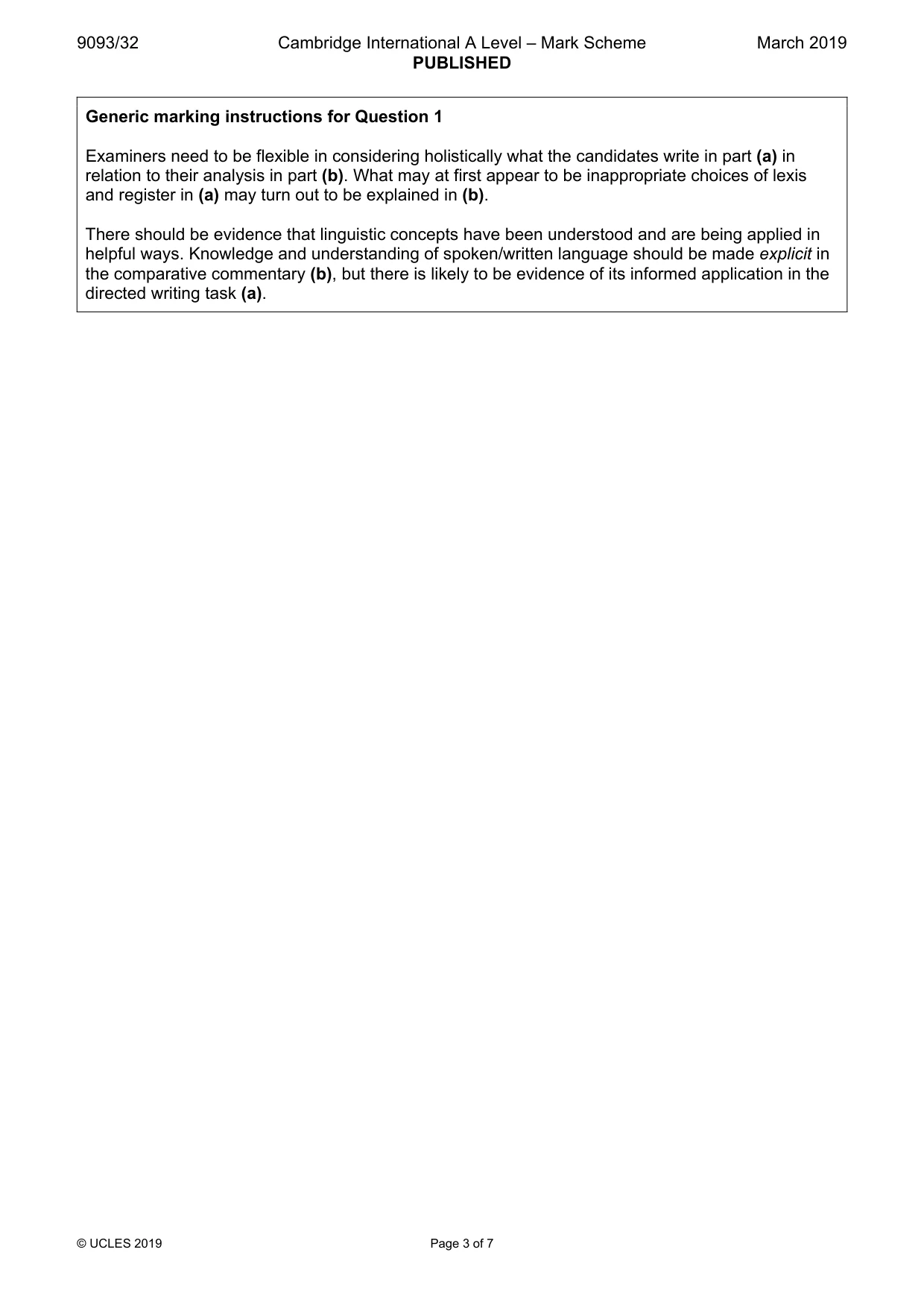
9093/32 Cambridge International A Level – Mark Scheme PUBLISHED March 2019 © UCLES 2019 Page 2 of 7 Generic Marking Principles These general marking principles must be applied by all examiners when marking candidate answers. They should be applied alongside the specific content of the mark scheme or generic level descriptors for a question. Each question paper and mark scheme will also comply with these marking principles. GENERIC MARKING PRINCIPLE 1: Marks must be awarded in line with: • the specific content of the mark scheme or the generic level descriptors for the question • the specific skills defined in the mark scheme or in the generic level descriptors for the question • the standard of response required by a candidate as exemplified by the standardisation scripts. GENERIC MARKING PRINCIPLE 2: Marks awarded are always whole marks (not half marks, or other fractions). GENERIC MARKING PRINCIPLE 3: Marks must be awarded positively: • marks are awarded for correct/valid answers, as defined in the mark scheme. However, credit is given for valid answers which go beyond the scope of the syllabus and mark scheme, referring to your Team Leader as appropriate • marks are awarded when candidates clearly demonstrate what they know and can do • marks are not deducted for errors • marks are not deducted for omissions • answers should only be judged on the quality of spelling, punctuation and grammar when these features are specifically assessed by the question as indicated by the mark scheme. The meaning, however, should be unambiguous. GENERIC MARKING PRINCIPLE 4: Rules must be applied consistently e.g. in situations where candidates have not followed instructions or in the application of generic level descriptors. GENERIC MARKING PRINCIPLE 5: Marks should be awarded using the full range of marks defined in the mark scheme for the question (however; the use of the full mark range may be limited according to the quality of the candidate responses seen). GENERIC MARKING PRINCIPLE 6: Marks awarded are based solely on the requirements as defined in the mark scheme. Marks should not be awarded with grade thresholds or grade descriptors in mind.
Mark scheme, page 3
9093/32 Cambridge International A Level – Mark Scheme PUBLISHED March 2019 © UCLES 2019 Page 3 of 7 Generic marking instructions for Question 1 Examiners need to be flexible in considering holistically what the candidates write in part (a) in relation to their analysis in part (b). What may at first appear to be inappropriate choices of lexis and register in (a) may turn out to be explained in (b). There should be evidence that linguistic concepts have been understood and are being applied in helpful ways. Knowledge and understanding of spoken/written language should be made explicit in the comparative commentary (b), but there is likely to be evidence of its informed application in the directed writing task (a).
Mark scheme, page 4
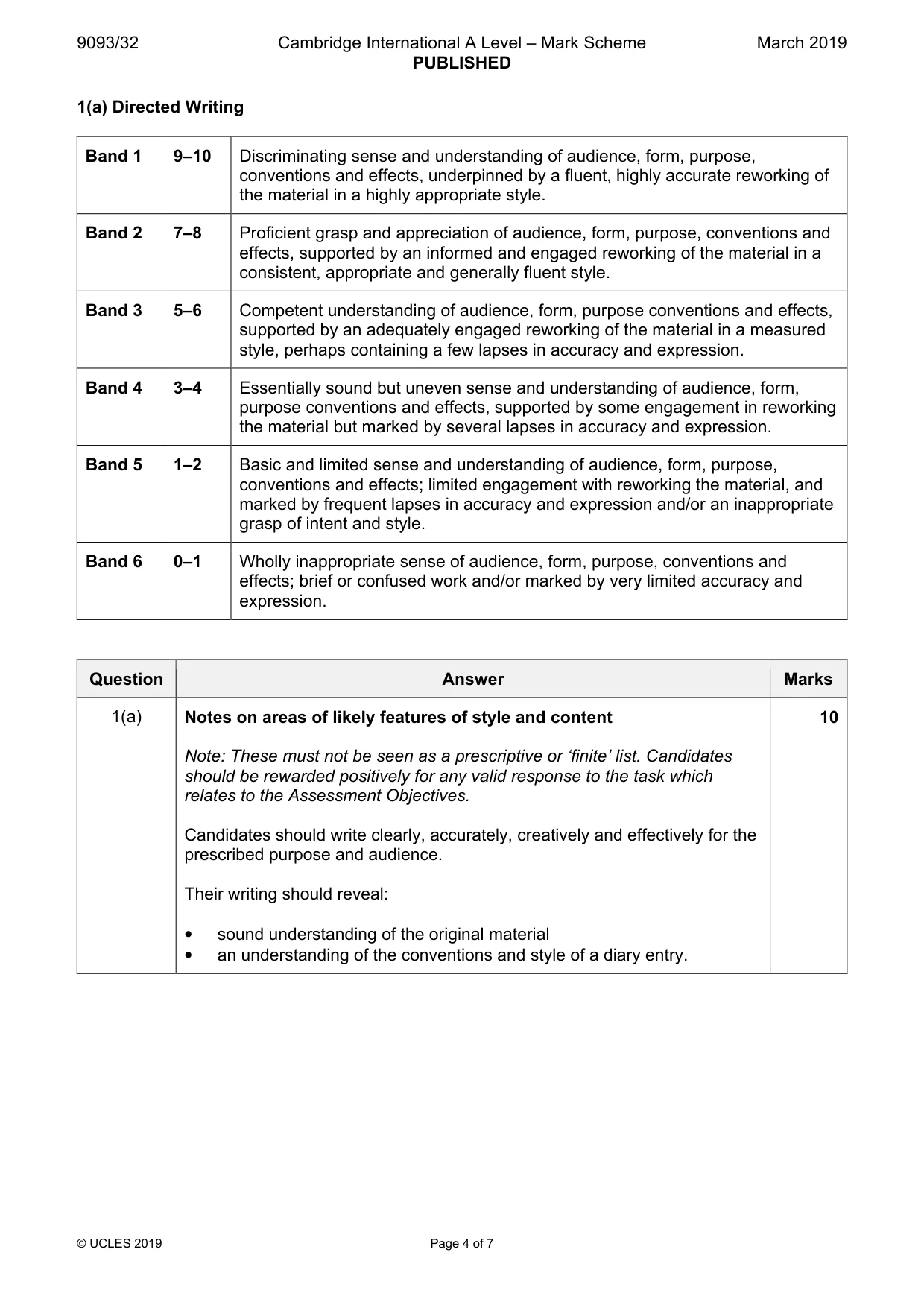
9093/32 Cambridge International A Level – Mark Scheme PUBLISHED March 2019 © UCLES 2019 Page 4 of 7 1(a) Directed Writing Band 1 9–10 Discriminating sense and understanding of audience, form, purpose, conventions and effects, underpinned by a fluent, highly accurate reworking of the material in a highly appropriate style. Band 2 7–8 Proficient grasp and appreciation of audience, form, purpose, conventions and effects, supported by an informed and engaged reworking of the material in a consistent, appropriate and generally fluent style. Band 3 5–6 Competent understanding of audience, form, purpose conventions and effects, supported by an adequately engaged reworking of the material in a measured style, perhaps containing a few lapses in accuracy and expression. Band 4 3–4 Essentially sound but uneven sense and understanding of audience, form, purpose conventions and effects, supported by some engagement in reworking the material but marked by several lapses in accuracy and expression. Band 5 1–2 Basic and limited sense and understanding of audience, form, purpose, conventions and effects; limited engagement with reworking the material, and marked by frequent lapses in accuracy and expression and/or an inappropriate grasp of intent and style. Band 6 0–1 Wholly inappropriate sense of audience, form, purpose, conventions and effects; brief or confused work and/or marked by very limited accuracy and expression. Question Answer Marks 1(a) Notes on areas of likely features of style and content Note: These must not be seen as a prescriptive or ‘finite’ list. Candidates should be rewarded positively for any valid response to the task which relates to the Assessment Objectives. Candidates should write clearly, accurately, creatively and effectively for the prescribed purpose and audience. Their writing should reveal: • sound understanding of the original material • an understanding of the conventions and style of a diary entry. 10
Mark scheme, page 5
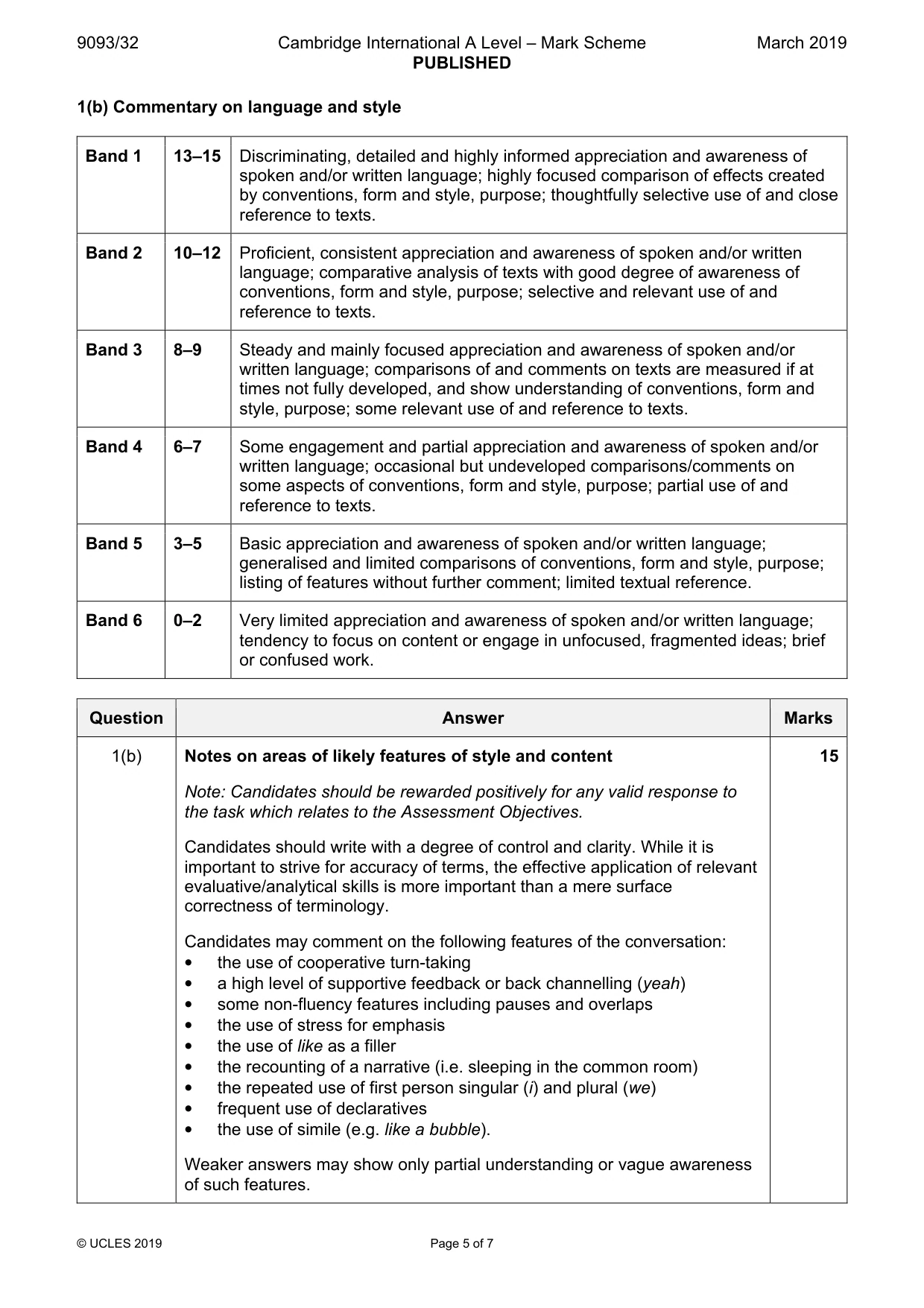
9093/32 Cambridge International A Level – Mark Scheme PUBLISHED March 2019 © UCLES 2019 Page 5 of 7 1(b) Commentary on language and style Band 1 13–15 Discriminating, detailed and highly informed appreciation and awareness of spoken and/or written language; highly focused comparison of effects created by conventions, form and style, purpose; thoughtfully selective use of and close reference to texts. Band 2 10–12 Proficient, consistent appreciation and awareness of spoken and/or written language; comparative analysis of texts with good degree of awareness of conventions, form and style, purpose; selective and relevant use of and reference to texts. Band 3 8–9 Steady and mainly focused appreciation and awareness of spoken and/or written language; comparisons of and comments on texts are measured if at times not fully developed, and show understanding of conventions, form and style, purpose; some relevant use of and reference to texts. Band 4 6–7 Some engagement and partial appreciation and awareness of spoken and/or written language; occasional but undeveloped comparisons/comments on some aspects of conventions, form and style, purpose; partial use of and reference to texts. Band 5 3–5 Basic appreciation and awareness of spoken and/or written language; generalised and limited comparisons of conventions, form and style, purpose; listing of features without further comment; limited textual reference. Band 6 0–2 Very limited appreciation and awareness of spoken and/or written language; tendency to focus on content or engage in unfocused, fragmented ideas; brief or confused work. Question Answer Marks 1(b) Notes on areas of likely features of style and content Note: Candidates should be rewarded positively for any valid response to the task which relates to the Assessment Objectives. Candidates should write with a degree of control and clarity. While it is important to strive for accuracy of terms, the effective application of relevant evaluative/analytical skills is more important than a mere surface correctness of terminology. Candidates may comment on the following features of the conversation: • the use of cooperative turn-taking • a high level of supportive feedback or back channelling (yeah) • some non-fluency features including pauses and overlaps • the use of stress for emphasis • the use of like as a filler • the recounting of a narrative (i.e. sleeping in the common room) • the repeated use of first person singular (i) and plural (we) • frequent use of declaratives • the use of simile (e.g. like a bubble). Weaker answers may show only partial understanding or vague awareness of such features. 15
Mark scheme, page 6
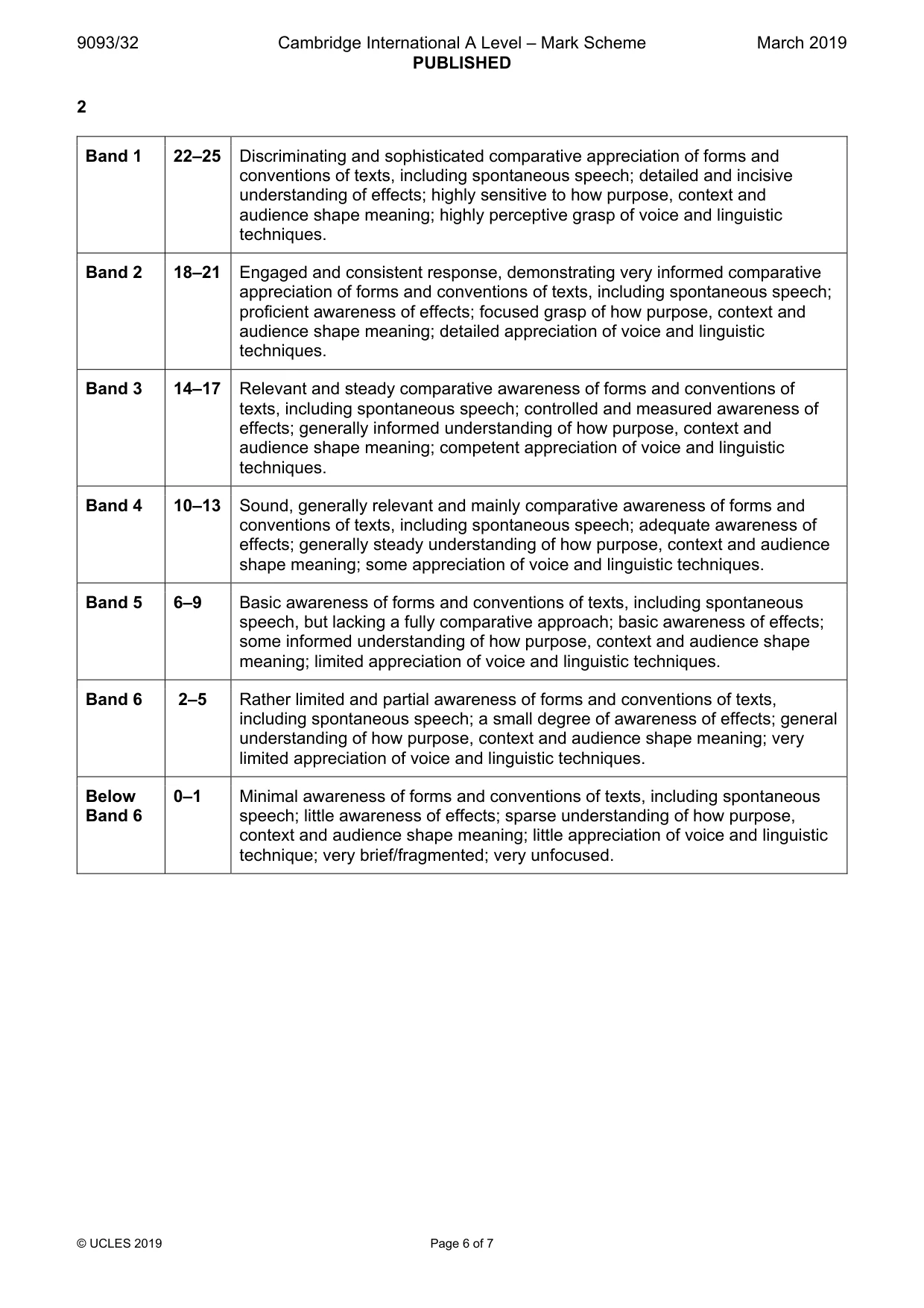
9093/32 Cambridge International A Level – Mark Scheme PUBLISHED March 2019 © UCLES 2019 Page 6 of 7 2 Band 1 22–25 Discriminating and sophisticated comparative appreciation of forms and conventions of texts, including spontaneous speech; detailed and incisive understanding of effects; highly sensitive to how purpose, context and audience shape meaning; highly perceptive grasp of voice and linguistic techniques. Band 2 18–21 Engaged and consistent response, demonstrating very informed comparative appreciation of forms and conventions of texts, including spontaneous speech; proficient awareness of effects; focused grasp of how purpose, context and audience shape meaning; detailed appreciation of voice and linguistic techniques. Band 3 14–17 Relevant and steady comparative awareness of forms and conventions of texts, including spontaneous speech; controlled and measured awareness of effects; generally informed understanding of how purpose, context and audience shape meaning; competent appreciation of voice and linguistic techniques. Band 4 10–13 Sound, generally relevant and mainly comparative awareness of forms and conventions of texts, including spontaneous speech; adequate awareness of effects; generally steady understanding of how purpose, context and audience shape meaning; some appreciation of voice and linguistic techniques. Band 5 6–9 Basic awareness of forms and conventions of texts, including spontaneous speech, but lacking a fully comparative approach; basic awareness of effects; some informed understanding of how purpose, context and audience shape meaning; limited appreciation of voice and linguistic techniques. Band 6 2–5 Rather limited and partial awareness of forms and conventions of texts, including spontaneous speech; a small degree of awareness of effects; general understanding of how purpose, context and audience shape meaning; very limited appreciation of voice and linguistic techniques. Below Band 6 0–1 Minimal awareness of forms and conventions of texts, including spontaneous speech; little awareness of effects; sparse understanding of how purpose, context and audience shape meaning; little appreciation of voice and linguistic technique; very brief/fragmented; very unfocused.
Mark scheme, page 7
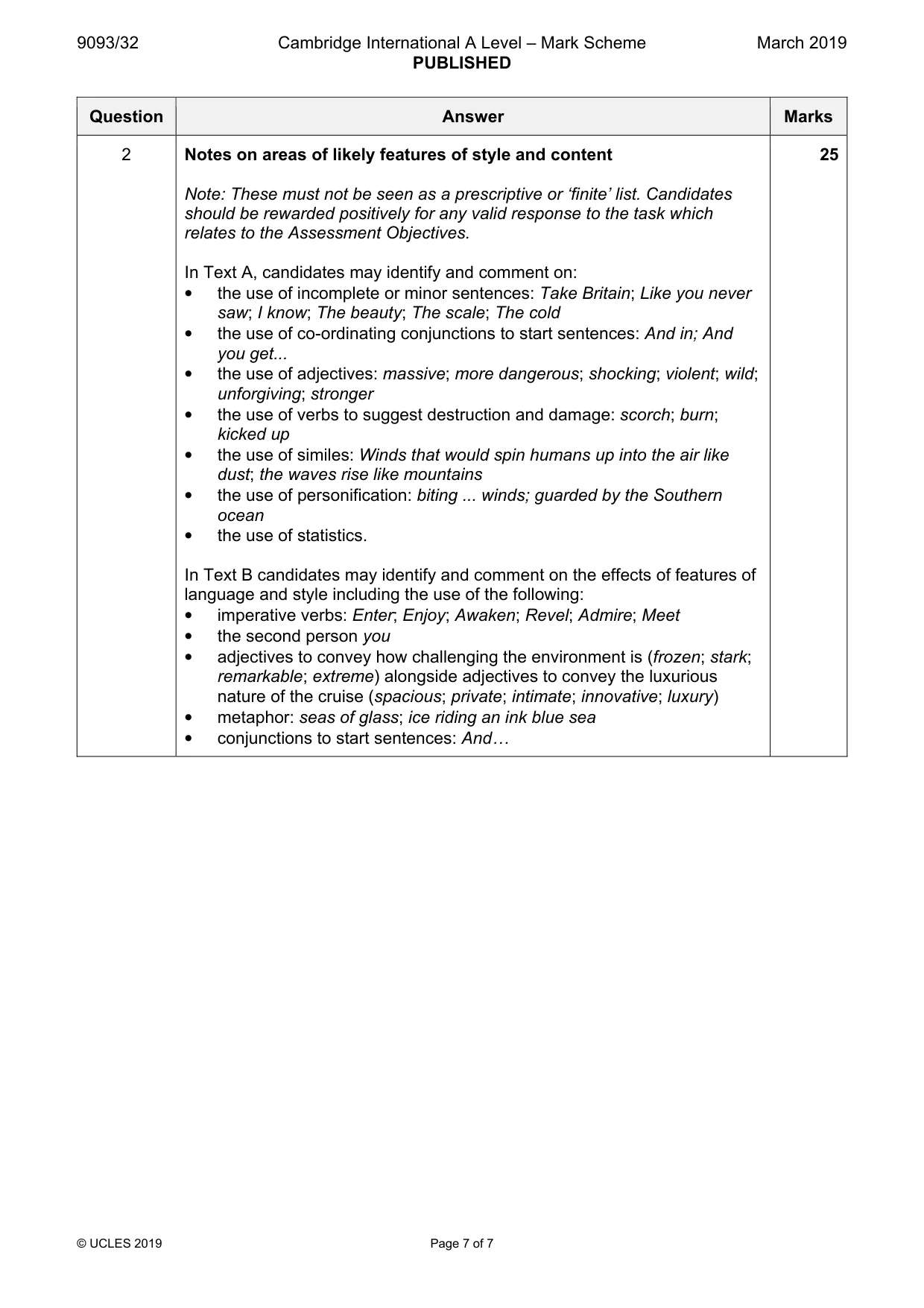
9093/32 Cambridge International A Level – Mark Scheme PUBLISHED March 2019 © UCLES 2019 Page 7 of 7 Question Answer Marks 2 Notes on areas of likely features of style and content Note: These must not be seen as a prescriptive or ‘finite’ list. Candidates should be rewarded positively for any valid response to the task which relates to the Assessment Objectives. In Text A, candidates may identify and comment on: • the use of incomplete or minor sentences: Take Britain; Like you never saw; I know; The beauty; The scale; The cold • the use of co-ordinating conjunctions to start sentences: And in; And you get... • the use of adjectives: massive; more dangerous; shocking; violent; wild; unforgiving; stronger • the use of verbs to suggest destruction and damage: scorch; burn; kicked up • the use of similes: Winds that would spin humans up into the air like dust; the waves rise like mountains • the use of personification: biting ... winds; guarded by the Southern ocean • the use of statistics. In Text B candidates may identify and comment on the effects of features of language and style including the use of the following: • imperative verbs: Enter; Enjoy; Awaken; Revel; Admire; Meet • the second person you • adjectives to convey how challenging the environment is (frozen; stark; remarkable; extreme) alongside adjectives to convey the luxurious nature of the cruise (spacious; private; intimate; innovative; luxury) • metaphor: seas of glass; ice riding an ink blue sea • conjunctions to start sentences: And« 25
What you needed in this session
Cambridge’s own grade thresholds for 2019 Feb/March, Paper 3 · Variant 2. A higher threshold means an easier paper — the bar moves with how the cohort did.