Cambridge A Level English - Language AS and A Level (from 2014) 9093 — 2018 Oct/Nov Paper 1 · Variant 3
9093/13/O/N/18 · 50 marks · ≈56 min
The question paper and its mark scheme, free to read here and free to download. This is Cambridge’s own paper, exactly as it was sat.
Question paper8 pages
Mark scheme5 pages
Answers below. Sit the paper first if you are practising.
Paper as text
Question paper, page 1
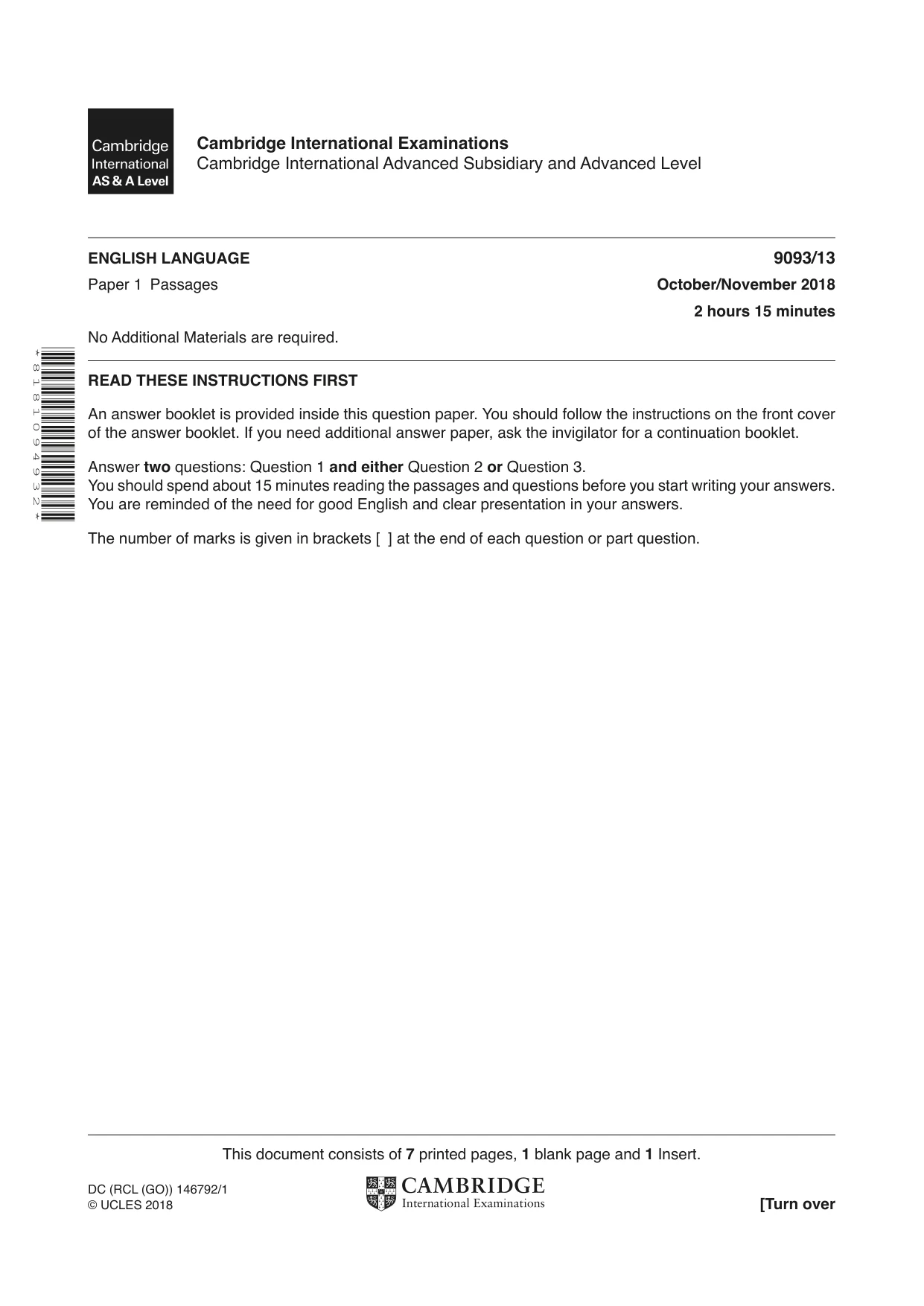
This document consists of 7 printed pages, 1 blank page and 1 Insert. DC (RCL (GO)) 146792/1 © UCLES 2018 [Turn over Cambridge International Examinations Cambridge International Advanced Subsidiary and Advanced Level * 8 1 8 1 0 9 4 9 3 2 * ENGLISH LANGUAGE 9093/13 Paper 1 Passages October/November 2018 2 hours 15 minutes No Additional Materials are required. READ THESE INSTRUCTIONS FIRST An answer booklet is provided inside this question paper. You should follow the instructions on the front cover of the answer booklet. If you need additional answer paper, ask the invigilator for a continuation booklet. Answer two questions: Question 1 and either Question 2 or Question 3. You should spend about 15 minutes reading the passages and questions before you start writing your answers. You are reminded of the need for good English and clear presentation in your answers. The number of marks is given in brackets [ ] at the end of each question or part question.
Question paper, page 2
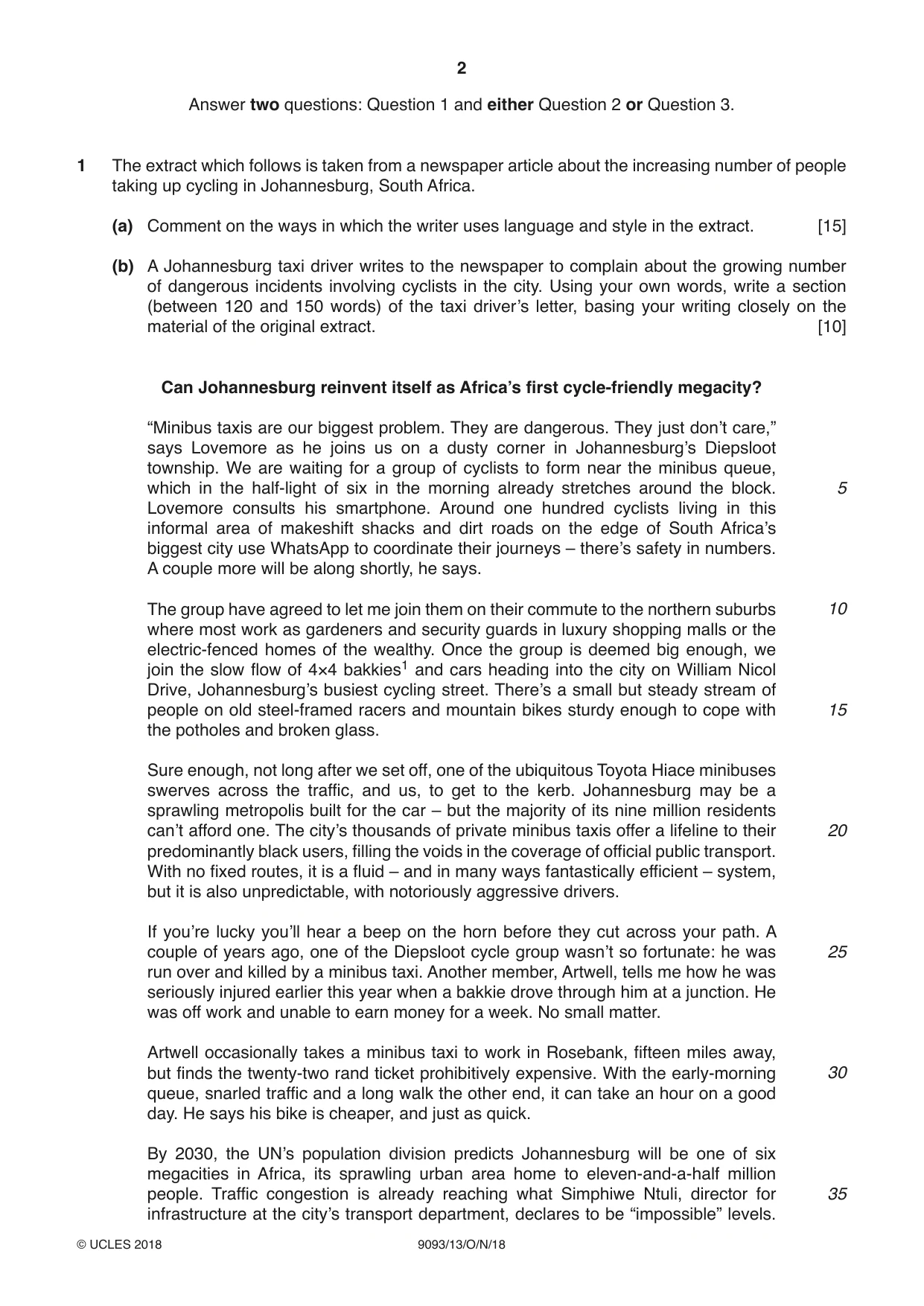
2 9093/13/O/N/18 © UCLES 2018 Answer two questions: Question 1 and either Question 2 or Question 3. 1 The extract which follows is taken from a newspaper article about the increasing number of people taking up cycling in Johannesburg, South Africa. (a) Comment on the ways in which the writer uses language and style in the extract. [15] (b) A Johannesburg taxi driver writes to the newspaper to complain about the growing number of dangerous incidents involving cyclists in the city. Using your own words, write a section (between 120 and 150 words) of the taxi driver’s letter, basing your writing closely on the material of the original extract. [10] Can Johannesburg reinvent itself as Africa’s first cycle-friendly megacity? “Minibus taxis are our biggest problem. They are dangerous. They just don’t care,” says Lovemore as he joins us on a dusty corner in Johannesburg’s Diepsloot township. We are waiting for a group of cyclists to form near the minibus queue, which in the half-light of six in the morning already stretches around the block. Lovemore consults his smartphone. Around one hundred cyclists living in this informal area of makeshift shacks and dirt roads on the edge of South Africa’s biggest city use WhatsApp to coordinate their journeys – there’s safety in numbers. A couple more will be along shortly, he says. The group have agreed to let me join them on their commute to the northern suburbs where most work as gardeners and security guards in luxury shopping malls or the electric-fenced homes of the wealthy. Once the group is deemed big enough, we join the slow flow of 4×4 bakkies1 and cars heading into the city on William Nicol Drive, Johannesburg’s busiest cycling street. There’s a small but steady stream of people on old steel-framed racers and mountain bikes sturdy enough to cope with the potholes and broken glass. Sure enough, not long after we set off, one of the ubiquitous Toyota Hiace minibuses swerves across the traffic, and us, to get to the kerb. Johannesburg may be a sprawling metropolis built for the car – but the majority of its nine million residents can’t afford one. The city’s thousands of private minibus taxis offer a lifeline to their predominantly black users, filling the voids in the coverage of official public transport. With no fixed routes, it is a fluid – and in many ways fantastically efficient – system, but it is also unpredictable, with notoriously aggressive drivers. If you’re lucky you’ll hear a beep on the horn before they cut across your path. A couple of years ago, one of the Diepsloot cycle group wasn’t so fortunate: he was run over and killed by a minibus taxi. Another member, Artwell, tells me how he was seriously injured earlier this year when a bakkie drove through him at a junction. He was off work and unable to earn money for a week. No small matter. Artwell occasionally takes a minibus taxi to work in Rosebank, fifteen miles away, but finds the twenty-two rand ticket prohibitively expensive. With the early-morning queue, snarled traffic and a long walk the other end, it can take an hour on a good day. He says his bike is cheaper, and just as quick. By 2030, the UN’s population division predicts Johannesburg will be one of six megacities in Africa, its sprawling urban area home to eleven-and-a-half million people. Traffic congestion is already reaching what Simphiwe Ntuli, director for infrastructure at the city’s transport department, declares to be “impossible” levels. 5 10 15 20 25 30 35
Question paper, page 3
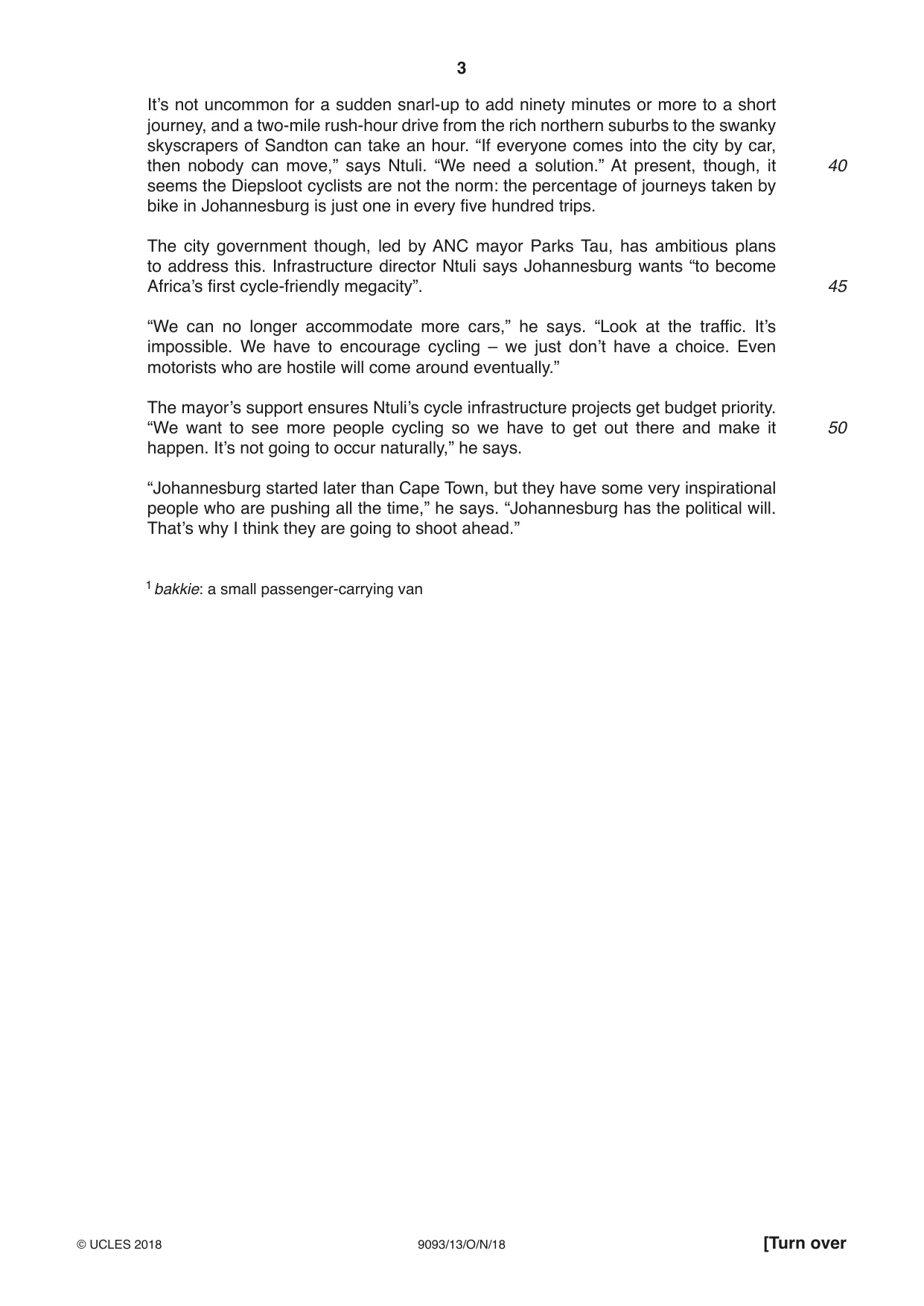
3 9093/13/O/N/18 © UCLES 2018 [Turn over It’s not uncommon for a sudden snarl-up to add ninety minutes or more to a short journey, and a two-mile rush-hour drive from the rich northern suburbs to the swanky skyscrapers of Sandton can take an hour. “If everyone comes into the city by car, then nobody can move,” says Ntuli. “We need a solution.” At present, though, it seems the Diepsloot cyclists are not the norm: the percentage of journeys taken by bike in Johannesburg is just one in every five hundred trips. The city government though, led by ANC mayor Parks Tau, has ambitious plans to address this. Infrastructure director Ntuli says Johannesburg wants “to become Africa’s first cycle-friendly megacity”. “We can no longer accommodate more cars,” he says. “Look at the traffic. It’s impossible. We have to encourage cycling – we just don’t have a choice. Even motorists who are hostile will come around eventually.” The mayor’s support ensures Ntuli’s cycle infrastructure projects get budget priority. “We want to see more people cycling so we have to get out there and make it happen. It’s not going to occur naturally,” he says. “Johannesburg started later than Cape Town, but they have some very inspirational people who are pushing all the time,” he says. “Johannesburg has the political will. That’s why I think they are going to shoot ahead.” 1 bakkie: a small passenger-carrying van 40 45 50
Question paper, page 4
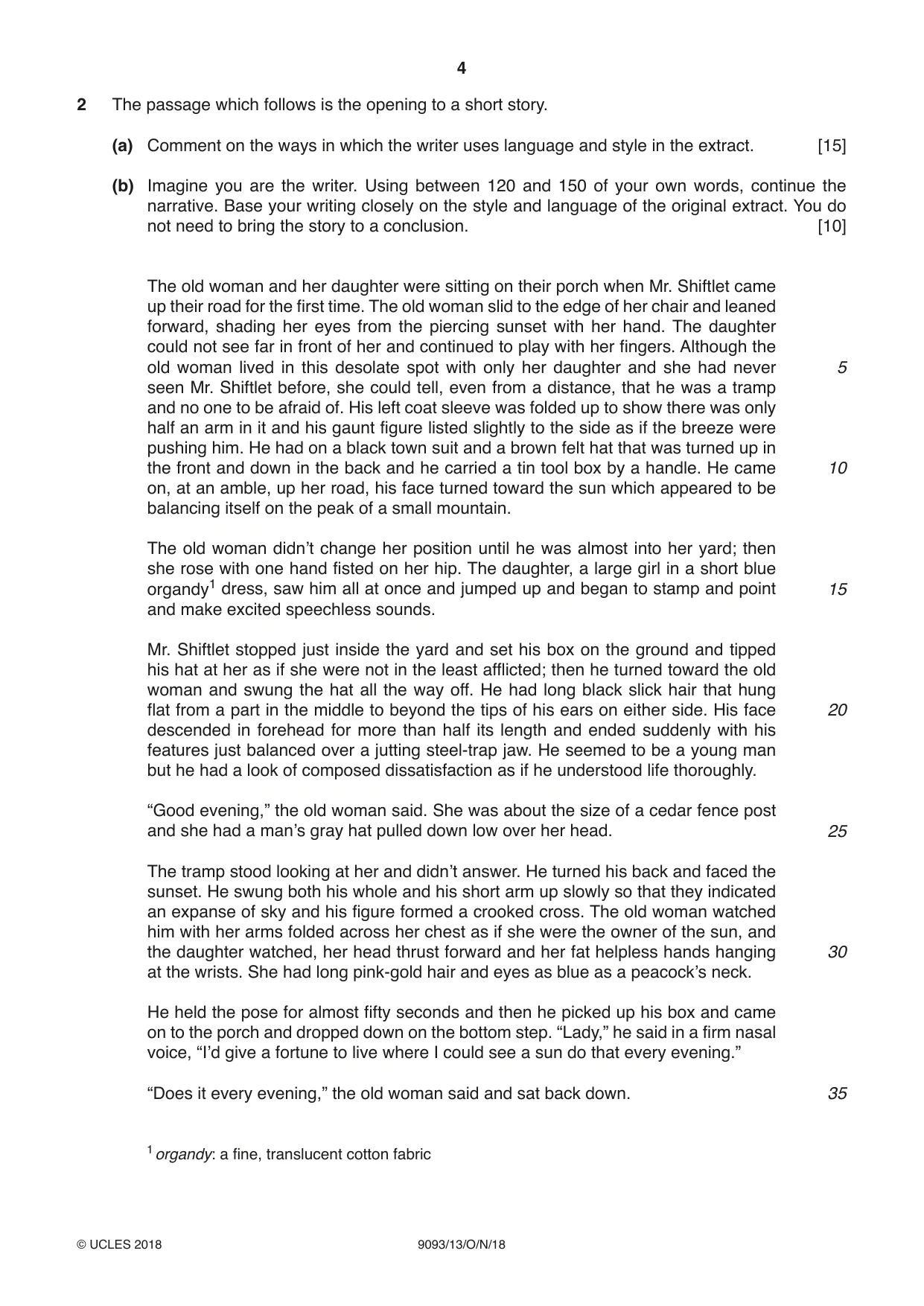
4 9093/13/O/N/18 © UCLES 2018 2 The passage which follows is the opening to a short story. (a) Comment on the ways in which the writer uses language and style in the extract. [15] (b) Imagine you are the writer. Using between 120 and 150 of your own words, continue the narrative. Base your writing closely on the style and language of the original extract. You do not need to bring the story to a conclusion. [10] The old woman and her daughter were sitting on their porch when Mr. Shiftlet came up their road for the first time. The old woman slid to the edge of her chair and leaned forward, shading her eyes from the piercing sunset with her hand. The daughter could not see far in front of her and continued to play with her fingers. Although the old woman lived in this desolate spot with only her daughter and she had never seen Mr. Shiftlet before, she could tell, even from a distance, that he was a tramp and no one to be afraid of. His left coat sleeve was folded up to show there was only half an arm in it and his gaunt figure listed slightly to the side as if the breeze were pushing him. He had on a black town suit and a brown felt hat that was turned up in the front and down in the back and he carried a tin tool box by a handle. He came on, at an amble, up her road, his face turned toward the sun which appeared to be balancing itself on the peak of a small mountain. The old woman didn’t change her position until he was almost into her yard; then she rose with one hand fisted on her hip. The daughter, a large girl in a short blue organdy1 dress, saw him all at once and jumped up and began to stamp and point and make excited speechless sounds. Mr. Shiftlet stopped just inside the yard and set his box on the ground and tipped his hat at her as if she were not in the least afflicted; then he turned toward the old woman and swung the hat all the way off. He had long black slick hair that hung flat from a part in the middle to beyond the tips of his ears on either side. His face descended in forehead for more than half its length and ended suddenly with his features just balanced over a jutting steel-trap jaw. He seemed to be a young man but he had a look of composed dissatisfaction as if he understood life thoroughly. “Good evening,” the old woman said. She was about the size of a cedar fence post and she had a man’s gray hat pulled down low over her head. The tramp stood looking at her and didn’t answer. He turned his back and faced the sunset. He swung both his whole and his short arm up slowly so that they indicated an expanse of sky and his figure formed a crooked cross. The old woman watched him with her arms folded across her chest as if she were the owner of the sun, and the daughter watched, her head thrust forward and her fat helpless hands hanging at the wrists. She had long pink-gold hair and eyes as blue as a peacock’s neck. He held the pose for almost fifty seconds and then he picked up his box and came on to the porch and dropped down on the bottom step. “Lady,” he said in a firm nasal voice, “I’d give a fortune to live where I could see a sun do that every evening.” “Does it every evening,” the old woman said and sat back down. 1 organdy: a fine, translucent cotton fabric 5 10 15 20 25 30 35
Question paper, page 5
5 9093/13/O/N/18 © UCLES 2018 [Turn over Turn over for Question 3.
Question paper, page 6
6 9093/13/O/N/18 © UCLES 2018 3 The following text is an extract from a piece of travel writing about Patagonia, a region at the southern end of South America. (a) Comment on the ways in which language and style are used to convey the writer’s reflections on his surroundings. [15] (b) A specialist travel brochure runs a feature advertisement about Patagonia. Basing your writing closely on the material of the original passage and using your own words, write a section (between 120 and 150 words) of the advertisement. [10] As he fished out his door key, I asked him about Patagonia. ‘I have been there,’ he said. ‘But I don’t know it well. I’ll tell you this, though. It’s a dreary place. A very dreary place.’ ‘I was planning to take the train tomorrow.’ ‘Don’t go tomorrow. Come and see me. I like your reading.’ ‘I suppose I can go to Patagonia next week.’ ‘It’s dreary,’ said Borges. He had got the door open, and now he shuffled to the elevator and pulled open the metal gates. ‘The gate of the hundred sorrows,’ he said, and entered chuckling. In Patagonia It had been my intention to arrive in Esquel on Holy Saturday and to wake on Easter Sunday and watch the sunrise. But Easter had passed. This was no special date, and I had overslept. I got up and went outside. It was a sunny breezy day—the sort of weather that occurs every day of the year in that part of Patagonia. I walked to the station. The engine that had taken me to Esquel looked derelict on the siding, as if it would never run again. But it had a hundred more years in it, I was sure. I walked beyond it, past the one-storey houses to the one-roomed huts, to where the road turned into a dusty track. There was a rocky slope, some sheep, the rest bushes and weeds. If you looked closely you could see small pink and yellow flowers on these bushes. The wind stirred them. I went closer. They shook. But they were pretty. Behind my head was a great desert. The Patagonian paradox was this: to be here, it helped to be a miniaturist, or else interested in enormous empty spaces. There was no intermediate zone of study. Either the enormity of the desert space, or the sight of a tiny flower. You had to choose between the tiny or the vast. The paradox diverted me. My arrival did not matter. It was the journey that counted. The sheep saw me. The younger ones kicked their heels. When I looked again, they were gone, and I was an ant on a foreign ant-hill. It was impossible to verify the size of anything in this space. There was no path through the bushes, but I could look over them, over this ocean of thorns which looked so mild at a distance, so cruel near by, so like misshapen nosegays1 close-up. It was perfectly quiet and odourless. I knew I was nowhere, but the most surprising thing of all was that I was still in the 5 10 15 20 25 30
Question paper, page 7
7 9093/13/O/N/18 © UCLES 2018 world after all this time, on a dot at the lower part of the map. The landscape had a gaunt expression, but I could not deny that it had readable features and that I existed in it. This was a discovery—the look of it. I thought: Nowhere is a place. Down there the Patagonian valley deepened to grey rock. Ahead, there was a succession of hills, whittled and fissured by the wind, which now sang in the bushes. The bushes shook with this song. They stiffened again and were silent. The sky was clear blue. A puff of cloud, white as a quinceflower, carried a small shadow from town, or from the South Pole. I saw it approach. It rippled across the bushes and passed over me, a brief chill, and then sloped off to the east. There were no voices here. There was this, what I saw; and, though beyond it were mountains and glaciers and albatrosses and Indians, there was nothing here to speak of, nothing here to delay me further. Only the Patagonian paradox: the vast space, the very tiny blossoms of the sage-bush’s cousin. The nothingness itself, a beginning for some intrepid traveller, was an ending for me. I had arrived in Patagonia, and I laughed when I remembered I had come here from Boston, on the subway train that people took to work. 1 nosegays: small bunches of flowers 35 40 45
Question paper, page 8
8 9093/13/O/N/18 © UCLES 2018 Permission to reproduce items where third-party owned material protected by copyright is included has been sought and cleared where possible. Every reasonable effort has been made by the publisher (UCLES) to trace copyright holders, but if any items requiring clearance have unwittingly been included, the publisher will be pleased to make amends at the earliest possible opportunity. To avoid the issue of disclosure of answer-related information to candidates, all copyright acknowledgements are reproduced online in the Cambridge International Examinations Copyright Acknowledgements Booklet. This is produced for each series of examinations and is freely available to download at www.cie.org.uk after the live examination series. Cambridge International Examinations is part of the Cambridge Assessment Group. Cambridge Assessment is the brand name of University of Cambridge Local Examinations Syndicate (UCLES), which is itself a department of the University of Cambridge. BLANK PAGE
Mark scheme, page 1
This document consists of 5 printed pages. © UCLES 2018 [Turn over Cambridge Assessment International Education Cambridge International Advanced Subsidiary and Advanced Level ENGLISH LANGUAGE 9093/13 Paper 1 Passages October/November 2018 MARK SCHEME Maximum Mark: 50 Published This mark scheme is published as an aid to teachers and candidates, to indicate the requirements of the examination. It shows the basis on which Examiners were instructed to award marks. It does not indicate the details of the discussions that took place at an Examiners’ meeting before marking began, which would have considered the acceptability of alternative answers. Mark schemes should be read in conjunction with the question paper and the Principal Examiner Report for Teachers. Cambridge International will not enter into discussions about these mark schemes. Cambridge International is publishing the mark schemes for the October/November 2018 series for most Cambridge IGCSE™, Cambridge International A and AS Level components and some Cambridge O Level components.
Mark scheme, page 2
9093/13 Cambridge International AS/A Level – Mark Scheme PUBLISHED October/November 2018 © UCLES 2018 Page 2 of 5 Generic Marking Principles These general marking principles must be applied by all examiners when marking candidate answers. They should be applied alongside the specific content of the mark scheme or generic level descriptors for a question. Each question paper and mark scheme will also comply with these marking principles. GENERIC MARKING PRINCIPLE 1: Marks must be awarded in line with: • the specific content of the mark scheme or the generic level descriptors for the question • the specific skills defined in the mark scheme or in the generic level descriptors for the question • the standard of response required by a candidate as exemplified by the standardisation scripts. GENERIC MARKING PRINCIPLE 2: Marks awarded are always whole marks (not half marks, or other fractions). GENERIC MARKING PRINCIPLE 3: Marks must be awarded positively: • marks are awarded for correct/valid answers, as defined in the mark scheme. However, credit is given for valid answers which go beyond the scope of the syllabus and mark scheme, referring to your Team Leader as appropriate • marks are awarded when candidates clearly demonstrate what they know and can do • marks are not deducted for errors • marks are not deducted for omissions • answers should only be judged on the quality of spelling, punctuation and grammar when these features are specifically assessed by the question as indicated by the mark scheme. The meaning, however, should be unambiguous. GENERIC MARKING PRINCIPLE 4: Rules must be applied consistently e.g. in situations where candidates have not followed instructions or in the application of generic level descriptors. GENERIC MARKING PRINCIPLE 5: Marks should be awarded using the full range of marks defined in the mark scheme for the question (however; the use of the full mark range may be limited according to the quality of the candidate responses seen). GENERIC MARKING PRINCIPLE 6: Marks awarded are based solely on the requirements as defined in the mark scheme. Marks should not be awarded with grade thresholds or grade descriptors in mind.
Mark scheme, page 3
9093/13 Cambridge International AS/A Level – Mark Scheme PUBLISHED October/November 2018 © UCLES 2018 Page 3 of 5 Assessment Objectives: • Ability to read with understanding written material in a variety of forms, and to comment on its effectiveness. • Knowledge and understanding of features of English language. • Ability to write clearly, accurately and effectively for a particular purpose or audience. Each answer is marked out of a total of 25. • 15 marks are available for part (a) – commentary on use of language in the passage. • 10 marks are available for part (b) – directed writing task based on the passage. Each part is marked in accordance with the following general marking criteria.
Mark scheme, page 4
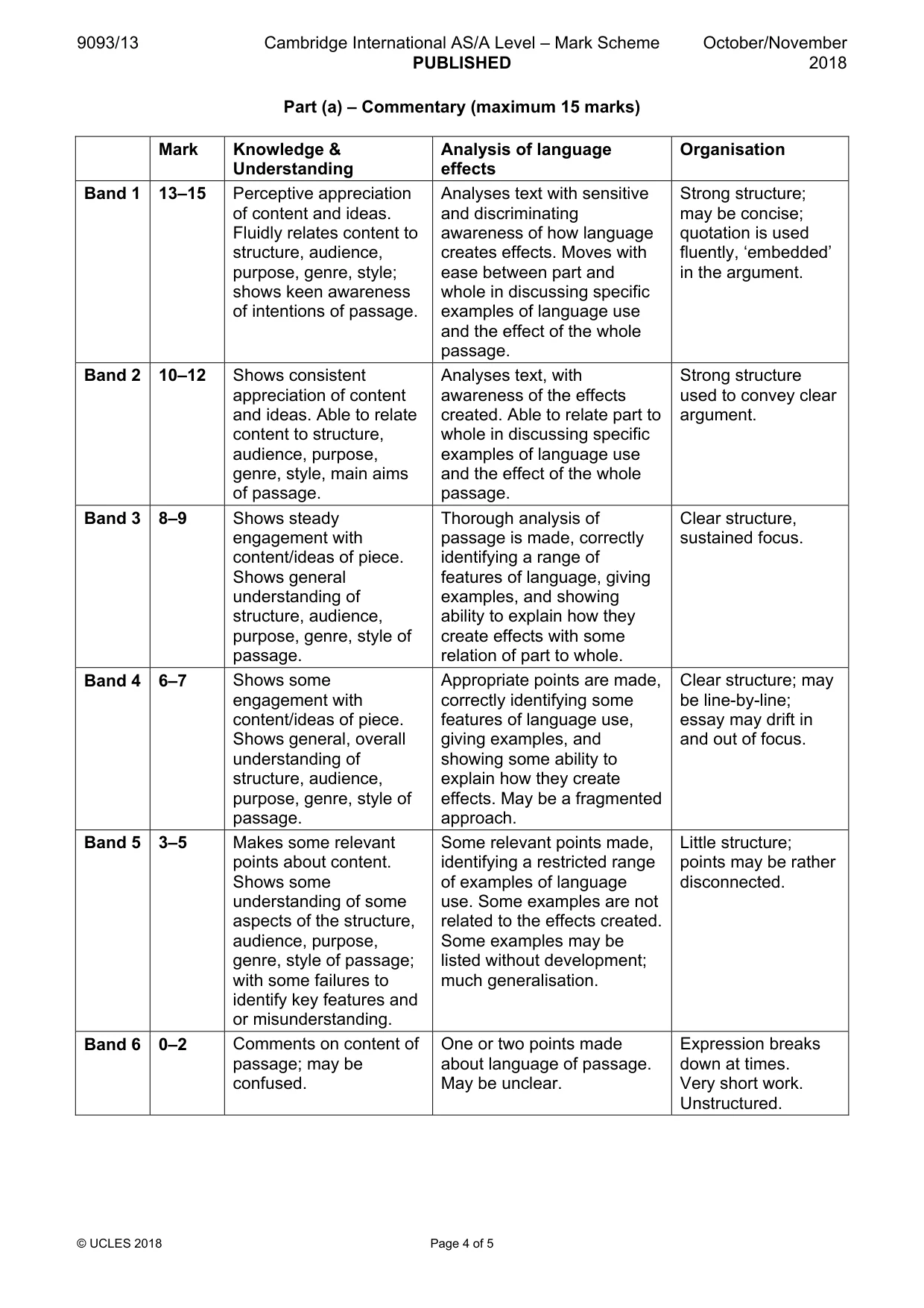
9093/13 Cambridge International AS/A Level – Mark Scheme PUBLISHED October/November 2018 © UCLES 2018 Page 4 of 5 Part (a) – Commentary (maximum 15 marks) Mark Knowledge & Understanding Analysis of language effects Organisation Band 1 13–15 Perceptive appreciation of content and ideas. Fluidly relates content to structure, audience, purpose, genre, style; shows keen awareness of intentions of passage. Analyses text with sensitive and discriminating awareness of how language creates effects. Moves with ease between part and whole in discussing specific examples of language use and the effect of the whole passage. Strong structure; may be concise; quotation is used fluently, ‘embedded’ in the argument. Band 2 10–12 Shows consistent appreciation of content and ideas. Able to relate content to structure, audience, purpose, genre, style, main aims of passage. Analyses text, with awareness of the effects created. Able to relate part to whole in discussing specific examples of language use and the effect of the whole passage. Strong structure used to convey clear argument. Band 3 8–9 Shows steady engagement with content/ideas of piece. Shows general understanding of structure, audience, purpose, genre, style of passage. Thorough analysis of passage is made, correctly identifying a range of features of language, giving examples, and showing ability to explain how they create effects with some relation of part to whole. Clear structure, sustained focus. Band 4 6–7 Shows some engagement with content/ideas of piece. Shows general, overall understanding of structure, audience, purpose, genre, style of passage. Appropriate points are made, correctly identifying some features of language use, giving examples, and showing some ability to explain how they create effects. May be a fragmented approach. Clear structure; may be line-by-line; essay may drift in and out of focus. Band 5 3–5 Makes some relevant points about content. Shows some understanding of some aspects of the structure, audience, purpose, genre, style of passage; with some failures to identify key features and or misunderstanding. Some relevant points made, identifying a restricted range of examples of language use. Some examples are not related to the effects created. Some examples may be listed without development; much generalisation. Little structure; points may be rather disconnected. Band 6 0–2 Comments on content of passage; may be confused. One or two points made about language of passage. May be unclear. Expression breaks down at times. Very short work. Unstructured.
Mark scheme, page 5
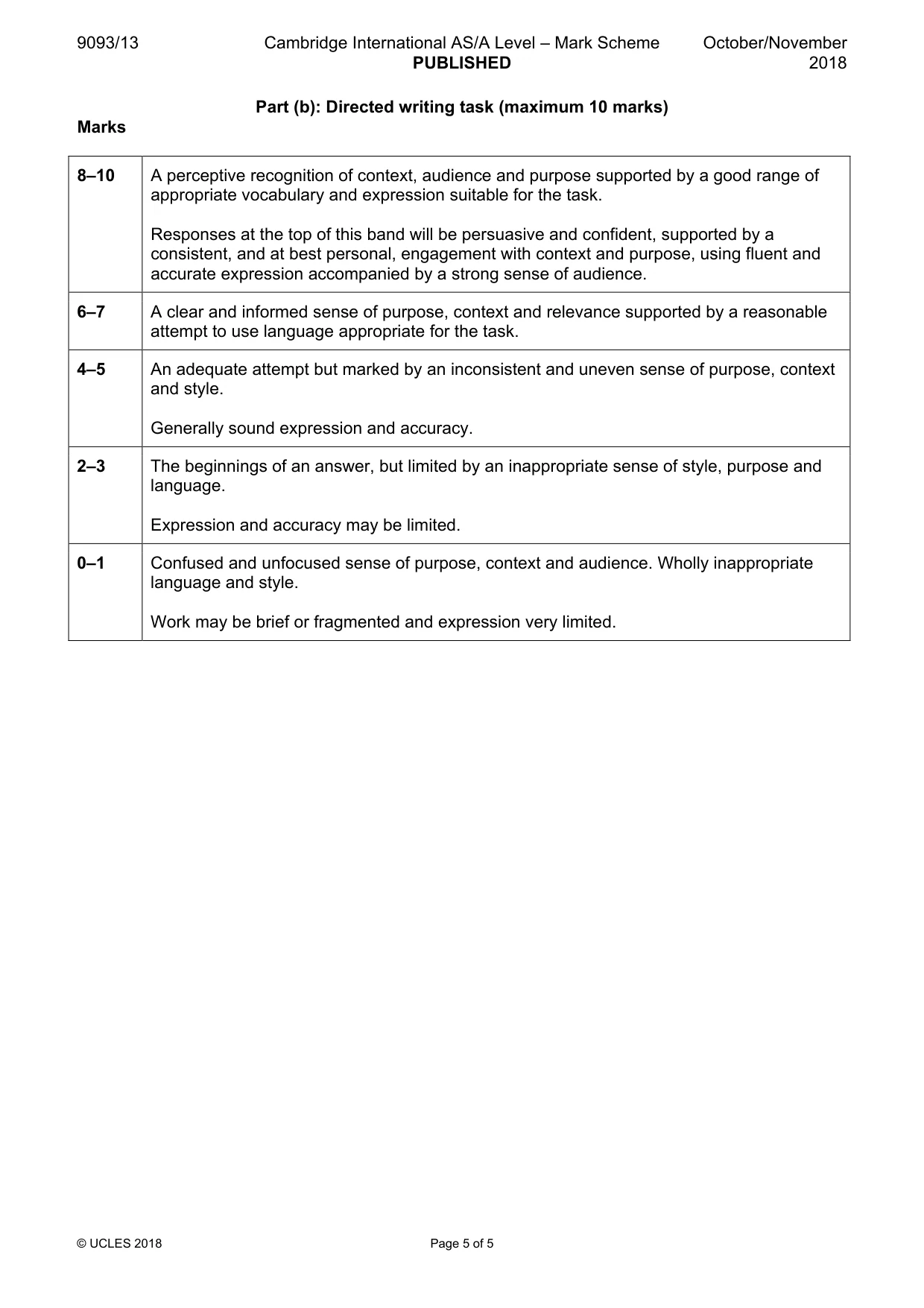
9093/13 Cambridge International AS/A Level – Mark Scheme PUBLISHED October/November 2018 © UCLES 2018 Page 5 of 5 Part (b): Directed writing task (maximum 10 marks) Marks 8–10 A perceptive recognition of context, audience and purpose supported by a good range of appropriate vocabulary and expression suitable for the task. Responses at the top of this band will be persuasive and confident, supported by a consistent, and at best personal, engagement with context and purpose, using fluent and accurate expression accompanied by a strong sense of audience. 6–7 A clear and informed sense of purpose, context and relevance supported by a reasonable attempt to use language appropriate for the task. 4–5 An adequate attempt but marked by an inconsistent and uneven sense of purpose, context and style. Generally sound expression and accuracy. 2–3 The beginnings of an answer, but limited by an inappropriate sense of style, purpose and language. Expression and accuracy may be limited. 0–1 Confused and unfocused sense of purpose, context and audience. Wholly inappropriate language and style. Work may be brief or fragmented and expression very limited.
What you needed in this session
Cambridge’s own grade thresholds for 2018 Oct/Nov, Paper 1 · Variant 3. A higher threshold means an easier paper — the bar moves with how the cohort did.