Cambridge A Level English - Language AS and A Level (from 2014) 9093 — 2018 Oct/Nov Paper 1 · Variant 1
9093/11/O/N/18 · 50 marks · ≈56 min
The question paper and its mark scheme, free to read here and free to download. This is Cambridge’s own paper, exactly as it was sat.
Question paper8 pages

Mark scheme5 pages
Answers below. Sit the paper first if you are practising.
Paper as text
Question paper, page 1
This document consists of 6 printed pages, 2 blank pages and 1 Insert. DC (RCL (GO)) 146813/3 © UCLES 2018 [Turn over Cambridge International Examinations Cambridge International Advanced Subsidiary and Advanced Level * 9 6 4 8 4 4 7 8 6 1 * ENGLISH LANGUAGE 9093/11 Paper 1 Passages October/November 2018 2 hours 15 minutes No Additional Materials are required. READ THESE INSTRUCTIONS FIRST An answer booklet is provided inside this question paper. You should follow the instructions on the front cover of the answer booklet. If you need additional answer paper, ask the invigilator for a continuation booklet. Answer two questions: Question 1 and either Question 2 or Question 3. You should spend about 15 minutes reading the passages and questions before you start writing your answers. You are reminded of the need for good English and clear presentation in your answers. The number of marks is given in brackets [ ] at the end of each question or part question.
Question paper, page 2
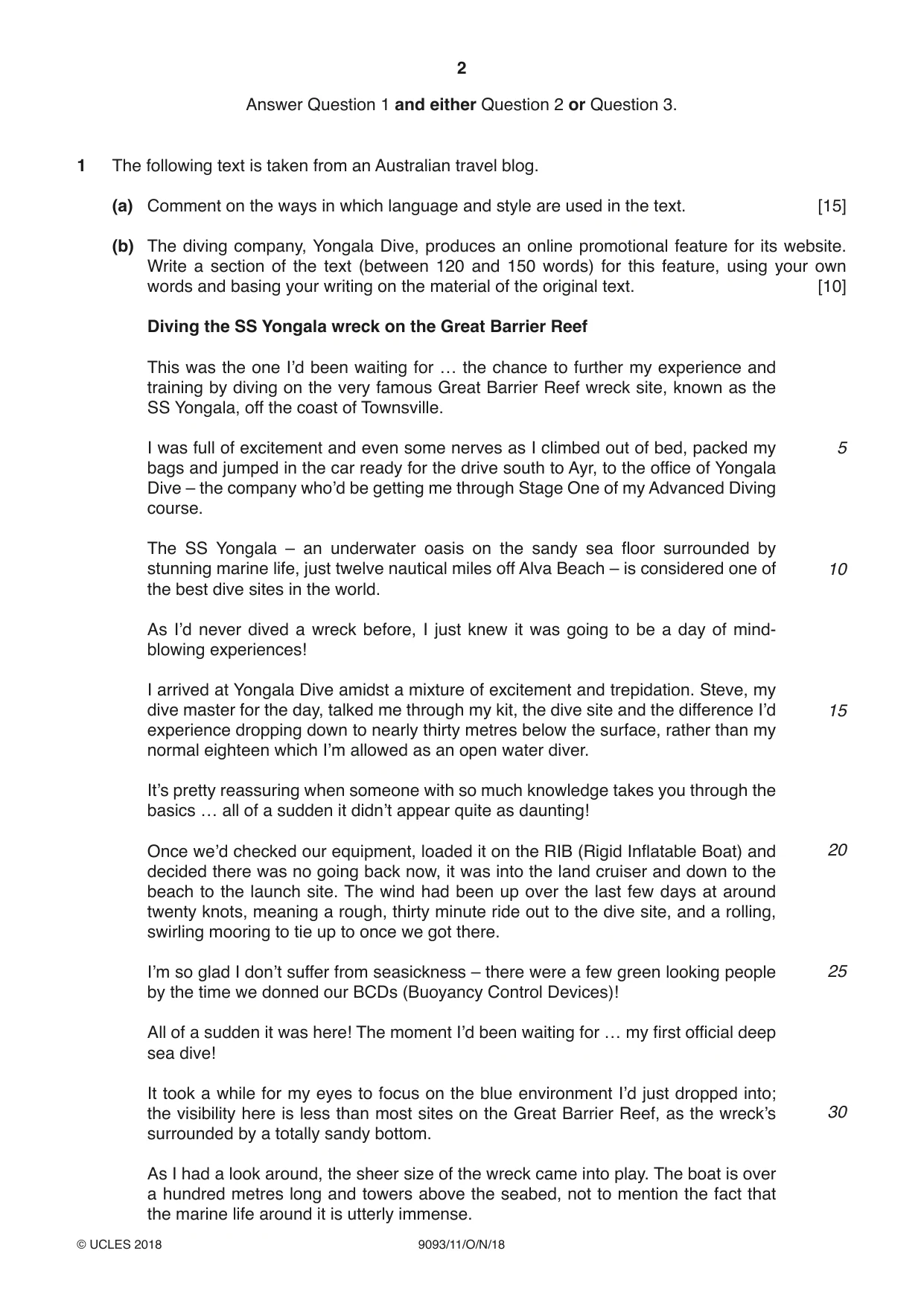
2 9093/11/O/N/18 © UCLES 2018 Answer Question 1 and either Question 2 or Question 3. 1 The following text is taken from an Australian travel blog. (a) Comment on the ways in which language and style are used in the text. [15] (b) The diving company, Yongala Dive, produces an online promotional feature for its website. Write a section of the text (between 120 and 150 words) for this feature, using your own words and basing your writing on the material of the original text. [10] Diving the SS Yongala wreck on the Great Barrier Reef This was the one I’d been waiting for … the chance to further my experience and training by diving on the very famous Great Barrier Reef wreck site, known as the SS Yongala, off the coast of Townsville. I was full of excitement and even some nerves as I climbed out of bed, packed my bags and jumped in the car ready for the drive south to Ayr, to the office of Yongala Dive – the company who’d be getting me through Stage One of my Advanced Diving course. The SS Yongala – an underwater oasis on the sandy sea floor surrounded by stunning marine life, just twelve nautical miles off Alva Beach – is considered one of the best dive sites in the world. As I’d never dived a wreck before, I just knew it was going to be a day of mind- blowing experiences! I arrived at Yongala Dive amidst a mixture of excitement and trepidation. Steve, my dive master for the day, talked me through my kit, the dive site and the difference I’d experience dropping down to nearly thirty metres below the surface, rather than my normal eighteen which I’m allowed as an open water diver. It’s pretty reassuring when someone with so much knowledge takes you through the basics … all of a sudden it didn’t appear quite as daunting! Once we’d checked our equipment, loaded it on the RIB (Rigid Inflatable Boat) and decided there was no going back now, it was into the land cruiser and down to the beach to the launch site. The wind had been up over the last few days at around twenty knots, meaning a rough, thirty minute ride out to the dive site, and a rolling, swirling mooring to tie up to once we got there. I’m so glad I don’t suffer from seasickness – there were a few green looking people by the time we donned our BCDs (Buoyancy Control Devices)! All of a sudden it was here! The moment I’d been waiting for … my first official deep sea dive! It took a while for my eyes to focus on the blue environment I’d just dropped into; the visibility here is less than most sites on the Great Barrier Reef, as the wreck’s surrounded by a totally sandy bottom. As I had a look around, the sheer size of the wreck came into play. The boat is over a hundred metres long and towers above the seabed, not to mention the fact that the marine life around it is utterly immense. 5 10 15 20 25 30
Question paper, page 3
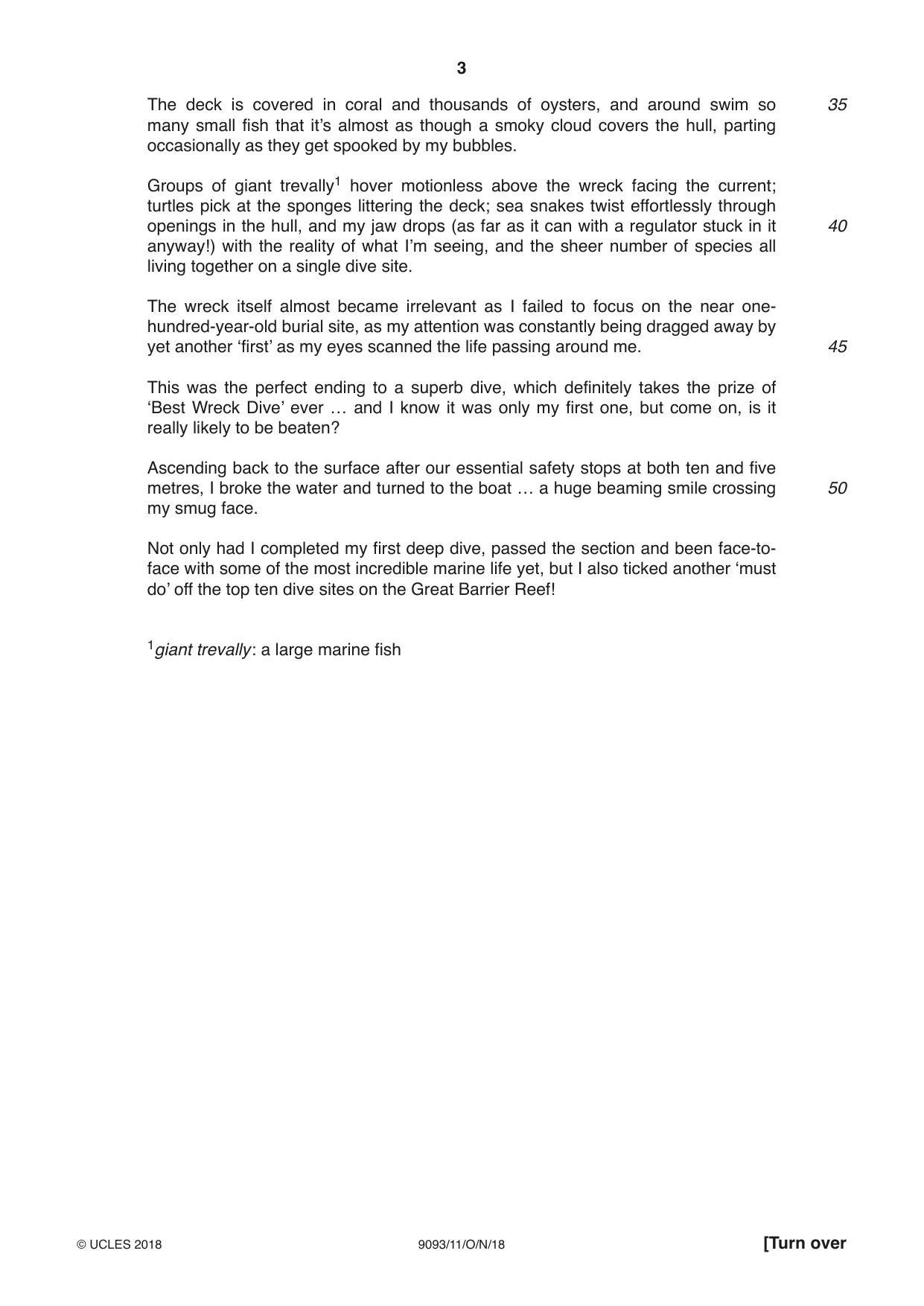
3 9093/11/O/N/18 © UCLES 2018 [Turn over The deck is covered in coral and thousands of oysters, and around swim so many small fish that it’s almost as though a smoky cloud covers the hull, parting occasionally as they get spooked by my bubbles. Groups of giant trevally1 hover motionless above the wreck facing the current; turtles pick at the sponges littering the deck; sea snakes twist effortlessly through openings in the hull, and my jaw drops (as far as it can with a regulator stuck in it anyway!) with the reality of what I’m seeing, and the sheer number of species all living together on a single dive site. The wreck itself almost became irrelevant as I failed to focus on the near one- hundred-year-old burial site, as my attention was constantly being dragged away by yet another ‘first’ as my eyes scanned the life passing around me. This was the perfect ending to a superb dive, which definitely takes the prize of ‘Best Wreck Dive’ ever … and I know it was only my first one, but come on, is it really likely to be beaten? Ascending back to the surface after our essential safety stops at both ten and five metres, I broke the water and turned to the boat … a huge beaming smile crossing my smug face. Not only had I completed my first deep dive, passed the section and been face-to- face with some of the most incredible marine life yet, but I also ticked another ‘must do’ off the top ten dive sites on the Great Barrier Reef! 1giant trevally: a large marine fish 35 40 45 50
Question paper, page 4
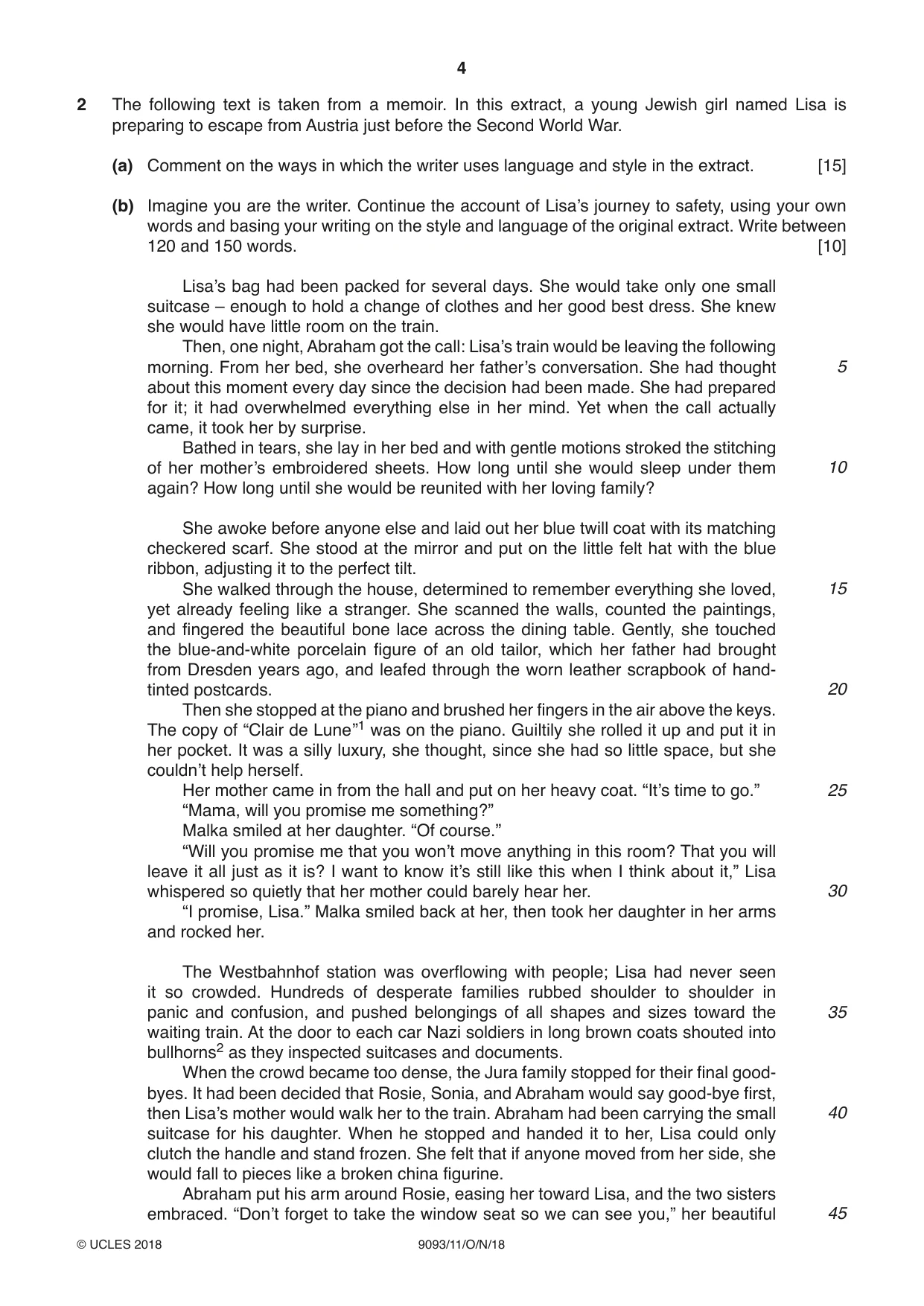
4 9093/11/O/N/18 © UCLES 2018 2 The following text is taken from a memoir. In this extract, a young Jewish girl named Lisa is preparing to escape from Austria just before the Second World War. (a) Comment on the ways in which the writer uses language and style in the extract. [15] (b) Imagine you are the writer. Continue the account of Lisa’s journey to safety, using your own words and basing your writing on the style and language of the original extract. Write between 120 and 150 words. [10] Lisa’s bag had been packed for several days. She would take only one small suitcase – enough to hold a change of clothes and her good best dress. She knew she would have little room on the train. Then, one night, Abraham got the call: Lisa’s train would be leaving the following morning. From her bed, she overheard her father’s conversation. She had thought about this moment every day since the decision had been made. She had prepared for it; it had overwhelmed everything else in her mind. Yet when the call actually came, it took her by surprise. Bathed in tears, she lay in her bed and with gentle motions stroked the stitching of her mother’s embroidered sheets. How long until she would sleep under them again? How long until she would be reunited with her loving family? She awoke before anyone else and laid out her blue twill coat with its matching checkered scarf. She stood at the mirror and put on the little felt hat with the blue ribbon, adjusting it to the perfect tilt. She walked through the house, determined to remember everything she loved, yet already feeling like a stranger. She scanned the walls, counted the paintings, and fingered the beautiful bone lace across the dining table. Gently, she touched the blue-and-white porcelain figure of an old tailor, which her father had brought from Dresden years ago, and leafed through the worn leather scrapbook of hand- tinted postcards. Then she stopped at the piano and brushed her fingers in the air above the keys. The copy of “Clair de Lune”1 was on the piano. Guiltily she rolled it up and put it in her pocket. It was a silly luxury, she thought, since she had so little space, but she couldn’t help herself. Her mother came in from the hall and put on her heavy coat. “It’s time to go.” “Mama, will you promise me something?” Malka smiled at her daughter. “Of course.” “Will you promise me that you won’t move anything in this room? That you will leave it all just as it is? I want to know it’s still like this when I think about it,” Lisa whispered so quietly that her mother could barely hear her. “I promise, Lisa.” Malka smiled back at her, then took her daughter in her arms and rocked her. The Westbahnhof station was overflowing with people; Lisa had never seen it so crowded. Hundreds of desperate families rubbed shoulder to shoulder in panic and confusion, and pushed belongings of all shapes and sizes toward the waiting train. At the door to each car Nazi soldiers in long brown coats shouted into bullhorns2 as they inspected suitcases and documents. When the crowd became too dense, the Jura family stopped for their final good- byes. It had been decided that Rosie, Sonia, and Abraham would say good-bye first, then Lisa’s mother would walk her to the train. Abraham had been carrying the small suitcase for his daughter. When he stopped and handed it to her, Lisa could only clutch the handle and stand frozen. She felt that if anyone moved from her side, she would fall to pieces like a broken china figurine. Abraham put his arm around Rosie, easing her toward Lisa, and the two sisters embraced. “Don’t forget to take the window seat so we can see you,” her beautiful 5 10 15 20 25 30 35 40 45
Question paper, page 5
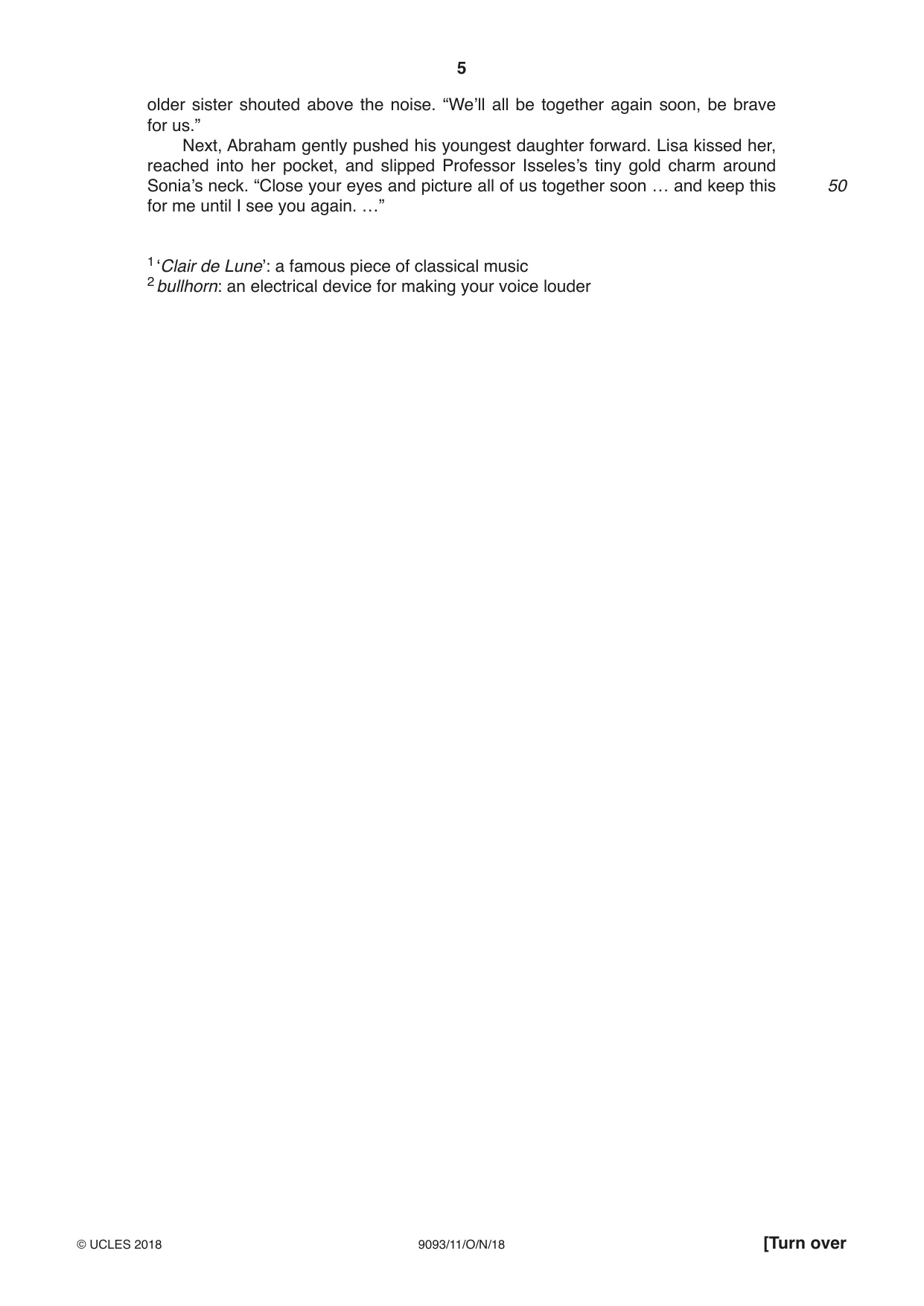
5 9093/11/O/N/18 © UCLES 2018 [Turn over older sister shouted above the noise. “We’ll all be together again soon, be brave for us.” Next, Abraham gently pushed his youngest daughter forward. Lisa kissed her, reached into her pocket, and slipped Professor Isseles’s tiny gold charm around Sonia’s neck. “Close your eyes and picture all of us together soon … and keep this for me until I see you again. …” 1 ‘Clair de Lune’: a famous piece of classical music 2 bullhorn: an electrical device for making your voice louder 50
Question paper, page 6
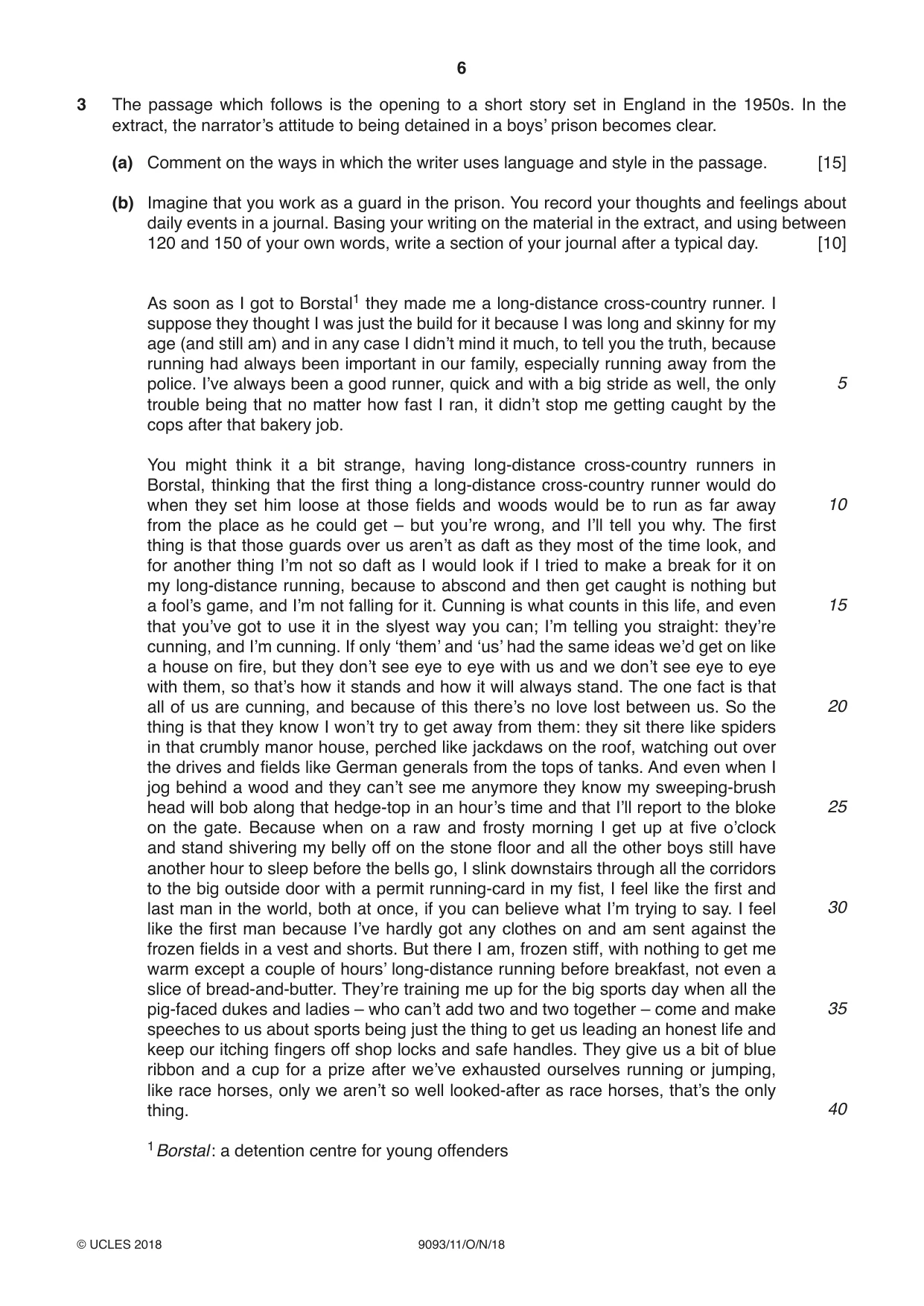
6 9093/11/O/N/18 © UCLES 2018 3 The passage which follows is the opening to a short story set in England in the 1950s. In the extract, the narrator’s attitude to being detained in a boys’ prison becomes clear. (a) Comment on the ways in which the writer uses language and style in the passage. [15] (b) Imagine that you work as a guard in the prison. You record your thoughts and feelings about daily events in a journal. Basing your writing on the material in the extract, and using between 120 and 150 of your own words, write a section of your journal after a typical day. [10] As soon as I got to Borstal1 they made me a long-distance cross-country runner. I suppose they thought I was just the build for it because I was long and skinny for my age (and still am) and in any case I didn’t mind it much, to tell you the truth, because running had always been important in our family, especially running away from the police. I’ve always been a good runner, quick and with a big stride as well, the only trouble being that no matter how fast I ran, it didn’t stop me getting caught by the cops after that bakery job. You might think it a bit strange, having long-distance cross-country runners in Borstal, thinking that the first thing a long-distance cross-country runner would do when they set him loose at those fields and woods would be to run as far away from the place as he could get – but you’re wrong, and I’ll tell you why. The first thing is that those guards over us aren’t as daft as they most of the time look, and for another thing I’m not so daft as I would look if I tried to make a break for it on my long-distance running, because to abscond and then get caught is nothing but a fool’s game, and I’m not falling for it. Cunning is what counts in this life, and even that you’ve got to use it in the slyest way you can; I’m telling you straight: they’re cunning, and I’m cunning. If only ‘them’ and ‘us’ had the same ideas we’d get on like a house on fire, but they don’t see eye to eye with us and we don’t see eye to eye with them, so that’s how it stands and how it will always stand. The one fact is that all of us are cunning, and because of this there’s no love lost between us. So the thing is that they know I won’t try to get away from them: they sit there like spiders in that crumbly manor house, perched like jackdaws on the roof, watching out over the drives and fields like German generals from the tops of tanks. And even when I jog behind a wood and they can’t see me anymore they know my sweeping-brush head will bob along that hedge-top in an hour’s time and that I’ll report to the bloke on the gate. Because when on a raw and frosty morning I get up at five o’clock and stand shivering my belly off on the stone floor and all the other boys still have another hour to sleep before the bells go, I slink downstairs through all the corridors to the big outside door with a permit running-card in my fist, I feel like the first and last man in the world, both at once, if you can believe what I’m trying to say. I feel like the first man because I’ve hardly got any clothes on and am sent against the frozen fields in a vest and shorts. But there I am, frozen stiff, with nothing to get me warm except a couple of hours’ long-distance running before breakfast, not even a slice of bread-and-butter. They’re training me up for the big sports day when all the pig-faced dukes and ladies – who can’t add two and two together – come and make speeches to us about sports being just the thing to get us leading an honest life and keep our itching fingers off shop locks and safe handles. They give us a bit of blue ribbon and a cup for a prize after we’ve exhausted ourselves running or jumping, like race horses, only we aren’t so well looked-after as race horses, that’s the only thing. 1 Borstal: a detention centre for young offenders 5 10 15 20 25 30 35 40
Question paper, page 7
7 9093/11/O/N/18 © UCLES 2018 BLANK PAGE
Question paper, page 8
8 9093/11/O/N/18 © UCLES 2018 BLANK PAGE Permission to reproduce items where third-party owned material protected by copyright is included has been sought and cleared where possible. Every reasonable effort has been made by the publisher (UCLES) to trace copyright holders, but if any items requiring clearance have unwittingly been included, the publisher will be pleased to make amends at the earliest possible opportunity. To avoid the issue of disclosure of answer-related information to candidates, all copyright acknowledgements are reproduced online in the Cambridge International Examinations Copyright Acknowledgements Booklet. This is produced for each series of examinations and is freely available to download at www.cie.org.uk after the live examination series. Cambridge International Examinations is part of the Cambridge Assessment Group. Cambridge Assessment is the brand name of University of Cambridge Local Examinations Syndicate (UCLES), which is itself a department of the University of Cambridge.
Mark scheme, page 1
This document consists of 5 printed pages. © UCLES 2018 [Turn over Cambridge Assessment International Education Cambridge International Advanced Subsidiary and Advanced Level ENGLISH LANGUAGE 9093/11 Paper 1 Passages October/November 2018 MARK SCHEME Maximum Mark: 50 Published This mark scheme is published as an aid to teachers and candidates, to indicate the requirements of the examination. It shows the basis on which Examiners were instructed to award marks. It does not indicate the details of the discussions that took place at an Examiners’ meeting before marking began, which would have considered the acceptability of alternative answers. Mark schemes should be read in conjunction with the question paper and the Principal Examiner Report for Teachers. Cambridge International will not enter into discussions about these mark schemes. Cambridge International is publishing the mark schemes for the October/November 2018 series for most Cambridge IGCSE™, Cambridge International A and AS Level components and some Cambridge O Level components.
Mark scheme, page 2
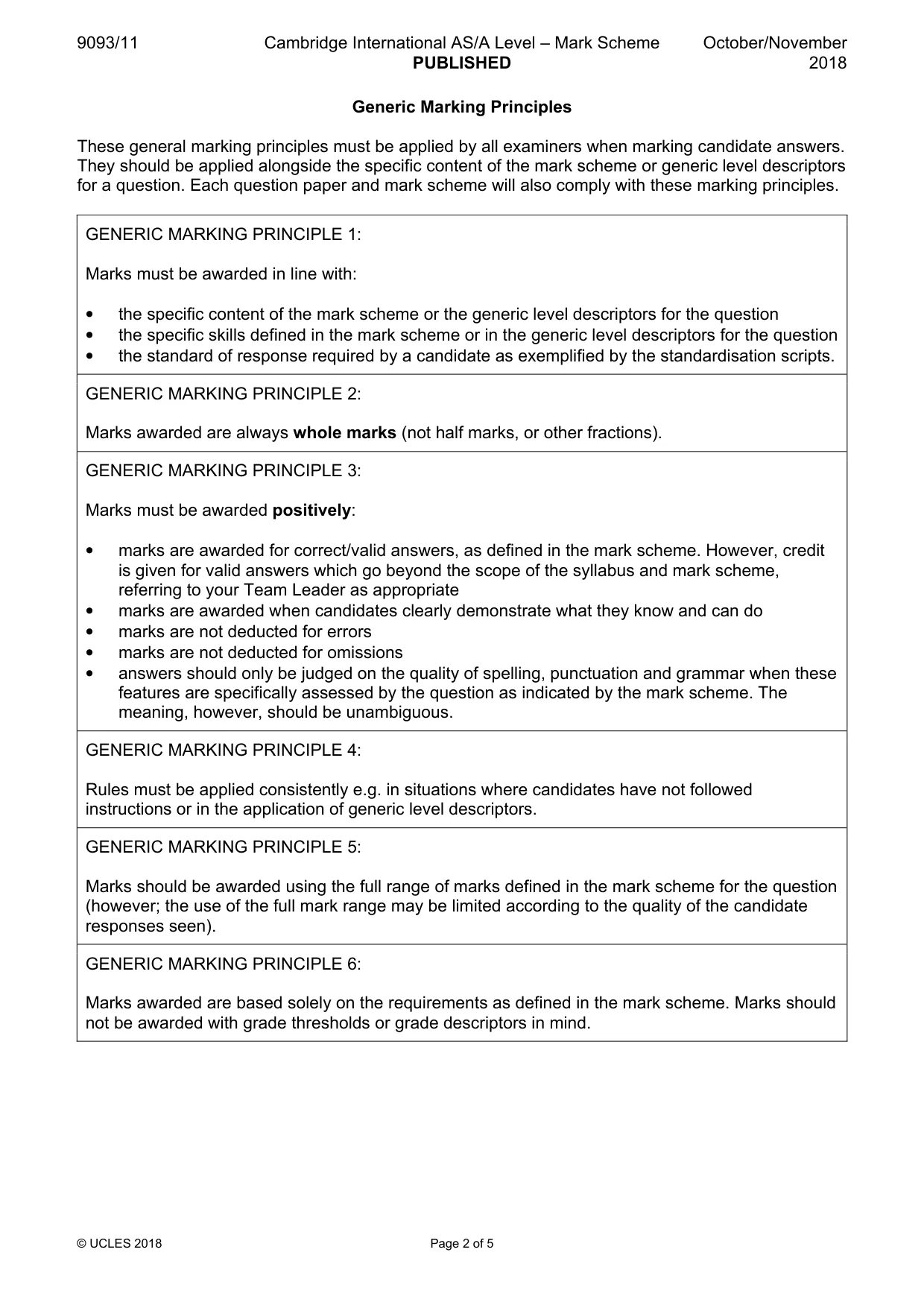
9093/11 Cambridge International AS/A Level – Mark Scheme PUBLISHED October/November 2018 © UCLES 2018 Page 2 of 5 Generic Marking Principles These general marking principles must be applied by all examiners when marking candidate answers. They should be applied alongside the specific content of the mark scheme or generic level descriptors for a question. Each question paper and mark scheme will also comply with these marking principles. GENERIC MARKING PRINCIPLE 1: Marks must be awarded in line with: • the specific content of the mark scheme or the generic level descriptors for the question • the specific skills defined in the mark scheme or in the generic level descriptors for the question • the standard of response required by a candidate as exemplified by the standardisation scripts. GENERIC MARKING PRINCIPLE 2: Marks awarded are always whole marks (not half marks, or other fractions). GENERIC MARKING PRINCIPLE 3: Marks must be awarded positively: • marks are awarded for correct/valid answers, as defined in the mark scheme. However, credit is given for valid answers which go beyond the scope of the syllabus and mark scheme, referring to your Team Leader as appropriate • marks are awarded when candidates clearly demonstrate what they know and can do • marks are not deducted for errors • marks are not deducted for omissions • answers should only be judged on the quality of spelling, punctuation and grammar when these features are specifically assessed by the question as indicated by the mark scheme. The meaning, however, should be unambiguous. GENERIC MARKING PRINCIPLE 4: Rules must be applied consistently e.g. in situations where candidates have not followed instructions or in the application of generic level descriptors. GENERIC MARKING PRINCIPLE 5: Marks should be awarded using the full range of marks defined in the mark scheme for the question (however; the use of the full mark range may be limited according to the quality of the candidate responses seen). GENERIC MARKING PRINCIPLE 6: Marks awarded are based solely on the requirements as defined in the mark scheme. Marks should not be awarded with grade thresholds or grade descriptors in mind.
Mark scheme, page 3
9093/11 Cambridge International AS/A Level – Mark Scheme PUBLISHED October/November 2018 © UCLES 2018 Page 3 of 5 Assessment Objectives: • Ability to read with understanding written material in a variety of forms, and to comment on its effectiveness. • Knowledge and understanding of features of English language. • Ability to write clearly, accurately and effectively for a particular purpose or audience. Each answer is marked out of a total of 25. • 15 marks are available for part (a) – commentary on use of language in the passage. • 10 marks are available for part (b) – directed writing task based on the passage. Each part is marked in accordance with the following general marking criteria.
Mark scheme, page 4
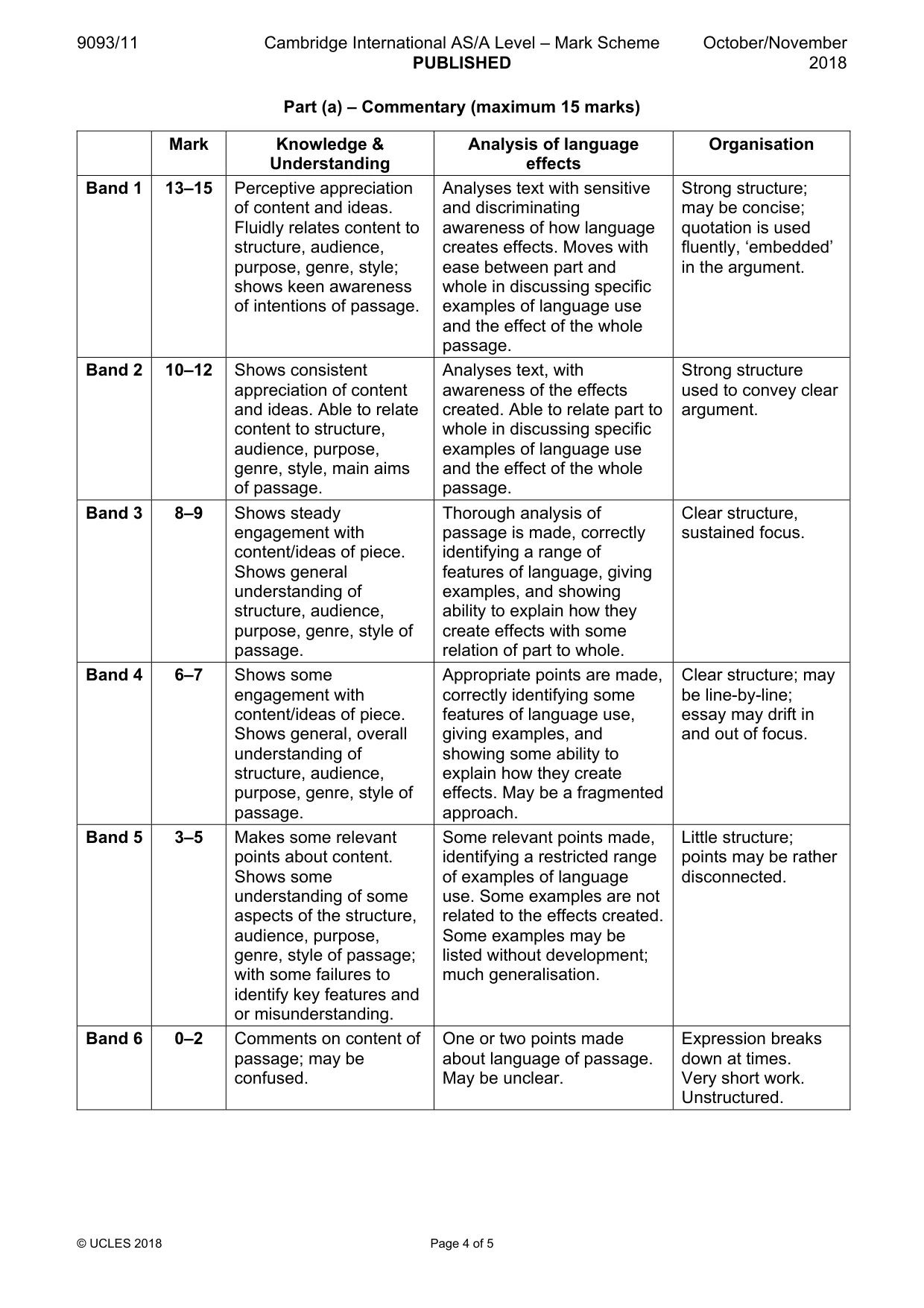
9093/11 Cambridge International AS/A Level – Mark Scheme PUBLISHED October/November 2018 © UCLES 2018 Page 4 of 5 Part (a) – Commentary (maximum 15 marks) Mark Knowledge & Understanding Analysis of language effects Organisation Band 1 13–15 Perceptive appreciation of content and ideas. Fluidly relates content to structure, audience, purpose, genre, style; shows keen awareness of intentions of passage. Analyses text with sensitive and discriminating awareness of how language creates effects. Moves with ease between part and whole in discussing specific examples of language use and the effect of the whole passage. Strong structure; may be concise; quotation is used fluently, ‘embedded’ in the argument. Band 2 10–12 Shows consistent appreciation of content and ideas. Able to relate content to structure, audience, purpose, genre, style, main aims of passage. Analyses text, with awareness of the effects created. Able to relate part to whole in discussing specific examples of language use and the effect of the whole passage. Strong structure used to convey clear argument. Band 3 8–9 Shows steady engagement with content/ideas of piece. Shows general understanding of structure, audience, purpose, genre, style of passage. Thorough analysis of passage is made, correctly identifying a range of features of language, giving examples, and showing ability to explain how they create effects with some relation of part to whole. Clear structure, sustained focus. Band 4 6–7 Shows some engagement with content/ideas of piece. Shows general, overall understanding of structure, audience, purpose, genre, style of passage. Appropriate points are made, correctly identifying some features of language use, giving examples, and showing some ability to explain how they create effects. May be a fragmented approach. Clear structure; may be line-by-line; essay may drift in and out of focus. Band 5 3–5 Makes some relevant points about content. Shows some understanding of some aspects of the structure, audience, purpose, genre, style of passage; with some failures to identify key features and or misunderstanding. Some relevant points made, identifying a restricted range of examples of language use. Some examples are not related to the effects created. Some examples may be listed without development; much generalisation. Little structure; points may be rather disconnected. Band 6 0–2 Comments on content of passage; may be confused. One or two points made about language of passage. May be unclear. Expression breaks down at times. Very short work. Unstructured.
Mark scheme, page 5
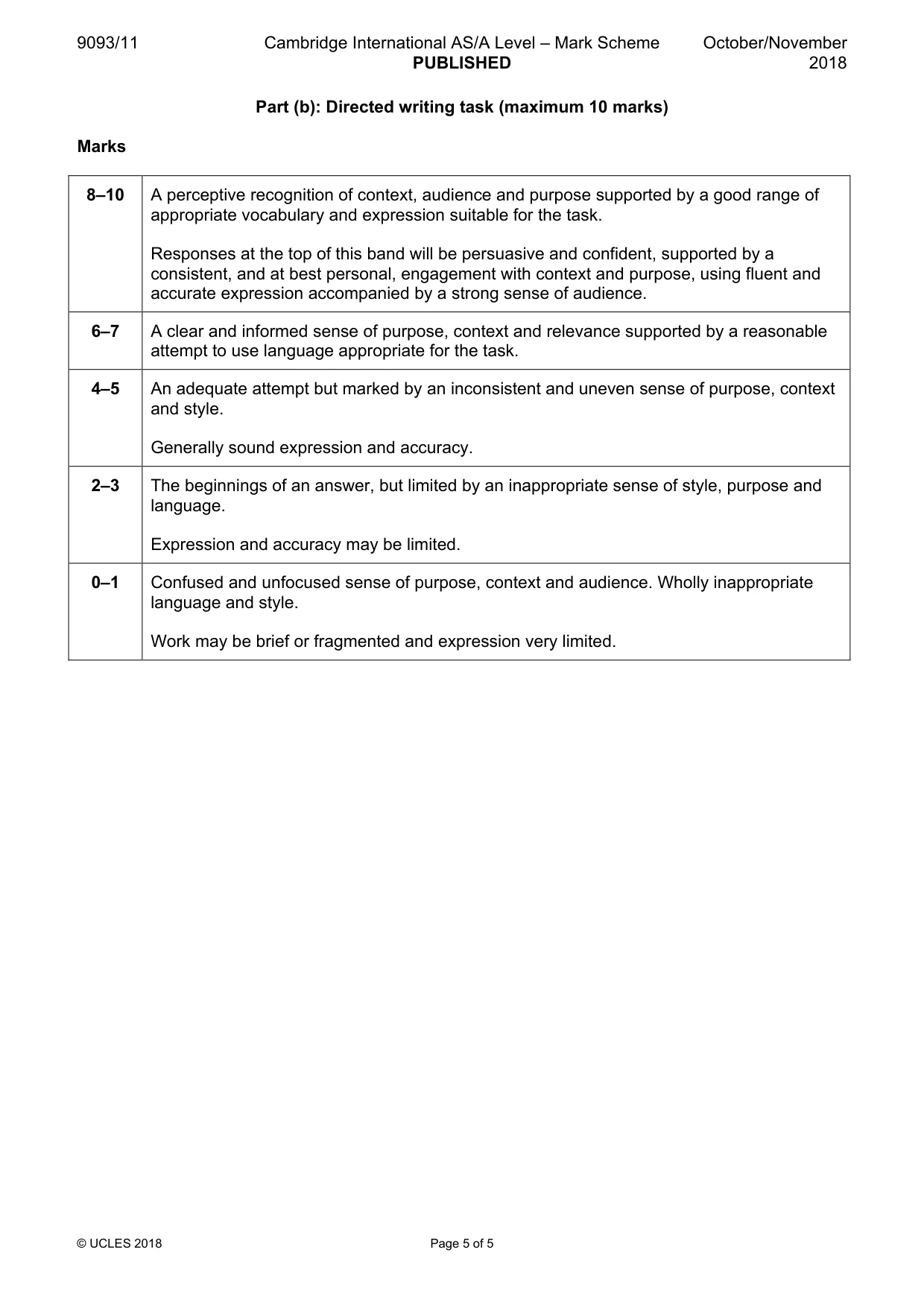
9093/11 Cambridge International AS/A Level – Mark Scheme PUBLISHED October/November 2018 © UCLES 2018 Page 5 of 5 Part (b): Directed writing task (maximum 10 marks) Marks 8–10 A perceptive recognition of context, audience and purpose supported by a good range of appropriate vocabulary and expression suitable for the task. Responses at the top of this band will be persuasive and confident, supported by a consistent, and at best personal, engagement with context and purpose, using fluent and accurate expression accompanied by a strong sense of audience. 6–7 A clear and informed sense of purpose, context and relevance supported by a reasonable attempt to use language appropriate for the task. 4–5 An adequate attempt but marked by an inconsistent and uneven sense of purpose, context and style. Generally sound expression and accuracy. 2–3 The beginnings of an answer, but limited by an inappropriate sense of style, purpose and language. Expression and accuracy may be limited. 0–1 Confused and unfocused sense of purpose, context and audience. Wholly inappropriate language and style. Work may be brief or fragmented and expression very limited.
What you needed in this session
Cambridge’s own grade thresholds for 2018 Oct/Nov, Paper 1 · Variant 1. A higher threshold means an easier paper — the bar moves with how the cohort did.