Cambridge A Level English - Language AS and A Level (from 2014) 9093 — 2018 Oct/Nov Paper 1 · Variant 2
9093/12/O/N/18 · 50 marks · ≈56 min
The question paper and its mark scheme, free to read here and free to download. This is Cambridge’s own paper, exactly as it was sat.
Question paper8 pages

Mark scheme5 pages
Answers below. Sit the paper first if you are practising.

Paper as text
Question paper, page 1
This document consists of 7 printed pages, 1 blank page and 1 Insert. DC (RCL (GO)) 146814/3 © UCLES 2018 [Turn over Cambridge International Examinations Cambridge International Advanced Subsidiary and Advanced Level * 4 4 6 2 2 7 4 2 7 5 * ENGLISH LANGUAGE 9093/12 Paper 1 Passages October/November 2018 2 hours 15 minutes No Additional Materials are required. READ THESE INSTRUCTIONS FIRST An answer booklet is provided inside this question paper. You should follow the instructions on the front cover of the answer booklet. If you need additional answer paper, ask the invigilator for a continuation booklet. Answer two questions: Question 1 and either Question 2 or Question 3. You should spend about 15 minutes reading the passages and questions before you start writing your answers. You are reminded of the need for good English and clear presentation in your answers. The number of marks is given in brackets [ ] at the end of each question or part question.
Question paper, page 2
2 9093/12/O/N/18 © UCLES 2018 Answer Question 1 and either Question 2 or Question 3. 1 The following text is taken from an online brochure which features luxury holidays. (a) Comment on the ways in which language and style are used to promote the Niyama holiday resort to potential tourists. [15] (b) The same brochure includes another promotional feature for a luxury holiday resort (real or imagined) in a different part of the world. Using your own words, and basing your writing on the style and language of the original passage, write a section of the promotional material about this second luxury resort for the brochure’s website. Write between 120 and 150 words. [10] The luxurious Niyama Maldives resort is a forty-minute seaplane ride away from Male, and set on the lush private island of Olhuveli. Spread out across two islands, Niyama is a relaxed, upmarket and innovative resort that maintains a fantastic balance between tranquil beauty and a real sense of fun. The islands are named ‘Chill’ and ‘Play’, and as they suggest you can either choose to lose yourself completely in this tropical paradise, with its quiet, private beach, butler services and twenty-four hour spa, or you can engage with the latest technology in the form of Nintendo Wiis and X-Box 360s and dance the night away in ‘Subsix’ – the World’s first underwater music club lying six metres below the surface of the ocean. Surrounded by pristine, clear-blue waters and with splashes of green and crimson, a stay at Niyama all but guarantees a true luxury Maldives holiday experience. Accommodation takes the form of a range of stylish pavilions and studios situated both on the beach and over water, and all have a wide variety of features on offer including iPads, flat-screen televisions and more. There are a number of different dining options to choose from at Niyama, from outdoor campfire grills fusing tastes from South America, Asia and Africa, to the ‘Edge’ restaurant, a stunning floating restaurant that can only be accessed by boat. Here you can enjoy local flavours, daily catches and signature cocktails on a private jetty that offers stunning panoramic views of the Indian Ocean in all its beauty. There are a wide variety of facilities at the Niyama Maldives resort, such as the Lime Spa, where you can enjoy treatments overlooking the lagoon or in two separate on-island spa sanctuaries with their own outdoor shower, whirlpool and day bed, a gadget and games room, pool, diving centre, gym, motorised and non-motorised water sports and much more. Niyama has an extensive range of facilities on offer, and with its careful balance of fun and tranquillity you can decide what type of luxury holiday experience you have in the Maldives. Treatments can be personalised to suit your individual requirements, whilst signature treatments make use of local ingredients such as coconut oil and Maldivian coral sand. Those suffering from the effects of jet-lag are advised to partake in after-dark treatments, with therapies designed to heal, nurture and restore. For those with children, the Explorers club offers children under twelve the opportunity to enjoy tailor-made activities based around their interests and abilities. Run by fully qualified childcare professionals, the classes separate children into four age groups, with a sleeping room for daytime siestas and theme days such 5 10 15 20 25 30 35
Question paper, page 3
3 9093/12/O/N/18 © UCLES 2018 [Turn over as Circus Fun and Jungle Safari designed to ensure even the younger ones have the perfect Maldives holiday experience. Older children can enjoy expeditions to nearby islands, snorkelling safaris and football, plus there is even an amphitheatre for those looking to enter the world of show business. Niyama offers a truly breathtaking Indian Ocean experience where you can sample innovative dining in a modern and stylish luxury Maldives resort. 40
Question paper, page 4
4 9093/12/O/N/18 © UCLES 2018 2 The following extract is taken from an autobiography. In it, a Jewish writer recalls trying to escape, with his parents, on the day that German forces invaded Poland in September 1939. (a) Comment on the ways in which the writer uses language and style to give a vivid account of the experience. [15] (b) Imagine you are the writer. Basing your writing closely on the style and features of the original, continue the account using between 120 and 150 of your own words. You do not need to bring your response to a conclusion. [10] Despite the onrush of people who were trying to leave Katowice that morning, probably because it was not far from the German border, we eventually got to board the carriage reserved for us and some other refugees who had also received their visas. Finally, after a long delay, the train moved out of the station. We seemed to have made it. I don’t know how long we travelled on that train. For the most part, though, the train was standing more than moving, waiting for other trains, loaded with soldiers, to pass. The roads alongside the railroad line were crowded with people walking or riding in horse-drawn carriages and wagons. Everywhere there were long Polish army columns, marching, on horseback or on trucks, pulling artillery pieces and supplies. The soldiers were moving in the opposite direction from the civilians, who had to make room for them to pass on the narrow roads. For me, all this commotion was very exciting. I spent much time waving to the passing soldiers and admiring their three-cornered hats and uniforms. And then, suddenly, the fun stopped. Our train had again halted, this time next to a train filled with Polish soldiers and military equipment. On either side of the tracks were open fields. We had probably not been standing there for more than a few minutes when we began to hear the far-off sounds of approaching aeroplanes. Then they were above us – two or three of them. People began to scream, ‘Niemcy! Niemcy!’ (‘Germans! Germans!’), and suddenly the air resounded with the rattle of machine- gun fire and the thump of exploding bombs. The train began to shake. The noise was terrible. My father grabbed my mother and me and pushed us out of the train. ‘They are attacking the military train!’ he screamed above the noise. ‘We must get out, we must get out.’ Some people had already jumped from the train and were scrambling across the tracks into the fields. We followed behind, pushed on by others. The Polish soldiers began to shoot at the German planes with rifles held out of their carriage windows. They did not have much luck. The planes kept swooping down on the trains and the tracks, blowing up some of the carriages. They kept repeating this manoeuvre for what seemed like a very long time. We managed to reach the nearby field, where my mother threw herself on top of me while my father shielded both of us with his body. People were screaming as the planes flew over us with their machine guns blazing. They could easily have killed all of us, but it seemed we were not their target. Then, just as suddenly as they had appeared, the planes were gone. We waited for a while for them to return and, when they did not, we got up and started to look around. No one on our side of the field seemed to have been hit, but people were wailing and a few children were crying. Some railroad cars were on fire; there was smoke everywhere. Many injured and dead soldiers were lying on the other side of the tracks and near their train. The tracks had been destroyed as far as the eye could see. 5 10 15 20 25 30 35 40
Question paper, page 5
5 9093/12/O/N/18 © UCLES 2018 [Turn over Turn over for Question 3.
Question paper, page 6
6 9093/12/O/N/18 © UCLES 2018 3 The text which follows is an extract from an essay about a hospital for the poor in France in the 1930s. (a) Comment on the ways the writer uses language and style in the extract. [15] (b) Imagine you are a nurse who works at the hospital. Using between 120 and 150 of your own words, and basing your writing closely on the material in the original extract, write a section of your journal for the same day. [10] In the year 1929 I spent several weeks in the Hôpital X, in the fifteenth arrondissement1 of Paris. The clerks put me through the usual interrogation at the reception desk, and I was kept answering questions for some twenty minutes before they would let me in. If you have ever had to fill in forms in a foreign country you will know the kind of questions I mean. For some days past my temperature had been above a hundred degrees, and by the end of the interview I had some difficulty in standing on my feet. Behind me stood a resigned little group of patients carrying a few personal belongings, all waiting to be grilled. After the questioning came the bath – a compulsory routine for all newcomers apparently – just as in prison. My clothes were taken away from me, and after I had sat shivering for some minutes in five inches of warm water, I was given a linen nightshirt and a short blue dressing-gown – no slippers, they had none big enough for me, they said – and led out into the open air. This was a night in February and I was suffering from pneumonia. The ward we were going to was some distance away and it seemed that to get to it you had to cross the hospital grounds. Someone stumbled in front of me with a lantern. The gravel path was frosty underfoot, and the wind whipped the nightshirt round my bare legs. When we got into the ward, I immediately noticed the foul smell. It was a long, badly lit room, full of murmuring voices and three rows of beds that were surprisingly close together. As I lay down, I saw on a bed opposite me a small, round-shouldered man sitting half naked while a doctor and a student performed some strange operation on him. First the doctor produced from his black bag a dozen small glasses, then the student burned a match inside each glass to exhaust the air, then the glass was placed on to the man’s back or chest and the vacuum drew up a huge yellow blister. Only after some moments did I realize what they were doing to him. It was something called cupping, a treatment which you can read about in old medical text-books but which till then I had vaguely thought of as one of those things they do to horses. The cold air outside had probably lowered my temperature, and I watched this horrible treatment with detachment and even a certain amount of amusement. The next moment, however, the doctor and the student came across to my bed, pulled me upright and without speaking began applying the same set of glasses, which had not been sterilized in any way. A few feeble protests that I uttered got no more response than if I had been an animal. I was very much stunned by the impersonal way in which the two men started on me. I had never been in the public ward of a hospital before, and it was my first experience of doctors who handle you without speaking to you or even in fact taking any notice of you at all. They only put on six glasses in my case, and each glass drew about a spoonful of dark-coloured blood. As I lay down again, humiliated, disgusted and frightened by the thing that had been done to me, I reflected that now at least they would leave me alone. But I was wrong. There was another treatment coming: the mustard poultice,2 seemingly a matter of routine like the hot bath. Two unkempt looking nurses had already got the poultice ready, and they lashed it round my chest as tight as a strait-jacket while some men who were wandering about the ward in shirt and trousers began to collect round my bed with half-sympathetic grins. I learned later that watching a 5 10 15 20 25 30 35 40
Question paper, page 7
7 9093/12/O/N/18 © UCLES 2018 patient have a mustard poultice was a favourite pastime in the ward. These things are normally applied for a quarter of an hour and certainly they are funny enough if you don’t happen to be the person inside. For the first five minutes the pain is severe, but you believe you can bear it. During the second five minutes this belief evaporates, but the poultice is tied at the back and you can’t get it off. This is the period the onlookers enjoy most. During the last five minutes, a feeling of numbness takes over. After the poultice had been removed a waterproof pillow packed with ice was forced beneath my head and I was left alone. I did not sleep, and to the best of my knowledge this was the only night of my life – I mean the only night spent in bed – in which I have not slept at all, not even a minute. 1 arrondissement: district 2 mustard poultice: a type of very hot bandage that is applied to the body 45 50
Question paper, page 8
8 9093/12/O/N/18 © UCLES 2018 BLANK PAGE Permission to reproduce items where third-party owned material protected by copyright is included has been sought and cleared where possible. Every reasonable effort has been made by the publisher (UCLES) to trace copyright holders, but if any items requiring clearance have unwittingly been included, the publisher will be pleased to make amends at the earliest possible opportunity. To avoid the issue of disclosure of answer-related information to candidates, all copyright acknowledgements are reproduced online in the Cambridge International Examinations Copyright Acknowledgements Booklet. This is produced for each series of examinations and is freely available to download at www.cie.org.uk after the live examination series. Cambridge International Examinations is part of the Cambridge Assessment Group. Cambridge Assessment is the brand name of University of Cambridge Local Examinations Syndicate (UCLES), which is itself a department of the University of Cambridge.
Mark scheme, page 1
This document consists of 5 printed pages. © UCLES 2018 [Turn over Cambridge Assessment International Education Cambridge International Advanced Subsidiary and Advanced Level ENGLISH LANGUAGE 9093/12 Paper 1 Passages October/November 2018 MARK SCHEME Maximum Mark: 50 Published This mark scheme is published as an aid to teachers and candidates, to indicate the requirements of the examination. It shows the basis on which Examiners were instructed to award marks. It does not indicate the details of the discussions that took place at an Examiners’ meeting before marking began, which would have considered the acceptability of alternative answers. Mark schemes should be read in conjunction with the question paper and the Principal Examiner Report for Teachers. Cambridge International will not enter into discussions about these mark schemes. Cambridge International is publishing the mark schemes for the October/November 2018 series for most Cambridge IGCSE™, Cambridge International A and AS Level components and some Cambridge O Level components.
Mark scheme, page 2
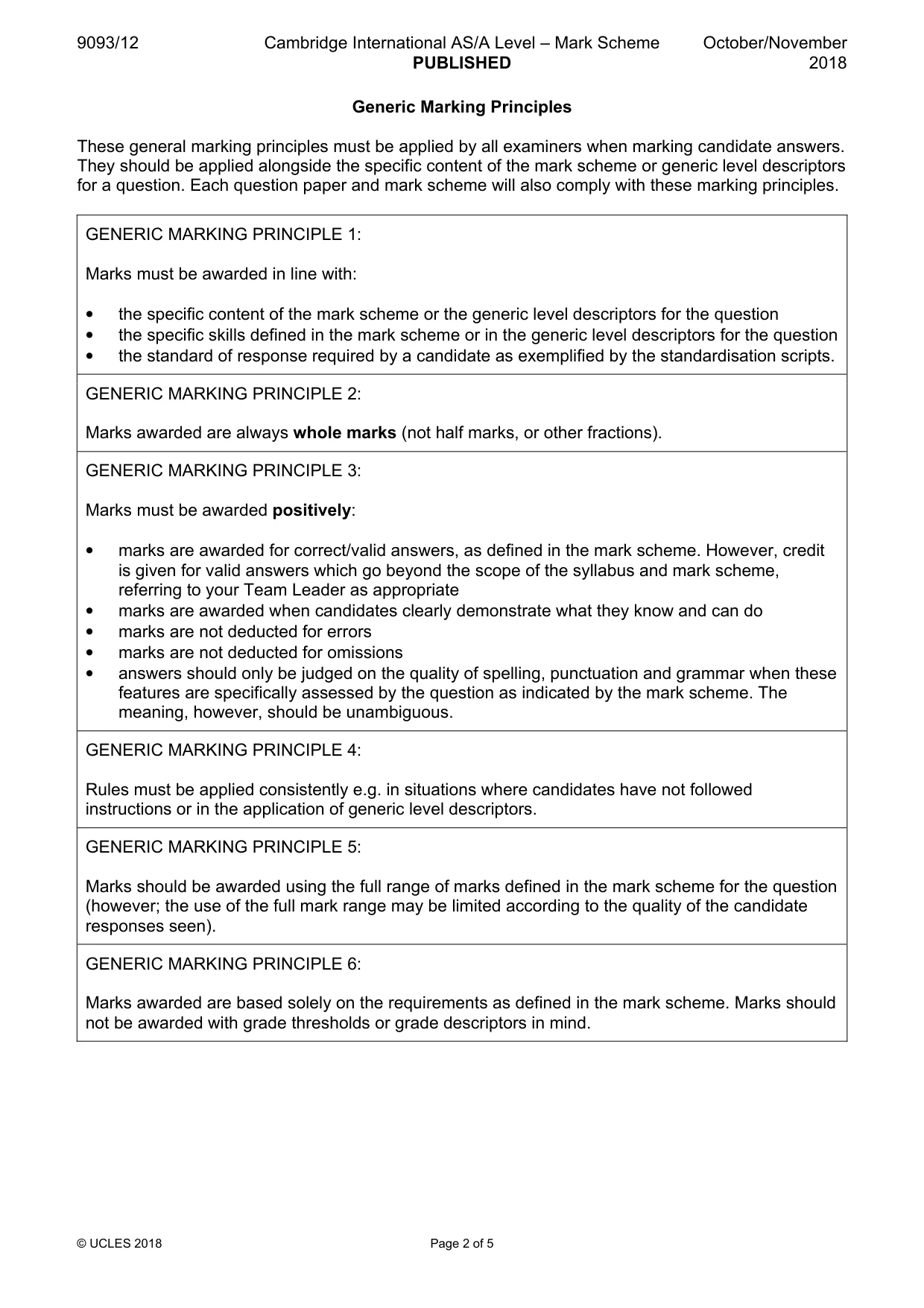
9093/12 Cambridge International AS/A Level – Mark Scheme PUBLISHED October/November 2018 © UCLES 2018 Page 2 of 5 Generic Marking Principles These general marking principles must be applied by all examiners when marking candidate answers. They should be applied alongside the specific content of the mark scheme or generic level descriptors for a question. Each question paper and mark scheme will also comply with these marking principles. GENERIC MARKING PRINCIPLE 1: Marks must be awarded in line with: • the specific content of the mark scheme or the generic level descriptors for the question • the specific skills defined in the mark scheme or in the generic level descriptors for the question • the standard of response required by a candidate as exemplified by the standardisation scripts. GENERIC MARKING PRINCIPLE 2: Marks awarded are always whole marks (not half marks, or other fractions). GENERIC MARKING PRINCIPLE 3: Marks must be awarded positively: • marks are awarded for correct/valid answers, as defined in the mark scheme. However, credit is given for valid answers which go beyond the scope of the syllabus and mark scheme, referring to your Team Leader as appropriate • marks are awarded when candidates clearly demonstrate what they know and can do • marks are not deducted for errors • marks are not deducted for omissions • answers should only be judged on the quality of spelling, punctuation and grammar when these features are specifically assessed by the question as indicated by the mark scheme. The meaning, however, should be unambiguous. GENERIC MARKING PRINCIPLE 4: Rules must be applied consistently e.g. in situations where candidates have not followed instructions or in the application of generic level descriptors. GENERIC MARKING PRINCIPLE 5: Marks should be awarded using the full range of marks defined in the mark scheme for the question (however; the use of the full mark range may be limited according to the quality of the candidate responses seen). GENERIC MARKING PRINCIPLE 6: Marks awarded are based solely on the requirements as defined in the mark scheme. Marks should not be awarded with grade thresholds or grade descriptors in mind.
Mark scheme, page 3
9093/12 Cambridge International AS/A Level – Mark Scheme PUBLISHED October/November 2018 © UCLES 2018 Page 3 of 5 Assessment Objectives: • Ability to read with understanding written material in a variety of forms, and to comment on its effectiveness. • Knowledge and understanding of features of English language. • Ability to write clearly, accurately and effectively for a particular purpose or audience. Each answer is marked out of a total of 25. • 15 marks are available for part (a) – commentary on use of language in the passage. • 10 marks are available for part (b) – directed writing task based on the passage. Each part is marked in accordance with the following general marking criteria.
Mark scheme, page 4
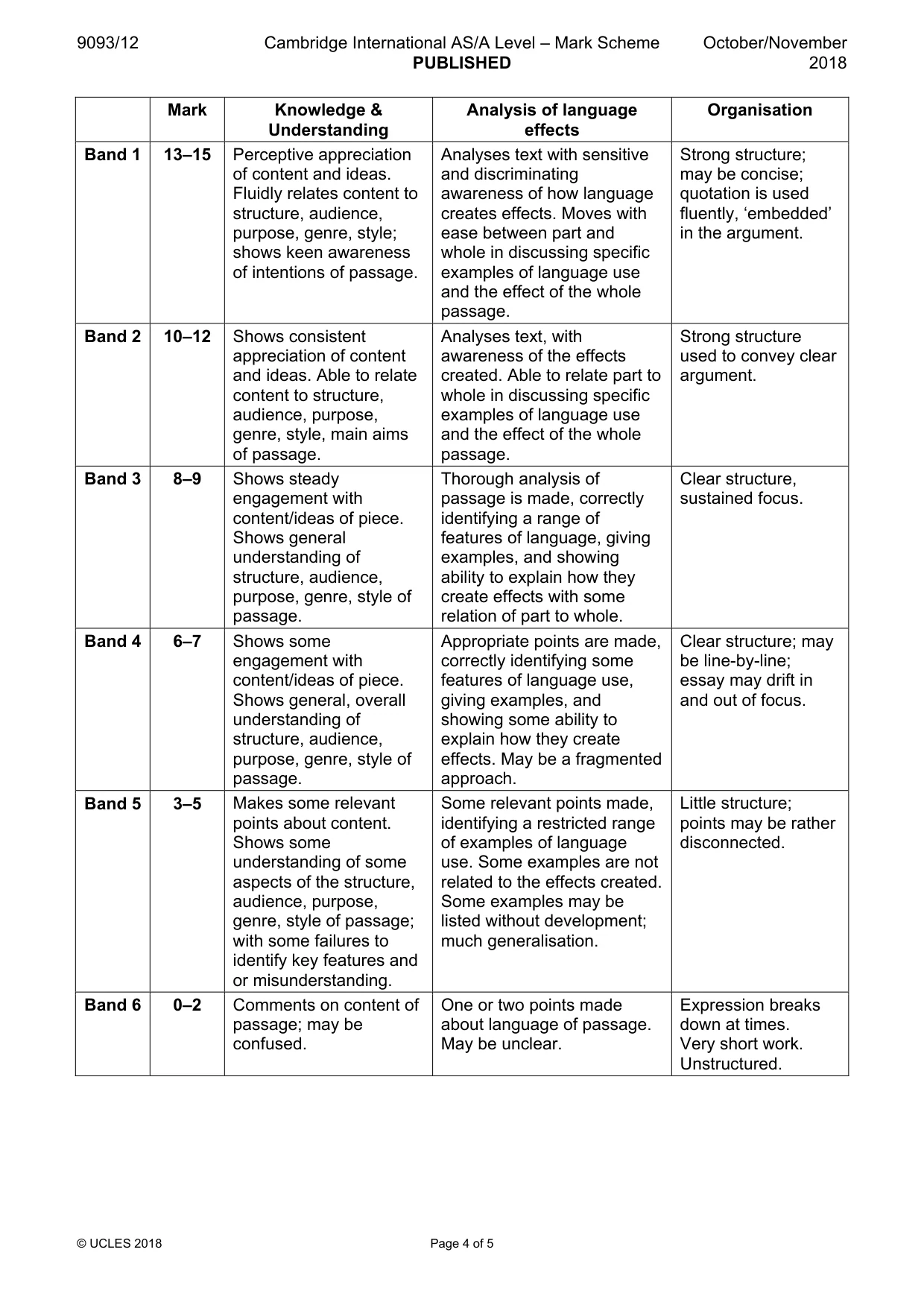
9093/12 Cambridge International AS/A Level – Mark Scheme PUBLISHED October/November 2018 © UCLES 2018 Page 4 of 5 Mark Knowledge & Understanding Analysis of language effects Organisation Band 1 13–15 Perceptive appreciation of content and ideas. Fluidly relates content to structure, audience, purpose, genre, style; shows keen awareness of intentions of passage. Analyses text with sensitive and discriminating awareness of how language creates effects. Moves with ease between part and whole in discussing specific examples of language use and the effect of the whole passage. Strong structure; may be concise; quotation is used fluently, ‘embedded’ in the argument. Band 2 10–12 Shows consistent appreciation of content and ideas. Able to relate content to structure, audience, purpose, genre, style, main aims of passage. Analyses text, with awareness of the effects created. Able to relate part to whole in discussing specific examples of language use and the effect of the whole passage. Strong structure used to convey clear argument. Band 3 8–9 Shows steady engagement with content/ideas of piece. Shows general understanding of structure, audience, purpose, genre, style of passage. Thorough analysis of passage is made, correctly identifying a range of features of language, giving examples, and showing ability to explain how they create effects with some relation of part to whole. Clear structure, sustained focus. Band 4 6–7 Shows some engagement with content/ideas of piece. Shows general, overall understanding of structure, audience, purpose, genre, style of passage. Appropriate points are made, correctly identifying some features of language use, giving examples, and showing some ability to explain how they create effects. May be a fragmented approach. Clear structure; may be line-by-line; essay may drift in and out of focus. Band 5 3–5 Makes some relevant points about content. Shows some understanding of some aspects of the structure, audience, purpose, genre, style of passage; with some failures to identify key features and or misunderstanding. Some relevant points made, identifying a restricted range of examples of language use. Some examples are not related to the effects created. Some examples may be listed without development; much generalisation. Little structure; points may be rather disconnected. Band 6 0–2 Comments on content of passage; may be confused. One or two points made about language of passage. May be unclear. Expression breaks down at times. Very short work. Unstructured.
Mark scheme, page 5
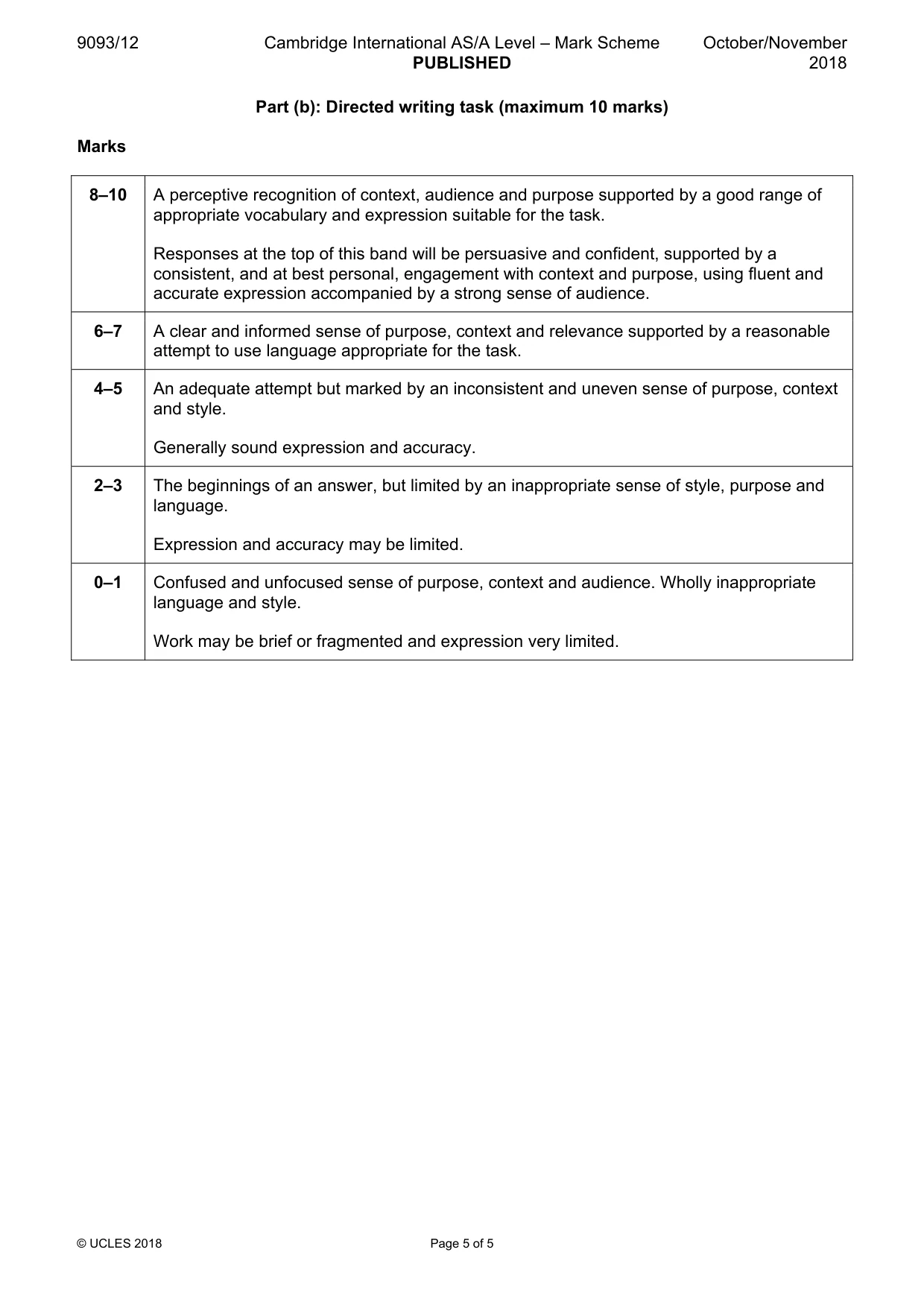
9093/12 Cambridge International AS/A Level – Mark Scheme PUBLISHED October/November 2018 © UCLES 2018 Page 5 of 5 Part (b): Directed writing task (maximum 10 marks) Marks 8–10 A perceptive recognition of context, audience and purpose supported by a good range of appropriate vocabulary and expression suitable for the task. Responses at the top of this band will be persuasive and confident, supported by a consistent, and at best personal, engagement with context and purpose, using fluent and accurate expression accompanied by a strong sense of audience. 6–7 A clear and informed sense of purpose, context and relevance supported by a reasonable attempt to use language appropriate for the task. 4–5 An adequate attempt but marked by an inconsistent and uneven sense of purpose, context and style. Generally sound expression and accuracy. 2–3 The beginnings of an answer, but limited by an inappropriate sense of style, purpose and language. Expression and accuracy may be limited. 0–1 Confused and unfocused sense of purpose, context and audience. Wholly inappropriate language and style. Work may be brief or fragmented and expression very limited.
What you needed in this session
Cambridge’s own grade thresholds for 2018 Oct/Nov, Paper 1 · Variant 2. A higher threshold means an easier paper — the bar moves with how the cohort did.