Cambridge A Level English - Language AS and A Level (from 2014) 9093 — 2018 May/June Paper 1 · Variant 3
9093/13/M/J/18 · 50 marks · ≈56 min
The question paper and its mark scheme, free to read here and free to download. This is Cambridge’s own paper, exactly as it was sat.
Question paper8 pages
Mark scheme4 pages
Answers below. Sit the paper first if you are practising.
Paper as text
Question paper, page 1
* 1 2 3 3 3 2 5 6 9 5 * This document consists of 7 printed pages, 1 blank page and 1 Insert. DC (SC) 146706/2 © UCLES 2018 [Turn over Cambridge International Examinations Cambridge International Advanced Subsidiary and Advanced Level ENGLISH LANGUAGE 9093/13 Paper 1 Passages May/June 2018 2 hours 15 minutes No Additional Materials are required. READ THESE INSTRUCTIONS FIRST An answer booklet is provided inside this question paper. You should follow the instructions on the front cover of the answer booklet. If you need additional answer paper, ask the invigilator for a continuation booklet. Answer two questions: Question 1 and either Question 2 or Question 3. You should spend about 15 minutes reading the passages and questions before you start writing your answers. You are reminded of the need for good English and clear presentation in your answers. The number of marks is given in brackets [ ] at the end of each question or part question.
Question paper, page 2
2 9093/13/M/J/18 © UCLES 2018 Answer Question 1 and either Question 2 or Question 3. 1 The following extract from a biography focuses on a day in the life of an Iraqi family in the 1950s. (a) Comment on the ways the writer uses language and style in the extract. [15] (b) Imagine you are the writer. Basing your writing closely on the style and features of the original, continue the account using between 120 and 150 of your own words. You do not need to bring your response to a conclusion. [10] ‘Mama, look! The snake is coming. He is nearly in our house.’ Nabeel, now eight, and his little brother Jabbar are hopping up and down impatiently as they tell Sabria of the Lebetine viper’s progress across the sandy courtyard. ‘He has left Ali’s house, Mama, and he is coming to ours, slithering along in the sand. He is a big, beautiful one. Please come and see, Mama.’ ‘He will be our snake,’ Jabbar squeals, with the wilful certainty of a four-year-old. ‘And the bowl? Is that still where I left it?’ Sabria calls to them from the well, knowing that either of them, in his eagerness, may have forgotten to replenish the water, or even knocked it over. ‘Yes, Mama,’ the two boys chorus. ‘It’s still there.’ ‘And I filled it,’ Jabbar says proudly. ‘Nabeel put in the salt but I got the water and poured it.’ Sabria sets down her bucket and moves to the gate where the boys are crouched. It isn’t that she doesn’t trust them, simply that things have to be right. There are no second chances with snakes. Cautiously she treads backwards through the courtyard, her shoes leaving only the faintest impression in the sand. The bowl, a simple brown earthenware dish, brims with salty water. Broader at the base than at the lip, it will not tip over when the snake begins to drink, yet it is shallow enough for it to reach in easily. ‘Don’t go too close,’ Sabria breathes, returning to the bronze grate where she is about to start cooking rice. ‘And if I see either of you throwing stones I will punish you severely. You must never tease a snake.’ The two boys run from the shady part of the courtyard and out through the doorway, a huge wooden frame, nailed together from reclaimed railway sleepers that Yasin had liberated from the depot at the old Western Baghdad railway station. Across it are nailed strips of silvery aluminium – flat-beaten from empty cooking-oil cans, with patches of red and yellow paint still visible. Half ignoring their mother, the boys crouch at the compound gate to watch the snake as it slithers along beneath the brown mud wall. Jabbar tugs at Nabeel’s shorts. ‘Shall we move the bowl? Maybe he cannot see it.’ ‘No,’ whispers Nabeel, ‘it’s too dangerous. And you are only four, so you should do as I say because I am older.’ He holds Jabbar tight by the arm, both boys frozen a few feet from the snake, which has stopped moving and is eyeing them with its head raised and motionless. Nabeel reaches slowly for his seven-eyes talisman. A tiny piece of rock with seven gnarled fingers and a spherical hole at the end of each, it has been glued into his hair with asphalt at his mother’s instruction by an old mystic living on the outskirts of Karradat Mariam. Rolling it between his thumb and forefinger, he feels a reassuring sense of its protection come over him. To Jabbar, he whispers, ‘We will win, you’ll see. But to win we must be patient and wait for him to come in his own time.’ Cautiously at first, the snake arcs sideways towards the bowl, leaving a series of identical S-shaped tracks in the sand. The boys know that much depends on the snake taking a drink from their bowl. Their mother, like everyone they know, has often told them that a visiting snake brings good fortune to a house and everyone in it. But first it must drink the offering. 5 10 15 20 25 30 35 40
Question paper, page 3
3 9093/13/M/J/18 © UCLES 2018 [Turn over ‘So if he drinks from the bowl, he won’t bite us and we’ll have good luck?’ asks Jabbar, still confused. ‘I’ve already told you,’ Nabeel says impatiently. ‘If he drinks the water he is our friend for always.’ ‘But what about people who don’t live here? Will he bite them instead?’ ‘I don’t know,’ Nabeel hisses testily, flicking his brother’s ear. ‘All I know is that Mama says we must be good to him and not scare him away, because then it’ll be good for us.’ Crouched in the sand, the two boys consider their next move. 45 50
Question paper, page 4
4 9093/13/M/J/18 © UCLES 2018 2 The following text is an extract from a French writer’s memoir about the part of her childhood she spent with her grandparents in Egypt. (a) Comment on the ways in which language and style are used in the extract. [15] (b) Imagine that you are the grandmother in the extract. Using your own words, write her diary account of the day her granddaughter was taken away. Base your writing closely on the material in the original extract and write between 120 and 150 words. [10] Chapter 6 After my father’s death in 1939, my mother traveled. When war was declared in Europe, she had worried about my brother and had tried to have him come back, but her father had convinced her that the war would last only a few months and that my brother would be safe with them. She then decided to leave for Lebanon. My mother loved Beirut, which she used to say reminded her of Paris. She stayed there from 1939 to 1942, calling my grandparents once in a while to see how I was. She never talked to me on the telephone, and she became, as the time went by, some faraway figure that I often fantasized about. In my dreams, she was the perfect mother who one day would come, after which we would all live happily together. Then one day, I was in the kitchen eating my goûter (snack): puréed chickpeas and some triangles of pita that Ahmet had toasted the way I liked, so crisp that they crumbled as I dipped them. My grandmother sailed into the kitchen followed by my mother – suntanned, young, radiant. My hand, with the piece of pita slathered with hummus, froze. I stared rudely until I was interrupted by my grandmother’s worried voice. “Say hello to your mother, Colette!” How do you say hello to a mother you haven’t seen for three years? I walked slowly toward her. She lunged at me, put her large hands around my face, and exclaimed, “You’ve grown so much! You’re lovely, but you’ve put on so much weight! … and you’re so dark! What happened?” My grandmother cringed. We had just spent a month at the sea, and my copper-colored skin always deepened in tone. Yes, I was rounder than I had been when she left me, but I was far from plump. We left the kitchen and followed my grandmother into the living room in awkward silence. There Mother looked at me again, hesitated for a moment, and, after heaving a great, dramatic sigh, began to speak. She told me that she had moved back to Cairo and had taken an apartment in town with an Italian friend whose husband – an engineer – was interned in a prisoner-of-war camp outside of Alexandria. “The poor woman had nowhere to go. So, you understand, I took her in. We are really the best of friends. And her daughter, Yolande – we call her Lola – is intelligent and very pretty. She’ll be your best friend … you’ll see. She can teach you to dress well and act like a lady.” There was another long silence. My grandmother’s dressmaker had made the gossamer-thin white cotton dress I was wearing. I liked my dress. I didn’t think I was badly dressed. I gave my grandmother a quizzical look, and in a low voice she said that my mother had come to take me home. I would leave that afternoon with her. I started to sob, clinging to Grandmaman. This was not what I had dreamed about all those years. 5 10 15 20 25 30 35
Question paper, page 5
5 9093/13/M/J/18 © UCLES 2018 [Turn over TURN OVER FOR QUESTION 3.
Question paper, page 6
6 9093/13/M/J/18 © UCLES 2018 3 In the text which follows, the writer reviews a non-fiction book about Dadaab in East Africa – the largest refugee camp in the world. (a) Comment on the ways in which the writer uses language and style in the passage. [15] (b) Imagine that a friend of yours intends to do voluntary work helping refugees. Using your own words and basing your writing closely on the material in the passage, write an email (between 120 and 150 words) in which you advise this friend of the need for such help in Dadaab. [10] In 2010, Ben Rawlence, then a researcher for Human Rights Watch, visited the refugee camp of Dadaab on the eastern Kenyan border, home to three thousand displaced people, many of whom had fled the chronic civil war in neighbouring Somalia. The next year, he returned for what would be the first of seven long visits to follow the lives of nine of its inhabitants, and to watch the camp grow until it became the largest refugee settlement in the world; more town than camp, with its own hospitals, cinemas and soccer teams. It would be good to be able to say that his story is encouraging or uplifting; but Rawlence’s City of Thorns is a deeply disturbing and depressing portrait of the violence, destitution, fear, sense of hopelessness and neglect in which a large number of the world’s estimated sixty million forcibly displaced people now live. At the time of Rawlence’s first visit to Dadaab, up to half of Somalia’s six to eight million people had already fled their homes. Those who stayed behind were too poor or wanted to guard what little they had left or, as Rawlence puts it, had become “so accustomed to the roulette of war, it had simply become the landscape of life.” Those determined to leave had struggled their way across the parched desert and through the scrubby bush, dragging their exhausted, famished children behind them, scaring them into keeping going with stories of lions. They were preyed upon by marauding soldiers and insurgents, their possessions looted, until they found a corner of this vast camp in which they could build a mud hut and receive just enough food rations to stay alive. Around them lay a vast, bare plain, a treeless dust bowl, with acacia thorns planted in the sand to mark out boundaries. Soon they discovered that they had exchanged one hell for another. In theory, the camp services were free. In practice, Dadaab had too little of everything – food, water, schools, medical supplies. Corrupt officials and criminals ensured an atmosphere of constant fear and watchfulness. The dry season brought dust and sand and grit that got into everything; the rains brought insects, disease and overflowing waste, and turned the roads into stinking rivers of sewage. The inhabitants of Dadaab had coined a word: buufis. It meant an ache, a depression, a persistent longing to be elsewhere, to be resettled in some other part of the world, so strong that it pushed the present into the shadows. Buufis was made worse by the Internet and Facebook, which enabled the residents of the camp to follow the fortunes of those who had got away and thrived. There is little cure for buufis now. Those stuck in Dadaab are truly stuck. Among those who came were a young man called Guled, a former child soldier; Nisho, born as his parents were fleeing their country in 1991; and clever, strong-willed Muna, to whom schooling gave the confidence to defy the strict rules of her clan. It is through their individual stories, their efforts to claw out just tolerable lives, find work, have children, remain healthy, that Rawlence has built his remarkable book. The book does not resolve into a particular ending: it simply stops. Some families have opted to risk going home; others have stayed. Like Dadaab itself, the story has 5 10 15 20 25 30 35 40
Question paper, page 7
7 9093/13/M/J/18 © UCLES 2018 no conclusion. It is a portrait, beautifully and movingly painted. And it is more than that. It is an important reminder that a vast majority of the world’s refugees remain, like the inhabitants of Dadaab, in an indefinite limbo of poverty and fear, unwanted and largely forgotten. 45
Question paper, page 8
8 9093/13/M/J/18 © UCLES 2018 BLANK PAGE Permission to reproduce items where third-party owned material protected by copyright is included has been sought and cleared where possible. Every reasonable effort has been made by the publisher (UCLES) to trace copyright holders, but if any items requiring clearance have unwittingly been included, the publisher will be pleased to make amends at the earliest possible opportunity. To avoid the issue of disclosure of answer-related information to candidates, all copyright acknowledgements are reproduced online in the Cambridge International Examinations Copyright Acknowledgements Booklet. This is produced for each series of examinations and is freely available to download at www.cie.org.uk after the live examination series. Cambridge International Examinations is part of the Cambridge Assessment Group. Cambridge Assessment is the brand name of University of Cambridge Local Examinations Syndicate (UCLES), which is itself a department of the University of Cambridge.
Mark scheme, page 1
IGCSE™ is a registered trademark. This document consists of 4 printed pages. © UCLES 2018 [Turn over Cambridge Assessment International Education Cambridge International Advanced Subsidiary and Advanced Level ENGLISH LANGUAGE 9093/13 Paper 1 Passages May/June 2018 MARK SCHEME Maximum Mark: 50 Published This mark scheme is published as an aid to teachers and candidates, to indicate the requirements of the examination. It shows the basis on which Examiners were instructed to award marks. It does not indicate the details of the discussions that took place at an Examiners’ meeting before marking began, which would have considered the acceptability of alternative answers. Mark schemes should be read in conjunction with the question paper and the Principal Examiner Report for Teachers. Cambridge International will not enter into discussions about these mark schemes. Cambridge International is publishing the mark schemes for the May/June 2018 series for most Cambridge IGCSE™, Cambridge International A and AS Level and Cambridge Pre-U components, and some Cambridge O Level components.
Mark scheme, page 2
9093/13 Cambridge International AS/A Level – Mark Scheme PUBLISHED May/June 2018 © UCLES 2018 Page 2 of 4 Generic Marking Principles These general marking principles must be applied by all examiners when marking candidate answers. They should be applied alongside the specific content of the mark scheme or generic level descriptors for a question. Each question paper and mark scheme will also comply with these marking principles. GENERIC MARKING PRINCIPLE 1: Marks must be awarded in line with: • the specific content of the mark scheme or the generic level descriptors for the question • the specific skills defined in the mark scheme or in the generic level descriptors for the question • the standard of response required by a candidate as exemplified by the standardisation scripts. GENERIC MARKING PRINCIPLE 2: Marks awarded are always whole marks (not half marks, or other fractions). GENERIC MARKING PRINCIPLE 3: Marks must be awarded positively: • marks are awarded for correct/valid answers, as defined in the mark scheme. However, credit is given for valid answers which go beyond the scope of the syllabus and mark scheme, referring to your Team Leader as appropriate • marks are awarded when candidates clearly demonstrate what they know and can do • marks are not deducted for errors • marks are not deducted for omissions • answers should only be judged on the quality of spelling, punctuation and grammar when these features are specifically assessed by the question as indicated by the mark scheme. The meaning, however, should be unambiguous. GENERIC MARKING PRINCIPLE 4: Rules must be applied consistently e.g. in situations where candidates have not followed instructions or in the application of generic level descriptors. GENERIC MARKING PRINCIPLE 5: Marks should be awarded using the full range of marks defined in the mark scheme for the question (however; the use of the full mark range may be limited according to the quality of the candidate responses seen). GENERIC MARKING PRINCIPLE 6: Marks awarded are based solely on the requirements as defined in the mark scheme. Marks should not be awarded with grade thresholds or grade descriptors in mind.
Mark scheme, page 3
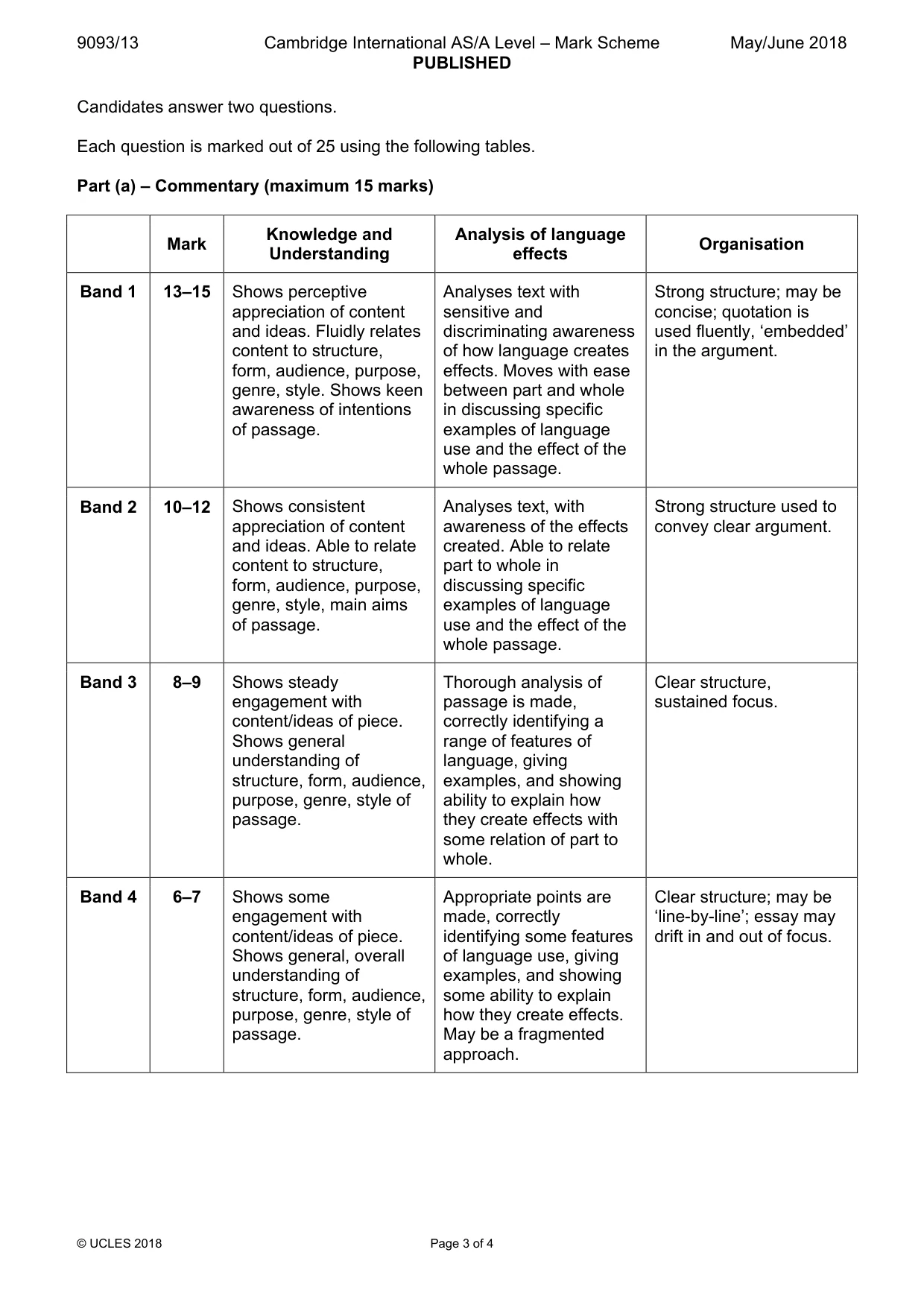
9093/13 Cambridge International AS/A Level – Mark Scheme PUBLISHED May/June 2018 © UCLES 2018 Page 3 of 4 Candidates answer two questions. Each question is marked out of 25 using the following tables. Part (a) – Commentary (maximum 15 marks) Mark Knowledge and Understanding Analysis of language effects Organisation Band 1 13–15 Shows perceptive appreciation of content and ideas. Fluidly relates content to structure, form, audience, purpose, genre, style. Shows keen awareness of intentions of passage. Analyses text with sensitive and discriminating awareness of how language creates effects. Moves with ease between part and whole in discussing specific examples of language use and the effect of the whole passage. Strong structure; may be concise; quotation is used fluently, ‘embedded’ in the argument. Band 2 10–12 Shows consistent appreciation of content and ideas. Able to relate content to structure, form, audience, purpose, genre, style, main aims of passage. Analyses text, with awareness of the effects created. Able to relate part to whole in discussing specific examples of language use and the effect of the whole passage. Strong structure used to convey clear argument. Band 3 8–9 Shows steady engagement with content/ideas of piece. Shows general understanding of structure, form, audience, purpose, genre, style of passage. Thorough analysis of passage is made, correctly identifying a range of features of language, giving examples, and showing ability to explain how they create effects with some relation of part to whole. Clear structure, sustained focus. Band 4 6–7 Shows some engagement with content/ideas of piece. Shows general, overall understanding of structure, form, audience, purpose, genre, style of passage. Appropriate points are made, correctly identifying some features of language use, giving examples, and showing some ability to explain how they create effects. May be a fragmented approach. Clear structure; may be ‘line-by-line’; essay may drift in and out of focus.
Mark scheme, page 4
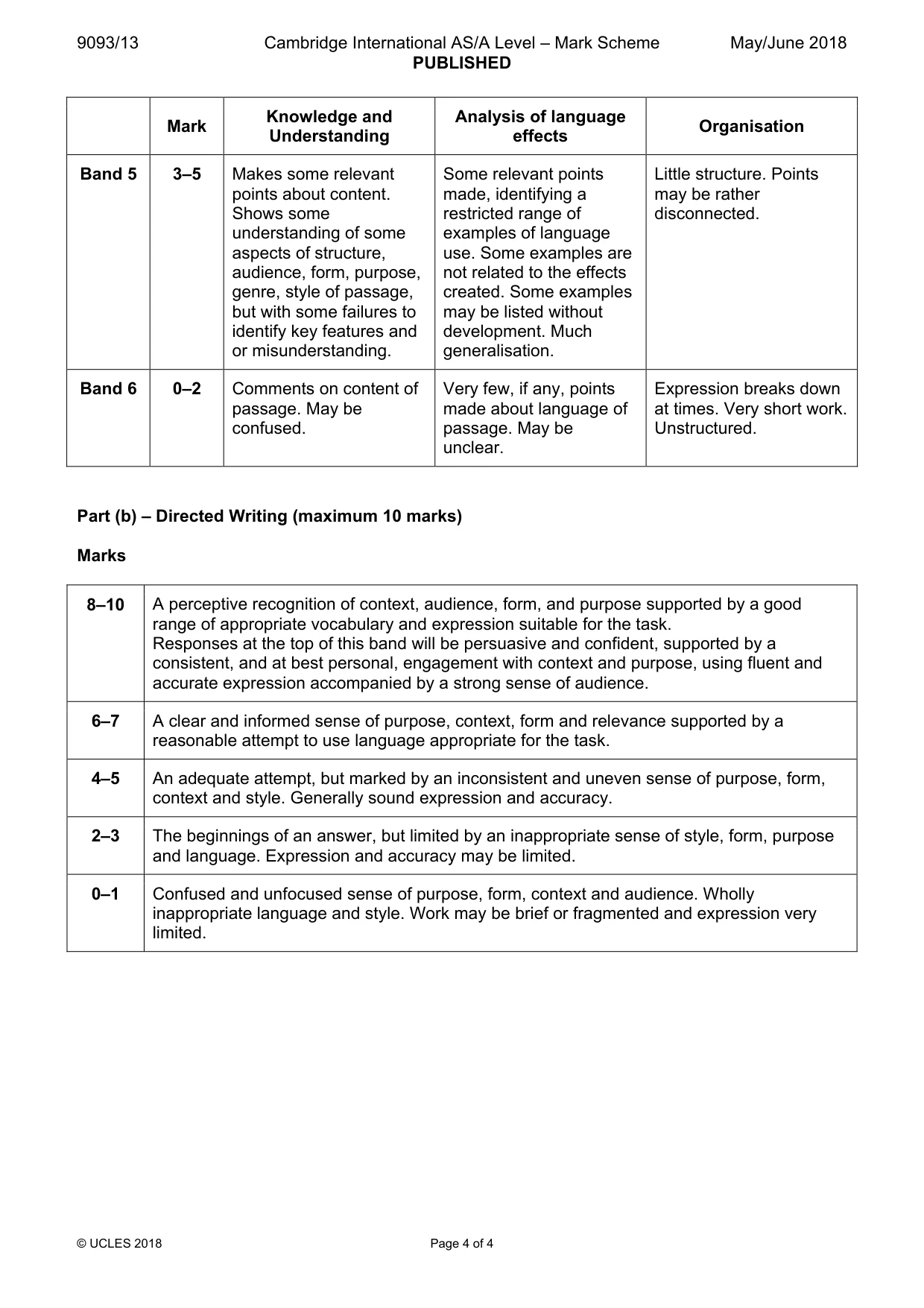
9093/13 Cambridge International AS/A Level – Mark Scheme PUBLISHED May/June 2018 © UCLES 2018 Page 4 of 4 Mark Knowledge and Understanding Analysis of language effects Organisation Band 5 3–5 Makes some relevant points about content. Shows some understanding of some aspects of structure, audience, form, purpose, genre, style of passage, but with some failures to identify key features and or misunderstanding. Some relevant points made, identifying a restricted range of examples of language use. Some examples are not related to the effects created. Some examples may be listed without development. Much generalisation. Little structure. Points may be rather disconnected. Band 6 0–2 Comments on content of passage. May be confused. Very few, if any, points made about language of passage. May be unclear. Expression breaks down at times. Very short work. Unstructured. Part (b) – Directed Writing (maximum 10 marks) Marks 8–10 A perceptive recognition of context, audience, form, and purpose supported by a good range of appropriate vocabulary and expression suitable for the task. Responses at the top of this band will be persuasive and confident, supported by a consistent, and at best personal, engagement with context and purpose, using fluent and accurate expression accompanied by a strong sense of audience. 6–7 A clear and informed sense of purpose, context, form and relevance supported by a reasonable attempt to use language appropriate for the task. 4–5 An adequate attempt, but marked by an inconsistent and uneven sense of purpose, form, context and style. Generally sound expression and accuracy. 2–3 The beginnings of an answer, but limited by an inappropriate sense of style, form, purpose and language. Expression and accuracy may be limited. 0–1 Confused and unfocused sense of purpose, form, context and audience. Wholly inappropriate language and style. Work may be brief or fragmented and expression very limited.
What you needed in this session
Cambridge’s own grade thresholds for 2018 May/June, Paper 1 · Variant 3. A higher threshold means an easier paper — the bar moves with how the cohort did.