Cambridge A Level English - Language AS and A Level (from 2014) 9093 — 2018 May/June Paper 1 · Variant 2
9093/12/M/J/18 · 50 marks · ≈56 min
The question paper and its mark scheme, free to read here and free to download. This is Cambridge’s own paper, exactly as it was sat.
Question paper8 pages

Mark scheme4 pages
Answers below. Sit the paper first if you are practising.
Paper as text
Question paper, page 1
* 7 2 4 3 5 9 1 3 0 6 * This document consists of 6 printed pages, 2 blank pages and 1 Insert. DC (SC) 146705/3 © UCLES 2018 [Turn over Cambridge International Examinations Cambridge International Advanced Subsidiary and Advanced Level ENGLISH LANGUAGE 9093/12 Paper 1 Passages May/June 2018 2 hours 15 minutes No Additional Materials are required. READ THESE INSTRUCTIONS FIRST An answer booklet is provided inside this question paper. You should follow the instructions on the front cover of the answer booklet. If you need additional answer paper, ask the invigilator for a continuation booklet. Answer two questions: Question 1 and either Question 2 or Question 3. You should spend about 15 minutes reading the passages and questions before you start writing your answers. You are reminded of the need for good English and clear presentation in your answers. The number of marks is given in brackets [ ] at the end of each question or part question.
Question paper, page 2
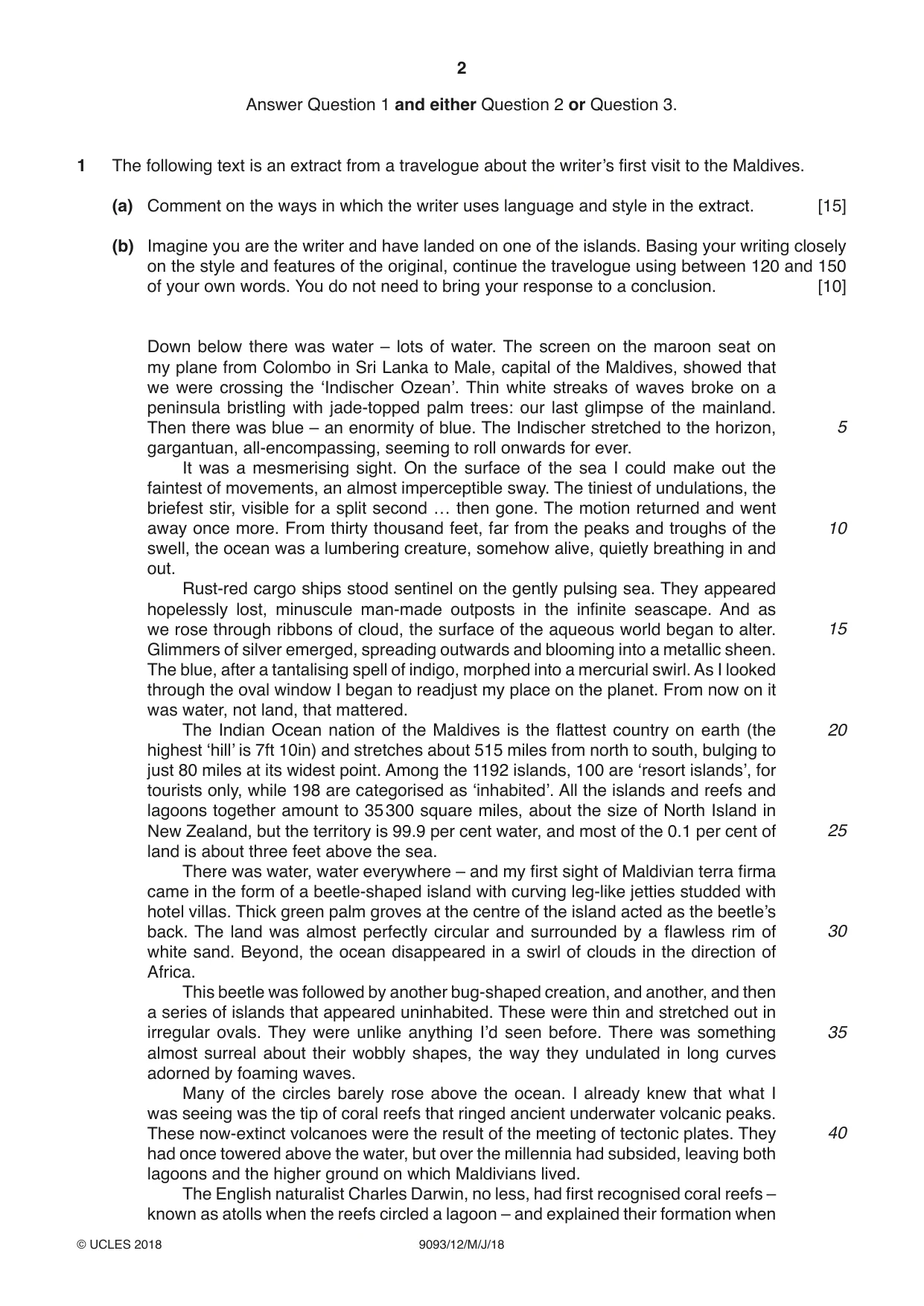
2 9093/12/M/J/18 © UCLES 2018 Answer Question 1 and either Question 2 or Question 3. 1 The following text is an extract from a travelogue about the writer’s first visit to the Maldives. (a) Comment on the ways in which the writer uses language and style in the extract. [15] (b) Imagine you are the writer and have landed on one of the islands. Basing your writing closely on the style and features of the original, continue the travelogue using between 120 and 150 of your own words. You do not need to bring your response to a conclusion. [10] Down below there was water – lots of water. The screen on the maroon seat on my plane from Colombo in Sri Lanka to Male, capital of the Maldives, showed that we were crossing the ‘Indischer Ozean’. Thin white streaks of waves broke on a peninsula bristling with jade-topped palm trees: our last glimpse of the mainland. Then there was blue – an enormity of blue. The Indischer stretched to the horizon, gargantuan, all-encompassing, seeming to roll onwards for ever. It was a mesmerising sight. On the surface of the sea I could make out the faintest of movements, an almost imperceptible sway. The tiniest of undulations, the briefest stir, visible for a split second … then gone. The motion returned and went away once more. From thirty thousand feet, far from the peaks and troughs of the swell, the ocean was a lumbering creature, somehow alive, quietly breathing in and out. Rust-red cargo ships stood sentinel on the gently pulsing sea. They appeared hopelessly lost, minuscule man-made outposts in the infinite seascape. And as we rose through ribbons of cloud, the surface of the aqueous world began to alter. Glimmers of silver emerged, spreading outwards and blooming into a metallic sheen. The blue, after a tantalising spell of indigo, morphed into a mercurial swirl. As I looked through the oval window I began to readjust my place on the planet. From now on it was water, not land, that mattered. The Indian Ocean nation of the Maldives is the flattest country on earth (the highest ‘hill’ is 7ft 10in) and stretches about 515 miles from north to south, bulging to just 80 miles at its widest point. Among the 1192 islands, 100 are ‘resort islands’, for tourists only, while 198 are categorised as ‘inhabited’. All the islands and reefs and lagoons together amount to 35 300 square miles, about the size of North Island in New Zealand, but the territory is 99.9 per cent water, and most of the 0.1 per cent of land is about three feet above the sea. There was water, water everywhere – and my first sight of Maldivian terra firma came in the form of a beetle-shaped island with curving leg-like jetties studded with hotel villas. Thick green palm groves at the centre of the island acted as the beetle’s back. The land was almost perfectly circular and surrounded by a flawless rim of white sand. Beyond, the ocean disappeared in a swirl of clouds in the direction of Africa. This beetle was followed by another bug-shaped creation, and another, and then a series of islands that appeared uninhabited. These were thin and stretched out in irregular ovals. They were unlike anything I’d seen before. There was something almost surreal about their wobbly shapes, the way they undulated in long curves adorned by foaming waves. Many of the circles barely rose above the ocean. I already knew that what I was seeing was the tip of coral reefs that ringed ancient underwater volcanic peaks. These now-extinct volcanoes were the result of the meeting of tectonic plates. They had once towered above the water, but over the millennia had subsided, leaving both lagoons and the higher ground on which Maldivians lived. The English naturalist Charles Darwin, no less, had first recognised coral reefs – known as atolls when the reefs circled a lagoon – and explained their formation when 5 10 15 20 25 30 35 40
Question paper, page 3
3 9093/12/M/J/18 © UCLES 2018 [Turn over pottering about the world’s oceans in the 1830s on his ship, HMS Beagle. The peaks were part of an enormous ridge that ran from Madagascar to India, the submerged mountain range to which I was headed. 45
Question paper, page 4
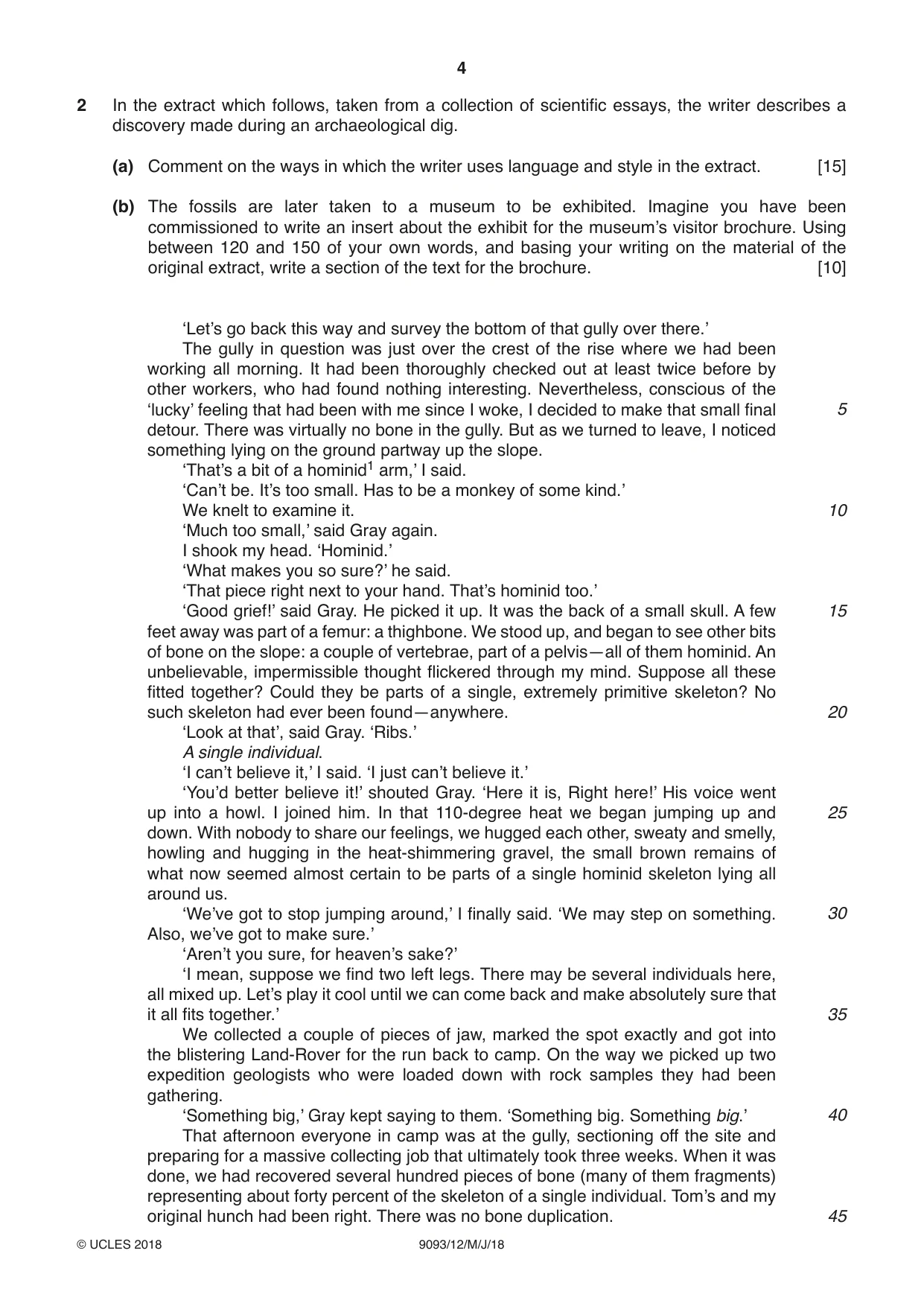
4 9093/12/M/J/18 © UCLES 2018 2 In the extract which follows, taken from a collection of scientific essays, the writer describes a discovery made during an archaeological dig. (a) Comment on the ways in which the writer uses language and style in the extract. [15] (b) The fossils are later taken to a museum to be exhibited. Imagine you have been commissioned to write an insert about the exhibit for the museum’s visitor brochure. Using between 120 and 150 of your own words, and basing your writing on the material of the original extract, write a section of the text for the brochure. [10] ‘Let’s go back this way and survey the bottom of that gully over there.’ The gully in question was just over the crest of the rise where we had been working all morning. It had been thoroughly checked out at least twice before by other workers, who had found nothing interesting. Nevertheless, conscious of the ‘lucky’ feeling that had been with me since I woke, I decided to make that small final detour. There was virtually no bone in the gully. But as we turned to leave, I noticed something lying on the ground partway up the slope. ‘That’s a bit of a hominid1 arm,’ I said. ‘Can’t be. It’s too small. Has to be a monkey of some kind.’ We knelt to examine it. ‘Much too small,’ said Gray again. I shook my head. ‘Hominid.’ ‘What makes you so sure?’ he said. ‘That piece right next to your hand. That’s hominid too.’ ‘Good grief!’ said Gray. He picked it up. It was the back of a small skull. A few feet away was part of a femur: a thighbone. We stood up, and began to see other bits of bone on the slope: a couple of vertebrae, part of a pelvis—all of them hominid. An unbelievable, impermissible thought flickered through my mind. Suppose all these fitted together? Could they be parts of a single, extremely primitive skeleton? No such skeleton had ever been found—anywhere. ‘Look at that’, said Gray. ‘Ribs.’ A single individual. ‘I can’t believe it,’ I said. ‘I just can’t believe it.’ ‘You’d better believe it!’ shouted Gray. ‘Here it is, Right here!’ His voice went up into a howl. I joined him. In that 110-degree heat we began jumping up and down. With nobody to share our feelings, we hugged each other, sweaty and smelly, howling and hugging in the heat-shimmering gravel, the small brown remains of what now seemed almost certain to be parts of a single hominid skeleton lying all around us. ‘We’ve got to stop jumping around,’ I finally said. ‘We may step on something. Also, we’ve got to make sure.’ ‘Aren’t you sure, for heaven’s sake?’ ‘I mean, suppose we find two left legs. There may be several individuals here, all mixed up. Let’s play it cool until we can come back and make absolutely sure that it all fits together.’ We collected a couple of pieces of jaw, marked the spot exactly and got into the blistering Land-Rover for the run back to camp. On the way we picked up two expedition geologists who were loaded down with rock samples they had been gathering. ‘Something big,’ Gray kept saying to them. ‘Something big. Something big.’ That afternoon everyone in camp was at the gully, sectioning off the site and preparing for a massive collecting job that ultimately took three weeks. When it was done, we had recovered several hundred pieces of bone (many of them fragments) representing about forty percent of the skeleton of a single individual. Tom’s and my original hunch had been right. There was no bone duplication. 5 10 15 20 25 30 35 40 45
Question paper, page 5
5 9093/12/M/J/18 © UCLES 2018 [Turn over But a single individual of what? On preliminary examination it was very hard to say, for nothing quite like it had ever been discovered. The camp was rocking with excitement. That first night we never went to bed at all. 1hominid: the group consisting of all Modern and Great Apes, including humans
Question paper, page 6
6 9093/12/M/J/18 © UCLES 2018 3 In the following text, taken from an anthology of travel writing, the author remembers joining a group of children and their uncle on a boat journey in the South Pacific. (a) Comment on the ways in which the writer uses language and style to present his thoughts and feelings. [15] (b) Years later, Uncle Joe writes a letter to Mitchey. In his letter, the uncle recalls the same boat trip and shares his own memories of it. Using your own words, and basing your writing closely on the material in the original passage, write a section (between 120 and 150 words) of Uncle Joe’s letter. [10] UNCLE JOE’S OUTING South Pacific, June 1995 Joining a group of children on an outing in the South Seas brought back memories of long-gone summers. It was darkening now, and a fat moon rose behind the island, showering the shallows with light. Needles of phosphorescence ignited in the wake of the boat as it moved in towards the beach. Uncle Joe had cut the engine, and one of the island boys stood on the bow, poling us into the smooth waters near the shoreline. Behind us the Calvados Islands stretched off towards New Guinea, and beyond that the great immensity of Asia. An hour earlier we crossed the last great coral reef before Neimoa, Uncle Joe steering carefully while an islander whispered directions in his ear. No matter how many times he had crossed this jagged obstacle course, he wanted the voice of an islander in his ear, whispering the turns of the wheel like a prayer. And then we were clear into the lee of the Calvados where a marlin1 leapt across our bows and the schools of flying fish chased across the waves, while the children cheered and sang: ‘Five little hungry frogs sitting on a great big log, eating all the delicious bugs, yum, yum.’ Now in the shallows one of them had seen a shark. It lay straight ahead in the shaky light-beams of Uncle Joe’s ancient torch, a small sandshark dozing in the white sands of the shallows. The three children were on holiday with their Uncle Joe and they had begged him to rescue them from the boredom of the summer holidays. The youngest was called Mitchey, and his two sisters began to tease him. ‘That shark will eat you Mitchey,’ they cried. But Mitchey wasn’t bothered. He knew the sandshark only cared about fish. We made the last kilometres of the journey on a small fishing skip. The island smell, ozone, hibiscus, coconut, sweet wild grass, flowed towards us on the night breeze and Mitchey, who had spoken all the way down about leaping on to the beach, fell fast asleep, and was carried on to the sand by his eldest sister. Over the next three days, I watched the children as they followed Uncle Joe from one end of the island to the other. They teased Mitchey relentlessly and then cuddled him; they pretended to steal his food, and then fed him with toffees. In the mornings, they would run diving into the crystal waters, hooting and shrieking, splashing each other until, exhausted from the play, they would fall on the hot sand and sing of the small frogs or tunes of the South Seas unknown to me. When I left them, watching their smiling faces growing ever more distant, as the boat began its inexorable2 journey out of Eden, I felt a pang for all my own summers past and gone, and for the adult life with all its trials that even now was slowly swimming towards them. 1marlin: a large marine fish 2inexorable: impossible to stop or prevent 5 10 15 20 25 30 35
Question paper, page 7
7 9093/12/M/J/18 © UCLES 2018 BLANK PAGE
Question paper, page 8
8 9093/12/M/J/18 © UCLES 2018 BLANK PAGE Permission to reproduce items where third-party owned material protected by copyright is included has been sought and cleared where possible. Every reasonable effort has been made by the publisher (UCLES) to trace copyright holders, but if any items requiring clearance have unwittingly been included, the publisher will be pleased to make amends at the earliest possible opportunity. To avoid the issue of disclosure of answer-related information to candidates, all copyright acknowledgements are reproduced online in the Cambridge International Examinations Copyright Acknowledgements Booklet. This is produced for each series of examinations and is freely available to download at www.cie.org.uk after the live examination series. Cambridge International Examinations is part of the Cambridge Assessment Group. Cambridge Assessment is the brand name of University of Cambridge Local Examinations Syndicate (UCLES), which is itself a department of the University of Cambridge.
Mark scheme, page 1
IGCSE™ is a registered trademark. This document consists of 4 printed pages. © UCLES 2018 [Turn over Cambridge Assessment International Education Cambridge International Advanced Subsidiary and Advanced Level ENGLISH LANGUAGE 9093/12 Paper 1 Passages May/June 2018 MARK SCHEME Maximum Mark: 50 Published This mark scheme is published as an aid to teachers and candidates, to indicate the requirements of the examination. It shows the basis on which Examiners were instructed to award marks. It does not indicate the details of the discussions that took place at an Examiners’ meeting before marking began, which would have considered the acceptability of alternative answers. Mark schemes should be read in conjunction with the question paper and the Principal Examiner Report for Teachers. Cambridge International will not enter into discussions about these mark schemes. Cambridge International is publishing the mark schemes for the May/June 2018 series for most Cambridge IGCSE™, Cambridge International A and AS Level and Cambridge Pre-U components, and some Cambridge O Level components.
Mark scheme, page 2
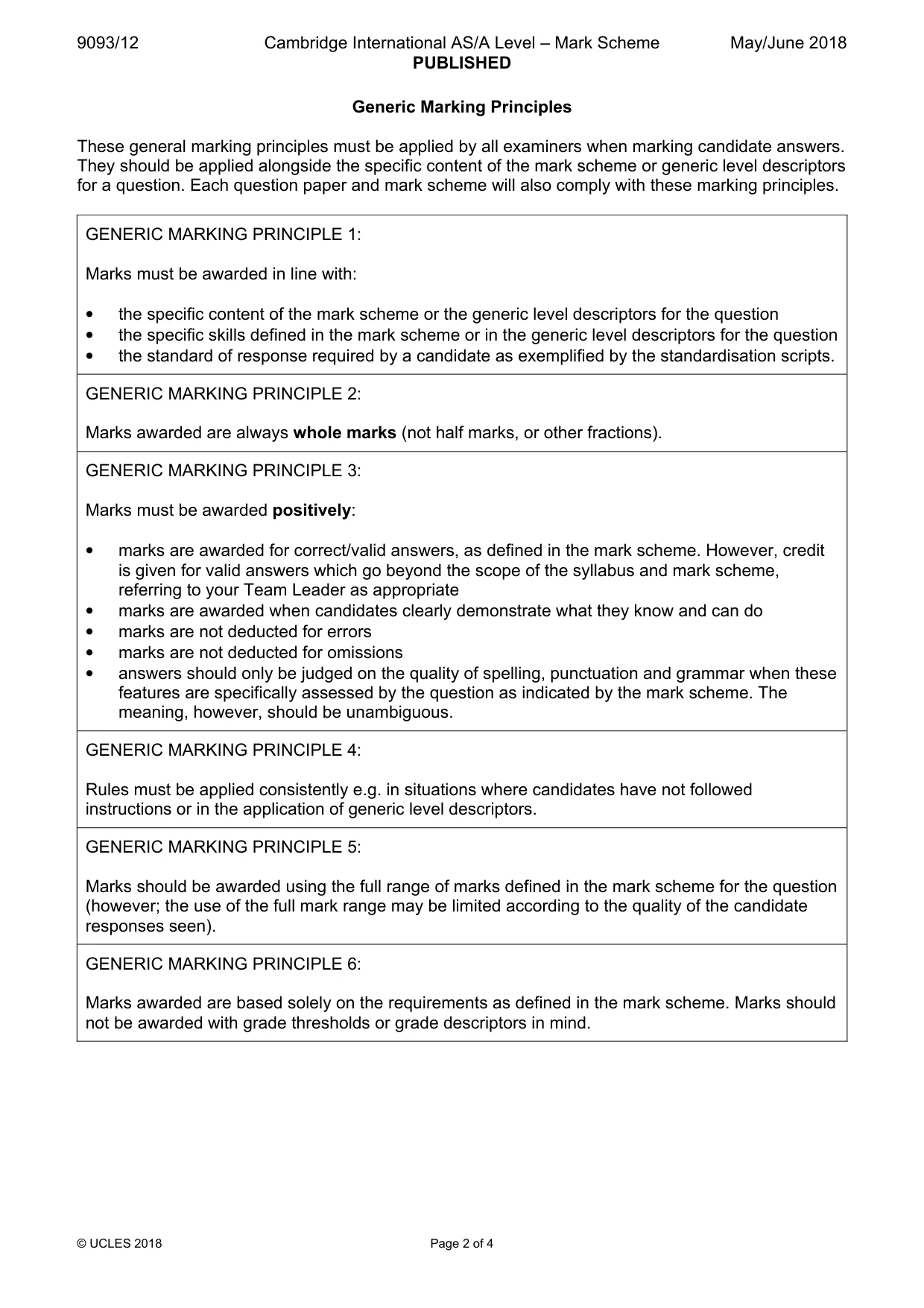
9093/12 Cambridge International AS/A Level – Mark Scheme PUBLISHED May/June 2018 © UCLES 2018 Page 2 of 4 Generic Marking Principles These general marking principles must be applied by all examiners when marking candidate answers. They should be applied alongside the specific content of the mark scheme or generic level descriptors for a question. Each question paper and mark scheme will also comply with these marking principles. GENERIC MARKING PRINCIPLE 1: Marks must be awarded in line with: • the specific content of the mark scheme or the generic level descriptors for the question • the specific skills defined in the mark scheme or in the generic level descriptors for the question • the standard of response required by a candidate as exemplified by the standardisation scripts. GENERIC MARKING PRINCIPLE 2: Marks awarded are always whole marks (not half marks, or other fractions). GENERIC MARKING PRINCIPLE 3: Marks must be awarded positively: • marks are awarded for correct/valid answers, as defined in the mark scheme. However, credit is given for valid answers which go beyond the scope of the syllabus and mark scheme, referring to your Team Leader as appropriate • marks are awarded when candidates clearly demonstrate what they know and can do • marks are not deducted for errors • marks are not deducted for omissions • answers should only be judged on the quality of spelling, punctuation and grammar when these features are specifically assessed by the question as indicated by the mark scheme. The meaning, however, should be unambiguous. GENERIC MARKING PRINCIPLE 4: Rules must be applied consistently e.g. in situations where candidates have not followed instructions or in the application of generic level descriptors. GENERIC MARKING PRINCIPLE 5: Marks should be awarded using the full range of marks defined in the mark scheme for the question (however; the use of the full mark range may be limited according to the quality of the candidate responses seen). GENERIC MARKING PRINCIPLE 6: Marks awarded are based solely on the requirements as defined in the mark scheme. Marks should not be awarded with grade thresholds or grade descriptors in mind.
Mark scheme, page 3
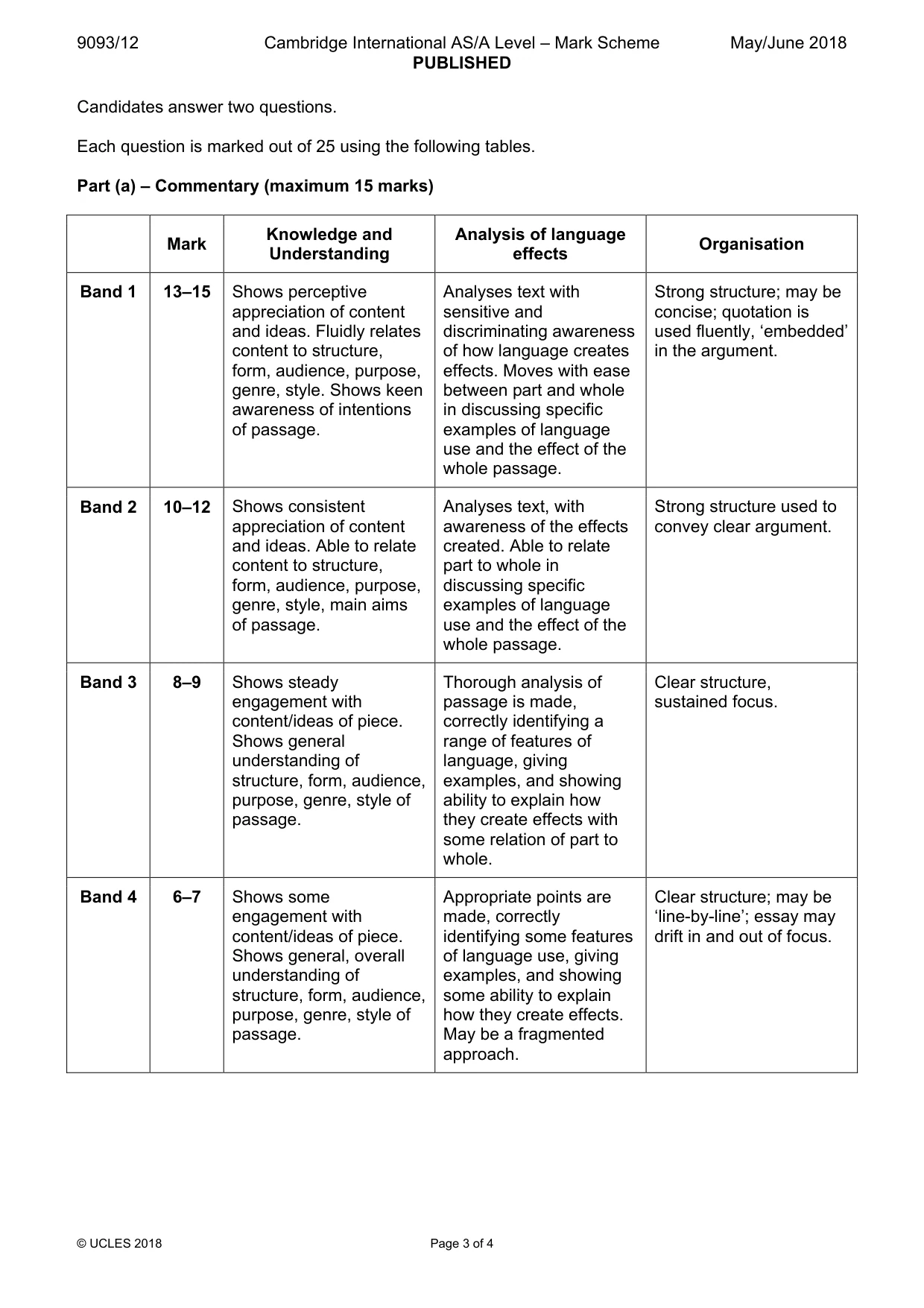
9093/12 Cambridge International AS/A Level – Mark Scheme PUBLISHED May/June 2018 © UCLES 2018 Page 3 of 4 Candidates answer two questions. Each question is marked out of 25 using the following tables. Part (a) – Commentary (maximum 15 marks) Mark Knowledge and Understanding Analysis of language effects Organisation Band 1 13–15 Shows perceptive appreciation of content and ideas. Fluidly relates content to structure, form, audience, purpose, genre, style. Shows keen awareness of intentions of passage. Analyses text with sensitive and discriminating awareness of how language creates effects. Moves with ease between part and whole in discussing specific examples of language use and the effect of the whole passage. Strong structure; may be concise; quotation is used fluently, ‘embedded’ in the argument. Band 2 10–12 Shows consistent appreciation of content and ideas. Able to relate content to structure, form, audience, purpose, genre, style, main aims of passage. Analyses text, with awareness of the effects created. Able to relate part to whole in discussing specific examples of language use and the effect of the whole passage. Strong structure used to convey clear argument. Band 3 8–9 Shows steady engagement with content/ideas of piece. Shows general understanding of structure, form, audience, purpose, genre, style of passage. Thorough analysis of passage is made, correctly identifying a range of features of language, giving examples, and showing ability to explain how they create effects with some relation of part to whole. Clear structure, sustained focus. Band 4 6–7 Shows some engagement with content/ideas of piece. Shows general, overall understanding of structure, form, audience, purpose, genre, style of passage. Appropriate points are made, correctly identifying some features of language use, giving examples, and showing some ability to explain how they create effects. May be a fragmented approach. Clear structure; may be ‘line-by-line’; essay may drift in and out of focus.
Mark scheme, page 4
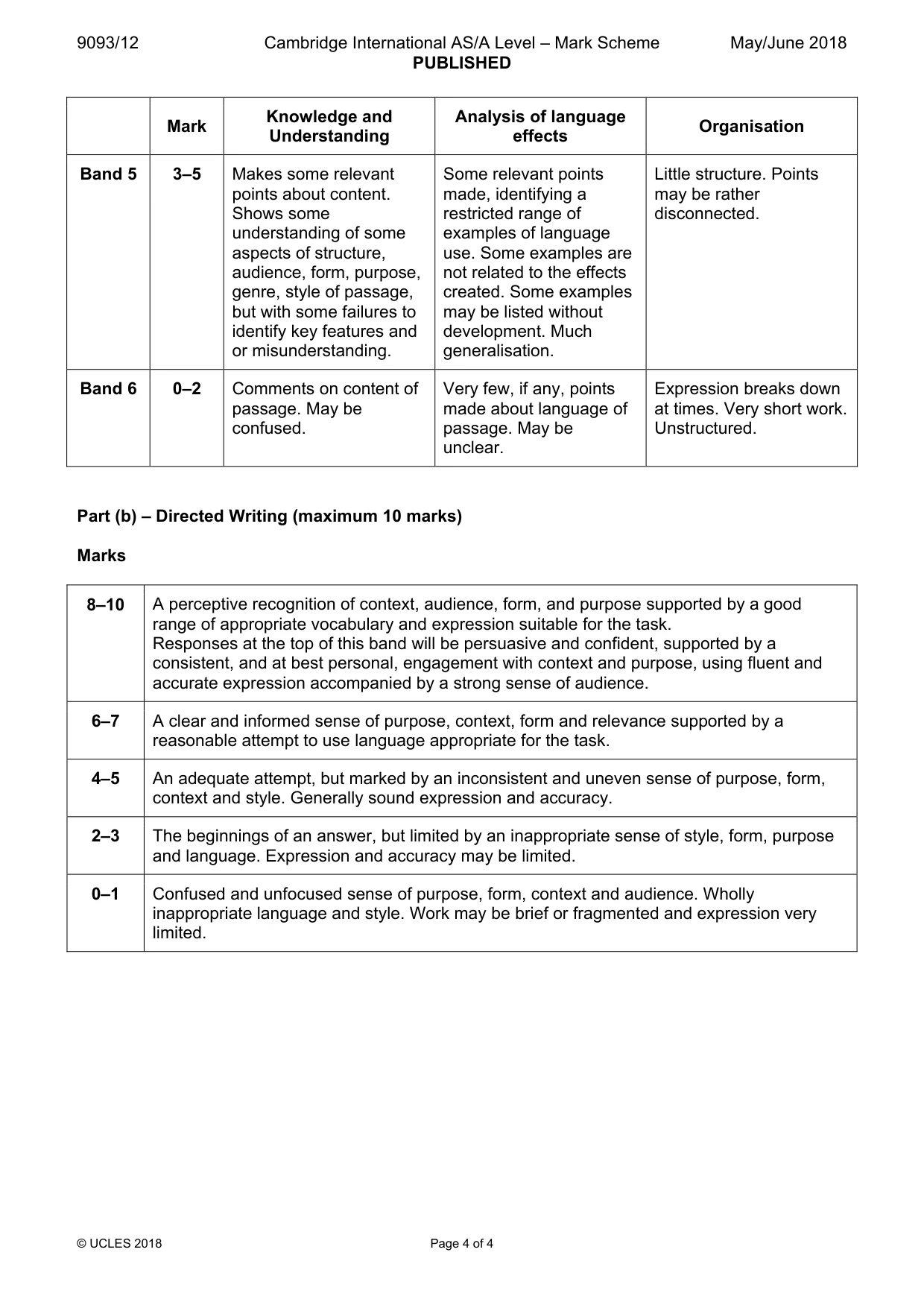
9093/12 Cambridge International AS/A Level – Mark Scheme PUBLISHED May/June 2018 © UCLES 2018 Page 4 of 4 Mark Knowledge and Understanding Analysis of language effects Organisation Band 5 3–5 Makes some relevant points about content. Shows some understanding of some aspects of structure, audience, form, purpose, genre, style of passage, but with some failures to identify key features and or misunderstanding. Some relevant points made, identifying a restricted range of examples of language use. Some examples are not related to the effects created. Some examples may be listed without development. Much generalisation. Little structure. Points may be rather disconnected. Band 6 0–2 Comments on content of passage. May be confused. Very few, if any, points made about language of passage. May be unclear. Expression breaks down at times. Very short work. Unstructured. Part (b) – Directed Writing (maximum 10 marks) Marks 8–10 A perceptive recognition of context, audience, form, and purpose supported by a good range of appropriate vocabulary and expression suitable for the task. Responses at the top of this band will be persuasive and confident, supported by a consistent, and at best personal, engagement with context and purpose, using fluent and accurate expression accompanied by a strong sense of audience. 6–7 A clear and informed sense of purpose, context, form and relevance supported by a reasonable attempt to use language appropriate for the task. 4–5 An adequate attempt, but marked by an inconsistent and uneven sense of purpose, form, context and style. Generally sound expression and accuracy. 2–3 The beginnings of an answer, but limited by an inappropriate sense of style, form, purpose and language. Expression and accuracy may be limited. 0–1 Confused and unfocused sense of purpose, form, context and audience. Wholly inappropriate language and style. Work may be brief or fragmented and expression very limited.
What you needed in this session
Cambridge’s own grade thresholds for 2018 May/June, Paper 1 · Variant 2. A higher threshold means an easier paper — the bar moves with how the cohort did.