Cambridge A Level English - Language AS and A Level (from 2014) 9093 — 2018 May/June Paper 1 · Variant 1
9093/11/M/J/18 · 50 marks · ≈56 min
The question paper and its mark scheme, free to read here and free to download. This is Cambridge’s own paper, exactly as it was sat.
Question paper8 pages

Mark scheme4 pages
Answers below. Sit the paper first if you are practising.
Paper as text
Question paper, page 1
* 5 4 3 8 4 6 5 0 6 8 * This document consists of 7 printed pages, 1 blank page and 1 Insert. DC (SC) 146704/3 © UCLES 2018 [Turn over Cambridge International Examinations Cambridge International Advanced Subsidiary and Advanced Level ENGLISH LANGUAGE 9093/11 Paper 1 Passages May/June 2018 2 hours 15 minutes No Additional Materials are required. READ THESE INSTRUCTIONS FIRST An answer booklet is provided inside this question paper. You should follow the instructions on the front cover of the answer booklet. If you need additional answer paper, ask the invigilator for a continuation booklet. Answer two questions: Question 1 and either Question 2 or Question 3. You should spend about 15 minutes reading the passages and questions before you start writing your answers. You are reminded of the need for good English and clear presentation in your answers. The number of marks is given in brackets [ ] at the end of each question or part question.
Question paper, page 2
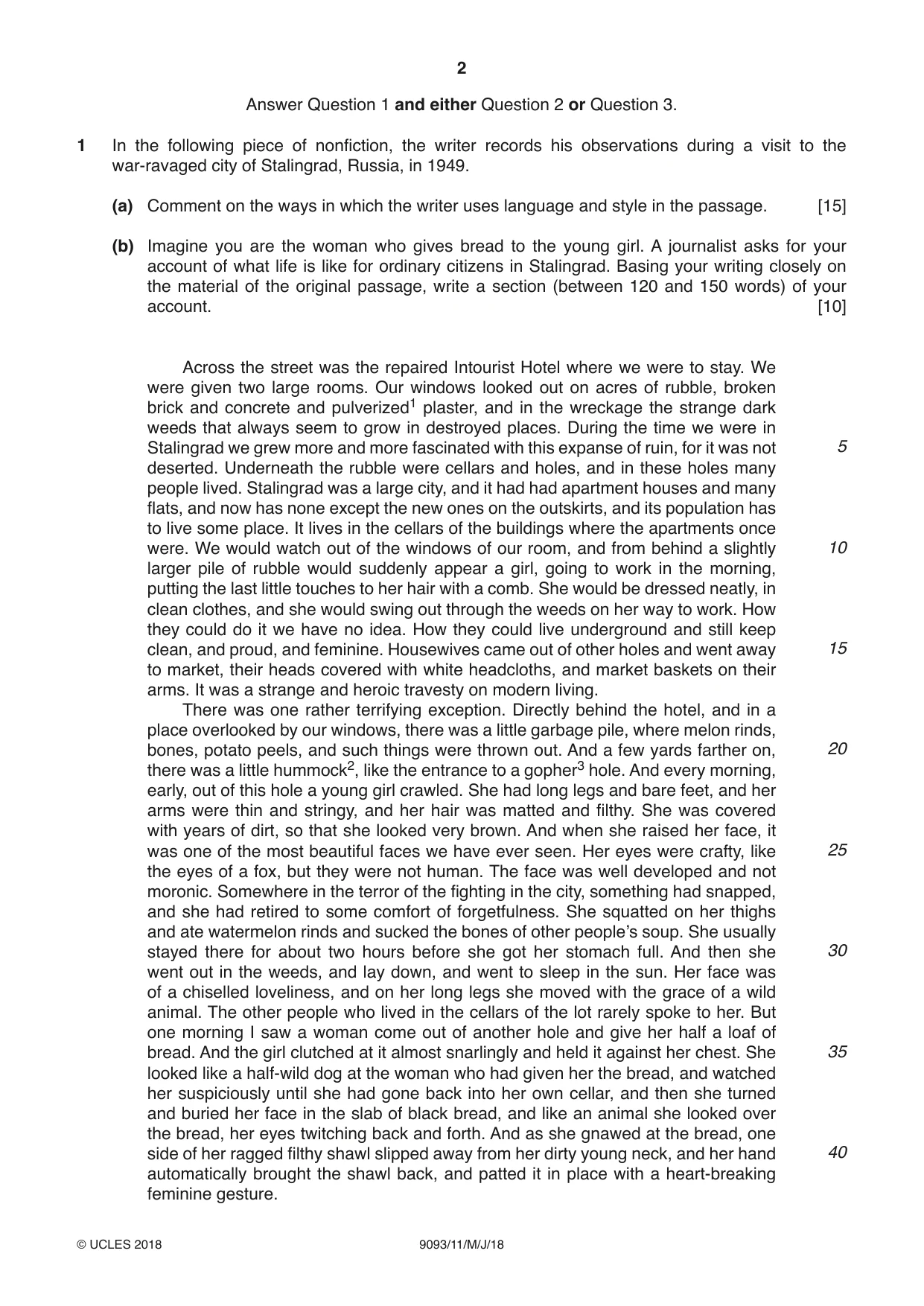
2 9093/11/M/J/18 © UCLES 2018 Answer Question 1 and either Question 2 or Question 3. 1 In the following piece of nonfiction, the writer records his observations during a visit to the war‑ravaged city of Stalingrad, Russia, in 1949. (a) Comment on the ways in which the writer uses language and style in the passage. [15] (b) Imagine you are the woman who gives bread to the young girl. A journalist asks for your account of what life is like for ordinary citizens in Stalingrad. Basing your writing closely on the material of the original passage, write a section (between 120 and 150 words) of your account. [10] Across the street was the repaired Intourist Hotel where we were to stay. We were given two large rooms. Our windows looked out on acres of rubble, broken brick and concrete and pulverized1 plaster, and in the wreckage the strange dark weeds that always seem to grow in destroyed places. During the time we were in Stalingrad we grew more and more fascinated with this expanse of ruin, for it was not deserted. Underneath the rubble were cellars and holes, and in these holes many people lived. Stalingrad was a large city, and it had had apartment houses and many flats, and now has none except the new ones on the outskirts, and its population has to live some place. It lives in the cellars of the buildings where the apartments once were. We would watch out of the windows of our room, and from behind a slightly larger pile of rubble would suddenly appear a girl, going to work in the morning, putting the last little touches to her hair with a comb. She would be dressed neatly, in clean clothes, and she would swing out through the weeds on her way to work. How they could do it we have no idea. How they could live underground and still keep clean, and proud, and feminine. Housewives came out of other holes and went away to market, their heads covered with white headcloths, and market baskets on their arms. It was a strange and heroic travesty on modern living. There was one rather terrifying exception. Directly behind the hotel, and in a place overlooked by our windows, there was a little garbage pile, where melon rinds, bones, potato peels, and such things were thrown out. And a few yards farther on, there was a little hummock2, like the entrance to a gopher3 hole. And every morning, early, out of this hole a young girl crawled. She had long legs and bare feet, and her arms were thin and stringy, and her hair was matted and filthy. She was covered with years of dirt, so that she looked very brown. And when she raised her face, it was one of the most beautiful faces we have ever seen. Her eyes were crafty, like the eyes of a fox, but they were not human. The face was well developed and not moronic. Somewhere in the terror of the fighting in the city, something had snapped, and she had retired to some comfort of forgetfulness. She squatted on her thighs and ate watermelon rinds and sucked the bones of other people’s soup. She usually stayed there for about two hours before she got her stomach full. And then she went out in the weeds, and lay down, and went to sleep in the sun. Her face was of a chiselled loveliness, and on her long legs she moved with the grace of a wild animal. The other people who lived in the cellars of the lot rarely spoke to her. But one morning I saw a woman come out of another hole and give her half a loaf of bread. And the girl clutched at it almost snarlingly and held it against her chest. She looked like a half‑wild dog at the woman who had given her the bread, and watched her suspiciously until she had gone back into her own cellar, and then she turned and buried her face in the slab of black bread, and like an animal she looked over the bread, her eyes twitching back and forth. And as she gnawed at the bread, one side of her ragged filthy shawl slipped away from her dirty young neck, and her hand automatically brought the shawl back, and patted it in place with a heart‑breaking feminine gesture. 5 10 15 20 25 30 35 40
Question paper, page 3
3 9093/11/M/J/18 © UCLES 2018 [Turn over We wondered how many there might be like this, minds that could not tolerate living in the twentieth century any more, that had retired not to the hills, but into the ancient hills of the human past, into the old wilderness of pleasure, and pain, and self‑preservation. It was a face to dream about for a long time. 1 pulverized: crushed or ground into a fine powder 2 hummock: a small, raised area on a piece of land 3 gopher: a burrowing rodent found in North and Central America 45
Question paper, page 4
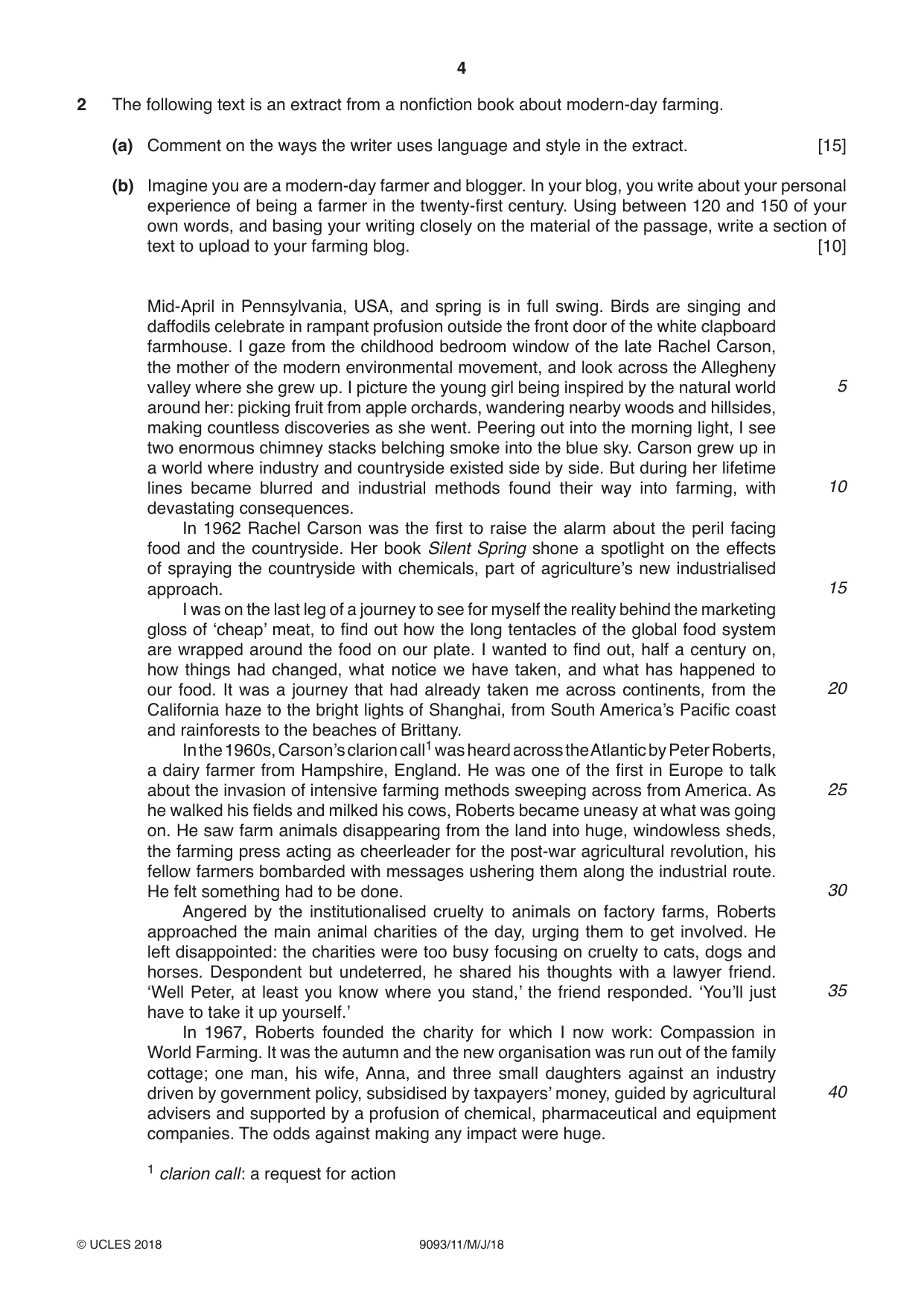
4 9093/11/M/J/18 © UCLES 2018 2 The following text is an extract from a nonfiction book about modern‑day farming. (a) Comment on the ways the writer uses language and style in the extract. [15] (b) Imagine you are a modern‑day farmer and blogger. In your blog, you write about your personal experience of being a farmer in the twenty‑first century. Using between 120 and 150 of your own words, and basing your writing closely on the material of the passage, write a section of text to upload to your farming blog. [10] Mid‑April in Pennsylvania, USA, and spring is in full swing. Birds are singing and daffodils celebrate in rampant profusion outside the front door of the white clapboard farmhouse. I gaze from the childhood bedroom window of the late Rachel Carson, the mother of the modern environmental movement, and look across the Allegheny valley where she grew up. I picture the young girl being inspired by the natural world around her: picking fruit from apple orchards, wandering nearby woods and hillsides, making countless discoveries as she went. Peering out into the morning light, I see two enormous chimney stacks belching smoke into the blue sky. Carson grew up in a world where industry and countryside existed side by side. But during her lifetime lines became blurred and industrial methods found their way into farming, with devastating consequences. In 1962 Rachel Carson was the first to raise the alarm about the peril facing food and the countryside. Her book Silent Spring shone a spotlight on the effects of spraying the countryside with chemicals, part of agriculture’s new industrialised approach. I was on the last leg of a journey to see for myself the reality behind the marketing gloss of ‘cheap’ meat, to find out how the long tentacles of the global food system are wrapped around the food on our plate. I wanted to find out, half a century on, how things had changed, what notice we have taken, and what has happened to our food. It was a journey that had already taken me across continents, from the California haze to the bright lights of Shanghai, from South America’s Pacific coast and rainforests to the beaches of Brittany. In the 1960s, Carson’s clarion call1 was heard across the Atlantic by Peter Roberts, a dairy farmer from Hampshire, England. He was one of the first in Europe to talk about the invasion of intensive farming methods sweeping across from America. As he walked his fields and milked his cows, Roberts became uneasy at what was going on. He saw farm animals disappearing from the land into huge, windowless sheds, the farming press acting as cheerleader for the post‑war agricultural revolution, his fellow farmers bombarded with messages ushering them along the industrial route. He felt something had to be done. Angered by the institutionalised cruelty to animals on factory farms, Roberts approached the main animal charities of the day, urging them to get involved. He left disappointed: the charities were too busy focusing on cruelty to cats, dogs and horses. Despondent but undeterred, he shared his thoughts with a lawyer friend. ‘Well Peter, at least you know where you stand,’ the friend responded. ‘You’ll just have to take it up yourself.’ In 1967, Roberts founded the charity for which I now work: Compassion in World Farming. It was the autumn and the new organisation was run out of the family cottage; one man, his wife, Anna, and three small daughters against an industry driven by government policy, subsidised by taxpayers’ money, guided by agricultural advisers and supported by a profusion of chemical, pharmaceutical and equipment companies. The odds against making any impact were huge. 1 clarion call: a request for action 5 10 15 20 25 30 35 40
Question paper, page 5
5 9093/11/M/J/18 © UCLES 2018 [Turn over TURN OVER FOR QUESTION 3.
Question paper, page 6
6 9093/11/M/J/18 © UCLES 2018 3 The passage which follows is from a nonfiction book about the science of predicting future events. In this chapter, the writer considers the reliability of weather forecasting. (a) Comment on the ways the writer uses language and style in the passage. [15] (b) A national newspaper where you live runs a feature about weather events that have had a significant impact locally. You write a letter to the newspaper describing your own experience of waiting in anticipation of a storm. Basing your writing on the style of the original passage, and using between 120 and 150 of your own words, write a section of the letter. [10] On Tuesday, August 23, 2005, an Air Force reconnaissance plane detected signs of a disturbance over the Bahamas. There were “several small vortices,” it reported, spirals of wind rotating in a counter‑clockwise motion from east to west—away from the expanse of the Atlantic and toward the United States. This disruption in wind patterns was hard to detect from clouds or from satellite data, but cargo ships were beginning to recognize it. The National Hurricane Center thought there was enough evidence to characterize the disturbance as a tropical cyclone, labelling it Tropical Depression Twelve. It was a “tricky” storm that might develop into something more serious or might just as easily dissipate; about half of all tropical depressions in the Atlantic Basin eventually become hurricanes. The depression strengthened quickly, however, and by Wednesday afternoon one of the Hurricane Center’s computer models was already predicting a double landfall in the United States—a first one over southern Florida and a second that might “take the cyclone to New Orleans.” The storm had gathered enough strength to become a hurricane and it was given a name, Katrina. Katrina’s first landfall—it passed just north of Miami and then zoomed through the Florida Everglades a few hours later as a Category 1 hurricane—had not been prolonged enough to threaten many lives. But it had also not been long enough to take much energy out of the storm. Instead, Katrina was gaining strength in the warm waters of the Gulf of Mexico. In the early hours of Saturday morning the forecast really took a turn for the worse: Katrina had become a Category 3 hurricane, on its way to being a Category 5. And its forecast track had gradually been moving westward, away from Florida and toward Mississippi and Louisiana. The computer models were now in agreement: the storm seemed bound for New Orleans. A direct strike of a major hurricane on New Orleans had long been every weather forecaster’s worst nightmare. The city presented a perfect set of circumstances that might contribute to the death and destruction there. On the one hand there was its geography: New Orleans does not border the Gulf of Mexico as much as sink into it. Much of the population lived below sea level and was counting on protection from an outdated system of levees1 and a set of natural barriers that had literally been washing away to sea. On the other hand there was its culture. New Orleans does many things well, but there are two things that it proudly refuses to do. New Orleans does not move quickly, and New Orleans does not place much faith in authority. If it did those things, New Orleans would not really be New Orleans. It would also have been much better prepared to deal with Katrina, since those are the exact two things you need to do when a hurricane threatens to strike. The National Hurricane Center nailed its forecast of Katrina; it anticipated a potential hit on the city almost five days before the levees were breached, and concluded that some version of the nightmare scenario was probably more than forty‑eight hours away. Twenty or thirty years ago, this advance warning would almost certainly not have been possible, and fewer people would have been evacuated. The Hurricane 5 10 15 20 25 30 35 40
Question paper, page 7
7 9093/11/M/J/18 © UCLES 2018 Center’s forecast, and the steady advances made in weather forecasting over the past few decades, undoubtedly saved many lives. Not everyone listened to the forecast, however. About eighty‑thousand New Orleanians—almost a fifth of the city’s population at the time—failed to evacuate the city, and one‑thousand‑six‑hundred of them died. Surveys of the survivors found that about two‑thirds of them did not think the storm would be as bad as it was. Others had been confused by an unclear evacuation order; the city’s mayor, Ray Nagin, waited almost twenty‑four hours to call for a mandatory evacuation, despite pleas from other public officials. Still other residents—impoverished, elderly, or disconnected from the news—could not have fled even if they had wanted to. Weather forecasting is one of the success stories in this book, a case of man and machine joining forces to understand and sometimes anticipate the complexities of nature. That we can sometimes predict nature’s course, however, does not mean we can alter it. Nor does a forecast do much good if there is no one willing to listen to it. The story of Katrina is one of human ingenuity and human error. 1 levees: embankments 45 50 55
Question paper, page 8
8 9093/11/M/J/18 © UCLES 2018 BLANK PAGE Permission to reproduce items where third‑party owned material protected by copyright is included has been sought and cleared where possible. Every reasonable effort has been made by the publisher (UCLES) to trace copyright holders, but if any items requiring clearance have unwittingly been included, the publisher will be pleased to make amends at the earliest possible opportunity. To avoid the issue of disclosure of answer‑related information to candidates, all copyright acknowledgements are reproduced online in the Cambridge International Examinations Copyright Acknowledgements Booklet. This is produced for each series of examinations and is freely available to download at www.cie.org.uk after the live examination series. Cambridge International Examinations is part of the Cambridge Assessment Group. Cambridge Assessment is the brand name of University of Cambridge Local Examinations Syndicate (UCLES), which is itself a department of the University of Cambridge.
Mark scheme, page 1
IGCSE™ is a registered trademark. This document consists of 4 printed pages. © UCLES 2018 [Turn over Cambridge Assessment International Education Cambridge International Advanced Subsidiary and Advanced Level ENGLISH LANGUAGE 9093/11 Paper 1 Passages May/June 2018 MARK SCHEME Maximum Mark: 50 Published This mark scheme is published as an aid to teachers and candidates, to indicate the requirements of the examination. It shows the basis on which Examiners were instructed to award marks. It does not indicate the details of the discussions that took place at an Examiners’ meeting before marking began, which would have considered the acceptability of alternative answers. Mark schemes should be read in conjunction with the question paper and the Principal Examiner Report for Teachers. Cambridge International will not enter into discussions about these mark schemes. Cambridge International is publishing the mark schemes for the May/June 2018 series for most Cambridge IGCSE™, Cambridge International A and AS Level and Cambridge Pre-U components, and some Cambridge O Level components.
Mark scheme, page 2
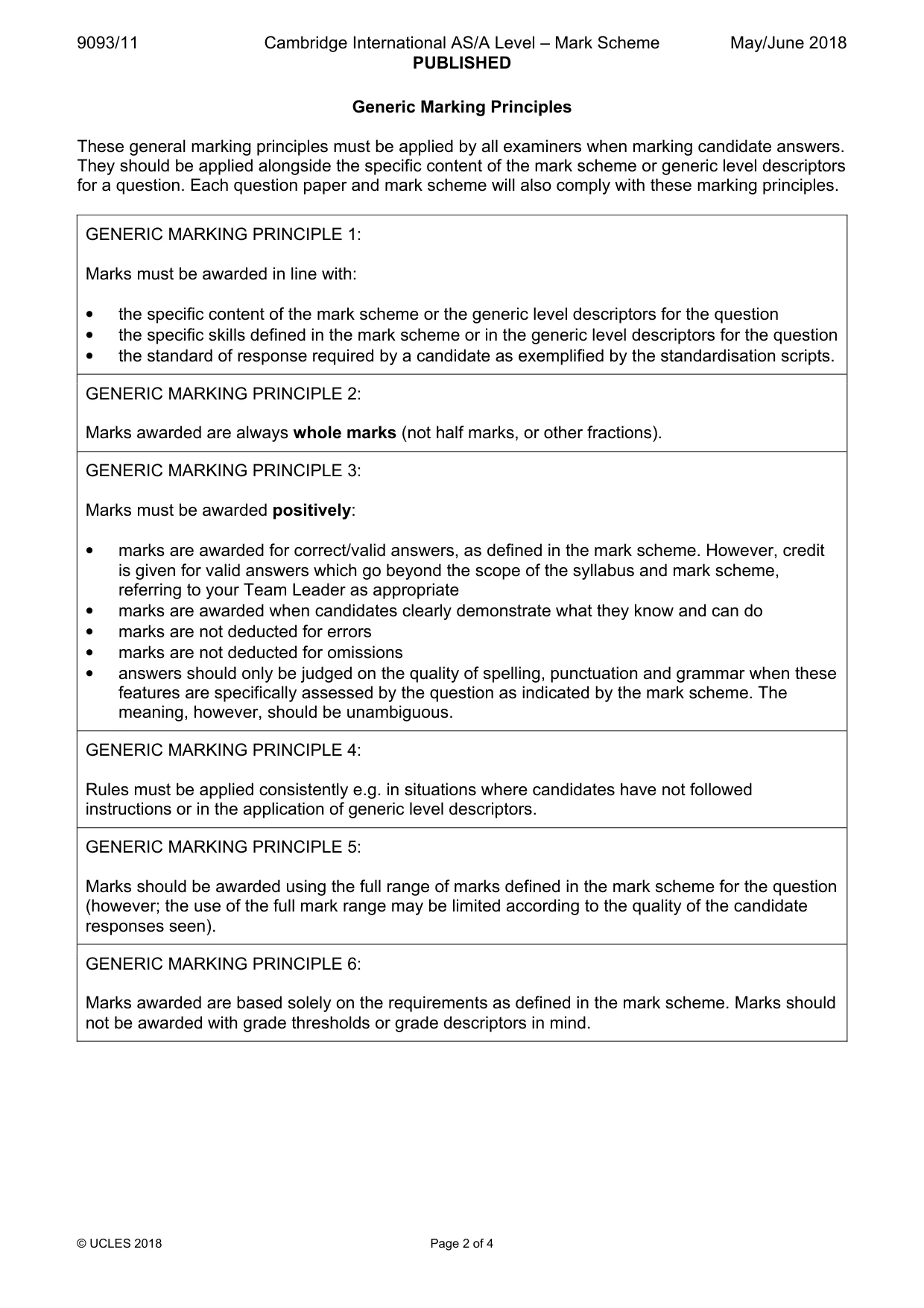
9093/11 Cambridge International AS/A Level – Mark Scheme PUBLISHED May/June 2018 © UCLES 2018 Page 2 of 4 Generic Marking Principles These general marking principles must be applied by all examiners when marking candidate answers. They should be applied alongside the specific content of the mark scheme or generic level descriptors for a question. Each question paper and mark scheme will also comply with these marking principles. GENERIC MARKING PRINCIPLE 1: Marks must be awarded in line with: • the specific content of the mark scheme or the generic level descriptors for the question • the specific skills defined in the mark scheme or in the generic level descriptors for the question • the standard of response required by a candidate as exemplified by the standardisation scripts. GENERIC MARKING PRINCIPLE 2: Marks awarded are always whole marks (not half marks, or other fractions). GENERIC MARKING PRINCIPLE 3: Marks must be awarded positively: • marks are awarded for correct/valid answers, as defined in the mark scheme. However, credit is given for valid answers which go beyond the scope of the syllabus and mark scheme, referring to your Team Leader as appropriate • marks are awarded when candidates clearly demonstrate what they know and can do • marks are not deducted for errors • marks are not deducted for omissions • answers should only be judged on the quality of spelling, punctuation and grammar when these features are specifically assessed by the question as indicated by the mark scheme. The meaning, however, should be unambiguous. GENERIC MARKING PRINCIPLE 4: Rules must be applied consistently e.g. in situations where candidates have not followed instructions or in the application of generic level descriptors. GENERIC MARKING PRINCIPLE 5: Marks should be awarded using the full range of marks defined in the mark scheme for the question (however; the use of the full mark range may be limited according to the quality of the candidate responses seen). GENERIC MARKING PRINCIPLE 6: Marks awarded are based solely on the requirements as defined in the mark scheme. Marks should not be awarded with grade thresholds or grade descriptors in mind.
Mark scheme, page 3
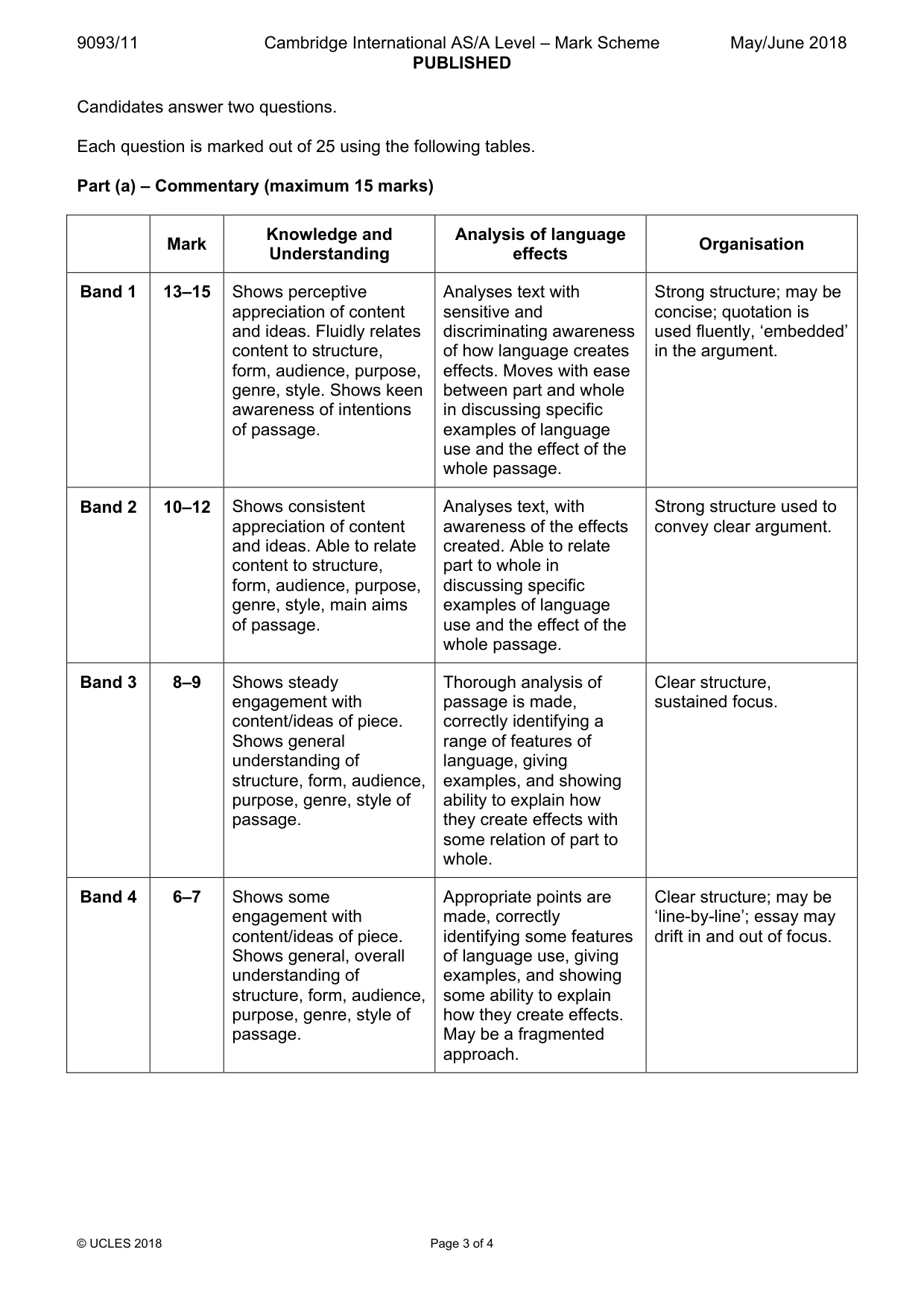
9093/11 Cambridge International AS/A Level – Mark Scheme PUBLISHED May/June 2018 © UCLES 2018 Page 3 of 4 Candidates answer two questions. Each question is marked out of 25 using the following tables. Part (a) – Commentary (maximum 15 marks) Mark Knowledge and Understanding Analysis of language effects Organisation Band 1 13–15 Shows perceptive appreciation of content and ideas. Fluidly relates content to structure, form, audience, purpose, genre, style. Shows keen awareness of intentions of passage. Analyses text with sensitive and discriminating awareness of how language creates effects. Moves with ease between part and whole in discussing specific examples of language use and the effect of the whole passage. Strong structure; may be concise; quotation is used fluently, ‘embedded’ in the argument. Band 2 10–12 Shows consistent appreciation of content and ideas. Able to relate content to structure, form, audience, purpose, genre, style, main aims of passage. Analyses text, with awareness of the effects created. Able to relate part to whole in discussing specific examples of language use and the effect of the whole passage. Strong structure used to convey clear argument. Band 3 8–9 Shows steady engagement with content/ideas of piece. Shows general understanding of structure, form, audience, purpose, genre, style of passage. Thorough analysis of passage is made, correctly identifying a range of features of language, giving examples, and showing ability to explain how they create effects with some relation of part to whole. Clear structure, sustained focus. Band 4 6–7 Shows some engagement with content/ideas of piece. Shows general, overall understanding of structure, form, audience, purpose, genre, style of passage. Appropriate points are made, correctly identifying some features of language use, giving examples, and showing some ability to explain how they create effects. May be a fragmented approach. Clear structure; may be ‘line-by-line’; essay may drift in and out of focus.
Mark scheme, page 4
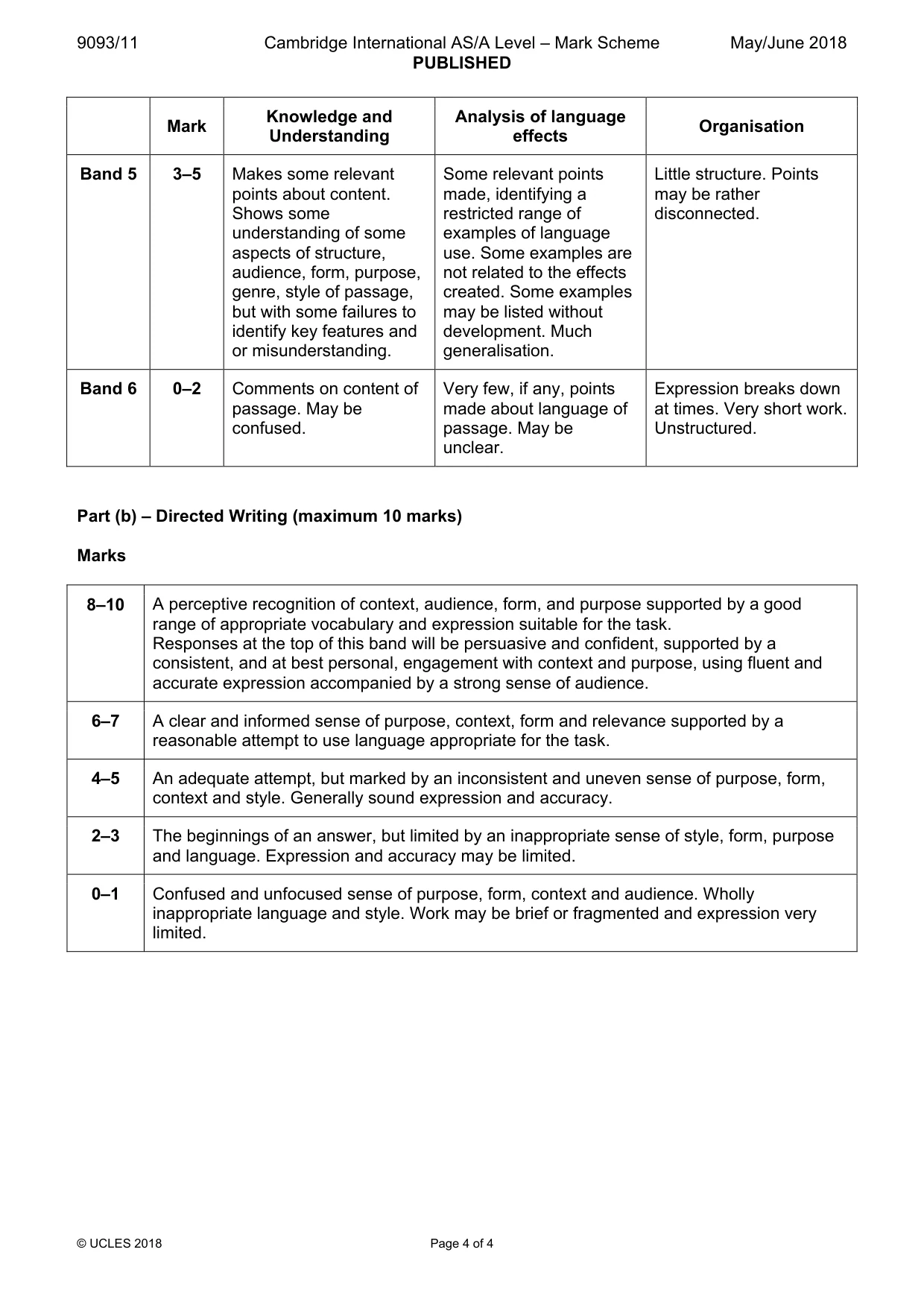
9093/11 Cambridge International AS/A Level – Mark Scheme PUBLISHED May/June 2018 © UCLES 2018 Page 4 of 4 Mark Knowledge and Understanding Analysis of language effects Organisation Band 5 3–5 Makes some relevant points about content. Shows some understanding of some aspects of structure, audience, form, purpose, genre, style of passage, but with some failures to identify key features and or misunderstanding. Some relevant points made, identifying a restricted range of examples of language use. Some examples are not related to the effects created. Some examples may be listed without development. Much generalisation. Little structure. Points may be rather disconnected. Band 6 0–2 Comments on content of passage. May be confused. Very few, if any, points made about language of passage. May be unclear. Expression breaks down at times. Very short work. Unstructured. Part (b) – Directed Writing (maximum 10 marks) Marks 8–10 A perceptive recognition of context, audience, form, and purpose supported by a good range of appropriate vocabulary and expression suitable for the task. Responses at the top of this band will be persuasive and confident, supported by a consistent, and at best personal, engagement with context and purpose, using fluent and accurate expression accompanied by a strong sense of audience. 6–7 A clear and informed sense of purpose, context, form and relevance supported by a reasonable attempt to use language appropriate for the task. 4–5 An adequate attempt, but marked by an inconsistent and uneven sense of purpose, form, context and style. Generally sound expression and accuracy. 2–3 The beginnings of an answer, but limited by an inappropriate sense of style, form, purpose and language. Expression and accuracy may be limited. 0–1 Confused and unfocused sense of purpose, form, context and audience. Wholly inappropriate language and style. Work may be brief or fragmented and expression very limited.
What you needed in this session
Cambridge’s own grade thresholds for 2018 May/June, Paper 1 · Variant 1. A higher threshold means an easier paper — the bar moves with how the cohort did.