Cambridge A Level English - Language AS and A Level (from 2014) 9093 — 2018 Feb/March Paper 3 · Variant 2
9093/32/F/M/18 · 50 marks · ≈56 min
The question paper and its mark scheme, free to read here and free to download. This is Cambridge’s own paper, exactly as it was sat.
Question paper8 pages


Mark scheme6 pages
Answers below. Sit the paper first if you are practising.
Paper as text
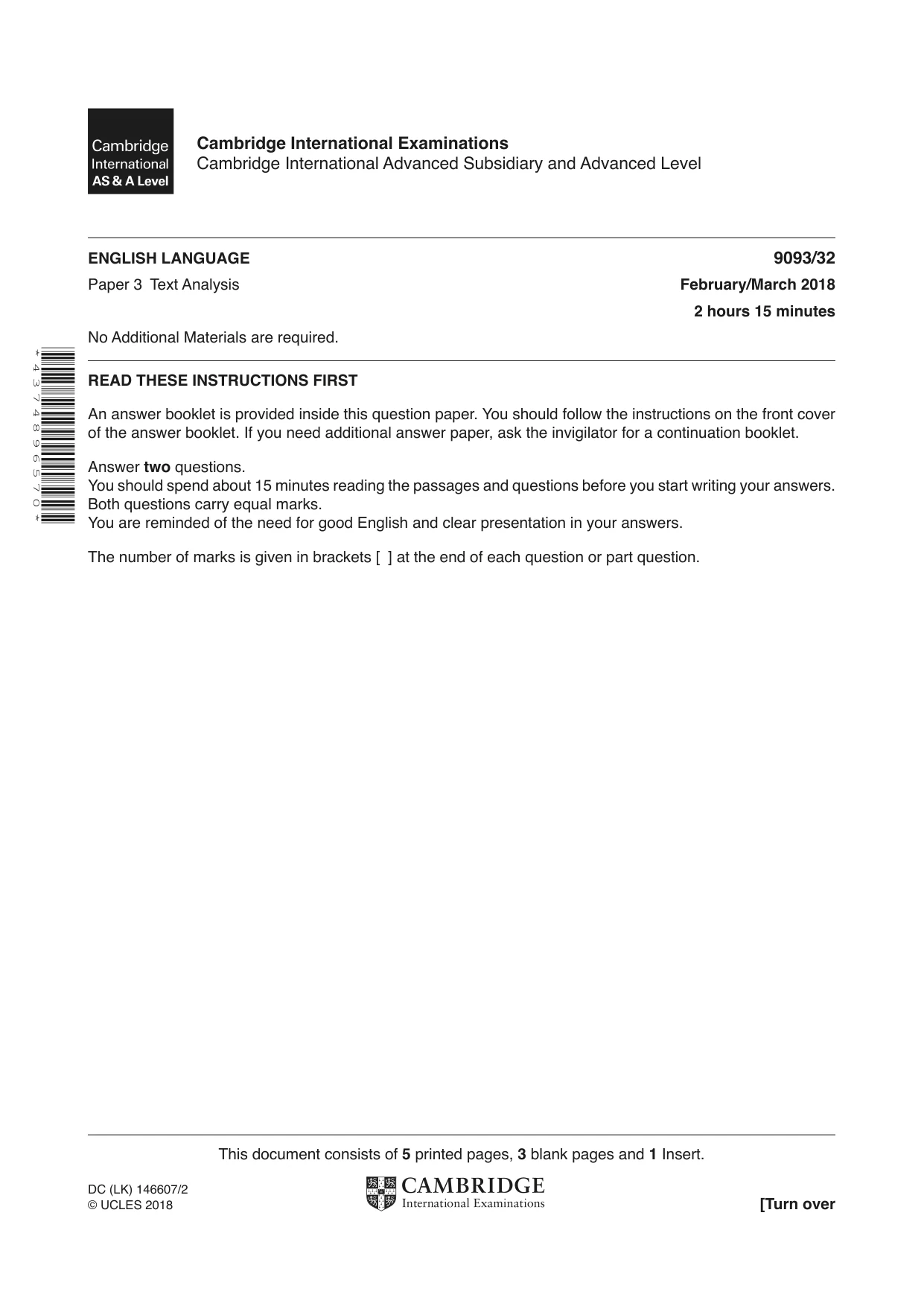
Question paper, page 1
* 4 3 7 4 8 9 6 5 7 0 * This document consists of 5 printed pages, 3 blank pages and 1 Insert. DC (LK) 146607/2 © UCLES 2018 [Turn over Cambridge International Examinations Cambridge International Advanced Subsidiary and Advanced Level ENGLISH LANGUAGE 9093/32 Paper 3 Text Analysis February/March 2018 2 hours 15 minutes No Additional Materials are required. READ THESE INSTRUCTIONS FIRST An answer booklet is provided inside this question paper. You should follow the instructions on the front cover of the answer booklet. If you need additional answer paper, ask the invigilator for a continuation booklet. Answer two questions. You should spend about 15 minutes reading the passages and questions before you start writing your answers. Both questions carry equal marks. You are reminded of the need for good English and clear presentation in your answers. The number of marks is given in brackets [ ] at the end of each question or part question.
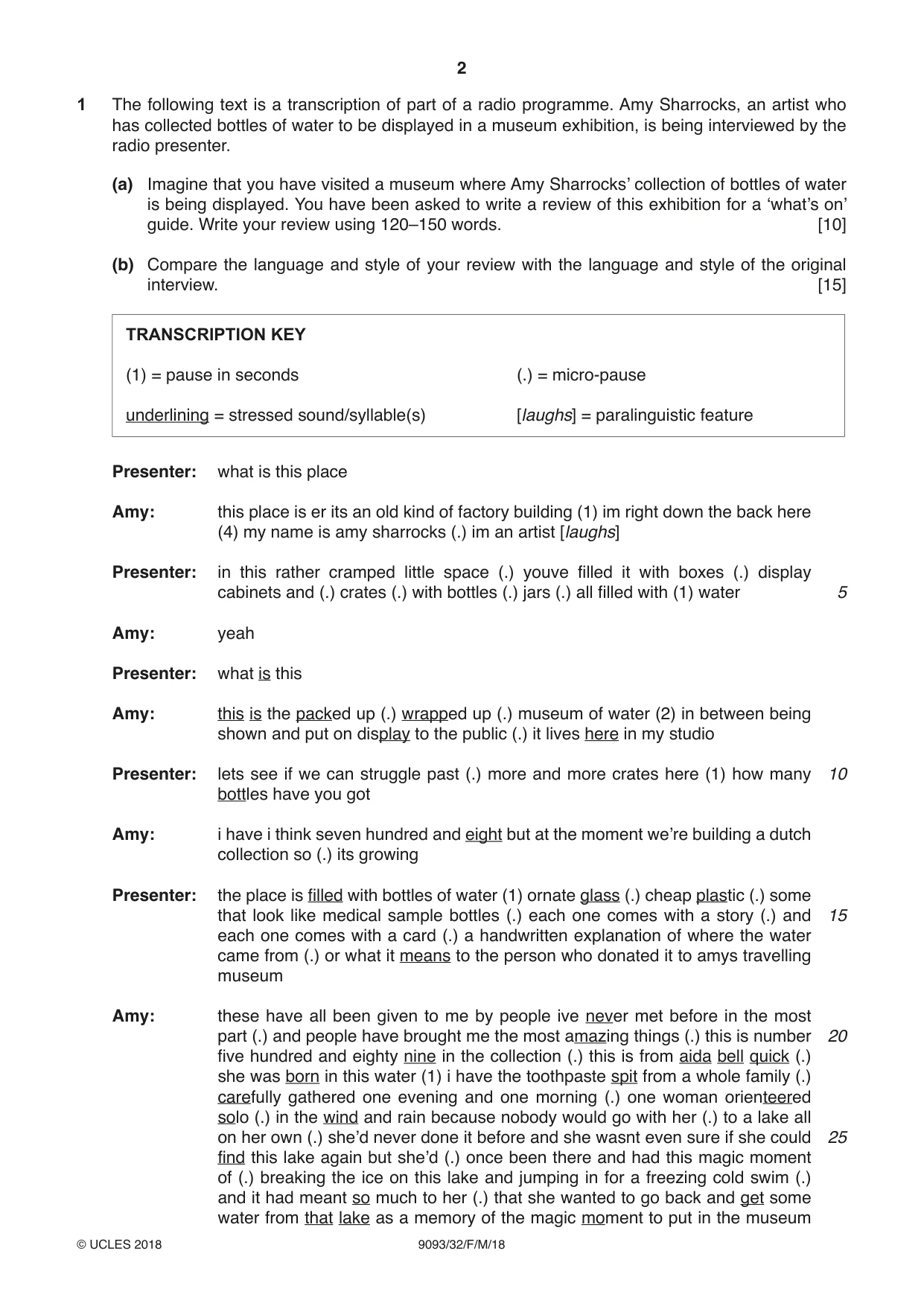
Question paper, page 2
2 9093/32/F/M/18 © UCLES 2018 1 The following text is a transcription of part of a radio programme. Amy Sharrocks, an artist who has collected bottles of water to be displayed in a museum exhibition, is being interviewed by the radio presenter. (a) Imagine that you have visited a museum where Amy Sharrocks’ collection of bottles of water is being displayed. You have been asked to write a review of this exhibition for a ‘what’s on’ guide. Write your review using 120–150 words. [10] (b) Compare the language and style of your review with the language and style of the original interview. [15] TRANSCRIPTION KEY (1) = pause in seconds (.) = micro-pause underlining = stressed sound/syllable(s) [laughs] = paralinguistic feature Presenter: what is this place Amy: this place is er its an old kind of factory building (1) im right down the back here (4) my name is amy sharrocks (.) im an artist [laughs] Presenter: in this rather cramped little space (.) youve filled it with boxes (.) display cabinets and (.) crates (.) with bottles (.) jars (.) all filled with (1) water Amy: yeah Presenter: what is this Amy: this is the packed up (.) wrapped up (.) museum of water (2) in between being shown and put on display to the public (.) it lives here in my studio Presenter: lets see if we can struggle past (.) more and more crates here (1) how many bottles have you got Amy: i have i think seven hundred and eight but at the moment we’re building a dutch collection so (.) its growing Presenter: the place is filled with bottles of water (1) ornate glass (.) cheap plastic (.) some that look like medical sample bottles (.) each one comes with a story (.) and each one comes with a card (.) a handwritten explanation of where the water came from (.) or what it means to the person who donated it to amys travelling museum Amy: these have all been given to me by people ive never met before in the most part (.) and people have brought me the most amazing things (.) this is number five hundred and eighty nine in the collection (.) this is from aida bell quick (.) she was born in this water (1) i have the toothpaste spit from a whole family (.) carefully gathered one evening and one morning (.) one woman orienteered solo (.) in the wind and rain because nobody would go with her (.) to a lake all on her own (.) she’d never done it before and she wasnt even sure if she could find this lake again but she’d (.) once been there and had this magic moment of (.) breaking the ice on this lake and jumping in for a freezing cold swim (.) and it had meant so much to her (.) that she wanted to go back and get some water from that lake as a memory of the magic moment to put in the museum 5 10 15 20 25
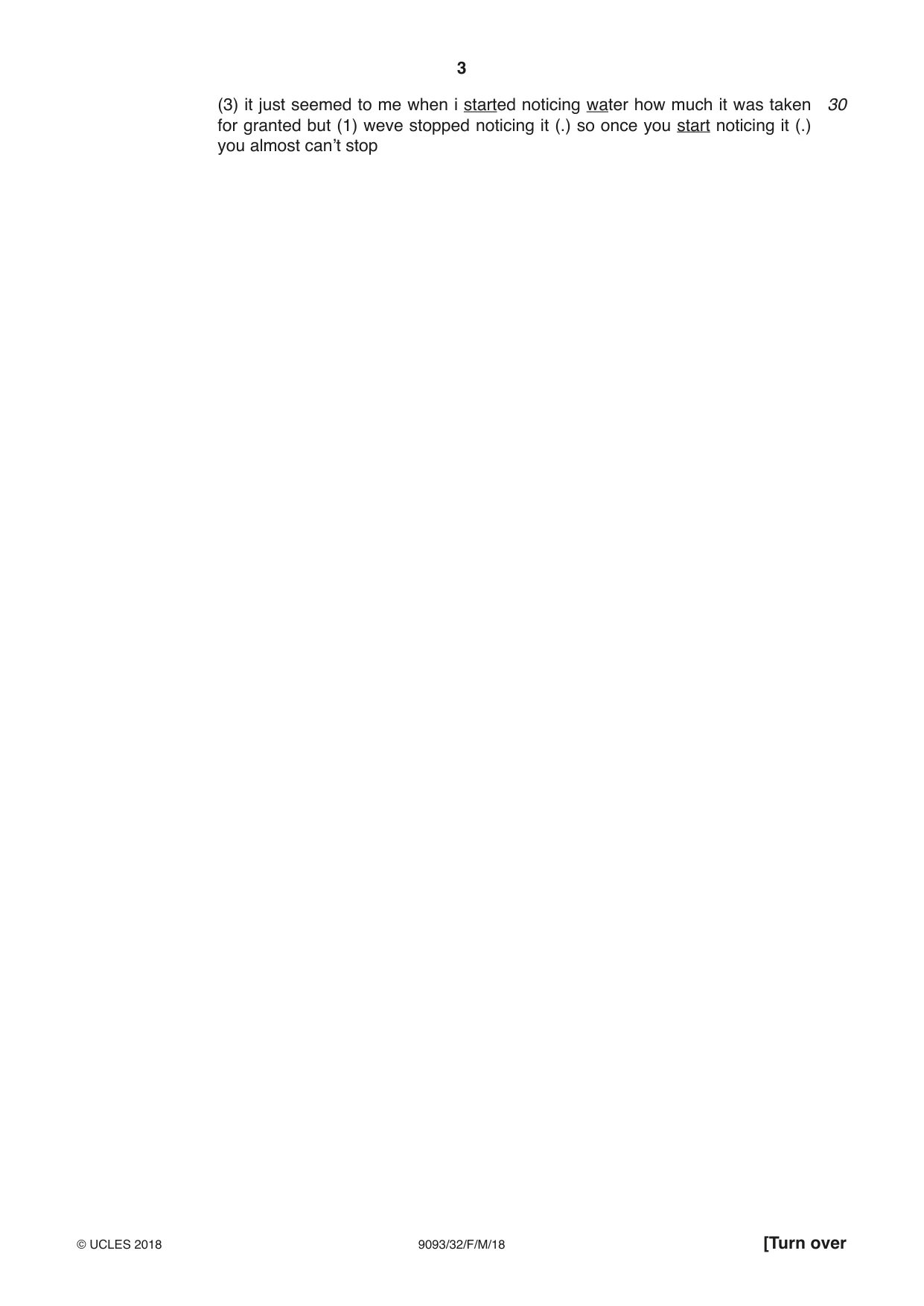
Question paper, page 3
3 9093/32/F/M/18 © UCLES 2018 [Turn over (3) it just seemed to me when i started noticing water how much it was taken for granted but (1) weve stopped noticing it (.) so once you start noticing it (.) you almost can’t stop 30
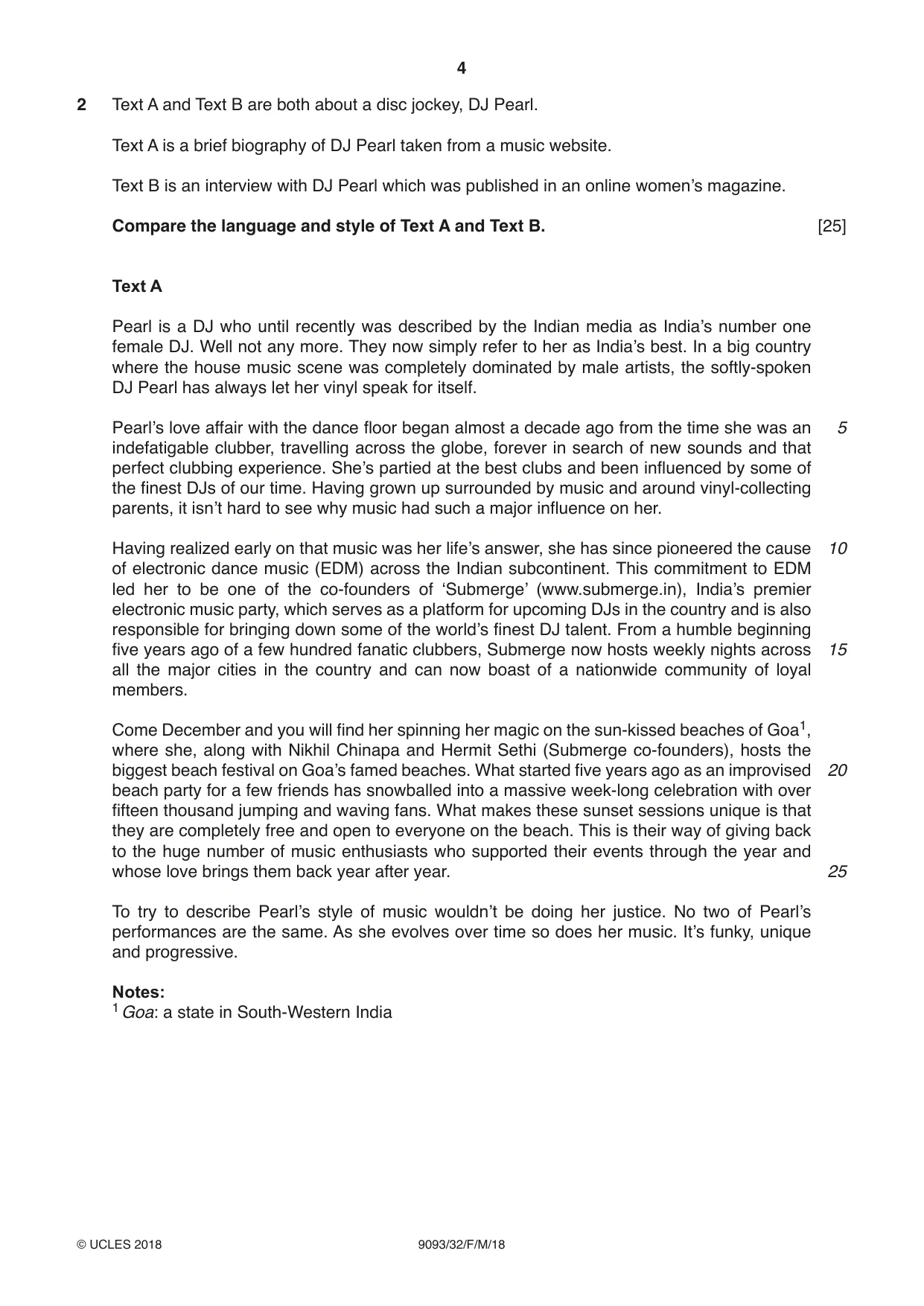
Question paper, page 4
4 9093/32/F/M/18 © UCLES 2018 2 Text A and Text B are both about a disc jockey, DJ Pearl. Text A is a brief biography of DJ Pearl taken from a music website. Text B is an interview with DJ Pearl which was published in an online women’s magazine. Compare the language and style of Text A and Text B. [25] Text A Pearl is a DJ who until recently was described by the Indian media as India’s number one female DJ. Well not any more. They now simply refer to her as India’s best. In a big country where the house music scene was completely dominated by male artists, the softly-spoken DJ Pearl has always let her vinyl speak for itself. Pearl’s love affair with the dance floor began almost a decade ago from the time she was an indefatigable clubber, travelling across the globe, forever in search of new sounds and that perfect clubbing experience. She’s partied at the best clubs and been influenced by some of the finest DJs of our time. Having grown up surrounded by music and around vinyl-collecting parents, it isn’t hard to see why music had such a major influence on her. Having realized early on that music was her life’s answer, she has since pioneered the cause of electronic dance music (EDM) across the Indian subcontinent. This commitment to EDM led her to be one of the co-founders of ‘Submerge’ (www.submerge.in), India’s premier electronic music party, which serves as a platform for upcoming DJs in the country and is also responsible for bringing down some of the world’s finest DJ talent. From a humble beginning five years ago of a few hundred fanatic clubbers, Submerge now hosts weekly nights across all the major cities in the country and can now boast of a nationwide community of loyal members. Come December and you will find her spinning her magic on the sun-kissed beaches of Goa1, where she, along with Nikhil Chinapa and Hermit Sethi (Submerge co-founders), hosts the biggest beach festival on Goa’s famed beaches. What started five years ago as an improvised beach party for a few friends has snowballed into a massive week-long celebration with over fifteen thousand jumping and waving fans. What makes these sunset sessions unique is that they are completely free and open to everyone on the beach. This is their way of giving back to the huge number of music enthusiasts who supported their events through the year and whose love brings them back year after year. To try to describe Pearl’s style of music wouldn’t be doing her justice. No two of Pearl’s performances are the same. As she evolves over time so does her music. It’s funky, unique and progressive. Notes: 1 Goa: a state in South-Western India 5 10 15 20 25
Question paper, page 5
5 9093/32/F/M/18 © UCLES 2018 Text B Question: How did you get into this industry and what attracted you to this kind of music? Answer: After trying a bunch of careers I couldn’t really settle into, I decided to get a job that would help me get out of the country and explore my two big loves, art and music. So I joined a Dutch airline and spent the next few years doing just that. This exposed me to the world of clubbing, obscure record stores and DJ sets the way they were meant to be played. Question: What inspires you to perform? Answer: Inspiration comes from everywhere, but most of all from the audience before me. There is no way to describe that moment when you are part of their story. Even if ever so briefly, the whole club becomes one. That is the moment I live for as a DJ. You almost disappear as part of the equation. It’s the music and the crowd. It’s meditative as well as exhilarating, pure joy and a deep experience, all at the same time… and quite indescribable as you can see. I’m struggling to find adjectives for you. Question: Describe your music for someone who has never heard it. Answer: I just play tracks that I fall in love with. I spend endless hours searching for these and can’t wait to share them at the next gig. I try and play different styles of music because I feel this is necessary to tell a story. I try and take the crowd through a bit of House, Techno, Progressive, Trance… whatever they are up for on a particular day. Question: What do you love most about what you are currently doing? Has it given you the freedom to do what you would otherwise never have done? Answer: When you reach a certain level in this profession, you have to constantly police and push yourself to stay at the top of your game. Having said that, I want nothing more than to spend every day of my life immersed in music. I do spend snatches of time reading or with my other love, art. But they really are just snatches. There are immense crests and troughs in this profession and it takes years to get used to this pattern. It’s those magical moments you share with a crowd of people that keep you inspired to keep chasing this. 5 10 15 20 25
Question paper, page 6
6 9093/32/F/M/18 © UCLES 2018 BLANK PAGE
Question paper, page 7
7 9093/32/F/M/18 © UCLES 2018 BLANK PAGE
Question paper, page 8
8 9093/32/F/M/18 © UCLES 2018 Permission to reproduce items where third-party owned material protected by copyright is included has been sought and cleared where possible. Every reasonable effort has been made by the publisher (UCLES) to trace copyright holders, but if any items requiring clearance have unwittingly been included, the publisher will be pleased to make amends at the earliest possible opportunity. To avoid the issue of disclosure of answer-related information to candidates, all copyright acknowledgements are reproduced online in the Cambridge International Examinations Copyright Acknowledgements Booklet. This is produced for each series of examinations and is freely available to download at www.cie.org.uk after the live examination series. Cambridge International Examinations is part of the Cambridge Assessment Group. Cambridge Assessment is the brand name of University of Cambridge Local Examinations Syndicate (UCLES), which is itself a department of the University of Cambridge. BLANK PAGE
Mark scheme, page 1
® IGCSE is a registered trademark. This document consists of 6 printed pages. © UCLES 2018 [Turn over Cambridge Assessment International Education Cambridge International Advanced Level ENGLISH LANGUAGE 9093/32 Paper 3 Text Analysis March 2018 MARK SCHEME Maximum Mark: 50 Published This mark scheme is published as an aid to teachers and candidates, to indicate the requirements of the examination. It shows the basis on which Examiners were instructed to award marks. It does not indicate the details of the discussions that took place at an Examiners’ meeting before marking began, which would have considered the acceptability of alternative answers. Mark schemes should be read in conjunction with the question paper and the Principal Examiner Report for Teachers. Cambridge International will not enter into discussions about these mark schemes. Cambridge International is publishing the mark schemes for the March 2018 series for most Cambridge IGCSE®, Cambridge International A and AS Level components and some Cambridge O Level components.
Mark scheme, page 2
9093/32 Cambridge International A Level – Mark Scheme PUBLISHED March 2018 © UCLES 2018 Page 2 of 6 Generic Marking Principles These general marking principles must be applied by all examiners when marking candidate answers. They should be applied alongside the specific content of the mark scheme or generic level descriptors for a question. Each question paper and mark scheme will also comply with these marking principles. GENERIC MARKING PRINCIPLE 1: Marks must be awarded in line with: • the specific content of the mark scheme or the generic level descriptors for the question • the specific skills defined in the mark scheme or in the generic level descriptors for the question • the standard of response required by a candidate as exemplified by the standardisation scripts. GENERIC MARKING PRINCIPLE 2: Marks awarded are always whole marks (not half marks, or other fractions). GENERIC MARKING PRINCIPLE 3: Marks must be awarded positively: • marks are awarded for correct/valid answers, as defined in the mark scheme. However, credit is given for valid answers which go beyond the scope of the syllabus and mark scheme, referring to your Team Leader as appropriate • marks are awarded when candidates clearly demonstrate what they know and can do • marks are not deducted for errors • marks are not deducted for omissions • answers should only be judged on the quality of spelling, punctuation and grammar when these features are specifically assessed by the question as indicated by the mark scheme. The meaning, however, should be unambiguous. GENERIC MARKING PRINCIPLE 4: Rules must be applied consistently e.g. in situations where candidates have not followed instructions or in the application of generic level descriptors. GENERIC MARKING PRINCIPLE 5: Marks should be awarded using the full range of marks defined in the mark scheme for the question (however; the use of the full mark range may be limited according to the quality of the candidate responses seen). GENERIC MARKING PRINCIPLE 6: Marks awarded are based solely on the requirements as defined in the mark scheme. Marks should not be awarded with grade thresholds or grade descriptors in mind.
Mark scheme, page 3
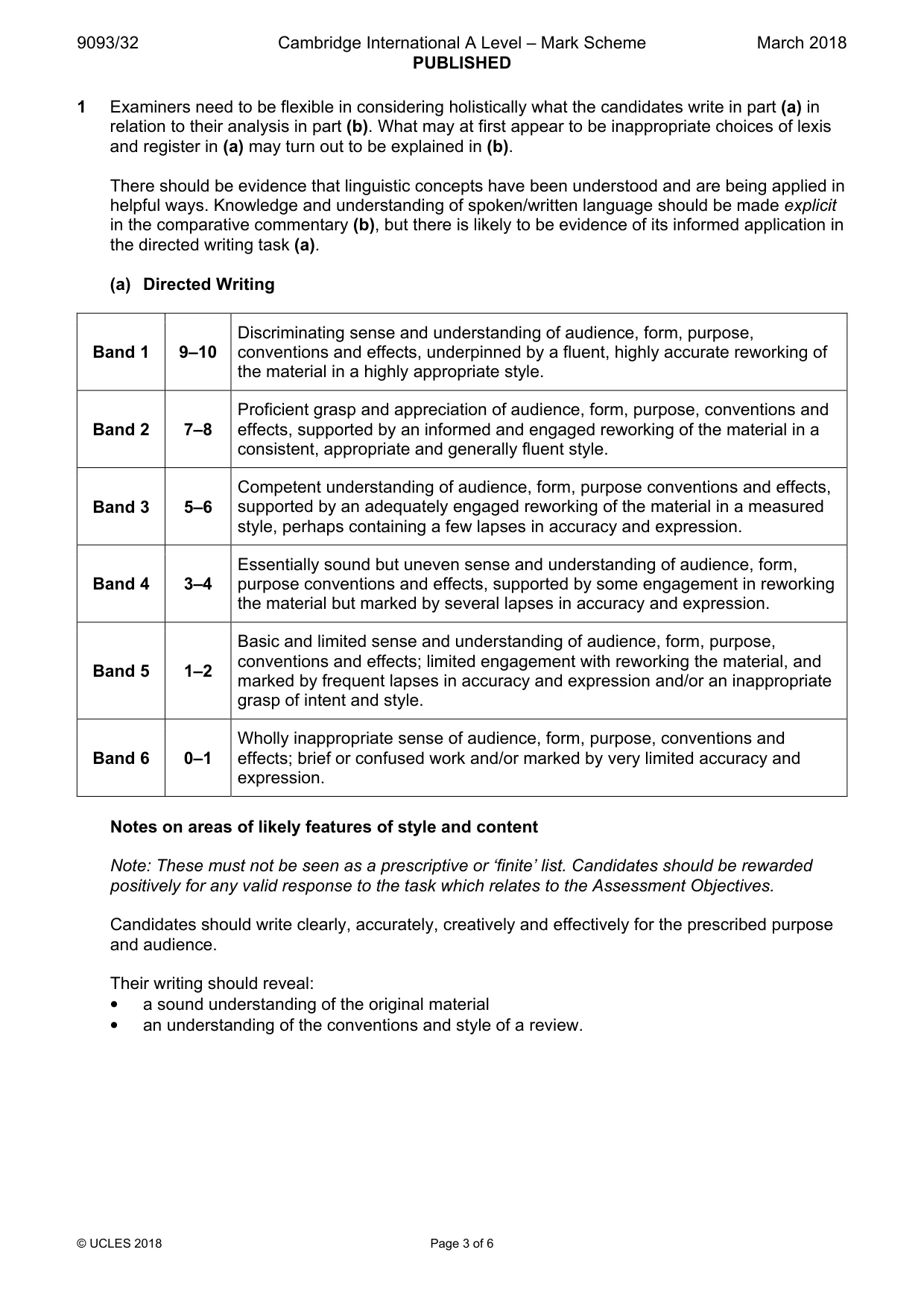
9093/32 Cambridge International A Level – Mark Scheme PUBLISHED March 2018 © UCLES 2018 Page 3 of 6 1 Examiners need to be flexible in considering holistically what the candidates write in part (a) in relation to their analysis in part (b). What may at first appear to be inappropriate choices of lexis and register in (a) may turn out to be explained in (b). There should be evidence that linguistic concepts have been understood and are being applied in helpful ways. Knowledge and understanding of spoken/written language should be made explicit in the comparative commentary (b), but there is likely to be evidence of its informed application in the directed writing task (a). (a) Directed Writing Band 1 9–10 Discriminating sense and understanding of audience, form, purpose, conventions and effects, underpinned by a fluent, highly accurate reworking of the material in a highly appropriate style. Band 2 7–8 Proficient grasp and appreciation of audience, form, purpose, conventions and effects, supported by an informed and engaged reworking of the material in a consistent, appropriate and generally fluent style. Band 3 5–6 Competent understanding of audience, form, purpose conventions and effects, supported by an adequately engaged reworking of the material in a measured style, perhaps containing a few lapses in accuracy and expression. Band 4 3–4 Essentially sound but uneven sense and understanding of audience, form, purpose conventions and effects, supported by some engagement in reworking the material but marked by several lapses in accuracy and expression. Band 5 1–2 Basic and limited sense and understanding of audience, form, purpose, conventions and effects; limited engagement with reworking the material, and marked by frequent lapses in accuracy and expression and/or an inappropriate grasp of intent and style. Band 6 0–1 Wholly inappropriate sense of audience, form, purpose, conventions and effects; brief or confused work and/or marked by very limited accuracy and expression. Notes on areas of likely features of style and content Note: These must not be seen as a prescriptive or ‘finite’ list. Candidates should be rewarded positively for any valid response to the task which relates to the Assessment Objectives. Candidates should write clearly, accurately, creatively and effectively for the prescribed purpose and audience. Their writing should reveal: • a sound understanding of the original material • an understanding of the conventions and style of a review.
Mark scheme, page 4
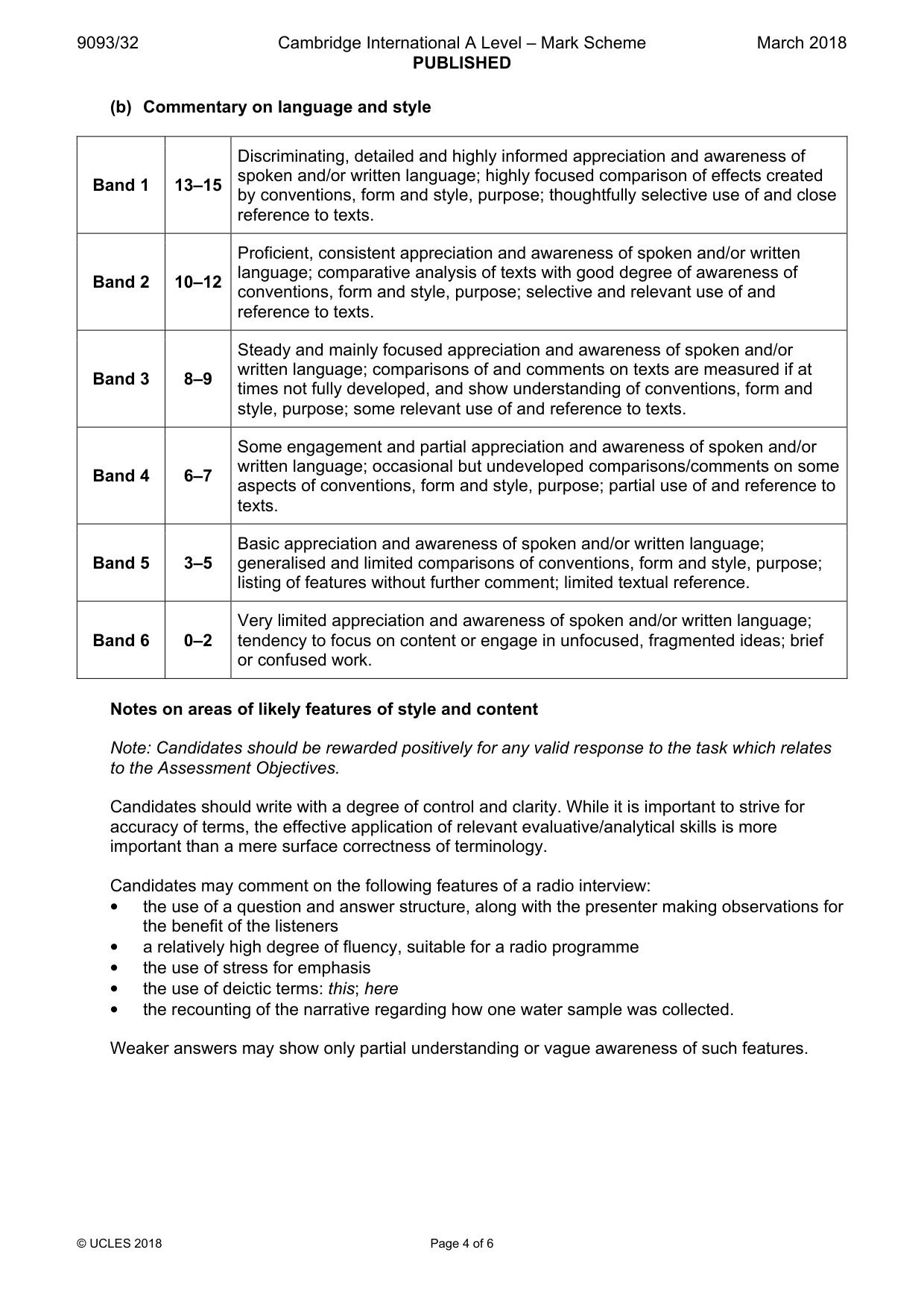
9093/32 Cambridge International A Level – Mark Scheme PUBLISHED March 2018 © UCLES 2018 Page 4 of 6 (b) Commentary on language and style Band 1 13–15 Discriminating, detailed and highly informed appreciation and awareness of spoken and/or written language; highly focused comparison of effects created by conventions, form and style, purpose; thoughtfully selective use of and close reference to texts. Band 2 10–12 Proficient, consistent appreciation and awareness of spoken and/or written language; comparative analysis of texts with good degree of awareness of conventions, form and style, purpose; selective and relevant use of and reference to texts. Band 3 8–9 Steady and mainly focused appreciation and awareness of spoken and/or written language; comparisons of and comments on texts are measured if at times not fully developed, and show understanding of conventions, form and style, purpose; some relevant use of and reference to texts. Band 4 6–7 Some engagement and partial appreciation and awareness of spoken and/or written language; occasional but undeveloped comparisons/comments on some aspects of conventions, form and style, purpose; partial use of and reference to texts. Band 5 3–5 Basic appreciation and awareness of spoken and/or written language; generalised and limited comparisons of conventions, form and style, purpose; listing of features without further comment; limited textual reference. Band 6 0–2 Very limited appreciation and awareness of spoken and/or written language; tendency to focus on content or engage in unfocused, fragmented ideas; brief or confused work. Notes on areas of likely features of style and content Note: Candidates should be rewarded positively for any valid response to the task which relates to the Assessment Objectives. Candidates should write with a degree of control and clarity. While it is important to strive for accuracy of terms, the effective application of relevant evaluative/analytical skills is more important than a mere surface correctness of terminology. Candidates may comment on the following features of a radio interview: • the use of a question and answer structure, along with the presenter making observations for the benefit of the listeners • a relatively high degree of fluency, suitable for a radio programme • the use of stress for emphasis • the use of deictic terms: this; here • the recounting of the narrative regarding how one water sample was collected. Weaker answers may show only partial understanding or vague awareness of such features.
Mark scheme, page 5
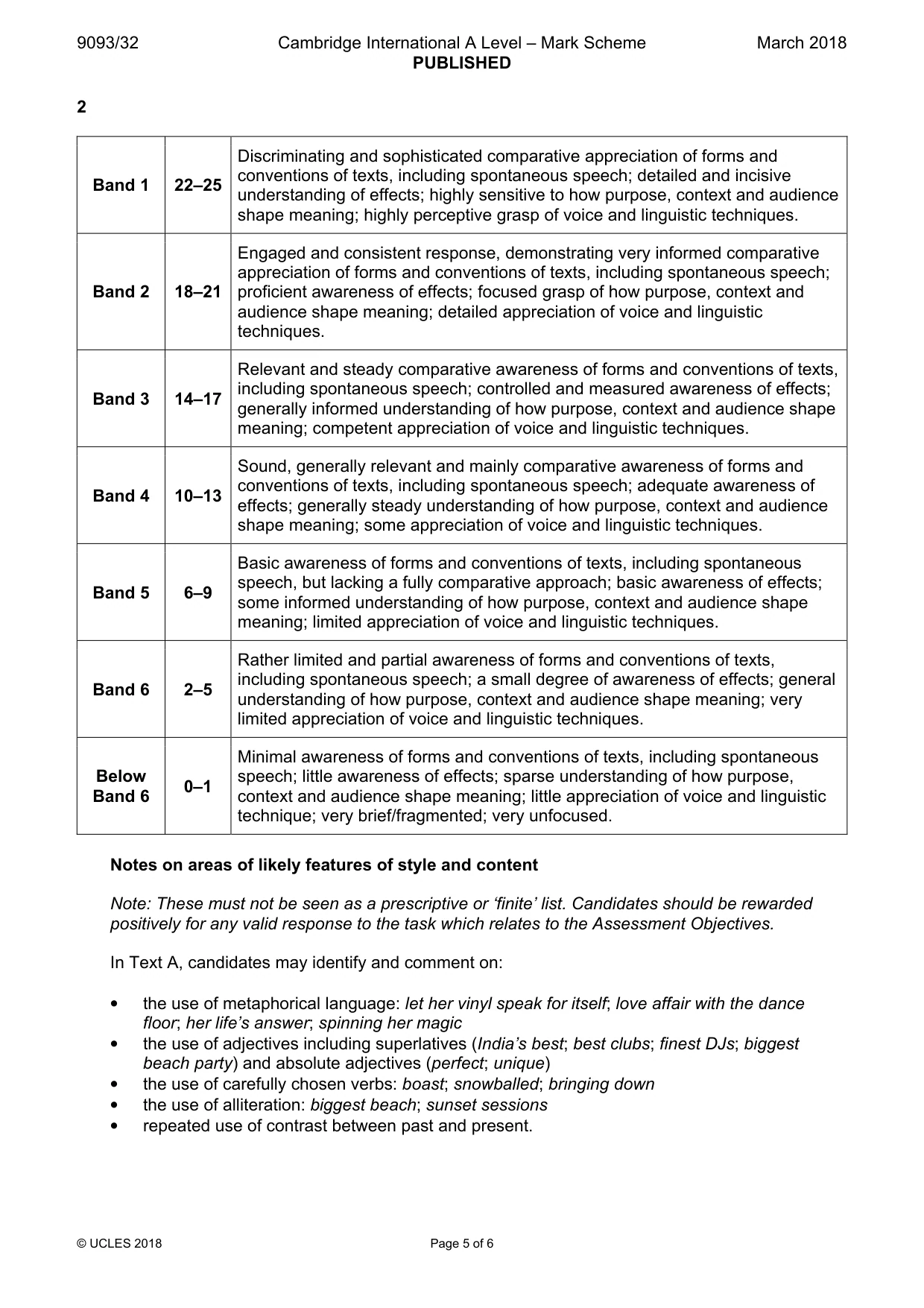
9093/32 Cambridge International A Level – Mark Scheme PUBLISHED March 2018 © UCLES 2018 Page 5 of 6 2 Band 1 22–25 Discriminating and sophisticated comparative appreciation of forms and conventions of texts, including spontaneous speech; detailed and incisive understanding of effects; highly sensitive to how purpose, context and audience shape meaning; highly perceptive grasp of voice and linguistic techniques. Band 2 18–21 Engaged and consistent response, demonstrating very informed comparative appreciation of forms and conventions of texts, including spontaneous speech; proficient awareness of effects; focused grasp of how purpose, context and audience shape meaning; detailed appreciation of voice and linguistic techniques. Band 3 14–17 Relevant and steady comparative awareness of forms and conventions of texts, including spontaneous speech; controlled and measured awareness of effects; generally informed understanding of how purpose, context and audience shape meaning; competent appreciation of voice and linguistic techniques. Band 4 10–13 Sound, generally relevant and mainly comparative awareness of forms and conventions of texts, including spontaneous speech; adequate awareness of effects; generally steady understanding of how purpose, context and audience shape meaning; some appreciation of voice and linguistic techniques. Band 5 6–9 Basic awareness of forms and conventions of texts, including spontaneous speech, but lacking a fully comparative approach; basic awareness of effects; some informed understanding of how purpose, context and audience shape meaning; limited appreciation of voice and linguistic techniques. Band 6 2–5 Rather limited and partial awareness of forms and conventions of texts, including spontaneous speech; a small degree of awareness of effects; general understanding of how purpose, context and audience shape meaning; very limited appreciation of voice and linguistic techniques. Below Band 6 0–1 Minimal awareness of forms and conventions of texts, including spontaneous speech; little awareness of effects; sparse understanding of how purpose, context and audience shape meaning; little appreciation of voice and linguistic technique; very brief/fragmented; very unfocused. Notes on areas of likely features of style and content Note: These must not be seen as a prescriptive or ‘finite’ list. Candidates should be rewarded positively for any valid response to the task which relates to the Assessment Objectives. In Text A, candidates may identify and comment on: • the use of metaphorical language: let her vinyl speak for itself; love affair with the dance floor; her life’s answer; spinning her magic • the use of adjectives including superlatives (India’s best; best clubs; finest DJs; biggest beach party) and absolute adjectives (perfect; unique) • the use of carefully chosen verbs: boast; snowballed; bringing down • the use of alliteration: biggest beach; sunset sessions • repeated use of contrast between past and present.
Mark scheme, page 6
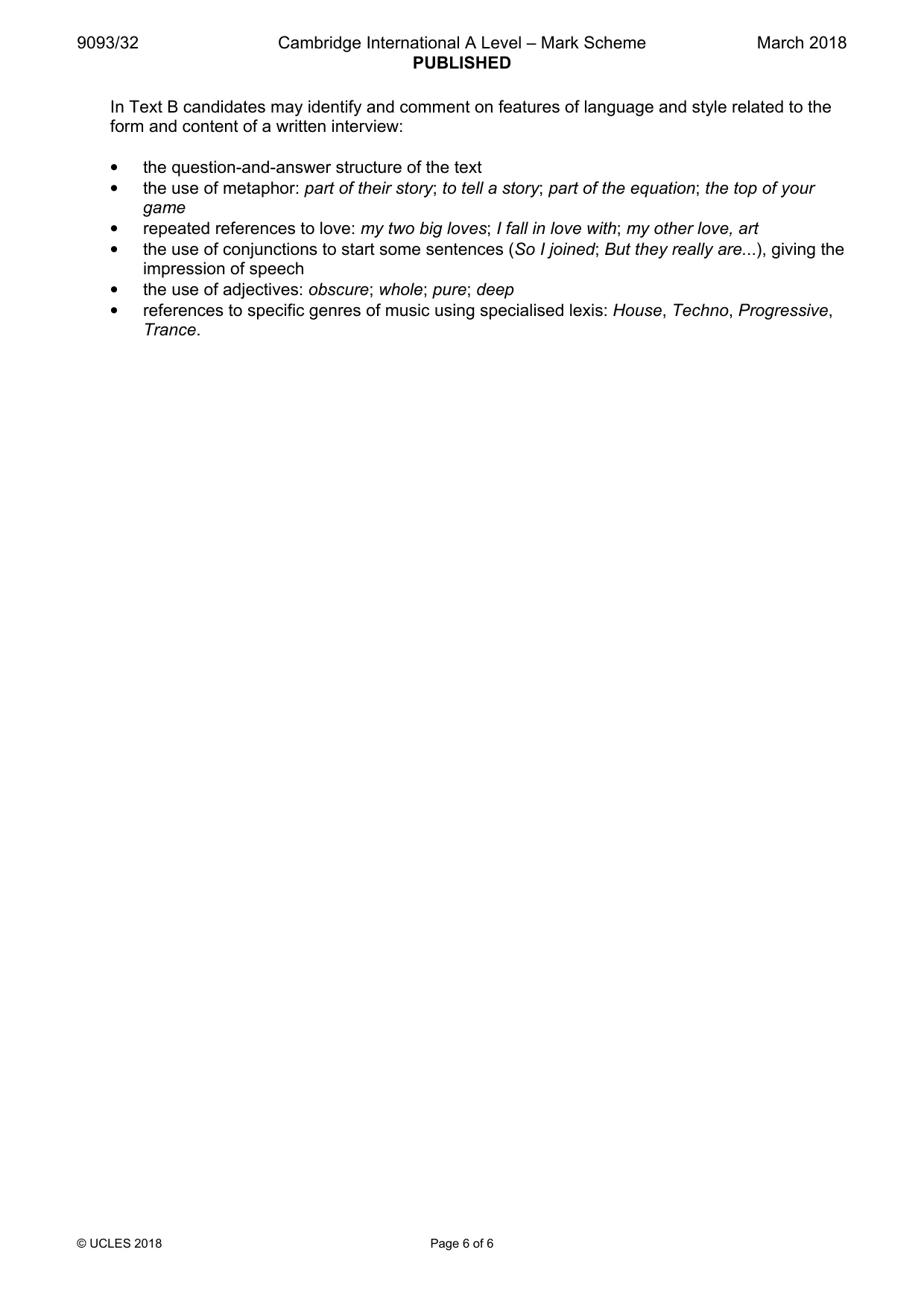
9093/32 Cambridge International A Level – Mark Scheme PUBLISHED March 2018 © UCLES 2018 Page 6 of 6 In Text B candidates may identify and comment on features of language and style related to the form and content of a written interview: • the question-and-answer structure of the text • the use of metaphor: part of their story; to tell a story; part of the equation; the top of your game • repeated references to love: my two big loves; I fall in love with; my other love, art • the use of conjunctions to start some sentences (So I joined; But they really are...), giving the impression of speech • the use of adjectives: obscure; whole; pure; deep • references to specific genres of music using specialised lexis: House, Techno, Progressive, Trance.
What you needed in this session
Cambridge’s own grade thresholds for 2018 Feb/March, Paper 3 · Variant 2. A higher threshold means an easier paper — the bar moves with how the cohort did.