Cambridge A Level English - Language AS and A Level (from 2014) 9093 — 2017 May/June Paper 1 · Variant 3
9093/13/M/J/17 · 50 marks · ≈56 min
The question paper and its mark scheme, free to read here and free to download. This is Cambridge’s own paper, exactly as it was sat.
Question paper8 pages
Mark scheme3 pages
Answers below. Sit the paper first if you are practising.
Paper as text
Question paper, page 1
This document consists of 7 printed pages, 1 blank page and 1 Insert. DC (RCL (JDA)) 130816/2 © UCLES 2017 [Turn over Cambridge International Examinations Cambridge International Advanced Subsidiary and Advanced Level * 1 3 4 9 2 2 8 7 1 4 * ENGLISH LANGUAGE 9093/13 Paper 1 Passages May/June 2017 2 hours 15 minutes No Additional Materials are required. READ THESE INSTRUCTIONS FIRST An answer booklet is provided inside this question paper. You should follow the instructions on the front cover of the answer booklet. If you need additional answer paper, ask the invigilator for a continuation booklet. Answer two questions: Question 1 and either Question 2 or Question 3. You should spend about 15 minutes reading the passages and questions before you start writing your answers. You are reminded of the need for good English and clear presentation in your answers. The number of marks is given in brackets [ ] at the end of each question or part question.
Question paper, page 2
2 9093/13/M/J/17 © UCLES 2017 Answer Question 1 and either Question 2 or Question 3. 1 The following passage is the opening of a short story, The Secret Life of Walter Mitty, by James Thurber. Walter Mitty, a middle-aged man, lives more in his imagination than in reality. (a) Comment on the language and style of the passage and the way in which Walter Mitty is presented. [15] (b) Write a continuation (120–150 words) of the story. You should base your answer closely on the style and language of the original passage. You do not have to bring your writing to a conclusion. [10] ‘We’re going through!’ The Commander’s voice was like thin ice breaking. He wore his full-dress uniform, with the heavily braided white cap pulled down rakishly over one cold grey eye. ‘We can’t make it, sir. It’s spoiling for a hurricane, if you ask me.’ ‘I’m not asking you, Lieutenant Berg,’ said the Commander. ‘Throw on the power lights! Rev her up to 8,500! We’re going through!’ The pounding of the cylinders increased: ta-pocketa-pocketa-pocketa pocketa-pocketa. The Commander stared at the ice forming on the pilot window. He walked over and twisted a row of complicated dials. ‘Switch on No. 8 auxiliary!’ he shouted. ‘Switch on No. 8 auxiliary!’ repeated Lieutenant Berg. ‘Full strength in No. 3 turret!’ shouted the Commander. ‘Full strength in No. 3 turret!’ The crew, bending to their various tasks in the huge, hurtling eight- engined Navy hydroplane, looked at each other and grinned. ‘The Old Man’ll get us through,’ they said to one another. ‘The Old Man ain’t afraid of Hell!’ ‘Not so fast! You’re driving too fast!’ said Mrs Mitty. ‘What are you driving so fast for?’ ‘Hmm?’ said Walter Mitty. He looked at his wife, in the seat beside him, with shocked astonishment. She seemed grossly unfamiliar, like a strange woman who had yelled at him in a crowd. ‘You were up to fifty-five,’ she said. ‘You know I don’t like to go more than forty. You were up to fifty-five.’ Walter Mitty drove on toward Waterbury in silence, the roaring of the SN 202 through the worst storm in twenty years of Navy flying fading in the remote, intimate airways of his mind. ‘You’re tensed up again,’ said Mrs Mitty. ‘It’s one of your days. I wish you’d let Dr Renshaw look you over.’ Walter Mitty stopped the car in front of the building where his wife went to have her hair done. ‘Remember to get those overshoes1 while I’m having my hair done,’ she said. ‘I don’t need overshoes,’ said Mitty. She put her mirror back into her bag. ‘We’ve been all through that,’ she said, getting out of the car. ‘You’re not a young man any longer.’ He raced the engine a little. ‘Why don’t you wear your gloves? Have you lost your gloves?’ Walter Mitty reached in a pocket and brought out the gloves. He put them on, but after she had turned and gone into the building and he had driven on to a red light, he took them off again. ‘Pick it up, brother!’ snapped a cop as the light changed, and Mitty hastily pulled on his gloves and lurched ahead. He drove around the streets aimlessly for a time, and then he drove past the hospital on his way to the parking lot. … ‘It’s the millionaire banker, Wellington McMillan,’ said the pretty nurse. ‘Yes?’ said Walter Mitty, removing his gloves slowly. ‘Who has the case?’ ‘Dr Renshaw and Dr Benbow, but there are two specialists here, Dr Remington from New York and Mr Pritchard-Mitford from London. He flew over.’ A door opened down a long, cool corridor and Dr Renshaw came out. He looked distraught and haggard. ‘Hello, Mitty,’ 5 10 15 20 25 30 35
Question paper, page 3
3 9093/13/M/J/17 © UCLES 2017 [Turn over he said. ‘We’re having the devil’s own time with McMillan, the millionaire banker and close personal friend of Roosevelt.2 Obstreosis of the ductal tract. Tertiary. Wish you’d take a look at him.’ ‘Glad to,’ said Mitty. 1 overshoes : slip-on cover, to protect your shoe from snow or rain. 2 Roosevelt : American president, 1933–1945. 40
Question paper, page 4
4 9093/13/M/J/17 © UCLES 2017 2 The following is part of a speech by Stella Young, an Australian comedian who used a wheelchair for most of her life. (a) Comment on the language and style of the extract and the ways in which it conveys Stella Young’s attitudes towards disability. [15] (b) Stella Young is asked to write guidelines for how a school should support disabled students. Write the opening of this document (120–150 words), basing your answer closely on the language and material of the original extract. [10] I grew up in a very small country town in Victoria. I had a very normal, low-key kind of upbringing. I went to school, I hung out with my friends, I fought with my younger sisters. It was all very normal. And when I was 15, a member of my local community approached my parents and wanted to nominate me for a community achievement award. And my parents said, “Hm, that’s really nice, but there’s kind of one glaring problem with that. She hasn’t actually achieved anything.” (Laughter ) And they were right, you know. I went to school, I got good marks, I had a very low-key after school job in my mum’s hairdressing salon, and I spent a lot of time watching TV. Yeah, I know. What a contradiction. But they were right, you know. I wasn’t doing anything that was out of the ordinary at all. I wasn’t doing anything that could be considered an achievement if you took disability out of the equation. Years later, I was on my second teaching round in a Melbourne high school, and I was about 20 minutes into a year 11 legal studies class when this boy put up his hand and said, “Hey miss, when are you going to start doing your speech?” And I said, “What speech?” You know, I’d been talking to them about defamation law for a good 20 minutes. And he said, “You know, like, your motivational speaking. You know, when people in wheelchairs come to school, they usually say, like, inspirational stuff?” (Laughter ) “It’s usually in the big hall.” And that’s when it dawned on me. This kid had only ever experienced disabled people as objects of inspiration. We are not, to this kid – and it’s not his fault, I mean – that’s true for many of us. For lots of us, disabled people are not our teachers or our doctors or our manicurists. We’re not real people. We are there to inspire. And in fact, I am sitting on this stage looking like I do in this wheelchair, and you are probably kind of expecting me to inspire you. Right? (Laughter ) Yeah. Well, ladies and gentlemen, I’m afraid I’m going to disappoint you dramatically. I am not here to inspire you. I am here to tell you that we have been lied to about disability. Yeah, we’ve been sold the lie that disability is a Bad Thing, capital B, capital T. It’s a bad thing, and to live with a disability makes you exceptional. It’s not a bad thing, and it doesn’t make you exceptional. And in the past few years, we’ve been able to propagate this lie even further via social media. You may have seen images like this one: “The only disability in life is a bad attitude.” Or this one: “Your excuse is invalid.” Indeed. Or this one: “Before you quit, try!” These are just a couple of examples, but there are a lot of these images out there. You know, you might have seen the one, the little girl with no hands drawing a picture with a pencil held in her mouth. You might have seen a child running on carbon fiber prosthetic legs. And these images – there are lots of them out there – objectify one group of people for the benefit of another group of people. So in this case, we’re objectifying disabled people for the benefit of nondisabled people. The purpose of these images is to inspire you, to motivate you, so that we can look at them and think, “Well, however bad my life is, it could be worse. I could be that person.” 5 10 15 20 25 30 35 40
Question paper, page 5
5 9093/13/M/J/17 © UCLES 2017 [Turn over But what if you are that person? I’ve lost count of the number of times that I’ve been approached by strangers wanting to tell me that they think I’m brave or inspirational, and this was long before my work had any kind of public profile. They were just kind of congratulating me for managing to get up in the morning and remember my own name. (Laughter ) And it is objectifying. These images, those images objectify disabled people for the benefit of nondisabled people. They are there so that you can look at them and think that things aren’t so bad for you, to put your worries into perspective. And life as a disabled person is actually somewhat difficult. We do overcome some things. But the things that we’re overcoming are not the things that you think they are. They are not things to do with our bodies. I use the term “disabled people” quite deliberately, because I subscribe to what’s called the social model of disability, which tells us that we are more disabled by the society that we live in than by our bodies and our diagnoses. So I have lived in this body a long time. I’m quite fond of it. It does the things that I need it to do, and I’ve learned to use it to the best of its capacity just as you have, and that’s the thing about those kids in those pictures as well. They’re not doing anything out of the ordinary. They are just using their bodies to the best of their capacity. So is it really fair to objectify them in the way that we do, to share those images? People, when they say, “You’re an inspiration,” they mean it as a compliment. And I know why it happens. It’s because of the lie, it’s because we’ve been sold this lie that disability makes you exceptional. And it honestly doesn’t. 45 50 55 60
Question paper, page 6
6 9093/13/M/J/17 © UCLES 2017 3 The passage below is from a website article that encourages people to learn a foreign language. (a) Comment on the style and language of the extract. [15] (b) Basing your answer closely on the style and language of the original extract, write the opening of an article (120–150 words) that encourages someone to take up a particular hobby or activity. [10] Going Undercover: Donning the Disguise of Language ATTENTION, AGENT NIGHTSHADE: DESTROY THIS NOTE AFTER READING Your mission, should you choose to accept it, is to infiltrate a group of people to learn more about how they see the world, gain access to incredible first-hand stories, make lasting friendships, and seamlessly immerse yourself into a vibrant, stimulating atmosphere. In short, Agent Nightshade, your mission is to learn another language. Our ability to learn a second language is a magnificent phenomenon unique to humanity. It’s a disguise, in a way, a cloak that allows you to be part of something you’d otherwise never see. It’s a feat almost as unlikely as a brown bear passing itself off as a whippoorwill,1 learning to warble and trill, and finding out what exactly those birds were up to all day. Not unlike that bear in disguise, Agent Nightshade, when you learn another language and use it to communicate with native speakers, you’ll be able to step into what is almost a different plane of reality. You’ll cross into a world where people have a range of cultural references that are new to you. There are often differences in senses of humor, forms of politeness, and approaches to day-to-day life. “The ability to learn a second language is a disguise, in a way, a cloak that allows you to be part of something you’d otherwise never see.” If you wait for other people to translate conversations as they happen, you won’t get anywhere. I’ve seen many a spy fall by the wayside, waiting for someone to explain the breathtaking fifteen-minute story that had everyone else’s attention around a dinner table. However, if you’re willing to roll up your sleeves and learn to speak and understand a bit yourself, you’ll be donning the right costume to allow events and conversations to continue seamlessly, freeing up the people around you to express themselves with ease. Just how does all this work, you ask, Agent Nightshade? Allow me to give some examples. Operation: Checkout line I can still remember, back in my early linguistic spying days, the first time I understood a joke in German. I was waiting in line at an art store, and the cashier was wrapping up dozens of pen tips and inkwells for the man in line before me. It took quite a while, and eventually she smiled at me sheepishly, ready to ring up my single tube of red oil paint. She rolled her eyes and said, “Stunden später …” (“Hours later …”). And just like that, I was in! It didn’t matter that I didn’t know the words to say that no, thank you, I didn’t need a bag. The fact of it was, I wasn’t a stranger standing outside in the cold anymore. I had touched down in the world surrounding me: I had understood a mildly humorous comment! Needless to say, I left the store feeling giddy that day. The dawn of my career in espionage. 5 10 15 20 25 30 35
Question paper, page 7
7 9093/13/M/J/17 © UCLES 2017 Operation: Blue Eyes So you see, you don’t even need to be able to speak that much to conduct entry- level spy operations. Another example took place during the month I spent in Finland for an artist’s residency. The brevity of my stay – together with the insane complexity of the Finnish language – prevented me from learning to speak very much. I did, however, learn a few short phrases, including “please,” “thank you,” the numbers one through ten, as well as the useful phrase, “Sinulla on kauniit siniset silmät” (“You have such beautiful blue eyes”). Despite the fact that I couldn’t carry on a conversation, I practiced this phrase till I had it down pat and could say it quite loudly and clearly. Its effect was astonishing: People would stop in their tracks, as if I had suddenly stepped out from a mirror and into the room. And luckily, the relative homogeneity 2 of the inhabitants of Finland meant that I could make this declaration to virtually everyone I met. Agent Nightshade, the hour is growing late, and though I have many more thrilling tales of linguistic espionage to tell, I think you should be on your way. We can continue our talks when you’ve completed a few missions of your own. Good luck and Godspeed, Gloria Intrigue 1 whippoorwill: a small North American songbird. 2 homogeneity : physical similarity. 40 45 50 55
Question paper, page 8
8 9093/13/M/J/17 © UCLES 2017 Permission to reproduce items where third-party owned material protected by copyright is included has been sought and cleared where possible. Every reasonable effort has been made by the publisher (UCLES) to trace copyright holders, but if any items requiring clearance have unwittingly been included, the publisher will be pleased to make amends at the earliest possible opportunity. To avoid the issue of disclosure of answer-related information to candidates, all copyright acknowledgements are reproduced online in the Cambridge International Examinations Copyright Acknowledgements Booklet. This is produced for each series of examinations and is freely available to download at www.cie.org.uk after the live examination series. Cambridge International Examinations is part of the Cambridge Assessment Group. Cambridge Assessment is the brand name of University of Cambridge Local Examinations Syndicate (UCLES), which is itself a department of the University of Cambridge. BLANK PAGE
Mark scheme, page 1
® IGCSE is a registered trademark. This document consists of 3 printed pages. © UCLES 2017 [Turn over Cambridge International Examinations Cambridge International Advanced Subsidiary and Advanced Level ENGLISH LANGUAGE 9093/13 Paper 1 Passages May/June 2017 MARK SCHEME Maximum Mark: 50 Published This mark scheme is published as an aid to teachers and candidates, to indicate the requirements of the examination. It shows the basis on which Examiners were instructed to award marks. It does not indicate the details of the discussions that took place at an Examiners’ meeting before marking began, which would have considered the acceptability of alternative answers. Mark schemes should be read in conjunction with the question paper and the Principal Examiner Report for Teachers. Cambridge will not enter into discussions about these mark schemes. Cambridge is publishing the mark schemes for the May/June 2017 series for most Cambridge IGCSE®, Cambridge International A and AS Level and Cambridge Pre-U components, and some Cambridge O Level components.
Mark scheme, page 2
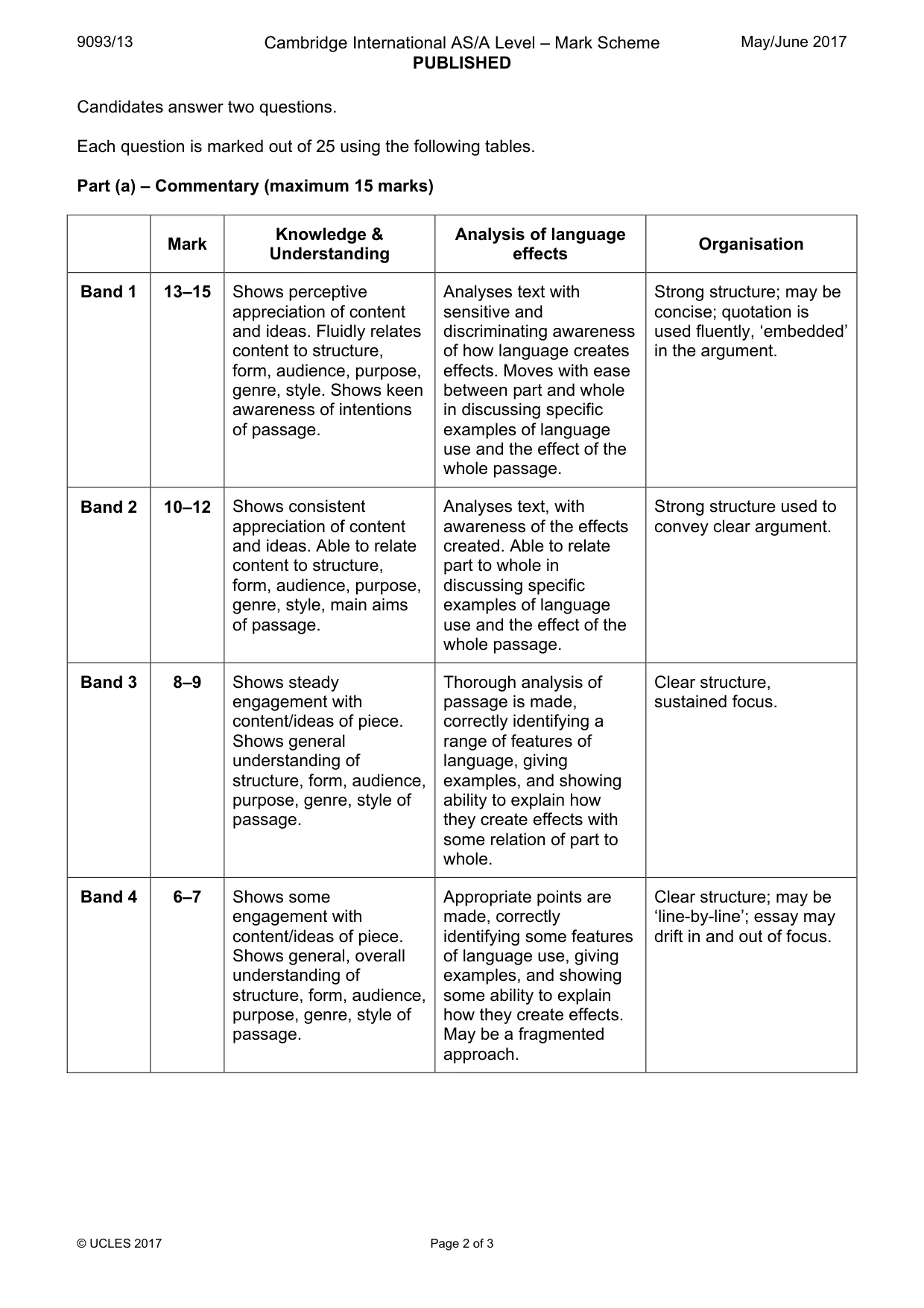
9093/13 Cambridge International AS/A Level – Mark Scheme PUBLISHED May/June 2017 © UCLES 2017 Page 2 of 3 Candidates answer two questions. Each question is marked out of 25 using the following tables. Part (a) – Commentary (maximum 15 marks) Mark Knowledge & Understanding Analysis of language effects Organisation Band 1 13–15 Shows perceptive appreciation of content and ideas. Fluidly relates content to structure, form, audience, purpose, genre, style. Shows keen awareness of intentions of passage. Analyses text with sensitive and discriminating awareness of how language creates effects. Moves with ease between part and whole in discussing specific examples of language use and the effect of the whole passage. Strong structure; may be concise; quotation is used fluently, ‘embedded’ in the argument. Band 2 10–12 Shows consistent appreciation of content and ideas. Able to relate content to structure, form, audience, purpose, genre, style, main aims of passage. Analyses text, with awareness of the effects created. Able to relate part to whole in discussing specific examples of language use and the effect of the whole passage. Strong structure used to convey clear argument. Band 3 8–9 Shows steady engagement with content/ideas of piece. Shows general understanding of structure, form, audience, purpose, genre, style of passage. Thorough analysis of passage is made, correctly identifying a range of features of language, giving examples, and showing ability to explain how they create effects with some relation of part to whole. Clear structure, sustained focus. Band 4 6–7 Shows some engagement with content/ideas of piece. Shows general, overall understanding of structure, form, audience, purpose, genre, style of passage. Appropriate points are made, correctly identifying some features of language use, giving examples, and showing some ability to explain how they create effects. May be a fragmented approach. Clear structure; may be ‘line-by-line’; essay may drift in and out of focus.
Mark scheme, page 3
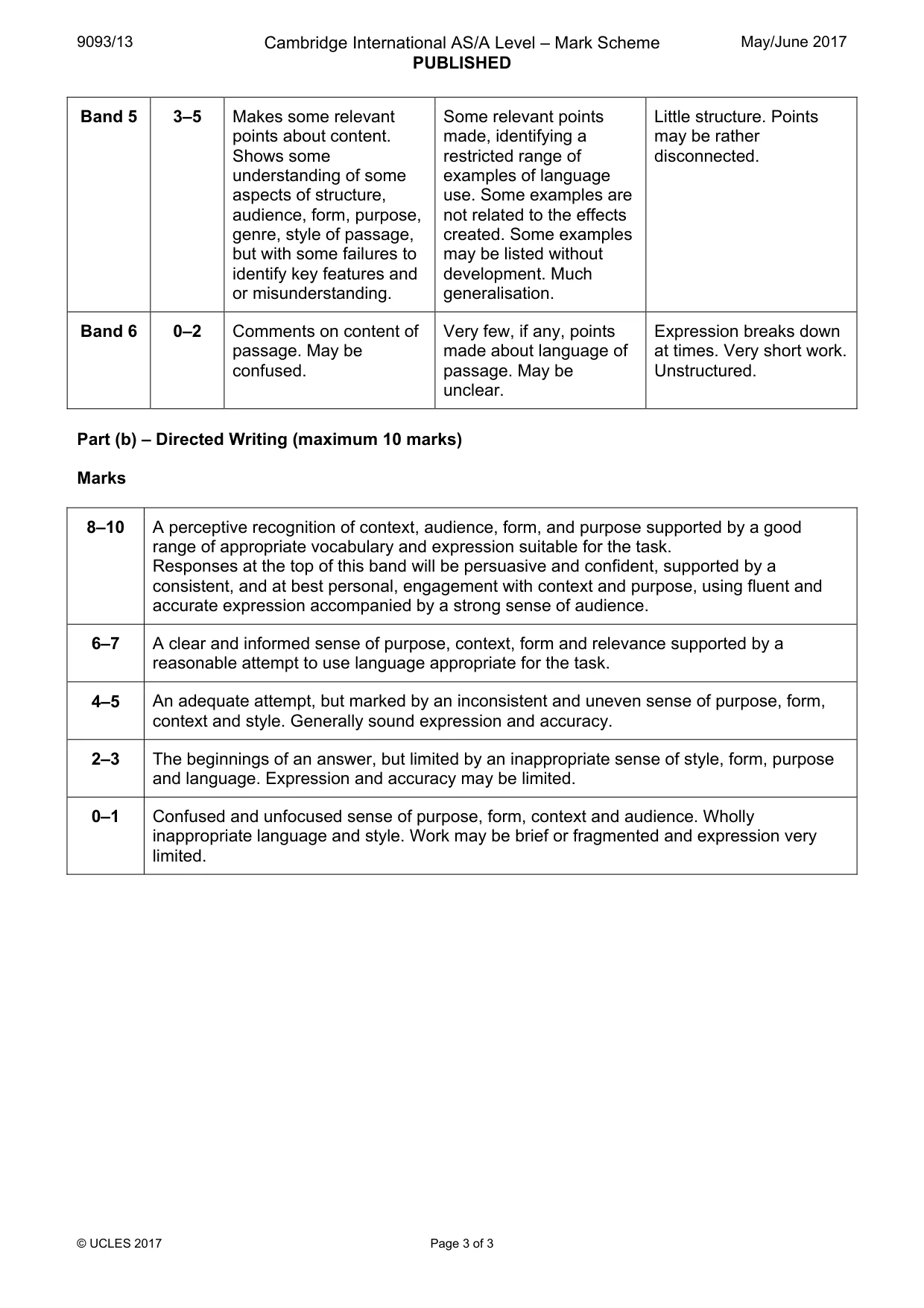
9093/13 Cambridge International AS/A Level – Mark Scheme PUBLISHED May/June 2017 © UCLES 2017 Page 3 of 3 Band 5 3–5 Makes some relevant points about content. Shows some understanding of some aspects of structure, audience, form, purpose, genre, style of passage, but with some failures to identify key features and or misunderstanding. Some relevant points made, identifying a restricted range of examples of language use. Some examples are not related to the effects created. Some examples may be listed without development. Much generalisation. Little structure. Points may be rather disconnected. Band 6 0–2 Comments on content of passage. May be confused. Very few, if any, points made about language of passage. May be unclear. Expression breaks down at times. Very short work. Unstructured. Part (b) – Directed Writing (maximum 10 marks) Marks 8–10 A perceptive recognition of context, audience, form, and purpose supported by a good range of appropriate vocabulary and expression suitable for the task. Responses at the top of this band will be persuasive and confident, supported by a consistent, and at best personal, engagement with context and purpose, using fluent and accurate expression accompanied by a strong sense of audience. 6–7 A clear and informed sense of purpose, context, form and relevance supported by a reasonable attempt to use language appropriate for the task. 4–5 An adequate attempt, but marked by an inconsistent and uneven sense of purpose, form, context and style. Generally sound expression and accuracy. 2–3 The beginnings of an answer, but limited by an inappropriate sense of style, form, purpose and language. Expression and accuracy may be limited. 0–1 Confused and unfocused sense of purpose, form, context and audience. Wholly inappropriate language and style. Work may be brief or fragmented and expression very limited.
What you needed in this session
Cambridge’s own grade thresholds for 2017 May/June, Paper 1 · Variant 3. A higher threshold means an easier paper — the bar moves with how the cohort did.