Cambridge A Level English - Language AS and A Level (from 2014) 9093 — 2017 May/June Paper 1 · Variant 2
9093/12/M/J/17 · 50 marks · ≈56 min
The question paper and its mark scheme, free to read here and free to download. This is Cambridge’s own paper, exactly as it was sat.
Question paper8 pages
Mark scheme3 pages
Answers below. Sit the paper first if you are practising.
Paper as text
Question paper, page 1
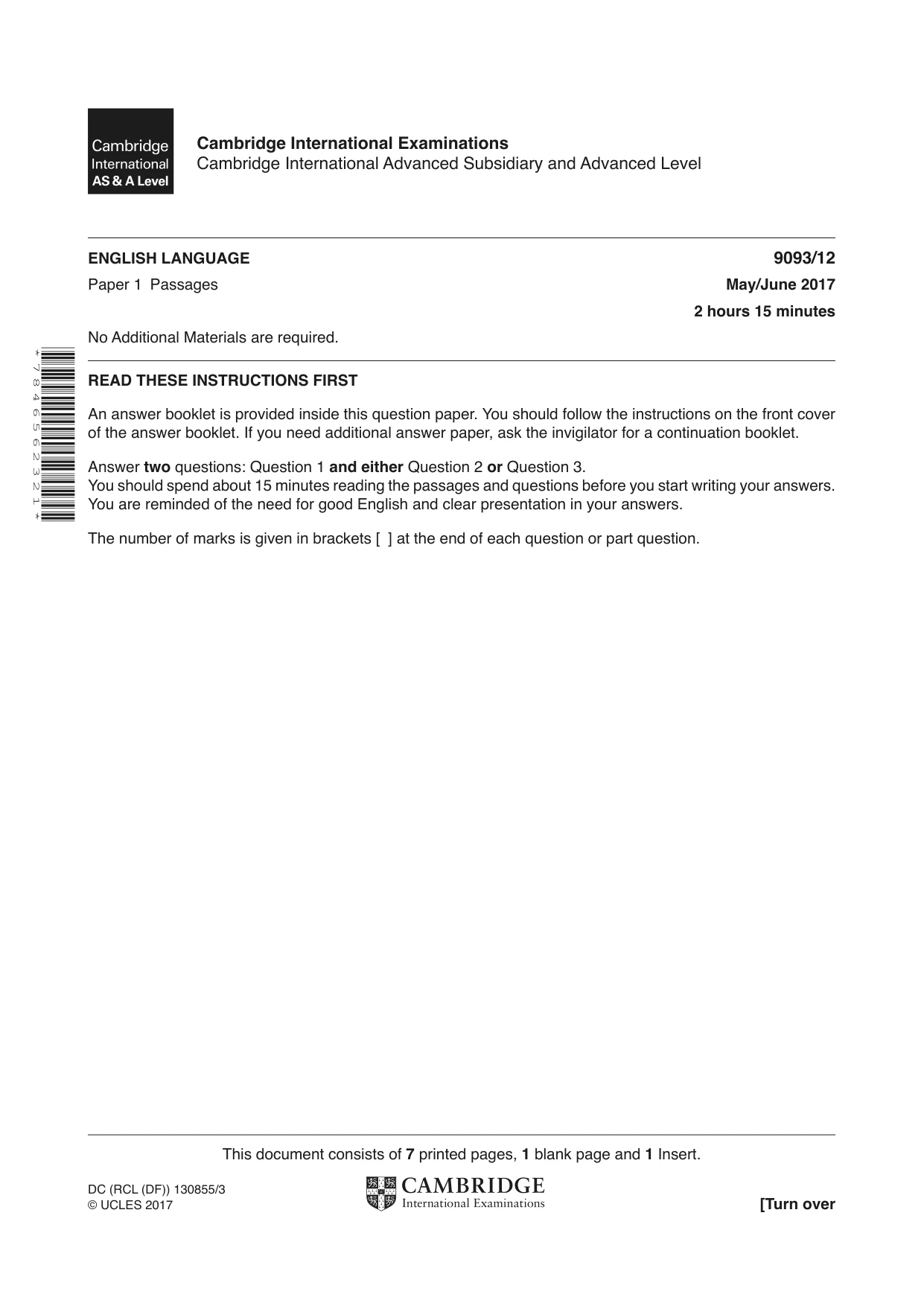
This document consists of 7 printed pages, 1 blank page and 1 Insert. DC (RCL (DF)) 130855/3 © UCLES 2017 [Turn over Cambridge International Examinations Cambridge International Advanced Subsidiary and Advanced Level * 7 8 4 6 5 6 2 3 2 1 * ENGLISH LANGUAGE 9093/12 Paper 1 Passages May/June 2017 2 hours 15 minutes No Additional Materials are required. READ THESE INSTRUCTIONS FIRST An answer booklet is provided inside this question paper. You should follow the instructions on the front cover of the answer booklet. If you need additional answer paper, ask the invigilator for a continuation booklet. Answer two questions: Question 1 and either Question 2 or Question 3. You should spend about 15 minutes reading the passages and questions before you start writing your answers. You are reminded of the need for good English and clear presentation in your answers. The number of marks is given in brackets [ ] at the end of each question or part question.
Question paper, page 2
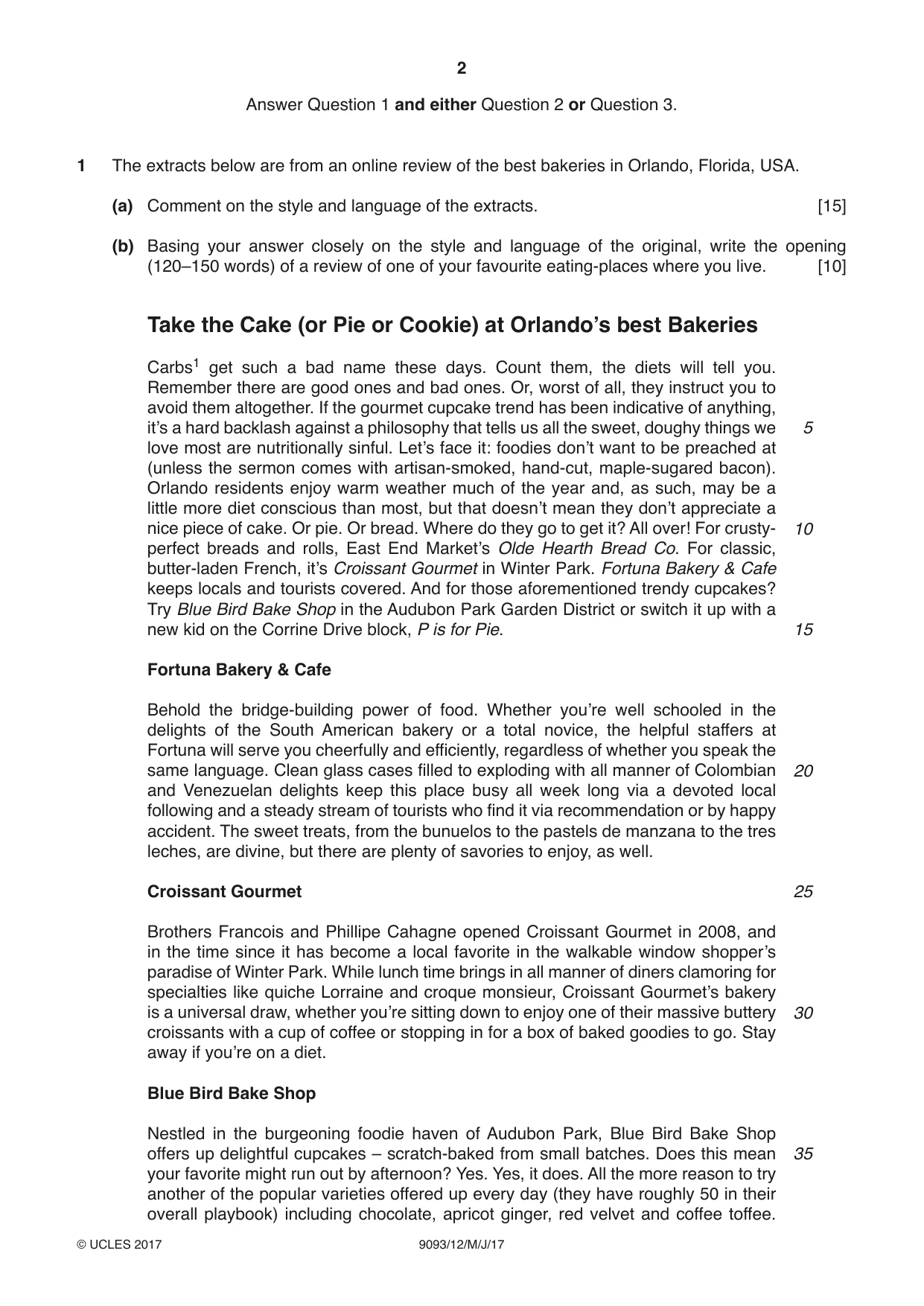
2 9093/12/M/J/17 © UCLES 2017 Answer Question 1 and either Question 2 or Question 3. 1 The extracts below are from an online review of the best bakeries in Orlando, Florida, USA. (a) Comment on the style and language of the extracts. [15] (b) Basing your answer closely on the style and language of the original, write the opening (120–150 words) of a review of one of your favourite eating-places where you live. [10] Take the Cake (or Pie or Cookie) at Orlando’s best Bakeries Carbs1 get such a bad name these days. Count them, the diets will tell you. Remember there are good ones and bad ones. Or, worst of all, they instruct you to avoid them altogether. If the gourmet cupcake trend has been indicative of anything, it’s a hard backlash against a philosophy that tells us all the sweet, doughy things we love most are nutritionally sinful. Let’s face it: foodies don’t want to be preached at (unless the sermon comes with artisan-smoked, hand-cut, maple-sugared bacon). Orlando residents enjoy warm weather much of the year and, as such, may be a little more diet conscious than most, but that doesn’t mean they don’t appreciate a nice piece of cake. Or pie. Or bread. Where do they go to get it? All over! For crusty- perfect breads and rolls, East End Market’s Olde Hearth Bread Co. For classic, butter-laden French, it’s Croissant Gourmet in Winter Park. Fortuna Bakery & Cafe keeps locals and tourists covered. And for those aforementioned trendy cupcakes? Try Blue Bird Bake Shop in the Audubon Park Garden District or switch it up with a new kid on the Corrine Drive block, P is for Pie. Fortuna Bakery & Cafe Behold the bridge-building power of food. Whether you’re well schooled in the delights of the South American bakery or a total novice, the helpful staffers at Fortuna will serve you cheerfully and efficiently, regardless of whether you speak the same language. Clean glass cases filled to exploding with all manner of Colombian and Venezuelan delights keep this place busy all week long via a devoted local following and a steady stream of tourists who find it via recommendation or by happy accident. The sweet treats, from the bunuelos to the pastels de manzana to the tres leches, are divine, but there are plenty of savories to enjoy, as well. Croissant Gourmet Brothers Francois and Phillipe Cahagne opened Croissant Gourmet in 2008, and in the time since it has become a local favorite in the walkable window shopper’s paradise of Winter Park. While lunch time brings in all manner of diners clamoring for specialties like quiche Lorraine and croque monsieur, Croissant Gourmet’s bakery is a universal draw, whether you’re sitting down to enjoy one of their massive buttery croissants with a cup of coffee or stopping in for a box of baked goodies to go. Stay away if you’re on a diet. Blue Bird Bake Shop Nestled in the burgeoning foodie haven of Audubon Park, Blue Bird Bake Shop offers up delightful cupcakes – scratch-baked from small batches. Does this mean your favorite might run out by afternoon? Yes. Yes, it does. All the more reason to try another of the popular varieties offered up every day (they have roughly 50 in their overall playbook) including chocolate, apricot ginger, red velvet and coffee toffee. 5 10 15 20 25 30 35
Question paper, page 3
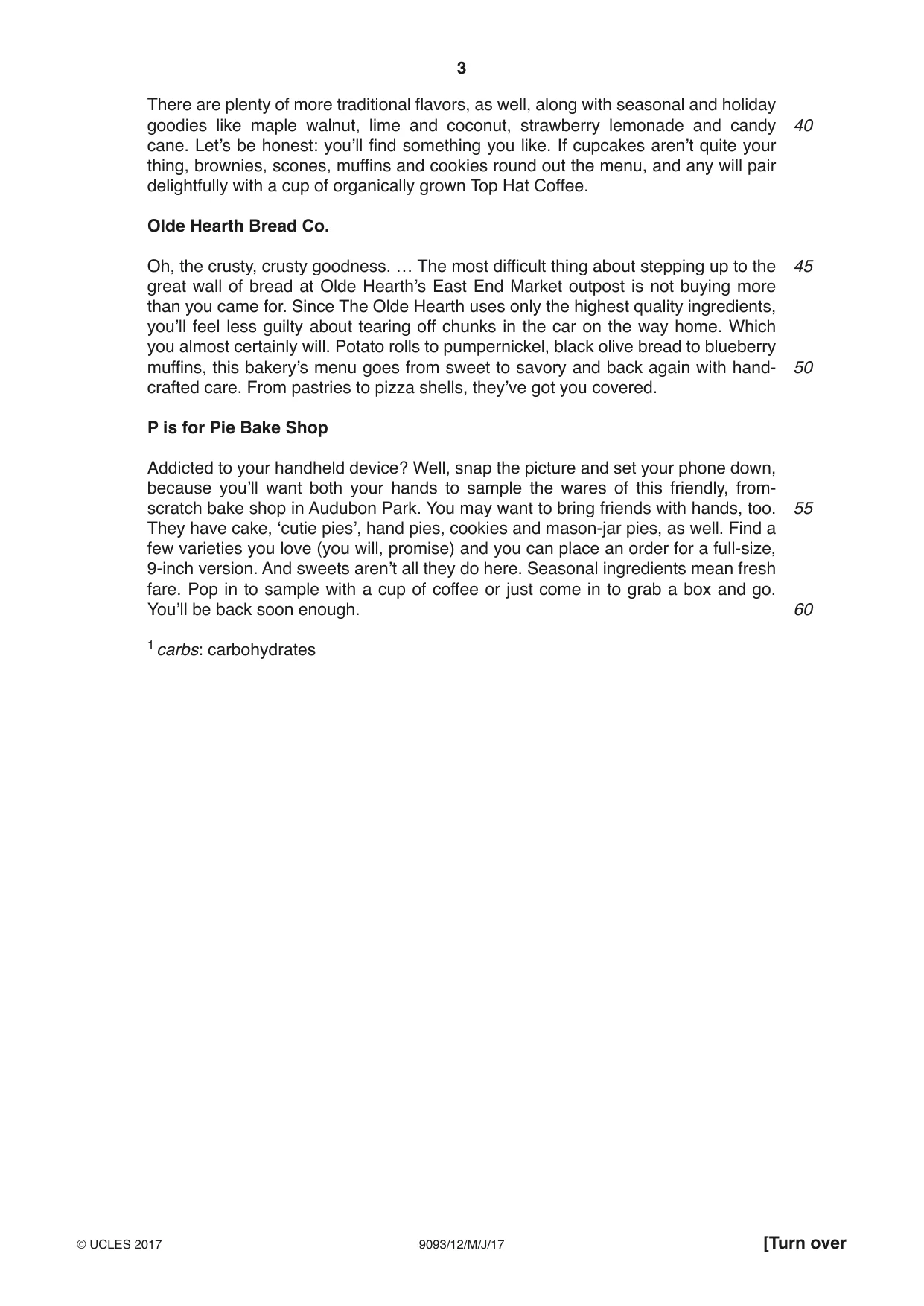
3 9093/12/M/J/17 © UCLES 2017 [Turn over There are plenty of more traditional flavors, as well, along with seasonal and holiday goodies like maple walnut, lime and coconut, strawberry lemonade and candy cane. Let’s be honest: you’ll find something you like. If cupcakes aren’t quite your thing, brownies, scones, muffins and cookies round out the menu, and any will pair delightfully with a cup of organically grown Top Hat Coffee. Olde Hearth Bread Co. Oh, the crusty, crusty goodness. … The most difficult thing about stepping up to the great wall of bread at Olde Hearth’s East End Market outpost is not buying more than you came for. Since The Olde Hearth uses only the highest quality ingredients, you’ll feel less guilty about tearing off chunks in the car on the way home. Which you almost certainly will. Potato rolls to pumpernickel, black olive bread to blueberry muffins, this bakery’s menu goes from sweet to savory and back again with hand- crafted care. From pastries to pizza shells, they’ve got you covered. P is for Pie Bake Shop Addicted to your handheld device? Well, snap the picture and set your phone down, because you’ll want both your hands to sample the wares of this friendly, from- scratch bake shop in Audubon Park. You may want to bring friends with hands, too. They have cake, ‘cutie pies’, hand pies, cookies and mason-jar pies, as well. Find a few varieties you love (you will, promise) and you can place an order for a full-size, 9-inch version. And sweets aren’t all they do here. Seasonal ingredients mean fresh fare. Pop in to sample with a cup of coffee or just come in to grab a box and go. You’ll be back soon enough. 1 carbs: carbohydrates 40 45 50 55 60
Question paper, page 4
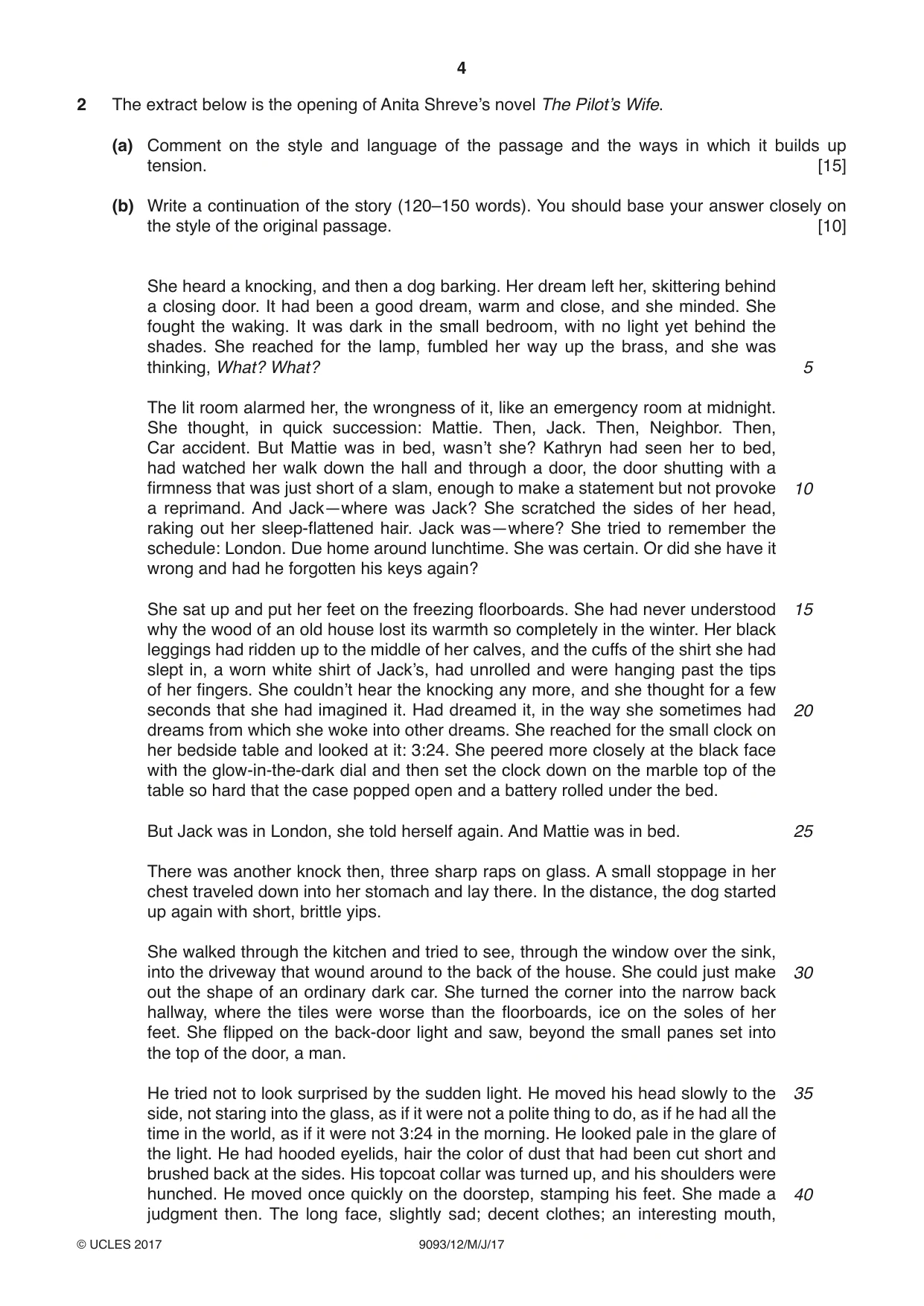
4 9093/12/M/J/17 © UCLES 2017 2 The extract below is the opening of Anita Shreve’s novel The Pilot’s Wife. (a) Comment on the style and language of the passage and the ways in which it builds up tension. [15] (b) Write a continuation of the story (120–150 words). You should base your answer closely on the style of the original passage. [10] She heard a knocking, and then a dog barking. Her dream left her, skittering behind a closing door. It had been a good dream, warm and close, and she minded. She fought the waking. It was dark in the small bedroom, with no light yet behind the shades. She reached for the lamp, fumbled her way up the brass, and she was thinking, What? What? The lit room alarmed her, the wrongness of it, like an emergency room at midnight. She thought, in quick succession: Mattie. Then, Jack. Then, Neighbor. Then, Car accident. But Mattie was in bed, wasn’t she? Kathryn had seen her to bed, had watched her walk down the hall and through a door, the door shutting with a firmness that was just short of a slam, enough to make a statement but not provoke a reprimand. And Jack—where was Jack? She scratched the sides of her head, raking out her sleep-flattened hair. Jack was—where? She tried to remember the schedule: London. Due home around lunchtime. She was certain. Or did she have it wrong and had he forgotten his keys again? She sat up and put her feet on the freezing floorboards. She had never understood why the wood of an old house lost its warmth so completely in the winter. Her black leggings had ridden up to the middle of her calves, and the cuffs of the shirt she had slept in, a worn white shirt of Jack’s, had unrolled and were hanging past the tips of her fingers. She couldn’t hear the knocking any more, and she thought for a few seconds that she had imagined it. Had dreamed it, in the way she sometimes had dreams from which she woke into other dreams. She reached for the small clock on her bedside table and looked at it: 3:24. She peered more closely at the black face with the glow-in-the-dark dial and then set the clock down on the marble top of the table so hard that the case popped open and a battery rolled under the bed. But Jack was in London, she told herself again. And Mattie was in bed. There was another knock then, three sharp raps on glass. A small stoppage in her chest traveled down into her stomach and lay there. In the distance, the dog started up again with short, brittle yips. She walked through the kitchen and tried to see, through the window over the sink, into the driveway that wound around to the back of the house. She could just make out the shape of an ordinary dark car. She turned the corner into the narrow back hallway, where the tiles were worse than the floorboards, ice on the soles of her feet. She flipped on the back-door light and saw, beyond the small panes set into the top of the door, a man. He tried not to look surprised by the sudden light. He moved his head slowly to the side, not staring into the glass, as if it were not a polite thing to do, as if he had all the time in the world, as if it were not 3:24 in the morning. He looked pale in the glare of the light. He had hooded eyelids, hair the color of dust that had been cut short and brushed back at the sides. His topcoat collar was turned up, and his shoulders were hunched. He moved once quickly on the doorstep, stamping his feet. She made a judgment then. The long face, slightly sad; decent clothes; an interesting mouth, 5 10 15 20 25 30 35 40
Question paper, page 5
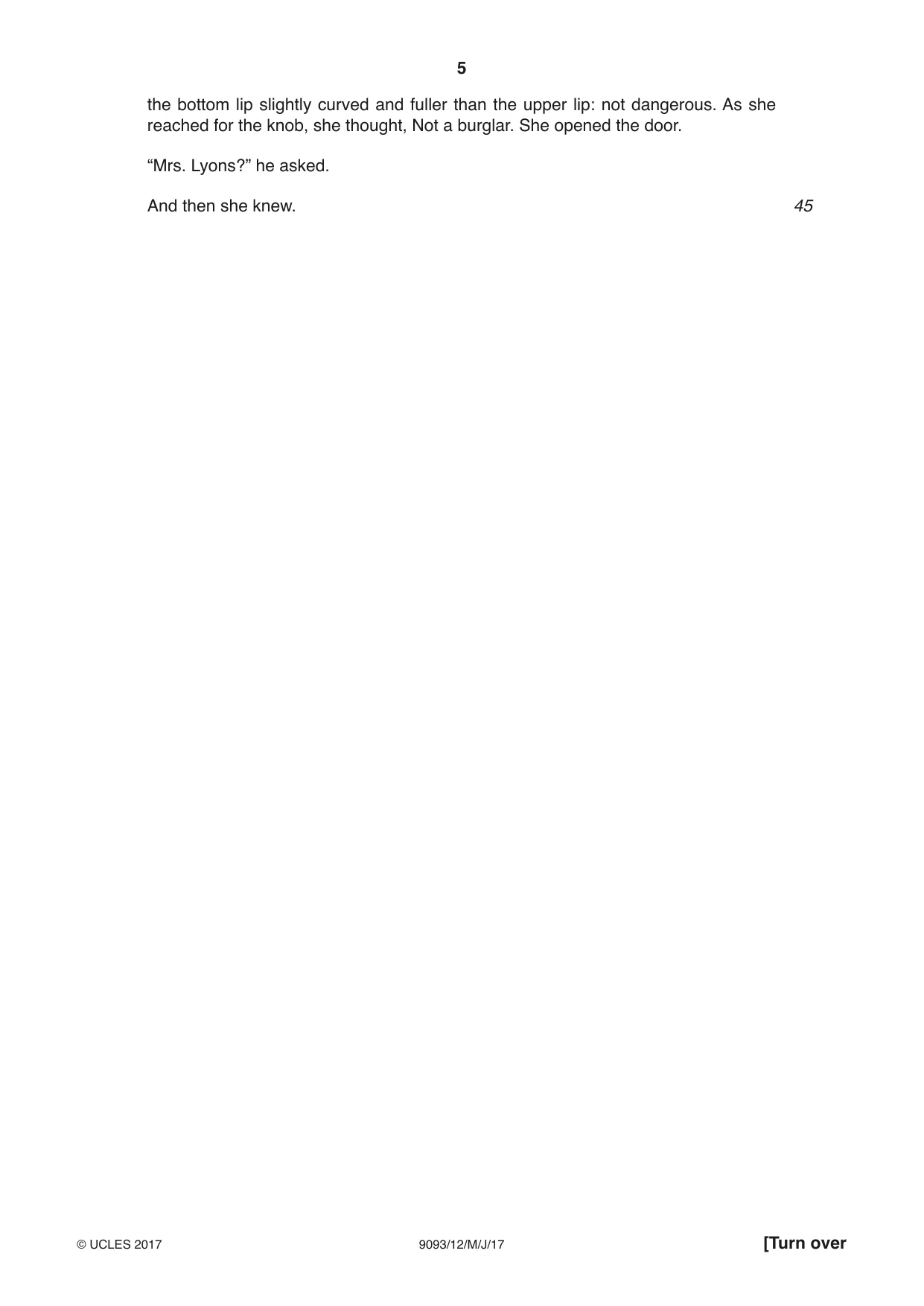
5 9093/12/M/J/17 © UCLES 2017 [Turn over the bottom lip slightly curved and fuller than the upper lip: not dangerous. As she reached for the knob, she thought, Not a burglar. She opened the door. “Mrs. Lyons?” he asked. And then she knew. 45
Question paper, page 6
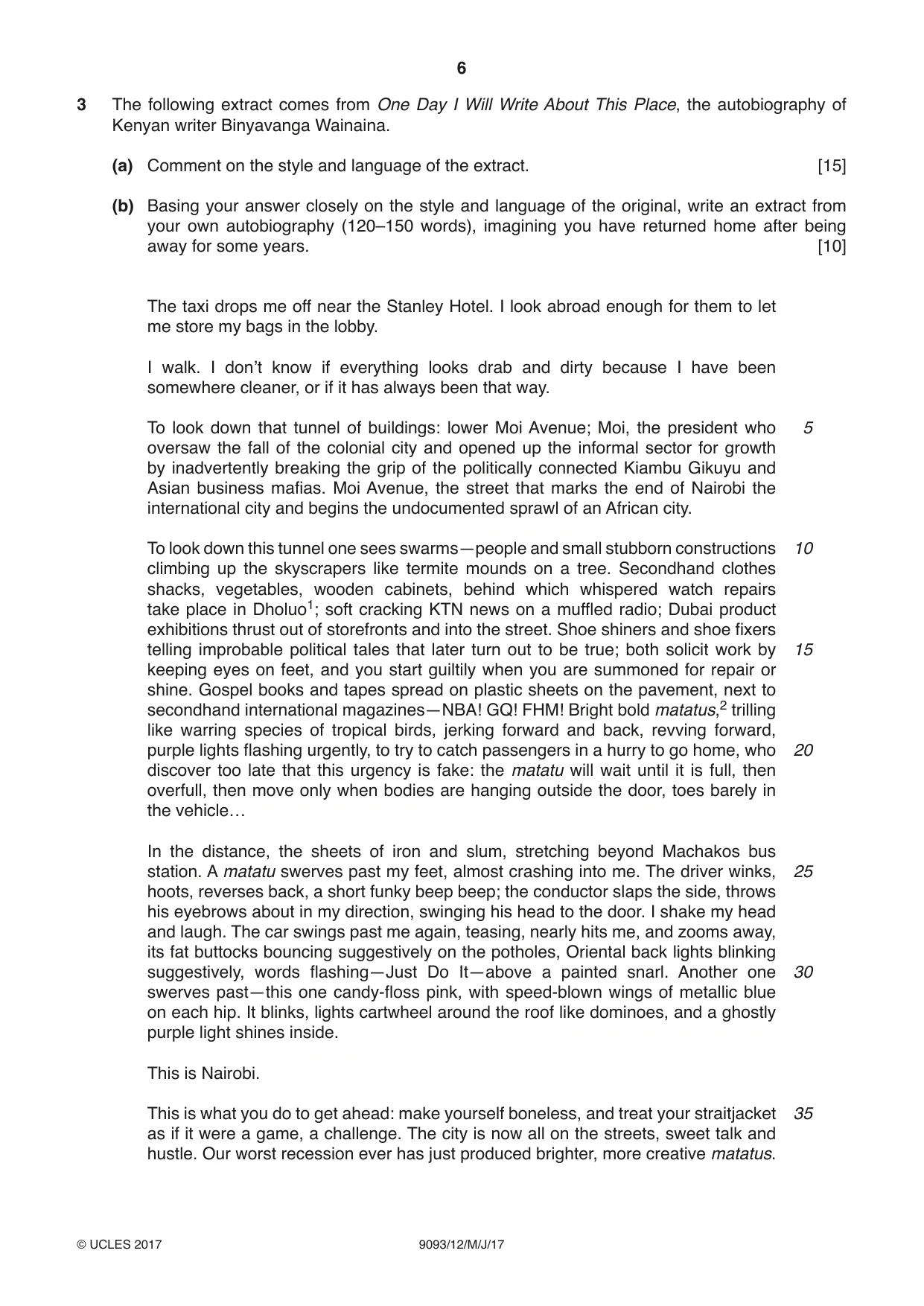
6 9093/12/M/J/17 © UCLES 2017 3 The following extract comes from One Day I Will Write About This Place, the autobiography of Kenyan writer Binyavanga Wainaina. (a) Comment on the style and language of the extract. [15] (b) Basing your answer closely on the style and language of the original, write an extract from your own autobiography (120–150 words), imagining you have returned home after being away for some years. [10] The taxi drops me off near the Stanley Hotel. I look abroad enough for them to let me store my bags in the lobby. I walk. I don’t know if everything looks drab and dirty because I have been somewhere cleaner, or if it has always been that way. To look down that tunnel of buildings: lower Moi Avenue; Moi, the president who oversaw the fall of the colonial city and opened up the informal sector for growth by inadvertently breaking the grip of the politically connected Kiambu Gikuyu and Asian business mafias. Moi Avenue, the street that marks the end of Nairobi the international city and begins the undocumented sprawl of an African city. To look down this tunnel one sees swarms—people and small stubborn constructions climbing up the skyscrapers like termite mounds on a tree. Secondhand clothes shacks, vegetables, wooden cabinets, behind which whispered watch repairs take place in Dholuo1; soft cracking KTN news on a muffled radio; Dubai product exhibitions thrust out of storefronts and into the street. Shoe shiners and shoe fixers telling improbable political tales that later turn out to be true; both solicit work by keeping eyes on feet, and you start guiltily when you are summoned for repair or shine. Gospel books and tapes spread on plastic sheets on the pavement, next to secondhand international magazines—NBA! GQ! FHM! Bright bold matatus,2 trilling like warring species of tropical birds, jerking forward and back, revving forward, purple lights flashing urgently, to try to catch passengers in a hurry to go home, who discover too late that this urgency is fake: the matatu will wait until it is full, then overfull, then move only when bodies are hanging outside the door, toes barely in the vehicle… In the distance, the sheets of iron and slum, stretching beyond Machakos bus station. A matatu swerves past my feet, almost crashing into me. The driver winks, hoots, reverses back, a short funky beep beep; the conductor slaps the side, throws his eyebrows about in my direction, swinging his head to the door. I shake my head and laugh. The car swings past me again, teasing, nearly hits me, and zooms away, its fat buttocks bouncing suggestively on the potholes, Oriental back lights blinking suggestively, words flashing—Just Do It—above a painted snarl. Another one swerves past—this one candy-floss pink, with speed-blown wings of metallic blue on each hip. It blinks, lights cartwheel around the roof like dominoes, and a ghostly purple light shines inside. This is Nairobi. This is what you do to get ahead: make yourself boneless, and treat your straitjacket as if it were a game, a challenge. The city is now all on the streets, sweet talk and hustle. Our worst recession ever has just produced brighter, more creative matatus. 5 10 15 20 25 30 35
Question paper, page 7
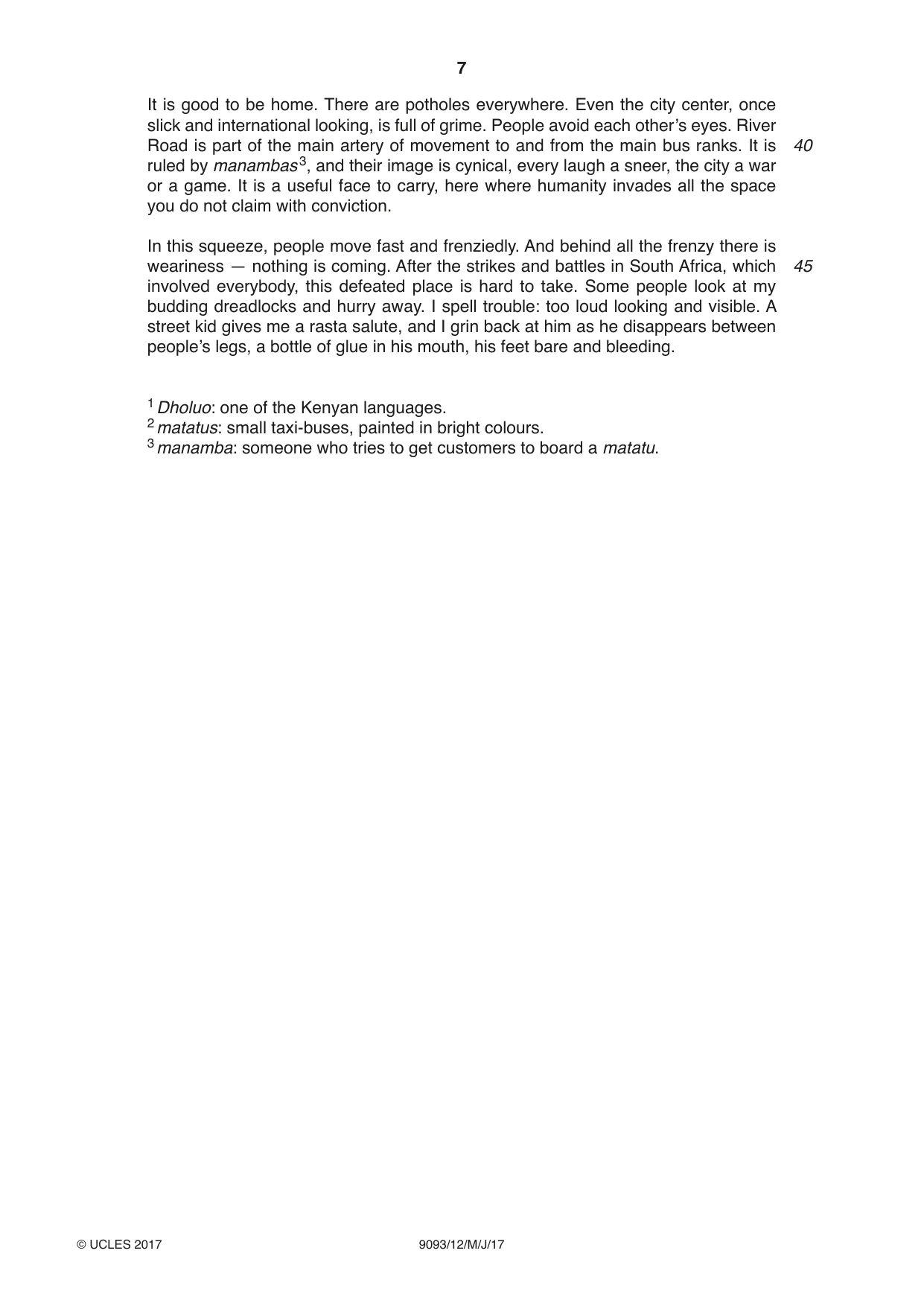
7 9093/12/M/J/17 © UCLES 2017 It is good to be home. There are potholes everywhere. Even the city center, once slick and international looking, is full of grime. People avoid each other’s eyes. River Road is part of the main artery of movement to and from the main bus ranks. It is ruled by manambas 3, and their image is cynical, every laugh a sneer, the city a war or a game. It is a useful face to carry, here where humanity invades all the space you do not claim with conviction. In this squeeze, people move fast and frenziedly. And behind all the frenzy there is weariness — nothing is coming. After the strikes and battles in South Africa, which involved everybody, this defeated place is hard to take. Some people look at my budding dreadlocks and hurry away. I spell trouble: too loud looking and visible. A street kid gives me a rasta salute, and I grin back at him as he disappears between people’s legs, a bottle of glue in his mouth, his feet bare and bleeding. 1 Dholuo: one of the Kenyan languages. 2 matatus: small taxi-buses, painted in bright colours. 3 manamba: someone who tries to get customers to board a matatu. 40 45
Question paper, page 8
8 9093/12/M/J/17 © UCLES 2017 BLANK PAGE Permission to reproduce items where third-party owned material protected by copyright is included has been sought and cleared where possible. Every reasonable effort has been made by the publisher (UCLES) to trace copyright holders, but if any items requiring clearance have unwittingly been included, the publisher will be pleased to make amends at the earliest possible opportunity. To avoid the issue of disclosure of answer-related information to candidates, all copyright acknowledgements are reproduced online in the Cambridge International Examinations Copyright Acknowledgements Booklet. This is produced for each series of examinations and is freely available to download at www.cie.org.uk after the live examination series. Cambridge International Examinations is part of the Cambridge Assessment Group. Cambridge Assessment is the brand name of University of Cambridge Local Examinations Syndicate (UCLES), which is itself a department of the University of Cambridge.
Mark scheme, page 1
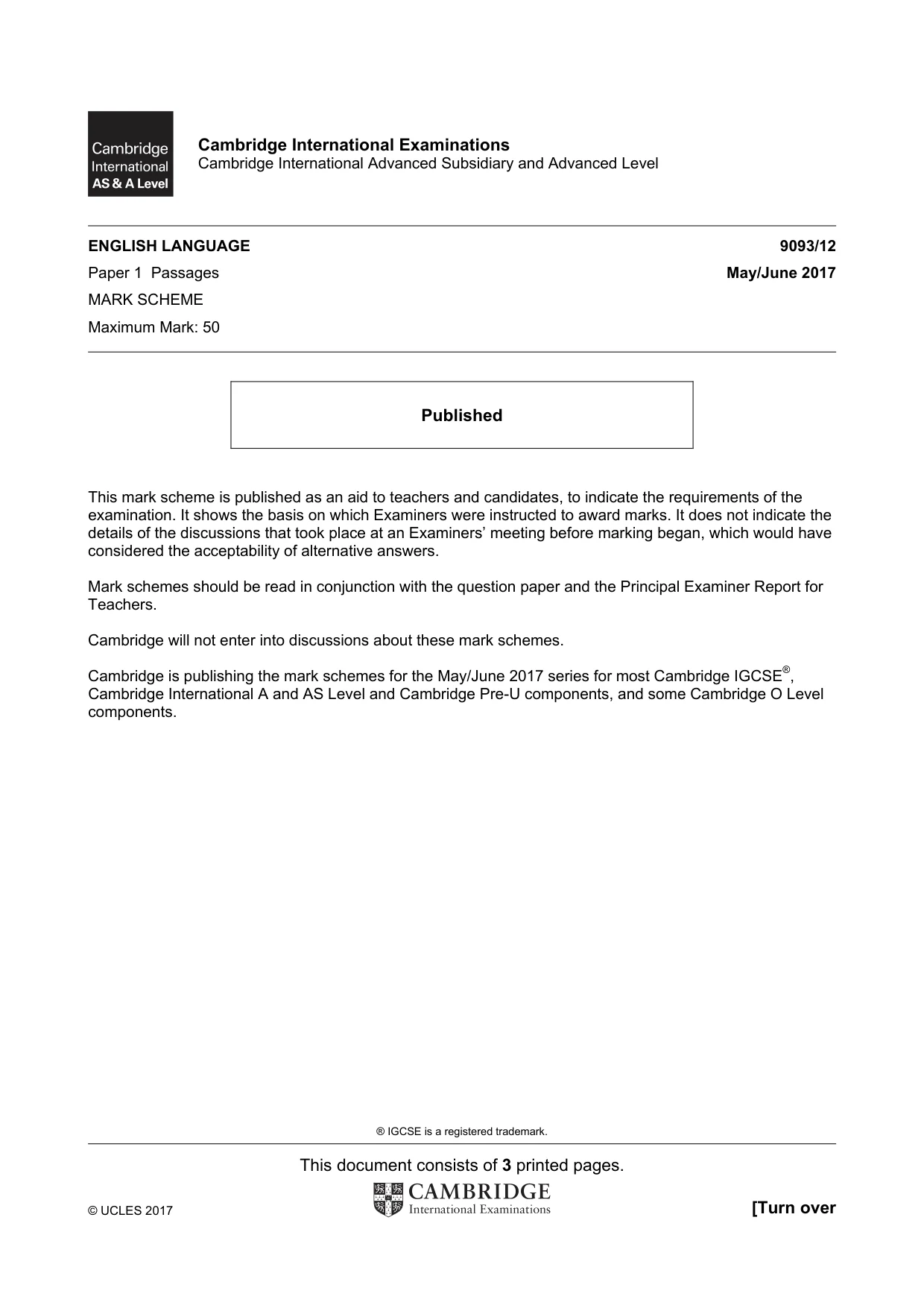
® IGCSE is a registered trademark. This document consists of 3 printed pages. © UCLES 2017 [Turn over Cambridge International Examinations Cambridge International Advanced Subsidiary and Advanced Level ENGLISH LANGUAGE 9093/12 Paper 1 Passages May/June 2017 MARK SCHEME Maximum Mark: 50 Published This mark scheme is published as an aid to teachers and candidates, to indicate the requirements of the examination. It shows the basis on which Examiners were instructed to award marks. It does not indicate the details of the discussions that took place at an Examiners’ meeting before marking began, which would have considered the acceptability of alternative answers. Mark schemes should be read in conjunction with the question paper and the Principal Examiner Report for Teachers. Cambridge will not enter into discussions about these mark schemes. Cambridge is publishing the mark schemes for the May/June 2017 series for most Cambridge IGCSE®, Cambridge International A and AS Level and Cambridge Pre-U components, and some Cambridge O Level components.
Mark scheme, page 2
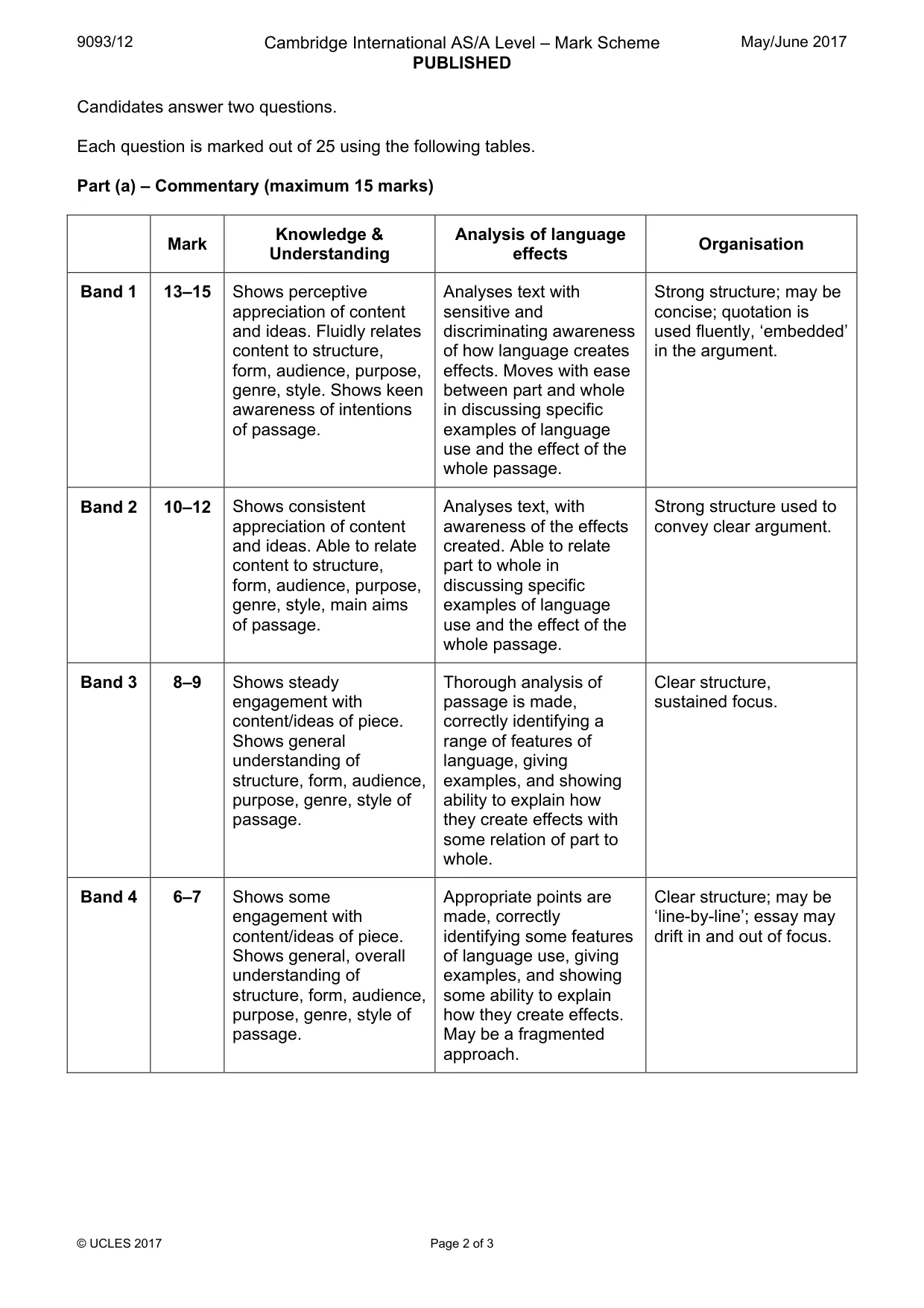
9093/12 Cambridge International AS/A Level – Mark Scheme PUBLISHED May/June 2017 © UCLES 2017 Page 2 of 3 Candidates answer two questions. Each question is marked out of 25 using the following tables. Part (a) – Commentary (maximum 15 marks) Mark Knowledge & Understanding Analysis of language effects Organisation Band 1 13–15 Shows perceptive appreciation of content and ideas. Fluidly relates content to structure, form, audience, purpose, genre, style. Shows keen awareness of intentions of passage. Analyses text with sensitive and discriminating awareness of how language creates effects. Moves with ease between part and whole in discussing specific examples of language use and the effect of the whole passage. Strong structure; may be concise; quotation is used fluently, ‘embedded’ in the argument. Band 2 10–12 Shows consistent appreciation of content and ideas. Able to relate content to structure, form, audience, purpose, genre, style, main aims of passage. Analyses text, with awareness of the effects created. Able to relate part to whole in discussing specific examples of language use and the effect of the whole passage. Strong structure used to convey clear argument. Band 3 8–9 Shows steady engagement with content/ideas of piece. Shows general understanding of structure, form, audience, purpose, genre, style of passage. Thorough analysis of passage is made, correctly identifying a range of features of language, giving examples, and showing ability to explain how they create effects with some relation of part to whole. Clear structure, sustained focus. Band 4 6–7 Shows some engagement with content/ideas of piece. Shows general, overall understanding of structure, form, audience, purpose, genre, style of passage. Appropriate points are made, correctly identifying some features of language use, giving examples, and showing some ability to explain how they create effects. May be a fragmented approach. Clear structure; may be ‘line-by-line’; essay may drift in and out of focus.
Mark scheme, page 3
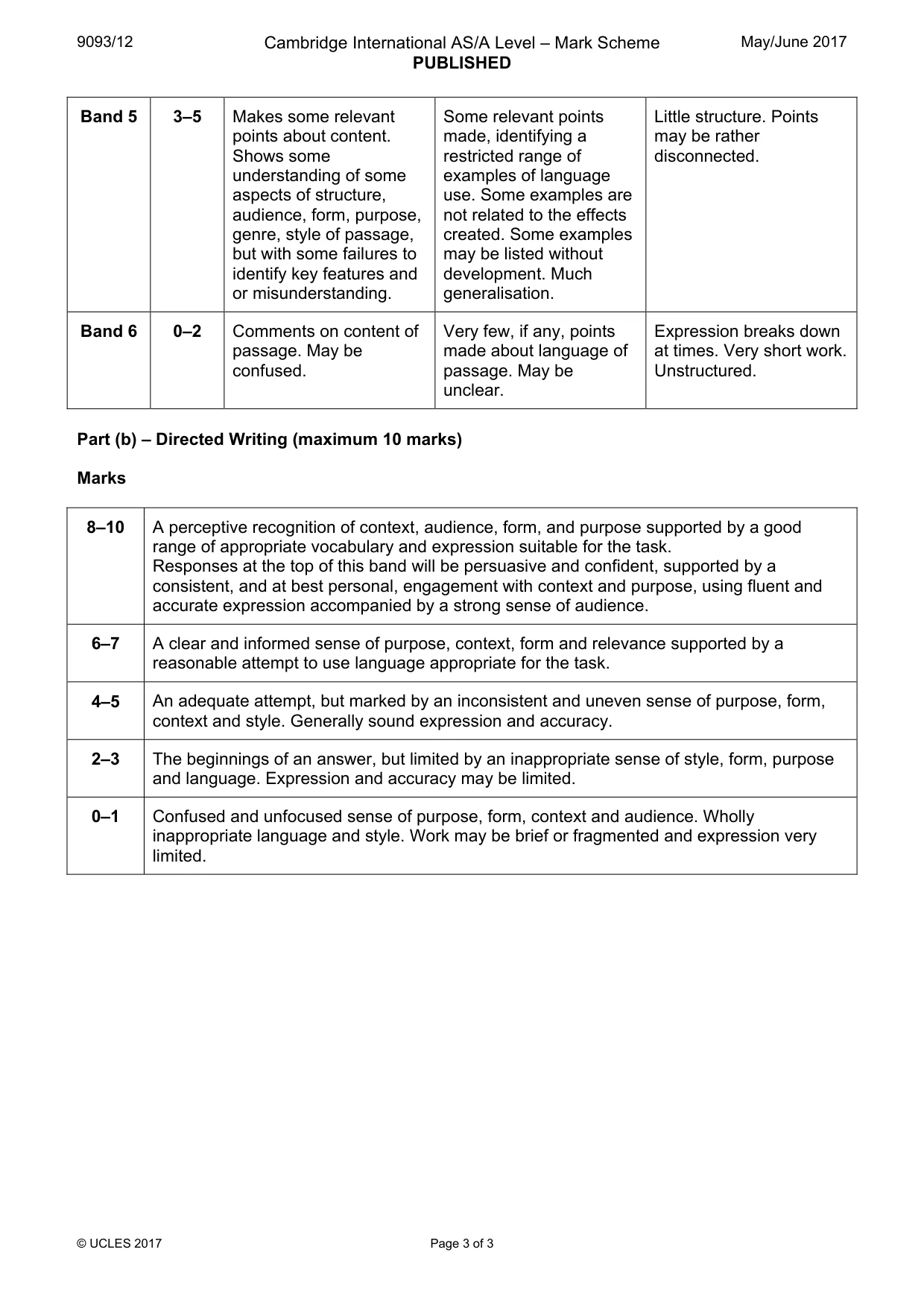
9093/12 Cambridge International AS/A Level – Mark Scheme PUBLISHED May/June 2017 © UCLES 2017 Page 3 of 3 Band 5 3–5 Makes some relevant points about content. Shows some understanding of some aspects of structure, audience, form, purpose, genre, style of passage, but with some failures to identify key features and or misunderstanding. Some relevant points made, identifying a restricted range of examples of language use. Some examples are not related to the effects created. Some examples may be listed without development. Much generalisation. Little structure. Points may be rather disconnected. Band 6 0–2 Comments on content of passage. May be confused. Very few, if any, points made about language of passage. May be unclear. Expression breaks down at times. Very short work. Unstructured. Part (b) – Directed Writing (maximum 10 marks) Marks 8–10 A perceptive recognition of context, audience, form, and purpose supported by a good range of appropriate vocabulary and expression suitable for the task. Responses at the top of this band will be persuasive and confident, supported by a consistent, and at best personal, engagement with context and purpose, using fluent and accurate expression accompanied by a strong sense of audience. 6–7 A clear and informed sense of purpose, context, form and relevance supported by a reasonable attempt to use language appropriate for the task. 4–5 An adequate attempt, but marked by an inconsistent and uneven sense of purpose, form, context and style. Generally sound expression and accuracy. 2–3 The beginnings of an answer, but limited by an inappropriate sense of style, form, purpose and language. Expression and accuracy may be limited. 0–1 Confused and unfocused sense of purpose, form, context and audience. Wholly inappropriate language and style. Work may be brief or fragmented and expression very limited.
What you needed in this session
Cambridge’s own grade thresholds for 2017 May/June, Paper 1 · Variant 2. A higher threshold means an easier paper — the bar moves with how the cohort did.