Cambridge A Level English - Language AS and A Level (from 2014) 9093 — 2017 May/June Paper 1 · Variant 1
9093/11/M/J/17 · 50 marks · ≈56 min
The question paper and its mark scheme, free to read here and free to download. This is Cambridge’s own paper, exactly as it was sat.
Question paper8 pages
Mark scheme3 pages
Answers below. Sit the paper first if you are practising.
Paper as text
Question paper, page 1
This document consists of 7 printed pages, 1 blank page and 1 Insert. DC (RCL DC (JDA)) 130859/2 © UCLES 2017 [Turn over Cambridge International Examinations Cambridge International Advanced Subsidiary and Advanced Level * 3 0 8 7 5 9 7 5 0 9 * ENGLISH LANGUAGE 9093/11 Paper 1 Passages May/June 2017 2 hours 15 minutes No Additional Materials are required. READ THESE INSTRUCTIONS FIRST An answer booklet is provided inside this question paper. You should follow the instructions on the front cover of the answer booklet. If you need additional answer paper, ask the invigilator for a continuation booklet. Answer two questions: Question 1 and either Question 2 or Question 3. You should spend about 15 minutes reading the passages and questions before you start writing your answers. You are reminded of the need for good English and clear presentation in your answers. The number of marks is given in brackets [ ] at the end of each question or part question.
Question paper, page 2
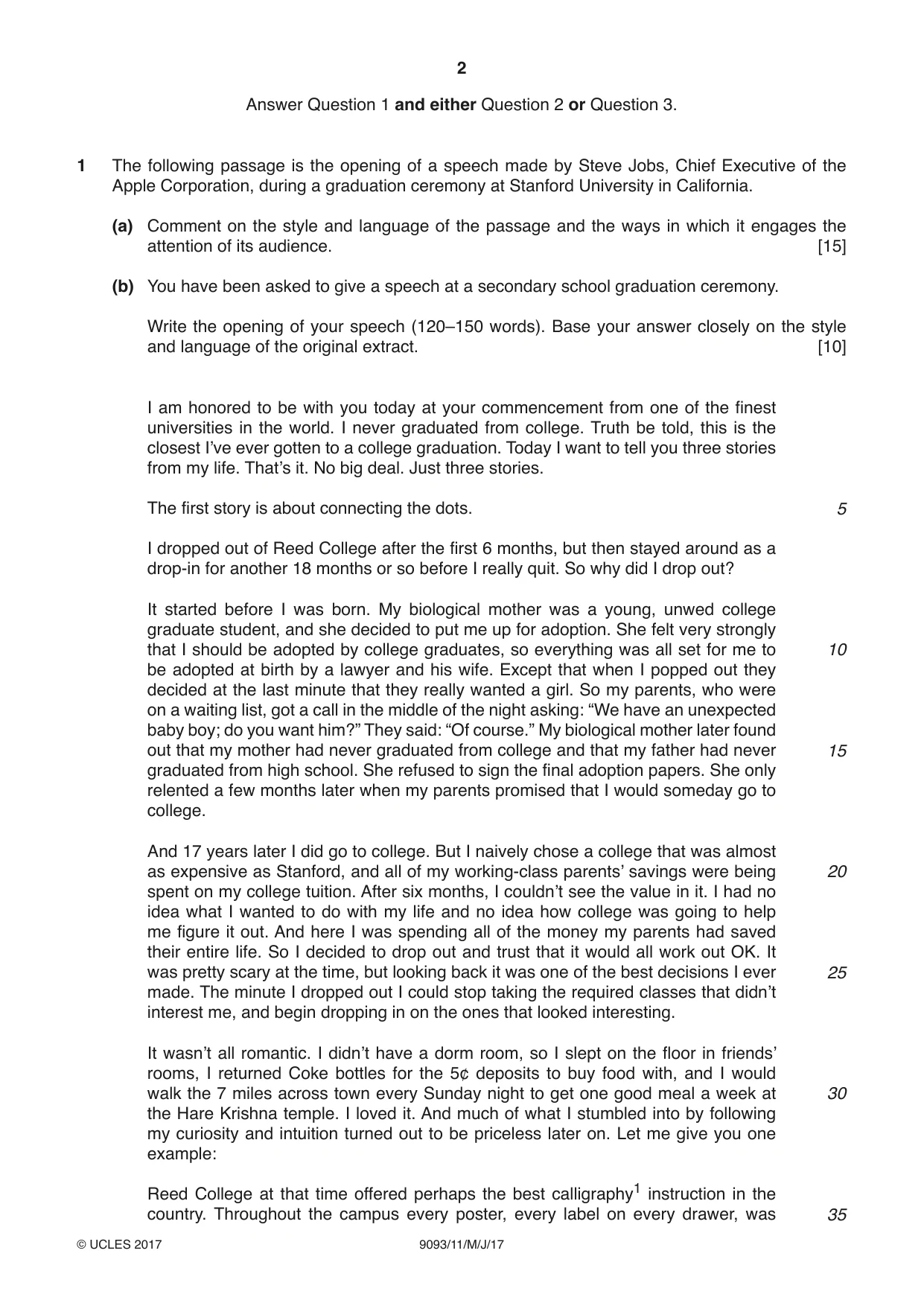
2 9093/11/M/J/17 © UCLES 2017 Answer Question 1 and either Question 2 or Question 3. 1 The following passage is the opening of a speech made by Steve Jobs, Chief Executive of the Apple Corporation, during a graduation ceremony at Stanford University in California. (a) Comment on the style and language of the passage and the ways in which it engages the attention of its audience. [15] (b) You have been asked to give a speech at a secondary school graduation ceremony. Write the opening of your speech (120–150 words). Base your answer closely on the style and language of the original extract. [10] I am honored to be with you today at your commencement from one of the finest universities in the world. I never graduated from college. Truth be told, this is the closest I’ve ever gotten to a college graduation. Today I want to tell you three stories from my life. That’s it. No big deal. Just three stories. The first story is about connecting the dots. I dropped out of Reed College after the first 6 months, but then stayed around as a drop-in for another 18 months or so before I really quit. So why did I drop out? It started before I was born. My biological mother was a young, unwed college graduate student, and she decided to put me up for adoption. She felt very strongly that I should be adopted by college graduates, so everything was all set for me to be adopted at birth by a lawyer and his wife. Except that when I popped out they decided at the last minute that they really wanted a girl. So my parents, who were on a waiting list, got a call in the middle of the night asking: “We have an unexpected baby boy; do you want him?” They said: “Of course.” My biological mother later found out that my mother had never graduated from college and that my father had never graduated from high school. She refused to sign the final adoption papers. She only relented a few months later when my parents promised that I would someday go to college. And 17 years later I did go to college. But I naively chose a college that was almost as expensive as Stanford, and all of my working-class parents’ savings were being spent on my college tuition. After six months, I couldn’t see the value in it. I had no idea what I wanted to do with my life and no idea how college was going to help me figure it out. And here I was spending all of the money my parents had saved their entire life. So I decided to drop out and trust that it would all work out OK. It was pretty scary at the time, but looking back it was one of the best decisions I ever made. The minute I dropped out I could stop taking the required classes that didn’t interest me, and begin dropping in on the ones that looked interesting. It wasn’t all romantic. I didn’t have a dorm room, so I slept on the floor in friends’ rooms, I returned Coke bottles for the 5¢ deposits to buy food with, and I would walk the 7 miles across town every Sunday night to get one good meal a week at the Hare Krishna temple. I loved it. And much of what I stumbled into by following my curiosity and intuition turned out to be priceless later on. Let me give you one example: Reed College at that time offered perhaps the best calligraphy1 instruction in the country. Throughout the campus every poster, every label on every drawer, was 5 10 15 20 25 30 35
Question paper, page 3
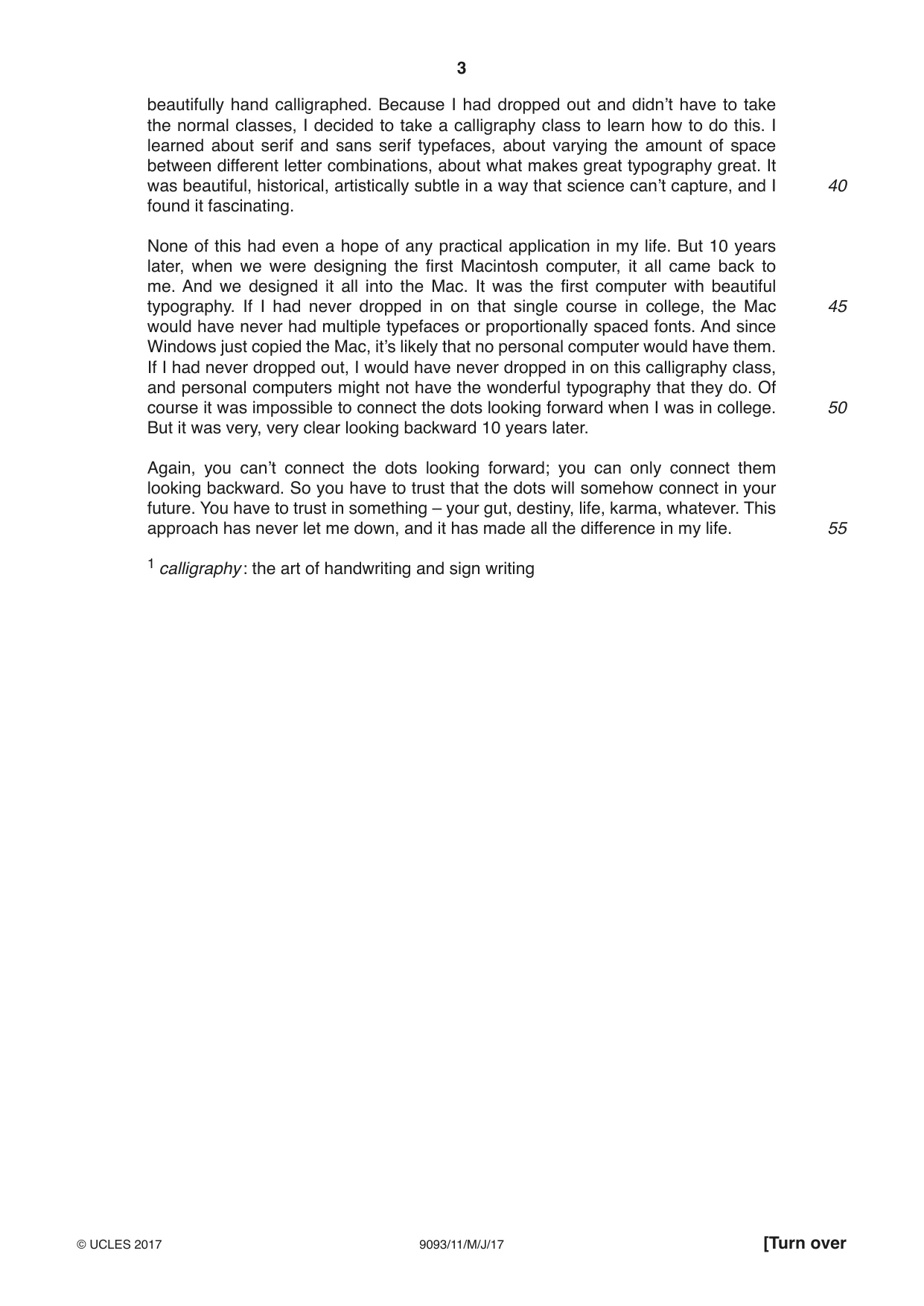
3 9093/11/M/J/17 © UCLES 2017 [Turn over beautifully hand calligraphed. Because I had dropped out and didn’t have to take the normal classes, I decided to take a calligraphy class to learn how to do this. I learned about serif and sans serif typefaces, about varying the amount of space between different letter combinations, about what makes great typography great. It was beautiful, historical, artistically subtle in a way that science can’t capture, and I found it fascinating. None of this had even a hope of any practical application in my life. But 10 years later, when we were designing the first Macintosh computer, it all came back to me. And we designed it all into the Mac. It was the first computer with beautiful typography. If I had never dropped in on that single course in college, the Mac would have never had multiple typefaces or proportionally spaced fonts. And since Windows just copied the Mac, it’s likely that no personal computer would have them. If I had never dropped out, I would have never dropped in on this calligraphy class, and personal computers might not have the wonderful typography that they do. Of course it was impossible to connect the dots looking forward when I was in college. But it was very, very clear looking backward 10 years later. Again, you can’t connect the dots looking forward; you can only connect them looking backward. So you have to trust that the dots will somehow connect in your future. You have to trust in something – your gut, destiny, life, karma, whatever. This approach has never let me down, and it has made all the difference in my life. 1 calligraphy : the art of handwriting and sign writing 40 45 50 55
Question paper, page 4
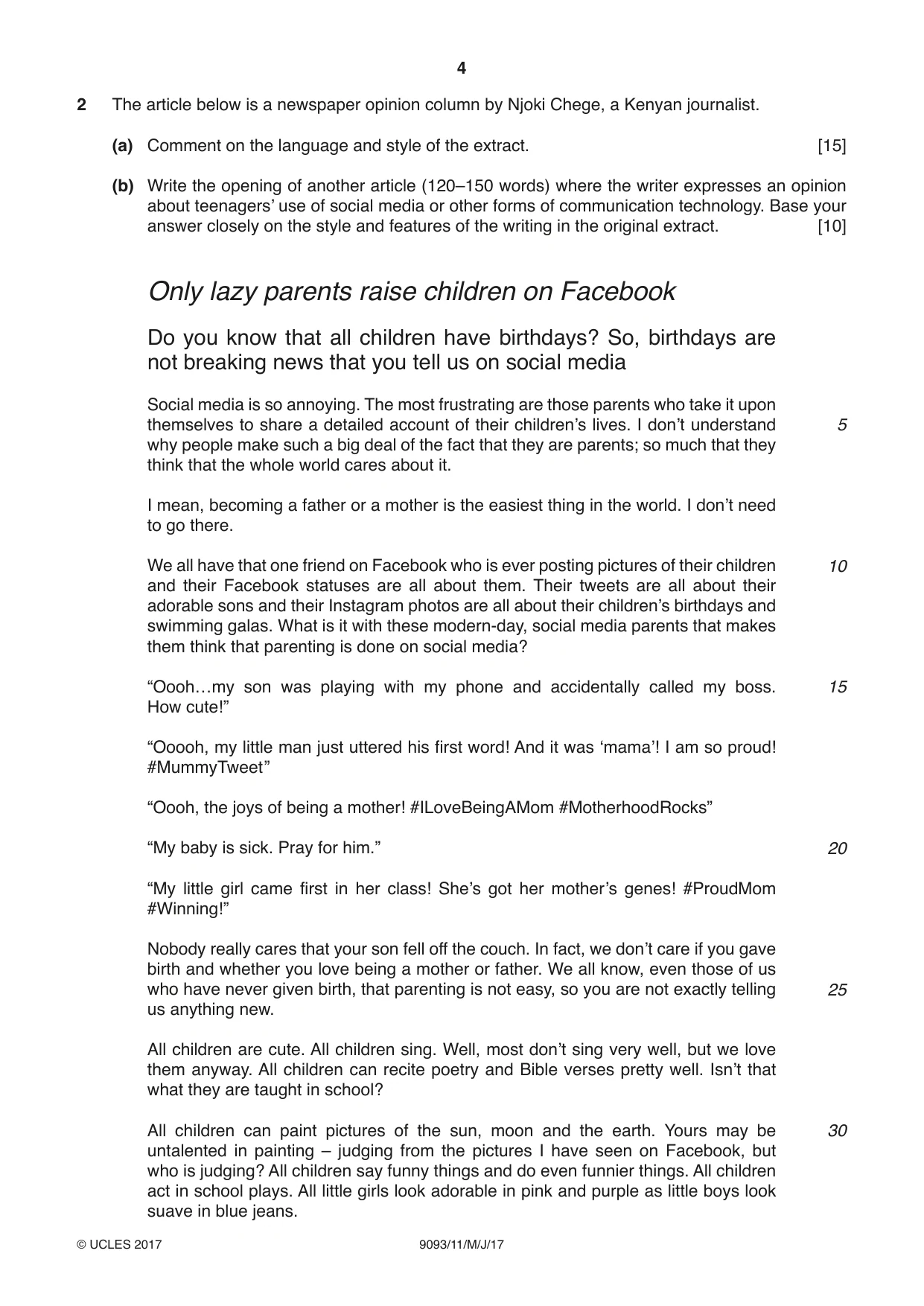
4 9093/11/M/J/17 © UCLES 2017 2 The article below is a newspaper opinion column by Njoki Chege, a Kenyan journalist. (a) Comment on the language and style of the extract. [15] (b) Write the opening of another article (120–150 words) where the writer expresses an opinion about teenagers’ use of social media or other forms of communication technology. Base your answer closely on the style and features of the writing in the original extract. [10] Only lazy parents raise children on Facebook Do you know that all children have birthdays? So, birthdays are not breaking news that you tell us on social media Social media is so annoying. The most frustrating are those parents who take it upon themselves to share a detailed account of their children’s lives. I don’t understand why people make such a big deal of the fact that they are parents; so much that they think that the whole world cares about it. I mean, becoming a father or a mother is the easiest thing in the world. I don’t need to go there. We all have that one friend on Facebook who is ever posting pictures of their children and their Facebook statuses are all about them. Their tweets are all about their adorable sons and their Instagram photos are all about their children’s birthdays and swimming galas. What is it with these modern-day, social media parents that makes them think that parenting is done on social media? “Oooh…my son was playing with my phone and accidentally called my boss. How cute!” “Ooooh, my little man just uttered his first word! And it was ‘mama’! I am so proud! #MummyTweet ” “Oooh, the joys of being a mother! #ILoveBeingAMom #MotherhoodRocks” “My baby is sick. Pray for him.” “My little girl came first in her class! She’s got her mother’s genes! #ProudMom #Winning!” Nobody really cares that your son fell off the couch. In fact, we don’t care if you gave birth and whether you love being a mother or father. We all know, even those of us who have never given birth, that parenting is not easy, so you are not exactly telling us anything new. All children are cute. All children sing. Well, most don’t sing very well, but we love them anyway. All children can recite poetry and Bible verses pretty well. Isn’t that what they are taught in school? All children can paint pictures of the sun, moon and the earth. Yours may be untalented in painting – judging from the pictures I have seen on Facebook, but who is judging? All children say funny things and do even funnier things. All children act in school plays. All little girls look adorable in pink and purple as little boys look suave in blue jeans. 5 10 15 20 25 30
Question paper, page 5
5 9093/11/M/J/17 © UCLES 2017 [Turn over All children become number one in nursery school; all they have to do is use their crayons and ensure they colour within the boundaries, right? Did you know that all children have birthdays too? So birthdays are not exactly breaking news; you don’t have to give us updates. All children have dreams. So what if yours wants to become a pilot? I wanted to be a president when I was four years old, and look where I am today! So please, don’t start your Facebook updates with “My children’s dreams are valid. My son just told me he wants to be a doctor.” We all know that with genes that make you post aimless photos on Facebook, chances of your child becoming a doctor are very slim. I am just pointing out the obvious. Spare us the ego trips on social media about what a great parent you are. If you cannot hang those awkward paintings your son drew on the walls of your living room, what makes you think that we want to see them on Facebook? Spare us the family holiday photos of your children at the beach. Spare us the blow- by-blow account of your children’s lives. Let those little angels grow up in peace and stop violating their privacy by telling the entire world what they ate for dinner. Your child turned one month old, so what? Your son got a prize for being the most disciplined, news flash! Your daughter joined class one and looks cute in her uniform. Big deal! The truth is, there will always be a cuter, smarter, prettier, more adorable child than yours. Your friend’s family life will always look better than yours in Facebook photos and they might look like they are having more fun with their children than yours. But it is just nonsensical to hold teenage contests on social media. You cannot do parenting on social media. Period. 35 40 45 50 55
Question paper, page 6
6 9093/11/M/J/17 © UCLES 2017 3 The passage below is from a novel. It describes a teenage boy called Cotter attempting to get into a baseball game without buying a ticket. (a) Comment on the ways in which language and style are used to portray the character of Cotter. [15] (b) The policeman Cotter escapes from writes his report about the disorder at the baseball game. Basing your answer closely on the material of the original extract, write the part of the report that deals with behaviour like Cotter’s. You should write between 120 and 150 words. [10] Cotter thinks he sees a path to the turnstile on the right. He drains himself of everything he does not need to make the jump. Some are still jumping, some are thinking about it, some need a haircut, some have girlfriends in woolly sweaters and the rest have landed in the ruck and are trying to get up and scatter. A couple of stadium cops are rumbling down the ramp. Cotter sheds these elements as they appear, sheds a thousand waves of information hitting on his skin. His gaze is trained on the iron bars projected from the post. He picks up speed and seems to lose his gangliness, the slouchy funk of hormones and unbelonging and all the stammering things that seal his adolescence. He is just a running boy, a half-seen figure from the streets, … Then he leaves his feet and is in the air, feeling sleek and unmussed1 and sort of businesslike, flying in from Kansas City with a briefcase full of bank drafts. His head is tucked, his left leg is clearing the bars. And in one prolonged and aloof and discontinuous instant he sees precisely where he’ll land and which way he’ll run and even though he knows they will be after him the second he touches ground, even though he’ll be in danger for the next several hours—watching left and right—there is less fear in him now. He comes down lightly and goes easy-gaiting2 past the ticket taker groping for his fallen cap and he knows absolutely—knows it all the way, deep as knowing goes, he feels the knowledge start to hammer in his runner’s heart—that he is uncatchable. Here comes a cop in municipal bulk with a gun and cuffs and a flashlight and a billy club3 all jigging on his belt and a summons pad wadded in his pocket. Cotter gives him a juke step4 that sends him nearly to his knees and the hot dog eaters bend from the waist to watch the kid veer away in soft acceleration, showing the cop a little finger-wag bye-bye. He surprises himself this way every so often, doing some gaudy thing that whistles up out of unsuspected whim. He runs up a shadowed ramp and into a crossweave of girders and pillars and spilling light. He hears the crescendoing last chords of the national anthem and sees the great open horseshoe of the grandstand and that unfolding vision of the grass that always seems to mean he has stepped outside his life … . He runs at quarter speed craning to see the rows of seats, looking for an inconspicuous wedge behind a pillar. He cuts into an aisle in section 35 and walks down into the heat and smell of the massed fans, he walks into the smoke that hangs from the underside of 5 10 15 20 25 30 35
Question paper, page 7
7 9093/11/M/J/17 © UCLES 2017 the second deck, he hears the talk, he enters the deep buzz, he hears the warm-up pitches crack into the catcher’s mitt, a series of reports that carry a comet’s tail of secondary sound. Then you lose him in the crowd. 1 unmussed : smoothed down 2 easy-gaiting : walking casually 3 billy club : a truncheon or baton 4 juke step : a baseball term for a false move to deceive an opponent
Question paper, page 8
8 9093/11/M/J/17 © UCLES 2017 Permission to reproduce items where third-party owned material protected by copyright is included has been sought and cleared where possible. Every reasonable effort has been made by the publisher (UCLES) to trace copyright holders, but if any items requiring clearance have unwittingly been included, the publisher will be pleased to make amends at the earliest possible opportunity. To avoid the issue of disclosure of answer-related information to candidates, all copyright acknowledgements are reproduced online in the Cambridge International Examinations Copyright Acknowledgements Booklet. This is produced for each series of examinations and is freely available to download at www.cie.org.uk after the live examination series. Cambridge International Examinations is part of the Cambridge Assessment Group. Cambridge Assessment is the brand name of University of Cambridge Local Examinations Syndicate (UCLES), which is itself a department of the University of Cambridge. BLANK PAGE
Mark scheme, page 1
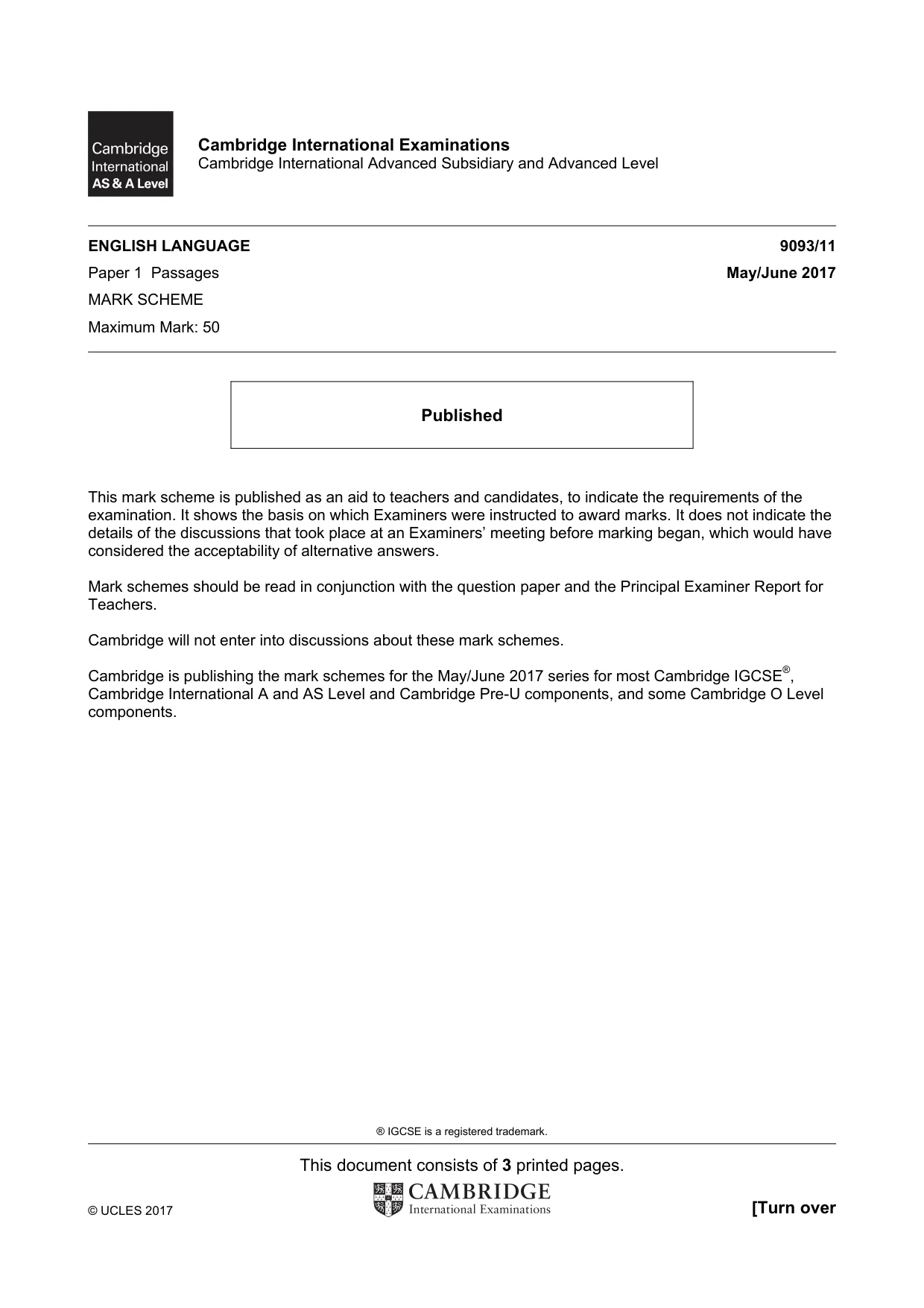
® IGCSE is a registered trademark. This document consists of 3 printed pages. © UCLES 2017 [Turn over Cambridge International Examinations Cambridge International Advanced Subsidiary and Advanced Level ENGLISH LANGUAGE 9093/11 Paper 1 Passages May/June 2017 MARK SCHEME Maximum Mark: 50 Published This mark scheme is published as an aid to teachers and candidates, to indicate the requirements of the examination. It shows the basis on which Examiners were instructed to award marks. It does not indicate the details of the discussions that took place at an Examiners’ meeting before marking began, which would have considered the acceptability of alternative answers. Mark schemes should be read in conjunction with the question paper and the Principal Examiner Report for Teachers. Cambridge will not enter into discussions about these mark schemes. Cambridge is publishing the mark schemes for the May/June 2017 series for most Cambridge IGCSE®, Cambridge International A and AS Level and Cambridge Pre-U components, and some Cambridge O Level components.
Mark scheme, page 2
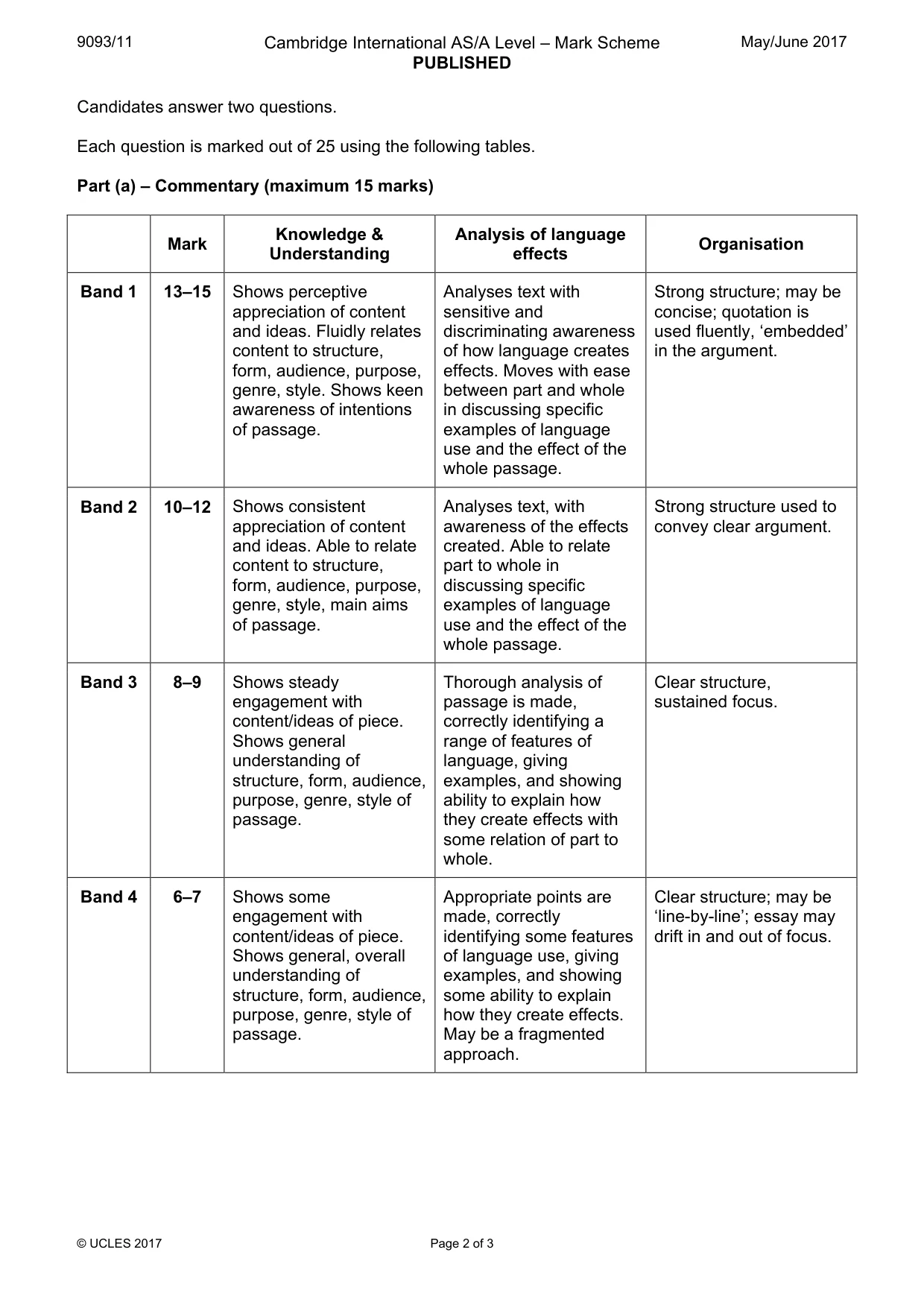
9093/11 Cambridge International AS/A Level – Mark Scheme PUBLISHED May/June 2017 © UCLES 2017 Page 2 of 3 Candidates answer two questions. Each question is marked out of 25 using the following tables. Part (a) – Commentary (maximum 15 marks) Mark Knowledge & Understanding Analysis of language effects Organisation Band 1 13–15 Shows perceptive appreciation of content and ideas. Fluidly relates content to structure, form, audience, purpose, genre, style. Shows keen awareness of intentions of passage. Analyses text with sensitive and discriminating awareness of how language creates effects. Moves with ease between part and whole in discussing specific examples of language use and the effect of the whole passage. Strong structure; may be concise; quotation is used fluently, ‘embedded’ in the argument. Band 2 10–12 Shows consistent appreciation of content and ideas. Able to relate content to structure, form, audience, purpose, genre, style, main aims of passage. Analyses text, with awareness of the effects created. Able to relate part to whole in discussing specific examples of language use and the effect of the whole passage. Strong structure used to convey clear argument. Band 3 8–9 Shows steady engagement with content/ideas of piece. Shows general understanding of structure, form, audience, purpose, genre, style of passage. Thorough analysis of passage is made, correctly identifying a range of features of language, giving examples, and showing ability to explain how they create effects with some relation of part to whole. Clear structure, sustained focus. Band 4 6–7 Shows some engagement with content/ideas of piece. Shows general, overall understanding of structure, form, audience, purpose, genre, style of passage. Appropriate points are made, correctly identifying some features of language use, giving examples, and showing some ability to explain how they create effects. May be a fragmented approach. Clear structure; may be ‘line-by-line’; essay may drift in and out of focus.
Mark scheme, page 3
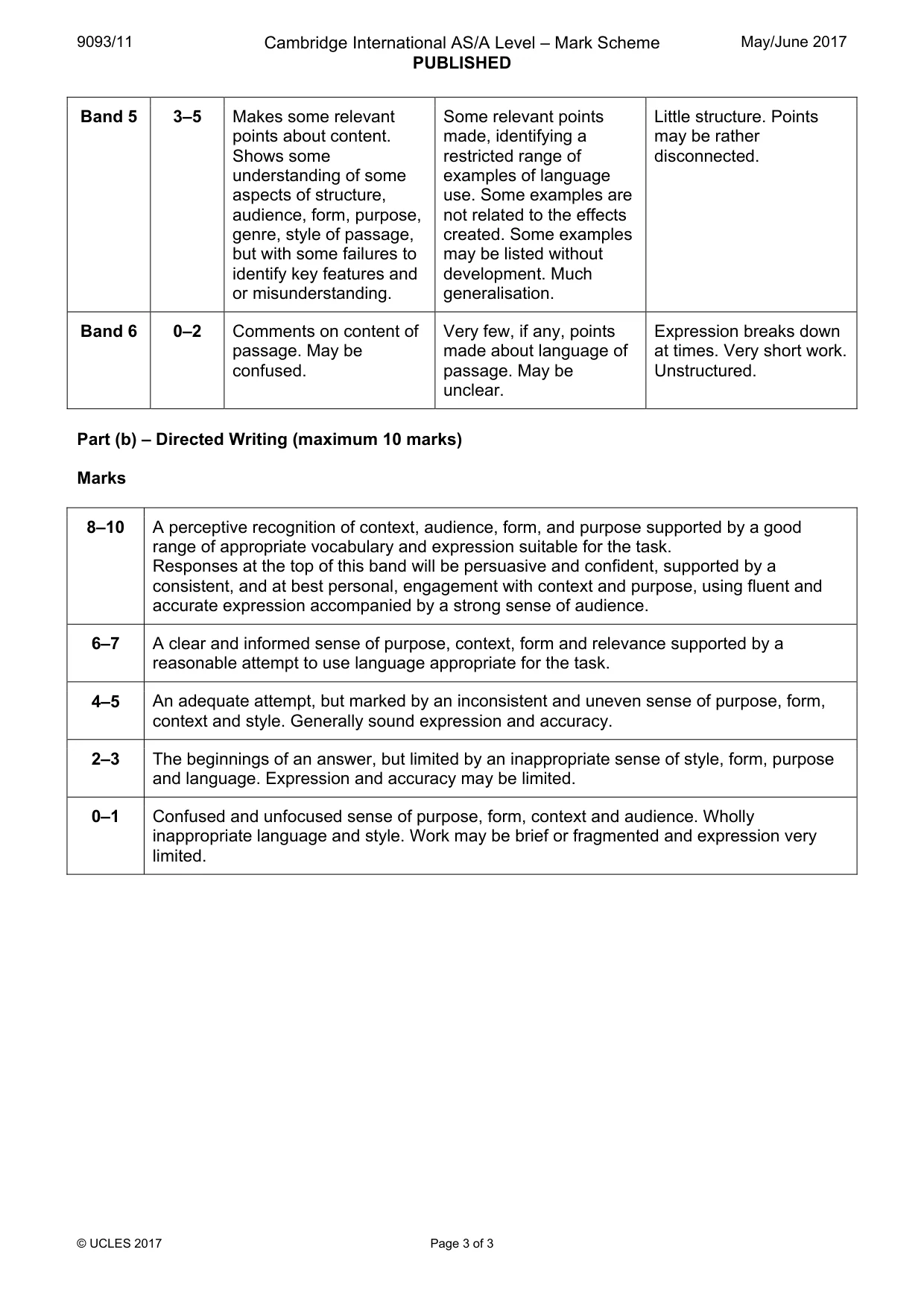
9093/11 Cambridge International AS/A Level – Mark Scheme PUBLISHED May/June 2017 © UCLES 2017 Page 3 of 3 Band 5 3–5 Makes some relevant points about content. Shows some understanding of some aspects of structure, audience, form, purpose, genre, style of passage, but with some failures to identify key features and or misunderstanding. Some relevant points made, identifying a restricted range of examples of language use. Some examples are not related to the effects created. Some examples may be listed without development. Much generalisation. Little structure. Points may be rather disconnected. Band 6 0–2 Comments on content of passage. May be confused. Very few, if any, points made about language of passage. May be unclear. Expression breaks down at times. Very short work. Unstructured. Part (b) – Directed Writing (maximum 10 marks) Marks 8–10 A perceptive recognition of context, audience, form, and purpose supported by a good range of appropriate vocabulary and expression suitable for the task. Responses at the top of this band will be persuasive and confident, supported by a consistent, and at best personal, engagement with context and purpose, using fluent and accurate expression accompanied by a strong sense of audience. 6–7 A clear and informed sense of purpose, context, form and relevance supported by a reasonable attempt to use language appropriate for the task. 4–5 An adequate attempt, but marked by an inconsistent and uneven sense of purpose, form, context and style. Generally sound expression and accuracy. 2–3 The beginnings of an answer, but limited by an inappropriate sense of style, form, purpose and language. Expression and accuracy may be limited. 0–1 Confused and unfocused sense of purpose, form, context and audience. Wholly inappropriate language and style. Work may be brief or fragmented and expression very limited.
What you needed in this session
Cambridge’s own grade thresholds for 2017 May/June, Paper 1 · Variant 1. A higher threshold means an easier paper — the bar moves with how the cohort did.