Cambridge A Level English - Language AS and A Level (from 2014) 9093 — 2017 Feb/March Paper 3 · Variant 2
9093/32/F/M/17 · 50 marks · ≈56 min
The question paper and its mark scheme, free to read here and free to download. This is Cambridge’s own paper, exactly as it was sat.
Question paper8 pages



Mark scheme5 pages
Answers below. Sit the paper first if you are practising.

Paper as text
Question paper, page 1
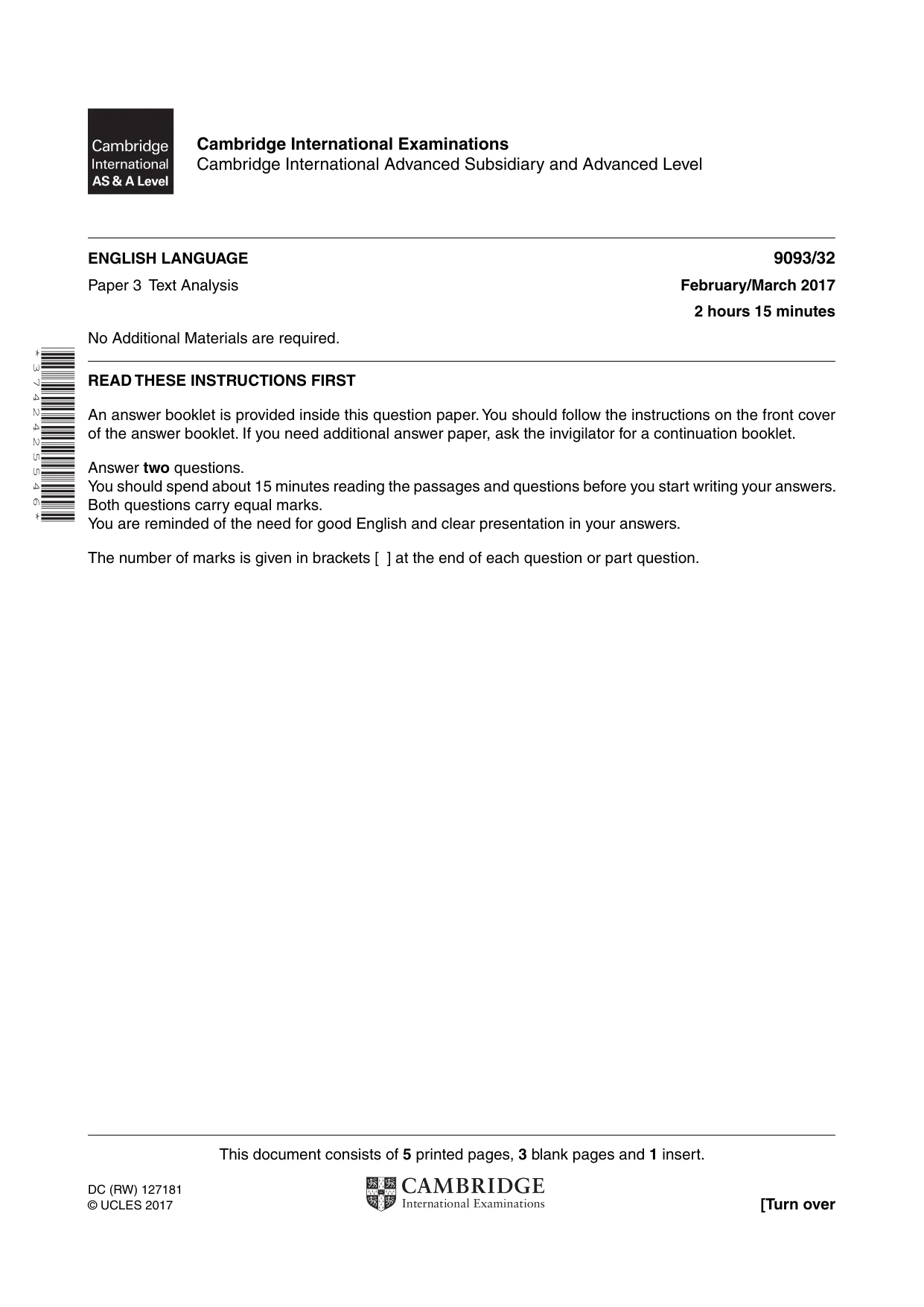
This document consists of 5 printed pages, 3 blank pages and 1 insert. DC (RW) 127181 © UCLES 2017 [Turn over Cambridge International Examinations Cambridge International Advanced Subsidiary and Advanced Level * 3 7 4 2 4 2 5 5 4 6 * ENGLISH LANGUAGE 9093/32 Paper 3 Text Analysis February/March 2017 2 hours 15 minutes No Additional Materials are required. READ THESE INSTRUCTIONS FIRST An answer booklet is provided inside this question paper. You should follow the instructions on the front cover of the answer booklet. If you need additional answer paper, ask the invigilator for a continuation booklet. Answer two questions. You should spend about 15 minutes reading the passages and questions before you start writing your answers. Both questions carry equal marks. You are reminded of the need for good English and clear presentation in your answers. The number of marks is given in brackets [ ] at the end of each question or part question.
Question paper, page 2
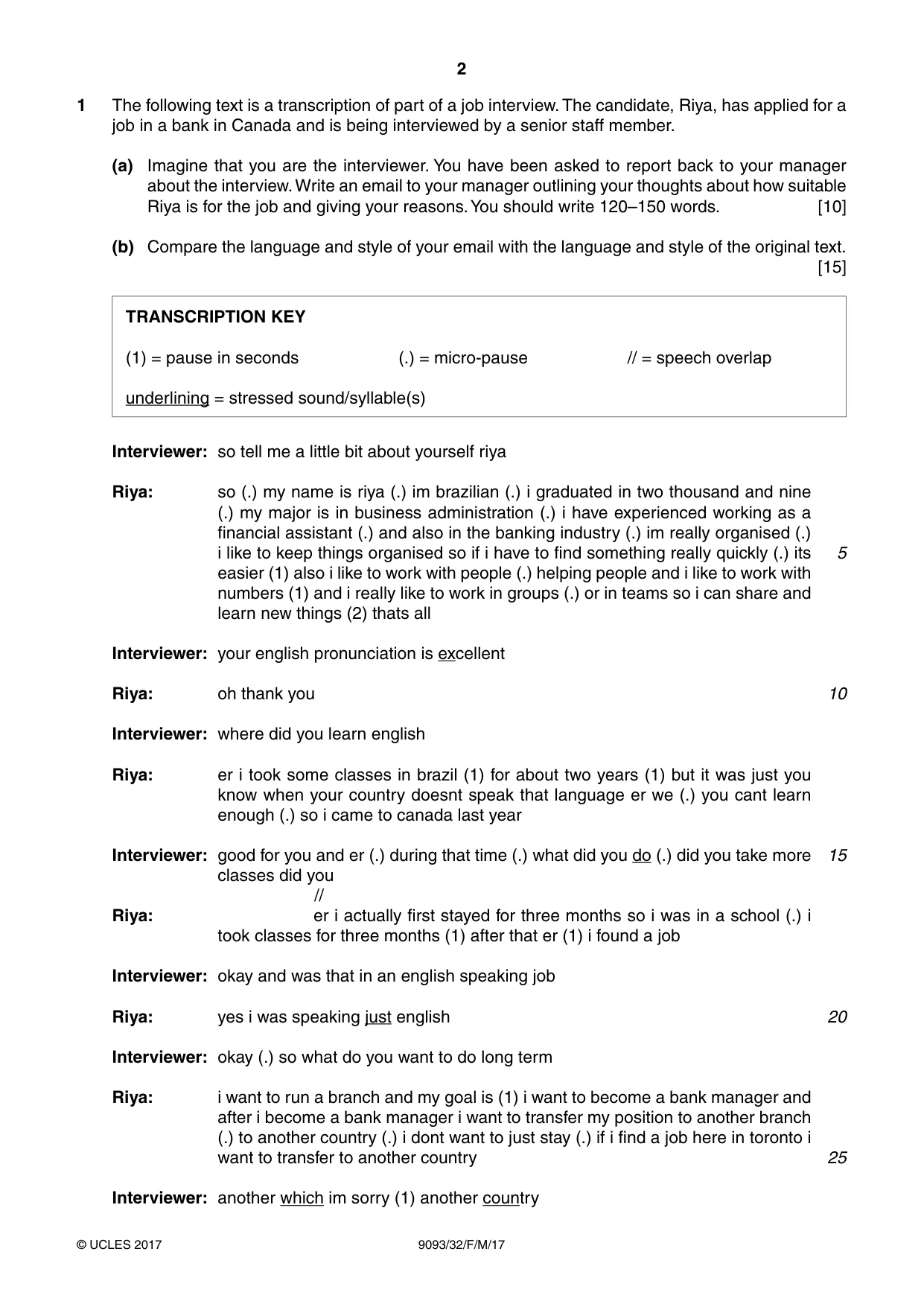
2 9093/32/F/M/17 © UCLES 2017 1 The following text is a transcription of part of a job interview. The candidate, Riya, has applied for a job in a bank in Canada and is being interviewed by a senior staff member. (a) Imagine that you are the interviewer. You have been asked to report back to your manager about the interview. Write an email to your manager outlining your thoughts about how suitable Riya is for the job and giving your reasons. You should write 120–150 words. [10] (b) Compare the language and style of your email with the language and style of the original text. [15] TRANSCRIPTION KEY (1) = pause in seconds (.) = micro-pause // = speech overlap underlining = stressed sound/syllable(s) Interviewer: so tell me a little bit about yourself riya Riya: so (.) my name is riya (.) im brazilian (.) i graduated in two thousand and nine (.) my major is in business administration (.) i have experienced working as a financial assistant (.) and also in the banking industry (.) im really organised (.) i like to keep things organised so if i have to find something really quickly (.) its easier (1) also i like to work with people (.) helping people and i like to work with numbers (1) and i really like to work in groups (.) or in teams so i can share and learn new things (2) thats all Interviewer: your english pronunciation is excellent Riya: oh thank you Interviewer: where did you learn english Riya: er i took some classes in brazil (1) for about two years (1) but it was just you know when your country doesnt speak that language er we (.) you cant learn enough (.) so i came to canada last year Interviewer: good for you and er (.) during that time (.) what did you do (.) did you take more classes did you // Riya: er i actually first stayed for three months so i was in a school (.) i took classes for three months (1) after that er (1) i found a job Interviewer: okay and was that in an english speaking job Riya: yes i was speaking just english Interviewer: okay (.) so what do you want to do long term Riya: i want to run a branch and my goal is (1) i want to become a bank manager and after i become a bank manager i want to transfer my position to another branch (.) to another country (.) i dont want to just stay (.) if i find a job here in toronto i want to transfer to another country Interviewer: another which im sorry (1) another country 5 10 15 20 25
Question paper, page 3
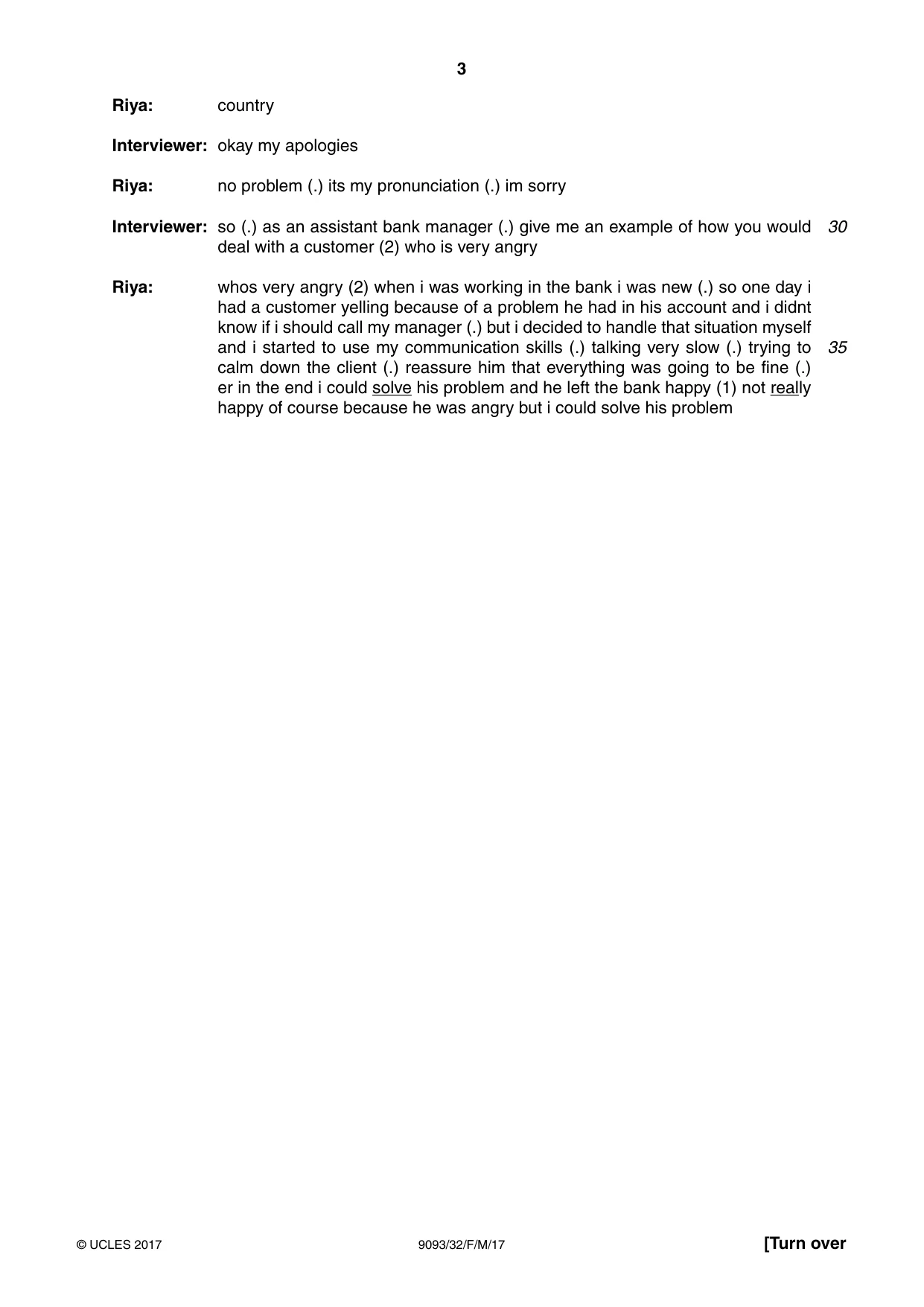
3 9093/32/F/M/17 © UCLES 2017 [Turn over Riya: country Interviewer: okay my apologies Riya: no problem (.) its my pronunciation (.) im sorry Interviewer: so (.) as an assistant bank manager (.) give me an example of how you would deal with a customer (2) who is very angry Riya: whos very angry (2) when i was working in the bank i was new (.) so one day i had a customer yelling because of a problem he had in his account and i didnt know if i should call my manager (.) but i decided to handle that situation myself and i started to use my communication skills (.) talking very slow (.) trying to calm down the client (.) reassure him that everything was going to be fine (.) er in the end i could solve his problem and he left the bank happy (1) not really happy of course because he was angry but i could solve his problem 30 35
Question paper, page 4
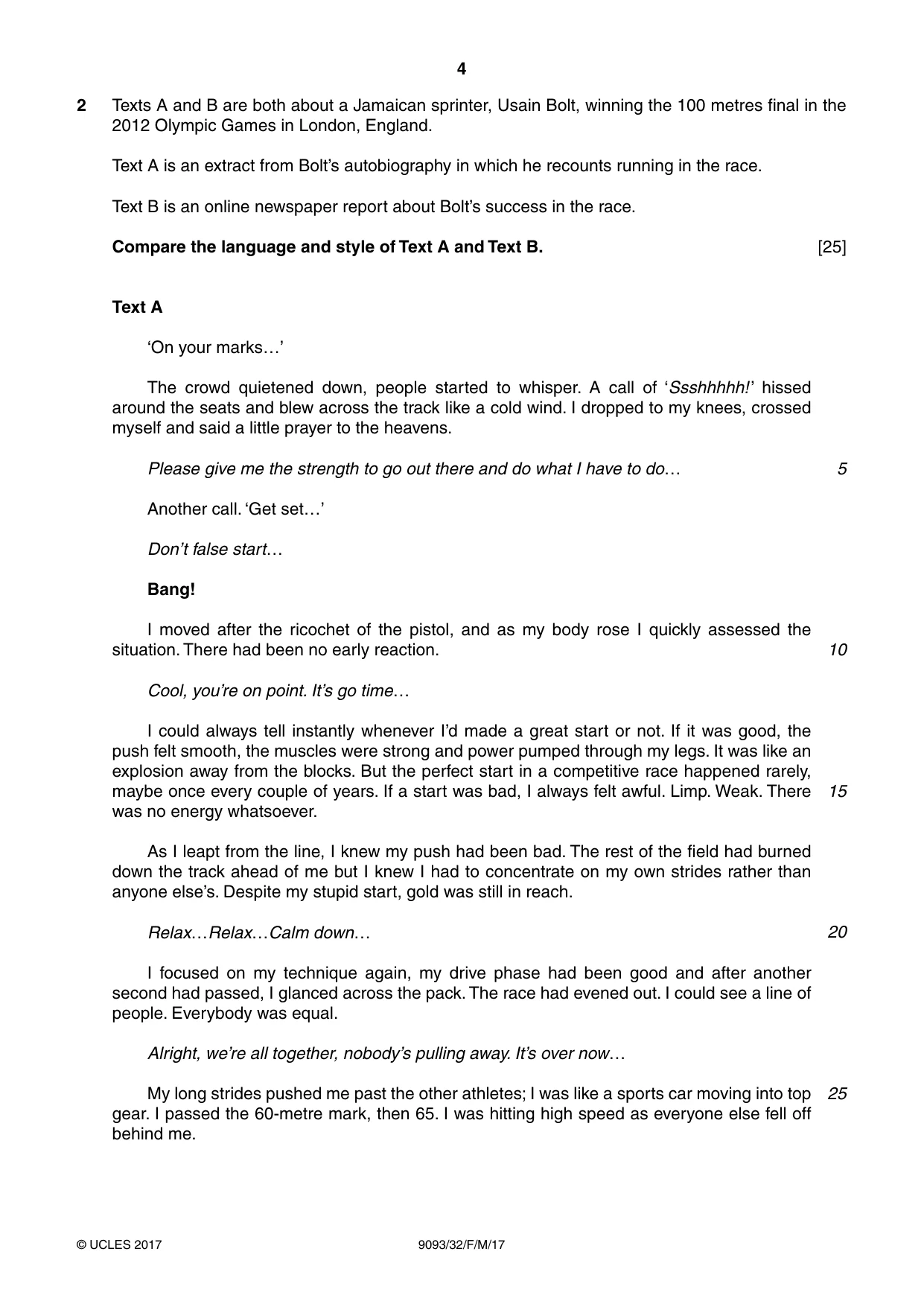
4 9093/32/F/M/17 © UCLES 2017 2 Texts A and B are both about a Jamaican sprinter, Usain Bolt, winning the 100 metres final in the 2012 Olympic Games in London, England. Text A is an extract from Bolt’s autobiography in which he recounts running in the race. Text B is an online newspaper report about Bolt’s success in the race. Compare the language and style of Text A and Text B. [25] Text A ‘On your marks…’ The crowd quietened down, people started to whisper. A call of ‘Ssshhhhh! ’ hissed around the seats and blew across the track like a cold wind. I dropped to my knees, crossed myself and said a little prayer to the heavens. Please give me the strength to go out there and do what I have to do… Another call. ‘Get set…’ Don’t false start… Bang! I moved after the ricochet of the pistol, and as my body rose I quickly assessed the situation. There had been no early reaction. Cool, you’re on point. It’s go time… I could always tell instantly whenever I’d made a great start or not. If it was good, the push felt smooth, the muscles were strong and power pumped through my legs. It was like an explosion away from the blocks. But the perfect start in a competitive race happened rarely, maybe once every couple of years. If a start was bad, I always felt awful. Limp. Weak. There was no energy whatsoever. As I leapt from the line, I knew my push had been bad. The rest of the field had burned down the track ahead of me but I knew I had to concentrate on my own strides rather than anyone else’s. Despite my stupid start, gold was still in reach. Relax…Relax…Calm down… I focused on my technique again, my drive phase had been good and after another second had passed, I glanced across the pack. The race had evened out. I could see a line of people. Everybody was equal. Alright, we’re all together, nobody’s pulling away. It’s over now… My long strides pushed me past the other athletes; I was like a sports car moving into top gear. I passed the 60-metre mark, then 65. I was hitting high speed as everyone else fell off behind me. 5 10 15 20 25
Question paper, page 5
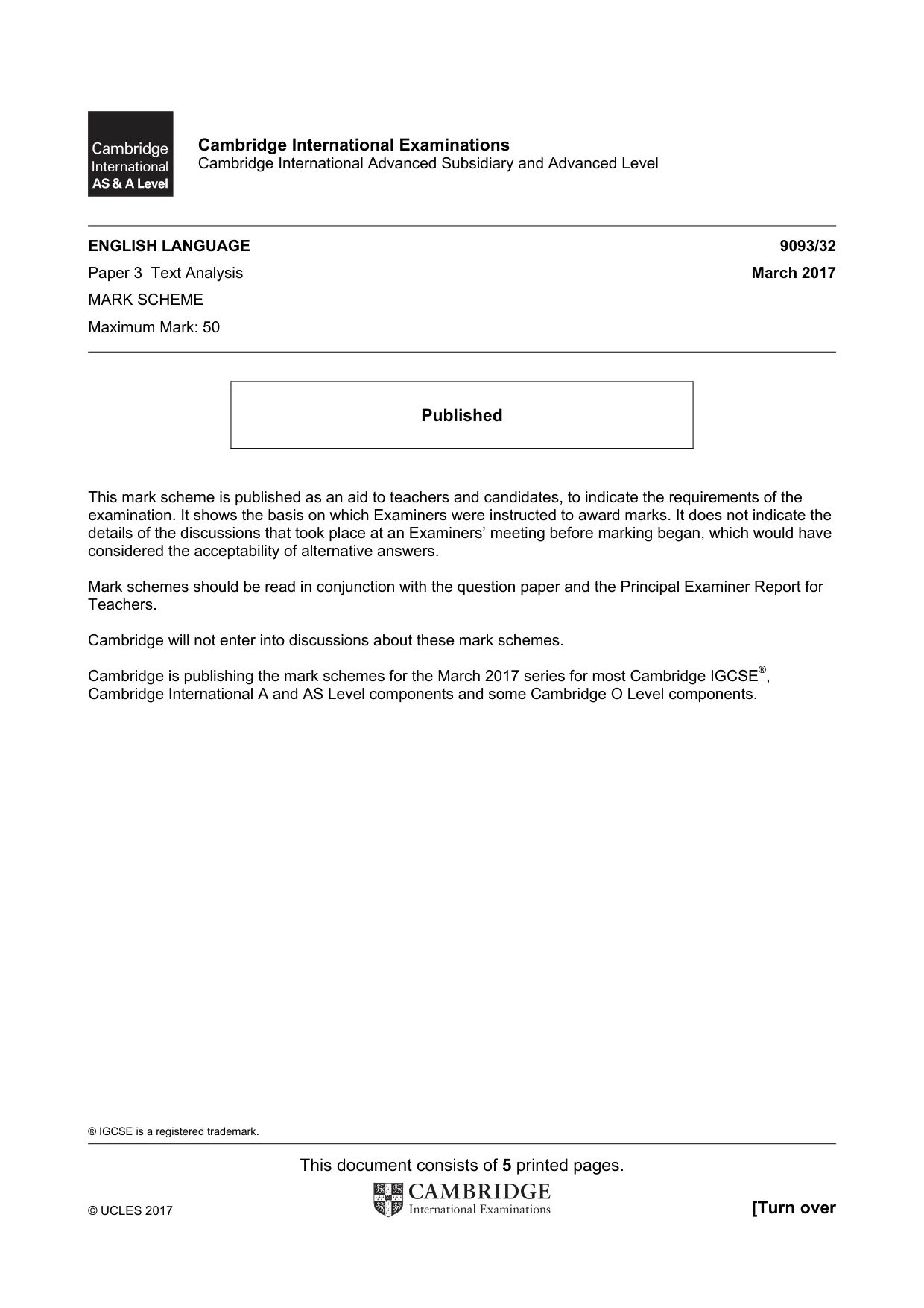
5 9093/32/F/M/17 © UCLES 2017 Text B 9.63 seconds… Legend Bolt retains 100 m crown after stunning victory sees him shatter his OWN Olympic record Bolt did it again. He did it as he said he would. As predicted, this was his time. Bolt became the first athlete this century to retain his Olympic 100 metres title, the first since Carl Lewis in 1988. Nobody stays the fastest man in the world for long and there were many who thought Bolt would repeat the brief flickering of many past champions. They were wrong, so very wrong. Having given the field a head start, he then accelerated. It was as if Batman had flicked the switch on the Batmobile, the one that sends the machine into warp speed. We almost expected to see an ignition of white-hot flame at Bolt’s tail. And that is what Bolt is, in essence. A latter-day superhero. He draped the Jamaican flag around his shoulders like a Caped Crusader, too, and mimed firing his arrow as if an Olympian of old. He is old, Bolt, yet so very new. His talent is one of the purest skills of all: the ability to run faster than any other man. But his manner is modern. He knows his place in sport’s galaxy, his status, and what it represents. He is charismatic, mesmerising. Once he entered the track nobody could take their eyes from him; and then when he started running, blink, and he was gone. Bolt was in his element. When his name was announced, he went through his showman’s routine. He shut his eyes, pretended to be deeply focused, then lifted his head up with a broad grin and made a running gesture with his fingers, put them to his forehead and then away in a salute. The crowd loved it. It is easy to root for Bolt, the way it is any man who combines supreme athleticism with charm and personality. Bolt has such charisma. Even operating from a rare position of vulnerability, his demeanour suggested he was the man to beat. So it proved. The moment the pistol sounded, all doubts about his fitness evaporated. Slow out of the blocks, as he would be at 6 feet 5 inches from a crouching position, it was instantly the Bolt of old, motoring as if slung from a catapult, tearing up the super-fast surface as if it would curl up beneath his feet as he went. 5 10 15 20 25
Question paper, page 6
6 9093/32/F/M/17 © UCLES 2017 BLANK PAGE
Question paper, page 7
7 9093/32/F/M/17 © UCLES 2017 BLANK PAGE
Question paper, page 8
8 9093/32/F/M/17 © UCLES 2017 Permission to reproduce items where third-party owned material protected by copyright is included has been sought and cleared where possible. Every reasonable effort has been made by the publisher (UCLES) to trace copyright holders, but if any items requiring clearance have unwittingly been included, the publisher will be pleased to make amends at the earliest possible opportunity. To avoid the issue of disclosure of answer-related information to candidates, all copyright acknowledgements are reproduced online in the Cambridge International Examinations Copyright Acknowledgements Booklet. This is produced for each series of examinations and is freely available to download at www.cie.org.uk after the live examination series. Cambridge International Examinations is part of the Cambridge Assessment Group. Cambridge Assessment is the brand name of University of Cambridge Local Examinations Syndicate (UCLES), which is itself a department of the University of Cambridge. BLANK PAGE
Mark scheme, page 1
® IGCSE is a registered trademark. This document consists of 5 printed pages. © UCLES 2017 [Turn over Cambridge International Examinations Cambridge International Advanced Subsidiary and Advanced Level ENGLISH LANGUAGE 9093/32 Paper 3 Text Analysis March 2017 MARK SCHEME Maximum Mark: 50 Published This mark scheme is published as an aid to teachers and candidates, to indicate the requirements of the examination. It shows the basis on which Examiners were instructed to award marks. It does not indicate the details of the discussions that took place at an Examiners’ meeting before marking began, which would have considered the acceptability of alternative answers. Mark schemes should be read in conjunction with the question paper and the Principal Examiner Report for Teachers. Cambridge will not enter into discussions about these mark schemes. Cambridge is publishing the mark schemes for the March 2017 series for most Cambridge IGCSE®, Cambridge International A and AS Level components and some Cambridge O Level components.
Mark scheme, page 2
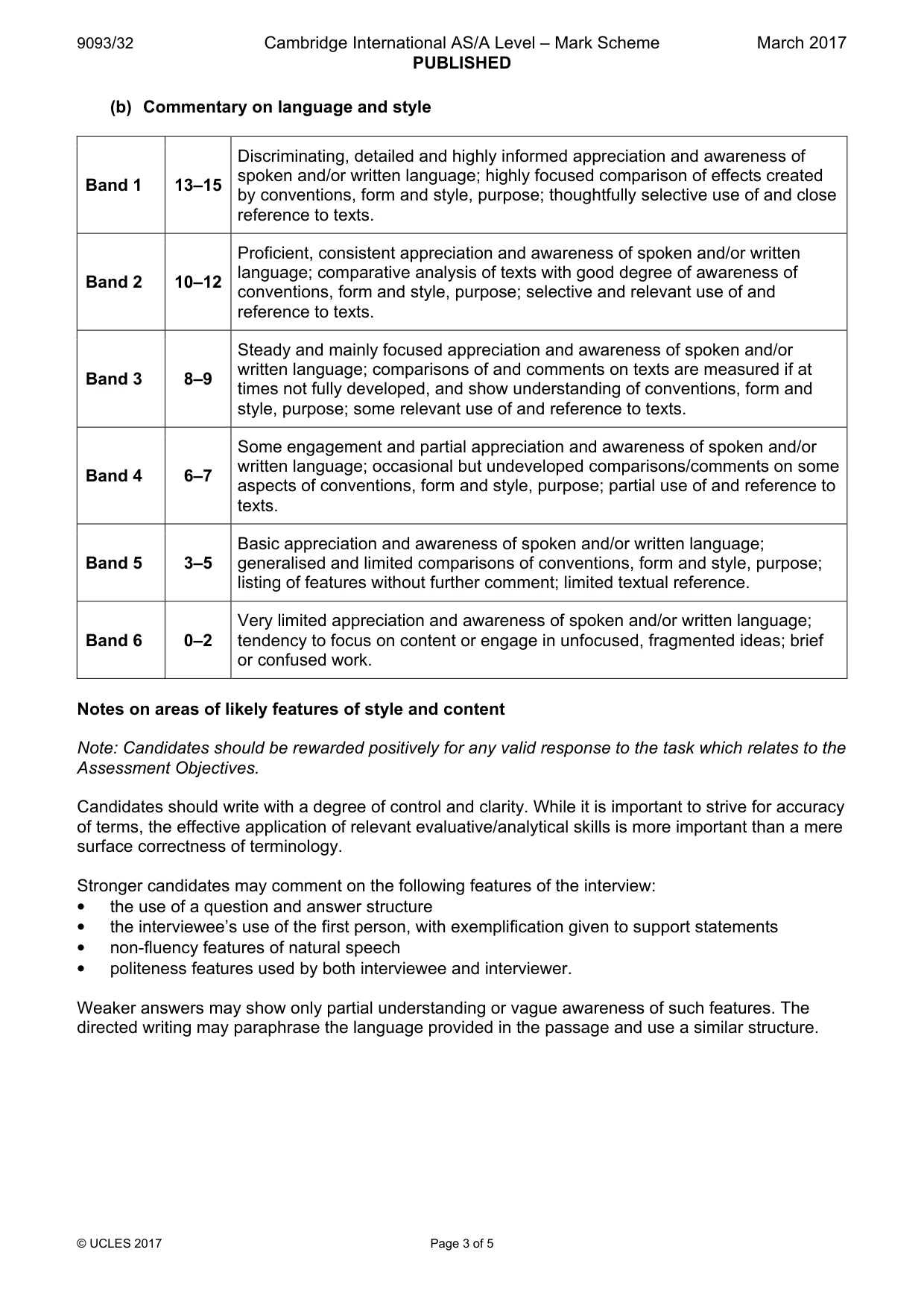
9093/32 Cambridge International AS/A Level – Mark Scheme PUBLISHED March 2017 © UCLES 2017 Page 2 of 5 1 Examiners need to be flexible in considering holistically what the candidates write in part (a) in relation to their analysis in part (b). What may at first appear to be inappropriate choices of lexis and register in (a) may turn out to be explained in (b). There should be evidence that linguistic concepts have been understood and are being applied in helpful ways. Knowledge and understanding of spoken/written language should be made explicit in the comparative commentary (b), but there is likely to be evidence of its informed application in the directed writing task (a). (a) Directed Writing Band 1 9–10 Discriminating sense and understanding of audience, form, purpose, conventions and effects, underpinned by a fluent, highly accurate reworking of the material in a highly appropriate style. Band 2 7–8 Proficient grasp and appreciation of audience, form, purpose, conventions and effects, supported by an informed and engaged reworking of the material in a consistent, appropriate and generally fluent style. Band 3 5–6 Competent understanding of audience, form, purpose conventions and effects, supported by an adequately engaged reworking of the material in a measured style, perhaps containing a few lapses in accuracy and expression. Band 4 3–4 Essentially sound but uneven sense and understanding of audience, form, purpose conventions and effects, supported by some engagement in reworking the material but marked by several lapses in accuracy and expression. Band 5 1–2 Basic and limited sense and understanding of audience, form, purpose, conventions and effects; limited engagement with reworking the material, and marked by frequent lapses in accuracy and expression and/or an inappropriate grasp of intent and style. Band 6 0–1 Wholly inappropriate sense of audience, form, purpose, conventions and effects; brief or confused work and/or marked by very limited accuracy and expression. Notes on areas of likely features of style and content Note: These must not be seen as a prescriptive or ‘finite’ list. Candidates should be rewarded positively for any valid response to the task which relates to the Assessment Objectives. Candidates should write clearly, accurately, creatively and effectively for the prescribed purpose and audience. Their writing should reveal: • a sound understanding of the original material • an understanding of the conventions of email communication. Bullet points may be accepted as part of the email although continuous prose would be equally appropriate.
Mark scheme, page 3
9093/32 Cambridge International AS/A Level – Mark Scheme PUBLISHED March 2017 © UCLES 2017 Page 3 of 5 (b) Commentary on language and style Band 1 13–15 Discriminating, detailed and highly informed appreciation and awareness of spoken and/or written language; highly focused comparison of effects created by conventions, form and style, purpose; thoughtfully selective use of and close reference to texts. Band 2 10–12 Proficient, consistent appreciation and awareness of spoken and/or written language; comparative analysis of texts with good degree of awareness of conventions, form and style, purpose; selective and relevant use of and reference to texts. Band 3 8–9 Steady and mainly focused appreciation and awareness of spoken and/or written language; comparisons of and comments on texts are measured if at times not fully developed, and show understanding of conventions, form and style, purpose; some relevant use of and reference to texts. Band 4 6–7 Some engagement and partial appreciation and awareness of spoken and/or written language; occasional but undeveloped comparisons/comments on some aspects of conventions, form and style, purpose; partial use of and reference to texts. Band 5 3–5 Basic appreciation and awareness of spoken and/or written language; generalised and limited comparisons of conventions, form and style, purpose; listing of features without further comment; limited textual reference. Band 6 0–2 Very limited appreciation and awareness of spoken and/or written language; tendency to focus on content or engage in unfocused, fragmented ideas; brief or confused work. Notes on areas of likely features of style and content Note: Candidates should be rewarded positively for any valid response to the task which relates to the Assessment Objectives. Candidates should write with a degree of control and clarity. While it is important to strive for accuracy of terms, the effective application of relevant evaluative/analytical skills is more important than a mere surface correctness of terminology. Stronger candidates may comment on the following features of the interview: • the use of a question and answer structure • the interviewee’s use of the first person, with exemplification given to support statements • non-fluency features of natural speech • politeness features used by both interviewee and interviewer. Weaker answers may show only partial understanding or vague awareness of such features. The directed writing may paraphrase the language provided in the passage and use a similar structure.
Mark scheme, page 4
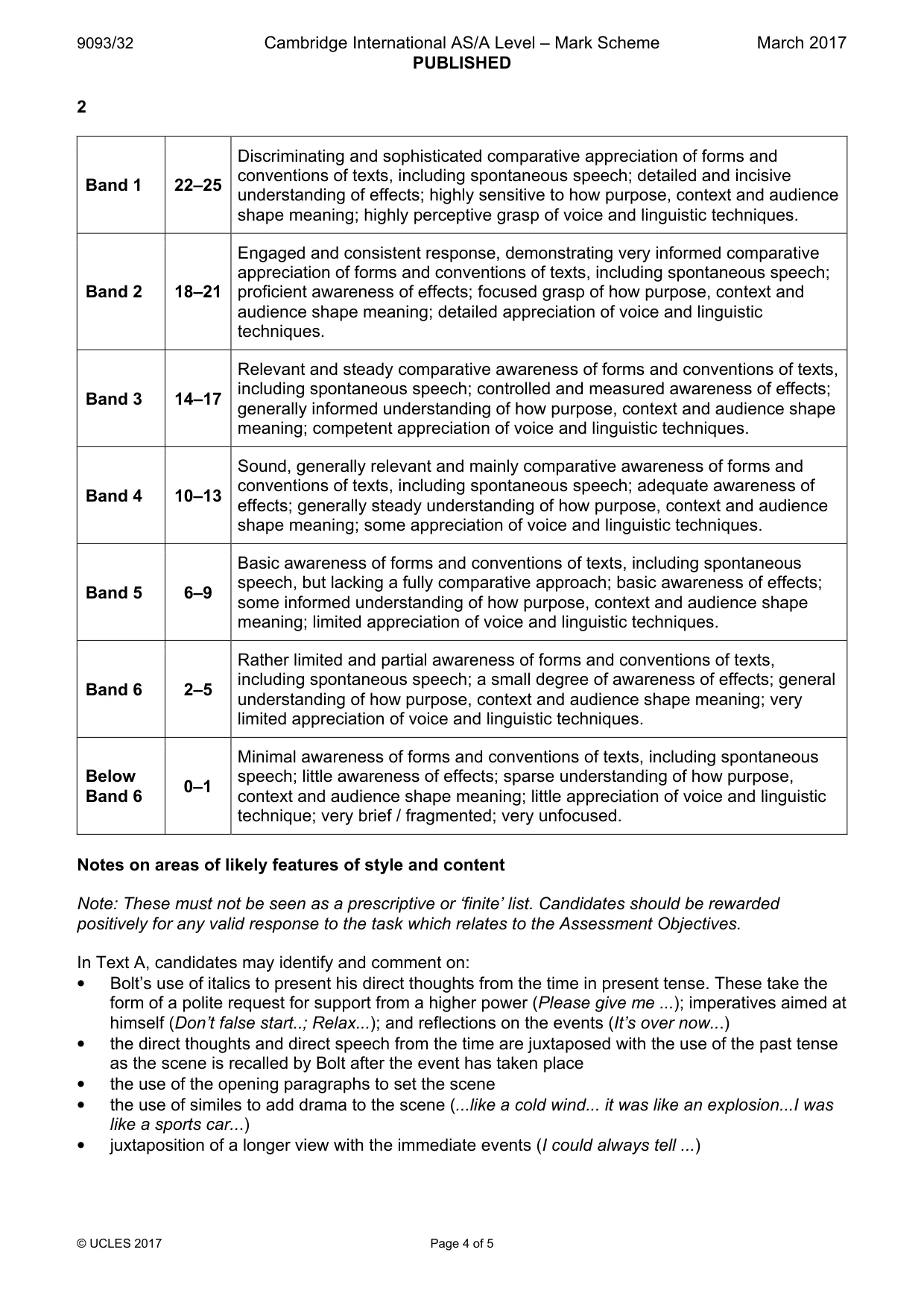
9093/32 Cambridge International AS/A Level – Mark Scheme PUBLISHED March 2017 © UCLES 2017 Page 4 of 5 2 Band 1 22–25 Discriminating and sophisticated comparative appreciation of forms and conventions of texts, including spontaneous speech; detailed and incisive understanding of effects; highly sensitive to how purpose, context and audience shape meaning; highly perceptive grasp of voice and linguistic techniques. Band 2 18–21 Engaged and consistent response, demonstrating very informed comparative appreciation of forms and conventions of texts, including spontaneous speech; proficient awareness of effects; focused grasp of how purpose, context and audience shape meaning; detailed appreciation of voice and linguistic techniques. Band 3 14–17 Relevant and steady comparative awareness of forms and conventions of texts, including spontaneous speech; controlled and measured awareness of effects; generally informed understanding of how purpose, context and audience shape meaning; competent appreciation of voice and linguistic techniques. Band 4 10–13 Sound, generally relevant and mainly comparative awareness of forms and conventions of texts, including spontaneous speech; adequate awareness of effects; generally steady understanding of how purpose, context and audience shape meaning; some appreciation of voice and linguistic techniques. Band 5 6–9 Basic awareness of forms and conventions of texts, including spontaneous speech, but lacking a fully comparative approach; basic awareness of effects; some informed understanding of how purpose, context and audience shape meaning; limited appreciation of voice and linguistic techniques. Band 6 2–5 Rather limited and partial awareness of forms and conventions of texts, including spontaneous speech; a small degree of awareness of effects; general understanding of how purpose, context and audience shape meaning; very limited appreciation of voice and linguistic techniques. Below Band 6 0–1 Minimal awareness of forms and conventions of texts, including spontaneous speech; little awareness of effects; sparse understanding of how purpose, context and audience shape meaning; little appreciation of voice and linguistic technique; very brief / fragmented; very unfocused. Notes on areas of likely features of style and content Note: These must not be seen as a prescriptive or ‘finite’ list. Candidates should be rewarded positively for any valid response to the task which relates to the Assessment Objectives. In Text A, candidates may identify and comment on: • Bolt’s use of italics to present his direct thoughts from the time in present tense. These take the form of a polite request for support from a higher power (Please give me ...); imperatives aimed at himself (Don’t false start..; Relax...); and reflections on the events (It’s over now...) • the direct thoughts and direct speech from the time are juxtaposed with the use of the past tense as the scene is recalled by Bolt after the event has taken place • the use of the opening paragraphs to set the scene • the use of similes to add drama to the scene (...like a cold wind... it was like an explosion...I was like a sports car...) • juxtaposition of a longer view with the immediate events (I could always tell ...)
Mark scheme, page 5
9093/32 Cambridge International AS/A Level – Mark Scheme PUBLISHED March 2017 © UCLES 2017 Page 5 of 5 In Text B candidates may identify and comment on features of language and style related to the form and content of an online news report: • Bolt is referred to throughout in the third person using his surname only, assuming some prior knowledge or familiarity with him on behalf of the audience • the use of an extended metaphor relating to Bolt as a superhero • the use of further imagery in the final paragraph, using the conditional clause as if and the dynamic verbs motoring and tearing up • the writer identifies with the rest of the spectators using the pronouns ‘we’ and ‘nobody could take their eyes off him’ to suggest that this was a shared experience • the use of short sentences to create impact, as well as repetition for emphasis (they were wrong, so very wrong) and the use of oxymoron: He is old, Bolt, yet so very new.
What you needed in this session
Cambridge’s own grade thresholds for 2017 Feb/March, Paper 3 · Variant 2. A higher threshold means an easier paper — the bar moves with how the cohort did.